



Abstract
Objective
Endovascular aortic aneurysm repair (EVAR) is the primary treatment for abdominal aortic aneurysms, constituting 70%–80% of interventions. Despite initial benefits, long-term studies show increased mortality. Using nationwide data, this study assesses outcomes of EVAR, open aortic repair (OAR), and EVAR explantation (EE) in Korea, while exploring characteristics of late open conversion, including the rising EE incidence.
Methods
Employing the National Health Insurance Service database, covering health-related data for nearly 50 million Koreans, the study spanned from 2002 to 2020. Patients with AAA diagnoses (I71.3 or I71.4) were categorized into OAR, EVAR, and EE groups based on procedural codes. Statistical analyses, including t-tests, Fisher’s exact tests, Cox proportional hazard models, and multivariate Cox regression, assessed baseline characteristics, mortality risks, and factors within the EE group.
Results
The analysis encompassed 26,195 patients, with 66.19% in the EVAR group, 31.87% in the OAR group, and 1.94% in the EE group. EVAR cases steadily increased from 2002 to 2018. Survival rates favored EVAR, followed by OAR and EE. 30-day survival was lower in EE than EVAR. Multivariate analysis for EE revealed no risk factors for 30-days survival but identified age, chronic kidney disease, high Charlson Comorbidity Index scores, and less than 6 months since EVAR as risk factors for overall mortality.
Conclusion
Rising EE trends with increased EVAR adoption, particularly evident in the Korean dataset, underscore inferior outcomes. This highlights the critical need for strategic initial treatment decisions and timely interventions to enhance overall results and mitigate the unfavorable EE incidence.
Introduction
In recent decades, endovascular aortic aneurysm repair (EVAR) has emerged as the standard procedure for abdominal aortic aneurysms (AAA), constituting 70% to 80% of aneurysm repairs. 1 Numerous prospective randomized clinical trials consistently demonstrated EVAR’s initial superiority over conventional open aortic repair (OAR) in elective AAA treatment, resulting in reduced mortality and morbidity during perioperative and short-term follow-up periods. 2 However, despite these early benefits, long-term follow-up studies have uncovered a loss of this advantage, revealing increased overall mortality and, notably, higher aneurysm-related morbidity and mortality four to 8 years post-intervention. 3
Recent literature reports the incidence of endoleaks, particularly type I (5%) and type II (20%–40%). 4 Endoleaks after EVAR significantly increase the risk of potential aneurysmal rupture. 5 Additionally, complications such as aortic graft infections add complexity to EVAR outcomes. 6 While short-term benefits over OAR are apparent, long-term concerns arise due to reduced durability, increased reinterventions, and the potential for rupture. 3 Current recommendations emphasize considering endovascular or laparoscopic approaches for addressing endoleak, particularly when the sac increases by more than 10 mm. 5 If these interventions prove unsuccessful, pursuing late open conversion (LOC) is recommended, in line with the reported overall LOC incidence of 5.3% in recent meta-analyses. 7 The purpose of this study is to utilize data from the National Health Insurance Service (NHIS) to compare the outcomes of EVAR, OAR, and EVAR explantation (EE) in Korea. Additionally, the study aims to investigate the characteristics of LOC, including EE, which has been on the rise in Korea.
Methods
The study was approved by the IRB (Institutional Review Board) of Korea University Guro hospital (No. K2022-0122-001). This research, based on anonymized national data, was exempted by the IRB from obtaining consent forms from individual patients.
Study population
We utilized the database provided by the NHIS which includes health care utilization, health screening, socio-demographic variables, and mortality of approximately 50 million Koreans. The NHIS is a government insurance system covering nearly 97% of the entire Korean population. Approximately 3% of individuals fall under the classification of Medical Aid (MA) and were not included in the NHIS and our study. 8 Once the research receives final approval from the National Health Insurance Service Research Review Committee, access to the data is granted through the National Health Insurance Service’s Big Data Sharing Service (https://nhiss.nhis.or.kr).
Study design and diagnostic code
Our study focused on patients registered in Korea’s NHIS from 2002 to 2020. We finalized our cohort by selecting patients with the AAA diagnosis code from this database. The diagnostic codes were based on the 10th revision of the International Statistical Classification of Diseases and Related Health Problems (ICD-10 code). The diagnostic codes for AAA were included with I71.3 (AAA, ruptured) or I71.4 (AAA, without mention of rupture). Then, we divided this cohort into OAR group, EVAR group, and EE group. The cohort was categorized into three groups based on procedural codes: the OAR group comprised patients with OAR codes (O0223, O0224, or O2034) without prior EVAR codes, the EVAR group included patients with EVAR codes (M6611 or M6612) without subsequent OAR codes, and the EE group was defined that OAR codes occurred following the initial EVAR code. The comorbidities and Charlson Comorbidity Index (CCI) were identified based on ICD-10 codes in these patients; hypertension, dyslipidemia, diabetes mellitus, ischemic heart disease, cerebrovascular disease, chronic kidney disease, congestive heart failure, and chronic obstructive pulmonary disease. The calculation method for CCI was adopted as described in a previously referenced study. 9 The procedure codes and diagnostic codes for comorbidities mentioned above are detailed in Supplementary Table 1.
Statistics
Baseline Characteristics of AAA Patients in EVAR, OAR, and EE groups.
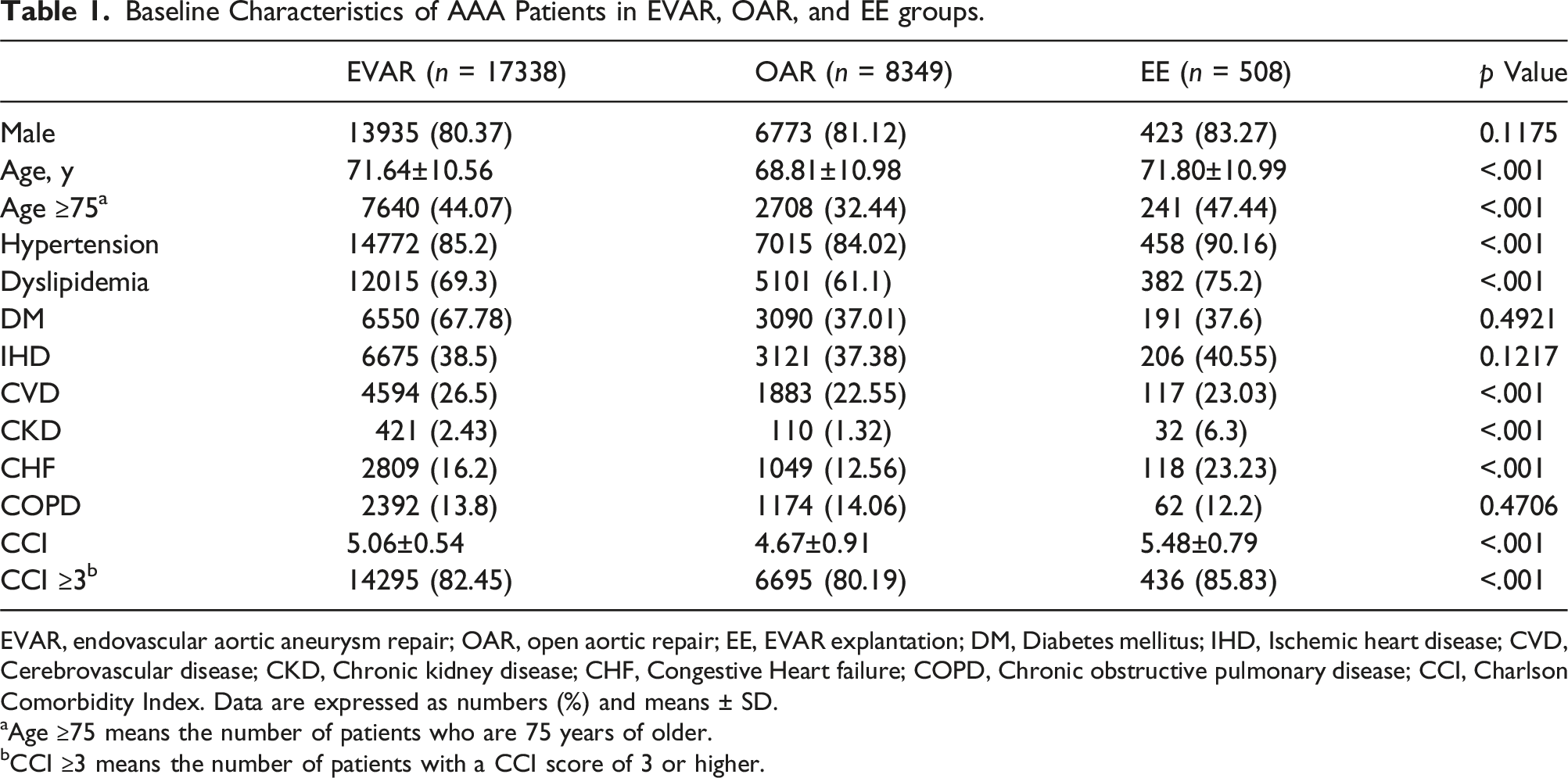
EVAR, endovascular aortic aneurysm repair; OAR, open aortic repair; EE, EVAR explantation; DM, Diabetes mellitus; IHD, Ischemic heart disease; CVD, Cerebrovascular disease; CKD, Chronic kidney disease; CHF, Congestive Heart failure; COPD, Chronic obstructive pulmonary disease; CCI, Charlson Comorbidity Index. Data are expressed as numbers (%) and means ± SD.
aAge ≥75 means the number of patients who are 75 years of older.
bCCI ≥3 means the number of patients with a CCI score of 3 or higher.
Comparisons of overall and 30-day mortality among AAA patients in EVAR, OAR, and EE groups.

AAA, abdominal aortic aneurysm; EVAR, endovascular aortic aneurysm repair; OAR, open aortic repair; EE, EVAR explantation; CCI, Charlson Comorbidity Index. Data are expressed as hazard ratio (95% confidence interval).
Analysis of uni- and multi-variable risk factors for overall mortality and 30-days mortality in the EVAR explantation group.

EVAR, endovascular aortic aneurysm repair; HR, hazard ratio; DM, Diabetes mellitus; IHD, Ischemic heart disease; CVD, Cerebrovascular disease; CKD, Chronic kidney disease; CHF, Congestive Heart failure; COPD, Chronic obstructive pulmonary disease; CCI, Charlson Comorbidity Index. The crude HR reflects the univariable analysis of risk factors, while the adjusted HR takes into account the multivariable analysis. Data are expressed as hazard ratio (95% confidence interval).
aAge ≥75 means the number of patients who are 75 years of older.
bCCI ≥3 means the number of patients with a CCI score of 3 or higher.
cDuration ≥ 6M means patients with a duration of 6 months or more from EVAR to EVAR explantation.
dmeans p < 0.05.
Results
A total of 26,195 patients were included in the analysis, with 17,338 (66.19%) in the EVAR group, 8349 (31.87%) in the OAR group, and 508 (1.94%) in the EE group. Among the three groups, EVAR exhibited the largest distribution, steadily increasing from 2002 to 2018, with a slight decrease from 2018 to 2020. OAR demonstrated a consistent annual increase after 2022, comprising only 725 cases in 2020, accounting for approximately 40% of the 1850 EVAR cases during the same period. EE has shown a steady rise every year since 2005, starting with one case in 2005 and reaching 95 cases in 2020. As of 2020, among patients undergoing treatment for AAA, EVAR represented 69.2% (1850 patients), OAR 27.2% (725), and EE 3.6% (95) (Figure 1). Annual Trends in Endovascular Aortic Aneurysm Repair (EVAR), Open Aortic Repair (OAR), and EVAR Explantation (EE) in Korea.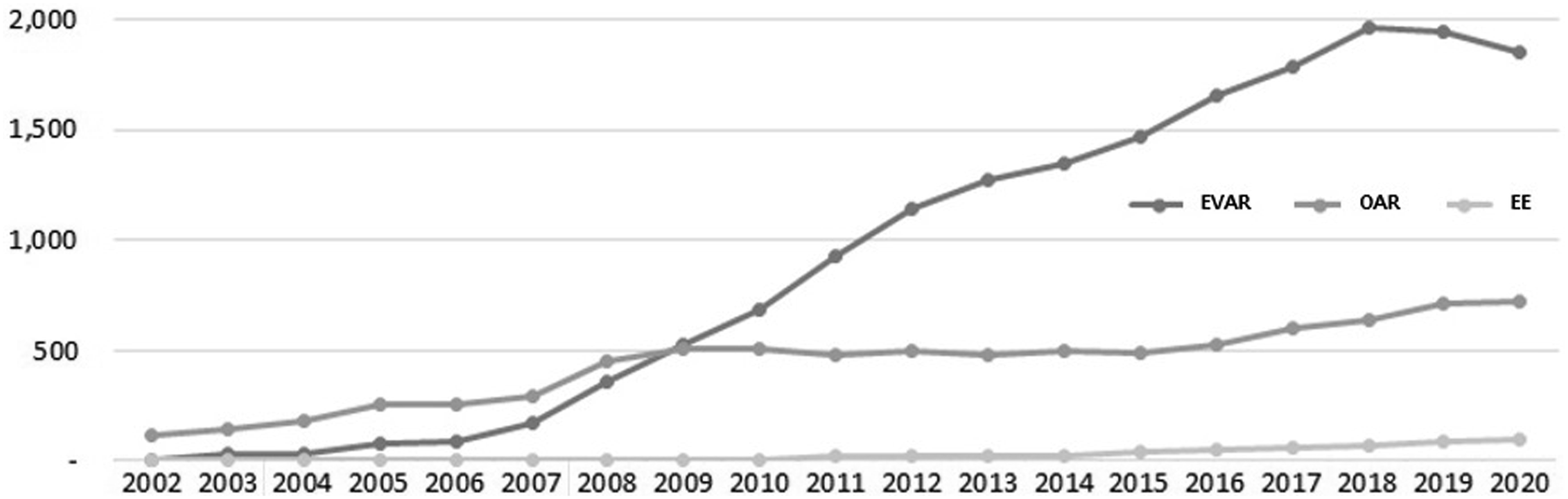
The mean age was 70.7 ± 10.8 years, with the OAR group showing a slightly younger average age of 68.8 ± 11.0 years. Comorbidities such as diabetes mellitus, ischemic heart disease, and COPD did not demonstrate significant differences among the three groups. Cerebrovascular disease showed distributions of 26.5% in the EVAR group, 23.0% in the EE group, and 22.6% in the OAR group, with the highest prevalence observed within the EVAR group. Additionally, hypertension, hyperlipidemia, chronic kidney disease, and congestive heart failure were more prevalent in the EE group compared to the other groups. Assessing the Charlson Comorbidity Index (CCI) scores, the proportion of scores equal to or greater than 3 was highest in the EE group at 85.8%, followed by 82.6% in the EVAR group and 80.2% in the OAR group. The median time from EVAR to EE was 1246.75 days (Table 1).
Overall survival rates showed EVAR as the highest, followed by the OAR group and then the EE group. However, around 18 months into observation, the OAR group demonstrated the highest survival rates (Figure 2). 30-day survival was 94.7% in the EVAR group, 90.3% in the OAR group, and 89.1% in the EE group. One-year survival was 83.5% in the EVAR group, 82.0% in the OAR group, and 73.2% in the EE group. Three-year survival was 69.8% for EVAR group, 73.5% for OAR group, and 57.2% for EE group. The EE group had the lowest survival across all intervals. Survival probabilities and survival numbers over time according to Endovascular Aortic Aneurysm Repair (EVAR), Open Aortic Repair (OAR), and EVAR Explantation (EE) in Korea.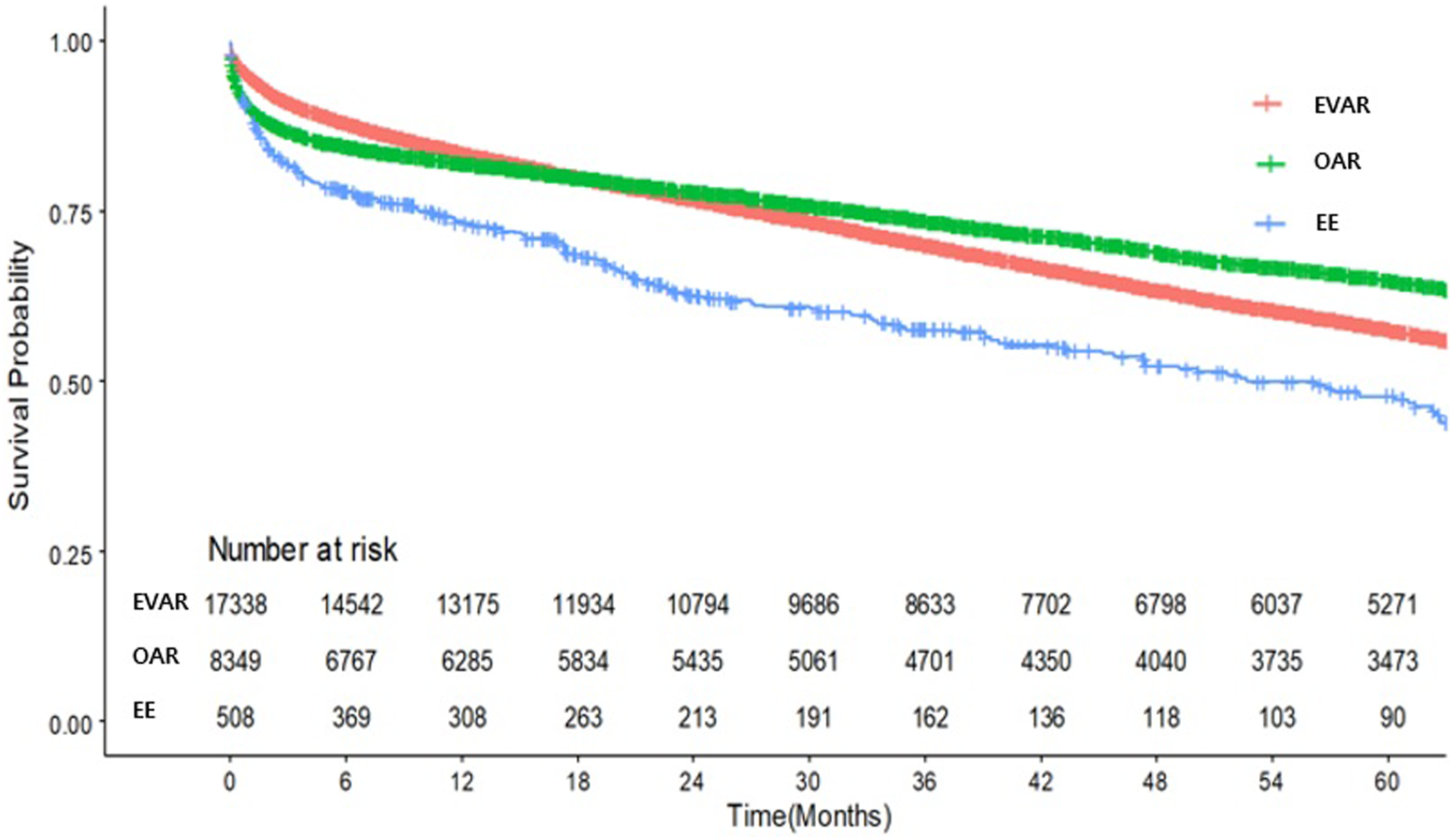
We calculated the risk of mortality for each group after adjusting for age, sex, and CCI (Table 2). While 30-days survival did not differ between the EE and OAR groups, the EE group was 2.10 times higher than the EVAR group, with statistical significance. The OAR group was 1.89 times higher than the EVAR group. For overall mortality, the EE group was 1.33 times higher than OAR and 1.40 times higher than EVAR (Table 2). We performed a multivariate analysis with cox regression to determine the impact on survival within the EE group. There were no risk factors in multivariate analysis for 30-days survival. However,
Discussion
With over 97% of Koreans in Korean territories covered by NHIS for medical services, the NHIS-based analysis is representative of Korea. 8 This study provides comprehensive initial data on EE in Korea, with over 1000 annual EVAR procedures (Figure 1), representing early findings in Asia. Among 26,195 individuals treated for AAA in Korea, the 30-days mortality rates for EVAR, OAR, and EE groups were 5.3%, 9.7%, and 10.9%, respectively, with the difference becoming more pronounced over 1-year and 3-year survival periods. Overall mortality, not procedure-related mortality, was compared in this study. Due to a lack of detailed EE cause analysis, direct comparisons with other studies may not be appropriate. Nonetheless, the study indicated unfavorable outcomes for EE compared to other treatments, with 30-days mortality similar to reported results in the US. 10
Outcomes of EVAR explantation
The main cause of aneurysmal rupture after EVAR is often attributed to untreated or undetected type 1A endoleak. 11 Some studies have reported outcomes for managing endoleak after EVAR, utilizing approaches such as Fenestrated EVAR or surgical EE. 12 In cases of EVAR failure, which include EE, LOC may become the only practical option, indicating that LOC is necessary when other interventions are not feasible or effective for addressing a failing EVAR. 13 The morbidity and mortality rates for LOC are reported to be higher than standard procedures, primarily due to additional technical challenges encountered during surgery, particularly in terms of access, aortic cross-clamping, and stent graft removal. 14 In a Canadian study, elective EE was associated with lower mortality rates than treatment for infection or rupture, emphasizing the recommendation to consider surgery for individuals with an indication for EE before the onset of symptoms or rupture. 15
Studies on late open conversion
Most studies on LOC after EVAR have primarily consisted of single-center case series. However, recently, two meta-analyses have reported, consolidating findings from these individual studies. Both groups highlighted higher perioperative mortality in cases of infection or rupture. The Italian group reported a 30-days mortality of 19.4% for infection and 32.6% for rupture, while the Canadian group reported 15% for infection and 33% for rupture.16,17 Based on data from the US National Surgical Quality Improvement Program, the 30-day mortality rates for 32,164 individuals treated for AAA were reported as 1.7% for EVAR, 4.2% for OAR, and 10.0% for LOC. 10 In a recent multicenter study in Europe, the 30-day mortality for LOC in noninfected EVAR failure was reported as 6.1% for elective cases and 28.3% for rupture. 18
In this study, EVAR was performed, and, on average, EE was undertaken 3.41 years later. The EE group exhibited a higher incidence of various morbidities. The authors considered that comorbidities might potentially serve as risk factors for both EE and mortality, and they entertained the idea that the condition of AAA patients could have changed over the 3-year period. Due to elevated comorbidity and inherent surgical risks, outcomes for EE are less favorable, with several studies indicating higher mortality rates, particularly in cases of rupture. 18 Efforts should be made to minimize the occurrence of EE, and if necessary, its performance at an appropriate time becomes crucial. Recent guidelines have favored OAR if the patient’s condition allows. 19 Selecting the appropriate modality for the treatment of AAA patients and determining the optimal timing for intervention are crucial.
This study has its limitations. It focused on patients who underwent EE, whether partial or complete, after EVAR. This study, as a nationwide big data analysis, did not sufficiently capture clinical information such as whether the surgeries or procedures were elective or emergency, the presence of an aneurysmal rupture, the patient’s status in terms of shock, or whether there was graft infection following EVAR. The presence of rupture is a critical factor in AAA research. Therefore, although we conducted a sample survey on the presence of rupture among our AAA patients, we did not cite the rupture status as a risk factor in this study due to discrepancies between the diagnostic codes in Korea’s NHIS and the actual medical records regarding rupture presence at our institution. In particular, Jo et al. recently reported a multicenter study on how the I71.3 code reflects ruptured AAA in Korea and reported that the rate of true ruptured AAA was only 43%. 20 Many studies, however, target LOC involving a return to open repair after EVAR. Although these concepts are closely related, LOC predominantly entails EE, but may include a small subset of cases involving open proximal fixation, open endoleak repair, and similar procedures. Furthermore, this study utilized big data from Korea but did not obtain detailed information on specific aspects such as rupture or infection.
Conclusion
The Korean dataset analysis indicates a rising trend in EE aligned with the increased adoption of EVAR for AAA. Comparative evaluations with EVAR and OAR demonstrate less favorable outcomes for EE, especially in terms of 30-day and overall mortality rates. To mitigate EE incidence, the strategic choice of the initial treatment modality is essential. Moreover, precise timing for treatment in high-morbidity EE cases is crucial. The study underscores the need for well-designed research to address the evolving challenges in EE management, offering valuable insights for clinicians navigating the complexities of EVAR-related complications.
Supplemental Material
Supplemental Material - Nationwide analysis of EVAR explantation outcomes in Korea: A comprehensive dataset study
Supplemental Material for Nationwide analysis of EVAR explantation outcomes in Korea: A comprehensive dataset study by Hyo Kee Kim, Pyoung Jae Park, Jee Hyun Park, Young Ju Oh, Cheol Woong Jung, and Heungman Jun in Vascular
Footnotes
Declaration of conflicting interests
The author(s) declared no potential conflicts of interest with respect to the research, authorship, and/or publication of this article.
Funding
The author(s) disclosed receipt of the following financial support for the research, authorship, and/or publication of this article: This research was supported by a Korea University grant in 2022.

Supplemental Material
Supplemental material for this article is available online.
References
Supplementary Material
Please find the following supplemental material available below.
For Open Access articles published under a Creative Commons License, all supplemental material carries the same license as the article it is associated with.
For non-Open Access articles published, all supplemental material carries a non-exclusive license, and permission requests for re-use of supplemental material or any part of supplemental material shall be sent directly to the copyright owner as specified in the copyright notice associated with the article.
