



Abstract
Aims
The association between gender and length of hospital stay following infra-inguinal bypass (IIB) surgery is unclear. While previous studies have reported gender disparities in length of hospital stay (LoS), the results are conflicting and could be attributable to other confounding factors. We undertook this cohort study to determine if there are any gender differences in length of hospital stay following infra-inguinal bypass for PAD after adjusting for well-known confounders.
Methods
A 3-year single-centre retrospective case notes analysis of all people undergoing IIB between 2017 and 2019. Rutherford stage, graft conduit, urgency of bypass, level of bypass, procedure details, baseline demographics, length of stay (LoS) and co-morbidities were collected and univariable associations with length of hospital stay were reported. Factors associated with increased LoS on univariable analysis were entered into a multivariable model.
Results
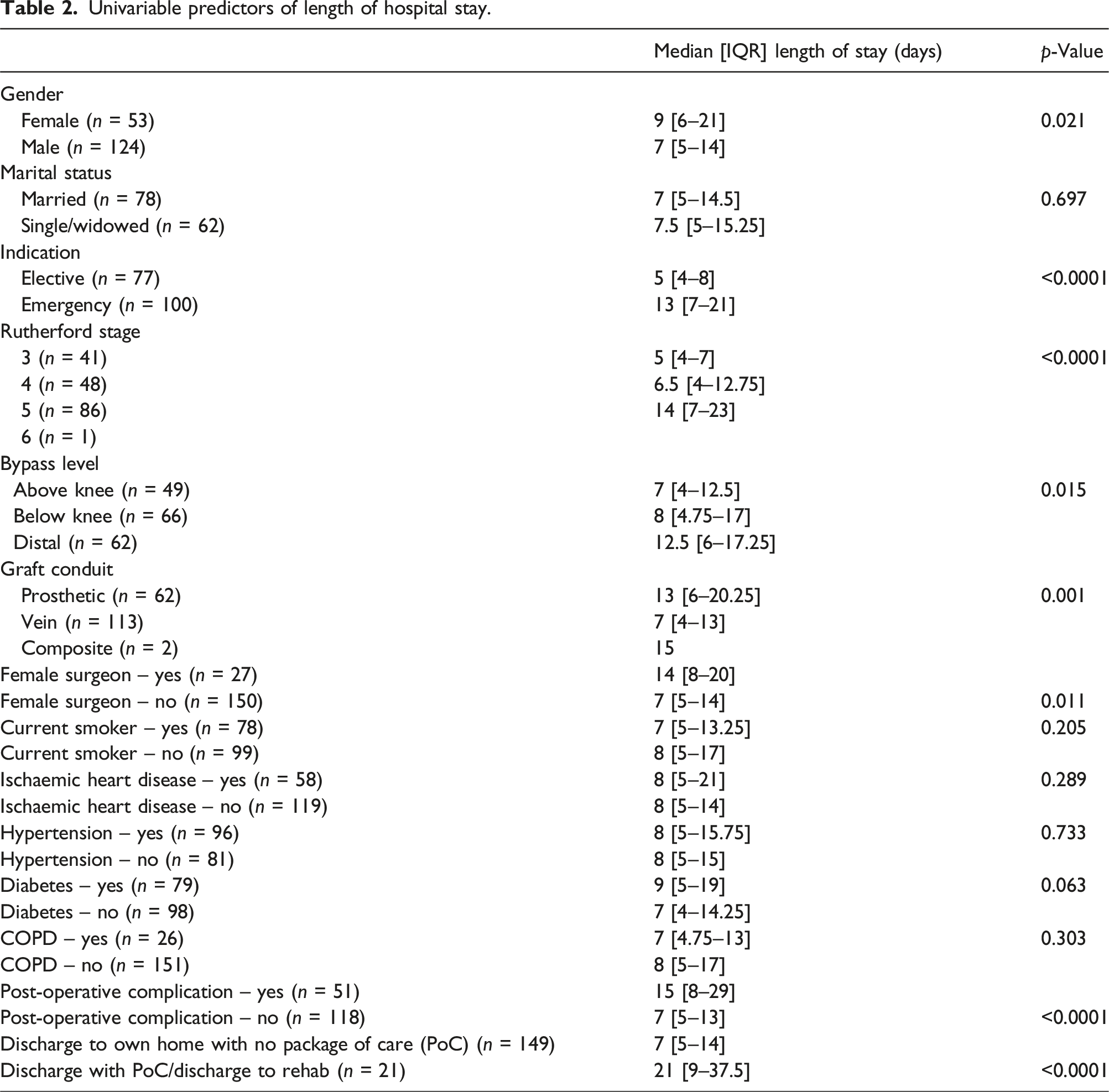
177 IIB were analysed with a median age of 70 [63–73] years, 124 (70.1%) were male and 89 (50.2%) had DM. A total of 78 (44.1%) were current smokers, and 100 (56.5%) underwent emergency procedures. The cohort included patients with Rutherford stage 3 (n = 41 (23.2%)), stage 4 (n = 48 (27.1%)), stage 5 (n = 86 (48.6%)) and stage 6 (n = 1 (0.6%)) disease. A total of 100 (56.5%) underwent emergency procedures. The conduits used were prosthetic (n = 62 (35%)), vein (n = 113 (63.8%)) and composite (n = 2 (1.1%)), and the level of distal anastomosis was above knee (n = 49 (27.7%)), below knee (n = 66 (37.3%)) and distal (n = 62 (35%). Baseline demographics did not differ by gender, and there were no differences in post-operative complications. The proportion of patients discharged to their usual place of residence without a package of care did not differ by gender (p = .387). However, length of stay for female patients was significantly longer than for male patients (9 [6–21] vs 7 [5–14] days, p = .021). Other factors associated with increased LoS on univariable analysis were emergency versus elective (p < .0001), Rutherford stage (p < .0001), bypass level (p = .001), bypass conduit (p = .001), post-operative complications (p < .0001) and discharge to rehab or home with package of care (p < .0001). Patients operated on by a female surgeon also had a longer hospital stay (14 [8–20] vs 7 [5–14], p = .011) than those operated on by a male surgeon. After multivariate adjustment for bypass urgency, level and conduit, Rutherford stage, presence of post-operative complications and discharge destination, female gender (RR 1.59 95% CI: 1.09–2.3, p = .017) was still associated with increased length of hospital stay.
Conclusions
Even after adjustment for well-known factors associated with length of hospital stay, female gender appears to be independently associated with significantly longer hospital stays. Further investigation into factors affecting gender differences could shed further light on this apparent difference.
Introduction
Globally, there are over 200 million people living with peripheral arterial disease (PAD). 1 Approximately 20% of people over 60 years have some degree of PAD 2 and while the prevalence in men and postmenopausal women is similar, 3 women tend to present at an older age with more complex, multilevel disease.4,5
It has been well established that following surgery women have worse outcomes than men.6–10 For coronary artery bypass graft (CABG) surgery, it has been well documented that women have an increased risk of mortality and adverse outcomes, 11 as well as a longer length of stay (LoS). 12 Studies looking into impact of gender within aortic aneurysm interventions have found that female gender is associated with greater mortality, morbidity and longer LoS.13–15 A recent systematic review and meta-analysis of sex and gender-based differences in presentation severity and outcomes following major vascular surgery 16 found that females who had undergone vascular surgery were associated with more severe disease at presentation, with a greater proportion of ruptured AAA and Chronic Limb Threatening Ischaemia (CLTI). It concluded that this could potentially contribute to the higher mortality rates in females with AAA and PAD. 16
Several studies have reported on gender disparities in LoS following infra-inguinal bypass (IIB),17–20 and the results have been conflicting. The BASIL-1 trial reported women as having a shorter but non-significant LoS than men. 17 However, men had more advanced PAD at baseline and were more likely to have had previous revascularisation before entry into the study, which could have accounted for longer LoS in men. Other studies5,18–20 reported longer LoS in women, but in these studies women presented with more advanced disease, had a greater risk factor profile, were more likely to have emergent procedures, had a greater loss of independence following surgery, were more likely to have post-operative infections and post-operative haemorrhage and were more likely to be discharged to a nursing home, which could account for the apparent increased LoS. We therefore sought to assess for gender-related differences in LoS in a contemporary population with Rutherford 3–6 disease and assess whether this finding remains significant after adjusting for other confounding factors.
Methods
This was a 3-year single-centre retrospective, observational cohort study of all people undergoing IIB for peripheral arterial disease between 01/01/2017 and 31/12/2019 at our institution. Patients undergoing exclusion bypasses of popliteal aneurysms or other intrinsic vascular wall abnormalities were excluded, as were those who were lost to follow-up or with insufficient demographic details. Patients having a contralateral IIB during the study period only had their index leg analysed.
Baseline demographics were collected using patient clinical records. Demographic data included sex, marital status, age at procedure, smoking status, comorbidities (Chronic obstructive pulmonary disease (COPD), Hypertension (HTN), ischaemic heart disease (IHD), Cerebrovascular Disease (CBVD), Diabetes mellitus (DM)) and antiplatelet/anticoagulant use. We collected procedural data including gender of operating surgeon, Rutherford stage, graft conduit type, urgency of bypass, level of bypass, procedure details and LoS. Information on post-operative complications, discharge destination and whether patient required a package of care on discharge was collected from the electronic discharge letter.
Due to the observation nature of this retrospective analysis study, our audit department deemed that ethical approval was not necessary, due to the use of pseudo-anonymised data.
Statistical methods
Descriptive statistics were presented as absolute number with percentages, mean with SD or median with inter-quartile range. Categorical variables were analysed using Chi-squared test or Fisher’s exact test, when values <5. Mann–Whitney-U or Kruskal–Wallis tests were used for non-parametric testing for univariable comparisons on LoS and Student’s t-Test for parametric testing. Univariable associations with LoS with a significance of p < .05 were entered into a Cox proportional hazards model and results were reported as Relative Risk (RR) with their respective 95% confidence intervals (95% CIs).
Results
A total of 215 separate procedures were performed coded as infra-inguinal bypasses (IIB), of which 38 procedures were excluded. Consort diagram is shown in Figure 1. Consort diagram demonstrating cohort selection process.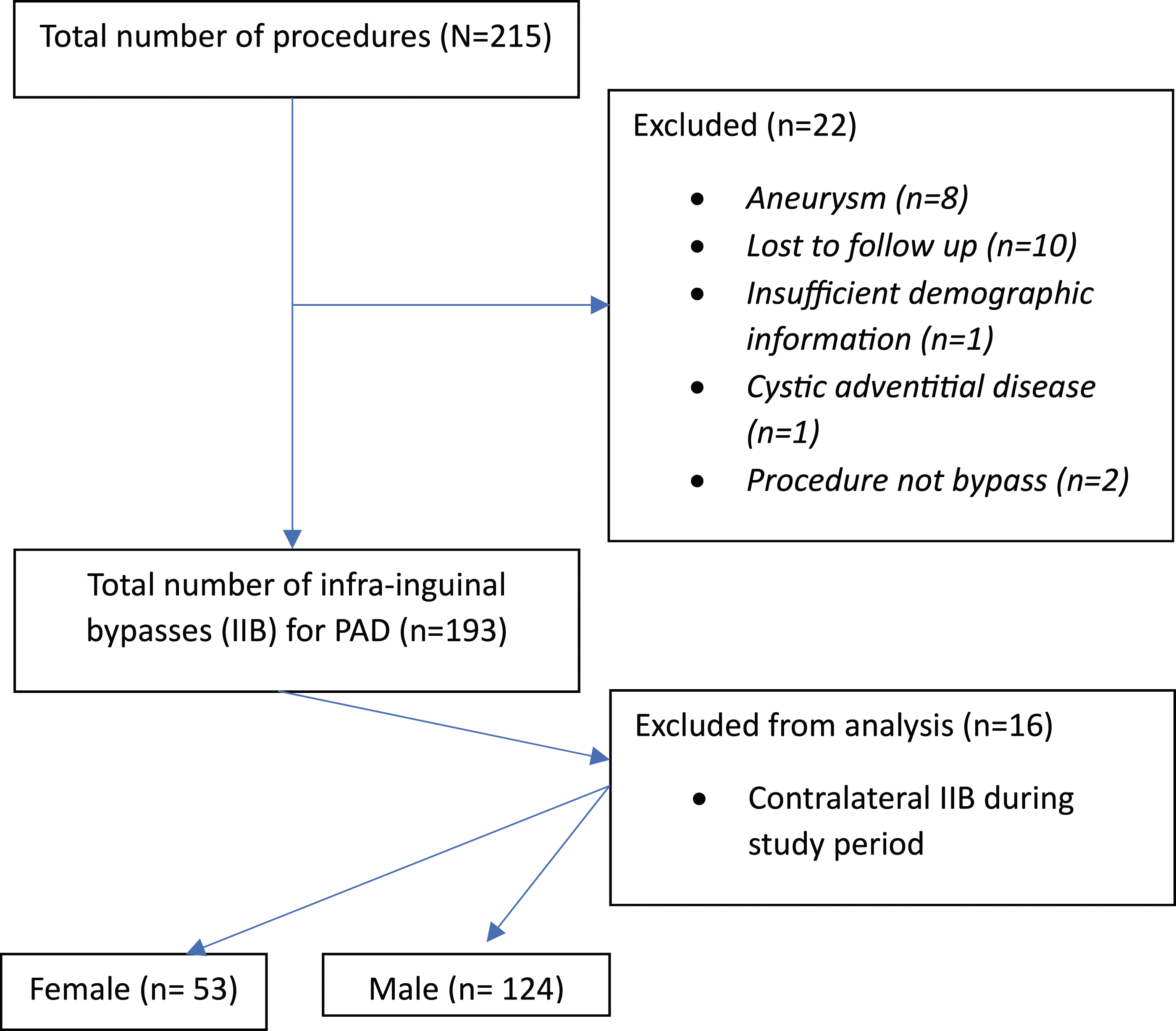
Baseline demographics.

an = 42.
bn = 98.
cn = 52.
dn = 49.
en = 120.
fn = 51.
gn = 119.
The conduits used were prosthetic (n = 62 (35%)), vein (n = 113 (63.8%)) and composite (n = 2 (1.1%)), and the level of distal anastomosis was above knee (n = 49 (27.7%)), below knee (n = 66 (37.3%)) and distal (n = 62 (35%)).
No differences in age, urgency of surgery, marital status, Rutherford stage, graft conduit or level of bypass were found between females and males. While no differences overall were found in proportion of patients on either an antiplatelet or anticoagulants or a combination, male patients were significantly more likely to be on anticoagulation (27 (21.8%0 vs 7 (13.2%)) and females more likely to be on dual antiplatelet therapy (6 (11.3%) versus 3 (2.4%)) at baseline (p = .04).
Inpatient complications
Fifty-one (28.8%) patients were recorded as having a post-operative complication on their electronic discharge letter, with no differences by gender (female vs male: 13 (26.5%) versus 38 (31.7), p = .509).
The most common complications were reported as infection (surgical site, urinary tract and chest) (28 (15.8%)) or graft occlusion (16 (9%)); 6 (3.4%) of these underwent an ipsilateral major limb amputation prior to discharge. No differences in post-operative complications were found between female and male patients, including proportion of grafts occluded before discharge (female vs male: 5 (9.4%) versus 11 (8.9%), p = .905) or ipsilateral major limb amputations (female vs male: 2 (3.8%) versus 4 (3.2), p = .854).
Discharge destination
Overall, 149 (84.2%) were discharged independently to their usual place of residence, with the remaining requiring a package of care or discharge to a rehabilitation facility, care or nursing home. All patients undergoing major limb amputation were discharged to a residential post-amputation rehab facility. The proportion of patients discharged to their usual place of residence without a package of care did not differ by gender (female vs male: 43 (84.3%) versus 106 (89.1%), p = .387). However, length of stay for female patients was significantly longer than for male patients (9 [6–21] vs 7 [5–14] days, p = .021).
Univariable and multivariable associations with length of hospital stay
Univariable predictors of length of hospital stay.
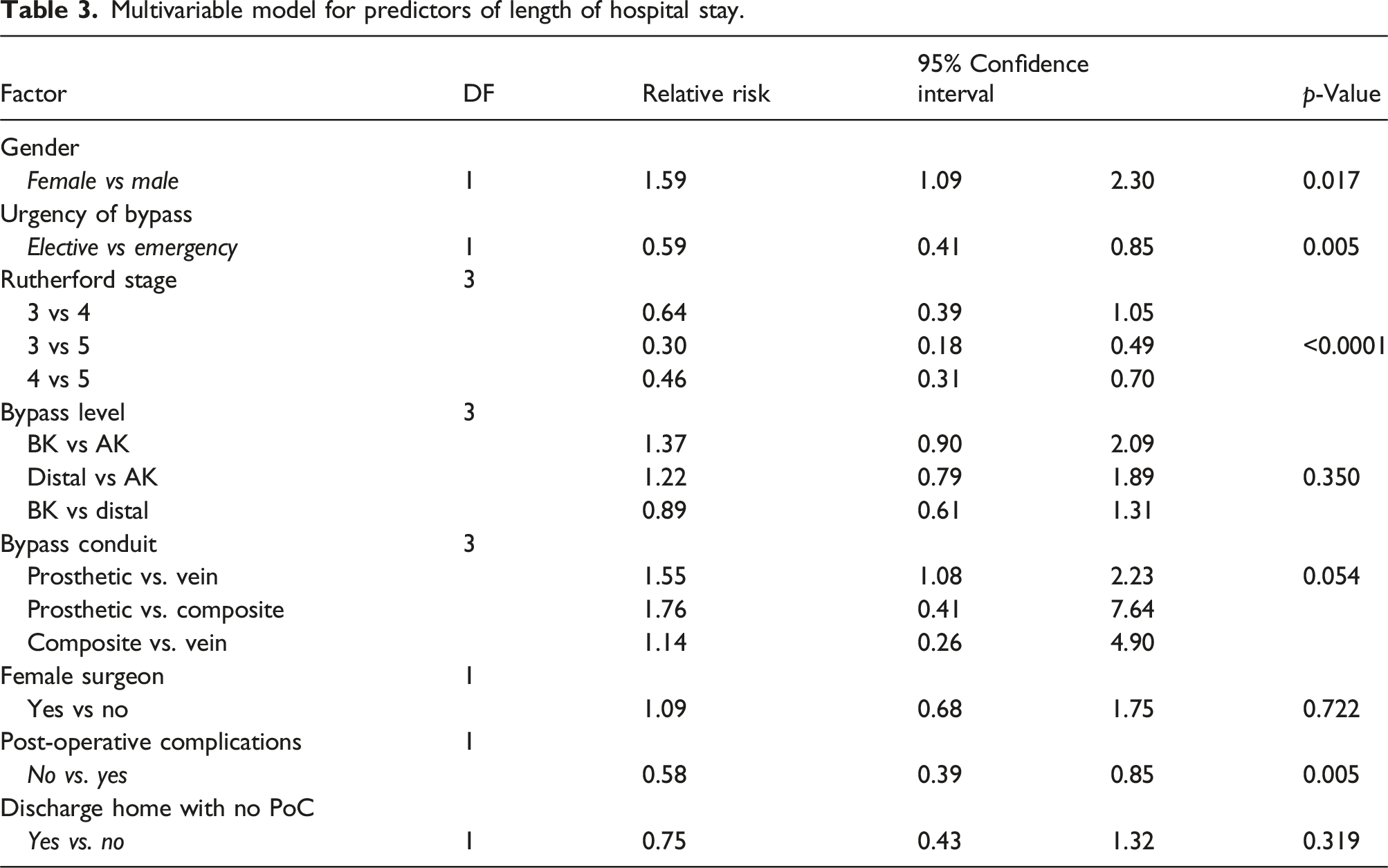
Multivariable model for predictors of length of hospital stay.
Multivariable model for predictors of length of hospital stay in Rutherford 3 and 4 patients.

Discussion
This study has demonstrated that female gender is associated with increased length of hospital stay following IIB, spending a median of 2 days longer than men, even after adjusting for other confounding variables. A previous study on 4894 patients undergoing bypass for CLTI found that prolonged pre-operative hospitalisation (OR 2.2 95% CI: 1.8–2.6, p < .001) and pre-operative dependent functional status (OR 2 95% CI: 1.7–2.3, p < .001) were the greatest predictors of extended hospital stay 21 (Siracuse et al. 2014). Previous studies in large populations undergoing IIB17–20 have reported gender disparities in LoS. Those reporting increased LoS in female patients found that they presented at an older age with more advanced disease. Differences in risk factor profile at baseline were also apparent between genders, females were more likely to have emergent procedures, had a greater loss of independence than men following surgery, were more likely to have post-operative infections and post-operative haemorrhage and were more likely to be discharged to a nursing home,18–20,22 any of which could have accounted for the apparent increased LoS.
While the BASIL-1 trial found a non-significant trend in shorter LoS in female patients, (median LOS 11 [4–21] vs 15 [7-26]), 17 they reported significantly greater prevalence of gangrene in men (p < .05) and men were significantly more likely to have had previous revascularisation procedures before entry into the study and therefore were undergoing revision surgery, which would be more likely to require a longer recovery. BASIL-1 also reflects data from both bypass and endovascular outcomes, and men underwent proportionally more bypasses than women, perhaps explaining the difference in LoS findings to ours. Interestingly, our contemporary vascular population had significantly shorter hospital stays for both genders than their population, and our findings reflect those of Egorova et al. 2010, 18 suggesting LoS has reduced in more recent years in both genders.
Whilst not reporting directly on LoS, a recent systematic review and meta-analysis reported women having higher rates of CLTI at presentation (OR 1.10 95% CI: 1.02–1.19, p = .01) and higher rates of graft thrombosis (OR 1.18 95% CI: 1.08–1.25, p = .0002) which would likely have led to longer LoS in these patients. 16 In addition, there may be gender-based differences in complications following IIB in general. In a study of 1404 IIB procedures, women had a greater risk of wound complications and limb loss than men. 9 Furthermore, in a study on over 11000 IIB, women had more surgical site complications on univariate analysis and systemic complications on multivariate analysis. 5 Vouyouka et al. found that even after multivariate adjustment women have significantly higher rates of mortality, infection and periprocedural bleeding. 7
Unlike previous studies, our study included Rutherford 3–6 patients and not just those with CLTI. We also analysed elective and emergent procedures and investigated marital status as a surrogate for support at home. We found no differences in risk factor profile at baseline, Rutherford stage, graft conduit, level of distal anastomosis, post-operative complications and discharge destination between male and female patients. We found elective patients had a shorter LoS as did lower Rutherford stage and patients developing post-operative complications and those requiring a package of care or discharge to rehab or care home remained in hospital longer. After multi-variable adjustment, emergent procedures (p = .005), higher Rutherford stage (p < .0001) and presence of post-operative complications (p = .005) all remained significantly associated with LoS.
Female gender was also associated with increased LoS (p = .017) after multivariable adjustment for known confounders, which support findings seen in studies investigating gender differences following coronary artery bypass grafting (CABG) and aneurysm repair.13–15
Our findings seem to be much more dramatic, with a 2-day difference in LoS, than previous IIB studies.18,22 A previous study in 2576 patients 22 reported a non-significant trend towards longer LoS in females (8.5 vs 7.7 days, p = .06) but noted a higher rate of reintervention for graft thrombosis in women (4% vs 2%, p < .0001) and 3 x more likelihood of women being discharged to a nursing home (15% vs 5%, p < .0001) than men. In another study investigating long-term trends in PAD, 18 women undergoing revascularisation procedures were older (72 vs 70 years, p < .0001) and were more likely to have emergent procedures, with the trend continuing for the whole decade (p < .0001). However, despite this finding, this study suggested discrepancies in gender LoS following IIB were reduced over a decade, from a difference of 1.4 days (12.9 vs 11.5 days) in 1998 to 0.3 days (9.6 vs 9.2 days) in 2007.
Our study appears to be the first to demonstrate a clear association between gender and LoS following IIB after adjusting for Rutherford stage, graft conduit, bypass level, emergence of procedure, post-operative complications, gender of operating surgeon and discharge destination. There was no age difference between the genders in our population nor disparities in marital status and risk factor profiles where equivalent and so this study contributes to the literature as other reasons which may have accounted for LoS in other studies were taken into account.
A recent population-based study investigating patient outcomes by gender of surgeon 23 found that patients operated on by female surgeons had lower rates of adverse post-operative outcomes including death, than men. Interestingly on univariable analysis we found that having a female operating surgeon is associated with twice as long hospital days (p = .011) compared to male surgeons. However, in this study female surgeons had a trend towards operating on significantly more Rutherford 5 patients than male surgeons (p = .051), which is likely why this finding did not remain significant after multivariable adjustment for other confounders.
Vascular anatomy may play a role in explaining some of our findings. Smaller blood vessels pose a greater technical challenge for surgeons and have been reported as being associated with an increased incidence of post-operative bleeding 7 and increased operative times, 13 contributing to a longer overall hospital stay. The impacts of blood vessel size are explored by Seymour et al, but give very little conclusive evidence for impact of vessel size within IIB. 24 Lower bypass level could correspond with smaller blood vessels. However, our cohort reported no differences in bypass level between genders. However, overall smaller vessel diameters in females could have led to longer operative times and this may have had a corresponding knock-on effect with LoS.
Other gender disparities previously reported on are differences in microvascular function in women with a previous study reporting females with intermittent claudication had worse arterial compliance. 25 It has been reported that women with PAD in the community have decreased functional status and mobility when compared to men. 26 Given that pre-operative dependence has been reported as a strong predictor of LoS, 21 a possible explanation for delayed discharge on women could be more mobility issues in women following bypass surgery. This is supported in a previous study, which found that after propensity matching for pre-operative symptoms and comorbidities, women were more likely to have loss of independence following saphenous vein femoral-popliteal (p < .0001) and femoral tibial bypass (p = .0006) and prosthetic femoral-popliteal bypass (p = .02). It is possible that women mobilise later than men due to greater post-operative pain and increased requirement for opioid analgesia, which has been noted previously. 27
The main limitations of this study are the relatively small cohort, particularly the female group; however PAD is known to be more prevalent in males and proportionally our cohorts are representative of previous studies.5,17 We did not investigate time to in-hospital mobilisation, which may have contributed to the apparent difference in LoS.
We also did not collect baseline data on frailty scores and pre-operative mobility, which may have affected the LoS in our patients. However, all patients would likely have a Rockwood frailty score 28 of 4–6 if they were having an infra-inguinal bypass for IC or CLTI. Patients with higher frailty scores would be highly unlikely to have a major vascular surgical procedure. Also, unlike previous studies investigating gender differences in LoS, almost a quarter of patients included in this study had Rutherford 3 disease and so would have been ambulatory pre-operatively. Furthermore, our cohorts had equivalent Rutherford 4 and 5 disease and so one would expect mobility to be similar in both genders. Patients with Rutherford 5 disease would likely be less ambulant than those with claudication and rest pain on admission and post-operatively, whether or not they had a minor amputation. With the push to reduce hospital stay for all inpatients and reduce the returns to theatre, most patients in our unit who require minor amputation have this performed in the same sitting at the end of the bypass procedure once the wounds are closed and dressed. We did not directly analyse for potential differences in proportions of patients of each gender having minor amputations, which is a limitation of this study. However, we performed a multivariable adjustment investigating length of stay in patients without Rutherford 5 disease and female gender remained an independent predictor of this.
We did not investigate whether the patients had social support pre-operatively and following discharge, due to the retrospective nature of this study. Due to earlier morbidity and mortality in men, it is possible that women presenting to vascular services are less likely to have a partner able to provide post-operative care and support. 29 This could complicate discharge planning leading to increased LoS. In addition, it is possible women make up a larger proportion of the care home population, 30 which again complicates discharges due to issues with communication, transport and care home capacity. However, no differences in discharge destination or requirement for package of care by gender (p = .387) were found in this study.
Our cohort is from a single centre, which although caters for a large population, and is not representative of all vascular services. Our cohort is largely elderly and taken from a predominantly white demographic, which may limit the extent of any subsequent applications.
This study highlights gender-based differences in LoS following IIB. This study also reinforces the importance of increased awareness of women’s risk following IIB through earlier identification and risk factor mitigation, 10 providing a baseline for future research to help understand why these differences are apparent. Many explanations have been described in previous work, although the reasons behind the apparent differences in length of stay by gender are most likely multifactorial.
There is a paucity of high-quality research specifically aimed at prehabilitation for patients undergoing vascular surgery, both peripheral and aortic31,32 surgery, making it difficult to draw definitive conclusions upon which to base a change in practice. Given that pre-operative functional status and frailty are associated with worse post-operative outcomes 5 including loss of independence and higher discharge to nursing homes, future research should focus on the prehabilitation prior to major vascular surgery, along with early mobilisation and enhanced recovery programs to see whether these mitigate the apparent gender differences found in LoS in our study.
Conclusion
This study has shown that length of hospital stay is significantly longer for women than men following infra-inguinal bypass for PAD, staying for an average of 2 days longer. Even after multivariable adjustment for well-known confounders, female gender has been shown to be an independent predictor of increased length of hospital stay. Further investigation into factors affecting gender differences in LoS including frailty status, pre-operative mobility, social support at home and biological differences such as vessel diameter, occurrence of post-operative complications and graft patency could shed further light on this apparent difference. This could potentially inform pre-operative and post-operative management to reduce risks to women undergoing IIB for PAD.
Footnotes
Declaration of conflicting interests
The author(s) declared no potential conflicts of interest with respect to the research, authorship, and/or publication of this article.
Funding
The author(s) received no financial support for the research, authorship, and/or publication of this article.
Ethical Statement

Data availability statement
Anonymised data can be made available from the corresponding author at reasonable request.