




Abstract
Objectives
The physicochemical qualities and ingestibility of high value-added amlodipine besilate formulations were evaluated using one brand name and four generic orally disintegrating tablets (formulations A, B, C, D, and E) and a generic orally disintegrating film (formulation F).
Methods
Pushing out from a press-through package, tablet strength, and hydrophilia were examined for the aforementioned formulations A–E, and sensory characteristics according to the disintegration time, taste, and palatability in healthy subjects were evaluated for formulations A–F.
Results
The strength required for pushing out from a press-through package for formulations A, B, C, D, and E was approximately 20 N, indicating ease of opening for most users. Moreover, hardness and friability of formulations A, B, C, D, and E were more than 0.03 kg/mg and less than 1%, respectively. Thus, all formulations had sufficient tablet strength to endure fall impact in the automatic packing machine and vibration when carrying them from one place to another. The wetting time of formulation E (9 s) was significantly shorter than that of formulations A (27 s), B (34 s), C (28 s), and D (29 s), indicating that with the exception of hydrophilia, the physicochemical qualities of the five aforementioned formulations of orally disintegrating tablets were equivalent. The disintegration time of formulations E (15 s) and F (15 s) in the oral cavity was significantly shorter than that of formulations A (23 s), B (26 s), C (25 s), and D (22 s). Moreover, more than 50% of subjects reported strong or weak bitterness for formulations B, C, D, E, and F. Finally, more than 80% of subjects described formulations A, E, and F as easy to take, indicating good palatability.
Conclusions
This study provides useful information for selecting high value-added amlodipine besilate formulations for individualized treatments.
Keywords
Introduction
Amlodipine besilate selectively binds to potential operated calcium channels on the cell membranes and decreases Ca2+ uptake by cells, leading to the relaxation of the smooth muscles of the coronary and peripheral vessels. 1 Therefore, amlodipine besilate is used frequently for the treatment of hypertension and angina pectoris. Amlodin® and Norvasc®, which are amlodipine besilate formulations, have been marketed globally since 1989. In addition, orally disintegrating (OD) tablets, OD films, and oral jellies have been developed and marketed as high value-added formulations that are easy to take. High value-added formulations such as OD tablets can reduce swallowing burden, leading to an improvement in medication compliance. Among patients with prostatic hypertrophy, equivalent efficacy was observed before and after the replacement of tamusulosin capsules (used for dysuria treatment) with OD tablets, and elderly patients tended to prefer OD tablets. 2 Moreover, the replacement of conventional voglibose tablets (used to inhibit diabetic postcibal hyperglycemia) with OD tablets reportedly led to an improvement in medication compliance and increase in therapeutic efficacy. 3
OD tablets and films are rapidly dissolved or disintegrated in the oral cavity, 4 and patients can take these formulations with or without water. Thus, these formulations are highly convenient for patients in all situations, including those in whom water intake is limited, who have difficulty obtaining water because of a busy lifestyle, and in whom deglutition functions are decreased.5,6 In Japan, amlodipine besilate OD tablets that are currently sold include brand name and generic formulations from more than 20 companies, and amlodipine besilate OD films are sold as a generic formulation by one company. However, orally active amlodipine besilate jellies are sold as a generic formulation by four companies, but it is more cumbersome than OD tablets and films and is unsuitable as a pocket or handbag accouterment. Thus, use of orally jelly is limited to patients with decreased swallowing function, and in the present study, we focused on OD tablets and films of amlodipine besilate.
Although generic and high value-added formulations are currently in clinical use, these are not limited to amlodipine besilate OD tablets and films, and physicians and pharmacists have difficulty selecting suitable formulations for individual patients. Moreover, cost price from wholesalers is not an optimal criterion for the selection of formulations, warranting selection on the basis of scientific assessments of physicochemical qualities and ingestibility. Important physicochemical quality indexes of amlodipine besilate OD tablets include ease of pushing out from press-through packages (PTP), tablet strength against vibration and impact during transport, tablet strength against fall impact in automatic packing machines, and hydrophilia, which influences mouth feeling. In addition, disintegration times in the oral cavity, taste, mouth feeling, and palatability are ingestibility indexes that directly influence the medication compliance. Although evaluations of physicochemical qualities such as strength are not relevant to thin and flexible amlodipine besilate OD films, the evaluation of ingestibility indexes such as taste remain important. However, little is known of the physicochemical qualities and ingestibility of amlodipine besilate OD tablets and films.
Indexes of physicochemical qualities and ingestibility were assessed in high value-added amlodipine besilate formulations, including one brand name and four generic OD tablets and a generic OD film. In particular, pushing out from a PTP, tablet strength, and hydrophilia were examined, and sensory tests were performed on healthy subjects to assess the disintegration time, taste, mouth feeling, and palatability.
Methods
Materials
Amlodipine besilate OD tablets and films
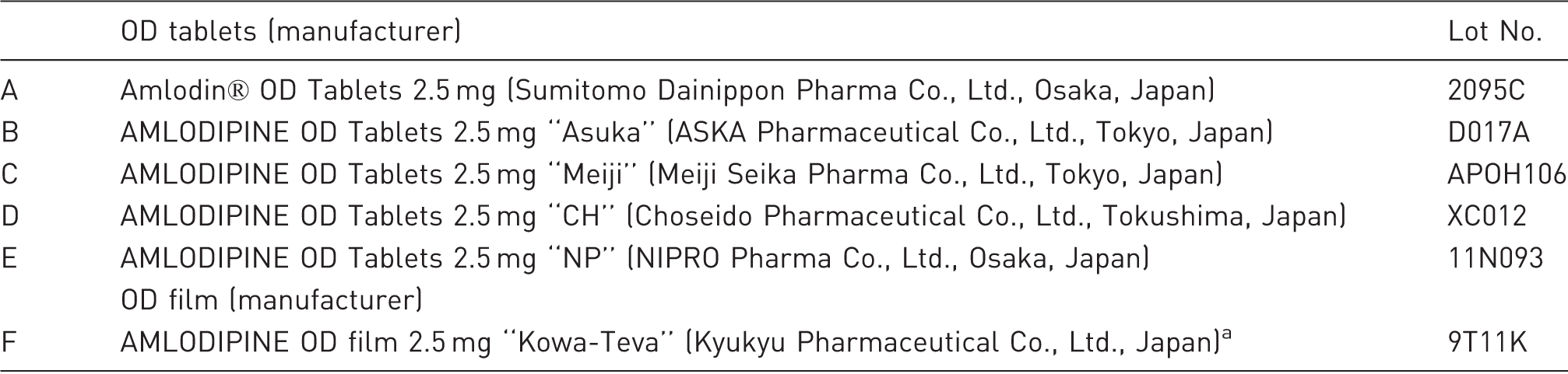
Current name is AMLODIPINE OD film 2.5 mg “QQ” (Kyukyu Pharmaceutical Co., Ltd., Japan)
Measurement of the strength required for pushing out from a PTP for OD tablets
The strength required for pushing out from a PTP for OD tablets were determined using a digital force gauge (IMADA Co., Ltd., Aichi, Japan) as previously described. 7 In brief, one PTP was placed on a setting stand with a tablet diameter sized hole, and a pushing-out jig was attached to a digital force gauge and lowered at a rate of 50 mm/min. The strength (N) required for pushing out was defined as the load upon ripping of the aluminum film.
Measurement of hardness and friability of OD tablets
Hardness (kg/mg) values (kg) were expressed as those measured using a Monsanto-type tablet hardness tester (Ikemoto Scientific Technology Co., Ltd., Tokyo, Japan) divided by the tablet weight (mg). Friability of OD tablets was determined using the tablet friability test of the Japanese Pharmacopoeia 16th edition.8,9 In these experiments, approximately 6.5 -g OD tablets were placed in a drum and were rotated 100 times at 25 rpm. The mass of OD tablets before and after drum rotation was recorded and friability (%) was calculated according to the tablet weight loss.
Measurement of the wetting time of OD tablets
Hydrophilia was assessed according to the wetting time as previously described. 10 In brief, one OD tablet was placed on filter papers (diameter, 90 mm) wetted in 10 mL water, and the time required for complete wetting was assessed by visual inspection.
Sensory testing
Sensory testing was performed with approval from the Hokkaido Pharmaceutical University president (No. 12-04-001) following examination of protocols by the study ethics committee. Informed consent was obtained from all subjects, and 45 healthy volunteers (18 men and 27 women, 24–64 years old) were included in the study.
Questionnaire and sensory testing options
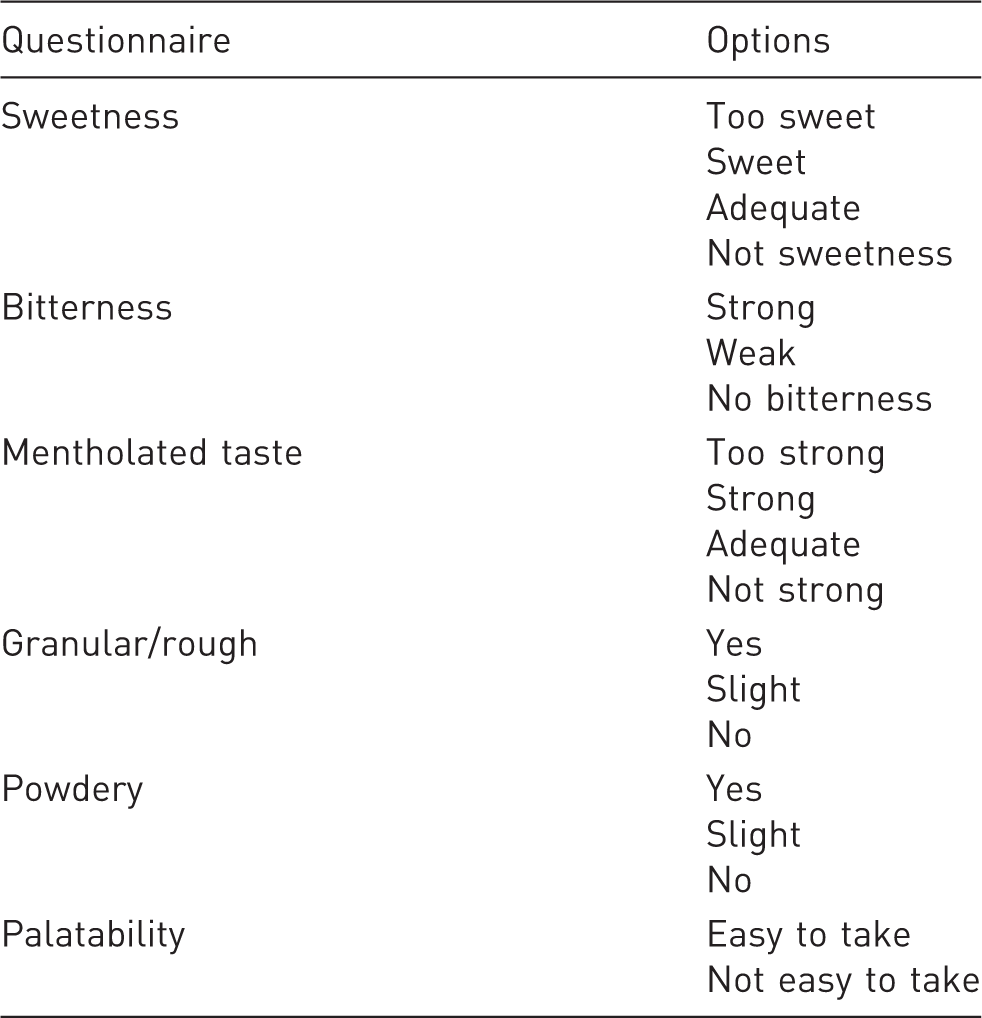
All subjects were blinded to the names and manufacturers of OD tablets and films and tested the tablets and films at 1 h intervals on the same day.
Statistical analysis
Differences were identified using Tukey’s honestly significant difference test and were considered significant when p < 0.05.
Results
Pushing out from PTP
The strength required for pushing out from a PTP for OD tablets (Figure 1) were approximately 20 N for all formulations.
Strength required for pushing out from a PTP for OD tablets. Values are presented as means ± standard deviations (S.D.; n = 4).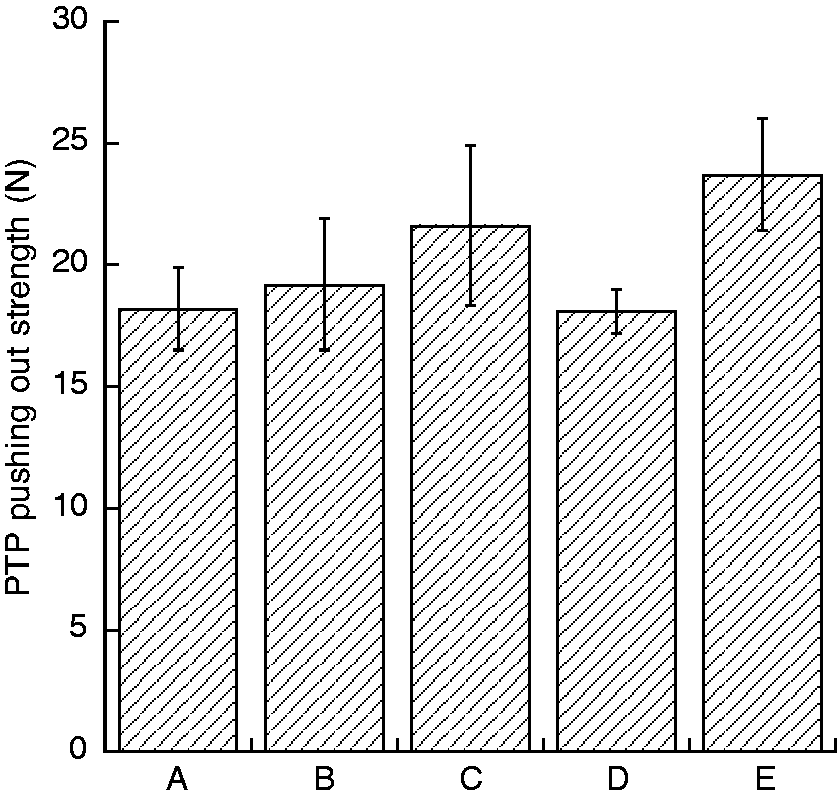
Tablet strength
Hardness of OD tablets (Figure 2) was more than 0.030 kg/mg for all formulations, and friability values were 0.23% (formulation A), 0.15% (formulation B), 0.11% (formulation C), 0.08% (formulation D), and 0.23% (formulation E).
Hardness of OD tablets. (a) p < 0.05 vs. A; (b) p < 0.05 vs. B; (c) p < 0.05 vs. C; (d) p < 0.05 vs. D; (e) p < 0.05 vs. E. Values are presented as means ± S.D. (n = 10).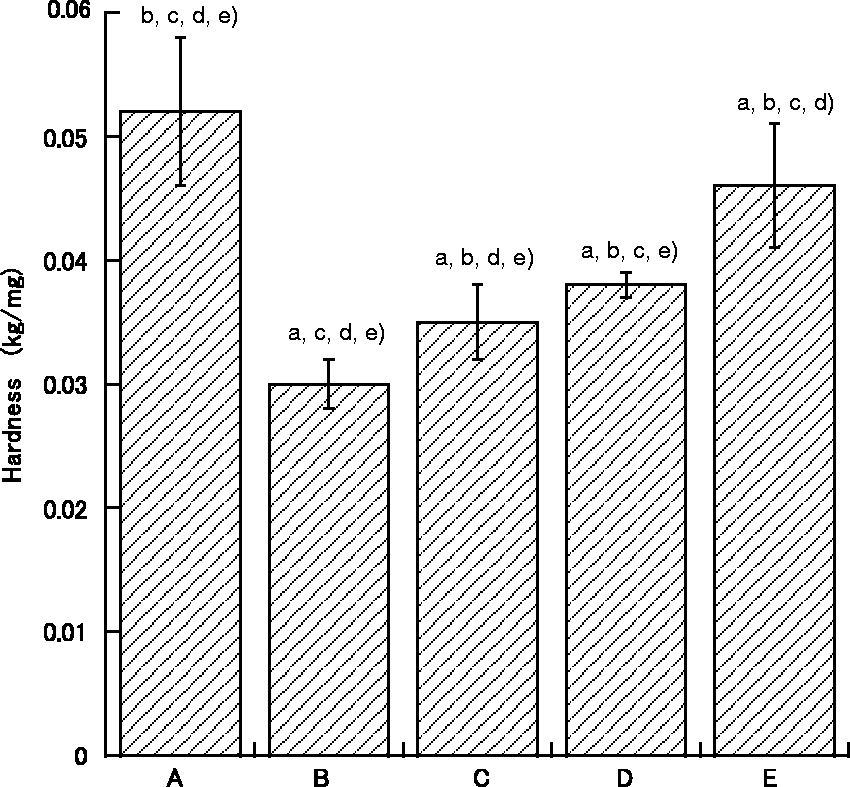
Hydrophilia
The wetting time (Figure 3) of formulation E (9 s) was significantly shorter than that of formulations A (27 s), B (34 s), C (28 s), and D (29 s).
Wetting time of OD tablets. (a) p < 0.05 vs. A; (b) p < 0.05 vs. B; (c) p < 0.05 vs. C; (d) p < 0.05 vs. D; (e) p < 0.05 vs. E. Values are presented as means ± S.D. (n = 4).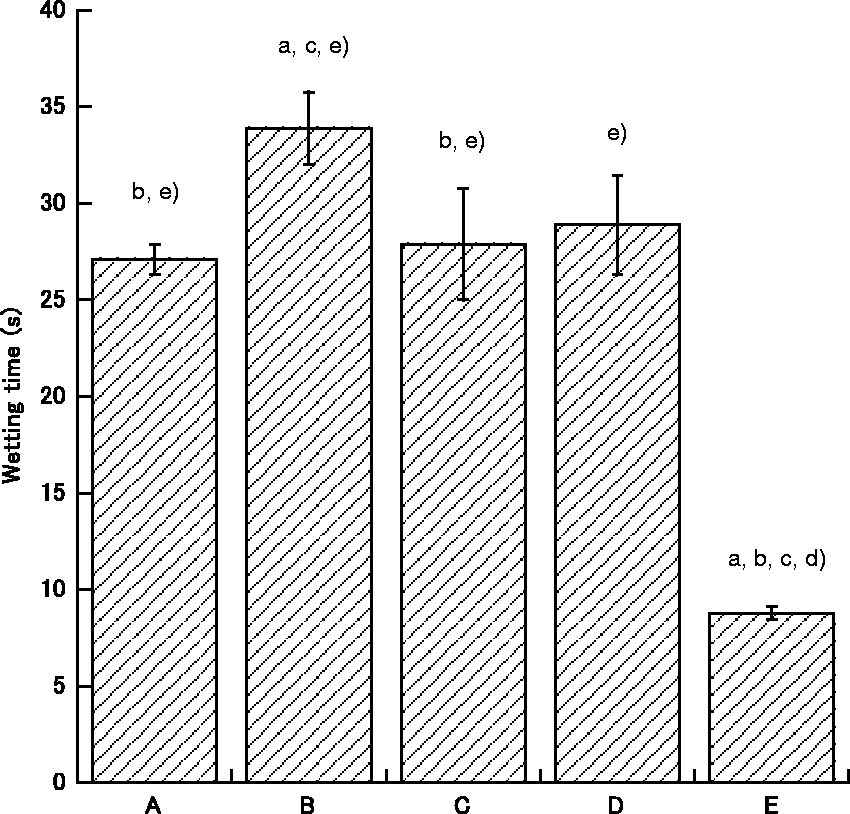
Disintegration in the oral cavity
The disintegration time of OD tablets and films in the oral cavity is shown in Figure 4. The disintegration time of formulations E (15 s) and F (15 s) was significantly shorter than that of formulations A (23 s), B (26 s), C (25 s), and D (22 s).
Disintegration times of OD tablets and films in oral cavities. (a) p < 0.05 vs. A; (b) p < 0.05 vs. B; (c) p < 0.05 vs. C; (d) p < 0.05 vs. D; (e) p < 0.05 vs. E; (f) p < 0.05 vs. F. Values are presented as means ± S.D. (n = 45).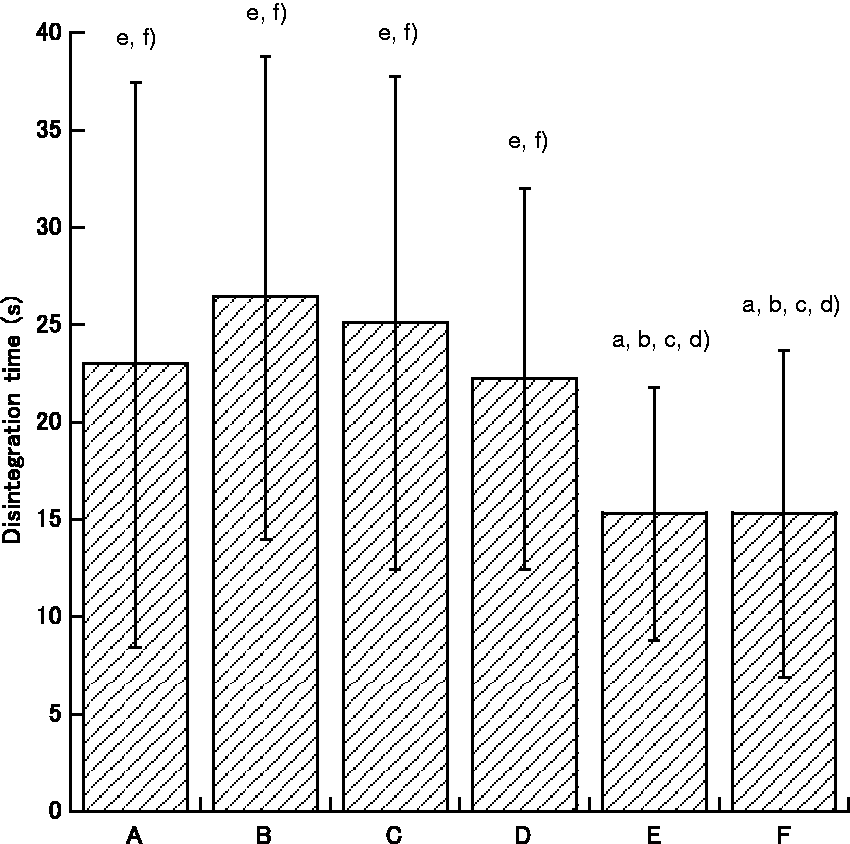
Taste, mouth feeling, and palatability
Taste, mouth feeling, and palatability of OD tablets and films were determined in healthy subjects (Figure 5). In these assessments, more than 50% of subjects reported strong or weak bitterness for formulations B, C, D, E, and F, whereas more than 80% of subjects reported no bitterness for formulation A. Most subjects reported no granular/rough and powdery sensations in mouth feeling tests for formulation F, and more than 80% of subjects described formulations A, E, and F as easy to take, indicating good palatability of these formulations.
Taste, mouth feeling, and palatability of OD tablets and films. (a) Sweetness, (b) bitterness, (c) mentholated taste, (d) granular/rough, (e) powdery, and (f) palatability.
Discussion
PTP requiring pushing out strengths of 20–30 N are reportedly easy to open. 12 Therefore, the strength required for pushing out from a PTP for the studied formulations was approximately 20 N (Figure 1), confirming ease of pushing out in all cases.
Hardness was more than 0.030 kg/mg for all formulations (Figure 2), accommodating the use of automatic packing machines for all the studied tablets. 13 These data suggest that all the studied tablets had sufficient strength to endure fall impact in automatic packing machines. Previous studies demonstrate that friability of less than 1% is suitable for carrying from one place to another.8,9 Therefore, all the present tablets had friability of less than 1%, suggesting sufficient durability to withstand vibrations of carrying without damage. It is accepted that differences in hardness and friability among formulations reflect differing additives and compression pressures.
Immersion wetting is a widely demonstrated approach for determining solid hydrophilia of formulations. 14 In the present study, immersion wetting rates of formulation E were significantly shorter than those of other formulations (Figure 3), presumably reflecting differences in additives.
Disintegration times of formulations E and F in oral cavities were significantly shorter than those of other formulations (Figure 4) and showed similar tendencies to wetting times (Figure 3). These findings indicate that hydrophilia is strongly associated with the disintegration of OD tablets in the oral cavity. Patients reportedly feel no major stresses from tablets with disintegration times within 60 s, 15 indicating suitable disintegration time of all of the present formulations.
Taste, mouth feeling, and palatability of OD tablets and films differed among formulations (Figure 5), and more than 50% of subjects reported strong or weak bitterness for formulations B, C, D, E, and F. However, more than 80% of subjects reported no bitterness for formulation A, potentially reflecting the use of a patented coating technology for amlodipine besilate formulation A. 16 In subsequent evaluations, most subjects reported no granular/rough and or powdery sensations for formulation F, reflecting the absence of insoluble additives in this film formulation. Finally, more than 80% of subjects described formulations A, E, and F as easy to take. Hence, the palatability of OD tablets and films was in agreement with subject-reported sweetness and bitterness, level of mentholated taste, and sensations of granular/rough and powdery.
Conclusions
In this study, the physicochemical qualities of OD tablets, including pushing out from a PTP, tablet strength, and hydrophilia, were examined, and the ingestibility including disintegration time, taste, mouth feeling, and palatability of OD tablets and films were evaluated. In these physicochemical assessments, only hydrophilia differed among the OD tablets. However, the ingestibility of OD tablets and films significantly differed, providing useful criteria for individualized selection of high value-added amlodipine besilate formulations.
Footnotes
Ethical approval
All procedures involving human participants were performed in accordance with the ethical standards of the institutional and/or national research committee and with the 1964 Helsinki declaration and its later amendments or comparable ethical standards. Informed consent was obtained from all subjects included in the study.
Declaration of conflicting interests
The author(s) declared no potential conflicts of interest with respect to the research, authorship, and/or publication of this article.
Funding
The author(s) received no financial support for the research, authorship, and/or publication of this article.