




Abstract
Over the last few years, multiple media reports have commented on compulsory licensing of pharmaceutical patents in India. A majority of these reports painted a doomsday scenario and were devoid of facts. The grant of India’s sole compulsory licence in March 2012 (to Natco for Bayer’s patented drug – Sorafenib) spawned a series of media reports theorising that the grant of this compulsory license was ‘… a major blow to global pharmaceutical firms’ and speculating a beginning of compulsory licensing era for pharmaceuticals patents. However, this simply has happened and India till date has rejected all subsequent compulsory licence applications filed after the Natco/Sorafenib compulsory license application. The purpose of the present article is to collate the present information around the various compulsory licences in India and provide some historical background at a time when even developed countries are beginning to issue compulsory licences for pharmaceutical products.
Background on compulsory licence (CL) applications
India has a long history of patent law, going back to the 1850s. 1 The present patents regime is enshrined within the Patents Act, 1970 2 (the 1970 Act) that was enacted after repealing the Indian Patents and Designs Act 1911 (the 1911 Act).
Pursuant to an earlier version of the Patents Act, 1970, India allowed only process patents within the drug/pharmaceuticals and food domain until 2005. Changes were made in stages to the Patents Act, 1970 in 1999, 3 2002 4 and 2005 as a part of India’s Trade Related Aspects of Intellectual Property Agreement (TRIPs Agreement) commitments. India restarted issuing product patents for pharmaceuticals from 2005. 5
The Indian Patents and Designs Act of 1911 was amended in 1952 (vide Act LXX of 1952) to provide CLs for both product and process patents in the food, medicine, insecticide, germicide or fungicide domain or inventions capable of being used as surgical or curative devices 6 as well as provide a mechanism called ‘Licence of Rights’. 7 This effectively meant that an interested person could get a license for such patents as a matter of right – hence the term ‘Licence of Rights’ mechanism. 8
The 1970 Act was a big game changer; for instance, it removed product patents in the food, drugs and related areas (i.e. it disallowed product claims in these areas). The 1970 Act carried forward the ‘Licence of Rights’ mechanism. Patents pertaining to food and drug were deemed endorsed with a ‘Licence of Right’ after the expiry of three years from the grant of patent. 9 The ‘Licence of Rights’ feature was almost directly and wholly borrowed from the corresponding legislation in the United Kingdom (for instance, section 35 of the UK Patents Act of 1949). Certain forms of this ‘Licences of Right’ provisions are still present in patent legislations of various Commonwealth jurisdictions, including the United Kingdom (section 46).
The 1970 India legislation also provided for grant of Compulsory Licences (hereinafter, referred as CL) only under specific grounds. The 1970 Act was amended in 2002 and the chapter titled ‘Licences of Right’ was removed. Additionally, the provisions relating to CLs in sections 82 through 94 were revised. The Act states that a CL can be sought from the Controller of Patents by a license seeker if it can show any of the below three grounds:
10
that reasonable requirements of the Indian public with respect to the patented invention have not been satisfied, or that the patented invention is not available to the public at a reasonably affordable price, or that the patented invention is not worked in the territory of India.
Additionally, a compulsory license to manufacture and export patented pharmaceutical product to a country having insufficient or no manufacturing capacity in the pharmaceutical sector for the patented product to address public health problems is also provided. 11 It is to be noted that such a CL can be issued by the Controller only if the destination country has granted a CL on the corresponding patent or has, by notification or otherwise, allowed importation of the patented pharmaceutical products from India.
Over the last few years, a number of media reports/speakers/stakeholders have commented on the CL situation in India and there is a lot of fiction mixed in a very small amount of facts. The grant of a CL in March 2012 (granted to Natco for Bayer’s patented drug – Sorafenib) spawned a series of media reports globally that tried to argue that the grant of this compulsory license was ‘… a major blow to global pharmaceutical firms’ 12 and that this grant would lead to the opening of floodgates to issuance of further compulsory licenses. However, nothing of that sort happened and the reality is that till date, India has rejected all subsequent licence applications apart from the sole Natco/Sorafenib CL.
Earlier licence applications
Official data pertaining to CLs in India, prior to the Sorafenib licence, either under the 1911 Act or the 1970 Act is sketchy at best. The Ayyangar Committee Report 13 has data for the 1911 Act and gives the following data on compulsory license activity in India for the period 1950–59:
No compulsory license was granted in pharmaceutical/chemical domain during the above period. A 1984 Thesis by Sudip Chaudhuri states the following:
14
Till 1972, i.e. when a new Act came into force, there were only five applications for compulsory licence made by Hindusthan Antibiotics Ltd (in 1959), Alembic Chemical Works (1963), Dey’s Medical Stores (Manufacturing) (1960), Raptakos Brett & Co (1957) and Neo Pharma Industries (1961). The applications were ultimately withdrawn in the first two cases.
On a related note, in a 2007
19
paper, Janice Mueller mentions that ‘fewer than half a dozen compulsory licences have been granted in the history of India’s patent system’. It is unclear as to whether Mueller is referring to licences under the 1911 Act or the 1970 Act. That said, in the present author’s checks, the sole granted
Present position
The purpose of the present article is to only focus on the information around the various drug/pharmaceutical CL requests made under the 1970 Act. The next section gives a short description on the individual cases.
A lot has been written on the
The
While it is not clear if Natco also applied for an export-related CL for a third product, a Department of Industrial Policy and Promotion (hereinafter, DIPP) paper states:
26
In September 2007, three applications under section 92A of the Patents Act, 1970 were received for grant of compulsory licence for the manufacture and export of patented drugs to countries which reportedly did not have manufacturing capacity nor had insufficient capacity. The process envisaged under the Act was initiated. However, the applicant subsequently withdrew his applications.
Natco’s 2010 request for a CL
27
to manufacture and sale in India
Similarly, not much information is available on the Cipla/
BDR pharma sought a CL on
Lee Pharma requested a CL for AstraZeneca’s patent on
Cipla had taken a different route against the patents covering
The Health Ministry angle
The Ministry of Health & Family Welfare had, in January 2013,
35
sent a letter to the DIPP (DIPP comes under the Ministry of Commerce & Industry) recommending that three drugs – Dasatinib, Trastuzumab and Ixabepilone – be placed under the CL regime. The
The US IBC and Government of India's 2016 statements
A 2016 development is worth mentioning here. The US India Business Council (USIBC), in a letter36 dated 05 Feb 2016 addressed to the Office of the United States Trade Representative stated that ‘The Government of India has privately reassured India it would not use Compulsory Licenses for commercial purposes’. This letter caused a lot of concern that access to affordable medicines could be impacted; for instance, the medical charity Medecins Sans Frontieres (MSF) expressed concerned and said,37 ‘Such a commitment will encourage multinational drug companies to start charging unaffordable prices to Indian patients and governments across the developing world, further undermining access to critical, and life-saving products'.
Amidst this media uproar, India’s Commerce Ministry had to then issue a clarification38 stating ‘(India) retains the sovereign right to utilize the flexibilities provided in the international IPR regime. It may be noted that to date, there has been only one case of compulsory license in India and that too after a well-thought out and laid down process, which was subsequently upheld right up to the highest Court of the land.’ Likewise, the USIBC also issued a clarification39 stating ‘USIBC recognizes and supports the Government of India’s sovereign right to issue a compulsory license (CL).’
Conclusion
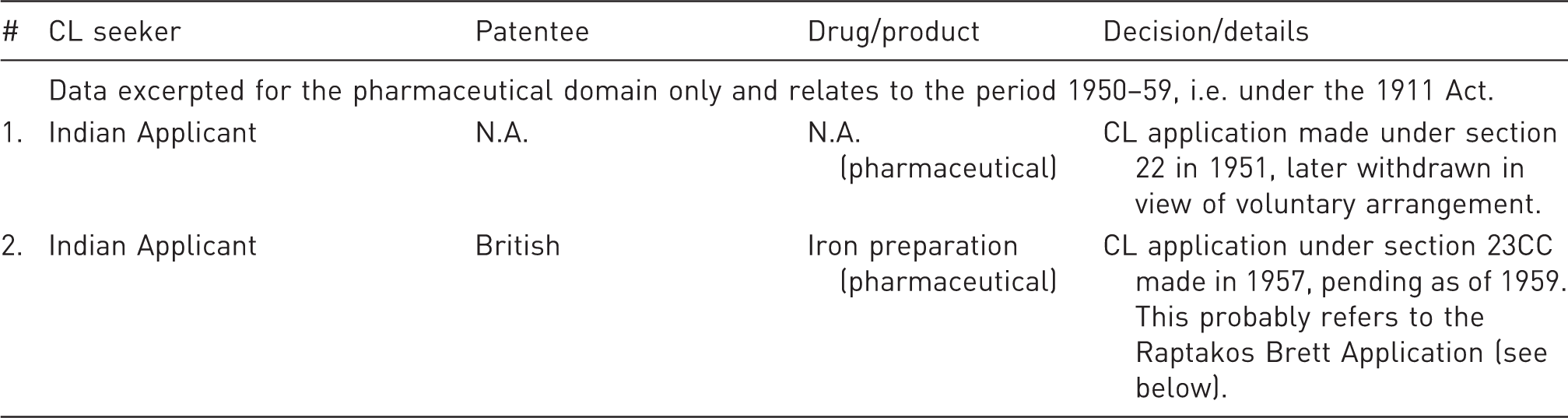
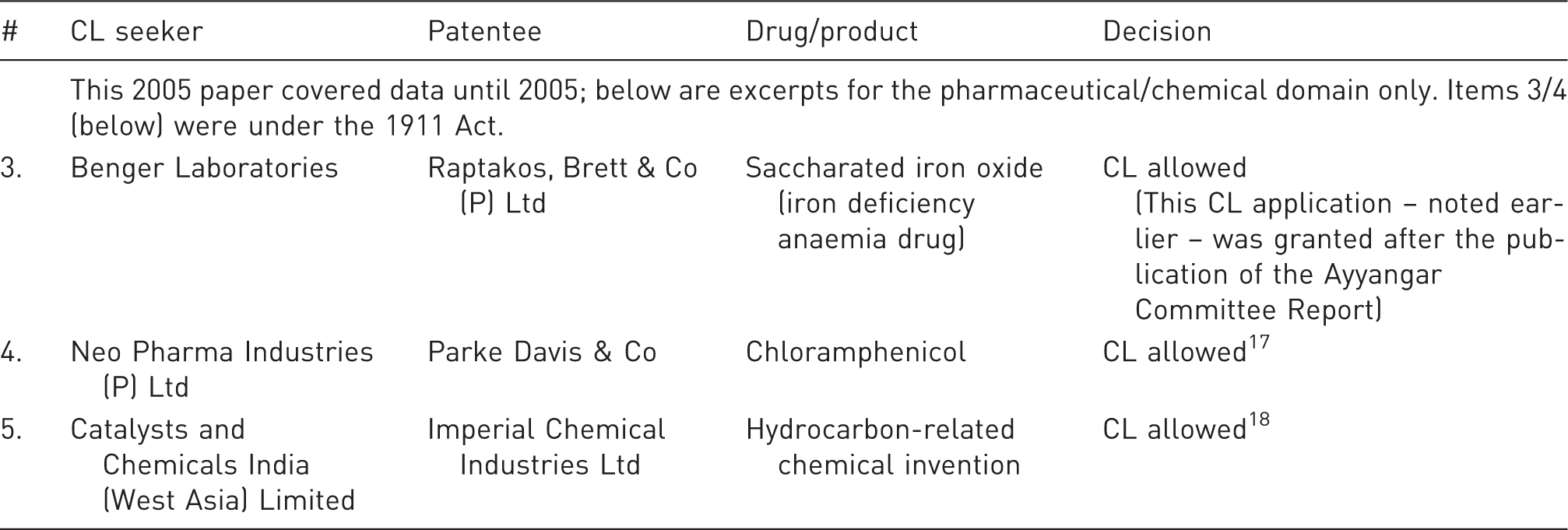
Raw data for Pharmaceutical/Drug CLs under the 1970 Act – period 1970 through December 2016

Footnotes
Acknowledgments
The author is deeply indebted to the work done by Ms. Janice Mueller, Prof. Sudip Chaudhuri, Ms. Mrinalini Kochupillai and Prof. Shamnad Basheer. A sincere thank you is due to senior practitioners – Mr. Guru Nataraj and Mr. Feroz Ali for the discussions over the years and to Ms. Devika Agarwal and Ms. Sufiyah Sulaiman for their help in reviewing draft versions of this article.
Author's note
The discussion in this article is based on information in the public domain as of 31 December 2016. Errors, if any, are the sole responsibility of the author. The observations and submissions contained in this article are entirely personal and should not be attributed or construed to reflect the views of the author’s present or past employer(s). The author welcomes all comments/counter-views/inputs to his mail ID.
Declaration of conflicting interests
The author(s) declared no potential conflicts of interest with respect to the research, authorship, and/or publication of this article.
Funding
The author(s) received no financial support for the research, authorship, and/or publication of this article.