




Abstract

Compiled and written by Greenblum & Bernstein, PLC
A US intellectual property law firm which provides a full range of services in IP-related matters across all industries, including the biotech and pharmaceutical industries, including:
Inter partes Review (IPR) and Post Grant Review (PGR)
Abbreviated new drug applications (ANDAs) and Notice Letters
Patent and trademark litigation
Patent drafting and prosecution
Patent infringement and validity opinions
Patent reexamination proceedings and interferences
New drug strategies
Market entry strategies
Joint venture strategies
Licensing
This section is intended to be a synopsis of recent developments and is not intended to be exhaustive. If any issue is referred to in this section is to be relied upon, specific advice should be sought. Please contact:
Paul A Braier, PhD, Esq.
Greenblum & Bernstein, PLC
1950 Roland Clarke Place
Reston, VA 20191
USA
Tel: + 1 703 716 1191
Fax: + 1 703 716 1180
Email: pbraier@gbpatent.com
Web: www.gbpatent.com
What companies need to know about FDA’s Final Rule on ANDAs and 505(b)(2) applications
Partner, Greenblum & Bernstein, PLC, Reston, USA
This article provides a summary of important regulatory changes that affect ANDAs, 505(b)(2) applications, and the applicants that file them.
ANDA
505(b)(2)
Orange Book
Paragraph IV
MMA
Introduction
On 8 December 2003, President George W Bush signed into law the Medicare Modernization Act (MMA), which enacted the most significant reforms to the US law of generic medicines since the Hatch–Waxman Act passed in 1984. 1 Among other policies, a major goal of the MMA was to curb or end abuses, and close loopholes that resulted in delayed marketing of generic products. 2 For example, some of the now-familiar provisions of the MMA ended stacking multiple 30-month stays of generic approval; instituted the counterclaim in Hatch–Waxman lawsuits for correcting or delisting Orange Book patents; replaced the “market trigger” for the 180-day generic exclusivity by new forfeiture provisions; and required filing certain generic–generic and generic–brand agreements with the Federal Trade Commission.
The Hatch–Waxman Act was a large, comprehensive law, and the MMA amendments made it even larger and more complicated. Rather than immediately issue new rules for implementing the MMA, The U.S. Food and Drug Administration (FDA) instead chose to implement the law directly from the statute for a number of years. In February 2015, over 11 years after passage of the MMA, FDA finally published, for the first time, a set of proposed rules. After a notice-and-comment period to allow public input, FDA issued the Final Rule on 6 October 2016, 3 nearly 13 years after the law took effect.
The Final Rule came into effect on 5 December 2016, and applies in its entirety to all newly-filed New Drug Applications (NDAs), Abbreviated New Drug Applications (ANDAs), and 505(b)(2) applications that are submitted after that date. 4 Certain rules also apply to applications that were pending on the effective date, namely: provisions relating to patent amendments, Orange Book listing of new patents, Orange Book patent challenges, and reporting court decisions.
This article outlines some of the more important and/or interesting provisions of the new regulations, and the impact they may have on ANDAs and 505(b)(2) applications.
The Final Rule
New definitions and terminology
It is important when terms of art are used that everyone has a common understanding of what the terms mean. Some definitions (e.g. commercial marketing) have the potential to substantially impact generic companies and brand–generic litigation settlements. Definitions are found in 21 U.S.C. § 314.3.
505(b)(2) Application
This is now defined as a subset of 505(b)(1) applications. An unstated implication of this definition is that all of the regulations that apply to branded NDAs would appear also to apply to 505(b)(2) applications.
Reference standard and reference listed drug
The reference standard is defined as the drug product (e.g. particular dosage strength) selected by FDA for which an ANDA applicant must perform bioequivalence studies. The reference standard is to be distinguished from “reference listed drug” which now encompasses all dosage strengths of the product line of the reference standard. FDA has completed revisions to the Orange Book listings to reflect these definitional changes. 5
Acknowledgement Letter
This is the name officially adopted to refer to the written communication FDA sends an ANDA applicant that the ANDA is sufficiently complete to permit substantive review, and has therefore been “received” by FDA. As defined, this term does not apply to 505(b)(2) applications, just ANDAs.
Paragraph IV Acknowledgement Letter
This is the name officially adopted to refer to the written communication from FDA that a 505(b)(2) or ANDA with P-IV is sufficiently complete for substantive review. This term applies to both ANDAs and 505(b)(2) applications, provided they have a P-IV patent challenge.
Commercial marketing
Commercial marketing means introduction into interstate commerce of an ANDA drug or an authorized generic (AG) outside control of the ANDA holder. FDA uses this concept to determine when the 180-day generic drug exclusivity is triggered. More on this in the following section.
Commercial marketing
Though tucked into the definitions section of the Final Rule, the above definition can have major ramifications for ANDAs. For example, FDA considers transfers of drug product from a manufacturer to a third-party distributor to be a triggering commercial marketing event.
Moreover, the definition clearly contemplates that the marketing of an AG should trigger the 180-day period. Any brand–generic settlement or brand–AG contract should take this into account when the agreement is being drafted.
It often happens that a generic drug product is manufactured by one division of a company, and the marketing in the US is done by a different division of the same company. When this is the case, is it possible that FDA might consider a transfer of product from one division to another to constitute commercial marketing. Therefore, it is important that ANDAs and 505(b)(2) applications identify both manufacturer and marketer in order to avoid early triggering of the exclusivity.
The various implications of FDA’s new definition of “commercial marketing” have not yet been challenged in court, and it remains to be seen whether they will be upheld.
FTF marketing notice
This new provision 6 requires the holder of an approved first-to-file (FTF) ANDA with 180-day exclusivity rights to notify FDA within 30 days of its first commercial marketing of the drug. The purpose of this requirement is to give FDA the information needed to know when non-first filers can be given final approvals.
This section also provides a penalty for failure to inform FDA. If an FTF ANDA holder does not inform FDA within 30 days of marketing, FDA will deem the commercial marketing to have commenced on the day of final approval.
Drug products for which there is a single FTF are extremely rare these days. Typical FTF litigations involve several defendants, anywhere from three or four, to in excess of 20 FTF filers. The FDA rule does not address what happens to the group if even one FTF filer neglects to timely notify FDA of commercial marketing. If any generic actually begins marketing on the day of final approval, then there is no harm. But if the first commercial marketing of a generic takes place later, and even a single generic neglects to notify FDA of commercial marketing, a strict reading of the rule suggests that FDA will shorten the 180-day exclusivity so that it ends 180 days from final approval, not 180 days from first actual marketing. The 180-day exclusivity belongs to the entire group of eligible FTF filers, not to each FTF filer individually. So shortening the 180-day exclusivity shortens it for the entire group of FTF filers, not just the ANDA applicant(s) that failed to inform FDA. This could well be an unintended consequence of the rule, and it remains to be seen how FDA will hold in this sort of situation.
New NDA Orange Book requirements
In order to address the problem of overly broad Use Codes, FDA has revised the rules for submitting method-of-use patents for listing in the Orange Book. 7 Under the new rules, when the NDA holder submits a Use Code, it must also specifically identify sections of the package insert that support the Use Code.
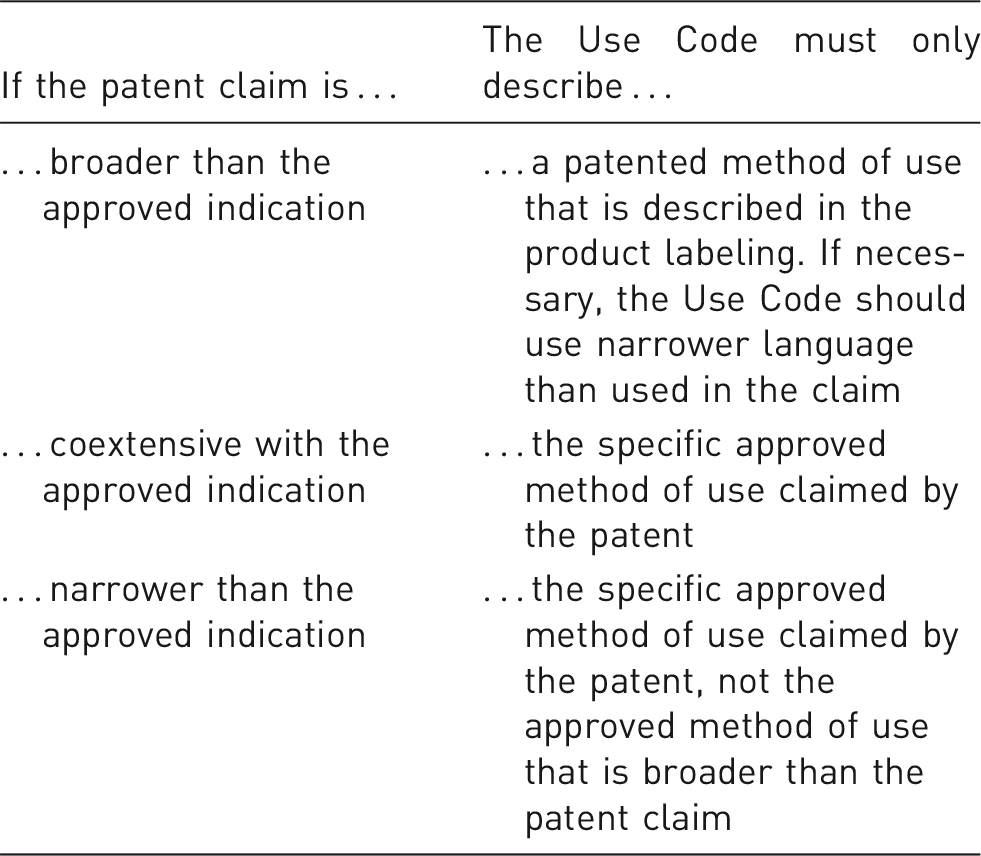
These new Use Code requirements do not apply retroactively—FDA expressly chose not to impose a requirement to update any Use Code that does not meet the new requirements. However, the new requirements apply to all new NDAs and 505(b)(2) applications, as well as to any new or revised patent listings in old NDAs and 505(b)(2) applications.
While FDA has not broadly required updating patent listings, the Final Rule does impose a new requirement that the NDA holder must notify FDA:
“promptly,” if the patent no longer meets the requirements for listing (e.g. a non-appealable finding of invalidity)
9
; within 14 days, if a court orders the NDA holder to withdraw or amend the listing
10
; or if the patent is granted a Hatch–Waxman patent term extension by the US PTO (no defined time limit for notification).
11
In keeping with its long-standing policy, however, FDA will not delist a patent from the Orange Book if doing so will have an impact on a first-filer’s 180-day exclusivity.
12
New patent listing challenge procedure
The Final Rule includes an entirely re-vamped Orange Book patent challenge procedure 13 to replace the former ineffective procedure. The new procedure applies to all Orange Book patents, regardless when the NDA was filed or the patent listed. Under the new procedure, any person other than the NDA holder can challenge the listing of any patent listed for any NDA.
Broadly speaking, the procedure involves the challenger submitting a statement of dispute describing the specific grounds for disagreeing with the accuracy or relevance of the information listed in the Orange Book for the patent. If the dispute relates to accuracy or relevance of the Use Code, then the statement of dispute must only be a narrative description of the challenger’s interpretation of the scope of the patent. This narrative description is limited to 250 characters, suggesting that FDA is seeking what the challenger offers as a replacement Use Code. FDA does not review the submission, but instead sends it directly to the NDA holder, which has 30 days to respond to FDA concerning the challenge.
If the NDA holder confirms the correctness of the listing (or Use Code), FDA will not change the Orange Book information. If the NDA holder amends or withdraws the listing, or provides a new Use Code, FDA will update the Orange Book to reflect the new information. Unless the NDA holder requests amending the listing or withdrawing the patent, FDA will not make any updates to the Orange Book.
The FDA procedure does not provide the challenger with any redress if the NDA holder does not respond to the challenger’s satisfaction. It would appear that the challenger’s only redress would be in Federal court. The Final Rule permits anyone (other than the NDA holder) to initiate an Orange Book patent dispute. However, to seek redress in court, the challenger likely must have a threshold legal connection to the dispute, a requirement known as “standing.” 14 A challenger that has filed an ANDA with P-IV challenge to the disputed patent would almost certainly have standing to send the dispute to Federal court, but would there still be standing if the ANDA applicant did a P-III certification or section viii carve-out? 15 It is also not so clear whether an unidentified third party or an insurance company would have sufficient standing to bring the matter to court. These issues have not yet been addressed in court, but probably will over the coming years.
Notice Letter requirements and delivery
The Final Rule Certain revised some of the formal requirements for the content of Notice Letters, and has added a few new requirements. 16 While the new content requirements are not onerous by any means, it is important for the ANDA/505(b)(2) applicant to be aware of them lest the NDA holder challenge the sufficiency of the Notice Letter.
Under the new rule, a Notice Letter is deemed invalid if it is sent before receipt of the Paragraph IV Acknowledgement Letter. 17 For a patent that is newly listed after the FDA sends the Paragraph IV Acknowledgement Letter, the new rule deems the Notice Letter invalid if sent before the first working day after the patent is listed. 18
The Final Rule also somewhat simplifies sending and delivery of the Notice Letter.
19
Under the previous rule, the Notice Letter had to be sent using the US Postal Service (USPS) via registered mail—any alternative means of delivery would require advance permission from FDA. The new rule permits use of USPS registered or certified mail, and also permits use of any “designated delivery service” without requiring any advance permission from FDA. The rule does not list specific companies that qualify as designated delivery services, but spells out the requirement that must be met to qualify. A designated delivery service must:
be generally available to the public; regularly maintain electronic records of (or mark on the cover) the date on which the item (the Notice Letter) was given to the business for delivery; and must provide overnight or two-day delivery service throughout the United States.
Companies that would appear to qualify as designated delivery services probably include Federal Express, UPS, and DHL.
20
Parting words
This article is not intended to be a comprehensive detailed exposition of all aspects of the Final Rule. The Final Rule covers many aspects of ANDAs and 505(b)(2) applications not covered above. And some of the provisions discussed above include additional important details that were not practical to include in this article. Companies’ regulatory advisors should be aware of all the details to guide you through this maze. However, it is important that ANDA and 505(b)(2) applicants be sufficiently aware of the most important changes in order to know how the rules impact their current and future applications, and to enable the companies to make informed business decisions.
Disclaimer
Any opinions expressed herein are solely those of the author.
Footnotes
Declaration of conflicting interests
The author(s) declared no potential conflicts of interest with respect to the research, authorship, and/or publication of this article.
Funding
The author(s) received no financial support for the research, authorship, and/or publication of this article.