



Abstract
Aim: The objective is to study the availability and affordability of biosimilar medicinal products containing monoclonal antibodies, measure their drug utilization, and evaluate the rational drug use globally through analysis and systematic review of scientific articles published in the scientific literature.
Materials and methods: The documentary analysis of scientific publications was carried out by specific keywords in MEDLINE database, Central Medical Library, and national peer-reviewed scientific journals in Bulgaria for the period from January 2008 to May 2020. 100 scientific publications have been found for a period of 12 years. Articles were selected according to PRISMA. Analyses include 17 articles that fully meet the preset criteria. Descriptive and variational analyses were carried out as basic statistical analyses. Mean values, standard deviation, minimum, maximum, and 95% confidence intervals have been determined.
Results and discussion: Studies on this topic in EU Member States are obviously of interest, but publication activity is not high—only 17 scientific publications over a 12-year period. All 17 studies reflect cost savings after switching from a reference biological medicinal product to a biosimilar medicinal product, and the reduction in budgetary costs as a weighted average is about 30% of the total budgetary costs of biological therapies for the first 5 years. All 17 studies have reported that the use of biosimilar medicinal products is rather low. Although the quality, safety, and efficacy of biosimilar medicinal products have been unequivocally established, their introduction to the market is still insufficient.
Keywords
Introduction
Rational drug use means that patients receive medicinal products suitable to their clinical needs in doses, which meet their individual needs, for a sufficient period of time and at the lowest possible cost to them and the community.1,2 A medicinal product can be defined as available only if it has marketing authorization and a registered price. The same medicinal product is defined as accessible if it is available and included in a reimbursement system from a public, private, and/or government fund.3,4
Biosimilar medicinal products (BSMPs) by their nature are biological medicines that are very similar to other biological medicinal products, which have already been approved in the EU—the so-called “reference biological medicinal products.” The “similar biological” medicinal product and the “reference” medicinal product are expected to have the same safety and efficacy profile and are used for treatment in the same settings.5,6 The main objective of the European regulatory framework is to determine the similarity of a biological product to a reference biological medicinal product.
Biosimilar medicinal products are authorized under a Centralized Procedure according to Regulation (EC) No 726/2004. 7 If a biosimilar medicinal product has proven similarity to a reference medicinal product and comparable safety and efficacy with respect to one therapeutic indication, the safety and efficacy data may be extrapolated to all other indications that have already been approved for the reference medicinal product. 6 A BSMP must not be placed on the EU market until the expiry of 10 years after the initial marketing authorization of the reference product. The 10 year period is called “data exclusivity” period. 8 “Data exclusivity” period of reference BMPs is in the process of expiry and BSMPs are already available on the market. BSMP share is expected to increase gradually, resulting in reduction of the drug provision costs and increase in the patients' access to biological treatment.
Aim of the study
The primary objective of the study is to conduct a retrospective analysis of scientific publications on the availability and affordability of BSMP, containing monoclonal antibodies, published in the scientific literature. The secondary objective is to determine the drug utilization and rational drug use in accordance with WHO criteria for BSMP, containing monoclonal antibodies.
Materials and methods
The main method used in this study is the so-called documentary method—data analysis from a systematic review of specialized medical scientific literature. The systematic review was carried out in accordance with the recommendations of the Preferred Reporting Items for Systematic Reviews and Meta-Analyses (PRISMA) Guidelines.9,10 PRISMA is an evidence-based minimum set of items for reporting in systematic reviews and meta-analyses. It was designed to focus mainly on the reporting of reviews evaluating randomized trials but can also be used as a basis for reporting systematic reviews of other types of research, particularly evaluations of interventions. The set has been modified for use when conducting and reporting prior reviews. A study protocol was developed according with PRISMA 2009 Checklist, 11 with predetermined: topic, design, search strategy, inclusion and exclusion criteria, data collection methods, data analysis and statistical evaluation, and conclusions. The protocol is not preliminarily registered in the PROSPERO system (International prospective register of systematic reviews) because the study is limited to a systematic review of scientific publications without conducting a meta-analysis. It will be carried out at a later stage.
The topic of the systematic review is a study of the drug use, availability, and affordability of biosimilar medicinal products containing monoclonal antibodies, according to data from the scientific literature. Design: retrospective observational study. Search strategy: An active search for scientific publications by the following keywords in English was carried out: Biosimilar medicines, Availability, Affordability, Monoclonal antibodies, Drug utilization, Rational drug use, and Biosimilar medicinal products containing monoclonal antibodies. Study period and types of databases: The search for scientific publications was carried out in MEDLINE database, Central Medical Library, and national peer-reviewed scientific journals in Bulgaria for the period from January 2008 to May 2020. For a period of 12 years, we found 100 scientific publications on biosimilar medicinal products. Evaluated results and inclusion criteria: Only scientific publications containing analysis of biosimilar medicinal products were analyzed. The criteria for inclusion of scientific publications in the analyses are the following: the scientific article must contain data of biosimilar medicinal products containing monoclonal antibodies; data of drug use analysis, availability, and availability of biosimilar medicinal products. Data retrieval: Two of the authors, independently of each other, retrieve data from the scientific articles determined as eligible to meet the inclusion criteria. The following data have been retrieved for this study: surname of the first author, year of publication, country of origin, type of scientific communication, types of biological medicinal products, type of studies, designs, frequency of articles on specific medicinal products by INN, average duration of studies, countries, where studies were conducted, availability of pharmacoeconomic analyses, analyses of the budgetary impact in the scientific publications, etc. Statistical analyses: The open-source statistical software Jamovi and Microsoft Excel 2016 were used. Descriptive and variational analyses were carried out as basic statistical methods. We determined mean values, standard deviation, minimum, maximum, and 95% confidence intervals at significance level of α is 0.05, the null hypothesis was rejected at р<0.05. The results of the conducted analyses are presented as absolute and relative frequencies in one-dimensional and two-dimensional tables of frequency allocation.
Results
The selection of the analyzed scientific articles, conducted according to the search strategy, is presented as PRISMA flow-diagram (Figure 1). Overview of the searching process - PRISMA flow-diagram.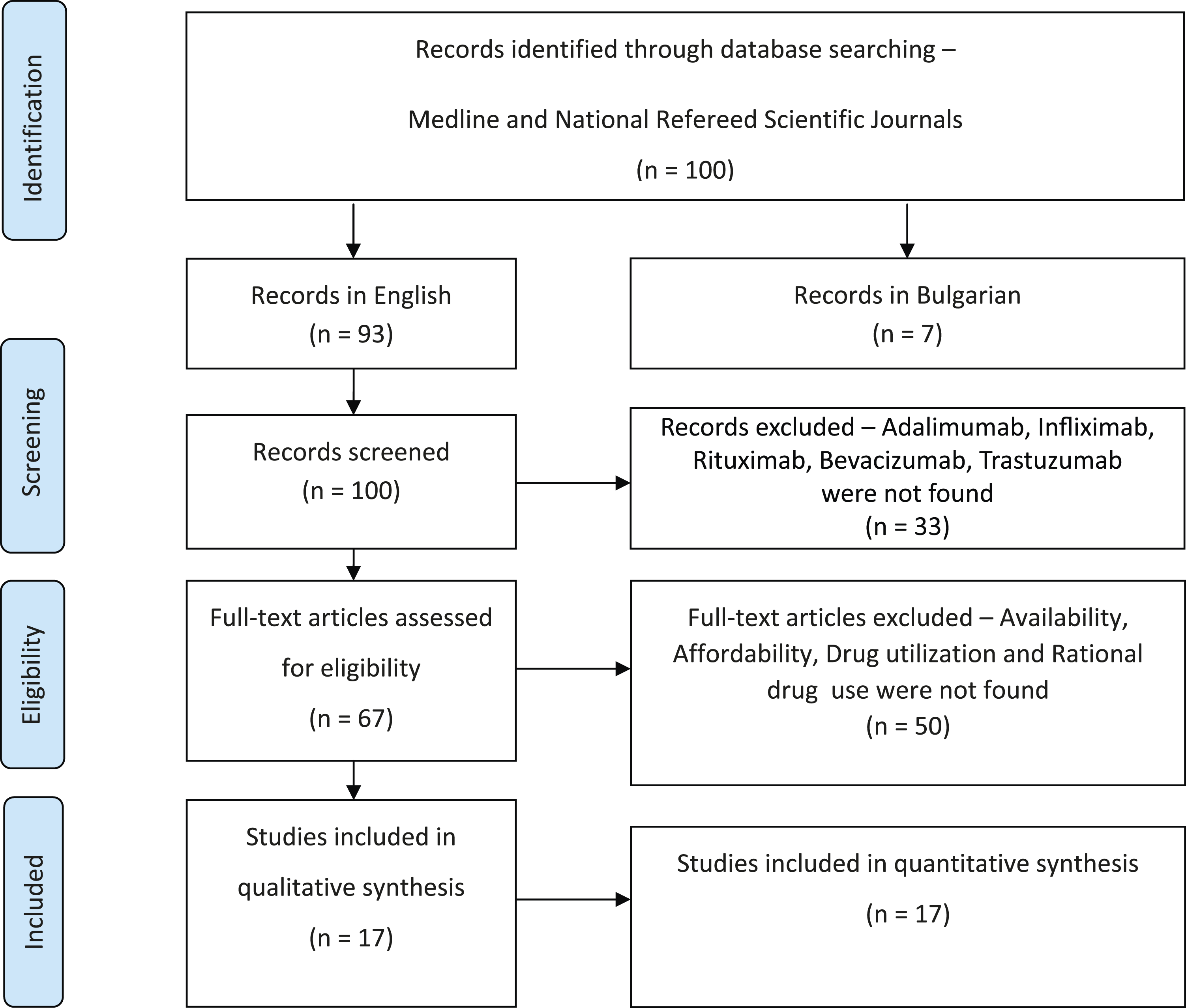
The literature search is limited only to articles published in English and Bulgarian. We found 100 scientific publications during the initial search. We screened 100 titles and abstracts, followed by a search for the full texts of the articles. We excluded 33 articles because the contents did not contain the keywords adalimumab, infliximab, rituximab, bevacizumab, and trastuzumab. At the final stage, we excluded 50 full-text articles from the remaining 67 articles, as they did not contain data of the availability, affordability, and rational use of biosimilar medicinal products.
Relative share of scientific publications sorted by INN (n-17).
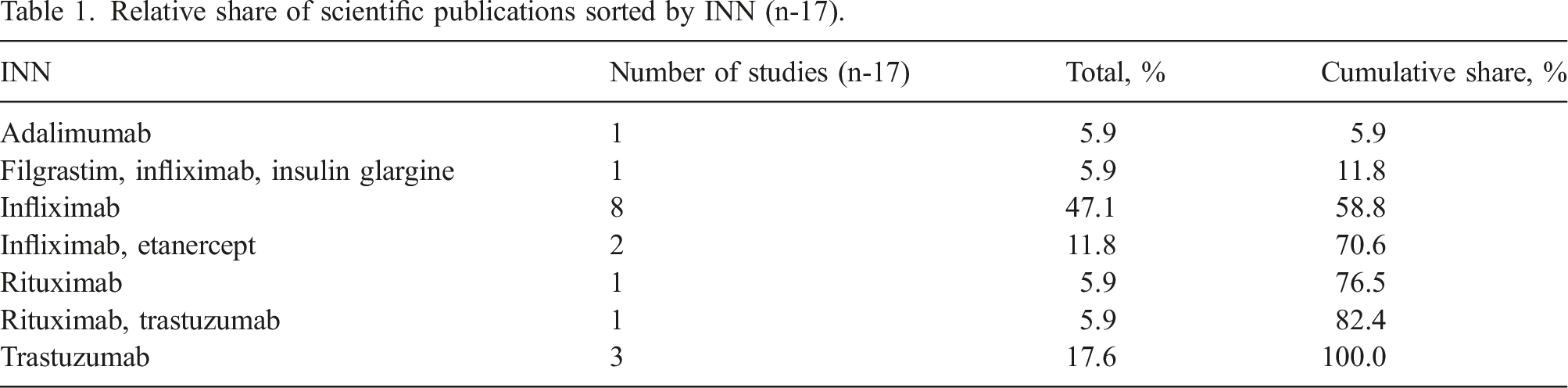

Relative share of publications by INN.
Duration of the studies.
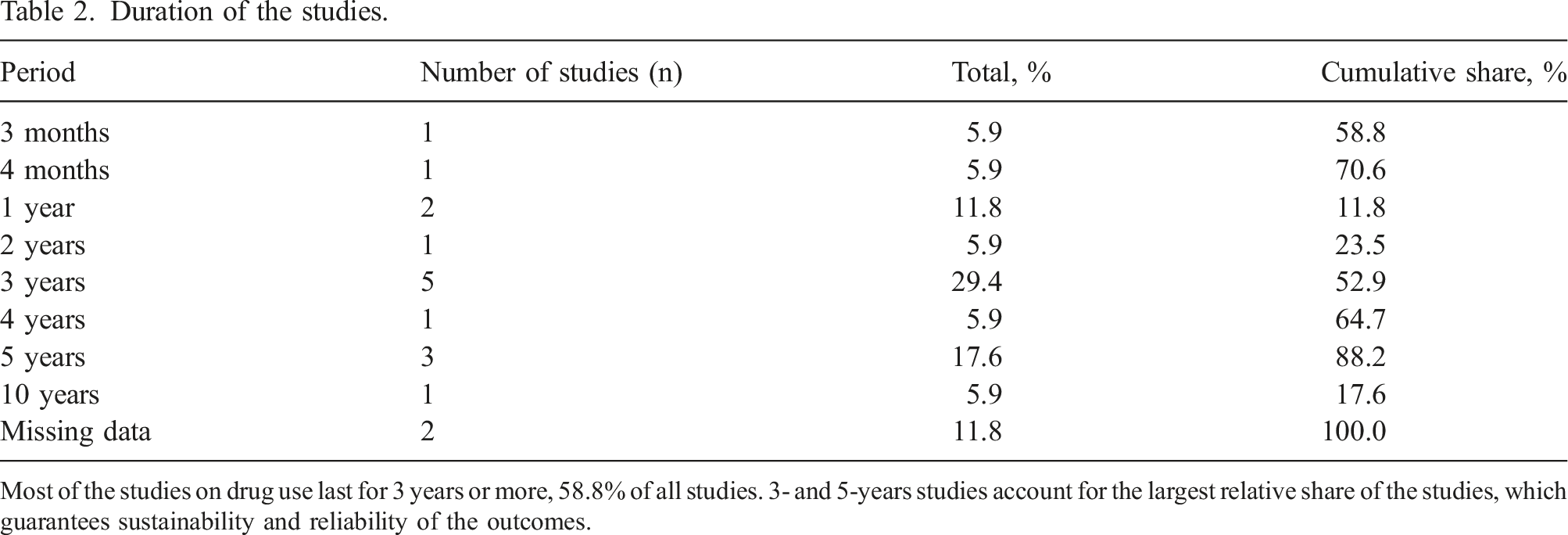
Most of the studies on drug use last for 3 years or more, 58.8% of all studies. 3- and 5-years studies account for the largest relative share of the studies, which guarantees sustainability and reliability of the outcomes.
Types of studies.
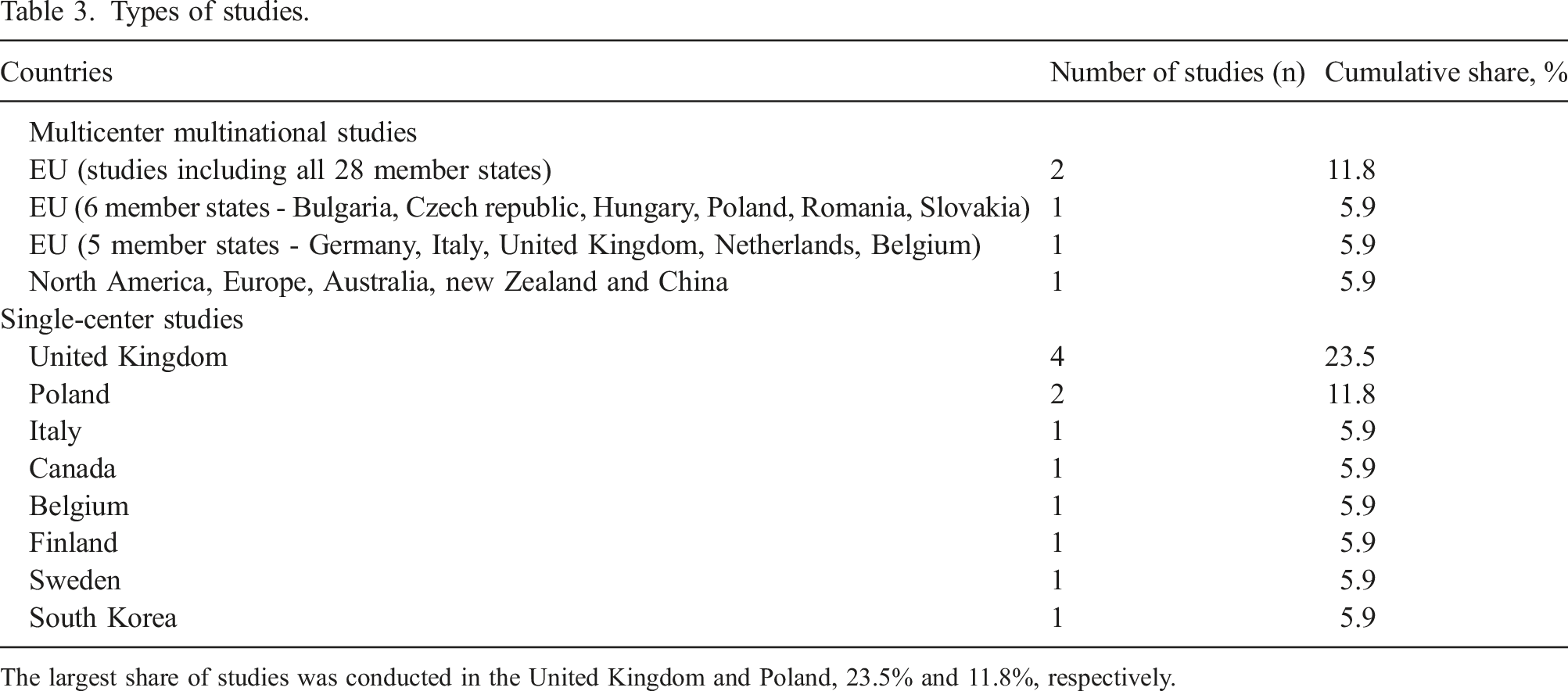
The largest share of studies was conducted in the United Kingdom and Poland, 23.5% and 11.8%, respectively.
Study design.

Outcomes.

Surveys show the need for better information of politicians and healthcare professionals about the quality, safety, and efficacy of the BSMP, and the potential benefits of budget savings by increasing the use of biosimilar medicinal products.
The remaining six studies describe how competition between biosimilars and reference biologic products reduces the costs for the paying institution and improves patients' access to biologic therapy in general.
Discussion
Mansell K. et al. conducted a study to evaluate potential cost savings that have resulted from the use of biosimilar filgrastim, infliximab, and insulin glargine in Canada and found that the overall use of biosimilar drugs in Canada was low. The team concludes that politicians, healthcare professionals, and patients need to be informed of the potential savings by increasing the use of biosimilar medicinal products, especially in an increasingly expensive healthcare system. 12
Similar results were also observed in a study conducted by Peyrin-Biroulet L. et al. concerning the use of biosimilar medicinal products for treatment of Crohn’s disease—significant savings in the treatment costs after switching from biological adalimumab to biosimilar one were established. 13
In 2019, Lee SM. et al. conducted the budget impact assessment after switching from biological trastuzumab to biosimilar trastuzumab in the treatment of breast and stomach cancer in 28 European countries. The team estimated that the budget savings could be between EUR 0.91 billion and EUR 2.27 billion over the next 5 years. These cost savings could be used to help improve patients' access to biological medicinal products. 14
In 2020, the team of Huoponen S. analyzed the transition (switching) from therapy with biological medicinal products to therapy with biosimilar medicinal products and evaluated the changes in the patient quality of life. The results of the study show that the cost of biosimilar medicinal products amounts to one third of the cost of reference biological medicinal products, without any change in the quality of life of patients. 15
In 2019, Giuliani J and Bonetti A. studied the economic impact of the biosimilar medicinal products used in oncology and hematology, examining rituximab and trastuzumab in particular. The authors focus mainly on the costs associated with the reference rituximab and trastuzumab and biosimilar rituximab and trastuzumab. After reviewing clinical trials including more than 2362 patients, the authors found that the costs of biosimilar medicinal products were 40% lower than the cost of biological rituximab and trastuzumab, without any pharmacological differences. 16
Moorkens E. et al. reviewed the differences in market behavior when the price of the biological medicinal products approaches the price of the biosimilar medicinal products. The variation in the market share of biosimilar MPs in relative values varies from 18 to 96%. The study looked at market behavior in the period 2012–2017. The introduction of the biosimilar infliximab has been slow, but it has been gaining market share each year due to expiring contractual relationships. 17
Sieczkowska-Golub J. et al. reviewed the switch to biosimilar medicinal products in pediatric patients with inflammatory bowel disease—Crohn’s disease and ulcerative colitis. The team pays attention to the rapid shift of the biological medicinal products in the therapeutic ladder, which is mainly due to their high efficiency and ability to put the patient into remission. The only drawback is the high cost of the therapy, which is often the reason for the too early discontinuity of the therapy that leads to severe exacerbations. After conducting a number of in-depth analyses, the authors concluded that switching to biosimilar infliximab was the perfect solution to reduce treatment costs by 10–30% without compromising patient treatment. 18
Sarosiek T. and Morawski P. draw attention to the improved patient access to adequate therapy after the introduction of biosimilar medicinal products, in particular trastuzumab, and also identify reductions in treatment costs due to increasing competition. 19
Kim J. et al. estimate the cost savings between 2011 and 2014 as a result of the use of biosimilar infliximab on the South Korean market. Through a retrospective study of publicly available databases, they analyzed 10,986 prescriptions, 2620 of which were infliximab prescriptions. The cost savings amounted $ 262,270 for 133 patients in 2013 and $ 395,220 for 174 patients in 2014. The conclusion is that the introduction of biosimilar infliximab reduces the direct medical costs for both patients and the paying institution, which costs can then be used to improve patients' access to infliximab. The introduction of biosimilar infliximab may lead to further reduction in the healthcare costs. 20
Blackwell K. et al. emphasize the need of biosimilar trastuzumab for patients with HER-2 positive breast cancer. In their study, they point out that the high cost of the biological trastuzumab is the main barrier for many women not to switch to therapy with the medicinal product. The introduction of biosimilar trastuzumab would improve its market availability, which in turn would improve the chances of a favorable outcome for patients with HER-2 positive breast cancer. 21
Aladul MI. et al. investigated the impact of the introduction of biosimilar infliximab and etanercept on the use of biological disease-modifying antirheumatic drugs (bDMARDs) and the subsequent impact on the budget of the paying institution. The introduction of biosimilar disease-modifying antirheumatic drugs leads to significant cost savings for the health insurance fund, as the reference medicinal products are forced to reduce their prices in response to the availability of cheaper biosimilar medicinal products. Results show that when a reference biological medicinal product and its biosimilar competitor are available on the market, price becomes a key prescribing factor. 22
Aladul MI’s team conducted another study focused on patients' awareness and attitude towards biosimilar medicinal products. A total of 182 patients took part in the study. Participants in the therapy with biosimilar MPs were more confident about safety and efficacy and understood the importance of switching to biosimilar MPs. On the other hand, participants on therapy with reference biological medicinal products were significantly more reluctant to switch to biosimilar MPs. Patients expressed concern and felt that more clinical trials investigating the switch to biosimilar MPs were needed. Better patient awareness by healthcare professionals would contribute to better patient perception of the biosimilar medicinal products. 23
Gulacsi L. et al. conducted a budget impact analysis of biosimilar rituximab in 28 EU Member States. The analysis was conducted from the point of view of different scenarios related to the market share of the entering biosimilar rituximab. In the first scenario, the introduction of biosimilar rituximab is associated with savings estimated at 90.04 million in the first year, which would allow another 7531 patients to access treatment with rituximab. This equals to a 6.4% increase in the number of patients treated with rituximab. In the second scenario, the budget savings amount to 150.10 million, with a total of 12,551 additional patients, who would gain access to rituximab, equaling to an increase of 10.7%. For a 3 year horizon, the estimated budget savings were approximately 570 million, equaling to 47,695 additional patients with access to rituximab. The model forecasts that the introduction of biosimilar rituximab in the EU would be associated by significant budget savings, whose redistribution would allow many more patients to access rituximab treatment. 24
Razanskaite V. et al. conducted a study to evaluate the effect of switching from reference infliximab to biosimilar infliximab in the treatment of inflammatory bowel disease (IBD). The study included a total of 143 patients with IBD, 118 of whom were diagnosed with Crohn’s disease, 23 with ulcerative colitis, and 2 with undiagnosed intestinal disease. All patients were switched to therapy with biosimilar infliximab. The frequency of ADRs reported by patients remained unchanged before and after switching to biosimilar infliximab. A significant reduction in the therapy costs by EUR 40,000–60,000 per month was established. 25
In 2016, Brodszky V. et al. prepared an international budget impact analysis of biosimilar infliximab, calculating the therapy cost for Crohn’s disease in Bulgaria, the Czech Republic, Hungary, Poland, Romania, and Slovakia. The team sets two scenarios in the model, depending on whether any country-specific guidelines for interchangeability between the reference biological medicinal product and the biosimilar medicinal product are in place. In the countries with guidelines that allow and support interchangeability, there has been a reduction in the therapy cost by EUR 16.9 million, an amount that would be sufficient to provide therapy to an additional 722–1530 patients with Crohn’s disease. 26
In 2015, Jha A. et al. also carried out an international prospective budget impact analysis tracking the market launch of biosimilar infliximab in Germany, Italy, the United Kingdom, the Netherlands, and Belgium. The team has calculated that the average annual cost savings from the introduction of biosimilar infliximab would amount to EUR 2.89 million in Belgium at a 10% lower cost of biosimilar infliximab compared to the reference biological infliximab. In Germany, EUR 33.80 million will be saved at a 30% lower price. With these cost savings, an additional 250 patients in Belgium and 2602 in Germany can be treated. The introduction of biosimilar infliximab would have a significant impact on the health insurance budgets of the targeted countries. 27
In 2014, Dylst P. et al. published a study identifying the main obstacles to the introduction of biosimilar medicinal products in Belgium. Interviews were conducted to explore in more depth the barriers that the entering biosimilar medicinal products face. Respondents were selected to be a representative sample of all stakeholders (paying institutions, doctors, pharmacists, patients, researcher, and marketing authorization holders). Three types of obstacles to the introduction of biosimilar medicinal products were identified. One of them is the lack of doctors’ trust in biosimilar medicinal products, including uncertainty about the interchangeability and switching from a biological to a biosimilar medicinal product. The health insurance system, which fails to stimulate doctors to prescribe biosimilar medicinal products, is also identified as an obstacle.
Providing objective and clear information to all stakeholders on the concept of biosimilar medicinal products, reforming the funding of healthcare institutions, developing and implementing prescription quotas in hospitals, creating registers of patients receiving biosimilar medicinal products, speeding up the pricing process, and reimbursement of costs of biosimilars are part of the solutions proposed to improve the availability of products in Belgium. The team has concluded that in order to fully utilize the potential savings from the biosimilar medicinal products, the Belgian government and the marketing authorization holders must take measures to reduce the mistrust by prescribers and patients. In addition, introduction of reforms related to the funding of hospitals and development of incentives for doctors prescribing biosimilar medicinal products are needed. 28
Conclusion
Studies on this topic in EU Member States are obviously of interest, but publication activity is not high—only 17 scientific publications over a 12-year period. All 17 studies reflect cost savings after switching from a reference biological medicinal product to a biosimilar medicinal product, and the reduction in budgetary costs as a weighted average is about 30% of the total budgetary costs of biological therapies for the first 5 years. All 17 studies have reported that the use of biosimilar medicinal products is rather low. Although the quality, safety, and efficacy of biosimilar medicinal products have been unequivocally established, their introduction to the market is still insufficient.
Numerous obstacles to the market entry of biosimilar medicinal products containing monoclonal antibodies have been identified, some of the most important being are as follows: lack of doctors’ trust, lack of established rules for decision-making on “substitutability/interchangeability/switching” of biological and biosimilar medicinal products by national competent authorities (these types of decisions are not part of the marketing authorization procedures and are beyond EMA competence), lack of reforms in the reimbursement and pricing systems, lack of financial incentives for doctors and patients, aggressive promotion policies, various psychological and social factors, etc.
Footnotes
Declartion of Conflict of interest
The author(s) declared the following potential conflicts of interest with respect to the research, authorship, and/or publication of this article
Funding
The author(s) received no financial support for the research, authorship, and/or publication of this article.
