




Abstract
The purpose of this study was to identify strategic thinking skills that distinguish effective school leaders in Hong Kong. Three constructs framed the study: strategic thinking skills, organizational-personal characteristics, and school leader effectiveness. This study used a quantitative non-experimental design, and univariate and correlation techniques to identify the relationships between the variables examined. Five hundred and forty-three (543) school leaders participated in the study. The factor structure of the strategic thinking questionnaire (STQ) in the Chinese context was validated. The results confirmed that a link between use of strategic thinking skills and leader effectiveness exists. The strategic thinking skills profile of Hong Kong school leaders is formed around systems thinking; it is the strongest predictor of leader effectiveness. This thinking profile changes depending on role assignment, school type, and environmental complexity. Principals use systems thinking and reframing in tandem. Vice-principals use reframing more often than the other skills. Senior masters use strategic thinking skills significantly less often than principals and vice-principals.
Keywords
Introduction
Preparing young people for the new world of work and life in times of complexity and continuous change is one of the most important challenges confronting school leaders. Hong Kong is not exceptional in this regard. Like many societies, the city has experienced a pervasive and influential transformation of its education system since the 1982 report A Perspective on Education in Hong Kong, proposed by an international panel of experts, was submitted. With the publication of the seven successive Education Commission Reports (Education Commission, 1984, 1986, 1988, 1990, 1992, 1996, 1997), The School Management Initiative (Education and Manpower Branch and Education Department, 1991) and Information Technology for Learning in a New Era (Education and Manpower Bureau, 1998), the city experienced a pervasive and influential transformation of its education system. These changes started with remedying inadequacies of teacher training (Education Commission, 1984, 1992), enhancement of management initiatives focused on increasing delegation, empowerment, teacher autonomy, accountability and parental involvement (Education and Manpower Branch and Education Department, 1991), school self evaluation and quality assurance inspections (Education Commission, 1997), promotion of information technology throughout all aspects of learning and teaching (Education and Manpower Bureau, 1998), development of a school-based curriculum that emphasizes helping students develop a global outlook and equipping them with a repertoire of skills and the positive attitudes required in order to respect knowledge and to learn how to learn’ (Curriculum Development Council, 2000: 1). At the turn of the new millennium, the Hong Kong Education Commission launched another extensive review of curriculum, academic structure and the assessment mechanism at various stages, as well as the interface between different stages of education and all initiatives asked for all school leaders and teachers for continuous professional development (ACTEQ, 2003).
These waves of change have led to complexity and sometimes ambiguity and chaos which required that Hong Kong school leaders to think and act differently than before. These conditions created opportunities for growth, opportunity, innovation, threat, disorientation and upheaval. However, whether leaders are able to appreciate change depends very much on their attitude in perceiving it.
It is generally agreed that dealing with rapid, complex and often discontinuous change requires the ability to think and act strategically (Pisapia, 2009). In this regard, several promising new practices have developed in Hong Kong such as schools transforming into learning communities (Pang, 2006a; Pang and Cheung, 2004), and attempts for school leaders to move from hierarchical, supervisory and controlling roles to facilitative and supportive roles (Pang, 2006b). But generally, there is an over reliance on linearity which does not fit with today’s realities of fast and furious change (Schreyogg and Noss, 2000; Weick and Quinn, 1999). Pisapia (2009) notes that one of the reasons leaders who find themselves in such messy, chaotic, complex environments fail is they are trained in and rely upon a linear thinking mindset that does not work in situations characterized by ambiguity and complexity. They are unable to identify critical societal and institutional forces impacting their environment and thus do not connect their organizations to the current major themes associated with success.
Modern leaders must possess a strategic mindset, which is developed through the application of advanced cognitive capabilities. Dweck (2006), Kegan and Leahy (2009) and Pisapia (2009) have argued persuasively how well-developed methods of processing information, training, and experience leads to mindsets that hinder attempts to achieve adaptive change. They conclude that mindset—our learned assumptions and methods—drive every aspect of our lives, from work to play to relationships. If they are correct, then the ability of school leaders to deal with change lies in how school leaders think and how they help their members prepare for continuous professional development and school improvement.
Study Aims
The purpose of this study is to identify the level of use of strategic thinking skills that can distinguish effective school leaders in Hong Kong. The questions which guided the study asked: (1) What is the level of use of strategic thinking skills of Hong Kong school leaders? (2) Is this level of usage moderated by personal and organizational characteristics of the leaders? (3) Is the level of use of strategic thinking skills linked to leader effectiveness?
Importance of the study
This study is important because it inquires into the ability of school leaders to think in a strategic way, which is critically important in a system of self-management, such as that found in the Hong Kong school system. Although this assumption has gone largely unnoticed in the empirical literature, Wong (2010) reported that in a study of the differences of leadership perspectives of Hong Kong teacher and principals; teachers view strategic thinking as a more important skill than do principals. Second, if a relationship between thinking and effectiveness can be established, training programs specific to school leaders’ could be developed that maximize leader effectiveness. Finally, this study adds to the developing strategic leadership literature and results can help identify potential outstanding leaders and future research areas.
Conceptual/Theoretical Framework
The three constructs that framed the study: leader thinking; organizational-personal characteristics; and leader effectiveness are discussed in the following paragraphs.
The Strategic Thinking Framework
In the management literature, it is commonly agreed that that strategic thinking is important leader skill; there is less clarity on its core elements. Liedtka’s (1998) elements include system perspective, focused intent, thinking in time, hypothesis-driven and intelligent opportunism. She (1998: 32) says, ‘A strategic thinker has a mental model of the complete end-to-end system of value creation, his or her role within it, and an understanding of the competencies it contains’. O'Shannassy (2003) proposed a model for what he called the Modern Strategic Management Process in which strategic thinking is the starting point. He (2003: 57) said: ‘… strategic thinking combines creativity and analysis which facilitates a problem solving or hypothesis oriented approach’. Bonn (2005) suggested that the key elements of strategic thinking are systems thinking, creativity and vision. She (2005: 340) said ‘research on strategic thinking should address the following levels: (a) the characteristics of an individual strategic thinker; (b) the dynamics that take place within a group of individuals; and (c) the organization context’. To clarify our terms, strategic thinking in the broader sense is the result of the interaction between leadership characteristics expressed by skills, experiences and abilities of the leaders, and the characteristics of the internal and external environment of the organization (Daghir and Al Zaydi, 2005). Our focus in this study is on the leader’s thinking skills that support the way they make sense of their environment. The assumption is that if leaders possess these skills they will be better able to (1) recognize interdependencies, interrelationships and patterns, and (2) make consequential decisions using both powers of analysis and intuition.
Pisapia, Reyes-Guerra and Coukos-Semmel (2005), concurring with Daghir and Al Zaydi’s (2005) finding of a lack of appropriate instrumentation to test this assumption, identified—systems thinking, reflection and reframing—as important concepts scholars associated with strategic thinking (Dewey 1933; Simon, 1957; Argyris and Schön, 1978; Schön, 1983; Morgan, 1987; Senge 1990; Bolman and Deal, 1994; Halpren, 1996; Cohen et al., 2000). From their review of the literature, Pisapia and his colleagues further defined the three skills and then created items to develop a valid and reliable instrument to study a leader’s ability to recognize patterns, interdependencies and make consequential decisions. They hypothesized that effective leaders use these skills differently than less effective leaders, especially under conditions of complexity. The skills, incorporated into what is now called the strategic thinking questionnaire (STQ), are described on Table 1.
Descriptions of the thinking skills found in the strategic thinking questionnaire

The use of strategic thinking skills has been studied in leaders. Chilcoat (1995), for example, suggests that effective leaders demonstrate more complex mental processes than ineffective leaders. Moreover, Leithwood and Steinbach (1992) believe that efforts to improve the effectiveness of school leaders may be more productive if more consideration were given to improve the quality of thinking and problem solving rather than simply focusing on actions or behaviors.
These skills have also been studied using the STQ. For instance, Pisapia, Reyes-Guerra and Yasin (2006) conducted a study of 136 leaders from profit (40 percent) and non-profit (60 percent) organizations. The study identified (1) a cumulative effect of strategic thinking skills and self reported leader effectiveness (r = 0.279, p < 0.001, ES = 0.43); (2) Reframing (r = 0.219, p < 0.01, ES = 0.08), reflection (r = 0.243, p < 0.05, ES = 0.07); and systems thinking (r = 0.260, p < 0.05, ES = 0.09) were significantly correlated with leader effectiveness. Systems thinking explained most of the variance in the effectiveness variable.
Zsiga (2008) applied the STQ to levels of self-directed learning readiness, strategic thinking, and leader effectiveness in Young Men's Christian Association (YMCA) directors. The analysis of the 471 responses demonstrated robust correlations between self-directed learning readiness and strategic thinking (r = 0.58, p < 0.001). Leader effectiveness, on an objective measure, correlated similarly and significantly with these two constructs (r = 0.10, p < 0.05). These correlations present indicate that a positive relationship exists between self-directed learning levels, strategic thinking levels, and objective leader effectiveness. The study also provided evidence of (1) a positive relationship between strategic thinking [total] and leader effectiveness, (2) reframing and leader effectiveness, (3) moderation of strategic thinking and leader effectiveness by ethnicity and (4) a robust association of the strategic thinking skills scale with the self directed learning scale.
The use of strategic thinking skills has also been studied in advanced graduate students preparing for leadership positions. For instance, Pisapia et al. (2009) conducted a comparative study of 328 students in graduate administration programs in Hong Kong (HK), Shanghai, Borneo, Kula Lumpur (KL) and the USA. They concluded that the variance in the use of strategic thinking skills use was more a function of age of the respondents, rather than location or gender. Reflection and systems thinking skill usage rose incrementally for each location, as participants got older. They offered an alternative explanation that rather than an age bias, the age variable could be a proxy for experience and/or education, which are likely moderators of thinking skills.
Penney (2010) investigated the relationship of the use of strategic thinking skills and the use of technology by 122 graduates of the National Executive Fire Chiefs Academy in the USA. She found that (1) education level and length of service and age were positively associated with higher use of strategic thinking skills, and that (2) age was a moderator of the relationship of systems thinking and reflecting and information and computer technology comfort (t = -2.359; p = 0.020).
Pisapia and Glick-Cuenot (2010) applied the STQ to entering freshman to determine if strategic thinking skills possessed by students before they took university courses were related to grade point average and retention. Significant correlations were found between systems thinking, (r = 0.249, p < 0.000) and reflection (r = 0.200, p < 0.002) and grade point average.
In summary, statistical analyses of STQ administrations yields five major impressions. First, strategic thinking is associated with self reported and objective measures of leader effectiveness. Supervisors and managers in our samples score lower than the executives; as expected. However, the high performers (the top 20 percent on effectiveness scores) in each management category used these mental skills significantly more often than less successful managers. Second, there is a cumulative impact when the three capabilities which form the strategic thinking construct are used. The strength of the relationship between strategic thinking and leader effectiveness increases as leaders use the three dimensions in tandem. Third, there is a significant relationship between the use of strategic thinking skills and self directed learning. Fourth, the use of these skills improves with age and experience—the younger you are the less you use these skills. Finally, the STQ appears free of cultural and gender bias; but reveals an age bias.
Environmental and Personal Characteristics
As many scholars have noted, when it comes to leadership context is important (Leavy and Wilson, 1994; Hinkin and Tracey, 1999; Osborn et al., 2002; Pisapia 2009). For some researchers such as Kolb et al. (2001), organizational environment is an important factor influencing how the leader behaves. According to them, environment dictates the choice of structure and the way the communication is implemented in the organization. Hoy and Miskel (1987) identified four dimensions that could influence leader actions: structural properties of the organization, organizational climate, role characteristics and subordinate characteristics. In our study, the influence of environmental indicators—school type, size of staff—number of teachers—numbers of students—were studied to determine if they are related to the use of strategic thinking skills.
For other researchers (Luthans, 1981), personal characteristics and traits of the leader may also affect their style of leadership and eventually their effectiveness. The study of leader characteristics and traits has a long history. In fact it was the first organized approach to studying leadership. This study used leader personal characteristics of—position, gender, age, working experience, and educational degree earned—to determine if they are related to the use of strategic thinking skills.
Leader Effectiveness
Luthans (1988: 137) differentiated successful managers from effective managers. According to him successful managers refers to ‘those who have been promoted relatively quickly’ and effective mangers to ‘those who have satisfied, committed subordinates and high performing units’. Other scholars have defined leader effectiveness in different ways. For Pisapia (2009) effectiveness is dependent on how proficiently the organization responds and readapts to its ever-evolving context and the ability of the leader to continually renew the systems of learning within the organization. Kolb et al. (2001) suggest that to be successful or effective, today’s managers must possess the capacity to analyze complex situations accurately and choose appropriate responses. Pondy (1983) and Weick (1983) considered pragmatic thinking and action to be basic to the success or effectiveness of an executive (cited in Bass 1990a). Bass (1990b: 106), believed that successful executives are those who are able to ‘unite the intuitive and the rational and respond to behavior, not intentions or preconceptions’. In his later writing, he maintained that in order to be effective and successful, leaders need to be ‘truly transformational in identifying and publicizing the inadequacy of defensive pseudosolutions’ (Bass, 1998: 43). He also believed that in order for leaders to be successful or effective in crisis conditions, they must be transformational—able to rise above what their followers see as their immediate needs and appropriate reactions. Other scholars, such as Collins and Porras (1997), use objective criteria such as followers’ productivity, that is, the amount of work completed, or group and organizational outcomes.
This study adopts the Luthans’ view that of leader effectiveness is the result of satisfying committed subordinates and high performing units as the criterion variable. To represent managerial effectiveness, 10 effectiveness items were formed from the literature and placed in the primary data collection tool under three dimensions of effectiveness important to strategic leaders: leadership, management, and performance. Effectiveness items included those related to leadership: (1) successful provision of value to the organization (Collins, 2001); (2) bringing about change in the organization (Kotter, 1996; Leithwood et al., 1999; Collins, 2001); (3) satisfying the needs of the organization’s external stakeholders (Burns, 1978); and (4) empowering followers (Senge, 1990; Kotter 1996; Leithwood et al., 1999). Items that related to management included: (1) maintaining an orderly work environment (Heifetz, 1994); and (2) satisfying the needs of the organization’s internal stakeholders (Barnard, 1938; Burns, 1978; Bass and Avolio, 1994; Kotter, 1996; Leithwood et al., 1999; Collins, 2001). Also included were items that related to organizational performance, for example, success in meeting the goals of the organization’s mission or vision (Bass, 1990b; Bass and Avolio, 1994; Kotter, 1996; Collins and Porras, 1997; Leithwood et al., 1999; Collins, 2001).
Methods
Research Design
This study employed a quantitative non-experimental design. The strategic thinking skills—reflection, reframing and systems thinking—were selected as the predictor variables and leader effectiveness the criterion variable. The influence of environmental and personal characteristics was also studied to determine their impact on the use of participants’ strategic thinking skills.
Participants
A random sample of approximately three school leaders at 200 primary and 200 secondary schools in Hong Kong were invited to participate in the study. A total of 531 respondents (including 183 principals, 204 vice-principals and 141 senior masters [program coordinators]; 3 missing) returned usable questionnaires, which accounted to about 45 percent return rate. Forty-seven percent (n = 248) were male and 51.2 percent (n = 272) were female; 11 respondents did not provide information. The respondents’ ages in years ranged from 23 to 60 years of age (M = 47.48, SD = 7.13). The respondents’ experience in leadership positions ranged from one year to 38 years (M = 7.18, SD = 6.22). Fifty-six percent of the respondents held bachelors’ degrees, 37 percent masters’ degrees, 2 percent doctorate degrees, and 5 percent certificate or associate degrees.
Data Collection—Instruments
The strategic thinking questionnaire (STQv1) was the primary data collection instrument for this study. The STQv1 collects data on participant use of three thinking skills—reflection, reframing and systems thinking. The STQ (44 items) asks respondents to rate how often they use these skills when confronted with problems, dilemmas, and/or opportunities on a Likert-type scale, where 1 = rarely or almost never, 2 = once in a while, 3 = sometimes, 4 = often, and 5 = frequently or almost always. Average to above average scores on the STQ suggest that the respondent is effective in using the strategic thinking skills, meaning that he or she is most likely to possess the skills to be a strategic thinker. The higher the scores, the more positive the prediction for effective functioning in meeting environmental demands and pressures. On the other hand, an inability to be an effective strategic thinker is suggested by low scores.
The strategic thinking questionnaire (STQ) is a self-report instrument that includes two indicators: (1) omission rate (number of omitted responses); and (2) an inconsistency index (degree of response inconsistency) to overcome validity issues with such instruments. If scores on the paired items deviated more than one point the case was eliminated from the analyses. It also includes seven reverse scored items to reduce the danger of patterned answers. Five hundred and forty-three responses were received. After application of these tests, 12 cases were removed leaving 531 cases for analysis in this study.
The base STQ is accompanied by 10 leader effectiveness items (alpha 0.897), and by 9 environmental and personal characteristics questions for a total of 63 items. The translation from English to Chinese was achieved in three steps. The STQv1 was first translated into Chinese by Hong Kong based academicians. It was then retranslated into English and reviewed by STQ developers; then back-translated. The back translated version and the original version were found to be quite similar. A few terms were modified to improve the translation. The content validity of the translated version was then verified by a panel of three experienced Hong Kong educational leaders with PhDs in educational administration.
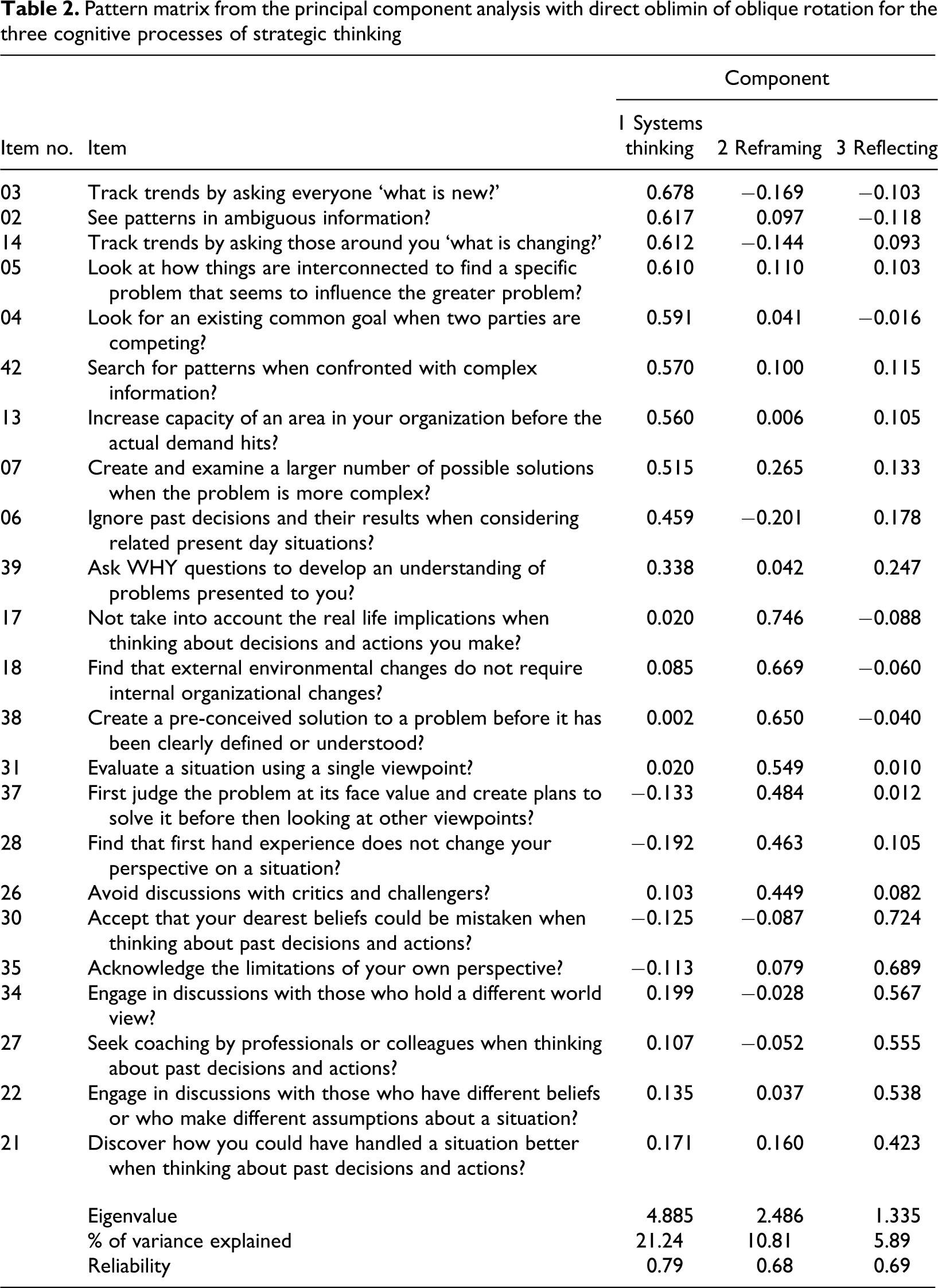
The Chinese version of the STQ was psychometrically tested with the Hong Kong dataset. A confirmatory factor analyses (CFA) was performed with the strategic thinking items using the principal component analysis (PCA) with direct oblimin of oblique rotation method to extract the common factors in the STQ. As seen in Table 2, the results of the PCA confirmed the construct validity of the STQ. The strategic thinking scale that resulted from the PCA is comprised of three subscales: systems thinking (10 items), reframing (7 items), and reflecting (6 items).
Pattern matrix from the principal component analysis with direct oblimin of oblique rotation for the three cognitive processes of strategic thinking
Data Analysis
Descriptive statistics, multiple univariate analyses of variance and regression analyses were preformed to evaluate the relationship among the variables. All of the data collected for this study were entered into SPSS v16.0 in order to run the analyses.
Limitations of the Study
Results from this study are limited by operations. The data were self reported. The reliability of using self ratings as a measure in research studies has been a reviewed by a number of writers without reaching conclusive universal consensus on their effectiveness (Harris and Schaubroeck, 1988; Atwater and Yammarino, 1992; Smither et al., 1995; Yammarino and Atwater, 1997; Weisband and Atwater, 1999).
Despite Spector’s (1992) claim that such data is not as limited as commonly expected, and with the lack of a full consensus, there are still indications of a tendency for self-reported data to be inflated. Therefore, the STQ is designed to elicit individual preferences and behaviors without influencing the respondent toward or away from any particular selection. It contains safeguards identified in previous paragraphs to overcome the effects of self-reporting. These safeguards were applied and cases were removed before the data was analyzed. Base our experience with other applications of the STQ we are confident that the data as it relates to the use of strategic thinking skills is solid and can be depended upon. We are slightly less confident of the data in regards to leader effectiveness even though the results we found are consistent with Zsiga's (2008) study which used an objective measure of effectiveness.
Results
Use of Strategic Thinking Skills
The initial two research questions asked us to determine the level of the participant’s use of strategic thinking skills, and the effect of personal and environmental characteristics on these skills. These research questions were addressed by first comparing the means for study participants on the three strategic thinking skills. As seen on Table 3, reframing (M = 3.75, SD = 0.43) was used most often, and reflection (M = 3.69, SD = 0.42) the least often in the general sample. Position was significantly related to the use of each of the strategic thinking skills: systems thinking (F = 10.316, p = 0.000, ES = 0.038), reflection (F = 3.642, p = 0.027, ES = 0.014) and reframing (F = 10.529, p = 0.000, ES = 0.039).
Means and standard deviations for sample, position, gender, and school type
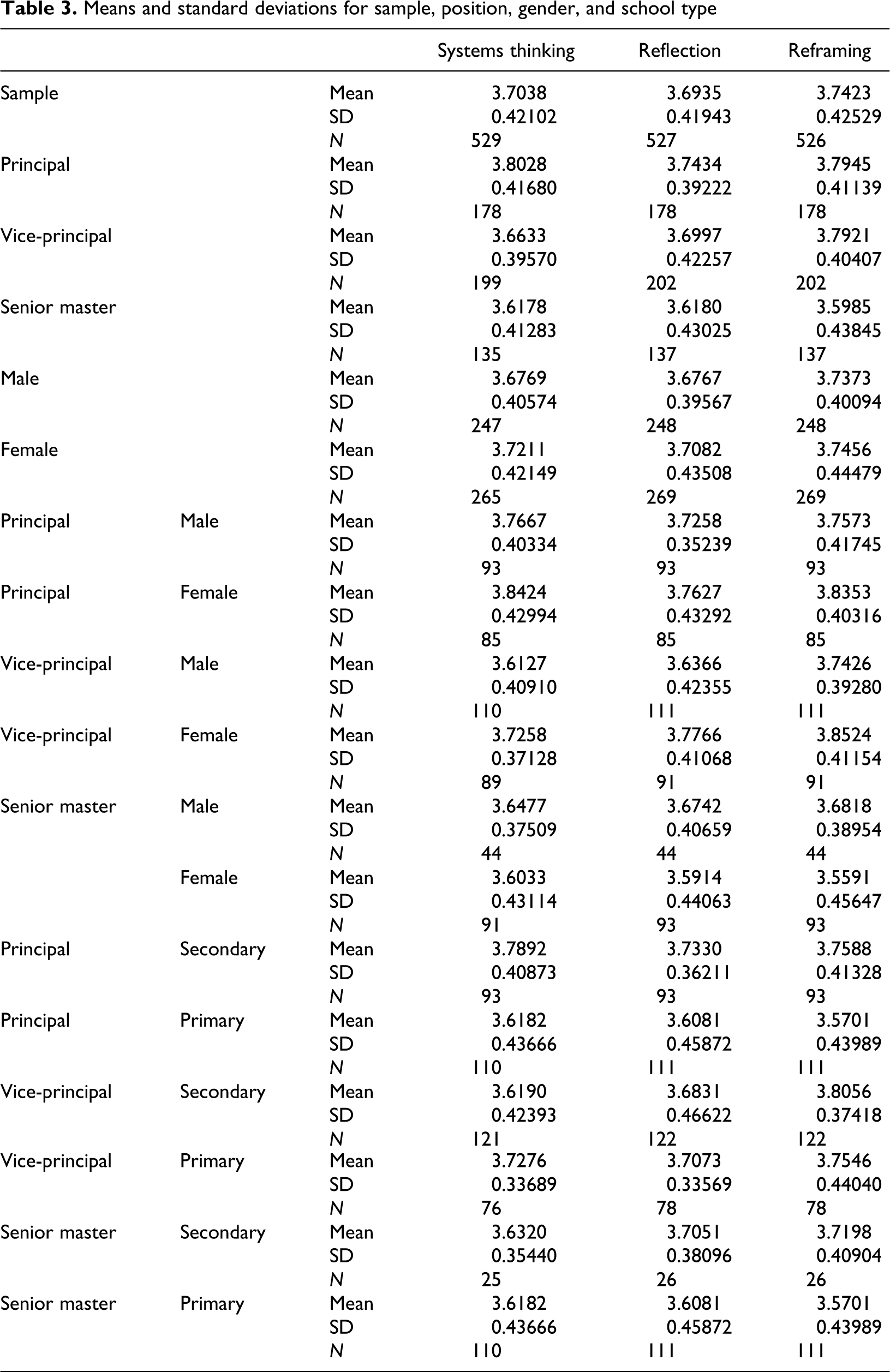
The rank order of use of strategic thinking skills by the sample is reframing (M = 3.74, SD = 0.43), systems thinking (M = 3.70, SD = 0.42) and reflection (M = 3.69, SD = 0.42). As seen in Table 3, this rank ordering stays consistent across gender but not organizational position. Principals use the skills in the following rank order—systems thinking (M = 3.80, SD = 0.42)—reframing (M = 3.80, SD = 0.42)—reflection (M = 3.74, SD = 0.39); vice-principals rank order the skill use as reframing (M = 3.79, SD = 0.40), reflection (M = 3.70, SD = 0.42) and systems thinking (M = 3.66, SD = 0.40) and for senior masters reframing (M = 3.60, SD = 0.44) is the least used skill.
Also seen in Table 3, position and school type yield different usage levels of the strategic thinking skills. First, principals of secondary schools use the skills differently than principals of primary schools. Secondary principals use systems thinking (M = 3.79, SD = 0.41), reframing (M = 3.76, SD = 0.41) and reflection (M = 3.73, SD = 0.36) to a greater extent than primary principals systems thinking (M = 3.62, SD = 0.44), reframing (M = 3.57, SD = 0.44) and reflection (M = 3.61, SD = 0.46.) Second, vice-principals of secondary schools also use the skills differently than vice-principals of primary schools. Both groups use reframing to a greater extent than the other two skills but secondary principals use reframing (M = 3.81, SD = 0.37) more often than primary vice-principals (M = 3.76, SD = 0.44). Lastly, the comparison of senior masters at secondary schools to those at primary schools depicts differences in use of reframing (M = 3.72, SD = 0.41) versus (M = 3.57, SD = 0.44) and reflection (M = 3.71, SD = 0.38) versus (M = 3.61, SD = 0.46).
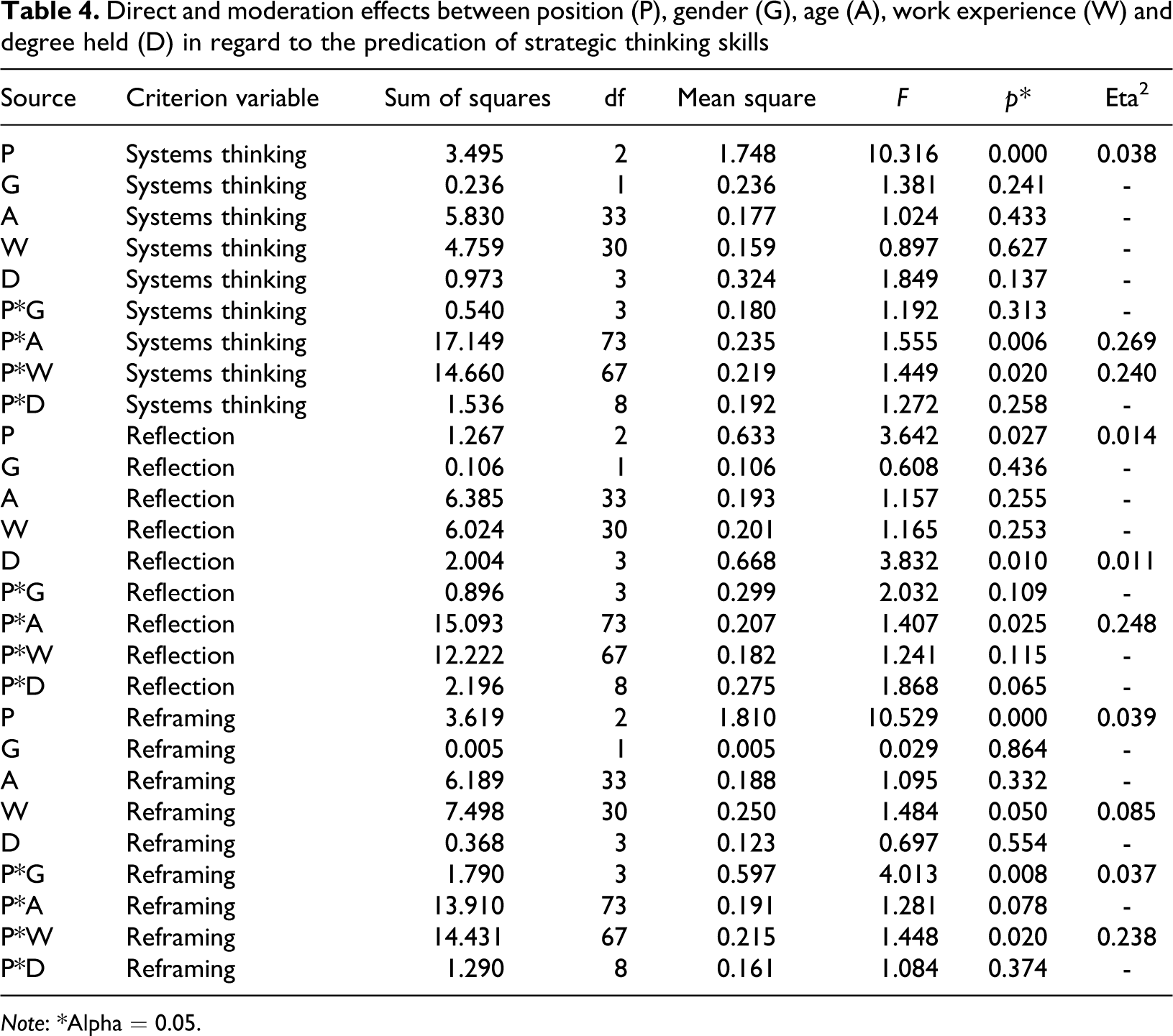
This initial inquiry indicated that principals’ use of strategic thinking skills were influenced by the position they hold and the type of school they manage. We sought to confirm these results through by examining the moderation effects of personal and environmental characteristics in regard to the prediction of the principal’s use of strategic leader actions. Table 4 displays the results of univariate analyses for personal characteristics of position, gender, age, working conditions, and academic degree held.
Direct and moderation effects between position (P), gender (G), age (A), work experience (W) and degree held (D) in regard to the predication of strategic thinking skills
Note: *Alpha = 0.05.
As indicated in preceding paragraphs, position was positively associated with each of the three strategic thinking skills. However, the gender and age variables did not produce any significant relationships with systems thinking, reflection and reframing. The respondent’s work experience produced one significant relationship with reframing (F = 1.484, p = 0.05, ES = 0.085). Degrees held produced one significant relationship with reflection (F = 3.832, p = 0.010, ES = 0.022).
As seen in Table 4, position and age (F = 1.555, p = 0.006, ES = 0.269), and position and work experience (F = 14.660, p = 0.020, ES = 0.240) influenced systems thinking. Position and age (F = 15.093, p = 0.025, ES = 0.248) influenced reflection. Position and gender (F = 1.790, p = 0.008, ES = 0.037) and position and work experience (F = 14.431, p = 0.020, ES = 0.238) influenced reframing. No other interactions were found among personal characteristics and use of strategic thinking skills.
The main effect of position was tested for interactions with all personal and environmental characteristics on the use of strategic thinking skills. There were no significant interactions among these variables and systems thinking or reflection.
As seen in Table 5, school type did produce significant interactions with school type and gender (F = 2.607, p = 0.026, ES = 0.059), work experience (F = 1.407, p = 0.022, ES = 0.399), degree held (F = 1.684, p = 0.086, ES = 0.075) and reframing. No other interactions were found for environmental characteristics.
Moderation effects between school type (ST), size of staff (S), number of teachers (NT) and number of students (NS) in regard to the predication of strategic thinking skills

Note: *Alpha = 0.05.
The Link between Strategic Thinking Skills and Leader Effectiveness
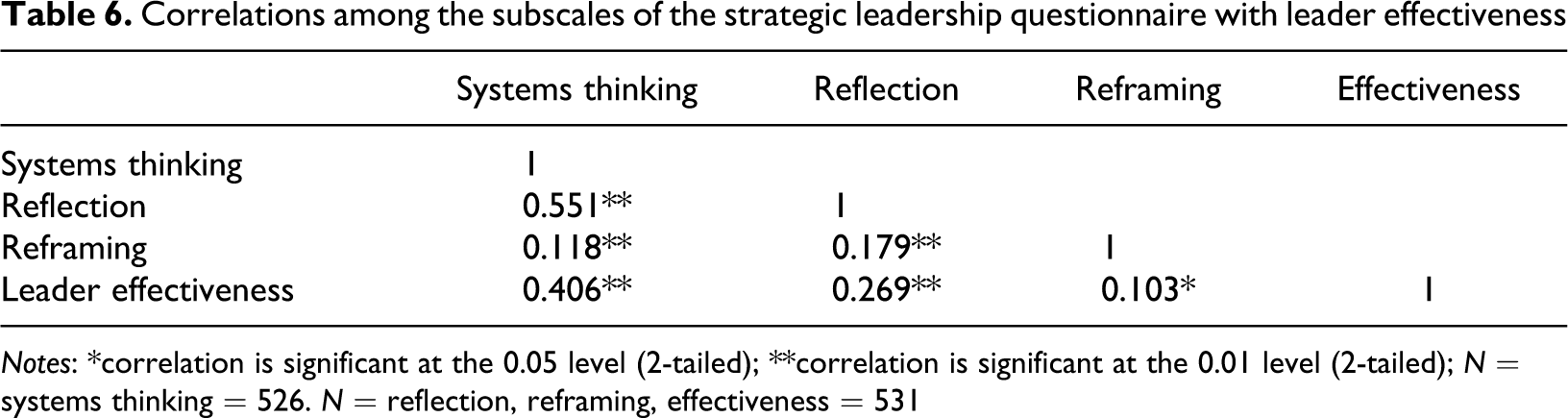
Research question three asked if school leader use of strategic thinking skills is linked to leader effectiveness. For this analysis, the ten effectiveness items were summed. Pearson r correlations were used to compare the relationship among the four variables. As seen in Table 6, significant relationships exist between each of the four variables tested. Systems thinking and leader effectiveness were significantly related (r = 0.406, p < 0.01, ES = moderate). Reflection and leader effectiveness were significantly related (r = 0.269, p < 0.01, ES = moderate). Reframing and leader effectiveness were significantly related (r = 0.103 p < 0.05, ES = weak). Effect size classifications were guided by Cohen’s (1988) taxonomy of correlation values. In effect, as use of strategic thinking skills increased, so did leader effectiveness.
Correlations among the subscales of the strategic leadership questionnaire with leader effectiveness
Notes: *correlation is significant at the 0.05 level (2-tailed); **correlation is significant at the 0.01 level (2-tailed); N = systems thinking = 526. N = reflection, reframing, effectiveness = 531
As displayed in Table 6, the three subscales of strategic thinking also correlated positively and significantly to one another. Based on Senge’s (1990) Fifth Discipline discourse that systems thinking is the crucial criterion for strategic thinking, leadership and development in any organization, we expected some shared variability to be present. The correlation for systems thinking with reflecting (r = 0.551) indicates that 30 percent of the variability of systems thinking is predicted by reflection and vice versa. While this relationship is higher than we would have liked, it is within bounds of acceptability. The correlations among reframing and systems thinking and reframing (r = 0.118) and reflection with reframing (r = 0.179) were significant but weakly associated (about 1 percent and 3 percent of the variance, respectively).
Discussion and Conclusion
Hong Kong, like many societies, has experienced a pervasive and influential transformation of its education system. It is no longer enough for school leaders to think linearly and simply to react to them (Senge 1990, Lam and Pang 2003, Pisapia 2006). Hong Kong school leaders are required to think and act strategically in coping with the challenges arisen from an increasingly complex environment (Mintzberg 1994, Hooijberg et al. 1997, Gamage and Pang 2006). The Hong Kong context enables us to interpret our findings in a clearer fashion.
We extracted several major findings from our results. While there were differences in level of use of strategic thinking skills in the overall sample, none rose to a level of significant difference. What does make a difference is the position the school leader holds. Whether one is the principal, vice-principal or the senior masters, position held was the most influential predictor of the use of the three strategic thinking skills. Principals seemingly use systems thinking (M = 3.80) and reframing (M = 3.80) in tandem. While vice-principals use reframing (M = 3.79) significantly more often than systems thinking (M = 3.66) and reflection (M = 3.70). Conversely, senior masters who are closest to the work of technical work of teaching use reframing (M = 3.60) significantly less often than do principals and vice-principals. This finding supports Katz and Kahn ‘s (1978) finding that as one moves to upper levels of management conceptual skills become more important, at managerial levels interpersonal skills are the most important, and at the supervisory levels technical skills are the most important. It also begs the question, does one move to higher levels of responsibility because they have these strategic thinking skills or because do they acquire them once they are selected. It’s our assumption that both factors are at play in this finding.
At the principal level of the organization a major focus is maintaining the fit between the external environment and internal organizational processes to build organizational resilience. At this level, systems thinking—seeing the system holistically—and reframing—switching across multiple perspectives—are the two most used strategic thinking skills. At the vice-principal level the focus primarily on creating alignment, improving processes, staying focused, communication, conflict management, and developing relationships are important. At this level, reframing is the most used strategic thinking skill. At the senior master level the use of strategic thinking skills are more muted than at the two levels above it. The focus is on the work and tactical decisions rather than looking at things from different points of view. At this level, the focus is on execution of the organization’s goal for instruction in a particular curricular area.
While there were mean differences in how males and females used the strategic thinking skills, they did not rise to a level of significance. This finding supports findings from other studies that the STQ does not demonstrate a gender bias (Pisapia, et al., 2009; Penney, 2010). In the broader sense, female principals did demonstrate more use of systems thinking and reframing skills than their male counterparts. However, the only interaction of gender with other personal characteristics that rose to a level of significance was in regard to predicting the use of reframing skills. This relationship was found at the principal and vice-principals level; but not at the senior master level.
Principals at secondary schools use strategic thinking skills to a greater extent than principals at primary schools. The work is more certain in primary schools and thus reframing in particular is not a skill that is used often when compared to secondary principals. However, this finding does not hold at the level of vice-principals at primary schools. Primary vice-principals use systems thinking and reflection to a greater extent than vice-principals at the secondary schools. It warrants further investigation. The effect of complexity is also seen in the role of senior master. Secondary senior masters use reframing and reflection to a greater extent than primary senior masters. While a greater understanding of the contexts of secondary schools and primary schools in Hong Kong would help our analysis, we feel safe in concluding that as complexity of context increases (position, school type, size of staff, number of teachers, and number of students) school leaders use different strategic thinking skills. Larger role responsibilities necessitate a greater the need for systems thinking skills. In particular, the more complex the environment, the more often school leaders need to practice reframing skills.
What appears to be muted in this contextual complexity discussion is the role of reflection (that is, weaving logical and rational thinking to create intuitive principles to guide future actions). Principals reflect more often than vice-principals and senior masters. Reflection also seems to be a function of educational training with those with higher degrees practicing it more often than those with lower academic degrees. On the other hand, given the vast literature (Dewey, 1933; Argyris and Schön, 1978; Korthagen and Kessels, 1999; Edmondson 2002; Leithwood et al., 2004; Contich, 2006) on the importance of reflection it was surprising to not see it as a more important thinking factor in school leaders in Hong Kong. On the other hand, although the role of reflection has been advocated by many scholars; it has not been carefully examined. These explanations are open to conjecture and the grist for future studies.
The link between the use of strategic thinking skills and leader effectiveness is evident in our data. While the apparent limitations of the use of self reported effectiveness data constrains any strong claim to link leader effectiveness to the use of strategic thinking skills, the results are consistent with the findings of other studies using the STQ (Pisapia et al., 2006; Zsiga, 2008). This confirmation leads us to a qualified ‘we think the use of strategic thinking skills and leader effectiveness is linked.’ To secure this linkage future research needs to be conducted using more objective measures of leader effectiveness. Given the limitations, we are still left with three major impressions of the way the school leaders in Hong Kong process information and their effectiveness. First, the use of strategic thinking skills seems to be able to distinguish between more and less effective leaders. Second, there is a cumulative impact of the use of the three skills that form the strategic thinking construct. The strength of the relationship between strategic thinking and leader effectiveness increased as school leaders used the three strategic thinking processes in tandem. However, our data agrees with that of Pisapia et al. (2006), Zsiga (2008) and Pisapia and Glick-Cuenot (2010) who found that systems thinking skills presents greater explanatory power than reflection and reframing. The link between reframing and leader effectiveness is weak, but appears important as complexity rises. It could be that as one perceives greater complexity they also perceive that they are not as effective as those who work in stable environments. This intriguing finding needs further clarification in future studies. The fact remains, however, that Hong Kong school leaders, who demonstrated higher use of systems thinking, also reported higher perceptions of effectiveness. As suggested in preceding paragraphs, these findings support Senge’s (1990) proposition and Pisapia’s (2006; 2009) research that systems’ thinking is the key discipline for leader effectiveness.
After concentrated study, Pisapia (2010) suggested that strategic thinking places a premium on synthesis and integration and requires the ability to examine new possibilities dealing with large chunks of information, and the ability to pull pieces together into a big picture. It involves being able to recognize patterns and visual images. In strategic thinking, not only are the data sources different but the analysis of the data is different. Strategic thinking, he suggests, is both creative and critical, although accomplishing both types of thinking simultaneously is difficult, because of the requirement to suspend critical judgment. When applied correctly, strategic thinking skills enable leaders to (1) recognize interdependencies, interrelationships and patterns, and (2) make consequential decisions using both powers of analysis and intuition. It is our interpretation that data in this study support this claim.