



Abstract
The purpose of this article is to determine the relationship between transformational leadership of vocational school principals on vocational teachers’ organizational commitment. A random sample of 340 vocational teachers responded to a three-part instrument (the transformational leadership questionnaire, the organizational commitment questionnaire and a demographic section). Means, standard deviations, Pearson correlations and stepwise regression analysis were used to analyse the data. The findings indicated that a strong, positive and significant relationship exists between transformational leadership (overall) and the organizational commitment dimension. Furthermore, the relationship between each component of transformational leadership and organizational commitment was found to be moderate, positive and significant. Finally, it is suggested that more workshops and training courses in transformational leadership should be sponsored by the Ministry of Education in Jordan to promote organizational commitment among vocational teachers.
Introduction and Literature Review
Organizations find it increasingly challenging to maintain sustainability in a world characterized by global competitiveness, organizational restructuring and fluctuating economies. Such challenges prompt the need to maintain high levels of employee commitment (Bass, 2000; Magliocca and Christakis, 2001). Employee commitment is vital for organizations seeking to retain their top performers in an increasingly turbulent labour market. According to Holton and O’Neill (2002), employee commitment is significant because of the costs associated with recruiting, socializing and training new employees. The positive outcomes of employee commitment to their organizations, termed ‘organizational commitment’, have been well documented in the literature. Organizational commitment is vital to individual and organizational outcome variables, such as absenteeism, turnover intentions, work stress, organizational citizenship behaviour, job satisfaction, job involvement, work motivation, individual performance, productivity, profitability and quality (Benkhoff, 1997; Boglar, 2005; Chow and Holden, 1997; Meyer and Allen, 1997; Meyer et al., 2002; Mowday et al., 1979; Reichheld, 2001). For example, individuals that are committed to the values and goals of their organization work harder, are less likely to be absent from work, have lower intentions to quit, possess increased job satisfaction and tend to have increased productivity (Allen and Meyer, 1996; Lu et al., 2002; Mathieu and Zajac, 1990; Meyer and Allen, 1997; Mowday et al., 1982; Porter et al., 1974; Stallworth, 2003). Conversely, those with low organizational commitment are shown to be much more costly to organizations; costs that extend beyond the simple financial costs associated with poor performance (Hunt, 1991). Thus, organizational commitment is an important precondition for organizational effectiveness, especially when considering that the costs associated with higher turnover and absenteeism are avoided (Bartlett, 2001; McMurray et al., 2000).
In a broad term, organizational commitment may be generally defined as a strong belief in and acceptance of organizational goals and values, a willingness to exert effort on behalf of the organization and a desire to maintain organizational membership (Porter et al., 1974). According to Bartlett (2001: 336) ‘organizational commitment can be thought of as the level of attachment felt toward the organization in which one is employed’. Meyer and Allen (1997) defined organizational commitment as an individual dedication and loyalty to an organization. Thus, committed employees have a purpose, are involved, help solve organizational problems and feel the need to go beyond what is usually expected of them in order to make a significant contribution to the organization (Mowday et al., 1979). Therefore, retaining such employees should be a high priority for an organization.
Previous research indicated that many factors have been shown to influence employees’ organizational commitment. One such factor considered to be a key determinant is transformational leadership (Allen and Meyer, 1996; Eby et al., 1999; Mowday et al., 1982). Transformational leadership has received considerable attention and has been researched more than all other leadership theories combined (Judge and Bono, 2000; Lowe and Gardner, 2001). Interest in transformational leadership is justified by the fact that the results of many studies indicated that a positive relationship exists between leaders that are characterized as transformational and their followers’ performance (Boehke et al., 2003; Katzenbach, 2000). Moreover, various studies found a positive, direct relationship between the transformational leadership of school principals and their followers’ trust and team work (Pillai and Williams, 2004) and job satisfaction (Catalano, 2002). Therefore, transformational leadership is an important construct that has influenced many individual and organizational outcome variables.
Transformational leadership is concerned with the process of how certain leaders are able to inspire their followers to accomplish more than is usually expected of them by stimulating higher-level needs: behaving in ways that make others want to trust, respect and admire them; empowering employees to transcend their own self-interests for the good of the organization; creating an atmosphere in which followers are compelled to be more productive; and by giving meaning to organizational life (Bass, 1995; Bass and Avolio, 1990; Durbin, 2001; Northhouse, 2004). Transformational leaders also recognize, understand and attempt to address each follower’s needs on a one-on-one basis (Bass, 1998). Followers working with transformational leaders are more involved, empowered, motivated and committed to their organizations and demonstrate fewer withdrawal behaviours (Bono and Judge, 2003; Walumbwa and Lawler, 2003). Furthermore, followers who feel they receive the leader’s special attention are more likely to work toward long-term goals and work harder to meet the leader’s expectations.
Bass (1998) described transformational leadership as having four main components: idealized influence; inspirational motivation; intellectual stimulation; and individualized consideration.
Idealized influence describes leaders who serve as role models that are ‘admired, respected, and trusted’ by followers (Bass, 1998: 5). They excite, arouse and inspire their followers such that the relationship between the leader and follower is based on personal understanding as opposed to formal, institutional rules, regulations, rewards or punishments. Followers identify with these leaders and want very much to imitate them.
Inspirational motivation describes leaders who communicate high expectations and standards to followers, inspire them through motivation to become committed to and be part of the shared vision in the organization. By sharing goals and expectations, leaders can inspire followers to work as a team to meet the goals of the organization and provide meaning and challenge to followers’ work.
Intellectual stimulation includes leaders that stimulate followers to be creative, innovative, systematic thinkers and to challenge their own beliefs and values as well as those of the leader and the organization to break away from old ways of thinking. This type of leadership supports followers as they try new approaches and develop innovative ways of dealing with organizational issues. Additionally, mistakes are not criticized with others present and followers’ suggestions are considered to solve problems. This motivates followers to become more involved in their jobs, resulting in higher levels of commitment (Avolio et al., 2004).
Individualized consideration is representative of leaders who provide a supportive environment in which they listen attentively to the individual needs of followers. Also, ‘transformational leaders pay special attention to each individual follower’s needs for achievement and growth by acting as coach or mentor’ (Ball, 1998: 6), while trying to assist individuals in reaching their fullest potential. These leaders treat followers on a one-to-one basis and may use delegation as a means to help followers grow through personal challenges.
In brief, transformational leaders are able to influence followers’ organizational commitment by:
promoting higher levels of intrinsic value associated with goal achievement and by creating a higher level of personal commitment on the part of leaders and followers to a common vision, mission and goals (Shamir et al., 1998)
encouraging followers to think critically by seeking new approaches to solving problems, involving followers in decision-making process, inspiring loyalty, recognizing and appreciating the different needs of each follower to maximize their potential (Avolio, 1999; Bass and Avolio, 1994);
identifying with followers’ needs for achievement and growth and motivating followers to get more involved in their work, which can result in higher levels of organizational commitment (Walumbwa and Lawler, 2003).
Statement of the Problem
Organizational commitment has been the focus of ongoing research attention for decades due to its impact on individual and organizational performance. Despite the widespread acknowledgment of the importance and value of organizational commitment, there has been limited research that has specifically addressed the relationship between leader transformational behaviour and employees’ organizational commitment. As Kuchinke (1999: 152) noted ‘although the positive effects of transformational leadership are relatively well researched in the North American context, very little is known about its effect abroad’. The vocational environment in Jordanian high schools was chosen for this study because vocational teachers are primarily concerned with preparing specialized and skilled workforce in various areas (for example, industrial, agricultural, home-economics). This workforce is expected to contribute to the national Jordanian economy. Therefore, the primary purpose of this study was to determine the relationship between transformational leadership behaviour of vocational high school principals and organizational commitment of their vocational teachers.
Research Objectives
To accomplish the primary purpose of this study, the major research objectives are briefly stated as follows:
To describe the transformational leadership behaviour of vocational school principals and the level of organizational commitment among vocational teachers in Jordan.
To determine the relationship between principals’ transformational leadership behaviour and their vocational teachers’ level of organizational commitment.
To determine the impact of the four components of transformational leadership on organizational commitment of vocational teachers.
Significance of the Study
Results of this study have important implications for many stakeholders including administrators, school principals and teachers. By understanding the nature of the relationship between transformational leadership and organizational commitment, administrators and other stakeholders can understand the effectiveness of school principals in maintaining organizational commitment among their teachers. This may also help them in designing effective strategies to enhance the transformational leadership of school principals, which is a key determinant of school commitment. The result of this study will also help fill in the gap in the literature related to the lack of research on the relationship between transformational leadership and organizational commitment in international countries such as Jordan especially in vocational arenas.
Educational System in Jordan
Education has played an important role in the Jordan’s development to becoming an urban, industrialized nation. With few natural resources at its disposal, Jordan has opted to develop its human capacity. To date Jordan's record of educational development has been impressive. Jordan’s population has a very high literacy rate of 89 per cent. Further, the Jordan educational system has undergone major reform initiatives as a critical step to realizing its vision of becoming a regional information technology nucleus and to fully enter into the global economy. The goal of the reform initiatives was to create and manage an educational system based on excellence, dedicated to high standards and contributing to the nation's wealth in a global knowledge economy; enabling Jordanian youth to effectively compete for domestic, regional and international employment. The reform initiatives target all sectors of pre-school, basic and vocational education, as well as teachers, students and administrators (Ministry of Education, 1993).
The structure of the educational system in Jordan consists of a 2-year cycle of pre-school education, 10 years of compulsory basic education and 2 years of secondary academic or vocational education. In Jordan education is free in primary and secondary stages and is made compulsory for all through the age of 15. The secondary education level consists of 2 years' study for students aged 16 to 18 who have completed the basic cycle (10 years) and comprises two major tracks (Ministry of Education, 2004):
Secondary education track, which can either be academic or vocational. At the end of the two-year period, students sit for the general exam and those who pass it are awarded a certificate called Tawjihi. The academic stream qualifies students for entrance to universities, whereas the vocational or technical type qualifies for entrance to community colleges or universities or the job market.
Vocational secondary education track, which provides intensive vocational training and apprenticeship, and leads to the award of a certificate to practice their vocational skills in the labor market. This track comprises majors in industrial education, agricultural education, hotel education, nursing education, and home-economics education.
Methodology
Population and Sample
The target population for this study was defined as all vocational school teachers currently employed in the middle and north educational districts of Jordan during the academic year 2008/9. In order to establish the frame of the accessible population, the researchers obtained a list of all vocational schools and all vocational teachers employed from the Ministry of Education, which included 66 schools. These schools mainly specialized in various vocational fields including industrial, agricultural and home economics. The total teacher population of these schools was 1013 vocational teachers. A random sample of 400 vocational teachers was selected from this pool of schools. In the sample of the surveys returned, 340 were useable, resulting in a response rate of 80 per cent. Data gained from the returned questionnaires indicated that over 59 per cent of vocational teachers who responded were male, between the age of 31 and 41 years, have a undergraduate degree (72.4 per cent), and with 5 to 12 years of experience (71.8 per cent). Table 1 presents the descriptive statistics for the vocational teachers who participated in the study.
Sample personal characteristics

Instrumentation
A three-part instrument was used to collect data in this study. The first part contained the transformational leadership scale (TLS). The TLS is a subscale of the ‘Multifactor leadership questionnaire form 6S (MLQ-6S)’ designed by Bass and Avolio (1995) and is used to measure followers’ perceptions of the transformational leadership behaviour of their superiors. The TLS is comprised of four components represented by 12 items as follows: idealized influence (three items; example: ‘I make others feel good to be around me’); inspirational motivation (three items; example: ‘I help others find meaning in their work’); intellectual stimulation (three items; example: ‘I enable others to think about old problems in new ways’); and individualized consideration (three items; example: ‘I give personal attention to others who seem rejected’). These 12 items are rated on a five-point, Likert type-scale ranged as follows: 1 = strongly disagree; 2 = disagree; 3 = neutral; 4 = agree; and 5 = strongly agree. Higher scores of 4 and 5 indicate a strong transformational leadership behaviour in school principals, whereas a low score of 1 and 2 reflects a weak transformational leadership behaviour in school principals. This scale takes approximately 10 minutes to complete. The validity and reliability of the questionnaire was established by many studies and the overall alpha reliability coefficient for the scale ranged from 0.81 to 0.94 (Avolio et al., 1999; Bass, 1985, 1998; Bono and Judge, 2003; Bass and Avolio, 1993, 1994; Kark et al., 2003).
The second part of the instrument consisted of the organizational commitment questionnaire (OCQ) which is used to measure organizational commitment. The OCQ consists of nine items, positively worded statements (Mowday, et al., 1979). Examples of items include ‘I am willing to put in a great deal of effort beyond that normally expected in order to help this organization be successful’ and ‘ I am proud to tell others that I am part of this organization’. All items are rated on a five-point, Likert-type response scale ranged as above. To measure organizational commitment, results are summed and divided by nine to arrive at a summary indicator of overall organizational commitment. The higher the score, the more organizational commitment an individual is judged to be. The OCQ was selected because it proves to be valid and reliable. The coefficient alpha internal consistency estimates of reliability ranged from 0.84 to 0.91 (Cotton and Tuttle, 1986; Mowday et al., 1982; Porter et al., 1974; Robert et al., 2000). The third part of the instrument contained information related to demographic characteristics of respondents. The demographic questions asked participants to provide information regarding their gender, age, educational level, area of specialization and years of experience.
Instrument Translation Process
To ensure equivalence of meaning of the items between the Arabic and English versions of the TLS and OCQ, a rigorous translation process was used that included forward and backward translation, subjective evaluations of the translated items and pilot testing (Lomi, 1992; Sperber et al., 1994). Four translators bilingual in English and Arabic translated the English versions of the TLS and OCQ into Arabic (forward translation). Those translators were instructed to retain both the form (language) and the meaning of the items as close to the original as possible but to give priority to meaning equivalence. When the Arabic translations were finalized, the TLS and OCQ were then backward translated (from Arabic to English) by four other translators, bilingual in English and Arabic.
The backward translated items were then evaluated by a group of eight university faculties to ensure that the item meanings were equivalent in both the original English versions and the backward-translated versions. If differences in meaning were found between items, those items were put through the forward and backward translation process again until the university faculties were satisfied there were substantial meaning equivalence. The Arabic versions of the TLS and OCQ were then pilot tested with a group of 11 university faculties, 21 vocational teachers and 3 school principals to collect feedback about instruments’ content and usage. The feedback from the pilot group did not lead to any substantive changes and the instruments were judged to have both face and content validity and are culture free.
Instrument Standardization
The instruments (TLS and OCQ) were pilot tested with a group of 82 vocational teachers. These vocational teachers were excluded from the main sample of the study. Changes recommended by the validation panel and those identified as needed during the pilot test were incorporated into the instrument. These changes occurred in the wording of items. The internal consistency for the instruments was determined using the same group of teachers used in the pilot study. The calculated coefficient alpha reliability for the TLS was 0.89 (idealized influence = 0.79; inspirational motivation = 0.86; intellectual stimulation = 0.83; and individual consideration = 0.84). The calculated coefficient alpha reliability for the OCQ was 0.92. The standards for instrument reliability for Cronbach's alpha by Robinson et al. (1991) were used to judge the quality of the two scales in the instrument: 0.80–1.00 (exemplary reliability), 0.70–0.79 (extensive reliability), 0.60–0.69 (moderate reliability) and < 0.60 (minimal reliability). Both instruments had exemplary reliability. These figures suggest that the instruments are suitable to measure the transformational leadership behaviour of school principals and the organizational commitment level of vocational teachers in Jordanian vocational schools.
Data Collection
The data collection took place during the first term of the academic year 2008/9, date was obtained from 340 vocational teachers. The researchers met with school principals, explained the nature and purpose of the study and answered questions regarding the administration process. After approval for the collection of data was obtained, assessment instruments were assembled as a packet and distributed by the researchers. Vocational teachers were informed of the purpose of the study and were assured of confidentiality and voluntary nature of the study. After completion, the vocational teachers returned the completed instruments to the researchers by a deadline.
Data Analysis
The alpha level was set at 0.05 a priori. Procedures for statistical analysis are discussed by objective. Objective 1 was to determine the transformational leadership behaviour of school principals and the level of organizational commitment among vocational teachers in Jordan. These variables were summarized with descriptive statistics including means and standard deviations. Objective 2 was to determine the relationship between principals’ transformational leadership behaviour and their vocational teachers’ level of organizational commitment. This objective was accomplished using the Pearson product moment correlation coefficient (r). The interpretation of the correlation coefficients was based on the following set of descriptors: 0.70 or higher (very strong relationship); 0.50–0.69 (substantial relationship); 0.30–0.49 (moderate relationship); 0.10–0.29 (low relationship); and <0.09 (negligible relationship) (Davis, 1971). Objective 3 was to determine the impact of the four components of transformational leadership on the organizational commitment of vocational teachers. This objective was accomplished utilizing stepwise regression analysis.
Results
Objective 1
Objective 1 was to determine the transformational leadership behaviour of school principals and the level of organizational commitment among vocational teachers in Jordan. Descriptive statistics including means and standard deviations were used to achieve this objective. As shown in Table 2, the mean value for the transformational leadership total score was 3.88 (SD = 0.49). Four categories comprised the scales that measured transformational leadership. The mean value for idealized influence was 3.89 (SD = 0.69); the mean value for inspirational motivation was 4.07 (SD = 0.70); the mean value for intellectual stimulation was 3.67 (SD = 0.68); and the mean value for individualized consideration was 3.91 (SD = 0.49). These results indicate a moderate-to-high transformational leadership behaviour among school principals. Further, the mean value of organizational commitment was 3.93 (SD = 0.49) indicating a moderate-to-high level of organizational commitment among vocational teachers.
Four dimensions of transformational leadership and organizational commitment of vocational teachers

Objective 2
Objective 2 was to determine the relationship between principals’ transformational leadership behaviour and their vocational teachers’ level of organizational commitment. The Pearson product moment correlation coefficient (r) was used to achieve this objective. As indicated in Table 3, the results of the correlation analyses between the total transformational leadership scores and total organizational commitment scores (r = 0.50, p = 0.000) was statistically significant. Using Davis’ (1971) descriptors this correlation would be classified as a substantial positive relationship, indicating that vocational teachers who work with principals with high levels of transformational leadership behaviour tend to have higher levels of organizational commitment. When the categories of transformational leadership were correlated with organizational commitment, the category which was most highly related was inspirational motivation (r = 0.42, p = 0.000), followed by individualized consideration (r = 0.38, p = 0.000), intellectual stimulation (r = 0.31, p = 0.000) and idealized influence (r = 0.28, p = 0.000). All of these correlations were statistically significant. According to Davis (1971), these correlations would be classified as a moderate positive relationship.
Pearson correlation analysis
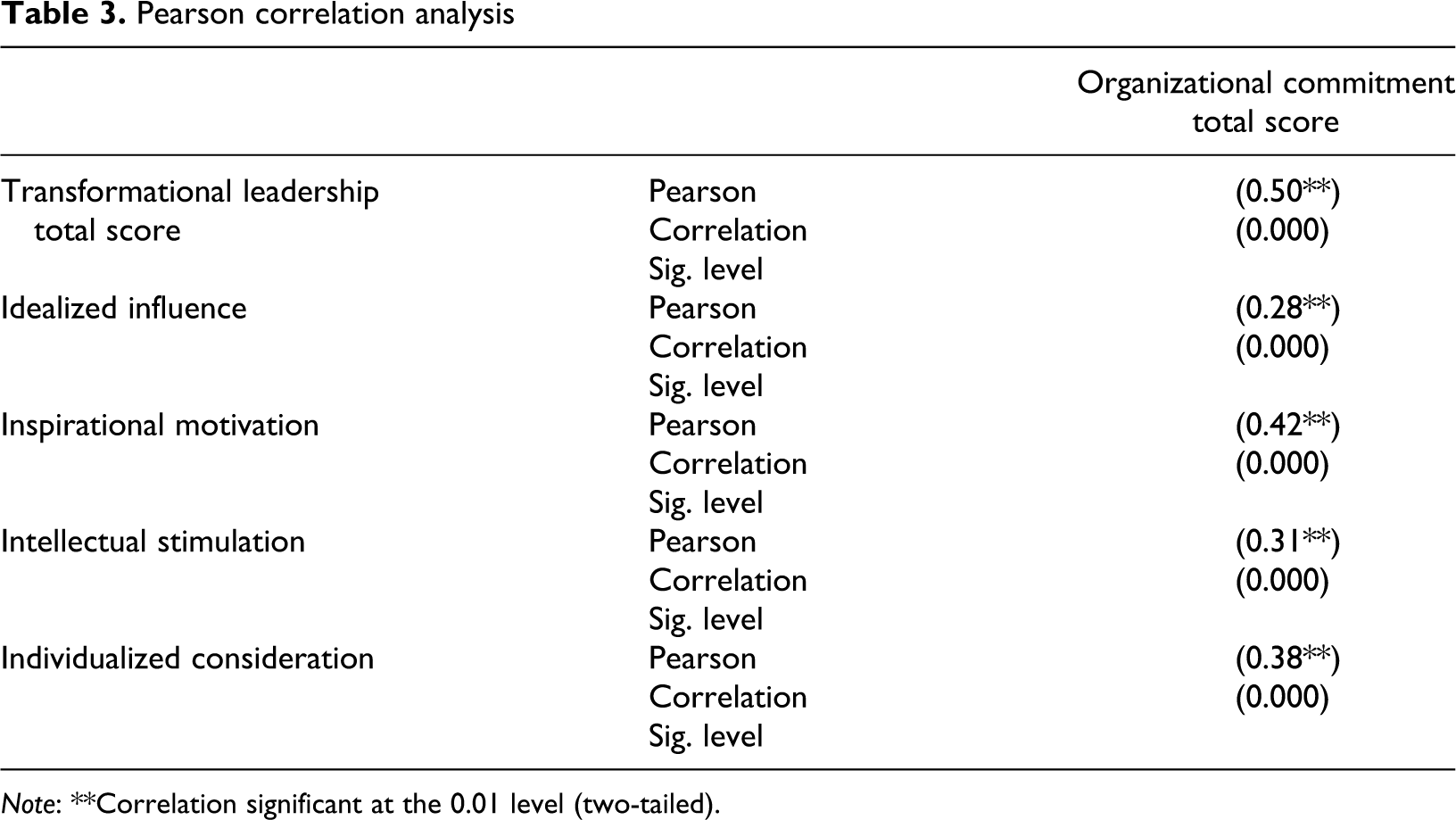
Note: **Correlation significant at the 0.01 level (two-tailed).
Objective 3
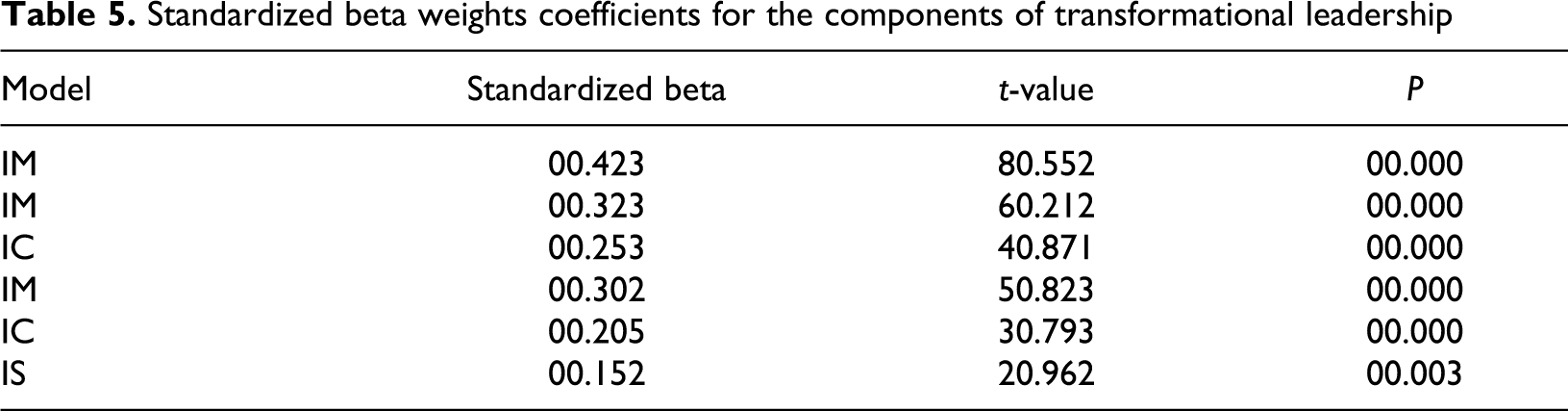
Objective 3 was to determine the impact of the four components of transformational leadership on organizational commitment of vocational teachers. This objective was accomplished utilizing stepwise regression analysis. As shown in Table 4, the component of inspirational motivation was statistically significant and explained 17.9 per cent of the variance in organizational commitment, followed by individualized consideration, explaining 5.4 per cent of the variance and intellectual stimulation explaining 2 per cent of the variance. However, the component of idealized influence was statistically insignificant and did not contribute to the regression model. Moreover, standardized Beta weights were significant (at the 0.05 alpha level) for the three retained variables as shown in Table 5.
Impact of transformational leadership on organizational commitment
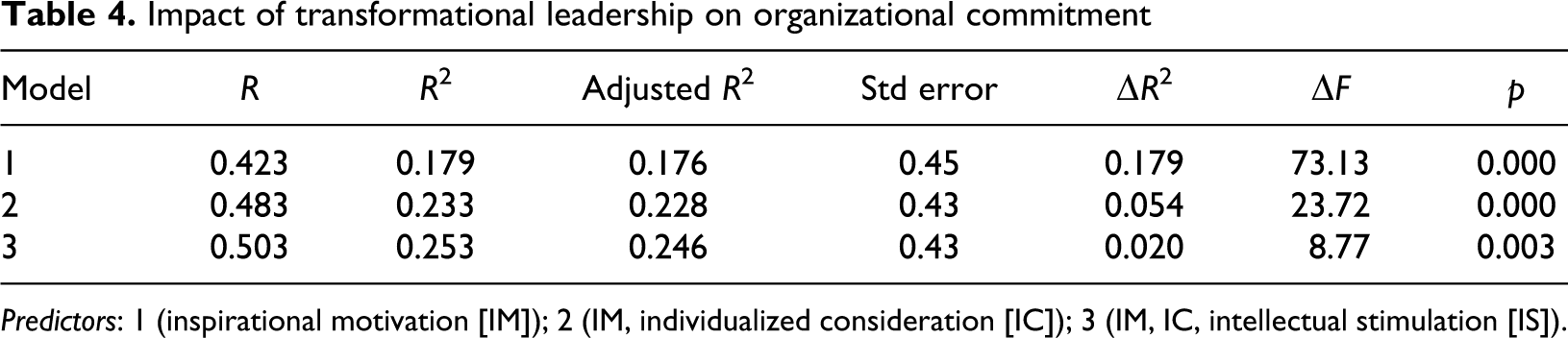
Predictors: 1 (inspirational motivation [IM]); 2 (IM, individualized consideration [IC]); 3 (IM, IC, intellectual stimulation [IS]).
Standardized beta weights coefficients for the components of transformational leadership
Discussion
Based on vocational teachers’ perceptions, the findings of this study indicate that school principals in Jordan possess a moderate-to-high level of transformational leadership behaviour. To elaborate, vocational teachers perceived their principals to be inspirational; that they may help others focus on their work and try to make others feel their work is significant. Moreover, vocational teachers feel that school principals valued ‘individualized consideration’, that they showed interest in others’ well-being, assigned projects individually and paid attention to those who seem less involved in the group. Furthermore, vocational teachers recognized their principals to possess the quality of ‘idealized influence’ because they hold their trust and respect, appeal to their hopes and act as their role models. Finally, vocational teachers feel that their principals intellectually stimulate their creative thinking in looking at old problems in new ways and their own values and those of the system. These results provide added support for previous research that has emphasized the importance of transformational leadership as a dominant practice in public sectors including educational entities (Bass, 1985; Bass, 1998; Collins and Holton, 2004; Lowe and Gardner, 2001).
These findings also indicate that vocational teachers possess a moderate-to-high level of organizational commitment as indicated by its overall mean value (3.93). For example, vocational teachers may be willing to exert effort on behalf of the organization, wish to maintain organizational membership and encourage others to work for such organization because of the congruence between the individual and the organization values. With regard to organizational commitment in educational settings, few studies have been conducted in this area. Thus, studies such as this one can assist with the understanding of vocational teachers’ commitment from an empirical point of view. Effective organizational commitment is important because of the link between such commitment and desired organizational outcomes as regular attendance, less employee turnover and increased productivity. Individuals who have high levels of organizational commitment generally have high levels of job satisfaction, lower levels of work stress, and lower intentions to quit (Johnston et al., 1990; Meyer and Allen, 1997).
The study also examined the relationship between school principals’ transformational leadership behaviour and their vocational teachers’ level of organizational commitment. Findings indicated that the transformational leadership behaviour of school principals was found to have a high correlation with organizational commitment of vocational teachers. The transformational leadership total score showed a positive and strong correlation with organizational commitment. This implies the positive effect of school principles practicing transformational leadership, which is affects organizational commitment. This strong relationship suggests that as the practice of transformational leadership increases, the organizational commitment of vocational teachers increases. The detailed relationships suggest that the component of inspirational motivation has the strongest correlation which implies that the more the school principals communicate a clear vision, help others focus on their work and make others feel their work is significant, the higher their organizational commitment would be. The next highest correlation was for the individualized consideration component, indicating that principals’ act in showing interest in others well-being and assigning projects individually has resulted in higher organizational commitment among vocational teachers. The least correlation was for the idealized influence component which indicates that principals are doing basic job in acting as role models and in maintaining the trust, respect and faith of vocational teachers. This study provides evidence to support the use of transformational leadership to increase organizational commitment of vocational teachers, the least studied and understood group of educators. These findings provide evidence that transformational leadership can be used as important tool to produce substantial results especially related to organizational commitment (Catano et al., 2001; Collins and Holton, 2004; Walumbwa and Lawler, 2003).
The study also attempted to determine the impact of the four components of transformational leadership on the organizational commitment of vocational teachers. Utilizing stepwise regression analyses, the component of inspirational motivation explained 17.9 per cent of the variance in organizational commitment, that is, knowing that school principals practicing the component of inspirational motivation with their vocational teachers can predict almost 18 per cent of the variance in their organizational commitment. The second and third components explained 5.4 and 2 per cent, respectively, in organizational commitment of vocational teachers. The fourth component of idealized influence did not have any impact of organizational commitment. It is obvious that inspirational motivation is what drives organizational commitment in this study. These results indicate that vocational teachers want principals who have the vision to the school through the turbulent changes needed to succeed, those who can maintain their existence and success through guiding followers to focus on work, and who can find means and ways to make teachers value and realize the importance of their work. In Jordan, vocational teachers and principals are restrained by the negative views held by people toward vocational work and those who work in such vocations. In order to lift this pressure school principals who can guide teachers through overcoming such obstacles and direct them in what they could and should do are required. Finally, it is worth mentioning that this study used a single source of data, which collected all data from vocational teachers. Future research in Jordan should attempt to overcome this problem by utilizing multiple sources of data collection.
Conclusion
Based on the findings of the study, the researchers suggested a number of practical and theoretical recommendations. From the practical perspective, the following actions are desired:
The Ministry of Education should design effective transformational leadership programmes and that all principals should be required to undertake as part of their assessment for promotion. Principals who possess such leadership skills should also be provided with monetary and non-monetary rewards.
Principals of vocational schools should hold regular meetings to communicate to vocational teachers their vision; the importance of their individual and collective work to the development of the organization and the society as a whole; and to challenge their old ways of thinking with new approaches.
The organizational commitment of vocational teachers should be emphasized via various means including lectures, seminars and training workshops. Principals and area directors should instil the importance of the school to the life of individuals and the effort provided on part of the Ministry of Education to maximize the performance of its vocational teachers; connect the fate of the organization with the fate of its teachers; match the work values of their teachers with the work values of the school districts, and provide job assignments that inspire the very best in people.
Researchers who wish to take research in English to an international level, should precisely follow the rigorous translation procedures utilized in this study. From the theoretical perspective, the following actions are suggested:
Further study needs to be undertaken in Jordan that correlate transformational leadership behaviour of school principals with other variables such as job satisfaction, intent to leave, school performance, academic achievement and business-partnership efforts
The present study should be replicated with all vocational teachers in Jordan utilizing multiple sources of data collection including focus groups, interviews and observations.
More demographic variables should be studied such as ‘time spent at school’ and ‘time spent with current principal’.
Contribution of the Study
This study may contribute greatly to the international literature in several ways. First, international researchers and practitioners may have a clear picture of the status of the vocational education system in Jordan with regard to the practice of principals’ leadership behaviour and how it may impact the commitment of vocational teachers. Second, this study sheds light on an important aspect of the Jordanian culture and how it interacts with the leadership behaviours and commitment of teachers. We expect that as the Jordanian educational reform initiatives accommodate global trends, the culture aspect will be further eroded.