Abstract
This article illuminates major features of high-quality leadership programmes across different education systems. We do so by focusing on capturing commonalities and variations in high-quality pre-service programmes from five differing societies, all of which are high-performing education systems. To this end, we first delineate key profiles of each programme. Based on that, we discuss commonalities and variations in leadership programmes in terms of framework, content and operational features. Finally, we flesh out important implications for policy and practice.
Keywords
Introduction
Leadership is a critical determinant of organizational performance across organizations, including schools (Barber et al., 2010; McCall, 1998). While often indirect, the impact of principals’ leadership on various indicators of organizational capacity and performance is significant (Bryk et al., 2010; Louis et al., 2010; Robinson et al., 2008). In this context, increasing attention is being paid internationally to developing high-quality school leadership programmes (Barber et al., 2010). System leaders are enamoured by their potential to equip potential principals for their work by emphasizing instructional and organizational leadership (Bush and Jackson, 2002). Following general agreement of the importance of meaningful preparation to successful school leadership, research has documented indicators and/or features of high-quality leadership programmes (for example, Barber et al., 2010; Darling-Hammond et al., 2010; Huber and West, 2002; Peterson, 2002; Pounder, 2011). Empirical research in the USA points towards a consensus regarding programme features that best prepare aspiring principals (Pounder, 2011).
Recognizing the need to expand our understanding of leadership preparation internationally, this article aims to investigate how state-of-the-art leadership development has been conducted across a number of different national contexts. Because purveyors of leadership preparation programmes look to practices elsewhere as models for improvement, this article will advance understanding of how programmes converge or are differentiated internationally by providing insights into developing trajectories of principal preparation.
This article articulates the critical features of five principal preparation programmes selected from Asia, North America and Australia by focusing on the following overarching question.
How are the leadership preparation programmes similar or differentiated internationally?
We address this question by focusing on the following three sub-questions.
Are there any common or different frameworks which bind leadership development programmes with related leadership functions or local conditions?
What major content areas are delivered through the programmes?
How are programmes operationalized in terms of provider expertise, formal credentials and participant selection?
Based on the answers to these questions, we provide a number of implications for principal leadership programme development. In doing this, the article identifies major directions that principal preparation programmes are taking to meet the complex needs of principals working in ever-changing global contexts in general, and various forms of educational reforms in particular (Cheng, 2009).
This article consists of five parts. First, it briefly reviews relevant literature in order to provide a comparative analytic framework for this study. Second, it describes the methodology employed in this study in terms of site selection, data collection and analysis. The third part delineates major features of the programmes used for analysis. Fourth, the findings are analysed in terms of two major analytic categories: programme commonalities and variations in context. Finally, implications for programme development are discussed in-depth.
Literature Review
Over the last 20 years, school principals’ work has increased in complexity in response to wide-ranging reforms such as the coupling of school-based management with accountability measures (Ball, 2008; Cheng, 2009; Gronn and Rawlings- Sanaei, 2003; Lee et al., 2012a; Lim, 2007; Walker and Ko, 2011), standardized testing (Carnoy and Loeb, 2002) and the use of data related to student learning outcomes to drive school improvement (Lee et al., 2012b). The pressures of implementing such changes in schools, the skills needed to make them work and the time commitments required have resulted in many potential leaders electing not to enter the principalship (Caldwell, 2003; Casavant and Cherkowski, 2001; MacBeath, 2011; Walker and Kwan, 2010). In Asian societies, such as Hong Kong and Singapore, this problem is not evident (Walker and Qian, 2006). Nevertheless, the bulk of recent research on leadership preparation has been conducted in western societies.
Within this context, preparing effective school leaders has been placed at the core of many educational reform agendas (Bryant et al., 2012) and has been the subject of much research. Indeed, recent studies have focused on indicators of effectiveness of high-quality leadership programmes. For example, Darling-Hammond et al. (2010) studied eight pre-service principal training programmes in the USA, which were selected for their strong outcomes. Despite varied approaches, the following features were embedded in each:
the alignment of a coherent curriculum with externally developed state and/or professional standards;
an emphasis on instructional leadership and school improvement to guide the programme philosophy and curriculum;
the use of active and student-centred learning strategies;
a teaching faculty that includes practitioners and scholars who are experts in their fields;
diverse support structures such as formal mentoring systems and cohorts;
a rigorous approach to participant selection;
supervised internships or school attachments.
Consistent with these indicators, the overall trajectory of leadership preparation programmes has converged across different societies. Based on our previous work (Walker et al., 2011), we particularly note this convergence in terms of three interdependent components of leadership programmes – that is, framework, content and operation.
With the increasing global emphasis on accountability, states or professional associations frequently mandate leadership frameworks that are centrally defined and aligned to district or state level educational policies (Bryant et al., 2012). Within jurisdictions, various providers may be endorsed to deliver leadership programmes that meet the requirements stipulated in the frameworks. A possible consequence of this alignment is a narrowed choice of programme content and learning outcomes for aspiring leaders, regardless of the selected provider (Huber and West, 2002; Roach et al., 2011).
Although conducted mostly in western countries, previous research suggests a high level of commonality in the content of contemporary leadership development programmes. For example, Bush and Jackson’s (2002: 421) study of leadership preparation programmes in North Carolina, Ontario and England found a shared emphasis on organizational, transformational and instructional leadership as well as traditional content areas such as ‘professional development, finance, curriculum, and external relations’.
A body of research also shows that common features embedded in leadership programmes include the engagement of participants in the field through experiences such as internships or university–district partnerships (for example, Darling-Hammond et al., 2010; Perez et al., 2011; Piggot-Irvine, 2011). Both tactics aim to address the provision of authentic leadership experiences for programme participants. Perez et al.’s (2011: 217) study of an 18-month-long field experience found that participants developed a better understanding of school leadership’s complexity and particularly in ‘the leader’s role in fostering trust and relationships, encouraging collaboration, and building leadership capacity within schools’. The internship serves to contextualize skills that are otherwise explored through simulations, case studies and problem-based learning, learning strategies that fall short of ‘the same urgency, sense of responsibility, and discomfort’ (Perez et al., 2011: 218–219) encountered in the principalship. In such programmes, field experiences form the ‘centerpiece’ of authentic leader development.
Another notable common feature is participation in action-oriented projects and experiential project based learning that allow application of learning in real-world contexts. Findings by Piggot-Irvine (2011) suggest that for such approaches to be effective they require careful delineation of scope, time constraints and support from academic staff and/or mentors. This suggests that leadership projects would benefit from being coupled with extended periods in the field and well-developed mentorship structures. In sum, over the last decade ‘traditional’ (Grogan et al., 2009) programmes held only in university classrooms have given way to school-based leadership development that emphasizes learning through practice in context (Piggot-Irvine, 2011).
Darling-Hammond et al. (2010) suggest that excellent leadership programmes demonstrate positive relationships between universities and districts. More specifically, Sanzo et al. (2011) report that when courses are taught in an integrated fashion involving both university faculty and district leadership, participants seemed more able to connect theory to practice.
Many of the above developments reflect a swing towards learning through practice. This development has been reinforced in many countries by the involvement of professional associations, unions and non-governmental agencies as programme providers – alone or in partnership with universities – and/or as contributors to state leadership frameworks (Bryant et al., 2012; Huber, 2004; MacBeath, 2011).
All these features illustrate a degree of convergence in terms of the operational features in current leadership development programmes; however, we also contend that differing district and national contexts impact on the operation of leadership development programmes (Leithwood and Levin, 2008). Operationalizing leadership programmes seems to be inextricably intertwined with local needs or local leadership cultures. Thus, whereas contemporary leadership programmes employ similar features in terms of framework and content, state goals and local needs significantly impact on enactment (Bryant et al., 2012). Given that most previous research targeted western-based leadership programmes, we believe that a focus on eastern societies may help identify variations. For instance, systems such as Hong Kong and Singapore that perform at the high end of international measures and which retain examination-oriented cultures, may honour differing values that inform leadership preparation. We believe that capturing both commonality and variations in quality leadership programmes will provide a fuller picture for school leadership programme developers and policymakers. This perspective sets the scene of our inquiry.
Methodology
Site Selection
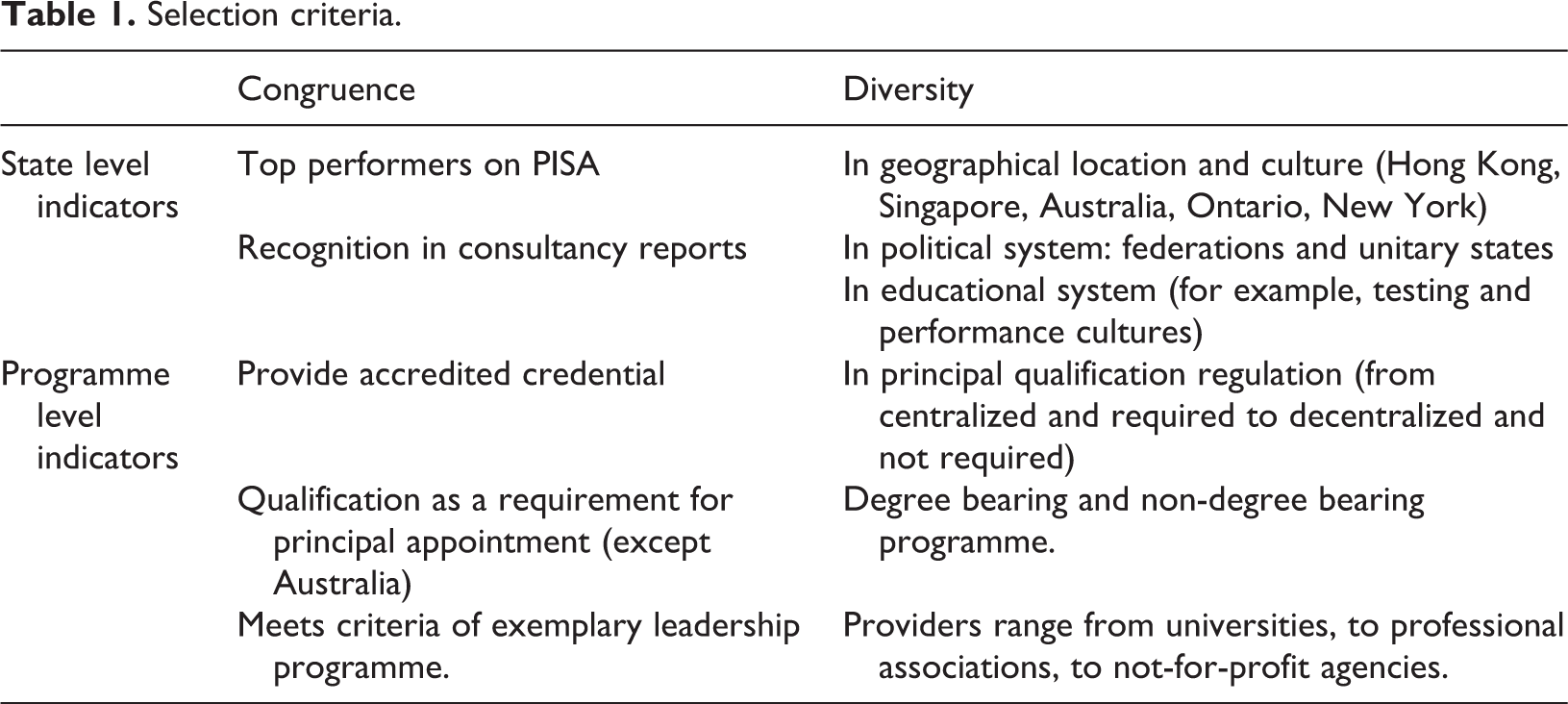
For the purposes of this study, we identified five leadership programmes from five different societies for analysis (that is, Australia, Canada, Hong Kong, Singapore and the USA). Given the aim to draw international comparisons in leadership preparation, selection criteria addressed congruence around indicators of excellence and diversity of context.
At the state level, each of the selected programmes is located in jurisdictions reported as top performers in the Programme for International Student Assessment (PISA). We recognize that PISA results do not evidence a direct relationship to leadership preparation. However, PISA results are closely followed by policymakers, stimulate international competition and legitimate reform efforts (Afonso and Costa, 2009; Rautalin and Alasuutari, 2009). High performing societies become magnets of interest for researchers and policymakers looking for strategies to improve their own educational systems (Phillips and Ochs, 2003). Accordingly, performance on PISA is recognized in consultancy reports (Barber et al., 2010), policy papers (National Governors Association et al., 2008) and academic research (Matthews et al., 2008) on school leadership, and informs our selection. Each of the jurisdictions selected for study performs in the top 10 of PISA measures. Further, the selected programmes are offered in jurisdictions identified for excellence in educational leadership (Barber et al., 2010). Given the diverse performance on PISA that is found within large federations such as the USA and Canada, this helped to narrow our selection (for example, to specify New York and Ontario).
The five programmes were selected to illuminate commonalities and variations in high-quality pre-service programmes, which aim to develop key knowledge and skills of individual leaders. However, we note that there is substantial critique of this structural-functionalist approach to studies on leadership development programmes (Gronn, 2003; O’Reilly and Reid, 2010; Simkins, 2012). Specifically, Gronn’s conceptualization of ‘designer leadership’ problematizes current leadership development programmes which are predominantly aligned with standards-based approaches. Based on Foucault’s concept of ‘disciplined subjectivity’, Gronn (2003: 283–284) argues that both aspiring and practizing leaders are expected to subject themselves to standards-based leadership development programmes by ‘acting in conformity with a leadership design blueprint’ which is ‘accredited by the standardizers, typically a state agency’ such as the National College for School Leadership. For Gronn, standards-based leadership development programmes are viewed as social apparatuses to achieve disciplined subjectivity. Similarly based on the Foucauldian perspective, O’Reilly and Reid (2010: 960) posit that there has been ‘an emerging set of beliefs that frames and justifies certain innovatory changes in contemporary organizational and managerial practice’, which they call ‘leaderism’. They further argue that leaderism as a public policy discourse is predominantly permeated in current leadership development programmes in the UK and that it functions as a social and organizational technology for control. In line with this problematization of current leadership development programmes, Simkins (2012: 634) suggests more studies on leadership development programmes from constructivist perspectives in that the goals and outcomes of leadership development programmes may be contested areas and ‘the formation of leader identity is at least as significant an issue as the development of specific skills and qualities’. Reflecting such substantial critique, we wish to note that follow-up studies using critical discourse analysis (Fairclough, 1995, 2003) are needed for analysing goals, strategies and outcomes embedded in leadership development programmes with more critical perspectives.
At the programme level, selection criteria used recently delineated research-based indicators of exemplary leadership programmes with high performance outcomes (Darling-Hammond et al., 2010). These include alignment to ‘state and professional standards’, an emphasis on ‘instructional leadership and school improvement’, student-centred learning, knowledgeable faculty, cohort structures, ‘formalized mentoring and advisement’, rigorous participant selection and site-based internships (Darling-Hammond et al., 2010: 181–182). Although the selected programmes share such features, commonalities and variations in their development, employment and emphases need to be further understood. Selecting programmes with broadly shared features allow for a more fine-grained analysis of similarities and distinctives.
Each programme leads to a credential accredited by regulatory agencies or universities. We exempted Victoria, Australia from this final selection criterion in order to meet selection criteria for the diversity necessary to obtain an international perspective on principal preparation in high performing educational systems. Additionally, we justify this decision because of anecdotal evidence suggesting that the state’s various leadership development programmes, while not required, are figuring as important in leader recruitment. We note that of the top ranked PISA performers, most do not have required pre-services preparation programmes, which eliminated countries such as Finland, New Zealand and the Netherlands from our selection.
Finally, we limited our study to systems that operate leadership programmes in the medium of English. This served practically to assist in data collection and analysis as the selected systems had documents in English which were publically available on the Internet or by request.The selection criteria in terms of congruence are summarized in Table 1. 1 Table 1 also presents the selection criteria applied for diversity. This reflects variation in geographic location and culture (Asia, Australia and North America), in qualification system structures (from centralized and required to decentralized and not required), variation in testing and performance cultures, in political systems (federal and unitary states), and in programme providers (universities, professional associations and non-governmental agencies). Our selection does not cover all possible high performing programmes, however we contend that it exemplifies a diverse enough range of systems, providers and programmes from which to inform our conclusions about commonality and variation in international programmes.
Selection criteria.
Sources and Data Collection
The data set comprises reviews of programme evaluation reports, in-house materials such as syllabi and Internet searches. Each of the researchers initially explored different programmes, contacted key personnel, searched the Internet, and uncovered academic papers and internal documents related to the specific programmes. While Internet data often provided the general structure of programmes, the evaluation reports, programme guidelines and interviews served to tease out key or unique features of each. (See Appendix 1 for sources in addition to those provided in the reference list.)
Analytical Strategies
We devised a comparative analytic framework based on our review of extant literature. Leithwood and Levin’s (2008) leadership development typology informed the initial draft of the framework (their influence is referenced in the framework in Appendix 2). Leithwood and Levin (2008) observe a lack of a comprehensive leadership typology. Accordingly, through the literature review we identified other facets of leadership preparation programmes and wrote descriptors of each in order to build a broader analytic typology. We used each item in the expanded typology to guide our initial analysis. We met regularly throughout the process of data collection and analysis to review and revise the conceptual framework. We added, merged and renamed the codes iteratively. Renaming or developing new codes proved essential. 2
Initially, the literature review suggested multiple content areas. While we used these to code programmes, given that our purpose aimed for comparison we used a constant comparative approach (Corbin and Strauss, 2008; Creswell, 2007) to identify content common across the five programmes. This process led to the creation of a separate code to stress the prominent or distinctive features of the respective programmes. The source of content also emerged as significant given the varied roles of frameworks, academics and practitioners in structuring and delivering programme content.
Nearer to the end of our analysis we arranged the codes under five broad themes: purpose, framework, content, delivery and operational features. However, in this paper we limit our discussion to the three themes that emerged as most significant and interrelated: 3 framework, content and operational features. For example, frameworks often inform content areas, operationalize programme purposes and drive programme features and delivery. Although we do not analyse purpose and delivery, these overlapping influences and connections are explored later in this article.
As we developed new codes, we wrote new definitions as a ‘code book’ that provided ‘observable boundaries’ for each code (Quartaroli, 2009: 265) and met frequently to ensure consistency in our application of the codes to analysing the respective programmes. Where applicable we followed Leithwood and Levin’s (2008) model of defining each code along a continuum that expresses a range of possible manifestations. To reflect this range in the coding process, we devised key word descriptors, or sub-codes (see Appendix 2). 4
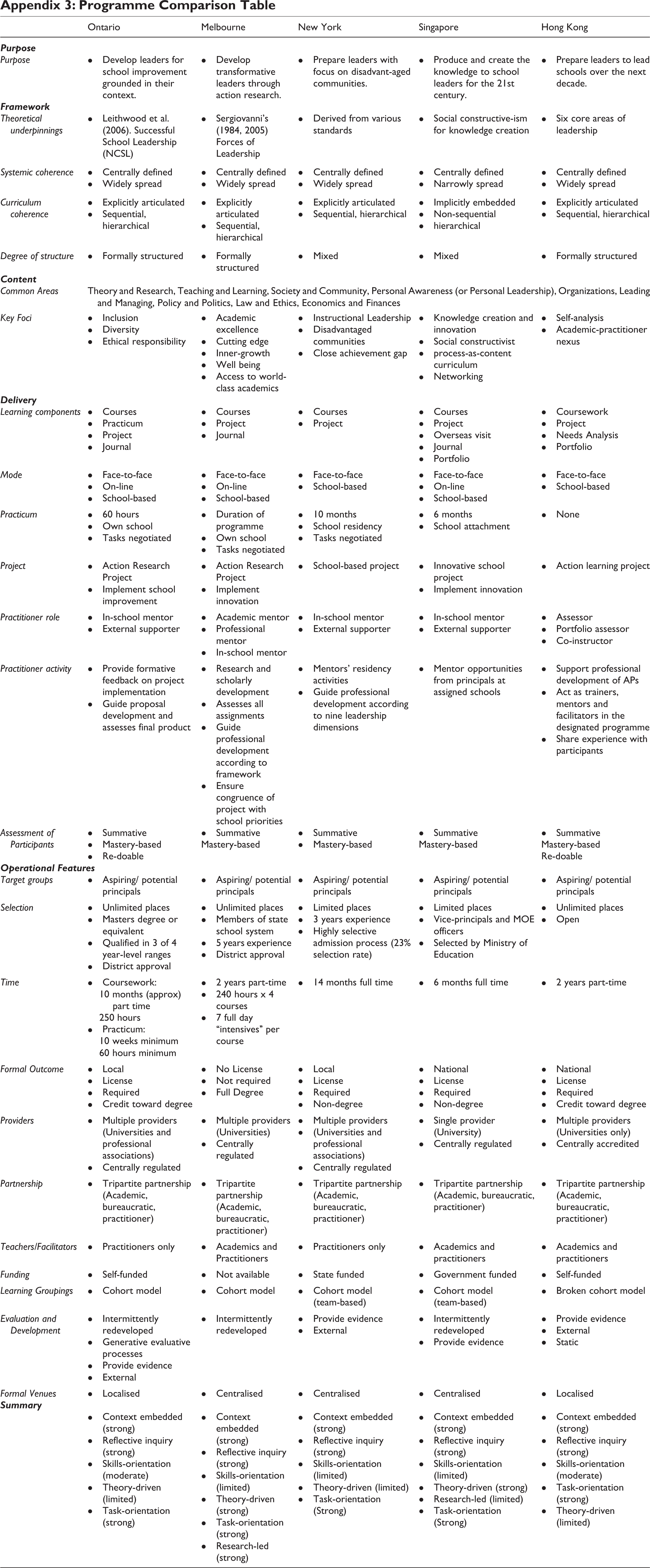
In order to organize the data in a manner suitable for comparison, we constructed a range of data displays (Miles and Huberman, 1994) for each programme. The displays took the form of matrices to summarize the data and partially ordered displays to evaluate the interrelationship among programme components (that is, codes). Within the cells of each matrix we placed extracts from the raw data, summaries and/or keyword descriptors. This provided a basis for cross-case comparison. We worked together to reduce the data (further honing our codebook) and create cross case matrixes to compare the data across programmes. The displays (further reduced into Appendix 3) provided the basis for writing up the findings.
Programme Profiles, Contexts and Frameworks
In this section, we describe key features of the selected programmes and some of their distinctive features in order to provide readers with profiles of each programme, their respective frameworks and the contexts in which they operate.
Canada (Ontario): Principals Qualification Programme (PQP)
In Canada, the province of Ontario has long mandated a pre-service qualification for entry into the principalship, termed the Principals Qualification Programme (PQP). The PQP is regulated by the Ontario College of Teachers (OCT), which mandates programme expectations, content requirements and learning outcomes. The OCT also accredits providers, which include six universities and three professional associations (Ontario College of Teachers, 2011). The OCT’s guidelines in turn cohere to the Ontario Leadership Framework, developed by the Institute for Education Leadership (IEL, 2008), which cites Leithwood et al.’s (2006) influential research synthesis as providing the framework’s theoretical underpinnings. These informed four of the framework’s leadership domains (IEL, 2008):
setting directions;
building relationships and developing people;
developing the organization;
leading the instructional programme. 5
In sum, the framework used in Ontario is research informed, adapted by the IEL, mandated by the OCT and implemented by different providers. In addition, beyond training for aspiring principals, the framework informs various facets of leader development, including mentoring (Ontario, 2010a), and performance appraisal (Ontario, 2010b) and is delineated for principals, district supervisors, and government and Catholic schools.
We have selected the PQP delivered by the Ontario Principals Council (OPC) for analysis. The OPC, as the professional association for principals, offers a programme distinctive from those typically run through universities. The OPC delivers the PQP throughout the province in urban and rural districts, making it one of the most widely distributed leadership programmes in the province. This scope is reflected in the number of candidates who complete the programme annually, placing the OPC as the PQP’s largest provider. While the PQP does not award a postgraduate degree, agreements between the OPC and three universities in Canada, Australia and the UK allow credit to be transferred into master’s degree programmes offered by the respective universities.
Australia (Victoria): Master of School Leadership (MSL)
The Australian state of Victoria has placed leadership development as key to the state’s school improvement efforts (Elmore, 2007). This has led to the creation of the Bastow Institute of Educational Leadership, an agency within the Department of Education and Early Childhood Development (DEECD), which supports leadership development for current and aspiring school leaders. It is responsible for the implementation of the government’s Developmental Learning Framework for School Leaders (Department of Education, 2007). The framework is derived from the work of Sergiovanni (1984, 2005) and accordingly targets the following domains.
Technical: Thinks and plans strategically, aligns resources with desired outcomes, holds self and others to account.
Human: Advocates for all students; develops relationships; develops individual collective capacity.
Educational: Shapes pedagogy; focuses on achievement; promotes enquiry and reflection.
Symbolic: Develops and manages self; aligns actions with shared values; creates and shares knowledge.
Cultural: Shapes future; develops a unique school culture; sustains partnerships and networks. (Department of Education, 2007)
It provides competency indicators for each domain and informs principal induction, development, selection, mentoring, succession planning and professional learning (Department of Education, 2007).
In Victoria, there is no single credential required of principals; however, the Bastow Institute has developed a range of pathways for leader development. These range from weekend workshops to a 2-year Master of School Leadership (MSL) delivered by two providers: the University of Melbourne and Monash University (Department of Education and Early Childhood Development, 2010). The Bastow Institute serves to regulate and accredit the MSL. We focused on the MSL delivered by the University of Melbourne as it is the state’s largest university, a significant international leader in educational research, and a major provider of pre- and in-service training for teachers and leaders in Victoria.
Singapore: Leaders in Education Programme (LEP)
Since 1997, Singapore’s educational reforms have been aligned with its vision of ‘Thinking Schools, Learning Nation’ and further specified in 2005 through the state’s policy initiative ‘Teach Less Learn More (TLLM)’ (Ng, 2008, Ministry of Education [MOE], 2005). Under TLLM, the role of school leaders has been redefined to stress the development of creative and innovative transformational leaders, and instructional leaders capable of creating and implementing innovative programmes for diverse learners (MOE, 2005; National Institute of Education [NIE], 2010). The underlying goals of this vision are summarized as (1) developing all students into lifelong learners through critical thinking, (2) forging creativity and entrepreneurship in schools and (3) creating a culture of learning and innovation across various societal sectors and levels (Ng, 2008). To achieve these goals, Singapore mandates a single pathway to the principalship through the Leaders in Education Programme (LEP), which in 2001 replaced the Diploma in Educational Administration. It is delivered only by the NIE.
In keeping with government policy, the LEP draws its framework from international models, which are adapted to focus on promoting creativity, innovation, diversity and distributed leadership. To provide a coherent framework to deliver these aims, Singapore, like Victoria, draws on Sergiovanni’s Five Forces of Leadership but also applies Howard Gardner’s (2008) Five Minds for the Future to identify key competences and attitudes, termed mind-sets, that are ‘needed to perform the roles’ (NIE, 2011: 5–6). Summarizing Gardner (2008: 3):
the disciplined mind develops expertise in ‘at least one discipline’ that entails a specific set of skills, knowledge and understanding;
the synthesizing mind collects, analyses, evaluates and synthesizes information from wide-ranging sources;
the creating mind moves knowledge ahead of technological advances through innovative questioning and thinking;
the respectful mind, cognizant of the globalized world’s interconnectivity, negotiates differences among individuals and societies;
the ethical mind acts for the greater social good over self-interest.
The framework, developed by faculty at the NIE and endorsed by the MOE is applied narrowly to the LEP, for which it was specifically created.
Hong Kong: Certification for Principalship (CFP)
Until 1999, leadership preparation in Hong Kong followed no clear and coherent pathway. A shift towards involving academics and practitioners in developing and delivering a mandatory leadership preparation credential occurred in response to two consultation reports in 1999 and 2002, resulting in establishing the Certification for Principalship (CFP) as a mandatory entry requirement for principals. Currently, the government licenses three providers, all tertiary institutes, to deliver the CFP. Providers must demonstrate an alignment of the programme they designed to a required framework, Key Qualities of the Principalship in Hong Kong (Education Department, 2002; Walker et al., 2002; Walker and Kwong, 2006).
The Hong Kong framework is located in a wide range of international research, which has been adapted in response to research conducted on leadership in the Hong Kong context (Walker et al., 2002). It comprises four leadership domains:
strategic leadership;
instructional leadership;
organizational leadership; and
community leadership.
These in turn inform six core areas of programme foci:
strategic direction and policy environment;
learning, teaching and curriculum;
teacher professional growth and development;
staff and resources management;
quality assurance and accountability;
external communication; and
connection to the outside world.
The six core areas are further delineated by a structure of values, knowledge, skills and attributes that guide leadership development programmes for aspiring principals, which the CFP targets, newly appointed principals and serving principals (Education Department, 2002).
The United States (New York City): Aspiring Principals Programme (APP)
New York City comprises the largest public school district in the USA. Its recent reform efforts explicitly highlight leadership, empowerment and accountability as three key pillars in reform. These aim to close the achievement gap by stressing high standards for students and the use of data to drive improvement and shape accountability processes (Fryer, 2011). Within this context, the New York City Leadership Academy’s (NYCLA) Aspiring Principals Programme (APP) has demonstrated its success in raising student outcomes (Corcoran et al., 2009).
The APP programme framework differs from the PQP and MSL in that it is developed by the provider, the NYCLA and derived from multiple standards set at the national, state and city levels. Termed the Leadership Performance Standards Matrix, the framework emphasizes transformational and instructional leadership and drives content and assessment across 12 dimensions:
personal behaviour;
resilience;
communication;
focus on student performance;
situational problem-solving;
learning;
accountability for professional practice;
supervision;
leadership development;
climate and culture;
time, task and project management, and;
technology. (NYCLA, 2012)
This framework guides ‘participant selection, curricular scope, assignments, programme advancement, interventions and the comprehensive evaluation of each participant’ (NYCLA, 2012). Graduates must demonstrate competency in each dimension, further delineated by 55 behavioural criteria, which are in turn defined along a continuum of not meeting, progressing towards and meeting the standard. The Matrix has in turn been applied to the development of a Leadership Performance Planning Worksheet in conjunction with the states of Delaware and Kentucky and the Wallace Foundation. The Worksheet is used in the development of novice principals and is aligned to the Educational Leadership Policy Standards (Council of Chief State School Officers, 2008), which are derived from a database of 83 international empirical studies and 47 other references. In this sense, the NYCLA’s Matrix has wide influence, although not through the initial mandate of a singular state regulator.
Commonalities and Variations in Leadership Preparation Programmes
Frameworks
The preceding section points to several commonalities in terms of programme frameworks. The formation of frameworks is significantly influenced by governments, central/district offices and/or international pools of research, and are mediated by regulating agencies and programme providers. Typically, the frameworks do not stand in isolation, but are often applied or adapted to guide a range of leadership development strategies and programmes. Framework developers look to extant internationally respected theories and/or empirical research to underpin them but make adaptations to account for the local context. Ontario does so by adding a fifth dimension to the Leithwood et al.’s (2006) framework, Hong Kong by adjusting international findings to account for local leadership research, and Singapore by focusing the framework on national policy concerns of nation building and international competitiveness. In the case of New York’s APP, standards are developed from a range of sources and are focused locally on leadership preparation in underperforming schools.
Variations occur in the source of the frameworks and in their application. The programmes in Ontario, Hong Kong and New York look to syntheses of research from which programme standards and structures are derived. Ontario applies a synthesis by Leithwood et al. (2006) originally published by England’s National College of School Leaders, so in a sense borrows an extant framework that informs practices elsewhere. Hong Kong’s framework is derived from an international synthesis of literature filtered through research on leadership in the local context, and the NYC Leadership Academy on a synthesis of standards which are in turn underpinned by research. The Singaporean and Australian programmes provide interesting variations. Although both articulate explicit frameworks, rather than being derived from large-scale research syntheses, they are inspired by Sergiovanni’s model which in turn is based on empirical research.
Common Content Areas
We note that each programme emphasizes facets of instructional and transformative leadership and addresses specific topics as determined by their respective frameworks. As presented in Appendix 3, there is a great deal of commonality across a plurality of topics. The most salient common feature across the programmes is that ‘content is to some extent determined in the form of centrally defined competency frameworks’ (Ontario, Victoria and Hong Kong) or ‘frameworks developed by the provider but which draw on a range of sources for their construction’ (Singapore and New York). Where content expectations are delineated by regulators, providers shape programme content by allocating instructional resources, determining assessment strategies and stressing areas of respective expertise. Coupled with this overall commonality across programmes (see Appendix 3 for more details about commonality), we wish to highlight that there are context-specific variations across programmes, which are teased out below in detail. Variations in context and content source shape programme foci, at time narrowing the focus to the needs of communities and students.
Key Foci
National and Local Contexts
By analysing the programmes comparatively, contextual features emerge as drivers of content selection. In some instances, statutory or national aims determine the key areas of content foci. The OPC’s PQP programme draws particular attention to issues pertaining to inclusion and diversity, which reflects Canada’s constitutional status as a multicultural and bilingual country, and legislative requirements to address issues of access for aboriginal peoples as well as those with learning and developmental challenges (Ontario Principals’ Council, 2011a, 2011b). The content of Singapore’s LEP aligns to aims of nation-building in an era marked by international competitiveness, globalization and societal change. This includes an emphasis on knowledge creation and innovation, the development of networks, understanding international and corporate leadership contexts, and social constructivist processes (MOE, 2005; NIE, 2010, 2011). To provide instruction in these areas, the LEP comprises foundational coursework at the NIE, a school attachment in which candidates are meant to generate innovative solutions to problems of practice, a school based ‘Creative Action Project’ and participation in a learning community called the ‘Learning Syndicate’ as well as ‘management dialogue sessions’ and industrial attachments (LEP, 2011). In Victoria, the state’s emphasis on leadership development informs MSL content through the government’s Developmental Learning Framework and to 13 core leadership modules developed by the Bastow Institute. In contrast to the state defining content, New York City’s APP targets concerns of the local school district, which includes a large number of inner city schools. Local need drives its focus, emphasizing instructional leadership as the way to narrow the achievement gap. This specifically involves leadership preparation for instructional improvement in low-performing schools located in high poverty communities.
Sources of Content
In each of the programmes, content is derived from leadership frameworks, however other factors may shape programme specificity.
Student and Community Need
Hong Kong’s CFP addresses all of the common content areas, but a dual emphasize on a needs analysis (for example, participants’ self-analysis) and the academic–practitioner nexus shapes programme content. The needs analysis forms a profile for individual participants that is based on ‘extensive multi-point feedback’ (Walker and Kwong, 2006: 8). Participants respond to the needs analysis by creating a learning portfolio that demonstrates their in-school learning development. Instructors, mentors and syndicate group leaders, who are senior school principals, use individual needs-analysis results to provide feedback and guide participants’ development. The needs analyses are in turn used to create a cohort profile that allows instructors to tailor the content of subsequent modules to address the identified learner needs in alignment to the framework. In the OPC’s PQP, the involvement of practitioners, serving principals and district specialists, as primary instructional leaders, guest lecturers and mentors is intended to permit a focus on the particular needs of the wide-ranging communities in which the programme is delivered.
Professional and Academic Content
Providers’ expertise, and that of their faculty members, focus programme content. The OPC’s status as a professional organization gives its PQP curriculum writers access to its counselling and legal arms. This informs content pertaining to law and ethics, giving it particular currency in these areas. In New York, the APP’s content, skills and assessment are delivered in a 6-week summer intensive course and through leadership development sessions during a 10-month school residency. However, the interpretation or emphasis of content within these components are influenced by the contextual aims of the programme and its strong practitioner orientation, with instructors and mentors comprised of current and retired school leaders and district personnel. Melbourne’s MSL emphasizes leaders’ self-knowledge through ‘positive psychology’ to ground effective leaders (Waters and Luck, 2011), apparently drawing on the academic expertise of the programme director in organizational psychology. Delivered by a major research university, the MSL programme provides students with access to international researchers via the University of Melbourne faculty and visiting academics. The MSL differs from the other programmes we examined given its exceptionally strong emphasis on developing leaders as researchers who make contributions to theory through action research. Thus, in addition to being guided by a mandated framework, content is shaped by the particular expertise of its academics, who provide a stronger academic orientation than the other models examined.
The above indicates that while frameworks, often informed by state legislation, determine the primary content direction, content specification is mediated by identified student community needs and the particular expertise and organizational purposes of the providers.
Operational Features
The Practitioner Turn
Perhaps of greatest significance is the trend towards practitioners taking on expanded roles in leadership preparation. Across all programmes, practitioners play crucial roles in providing guidance to aspiring leaders through mentorship or job shadowing in participants’ own schools or in schools allocated by the respective programmes. Practitioners tend to be involved in all aspects of the programme including on-site or in-class mentoring, formative and summative feedback, and, particularly in the OPC’s PQP and NYCLA’s APP, as formal instructors and assessors, replacing positions conventionally held by university staff. Practitioners are seen to lend credibility by providing relevant tacit knowledge that permits the tailoring of programmes to the needs and resources of the local district, school and community context. The use of professional mentors in Victoria or district leaders in Ontario also provides the potential of contextualizing the content and skills articulated in the framework. Whereas Hong Kong’s CFP, the University of Melbourne’s MSL, and the NIE’s LEP emphasize content derived from research and academic networks, they still use practitioners as the oil to make the programmes work.
Tripartite Collaboration
Selected leadership programmes depend on the tripartite collaboration among government/regulator, provider and schools. This collaboration informs the development of leadership frameworks, programme regulation and content. Although the relationship of regulator to provider often appears mandated, the development of programme requirements may emerge through consultative processes. For instance, in Ontario providers were included in planning the redevelopment of the PQP requirements. Tripartite collaboration permits multiple providers to deliver the programmes in a manner that ensures some continuity in philosophy and content and simultaneously catering for local needs by drawing on local expertise. In most programmes, this occurs at the school level where mentors guide aspiring leaders in their development. The MSL exemplifies tripartite collaboration in that participants work with three mentors reflecting professional, academic and in-school programme aims. This mirrors the tripartite aims of encouraging participants’ progression along the developmental framework, honing their skills as researchers and ensuring that their work meets school needs.
Provider Expertise
Across the systems studied, elements of choice are offered to candidates. For all but Singapore, candidates may choose from different providers. The aspect of providing some measure of choice to leadership candidates appears a significant operational feature of leadership training programmes. However, once admitted to an individual programme limited choice is offered as candidates progress as cohorts thorough a prescribed curriculum. The providers we examined in Ontario, New York, Victoria and Hong Kong are each among one of several in the respective jurisdictions. Programmes are shaped by the providers’ particular expertise. Programmes offered by professional associations and not-for profit groups draw on networks and resources that differ from university-based programmes. They tend to emphasize practitioner orientations, local networks, and content derived from professional sources. For example, the OPC draws on its professional networks to identify top school leaders to act as instructors.
Formal Credentials
The programmes deliver a range of credential options. All but the MSL leads to a formal and required licensure needed to become a principal. However, anecdotal evidence suggests that the MSL is becoming a highly regarded credential for school principals. In addition to formal licensure, some programmes offer pathways to academic credentials, although in different ways. The MSL alone terminates in a postgraduate degree. However, in Ontario, the OPC is affiliated with universities in Canada, Australia and the UK which recognize its PQP as partial credit towards their master degree programmes. In Hong Kong, all providers are universities and the CFP is recognized as postgraduate credit at the discretion of the various universities. The Singaporean and New York programmes lead to the earning of a license but not a postgraduate degree.
Selection
All programmes have rigorous selection criteria, which typically require the prior completion of other academic or professional development programmes as well as the endorsement of a participants’ supervisor. In Ontario, Melbourne and Hong Kong, qualified participants may join the respective programme. This broad based selection contrasts with New York and Singapore in which applicants compete for limited places. New York selects only 23 per cent of applicants – those considered most likely to succeed in the challenging inner city context (NYCLA, 2011) – whereas Singapore limits places to vice-principals and Ministry of Education officers, which also selects participants. This limited selection may also reflect the framework and local goals of the respective programme.
Conclusion
Summary
We identified that the overall trajectories of leadership preparation programmes have converged across the five high-performing education systems in terms of three interdependent programme components – that is, framework, content and operation. Apart from these commonalities, we also note that differing local and national contexts have an impact on creating variations in terms of the enactment of the programme. These are summarized (see Appendix 3) as follows.
First, major commonalities in terms of framework include:
frameworks are based in empirically grounded research or theory;
frameworks are derived from research syntheses or widely respected international sources;
frameworks provide the potential of a common leadership language across the respective jurisdiction;
frameworks are adjusted to suit jurisdictional needs.
At the same time, however, major variations range from:
explicitly articulated to programme structure to implicitly applied in instructional tools;
derived from a synthesis of research to derived from a singular theoretical construct;
mandated from the top (Ontario, Hong Kong and Victoria) or framed by programme developers (Singapore and New York).
Second, with respect to content, major commonalities include:
established frameworks drive overarching content;
provider expertise determine specific foci;
practitioner involvement supports contextualization of content;
Content tends to emphasize a change orientation and stresses instructional and transformational leadership. Content variations include:
specific programme foci are dictated by local concerns as mediated by the particular expertise of academic and/or practitioners;
content ranges from addressing ‘national’ priorities such as globalization and the knowledge society (Hong Kong and Singapore) to more pragmatic concerns of the ‘local’ context (for example, NYC on closing the achievement).
Finally, major commonalities in terms of operational features include:
programmes accept aspiring and potential principals;
programmes have admission requirements (for example, experience and professional qualification);
successful completion of a programme results in formal licensure/certification – this is required by the system although some provide credit toward formal degrees;
programmes are offered by multiple providers who are centrally selected/regulated (except Singapore);
practitioners’ roles in programmes are expanding as programmes emphasize contextualized knowledge and skills.
The variations of operational features are summarized as follows.
Some programmes (for example, the cases of Singapore and New York City) involve a limited number of fully funded places to attract a wider range of talent.
Other programmes (for example, the cases of Hong Kong and Ontario) focus more on wider access to potential leaders and so an expanded pool of future principals. (In Ontario’s case, completion rates now exceed principal positions.)
As such, programmes which encourage wide access are offered on a part-time basis (Ontario, Melbourne-Victoria, Hong Kong); highly selective programmes (New York City and Singapore) are offered only on a full-time basis.
While programmes depend on a tripartite partnership among academics, practitioners and bureaucrats, variation in operational features across programmes is shaped by the key providers’ particular expertise and emphasis.
Implications for Policy, Practice and Research
To this point we have posited a typology of leadership development programmes and used this to described five high-quality leader development programmes and outline key areas around which programmes share commonality and exhibit variations. These findings point to several features that researchers and providers of leader development programmes may consider.
First, leadership frameworks inform each programme. How broadly these frameworks are applied vary. The benefits of aligning all leadership development and evaluation in a jurisdiction to a common framework allows for a common leadership language to be shared among government, regulators, providers and participants across a system. This may further promote opportunities for continued professional learning in networks across schools (for example, networked learning communities). Such benefits should be considered in light of the need to maintain the flexibility of providers to address local needs in context. In brief, programme developers may consider the impact of broadly applied leadership frameworks when they further develop or revise programmes for potential/aspiring principals.
Second, a wide degree of openness to participation of qualified candidates may impact healthily on a system’s leadership language and networks for those who wish to build their leadership capacity without aspiring to the principalship immediately. Where programmes allow all qualified candidates to participate they may provide a vehicle to broadening the pool of school leaders with diverse backgrounds. As Ontario, Victoria and Hong Kong apply their frameworks to a wide range of programmes, admitting participants who may not become principals serves to increase the capacity of middle leaders who share a common leadership language. Multiple providers enable a broad scope of admissions. Possible merits of this model would include that the potential of leadership preparation programmes to train numbers beyond the positions immediately available for the principalship may provide the potential of a common leadership language (Walker et al., 2011), and may serve to encourage teachers to see themselves as leaders (Townsend, 2011). This may increasingly boost a shared understanding of leadership among teacher-leaders at various levels within a school, not just principal aspirants. And from a practical point of view, accepting large numbers of candidates who meet admission requirements for programmes (for example, the Hong Kong and Ontario programmes) would ease the issue of principal shortage in high-needs schools. For example, unlike many inner city and poor US school districts (Owings et al., 2011), completion rates of leadership development programmes dramatically exceed principal positions in Ontario.
Third, at the same time, programmes that are highly selective/competitive and provide a limited number of places (for example, the cases of Singapore and New York City) may promote (1) smoother, more predictable programme operation or management, (2) programmes that can be organized and implemented around team-based learning units, (3) participants who can access more customized and intensive learning opportunities and (4) given that the programmes involve a limited number of fully funded places they may be more attractive to a wider range of talent. Reflecting differing merits between programmes focusing on greater openness and those emphasizing selective participation, we wish to emphasize that a guiding principle may concern the extent to which a jurisdiction intends to promote a common understanding of leadership for all potential leaders, regardless of the actual position they will take up in schools. Programme developers also need to explore whether the selective model benefits their educational system by considering the possibility of public funding, the overall status of supply and demand for principals, and the need for quality control for various leadership preparation programmes.
Fourth, our analysis draws predeominantly on documentary sources that emphasize program design. We have observed that programme developers look elsewhere to inform programme frameworks. However, as is common with many reform efforts, international borrowing may emphasize the needs of the state but it is in implementation on the ground where adaptations are made that account for local contexts. Although the diverse aims of states and the expertise of providers may explain some variation in programmes, how societal-cultural differences shape variation requires further research informed by rich qualitative data and the attentiveness of programme designers. The documentary data analysed in this study was not condusive to eludicating cultural impacts on programme variation.
Finally, the study demonstrates that across all programmes, regardless of their national context, the role of the practitioner as mentor and trainer is gaining in currency, with alignment to frameworks at times being the primary academic contribution. Where regulators delegate provision to accredited universities, professional and non-profit agencies, a measure of choice may be offered to candidates. This appears a significant option in larger jurisdictions. However, providers should carefully consider the differing expertise that academics and practitioners can bring to leadership preparation programmes. The emerging, but relatively recent, primacy of practitioners over academic staff in programme implementation appears to lend credibility and relevance to leadership preparation programs. Although, the implications of this development are not fully understood, it behoves scholars to consider specifically how their role in the tripartite relationship can better inform leadership preparation programs (Walker, 2011).
The days of including practitioners just to legitimize a programme by giving a one-off talk are gone. Rather, tripartite relationships can promote the development of ‘scholar-practitioners’ who have rich leadership credibility, informed by a formal knowledge base to which they contribute. In this regard, programme developers need to consider the differing expertise that academics and practitioners offer in programme content and operation (Walker and Dimmock, 2005). This will impact on the extent to which programmes offer orientations that stress research and theory and the application of theory and government policy to an immediate local context.
Footnotes
Appendix 1: Additional Documentary Sources
Appendix 2: Analytical Framework
Purpose
Indicates how a particular programme is intended to shape leaders’ development.
Theoretical underpinnings
From undefined or eclectic connection with leadership theories to explicitly articulated leadership theories or models (Kelly and Shaw, 2008), such as Sergiovanni’s Forces of Leadership.
Systemic coherence
From programmes independent of articulated leadership frameworks (such as degrees and programmes developed by a university or professional bodies with no articulation to state standards) to those fitted within a centrally defined leadership development framework (such as a coherent set of leadership dimensions around which leadership selection, training, mentoring and succession programmes are articulated). From frameworks that apply narrowly to a singular programme to frameworks shared widely across many leadership development programmes.
Curriculum coherence
Curriculum coherence and alignment across various learning components – that is, whether linkages across major learning components are explicitly articulated (or implicitly embedded) in a programme; whether major learning components are sequentially (or simultaneously) allocated, and whether major learning components are hierarchically arranged according to the level of learning components (for example, basic, intermediate, advanced).
Degree of structure
‘From [formally structured] (such as a principal qualification programme or a graduate degree) to non-formal or [informally structured] (such as networks, book clubs, or personal mentoring arrangements)’ (Leithwood and Levin, 2008: 288) or a mixture of both.
Theory and research
The extent to which programmes teach seminal and cutting edge leadership theories as well as training in practitioner-oriented research methodologies (such as action research).
Teaching and learning
Considers the extent to which programmes focus on leadership in the domain of teaching and learning (for example, areas such as instruction, curriculum, assessment, technology and inclusion in education).
Society, culture and community
Considers the impact of social and cultural forces on the school and the relationship of schools to the community (for example, community relations, its involvement in schools and the community as a resource).
Personal awareness (or personal leadership)
Considers the impact on leadership of self-nurturing and personal competencies (such as the impact of individual personality type and emotional intelligence on leadership and relationships in schools) as guidance for reflective practice (such as developing a personal philosophy of education and leadership).
Organizations
Considers topics such as the use of data for school improvement, planning and change; building school culture, shared meaning, common mission and vision.
Leading and managing
Considers themes from conventional management practices (such as personnel management, staff selection, and supervision) to effective leadership strategies (such as distributed leadership and problem solving).
Policy and politics
Considers policies enacted by the state (such as issues pertaining to governance, the relationship of the principal to the school board, accountability for student learning and resource utilization).
Law and ethics
Familiarizes candidates with legislation, collective agreements, student and teacher discipline, and other legal and ethical responsibilities of principals and school staff.
Economics and finances
Provides training in fiscal planning and budget administration.
Key foci
Indicates particular strengths or noted features of the programme.
Source of content
How content is derived for the programme.
Learning components
Indicates the major programme components around which instruction and assessment are organized.
Mode
From strictly conventional face-to-face classroom instruction to blended approaches that include face-to-face, distance and on-site learning (Grogan et al., 2008).
Practicum
Outlines the major features of practicum design such as its duration, location and tasks (Perez et al., 2011).
Project
Outlines the nature of capstone projects: from small-scale learning projects to extensive action research projects.
Practitioner role
Indicates the range of practitioner involvement such as coaching in leadership (professional mentor), instructional leadership, academic guidance (academic mentor), job shadowing, or formative feedback on site-based projects (in-school mentor).
Practitioner activity
Explains how practitioners are involved in teaching the programme and carry out their roles.
Assessment of participants
Indicates overarching assessment protocols, such as an emphasis on summative assessment according to fixed standards (mastery) or the extent to which participant may revise work in response to feedback.
Target groups
From leaders close to a principalship to those with future aspiration.
Selection
From competition for a limited number of places to open and unlimited admission based on meeting prescribed qualifications.
Time
From ‘short-term (such as individual workshops or conferences) to longer-term…(such as graduate degrees or formal qualifications programme)’ (Leithwood and Levin, 2008: 288). From part time to full time.
Formal outcome
From no license to a local or national license (such as a qualification issued by a particular district or jurisdiction) to a ‘broadly recognized’ degree (such as a master’s degree). (Leithwood and Levin, 2008: 288)
Provider
‘From programmes provided by the employer to those provided by’ professional associations or non-profit agencies to those provided by universities (Leithwood and Levin, 2008: 288). From independently delivered programmes to those accredited and regulated by a central authority.
Partnership
From programmes designed and /or delivered independent of other stakeholders (such as course content defined by individual instructors) to programmes designed in consultation with school districts, professional bodies and community stakeholders (Grogan et al., 2008). For example, tripartite partnership comprises a main operational agency (for example, university, professional association, or non-profit organization), a sponsoring/supervising agency (for example, government), and associate schools as local partners for on-site practicum (Hammond et al., 2010; Sanzo et al., 2011).
Funding
The source of funding for programme participants.
Teachers/facilitators
From conventionally instructed by academic staff to exclusively practitioner-led or a combination thereof.
Learning groupings
From courses, workshops or seminars selected according to individual interest to cohort approaches with progression through a programme defined for a specified group or somewhere in between (Grogan et al., 2008).
Evaluation and development
From a static, established programme to one frequently revisited and redeveloped. From internally evaluated to the provision of evidence to external evaluators or regulators.
Formal venues
From programmes provided at central locations (such as universities to which participants commute) to those delivered on-site or within participants’ communities. (Leithwood and Levin, 2008)
Programme encapsulation
From formal and didactic (such as focus on research, theory, management principles and administrative behaviour) to the development of critical thinking and analytical skills through reflective or craft models that emphasize professional inquiry, reflection, or context embedded content (such as practicum, mentoring, problem-based learning, job-shadowing, simulations and portfolio approaches). (adapted from Leithwood and Levin, 2008)
Appendix 3: Programme Comparison Table
Develop leaders for school improvement grounded in their context. Develop transformative leaders through action research. Prepare leaders with focus on disadvant-aged communities. Produce and create the knowledge to school leaders for the 21st century. Prepare leaders to lead schools over the next decade.
Leithwood et al. (2006). Successful School Leadership (NCSL) Sergiovanni’s (1984, 2005) Forces of Leadership Derived from various standards Social constructive-ism for knowledge creation Six core areas of leadership Centrally defined Widely spread Centrally defined Widely spread Centrally defined Widely spread Centrally defined Narrowly spread Centrally defined Widely spread Explicitly articulated Sequential, hierarchical Explicitly articulated Sequential, hierarchical Explicitly articulated Sequential, hierarchical Implicitly embedded Non-sequential hierarchical Explicitly articulated Sequential, hierarchical Formally structured Formally structured Mixed Mixed Formally structured Inclusion Diversity Ethical responsibility Academic excellence Cutting edge Inner-growth Well being Access to world-class academics Instructional Leadership Disadvantaged communities Close achievement gap Knowledge creation and innovation Social constructivist process-as-content curriculum Networking Self-analysis Academic-practitioner nexus Courses Practicum Project Journal Courses Project Journal Courses Project Courses Project Overseas visit Journal Portfolio Coursework Project Needs Analysis Portfolio Face-to-face On-line School-based Face-to-face On-line School-based Face-to-face School-based Face-to-face On-line School-based Face-to-face School-based 60 hours Own school Tasks negotiated Duration of programme Own school Tasks negotiated 10 months School residency Tasks negotiated 6 months School attachment None Action Research Project Implement school improvement Action Research Project Implement innovation School-based project Innovative school project Implement innovation Action learning project In-school mentor External supporter Academic mentor Professional mentor In-school mentor In-school mentor External supporter In-school mentor External supporter Assessor Portfolio assessor Co-instructor Provide formative feedback on project implementation Guide proposal development and assesses final product Research and scholarly development Assesses all assignments Guide professional development according to framework Ensure congruence of project with school priorities Mentors’ residency activities Guide professional development according to nine leadership dimensions Mentor opportunities from principals at assigned schools Support professional development of APs Act as trainers, mentors and facilitators in the designated programme Share experience with participants Summative Mastery-based Re-doable Summative Mastery-based Summative Mastery-based Summative Mastery-based Summative Mastery-based Re-doable Aspiring/ potential principals Aspiring/ potential principals Aspiring/ potential principals Aspiring/ potential principals Aspiring/ potential principals Unlimited places Masters degree or equivalent Qualified in 3 of 4 year-level ranges District approval Unlimited places Members of state school system 5 years experience District approval Limited places 3 years experience Highly selective admission process (23% selection rate) Limited places Vice-principals and MOE officers Selected by Ministry of Education Unlimited places Open Coursework: 10 months (approx) part time 250 hours Practicum: 10 weeks minimum 60 hours minimum 2 years part-time 240 hours x 4 courses 7 full day “intensives” per course 14 months full time 6 months full time 2 years part-time Local License Required Credit toward degree No License Not required Full Degree Local License Required Non-degree National License Required Non-degree National License Required Credit toward degree Multiple providers (Universities and professional associations) Centrally regulated Multiple providers (Universities) Centrally regulated Multiple providers (Universities and professional associations) Centrally regulated Single provider (University) Centrally regulated Multiple providers (Universities only) Centrally accredited Tripartite partnership (Academic, bureaucratic, practitioner) Tripartite partnership (Academic, bureaucratic, practitioner) Tripartite partnership (Academic, bureaucratic, practitioner) Tripartite partnership (Academic, bureaucratic, practitioner) Tripartite partnership (Academic, bureaucratic, practitioner) Practitioners only Academics and Practitioners Practitioners only Academics and practitioners Academics and practitioners Self-funded Not available State funded Government funded Self-funded Cohort model Cohort model Cohort model (team-based) Cohort model (team-based) Broken cohort model Intermittently redeveloped Generative evaluative processes Provide evidence External Intermittently redeveloped Provide evidence External Intermittently redeveloped Provide evidence Provide evidence External Static Localised Centralised Centralised Centralised Localised Context embedded (strong) Reflective inquiry (strong) Skills-orientation (moderate) Theory-driven (limited) Task-orientation (strong) Context embedded (strong) Reflective inquiry (strong) Skills-orientation (limited) Theory-driven (strong) Task-orientation (strong) Research-led (strong) Context embedded (strong) Reflective inquiry (strong) Skills-orientation (limited) Theory-driven (limited) Task-orientation (Strong) Context embedded (strong) Reflective inquiry (strong) Skills-orientation (limited) Theory-driven (strong) Research-led (limited) Task-orientation (Strong) Context embedded (strong) Reflective inquiry (strong) Skills-orientation (moderate) Task-orientation (strong) Theory-driven (limited)
Ontario
Melbourne
New York
Singapore
Hong Kong
Purpose
Theoretical underpinnings
Systemic coherence
Curriculum coherence
Degree of structure
Common Areas
Theory and Research, Teaching and Learning, Society and Community, Personal Awareness (or Personal Leadership), Organizations, Leading and Managing, Policy and Politics, Law and Ethics, Economics and Finances
Key Foci
Learning components
Mode
Practicum
Project
Practitioner role
Practitioner activity
Assessment of Participants
Target groups
Selection
Time
Formal Outcome
Providers
Partnership
Teachers/Facilitators
Funding
Learning Groupings
Evaluation and Development
Formal Venues