



Abstract
This quantitative study explores the relationship between school leadership and the development and sustenance of teacher social capital. The literature review discusses aspects of leadership theory to elucidate understanding of how leadership influences teachers’ working relationships. Quantitative methodology and analyses ascertain the correlation between Leithwood et al.’s dimensions of transformational leadership and the author’s dimensions of teacher social capital. Study findings indicate significant, positive moderate to high moderate correlations between: (1) transformational leadership and the environmental conditions nurturing teacher social capital; (2) leadership and teacher social capital; and (3) leadership and teacher collective efficacy (TCE). An additional major finding is the perception of higher levels of transformational leadership among teachers in middle performing and high performing schools as compared to the perceptions of teachers in low performing schools. This study provides evidence of the importance of transformational leadership in the development of teacher social capital within a school. High levels of teacher social capital should result in positive outcomes of student achievement, teacher quality and teacher job satisfaction. The study findings, interpretations and conclusions contribute to both school leadership and school improvement literature and should inform discussions about leadership development and the impact of leadership on teacher working relationships.
Introduction
What leaders think, do and say matters (Sparks, 2005). Research tells us that school leaders work indirectly through: (1) their influence on teachers; and (2) their effect on the learning environment to improve both teacher quality and student achievement (Griffith, 2003; Leithwood et al., 2008; Ross and Gray, 2006a). Consequently, one must ask, what are the dispositions, knowledge and skills demonstrated by effective school leaders, those leaders who have been able to bridge the gap between mediocrity and achievement by optimizing the teaching function? Another important question is how do these leadership attributes and practices influence teachers to make the most of teacher social capital? The purpose of this quantitative study is to answer these questions in order to gain better understanding of the leader’s role in the development and sustenance of teacher social capital. To address the first question, the literature review discusses aspects of leadership theory with respect to leadership influences on teachers’ working relationships. To answer the second question, quantitative methodology and analysis have been used to ascertain the correlation between leadership (particularly transformational) and teacher social capital.
Theoretical and Conceptual Framework
In the course of fulfilling the purpose of the study, social capital literature has been reviewed to develop a definition of teacher social capital. Contributions from literature and research in social capital theory, community psychology, leadership and education have culminated in a model that identifies: (1) the attributes of an environment where teacher social capital can germinate and thrive; (2) the dimensions of teacher social capital; (3) outcomes of a system of teacher social capital; and (4) the role of leadership in fostering teacher social capital. In order to test the conceptual model, a measurement instrument was developed to operationalize teacher social capital. This instrument was used in conjunction with measures of leadership and teacher efficacy to gather data necessary to answer the research questions and test the hypotheses.
Definition of Teacher Social Capital
Lin (2001: 29) combines ideas from Bourdieu (1985) and Coleman (1988) to define social capital as the ‘resources embedded in a social structure that are accessed and/or mobilized in purposive actions’. Lin’s definition captures key elements involved in creating value from relationships – available resources, the social network itself and actions that mobilize the resources. For the purpose of this study, using Lin’s definition as a foundation, teacher social capital is defined as the resources available to and used by a teacher by virtue of membership of social network(s) to produce outcomes that are beneficial to the teacher, her students and ultimately to the school community as a whole (Minckler, 2011). The primary network comprised of the teacher and his peers and the resources accessible through this network constitute teacher bonding social capital (TBOSC). TBOSC is operationalized in the Teacher Social Capital Scale (TSCS) (Minckler, 2011) as a function of sense of community and attributes of the school culture, such as norms and values that support effective teaching and learning. Teacher bridging social capital (TBRSC) refers to resources accessed through the external networks (outside of the school) to which a teacher belongs. TBRSC is operationalized through items on the TSCS that address participation in external social networks.
Conceptual Model
The key to understanding social capital is in recognizing that relationships have value, and that this value may be considered a form of capital. Answering the question, ‘Under what conditions do teacher relationships become a form of capital valuable to the school?’, assists in identifying the components of a conceptual model of teacher social capital. Relationships have value to the individual when his or her associations accomplish two major goals: (1) help the individual accomplish things he or she cannot do alone (task or instrumental outcomes); and (2) satisfy the individual’s belonging needs (an expressive outcome). To accomplish the task or instrumental outcomes, participants in the relationship share or exchange both tangible (teaching materials) and intangible resources (information). Over time, networks of individuals form to increase the quantity and quality of resources available for exchange within the group. Group members access these resources to accomplish individual and group objectives. Additionally, the group develops norms to regulate behaviors in order ‘to ensure group survival, facilitate task accomplishment, contribute to group morale, or express the group’s central values’ (Feldman, 1984: 52). Social capital theory is concerned with the structure and function of this broader network of exchange relationships in the creation of value.
Based upon the above understanding of social capital, a conceptual model of a system of teacher social capital has been developed that includes: (1) environmental conditions that enable valuable relationships to develop; (2) the features of a network conducive to meeting both the instrumental and expressive needs of the teacher participants; (3) actions that activate social capital; (4) actions that preserve and increase social capital; and (5) outcomes that result from teacher social capital. Figure 1 presents the elements of the system of teacher social capital (Minckler, 2011). The rationale for and conceptualization of the relationships among the variables are explained in detail elsewhere (Minckler, 2011; Minckler et al., 2010).
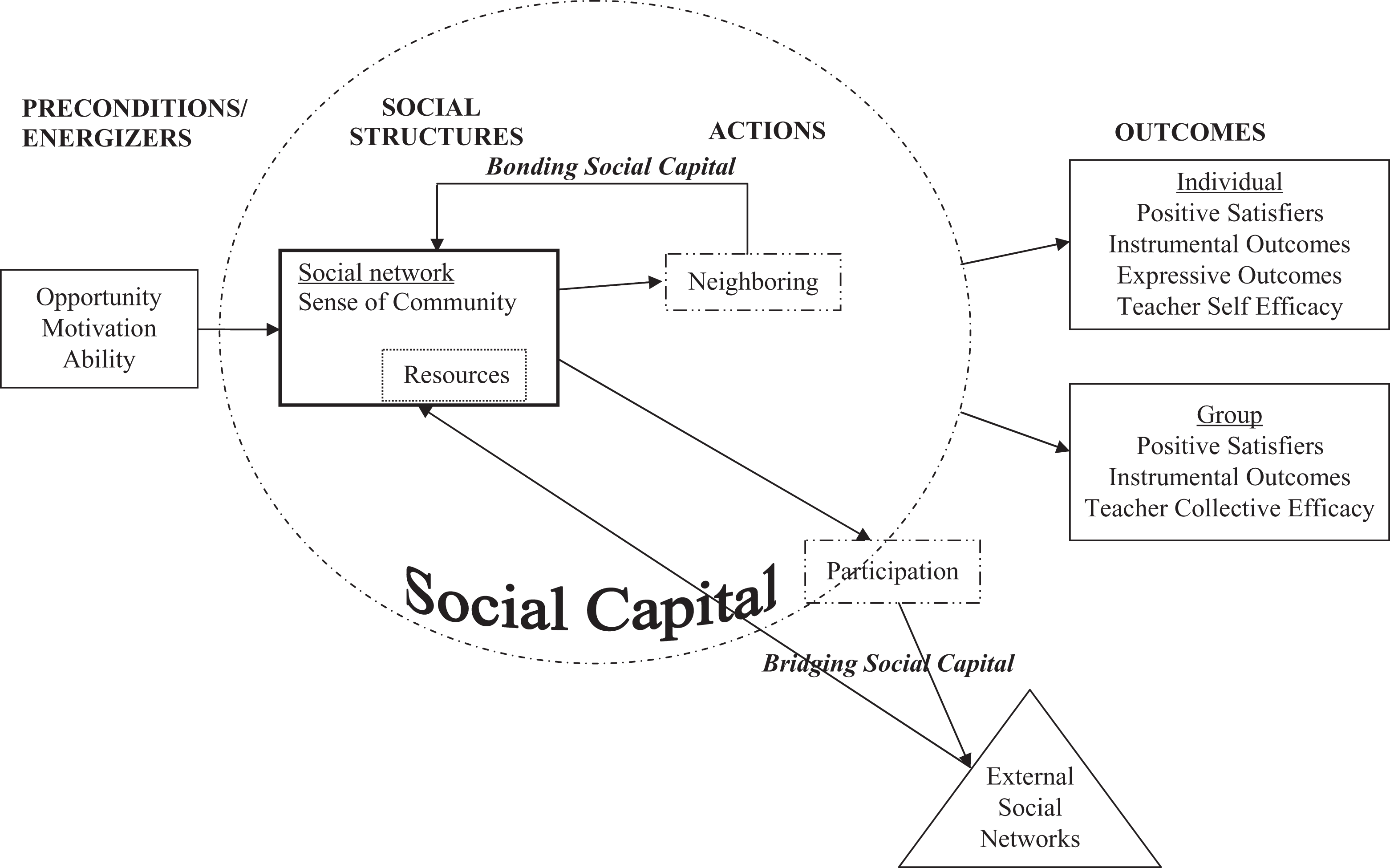
A conceptual model of a system of teacher social capital (Minckler, 2011).
Leadership
Northouse (2007: 3) defines leadership as ‘a process whereby an individual influences a group of individuals to achieve a common goal’. This definition of leadership is directly relevant to a discussion of the leader’s role in developing social capital. This study considers leadership as a process of interaction between and among the leader and followers that shapes organizational culture and influences group and individual behaviors to produce desired school outcomes. According to Hodson (2005: 44), competent leadership is recognized an ‘an important precondition for creation of social capital and organizational trust based on mutual gains’. Collaboration among people both uses and generates social capital. The quality of leadership determines whether this capital is spent on personal pursuits or is harnessed for organizational effectiveness.
Transformational Leadership in the School Setting
A number of researchers have studied leadership in the school setting (Barnett and McCormick, 2004; Leithwood, 1992; Ross and Gray, 2006a) in an effort to determine the degree to which school leaders are transformational and to determine the effect of transformational leadership on school performance. According to Leithwood et al. (2008: 27), ‘School leadership is second only to classroom teaching as an influence on pupil learning.’ Additionally, researchers have determined that the leaders’ impact is mediated through the teaching function (Griffith, 2003; Leithwood et al., 2008). Leithwood et al. (2008: 32) also suggest that ‘school leaders improve teaching and learning indirectly and most powerfully through their influence on staff motivation, commitment, and working conditions’. Ross and Gray (2006a: 813) report that principals ‘influence student achievement indirectly by creating the organizational conditions through which improved teaching and learning will occur’. Leithwood (1992: 2–3) recognizes that transformational school leaders are in ‘continuous pursuit of three goals: (1) Helping staff members develop and maintain a collaborative, professional school culture; (2) fostering teacher development; and (3) helping teachers solve problems together more effectively.’ By 2000, Leithwood and Jantzi (2000: 114) expanded the school transformational leadership model to include seven dimensions of transformational leadership: ‘Building school vision and establishing school goals; providing intellectual stimulation; offering individualized support; modeling best practices and important organizational values; demonstrating high performance expectations; creating a productive school culture; and developing structures to foster participation in school decisions’. The transformational leader works through all aspects of the school system – the people, the culture and the structure – to achieve organizational goals.
As posited, transformational leadership works through relationships to accomplish organizational goals. According to Leithwood (1992), transformational leadership harnesses both individual and collective action by exercising power through people not over them. Consequently, one may reasonably expect the transformational leader to play a pivotal role in creating and sustaining the conditions necessary to foster teacher social capital, a system built on relationships. This study focuses on how the transformational leader influences each component of the system of teacher social capital through actions that reflect the dimensions of transformational leadership identified by Leithwood and Jantzi (2000).
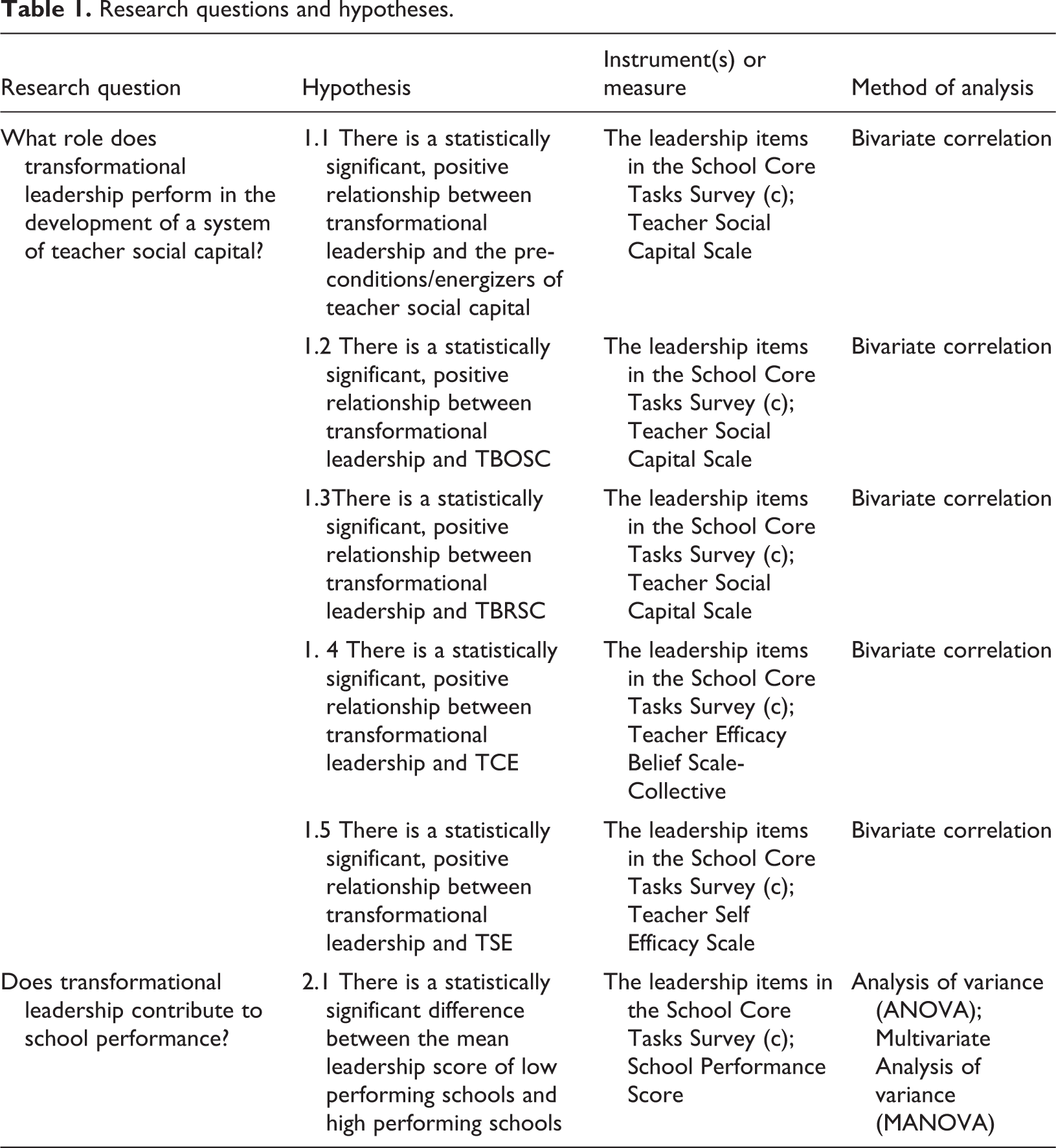
Research Questions and Hypotheses
Table 1 presents the research questions and hypotheses related to leadership and teacher social capital. Figure 2 presents the hypothesized relationships in graphic form. (Note: relationships among other variables in the figures, for example, TBOSC and teacher self-efficacy are discussed in Minckler [2011].)
Research questions and hypotheses.
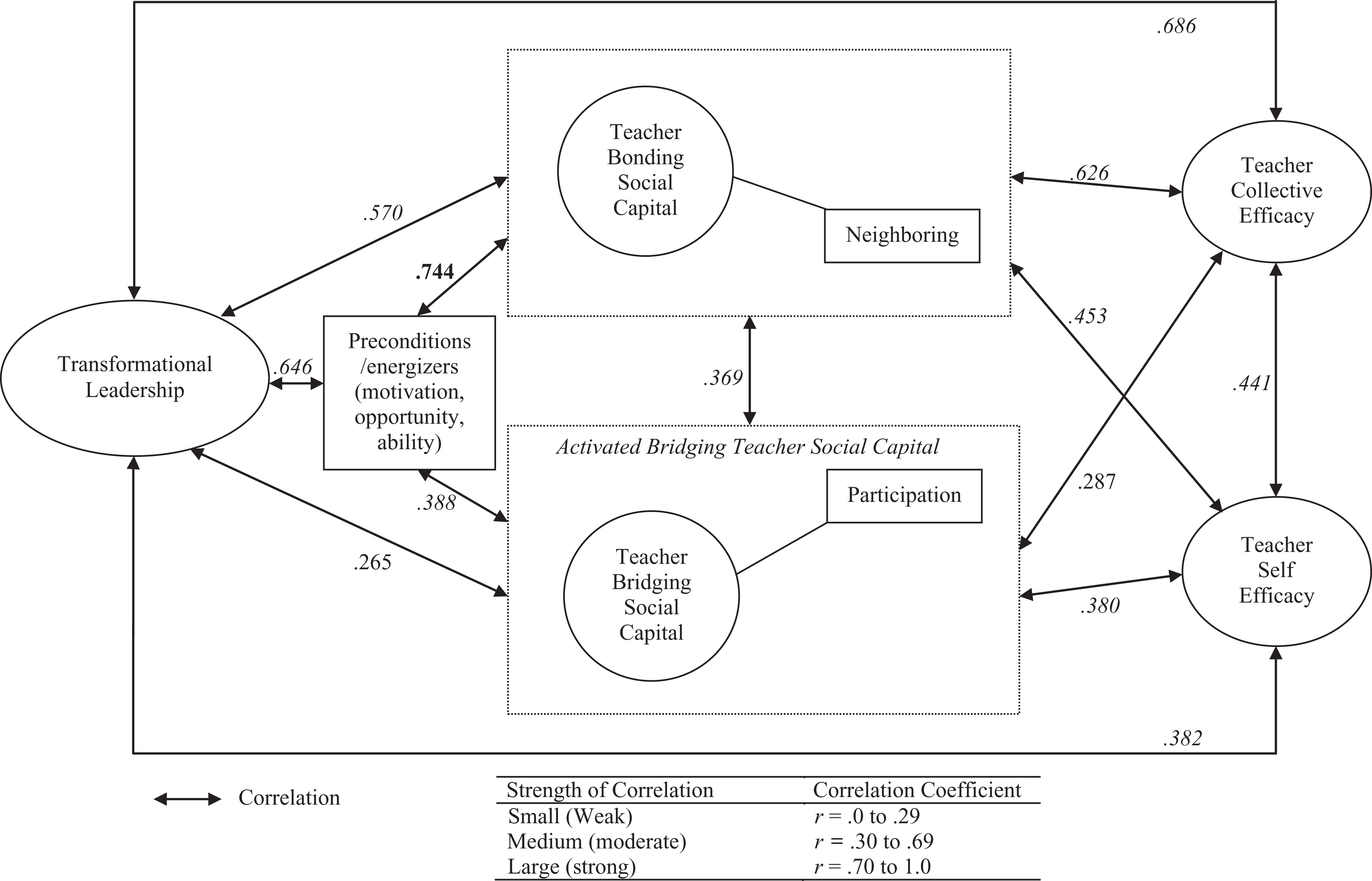
Correlations among the variables in the hypothesized model of the system of teacher social capital.
Methodology
Data Source
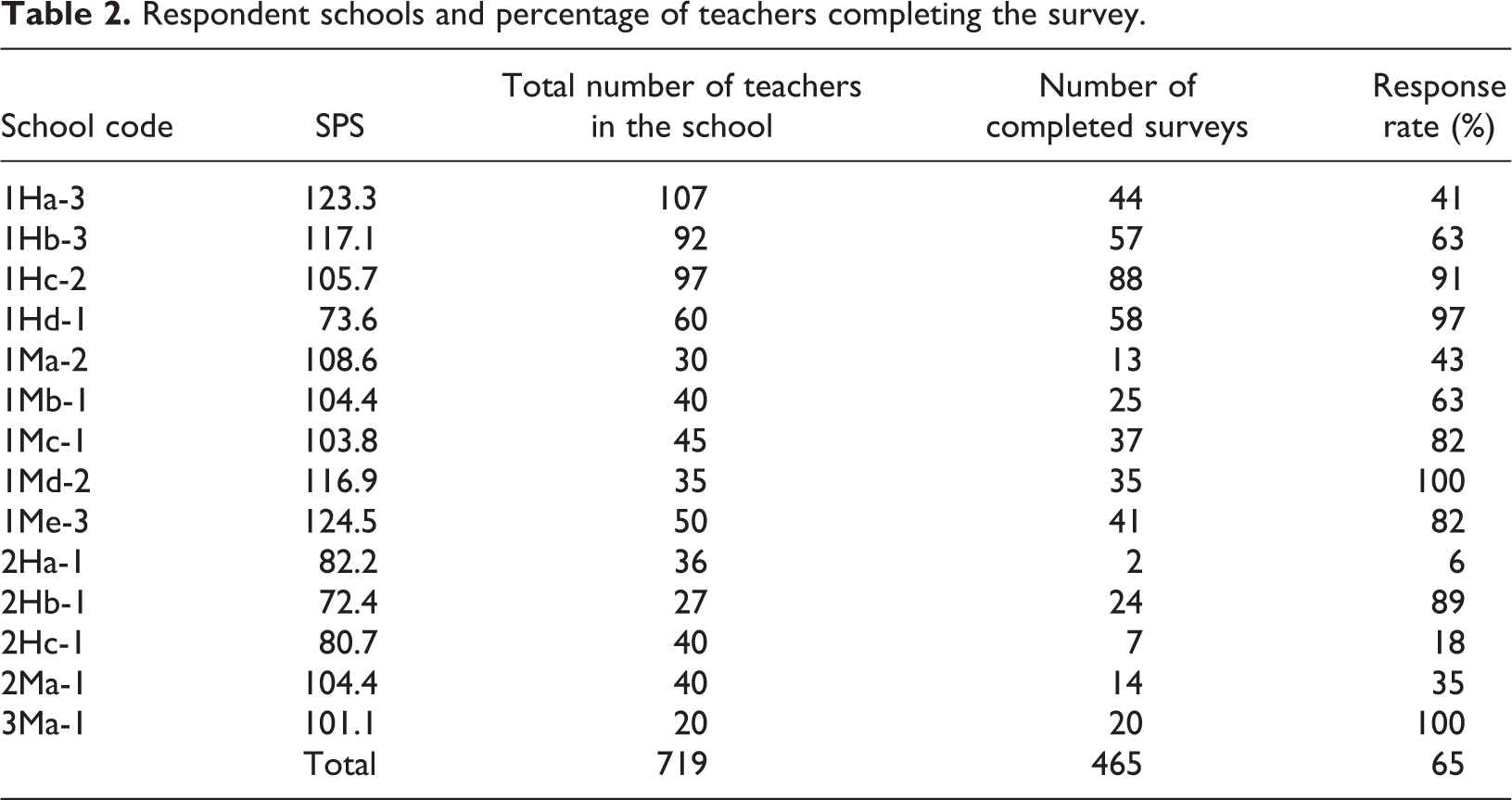
Data for the study are derived from a convenience sample of 13 schools in two school districts in southeastern Louisiana and one middle school in north Louisiana. Teachers (N = 465; 65% collective response rate for participating schools) within the middle and high schools in these districts completed a survey set designed to measure their perceptions about the degree to which the components of a system of teacher social capital are prevalent in their respective schools. Table 2 presents the number and percentage of participants from each school. Schools have been coded to preserve anonymity. The school code in the first column identifies each school first by school district (1, 2, or 3); then by school type (h = high school or m = middle school); next by a letter that distinguishes one school from another within the school district (a, b, c, d, or e); and lastly by a group number based on school performance score (SPS) (1 = low, 2 = middle, 3 = high). (Note: Statistical Package for the Social Sciences (SPSS) was used to group schools according to SPS.)
Respondent schools and percentage of teachers completing the survey.
Instrumentation
The following instruments comprised the survey set used to measure the key variables in the study.
Leadership
Teachers’ perceptions of school leadership were assessed using 31 items from the 38-item School Core Tasks Survey (c) (SCTS-L) (Leithwood et al., 2001). The principal researcher eliminated seven items considered redundant or irrelevant (to the sample population). The SCTS-L is a subsection of the management and leadership component of a comprehensive school monitoring system developed by Leithwood et al. (2001). In developing the leadership items, Leithwood et al. used a conceptualization of the school and school district as a learning organization (Senge, 1990) and school leadership as transformational. Transformational leaders foster the development of a learning organization through their beliefs, values and actions. The items address eight dimensions of transformational leadership: provides vision and/or inspiration, models behavior, provides individualized support, provides intellectual stimulation, fosters commitment to group goals, encourages high performance expectations, provides contingent reward and strongly encourages individual improvement.
Teacher Social Capital
TBOSC and TBRSC were measured using the 56-item TSCS (Minckler, 2011). Twenty-six items assess the preconditions/energizers – the teachers’ perceptions of the presence of: (1) opportunities to work together to plan, teach and learn from one another, and make decisions about curriculum; (2) motivation to both improve teaching and learning and to collaborate to do so; and (3) teachers’ abilities, the skills and knowledge to teach effectively. Twenty-five items address four dimensions of TBOSC – effective teaching beliefs and practices, collaboration, community identity, and culture of community. Five items address TBRSC, the degree to which teachers are linked to people or organizations outside the school that contribute to their effectiveness as teachers.
Teacher Efficacy
The teacher efficacy variables (collective and self) are identified in the study as outcomes of transformational leadership and teacher social capital. Hoy et al. (2002: 79) define teacher collective efficacy as ‘the perception of teachers in a school that the efforts of the faculty as a whole will have a positive effect on student learning’. Teachers with a strong sense of collective efficacy set goals that are more challenging, apply greater effort and are more persistent when facing obstacles. As a result, the school is more likely to achieve success. TCE is measured using the 10-item teacher efficacy belief scale-collective (Olivier, 2001).
Teacher self efficacy (TSE) ‘can be defined as a teacher’s individual belief in their capabilities to perform specific teaching tasks at a specified level of quality in a specified situation’ (Dellinger et al., 2008: 752). TSE acknowledges the myriad tasks involved in the process that must be performed well in order to achieve the outcome of high levels of student performance. TSE is measured using the 10-item TSE scale developed by Schwarzer et al. (1999).
Data Analysis
Statistical Package for the Social Sciences (SPSS) was used to analyze the data. The following quantitative analyses were performed to examine the psychometric characteristics of the study measures, test the proposed research hypotheses and answer the research questions: descriptive statistics for the sample (measures of central tendency and dispersion) to provide a snapshot of teacher perceptions of leadership, social capital and teacher efficacy among the middle and high schools in the study sample population; a series of bivariate correlations utilizing Pearson product moment procedures to examine correlations among the variables in the study to test the conceptual model (including the correlation between transformational leadership and teacher social capital); and the use of analysis of variance (ANOVA) and multivariate analysis (MANOVA) to determine whether there were significant differences in leadership, teacher social capital and efficacy beliefs between teachers in low, average and high schools.
Prior to conducting the bivariate correlations and the analyses of variance, preliminary analyses were conducted to test assumptions. Greater detail on the data analysis is reported in Minckler (2011).
Findings
Findings with interpretation are presented by research question for the analyses relevant to the relationships between leadership and the components of the system of teacher social capital. Findings relevant to the relationships among other variables in the study are presented in Minckler (2011).
Research Question 1
What role does transformation leadership perform in the development of a system of teacher social capital? To answer this research question, relationships were hypothesized between the leadership variable and the variables forming the system of teacher social capital: preconditions/energizers, TBOSC and TBRSC. A series of bivariate correlations assessed the relationships among the variables. The following guidelines were used to interpret the strength of correlation: small (negligible to weak), |r| = 0.0 to 0.29; medium (low moderate to high moderate), |r| = 0.30 to 0.69, and large, |r| = 0.70 to 1.0.
Hypothesis 1.1
There is a statistically significant, positive relationship between (transformational) leadership and the preconditions/energizers of teacher social capital. Table 3 presents the correlations among the seven leadership subscales and the three preconditions/energizers subscales. Correlations between the subscales ranged from a low moderate correlation of 0.371 (provides individualized support/ability) to a high moderate correlation of 0.636 (provides intellectual stimulation/opportunity). Within the leadership subscales and opportunity, correlations ranged from a moderate correlation of 0.497 (models behavior/opportunity) to a high moderate correlation of 0.636 (provides intellectual stimulation/opportunity). Within the leadership subscales and motivation, correlations ranged from a medium correlation of 0.406 (provides individualized support/motivation) to a moderate correlation of 0.515 (encourages high performance/motivation). Within the leadership subscales and ability, correlations ranged from a low moderate correlation of 0.371 (provides individualized support/ability) to a moderate correlation of 0.460 (encourages high performance/ability). Of the 28 correlations, all were positive, significant (ρ < 0.01) and moderate ranging from 0.371 (provides individualized support/ability) to 0.636 (provides intellectual stimulation/opportunity). The overall relationship between leadership and preconditions/energizers was significant (ρ < 0.01), positive and high moderate in magnitude (r = 0.646, see Table 4). Hypothesis 1.1 has been confirmed.
Summary of correlations between multiple factor subscales of leadership and preconditions/energizers (n = 293–458).
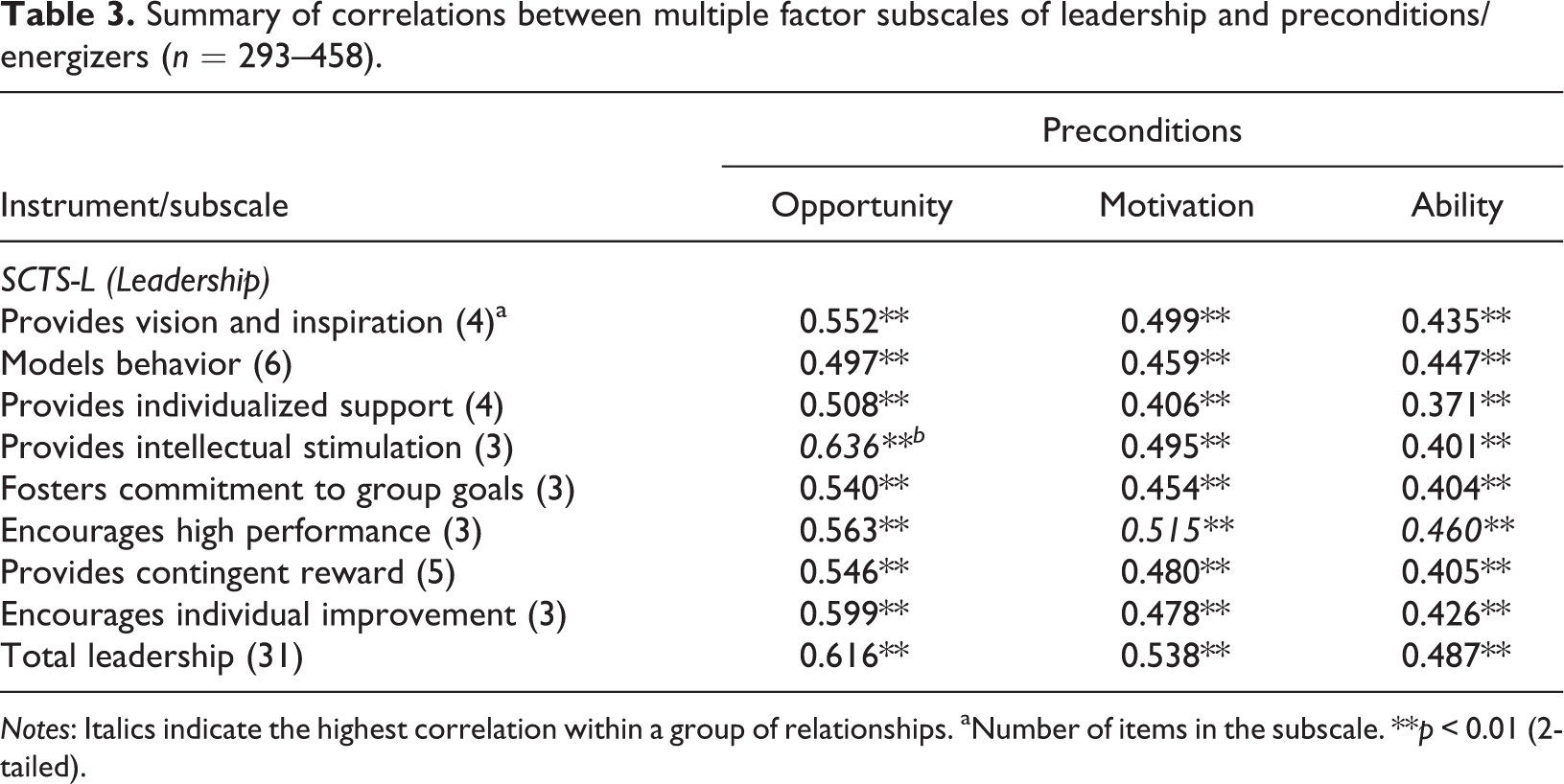
Notes: Italics indicate the highest correlation within a group of relationships. aNumber of items in the subscale. **p < 0.01 (2-tailed).
Correlations among the major study variables of total leadership,a total preconditions/energizers,a total TBOSC,a TBRSC, TCE, and TSE (n = 285–458).
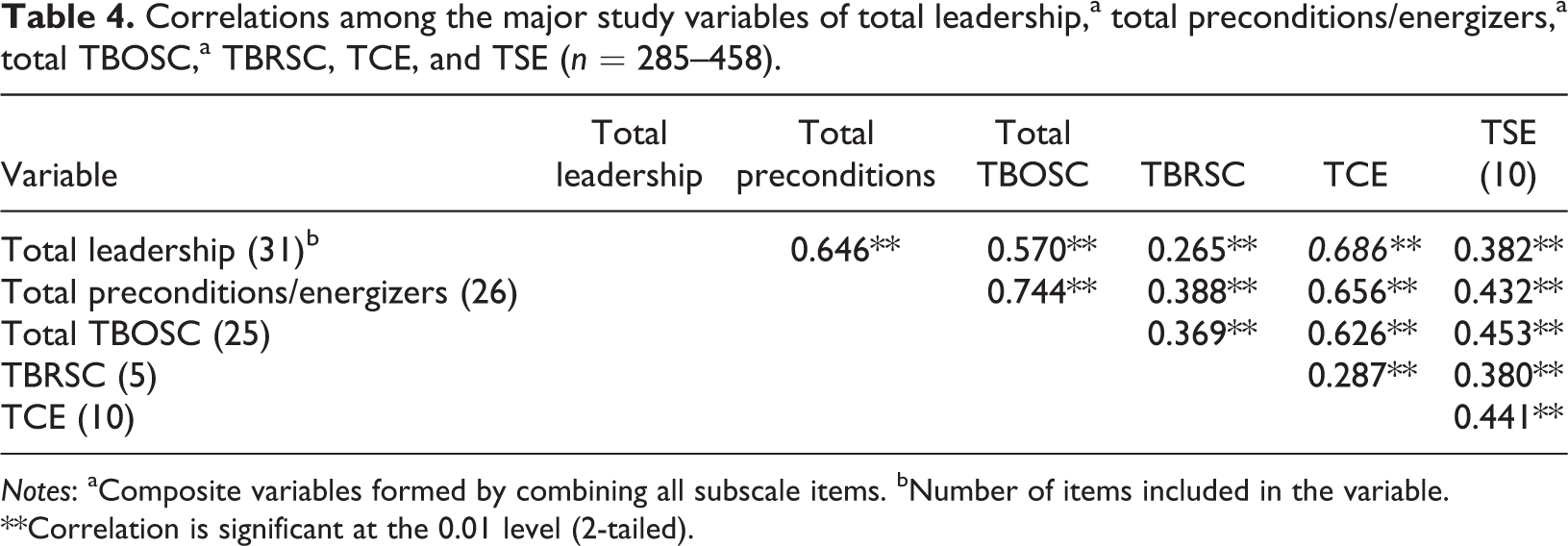
Notes: aComposite variables formed by combining all subscale items. bNumber of items included in the variable. **Correlation is significant at the 0.01 level (2-tailed).
Interpretation
The principal researcher hypothesized that transformational leadership works through preconditions (opportunity, motivation and ability) to establish the environment under which bonding and bridging social capital can thrive. In particular, school leadership certainly has more control over opportunity than do the teachers in the school. Teachers must have the place, the time and the imperative to form collaborative relationships. The transformational leader performs a crucial role in developing the structures, both physical (for example, shared scheduling time) and cultural (for example, norms of collegiality) that create the opportunities for groups of teachers to work together to create and use teacher social capital. The relationships between opportunity and the leadership subscales indicated that the teachers in the study perceive opportunities for professional growth as an avenue for leaders to provide intellectual stimulation and to encourage individual improvement and high performance. This finding tends to support the concept of the leader’s influence through academic press (Hoy et al., 1998). Academic press encompasses leadership practices of academic emphasis, resource support, and principal influence. By envisioning the school as a learning organization, creating structures that enable the necessary practices, establishing high expectations and encouraging individual improvement, the transformational leader shapes a school culture that values and builds capacity.
School leadership can also be expected to affect teacher motivation (Griffith, 2003; Leithwood and Jantzi, 2000; Piccolo and Colquitt, 2006; Webb, 2007). Study findings indicated a moderate relationship between leadership and motivation, primarily influenced by the leader actions of encouraging high performance, providing vision and inspiration, and providing intellectual stimulation. One might reasonably suspect that where high performance is not expected or encouraged, motivation is apt to be low. The significant, moderate correlations between: (1) motivation and providing intellectual stimulation; and (2) motivation and providing contingent reward, support the research of others, that is, transformational leaders develop intrinsic motivation in their followers through inspiration, individualized consideration and intellectual stimulation (Griffith, 2003; Leithwood and Jantzi, 2000; Webb, 2007).
The relationships between ability and the eight leadership subscales were low moderate, indicating that teachers did not see their knowledge and teaching skills strongly influenced by school leadership. The weakest correlation between the subscale of provides individualized support and ability particularly supports this interpretation. The strongest correlation, a moderate correlation between encourages high performance and ability supports the findings of Phillips (as cited in Bower and Powers, 2009) who posits that high expectations are a critical element of academic press.
Hypothesis 1.2
There is a statistically significant, positive relationship between transformational leadership and TBOSC.
Summary of intercorrelations between multiple factor subscales of leadership and TBOSC; (n = 425–459).
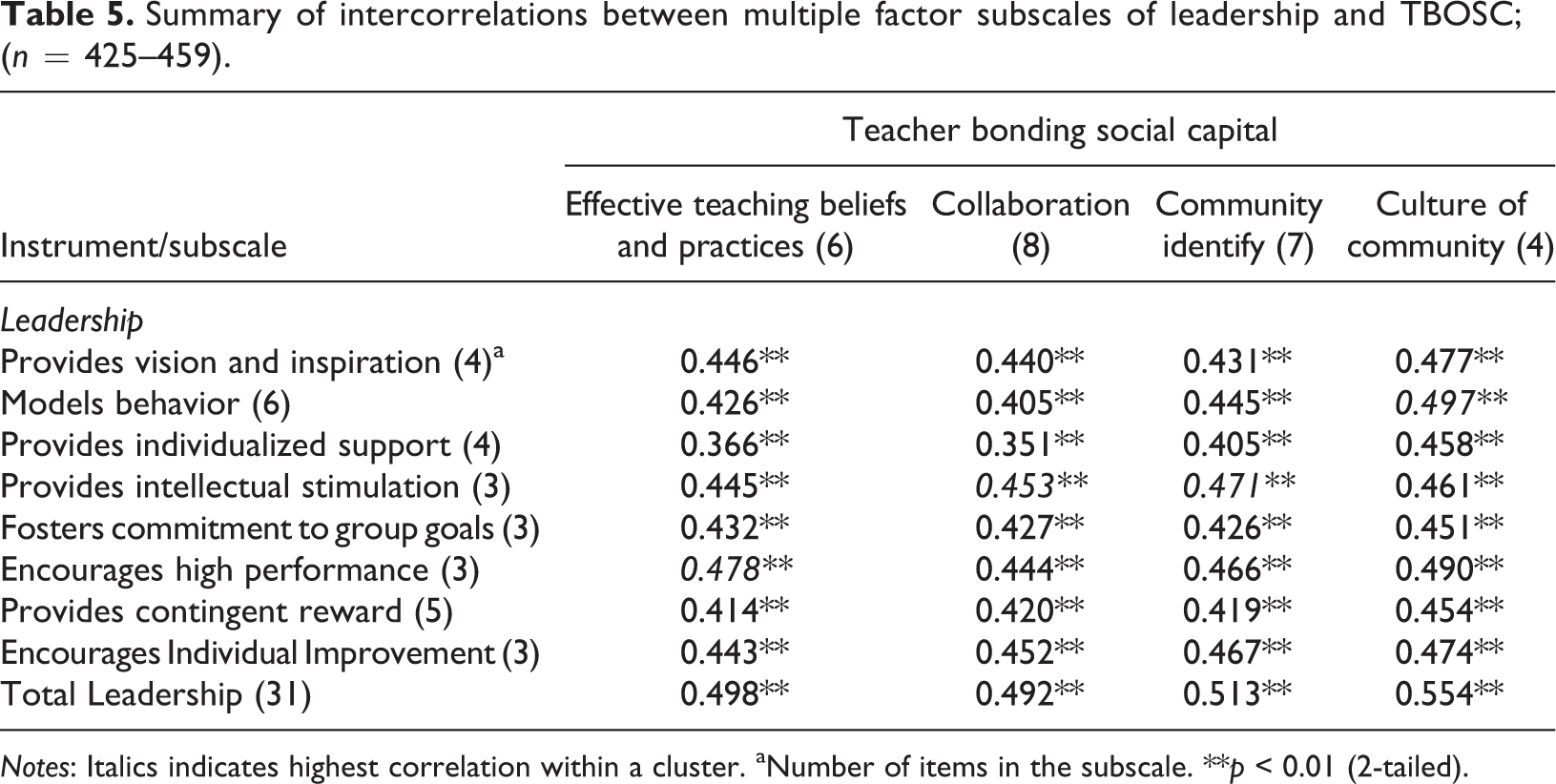
Notes: Italics indicates highest correlation within a cluster. aNumber of items in the subscale. **p < 0.01 (2-tailed).
Interpretation
Study findings suggest that school leaders may have a greater impact on TBOSC by establishing the conditions under which it can flourish than by directly influencing it. However, organizational theory and research also indicates that school leaders influence the social structure of the school through cultural mechanisms such as mission, vision, values and norms. Whether the norms and values of the network of teachers support collaboration, capacity building and student achievement is ultimately up to leadership. Leaders shape the organizational culture through consistency and alignment of words, attitude and actions. Leaders influence and modify group norms through ‘what they focus their attention on, how they react to crises, the behaviors they role model, and whom they attract to their organizations’ (Bass and Avolio, 1993: 113). The moderate correlation between the leadership subscale of encourages high performance and the TBOSC subscale of effective teaching beliefs and practices mirrors the finding of a moderate correlation between the leadership subscale of encourages high performance and ability. These findings add support to the interpretation that leaders affect teaching capacity through the establishment of high expectations. The moderate correlation between the leader subscale of encourages high performance and the TBOSC subscale of collaboration indicated that the teachers in the study associate leader expectations for high performance with their collaborative efforts to improve teaching and learning. The moderate correlations between: (1) leadership/provides intellectual stimulation and TBOSC/collaboration; and (2) leadership/provides intellectual stimulation and TBOSC/community identity suggested that teachers in the study recognize: (1) learning occurs when they are working together; and (2) they generally identify themselves as members of a community of learners. These findings support the concept of schools as learning organizations. Senge (1990: 3) defines learning organizations as ‘organizations where people continually expand their capacity to create the results they truly desire, where new and expansive patterns of thinking are nurtured, where collective aspiration is set free, and where people are continually learning to see the whole together’. The findings, in particular, support Senge’s (1990: 356) conceptualization of the leader as a teacher who ‘fosters learning for everyone’.
An additional finding of the study was the high moderate correlation between leadership/models behavior and TBOSC/culture of community. This finding reinforces the importance of the leader as role model (Bass, 1985, 1990). Through their actions, leaders demonstrate they value community and consider the school as community with shared vision, norms and goals.
These findings confirmed the principal researcher’s hypothesis: In schools where leadership models desired behavior, provides vision and inspiration, encourages high performance and fosters collaborative relationships focused on increasing teacher capacity and improving student achievement, TBOSC should be positively affected.
Hypothesis 1.3
There is a statistically significant, positive relationship between transformational leadership and TBRSC.
Summary of correlations between multiple factor subscales of the SCTS-L with one dimension scales of TBRSC (items on TSCS), TCE and TSE (n = 307–459).
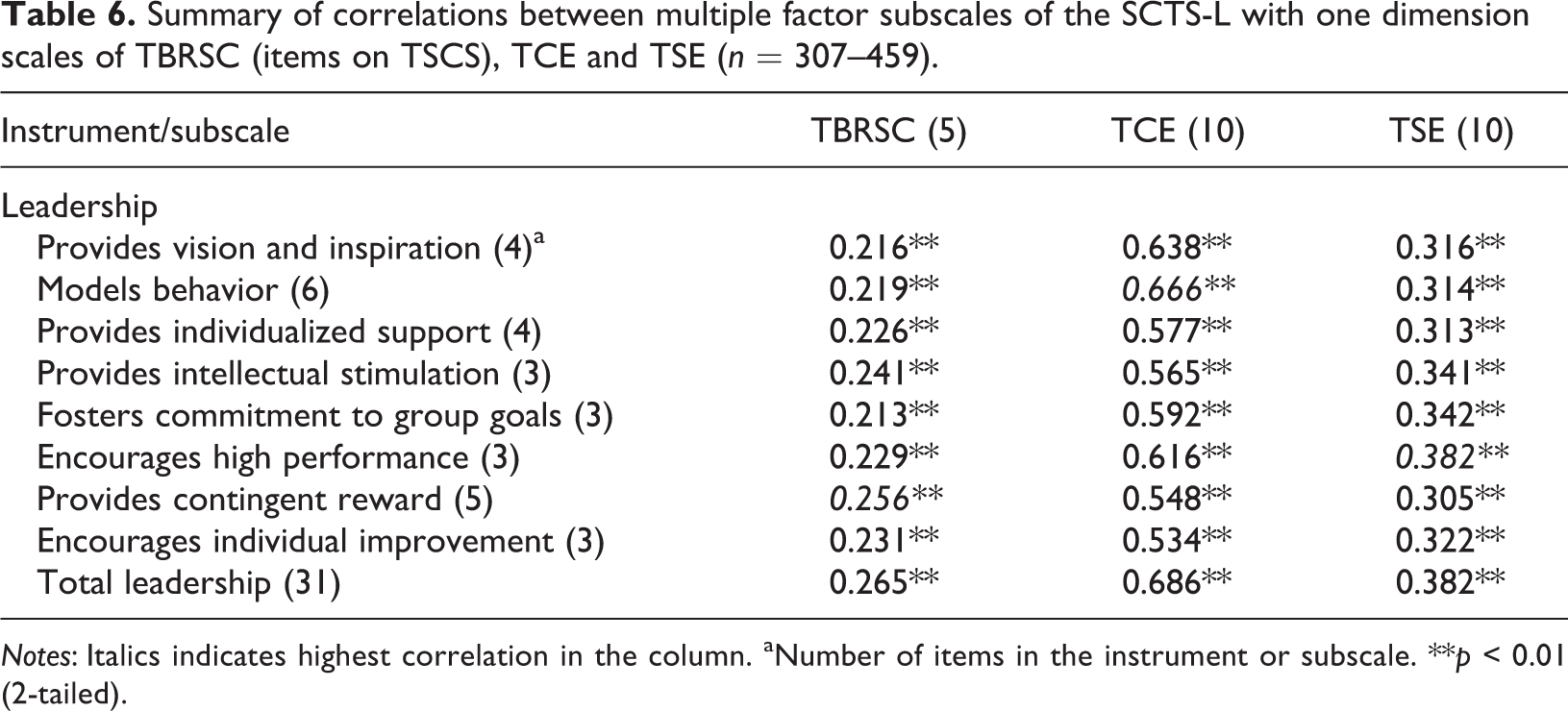
Notes: Italics indicates highest correlation in the column. aNumber of items in the instrument or subscale. **p < 0.01 (2-tailed).
Interpretation
The small correlation may indicate that teachers in the study see participation in professional organizations or professional development outside of the school as more of a self-directed activity than a leader-directed one. The lowest correlation of the eight possible was between leader provides contingent reward and TBRSC (0.256), suggesting the absence of both leader support and tangible rewards for participation in these external activities.
Hypothesis 1.4
There is a statistically significant, positive relationship between transformational leadership and TCE.
Interpretation
All correlations were moderate, confirming the principal researcher’s hypothesis that in schools where transformation leadership is practiced, one could expect to find at least moderate levels of TCE. Three subscales in particular, stand out as school leader behaviors related to TCE: models behavior; provides vision and inspiration; and encourages high performance. These particular attributes also have a high moderate correlation to the four subscales of TBOSC. Apparently, where leaders create a strong sense of community, establish and model high standards of performance, and inspire teachers to live up to those standards, teachers’ collective beliefs in their ability to get the job done are strengthened.
Hypothesis 1.5
There is a statistically significant, positive relationship between transformational leadership and TSE.
Interpretation
The relatively low moderate correlation between leadership and TSE supports the possibility that the leader has a more indirect effect on teachers’ self-efficacy through the leaders’ influence on collegial support. Where the leader enables and assists the teachers to establish an efficacious collaborative process, individual teachers both provide and receive the experiences and feedback they need to become more confident and capable in their abilities and more positive in their attitude about teaching. For example, Whalstrom and Louis (2008: 259) state, ‘increasing the visibility of classroom practice through frequent teacher observations of peers has been clearly linked to such benefits as improved instruction, improved teacher self efficacy, and improved teacher attitudes toward professional development’. These experiences (of peer observation) can become common practice among the teacher social network when leadership expects and encourages planning for their occurrence, provides resources to support their occurrence, and assures a defined process/format for the observation and the sharing of results.
The low moderate correlation between leadership and TSE is also consistent with the low moderate correlation between the leadership subscale, provides individualized support, and the precondition, ability. The teacher respondents did not appear to perceive their leadership as strongly influencing either the teaching ability of teachers in the school or their own TSE.
Pictorial Representation of the Relationships Among the Study Variables
Figure 2 presents the bivariate linkages among the study variables. The results displayed in Figure 2 show a pattern of relationships among the variables representing leadership, teacher social capital and outcomes. As explained in the narrative, all relationships were determined to be statistically significant; however, the magnitudes of the correlation coefficients varied from small to large. In Figure 2, medium correlations are italicized and large correlations are bold-faced. (Note: The positive correlations between the major variables tend to support the viability of the model of a system of teacher social capital.)
Research Question 2
Does transformational leadership contribute to school performance?
Hypothesis 2.1
There is a statistically significant difference between the mean leadership score of low performing schools and high performing schools.
Multivariate and one-way analysis of variance were used to test this hypothesis. An insufficient number of schools (N =14) precluded exploring the data using the school as the unit of analysis. However, teachers were grouped according to the school’s performance score (SPS) to look for mean differences in the study variables (leadership, TBOSC, TBRSC, TCE, TSE and SPS) among teachers working in low, middle and high performing schools. To organize teachers into groups, each teacher was assigned the SPS of his or her school. SPSS (the statistical software) was permitted to determine the thresholds for the three groups based on the SPS scores for the teachers involved in the study: Group 1, the low performing group, all teachers whose schools scored less than or equal to (<=) 104.4; Group 2, the middle performing group, all teachers whose schools scored from 104.5 to 116.9; and Group 3, the high performing group, all teachers whose schools scored 117.0 and above.
Multivariate Analysis of Variance
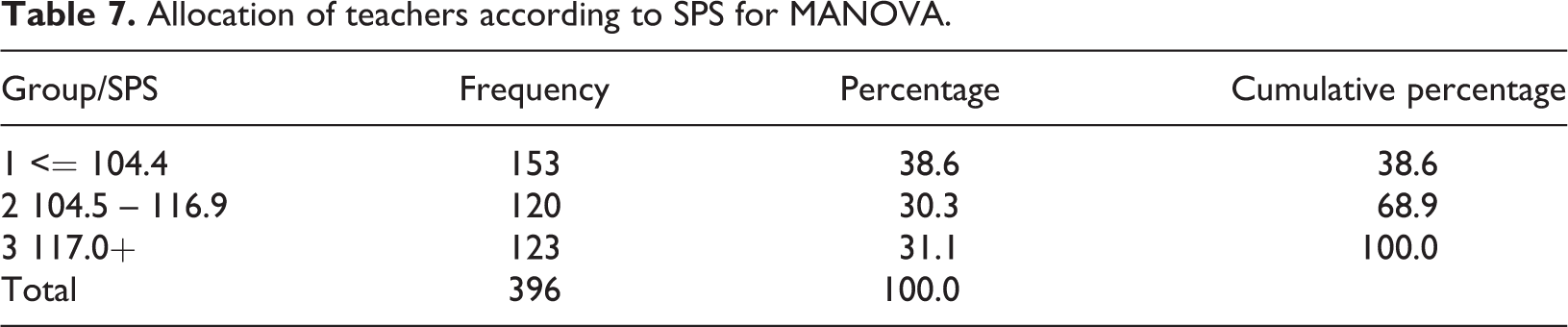
A multivariate analysis of variance was conducted to determine differences between the three SPS groups on a linear combination of leadership, preconditions, TBOSC, TBRSC, TCE and TSE. The composite precondition variable was not used because its inclusion caused a large inequality in group size (n of the largest group is greater than 1.5 times the n of the smallest group) which triggered a concern for sensitivity to violations of homogeneity of variance/covariance matrices (Leech et al., 2008). Instead, a modified precondition variable (MOTABIL) created by combining the two component variables of motivation and ability was used. Table 7 presents the number and percentage of teachers assigned to each group after making this modification. A significant difference was found, Wilks’ Λ = 0.945, F (388, 776) = 1.843, ρ = 0.038, multivariate η2 = 0.028, observed power = 0.931. Levene’s test of equality of error variances indicated that the assumption of homogeneity of variances was violated for both TCE (ρ = 0.016) and leadership (ρ = 0.011); consequently, results for these two variables should be viewed with caution. Examinations of the coefficients for the linear combinations distinguishing the three SPS groups indicated that leadership (β = −5.216, ρ = 0.015, η2 = 0.015), TBOSC (β = −3.141, ρ = 0.036, η2 = 0.011), TCE (β = −1.755, ρ = 0.014, η2 = 0.015) and MOTABIL (β = −2.962, ρ = 0.002, η2 = 0.024) contributed most to distinguishing the groups, more specifically, distinguishing the low performing Group 1 from Groups 2 and 3. The MANOVA indicates a small, significant leadership effect on SPS.
Allocation of teachers according to SPS for MANOVA.
One Way Analysis of Variance
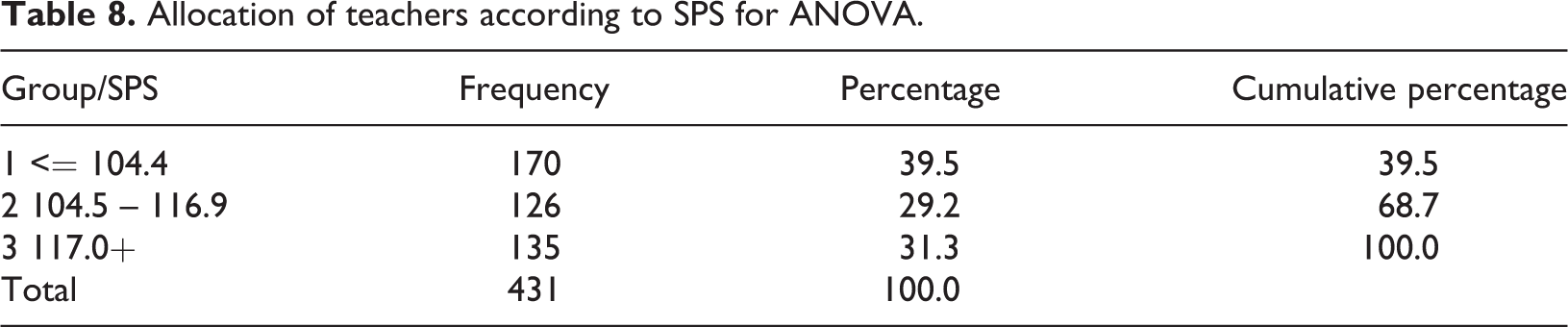
Univariate ANOVA for the leadership variable was conducted as a follow-up test to the MANOVA. Using the Bonferroni method for controlling Type I error rates for multiple comparisons, ANOVA was tested at the 0.017 level. In the process of conducting the ANOVA, the principal researcher tested the appropriate assumptions and conducted post hoc tests for the study variables. More detailed information is available in Minckler (2011). Table 8 presents the number and percentage of teachers assigned to each group by SPSS. The Levene statistic indicated that the data violated the assumption of equal variance among the groups; therefore, the Welch and Brown-Forsythe statistics have been reported. Both the Welch statistic (F (2, 282) = 6.344, ρ = 0.002, η2 = 0.029 (a small effect size)) and the Brown-Forsythe statistic (F (2, 416) = 6.600, ρ = 0.002) indicated there was a statistically significant difference among the groups. The interpretation of the magnitude of the effect size used Cohen’s guidelines (Leech et al., 2008): small = 0.10, medium = 0.24 and large = 0.37.
Allocation of teachers according to SPS for ANOVA.
Post hoc comparisons using the Games-Howell test indicated that the mean score for Group 1 (M = 92.08, SD = 19.82) was significantly different from Group 2 (M = 98.93, SD = 13.96), ρ = 0.002. Group 1 was not significantly different from Group 3 (M = 97.57, SD = 18.35), ρ = .034. Group 2 did not differ significantly from Group 3. Although the Group 1 mean differed significantly from Groups 2 and 3, the effect size was quite small.
Interpretation
Previous studies on the relationship between leadership and student achievement have tended to show that leader’s impact on teaching and learning is indirect and is mediated through the teaching function (Griffith, 2003; Leithwood et al., 2008; Ross and Gray, 2006a). Ross and Gray (2006a: 813) report that principals ‘influence student achievement indirectly by creating the organizational conditions through which improved teaching and learning will occur’. The results of the current study suggest that leaders may also have a direct, albeit small effect on student performance.
Major Findings and Conclusion
This section presents the main findings and conclusions of the study relative to school leadership.
Major Finding Number One
Significant, positive relationships were evident between leadership and each of the major facets of teacher social capital (preconditions/energizers, TBOSC and TBRSC).
Preconditions/energizers
Correlations between the leadership and preconditions/energizers subscales ranged from a moderate correlation between leadership/provides individualized support and preconditions/ability to a high moderate correlation between leadership/ provides intellectual stimulation and preconditions/opportunity.
Conclusion
Although correlations cannot be construed as causation, it is reasonable to suppose that the findings support the hypothesis that transformational leadership works through preconditions/energizers (opportunity, motivation and ability) to establish the environment under which teacher social capital thrives. Teachers must have the place, the time and the imperative to form collaborative relationships, and they must have resources to share. The transformational leader performs a crucial role in developing the structures, both physical (for example, shared scheduling time) and cultural (for example, norms of collegiality) that create the opportunities for groups of teachers to work together to create and use teacher social capital. The relationships between opportunity and the leadership subscales, in particular indicate that teachers in the study perceive opportunities for professional growth as an avenue for leaders to provide intellectual stimulation and to encourage individual improvement and high performance. This finding tends to support the concept of the leader’s influence through academic press (Hoy et al., 1998). Academic press encompasses leadership practices of academic emphasis, resource support and principal influence. By envisioning the school as a learning organization (Louis, 2006; Senge, 1990), creating structures that enable the necessary practices (Hord, 1997), establishing high expectations (Leithwood and Jantzi, 2000), and encouraging individual improvement (Leithwood and Jantzi, 2000), the transformational leader shapes a school culture that values and builds capacity.
Study findings also support earlier research indicating that leadership may also affect teacher motivation (Griffith, 2003; Leithwood and Jantzi, 2000; Piccolo and Colquitt, 2006; Webb, 2007). Findings indicate that the strongest relationships between leadership and motivation involve the leader actions of encouraging high performance, providing vision and inspiration, and providing intellectual stimulation. Study findings support the research of others, that is, transformational leaders develop intrinsic motivation in their followers through inspiration, individualized consideration, and by providing intellectual stimulation (Griffith, 2003; Leithwood and Jantzi, 2000; Webb, 2007).
The moderate relationships between preconditions/ability and the eight leadership subscales suggest that teachers in this study do not see their knowledge and teaching skills strongly influenced by school leadership. The low moderate correlation between the leadership subscale of provides individualized support and the preconditions/ability particularly supports this interpretation. This finding and interpretation also support Hoy et al. (1998), who, as previously mentioned, conclude that leaders influence ability more indirectly through academic press. Additionally, the significant, moderate correlation between leadership/encourages high performance and preconditions/ability tends to support the findings of Phillips (as cited in Bower and Powers, 2009) who posits that high expectations are a critical element of academic press.
TBOSC
The overall relationship between leadership and TBOSC is significant, positive and moderate in magnitude. The correlations among the subscales of each variable are significant, positive and moderate.
Conclusion
Study findings suggest that school leaders have a greater impact on TBOSC by establishing the conditions under which it can flourish. However, organizational theory and research also indicate that school leaders influence the social structure of the school through cultural mechanisms such as mission, vision, values and norms. School leaders affect the social structure of the school through cultural mechanisms such as mission, vision, values and norms. Whether the norms and values of the network of teachers support collaboration, capacity building and student achievement is ultimately up to leadership. Leaders shape the organizational culture through consistency and alignment of words, attitude and actions. Leaders influence and modify group norms through their emphasis, actions and hiring practices (Bass and Avolio, 1994). The significant, moderate correlation between leadership/encourages high performance, and TBOSC/effective teaching beliefs and practices mirrors the finding of a significant, moderate correlation between leadership/encourages high performance and preconditions/ability and supports the interpretation that leaders impact teaching capacity through the establishment of high expectations. the significant, moderate correlation between leadership/encourages high performance and TBOSC/ Collaboration indicates that the teachers in the study associate leader expectations for high performance with the work teachers do together to improve teaching and learning. The significant, moderate correlations between: (1) leadership/provides intellectual stimulation and TBOSC/collaboration; and (2) leadership/provides intellectual stimulation and TBOSC/community identity indicates that teachers in the study recognize that: (1) their major learning occurs when they are working together; and (2) they generally identify themselves as part of a community of learners. These findings support the concept of schools as learning organizations, particularly, Senge’s (1990: 356) conceptualization of the leader as a teacher who ‘fosters learning for everyone’.
An additional finding of the study was the significant, moderate correlation between the leadership/models behavior and TBOSC/culture of community reinforcing the importance of the leader as role model (Bass, 1985, 1990). Through their actions, leaders demonstrate that the school is a community with shared vision, norms and goals.
The Moderate Correlation between the Composite Measure of Leadership and the Composite Measure of TBOSC
This finding confirms the principal researcher’s hypothesis: In schools where leadership models desired behavior, provides vision and inspiration, encourages high performance and fosters collaborative relationships focused on increasing teacher capacity and improving student achievement, one should see respectable levels of TBOSC.
TBRSC
The correlation between the composite leadership variable (combined eight subscales) and TBRSC was significant, positive and small.
Conclusion
The small correlation may indicate that teachers in the study see participation in professional organizations or professional development outside of the school as more of a self-directed activity than a leader-directed one. The lowest correlation of the eight possible is between leadership/provides contingent reward and TBRSC suggests the absence of both leader support and tangible rewards for participating in these external activities.
Just as transformational leaders can affect TBOSC through practices such as providing vision and inspiration, modeling desired behavior, fostering commitment to group goals and providing opportunity, these same actions can be used to develop bridging social capital. Resources, including time, money and substitute teachers can be provided so that teachers can take advantage of opportunities to attend offsite workshops, conferences or meetings. If school leadership has established the structures whereby teachers can share the information, materials and skills gleaned from these opportunities, the entire teaching community can benefit.
Major Finding Number Two
Significant, positive relationships were evident between leadership and the outcomes of TCE and TSE.
TCE
The correlation between the composite leadership variable (eight subscales) and TCE is significant, positive and high moderate. The eight possible correlations among the subscales and TCE are all significant, positive and moderate.
Conclusion
The findings support previous research that has demonstrated school leadership strengthens TCE through the following actions: building instructional knowledge and skills (Brinson and Steiner, 2007) through ‘suitable professional learning opportunities’ (Ross and Gray, 2006a: 813); creating opportunities for teachers to collaboratively share skills and experience; helping teachers interpret results of their efforts by defining success (Ross and Gray, 2006b); providing ‘actionable feedback on teachers’ performances’ (Brinson and Steiner, 2007: 3); and involving teachers in school decision making, particularly relative to instructional goals and pedagogy (Brinson and Steiner, 2007).
By creating a culture and organizational structures that support teacher collaboration, the leader enlists the teachers within the school to engage in the desired activities, which in turn strengthen TCE.
TSE
The correlation between the composite leadership variable (eight subscales) and TSE was significant, positive and low moderate. All of the eight possible correlations between the subscales and TSE were significant, positive and low moderate.
Conclusion
The low moderate correlation between leadership and TSE supports the possibility that the leader has a more indirect effect on teachers’ self-efficacy via his/her influence on collegial support. Where the leader enables and assists the teachers to establish an efficacious collaborative process, individual teachers engage in the experiences and receive feedback they need to become more confident and capable in their abilities and more positive in their attitude about teaching. If this process does not exist, TSE is likely to be underdeveloped. For example, Whalstrom and Louis (2008: 459) indicate that frequent teacher peer observations have been ‘clearly linked to … improved teacher self efficacy.’ These experiences can become common practice among the teacher social network when leadership expects and encourages deliberate planning, a defined process, collegial relationships, and collective and individual participation.
Major Finding Number Three
Results of the MANOVA indicated that the mean perceived leadership measure for the teachers in low SPS schools was significantly lower than the average leadership values for both teachers performing in middle SPS schools and in high SPS schools.
Conclusion
Previous studies on the relationship between leadership and student achievement have tended to show that leader’s impact on teaching and learning is indirect and mediated through the teaching function (Griffith, 2003; Leithwood et al., 2008; Ross and Gray, 2006a). The results of the current study suggest that leaders may also have a direct, albeit very small direct effect on student performance.
Implications for School Leadership
The study findings provide insights into school leadership useful in improving both leader and teacher effectiveness. The small, but significant relationship between leadership and school performance contributes new knowledge to the study of school leadership. Heretofore, research has indicated that the leader’s impact on student performance has been indirect, through the teaching function. The findings of the current study suggest that the emphasis upon improved leadership (developing the knowledge, behaviors and attitudes of transformational leaders) may provide direct payoff in terms of improved school performance. Additionally, these transformational leadership skills are significantly, moderately correlated with TBOSC, which are also related significantly to school performance (Minckler, 2011).
Additional implications for leadership are presented in the paragraphs that follow, organized by components of the system of teacher social capital.
Preconditions/energizers
According to Leithwood et al. (2008: 27), ‘School leadership is second only to classroom teaching as an influence on pupil learning’. Additionally, researchers have determined that the leaders’ impact is mediated through the teaching function (Griffith, 2003; Leithwood et al., 2008). The identification of preconditions/energizers (opportunity, motivation and ability) introduces levers that school leaders can use to develop a school environment where teacher social capital flourishes. The study results reinforce the importance of creating access channels so that the individual teachers’ abilities or resources become accessible to the teaching community. These channels are created when opportunity, desire (or motivation) and imperative converge and teachers begin to collaborate to share resources and increase the teaching capacity of the school. When these relationships are deliberate (formalized), the impact is more likely to be effective. By identifying the conditions under which social capital forms and can be sustained, the model of a system of teacher social capital exposes additional tools leaders can use to improve the teaching function and ultimately student learning.
TBOSC
TBOSC and its four dimensions provide a model of teacher working relationships that should achieve results. Guidance for leaders in reinforcing three of the dimensions is presented here. This information is not new but reinforces the findings of others.
Culture of Community; Beliefs and Practices of Effective Teachers
Particularly through their actions, leaders demonstrate that the school is a community with shared vision, norms and goals. By using their influence and by establishing expectations, leaders assist teachers in identifying the beliefs and practices of effective teaching that will achieve results of improved teacher quality and student learning.
Collaboration
Collaboration requires a broadening of the scope of the traditional understanding of teaching abilities. In addition to content knowledge and pedagogical skills, teachers need to be competent collaborators. A host of skills is necessary, including communication, conflict resolution, teambuilding, team leadership and problem solving. The learning and practice of these skills could be incorporated into a professional development and team meeting plan.
TBRSC
The small correlation between leadership and TBRSC may indicate that teachers in the study see participation in professional organizations or professional development outside of the school as more of a self-directed activity than a leader-directed one. If these activities can be used to increase the teaching quality of the individual teacher, leaders need to increase the opportunity and/or motivation for teachers to participate. In order for these activities to increase the teaching capacity of the school, leaders need to create mechanisms that assure the incorporation of new learnings into the resource pool.
TSE
Findings of the study may support the importance of using deliberate mechanisms for increasing TSE. The moderate correlations found in the study between: (1) teacher social capital and TSE and (b) leadership and TSE suggest that existing training and development practices may not provide enough of Bandura’s (1997) four influences: mastery experiences; vicarious experiences; social persuasion; and positive experiences. To address Bandura’s postulates, school leaders can directly affect TSE by developing processes that: (1) assure teachers receive the training and practice they need to develop skill; (2) provide teachers with opportunities to observe other teachers who can serve as role models; (3) use observations from leaders and peers to provide positive feedback to help build confidence; and (4) provide mentor and peer support to help foster positive experiences that will result in reduced stress and greater job satisfaction.
Summary
This paper has presented the results of a study exploring the relationship between leadership and teacher social capital and other variables identified in the conceptual model of a system of teacher social capital. The study used Leithwood et al.’s (2001) measure of transformational leadership and the newly developed TSCS (Minckler, 2011) in conjunction with measures of TCE, and TSE to explore the relationships. Study findings indicate high-moderate, positive correlations between: transformational leadership and (1) the environmental conditions that nurture teacher social capital, (2) TBOSC, and (3) TCE. An additional major finding is the perception of higher levels of transformational leadership among teachers in middle performing and high performing schools as compared to the perceptions of teachers in low performing schools.
This study provides evidence of the importance of transformational leadership in the development of teacher social capital within a school. High levels of teacher social capital should result in positive outcomes of student achievement, teacher quality and teacher job satisfaction. The study findings, interpretations and conclusions contribute to both school leadership and school improvement literature and should inform discussions about leadership development and the impact of leadership on teacher working relationships.
Footnotes
Acknowledgement
I wish to thank Dianne F. Olivier, Assistant Professor of Educational Foundations and Leadership, University of Louisiana at Lafayette for her encouragement and support.