




Abstract
The purpose of this phenomenological study was to explore the life and career paths of women higher education administrators in sub-Saharan Africa. Specifically, the study sought to interpret the women’s experiences and identities, through the framework of intersectionality and gender performance, as ones that contributed to advancement within contexts traditionally barred to women. This research illustrates commonalities among the participants, elucidating the faith, family, and education as common constructs in their experiences and as mechanisms that propelled career trajectories. A major finding of the research is that the participants both preformed gender and defied it through the enactment of gender norms and personal agency, creating a threshold for their professional achievement in highly gendered cultures and institutions.
Introduction
Higher education institutions are inherently gendered organizations and systematically reproduce the social and cultural processes that create inequality within the academy (Acker, 1990). Access to employment opportunities are distributed unevenly and the ‘mechanisms to ensure equal opportunities and outcomes are elusive’ for women in higher education (Healy et al., 2011: 483). Women are often relegated to care work within the university (Blackmore and Sachs, 2000); feminized work (such as secretarial or student support positions) that is considered to be of little educational or scholarly value to the institution (Lynch, 2010) and exploits women’s self-perceptions of low entitlement and worth (Valian, 2005). For those who do make it into senior administration posts commonly held by men, race and social class may intersect with gender and have negative implications for the quality of work and career experience of women in higher education (Healy et al., 2011).
Gendered structures, attitudes, and processes ‘construct and regulate’ the routine experiences of sub-Saharan African women in higher education (Morley, 2010: 547). Women are also consigned to the ‘the informal, invisible, and often feminised work of institutional maintenance and interpersonal services’ at universities and are underrepresented in senior administrative ranks (Mama, 2003: 120). Women only make up 13% of the academic staff in established Ghanaian universities and are less likely to obtain an administrative position of any sort within the institution (Prah, 2002). In Nigeria, the amount of women among the faculty is only slightly better at 15%. Only 12 of the 117 universities in the Southern African Development Community (SADC) are led by women (Guramatunhu-Mudiwa, 2010). Educational organizations are often hostile places to women due to gender-based violence and sexual harassment and discrimination (Ampofo et al., 2004). Although sub-Saharan Africa boasts a highly heterogeneous higher education environment, with mutable institutions, policies, practices, and contexts, women are overwhelmingly barred from quality, equitable experiences (Teferra and Altbach, 2004).
Africa is not monolithic and ‘culture has a significant influence on gender stereotyping, socialization, family and work relationships, and the status of women in different countries’ (Nkomo and Ngambi, 2009: 60). Indeed educated African women often do not contest the status quo and accept discrimination due to traditional beliefs (Rathgeber, 2003). Women may also resist these practices and ‘turn their condition of marginalization into a source of critical insight’ (Chilisa and Ntseane, 2010: 620), employing multiple identities and ontological sovereignty to advance within higher education.
This phenomenological study explores the career and life paths of women who achieved administrative and leadership positions at five sub-Saharan African universities located in Zimbabwe, Ghana, Nigeria, and Madagascar in an effort to contribute to this new narrative. Employing hermeneutical interviews, descriptions of life and career development in terms of lived space, time, body, and human relations (Van Manen, 1990) enabled a descriptive account of interdependent factors relating to women’s success in highly gendered contexts. Gender performance and intersectionality frame the analysis and interpretation of the data, offering new ways to understand the experiences of sub-Saharan African women as higher education administrators.
Background
In sub-Saharan Africa, administrative positions in higher education with leadership opportunities are rigid: administrative supremacy starts with the vice-chancellor, then transfers to deans/directors, and then heads of department (Teferra and Altbach, 2004). Naturally, being in an administrative position on campus does not denote leadership. This is especially the case for women, as conceptions of leadership in African higher education perpetually leave their experiences in the margin (Johnson and Thomas, 2012). Walker (1998) notes that women are limited in the identities that they may express on campus and they must engage in a ‘complex and chaotic’ struggle in the hegemonic academic culture that often views women as inadequate. At the University of Cape Coast in Ghana, women are expected to defer to men in public situations and are systematically excluded from decision-making and influential policy-making bodies on campus (Prah, 2002). Organizational culture in higher education, that rewards conformity to the values of the majority, allows very little space to assert a non-hegemonic perspective (read women’s), especially within the upper echelons of university administration (Mabokela, 2003).
Social and cultural gender expectations may stress other ambitions for women, such as motherhood or marriage (Okeke, 2004; Rathgeber, 2003), over the education required to achieve leadership positions in sub-Saharan African universities (Prah, 2002). There is a perception, among both men and women alike, that the expectations of the university are not appropriate to the demands of women’s multiple identities (Kiamba, 2008; Shakleton et al., 2006). According to Okeke (2004), rigid domestic relations threaten the quality of women’s experiences in the workforce. Women are expected to be caretakers, wives, and mothers, all roles honored by society, yet they are then punished for these identities when they become influential within the university. In Nigerian universities, the ‘the inevitability of reproductive roles’ has resulted in outright discrimination against women for managerial positions (Odejide et al., 2006: 558). ‘Why on Earth should you appoint her? She won’t be able to perform. She will be asking you for permission to take her children to hospital’ (Lindow, 2011: 114).
Framing gender
Butler (1988) theorized that gender is not a state of being, but an act or series of acts that produce beliefs about gender identity.
Gender is in no way a stable identity or locus of agency from which various acts proceed; rather, it is an identity tenuously constituted in time – an identity instituted through a stylized repetition of acts. Further, gender is instituted through the stylization of the body and, hence, must be understood as the mundane way in which bodily gestures, movements, and enactments of various kinds constitute the illusion of an abiding gendered self (Butler, 1988: 519–520).
This perspective frames the exploration of gender in this study and takes into account that not all women acknowledge the mundane gender acts. Mejiuni (2013) notes in her research the low social status of Nigerian women, that these acts include being feminine through nurturing, care, housework, but also acceptance of inferiority to men through deference, respect, and the transferral of gender norms to younger generations. Women in Mejiuni’s study also described how they fear being punished or ostracized for not acting in a manner commensurate with gender expectations.
Lester (2008) illustrates how ‘doing gender’ is manifested within the academic environment through the performance of informal ‘mom’ roles (caring and nurturing) and ‘glue work’ (social organizing, note-taking), enforced by students, colleagues, and administrators. When women veered from these expectations their credibility was challenged and agency limited within the organization. Gender is not an intrinsic identity within this context, but is one constructed through expectations, acts, and enforcement. ‘As a corporeal field of cultural play, gender is a basically innovative affair, although it is quite clear that there are strict punishments for contesting the script by performing out of turn or through unwarranted improvisations’ (Butler, 1988: 531).
In sub-Saharan Africa, gender and identity are further burdened by historical circumstances. Discussions of identity often relate ‘to the contentious nature of the term in [Africans’] upbringing, as a site of oppression and resistance’ (Mama, 2001: 63). Maathai (2009) describes how her identity was a process of reclaiming her African name and culture (over a foreign identity imposed through colonization and Christianity). Western religion and traditional African male constructions of women are often embedded in language and rituals, socializing the acts commensurate with gender, but also creating sites of resistance to gender-based oppression (Chilisa and Ntseane, 2010). Nnaemeka (2003) writes that when African women resist, they challenge gender-based oppression through negotiation and compromise, knowing ‘when, where and how to detonate patriarchal land mines’ and when, where, and how to go around them (p. 378). While ‘unwanted improvisations’ of gender are punished in most contexts, women may be able to discover how to use gender expectations, norms, and acts to their benefit within sub-Saharan Africa.
Intersectionality
As the above discussion demonstrates, gender is a site for innovation and conflict for women.
[G]iven women’s positioning in different social contexts and within different matrices of domination at different points in their lives, in reality, women have an identity that is a set of identities, and as such comprise inconsistencies and paradoxes that can result in resistances and creativity (Mejiuni, 2013: 80).
The theory of intersectionality assumes that varied identifications (in the North American context, usually race, gender, and class) ‘intersect’ constructing complex experiences for the individual, commonly marginalization (Collins, 1990; Crenshaw, 1991). ‘Intersectional subordination need not be intentionally produced; in fact, it is frequently the consequence of the imposition of one burden that interacts with preexisting vulnerabilities to create yet another dimension of disempowerment’ (Crenshaw, 1991: 1249). These categories of self are constructed in relation to one another and structure women’s opportunities, interactions, and social location and ‘follows them into the workplace and shapes their work experiences’ (Johnson and Thomas, 2012: 159).
Intersectionality focuses on how gendered/racialized processes within organizations may victimize women. Yet, intersections also create opportunities (Shields, 2008). Nnaemeka (2003) argues ‘for going beyond a historicization of the intersection that limits us to questions of origins, genealogy, and provenance to focus more on the history of now, the moment of action that captures both being and becoming, both ontology and evolution’ (p. 361). Women’s identities are more than the sum of the parts that oppress them; they are made up of potentially empowering lived experiences, such as familial relations, motherhood, education, values, and vocation. This stance is reflective of a burgeoning movement in the literature on women away from negative accounts to those that may empower, employing ‘positive paradigms’ (Airini et al., 2011: 48). This research provides a narrative that elucidates the ‘history of now’ for women who achieved positions reserved for men in an environment often considered hostile to their ‘being and becoming’ and the constructive intersections of identity described by women in higher education administration in sub-Saharan Africa.
Context
While the women in this study all hail from sub-Saharan Africa, they were also socialized in contexts with differing social and cultural policies and practices that inform gender. For example, in 1980, Madagascar became a signatory to the United Nations Convention on the Elimination of all forms of Discrimination Against Women (CEDAW), described as the international bill of rights for women to incorporate equality principles into legal systems, to create tribunals to ensure effective protection of women, and to eliminate discrimination. The Organisation for Economic Co-operation and Development (OECD) Social Institutions and Gender Index (2012) reports that Malagasy women have equal right to equal pay in the workplace, are protected by regulations that prohibit discrimination based on reproductive or marital status, and are not prohibited from public life. Gender parity has been reached in higher education (Stiles, 2003). Yet despite these advancements, the island nation, liberated from French colonization in 1960, still experiences imbalanced access to quality education, particularly among rural and impoverished women and girls (Skjortnes and Zachariassen, 2010).
Nigeria joined CEDAW in 1985. The Nigerian government has been unable to impact the cultural, religious, and traditional impediments to a systematic gender policy (Eme, 2011). The country became independent from the United Kingdom in 1960, after the British established a male-dominated system of governance that advanced and reinforced colonial patriarchal perspectives (Eme, 2011; Mejiuni, 2013). In 2007, the Nigerian government implemented a national gender policy meant to re-orient culture, promote human rights, and empower women’s political participation; however, there remains a wide ‘gap between policy and practice’ (Eme, 2011: 1148).
The government of Ghana signed onto CEDAW in 1986 and has established robust mechanisms to address women’s issues, such as the Ministry of Women’s and Children’s Affairs. Ghanaian women continue to have low literacy rates and are trapped in the low status, low skilled, highly visible informal economy (street vending, petty trading) (Prah, 2002). Colonialism was a key factor in institutionalizing gender inequality in Ghana. After independence from the United Kingdom in 1957, the ‘traditional female’ perspective persisted and a low value has continued to be placed on education for women (Prah, 2002).
Zimbabwe joined CEDAW in 1991. A lack of urgency to address gender issues persists due to long-standing customs and traditions that enforce obedience to men and a low visibility of women in the public sphere (Shizha and Kariwo, 2011). Women in Zimbabwe have suffered under a racist patriarchy, even after independence from the United Kingdom in 1980, as social and cultural institutions had been established to perpetuate discrimination of black women. New laws and government bodies were introduced in the 90s to address gender issues, however this was done symbolically as financial and other resources have not been provided to create social programs and education (Shizha and Kariwo, 2011).
Research method
The lived experience of women administrators in higher education in sub-Saharan Africa was captured with the research question, ‘How do the participants describe their life and career development in light of gender?’ I explored this experience through existential reflection, a phenomenological approach to research, that ‘attempts to explicate the meanings as we live them in our everyday existence, our lifeworld’ (Van Manen, 1990: 11). Through this effort, I sought to both describe and interpret the meanings of participants’ experiences in light of the overlapping lifeworlds of lived time, space, body, and human relations (Van Manen, 1990).
Participants
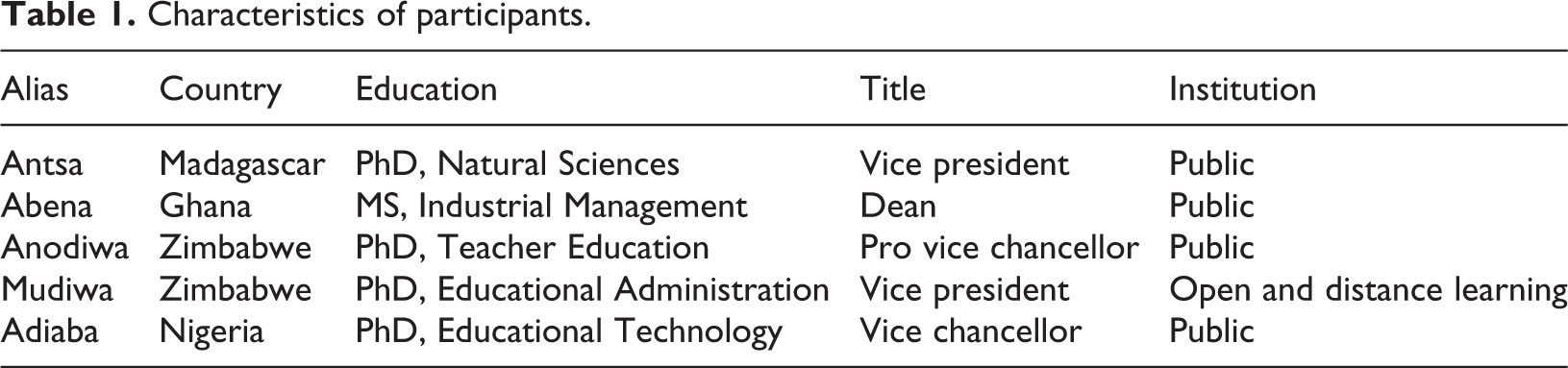
The participants in this study were five women senior administrators. Phenomenological researchers call for the use of at least three participants; however, the question is not ‘how many?’ but ‘have the participants had the experience that I am seeking to understand?’ (Englander, 2012). Four women had their PhDs from universities in Africa and one was currently working on obtaining a PhD. Each woman, except for one (a nurse), began her career as a teacher. Each hailed from sub-Saharan Africa: Zimbabwe (n=2), Ghana, Madagascar, and Nigeria and works at a public university. One works for an open and distance learning university. Table 1 includes the women’s aliases, title, country of origin, and type of institution.
Characteristics of participants.
The women were purposefully and critically selected based on their roles within the university and their experiences in sub-Saharan African higher education. The interviews took place in Stellenbosch, South Africa, at the Conference for Rectors, Vice Chancellors and Presidents of African Universities at which the women and myself were attendees and presenters in June of 2011. The women were contacted via email prior to the conference to participate.
Data collection
Lifeworlds were addressed in the interviews with attention to context (space), career trajectory (time), gender acts (body), and commitments (human relations). I asked participants to reflect upon their career progression, describe their life outside of work, explain how they negotiated their various commitments, and describe their experience as a woman. I commonly followed up during our discussions with requests for specific events and descriptions of situations. Each interview was more of a conversation with a hermeneutic thrust – ‘oriented to sense-making and interpreting of the notion that drives or stimulates the conversation’ (Van Manen, 1990: 98): gender and career development. Interviews took place in English, with the exception of one in French (with a translator present), each lasting one to two hours. A French translator also transcribed the interview in order to verify the accuracy of the translated interview.
Data analysis
Data analysis was conducted using the generation of themes around the core lifeworlds of the participants (Van Manen, 1990). I took the selective reading approach to isolating thematic statements. Multiple readings of transcripts, accompanied by reflexivity, enabled me to isolate relevant statements and phrases. I then translated these data into abstractions, represented in the text as themes. The final product is a descriptive phenomenological account of career, identity, and gender work. The participants’ narratives are presented together due to the striking similarities of their stories; differences are occasionally noted.
This research does not tell the women’s stories in totality. My own position as a white, middle-class, woman professor from the United States may act to distort the narrative. I cannot claim to speak for Africans nor African women; therefore it is not the purpose of this work to generalize from the data presented. I intend, instead, to bring constructive attention to women’s experiences as administrators in higher education in sub-Saharan Africa, elucidating identity intersections and gender acts in the service of advancement. Finally, while these women have obtained high-ranking, administrative positions that entail managing the important functions of the university, this research prompted insight into the more informal, gendered work on campus that women do in addition to their formal work as administrators and leaders.
Findings
Upon analysis, several consistent aspects of the participants’ descriptions of their lives emerged. First, each woman described key mechanisms in their contexts that enabled their sense of accomplishment as university leaders, highlighting the role of family, faith, agency, and education in career success, throughout their lives. Moreover, the participants in this study described themselves as having multiple identities in their work and communities that often overlapped. However, these identities were, at times, the projections of others’ expectations of women within their context. Finally, the participants often relayed characteristics and expectations associated with ‘being a woman’ that elicit a sense of performance, or ‘gendered work’. The following section will expand upon these findings and provide compelling data from our interviews to elucidate the nature of the women’s experiences.
Intersecting trajectories
Collectively, the women in this study described the life of an African woman educational leader as one inspired and supported by family, education, faith, and a deeply held sense of personal responsibility. Each of these constructs held dual purposes, in many cases, as family members provided direct support to the woman, but also the family’s values were important to her success. This also applies to education in that each woman began her career in education (with one exception: Abena began as a nurse), but was also inspired by an educational professional to pursue her career in the field. Faith and personal agency were commonly described as keys to each woman’s identity and elements of their success.
In each interview, women expressed that in many sub-Saharan African contexts, the girl and her education are often overlooked or undervalued. Antsa explained, ‘So, in Madagascar, like in all African countries, some will always think that the woman is there and the man is here’ using her hands to indicate low and high levels, respectively. Adiaba added to this, ‘But you know we were misled. Misled to feel that if the [child] is a male child, it’s a real child.’ Therefore, the gendered expectations of the family played a major role in personal and professional development.
When speaking of her parents’ values regarding her education, Anodiwa expressed that her parents took a laissez faire approach, encouraging their children to ‘follow their path’. Mudiwa added, ‘My parents were not that educated, but they were very supportive.’ Adiaba described how her family experienced cultural-derived hardships due to their egalitarian approach to girls’ education: ‘The community used to make fun of [my father] wondering why he would send a girl child to school.’ The women expressed a certain amount of understanding for the cultural values that served to prevent girls’ education. ‘Through experience and when I grew up, I knew that they did it out of ignorance’ (Adiaba).
Spousal support was also important to the maintenance of a career path and success. Each husband had a demanding career, often in education.
My husband is very supportive. So, he decided to work and I decided to work. So he is very supportive, very supportive. I have no problem because it was his choice not to do his PhD. Decided to have two Masters (Mudiwa).
Several women described spousal support as a quid pro quo relationship. Adiaba, the vice chancellor, when asked how her spouse felt about her position at the university, stated ‘[My husband]? Good enough. Sometime he was a medical director, so I also assisted him, so he has to.’ As in, her husband had held demanding roles in which she provided him support; it was his turn to do so for her in her new role as vice chancellor. Abena underscored the importance of having a spouse with whom she could talk:
But we make time to really sit and chat. He is also a lecturer, pharmacy. You know so we really have wide range of things to talk about. And in fact, he is the one in charge of our small church. So there is a lot to talk about, church and work.
Despite these supportive relationships, gender expectations often prevailed in the home. As Antsa succinctly explained: ‘In spite of it all I’m still a mother of a family, I take care of my husband, I take care of my child. I take care of my house, like [all women].’
As to their development as administrators, the women consistently spoke of their role as educators, highlighting teacher training as the seminal entry point on their career path.
I went through the university with the hope of teaching, kind of teacher trainer. And being one of the few ladies from that area [educational technology], I [moved up] quite speedily (Adiaba). At the beginning I was, I am a teacher in a high school, then at the university. From my earliest childhood I always had a dream, it was to be the teacher in a school (Antsa).
Participants also noted how an individual teacher or family member who was a teacher motivated them to pursue their career in education, despite cultural values that prohibited women’s involvement. Adiaba explained, ‘But my dad was teacher and he insisted that all his children would be equally educated.’
I’ve got a teacher who taught me in the high school. She was very progressive. She was very, very intelligent. I think my going to teaching was through that teaching. But I think the reason why I wanted to move on to PhD level was because of that teacher (Mudiwa).
The educational profession(al) played a formative role in the women’s lives, toward a way of being in an oppressive context and inspiring a path toward educational leadership. Education acted as a progenitor of ontological sovereignty for the women, enabling them to assert agency in their career choices.
In fact, the participants noted that their career success was utterly contingent upon a powerful sense of personal agency. This attribute enabled them to overcome the obstacles that gender created for their upward trajectory in higher education. In the following narratives, culture and gender shaped women’s opportunities yet hard work and competence allow them to quietly overcome, defy, exclusion from leadership.
Because I know the culture. Our culture in Madagascar. Most of the time, like I said, the woman here, the man there. One doesn’t have to shout all the time, to say we’re equal. I’ve never said that. But I defy this culture by the effort that I’ve made, so that I am more competent, so that I give results, and respect comes on its own (Antsa). So you know I took that as, you know, a warning of asking me ‘don’t go there’. It’s a male-dominated [area]. And that is why I became very determined (Adiaba).
Abena and Anodiwa suggest that women do not have to work harder than their male counterparts – that the expectations of hard work and diligence are universal characteristics of anyone aspiring for the respect of colleagues.
It’s not necessarily a person of being a woman, but it’s just being a person of hard work…She’s a tough woman. And generally also the same, you know. When you want to stand on your ground. But I think for that one, even if you are a man and you stand on your ground, you still get the same comments anyway (Abena). I mean I don’t think people can respect you for not being diligent, for not being committed to your work. If you are open-minded they also give you a name for being closed minded (Anodiwa).
In our interview, I followed up on Anodiwa’s comment, asking her if ‘they’ called her names. She responded, ‘I am sure I have names and I think one of my names is the issue about diligence.’ Therefore, both women saw diligence as both a necessity for success and a possible reason to be satirized at work. Abena also implied that agency, as a woman, earned one monikers. Each woman acknowledged in one way or another that being a woman leader in higher education came with difficulties associated with obstruction and/or ridicule as a result of efforts to overcome obstructions.
Faith emerged as a powerful support in the career and life paths of the women. Each participant noted personal and professional commitments to Christianity (as a volunteer in faith-based organizations or as a pastor or church treasurer), and one spoke of ‘trying to call to God’ in reference to the book of Romans where it is written that God provides gifts or talents to individuals, therefore the participant described herself as fulfilling her God-given talents or purpose in her career. Mudiwa and Adiaba both note supernatural intervention as the primary propellant of their career trajectories.
God made a way for me and I got it. And I kept trying to call to God, if you had wanted me, you had put me in that position, then it means I have something to offer (Adiaba). I am wherever I am by divine appointment (Mudiwa).
Participants also spoke of their duties to their faith, highlighting responsibilities to their churches and to their parishioners.
I’m also, how should I say this, in a church. I’m very observant (‘une fervente’). I do a lot of activities for the church where I’m a member (Antsa). Well…I’m a minister. A priest yeah. And so I still have my duties. My duties to perform. To the younger women in my church (Adiaba).
Both Mudiwa and Abena highlight the intersection between faith and professional identities and interests.
I’m also a student counselor with students especially in the higher education getting to problems I can actually counsel them. So I am counselor. I am a preacher, ah, that is part of me (Mudiwa). Yes, I am actively involved in the church…we have the women’s convention, which I introduced. The women meet once in the year and here again also I introduce entrepreneurship aspects so that, to [build the capacity] to the women of as far as managing their businesses are concerned. I am the chairperson for all their planning committee. Again, for the national women’s missionary society, I am also the Vice President of the Women’s Missionary Society. I am also involved in the youth work. At the same time also, various groups also invite me to give talks here and there on entrepreneurship (Abena).
With the exception of Anodiwa (who did not mention the role of faith in her life, but did speak of her work in the community), the women infused matters of faith and faith-based work into our discussions. Often faith served as a framework for career success, providing both reasoning and support for their paths to university leadership. The women also implied an intersection between faith work and professional work. In several instances, each noted how their professional identities in higher education intersected with the personal and community roles associated with their belief in Christianity.
Intersecting identities
In each interview, I asked the women about their formal roles in their workplaces. The women commonly provided a litany of prescribed expectations: work with faculty; write policy; provide direction; and represent their institutions, among others. I also asked the participants to describe the informal roles they played within their contexts. The women responded that they were expected to serve as mothers and role models. Moreover, their professional lives overlapped with their personal identities, creating rewarding experiences as well as those that burdened the women with additional expectations.
Many women spoke of being a mother at work, in addition to their role as administrators. Participants described the expectation that they would provide motherly support to colleagues, faculty, and students, demonstrating an intersection of personal and professional identities that created a space for support. Each woman had children at home or grown and described motherhood as a deeply ingrained part of their identity. In most cases, this expectation enabled the women to influence colleagues and students in positive ways, by creating close and supportive relationships.
The students see you as their mother and in fact, my lecturers see me as their mother. You know, I do recount, and in fact, the lecturers on campus, you know, they address me either Momma or Mommy or Mom or whatever. And I remember one lecturer asking me ‘Um, Madame, it looks like Mrs. [Abena] everybody calls you either Momma or Mommy or Ma. So can I also call you, address the same?’ And I said of course (Abena)! Because when I look and reflect, there are so many people that I affected or influenced to become what they are. So I think because of being the motherly or the mother, you know, that woman spirit of wanting to advance has impacted on different people (Mudiwa).
Yet, Adiaba described how the expectation of being a mother challenged her to remain resolute in her principles as a leader and administrator, due to pressures to relent on institutional polices. Therefore the mother identity, at times, carried with it problematic prospects for leniency and/or partiality.
Well, as the woman for the first time, that’s the first time having a woman [VC]. They would expect [me] to be a real mother. They expect me to be a model and as matter of fact, my students do look to come to me as a mother. The things that they were not able to ask… from my predecessor, they will try so I have to maintain…but at the same time, be [firm]. I try to be very [firm] on principles (Adiaba).
The women in this study also insisted that they were often expected to be role models in their positions as administrators, particularly for female students. Anodiwa, an administrator in academic affairs, expressed, somewhat reluctantly, in our interview:
They think I’m right out there I should be a role model for others around me particularly female students (Anodiwa).
As a vice chancellor, Adiaba believed that she was both a role model and a representative for women in academic administration. Interestingly, like Anodiwa, she positions the expectation to be an exemplar for women as something held by others, but she claims the proxy identity as one of personal responsibility.
What, you know, among women, they expect that I would be a role model. So I am holding that post in proxy for every woman. That’s how I feel. I feel like I am holding that post in proxy for every woman. If I succeed then every other woman has a chance (Adiaba).
Consistently the women noted how ‘they’ (university stakeholders or community members) projected obligations onto them – role model, mother. Personal and professional expectations intersected to engender affiliative identities, that is, parts of the self affiliated by gender. These intersections, while sometimes challenging to manage, enabled the women to serve constituents on campus and in the community in a holistic manner, instead of, as gender narratives usually imply, disenfranchising them or obviating their goals.
Gendered work
From each conversation came the sense that being a woman required a specialized effort, not unlike work, involving social practices predetermined by the African context. The participants knew being a woman came with socially prescribed work, activities, and actions, in addition to their employment at the university. For example, Adiaba described how she is responsible for performing as a woman, yet she was then punished because the work of a VC conflicts with the work of a woman.
It’s not a woman’s job being a Vice Chancellor. And things like that. And even after the interview, after the interview and the appointment, my husband was abducted just to prevent me from taking up the position (Adiaba).
This is a rather shocking consequence of her new position and stood out starkly among the other women’s experiences. However, during our interview she was accepting of the incident and that it hardened her resolve to remain in the position. ‘Just nothing happened. They released him after three weeks. And then he became very [lean]. But they released him. And so I think I decided to go on. There was a mission.’
Moreover the identity and agency claimed by the participants in the workplace often diverged from the expectations of a woman’s behavior. Anodiwa explained how she is socially confined by expectations of what can and cannot be done as a woman in her context, yet her agency as an authority figure allowed her to overcome social norms. In essence, her power and position as a leader within her organization allowed her to exhibit behavior that deviated from the norm.
Sometimes you do things that they don’t expect you should have done. Like you challenge what they are saying should be done and you come up with, and you disagree. Sometimes they get surprised, but when they know who you are, they fall back into, ‘Oh yeah’ (Anodiwa).
The women also reinforced norms through their gender work. Mudiwa spoke, enthusiastically, of her function in the helping professions as related to her gender and to gendered expectations in the home and in the community.
I’ve enjoyed my life as a woman…I’ve got my part to play. It can be in education where I have helped others to develop themselves. It can be in the community I know I got a part to play. In my family I got a part to play. So I see myself as a person who is blessed because [I] touch lives of others in terms of personal development, in terms of their own life, growth. So, I see the role of the woman as something that is very important (Mudiwa).
Abena noted how gendered norms (associated with being a mother) require that she do the work of others, exhibiting the same concern and skill set of a college counselor, in addition to her work as a Dean and a professor. Abena and Mudiwa further legitimize these norms in their performance by finding pleasure in it.
It makes me feel good, I mean, it makes the lecturers, it makes the students closer. And the students are able to come, even though we have counselors in the school, our students are able to just come to you with some personal problems because you are a mother. Lecturers are able to come to you cause you are their mother (Abena).
Often the women themselves enforced socially constructed gender norms. Antsa spoke of being proper as an expectation of her environment, quoting a Biblical phrase that describes the manner in which all women must perform.
Proper in the way that you behave, proper in the way that you dress, proper in the way that you carry yourself appropriately, whether it be in words, whether it be in manner, so I summarize everything by propriety, but at the same time a woman must be, in my opinion, I read it in the Bible somewhere, a woman is in some way a setting (decoration) in her home, so a woman must take care of herself.
The women in the study described their gender as requiring an awareness of the additional expectations and the need to, on some level, meet them in their appearance and in their behavior. They also realized that they defied gender norms with their work in the university, which at times created conflict for them both personally and professionally. I was left with the sense that it is hard work both performing as a woman and meeting the demands of university administration. ‘It’s exerting. If I ever come back, if there’s reincarnation, I will be a man’ (Adiaba).
Discussion: Interpreting lived experiences
Not one woman addressed gender directly in our discussions; instead they spoke of their gender in relation to actions (e.g. ‘it is not a woman’s job being Vice Chancellor’). Returning to Butler’s assertion that gender is a series of acts, this perspective is manifest in Antsa’s belief that women be ‘proper in the way that [they] dress, proper in the way that [they] carry yourself appropriately, whether it be in words, whether it be in manner.’ Here the focus is on the stylization and enactment of propriety by women. In this example, Antsa’s beliefs about gender are founded in Biblical catechism and consistent with social expectations. The ‘reproduction of gendered identity takes place through the various ways in which bodies are acted in relationship to the deeply entrenched or sedimented expectations of gendered existence’ (Butler, 1988: 524).
Moreover, the focus on motherhood and the mother identity does not originate in gender but in biological functions. But when the women describe their actions as ‘motherly’ or as ‘being like a mother’, then they are performing an act that constitutes gender and fulfills gender expectations. Yet the participants cite this as a source of agency and influence within the organization. This conflicts with the many accounts that motherhood and perceptions of motherhood impede women’s advancement in higher education (Okeke, 2004; Rathgeber, 2003; Walker, 1998; among others).
Yet, while the women might legitimate gender beliefs through the replication of them (by fulfilling expectations for motherly behavior or behaving proper), they also defied gender norms by advancing in a field that typically bars their entry. Therefore these acts of gender may be disrupted or the repetition may be altered in a way that creates gender transformation (Butler, 1988). In the case of these particular women, their performance of gender was altered by their personal agency, such as the display of hard work, diligence, and competence, in their career enactment.
These findings provide some insight into the intersections that support women’s identities and leadership in African higher education. Intersectionality, theoretically, focuses on those often static parts of one’s self-image that disenfranchise the individual, such as gender, race, religion, and sexuality, among others, and how those combine to compound the marginalization of one’s social location and opportunities (economically, legally, etc.) (Crenshaw, 1991). Despite the necessity of performing gender in their work and in their social life, the women identified their faith, family, education, and personal agency as naturalizing gender in the university and in the African context; these mechanisms disrupted the sentiment that women don’t belong, establishing a natural space for them, a sense of belonging. As Mudiwa stated, women have their ‘part to play’ within the university.
The women’s multiple self-images intersect to create a site of resistance. ‘Clearly, there is unequal power, but there is nonetheless some degree of agency that people can and do exert in the politics of naming… identity continues to be a site of resistance for members of different subordinated groups’ (Crenshaw, 1991: 1297). This quote from Crenshaw brings to mind the statement made by Antsa in our interview: ‘One doesn’t have to shout all the time, to say we’re equal. But I defy this culture by the effort that I’ve made.’ The intersection of the women’s identities, such as mother and role model, enabled them to simultaneously enact gender roles and defy them, bringing to bear their different ways of knowing about the university and its stakeholders. When a woman in this context performs both conditions the contradiction created what Collins (1986, 1999) refers to as ‘outsider within’ status.
Collins (1999) uses the term ‘outsider within’ to describe the social locations occupied by groups of unequal power (p. 86). It is an organizational identity marked by the simultaneity of privilege to be among the ranks of insiders (men) and shaped by race, class, gender, and historical circumstance that mark them as interlopers. This status is ‘a kind of belonging and not belonging, a “both/and” orientation that allows women…to be members of a particular group…and at the same time stand apart from it as the “outsider within”’ (Holvino, 2010: 251).
The women do not cease to perform their gender, but their presence in male-dominated positions raises tough questions within higher education about the continued marginalization of women. ‘All generalizations about the normal workings of labor markets, organizational structure, occupational mobility, and income differences that do not explicitly see oppression as problematic become suspect’ (Collins, 1986: S29). And while I do not suggest that the findings described here are generalizable, perhaps the women’s status as outsiders within at the universities of Africa may stimulate change to increasingly outmoded edicts about who should have access to leadership in academe. Coupled with the intersection of performance and agency, the outsider within status may create a threshold within women’s lives that allows them to be acknowledged by others as enacting both ‘being a woman’ and ‘being a professional’ in higher education.
Conclusion
These findings are but an initial foray in understanding African women’s successful attainment of leadership positions in higher education. Future work might delve into the identities beyond those associated with gender, culture, and work in Africa to explore socio-economic status, race, tribal affiliation, and the colonial encounter as being mutual constitutive.
The five women higher education administrators at the heart of this study described experiences that highlighted their ability to both perform gender at work and to defy and overcome gendered expectations within their careers, essentially performing as ‘outsiders within’. Faith, family, and education emerged as common constructs in their experiences that the women cited as supporting their career growth and trajectory. Moreover, the intersections of gender performance and personal agency created a threshold in which the women exerted ontological sovereignty over their lives and careers.