



Abstract
Few concepts are more noted in the leadership effects research than vision. It is a cardinal element in the school improvement equation as well. Yet, it remains one of the least well-specified components of that algorithm. Based on a comprehensive review of the research on effective leadership and school improvement from 1995 to 2012, we bring ‘concreteness’ to our understanding of vision. We identify its three essential dimensions. More importantly, we provide tangible scaffolding for each of these dimensions, scaffolding that should sharpen research in this area and guide the work of those who desire to bring this ethereal concept to life in schools.
Introduction
We learn from the broader literature on leadership that vision routinely surfaces in studies of effective organizations. ‘Commitment to shared vision’ (Hargreaves, 1995: 42), it is argued there, provides the roadmap required for an organization to be effective. We see this logic in studies of successful schools and the effective leaders of those institutions as well (Bryk et al., 1993; Ellet and Logan, 1990; Robinson et al., 2008). School success and ‘vision for learning’ (Notman and Henry, 2011: 382) are empirically linked (Desimone, 2002; Gurr et al., 2005; Wilson and Corcoran, 1988). Vision is especially critical in periods of major transitions and during difficult times (Day et al., 2000; Murphy et al., 2008; Potter et al., 2002).
Researchers also report that the principal is generally the essential figure in ensuring that a school vision is created (Austin, 1978; Edmonds and Frederiksen, 1978; Leithwood et al., 2004; Murphy et al., 2007). We also find that there is a relatively strong connection between the work of principals in framing, not imposing (Day et al., 2000; Fullan and Hargreaves, 1996), mission, goals, and expectations and school effectiveness (Goldring and Pasternack, 1994; Hallinger and Heck, 1996; Robinson, 2007). That is, vision-building is a central aspect of leading for success, defined in terms of learning outcomes for students (Cotton, 2003; Leithwood et al., 2009; Riehl and Sipple, 1996). More specifically, studies over the last two decades have confirmed that in improvement work, vision-related activity is the most powerful tool that principals possess (Hallinger and Heck, 1998; Heck and Hallinger, 2010; Leithwood et al., 1999; Valentine and Prater, 2011). Or, in alternate form, vision focus distinguishes more effective from less effective principals (Jackson, 2000; Rutherford, 1985; Witziers et al., 2003). It is hardly surprising, then, that vision work is a hallmark component of every important school leadership framework beginning in the 1980s (Murphy et al, 1983; Bossert et al., 1982) and carrying through to today (Leithwood et al., 2006; Notman and Henry, 2011; Supovitz et al., 2010).
At the same time, the idea of vision is somewhat ethereal (Potter et al., 2002). Dealing with vision is a bit like trying to carry fog around in a satchel. No area in the school improvement literature is more in need of intellectual architecture. In this article, we undertake to provide empirical scaffolding for ‘vision’. We integrate both conceptual and operational understandings from the research. We begin with a description of the methods that guided our work.
Analytic design
This article can best be described as an integrative review or a narrative synthesis—an interpretation of the literature (Vescio et al., 2008)—a method that is especially useful when combing qualitative and quantitative research findings (Rodgers et al., 2009). We follow guidance from Hallinger (2013a, 2013b) in explaining the construction of the article. The goal is to explore the broadest landscape possible to distill knowledge and understanding, on the one hand, and provide usable material, on the other, all in the service of creating an empirical backbone for vision. In the words of Battistich et al. (1997: 150), the aim is ‘to develop integrative explanatory concepts that provide people with a useful framework for considering action under particular circumstances.’ The topic at hand is explicit: vision for school improvement leadership. Specifically, we explain what vision is by exposing the pathways through which it materializes. We are quite transparent in our commitment to build on the legacy of scholars who have worked these fields over the last three decades. We build not only from their empirical findings, but also on analyses of the strengths and weaknesses of their work.
In order to be as comprehensive as possible, we proceeded in our work as follows. To provide grounding, we examined some of the classic literature on vision in general. We then moved into the education literature. Since almost all of the knowledge on vision is embedded, we began by compiling hard copies of everything we could turn up on (1) school leadership and (2) school improvement, both broadly defined, through the various search engines from 1975 to 2011. Using Hallinger’s (2013b: 14) language, we conducted an ‘exhaustive review’. We separated the resulting bounty into four groups: empirical studies (quantitative, qualitative, and mixed methods); major reviews of empirical research; robust theoretical and conceptual work; and all others. We concentrated our efforts on the first two categories, although we did read a good number of pieces from the theoretical domain as well. As we read, we identified and secured studies that had eluded us in our initial search. We read extensively until we had almost complete redundancy of information and nuances of interpretation had largely vanished.
Based on 35 years of work on school improvement leadership, we developed an abbreviated outline of what is known about school vision. We coded each piece of writing using our outline. We also developed a fairly hefty stack of ‘memo notes’ to ourselves as we read, based on the outline codes. After recopying all the articles and books, we then cut codes and placed each code on a separate sheet of paper with the following information: the coded sentences; the code; the names of author(s); the date of publication; and the page number. The process produced about 25,000 pieces of information. We then compiled like codes together. Following the canons of qualitative data analysis, we then grouped and regrouped items within categories into coherent sets as patterns and themes emerged. In this way, we believe, we have been able to enrich the narrative on school vision. It is our hope that researchers will find this integrative body of knowledge useful in shaping future explorations of vision in school improvement leadership. We unpack vision into three distinct but related domains: mission, which addresses overarching values and purposes; goals, which provide direction; and expectations, which establish specific targets. All three seem to be required for vision to impact student learning (Gray et al., 1999; Gronn, 2009; Leithwood et al., 2006).
Creating mission
At the broadest level, vision is about moral purpose and possibilities (Auerbach, 2007; Barnett et al., 2001; Day, 2005), concepts forged from values and beliefs that define the instructional program and shape the school climate in ways that enhance student learning (Creemers and Reezigt, 1996; Dinham, 2005; Siu, 2008). As Fullan (1982, 1993, 2002) has reminded us numerous times, mission is the bedrock of school improvement. Schools do not progress well without it (Borman, 2005; Leithwood, 2005; Riester et al., 2002). Additionally, mission rarely evolves without the guiding hand of the principal (Coldren and Spillane, 2007; Hallinger and Heck, 1998; Leithwood et al., 2009).
Researchers have also harvested important clues about how mission serves school improvement. Mission influences the instructional program and the learning climate, which, in turn, shape the behaviors of teachers and students (Murphy et al, 2000, 2013). As Mitchell and Sackney (2006) found, because schools are loosely coupled systems (see Cohen et al., 1972; Meyer and Rowan, 1975, Weick, 1976), they lack clear goals. In such situations, there is a natural tendency for effort to splinter, an effect only exacerbated by the frenetic nature of schooling. Mission begins to tighten systems by establishing the boundaries in which ‘schooling’ occurs (Murphy et al, 1982). Mission coheres means (Louis and Miles, 1990, 1991; Morrissey, 2000) and ends (Hallinger and Heck, 1998; Louis et al., 2010) around shared values and beliefs (Notman and Henry, 2011).
It is important to note that not all school missions harness equal amounts of energy (Barnett and McCormick, 2004; Mitchell and Sackney, 2006; Scheurich, 1998). From our analysis, we distill eight core values that anchor stronger missions, those that consistently direct the school into productive channels of work (see Table 1).
Core values and elements of mission in effective schools.
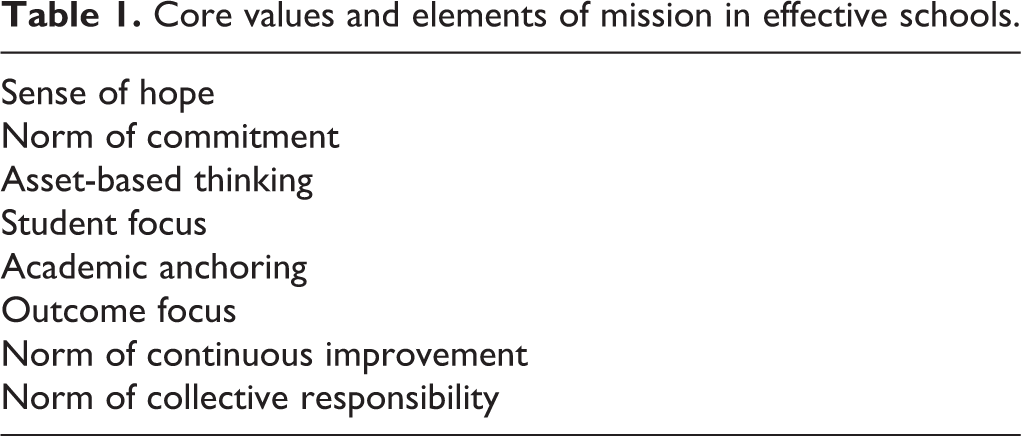
To begin with, the mission needs to convey a sense of hope, to open the door of possibility (Beck and Murphy, 1996; Brookover et al., 1979; Olivier and Hipp, 2006). As Leithwood and colleagues (Leithwood et al., 1999; Yu et al., 2002) instruct us, missions should be inspirational (Walker and Slear, 2011). They need to convey a palpable sense that conditions (e.g. low levels of success, disaffiliation) are malleable and that improvement is possible, even likely (Oakes and Guiton, 1995; McLaughlin and Talbert, 2001; Scheurich, 1998).
In addition, missions should address commitment to success (Bryk et al., 2010; Day et al., 2000; Louis and Miles, 1991; Timperly, 2009) and to the effort that such commitment entails (Blair, 2002; Olivier and Hipp, 2006; Riehl and Sipple, 1996). This encompasses the understanding that second best is insufficient (Dinham, 2005; Raywid, 1995; Southworth, 2002) and the conviction that the school can and will improve (Bryk et al., 2010; Riester et al., 2002; Strahan, 2003). In a related vein, mission should reflect the belief that all students will be successful (Eilers and Camacho, 2007; Gurr et al., 2005; Lezotte et al., 1980). That is, no one is permitted to fail. The embedded understanding is that schooling is the game changer for students (Bryk et al., 2010; Cotton, 2003; Raywid, 1995), a conviction and moral imperative about success (Day, 2005; Dinham, 2005; Edmonds, 1979).
Relatedly, mission should reflect asset-based thinking about students and the larger community (Auerbach, 2007, 2009). As Edmonds (1979) and Brookover and colleagues (Brookover and Lezotte, 1977; Brookover et al., 1978, 1979) reported at the beginning of the modern era of school improvement (see Purkey and Smith, 1983), this third core idea pushes back against the deficit-based thinking often found in struggling or failing schools and schools with large numbers of students placed at risk (Murphy, 2010; Rutter et al., 1979; Scanlan and Lopez, 2012). It is anchored in the belief that all students are capable of learning, that the school does not underestimate the abilities and efficacy of children (Goldenberg, 2004; Lezotte et al., 1980). Asset-based thinking means not accommodating instruction to preconceived assumptions of limitations, but rather conducting schools in ways that change students’ abilities and interests (Hallinger and Murphy, 1989; Oakes and Guiton, 1995). Optimism rather than pessimism holds the high ground (Edmonds, 1979; Theoharis, 2007). Problems and failure are not attributed to children and their families (McDougall et al., 2007; Murphy, 1992; Theoharis, 2007). Deficiencies are not assumed (Blair, 2002). Negative attitudes are conspicuous by their absence (Cooper, 1996). Constraints are recognized but they are challenged as impediments to success (Gurr et al., 2005; Leithwood et al., 1999). Schools push back on resistance to norms of success proactively not reactively (Beck and Murphy, 1996; Cotton, 2003; Crum and Sherman, 2008).
Student focus is the fourth core element/value in mission. Student-centered values hold the high ground (McLaughlin and Talbert, 2001). The spotlight is on children and youth (Eilers and Camacho, 2007), on what is in the best interests of students (Gurr et al., 2005; Johnson and Asera, 1999). Effective leaders run child-centered schools (Johnson and Asera, 1999; Scheurich, 1998). Concretely, that means developing structures, policies, operating systems, and budgets around a learner-centered ideology (Blair, 2002; Caldwell, 1998; May and Supovitz, 2006) and the specific youngsters in the school (Leithwood et al., 1999).
Fifth, the mission in an effective school is academically anchored (Hoy et al., 1998; May and Supovitz, 2011; Venezky and Winfield, 1979). It highlights student learning (Blase and Blase, 2004; Notman and Henry, 2011; Orr et al., 2008) and academic success (Dinham, 2005; Hallinger et al., 1996). An academically focused mission targets the instructional program (Cotton, 2000; Supovitz et al., 2010). Teaching and learning hold center stage and better instruction is job one (Collins and Valentine, 2010; Gurr et al., 2006).
Effective leaders also develop outcome-focused missions (Murphy, 1990; Supovitz and Poglinco, 2001, Sweeney, 1982). These outcomes feature measures of student learning in general (Leithwood, 2005) and provide markers of student achievement in particular (Hallinger and Heck, 1998; Timperly, 2009; Waters et al., 2003).
Seventh, missions in effective schools carry the value of continuous improvement (Ancess, 2003; Crum and Sherman, 2008; Jackson, 2000). Norms of complacency are challenged. Risk-taking is promoted and there is an appetite for change (Blair, 2002; Foster and St. Hilaire, 2003; Louis and Miles, 1991).
Finally, missions in effective schools are characterized by a norm of collective responsibility (Edmonds, 1979; Huberman et al., 2011). A culture of accountability emerges (Murphy, 1992; Barker, 2001; May and Supovitz, 2006), replacing traditions of externalizing responsibility (Bryk et al., 2010; May and Supovitz, 2006; Spillane et al., 2001a). Success is a collective endeavor (Hargreaves, 1997; McLaughlin and Talbert, 2001).
Establishing goals and expectations
Goals
From our analysis, we believe that we can point to five storylines in the area of organizational goals. To begin with, goal setting is seen as one of the most influential roles that principals can undertake to promote organizational effectiveness (Hulpia et al., 2009; Lomotey, 1989; Robinson et al., 2008), defined in terms of student achievement (Witziers et al., 2003). Second, schools are often found to have vague goals, ones that lack the power to direct action, especially teacher behavior (Goodlad, 1984; Leithwood and Montgomery, 1982; Murphy et al, 2001). Third, even when there are clear goals, they are often developed in ways that do not encourage ownership by school staff (Fullan and Hargreaves, 1996; Murphy et al, 2001). Fourth, schools that are effective in helping all students reach ambitious targets of performance have widely shared and clearly formed academic goals (Brewer, 1993; Leithwood and Jantzi, 2005; Robinson, 2007), goals that are ‘both a property of leadership and a quality of school organization’ (Robinson et al., 2008: 659). Fifth, in ‘getting goals right’, considerable attention needs to be devoted to the content of the goals, as well as the goal development process (Hargreaves et al., 1996). We explore both of these issues—content and processes—in the following.
Nature of the goals
Our analysis of research over the last 35 years leads us to conclude that goals that function well can be identified by critical markers. The most essential of these is a focus on the academic domain in general and on student learning in particular (Austin, 1978; Beck and Murphy, 1996; Barnes et al., 2010; Spillane et al., 2001b). Robinson and colleagues (2008) remind us that goals are most productive when they are specific, not generic. Supovitz and Poglinco (2001: 3–4) make this point as well, concluding that while generic goals can be a starting point, the ‘exponential value of instructional leadership comes from a marriage of intensive organizational focus on instructional improvement with a clear vision of instructional quality.’ Barnett and McCormick (2004) call this a ‘task focus’ and Strahan (2003) refers to it as a specific ‘stance about learning’ Goldenberg (2004) weighs in, arguing that the critical issue is establishing a clear notion of what the school is attempting to accomplish in explicit form. Thus, ‘academic focus’ and ‘learning stance’ are essential (Brewer, 1993; Day et al., 2000; Robinson et al., 2008). They positively impact student achievement (Barnes et al., 2010; McDougall et al., 2007; Silins and Mulford, 2004). Robinson (2007) drives these points home when she asserts that academic goal focus needs to become a platform for leaders and a dimension of school culture.
Implicitly and explicitly, other cardinal elements can be discerned in an analysis of academic learning focus. We discover, for example, that goals are best when the spotlight is on students (Leithwood et al., 1999; Rutherford, 1985; Wimpelberg, 1986), when there is a children-first perspective, and when student achievement is the central theme (Clark et al., 1980; Robinson et al., 2008; Wynne, 1980). Researchers also inform us that the goals that are found in productive schools are challenging but achievable (Cotton, 2003; Leithwood and Jantzi, 2005) and apply to all students (Murphy, 1990; Louis and Miles, 1991). They direct activity but are not rigid. They are ‘open to revision and review’ (Hargreaves, 1997: 108; Hargreaves et al., 1996). Goals that work well are meaningful to school staff (Dinham, 2005; Leithwood and Jantzi, 2000b). Meaningfulness includes knowledge of, internalization of, and ownership of goals (Blanc et al., 2010; Day et al., 2000; Supovitz and Poglinco, 2001).
Almost every study of effective leadership of school improvement has concluded that goals need to be clear and concrete (Goldenberg, 2004; Leithwood and Montgomery, 1982; Potter et al., 2002), not abstract or subject to interpretation (Brewer, 1993; Gray et al., 1999; Robinson, 2007). They should provide ‘stakes in the ground’ indicating the destination and the way to travel (Murphy et al, 2007). Parsimony and simplicity are desirable (Lomotey, 1989; Newmann et al., 2001). Scholars also report that goal clarity in effective schools directs the allocation and development of human and financial resources (Muprhy, 1990; Gray et al., 1999; Huberman et al., 2011). Recent studies have also identified the importance of tailoring goals to context, being the specific needs of students in a given school at a given time (Ancess, 2000; Day, 2005; Wohlstetter et al., 2008). Short-term goals that move the school to larger ends are desirable (Cotton, 2003) as they permit staff to experience reinforcing, short-term wins (Bryk et al., 2010; Johnson and Asera, 1999). It is important, however, that these short-term wins derive from and support the more encompassing mission of the school (Leithwood and Montgomery, 1982; Robinson et al., 2008).
Developing and communicating goals
Analyses across time also reveal important insights about the ways in which effective schools forge goals. One critical discovery is the importance of a process that fosters staff ownership of goals (Day et al., 2000; Fullan and Hargreaves, 1996). The literature highlights both the personal engagement of the principal and collaborative work of teachers here (Blair, 2002; Leithwood and Jantzi, 2005; Robinson et al., 2008). What is particularly important is the creation of ownership of the work to reach goals and responsibility for the results of those efforts (Murphy, 1992; Day, 2005; Leithwood et al., 2006). Wide participation of community stakeholders and reliance on hard data to arrive at decisions also define goal development in high-performing schools (Murphy et al, 1985; Datnow et al., 2008; Fullan and Hargreaves, 1996).
Instructional leaders also ensure that the importance of school goals is understood by discussing and reviewing them with staff periodically during the school year, especially in the context of instructional, curricular, and budgetary decisions. Both formal communications (e.g. goal statements, staff bulletins, articles in the principal or site-council newsletter, curricular and staff meetings, parent and teacher conferences, school handbook, assemblies) and informal interactions (e.g. conversations with staff) are used to communicate the school’s mission (Blase and Kirby, 2009; Cotton, 2003; McEvoy, 1987; Supovitz and Klein, 2003; Venezky and Winfield, 1979; Wynne, 1980).
Effective leaders not only spend more energy than their peers in communicating goals, but also appear more successful in getting their messages across (Louis and Cipollene, 1987; Miles, 1987). For example, Rutherford (1985) finds that teachers in schools with active instructional leaders are much more aware of, and can clearly communicate, the school’s mission and goals. Their counterparts in schools with less effective instructional leadership lack a common understanding of school-wide goals and expectations (Cotton, 2003; Leithwood and Jantzi, 2005; Taylor, 1986).
Explaining how goals work
The emerging theme from the research runs as follows: the development and inculcation of widely shared, ambitious, and unambiguous learning goals is one of the most valuable instruments in the school improvement toolbox. We close this part of our analysis with a note on what that research tells us about how goals function to improve organizational effectiveness and student learning. At a fundamental level, goals adhering to the description set out earlier provide tangible meaning to the school mission (Bryman, 2004; Leithwood et al., 2004; Supovitz and Poglinco, 2001). In so doing, they solidify action around shared values and purpose (Day et al., 2000; Leithwood and Jantzi, 2000b; Robinson, 2007). They signal importance to all stakeholders (Leithwood and Montgomery, 1982; Robinson et al., 2008). As such, they help people see more clearly. They keep staff from becoming distracted by separating the really important work from the balance of activity (Goldenberg, 2004; McDougal et al., 2007). Effort becomes more focused and more productive (Louis and Miles, 1991). Goals also serve as a powerful mechanism for organizational cohesion (Goldring and Pasternack, 1994; Robinson, 2007), helping principals with the essential role of coordinating action in complex organizations (Bryk et al., 2010; McDougall et al., 2007; Robinson et al., 2008).
On the personal side, strong goals can be powerful motivators for staff (Datnow et al., 2008; Geijsel et al., 2003; Leithwood et al., 2006), encouraging educators to reach for higher standards (Ancess, 2000; Barnett and McCormick, 2004). Goals have been shown to have an energizing effect (Leithwood et al., 1999; Newmann, 1992). They also have the potential to bring about cooperative work and to help dismantle the wall between teaching and school administration (Murphy, 2005; Fullan and Hargreaves, 1996; Lomotey, 1989). Shared work, in turn, can strengthen commitment and responsibility (Murphy, 2013; Hallinger and Heck, 1998, Youngs and King, 2002).
Expectations
Expectations are the third layer of school vision. They make even more concrete the understandings of performance for the organization and its employees (Day, 2005; Mulford and Silins, 2003). They create a platform to bring goals to life (Day et al., 2000; Goldenberg, 2004). They are both a measure of (Brookover et al., 1979), and a method to develop, academic press and a productive culture in the school (Murphy, 2013; Edmonds and Frederiksen, 1978; Goldenberg, 1996).
Over the last four decades, researchers have shown that expectations have important organizational consequences (Magnuson and Duncan, 2006; Miller, 1995; Shannon and Bylsma, 2002). Most importantly, they differentiate between more and less effective schools, with higher academic expectations linked to better outcomes, defined in terms of student learning (Bryk et al., 2010; Christle et al., 2005; Rutter et al., 1979). They work in part by helping to shape the school culture and by promoting organizational learning (Brookover et al., 1978; Hallinger and Heck, 1998; Leithwood et al., 1999). Expectations have their largest impact on children on the wrong side of the achievement gap, especially children from low-income families (Murphy, 2010; Hughes, 2003; Meehan et al., 2003).
On the teacher front, expectations help define in concrete terms understandings of quality (Leithwood and Jantzi, 2000a). According to Leithwood and colleagues (1999: 69), who have examined this issue in considerable depth: expectations of this sort help teachers see the challenging nature of the goals being pursued in their school. They may also sharpen teachers’ perceptions of the gap between what the school aspires to and what is presently being accomplished. Done well, expressions of high expectations also result in perceptions among teachers that what is being expected is also feasible.
High expectations convey in tangible fashion the hard work and improvement required to create a school where all youngsters reach ambitious targets of performance (Barnett and McCormick, 2004). They can energize faculty to work collectively, assume leadership responsibilities, and keep student improvement in the spotlight (Leithwood et al., 1999, 2006; McLaughlin and Talbert, 2001). At the heart of the success equation here are consistency and repetition of shared expectations (Blase and Kirby, 2009; Kochanek, 2005) that mediate teacher actions (Hallinan, 2001; Hughes, 2003).
Vision in action
Operationalization: The possibilities
So far, we have constructed a scaffold for school vision, one highlighting three domains: mission, goals, and expectations. Our remaining assignment is to review the research on how leaders help keep vision vibrant and at the center of school work. We know that schools are shaped by context, highly complex, and deeply human enterprises (Notman et al., 2009). They are also layered over with a wide assortment of demands from a diverse array of stakeholders. Under these conditions, it is not unusual for vision to fall by the wayside or to lose its directive power (Brooks et al., 2004; Heller and Firestone, 1995; Leithwood et al., 1999). Vision often becomes simply another item on an extensive list of important things. A meaning-infusing tool (Bryman, 2004) is transformed into a ‘bureaucratic necessity’ (Leithwood et al., 1999: 60). The specific implications for work are often undeveloped. Even when they are forged, they often “go missing” (Barnett et al., 2001; Eilers and Camacho, 2007; Hargreaves, 1997): Because considerably more happens in schools than the pursuit of explicit goals, even the most goal-focused leaders will need to skillfully manage the constant distractions that threaten to undermine their best intentions. Such distractions, in the form of new policy initiatives, school crises, calls for goal revision or abandonment, and the need to maintain school routines that are not directly goal related, all threaten to undermine goal pursuit. (Robinson et al., 2008: 667)
Thus, we know that considerable effort is required to keep vision in a starring role (Murphy, 1992; Robinson et al., 2008) to ensure that ‘the mission serves constantly as the criterion and desideratum for everything’ (Raywid, 1995: 70). For this to occur, the school needs to go beyond developing mission, goals, and expectations, that is, beyond articulation (Barnett and McCormick, 2004; Brewer, 1993). Everyone needs to be committed to the vision (Blair, 2002; Verona and Young, 2011). The staff, with the principal on point, needs to refresh and reinforce school vision, consciously working to maintain it as a driving force (Gurr et al., 2005, 2006; Timperley, 2005). According to Bryk and colleagues (2010), trust is a key leavening agent in most school matters but never more so than in building commitment to the school’s mission, goals, and expectations for children (Crum and Sherman, 2008; Day, 2005; Desimone, 2002). Trust is central to Timperly’s (2009: 220) concept of ‘vision in action’.
As was the case with the formulation and dissemination of vision, the principal’s actions are critical in bringing vision to life and to keeping it healthy (Murphy et al, 1987; Mitchell and Sackney, 2006). Leaders’ actions foster the commitment of others, nurture needed workplace trust, and steer work—or not (Berends et al., 2003; Datnow and Castellano, 2001, 2003; Stoll et al., 2006). Or, as Kruse, Seashore Louis, and Bryk (1995: 39) so aptly note, ‘What leaders say and do expresses what they value for the organization, and the behavioral expectations that they communicate on a daily basis either reinforce or call into question these basic values.’
Elsewhere, we have made the empirical case that forging consistency, coordination, coherence, and alignment is one of the two or three most critical, cross-domain functions of school leaders (Murphy, 1988, 1989, 2013). Given the truism that ‘you get what you work on in schools’ (Louis and Miles, 1991: 77), nowhere is that responsibility more essential than in the operationalization of school vision (Blair, 2002; Leithwood et al., 1999; Stein and Coburn, 2008), pushing, pulling, and carrying vision into the workflow of the school (Leithwood et al., 2010; Timperly, 2009). We know that in more effective schools, vision acts as the ‘organizing principle’ (Desimone, 2002: 451) for work. Vision encourages aligned actions in the service of school improvement (Murphy, 1992; Gray et al., 1999). It becomes infused into key organizational activities such as operating procedures, structures, policies, and budgets (Anderson et al., 2009; Brewer, 1993; Robinson et al., 2008), and is the cardinal leitmotif of school culture (Heller and Firestone, 1995; Leithwood et al., 1999). Challenges are addressed and problems attacked less on an ad hoc basis and more within the guidance of a master roadmap (Leithwood et al., 1999). As a consequence, there is less organizational drift (Cotton, 2003) and better uptake of organizational values (Strahan, 2003).
Communicating and consensus building
Beginning with the studies on school and teacher effects in the 1970s, investigations have been adding to our understanding of how leaders work to operationalize vision. Two themes from our analysis—consensus building and communication—were introduced earlier in our discussion of the goals aspect of vision. We expand on them here. Researchers show us that ongoing, coherent communication around school mission and goals is a hallmark dimension of high-performing schools (Murphy et al, 1985; Goldring and Pasternack, 1994; Robinson, 2007). It is, to use a metaphor, the fuel needed to power school vision (Greene and Lee, 2006; Heller and Firestone, 1995). They also unpack the variety of ways in which communication in the service of operationalizing vision occurs, through: (1) the use of stories (Firestone and Wilson, 1985), symbols, rituals, and slogans (Cotton, 2003; Harris, 2004); (2) the ways that resources are committed (Murphy et al., 1983); (3) conspicuous displays of mission, goals, and expectations, including achievements, throughout the school (Blase and Kirby, 2009; Robinson, 2007; Supovitz and Klein, 2003); (4) providing information on mission, goals, and expectations, including news of progress, in all oral and written communications (Robinson, 2007); (5) the clear linkage of vision to educational programs (Leithwood et al., 1999); and (6) acknowledging progress and celebrating success (Goldenberg, 2004; Robinson et al., 2008; Wynne, 1980). All of these strategies are enhanced to the extent that the focus is on the specific youngsters in a given school (Crum and Sherman, 2008; Timperly, 2009), that is, that context is taken into consideration (Notman et al., 2009).
Earlier, we explained that consensus in mission and goal development promotes a variety of important conditions (e.g. commitment) that mediate school success. Here, we deepen that narrative to collective action in operationalizing vision (Day et al., 2000; Fullan and Hargreaves, 1996; Notman and Henry, 2011), to ownership of the full staff for school improvement work (Creemers and Reezigt, 1996; Jackson, 2000; Webb, 2005). Collective work around a shared vision nourishes commitment and efficacy (Blase and Kirby, 2009; Stoll et al., 2006; Supovitz and Christman, 2003) and promotes personal and organizational learning needed to fuel continuous school improvement (Louis and Miles, 1991; Louis et al., 1996).
Modeling and monitoring
Research affirms that principals infuse vision with meaning by the ways in which they act (Cotton, 2003; Gersten and Carnine, 1981; High and Achilles, 1986), by modeling. In effective schools, principals demonstrate commitment through how they allocate their time, where they spend time, what they place on agendas, and how they accept responsibility for school success (Blase and Kirby, 2009; Gray et al., 1999; Leithwood et al., 1999). They ‘carry the torch’ for the school and its values (Morrissey, 2000; Sindelar et al., 2006), ensuring tight alignment between their behaviors and the school vision (Datnow and Castellano, 2001; Day et al., 2000; Notman and Henry, 2011). Through modeling, they become catalysts for student success (Sweeney, 1982).
Colleagues from the earliest studies of school effects have shown the keystone position that monitoring occupies in the school algorithm (Murphy et al, 1985; Bossert et al., 1982; Edmonds, 1979). Here, we simply highlight its position in relation to the vision dimension of highly productive schools and effective leadership. On that score, there is abundant evidence that rigorous assessment and monitoring of mission, goals, and expectations is an important part of the vision implementation playbook (Leithwood et al., 1999; Silins and Mulford, 2010). More importantly, studies reveal that this monitoring occurs in improving schools while it is not highlighted in reports of less effective schools (Datnow and Castellano, 2001, Gurr et al., 2006; Johnson and Asera, 1999). The core elements of this monitoring parallel those found in the general literature on assessment (Firestone and Martinez, 2009; Goldenberg, 2004; Mayrowetz and Weinstein, 1999).
Conclusion
This article was built on three key understandings. First, vision is a hallmark variable in the school improvement algorithm. Second, leadership is the keystone element in developing, implementing, and shepherding the school’s vision. This is especially the case for schools in turnaround mode and schools serving high concentrations of students in peril. Third, of all the conditions and ingredients of effective schools, our understanding of vision is the most fuzzy. Discussions and analyses of vision often unfold at high levels of abstraction that, while meaningful, provide little direction to researchers, policymakers, developers, and practitioners about how to grasp the concept in ways that it can be acted upon—to study, to provide guidance and direction, to forge into tools, and to build, respectively. Our objective in this article was to help illuminate this gap and create the blueprint for building a bridge between the abstract and concrete. Thus, we have provided guidance to the four key sets of actors in schooling production: researchers, policymakers, developers, and practitioners.
The infrastructure we forged is comprised of three layers: mission, goals, and expectations. Collectively, they direct construction crews to think and work their way to increasingly concrete layers of action, but always with the more concrete drawing from higher layers of purpose. The framework we employ thus supports one of the most critical laws of school improvement: consistency and coordination is paramount in the development of effective schools.
Our analysis of the literature allowed us to forge eight specific markers that define mission in highly productive schools: sense of hope, commitment to success, asset-based thinking, student focus, academic anchors, outcome-based focus, continuous improvement, and collective responsibility. We then revealed how goals take form based on these eight core values. We accomplished this by exploring five important storylines that we distilled from the research. Finally, we explained how expectations stand in service to goals, and ultimately mission. We closed our treatment of the topic with an analysis of the actions required to bring an integrated and supportive understanding of vision to life.
We close with an important reminder. Scholars over the last quarter-century have framed a law of school improvement. Context is a hallmark element in nearly every dimension of school change (Day et al., 2000; Notman and Henry, 2011; Penuel et al., 2010), not simply a “container” for the work, to borrow a metaphor from Spillane (Spillane et al., 2001a). The law has special saliency in the domain of mission, goals, and expectations, that is, the vision for the school (Murphy et al, 1985, Murphy and Hallinger, 1986). Context helps establish the norms and barriers that impact the development of improvement values (e.g. asset-based thinking) (Adams, 2010; Mitchell and Castle, 2005). Because situations are idiosyncratic, visions must be crafted to fit the context at hand (Dede and Honanna, 2005; Scheerens, 1997; Bruggencate et al., 2012).
The fact that context matters and matters a lot (Day, 2005; Notman et al., 2009) has implications for work in and around all aspects of a school’s vision. Teachers and school leaders need to respect the place of “situation” (Day et al., 2000) in vision working for better schools (Goldstein, 2004). They need to understand that vision work does not take place in a vacuum (Coldren and Spillane, 2007; Spillane et al., 2001b). School and community context variables such as “student background, community type, organization structure, school culture, teacher experience and competence, both human and financial resources, school size, and bureaucratic and labor organization” (Notman and Henry, 2011: 376) will help shape vision work.
Footnotes
Declaration of Conflicting Interests
The authors declared no potential conflicts of interest with respect to the research, authorship, and/or publication of this article.
Funding
The authors received no financial support for the research, authorship, and/or publication of this article.