




Abstract
This article is one of a series of papers generated from the Curriculum Reform study in Hong Kong with the purpose of understanding the impact of government’s role in the change process of the reform. This paper specifically examines the 17 government initiatives in the Curriculum Reform in terms of their adoption percentages of schools from before 2000 to 2006–7. These initiatives can be regarded as ‘soft’ measures of the Government, supplementing the hard policies on the Curriculum Reform. The adoption of these initiatives in schools reflects the extent of implementation of reform items and therefore should be crucial to the success of the Curriculum Reform. The study illustrates the impact of the government on the phase of adoption in the change process. The findings suggested that whereas the government initially played an important role in adoption of these initiatives it was not able to raise the adoption percentages further towards the end of the study. Other features of adoption and their impacts on policy and change are also discussed.
Introduction
To keep up with the environment and needs of society in the 21st century, the Curriculum Reform of Hong Kong, initiated in 2001, attempts to develop a new culture of learning and teaching by shifting from transmission of knowledge to learning how to learn, and thus make an impact on student learning. The baseline of the Curriculum Reform is to promote learning to learn through Four Key Tasks (Moral and Civic Education, Reading to Learn, Project Learning, and Information Technology for Interactive Learning) and to enhance learning and teaching in the eight Key Learning Areas (KLAs); these include infusing generic skills (critical thinking, creativity, and communication) into learning and teaching of all KLAs. There were two key phases of the Curriculum Reform: 2001–02 to 2005–06 was the short-term phase of implementation; and 2006–07 to 2010–11 was the medium-term phase.
To monitor and review the progress of change and to suggest actions for improvement, the Hong Kong Education Bureau (EDB) commissioned this research team to conduct a comprehensive review on Curriculum Reform in 2006–07. The purpose of the study was fourfold. (1) To examine the effectiveness of short-term curriculum development in schools. (2) To track the progress of the curriculum reform. (3) To inform decisions on how to support schools better in the implementation of the Curriculum Reform. (4) To provide information for the implementation of the curriculum reform in the medium-term phase, i.e. 2006–07 to 2010–11.
A series of papers has been generated from this large study. The first paper examined the extent to which school principals, curriculum leaders and teachers understood and supported the Curriculum Reform inititated by the Hong Kong government (Wong and Cheung, 2009). The findings indicated that the majority of respondents agreed with and supported the rationale of the Curriculum Reform. The level of agreement for the Curriculum Reform was particularly high among senior management teams such as school principals and curriculum leaders. In addition, the principals’ agreement with the reform has grown over the years since the inception of the Curriculum Reform in 2001.
The second paper looked at the progress of the curriculum development at the implementation stage of the reform (Cheung and Wong, 2011). The findings indicated that significant progress had been achieved in several key areas such as the development of a school-based curriculum, implementation of the four key learning areas, teaching of generic skills, and nurturing positive values and attitudes. In addition, the findings also suggested that teachers who agreed with the reform items changed their practices in the respective areas such as learning and teaching strategies, catering for learner diversity, assessment for learning, etc. However, despite the initial success, several key obstacles and challenges surfaced and the third paper therefore examined these obstacles and identified them under six categories; these are external factors, school factors, teacher factors, student factors, parent factors, and other factors (Cheung and Wong, 2012).
This current paper attempts to examine the impact of government effort on the change process of the reform programme. Drawing from current change literature, this paper maintains that educational change is a process. It attempts to explore further the part played by the government and the effectiveness of its influence in the process. It is generally agreed that the adoption of a mandatory reform by schools as a kind of formality without support to help tackle implementation obstacles will not lead to desirable outcomes as expected by policy-makers. This paper reports how the Hong Kong Government has tried to play a more active role in ensuring that the Curriculum Reform is adopted and implemented in school, in addition to merely mandating the reform program. As a result, some subsidiary measures are supplemented as task initiatives to facilitate the implementation of reform items in school. Thus, the adoption of these subsidiary initiatives by schools in terms of their adoption rates and an analysis of the adoption features of these initiatives have both provided useful information to understand the attitude of schools towards the reform, the extent of implementation of the reform items and the potential implementation issues of the Curriculum Reform with policy implications. It is hoped that this study will enrich the current change literature. Particular contribution will be made to further studies on the leadership role of government in an educational change.
It is suggested in the relevant literature that governments, especially those under a centralized educational system, will usually apply ‘hard’ and ‘soft’ policies to help assist adoption and implementation of change. ‘Hard’ policy refers to the use of legal structures to enforce compliance, and it carries the threat of sanctions such as directives and regulations. ‘Soft’ policy denotes the use of non-binding instruments such as guidelines, recommendations, informational devices or voluntary agreements with no enforcement or compliance mechanisms (Torenvlied and Akkerman, 2004). In Hong Kong where the education system is highly centralized, the Education Reform followed by the Curriculum Reform are both supported by ‘hard’ policies such as the External School Evaluation (ESE) exercise in which performance of schools is evaluated with reference to the reform items (Chan, 2012).
Equally, to facilitate the smooth implementation of the Reform the Government has conducted a holistic review of the school curriculum since 1999 and recommended ‘task’ initiatives for schools to follow from 2001–02 to 2005–06 (Curriculum Development Council, 2001). According to the Government these recommendations or ‘soft policies’ were based on authentic and practical experiences of schools, local research, policy contexts of Hong Kong and different perspectives of international development. The task initiatives were within the perspectives of curriculum planning, teaching and learning and school manangement of the Curriculum Reform (Curriculum Development Council, 2001). Thus the adoption of these task initiatives by school was of crucial importance in determining the success of the Reform. To a certain extent it also helped illustrate the extent of implementation of the Reform by schools. There are other interesting issues, such as: what were these initiatives; what were their nature and characteristics; were they well received and adopted by schools; were there any interesting features about the adoption of them by schools; and were there any implications for policy or change?
To address some of the above issues, the research questions of this paper are as follows. What were the task initiatives recommended by the government? What were the nature and characteristics of these ‘soft’ policies? Were these ‘soft’ policies well received and adopted by schools? What adoption features of the initiatives were evident from before 2001/2 to 2005/6? What are the policy implications of these initiatives on the Curriculum Reform or other change programmes?
Literature review
The study of this research project requires a literature review on the change process in general, and adoption and implementation issues for this paper in particular. A review of change leadership and government’s role as a leader is also provided to address the effect of the government’s role in educadtional change. Basically, Fullan’s change process model (Fullan, 1982; 2001a) is used to evaluate the short-term program of Hong Kong’s Curriculum Reform. According to Fullan, there are three broad phases of the change process. Phase I, often called initiation or adoption, consists of the process that leads up to and includes a decision to adopt or proceed with a change. Phase II is the implementation stage which involves the first experiences of attempting to put an idea or an element of the reform into practice. Phase III refers to continuation, in which the change is either adopted and integrated as an ongoing part of the system, or it disappears, by way of a decision to discard it or through attrition (Fullan, 2001a).
Figure 1 provides a schematic overview of Fullan’s model. The concept of outcome is added to provide a more complete overview of the change process. In this paper, outcome refers specifically to improved student learning and attitudes, new skills and problem-solving capacities.

A simplified overview of the change process.
There are numerous factors operating at each phase. As the two-way arrows imply, the change process is by no means a linear process, but rather one in which events at one phase can feed back to alter decisions made at previous stages, which then proceed to work their way through in a continuous interactive way. Whether the phases will move forward smoothly depends on how much the problems or obstacles affecting these phases are successfully resolved. Fullan (1982, 2001a) argued that if obstacles to implementation are not removed, a change will suffer from (a) the failure to be used in the intended manner and (b) the rejection by the decision-makers, rather than moving ahead from the implementation phase to the continuation phase.
Throughout the 1950s and 1960s, diffusion and adoption together were believed to account for nearly the whole process of change (Pressman and Wildavsky, 1979; Rogers, 1962; Rogers and Shoemaker, 1971). At that time, the principal problem was believed to be how to get innovations adopted; after that, it was thought, things would take care of themselves. There was little understanding of the importance of post-adoption influences. According to Mann (1978) and Hurst (1983), this resulted in curriculum planners introducing new and modern innovations that were not being implemented in practice. It was later recognized that the change process should also include the phases of implementation and continuation; this is because, unless actually implemented, the adoption of an innovation merely created the illusion that change had occurred (Berman, 1981; Fullan and Pomfret, 1977; Hall and Loucks., 1975; Kennedy et al., 1984; Rice, 1982). Since then, adoption and implementation have been studied either together or separately as independent topics.
On adoption and implementation
Eicholz and Rogers (1964) developed a framework for the identification of forms and causes of rejection in their study of resistence to electro-mechanical teaching aids. In brief, the causes of rejection were related to the lack of dissemination, the characteristics and quality of the innovation, and the cost factor. The factors affecting adoption have been enriched continuously in various studies. They include teachers’ attitude and receptivity (Nisbet and Collins, 1978; Waugh and Punch, 1987), institutional climate (Paul, 1977), user participation (Gross et al., 1971), the characteristics of the innovation (Smith and Keith, 1971), and the practicality of the innovation (Brown and McIntyre, 1978; Doyle and Ponder, 1977). There are also studies which stress the critical role in educational policy-making of organizational and bureaucratic considerations (Cuban, 1986; Elmore, 1987; House, 1974; Hoy and Miskel, 1991; Salter and Tapper, 1981; Wise, 1988). In their studies on rural school innovations, Oelschlager and Guenther (1983) suggested that adoption was associated with preparation and awareness. Using innovative programmes in the USA as an example, Fullan (1992) gave a summary list of eight specific factors affecting adoption: existence and quality of the change; access to information; advocacy from central administrators; teacher advocacy; exchange change agents; community pressure/support/opposition/apathy; new policy and funds; and problem-solving and bureaucratic incentives. In other studies, Perry et al. (1967) examined the shapes of an adoption curve. Kumar and Popat (2010) assessed the gaps of adoption and maintained that knowledge, market orientation and innovativeness would influence the adoption gaps significantly. Ong (2012), in his adoption study on green technology, suggested that people in low income, predominately minority and disadvantaged or designated areas were less likely to be early adopters or less likely to receive a grant to switch technology.
As for implementation studies, many focus on the part played by teachers and suggest that they are the crucial factor affecting implementation (Doyle and Ponder, 1977). There are other studies directly related to teachers and teachers’ belief (Cheung and Wong, 2011; Duke, 2004; Fullan, 2001; Fullan and Pomfret, 1977; Gregoire, 2003; Ingram, Louis, and Schreder, 2004; McLaughlin, 1998; Thompson, 1992; Turner, 2009; Whitaker, 1998; Wong, 2010).
Scholars argue that other factors need to be noted. These include the characteristics of the innovation, especially its explicitness and complexity, the strategies, inservice training, resource support, feedback mechanisms and participation, and characteristics of the adopting unit – the adoption process, organizational climate, evaluation and political complexities (Waugh and Punch, 1987); the relationship between developers and teacher users also needs to be taken into account (House, 1979). Studies indicate that centralized decision-making (Archer, 1979; Warwick and Williams, 1980; Wong, 2010) and bureaucratic organizations (Bien, 1988; Lauglo, 1977) do not provide an environment which encourages innovations. Elmore (1987) and Cuban (1986) explained the failure of instructional changes in the US on their reliance on the use of the classic tools of educational bureaucracies. Duke (2004) classified implementation problems as inherited problems and new problems. The inherited problems were those related to the design, decision-making process and the consensus whereas new problems related to poor judgement on the parts of leaders, inadequate staff development, faculty divisiveness, time constraints and organizational complexity (Wong and Cheung, 2009; Cheung and Wong, 2011; Calabrese; 2002; Caldwell and Spinks, 1992; Cheng, 2005; Fullan, 2005; Hill et al., 2000; Morris and Scott, 2005; Nolan and Meister, 2000; Whitaker, 1998; Wong, 2010).
Hall and Loucks (1975) argued that awareness of the degree of the implementation was just as important as the simple distinction between adoption and implementation and the implementation problems. They suggested that the variations in use by individual change users had to be described behaviourally and accounted for systematically. Brown and McIntyre (1978) suggested another means of measuring the extent of implementation by classifying changes as organizational and pedagogical.
There are particular concerns about obstacles and difficulties, particularly at the early stage of implementation. If the problem is not resolved, it will lead to a fall in adoption of the change. Fullan (2001b) used and defined the term ‘implementation dip’ as the inevitable bumpiness and difficulties which are encountered when people learn new behaviours and beliefs during the early stage of implementation. An implementation dip is literally a dip in performance and confidence when one encounters an innovation that requires new skills and new understandings (Fullan, 2001b; Pfeffer and Sutton, 2000; 2008).
According to Hall (2013), the initiatives to change schools by introducing new programs, processes and reforms over the past four decades has not resulted in desired outcomes being obtained because there is a lack of applicable constructs to measure the extent of implementation. A three-dimensional Concerns Based Adoption Model (CBAM) is suggested to assess the extent of implementation, with three inter-related constructs of Stages of Concern, Levels of Use and Innovation configurations, and their measures. The stages of concern address the personal side of change, the levels of use describe the different behavioral profiles of non-users and users, and the innovation configurations represent the possible operational forms of the change.
Some research on innovation suggests that change may actually be cyclical. Changing circumstances will cause a change to be amended and refined over time. An innovation, after being implemented for some time, may slow down and require new incentives, skills and understanding to move forward. In some cases, new changes will also emerge (Chambers 1997; Duke, 2004).
On change leadership and government’s role as a leader
Scholars also focus on the role played by leaders or policy-makers in helping to remove the implementation obstacles or an ‘implementation dip’. McLeod (2007) argued that there is always an ‘implementation dip’ for an innovation because it reflects an inevitable aspect of human nature: the task of leaders is to make the dip as short and shallow as possible. According to Fullan (2009), change is difficult for people to accept and it requires them to leave their comfort zones and to take risks. Leaders must be cognizant that peple are uncomfortable and probably not enjoying the change process. It is the leaders’ responsibility to help people get through the ‘implementation dip’ and decrease the amount of recovery time needed really to start implementation. Among the various change models developed, for instance by Rogers (1995), Kanter (1988) and Havelock (1973), Kotter (1996) suggested a leadership model for change. The model begins with establishing a sense of urgency and concludes with integrating changes into the culture of the organization. The eight stages listed were: establishing a sense of urgency; creating the guiding coalition; developing a vision and strategy; communicating the change vision; empowering broad-based action; generating short-term wins; consolidating gains and producing more change; and anchoring new approaches in the culture. Calabrese (2002) believed that leaders should acknowledge that change occurs in stages and they should seek to move individuals, based on their level of readiness, from one stage to the next. He contended that change involved loss and those affected went through denial, anger, bargaining and depression before they came to accept the change. Leithwood et al. (1999) maintained that the three important bases for leaders’ direction-setting were building a shared vision, developing consensus about goals, and creating high performance expectations. Hall (2013) argued that the acknowledgment of leadership as a factor was the key to achieving implementation success.
The role played by the government in leading change and innovations is also receiving attention. Research on policy implementation models has analysed educational change as either ‘top down’ or ‘bottom up’ (Sabatier 1986). Drawing from the fields of international law and international relations, the newly emerged policy approaches towards change are categorized as ‘hard’ and ‘soft’ policies (Abbott and Snidal 2000; Chan 2012). While hard policy refers to the use of legal structures to enforce adoption and compliance, and carries the threat of sanctions such as directives and regulations, Ahonen (2001) proposed three different methods of ‘soft’ policy making namely’regulative’, ‘redistributive’ and ‘allocative’ to identify measures used in various processes, generating effects from stronger to weaker. The concept of ‘soft’ policy has recently found a place in helping to implement reforms successfully in Asian countries and regions, including Hong Kong (Chan, 2012). Morris and Scott (2003) commented, from a political point of view, that the education reform and policy implementation by the post-1997 Hong Kong Government has been symbolic and remained rhetorical because of the existence of an inherited culture of inertia and cynicism towards reform. Applying Ahonen’s typology, Chan (2012) analysed the ‘soft’ measures provided by the Hong Kong government to schools and teachers in the Curriculum Reform in 2001 in various coordination units at different levels of the system, namely systematic and community level (curriculum guides, textbook review, learning and teaching resources), school level (on-site school-based support, library development, dissemination strategies and networks, provision of funding support such as the Capacity Enhancement Grant and the Quality Education Fund), teacher level (professional development programs, creation of time and space for teachers), and student level (making use of the space of learning).
The above review suggests that change is a complex process, the success of which depends on how the change is managed in order to remove resistance and obstacles in the process of adoption and the early stage of implementation. There is also evidence to suggest that governments tend to apply both hard and soft policies in managing the change process of a reform. Using Hong Kong as an example, for smooth implementation of the Curriculum Reform, the Government has recommended that schools use many task initiatives. This paper therefore attempts to examine specifically the extent to which these ‘soft’ policies are effective in the success of the reform in terms of their adoption by schools, with empirical data collected from this large study. It is also hoped that through the analysis of adoption rates and features of these government initiatives, this study will suggest an attempt to assess the extent of adoption and implementation of a change program particularly under a centralized education system in most of the Asian countries and regions where hard and soft policies are adopted in making changes.
Methods
Participants
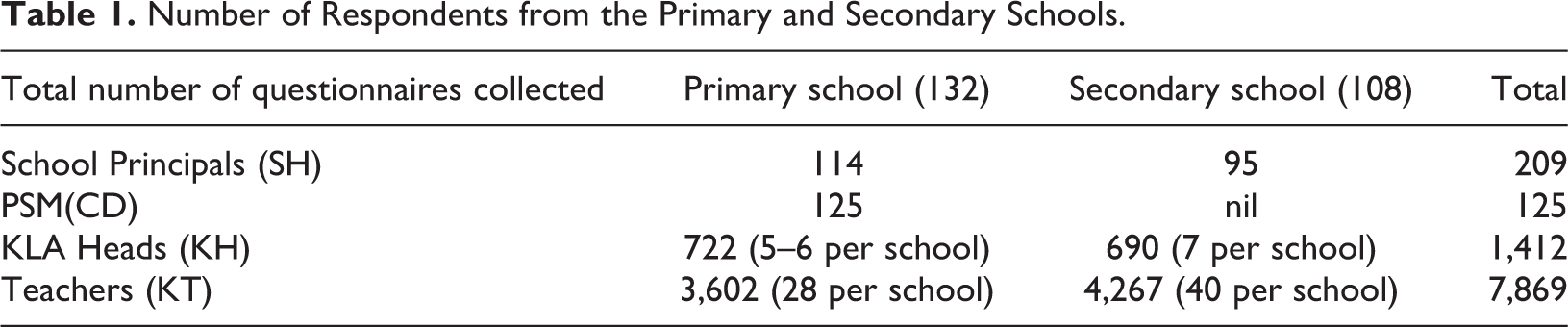
As indicated in Table 1, participants in the study included 209 school principals (SH), 125 primary school masters/mistresses (curriculum development) (PSM (CD)), 1412 key learning area (KLA) heads (KH), and 7869 teachers (KT) from 132 primary and 108 secondary schools in Hong Kong. More detail about the sampling selection is provided in Wong and Cheung (2009) and Cheung and Wong (2011).
Number of Respondents from the Primary and Secondary Schools.
Instruments
Four separate survey questionnaires were constructed for the four stakeholder groups. There were some common questions together with some unique questions customized for the respective groups. Each questionnaire consisted of the following major areas: (1) Support for the Curriculum Reform; (2) Implementation of the Curriculum Reform in the school; (3) Factors affecting the implementation of the Curriculum Reform; (4) Impact of the implementation of the curriculum reform on personal professional development and on students; (5) Overall outcomes of the Curriculum Reform; (6) Future school development and professional support; (7) Background information; and (8) others.
Questions were mainly on a 6-point Likert Scale (about 130–150 items). In addition to answering closed questions, respondents were asked to respond to several open-ended questions. The average time needed to complete the questionnaire was about 45–60 minutes.
Procedure
The study was carried out between October and November 2006. A pilot test was conducted in two primary and two secondary schools in September 2006. After reviewing the pilot results, the questionnaires were then revised and refined. The final questionaries were then sent to all 150 primary and 120 secondary schools in mid-October 2006. Clear instructions were given to school heads or the contact person for the distribution of the questionnaires and the selection of staff. The schools were given approximately three weeks to complete the questionnaires. A total of 132 primary and 108 secondary schools returned the completed questionnaires in mid-November 2006, response rates of 96% and 95% respectively. For data entry and processing, a large scanning machine for all quantitative input was used. Checking was carried out consistently. To ensure the quality of the data entered, 10% of questionnaires were randomly selected and further verified upon the completion of data input. Before data analysis, frequency tables were run for all questions and items in order to check the validity of the data. Ambiguous and missing responses were treated as missing in data input.
Data analysis
All closed questions in the questionnaire were coded and entered into SPSS for the analyses. The quantitative data were analyzed to yield frequencies and percentages of responses. Summary statistics, such as the mean and standard deviation, provided the best measure of central tendency and variability.
The findings from the questionnaire survey revealed a number of points worthy of attention: for example, SH agreement with the rationale of curriculum reform was higher in 2006 than 2001; evaluations from SH and PSM(CD) were more positive than those of KH and KT in many aspects of the curriculum reform; primary respondents were more positive about students’ performance than secondary respondents; students’ development of critical thinking skills was slower than communication skills and creativity; etc. The quantitative study was thus followed up by a qualitative study, in which six types of focus group interviews for principals and teachers in secondary and primary schools were conducted respectively (Primary SH, Secondary SH, Primary School KT and KH, Primary PSM(CD), Secondary School KH and Secondary School KT).
The focus group interviews were conducted in the form of semi-structured interviews, mainly based on the pre-designed questions covered by the survey questionnaires. Because the focus group interviews were designed to follow-up on the survey findings, their content was basically focused on supplementing the responses from the questionnaires. To improve the reliability of the research findings, the interview questions were sent to the participants beforehand by post or by fax. The questions for the interviews were largely similar across different groups, with minor differences tailored specifically for each stakeholder group. For example, SH were asked more about policy issues and KT were asked more about the implementation of the curriculum reform. The common questions across the groups allowed comparison of the views of the different stakeholders.
Participants for the focus group interviews were all selected on a voluntary basis. They were invited from those on the list who had shown up by providing information for contact in the qualitative study while they completed the questionnaire. Twenty SHs and 34 teachers were involved in the interviews. During the focus group interviews, each participant was identified using a letter from the English alphabet, to ensure protection of personal information. Names of participants and schools were treated confidentially and not disclosed. Information obtained during the focus group interviews was recorded on tape and in writing, and subsequently transcribed. The data were then analyzed and interpreted in the light of the study. The purpose of these focus group interviews was to address additional questions and to enrich the data collected from the quantitative study.
Supplements for this part of study
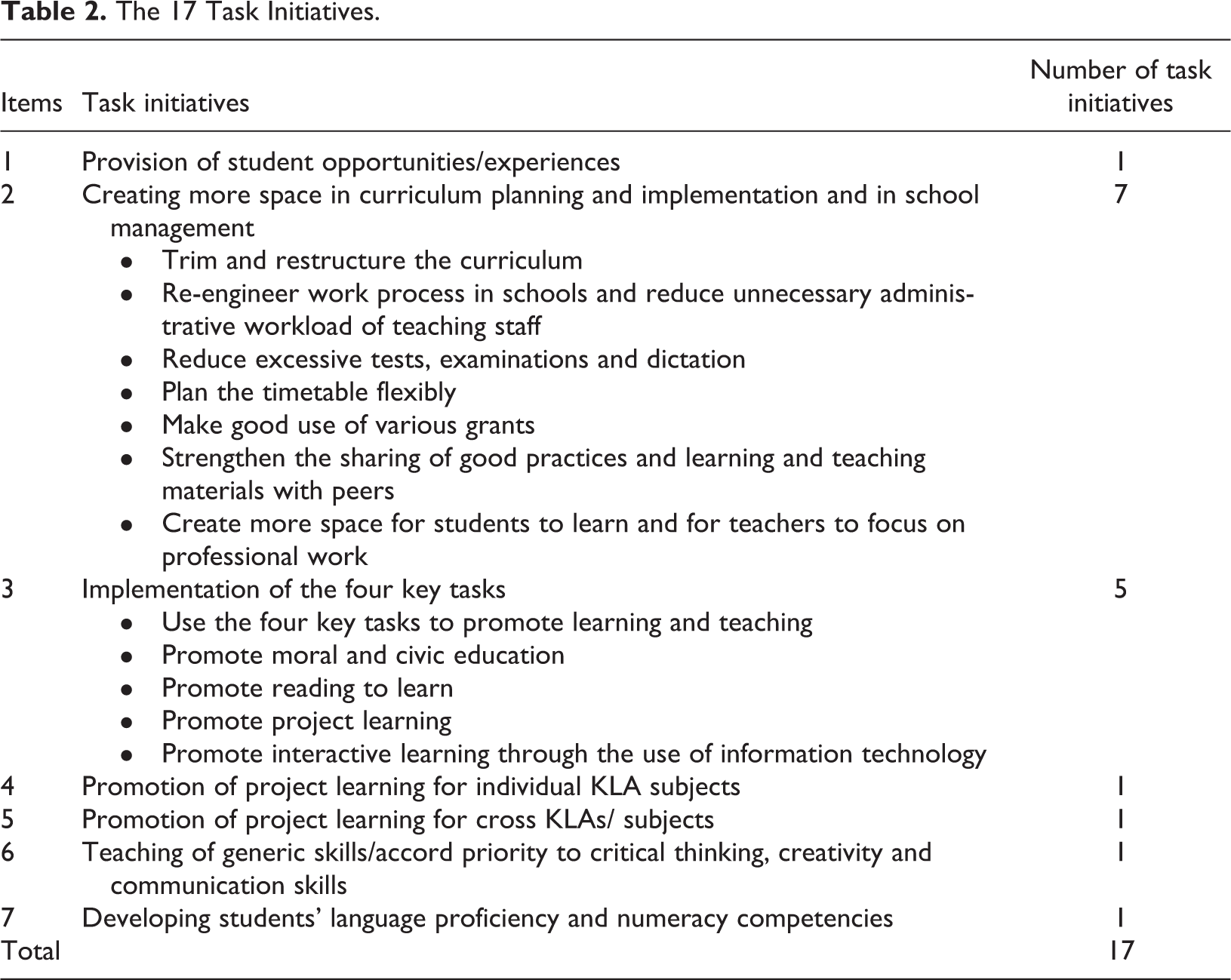
To collect data for the study reported in this paper, questions for the task initiatives were developed under the major Area 2 (‘Track the progress of the curriculum reform’) of the questionnaire and only this portion of the questionnaire and other related parts/interviews were reported. In total, 17 initiatives were developed by the research team with reference to the government documents (Curriculum Development Council, 2001) and inputs from officials of EDB. The 17 task initiatiatives developed were shown in Table 2.
The 17 Task Initiatives.
These 17 initiatives were then examined and triangulated by a small group of practising primary and secondary school principals. While confirming these were new task initiatives of the Curriculum Reform, school principals maintained that these initiatives were not totally new to them. The ideas of these initiatives, such as those related to school administration, had already been suggested for implementation under other reform programs, such as School-based Management, CEG (Capacity Enhancement Grant) and QEF (Quality Education Fund) towards the end of the 1990s. School administrators maintained that because of keen competition between schools during the late 1990’s, and their close contact with EDB through various channels, such as the Schools Councils and Schoolheads Associations, most of these initiatives had already been known to them. Some of these initiatives had also been implemented in schools on their own or during the consultation period of the Education Reform/Curriculum Reform. Typical examples were the Four Key Tasks, the CEG or the QEF. The nature and characteristics of each initiative were also shared and discussed.
The views of EDB officials and the practising school principals were taken into consideration in designing the questionnaire and for analysing the data collected. As a result, all the 17 initiatives were included in the questionnaire. In the questionnaire, schoolheads were asked to indicate whether they had used each of the key tasks to implement the Curriculum Reform in their present schools. If they had used the key tasks, they were also asked to indicate the years in which these tasks had been implemented from before 2001–02 to 2006–07. Before 2001–02 became one more column for data collection in order to accomdodate the reality that these initiatives were not only new to schools in 2001–02.
For the sake of data analysis, the research team conceptually categorized the 17 initiatives into three groups: school administration, teaching and learning – technical, and teaching and learning – value-oriented, to reflect accurately the true nature of these initiatives from the perspective of school administration and the working attitudes of principals towards their implementation. In group discussions with primary and secondary school principals, principals held the view that although ‘promote reading to learn’ was one of the four key learning tasks, the task was more related to the working relationship between school librarians, the general office of the school and the subject departments of KLA. The two other task initiatives namely ‘promote moral and civic education’ and ‘developing students’ language proficiency and numeracy competencies’ were not simply teaching and learning issues, but rather were involved controversial social and language issues of the Hong Kong society after the return of sovereignty to China in 1997. Table 3 shows the three groups of initiatives for our data analysis.
Three groups of initiatives.

Results
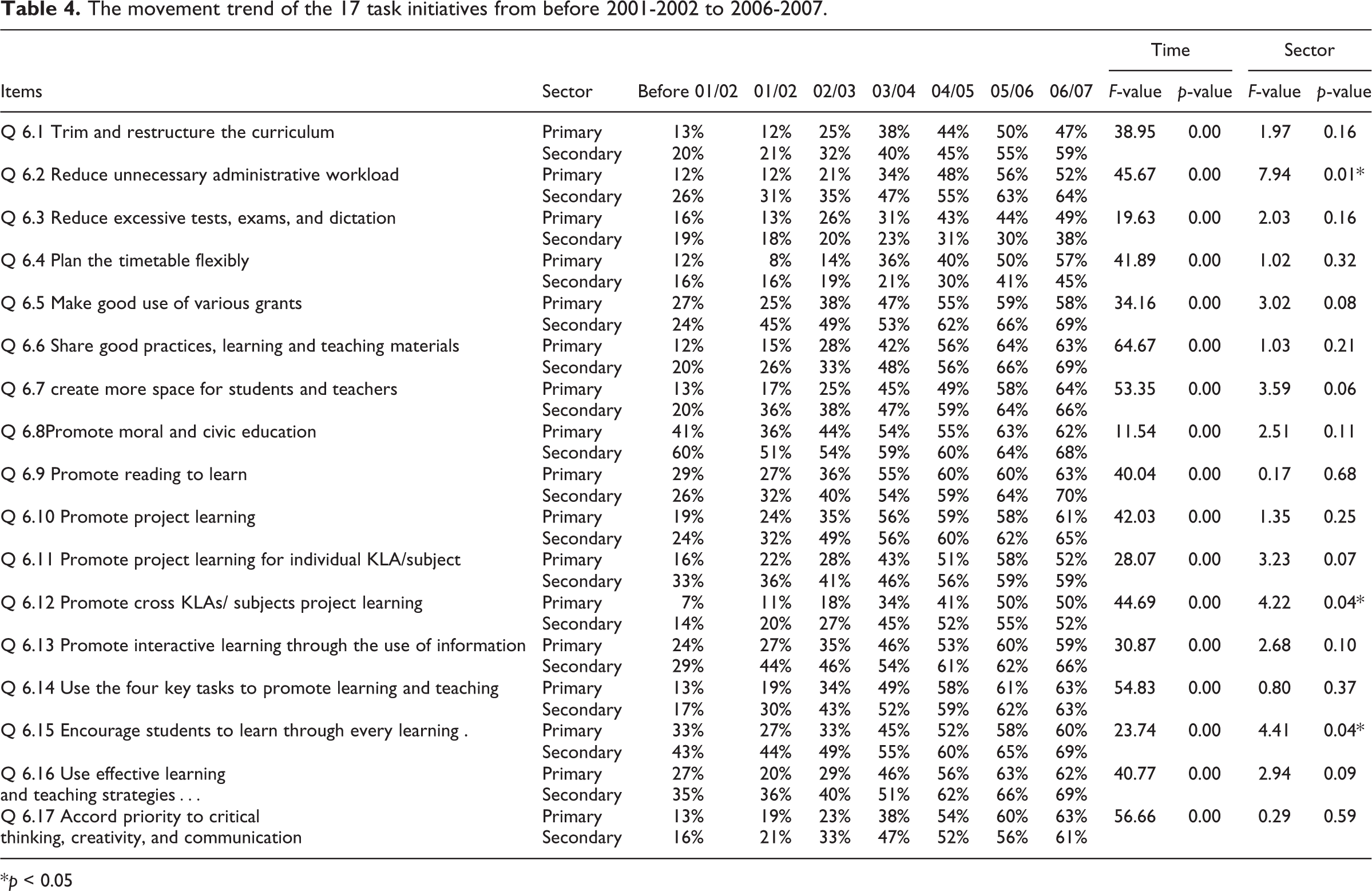
The findings in terms of individual task initiatives and the three groups are reported, respectively.The 17 key task initiatives and the features of their adoption for use to implement the Curriculum Reform in school are shown in Table 4.
The movement trend of the 17 task initiatives from before 2001-2002 to 2006-2007.
*p < 0.05
As reported by both primary and secondary schools, there was a significant increase in the adoption percentages of almost all initiatives over the years. For example, the initiative of trimming and restructuring the curriculum (Q6.1) increased by over 30% from before 2001–02 to year 2005–06 in both the primary and secondary sectors. Similar patterns were found in other initatives.
As indicated in Table 4, all of the 17 task initiatives followed an overall upward trend of movement over the time period from before 2001–02 to 2006–07. The p-values (sector) suggested that only ‘reduce unnecessary administrative workload’ (Q6.2), ‘promote cross- KLAs/subjects project learning’ (Q6.12) and ‘ecourage students to learn through every learning opportunity’(Q.6.15) have significant difference (p-value = 0.01, 0.04, and 0.04, respectively) in the trend of movement between primary and secondary sectors. By 2006–07, the adoption percentages of most of the initiatives were around 50%–70%. The rate of increase in the percentages both for primary and secondary schools is seen to slow down from 2005–06 onwards. It is also important to note that secondary schools started at a higher level than primary schools.
It was found that ‘dips’ existed in some individual task initiatives in 2001–2 with the adoption percentages lower than in the column ‘before 01–02’. These initiatives include ‘trim and restructure the curriculum’ (Q6.1), ‘reduce excessive tests, examinations and dictation’ (Q6.3), ‘plan the timetable flexibly’ (Q6.4), ‘make good use of various grants’ (Q6.5), ‘promote moral and civic education’ (Q6.8), ‘promote reading to learn’ (Q6.9), ‘encourage students to learn through every learning opportunity’ (Q6.15), and ‘use effective learning and teaching strategies’ (Q6.16) for primary schools. For secondary schools, these initiatives include and ‘reduce excessive tests, exams, and dictation’ (Q6.3), ‘promote moral and civic education’ (Q6.8), and ‘promote reading to learn’ (Q6.9). Clearly there are fewer ‘dips’ for the task initiatives found in the secondary school sector. The findings clearly show that the adoption percentages of these ‘soft’ measures increased once they were initiated officially by the government in the Curriculum Reform in 2001.
The adoption percentages of initiatives were then examined in the following graphs under the grouping of Administration, Teaching and learning –value-oriented, and Teaching and learning –technical.
In the ‘Administration’ graph above (see Figure 2), it can be seen that the adoption percentages of those administration initiatives shown in Table 3 for secondary schools moved upward steadily from before 2001(around 24%) to 2006–07 (around 60%). For primary schools, a ‘dip’ existed so that the adoption percentages fell from before 2001 (around 18%) to 2001–02 (around 15%). After that, the percentages went up from 2001–02 to 2005–06 (around 54%) before they slowed down to more or less the same percentages; ie., 54%.
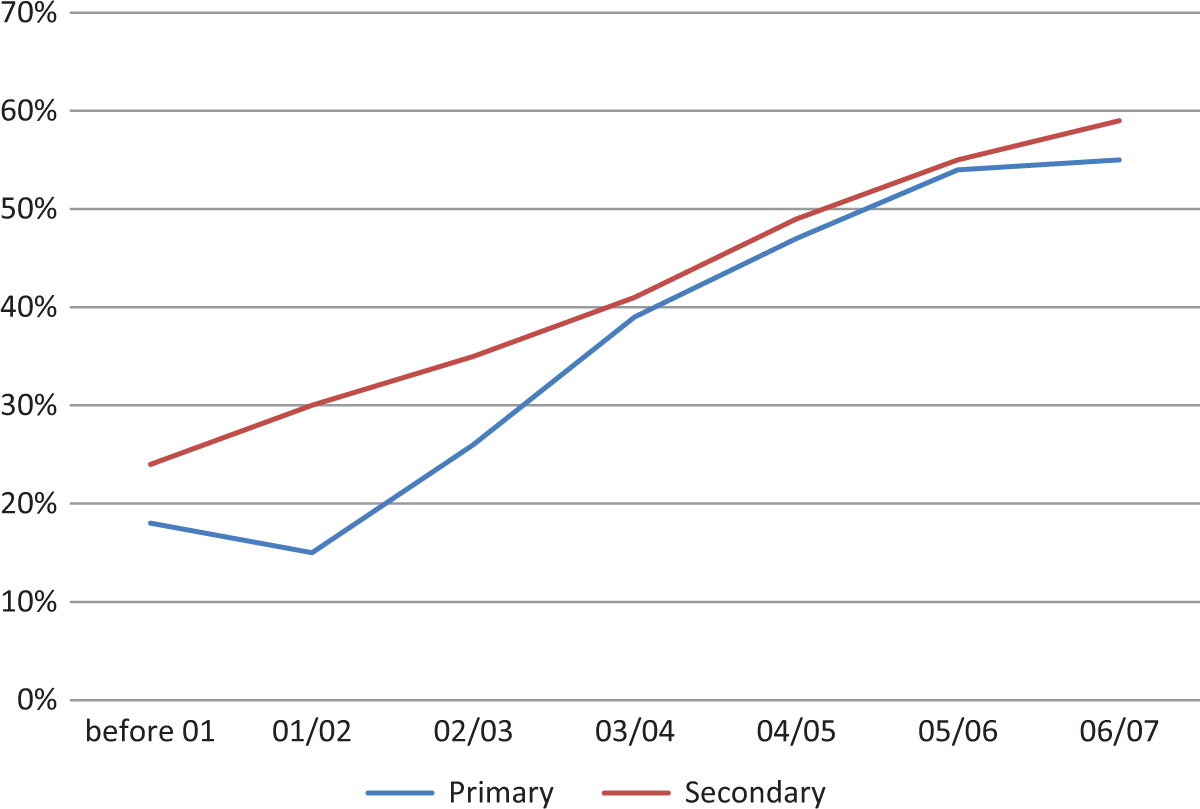
Administration.
In Figure 3 it can be seen that the adoption percentages of the initiatives started to move upward only after 2001–02, both for primary and secondary schools. The adoption perecntages for secondary schools from before 2001 to 2001–02 were more or less the same and there was the existence of a ‘dip’ for primary schools from before 2001 to 2002–02. Overall, from 2001–02 to 2003–04, there was a higher rate of increase for primary and secondary schools. The range of increase from before 2001 to 2006–07 was around 23% for secondary schools and 28% for primary schools.
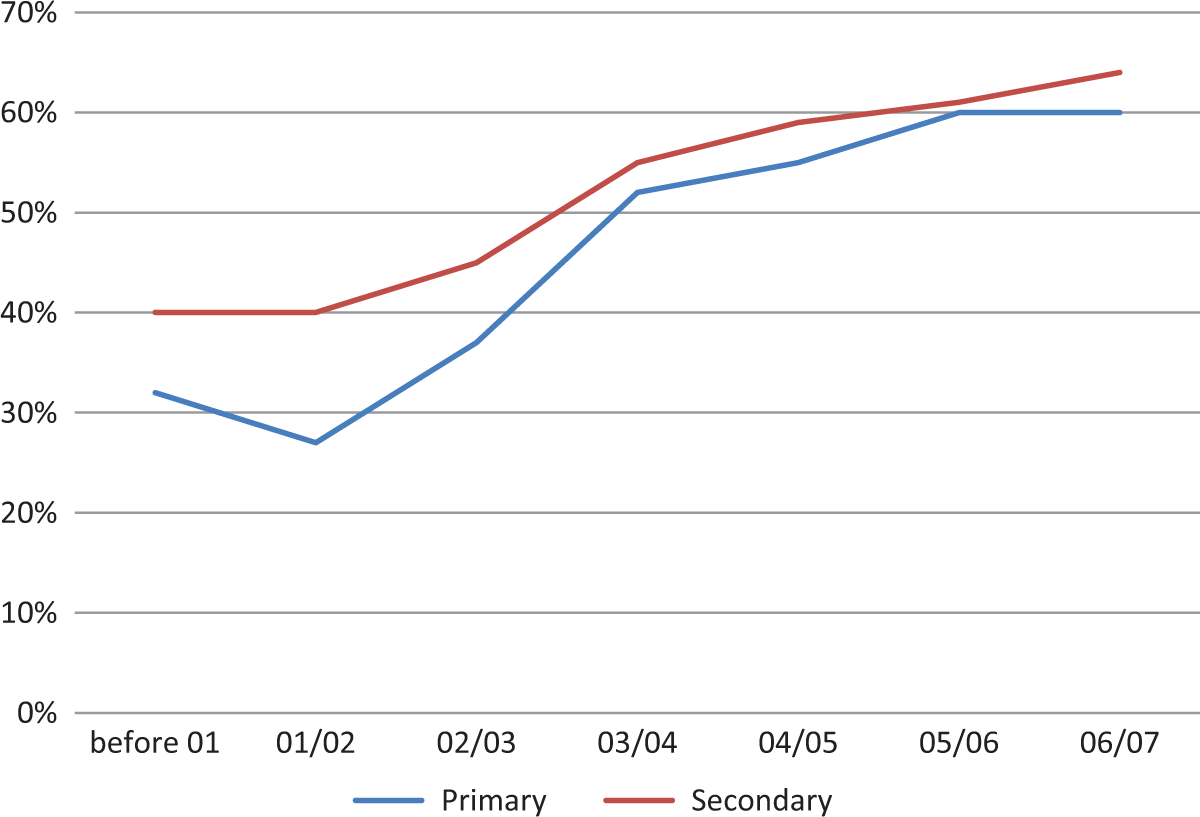
Teaching and learning: Value oriented.
Figure 4 shows that the adoption percentages of the initiatives moved upward steadily for primary and secondary schools from before 2001 onwards, although the rate of increase started to slow down slightly after 2003–04 and the percentages for primary schools remained more or less the same after 2005–06.

Teaching and learning: Technical.
Results by territory-wide system of assessment and Hong Kong certificate of education examination
The findings of the adoption features are further reported in terms of schools with students from different academic backgrounds. Under the centralized education system in Hong Kong, most of the schools were government-subsidized and students were allocated according to parental choice and the student’s abilities. As a result, primary and secondary schools were better differentiated in terms of the academic abilities of students. Overall, there is a tendency that secondary schools with above average scores in the public examination had a significantly higher percentage of adoption of government initiatives than those schools with below average scores (p < 0.05). The average difference was about 20%.
The adoption features of primary schools with students of different academic background are also consistent with the results of secondary schools. Because there is no public examination for primary students, the academic standard of primary students is measured in terms of their results in the Territory-wide System of Assessment (TSA). The main purpose of the TSA is to provide the government and school management with information on school standards in the key learning areas of P.3 and P.6 students for the purposes of school improvement. As with secondary schools, primary schools with above average TSA scores had a significantly higher percentage of adoption of government initiatives than their counterparts with below average TSA scores (p < 0.05). The average difference was about 25%.
Discussion
This paper is one of a series of papers generated from the Curriculum Reform study in Hong Kong with the aim of understanding the effect of the government’s role in the change process of the reform. This paper specifically examines the 17 government initiatives in the Curriculum Reform in terms of their adoption percentages of schools from before 2000 to 2006–7. These initiatives can be regarded as ‘soft’ measures of the Government, supplementing the hard policies on the Curriculum Reform, and the adoption of these initiatives in school reflects the extent of implementation of reform items and therefore should be crucial to the success of the Curriuclum Reform.
Overall, there was an upward-sloping movement of the adoption percentages of initiatives over time. The reasons for this are consistent with what is reported in most of the change literature (Chambers, 1997; Fullan, 1992; Duke, 2004); that is, schools were able to develop better understanding and skills after implementing the change over a period of time. As a result, it became an incentive for its adoption by other schools. Specifically, the reasons for such favourable upward movement of adoption percentages included the following:
First, our interviews with school principals and teachers indicated that they found the initiatives very useful in clarifying the reform items and serving their needs. The initiatives were also well supported by the efforts and strategies made by the government in terms of financial support to schools, central curriculum guides, provision of principal and teacher training programmes, on-site school-based support, partnership programmes and other supportive measures. Some, particularly those coming from schools with low enrolments, mentioned that their schools were already under pressure from strict government policies such as the TSA and External School Review (ESR). The adoption of these initiatives would help relieve some of the pressure from the Government and improve their relationship with the government. It was hoped that this would enhance student enrolments at their schools.
Second, the reform received agreement and support from most principals, curriculum leaders and teachers of primary and secondary schools. As suggested in our previous paper, most principals and teachers agreed with the challenges to be met, the guiding principles, the learning goals and the curriculum framework of the curriculum reform (Wong and Cheung, 2009). In particular, the agreement of principals to the reform grew since its inception of the curriculum in 2001. According to the data from in-depth interviews and open-ended questions collected from our previous studies, this gradual increase in the level of agreement was due mainly to a better understanding of the Curriculum Reform and an increased experience in implementing the reform (Wong and Cheung, 2009).
Third, awareness, knowledge and readiness also played an important part, as suggested in the literature (Fullan, 1982; Oelschlager and Guenther, 1983). Most of the reform initiatives or ideas of initiatives of a similar nature had already been disseminated or implemented by schools prior to the Reform through various channels or programmes. In other words, these initiatives were not totally new to schools. Schools had already encountered them before they were officially initiated.
Secondary schools were found to experience a higher percentage of adoption than primary schools. The number of initiatives with preliminary falling adoption percentages from before 2001 to 2001–02 was also found more in primary schools than in secondary schools. This is also similar and consistent with the findings of Kumar and Popat (2010) and Ong (2012), though under different contexts that knowledge, and the innovativeness of potential adopters would influence the adoption gap significantly, and that people or organzations in lower-income, predominately minority and in disadvantaged or designated areas are less likely to be early adopters or less likely to receive a grant to switch change. In the education context of Hong Kong during the period of 2000–2006, because of some social and historical reasons, secondary schools were better resourced, with larger school premises, better connections with the government, better equipped classrooms and more teachers in terms of numbers and higher academic qualifications, and thus they were in a better position to adopt government initiatives. It is also noted that with these advantages secondary schools were in a better position than primary schools to make better use of additional grants for the reform. As indicated in Table 4, there was an increase of the adoption percentage from 24% to 45% for ‘make good use of various grants’ (Q6.5) from ‘before 01/02’ to ‘01/02’ in secondary schools.
The findings of this paper suggest a positive impact of government’s role or government policy on adoption of these initiatives, and thus the part played by Government in the change process can be acknowledged. For example, while the initiatives were not new to schools, the adoption percentages of them increased immediately from 2001–2 onwards when they were initiated officially by the government as ‘soft policies’ in the Curriculum Reform, although the impact on different initiatives varied. The upward movement trends were similar between the primary and secondary sectors in all initatives except for ‘reducing unnecessary administrative workload’ (Q6.2) and ‘‘promote cross-KLAs/subjects project learning’ (Q6.12). The adoption percentages of these two initiatives started to fall after 2005–06 (Q6.2) for primary schools, and (Q6.12) for secondary schools probably because the two initiatives were closely related to the academic assessments of schools in Territory-wide System Assessment (TSA) or the Hong Kong Certificate of Education Examination (HKCEE). Primary and secondary schools in Hong Kong were very concerned with the results of these public assessments. The TSA involved a lot of administrative work in primary schools and the initiative ‘cross KLAs/subject project learning’ (Q6.12) practically could not help much in subject examination results of secondary schools in the HKCEE.
Such proactive support from the government is seen to help resolve the adoption ‘dips’ of many initiatives in the beginning, but not to increase the percentages towards the end of this study. From before 2001 to 2001–02, a fall in adoption percentages was evident for some individual task initiatives in primary and secondary schools. The fall lasted for only a very short time and formed ‘dips’ before the initiatives were officially started. When the Curriculum Reform started in 2001, the adoption percentages of all initiatives began to increase. However, towards the end of this study the adoption percentages for most of the initiatives still stayed from around 50 to 70. In fact, the adoption percentages of many initiatives had slowed down since 2005–06, and in 2006–07 those initiatives had actual and explicit falling in the adoption percentages included ‘trim and restructure the curriculum’ (Q6.1: primary), ‘reduce unnecessary administrative workload’ (Q6.2: primary), ‘promote project learning for individual KLA/ subject’ (Q6.11: primary), and ‘promote cross-KLAs/ subjects project learning’ (Q6.12: secondary). It seems that the scenario was similar to those suggested by Duke (2004) and Chambers (1997), which was that there was a ‘call’ for new refinement or new incentive for the Reform to move forward. Another challenge faced by the government was that schools with lower academic/TSA results of students would have lower adoption percentages of government initiatives.
The identification of initiatives in terms of Administration, Teaching and learning – technical, and Teaching and learning – value-oriented, as shown in Figures 1, 2 and 3, provides further implications for policy implementation. While the adoption percentages of three of them were moving upward from 2001–02, preliminary adoption ‘dips’ were found in the group of initiatives under Administration and Teaching and learning – value-oriented, of primary schools. In secondary schools, it also took a long time for the initiatives under Teaching and learning – value-oriented to remain at a lower adoption percentage before moving upwards. This finding reflects the uniqueness and implementation difficulties of the initiatives under these two groups which affected the decision of adoption by schools.
The two value-related initiatives under Teaching and learning are to ‘promote moral and civic education’ and to ‘use of effective learning and teaching strategies to help all students acquire basic competencies in Chinese, English and Nmeracy’. As one of the four key learning tasks, ‘moral and civic education’ was developed after Hong Kong’s return of sovereignty from UK to China in 1997, with the purpose of re-defining ‘values’ for students under the one-country, two-systems arrangement.
Hong Kong became a British colony in 1842 and since that time it has gone through at least three generations under the British governance. In the late 1990s, the identity and other political issues in Hong Kong had a significant effect on this key learning task. Schools also had to face the problems of insufficient numbers of qualified teachers and teaching materials for students’ learning to deal with this newly initiated key learning task. As a result, there were many implementation issues related to the task initiative, which led to a decline in its adoption percentage before it was officially initiated in 2001–02.
The second task initiative on effective learning of English, Chinese and numeracy touched upon many conflicting issues and values – an acute problem towards the late 1990s. These issues included whether the teaching medium in school should be English or Chinese. The policy on the medium of instruction has long been a controversial issue in Hong Kong. Since 1984, while still under the British rule, the Education Reports suggested that the Hong Kong government should actively promote mother-tongue teaching. In 1998–99, mother-tongue teaching became a policy of the Government of the Hong Kong Special Administrative Zone. Schools wishing to use English as the medium of instruction had to demonstrate their fulfillment of three prescribed criteria: student ability (85% secondary one students categorized as band one), teacher capability, and support measures in the school. As a result, only one-third to one-quarter of the total number of schools could maintain the status of using English as their medium of instruction. The policy was controversial and received much opposition from parents and schools. With the establishment of the ‘one-country, two- systems’, there has also been the issue whether Putongua should be used to replace Cantonese for Chinese learning in class.
When compared to the technical initiatives in teaching and learning, the implementation obstacles could be resolved more easily by schools. In Hong Kong, an international city facing the transformation towards a knowledge economy, there was a general consensus that the advancement of ICT and the sharing of good teaching practices in schools should be essential for the further development of the society. This helps to explain why the other key tasks, such as the use of ICT and project learning, experienced an upward-sloping movement of the adoption percentages; but not the moral and civic education. According to the interviews, school principals and teachers also stressed that the greatest improvements were in the areas of project learning and reading to learn, and the smallest increase was in ‘moral and civic education’.
In fact, the ‘dip’ shown under ‘administration’ for primary schools reflected more than the administrative difficulties faced by schools in terms of resources and personnel; but there was also the problem of traditional social values developed from a bookish, academic, examination-oriented and centralized education system. Schools were under the pressure from their stakholders if there was any decline in their results in the public assessments, and there were also queries about or opposition to those policy initiatives that were responsible for such adverse results. These findings are well-supported by the change literature which shows that factors affecting change are readiness, shared vision, attitudes and receptivity – those which most importantly require a change in people’s mindset, beliefs and values (Duke, 2004; Fullan, 2001b; Kotter, 1996; Leithwood et al., 2002; Nisbet and Collins, 1978; Turner, 2009; Waugh and Punch, 1987; Wong, 2010).
Overall, what can be concluded in this paper is that while the change process is a complex one with many adoption and implementation issues, as suggested in the literature, attempts have been made by the Hong Kong Government to exert its influence to get the planned Curriculum Reform better implemented in schools, by devising 17 subsidiary task initiatives as soft policies on top of other hard policies. To an extent the adoption rates of these government initiatives provide information supplementing Hall’s (2013) concept of inter-related constructs on the extent of implementation in the Concerns Based Adoption Model (CBAM). The study is significant as it leads to a better understanding of the actual attitude of schools towards the adoption of a mandatory reform. For example, higher adoption rates can be regarded as satisfying most of the construct items in the CBAM model, or vice versa. An analysis of the adoption features of government initiatives should be useful in developing desirable task initiatives required to enhance adoption and implementation of the Curriculum Reform. In this study, it was found that ‘soft’ initiatives with impact on ‘school administration’ and ‘teaching in general’ tended to have a higher adoption rate than initiatives with impact on ‘teaching with critical values’. It is also suggested, as Chambers (1997) and Duke (2004) have indicated, that the influence exerted by the Government is greater in the beginning than towards the end of the study. A change, after being implemented for some time may slow down and require new incentives, skills and understanding to move forward. Overall, this study has drawn from current literature and the major curriculum reform in Hong Kong has been used as an example to examine the leadership role played by a government under a small and centralized education system, and its effectiveness with policy implications in dealing with issues related to adoption and implementation in the change process. Academically, this paper has extended the scope and understanding of ‘adoption’ from its relationship with diffusion, the decision to adopt or reject constructs in the Concerns Based Adoption Model (CBAM) with regard to adoption rates of government soft policies. Further change and leadership studies in these aspects are thus recommended.
Limitations
The findings of this study are based mainly on the quantitative data collected from school principals on the adoption percentages for the government task initiatives, supplemented by group interviews with principals and other school stakeholders. There are thus two limitations to this study.
First, to a certain extent, much of the data collected came from the perception of school principals. It is noted that among the 17 initiatives, some were more related to school administration and some were more related to teaching and learning. The specific job nature of principalship in the education context of Hong Kong from before 2000 to 2006 suggested that principals exercised more authority in administrative than instructional leadership. In this regard, what was perceived by principals would probably reflect differences between initiatives related to administration and teaching and learning due to the constraints affecting the principals.
Second, the study provides data only on adoption percentages of initiatives. While the adoption percentages could indirectly reflect the extent of implementation difficulties, it is suggested that more direct studies are required to gain a greater understanding more about the actual implementation of these initiatives.
Finally, while developing the adoption curves for the soft measures, ‘dips’ were found in some initiatives. There is familiarity in the change literature with the concepts of ‘implementation’ and ‘implementation dip’. There are also studies on factors affecting adoption and adoption gaps, but not many on the shapes of the adoption curves (Perry et al., 1967). Thus, it is suggested that the concept of ‘dip’ can be adapted or further developed from implementation to adoption studies, probably for large change programmes initiated by the government under a centralized education system, to help understand more about adoption and the adoption process, and thus the extent of implementation. Further exploration of the ‘dip’ concept is also recommended.