



Abstract
To gain insight into how to promote teachers’ use of digital learning materials (DLMs) in their pedagogical practices we adopted the Integrated Model of Behaviour Prediction to investigate the relationships between organizational and teacher-related variables. A representative sample of 772 teachers from primary, secondary or vocational education took part in a survey study. Conjectured combinations of direct and indirect relationships between the variables were tested for the best model fit with structural equation modelling. The results suggest that a model with mediating relations from leadership through information and communication technology (ICT) policy and professional development activities to the variables self-efficacy, attitude and social norm, combined with direct relations from leadership to the latter, has the best fit for predicting teachers’ intention to use DLMs.
Keywords
Introduction
The introduction of information and communication technologies (ICTs) in educational practice can be considered as a form of innovative behaviour among teachers. Indeed, its use is still not currently part of the everyday school routine (Tondeur et al. 2007). Therefore it requires teachers to acquire new skills and competencies before it can actually become a part of the daily routine (Loogma et al., 2012). Moreover, the use of ICT may cause other problems to solve in the performance of teachers’ daily work than those they have been accustomed to until now.
Implementation of new technologies can change everyday routines substantially. Such a change can be understood as an innovation, which in turn requires innovative behaviour from employees. From research on innovations in education it is known that changes in teaching practice only flourish if the various actors at different levels (at individual teacher, team and school level through to national policy) have a joint vision on the subject (Hargreaves and Fink, 2006; Kennisnet, 2011). Availability and accessibility of a new technology alone is not sufficient to encourage its educational use (Tondeur et al., 2010; Van Kessel et al., 2004). Even when all possible conditions for the use of ICT have been created, teachers’ ICT usage has been found to be very limited (Yang and Huang, 2008). This implies that for the implementation of ICT in educational practice, additional incentives should be developed to achieve the actual desired innovation. In the context of the ‘Wikiwijs initiative’ (an infrastructure for the educational field to share digital learning materials in the Netherlands (OCW, 2010)), we conducted a questionnaire study in primary, secondary and vocational education. The aim of this study was to explore teacher-related variables in relation to their intention to use digital learning materials (DLMs) – as a particular form of ICT – in their pedagogical practices. In order to promote the use of DLMs it is important to gain more insights into the relationships between these teacher-related variables and school organizational variables. In Wikiwijs, the definition of DLMs was broadly formulated, namely all forms of digital objects that can be used in education, including images, as well as digital texts, curricular or integrated methods and everything in between (Van Buuren et al., 2010). DLMs were therefore in this article also operationalized broadly.
Research has shown that human behaviour is influenced by both the environment as well as individual factors such as motivation and capacity (see for instance Leithwood et al. (2002)) and that this also applies to the educational use of ICT (Law and Chow, 2008; Pelgrum, 2001). For a conceptual model to have sufficient predictive value, it should thus encompass environmental as well as individual variables. The Integrated Model for Behaviour Prediction (IMBP, see Fishbein, 2000) contains a number of critical factors that help to determine important variables in relation to the application of DLMs in educational practice. IMBP is a combination of the Theory of Planned Behaviour (Ajzen, 1991), Social Cognitive Learning Theory (Bandura, 1997) and the Health Belief Model (Janz and Becker, 1984). In IMBP three individual variables are placed at the core of the model. These are labelled proximal variables (they include self-efficacy, attitude and subjective norm) and are supposed to be a short distance from behavioural intention, and thus, can be seen as direct antecedents of intention. Distal variables, in IMBP, are more ‘distant’ from intention and their influence on intention is mediated through one or several proximal variables. Distal variables can be more or less distal, and form a chain of mediating relationships through which the outcome variable, a particular type of behaviour, is influenced.
This current study builds on earlier research on the intention of teachers to use DLMs. In this earlier research the IMBP was first tested for the topic of DLMs (Van Acker et al., 2013; Vermeulen et al., 2012; Kreijns et al., 2013). These previous studies focused mainly on individual determinants of behaviour, and concluded that the intention of teachers to use DLMs was largely explained by three variables: self-efficacy, attitude and, to a lesser extent, the subjective norm regarding DLM usage. The latter can possibly be explained by the finding that teachers experience only limited pressure to get started with DLMs. For a more detailed description of the IMBP and the variables used, we refer to the studies cited above.
The present study expands IMBP by including school organizational variables encompassing transformational leadership, school ICT policy and ICT professional development activities. Although several empirical studies have shown the importance of self-efficacy, attitude and subjective norm, it is as yet unclear how these variables are influenced by variables at other levels in the context of using DLMs. First, some models suggest direct relations between independent variables (e.g. transformational leadership (Pieterse et al., 2010) and behaviour). Second, other models suggest that psychological variables (such as different forms of motivation) mediate the relationship between the independent variables and behavioural intention (see for instance, Leithwood and Jantzi, 2006). More recently, the tested models have become more complex in the sense that a chain of variables can be determined that influence direct and/or indirect behaviour (e.g. Sang et al., 2011; Thoonen et al., 2011).
Moreover, it is still unclear which causal model underlies these structural relationships between variables at the organizational or teacher level. For the present study we formulated the following research question: To what extent does school leadership behaviour, expressed through a manifest school ICT policy, affect professional development in ICT applications, as well as teachers’ self-efficacy, attitude, subjective norm and the teachers’ intention to use DLMs?
In search of the best model fit, we compare three different models. All three models are based on IMBP, but they differ in the degree to which direct and indirect relationships between the variables are allowed. The first model allows only fully mediated relations between the organizational and the teacher variables. The second model includes direct relations between leadership and all the organizational variables and the teacher variables. The last model allows – in combination with the mediating relations of the organizational variables in model 2 – direct relations between the leadership dimensions on the one hand and the three proximal variables (teacher variables) on the other hand.
Theoretical framework and measurements on the role of leadership and integrating ICT
The aim of this study is to test whether the proximal variables from the IMBP (self-efficacy, attitude and subjective norm) are influenced by school leadership. Moreover, the impact of ICT policy and professional development activities with regard to ICT is tested; and it will be determined to what extent these latter variables mediate the relationship between leadership and the proximal variables, and the intention to use DLMs. However, the problem is that existing and validated instruments are not available for most of the variables in our model. The reason for this is that specific behaviour rather than generic behaviour has to be measured, and the likelihood of finding validated instruments for specific behaviours is rather low. In fact it is almost near to impossible to find instruments that other scholars have developed because their studies may focus on other types of specific behaviour. However, it is possible to find instruments that can act as a template. In general, adapting existing instruments and adding new items in order to construct appropriate IMBP measures is, according to Fishbein and Ajzen (2010), a normal and necessary procedure. To support scientists in constructing new instruments, Fishbein and Ajzen (2010) have included an appendix that delineates how to do this. The scale for measuring intention to use DLMs was eventually constructed with four items, following the guidelines by Fishbein and Ajzen (2010) – see Table 2, which presents an overview of all the items that belong to the various instruments.
Proximal variables
The variable self-efficacy is derived from the definition by Bandura, who formulated this concept as, ‘beliefs in one’s capabilities to organize and execute the courses of action required producing given attainments’ (Bandura, 1997: 3). In other words, self-efficacy is a person’s belief that they can perform a particular behaviour and can deliver a satisfactory performance. Self-efficacy here is the degree to which someone is convinced that they can successfully use DLMs in class under certain inhibiting or stimulating conditions. Self-efficacy is often seen as a motivational factor and is known to be an important mediating variable between organizational characteristics and (the intention to express) certain behaviour (Gong et al., 2009; Thoonen et al., 2011). In this research we choose an earlier Dutch validated instrument from Geijsel and colleges (2009) that is in line with the definition used in the IMBP.
Attitude is defined as a general feeling of sympathy or antipathy with respect to the use of DLMs. Ajzen (1991) formulated this attitude as, ‘the degree to which a person has a favourable or unfavourable evaluation or appraisal of the behaviour in question’ (Ajzen, 1991: 188). The relation between attitude and the use of ICT in pedagogical practice is found in a number of studies (Law and Chow, 2008; Sang et al., 2011). In our earlier research (Van Acker et al., 2013; Vermeulen et al., 2012; Kreijns et al., 2013) we constructed a valid attitude scale for our context following the guidelines of Fishbein and Ajzen (2010).
Subjective norm consists of the psychological pressure experienced when performing certain behaviours, such as using DLMs in class. This pressure is usually exerted by the teacher’s key stakeholders. According to Ajzen (1991) subjective norm refers to ‘the perceived social pressure to perform or not to perform the behavior’ (Ajzen, 1991: 188). This variable is measured with one single item, which is not uncommon in IMBP; see for example, the study by Hagger and Armitage (2004).
Distal variables
Transformational leadership
According to IMBP, distal variables exert a certain degree of influence on behaviour (or intention) through the proximal variables. In this study we take leadership to be an important environmental factor in influencing the behaviour of teachers, and thus to be a distal variable. Leadership is seen as an essential element in sustainable educational development (Hargreaves and Fink, 2006; Timperley et al., 2007). Differentiation in leadership behaviour seems to be essential for optimal employee behaviour. For instance, leadership communication and giving meaning by teachers have important consequences for school innovations (Cosner, 2011). In addition, various types of leaders and leadership styles have been distinguished in previous studies (see for instance Bush and Glover, 2003; Quinn et al., 1996). In this study, we opted for transformational leadership because this type of leadership is explicitly directed at the developmental capacity and the personal commitment of employees in an organization as well as its goal of increasing productivity (Bass and Avolio, 1994).
Transformational leadership is defined as a style of leadership that transforms employees to rise above their self-interest by altering their morale, ideals, interests and values, motivating them to perform better than initially expected (Bass, 1985; Yukl, 1998). In other words, transformational leadership refers to a set of behaviours of leaders that should lead to higher motivation and increased performance from employees (Geijsel et al., 1999, 2009; Leithwood and Jantzi, 2006). In research on transformational leadership within school organizations, three dimensions of this type of leadership have been identified: vision development, individual consideration and intellectual stimulation (Geijsel et al., 2009). These three dimensions are included as variables in this study.
The empirical research on transformational leadership in relation to individual behaviour has some contradictory results (Aryee et al., 2012). This can be explained by the perception of employees regarding leadership behaviour (Aryee et al., 2012). Transformational leaders motivate their employees by articulating a vision and mission in terms of the values these leaders represent (Gronn, 2000). Visionary and inspiring communication structures the attention and gives meaning to the actions of employees. In other words, by communicating the vision and purpose of the organization or organizational unit, employees will develop a more common frame of reference (Cosner, 2011). In the case of ICT, for example, leaders will thus, by communicating a clear vision on the use of DLMs, convince teachers of the usefulness and necessity of the use of DLMs. Usefulness and necessity of certain behaviour is measured in the IMBP with the variables attitude (usefulness) and subjective norm (necessity). Despite this theory, results show few effects of transformational leadership upon actual employee behaviour (Aryee et al., 2012; Leithwood and Jantzi, 2006). An explanation is a lack of communication about the vision and a lack of focus on achieving the organizational goals, leading to different perceptions by employees (Aryee et al., 2012). This lack of a common sense regarding the purpose of the organization and its policies (Cosner, 2011) creates a situation in which individual support and intellectual stimulus do not have a clear purpose; no positive attitude and no sense of subjective norm towards the behaviour are developed.
Another reported problem within educational organizations is the limited impact of transformational leadership on student outcomes (Leithwood and Jantzi, 2006; Marks and Printy, 2003; Robinson et al., 2008). Again, one of the explanations given for the limited impact on student outcomes was the lack of focus provided by the leader regarding the organizational goals in daily practice. Marks and Printy (2003) therefore argued in favour of integrating transformational leadership and educational leadership, the latter being leadership that is focused on improving student outcomes in the daily routine. Robinson et al. (2008) added the dimension of involving, promoting and participating in teacher professionalization as a more important leadership dimension than goal-setting with regard to student outcomes. In this research the scales for the three dimensions of transformational leadership, developed for the Dutch educational context by Geijsel et al. (2009), were included. The vision scale focuses on keeping the vision alive in all kind of situations. The individual consideration scale focuses on emotional support and explicit appreciation for the teachers’ own initiative. Individual consideration has to be understood from the perspective that a transformative leader acknowledges the individual aspirations, actions, beliefs and values rather than favoring the individual. Such an acknowledgement implies that the transformative leader is giving autonomy and support to the individual. This support can be informational, emotional, instrumental and appraising (see Van der Heijden, 2003). The items in Geysel et al’s (2009) scale for individual consideration reflect in particular the appraisal and emotional support (see Table 2). The intellectual stimulation scale, finally, focuses on learning development experimenting and challenges. Informational and instrumental support are more dominant when reflected in the scale for intellectual stimulation.
From various findings, we can expect that the relationship between organizational conditions (such as, on one hand, the dimensions of transformational leadership, ICT policy and ICT-related professional development activities and, on the other hand, the daily practice and use of new technologies) is more complex than has been concluded in previous research, where direct relationships between organizational conditions and employee behaviour have been suggested. In this study, we consider different models in order to find a model that gives the best prediction on teachers’ intention to use DLMs in pedagogical practices.
ICT policy
Because transformational leadership per se seemed too unfocused to implement the desired organizational outcomes, adding clear goals could be important. Indeed, clear goals formulated in a clear ICT policy are important factors for stimulating teachers using ICT in the classroom (Tondeur et al., 2007). Based on qualitative case studies Vanderlinde et al., (2012) found important relationships between leadership and the quality of the schools’ ICT policy. The quality of the ICT policy was revealed to be important for the implementation and integration of ICT into the curriculum. International research pointed out that school leadership, development and implementation of policies influences the effectiveness of schools as measured by student performance (OECD, 2010). Based on these findings, hypothesis 1 can be formulated: the three dimensions of transformational leadership, namely vision (1a), individual support (1b) and intellectual stimulus (1c) are related to the degree of implementation of ICT policy within the school.
In other studies (Vanderlinde et al., 2012; Tondeur et al., 2008) influencing factors on the teachers’ ICT use were situated at the school level. One of the important factors at the school level included the presence of an ICT policy. No instrument for this variable was available. Therefore, based on items from Tondeur et al. (2008), two items (see Table 2) were used to construct the instrument. We believe that these two items capture the core findings of Tondeur et al. (2008). Based on these findings, we formulate hypothesis 2: ICT policy affects the self-efficacy (2a), attitudes (2b) and subjective norm (2c), which in turn affect the intention to use DLMs in the classroom.
Professional development activities regarding ICT
Professional development activities are important in relation to teachers’ use of ICT (Loogma et al., 2012; Pelgrum, 2001; Tondeur et al., 2008). Transformational leadership is related to teachers attending professional development activities (Geijsel et al., 2009; Thoonen et al., 2011). To date, no research has investigated the relationship between transformational leadership, ICT policy and professional development. ICT policy should include employee professionalization plans for the field of ICT (Van Kessel et al., 2004). Therefore we assume that the relationship between transformational leadership and the professional development activities based on the intention to use DLMs is mediated by ICT policy (hypothesis 3). To measure professional development activities a validated instrument from Kwakman (1999) was used. This instrument measures formal and more informal activities regarding continuing professional development (CPD). The instrument is made more context-specific by adding ICT and DLMs into the items.
At the individual level of teacher professionalization, taking formal computer training plays an important role in whether or not teachers use ICT in their classes (Mumtaz, 2000). The influence of attending professionalization activities on teaching behaviour was found to be mediated by self-efficacy and motivation (Geijsel et al., 2009). Based on these findings hypothesis 4 can be formulated: professionalization influences self-efficacy (4a), attitude (4b) and subjective norm (4c) regarding the intention of teachers to use DLMs in their teaching practices. These four hypotheses combined form our first model, shown in Figure 1.
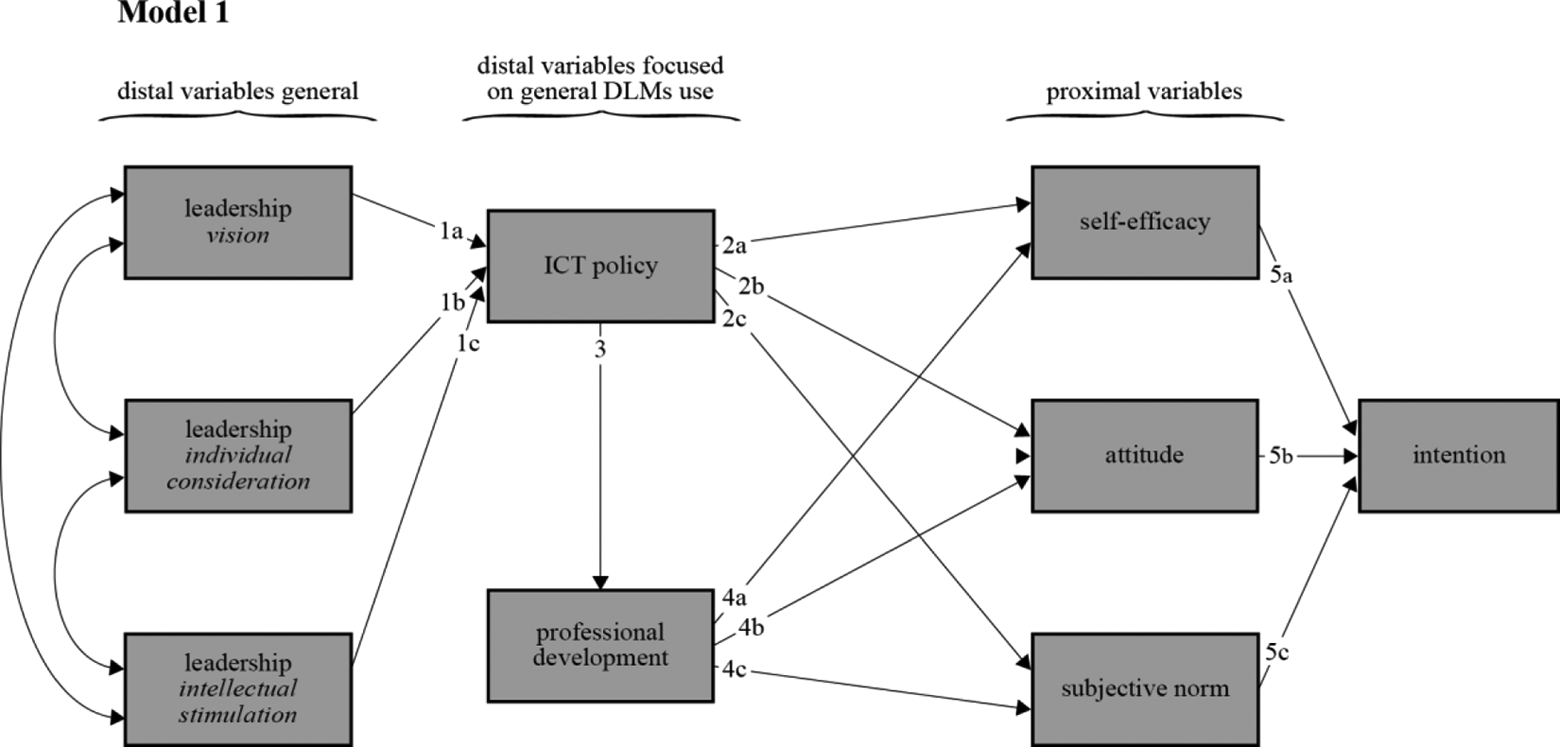
The Integrated Model for Behavioural Prediction (IMBP) for the use of DLMs. Model 1: path with direct (1a, 1b, 1c) relation between leadership and ICT policy and indirect relation (3) with professional development with intention to use DLMs.
Figure 1 shows the IMBP for the implementation of the use of DLMs. According to Fishbein and Ajzen (2010), the effects of the environmental variables are fully mediated by the proximal variables. In other words, we expect that the three dimensions of transformational leadership, both through the ICT policy of the school, via the professional development activities, influence self-efficacy, attitude and subjective norm. In this figure, the distal variables influence the intention to use DLMs through each of the more proximal variables. Figure 1 shows the factors examined here at the level of the individual teacher and the perceived ambient level based on the principles of the IMBP. The numbers indicating the above-formulated hypotheses are displayed in the model.
Alternative models
Different researchers have reported inconsistent findings regarding the link between transformational leadership and employee behaviour (Pieterse et al., 2010). Some studies have reported direct effects of leadership characteristics on employee motivation or behaviour (for instance Leithwood and Jantzi, 2006; Leithwood and Mascall, 2008) while other studies found mediating variables between the environmental and some of the proximal variables (Thoonen et al., 2011). Gong and colleagues (2009) speculated on several reasons for these inconsistent findings, including the need to learn more about the mechanisms underlying the effects of transformational leadership on employee behaviour. The mechanisms underlying these inconsistencies have not yet been empirically tested (Ayree et al., 2012; Marks and Printy, 2003). By comparing different relational models based on the same variables used in model 1, we hope to add some new insights on teachers’ intention to use DLMs in daily practice.
Model 2 is an expansion of model 1 showing the direct relations between the transformative leadership dimensions and the distal variable professionalization activities (Figure 2). Paths 6a, 6b and 6c are based on the literature on professionalization activities in educational organizations that gave empirical evidence for the enhancement of professionalization by some dimensions of transformational leadership (Stoll et al., 2006; Thoonen et al., 2011). In addition, one study found a mediating role for professional development activities between transformational leadership and teachers’ self-efficacy (Geijsel et al., 2009). Thus, model 2 was tested with the hypotheses that the three transformational leadership dimensions affect professional development activities regarding ICT directly, in addition to the indirect effect through ICT policy (6a, 6b and 6c).
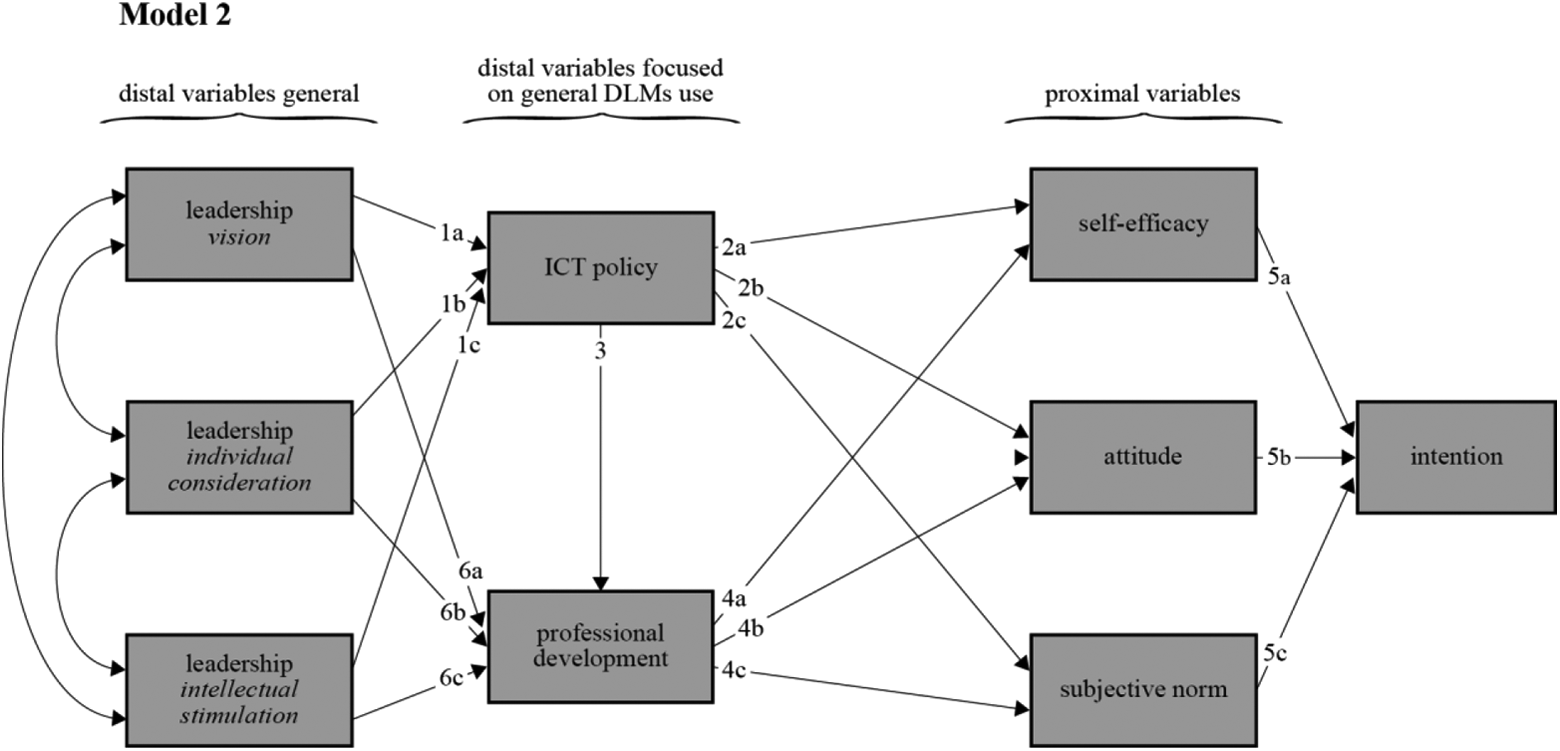
The Integrated Model for Behavioural Prediction (IMBP) for the use of DLMs. Model 2: path with direct relation between leadership and ICT policy (1a, 1b, 1c) and professional development (6a, 6b, 6c) and indirect relation with intention to use DLMs.
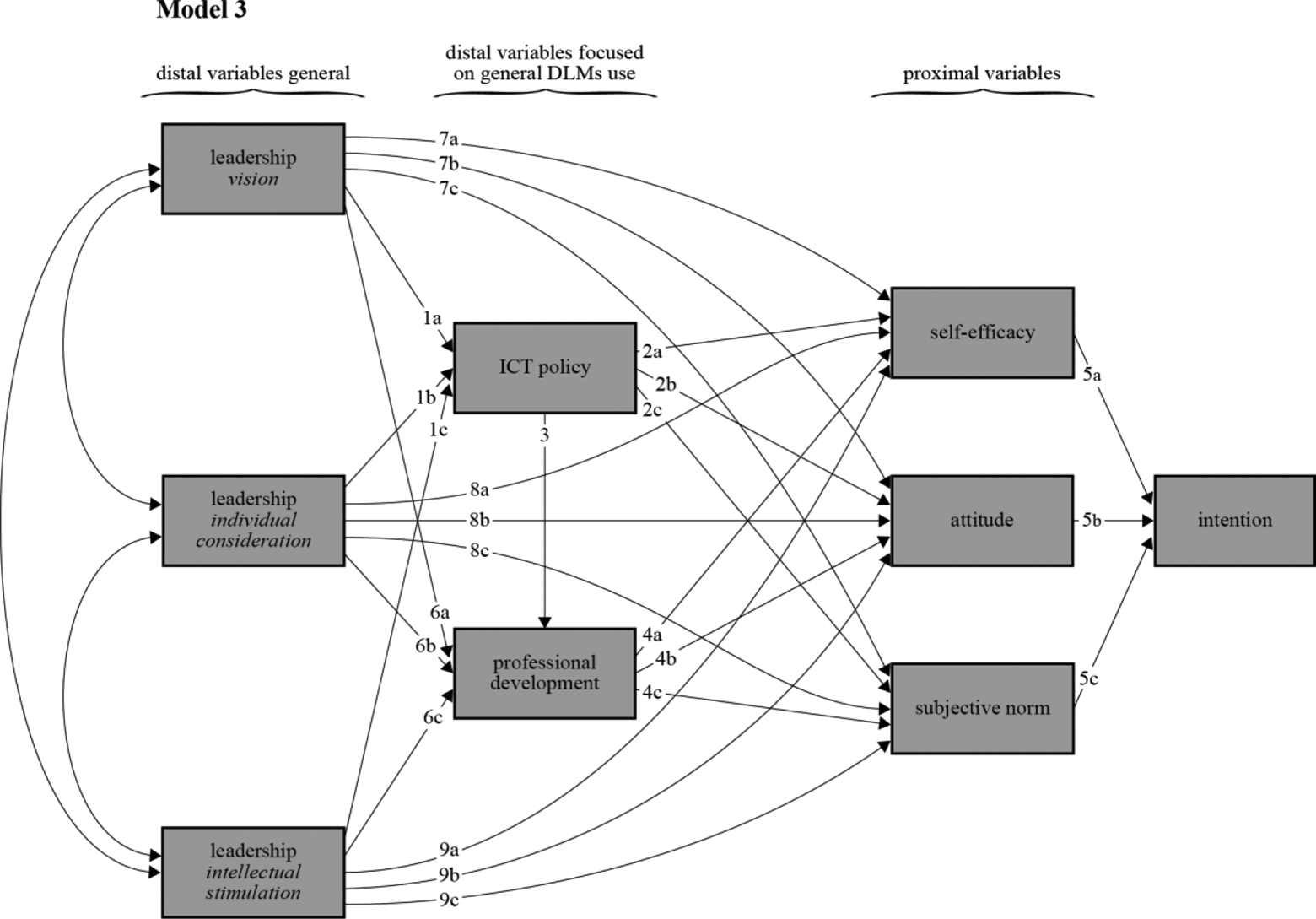
The Integrated Model for Behavioural Prediction (IMBP) for the use of DLMs. Model 3: path with direct (6a, 6b, 6c) relationships between leadership and professional development and direct (7, 7a, 7b, 7c, 8a, 8b, 8c, 9a, 9b, 9c) and indirect relations with intention to use DLMs.
Model 3 is based on research that demonstrates direct relationships between transformational leadership and all kinds of behaviour of employees (for example Chen et al., 2012) because, until now, little research on transformational leadership dimensions and the use of ICT has been conducted. In this third model the direct relationships (7a, 7b, 7c, 8a, 8b, 8c, 9a, 9b and 9c) between the transformational leadership dimensions and the proximal variables are tested in combination with the mediating relationships as presented in model 2.
Method
Data collection and response
The data was collected in two rounds (2010 and 2011), in which different questionnaires were submitted. In total 772 teachers, teaching in primary, secondary and vocational education from a TNS NIPO research panel (TNS NIPO is a professional organization for data gathering in the Netherlands), filled in a combination of the two questionnaires. The response is presented in Table 1 and exhibits a distribution that is representative for the characteristics of the population of Dutch teachers.
Characteristics of the research group: gender, age and type of school.

Measures
An online questionnaire was developed with items that are predominantly taken from existing validated instruments. When necessary, these were adapted to the Dutch situation, with a focus on the use of DLMs in educational practices. For all multi-item scales Cronbach’s alpha was calculated as a measure of internal consistency. Table 2 summarizes the characteristics of each scale.
Overview of the scales used, answer categories, Cronbach’s alpha and the sources of the scales.
*‘Regularly’ is defined as ‘a few times a week during the school year’.
Results
Direct relationships
The results of the bivariate correlations between the variables in the different models are shown in Table 3. The same table also contains the mean score and standard deviation for each variable. Strong direct relationships seem to exist primarily between ICT policy and the three dimensions of transformational leadership, between the dimensions of transformational leadership among themselves and between the three proximal variables.
Correlation matrix.
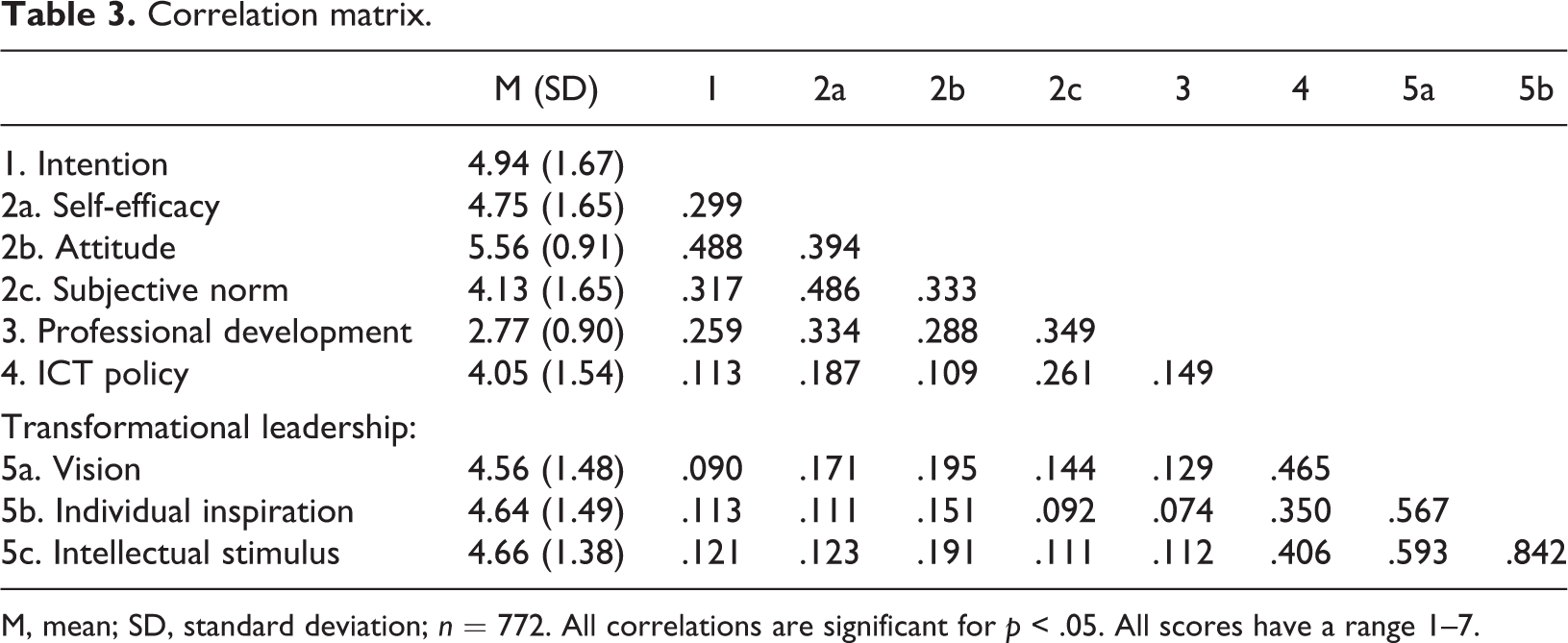
M, mean; SD, standard deviation; n = 772. All correlations are significant for p < .05. All scores have a range 1–7.
Path analysis
Structural equation modelling was used to test the relative fit of three nested models, which differ in the number of direct relationships between the leadership dimensions and professionalization on the one hand and subjective norm, self-efficacy and attitude on the other hand. Structural equation modelling (SEM) is a statistical method that enables the testing of causal relationships among several variables. The method incorporates factor analysis as well as regression analysis. Factor analysis is used in SEM to model latent constructs based on several measured variables. In SEM causal relationships are not tested using the measured variables as such, but rather with a latent (or underlying) representation of the construct of interest. A first step in a SEM analysis consists of modelling these latent constructs. The second step in SEM is testing the actual causal relationships using path analysis (which is based on regression analysis). As SEM captures the measurement error in the model, a major advantage of this technique is that the structural relationships between the variables are measured more accurately.
We present the models with incremental complexity and their path parameters in Figure 4. Table 4 shows several fit indices for the tested models. Although these fit indices provide an estimate of the absolute fit of the models, given the focus of this study, of main interest here are differences in fit. The SEM analyses were conducted using AMOS 19. Model fit was evaluated using the χ2 statistic, which is lower as model fit improves. As the χ2 statistic rapidly increases with model complexity and sample size, several other measures of model fit are reported. First is the comparative fit index (CFI and the normative fix index (NFI)), for which values between .90 and .94 indicate good fit and values of .95 and higher indicate very good fit. Second is the root mean square error of approximation (RMSEA), for which values between .06 and .08 indicate a good fit and values of .05 and less indicate a very close fit (Browne and Cudeck, 1989). To compare the nested models, we calculated chi-squared differences and tested the significance of these differences. These results are also presented in Table 4.
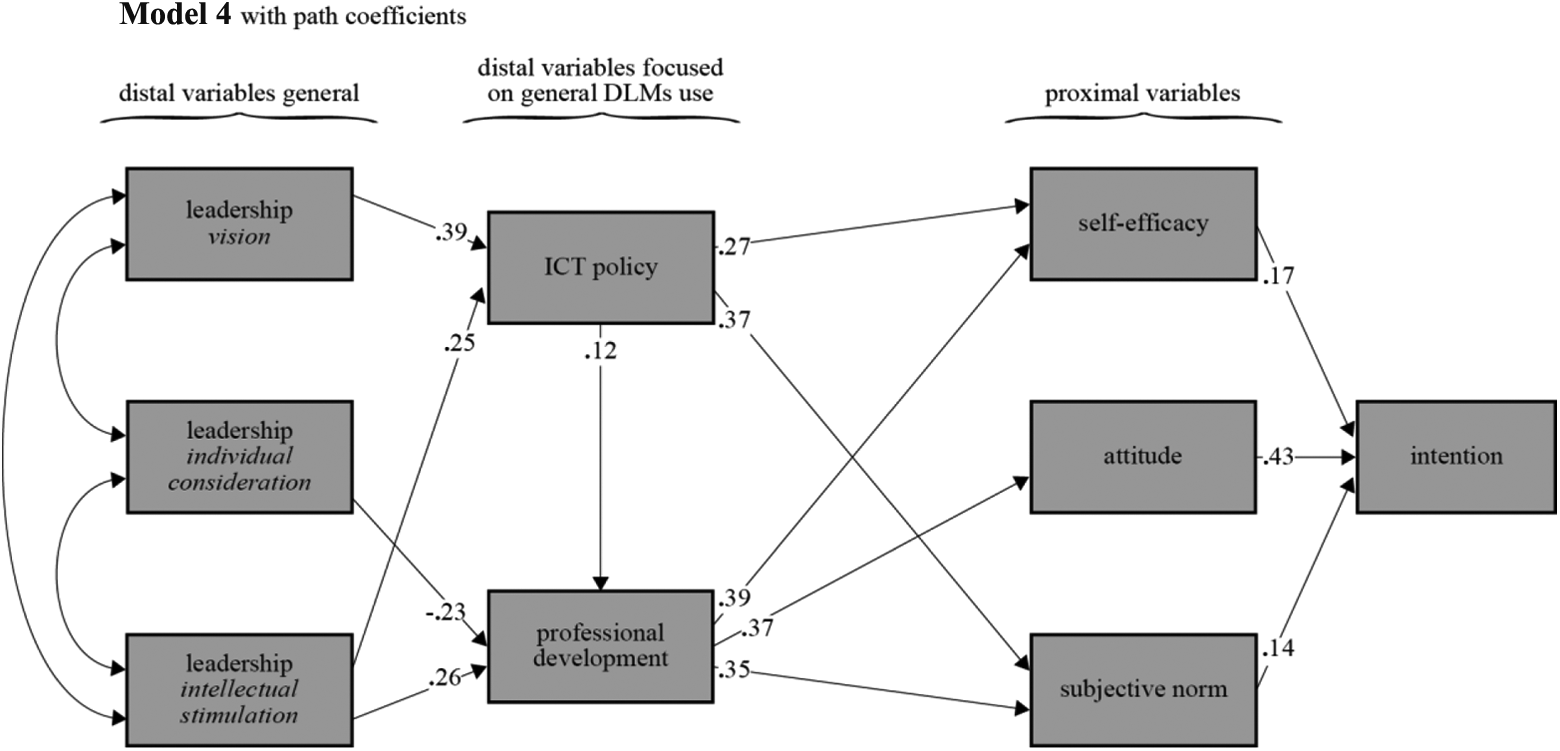
The path coefficients for model 3 for the use of DLMs, with direct relations from leadership to professional development activities and direct relations from leadership to the proximal variables self-efficacy, attitude and subjective norm. Nonsignificant paths were omitted from the diagram.
Fit indices for the three path models and the result of the model comparison.
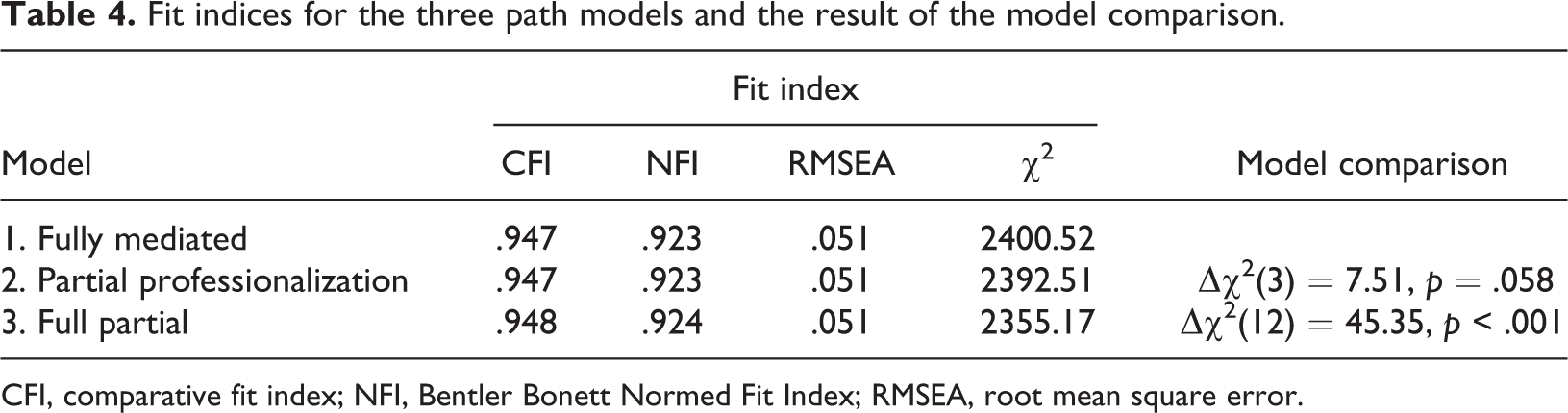
CFI, comparative fit index; NFI, Bentler Bonett Normed Fit Index; RMSEA, root mean square error.
Before the conjectured structural relationships were tested, the fit of the measurement model was tested. For conciseness, we do not report these results. In model 1 a fully mediated relationship is conjectured, meaning that no direct relationships between the transformational leadership dimensions nor professional development activities, nor attitude, self-efficacy and subjective norm exist. In model 2 direct relationships between the transformational leadership dimensions and professional development activities are allowed. Finally, in model 3 relationships between the transformational leadership dimensions and attitude, self-efficacy and subjective norm are allowed as well.
As can be observed in Table 4, the fit of our model does not increase significantly when allowing direct relationships between the transformational leadership dimensions and professional development activities (as is done in model 2). However, in the third step, when additional direct relationships are allowed between all three leadership dimensions and attitude, self-efficacy and subjective norm, the increase in model fit is significant. The final model with the path coefficients is presented in Figure 4.
The results of the path analysis in model 1 (see Table 5) suggest that the relationship between two dimensions of transformational leadership and the intention to use DLMs are mediated by ICT policy (hypotheses 1a and 1c) and professional development activities (hypothesis 3) as well as the proximal variables (2a, 2b, 2c and 4a, 4b, 4c). The transformational leadership dimensions are strongly related to each other; vision correlates with individual consideration by .61 and with intellectual stimulation by .67, and intellectual stimulation with individual consideration by .90. The relations between the proximal variables and the intention (5a, 5b, 5c) to use DLMs are strong for attitude (.43), and rather weak for self-efficacy (.17) and subjective norm (.14). In addition, strong direct effects are found for ICT policy on the self-efficacy and subjective norm regarding teachers’ use of DLMs in class; hypotheses 2a and 2c are thus confirmed. ICT policy also has a significant direct relation with attitude, although weaker than with the other two proximal variables. Hypothesis 2b can thus also be confirmed.
Parameters of the three path models.
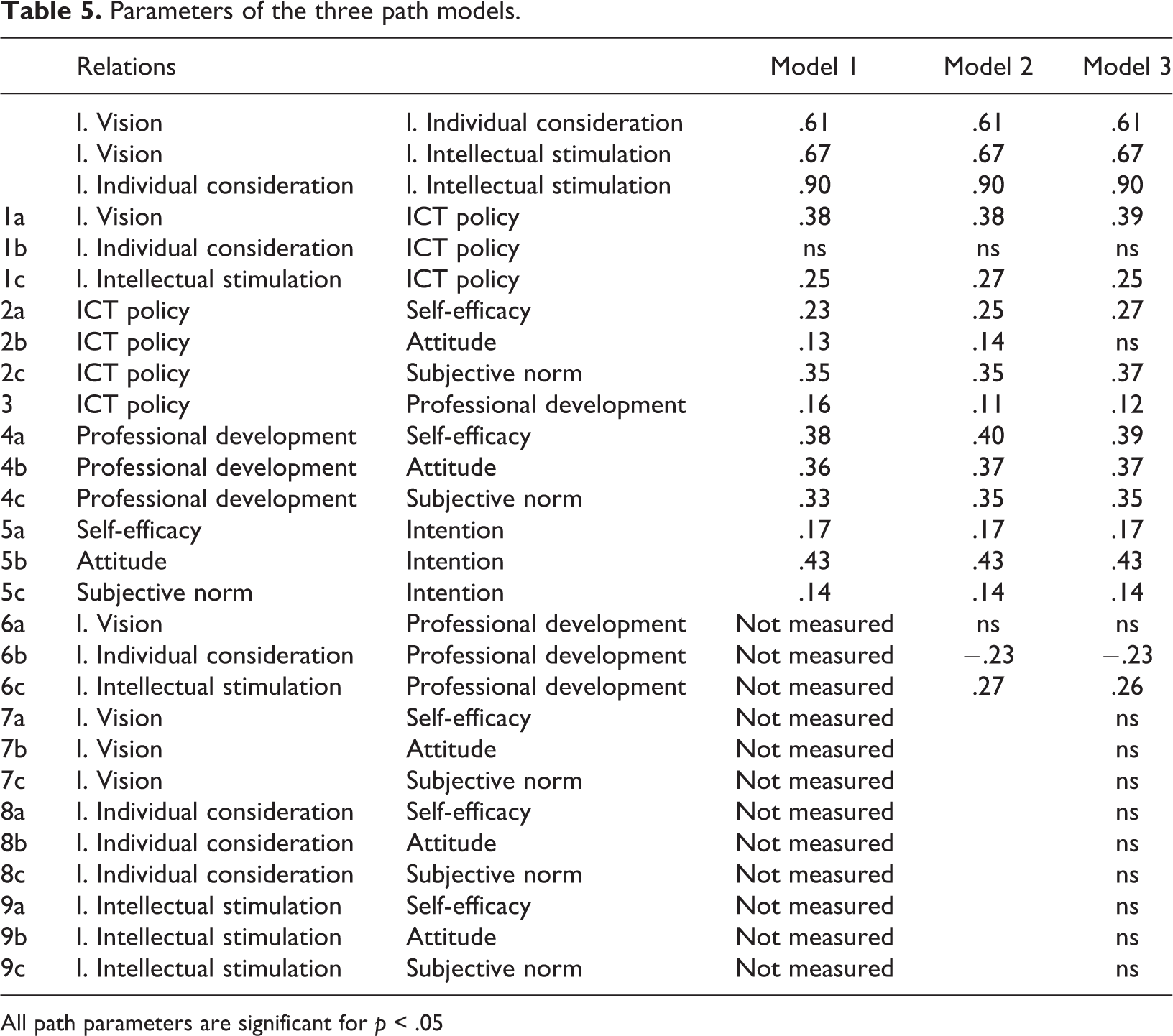
All path parameters are significant for p < .05
The results further show that the relationships between only two (hypotheses 1 and 3) of the three dimensions of transformational leadership and ICT policy are significant (in all three models). These significant relationships involve the leadership dimensions of vision and intellectual stimulation. The transformational leadership dimension of individual consideration has hardly any effect on the experienced ICT policy; hypothesis 1b must therefore be rejected.
The parameters tested in model 2 are shown in Table 5. In comparison with model 1, all three transformative leadership dimensions have an influence on ICT policy and professional development or both. The strongest relation (.38) is found between the leadership dimension vision and ICT policy, followed by intellectual stimulation on both ICT policy and professional development activities (.27). Hypotheses 1a and 1c are therefore confirmed.
Remarkably and in contrast to our expectations, individual consideration has a negative relationship with professional development activities (−.23). ICT policy and professional development activities both affect the intention through the mediators self-efficacy, attitude, and subjective norm. ICT policy influences the three proximal variables less strongly (for hypotheses 2a, 2b and 2c these are .25, .14 and .35 respectively) than professional development activities do (for hypotheses 4a, 4b and 4c these are .40, .37 and .35, respectively).
Model 3, shown in Figure 4, allowing direct relations between the leadership dimensions and the proximal variables, differs only slightly from model 2, with regard to the path parameters. There is however one clear exception: the relation between ICT policy and attitude is not significant in this final model. The direct relations from the leadership dimensions with the proximal variables are not significant (7a, 7b, 7c through to 9a, 9b, 9c).
Finally, from the analyses we can conclude that model 3 has the best fit and is the best predictor for teachers’ use of DLMs. The discussion will therefore mainly be based on the final model.
Conclusions and discussion
The IMBP including several variables at the school level was tested predicting teachers’ intention to use DLMs in their teaching practices. The results of the analysis indicate that the intention of teachers to use DLMs is influenced by a complex set of variables. In the model there is not one dominant path influencing teachers’ intention to use DLMs. ICT policy is most strongly related with the leadership dimension vision and less with intellectual stimulation. However, ICT policy is not related to attitude, which in turn has the strongest relation with intention. Professional development activities are most strongly affected by intellectual stimulation, which affects the three mediating variables for intention.
The strongest relationships appeared between professional development activities and the three proximal variables, self-efficacy, attitude and subjective norm. This relationship was to be expected from research into ICT professionalization and ICT (Loogma et al., 2012; Mumtaz, 2000; Pelgrum, 2001; Tondeur et al., 2008). No direct relations between the proximal variables and the leadership dimensions were found, this is in contrast to research where self-efficacy (Thoonen et al., 2011), attitude and subjective norm (Loogma et al., 2012) were directly related to transformational leadership.
That only two of the three transformational leadership dimensions, namely vision and intellectual stimulation, have a significant impact on ICT policy and that only intellectual stimulation has a positive influence on professional development activities regarding ICT, may correspond to the ideas of Marks and Printy (2003). They suggested that transformational leadership is insufficiently unfocused on an organization’s goals in order to influence positive organizational outcomes. Also, Leithwood and Jantzi (2006) made a comment on the disappointing effects of transformational leadership as a concept for improvement of school practice, due to the limited impact on student outcomes. Professional development activities are influenced positively through intellectual stimulation, as could be expected, but are negatively influenced by individual consideration. This latter result is puzzling. Thoonen and colleagues (2011) found a similar negative relation in their research between this dimension and professional development activities operationalized as experimenting and reflecting. They conclude that ‘more support and consideration seems to inhibit teachers’ engagement in professional learning activities’ (Thoonen et al., 2011: 515). Their explanation is as follows: ‘Showing concern and respect of school leaders for teachers’ emotions may be interpreted by teachers as tacit agreement of current classroom practice and therefore, may discourage teachers from engaging in experimenting and reflection activities’ (Thoonen et al., 2011: 520). This is an explanation that could well be true for the situation and culture in Dutch schools. This is in line with the relatively low perceived subjective norm on using DLMs (Vermeulen et al., 2012) and can be seen as a contribution to this explanation. Perhaps in Dutch schools there is no balance between, on the one hand, perceived pressure from the social surroundings and on the other hand showing respect for teachers’ feelings, encouraging or stimulating trying out new behaviour such as using DLMs. But more research is needed on this point before jumping to conclusions.
In addition to the above-mentioned problem, Marks and Printy (2003) plead for an integration of transformational leadership and educational leadership: in other words, leadership that focuses on vision, individualized consideration and intellectual stimulus combined with a strong focus on improving student outcomes. Printy (2008) emphasizes the function of communicating a clear vision for the development of social relationships and learning because it serves as a guide for teachers’ joint work, extends support for teachers’ efforts and protects teachers from external interference. Applied to the theme of this research, transformational leadership should be combined with focusing on improving student outcomes through the use of modern technologies such as DLMs. Indeed, a guiding policy, which provides teachers with a direction regarding the use of DLMs in the class situation, is important to effectively achieve high results with pupils. The findings of Tondeur et al. (2008, 2010) point in this same direction; clear goals and policy development regarding ICT at the school level was one of the stimulating factors for the use of ICT in the classroom.
ICT policy only has direct relationships with two of our proximal variables: self-efficacy and subjective norm. The latter are, however, less pronounced than attitude in predicting the intention to use DLMs. The link between ICT policy and attitude in the final model appears to be non-significant. A possible explanation is that the official policy in Dutch schools is not integrated with teacher’s beliefs about teaching and learning. There is some evidence regarding the major role that general pedagogic beliefs play in implementing e-learning didactics (Loogma et al., 2012; Hermans et al., 2008).
Our model comparison approach provided only partial support for our hypothesis that the proximal variables in IMBP as well as professional development activities are determined indirectly by transformational leadership. Although no direct relationships were found between the transformational leadership dimensions and self-efficacy, attitude and subjective norm, the statistical analysis suggests that a model allowing direct relations between some of the variables provides a better fit. The path coefficients indicate that two relationships might be responsible for this improved fit, namely the direct effect of individual consideration and intellectual stimulation on professional development activities. Although these relationships were not conjectured, a possible explanation for the first relationship, which is negative, might be that individual consideration hinders, because there is too much compassion for individual needs (Leithwood and Jantzi, 2006). Rather than external stimulation, previous research showed that teachers’ personal entrepreneurship was an important predictor of teachers’ intention to use DLMs (Van Acker et al., 2011). The second relationship, between intellectual stimulation and professional development activities, might indicate that teachers’ general attitude towards professionalization becomes more favourable because of the intellectual stimulation that school managers provide. As such, a specific influence of intellectual stimulation may thus be explained by ICT policy, while a general trend towards professionalization might also be triggered as indicated by the direct relationship.
Together these results could indicate that, beside the variables tested in this study, other influencing variables mediate between leadership and the proximal variables; for instance, the organizational culture of the school or the norms and values that prove to play a major role in innovation processes and innovative behaviour (Hargreaves and Fink, 2006). Other possible mediating variables are school learning climate and professional communities. Sebastian and Allensworth (2012) found in their path analyses that only learning climate mediated between leadership and the quality of instruction by teachers. Professional communities are related to teachers’ learning and working together and developing new practices (Printy, 2008); leadership should facilitate these communities. Future research could look deeper into the mediating relationships of these distal variables in relation to the use of DLMs in pedagogical practices.
This research has some limitations. First, it is not the behaviour itself (via self-report or actual behaviour) under investigation, but the intention to use DLMs. Without an intention to use DLMs there will be no behaviour, therefore it is an important factor to take into consideration. However, between intention and actual use there is still much room for all kinds of distortions, and therefore in future research the model should be expanded with self-reported or actual behaviour. A second limitation concerns a part of the operationalization. In the developed model the scale for ICT policy is constructed with only two items. For a more reliable measurement of this concept, it is desirable to construct a scale with more than two items. A third limitation is the number of distal variables. Only variables related to leadership were included. It is conceivable that the effects found here change as other distal context variables such as student population, school size, school culture, learning climate or experienced personnel policy are added.
Despite the limitations, we can conclude that with the variables chosen here, the results of path analysis confirm the applicability of the IMBP for the topic of using DLMs in pedagogical practices. Future research should further explore the concept of educational leadership combined with transformational leadership, and expand the model with other organizational variables. Further research should also proceed at the level of the student outcomes to gain more insights into the whole chain from organizational variables, through teacher variables, and how this affects student behaviour and educational outcomes.
For the development of teaching practices these research findings imply that two dimensions of transformational leadership (vision and intellectual stimulation), through a clear ICT policy and targeted professional development activities, strengthen the self-efficacy, attitude and subjective norm regarding the use of DLMs by teachers. This influence from a chain of environmental variables on the three proximal variables will, in accordance with the model tested here, affect teachers’ intention to use DLMs.