



Abstract
In recent years educational organizations have begun to be administered by more sharing, participation and democratic principles. The school-based management approach accelerated during the decentralization period in education is also seen as a cause for spread of leadership throughout the school. This trend is reflected in the educational leadership literature, which began to describe as distributed leadership (DL), the process/approach of spreading leadership organization-wide. However, the extent to which leadership in educational organizations is distributed cannot be easily delineated, particularly in countries such as Turkey where the system was established and managed centrally. Yet, DL attracts researchers’ attention in terms of the organizational behaviours. It ascribes to teachers, such as their commitment and associated psychological contracts (PCs). In this study of Turkish schools that are centrally organized, we consider the relationship between DL and teachers’ perceptions of their PC levels. As the research variables are multilevel, the data collected from 466 teachers working in 34 different schools were analysed by hierarchical linear modelling. The analyses indicated that the distribution of leadership among school managers was a significant predictor of the PCs of the teachers. However, the observed variance in the PC was determined to be explained by the service periods of teachers.
Introduction
In recent years, there has been increasing demand for democratization and decentralization in the Turkish education system. Criticism of the centralistic character and organizational structure of the Turkish education system were described by several researchers (Arslan and Atasayar, 2008; Memduhoğlu, 2007; Özdemir, 2008; Torun et al., 2008). They found that the centralized organization of Turkish public services was a key determinant of management in education. Turkey is administered as 81 provinces, each managed by a governor who is the senior administrative executive, responsible for the performance of all public services in the province in accordance with the relevant regulations. The Directorate of National Education (DNE) appoints a provincial director who represents the DNE in each province and serves under the governor. Provinces are comprised of several districts, the lowest level of public organization, each with their own administrative units, headed by district governors. As in the provinces, there are representatives of the DNE at district level, typically the deputy district governor. Thus all schools in Turkey are respectively administered by the DNE at district, provincial and ministerial level. This structure resembles a pyramid. At the apex is a member of the cabinet, the Minister of National Education (MNE) , responsible for all education activities in the country. The plans and decisions taken by the, in accordance with the command principal, through sequence, are applied in all schools at the lower level of the system.
School principals are responsible for implementing the education policies and plans determined by the MNE and DNE. The principal manages the school in accordance with the relevant regulations in force. The employment of school principals in Turkey is set out in the Civil Servants Law (CSL) number 657. In this respect, the principal is seen as a government officer. However, their authority to determine education applications is relatively limited. This in turn limits the scope for the principal to display leadership behaviours. Yet, elsewhere, in response to a rapidly transforming world, school principals have been seen to become leaders who develop purposes, targets and strategies and activate the organization in this view (Bush, 2008; Bush and Bell, 2002: 3).
Becoming skilful at leadership and applying these skills is problematic for Turkish school principals. One of the reasons for this may be that teachers do not receive leadership training before entering public service. Article 12 of the Law of Education Organization number 789, which entered into force in 1926, states that the “major principle of the profession is to be a teacher”. Further regulations applied since then have reinforced this principle in the education service. The National Education Fundamental Law no. 1739 now forms the basis of the National Education System of the country and entered into force in 1973. It too adopted the aforesaid principle. The 43rd article of the law describes teaching as “a field or profession which is responsible for education and the related management duties of the government”. In practice this means that after being appointed, the head of a school in Turkey is expected to acquire the knowledge and skills of managers in an informal way, as a “mentor- apprentice” (Şimsek, 2002).
The principal both appoints and disciplines employees in accordance with the regulations. In this respect, the principal is in unique command of the school, their relative power over their colleagues being enshrined by the centralist management culture of the system. The principal may use his title to control the behaviours of teachers and determine the duties and responsibilities of assistants. The principal also prepares the school’s annual and weekly syllabuses. However, he or she may extend this responsibility to include decisions about many other aspects of teachers’ work in education and he is authorized to sanction those teachers who fail to comply (Özdemir, 2009). Therefore, a principal in Turkey is traditionally seen as a ‘solo’ leader in the schools.
In contrast, a general tendency in contemporary organizations is towards the inclusion of employees into the organizational processes (Derber and Schwartz, 1983). Accordingly, democratic culture is desired in organizations, employees are empowered and the participation of employees in administrative processes is afforded. Efforts to enhance the quality of work in organizations are also accelerated (Cheney, 1995; Chiles and Zorn, 1995; Dachler and Wilpert, 1978; Marshall and Stohl, 1993; Vredenburgh and Brender, 1993). As a reflection of these developments, the “solo leadership” approach has begun to decline in today’s organizations (Bush and Glover, 2003; Elmore, 2000; Gronn, 2000, 2002; Harris et al. 2007; Spillane, 2005). Research in education leadership has followed this trend and increasingly focuses our attention on aspects of distributed leadership (DL) (e.g. Bush and Glover, 2012; Crawford, 2012; Harris, 2004; Hulpia et al., 2011; Lashway, 2003; Lumby, 2003; Spillane, 2006; Woods and Gronn, 2009).
However, in the Turkish setting, it is thought that either the centralistic structure of the education system or relative power given by this structure to the principal are obstacles to distribution of leadership in Turkish schools. In a review of the literature, a gap exists in terms of information about where and at what level leadership is distributed in Turkish schools. Also the relation between the distribution of leadership and the psychological contracts (PCs) of teachers in Turkey needs to be enlightened. In similar research, a relation between certain organizational behaviours, such as the distribution of leadership and organizational commitment, has been found (Hulpia et al., 2011). In other studies, there is a relation between leadership and spirits and performances (Bossert et al., 1982), motivation (Blase and Blase, 1999), vocational development (Eyal and Roth, 2011) and the collective efficacy (Fancera and Bliss, 2011) of teachers. Guest and Conway (2004) (cited in Demirkasımoğlu, 2012a: 85) stated that there is a relation between efficient leadership and PC. Yet, there is also some controversial evidence indicating that some forms of leadership, such as autocratic, are related to poor mental health, low vitality and high behavioural stress (Nyberg et al., 2011). The possible reason for the differences between positive and negative effects of leadership on the workers’ psychology may be the result of some mediating variables, such as meaningful work (Arnold et al., 2007). We hope that the present study would also contribute to this debate by presenting empirical evidence. Thus the present study seeks to obtain the opinion of teachers working in schools in Turkey as to what level leadership is distributed by school administrators, and what kind of a relation is seen between DL and PC.
Conceptual framework
Distributed leadership
Traditionally, the leadership process is analysed according to concepts of ‘solo leadership’ (Rost, 1993). When analysed historically, all the person-oriented, behaviour-oriented and contingency-oriented leadership approaches deal with the leadership process in terms of ‘what are the characteristics of a leader’, and ‘what a leader does’. Similarly, the transactional, transformational and instructional studies conducted in education and school leadership examine leadership in a solo leadership formula (e.g. Bass, 1985; Burns, 1978; Hallinger and Murphy, 1985). According to this view, the leader is in the senior position in contrast to the followers and the followers are dependent on him (Gronn, 2000). This approach began to be criticized in recent years (e.g. Elmore, 2000; Gronn, 2000, 2002; Harris et al., 2007; Spillane, 2005). An important basis for these criticisms is the impossibility of control of complicated organizations by a solo leader (Elmore, 2000). Traditional solo leadership, which conceptualizes the leader as a ‘hero’ metaphorically, has been superseded by the concept of DL, which regards leadership as a process spread throughout the organization.
According to Bolden (2011), even though the conceptual origins of DL can be traced back to 1250 BC, conditions were right for the acceptance of the DL in the mid-1990s. In line with this argument, Pearce and Conger (2003) think that some developments, including the rise in cross-functional teams, along with speed of delivery, the availability of information and greater job complexity have helped the conceptual development of DL recently (cited in Bolden, 2011: 253). Gronn (2000) mentioned that DL was conceptualized initially by Gibb in 1954. Gibb (1954) thought that leadership is probably best conceived as a group quality, as a set of functions which must be carried out by the group. Gibb (1968) also argued that ‘leaders and follower frequently exchange roles and observation has shown that the most active followers often initiate acts of leading’ (cited in Gronn, 2000: 324).
According to Heck and Hallinger (2009), DL in educational organizations is a ‘taking decision process’ based on participation or cooperation in which administers, teachers, students and parents take part. According to Spillane et al. (2001), DL is a process firstly involving the distribution of the works among leader and followers, then integration of the works done by members of the group. According to another view, it is described as ‘instead of heroic leadership which covers all functions of leadership, distribution of these functions among the members of an organization or team’ (Yukl, 2002: 4). Gronn (2000: 317) deals with DL as a characteristic of a group of people who are in interaction with each other. Gronn (2002: 425) criticizes the descriptions of leadership based on leader–follower dualism and argues that DL’s development is based on division of labour. When organizational activities are diversified and changed, the performance of such work requires special activity. Widespread need for specialization causes mutual dependency and naturally leads to greater cooperation within the organization. With distribution of leadership, it becomes necessary for the members of an organization to depend on each other and to cooperate. Thus, when leadership is distributed to the whole organization a greater power of leadership emerges than the arithmetical total of the separate leadership. This power is described as holism or synergy (Baloğlu, 2011).
As can be observed, the conceptual framework of DL differs between scholars. In an interesting study conducted by Bolden (2011), it was concluded that while there are some common theoretical bases, similarities and differences between DL and related concepts, including ‘shared’, ‘collective’, ‘collaborative’ and ‘democratic’leadership can be seen. In addition, it has been also indicated that there are also some differences between the approaches to DL. For example, Mayrowetz (2008) suggests that there are four common usages of the term DL. He thinks that ‘each usage has its strengths and weaknesses, though two of the usages are actually contradicted by empirical research’ (cited in Bolden, 2011: 263). In addition, despite the increasing popularity of DL among scholars, the quality of studies is controversial. Spillane (2005: 149) argues that ‘the lack of empirical evidence on the effectiveness of DL in promoting instructional improvement and increasing student achievement is considered a weakness’. Based on all these views on DL, it has been concluded that scholars do not share a common definition of the concept (Avolio et al., 2009). In addition, According to Harris (2005) there is no coherent conceptual base for DL in the literature. This situation is considered the main problem of DL in the literature. Therefore, we need to define the boundaries of DL in the present study and we chose to use the model developed by Hulpia et al. (2009). DL will therefore be examined from a holistic perspective as set out below.
While the conceptual and theoretical debate on DL has not been completed, there continues to be considerable interest in DL (e.g. Avolio et al., 1999; Conger and Pearce, 2003; MacBeath, 2005; Mayo et al., 2003; Sheppard et al., 2010; Silins et al., 2002). A variety of methods and approaches have been used to examine it. While some researchers discuss the organizations as a whole, others examine it as a total of its sections. In addition, some researchers choose to conceptualize the organization as a social network. As a result of our literature review on the field, we concluded that there is no agreement among scholars about what DL is and how to study it empirically.
However, recently Hulpia et al. (2009) synthesized each of the three approaches and suggested a more holistic model for DL. While Hulpia et al. (2009) were analysing the structure of DL in schools, they argued on one hand that the leadership functions of the principal, assistant principal and leader teachers should be analysed separately; on the other hand they argued that the level of coherence between these three leaders as a team is also an important factor. In schools in Turkey, a leadership team would comprise the principal, their assistant and a deputy principal. Thus, in the current research, a parallel opinion to Hulpia et al. (2009) is adopted. In this framework, DL deals with, firstly, (a) the level of the leadership skills of the principal, their assistant and the deputy principal, all of whom are designated leaders and, secondly, (b) the coherence level of the leadership team is also analysed.
Psychological contract
In recent decades, labour relations have altered significantly as traditional cooperation between employer organizations, labour unions and government began to decrease. In the new era, large-scale production units began to give way to smaller scale operations. Downsizing has also reduced the influence of labour unions on the workplace. It was observed that juridical relations between small scaled production units and administrators began to change their form to involve personal relations. This tendency in labour relations directed scientists to analyse the psychological relations of employees with their organization (Guest, 2004).
One of the key psychological relations of employees with an organization is their PC. March and Simon substantially contributed to the conceptual development of PC. These authors argue that there is an ‘unwritten contract of liabilities’ between employees who work for an organization and their employers (Roehling, 1997). Argyris (1960) suggested that the unwritten contractual liabilities related to labour relations can be seen as a ‘psychological labour contract’ and laid the etymological foundation of the PC concept. In a study of two factories, Argyris (1960) determined that the productivity of employees increases when they are autonomous, they receive satisfactory salary and they have job security in their work places. Then, Levinson et al. (1962: 21) determined the PC term as a ‘directive to the relations between two parts but a series of mutual expectations which are not stated definitely’. Schein (1965: 15) put forward that a PC occurs as a product of expectations of employees from the organization and an expectation of the organization from employees, arguing that a PC is a thing more than a wage paid for labour. Similarly, Kotter (1973) describes the PC as an ‘implicit contract related to what will be given mutually between employees and the employers’ (Guest, 1998: 650). Rousseau (1989) described the PC as the belief of the employee related to working conditions between the organization and employees and mutual liabilities. In this framework, according to Rousseau, there is no obligation to make a contract between the employer and employee as parts of the contract. Thus, this approach may be thought to differentiate the PC from previous approaches, which accept it as a mutual contract between the parts on the relational platform. In this approach, PC is determined as the subjective belief of the employee (Rousseau and Tijoriwala, 1998).
There are two types of PC (Vos et al., 2003), which begin to arise during organizational socialization as transactional and relational responsibilities (Rousseau and Parks, 1993). The transactional psychological contract (TPC) develops according to economic liabilities. In the TPC, the employee is willing to work overtime, in order to receive more wages, begins to work harder and informs the employer before leaving the work. However, the employee who accepts such a contract does not necessarily have a higher level of commitment to the organization. On the other hand, in the relational contract (RC), where the employer provides job security to employees, it is seen that the employees have a high sense of fidelity to the organization. In this respect, although the TPC is short term, the expectations and liabilities of RC involve a longer period of time (McDonald and Makin, 2000).
It is stated that the PC has various functions in organizational life. One of its most significant functions is its capacity to decrease the feeling of ambiguity of employees towards the organization. In this concern, an employee with a PC feels himself relatively safe in the organization. However, an employee who lacks a PC is expected to perform his work without being subject to any inspection. This is because the employee assumes they will be compensated for their work regardless. Also, the PC excites a feeling in employees for determining their own actions in the organization as a part of contract (Shore and Tetrick, 1994).
Academic concern for the PC has increased during recent years. Several studies have indicated that there is a positive relation between organizational commitment, job satisfaction and organizational citizenship (Karcıoğlu and Türker, 2010; McDonald and Makin, 2000; Turnley et al., 2003). On the other hand, other studies indicate that the employee breaks the PC, with as many of 54 percent of PCs broken after a short time (Robinson and Rousseau, 1994). Similarly, it is stated that many employees break their PC during their employment (Shapiro and Kessler, 2000). Turnley and Feldman (1999) found that breaches of PC bring certain behaviours such as abandoning the organization, expressing organizational problems and decreased cooperation and feelings of interdependency.
Shapiro (2002) put forward that PC breaches damage the confidence of employees in an organization and decrease their job satisfaction. A PC breach also decreases organizational confidence and causes pessimism among employees (Turnley et al., 2003). However, a PC breach is also an element that decreases the performance of employees (Lester et al., 2002). In a meta-analysis, PC breaches were found to be important factors for job satisfaction, organizational commitment and leaving an employer (Zhao et al., 2007).
There are few Turkey-addressed studies focusing on the views of educational organizations towards the PC. In one, Demirkasımoğlu (2012a) put forward that the PC could be used as an analytical tool for understanding and analysis of labour relations in education organizations. Following this suggestion it is thought that determining the PC level of Turkish teachers in state institutions will contribute to the relevant literature. It is expected that the present study will contribute to the theory, practice and research in the DL and PC fields. As started previously, we do not know if DL is indeed possible in centralized organizations. Secondly, we think that DL is still a developing field, with an insignificant empirical base. Therefore, the present study may contribute to the DL field in terms of its empirical evidence. Lastly, we hope that this study would trigger similar studies in different countries and in different settings.
Thus, the general purpose of the present study is to explore the relationship between DL and the PC in Turkish high schools based on the teachers’ view. In this study, the leadership process in Turkish schools is analysed in reference to DL. The relative effect of the leadership skill levels of the principal, their head assistant and the deputy principals, who are designated official administrative positions in schools, on the PC of teachers is analysed. However, how the general coherence level of each of these three administers effects the PC of teachers is questioned. Also, in this research, the relative effect of gender, age, service period and the location of the school contextual to the PC are analysed. Research questions are indicated schematically in Figure 1.
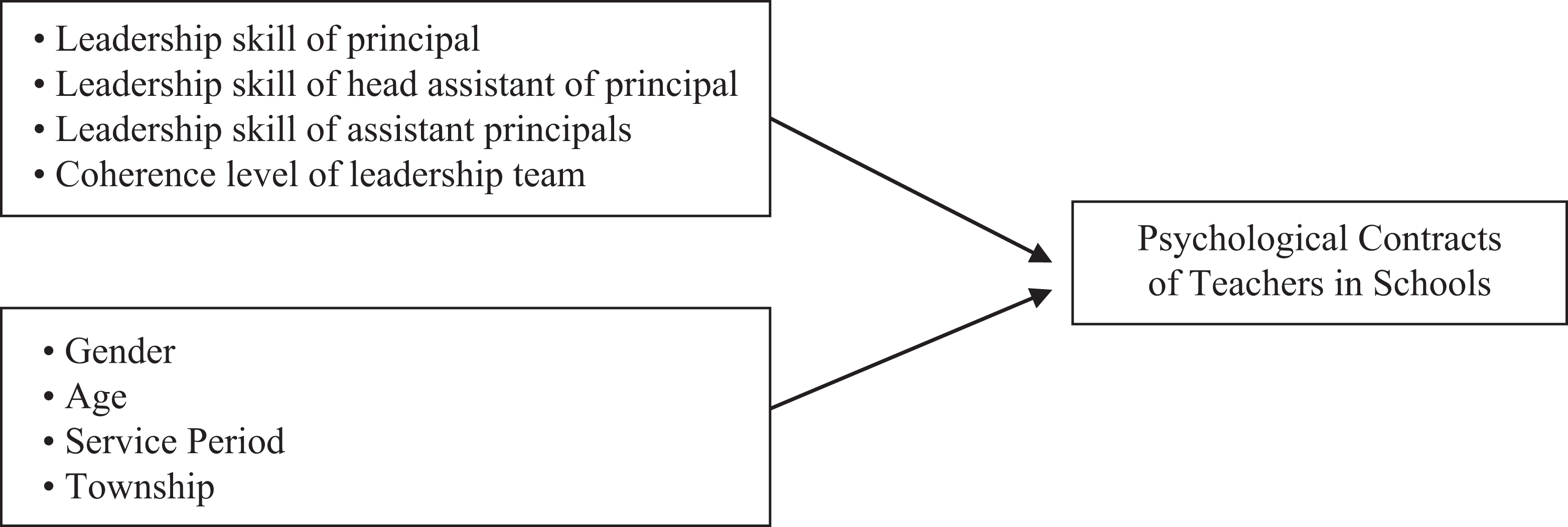
Research questions.
Method
This study focuses on the effect of DL on the PC of teachers in schools in Turkey and is designed according to a relational screening model. This model, according to Karasar (1991: 77), is used when the researcher wants to describe social events in their natural situation.
Population and sample
This research is conducted in Ankara, which is the second largest city of Turkey in terms of its population (approximately 5 million). According to the data received from the Ankara Provincial DNE, during the 2012–2013 academic year, 16,078 teachers worked in general high schools (MEB, 2013). Hence, 16,078 teachers were identified as the research population. Considering the impossibility of reaching all teachers, the study was conducted on a sample identified by a stratified sampling technique. Accordingly, a total of 364 subjects from eight locations where teachers are employed was determined with an error rate of 5 percent to be representative of the population (Balcı, 2005: 95). For this purpose, the total number of schools and teachers in each of eight different areas were taken into consideration. Hence, every unit (school and teacher) could in theory be represented in the sample randomly. However, considering possible problems that could arise when completing the survey, it was decided that the sample would be increased to 500 teachers. Hence, 500 teachers representing the target population were given the questionnaire, 466 of whom returned it fully completed. A description of the schools, teachers and their various personal variables is shown in Table 1.
Descriptive statistics of sample.
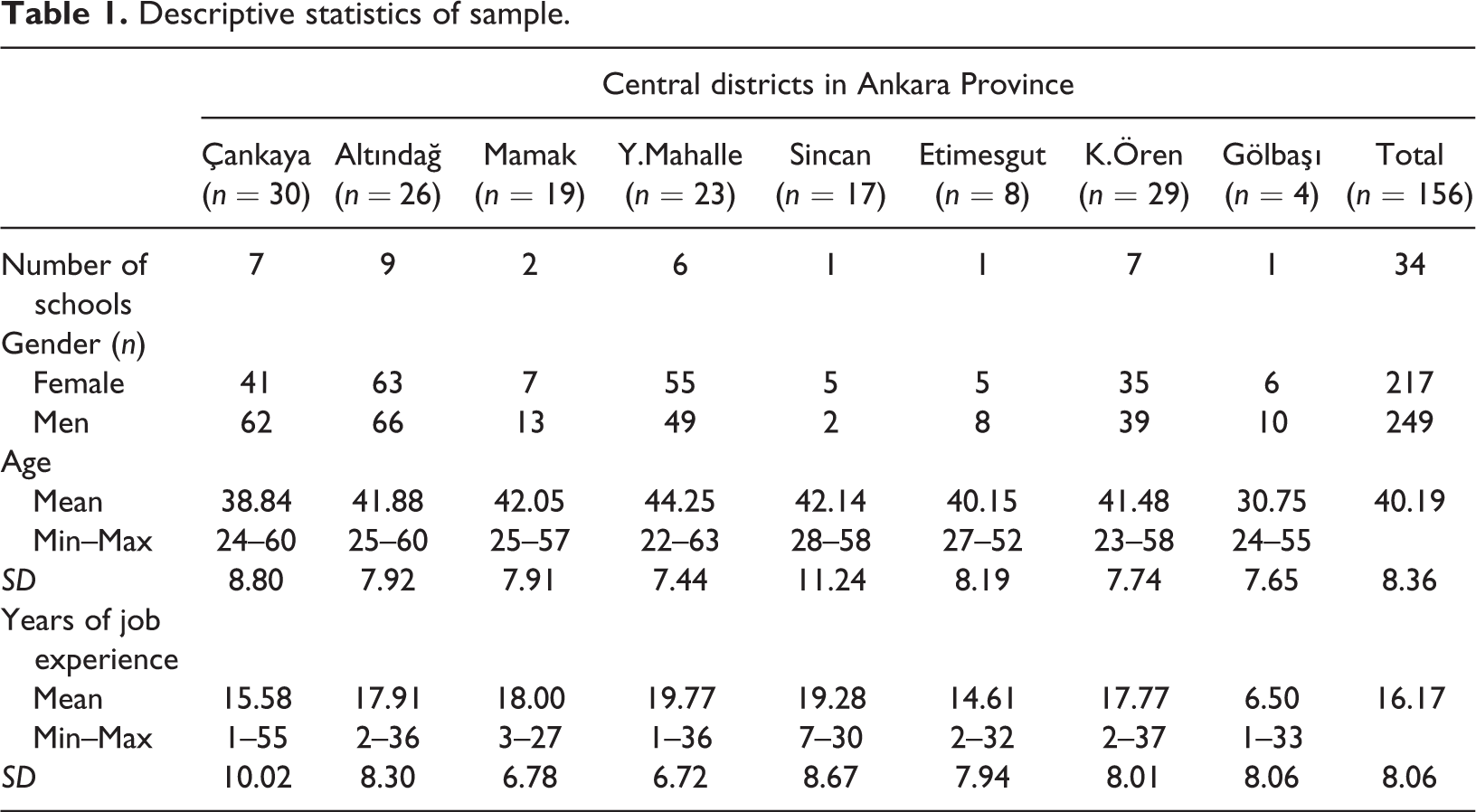
As seen in Table 1, in eight central districts of Ankara Province, there are 156 general high schools. This research was carried out in 34 of these high schools. The numbers of schools sampled in each district reflects the total number of schools in each. For example, in Etimesgut and Gölbaşı, there are fewer high schools than in Çankaya and Altındağ. Two hundred and seventeen (217) of the participants of this research are female, and 249 of them are male teachers (n = 466). The age average of the participants is 40.19. The age of the participants ranges between 22 and 63. The average period of service was determined as 16.17 years/months.
Data collection tools
In order to measure DL, a Distributed Leadership Inventory (DLI) developed by Hulpia et al. (2009) is used. The Turkish adaptation of DLI was undertaken by Özdemir (2012). The PC levels of the participants are measured by the Scale of Psychological Contract (SPC) developed by Millward and Hopkins (1998). The Turkish version of the scale is used by Mimaroğlu (2008). The psychometrical characteristics of the data collection tools are indicated below.
Distributed Leadership Inventory
The DLI scale has two main parts. The first part measures the ‘leadership functions’ of the members of the leadership team; the second part measures the ‘coherence in the leadership team’. The leadership functions part of DLI has 13 items. In the Turkish adaptation of DLI, subjects are requested to evaluate the leadership functions of the principal, head assistant to the principal and the assistant principal using a five-point Likert scale separately (1 = Never, 5 = Always) (Özdemir, 2012). The original form of the inventory was prepared in order to determine four basic leadership functions based on the related literature. These functions are (1) powerful vision, (2) supportive leadership behaviours, (3) educational support and cognitive excitation and (4) supervision (Hulpia et al., 2009). In the original version of the DLI, this section has two sub-dimensions of “support” and “supervision”. In the Turkish adaptation of DLI, at the end of exploratory factor analysis (EFA) for each of the three administrator positions, it is stated that this section has one dimension. As a result of the reliability analysis made within the context of the Turkish version of DLI, the Cronbach’s alpha coefficient value is calculated as .96 for the principal, .95 for the head assistant to the principal and .96 for the assistant principal. The sub-section relating to the adaptation of the leadership team describes the coherence level among members of the leadership team. This section consists of a five-point Likert scale of 10 items. In the original form of DLI the expressions of this section are prepared, based on the literature, in order to determine (1) role ambiguity, (2) group coherence and (3) purpose conciliation degree. In the original study, EFA and confirmative factor analysis (CFA) of this section is stated as one-dimensional in structure. The Turkish version of the DLI is determined as one-dimensional so as to accord with the original one. In the reliability studies of the Turkish version of the DLI, the Cronbach’s alpha coefficient of this section is calculated as .98.
In a study conducted by Hulpia et al. (2011), the internal validity of the DLI scores was tested by conducting exploratory factor analyses on the results of data obtained from a first stratified randomly selected subsample (n = 951) and it was reported that the DLI is a valid instrument. In the original study, CFA and validity scores were reported as follows: principals: χ2 = 353.840 (df = 64, p < .001), CFI = 0.960, TLI = 0.952, SRMR = 0.042, RMSEA = 0.069; assistant principals: χ2 = 361.794 (df = 64, p < .001), CFI = 0.957, TLI = 0.948, SRMR = 0.047, RMSEA = 0.070; teacher leaders: χ2 = 390.001 (df = 64, p < .001), CFI = 0.943, TLI = 0.931, SRMR = 0.044, RMSEA = 0.073; Cronbach’s α support = .91 (teacher leaders), .93 (principals, assistant principals); Cronbach’s α supervision = .79 (teacher leaders), .83 (principal), .85 (assistant principals).
Validity and reliability tests of the DLI were re-calculated based on the data received from participants in this research. CFA of the validity of sub-sections of the DLI was tested (LISREL 8.7); reliability was tested with Cronbach’s alpha coefficient (SPSS 20). The goodness of fit results of the DLI are [χ2= 5461.51; df = 1117 (p < .0001); χ2/df = 4.88; AGFI = .65; GFI = .68; NFI = .93; CFI = .95; IFI = .95; RMR = .11; RMSEA = .09]. When the DLI model goodness of fit results are analysed, it is seen that the adaptation between the model and data is high. The chi-square value of adaptation statistics is found to be significant. When the chi-square value rate to degrees of freedom is under 5, sufficient adaptation between the model and data is seen (Byrne, 1994: 147–149; Netemeyer et al., 2003: 151–153; Schermelleh-Engel and Moosbrugger, 2003: 52; Sümer, 2000: 49-74). When the RMSEA value is under .10 and NFI, CFI and IFI values are above .90, it is accepted that all the index values of the assessment model provide acceptable adaptation criteria (Brown, 2006). AGFI and GFI values are under the 0.80 critical values. It is thought that this case results from sample size. When the model is evaluated as a whole, the calculated indexes indicate the relations among the variables of the model. Therefore, it is accepted that the four-factor structure of the DLI model may be used in this research. Cronbach’s alpha internal consistency obtained from the sample is calculated in order to determine the reliability of the DLI. As a result of the analysis, the calculated internal consistency coefficients for each of the sub-dimensions and the whole are LF(principal) = .80; LF(head assistant of principal) = .97; LF(Assistant principal) = .97; LEU = .97; DLI(All) = .96. According to these results, Cronbach’s alpha values related to each sub-section of the DLI are above the .70 acceptable limit value (Anastasi, 1982). Thus, it was confirmed that the DLI is suitable for usage as a valid and reliable instrument.
Psychological Contract Scale
The Psychological Contract Scale (PCS) was developed to measure the PC levels of employees and it involves two sub-dimensions of10 “transactional” items and 7 “relational” items. The PCS is a five-point Likert-type scale ranging between “never agree” and “completely agree”. In the original study, the reliability coefficient value of the scale for the transactional sub-dimension was calculated at .62, and the relational sub-dimension at .65 (Millward and Hopkins, 1998). The Turkish version of the PCS was used by Mimaroğlu (2008), where the Cronbach’s alpha value for the 17-item scale was .68. Validity and reliability of the PCS are calculated in the current study as well. Validity of the scale was tested using CFA, and we found that the two-factor model produced acceptable goodness of fit values [χ2= 746.86; df = 115; χ2/Sd = 6.49; AGFI = .79; GFI = .84; NFI = .82; CFI = .84; IFI = .84; RMR = .14; RMSEA = .11]. We therefore determined that the PCS is a reliable scale (Cronbach’s alpha value = .80) using the current data. The Cronbach’s alpha reliability coefficients for the transactional and relational sub-dimensions of the scale are respectively .72 and .71. When the results are evaluated, it is seen that the PCS is a valid and reliable assessment scale in the context of the research.
Procedures and data analysis
In order to conduct the research, legal permission was obtained from Ankara National Education Directorate associated with the Ministry of National Education (MNE). The scales were applied by visiting the schools and obtaining permission from the principals for their teachers to participate in the study on a voluntary basis. In the analysis of the data, descriptive statistics techniques are used. In order to analyse the relations between variables, a correlation matrix was prepared that would provide us with initial insight into how the research variables are related. The matrix was also applied to see if there was a threat of multicollinearity.
The teachers who participated in the research (n = 466) are located in 34 different schools in the centre of Ankara province. One of the basic presumptions of the research is that teachers who work in the same school would tend to have homogenous psychological characteristics that may differ from school to school. Therefore, it is assumed that the PC levels of teachers who work in the same school may be more similar. Within this context, and given the multilevel structure of both the data set and research questions, the relation structure of the actualization levels of leadership skills of the school administers, coherence level among the administers, contextual variables (gender, age, service period and township) and PC are analysed using hierarchical linear modelling (hierarchical linear model (HLM) 7.0). Given the aim of the study, different models were tested using a forward stepwise HLM (Raudenbush and Bryk, 2002, cited in Hulpia et al., 2009: 743). First the unconditional model, in which no independent variables are included, was tested. Then, teachers’ perceptions related to the leadership variables and contextual variables were added as fixed effects.
Findings
Descriptive statistics
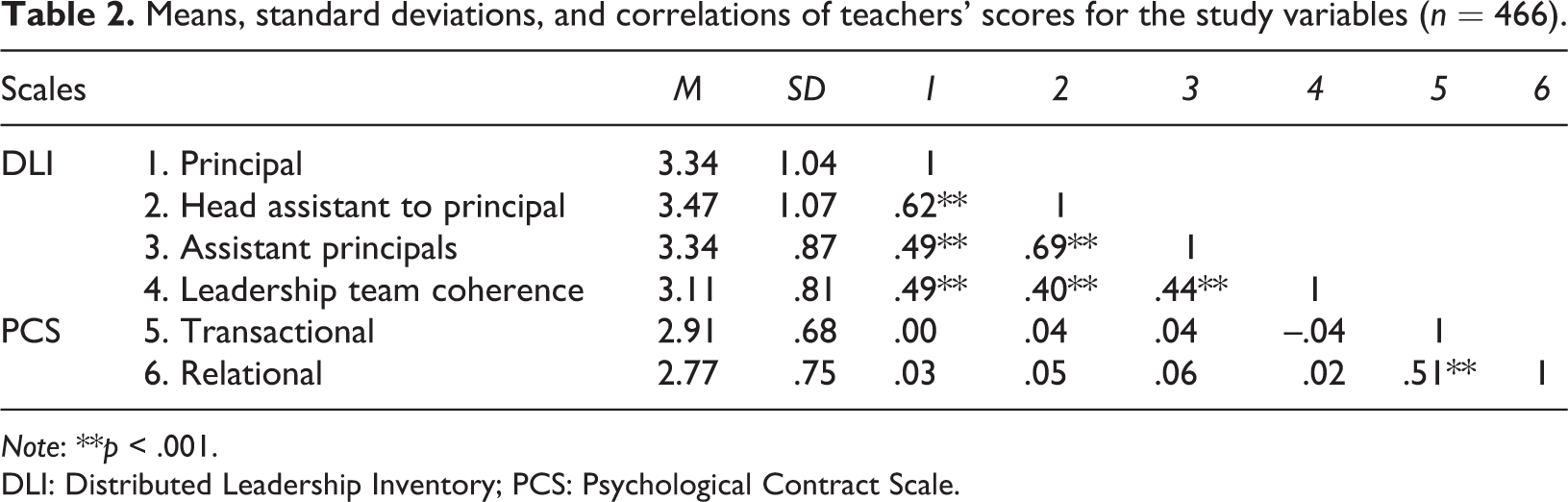
The opinions of the participants on DL and the PC was analysed using the Pearson correlation coefficient, and the results are indicated in Table 2.
Means, standard deviations, and correlations of teachers’ scores for the study variables (n = 466).
Note: **p < .001.
DLI: Distributed Leadership Inventory; PCS: Psychological Contract Scale.
The arithmetical mean and standard deviation points of the leadership skills and the PC levels of the principal, head assistant to the principal and assistant principals are indicated in Table 2. As can be seen, according to the opinions of participants, the leadership skills of the head assistant to the principal are relatively higher than the average (Mhead assistant of principal = 3.47). However, it is determined that the leadership skills levels of the principal and assistant principals are on the average [(Mprincipal = 3.34); (Massistant principal = 3.34)]. According to the opinions of the participants, the coherence level among the leadership team is on average (Mleadership team coherence = 3.11). When the PC levels of the participants are analysed, the arithmetical average is calculated as 2.91 in the transactional sub-dimension and 2.77 in the relational sub-dimension. According to this finding, it can be said that the PC levels of the participants are close to the medium level.
When the correlations in Table 2 are analysed, it is understood that between the levels of the leadership skills of administers who are in the leadership position and the PC levels of the teachers who work in the same school, there is not a significant relation. The relation levels among the variables are calculated as [(rprincipal-leadership*transactional PC = .00; p > .01); (rprincipal-leadership*relational PC = .03; p > .01); [(rhead assistant of principal-leadership*transactional PC = .04; p > .01); [(rhead assistant of principal-leadership*relational PC = .05; p > .01); (rassistant principal-leadership*transactional PC = .04; p > .01); [(rassistant principal-leadership*relational PC = .06; p > .01); (rleadership team coherence*transactional PC = –.04; p >.01); (rleadership team coherence*relational PC = .02 > .01].
Hierarchical linear models
In order to indicate the relations among leadership skills levels of the school administrators (i.e. principal, head assistant to the principal and assistant principal), coherence in leadership team, PC and contextual variables (i.e. gender, age, service period and district), the HLM is applied.
Unconditional model
In this research, data regarding the PC are used as dependent variables, and data regarding the DLI in which the teachers are evaluated as principal (X1), head assistant to the principal (X2), assistant principal (X3) and leadership team coherence (X4) at the school level are used. Firstly the unconditional model = M0, which does not involve any independent variable, is tested. Then the random-coefficients regression model = M1, to which the sub-dimensions of the DLI are added in the first-level regression analysis, is tested. One-way analysis of variance (ANOVA) random effects model analysis results are indicated in Table 3.
One-way variance analysis random effects model analysis results for distributed leadership variables.

Note: ***p < .001.
As can be seen in Table 3, the PC averages of school teachers is estimated at 3.196. The standard error for this estimation is. 03. It can be said that at the 95% confidence interval, the average for the PC ranges from 3.137 to 3.254 ((γ00 ± (1.96) (SH) =3.196 ± (1.96) (.03) = 3.137–3.254) with point interval likely at 95%. This estimation indicates that when the PCs of teachers are evaluated at the level of the schools in which they work, there is a significant difference between them (p < .001) and it is proper to subject this data group to hierarchical modelling. The intra-class correlation received by dividing variance into total variance is calculated to be approximately .10. This value indicates that 10% (τ00 / (τ00+σ2) = .017 / .184 = .092) of the difference in PCs arises from the difference in average PCs within the schools in which they work, and 90% arises from the personal differences among teachers.
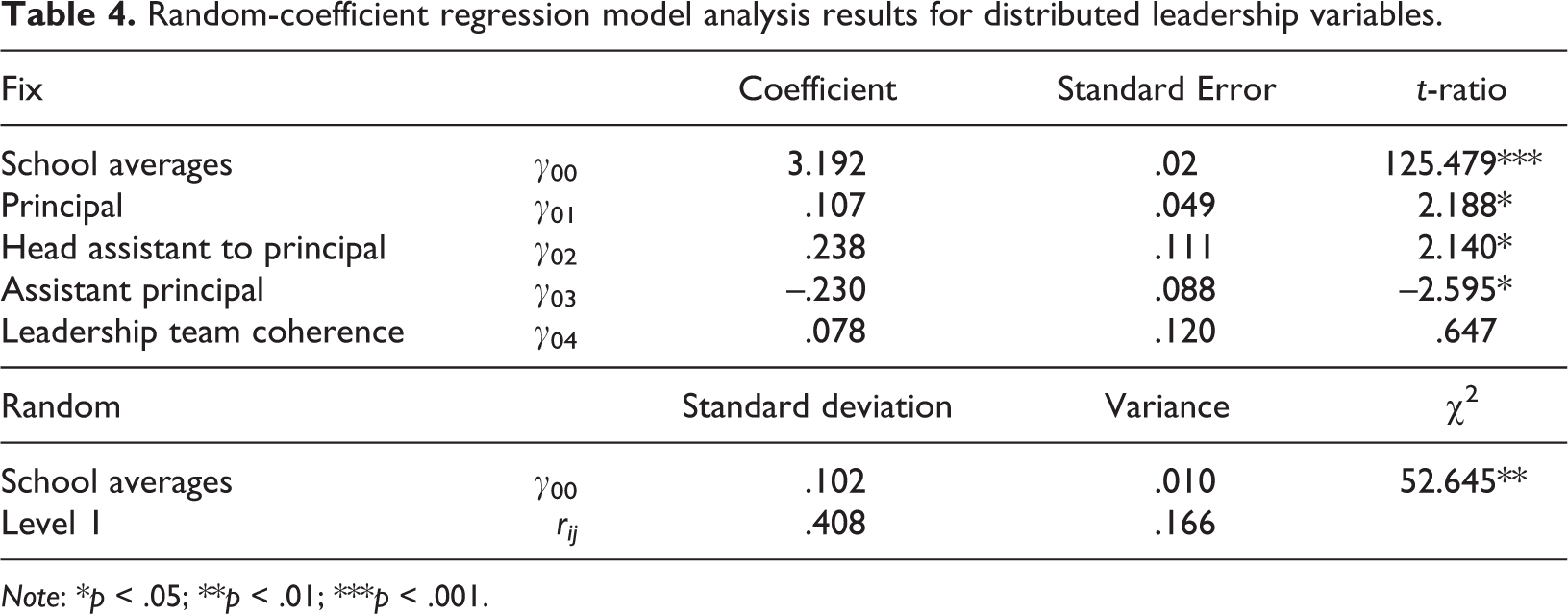
The intra-class correlation coefficients support the usage of two-level HLMs in the scope of the research. The difference between the PCs of the teachers from the average of inter-school variance is estimated as .167. The statistical significance of the estimated value of the inter-school variance indicates that there are differences in the PCs of the teachers inter-school (p < .001). In other words, estimated variance is the evidence that indicates that the PCs of teachers are not same in every school. The school level estimation of maximum likelihood of variance component is .017 (χ2 = 74.845, df = 32, p < .001). Random-coefficient regression model analysis results are indicated in Table 4.
Random-coefficient regression model analysis results for distributed leadership variables.
Note: *p < .05; **p < .01; ***p < .001.
According to Table 4, at the first level of the random coefficients model, the average value of intercept correlation on every school interpreted as the PCs of the teachers who work in a school is 3.192. The leadership skills of principal*the PCs of the teachers (γ01); the leadership skills of the head assistant of principal*the PCs of the teachers (γ02); the leadership skills of the assistant principal*the PCs of the teachers (γ03); and the leadership team coherence*the PCs of the teachers (γ04) average values of education coefficients on all schools are respectively estimated as .107, .238, –.230 and .078. In order to determine the variance of the PCs of teachers in which the level the administrators work at in the school predicts the leadership skills, the effect of the leadership skills of the principal, head assistant to principal and assistant principal levels on the PCs of the teachers is statistically found to be significant (p < .05). The effect of leadership team adaptation on the PCs of the teachers of leadership skills levels is not statistically significant (p > .05).
In the first level of the random coefficients, by attaching the adaptation variables between the leadership skills level of the principal, head assistant to the principal and assistant principal as predictor of PC of teachers and leadership team, the intra-school variable coefficient is calculated as .166. This value is quite close to the estimated total deviations of the rate of inter-school at the first level of one-way ANOVA of the random effects model. The variance rate explained in the first level of random coefficients is approximately .06 (τ00/ (τ00+σ2) = .01 / .166 = .056). This value is interpreted that approximately 6% of the differences observed in the PCs of teachers involves the leadership skills of the principal, head assistant to the principal and assistant principal.
In the second level of the random coefficients, the differences variance (uoj) of school averages and general averages is statistically found to be significant (p < .001). This result is an indicator of significant differences among the school averages. When the 95% plausible value range for school averages is calculated, 95% of the school averages are supposed to be between 3.152 and 3.231 points ((γ00±(1.96)(SE) = 3.192 ± (1.96)(.02) = 3.152–3.231). It is found that there are statistically significant differences among the schools with regards to the effects of the leadership skills of the principal, head assistant to the principal and assistant principal on the PCs of the teachers.
However, the effect of the coherence among the leadership team working in the schools on the PCs of the teachers does not differ in the schools (p < .05). The analysis results of the random-coefficients regression model done in order to determine whether gender, age, service period and district of the school are predictors of the PCs of the teachers are indicated in Table 5.
The analysis results of random-coefficients regression model for gender, age, service period and district of the school variables.

Note: *p < .05; **p < .01; ***p < .001.
According to Table 5, gender*PC (γ01), age*PC (γ02), service period* PC (γ03) and district of the school* PC (γ04) slope coefficients are respectively estimated according to the schools where teachers work as .037, .052, –.046 and .013.
While the age and service period variables that are added to the model in order to analyse the effects arising from the personal differences on the PCs of the teachers are found to be statistically significant (p < .05); gender and the district of the school are not found to be statistically significant (p > .05). In the first level of the random-coefficient regression model, by adding the gender, age, service period and district of school variables as the predictor of the PCs of teachers, the intra-school variable is calculated as .166. In the second level of the random-coefficients regression model, the differences variance (uoj) of the adjusted PCs of the teachers to general average is found to be statistically significant (p < .001). This result may be interpreted that there are significant differences among the adjusted school averages. The effect of the ages and service periods of the teacher’s variables in the model on the PCs is found to be statistically significant (p < .001). This result is interpreted that as long as the ages and service periods of the teachers increase, PCs have scope to increase. There is a statistically insignificant relation among the gender and district of schools and the PCs of teachers. This result indicates that the effect of the gender and district of the schools on PCs does not change for schools.
For comparing the different significance degrees of the variables, standard regression coefficients are calculated. Coefficients are indicated in Table 6.
Standardized regression coefficients of the significant predictors.
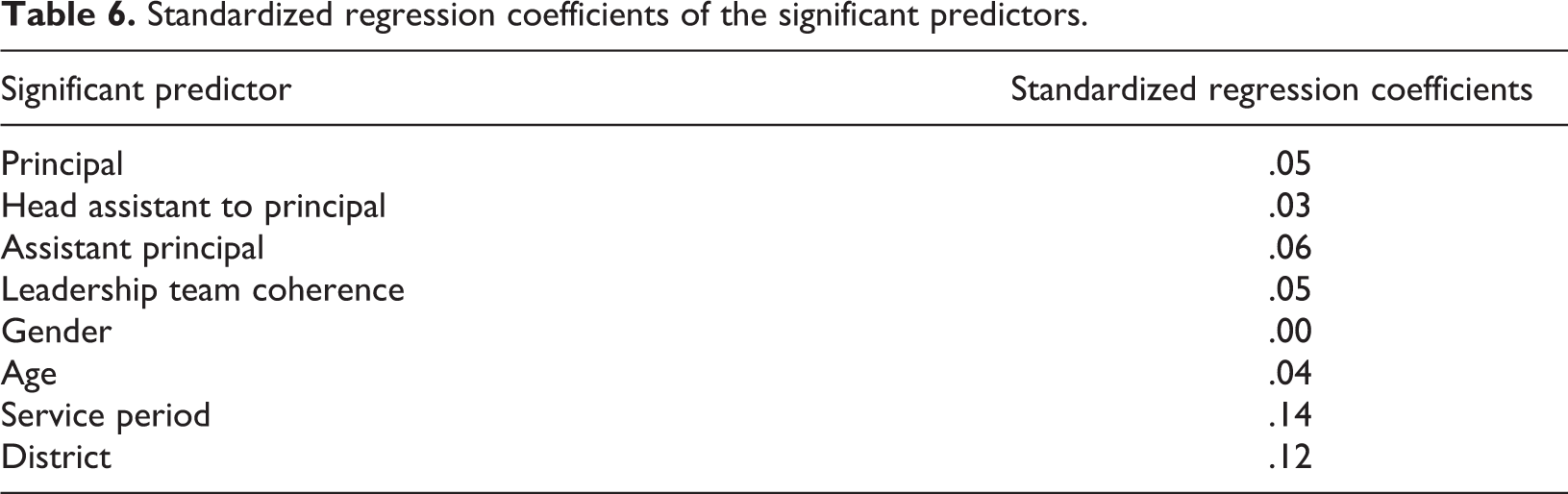
When Table 6 is analysed, it is seen that standard regression coefficients have values between .00 and .14. However, the leadership skill of the assistant principal is the most powerful predictor of the PCs of teachers. When the gender, age, service period and township of the school variables are compared, the most determinative variable of PCs of the teachers is service period. Gender has no effect on the PCs of the teachers.
Discussion
In previous researches, it was determined that the PC has relationships with, generally, the organizational commitment, job satisfaction and organizational citizenship behaviours of the employees (Karcıoğlu and Türker, 2010; McDonald and Makin, 2000; Turnley et al., 2003). In this research, we looked at the relative effect of the leadership process on the PC of the teachers who work in schools in Turkey. In the literature, leadership in educational organizations has traditionally been undertaken under a conceptualization of “solo” leadership (e.g. Bass, 1985; Burns, 1978; Hallinger and Murphy, 1985). In this research, the leadership process is handled from the perspective of DL. Therefore, the relative effects of the leadership skills of the principal, head assistant to the principal and assistant principal who are employed as the official administrators in high schools in Turkey and the coherence level of these administrators on the PC of the teachers who work in these schools are analysed. In addition to this, the relationship between the PC and teachers’ gender, age, service period and the district locations of the schools was considered. Data was obtained from 466 teachers working in 34 general high schools from eight districts in the centre of Ankara, which is the second largest city of Turkey in respect of the population. This data was analysed using a HLM.
We found the PC levels of participants to be at the moderate level. This finding is parallel to the findings of a study of primary school teachers in Turkey by Demirkasımoğlu (2012b). Therein, primary school teachers were seen to have a relatively positive PC with their schools. In terms of the leadership skills of school administrators, we observed that teachers’ consider these to be at a moderate level. This finding supports the research findings of Gümüşeli (1996), who considered the educational leadership behaviours of Turkish school principals who work in schools in Turkey. In this study, it has been indicated that the principals mostly display effective leadership behaviours. Similarly, Balyer and Özcan (2012), in their studies regarding the transformational leadership behaviours of principals, state that teachers found the leadership skills of the principal efficient.
On the other hand, the basic question of this research indicates the relation between the leadership skills of the principal, head assistant to the principal and assistant principal and the coherence level among them and the PC levels of the teachers. The hierarchical linear modelling applied for this purpose has revealed that 10% of the variances in PC specifically arise from within the schools where the teachers work. We found that 90 percent of the variability of PC arises from the personal characteristics of teachers. From this we infer that teachers’ workplaces have limited effect on their PCs. In other words, the PC of the teachers arises from personal characteristics rather than the variables related to school. Thus, it is determined that there is no significant relation between the leadership skills of the school administrators and the PC of the teachers. When these findings are evaluated as a whole, it is understood that the findings are contradictory to the research of Guest and Conway (2004) (cited in Demirkasımoğlu, 2012a: 85). In the aforementioned study, it is determined that efficient leadership is more related to the PC perceptions of the employees then the other variables. The possible reason for this contradictory finding may be the differences between the groups, cultural differences and methodological differences. When the leadership literature is analysed, there are certain views that the effects of the school leadership firstly on the academic success of the students are indirect rather than direct effects (e. g. Bossert et al., 1982; Hallinger and Heck, 1998). According to this view, the effect of the school leadership on school shareholders and students is based on various mediating variables. Witziers et al. (2003) stated that the efficient leadership of the school teacher has a connection between school organization character and educational climate. Therefore, the finding determined that there is not a powerful relation between the PC of teachers and the leadership behaviours of their administrators, and supports the ‘indirect effect’ views that have begun to be accepted in the literature. In other words, certain mediating variables may have roles between the effective leadership skills of the school administer and the PC of the teachers.
Our study determined with hierarchical linear modelling that the leadership skills of the principal, head assistant to the principal and the assistant principal are a significant predictor of the PC of teachers. The analysis results indicate that approximately 6 percent of the variance observed in the PC of the teachers may be explained by the leadership skills of the principal, head assistant to the principal and the assistant principal in the school where the teacher works. This finding is parallel with research indicating the relation between leadership period and certain organizational behaviour types that impact the motivations and morale of employees (e.g. Blase and Blase, 1999; Bossert et al., 1982). However, these studies are based on the solo leadership conceptualization. For this reason we utilized the DL conceptualization to obtain teachers’ perceptions of the administrative triumvirate in Turkish high schools. Our analysis indicates that the leadership skills of each of these three administrators have a partially positive effect on teachers’ PCs.
However, interestingly, the leadership team coherence level is not observed to be a significant predictor of the PC of the teachers. The possible reason for this may be that the administrative power is in the hand of school directors in Turkish schools. According to the regulations, the principal is authorized to overrule the decisions of the head assistant to the principal and the assistant principal. Furthermore, they cannot object to the decisions of the principal. This regulation causes an obligatory coherence among the administration team.
The HLM refers that 90% of the variance in the PC may be explained by the personal characteristics of the teachers. This finding is compatible with the research findings of Hulpia et al. (2011). In the research, which analyses the relation structure between DL and organizational commitment, 91 percent of the variance in the organizational commitment of teachers arises from their personal characteristics. It is observed that the age and working period variables are significant predictors of the PC. Findings indicate that as long as the age and working period increase, the PC level develops. This finding is adaptable to similar research (Karcıoğlu and Türker, 2010; Ng and Feldman, 2009). In the aforementioned studies it is reported that as long as the service periods of the employees increase, the PC level develops. The possible reason for this may be the greater amount of award teachers receive with longer service period of employment (Eichar et al., 1991; Quarstein et al., 1992). Therefore, the psychological commitment to the organization of the employees with this increasing award may have an increasing tendency. However, we found in our research that the PC of participants does not differ according to their gender. This finding contradicts the findings of Karcıoğlu and Türker (2010), on employees who work in health organizations in Turkey, who determined that males have more PC in their working places than female employees. However, our finding that the gender variable has no effect on the PC conforms with an earlier study on health sector employees by Mimaroğlu (2008).
Our analysis indicates that the independent variables of the research (leadership and contextual variables) are more or less the significant predictors of the PC. We found that the maximum effect on the PC is based on the service period. Among the leadership variables, the leadership behaviours of the assistant principal were found to have the maximum effect on the PC. The assistantship to the principal is evaluated as a first step of passing from administration to leadership (Weller and Weller, 2002). The possible effect of the relative effect of leadership behaviours of the assistant principal in Turkish schools on the PC of the teachers may be the organizational relation between the assistant principal and the teachers. Previous studies have determined that assistant principals comprehend their duties principally on the basis of mutual respect and partnership sense, and have qualified relations with other school employees (Marshall et al., 1996). In accordance with the regulations in Turkish high schools, the first administrative position a teacher can be appointed to is the post of assistant to the principal. However, assistant principals are typically not authorized to register or discipline teachers. Thus, it has been determined that assistantship to the principal is rarely perceived as a powerful status indicator in schools (Marshall, 1992). However, assistant principals in Turkish schools carry out their daily routines by cooperating with teachers. During this cooperation process, between the teachers and the assistant principal the horizontal organizational communication type is efficient rather than the vertical one. Hence, the assistant principal tends to practice interpersonal relations rather than bureaucratic relations with teaching staff. However, the principal exercises authority over the teachers in the framework of restrictive bureaucratic traditions. In other words, the principal has the potential to control the behaviours of teachers by means of power sources, such as legal, compulsive, award, charisma and expertise (Sezgin and Koşar, 2010). This may bring a more bureaucratic and stricter relation between principals and teachers. Given the bureaucratic centralist structure in Turkish schools (Özdemir, 2009), principals predominantly prefer vertical communication in their relations with teachers. This may explain why the effect of the principal on the PC of the teachers is relatively less than the effect of the assistant principal.
Result and suggestions
This research found that in Turkish schools with centralized management characteristics, there is generally a significant but minimal effect of distribution of leadership among school administrators on the PCs of teachers. The maximum effect on the PC is the effect of service period, with teachers’ PC seen to increase with length of service. Gender differences and the locations of schools are not seen to be related to the PC.
Based on these general results and the limited nature of the research, certain suggestions are put forward. Firstly, the research findings support reforms that would decentralize the Turkish education system in harmony with the general tendency. Within the context of school-based administration, school organization should be given the authority of making and applying decisions. Instead of the ‘principal-centred’ administration approach, participative administrative structuring in which teachers, parents and students will be involved should be accepted in Turkish schools. All shareholders, principally the teachers, should be strengthened in line with this general tendency. The leadership process should therefore be shared and distributed among the stakeholders of the school.
This research was carried out in Ankara, the second largest city of Turkey. More extensive studies, which cover the whole country, may be carried out. Issues of at what level leadership is required at all the levels of the Turkish education system, which has bureaucratic-centralized characteristics related to distribution of leadership, should be analysed. In this respect, the MNE central organization, provincial and district organizations should be analysed related to DL within the scope of analysis unit. Correspondingly, by setting qualitative methods and techniques to work, more detailed research should be undertaken with upper, middle and lower level administers and employees who work in the system. In this study, the PC is analysed as a dependent variable. Apart from that, the relations of job satisfaction, burnout, conflict and similar organizational behaviours with the distribution of leadership should be examined. The effect of distribution of leadership in schools on the academic success of students may also be analysed. Also the relative effect of distribution of leadership on school organization on the efficiency of a school may be analysed.
Footnotes
Funding
This research received no specific grant from any funding agency in the public, commercial or not-for-profit sectors.