




Abstract
This paper addresses if, and to what extent, the current working methods of the Dutch Inspectorate of Education affect the governance of school boards in schools for primary education. A key facet of the working method is the inspection meeting with the school board. Drawing upon a large quantitative study (n = 244) we are able to identify some changes in school board governance due to these inspection meetings. School boards that had an inspection meeting indicate changes in their governance of quality assurance and data use, and in the amount of data that they collect on the functioning of their schools. School boards indicate very small amounts of activities with regard to the curriculum and instruction in their schools.
Introduction
In many countries intensive debates are held on the best approach to improve schools (Martin, 2008; McNamara and O’Hara, 2005). External inspections are often looked upon as promising instruments for controlling and promoting the quality of schools. The expectations that inspectorates set through inspection standards and procedures, the feedback provided to schools as a result of assessments of the quality of education, and the consequences for failing schools, are expected to promote school improvement (Ehren et al., 2013). Over the last decade inspection arrangements have changed dramatically as many countries face challenges that stem from current policy directions (Black and Baldwin, 2010). In the Netherlands for example, the working methods of the Dutch Inspectorate of Education have changed significantly since 2003. Since that date there has been a stronger emphasis on the effectiveness of inspections, a stronger focus on outcomes of schools, and a government-wide drive to reduce the overall administrative burden of schools (Ehren and Honingh, 2011). The Inspectorate of Education was encouraged and expected to apply methods that were both more cost-effective and aligned to the roles and responsibilities of school boards.
As a result, the Inspectorate of Education now uses risk-based school inspections to evaluate schools’ performance on the inspection framework. The Inspectorate carries out early warning analyses, using information such as student achievement results on standardized tests and school documents, to identify possible risks of low educational quality in schools. Schools with no risks are not scheduled for inspection visits or monitoring, whereas schools that show risks receive additional inspection monitoring and interventions. Additional monitoring includes desk research upon additional student achievement results and school documents (for example, test scores in intermediate grades or annual reports), interviews with the school board and, potentially, inspection visits to the school to assess educational quality in the school as sufficient, failing or highly under-developed.
School boards in the Netherlands have a statutory responsibility for the quality and improvement of their school and this is coupled with a broader societal expectation that they will attend to these issues. As a result of this they have become the primary point of contact for the Dutch Inspectorate of Education. The Inspectorate of Education requires school boards to provide a range of information on the quality of their school(s) to inform the early warning analyses, which must include student assessment data, and uses these to identify schools that are potentially at risk of falling below what has been identified as being acceptable in terms of educational quality. School boards are scheduled for inspection meetings when one or more of their schools shows potentially failing quality, and they then have to formulate an improvement plan for their failing school(s), which is monitored by the Inspectorate of Education. These meetings, information requests and monitoring activities are expected to motivate school boards to improve the governance, and ultimately the quality, of their schools (Inspectorate of Education, 2010; Ehren and Honingh, 2011).
This new approach represents a decisive break from the past, when the Dutch inspection system primarily involved inspection visits of schools, and discussion of inspection assessments and consequences of assessments with school principals. Underlying this new approach is the assumption that school boards are responsible for, and best equipped to improve, failing schools.
Currently, it is unclear whether this change in focus from inspections of schools towards inspections of school boards, and in particular the inspection meetings with school boards, are effective in improving education. The underlying rationale is that this approach will improve the boards’ governance in the area of educational quality, which will then lead to the improvement of their schools. In particular, available research provides evidence about the impact of school inspection visits of schools, where inspectors observe teaching, hold interviews with school staff, analyse documents and feed back their assessment and suggestions for improvement to the principal and/or school staff. A recent literature review by Klerks (2013) shows plausible connections between this inspection model and school improvement (e.g. behavioural change among teachers, school improvement and student achievement results), while also leading to unintended consequences, such as excessive bureaucracy and teaching to the test. There is no evidence about the impact of school inspections (in particular, inspection meetings with school boards, and feedback to school boards) on how school boards govern their schools.
This paper contributes to this knowledge base by analysing if, and how, the change in inspection methods (from inspection visits to schools, to visits to school boards) leads to a change in how school boards govern their schools. We will, in particular, compare the changes that school boards that have had an inspection meeting make in how they govern their schools (e.g. increasing their focus on the educational quality and improvement of their schools), compared to school boards that have not had such a meeting yet: What is the impact of school inspections on the governance of school boards? Are school boards changing their governance of schools as a result of meeting with school inspectors? Which types of school boards (according to the number of schools they govern) change their governance as a result of school inspection meetings or feedback?
The section below firstly outlines the functions and roles of Dutch school boards in the governance of their schools and how their governance of schools is expected to change as a result of changes in the methods of the Inspectorate of Education. We will draw on Ehren and Honingh’s (2011) reconstruction of the programme theory of the re-enacted Supervision Act of 2011 to describe the expectations about how school boards should be inspected, the effect that such inspections are expected to have, and how these effects should be realized. The assumptions in this programme theory guide our literature review, which will be used to describe the characteristics of effective school boards in governing and improving the educational quality of their schools. These characteristics are then used to present our results and provide answers to the questions posed above.
Describing the Dutch context: School boards and inspections of school boards
Primary education in the Netherlands consists of eight years of education, from the age of four until the age of twelve (grade 1 to grade 8). Primary schools include public and private schools. Public schools are open to all children regardless of religion or world view and are generally subject to public law. They provide education on behalf of the state and are governed by the municipal council (or a governing committee), a public legal entity or a foundation set up by the council. Privately run schools can refuse admittance to pupils whose parents do not subscribe to the belief or ideology of the school. They are subject to private law and can be government funded, even though they have not been founded by the state. Private schools are governed by the board of the founding association (e.g. a church or parents’ association). Teaching is based on religious or ideological beliefs, and this category includes Catholic, Protestant, Jewish, Muslim, Hindu and anthroposophic schools. Both public and private schools may subscribe to specific teaching ideologies, such as Steiner, Montessori, Dalton, Freinet or the Jena Plan method. Both public and private schools are free to organize teaching, and can decide what they teach and how. The Ministry of Education, Culture and Science sets quality standards that apply to both public and private education. Publicly and privately run schools are also financed in the same way by the Ministry of Education, Culture and Science, and evaluated in the same way by the Inspectorate.
Both public and private schools have a high level of autonomy, working within the framework set by central government (attainment targets, examination requirements, etc.) Schools are fully responsible for the organization of teaching and learning, personnel and materials. Since 2006, they receive an annual budget as block grant funding. Schools are free to decide how the budget is spent and are responsible for the quality of education provided.
School board members in the Netherlands function as trustees rather than as representatives. The voluntary governors (laypersons receiving an honorarium) are appointed by co-optation, and the professional governors (receiving a salary) are appointed by the supervisory board.
Almost half of the school boards in primary education (46%) govern just one school, one-third (34%) govern 2–10 schools and one-fifth (20%) govern more than 10 schools. (Center on International Education Benchmarking, 2014).
School boards are responsible for the school’s strategic direction and educational quality, providing an accountability structure that addresses the needs of the school’s stakeholders and local community. In addition, they monitor and evaluate the school’s progress, and support and challenge improvement processes at all levels of the organization. They are expected to take on a range of responsibilities that are distinct from the more managerial and leadership role of the school leader and school management team in the school. The latter are expected to take on the operational leadership of the school within the strategic agenda set by the school board. The school board hires the school’s managerial staff and makes decisions about the school’s management alongside the principals (see Center on International Education Benchmarking, 2014).
Although Dutch school boards are still often seen as being prime exemplars of independent institutions (see Honingh and Hooge, 2009), recent legislative changes may have decreased their autonomy. The 2010 legislation entitled ‘Good Governance, Good Education’ not only requires schools to arrange for internal supervision and to implement a code of conduct, but also to have stronger internal control mechanisms, and meet requirements on minimum student achievement levels and school governance. Moreover, these legislative changes reveal significant alterations in the Dutch Department of Education’s philosophy and theory of action on governance of schools, school boards; and the Inspectorate of Education in controlling, monitoring and improving schools (see Ehren and Honingh, 2011: 242).
Such a change in the theory of action on governance in schools and the role of school boards also implies a change in the role of the Inspectorate. External supervision by the Inspectorate of Education should, according to Smeets and Verkroost (2011) and Janssens and De Wolf (2009), act in conjunction with governance within schools in a complementary and non-repetitive manner. School boards are expected to take on the main responsibility for assuring and overseeing the quality of schools, while school inspections act as a final check.
Smeets and Verkroost (2011) and Janssens and De Wolf (2009) describe the current working methods of the Inspectorate of Education, which seeks to provide such a check. These include annual early warning analyses in which information is collected on possible risks of low educational quality in all schools. The type of information gathered includes student achievement results on standardized tests, self-evaluation reports and financial reports of schools, complaints by parents and news items in the media. Despite the broad range of data collected, the results achieved by students in grade 8 of primary education (corrected for the socio-economic background of students) on the national standardized Cito test 1 is the primary indicator used in these early warning analyses. In the event of this process pointing to potential problems, an inspection meeting with the school board is scheduled. Potential risks are discussed during this interview, as well as the capacity of the school board to address and solve these risks. In the event of this interview failing to provide the Inspectorate of Education with sufficient information, or if in their judgement the school board is not capable of addressing the issues raised, an additional inspection visit is arranged. This subsequent visit makes use of an agreed inspection framework that categorizes schools as being either sufficient, failing or highly under-developed. The latter two categories have significant consequences and will be discussed below.
Schools that are evaluated as failing or highly under-developed are scheduled for additional inspection activities. The Inspectorate of Education instructs the school board to formulate a plan of approach aimed at improving quality. The Inspectorate examines the plan of approach and lays down performance agreements in an inspection plan. This plan specifies a timeframe within which quality improvements must be made and outlines a series of (interim) results that the school must attain. The process also involves a number of additional inspection visits and the plan specifies the indicators that the Inspectorate of Education will assess in the course of these (interim) visits. The school board must commit to the inspection plan. Failing schools that do not improve within two years are put under a special regime designed specifically for schools identified as being highly under-developed. School boards of highly under-developed schools have to meet with the board of directors of the Inspectorate of Education and may receive an official warning. If these activities do not yield the results agreed upon, the Inspectorate will report the highly under-developed school to the Minister, along with a proposal for initiating sanctions. On the basis of this report, the Minister may withdraw (part of) the school’s funding, which will ultimately result in closure of the school.
The theoretical framework: School inspections and effective school boards
Ehren and Honingh (2011) describe the programme theory of the revised Supervision Act in the Netherlands. The programme theory includes assumptions of the Inspectorate of Education and the Department of Education about how schools and school boards should be inspected, the effect that such inspections are expected to have, and how these effects should be realized. The assumptions on the working methods and intended effects on school boards will be summarized briefly here to inform our theoretical framework; a literature review will be used to elaborate on the key variables and mechanisms in this programme theory.
According to Ehren and Honingh (2011), one of the main goals of school inspections, after the revision of the Supervision Act, is to change school boards’ governance of their schools, which should ultimately lead to good education. Good education is described as ‘ensuring that all students have the opportunity to achieve their academic potential’.
The Inspectorate of Education uses the method of risk-based school inspections to evaluate schools’ performance on the inspection framework. The Inspectorate of Education requests school boards to send in information about the quality of their school(s), such as student achievement results for standardized tests and school documents. This information is used in an early warning analysis to identify high-risk schools. School boards of these schools are scheduled for inspection meetings in which the functioning of their schools is discussed and feedback is provided on how the school board can improve their governance of these schools. These meetings may lead to additional monitoring activities, such as desk research upon additional student achievement results and school documents (for example, test scores in intermediate grades or annual reports), and, potentially, inspection visits where the inspection framework is used to assess educational quality in the school as sufficient, failing or highly under-developed.
A failing or highly under-developed school is scheduled for an additional intervention where the school board has to formulate a plan of approach aimed at improving quality. The inspectorate monitors the implementation of this plan. In a case where the school does not improve, sanctions may be enacted against the school board, such as official warnings or administrative and/or financial sanctions.
The Dutch Inspectorate of Education does not define or evaluate the quality and effectiveness of school boards in itself, but expects these working methods to make school boards more effective in monitoring and improving the quality of their schools. As the Inspectorate of Education requests the school boards to provide information about the quality of their schools, school boards are expected to implement quality assurance systems in their schools that enable them to provide such information. These quality assurance systems are expected to support the improvement of educational quality in schools and to prevent schools from failing. The inspection meetings with school boards and the feedback provided to them should lead to a change in paradigm, where school boards not only govern administrative and financial issues in their schools, but also focus on improvement of educational quality.
Inspection assumptions such as those mentioned above, relating to the development of quality in schools and improvement of quality standards as part of a process of ‘making a difference’, can to an extent be linked to school effectiveness literature (see Thrupp, 1998). School effectiveness literature describes the standards of educational quality that have an effect on student achievement as well as how the input – e.g. students and their socio-economic backgrounds – and external context of the school – such as educational policy or in this case the governance of school boards – have an impact on achievement. These studies are relevant when considering the likelihood of inspection meetings with school boards resulting in the improvement of school board governance and ultimately facilitating quality improvement of schools.
Available school effectiveness studies indicate that school boards primarily have an indirect influence on improvement of schools through their impact on, and provision of, leadership in schools, and through changes in the structures and culture of the school that they institute (Claassen et al., 2008; Hofman et al., 2002; Land, 2002; Saatcioglu et al., 2011). Saatcioglu et al. (2011) describe how school boards’ policies, decisions and activities lead to changes in the school organization and, as such, ‘trickle down’ to the classroom level, ultimately impacting on the interaction between teachers and students. In particular, school boards that focus on improvement of student achievement and educational quality have been shown to have a (modest but significant) effect (Land, 2002; Plough, 2011; Ranson et al., 2005).
Such a focus on student achievement and educational quality is, however, not particularly evident in the Netherlands (Hooge and Honingh, 2014). A study by Claassen et al. (2008) indicated that school boards were often not aware of low student achievement levels in their schools and were informed of such problems by the Inspectorate of Education. School boardstake care of operational issues, in particular those related to human resources and financial management.
The introduction of inspection meetings with school boards (instead of school principals) in 2007 aimed to change this situation.
The available literature about the effectiveness of inspections provides remarkable little evidence to either support or reject these claims about the effects of inspections on school board governance. This is in strong contrast with the considerable literature base about the effects of education inspections on teachers, pupils’ achievements and school improvement. The outcomes of a recent literature review by Klerks (2013), see also Ehren and Visscher (2008), summarizes these effects and indicates plausible connections between inspection and school improvement and behavioural change among teachers. Inspection feedback to schools and teachers has led to improved teaching, and schools have been known to use the inspection feedback and framework for their school’s own self-evaluation and improvement.
In line with these results one would also expect school inspections in the Netherlands to have an impact on school boards. Although these effects have not been studied, available studies on the characteristics of effective school boards provide us with useful indicators of effective school board governance and school board behaviour that can be used to study such potential effects. In addition to research from the Netherlands, we will in particular draw from research in the US to describe such characteristics; this literature best reflects the context in which school boards in the Netherlands function and the responsibilities and powers they have: A large focus on student achievement data in the external accountability of schools, requirements for minimum student achievement results from schools; The (autonomous) role of school boards in ensuring such student achievement levels in their schools through the use of data to monitor and improve schools within a setting of national testing and performance standards (see Ehren and Honingh, 2011).
Relevant studies on effective school boards are described below.
Effective school boards
Reviewing the American and Dutch literature of effective school boards, Land (2002) shows that school boards have traditionally only focused on financial, legal and constituency issues, while they left the responsibility for students’ academic achievement to their administrators and educators. Only recently have school boards run the risk of being judged ineffective when they fail to develop policies and support programmes explicitly designed to improve students’ academic achievement, oversee and evaluate the implementation and performance of these policies and programmes, and demonstrate improved and/or high academic achievement.
According to Stringfield (2002), describing effective school boards (those that impact student achievement) involves evaluating virtually all functions of a board, from internal governance and policy formulation to communication with teachers, administrators and the public.
Available studies on effectiveness of school boards (e.g. Hofman, 1995; Land, 2002) compare high-achieving to low-achieving boards and point to markedly different habits and characteristics between the two, such as the extent to which school boards engage in goal setting and monitoring progress, their ‘data savviness’ in identifying students’ needs and justifying decisions based on data, their detailed knowledge of the district, including initiatives to jump-start success, and the working relationships with superintendents, teachers and administrators based on mutual respect, collegiality and a joint commitment to student success. School boards are advised to establish a vision for educational excellence, to advocate the vision inside and outside of the school system, to provide the resources and structures necessary to achieve this vision, and to hold programmes and people accountable for academic achievement of students.
Descriptions of effective school boards can be found in a number of studies and generally include the following characteristics (Hofman, 1995, Land, 2002, Stringfield, 2002): Commitment to a clear and shared vision and goals for student achievement and quality instruction that trickle down to the classroom. The school board should ensure that goals on student achievement include specific targets and benchmarks, and are the top priority in all schools without the distraction of other goals and initiatives. Professional development and other resources are aligned to meeting these goals, and the school board continuously monitors progress towards these goals without micro-managing schools and only spending a small amount of time on day-to-day operational issues. High priorities are supported, even during times of fiscal uncertainty.
Effective use of data. High-quality school boards are ‘data savvy’; they monitor data and use it to drive continuous improvement, even when the information is negative. They analyse and discuss trends on dropout rates, test scores and student needs, often on a monthly basis, to identify specific student needs and justify decisions based on that data, without ascribing blame or eliciting emotional responses.
Strong accountability and transparent evaluation. School boards evaluate and hold their principals accountable on shared goals, mutually agreed upon procedures and the progress of students. They support decisions that enhance improvement of student achievement rather than the daily management of the school.
Collaborative relationships and mutual trust with staff and the community. Effective school boards have a trusting and collaborative relationship with their principals and engage in a collegial policy-making process that emphasizes the need to find solutions and develop consensus among board members and other leaders on the identification and implementation of improvement strategies. They establish a strong communications structure to inform and engage both internal and external stakeholders in setting and achieving district goals, to receive information from many sources (e.g. principal, teachers and outside sources), and to share findings among all board members and to communicate actions and goals to staff. According to Hofman et al (2002), coherence between school governors, school leaders, teachers and the school community (parents) produces a sense of community that, in turn, shapes conditions in schools that have a positive effect on pupil achievement.
Political and organizational stability. Choices on goals and resources remain stable over longer periods of time, and school boards and principals have long-term service records, meeting goals and aligning resources to these goals, showing stability in the governance of schools. There is a low turnover rate and school board members and principals have long tenures, which is sustained by regular retreats for evaluation and goal-setting purposes.
School boards’ governance of successful or failing schools
The literature review above summarizes a set of common characteristics of effective school boards. Carver and Carver (2001) and Mordaunt and Cornforth (2004), however, point out that effective school boards align their expectations, their role and their choice of actions to the specific circumstances of their schools. These authors describe how school boards should fit their theory of action to the performance of their schools. School boards with successful schools can, for example, use routine operating policies to maintain stability and incremental improvement, whereas school boards with failing schools need to turnaround organizational failure and implement reform policies to drive change.
School boards with successful schools can stick to incremental improvements in the status quo of their schools; they do not need to implement fundamental changes and can primarily govern their schools for oversight (McAdams, 2006). Their practice of effective management and governance of their schools (which is framed as performance management/empowerment) includes activities such as hiring and evaluating principals, setting goals, building collaborative relationships, promoting a positive climate, approving policies and overseeing management.
School boards with failing schools, on the other hand, need to identify the types of failure and their causes, and need to align their reform policy to each failing school’s specific stage of turnaround (McAdams, 2006; Mordaunt and Cornforth, 2004). Mordaunt and Cornforth (2004) describe how school boards that have undertaken successful turnarounds, often take on a very hands-on approach, for short periods of time, sometimes taking over aspects of the management in failing schools. Such a reform strategy is framed by McAdams (2006) as ‘managed instruction’. In this case, school boards directly manage instruction, using the same comprehensive and aligned curriculum in all failing schools, and making sure that all teachers know how to teach it. Building on content and performance standards, school boards choose a tightly coupled instructional–management system in which they construct a coherent and aligned curriculum that covers every subject for every grade that is detailed down to individual lesson plans, teaching materials and sample assessments, which are available to teachers. Teaching is continually monitored and a comprehensive student information-management system, including frequent formative assessments to track student performance, is implemented. This theory of action requires significant resources for curriculum development, professional development, a student information-management system, strong instructional leadership from administrators and great sensitivity to the needs of teachers.
Since 2007, the Dutch Inspectorate of Education has prioritized the scheduling of meetings with the school boards of (potentially) failing schools. These school boards are expected to improve the quality of their schools as a result of these meetings. From the literature review above we expect these school boards to use an approach of ‘managed instruction’ to reform failing schools and to meet inspection expectations and feedback. School boards that did not have an inspection meeting receive no feedback about failing schools and are therefore not expected to manage the instruction in their schools. In our study, managed instruction was measured through a set of variables on the extent to which school boards (both the one that had an inspection meeting and those that did not) changed their governance of instructional time, curriculum and instruction, and professional development of school staff in their schools.
Summary
The conceptual model for our study firstly includes the inspection assumptions on how meetings with, and feedback to, school boards are expected to lead to the implementation and improvement of quality assurance of their schools and improvement of education quality in their schools. The literature on effective school board governance outlined the type of activities that school boards should undertake to meet these expectations. They should commit to a clear and shared vision and orientation on student achievement, which should be supported by effective use of student achievement data to monitor and drive improvement in their schools. School boards should monitor quality and achievement of these goals and hold principals accountable for achieving these goals. They should work collaboratively with staff and the school’s community in improving student achievement and communicating about actions and goals in a stable setting.
The literature additionally outlines the strategies that school boards should put in place if they have many failing schools. They should choose a more hands-on approach where they closely manage the instruction in their schools. Such school boards are expected to use a turnaround strategy where they develop and implement standards-based curricula, assessments and lesson plans across their schools, and invest in professional development of school staff to improve their teaching.
These indicators of effective school governance were used to detail the inspection assumptions on expected changes and outcomes of inspection meetings and feedback. Inspection meetings with, and feedback to school boards are expected to lead to more effective school board governance through the preparation of school boards for these meetings where they use (student achievement) data to monitor and improve teaching in their schools, and implement quality assurance systems to collect information about quality of their schools. The feedback to school boards with failing schools should additionally lead to an increase in the governance of the curriculum and instruction in the school and the professional development of school staff. Figure 1 provides a summary.
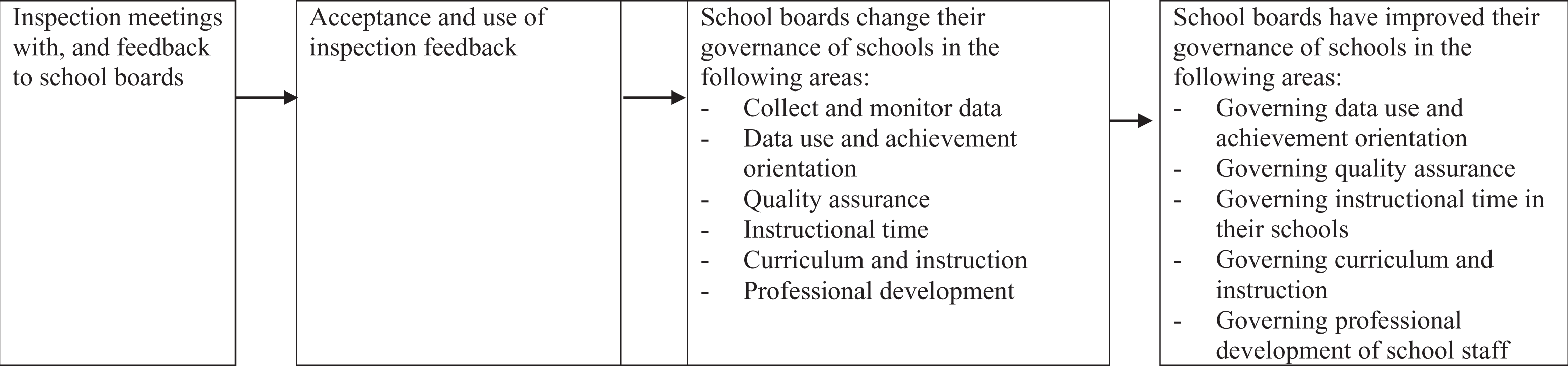
Theoretical framework of school inspections changing school board governance.
Method
We used an online survey of all school boards in primary education to explore how school boards govern their schools, and if and how they change their governance of schools as a result of meetings with school inspectors.
Selection of school boards
Our online survey was sent to all school boards in primary education in 2011; 244 school boards (20%) participated in the survey. Table 1 provides an overview of the school boards participating in our study compared to the entire population of school boards. The results indicate that a relatively limited number of small school boards (governing only one school) responded to our survey, while large school boards (11–20 schools) were over-represented.
Selection of school boards in primary education according to size of portfolio.

The inspectorate started to have meetings with school boards from 2007 onwards. We sent our survey to all school boards in primary education, regardless of whether they had had an inspection visit or not. According to the Inspectorate of Education (personal communication), the first schedule of meetings included, in particular, school boards with relatively large numbers of potentially failing schools. The second round of meetings included a wider range of school boards. Large school boards are also prioritized in the inspection schedule to have annual meetings with the Inspectorate of Education.
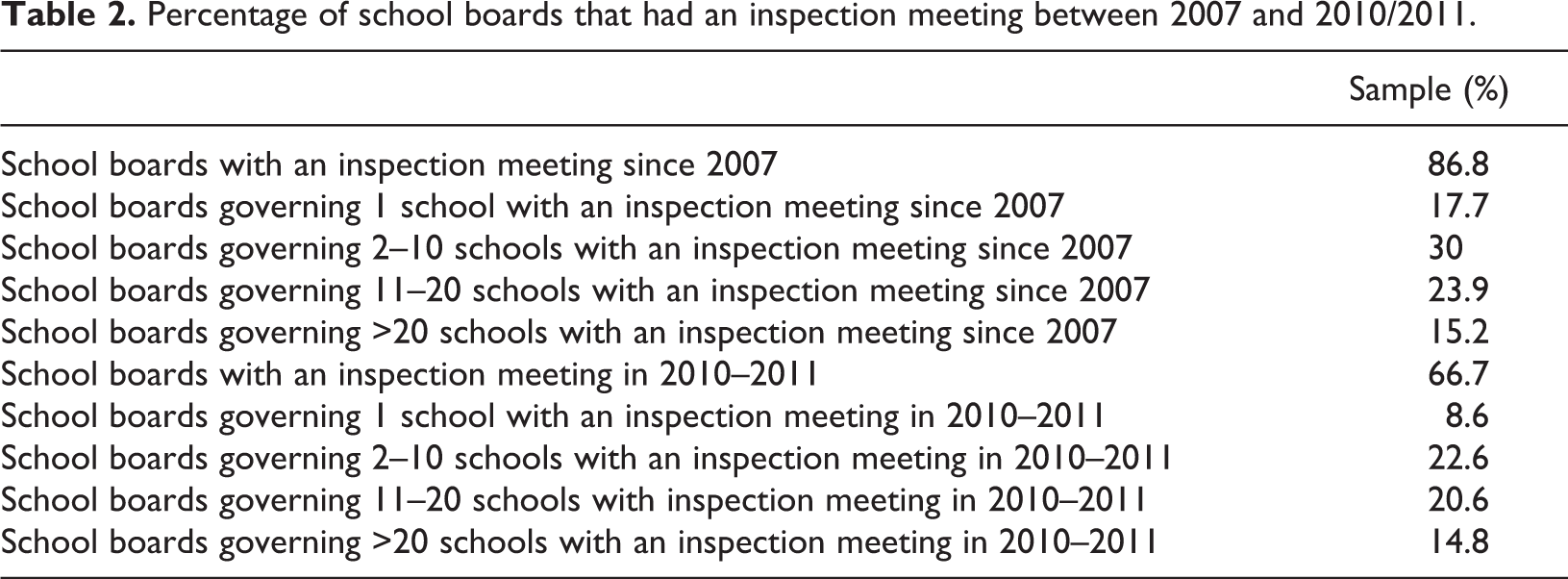
Table 2 shows that (in 2011) almost all school boards (87%) in our sample have had a meeting with the Inspectorate of Education since the implementation of inspection meetings with school boards in 2007. Approximately 67% of the school boards in our survey had a meeting with a school inspector in the year prior to our survey (2010–2011). This may have been their first meeting, but it may also have been a second or third meeting.
Percentage of school boards that had an inspection meeting between 2007 and 2010/2011.
Data collection
The survey included questions on how school boards govern their schools, including the variables in our theoretical framework in Figure 1. We asked school boards how they currently govern their schools, as well as to what extent the inspection meetings and feedback changed their governance of schools. In addition, we questioned school boards about their acceptance and use of inspection feedback. All items were answered on a five-point scale of disagree–agree.
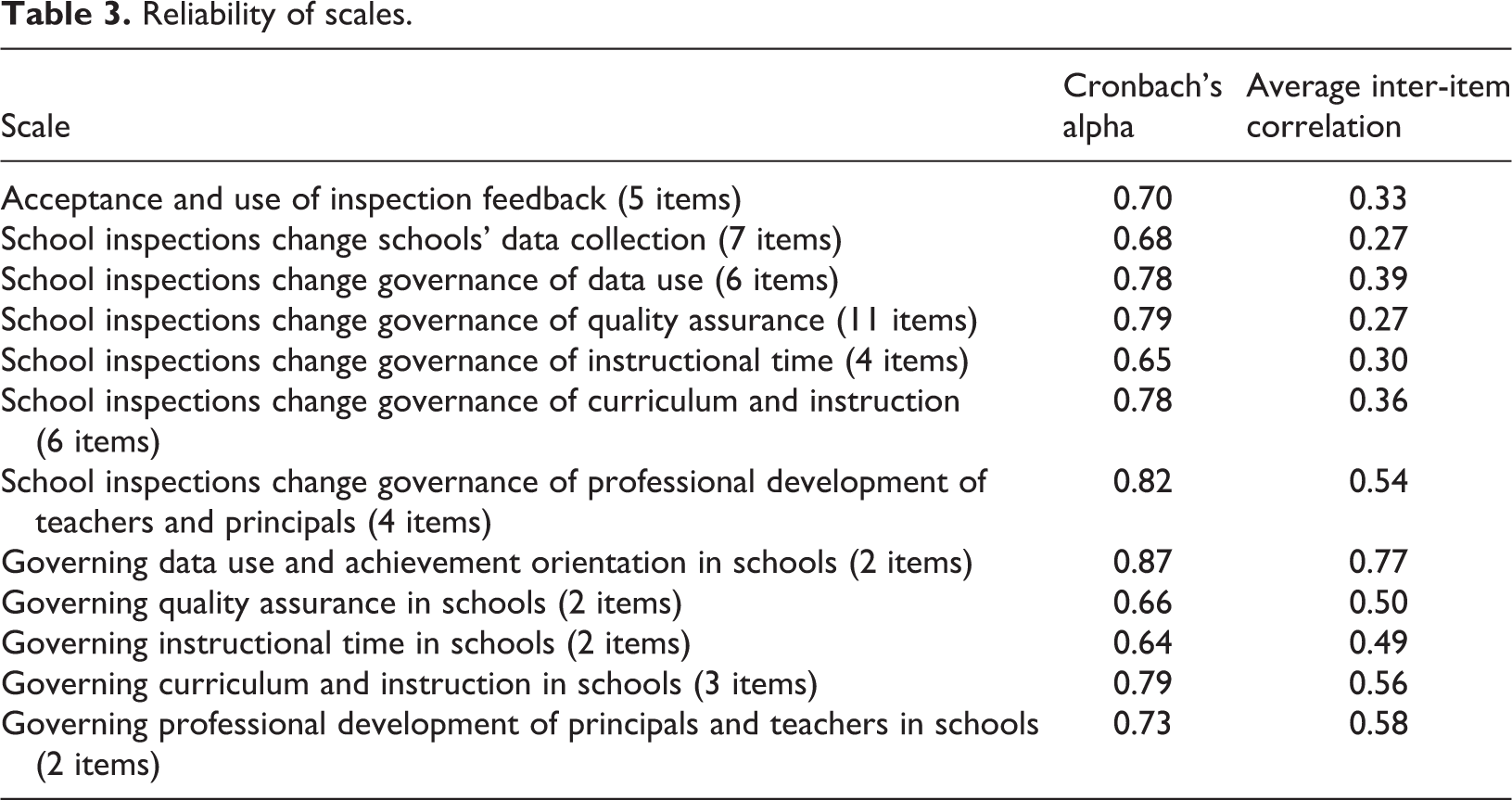
Table 3 shows that all scales have medium to high reliability coefficients and inter-item correlations. The scales of the variables ‘school inspections change governance of quality assurance’, and ‘school inspections change schools’ data collection’ have high reliability coefficients, but relatively low inter-item correlations. As the correlations round off to 0.3 we decided to keep these scales in the analyses.
Reliability of scales.
Data analysis
Data analyses included descriptive statistics, such as percentages, averages and standard deviations of all the variables. Additionally we used t-tests to compare differences between school boards that had received an inspection meeting since 2007 and school boards that had not yet had such a meeting. An ANOVA was used to compare changes in governance of school boards according to their size.
Results
This section firstly describes the actual changes in inspections of school boards and how school boards currently govern their schools. Next, it addresses changes in the governance of schools due to school inspections and whether principals perceive these changes to be related to the timing of the inspection meeting and/or the size of the school board.
Governance of school boards
Table 4 provides an overview of how school boards (2011) govern their schools. We tested whether differences between variables with high and low means are significant by using paired samples t-tests. The results of these t-tests (not included in the table) indicate that school boards govern the professional development of teachers and principals significantly more than the curriculum and instruction in their schools (t = 23, 10; df = 223; p < 0.001). They also report significantly higher levels of governing the quality assurance of their schools, compared to the instructional time in their schools (t = 13, 34; df = 229; p < 0.001).
Describing governance of school boards.

Note: five-point scale where disagree = 1; agree = 5.
We also compared governance styles of school boards according to the number of schools they govern. A distinction was made between small school boards (governing one school), medium-sized school boards (2–10 schools), large (11–20 schools) and super-large school boards (>20 schools). The second column in Table 5 shows whether these four groups differ in their governance of schools and changes in their governance as a result of school inspections; the third column indicates whether these differences are linear and increase according to the size of the school board.
Comparing governance of small/large school boards.

Entries are given in the form where F(dfM, dfR) = F; *p < .05, **p < .01. A negative value for ‘differences in means’ indicates a smaller value for governing in small school boards and a higher value for governing in large school boards.
The results in Table 5 indicate that small school boards govern the instruction time and the curriculum and instruction in schools in their schools to a greater extent than large school boards, while large school boards particularly govern the professional development of principals and teachers.
Changes in governance after school inspections
Table 6 shows the average scores of school boards on questions about their changes in governance, resulting from school inspections. According to school boards, changes in inspection methods particularly affect their governance of data use and achievement orientation in schools, the development of quality assurance and self-evaluations in schools and the information they collect. School inspections do not seem to affect their governance of teaching time, curriculum and instruction in schools. A paired sample t-test indicates that these differences are significant (‘school inspections change schools’ data collection’ versus ‘school inspections change governance of instructional time’: t = 30.24; df = 232; p < 0.001; ‘school inspections change governance of quality assurance in schools’ versus ‘school inspections change governance of curriculum and instruction’: t = 29.37; df = 229; p < 0.001). School boards indicate that they accept and use inspection feedback relatively often.
School boards’ perceptions of changes due to school inspections.

Note: five-point scale where disagree = 1; agree = 5.
In additional we compared school boards that had an inspection meeting since 2007 to school boards that had not yet had such a meeting (see Table 7, column 2). We also compared school boards that had a meeting in 2010–2011 to school boards that had not had a meeting that year (Table 7, column 3). Such a comparison provides insight into whether the timing of the inspection meeting affects the amount of change, and whether the type of changes that school boards implement change over time as the Inspectorate of Education refines their inspection meetings of school boards.
Comparing school boards that had/did not have an inspection meeting since 2007, and since 2010–2011.
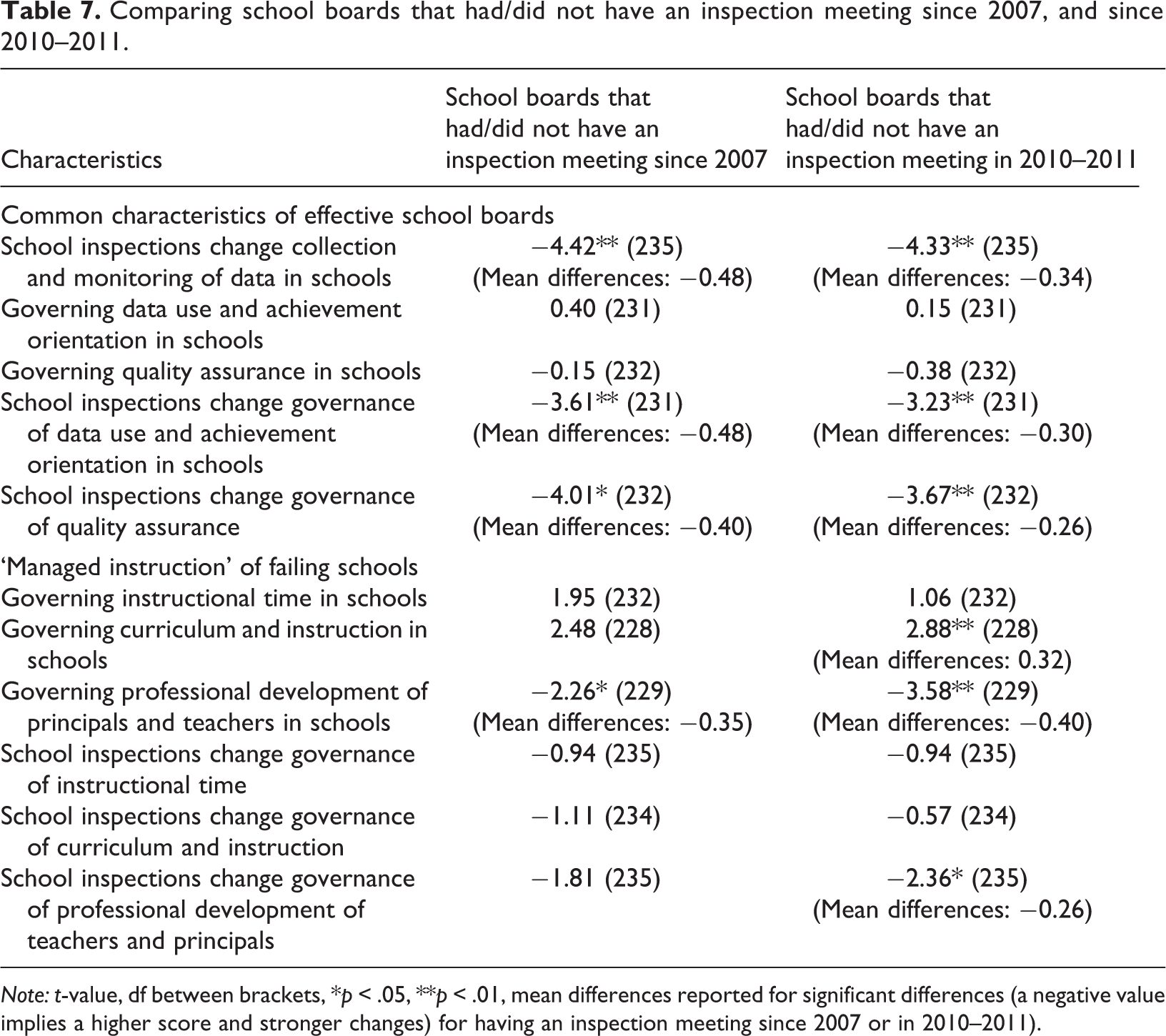
Note: t-value, df between brackets, *p < .05, **p < .01, mean differences reported for significant differences (a negative value implies a higher score and stronger changes) for having an inspection meeting since 2007 or in 2010–2011).
The results in the second column of Table 7 indicate that school boards that had an inspection meeting since 2007 scored higher in the extent to which they collect and monitor data on the functioning of their schools; they also scored higher in their governance of data use and achievement orientation in schools, and in their changes of how they govern the quality assurance in their schools. The third column, comparing school boards that had and did not have an inspection meeting in 2010/2011, confirms these results and additionally indicates a decline in the governance of curriculum and instruction in school boards that had a meeting.
Comparing changes in small/large school boards
Finally we compared small and larger school boards to analyse if they vary in the changes they have made in the governance of their schools. The results in Table 8 indicate significant differences between small and large school boards only in the extent to which they change their governance of data use and achievement orientation, quality assurance and the data they collect in their schools due to school inspections. Large school boards report more changes in their governance of schools compared to small school boards as a result of school inspections.
Comparing changes in governance of small/large school boards due to school inspections.
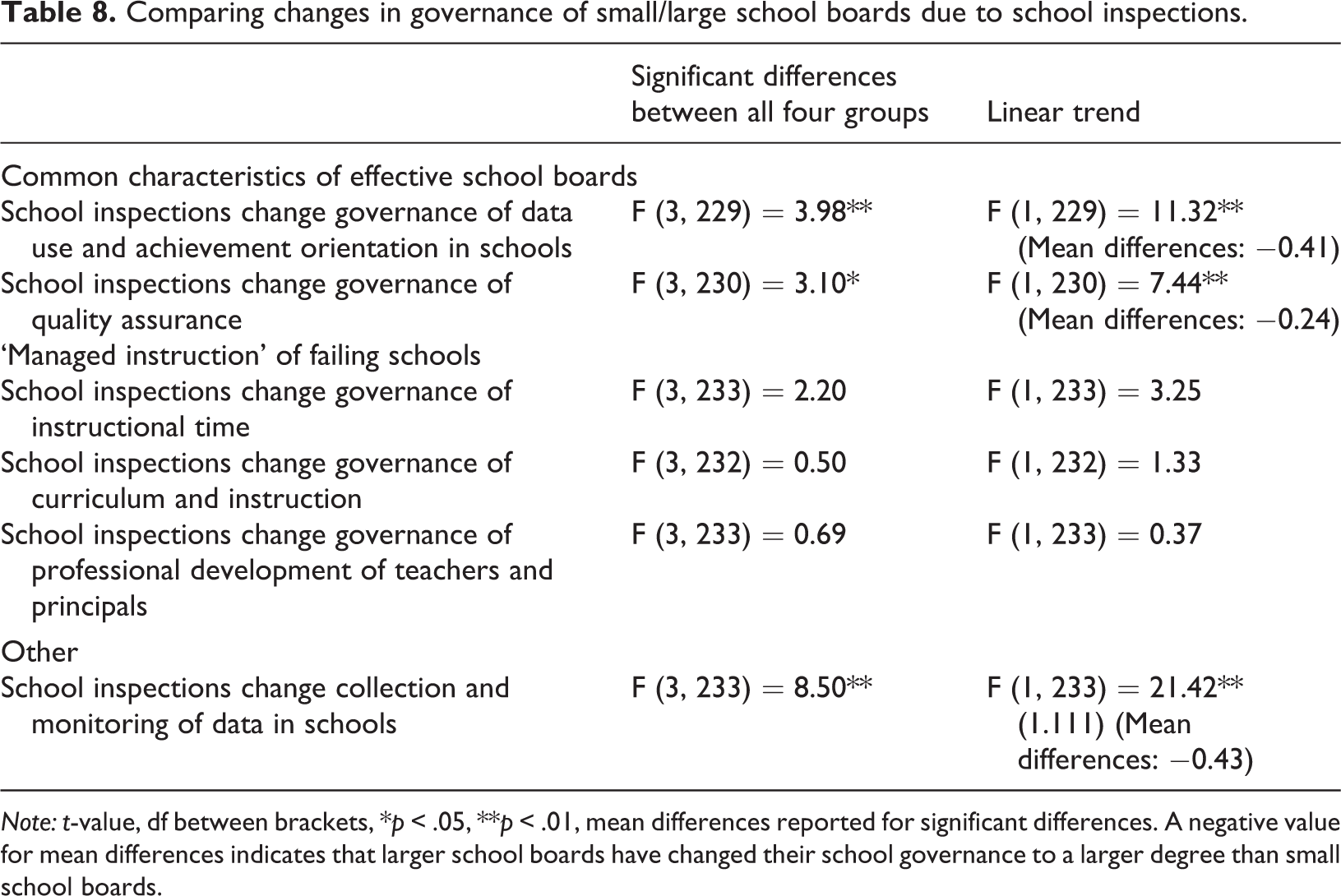
Note: t-value, df between brackets, *p < .05, **p < .01, mean differences reported for significant differences. A negative value for mean differences indicates that larger school boards have changed their school governance to a larger degree than small school boards.
Discussion and conclusions
Against the background of new expectations of external inspectorates and school boards, this paper deals with the issue of whether (and if so, to what extent) the current working methods of the Dutch Inspectorate of Education affects the governance of school boards in primary education. Holding school boards accountable for the quality of their schools, requesting information about the quality of their schools, and communicating to school boards the inspectorate’s inspection activities, outcomes of inspections and interventions is expected to improve their governance of schools. The inspection meetings with school boards and the feedback provided to them should also lead to a change in paradigm, where school boards not only govern administrative and financial issues in their schools, but also focus on improvement of educational quality.
Changes in school boards’ governance due to school inspections
The results of our survey indicate that school boards to a large extent accept the inspection feedback and say they use it for the improvement of their governance of schools. School inspections have, according to school boards, particularly increased their governance of professional development of principals and teachers, their governance of data use and quality assurance in schools, and the amount of data they collect on the functioning of their schools. However, school inspections do not seem to change their governance of teaching time, the curriculum and instruction in their schools. School boards that had an inspection meeting during the previous academic year even indicate a decrease in their governance of the curriculum and instruction in their schools, compared to school boards that did not have such a meeting.
An important caveat on these results is the fact that school boards with many failing schools were targeted for inspection meetings in 2007. An increase in changes in school boards with an inspection meeting can therefore also be a function of a greater need to implement changes in governance of schools in these school boards, instead of resulting from having had an inspection meeting. A comparison of inspected and non-inspected school boards in 2010–2011, however, supports these results, which implies that these changes are the result of inspection meetings with school boards. The changes are, however, reported by school boards on one occasion, and therefore only reflect their perceptions on how they changed their governance of schools.
Changes in governance in large and small school boards
In addition we compared the differences in changes in large and small school boards as a result of school inspections. Our results indicate that particularly large school boards implement changes due to school inspections. Large school boards to a larger extent change their governance of quality assurance and data use and the data they collect in their schools due to school inspections than was the case for small school boards.
Large school boards were, however, prioritized in the scheduling of inspection meetings, which implies that they have received more inspection visits compared to small school boards. These differences can therefore also result from a difference in the number of inspection meetings with small and large school boards instead of being a function of the number of schools in the school boards’ portfolio. Unfortunately we could not test this hypothesis as we have no information available on the total number of visits to small and large school boards.
Effectiveness of changes in governance of school boards
These findings seem to show that school boards prefer indirect ways of fostering change in the educational quality of schools, through an improved use of data and improved quality assurance in schools, instead of intervening directly in curriculum and teaching matters. Prior research indicates that such an indirect way of steering ultimately affects the interaction between pupils and teachers via changes in leadership, and structural and cultural factors (e.g. Saatcioglu et al., 2011). These results support a cautious positive conclusion on the potential of school inspections to enhance the effectiveness of school boards’ governance.
Prior studies, however, also emphasize a need to adapt the governance of school boards to the level of educational quality in their schools; outlining a continuum of ‘managed instruction’ of failing schools, to ‘performance/empowerment’ of high-performing schools. The results of our study do not provide insight into the extent to which school boards vary their governance of schools, but the results indicate little change in the governance of instructional aspects of their schools, such as the curriculum and teaching time. Given the fact that the inspectorate prioritized visits to school boards with many failing schools, such a change was to be expected; school boards with failing schools should take on a governance style of ‘managed instruction’ and focus on the improvement of the curriculum and teaching in their schools. As the results indicate little changes in these instructional aspects, it seems that school boards still particularly focus on more conditional aspects of good education in their schools and leave the quality of education to the principals and teachers in their schools. Additional improvements in the effectiveness of these school boards could be gained if school inspections motivate these school boards to focus on the governance of teaching and instruction in their schools.
Footnotes
Funding
This study was funded by a grant from the Dutch National Council for Primary Education.