



Abstract
The present study aims to extend and integrate previous research on the mediating effects of trust in supervisor and job satisfaction on the relationship between transformational leadership style and organizational citizenship behavior (OCB). Drawing on previous research, we argue that transformational leadership impacts OCB directly and indirectly via employees’ trust in supervisor and job satisfaction. Our sample comprised of 211 Arab male and female teachers in the Arab education system in Israel. The results of structural equation modeling indicated a direct effect between transformational leadership and OCB, and an indirect effect of job satisfaction on the relationship between transformational leadership and OCB. However, trust in supervisor did not mediate the effect between transformational leadership and OCB. Implications and directions for future research are discussed.
Keywords
Introduction
The Arab population in Israel is a national minority marginalized regarding four aspects: discriminatory state policies (Abu-Asbah and Abu Nasra, 2013; Haider, 2005; 2009; Khamaisi, 2003); a class structure that differentiates among ethnic groups; cultural and social-structural gaps; and socio-spatial segregation in the national periphery (Abu-Asbeh and Heilbrunn, 2011). The Israeli governments used ongoing discriminatory policies towards the Arab population, especially with regard to resource distribution, as well as land and infrastructure distribution (Abu-Asbah and Abu Nasra, 2013; Haider, 2005; 2009; Khamaisi, 2003).
The Arab community in Israel is a collectivist society (Dwairy, 2006), characterized by a high level of dependency between the individual and the collective; therefore individuals are willing to give up personal benefits for the collective. In addition, patriarchal structures are customary in public and private spheres (Abu-Baker, 2012). Due to this patriarchalism, Arab women are restricted as to movements, lifestyles, work and education (Abu-Rabia-Queder and Weiner-Levy, 2013). Therefore, high proportions (35%) of Arab women have entered the teaching profession (Central Bureau of Statistics 2013). Teaching enables the women to juggle between still present patriarchal structures while at the same time realizing an occupational career (Shapira and Hertz-Lazarowitz, 2009).
A number of studies that were conducted on the Arab education system in Israel (for example, Abu Asbah, 2007, 2008; Al-Haj, 1996; Svirsky and Degan-Bouzaglo, 2009) indicated that the Israeli education system discriminates against Arab education. The government uses the educational system in order to reinforce control over the Arab population, maintaining that prevailing policy does not aim to increase mobility but is rather reproducing the gaps between Jewish and Arab pupils (Al Haj, 1996). In addition the Arab historical narrative is absent in schoolbooks (Peled-Elhanan, 2012) and appointment policy of teacher and management staff is discriminative (Alhaj, 1996; Amara, 2005).
In addition, state educational policy fails to equalize financial and management resources between both educational systems. Another indicator of the discriminative policy is the fact that there is no independent Arab education administration for the Arab education system. The state investment per Arab student is also significantly lower than that for Jewish students. Following Svirsky and Degan-Bouzaglo (2009), Arab students receive 1.16 classroom hours of education in comparison to 1.56 hours per Jewish student. Not surprisingly, there is disparity in achievements between the two education systems in the national exams (for example, GEMS 1 , Matriculation 2 and Psychometric 3 ) as well as international exams (for example, TIMSS and PISA). Where there is 70.4% of students in the Jewish system eligible for a matriculation certificate, in comparison there is only a stagnant 52.5% among Arab students (CBS, 2012). According to the National Institute for Testing and Evaluation, in the year 2011, the gap between the two education systems was 100 points (466 compared to 566 respectively). Arab students’ lesser eligibility for matriculation, and their low score in the Psychometric Entrance Tests, limits their acceptance to academic institutes of higher education in general and, in particular, to the exclusive academic disciplines.
Thus, there are barriers to fostering human capital capacity crucial for the social and economic development of Arab society in Israel. It is in this context that leadership and the development of their followers are particularly important, in order to improve performance and contribution within the Arab education system. The importance of leadership stems from its ability to promote the educational and pedagogical process (Fullan, 2005) and to increase school effectiveness (Harris, 2002). Successful educational leadership is a source of inspiration for the school staff, organizational propulsion to achieve educational goals, developing staff communication, creating a positive school climate and creating organizational cohesion and stability (Fullan, 2005; Hargreaves et al., 2003; Harris, 2002; Optalka, 2007a). An additional factor influencing school functioning, development and effective management is organizational citizenship behavior (DiPaola and Tschannen-Moran, 2001; Somech and Drach-Zahavy, 2000). Studies indicate that this type of educational leadership has an impact on teachers’ functioning and informal performance, often called organizational citizenship behavior (OCB). Transformational leadership has been found to have a positive effect on organizational citizenship behavior in general and in the school system in particular. For example, studies by Koh et al. (1995), and Nguni et al. (2006) indicate that the level of organizational citizenship behavior is higher among teachers who are subordinates to principles with a transformational rather than a transactional leadership style. Nevertheless, to the best of our knowledge, only few studies have examined the factors mediating the relationship between transformational leadership and OCB, and their study did not concern the education system (Podsakoff et al., 1990). Podsakoff et al. (1990) investigated the mediating effect of trust and employee satisfaction on OCB and found that transformational leadership had no direct effects on OCB. Transformational leadership did influence employees’ satisfaction and trust, and that trust did influence OCB, but employee satisfaction did not (Podsakoff et al., 1990). Our study is similar to that of Podsakoff et al. (1990), in terms of concepts and their interrelationships, nevertheless it is different due to our utilization of variables in a very different organizational context. Whereas Podsakoff et al. (1990), investigated the organizational environment of for-profit businesses, our research is located within the educational systems, a non-profit organizational environment. The organizational context itself may then have an impact on the interrelationships between investigated variables.
The purpose of our study is to examine the effect of transformational leadership on organizational citizenship behavior, while focusing on the potential mediators – trust in supervisor and job satisfaction – in the Arab education system in Israel.
Theoretical framework and hypotheses development
OCB: the concept
Studies investigating organizational citizenship behavior (OCB) show that the willingness of workers to fulfill their duty and formal role is not sufficient to predict organizational effectiveness (Likert, 1961). Rather, it is the voluntary aspect, the organizational citizenship behavior of employees that predicts organizational effectiveness and enables efficient management/leadership (Finkelstein and Penner, 2004). Only a few studies investigated the influence of organizational citizenship behavior on educational institutions, in general, and in schools, in particular, and indicate that organizational citizenship behavior impacts the effectiveness and enhances the development and management in these organizational environments (Bogler and Somech, 2004).
Organizational citizen behavior is conceptually based on two theoretical roots: the Social Exchange theory and the Fairness and Social Justice theory. The former postulates a mutual relationship between the organization and the employee (Blau, 1964). Consequently, a system of social and economic exchanges emerges between the employee and some officials in the organization, and organizational citizen behavior is one of the positive outputs from an exchange based on justice and fairness (Moorman, 1991). Economic exchange is one aspect of exchange in general and includes the employee’s financial compensation. Here the relationship is embedded in personal interests and a short-term relationship (Blau, 1964; Walumbwa et al., 2011). Social exchange – the second aspect – is anchored in trust, a perception of justice, confidence in the employer, commitment and a long-term relationship. Social exchange focuses on the emotional aspects in the organization (Blau, 1964; Walumbwa et al., 2011). The Fairness and Social Justice theory maintains that mutual help of employees in the organization is an outcome of fairness perception (Adams, 1965), resulting from employees’ considering the ratio between investment in work and compensation, in comparison to co-workers’ investment and their compensation. The employee’s perception of fairness increases with the rate of congruence between how the employee evaluates his ratio of investment and compensation in comparison to his co-workers. Perception of unfairness prevents employees from assisting others (Welster et al., 1978), therefore a perception of fairness is a necessary precondition for OCB.
The concept of OCB encompasses all activities initiated by workers voluntarily above and beyond their job description, not necessarily related directly to a reward system but nevertheless contributing to the organization and its development (Podsakoff et al., 2000). Organ (1997) defines organizational citizenship behavior (OCB) as ‘contributions to the maintenance and enhancement of the social and psychological context that support task performance’, (1997: 91). Organ (1997) further maintains that OCB contributes to organizational effectiveness, that it is not included in the formal job definition of the worker, and depends entirely on the free will of the worker, meaning it is not formally rewarded. Over the past decade the definition has become more specific, with employees engaging in beneficial behaviors, such as taking on additional work roles and helping co-workers (Podsakoff et al., 2000), while empirical research has clarified the characteristics and antecedents of OCB (Organ et al., 2006; Podsakoff et al., 2000).
Within the educational context, OCB is defined as teachers taking on activities above and beyond their formal job obligations with the school, the teaching staff and the pupils, with an aim to promoting the organization and achieve its aims. Teachers’ OCB increases the level of education at the school because it enables the principal to focus upon educational and pedagogical issues instead of administration (DiPaola and Tschannen-Moran, 2001), backs up introducing changes successfully (Somech and Drach-Zahavy, 2000), and decreases tensions in schools (DiPaola and Tschannen-Moran, 2001). Optalka (2007b) mentioned a number of dimensions of OCB among Israeli teachers: assisting/helping pupils and fellow teachers in the school, initiating pedagogical changes and innovations, commitment to the school, and loyalty to the job. Loyalty according to Oplatka (2007b) would be expressed in teachers’ efforts to increase the level of education at the school.
Many studies on OCB dealt with the question of which factors foster it. One finding that many of these studies shared suggested that leadership has a crucial influence on OCB among workers (Podsakoff et al., 2006; Vigoda-Gadot, 2007).
Transformational leadership and OCB
Transformational leadership has been defined by Bass (1999:11) as ‘moving the follower beyond immediate self-interests through idealized influence (charisma), inspiration, intellectual stimulation, or individualized consideration’. Transformational leadership has received much attention in the literature dealing with leadership (Avolio and Jung, 1999; Dvir et al., 2002; Wang at al., 2011), and it has been found to be positively related to OCB (Picollo and Colquitt, 2006). Transformational leaders motivate followers by communicating the need to prioritize and internalize the organizations’ interests over their individual interests. Intrinsic motivation may lead to willingness of subordinates to contribute to the organizations’ aim, without expecting immediate personal and tangible rewards. Thereby they are willing to do much more than expected by the formal organizational role description. Wang et al. (2005), maintain that a positive association between transformational leadership and OCB is expected and has been supported empirically (for example, Podsakoff et al., 1990). Also more updated studies such as Judge et al. (2004), Podsakoff et al. (2000), and Wang et al. (2011), have provided empirical support for the positive relationship between transformational leadership and OCB. Also Nguni et al. (2006), found a direct effect between transformational leadership and the OCB of teachers. This positive effect is a result of teachers participating in decision-making and of empowerment increasing their self-efficacy. Therefore, a first hypothesis is suggested:
Trust in supervisor, job satisfaction, transformational leadership and OCB
The meta-analytical overview of Wang et al. (2011), indicates the existence of moderating variables in the relationship between transformational leadership and OCB, when the main variables are trust in the supervisor and job satisfaction (Bass et al., 2003). Job satisfaction can be conceptualized as a person's assessment of his/her job in terms of the fulfillment of congruence between values and needs (Hackman and Oldham, 1975; Ngodo, 2008). It is often defined as ‘the extent to which individuals are satisfied with their jobs and how they feel about different aspects of their jobs’ (Agho et al., 1993: 1007). Spector (1985; 1997) described job satisfaction as a core variable in research and theory of organizational phenomena. Variables that have been demonstrated to positively affect job satisfaction include: job level, tenure, salary (Chet et al., 1998), employee empowerment, and types of skills needed (Kirkman and Rosen, 1997). Job satisfaction is closely related to leadership style (Rossmiller, 1992). Rossmiller (1992) found a relationship between job satisfaction and transformational leadership in terms of employees taking part in organizational decision-making processes. Following Netemeyer et al. (1997), open communication between manager and employees, and the participation of employees in decision-making processes, increase job satisfaction. Liao et al. (2009), reported close correlations between job satisfaction and organizational performance. Employees’ attitude towards the workplace is reflected in job satisfaction and feeling of trust, which then affects organizational citizen behavior (Netemeyer et al., 1997). Top et al. (2012), maintain that a number of empirical and meta-analytic studies suggest that employees working within a transformational leadership culture are more involved, satisfied, empowered, motivated, trusted and committed to their organizations and demonstrate fewer withdrawal behaviors (Barling at al., 1996; Bono and Judge, 2003; Walumbwa and Lawler, 2003; Walumbwa et al., 2004). Nguni et.al (2006), maintain that the job satisfaction of teachers mediates the effects of transformational leadership on organizational citizenship behavior in schools. Thus, job satisfaction predicts OCB and transformational leadership enhances job satisfaction. Based on the above, the second hypothesis is suggested:
The second mediator of the effects of transformational leadership on organizational citizenship behavior is trust in the supervisor. Trust in the supervisor is defined as ‘one's overall faith and confidence in the qualities and abilities of management (Ferres et al., 2004). Ferres et al. (2004), state that trust is an important factor in determining organizational success and stability, and is also positively related to the wellbeing of employees in general and to employee job satisfaction in particular (Aryee et al., 2002). Thus, from an organizational perspective, the higher the trust, the more satisfied and productive the employees tend to be.
Trust is primarily developed and established via leadership (Creed and Miles, 1996; Fairholm, 1994; Shaw, 1997), and a number of studies showed so, independently of the specific leadership model used. Trust establishes an essential dimension of the relationship between transformational leaders and employees (Butler et al., 1999; Gillespie and Mann, 2000; Podsakoff et al., 1990; 1996). Trust in the leader has been identified in a number of studies as a central mechanism to the process of transformational leadership (Jung and Avolio, 2000; Kark et al., 2003; Podsakoff et al., 1990). Some researchers measure the quality of social exchange between followers and leaders as indicators of trust (Pillai et al., 1999; Schaubroeck et al., 2011).
Ferres et al. (2004), further maintain that transformational leadership was found to indirectly influence OCB via trust (Pillai et al., 1999). Accordingly, the third hypothesis suggests:
Methods
Participants
The sample included 211 male and female teachers from seven locations in the Northern region of Israel. These locations were selected while taking into account a number of variables such as size (number of residents), socio-economic status and education level. We randomly sampled one elementary and one junior high school at each location. The Northern region was chosen since 60 percent of Israel's Arab population resides in this geographical area.
Most of the respondents were women (78.0%); 68% of the respondents had a bachelor's degree, 18% had a teaching certificate, 12% had a master’s degree and 2% had a PhD degree. Forty-four percent of the respondents were class educators, 43% of them were professional teachers, and 13% of them were profession coordinators. The average seniority in the school was 10.71 years, compared to an average of 14.85 years in the education system. The response rate was 78%; 211 out of the 270 teachers agreed to participate in the study.
Variables and instruments
Organizational citizenship behavior (OCB)
These variables were based on a scale suggested by Williams and Anderson (1991). Respondents were asked to evaluate teachers’ behavior on a five-point Likert-type scale ranging from one – strongly disagree – to five – strongly agree – (sample items: ‘Helps others who have been absent’; ‘Helps others who have heavy workloads’; ‘Assists supervisor with his/her work (when not asked)’). The sub-scale was measured by the average response to the items. High scores indicate a high level of OCB. Reliability of the scale was 0.85.
Transformational leadership
This variable was measured using the Multi-factor Leadership Questionnaire (MLQ) (Bass, 1985). Respondents were asked to evaluate the transformational leadership behavior of their principal by using a 5-point Likert scale ranging from one – never – to five – always – (sample item: ‘Paints an interesting picture of the future’; ‘Behaves in a manner thoughtful of my personal needs’; ‘Has stimulated me to rethink the way I do things’). The sub-scale was measured by the average response to the items. Reliability of this scale was 0.85.
Job satisfaction
Job satisfaction was measured using an instrument developed by Schriesheim and Tsui (1980). Respondents were asked to indicate how satisfied they were with their current job, co-workers, supervisors, current salary, opportunities for promotion, and work in general on a response scale ranging from one – strongly disagree – to five – strongly agree. The sub-scale was measured by the average response to the items. High scores indicate a high level of job satisfaction. Reliability of the scale was 0.78.
Trust in supervisor
This variable was measured using an instrument developed by Hoy and Tschannen-Moran (2003). Respondents were asked to evaluate the level of trust in school principals. Responses were made on a five-point Likert scale ranging from one – strongly disagree – to five – strongly agree. The sub-scale was measured by the average response to the items. High scores indicate a high level of trust in the school principals. The questionnaire was originally intended to examine the teachers’ trust in students and parents. We modified the questionnaire so that the questions focus on the level of teachers’ trust in the school principal (sample item: ‘I can rely on my principal’, or ‘I believe in what the principal tells the teachers’). Reliability of this scale was 0.89.
Procedure
The research was conducted during the 2010/2011 school year. Data collection was coordinated with schools and continued for five months. Principals and teachers were provided with a detailed explanation of the research and its goals, emphasizing confidentiality of collected data. The questionnaire was administered in Arabic by research assistants enlisted and trained especially for this purpose. The teachers filled in the questionnaire during break time. Answering the entire questionnaire took about 30 minutes.
4.4 Analysis strategy
In order to examine the relationship between transformational leadership, job satisfaction, trust in supervisor and organization citizenship behavior, a structural equation modeling (SEM) analysis via EQS (version 6.1) (Bentler, 2006) with maximum likelihood estimation was employed. We chose first to analyse the data using a nested-models analysis and then to look at the significance of the individual paths (Anderson and Gerbing, 1988). The nested-models analysis contained comparing the change in chi-square associated with the restriction of certain paths in a series of nested models, and comparative fit index (CFI, Bentler, 1990), and Tucker–Lewis index (TLI = NNFI, Bentler and Bonnet, 1980). If the change in chi-square is significant, the model with smaller χ2 value and better fit index values is the better model.
Figure 1 depicts structural model showing direct and indirect (through trust in supervisor and job satisfaction) effect between transformational leadership and organizational citizenship behavior (Model 1) and the nested models used to assess the significance of those relationships. The path labeled 1 represent the path omitted in Model 2; the path labeled 2 represent the path omitted in Model 3; the path labeled 3 represent the path omitted in Model 4; the path labeled 4 represent the path omitted in Model 5; finally the path labeled 5 represent the path omitted in Model 6. The comparison between Model 1 and Model 2 examines the direct effect between transformational leadership and organizational citizenship behavior (Hypothesis 1). By comparing Model 2 with Model 3 and Model 5, we test the potential mediating effect of job satisfaction on the relationship between transformational leadership and organizational citizenship behavior (Hypothesis 2). Finally, by comparing Model 2 with Model 4 and Model 6 we test the potential mediating effect of trust in supervisor on the relationship between transformational leadership and organizational citizenship behavior (Hypothesis 3).
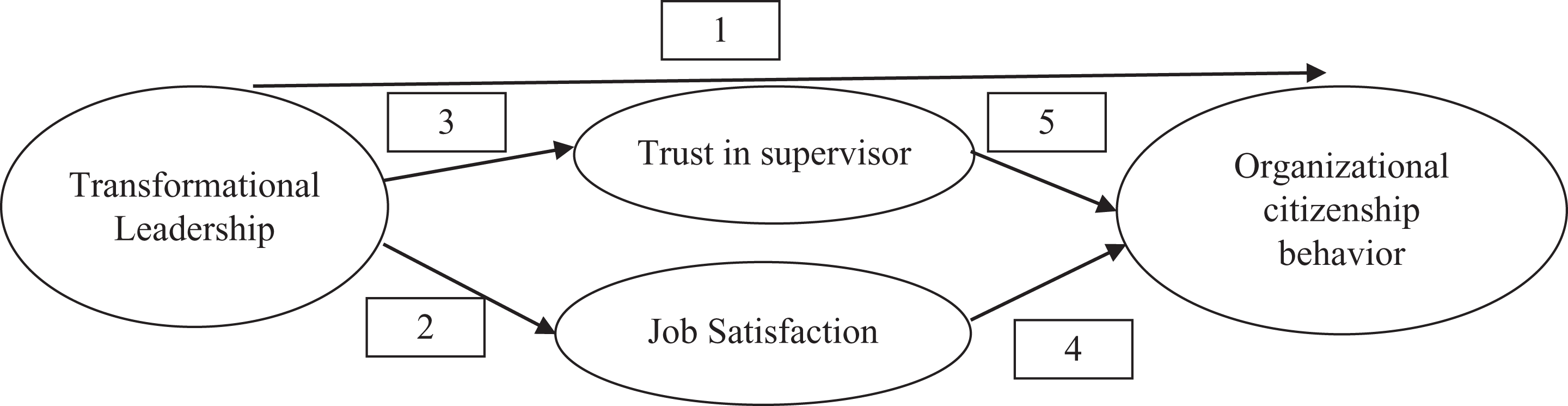
Description of the research models.
5. Findings
5.1 Descriptive statistics
Means, standard deviations, as well as the bivariate correlations of the research variables, were obtained and summarized in Table 1. The results show that the teachers expressed high levels of organization citizenship behavior (M = 3.5), transformational leadership (M = 3.9), job satisfaction (M = 3.8), and trust (M = 4.0). Pearson correlation coefficients between each of the organization citizenship behavior and transformational leadership and job satisfaction and principle trust are presented in the right three columns of Table 1. Correlation coefficients are strong (0.50, 0.74). A high correlation was found between organization citizenship behavior and transformational leadership (r = 0.56; P < 0.001), job satisfaction (r = 0.53; P < 0.001), trust in supervisor (r = 0.50; P < 0.001). We also found a high correlation between transformational leadership and job satisfaction (r = 0.65; P < 0.001), transformational leadership and principle trust (r = 0.74; P < 0.001), and between job satisfaction and principle trust (r = 0.61; P < 0.001).
Means (M), standard deviation (SD), correlation matrix (Pearson's) for the research variables.
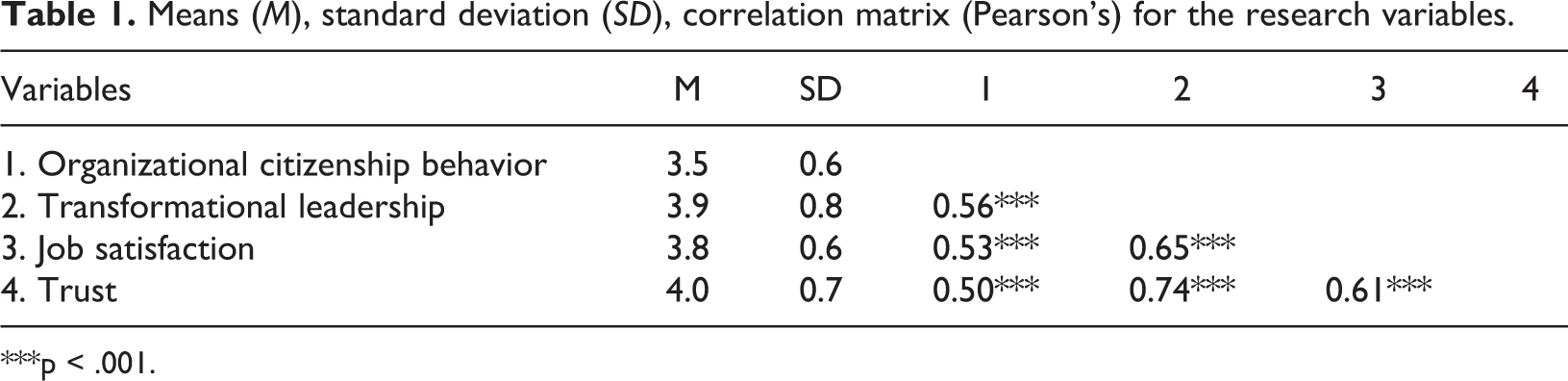
***p < .001.
5.2 Analyses of nested models
Table 2 reports the results for the nested-models analysis. As discussed earlier, six models were evaluated. Model 1 is the ‘saturated model’, that includes the direct and indirect (through job satisfaction and trust in supervisor) effects between transformational leadership and organizational citizenship behavior. Model 2 differed from Model 1 in that the direct effect between transformational leadership and job satisfaction was omitted. Therefore, the change in chi-square between Model 1 and Model 2 reflects the direct effect between transformational leadership and organizational citizenship behavior and thus is a test of their significance to the model. As can be seen in Table 2, the change in chi-square for the change in 1 degree of freedom was 6.2, which was significant (p < .05). In addition, the fit indices of Model 1 are higher than of Model 2. In Model 1, the CFI value was 0.981 and the TLI value was 0.971, which supports the fit of model 1. Therefore, we can state that transformational leadership directly effects organizational citizenship behavior.
Nested model comparisons.
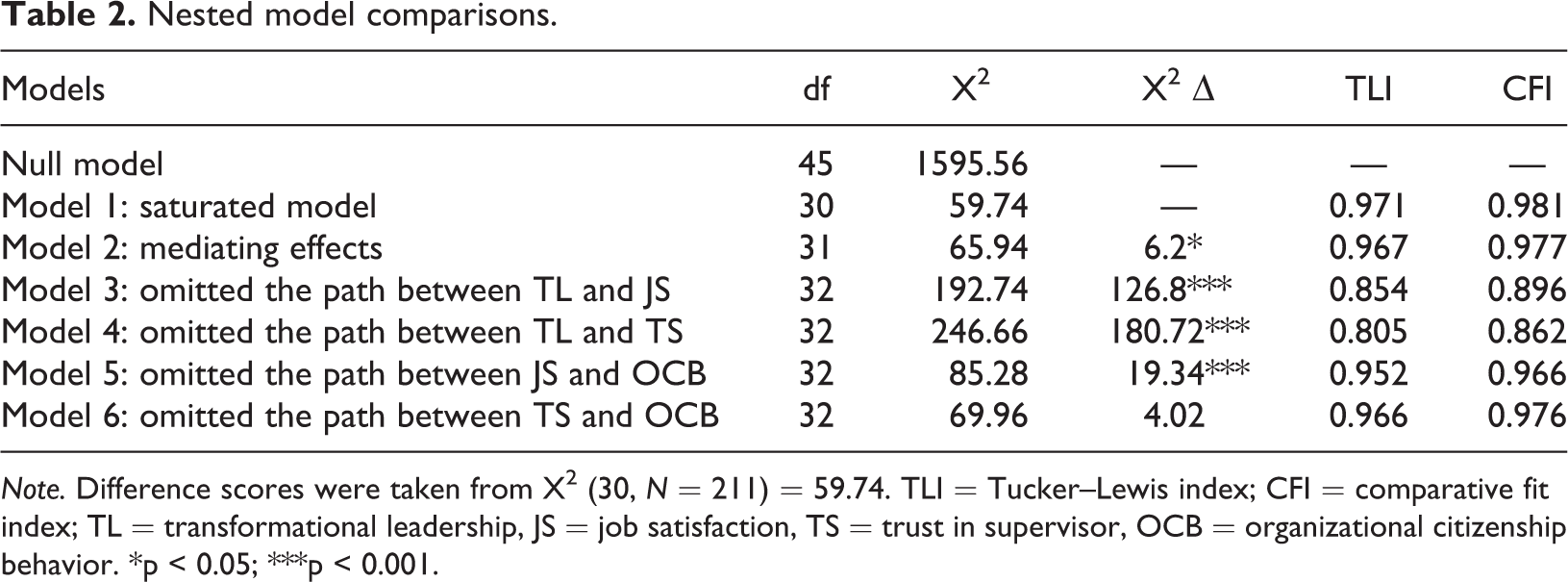
Note. Difference scores were taken from X2 (30, N = 211) = 59.74. TLI = Tucker–Lewis index; CFI = comparative fit index; TL = transformational leadership, JS = job satisfaction, TS = trust in supervisor, OCB = organizational citizenship behavior. *p < 0.05; ***p < 0.001.
Model 3 differed from Model 2 in that the path between transformational leadership and job satisfaction was omitted. Therefore, the change in chi-square between Model 2 and Model 3 reflects the relationship between transformational leadership and job satisfaction and is a test of their significance to the Model. As reported in Table 2, the change in chi-square for the change in 1 degree of freedom was 126.8, which was significant (p < 0.001). The fit indices of Model 2 are higher than of Model 3. In Model 2, the CFI value was 0.977 and the TLI value was 0.967, which supports the fit of Model 2. Therefore, we can state that the effect between transformational leadership and job satisfaction is significant and contributes to the fit of the model, thus these paths cannot be omitted.
Model 4 differed from Model 2 in that the path between transformational leadership and trust in supervisor was omitted. Therefore, the change in chi-square between Model 2 and Model 4 reflects the relationship between transformational leadership and trust in supervisor and is a test of their significance to the Model. As can be seen in Table 2, the change in chi-square for the change in 1 degree of freedom was 180.72, which was significant (p < .001). The fit indices of Model 2 are higher than of Model 4. In Model 2, the CFI value was 0.977 and the TLI value was 0.967, which supports the fit of Model 2. Therefore, we can state that the effect between transformational leadership and trust in the supervisor is important and contributes to the fit of the model, thus these paths cannot be omitted.
Model 5 differed from Model 2 in that the path between job satisfaction and organizational citizenship behavior was omitted. Therefore, the change in chi-square between Model 5 and Model 4 reflects the relationship between job satisfaction and organizational citizenship behavior and is a test of their significance to the model. The change in chi-square resulting from the restriction of the job satisfaction to the organizational citizenship behavior path was 19.34 for a change of 1 degree of freedom, which was significant (p < .001). The fit indices of Model 2 are higher than of Model 5. In Model 2, the CFI value was 0.977 and the TLI value was 0.967, which supports the fit of model 2. Thus, the results indicate the important of the path between job satisfaction and organizational citizenship behavior, which therefore cannot be omitted due to its contribution to the model fit.
Finally, Model 6 was evaluated to test the relationship between trust in the supervisor and organizational citizenship behavior. The change in chi-square resulting from the restriction of the path from trust in supervisor to organizational citizenship behavior was 4.02 for a change of 1 degree of freedom. This change was not significant (p > .05). Thus, we can state that the path between job satisfaction and organizational citizenship behavior does not contributed to the model fit, and can therefore be omitted.
5.3 Significance of individual paths
The results of the nested models analysis were supported by evaluating the individual paths in the saturated Model (Model 1). Figure 2 presents standardized regression coefficients for all the paths hypothesized in the Model. The results in Figure 2 support the results found in the nested-models analysis for the relationship between transformational leadership and organizational citizenship behavior. A positive relationship was found between transformational leadership and organizational citizenship behavior (0.39; P < .05), that supports Hypothesis 1. In addition, the paths coefficients in model 1 indicates that positive relationship was found between transformational leadership and trust in the supervisor (0.82; P < .05), but no statistically significant correlation was found between trust in the supervisor and organization citizenship behavior (p > 0.05). These results contradict Hypothesis 2 claiming that trust in the supervisor is mediating the relationship between transformational leadership and organizational citizenship behavior. Hypothesis 3 stating that job satisfaction is a mediator of the relationship between transformational leadership and organizational citizenship behavior was supported, and we found a positive relationship between transformational leadership and job satisfaction (0.76; P < 0.05), and between job satisfaction and organizational citizenship behavior (0.31; P < 0.05).
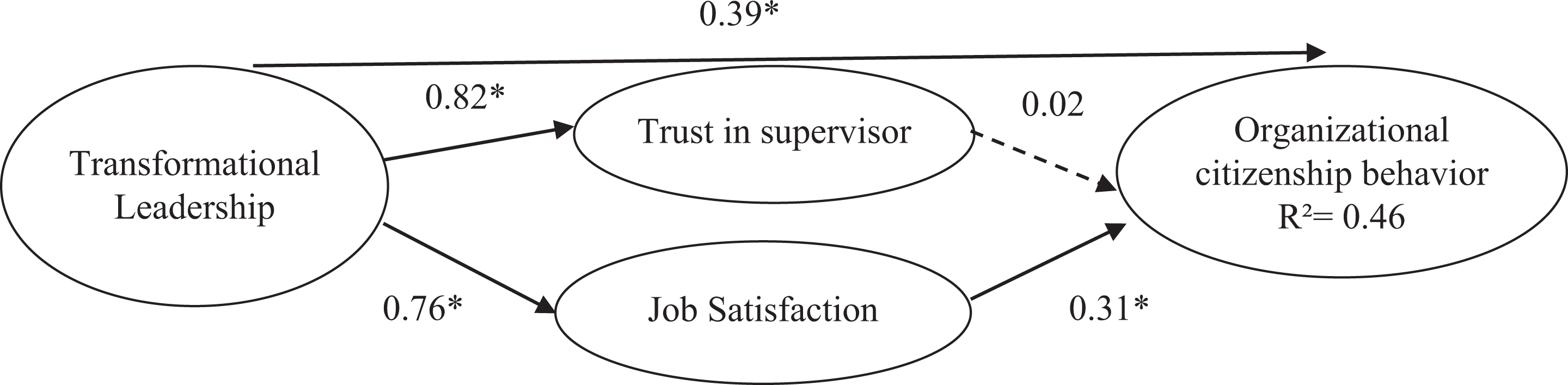
Parameter estimates for the hypothesized paths in the Saturated Model.
Conclusion and discussion
In our work, we examined the direct effect and the mediating effect of trust in supervisor and job satisfaction on the relationship between transformational leadership and organizational citizenship behavior. We tested several alternative models containing direct and indirect relationships among the key study variables, while excluding them one by one and comparing the acquired results to the theoretical model. The findings revealed a significant direct effect between transformational leadership and organizational citizenship behavior. Thus, hypothesis 1 was supported. Our finding is consistent with numerous studies described in the literature (Bass, 1985; Boerner et al., 2007; Howell and Avolio, 1993; Schlechter and Engelbrecht, 2006; Wang et al., 2005). These studies show that the direct effect is due to the support and encouragement workers receive from their leader, thereby causing them to contribute to organizational goal achievement also via investing efforts and time in work beyond role expectations.
The findings also revealed that job satisfaction mediates the relationship between transformational leadership and organizational citizenship behavior. Thus, support was also found for hypothesis 2. We found a positive relationship between transformational leadership and job satisfaction. In addition, a positive relationship was found between job satisfaction and organizational citizenship behavior. Thus, our findings go along with the conclusion of several researchers concerning the effect of the leadership style on organizational citizenship behavior (Rossmiller, 1992), and the mediating effect between these two variables through job satisfaction (Netemeyer et.al., 1997; Somech and Drach-Zahavy, 2000). Adaptation of transformational leadership (employees taking part in organizational decision-making processes, keeping open channels of communication with employees, and so on) increases the employees’ job satisfaction level, fosters employees’ identification with the organization and its goals, and improves their willingness to perform organizational citizenship behavior. Especially in the context of educational organizations teachers’ identification with and commitment towards the school are of crucial importance, since they influence the interaction with the school principal, but positively.
Thus, our findings also support the social exchange theory, stressing the importance of mutual dependencies in social exchange. More specifically, this type of relationship between the school principal and teacher causes the teachers to invest in their work and contribute to the organization above and beyond formal role expectations, thereby expressing a high level of organizational citizenship behavior. Thus, the more supportive the teachers perceived their principal's behavior, the more likely they were to engage in OCB, such as making suggestions for improvement, voluntarily attending meetings, or assisting colleagues with their duties.
Finally, our findings revealed that trust in supervisor does not mediate the relationship between transformational leadership and organizational citizenship behavior in the school context. Thus, hypothesis 3 was rejected. We found a positive relationship between transformational leadership and trust in supervisor, but not between trust in supervisor and organizational citizenship behavior. This finding differs from earlier work (Podsakoff et al., 1990).
The effect of transformational leadership on trust in the supervisor can again be explained by the social exchange theory and the character-based perspective. According to the social exchange theory, transformational leaders build trust by demonstrating individualized concern and respect for followers (Jung and Avolio, 2000). However, the character-based perspective claims that trust in the supervisor is influenced by the perception of the leader’s characteristics (Cunningham and MacGregor, 2000; Mayer et al., 1995). Followers’ perception of the leader as having integrity, dependability, fairness, and ability elicits their trust in the leader.
Several explanations are possible concerning the lack of effect between trust and organizational citizenship behavior. One possible explanation is the fact that our study concerned educational organizations, whereas former studies investigated the relationship mainly in business organizations. Following Dirks and Skarlicki (2007), the level of trust in the supervisor is influenced by the nature of the organization and its values. Organizations advocating values of care and concern require high levels of trust. Within the school context, values of care and concern for students and their education are at the very heart of the organization; therefore higher levels of trust in supervisors are required.
Another possible explanation for the lack of effect between trust and organizational citizenship behavior is related to the fact that the effect of trust in the supervisor on organizational performance increases in times of adversity, and not in prosperous and stable times (Dirks and Skarlicki, 2007). Therefore, given that schools overall operate in a much more stable environment than business organizations, our findings make sense.
In the context of the Arab education system, teachers perform organizational citizenship behavior despite the fact that trust in the supervisor has little effect on its existence in this context. This can be explained by two important characteristics of the Arab education system: the gender composition and the collectivist spirit of the Arab community in Israel. A high proportion of employees in the Arab education system are women (38 % of all Arab women in the labor force are employed in the education system – CBS, 2012). This composition affects the conduct of Arab schools and the extent of organizational citizenship behavior as a result of the values held by women. Women emphasize work values of cooperation, concern for others and empathy, interdependency and maintaining good relationships with colleagues and superiors. In contrast, men in their work rely on the values of autonomy, promotion in the organizational hierarchy and rewards (Farrell and Finkelstein, 2007; Lovell et al., 1999). These female traits are the infrastructure of organizational citizenship behavior, and therefore the level of organizational citizenship behavior in Arab education system is high.
The collectivist outlook of the Arab society (Dwairy, 2006) can explain the high level of organizational citizenship behavior among Arab teachers, despite the lack of relationship between trust in the supervisor and organizational citizenship behavior.
Indeed Erez and Earley (1993) found that the level of organizational citizenship behavior in a collectivist society is higher than in an individualist society, due to the close relationship between the individual and the society and the willingness to make sacrifices for the collective in order to belong. Arab teachers grew up with collective values as a main ingredient of the process of socialization and perpetuate these values to their students. The idea that the individual should operate in order to achieve collective objectives has affected the Arab teachers’ role perception, and the perception of borders separating formal and informal behavior in one’s role when considering the students’ interests.
Our study demonstrates the crucial importance of school principals in promoting OCBs in teachers, and the importance of the latter in terms of creating an organizational context that fosters the development of high quality education for Arab schoolchildren in Israel. The human resource is the most important factor with the highest potential to make a difference. Therefore OCBs in teachers constitutes one of the main available tools for implementing changes. In the light of the fact that the Arab education system in Israel suffers from a number of particular shortcomings, such as scarcity of educational and economic resources and parallel also from shortcomings of the entire education system in Israel, in form of ongoing budget cuts due to neo-liberal policies of the last years.
Finally, our study reveals that the organizational context in itself impacts the interaction of organizational variables. Podsakoff et al. (1990) investigated the same set of variables in an organizational environment of for-profit businesses. Our research is located within the educational systems, a non-profit organizational environment. Since our results differ from that of Posakoff's et al. (1990), it seems that the organizational context itself has an impact of the interrelationships between investigated variables.
Research limitations and recommendations for future studies
Some limitations should be mentioned: first, the research sample did not include Arab teachers from the Southern/Central regions of Israel. Inclusion of teachers from these regions may expose additional viewpoints. It is therefore recommended that future research on this issue cover populations from other regions. Second, organizational citizenship behavior of followers was rated by the teachers; it would have been better if the variable had also been measured by using principals’ rating, so as to avoid same-source bias. Third, the study examined the effect of trust in supervisor on organizational citizenship behavior, but it might have been better if other types of trust such as ‘trust in organization’ that have the potential to effect organizational citizenship behavior were considered.
In addition, it is important to examine the effects of the social characteristics of the Arab community and the gender composition of the Arab education system on the relationship between trust in supervisor and organizational citizenship behavior.