



Abstract
Education researchers and policymakers have been focusing for the last three decades on increasing parental involvement in schools. Their work focused on the positive effects that parental involvement has on varied aspects of school quality and functioning. In this study we examined ‘trust’, a known predictor of parental involvement in schools. Specifically we examined how generalized trust and different types of particularized trust affect parental active and passive participation in schools of choice, through multivariate logistic regression analysis and structural equation modeling (SEM) of data from a survey of 404 parents in 12 Israeli Democratic Schools. Our findings show that different types of trust have diverse direct, indirect and sometimes paradoxical effects on parent participation in schools of choice. Following these findings we suggest that educators and policymakers should consider the positive and negative implications of our findings when planning programs of parental involvement.
Keywords
Introduction
Education researchers and policy makers have been focusing increasingly for the last few decades on parental involvement in schools, demonstrating that parental involvement has important influences on school climate, on student achievement and teacher performance, as well as on other aspects of the school’s educational concept, functioning and quality (Epstein and Becker, 1982; Bronfenbrenner, 1986; Epstein 1990, 1995, 2001; Comer and Haynes, 1991; Chavkin, 1993; Fan and Chen, 2001). A link between trust and parental involvement in school was found in previous studies of parents' involvement in education (Adams and Christenson, 2000; Hoover-Dempsey et al., 2005). However, these studies did not examine different directions and types of trust, such as trust by parents toward school staff and the school community. Likewise, no reference was made concerning potential negative implications of the programs that attempt to strengthen specific types of trust, with the aim of enhancing parental involvement in school. In this research we examined how different types of trust within the school-of-choice setting affect active and passive parental involvement in the school, in an attempt to identify specific types of trust, which predict different forms of parental involvement. Such identification might assist policymakers and educators in developing parental involvement programs in schools, while paying attention to the important balance needed between different types of trust that promote such involvement and their wider and potentially negative implications. Such an examination has special import in schools of choice that often operate in an environment marked by opposition and pressure, bureaucratic resistance, public misunderstanding, and struggles for resources and autonomy (Wohlstetter et al., 1995; Wells et al., 1999; Mintrom, 2000; Deal et al., 2004; Honig, 2004; Renzulli and Evans, 2005; Finnigan, 2007). This uneasy environment may cause processes of withdrawal of the school community from the wider educational system, paired with an increased internal cohesiveness. This context turns schools of choice, and particularly Democratic schools, into an especially interesting case for observing the intricate links between trust and participation.
Parental Involvement in the School
Parental Involvement is a set of behaviors and attitudes that refers broadly both to direct parent-child interactions that take place in the home (Muller, 2009), and to family school-community interactions that take place in the school such as volunteering, meeting with teachers and other school personnel, attending school events, and parent teacher conferences, as well as taking an active part in the school governance and policy making (Desforges and Abouchaar, 2003; Hill and Taylor, 2004). Epstein (2002) too incorporates both aspects in her definition of parental involvement, as seen in her categorization of the phenomenon into six types, which include, on the one hand, parenting and learning at home, and then volunteering and parent–teacher communication on the other. Although the importance of both aspects has been repeatedly demonstrated (Emerson et al., 2012), the focus in this article is in a certain type of school, and therefore we will concentrate on parental engagement with schools and schooling.
Parental involvement is known to influence school climate, students' and teachers' functioning, and other aspects related to the school's educational views, functioning and academic standards (Rosenblatt and Peled, 2003). The influence of parental involvement and its positive or negative directions on student's achievements, motivation, truancy and on behavior at school is complex and depends on various factors such as age and the developmental stage of the student, the class and school they are attending, parents' education, parents' aspirations for their child, communication between parents and teachers, and parents' involvement with their child's learning at home and at school (Catsambis, 2001; Epstein and Sheldon, 2002; Rosenblatt and Peled, 2003; Harris and Goodall, 2008; Fan and Williams, 2010).
The benefits of parental involvement are manifold, and operate at the student, at the teacher and at the school levels. Parental involvement in school was found in a meta-analysis of 52 studies (Jeynes, 2007) to increase grades overall and in particular standardized tests. This is mostly since parental involvement helps students assimilate knowledge acquired in school, and enhances the relationship between teachers and parents. This was found true for voluntary parental involvement, but also for planned involvement through parental involvement programs (Jeynes, 2007). Hoover-Dempsey and Sandler (1995) argue that the main mechanisms through which parental involvement enhances educational results are parental modeling and reinforcement.
Effects on behavioral outcomes are less straightforward. While some studies (for example, Reynolds et al., 1992) found that parental involvement was associated with less behavior problems in school, other studies had different results. Simons-Morton et al. (1999) found that student–school bonding was positively correlated with school adjustment but inversely correlated with problem behavior. Izzo et al. (1999) found that the quantity of parent–teacher interactions predicts worse classroom behavior over time. They argue that this negative association is not causal, but rather merely statistical. Indeed, children's behavior problems tend to be frequent reasons for parent–teacher contact (Leitch and Tangri, 1988).
On the teacher and school side, parent involvement establishes mutual goals between parents and teachers by developing activities that cut across home and school (Christenson, 1995). Parental involvement was found to improve parent–teacher relations, increase understanding and sensitivity of teachers to the life conditions in immigrant students’ homes and communities (Valdes, 1996), and increase teacher efficacy and teacher perceptions of parent efficacy (Hoover-Dempsey et al., 1992). Other studies demonstrate positive effects on perceived school climate (Griffith, 1998; Izzo et al., 1999) and on the emergence of school climates that reduce violence (Peterson and Skiba, 2001).
Researchers have been using different frames of classification in order to conceptualize and study parental involvement. These frames relate to levels of active and passive parental involvement (Noy, 1990; Friedman and Fisher, 2003; Friedman, 2010), to parents' beliefs and motives of involvement in their children's education (Shapira and Goldring 1990; Bar, 2005; Hoover-Dempsey and Sandler, 2005), and to the physical space of the activity – school-based, home-based or community-based (Noy 1990; Catsambis, 2001; Deslandes and Bertrand, 2005; Hill and Tyson, 2009).
Goodall and Montgomery (2014) suggest a three-point continuum model that begins with ‘parental involvement with school’, progresses to ‘parental involvement with schooling’ and ends at ‘parental engagement with children’s learning’. They emphasize that this continuum is not merely a line between one point to another, but a process that allows schools to evaluate and plan parental involvement and engagement according to each school's unique situation (such as parents population, school needs, perceptions of parental involvement and engagement and so on). Each of these three points has its focus: parental involvement with school is school agency based, meaning that school staff dominate the relationships with the parents and it occurs mostly at school; parental involvement with schooling is shared agency between parents and the school and it can occur either in school or at home; parental engagement with children’s learning is parental agency based, meaning that the parents choose and decide how to act and be involved and it occurs mostly at home (Goodall and Montgomery, 2014).
Hill and Tyson (2009) point out that Epstein's classification of parental involvement is the most known and quoted among these frames. The types are divided into three groups of involvement, according to its space of activity: school-based involvement, which includes volunteering in school, communication between home and school and cooperation in policy planning and decision making; home-based involvement, which includes parenting and learning at home; and cooperation with the community, which includes collaboration and engagement of school with various organizations and institution in the community that surrounds school (Epstein and Salinas, 2004; Hill and Tyson, 2009). Epstein has developed her model of parent involvement into a wider conception of family school-community engagement: the Partnership Schools Comprehensive School Reform (CSR) model (Epstein, 2005; Epstein and Sanders, 2006; Epstein, and Sheldon, 2002). Her studies show that specific family, school and community partnership activities, such as parent workshops, may help improve educational outcomes, and are related to reduced rates of truancy and chronic absenteeism. She calls for a new model, based on a theory of overlapping spheres of influence, in which school, family and community share responsibility for socializing and educating students. This is achieved through ‘topics and activities of parent involvement, home–school relations, community relations, business partnerships, school-linked social services, and other connections of families and communities’ (Epstein and Sanders, 2006: 90). This model seems especially relevant in schools that are founded as grassroots organizations by the community that they serve, such as the ones we study here.
Noy (1990) classified parental involvement into five levels of that range from passive to active: (1) Parents as observers (lack of involvement) – in this most prevalent level the parents are passive bystanders in their children’s education. A typical activity to this level is reading school leaflets, participating in school's parties and in parents meetings – activities that are planned and implemented by the teachers, and the parents merely observe; (2) Parents as service providers (alleged involvement) – which include the provision of services to the school, either voluntarily or in response to a teacher's requests. These are often activities in short term projects such as making refreshments for parties, accompanying school trips and so on; (3) Parents as learners (partial involvement) – participation in activities that are designated to educate and promote parents, such as effective parenthood classes or personal enrichment courses like cooking classes; (4) Parents as partners in the educational process (full involvement) –activities that are linked to the educational process that takes place in school, such as direct contact with the students (or with teachers) through teaching subjects the parents are experts on, lecturing about their profession, telling a story from their personal past, tutoring specific students and so on. Another form involves contact with other parents such as directing parents' meetings, instructing parents' groups and so on. Friedman and Fisher (2003, see also Jowett and Baginsky, 1988) mention that in this level there are parents whose involvement is focused on their own child or on a certain group of students and they have no interest at all in the school as an organization. As opposed to these parents, some parents wish to be involved more fully in the educational process (Raywid, 1985). Friedman and Fisher (2003) claim that this type of involvement is more desirable than the previous types, since it is more empowering for the parents; and (5) Parents as partners in school policymaking (full involvement), such as participating in different school committees that determine the school's policy (Friedman, 2010).
In the context of the highly centralized educational system in Israel, where parents have little if any influence on school assignment, staff selection and so on, parental participation has been a relatively new phenomenon. In the 1960s parental involvement in education in Israel was limited and pertained only to physical conditions at school. Not unlike other developed countries, parental involvement in Israel has seen much change since the 1970s, caused by shortfalls in educational budgets and resources, disappointment with academic quality of schools, devaluation in teachers' status, changing educational ideologies and more (Shapira and Goldring, 1990; Powell and Diamond, 1995; Friedman and Fisher, 2003; Blackmore and Hutchison, 2010; Friedman, 2010). These processes motivated parents to take a more active role within the educational system in the 1980s, through converting public schools into unique schools with distinct educational models and foci, promoted by local government, educators and parents, but not by the Ministry of Education (Shapira, 1988). More recently parental involvement focused on policies of educational standards (Yogev, 2007) and on establishing schools of choice by groups of parents, democratic schools included (Shapira and Goldring, 1990; Friedman and Fisher 2003; Friedman, 2010). The response of the Ministry of Education was to establish two committees that try to regulate and often circumvent such initiatives (Weinstein, 2001; Dovrat, 2005).
Trust
Trust in schools is perceived as an essential resource that contributes to school effectiveness. High levels of trust improve school efficiency, enhance students' academic performance and have a significant influence on cooperation among different actors in the school (Mitchell et al., 2008). In their research about ethical climate and parental involvement in school, Rosenblatt and Peled (2003) claim that for parents to be engaged in school on the basis of cooperation, they must have some level of trust in school.
There is general agreement among researchers that public trust in schools has decreased significantly in the last decades (Adams and Christenson, Raywid et al., 2003; 2000; Hoover-Dempsey et al., 2005). This decrease in trust is often seen as an underlying cause for new legislation and new realities in the field of education concerning parents initiatives such as homeschooling and schools of choice on one hand, and implementing high-stakes testing, standardization and accountability – on the other hand (Mitchell et al., 2008).
But when we say ‘trust’, what are we referring to? The concept of trust has been researched in various methods and disciplines since the 1950s. Despite this variety, a number of common components stand out: when a person trusts others it makes him or her vulnerable; trust is dynamic and composed of identifiable stages; trust can change according to situation, subject or the target of our trust; trust is influenced by psychological tendencies, cultural norms, social interaction and behavior (Fukuyama, 1995; Sztompka, 1999; Mitchell et al., 2008). Different typologies are presented in the literature for the concept of trust. The types of trust mentioned are sometimes named differently even when it describes the same phenomena, fully or partly. In this research we chose to use the typology of trust as a component of social capital, which includes the following types of trust: particularized trust – typical to bonding social capital, and generalized trust – typical to bridging and linking social capital (Rothstein and Uslaner, 2005). Trust (together with social networks and norms of reciprocity) is one of the three major components of social capital, defined as characteristics of group membership or social organization, which promotes cooperation between individuals (Fukuyama, 1999; Putnam, 2006).
Particularized trust is the faith that one can trust only certain people belonging to our own networks, reference groups or identification groups, such as family and close friends. Identification-based trust includes only people that one knows personally and people who fit into a definite category of social identity the individual belongs to (Stolle, 2002; James and Sykuta, 2004). Particularized trust is typical to close groups and communities, and causes people to perceive the world in terms of ‘us’ and ‘them’ and to be entrenched inside their communities, trusting only people they know (Uslaner, 1999). Such groups and communities are characterized by a narrow ‘radius’ of trust and their members have difficulty in cooperating with strangers (Fukuyama, 1999). People with particularized trust will limit their actions and contributions only to people who belong to their reference or identification group (Rothstein and Uslaner, 2005). In addition, particularized trust limits what this type of closed groups can achieve, both materially and morally. Although they maintain activities that are typical to regular social organizations – meetings, fundraising and promotion of social activities – these activities are perceived as offensive by external others (Uslaner, 1999). James and Sykuta (2004) mention that since particularized trust is the kind of trust one gives only to people who belong to his or her reference or identification group, the advantages of this trust are mainly local and do not contribute to the wider society.
Generalized trust (often named ‘social trust’ or ‘moral trust’) reflects a positive perception on humanity and a faith that ‘most people’ are just, aiding each other, and trustworthy. This faith is particularly important in democratic societies, since high levels of generalized trust reflect the existence of a cooperative atmosphere and willingness of citizens to participate in governance (Putnam, 1993). Social trust is important for democracy because it expands the radius of ‘others’ in the public, beyond the narrow circles of family and friends (Flanagan, 2003). Generalized trust in others leads people to join voluntary organizations, to be involved in a variety of collective activities and it produces bridging and linking social capital for individuals and groups. Bridging social capital relates to bonds between groups that are different from each other, and linking social capital links ‘weak’ groups to ‘strong’ groups, who have accessibility and influence over policy and government (Menahem et al, 2006; Cheong et al., 2007). More than that, generalized trust shapes moral behavior and is related to tendencies that constitute the core of democratic culture, such as pluralism and tolerance (Uslaner, 1999). Social networks and organizations that have high levels of trust and reciprocity, increase the possibility that their members will take an active part in their community and by doing so will contribute to an efficient, collective polity (Uslaner, 1999; Putnam, 2006).
Trust and Parental Participation in School
Parental participation in the school is motivated by different factors and ranges along a continuum between parents' wishes to receive information, to their wish for oversight and control (Shapira and Goldring, 1990). Among the factors that affect parent participation are social expectations, parents’ beliefs regarding child rearing practices and their own perceived personal efficacy as educators. As well, research pointed out the parents' want to have an open communication with school staff, feeling wanted and accepted by school staff, and the parents’ capability to accept invitations for participation coming from school staff or their children (Bar, 2005; Hoover-Dempsey and Sandler, 2005).
While the research literature concerning social capital demonstrates a strong link between trust and civic engagement and participation, the research literature on parental involvement in schools has yet to fully understand this link. The relationship between trust and parental participation has been studied in various educational settings, using different definitions and variants of trust. Mostly, the studies assumed favorable effects of trust on participation and other educational outcomes and considered trust as a predictor and participation as an outcome. Tschannen-Moran (2001) developed a trust test and collected trust data from 898 teachers in 45 schools in an urban district. She correlated trust with different collaboration manifestations. She found that trust in clients (parents and students) was most influential in predicting collaboration, particularly collaboration with parents, but also with colleagues and principals. Lopez et al. (2001) found that trust of school staff towards migrant parents is crucial for understanding the parents’ histories in order to mobilize their participation in the school. In a qualitative study of an ethnically concentrated elementary school in a poor and diverse urban community, Lawson (2003) contended that trust goes both ways, and found that bi-directional mistrust is a major barrier to productive school–family relations.
Yet, the nature of ties between trust and participation is yet to be fully understood. For example, Adams and Christenson (2000) found perceived quality of family school interaction to be a better predictor of trust in elementary and secondary grades than the other way around. How trust is related to parental participation and how this trust is to be enhanced remains unanswered. Research that focuses on social capital and parental engagement neglects to look into trust separately from other aspects of social capital (McNeal, 1999), and various researchers call for more research on how to help school leaders identify practices and policies that encourage parent trust and involvement (Feuerstein, 2000; Peña, 2000; Machen, Wilson and Notar, 2005). There is need for studies that consider the complexity of relationships between trust and participation, and instead assuming trust to be a unitary factor, offer a finer distinction and a conceptual and empirical decomposition of trust. Despite the common assumption that parents who choose their children’s schools will be more involved in school, very little research in this context was done within schools of choice.
Schools of Choice
The democratic schools in Israel are schools of choice, where parents choose, of their own free will, to enroll their children, as opposed to traditional public schools where parents are obliged to register their children according to their place of residence. Buckley (2007) mentions that schools of choice, such as Charter Schools, are restricted by fewer of the rules and regulations that bind traditional public schools. The democratic schools in Israel are also under much less obligation, if any, to follow the rules and regulations that bind public schools in Israel. As a result, these schools have generated a new code of relationship with teachers and between schools and parents. In these schools parents are given a higher position and privileges within the school's community. In itself choosing a school allows the parents to come up with demands and with the expectation that the school will respond to the individual needs of their children. Schools of choice, usually being smaller and more intimate than traditional public schools, enable the conditions for the creation of stronger parent–school relationships, and consequently administrators, teachers and staff tend to be more consumer-friendly (Buckley, 2007).
Schools of choice are also grassroots organizations, often established by parents’ associations that continue to operate alongside the schools in order to sustain, operate and develop the school. These schools, like other grassroots organizations, are more focused on the services they give, and are heavily dependent on parents, instructors and community members to contribute their time and volunteer in the association's governing council, in instruction and in operating school programs (Sobeck et al., 2007). Indeed, in previous studies it was found that parents of students in schools of choice are more involved in the academic programs and partake in school activities more than do parents in traditional public schools (Schneider et al., 1997; Fisher and Friedman, 2009).
We chose to conduct our research in democratic schools since they constitute a unique laboratory, a sort of natural experiment on the connection between trust and parental involvement within the educational system in general and within school communities in particular. Bauch and Goldring (1995) assert that school type is a major factor in understanding the relationships between parent involvement and school responsiveness. An additional reason to our choice is that these schools are subjected to external objection and pressure (Wohlstetter et al., 1995; Wells et al., 2000; Deal et al., 2004; Honig et al., 2005; Finnigan, 2007). Public, legal, media and bureaucratic struggles against local and central government accompany – sometimes for many years – the founding and existence of these schools (Carr and Holley, 2013).
Furthermore, trust has a special meaning in democratic schools. In the educational philosophy of these schools trust is a basic value all members of the school community – students, parents and staff – are expected to embrace. Around this value all social, educational and academic methods and activities that are customary in democratic schools are developed, such as students making rules and organizing events, students’ freedom of expression, and the perceived fairness of rules and teachers in these schools. These practices generate the democratic climate, which is a significant predictor of school sense of community (Vieno et al., 2005). Furthermore, there is evidence that more democratic practices in the school may mitigate the drop in generalized social trust normally found between early and late adolescence (Flanagan and Stout, 2010).
The Research Model
In this research we set out to examine what are the types of trust that influence different manifestations of parental involvement in school. We assumed that generalized trust as well as particularized trust between the different parties in the school community will directly and indirectly effect parental involvement. We also assumed that higher levels of generalized trust and of particularized trust of parents in the democratic school and in its community, as well as school staff trust in parents, will increase the level of both passive and active parental involvement within the school. The hypothesized relations between trust and participation are shown in the model in Figure 1.
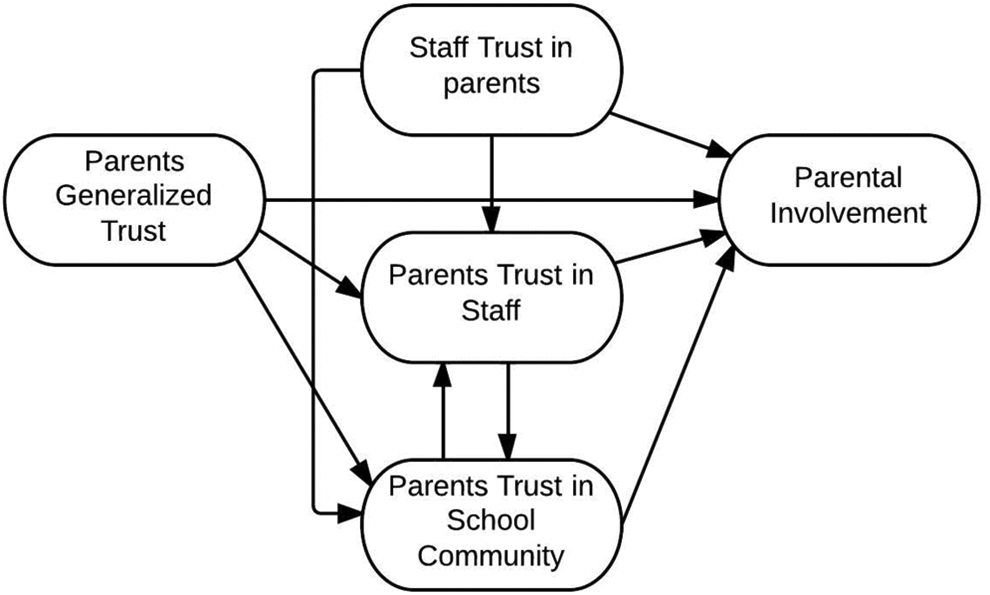
The research model.
Methods
The research instrument was a structured questionnaire, which included 20 items pertaining to parental involvement based on Friedman-Fisher’s scale for parental involvement and attitudes towards school (Friedman and Fisher, 2003), and 33 items measuring trust as a variable of social capital (Harper and Kelly, 2003; Li et al., 2003) and trust in the workplace (Shaw, 1997).
Six indices were produced from the questionnaire and Cronbach’s α reliability was calculated for each index: (1) Passive parental involvement in the school (α = 0.80); (2) Active parental involvement in the school (α = 0.89); (3) Perceived school staff trust towards parents (α = 0.74); (4) Generalized trust (α = 0.69); (5) Parents’ trust in schools' community (α = 0.82); and (6) Parents’ particularized trust in school staff (α = 0.89). The questionnaire also collected basic socio-demographic data.
There are 19 democratic schools operating in Israel, 12 of which were recruited for the study. The number of students attending these schools is approximately 1,700. The questionnaire was distributed to the parents using e-mail and by handing out printed questionnaires at the schools. The data was collected during the first half of 2010. A total number of 404 parents filled and returned the questionnaires.
Data analysis included descriptive statistical analysis in order to examine the parents' levels of trust and involvement, multiple linear regressions were calculated to predict the active and passive parental involvement by the different types of trust. Finally, two structural equation models, one for active parental involvement and another for passive parental involvement, were calculated to evaluate the research model, using the SPSS AMOS program.
Results
The descriptive statistics show that our sample is quite homogenous, and respondents are mostly employed, secular, middle class and highly educated. These statistics represent well the population of democratic schools’ parents.
The distributions of the index scores showed differences as well: passive participation was on average substantially higher than was active participation. The average passive participation index score was 3.7 (all indices are on a scale of 1–5) and the range was 3.4–4.3. The average active participation index score was 2.4 (ranging between 2.0–3.1). Among the different trust indices two types of particularized trust ranked highest – parents trust in the school community (3.9, range: 3.2–4.3) and parents trust in school staff (3.8, range: 3.2–4.2). Generalized trust was somewhat lower (3.4, range: 3.0–3.6) and particularized trust of school staff in parents was perceived by the parents to be relatively low but ranging widely (2.7, range: 2.3–3.4). We tested the data for possible effects of demographics and of parents’ exposure to the democratic school (length of time and number of children in the school) on the index results and none were found significant.
What we did find significant were some of the hypothesized effects of trust on parent participation (see Table 1 for regression results). Firstly, active parent participation was predicted better by trust than was passive parent participation (R2 = 0.4 vs. R2 = 0.2, respectively). Secondly, two different particularized types of trust do predict an increased participation: Parents’ trust in school community (with standardized coefficients of 0.442 for active involvement and 0.316 for passive involvement) and perceived trust of parents by school staff (with standardized coefficient of 0.378 for active involvement and a smaller coefficient of 0.174 for passive involvement). Parents’ trust in school staff is a negative predictor of active parent involvement (with standardized coefficient of -0.147) but is not a significant predictor of passive involvement.
Regression results.

To examine the interrelations between different levels and types of trust in their effect on participation we estimated the two SEMs shown in Figure 2. Both models were significant (at p < 0.01) and demonstrated strong fidelity to the data, as seen in the model fit indices included in the figure (the CFI, TLI and NFI are accepted model fit indices in SEM, and are considered high when they exceed a value of 0.9, and very high when they exceed 0.95. The RMSEA index is considered a stable and robust measure of model fit, and a value bellow 0.08 reflects minimal model-data disparity).
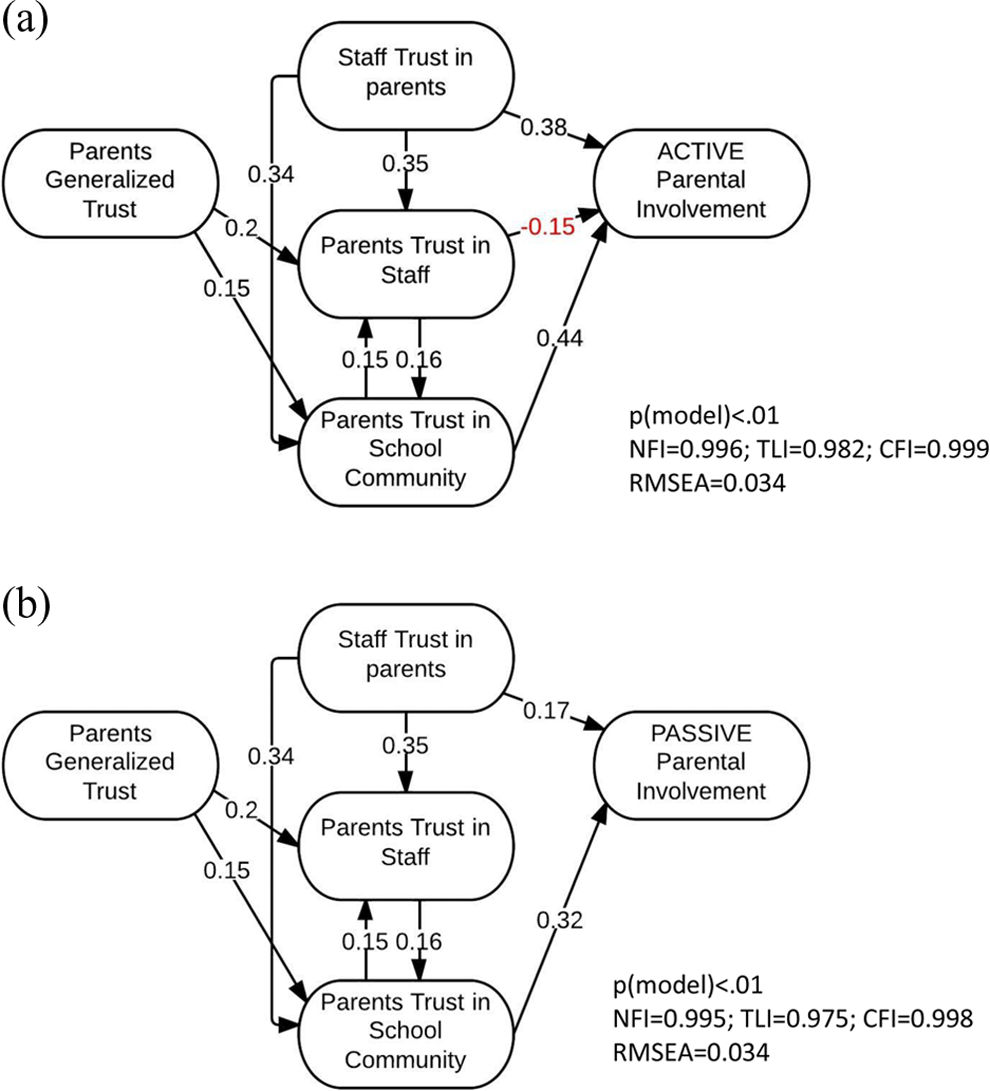
Structural equation models: parental involvement. a. Active involvement. b. Passive involvement.
The first, and possibly most striking finding, is that generalized trust has no direct effect on parental involvement. It does have an indirect effect through its positive effects on more particularized forms of trust (note the paths connecting generalized trust with parents’ trust in staff and in school community). We find also that the perceived trust of staff in the parents has strong effects on parents’ particularized trust (a 0.35 partial correlation in both types of participation), as well as a direct effect on participation (particularly active, with a 0.38 partial correlation). As well, parents’ trust in the school community is positively associated with both active and passive participation (0.35 and 032 partial correlations respectively). There are also various influences of different types of particularized trust on each other.
The main differences between the models are two: (1) parental trust in staff is significant only when active participation is examined, and its effect is negative (a -0.15 partial correlation); (2) perceived staff trust in parents plays a more minor role in affecting passive participation than it does with active participation.
Discussion
Our findings suggest that the ties between trust and parental involvement in school are more complex than what was hitherto put forward in the literature. Moreover, an empirical and conceptual decomposition of trust into different types is crucial for understanding trust effects on parental participation. People with relatively high a-priori generalized trust are more inclined to join voluntary organizations such as democratic schools. However, generalized trust has no direct connection with the level of involvement or participation. Its connection to involvement is via its impact on more particularized types of trust. Once an individual has already joined the organization, ranging levels of particularized trust may increase their actual level of involvement in the organization. Interestingly, parents who feel trusted by the school staff are more inclined to trust and therefore engage in school. This implies that trust, being a component of social capital, is rooted in norms of reciprocity (Fukuyama, 1995, Sztompka, 1999; Putnam, 2006; Mitchell et al., 2008).
From the literature on parental involvement in education we learn that planned positive parental involvement has positive implications for students’ social and academic functioning and for school climate, staff functioning and educational perspective (Rozenblat and Peled, 2003). Furthermore, grassroots organizations such as democratic schools depend on the involvement of members in order to exist, conduct their activities and further develop the organization (Sobeck et al., 2007). Hence, it is important to encourage parents' participation in schools, as it is important to increase members' involvement in grassroots organizations. If we wish to encourage involvement, we should engage in activities that promote personal interactions to increase the sense of community and solidarity among the members of the organization. Such activities will enhance particularized trust, and as a result, enhance members’ active and passive involvement in the organization.
Albeit, some caution would be well advised. First, our findings show that shortage in certain types of trust may actually increase involvement. Secondly, the strong role that particularized trust played in our findings should evoke some concerns when placed in the context of social capital theory. Particularized trust is typical to groups with bonding social capital, more than to groups with bridging or linking social capital (Rothstein and Uslaner, 2005). Therefore, encouraging parental involvement in schools through activities that strengthen particularized trust, might strengthen the school community’s bonding social capital and less, or perhaps not at all, the essential generalized trust needed for the existence of bridging and linking social capital – the two types of social capital, that are so important for the social-economic-technical development of communities, societies and even states and for the establishment of democratic culture (Uslaner, 1999; James and Sykuta, 2004). Furthermore, the literature warns against the risks concealed in bonding social capital and in a narrow radius of trust (Fukuyama, 1995). These risks may be expressed in corruption, discrimination, crime, exceptionalism and self-isolation (Portes, 1998; Fukuyama, 1999). These risks must be taken into consideration when parental involvement programs are planned. In a segmented and fragmented society such as Israel, and in light of the fact that schools of choice, including democratic schools, are predominantly an upper-middle-class phenomenon, we run the risk of alienation, increased fragmentation and segregation. It is particularly important in schools of choice, due to their tense relationships with governmental officials and society at large (Wohlstetter et al., 1995; Wells et al., 1999; Mintrom, 2000; Deal et al., 2004; Honig, 2004; Renzulli and Evans, 2005; Finnigan, 2007; Carr and Holley, 2013), and the threat posed by democratic schools and other schools of choice on Israel’s centralist education policy.
Thus, maybe it is worthwhile to stop and consider – to what level should we bring parental involvement? What kind of involvement do we seek and most importantly – what is the right balance? A balance that on the one hand will bond the members of the organization and on the other hand will not cause them to withdraw from the outside world, but rather strengthen the capacities and benefits associated with generalized trust and bridging and linking social capital.
To encourage particularized trust we would suggest communal activities that foster frequent interactions among community members and activities that will cause the parents to feel trusted by the school staff. These activities should be planned and performed by the school staff and leadership. An example to such activities can be informing the parents of fundamental decisions reached by the school staff, conversations with parents on subjects related to schools' educational philosophy and to the school in general and not only to their children in particular, inviting the parents to participate and express their opinions on subjects related to school policy and school life, inviting the parents to participate in staff meetings, and increasing transparency of school decision making. To strengthen generalized trust we would suggest activities such as exposing school community members to people from different communities and cultures, to public functionaries in the local and national levels, to journalists and senior business persons, and to the processes of political decision making in education.
There is also value to formal and informal training of school community members, to provide knowledge, tools and skills related to the development of those two types of social capital. These can be given by social entrepreneurs who possess experience gained while establishing grassroots organizations and/or by professionals and organizations specialized in assisting grassroots organizations. It is important that such training would include the young members of the school community as well, with necessary adjustments. Since trust or the lack of trust is affected by one's personal experiences starting at a young age (Sztompka, 1999), it is recommended to teach trust from a very young age and thus to nurture a trusting community, which in turn contributes to the development of the different types of social capital.
Such a mix of activities, involving students, parents, teachers and the school community more broadly, are in line with Partnership Schools Comprehensive School Reform (CSR) model (Esptein, 2005). Epstein and her associates (Epstein, and Sheldon, 2002; Epstein, and Sanders, 2006) have shown that educational outcomes improve when schools take comprehensive approaches to family and community involvement such as the ones we profess here.
Conclusion
Our research adds two new insights into the relations between trust and parental participation – (1) generalized trust is only indirectly associated with parental involvement, mediated through different types of particularized trust, and (2) trust may have both positive and negative effects on parental involvement in schools. When educational interventions encourage only particularized trust, they may prove to be detrimental to the school community’s bridging and linking social capital. Our findings support the holistic approaches suggested by models of family school–community partnerships that seem to hold much promise for our schools.
Finally, we should note that since the parents in our study filled in the questionnaire voluntarily, our sample may be somewhat biased. The large number of respondents, the high reliability of the indices and the variance found in the responses cause us to assess that this bias is limited. Notably, parents in democratic schools in Israel appear to be a rather homogeneous population, with relatively high socio-economic status, and therefore generalizations from this study should be made accordingly. Finally, we didn’t consider the variance in organization, ideology and legal and institutional status of the different schools included in the study, and how it may affect trust and participation. These limitations of our study are an opening for future studies that can improve our understanding of the links between trust and parental participation, including random sample studies and studies that incorporate a more diverse set of schools of choice and parent populations.