




Abstract
This study presents part of a research project currently underway which aims to characterise the best practices of highly effective schools in the Autonomous Region of the Basque Country (Spain). Multilevel statistical modelling and hierarchical linear models were used to select 32 highly effective schools, with highly effective being taken to mean any school with higher-than-expected student results after adjusting for the effect of contextual factors. Subsequently, qualitative techniques were used to record the perceptions of the management teams, educational advisors and inspectors of the selected schools regarding the practices in place in their organisations. This paper presents the results obtained in relation to leadership. These results indicate that leadership comprises a number of different competences that are manifested to different extents in the different schools, although a set of elements was identified as being common to the majority, namely: positive leadership in the school management, a clearly defined mission shared by all professionals, a positive attitude to training and lifelong learning, the ability to foster the commitment and motivation of the teaching staff in relation to a common school project, support for teaching and learning processes, attention paid to questions of peaceful and harmonious coexistence and well-organised coordination.
Introduction
This research aims to improve schools by identifying the best practices of a set of highly effective schools in the Autonomous Region of the Basque Country (ARBC), in Spain (Lizasoain et al., 2012). It is a collaborative effort by the University and the Basque Institute for Research and Evaluation in Education (ISEI-IVEI). The methodology used to identify the highly effective schools was applied to the results of the Diagnostic Assessments (DAs) carried out by the ISEI-IVEI of all schools in the ARBC. DAs are tests designed ad hoc by the ISEI-IVEI, with the same aim as PISA (Programme for International Student Assessment), namely to assess students' academic competence in different areas. DAs assess competence in Spanish language, Basque language and mathematics, as well as in alternate years, competence in science, technology and health (2009), and social and citizenship skills (2010), and are administered to all students in year 4 of primary and year 2 of secondary in the Basque education system. They are therefore census-based, standardised assessments which apply the same tests and processes to all students. Thanks to the application of statistical techniques based on multiple linear regression, previous studies published by the ISEI-IVEI in relation to the DAs (ISEI-IVEI, 2010, 2011, 2012) provide schools not only with information about the results obtained by their own students in the different areas, but also with details of how they compare with other schools which follow the same language model, are in the same funding model or have a similar socioeconomic level. What sets our study apart from those that precede it is that it uses multilevel statistical modelling and hierarchical linear models to identify the schools in question. This enables greater statistical precision, since more context variables belonging to both levels (student and school) are considered, thus enabling a better identification of highly effective schools, or in other words, schools whose students obtained higher-than-expected results after adjusting for the effects of contextual variables.
We should also highlight the fact that the aim is for the best practices identified during the research project to serve as a reference for the design of the improvement plans that are developed and implemented in all schools in the ARBC with the advice and support of the education inspectorate and advisors from the educational support services (Berritzegune, 2012). Thus, the research project is clearly aimed at improving the quality of education.
This study presents the part of the research project which identifies the leadership models established in those schools deemed to be highly effective. It has a twofold aim: to describe the leadership styles present in highly effective schools in the ARBC; and to identify common and distinguishing leadership-related practices in these schools, in accordance with either their funding model 1 or other variables.
With the aim of locating the study in its specific context, we will now outline the main characteristics of leadership in Spanish and Basque schools. Since the Organic Law Regulating the Right to Education was enacted in Spain in 1985, school management teams have been democratically elected by the School Council, on which all members of the educational community are represented. Nevertheless, this democratic model for electing the management team has gradually grown weaker over recent decades. Bolivar and Moreno (2006) attribute this to the fact that the democratic model has become a corporate model, in which the management team depends on the teaching staff for election (since teaching staff make up an important part of the School Council) and is therefore forced to negotiate any decisions made with this group. Also, the reduction in the number of people applying for management posts over recent decades has resulted in the education authorities intervening more actively in the selection of candidates, which in turn means that the management team is forced to juggle two separate roles: that of representing the educational community and that of representing the education authorities. Consequently, management teams are less independent in their decision-making, have to cope with a greater amount of paperwork and receive less support in their leadership role.
In response to this situation, the Organic Law on Education (LOE) (LOE, 2006) attempted to render management roles more professional by emphasising the need for training and the importance of establishing accreditation systems, although it opted to maintain the democratic model in which the educational community participates in the election of the management team. Nevertheless, the difficulties inherent in rendering the democratic model compatible with the professionalism of the management team are evident. In this sense, the new Organic Law for the Improvement of Educational Quality (LOMCE), which has been approved and is scheduled to come into force during the 2014–2015 academic year, incorporates a number of changes including a shift in decision-making authority from the School Council to the management team and a greater degree of intervention by the education authorities in the selection and assessment of the management team.
In the ARBC, a series of major changes have been implemented since the enactment of the LOE in relation to the selection and assessment of management teams in public non-university education (Decree 22/2009, Decree 61/2012) 2 . Some other aspects, however, remain unchanged; for example, candidates for the post of head teacher continue to be presented by the teaching staff and selected by a delegate committee of the School Council, although this committee now also includes a member of the education inspectorate.
Since 2009, head teachers have been appointed in accordance with a two-phase merit-based system. In the first phase, their management project is assessed, with special attention being paid to the candidate’s stated ideas regarding how best to develop the various dimensions of the school's educational project. The second phase assesses the merits earned by candidates in relation to their professional experience, language skills and training. All candidates are required to have been working as a civil servant for at least 5 years.
Candidates appointed to a management post with less than 2 years of experience are required to attend and pass an Initial Training Programme. Performance is then assessed by a team from the education inspectorate on the basis of the dimensions included in the management project. A positive assessment enables a head teacher to apply to remain in their post for a second 4-year term. If no aspirants put their name forward or none of those that do pass the selection phase, the education authorities appoint (as an extraordinary measure) a qualified teacher as head teacher for a period lasting no less than 1 year and no more than three. Another possible alternative is to consider external candidates (i.e. people not currently working in the school). In relation to lifelong learning, people in management positions are obliged to attend further training courses and activities organised by the education authorities. It is worth noting that these requirements apply only to public, state-funded schools, not to private schools or partially state-funded private schools.
The progress made at an administrative level in relation to the selection and assessment of the management team contrasts sharply with the small amount of research carried out in this field. If we focus on the Basque region, one of the most important studies carried out in this field was conducted by a group of institutions linked to the education system (Consejo Escolar de Euskadi et al., 2009) with the aim of analysing educational management in 243 public schools at the non-university level. The study concludes that one of the reasons for the lack of candidates for management posts (for two-thirds of all available posts, no candidates had put their name forward) is the absence of regulations governing working conditions (teaching relief entitlements) and real incentives. Other aspects which also require greater attention include training, a certain lack of independence, particularly as regards staff management, and a sense of an overly burdensome workload which leaves little time for the organisation and coordination tasks required to develop innovation projects. Although there is a study which interrelates the organisational and curricular development of Basque and Catalonian schools with the scores achieved by their students (Goikoetxea, 2007), the non-representative nature of the sample group used makes it difficult to draw firm conclusions from the results. Finally, another quantitative study was conducted in advanced vocational qualification courses, focusing on teachers’ transformational leadership and its positive association with students’ cognitive and affective learning, mediated by their empowerment (San Saturnino and Goikoetxea, 2013).
This paper analyses the leadership styles present in schools deemed to be highly effective in the ARBC, in Spain. The lack of research carried out into educational leadership in this region (especially studies including both a quantitative and a qualitative methodology) calls for an analysis of this kind, particularly as regards those schools considered to be highly effective, in which the identification of best leadership practices may serve to reorient improvement plans.
Theoretical framework of reference
The theoretical basis of the study draws on the current drive to improve school effectiveness and leadership styles.
The reason why it forms part of the current drive to improve school effectiveness, a drive which seeks to combine the theoretical school effectiveness approach with the practical school improvement approach, is that the project aims to improve education, mainly by identifying best practices that can then be included in the improvement plans that all non-university level teaching institutions in the ARBC are obliged to compile and implement. As Murillo (2004: 322) states, the current drive to improve school effectiveness aims: To explore how schools can engage in satisfactory processes of change which increase the development levels of all students through the optimisation of both teaching and learning processes and organisational structures, and to use this knowledge to bring about real improvements in the school environment.
Another aspect worth highlighting in relation to the theoretical school effectiveness approach is that this study analyses the added value of schools using multilevel statistical modelling techniques, which enable more precise and balanced information to be gathered regarding the effects of both internal school factors and contextual variables on student learning. It is also a very useful tool for implementing school improvement plans (Martínez Arias et al., 2009). As Murillo (2003) affirms, a school’s effectiveness depends mainly on its ability to foster a level of comprehensive, well-rounded development in all students that is higher than expected given the school’s previous performance and the students’ socioeconomic, cultural and family situation.
These statistical techniques are commonly employed in education system assessment research. The methodological strategy is based on the large body of research published by different teams at both a national and international level, all of which attest to the academic tradition and validity of mixed approaches for identifying best practices in highly effective schools. Of special interest are the papers by Ray et al. (2009) regarding the use of value-added models for improving British schools. Another important piece of research is that conducted by researchers working at the Consortium on Chicago School Research (Bryk, 2010), who carried out a longitudinal study using their own value-added model, in order to identify the reasons why 100 public primary schools in Chicago had substantially improved in reading and maths, whereas another 100 schools had not. The authors identified a set of school practices which promote improvement, as well as a set of conditions required to enable this to occur. Huffman et al. (2006) also used a mixed analysis model with hierarchical linear models and qualitative techniques to the same end.
From a methodological perspective, prior studies conducted in Spain using multilevel models include the work by Marchesi et al. (2002), who sought to identify the variables which predicted academic achievement in secondary school. Murillo and Hernández-Castilla (2011) also analysed the effect of school, classroom and country on socio-affective variables, in a multilevel study with four analysis levels and data for 5600 students from Spain and eight Latin American countries.
The relevance, interest and timeliness of the issue are patent at both a national and international level, as is the importance of opting for a multilevel perspective and mixed quantitative–qualitative approach.
The study of leadership within the framework of the drive to improve school effectiveness is linked to the leadership models associated with both the school effectiveness and school improvement approaches. Research carried out in this area has confirmed the importance of leadership in both change and school improvement (Huber and Muijs, 2010; Leithwood et al., 2008; Murillo, 2006; Robinson et al., 2008). Hence this study aims to identify the best leadership practices of highly effective schools in order to enable their inclusion in the design of training programmes aimed at helping schools to implement their improvement plans.
One of the contributions made by the drive towards improving school effectiveness to the theory of leadership occurred in the 1980s, with the appearance of the instructional leadership model. This model emphasises the involvement of the head teacher in the monitoring and coordination of the curriculum and the teaching–learning process. However, the drive towards school improvement, which focuses on analysing changes in schools, has called this model into question due to its static nature and limited contribution to the improvement of education (Murillo, 2006). Quantitative research carried out between 1980 and 1998, and summed up by Hallinger and Heck (1996), revealed significant yet limited effects of managerial leadership on student learning.
Hence the emergence of the transformational leadership model, which highlights the importance of triggering second-order changes that, despite not having a direct impact on teaching and learning, nevertheless have an indirect effect on these processes (Leithwood, 1994). This model advocates the need to create the conditions under which students will be encouraged to commit to improving their school and will be motivated to work towards this goal (Hallinger, 2003). Teaching staff have the opportunity of learning, sharing and leading through the activation of collaborative processes. Some quantitative studies have tried to identify the indirect effects of leadership on student learning through mediator factors related to the school’s organisational structures and processes (Leithwood et al., 2010), teacher engagement (Leithwood et al., 2008) and job satisfaction (Griffith, 2004).
Another model to be considered recently within the framework of school improvement is the distributed leadership model, which Murillo (2006) defines as a change in the organisational culture of the school, which seeks to foster the engagement and commitment of all stakeholders in the daily running and management of activities. The head teacher assumes responsibility for developing and fostering the leadership skills of others, with the aim of making the most of their abilities and competences. Participation can stem from formally or informally assigned posts (Spillane, 2006) and may vary depending on the specific activity or situation in question. The aim, however, is not to accumulate leaders, but rather to ensure that interaction and joint efforts between individuals give rise to synergies that in turn generate greater individual and organisational leadership capacity (Woods and Gronn, 2009). The focus is firmly placed on the school itself, rather than on any individual leader, and the leadership of the management team is sustained within the context of a school understood as a joint project for educational action, in which teachers themselves become leaders (Bolívar, 2011).
Studies carried out to date have used both qualitative and quantitative methods, with the aim of identifying the relationship between distributed leadership and academic results (Heck and Hallinger, 2009; Leithwood et al., 2007). However, some authors have pointed out the model’s lack of conceptual precision (Mayrowetz, 2008) and the need to explore the issue of measurement in more detail (Spillane and Healey, 2010).
A number of other models have also emerged over recent years, such as the shared instructional leadership model defined by Marks and Printy (2003). This model combines the instructional and the transformational leadership models in order to define a kind of instructional leadership that is shared between the management and the teachers, and which enables organisational learning (Ylimaki and Jacobson, 2013). Hallinger (2003: 345) quotes Sheppard (1996) in saying: When teachers perceive principals’ instructional leadership behaviours to be appropriate, they grow in commitment, professional involvement, and willingness to innovate. Thus, instructional leadership can itself be transformational.
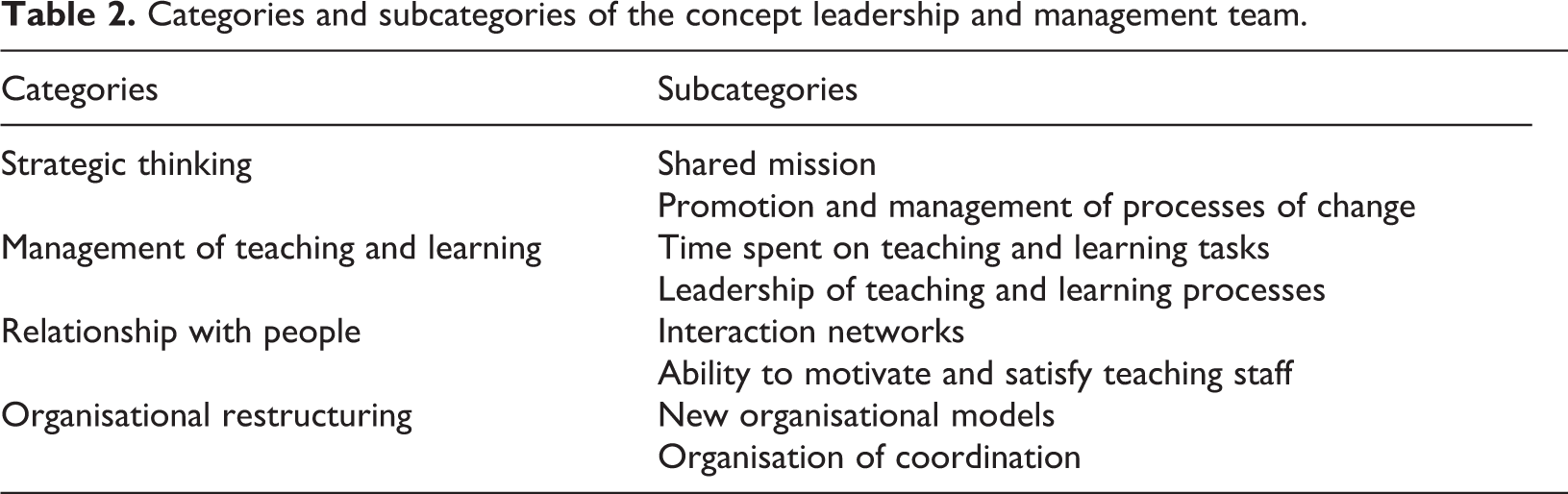
Given that this study aims to describe the leadership models existing in the highly effective schools of the ARBC and their possible similarities and differences, Álvarez’s model (2012) was taken as the theoretical model of reference. The research questions were based on the dimensions included in this model, which itself is located within the distributed leadership model and which identifies four key competences for effective educational leadership: strategic thinking, management of teaching and learning, relationship with people and organisational restructuring.
Research design
This research is descriptive in nature. A mixed model was used, which encompassed both quantitative and qualitative research methods.
Participants
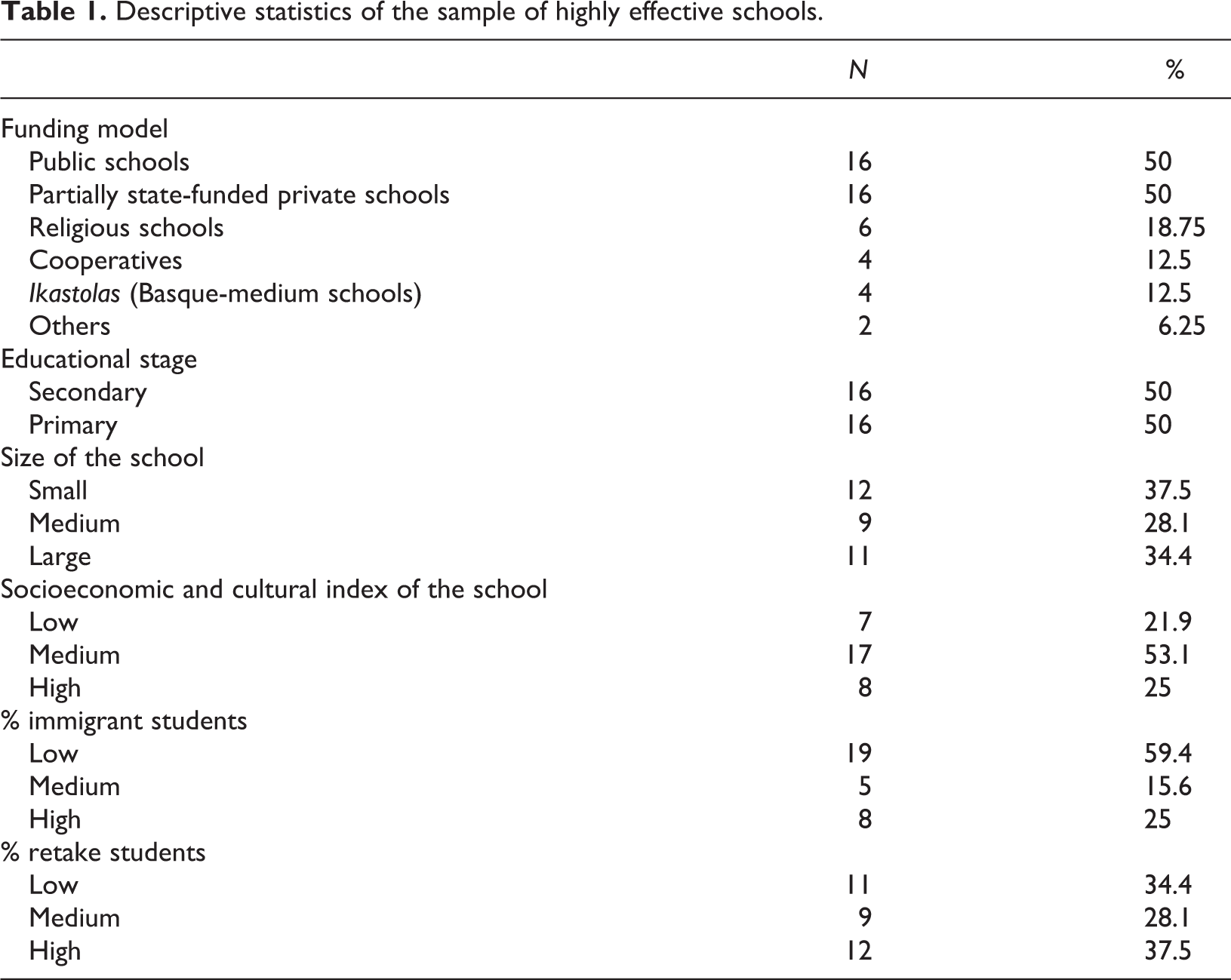
The quantitative study sample comprised the whole school-going population in year 4 of primary and year 2 of secondary in public or partially state-funded private Basque schools, over the space of 2 years: 2009 and 2010. Since this was a census-based study, a total of 409 primary schools were analysed, along with 324 secondary schools, with a total of 33,500 students in 2009 and 36,500 in 2010. Using the stated statistical techniques, 32 schools were chosen. The characteristics of these schools are given in Table 1 below.
Descriptive statistics of the sample of highly effective schools.
The criterion established for selecting globally highly efficient schools for more in-depth study was based on the residuals calculated for each competence and year in which the DAs were conducted in 2009–2010 in accordance with the multilevel models. Schools whose residuals for both years were above the 80th percentile were selected since a certain degree of stability over time was required. Thus, the final procedure for selecting the schools with the highest global added value consisted of reordering these residuals into ranges and following the criterion established either in the three basic core competences, or in two of them and the mean for all four assessed that particular year. The choice of the 80th percentile as the cutpoint was a heuristic decision based on two considerations: firstly, it is a high cutpoint that guarantees that the residual is large enough to render the assumption of high effectiveness plausible; and secondly, the fact that this level must be reached in all three basic core competences (or in two of them and the mean for all four competences evaluated) and in both assessment years means that the establishment of higher cutpoints would be too restrictive, resulting in too few schools being eligible for further study. The 80th percentile criterion resulted in the selection of a manageable number of schools, meaning that the subsequent qualitative study could be conducted in the established timeframe, in accordance with the scope of the research team.
In the qualitative study three groups of key informants from the selected schools participated: educational inspectors, advisors and the management teams.
a) Twenty-five educational inspectors from the 32 selected schools. In Spain, the education inspectorate ensures compliance with current laws, watches over the rights and obligations of those participating in school-based teaching and learning processes and works towards improving the quality and fairness of the education system (LOE Organic Law on Education, 2006).
b) Twenty-six key educational advisors from the selected schools. These advisors belong to the non-university educational support services. They offer advice on teaching issues, organise training sessions and work to promote innovation, experimentation and research in schools (Decree 15/2001, Basque Country Official Gazette).
c) Thirty management teams from the 32 selected schools (two schools were selected at both primary and secondary level, since they were combined primary/secondary schools, and in these cases the management team was the same for both).
Instruments
Highly effective schools were identified on the basis of the results of the DAs carried out in the ARBC in 2009 and 2010. A questionnaire was also used to gather information regarding the main contextual variables for both families and schools.
For the second phase of the research project, namely the characterisation of best practices (the qualitative study), a number of different instruments were developed as the basis for a series of semi-structured interviews with the three groups of informants.
Procedure
For the quantitative study, the preliminary statistical analyses were carried out, along with the design, adjustment and validation of the hierarchical linear models, in order to obtain the residuals. Once the group of highly effective schools had been selected, their practices were characterised by means of the qualitative study. The tasks performed were as follows: preliminary definition of the areas and variables to be studied, based on a review of the relevant literature and similar research studies; selection of the areas and variables and design of an initial set of categories and subcategories; study of possible informants and their subsequent selection; study of different techniques to be used and design of the instruments, adapted to each specific group; establishment of a common protocol for the interviews; confirmation of informants’ availability for interviews and making of appointments; and finally, the conducting of the interviews themselves after first obtaining informants' consent to be recorded. The interviews were conducted between January and May 2012, with each informant being interviewed by two members of the research team. The process prior to the interviews was carried out blind (i.e. the researchers were unaware which school was being selected), using the codes assigned to each school by ISEI-IVEI for this project.
Analysis
For the adjustment and validation of the multilevel models in the quantitative study, the level 1 covariables for students and level 2 covariables for schools were incorporated; for these, the rates and their means corresponding to all students in each school, segmented according to stage and year, were also obtained.
Once the different models had been developed and validated, the differential or residual scores were calculated for each school. The models varied for each subject, year and stage, since the effect of the different contextual variables was not the same in all cases. For example, some variables, such as Basque being the primary language used at home, had a greater effect on Basque language competence than on Spanish language competence or mathematics.
Once all the interviews had been carried out for the qualitative study, the data gathered were transcribed and each sequence assigned to one of the analysis categories. For the category ‘leadership and management team’ the reference used was Álvarez’s model (2012). The various subcategories were obtained through repeated readings and constant interaction between the excerpts in this category. A list of categories and subcategories is provided in Table 2.
Categories and subcategories of the concept leadership and management team.
Findings
As regards the selection of highly effective schools in the ARBC, the results reflect the diversity of this region as regards school funding models, with a substantial presence of partially state-funded private schools. The selection of highly effective schools included both public and partially state-funded private schools (teaching cooperatives, schools linked to a religious network, lay schools and those with a strong cultural-language component, such as partially state-funded private ikastolas, or Basque-medium schools). The schools were also extremely diverse as regards their socioeconomic and cultural indexes, percentage of immigrants and retake students and size.
According to the results, collegiate bodies such as the management team, School Committee of Pedagogical Coordination or other commissions, are made up of different members whose functions vary from school to school, particularly when we compare public schools with partially state-funded private ones. Members of the management team are appointed in one of two ways; in 10 cases managers voluntarily applied for the post, while in all other cases they were democratically elected by School Council or mandatorily appointed, by the education inspectorate in the case of public schools, or by the association or institution to which the school belongs, in the case of partially state-funded private schools.
No common distributed leadership style (as proposed by Álvarez’s (2012) theoretical model) was identified for the different schools, and the four different key competences proposed by this author were found to be present to differing extents, as can be observed in the results presented below. This section describes the results in accordance with the stated aims, following the order of the subcategories established during the design phase. Common and distinguishing aspects will also be mentioned, with the aim of responding to the study's second aim.
Strategic thinking
Strategic thinking refers to the ability to chart a course for the school, and to identify needs and foster processes of change to bring it about.
Shared mission
All three informant groups coincided in stating that the majority of the schools studied claimed to have a shared mission which linked all members of staff in pursuit of a common goal. This mission is based on a set of basic principles and values which are, in some cases, religious, identity based or social in nature (care of the underprivileged, defence of public services, cooperativism, etc.). The family tradition of certain schools, the fact of belonging to associations or institutions with a strong cultural or religious identity, and having implemented a quality system are elements which contribute to the development of a clear, shared mission.
We believe it is important to have clear goals, but everyone has to be heading in the same direction; in other words, it is important to involve teachers, parents and students. (Management team, School 35068) The staff are all committed to the school’s ideology and philosophy (…). Here they believe and are survivors. (Inspector, School 35462)
The school's organisational principles and values are clearly specified by the majority of participating management teams and, according to them, are explicitly and implicitly conveyed to and spread among the staff. This claim is also present in the responses provided by inspectors and advisors. Evidence of this lies in the initiation plans for new teachers, which aim to foster their adhesion to the school's ideology and working dynamics. In the case of partially state-funded private schools, the high level of specificity and planning in this area is especially worth mentioning. In these schools, training sessions are organised for new teachers, and each new member of staff is assigned a tutor, namely a colleague who helps them through the adaptation process, which may last for as long as 2 years. Other evidence includes staff selection criteria, which in partially state-funded private schools are closely linked with the organisation’s ideological outlook.
When hiring a new teacher, candidates are told what type of school this is and are provided with a copy of the teaching function handbook. They are also assigned a tutor from the existing teaching staff. As I always say, it takes a new teacher about two years to really understand and enter into the dynamics of this school. (Management team, school 26576) If a candidate can prove that they are from the local area and are known to us, i.e. is a former student, then this counts as a point in their favour. (Management team, school 26180)
Participating informants from public schools identified management teams which are committed to the school’s educational project and are capable of motivating the teaching staff. The role of a stable group of experienced teachers in the school was also highlighted as a factor which fosters a sense of identity. The work of these teachers is vital in the process of conveying the school’s values and teaching convictions to new members of staff, imbuing them with a sense of belonging and encouraging and helping them to adapt to this particular way of working.
There is a stable group of teachers who make every effort to ensure that the whole thing works; and not only that, they also assume responsibility for showing new teachers what we do here and how we do it, which isn’t always the case in every school (…) you feel protected, it is something you feel thankful for. (Advisor, school 31746)
Promotion and management of processes of change
Although most management teams focus on new training areas and try to identify emerging training areas or opportunities for educational innovation, advisors and inspectors are of the opinion that only some are capable of fostering processes of change which include modifications to the school’s organisational structures and management tools. Some examples include the setting up of process groups or new commissions for strategic planning and the active role played by some collegiate bodies in submitting educational proposals.
Differences were observed in the way in which innovation processes were implemented:
a) In some cases, it is the management team's responsibility to identify and make decisions regarding training needs, although, according to the management teams, they generally tend to listen carefully to teachers' suggestions.
b) The advisors coincided in stating that many of the schools (mainly partially state-funded private schools) rely on their own associations, institutions and external advisors to define training needs. Public schools tend to participate more in proposals tabled by the education authorities, although sometimes the management teams decide to look for training and innovation proposals elsewhere, since they believe they respond better to the specific needs of their school.
Their associations are organised. Whenever they see an innovation program they believe could be useful, they get right on it. (Inspector, school 36124)
c) In the majority of partially state-funded private schools it is the management team which decides who is to participate in the training activities. In public schools, no clear trend was identified, since in some schools the management team asks all teachers to participate, while in others teachers are given more freedom to decide which training activities they wish to engage in. The following excerpts from the interviews illustrate this point.
Innovation programmes are established by the management team; attendance is also decided by the management team and may be obligatory. (Advisor, school 35662) The school’s management team has to push for ongoing teacher training, since the education authorities do not establish the necessary dynamics in this sense. (Management team, school 29612)
d) According to inspectors and advisors, the training received does not always filter down into daily practice in the classroom.
e) Schools which do implement educational innovations in practice, assess the results.
We are working with cooperative learning methodologies. We are beginning to think about working in this way. We first started thinking about it at staff meetings and the idea proved popular; we are now implementing it systematically. (Management team, school 30602)
In this regard, inspectors and management teams stated that almost half of all highly effective Basque schools, both public and partially state-funded private ones, have a well-developed culture of evaluation. Evaluation processes focus on the assessment of the management team, teaching staff and families, as well as on specific programmes and activities. The management team constantly strives to gather data regarding different areas with the aim of using the information to design new improvement proposals. Many of these schools have a quality management system like EFQM
3
.
Quality processes are extremely useful. Syllabuses, exams, tutorials and coordination sessions are all assessed. Internal and external audits are carried out. A report is drafted for each academic year. (Management team, school 36180)
Management of teaching and learning
This section includes the references made by informants to the management team's handling of and attention to teaching and learning processes.
Time spent on teaching and learning tasks
Management teams indicate that most of their time is spent dealing with unforeseen events, management tasks, bureaucracy and paperwork. Time available for dealing with students, teachers, families and educational tasks is shorter than would ideally be required, although some head teachers attach greater priority to these tasks than others. A certain degree of weariness and dissatisfaction was expressed in relation to the bureaucratic demands of administrative tasks, especially by management teams working in public schools. This sentiment did not appear so explicitly in the responses provided by inspectors and advisors.
On a day-to-day basis, unexpected events take time away from dealing with school activities and other scheduled issues. (Management team, school 31746)
There is a fairly general consensus among all three informant groups that one of the common characteristics of all schools is that the functions of all members of the management team are clearly defined. This is aided by the guidelines laid out in the Basque School Act (1993), which define the functions of all school bodies (both groups and individuals). There is shared leadership which, in the case of teaching and learning processes, is assumed mainly by the deputy head responsible for curriculum programming
4
and the key stage coordinators. As indicated in the excerpt below: The head teacher is a manager and educational management falls to two deputy heads, one for secondary school and sixth-form, and the other for primary. (Inspector, school 35926)
Nevertheless, according to advisors and inspectors, in the majority of cases head teachers tend to have extensive experience in the school, both in teaching and in managerial posts. They comply with a series of criteria, such as having worked at the school for a long time, possessing an excellent level of both educational and institutional expertise, being highly motivated and hardworking, and being concerned about the school's problems. Thus, they enjoy a high level of respect and acknowledgement, which in turn bestows upon them a certain degree of moral authority. It is worth noting that head teachers continue to teach part-time, thus remaining in first-hand contact with what is happening in the classroom (Basque School Act 3/2008).
The three members of the management team are responsible for all aspects of school life. They are former students, so they know the school inside out and care about it deeply. (Inspector, school 37202)
Leadership of teaching and learning processes
The projects led by team managers are monitored, and there is communication between them and the management team. Some informants underscored the importance of teaching and learning process management commissions (School Committee of Pedagogical Coordination), as well as the importance of having efficient communication channels between the management team and teachers in this area, since during commission meetings, the deputy head responsible for curriculum programming and the stage coordinators agree on the methodological approach, resources and assessment instruments to be used, etc. The value of an open-minded, accessible management team was also highlighted. All three informant groups value the importance of self-organised groups of teachers, although they insist that it is the management team’s job to establish general guidelines and make high-level decisions.
The establishment of the annual plan is not imposed by the management team. The management team establishes guidelines, but then each key stage team meets to decide how best to put those guidelines into practice. Teachers make their own proposals. (Management team, school 37004) Both are compatible – we ask teachers their opinion and then decide. (…) they state their opinions, we assess them and then, with a great deal of diplomacy and determination, we set things in motion. (Management team, school 37884)
The interviews indicate that there is no direct supervision by the management team of teachers’ work in the classroom, since the Basque School Act does not oblige schools to assess teaching practice, and neither is it a criterion taken into consideration for teacher promotion. The absence of instructional supervision makes it difficult to involve teachers in assessment processes and to develop a culture of evaluation in the school. Nevertheless, some partially state-funded private schools do assess teachers’ work through questionnaires or interviews with the management team. Almost all of these schools have a quality management system.
The competences of the teaching staff are also assessed and an improvement plan is drawn up for each teacher in accordance with the results. The members of the management team are also assessed. The management team is assessed by both teachers and families. (Management team, school 30602)
The management teams cited two management strategies that stand out in both public and partially state-funded private schools, for teaching and learning and peaceful and harmonious coexistence processes:
a) The participation of a member of the management team in the meetings held to discuss projects or tutor meetings. The main reason for this is to provide teachers with support and to gain a better idea of what they need, although in some cases it may also be due to a certain desire to maintain control.
Tutor meetings are chaired by the supervisors, but there is always a member of the management team present. The aim is to gain a clearer understanding of the atmosphere. (…) if we are there, we hear about problems and ideas first-hand; it is also important to convey a sense of engagement. (Management team, school 32846)
b) A firm response by the management team in order to find solutions to any conflicts that may arise, particularly among students.
Teachers respond, but at the same time they feel supported. If there is an incident the management team goes up, the deputy head responsible for curriculum programming talks to the class, there is active engagement. (Management team, school 31746)
The majority of informants in all three groups stated that their management teams had a strong commitment to the comprehensive education of their students, backed up by tutorials and individual follow-up and monitoring activities. Nevertheless, underlying all discourses is a strong desire to strengthen core subjects (maths and languages), and even to increase the number of teaching hours dedicated to these subjects, particularly in partially state-funded private schools. Intervention in these subjects is the priority aim of the majority of the improvement plans designed in response to a request from the education inspectorate.
Relationship with staff
Interaction networks
The interviews indicate that, in general, the management teams believe in their schools and are fully committed to their jobs. They lead the school on the principle of teamwork, and generate a strong sense of commitment and engagement in a common project among those who work most closely with them. The following excerpt clearly illustrates this: The management team is effective and committed, they value teamwork highly. (Advisor, school 29986) They prefer things to be accepted during staff meetings, that way, people at least feel that it is their project, not something imposed by the management. A vote is taken during staff meetings, even when it is not strictly necessary. (Advisor, school 32846)
Some advisors and inspectors from partially state-funded private schools identified management leadership styles which focused on control, rules and regulations and operational authority. Certain contradictions were observed between what these informants said and that stated by the members of the management team, who considered themselves to be more democratic.
Relationships between teachers are somewhat strained, because there is not much democratic spirit, there is too much imposition. Young teachers don’t dare say anything. There are strict rules for everything. (Advisor, school 26180) They exercise their authority, give orders (…). The head is capable of listening and accepting proposals, but in staff meetings what he says is never questioned. (Inspector, school 33924)
One exception observed was a member of the management team who was more ambiguous in his actions, and showed a tendency to delegate tasks and demand that a minimum set of criteria be complied with.
I do what I’m told. I have my own set of criteria, but I don’t mind delegating (…) I delegate all I can. (Management team, school 28952)
At some schools, both public and partially state-funded private ones, all three informant groups allude to natural leaders who stand out from the rest and fill the post of deputy head teacher or school counsellor
5
, or who form a stable group within the school. Their professional experience, engagement with the school and its students and their people skills all help get teachers involved in their initiatives.
I think there are people who are perhaps elected because they are more engaged, they are the ones who really get things moving, the ones who try to guide or sweep everyone else along with them (…). It is possible that it is these people who prompt everyone else to join in. (Advisor, school 32252) The one who really has an effect is the deputy head (…). Although the head teacher is there, he is new and fairly young, whereas the deputy head has been there for years (…) she has a clear vision of what the school should be and it’s she who really carries the burden of responsibility. (Inspector, school 37532)
Ability to motivate and satisfy teaching staff
Based on the information provided by all three groups of informants, it can be deduced that the management teams are generally capable of transmitting their motivation, commitment and engagement with the school to staff, students and families. The time spent by the management team and teachers at their school often far exceeds established working hours. This is something mentioned time and again by informants. Management teams are aware that their commitment to the school requires a lot of time and energy, and gives them both moments of satisfaction and moments of frustration. There is a clear tendency to positively value the responsibility assumed by the management team in creating a climate conductive to a sense of belonging.
You can really tell when a management team establishes a good atmosphere. There are no major ideological disputes, even though the people working here are very diverse. (Management team, school 29986)
The members of the management teams interviewed, particularly those working in public schools, highlight the importance of responding to teachers’ requests and trying to ensure their wellbeing. One strategy is to designate one particular person at each key stage to help new teachers settle in.
The head is the driving force … She is always working to make sure people don’t feel overwhelmed. (Advisor, school 28798) It is a management team that fights tooth and nail to defend its teachers, it's a staunch defender of the work carried out by its teaching staff. (Inspector, school 32846)
In partially state-funded private schools, there is a tendency to make those teachers who live up to expectations permanent members of staff, while in public schools’ management team discourse there is a call for greater stability among teachers. When the information provided by inspectors, advisors and management staff is compared, contradictions are observed in relation to the perception of stability among the teaching staff in these schools.
The need to protect teachers' working conditions (timetables, work-life balance, etc.), as stated by some members of the management teams, contradicts the high level of professional dedication required from teaching staff, who spend more time at work than established in their contracts in both public and partially state-funded private schools. The following excerpt is highly illustrative in this sense: With regard to teachers, when establishing timetables, suggestions are accepted and our aim is to enable a good work–life balance. Personal issues are taken into account whenever possible. (Management team, school 35662)
Organisational restructuring
New organisational models
Given the variety of school types studied, different organisational models are to be expected. One model which stands out is the bureaucratic model with a management framework based on fixed, fairly rigid structures, which is governed by the education authorities through designated collegial bodies and individual figures (Basque School Act, 1993). Nevertheless, the informant groups differ as regards their perception of the way in which schools are structured. While some advisors and inspectors perceive some schools as having rigid, hierarchical structures with a more bureaucratic management style, the management teams of some of these same schools see their structures and working teams as being more flexible. Advisors and inspectors relate these schools to hierarchical structures in which the management team is firmly in control of the decision-making process. Communications channels do not work effectively, teachers do not always hear about the decisions made and their proposals are not always taken into account by the management team.
However, some management teams have instigated certain organisational restructuring processes, such as the setting up of bodies to respond better to the school’s needs, or the structuring of the school into process groups linked to the quality management system. These schools explicitly state the importance of setting up cross-functional, vertical structures that foster the participation of teaching staff and the distribution of responsibilities.
They have set up a kind of body, similar to an educational commission, although I think it’s something different; it’s mainly a management, participation and coordination body. (…) distributing management tasks among a group, a management group, has lent a certain degree of dynamism to the whole working of the school. (Advisor, school 37532) We are committed to participatory management, within the EFQM management system, and we believe in a horizontal rather than vertical organisation. There has been a change of mindset. (Management team, school 35662)
Organisation of coordination
A common characteristic of almost all management teams analysed is their ability to organise coordination well. Informants underscore the importance attached by the management team to systematic coordination (both horizontal and vertical), in order to ensure the consistency of key teaching and learning processes.
Internal coordination aims to respond to the needs of the teaching and learning processes. The frequency of these coordinated actions varies from school to school. Coordination with external organisations is something which occurs in almost all schools. Over and above the usual coordination actions in this field, of special interest here are coordination with schools at other educational stages, coordination with associations and institutions (cooperatives, ikastolas, religious congregations, etc.) and coordination with other schools with acknowledged best practices. In many of the schools in which this kind of coordination is found, these kinds of synergies with external organisations have been developed through the implementation of quality management systems.
The organisation of coordination is intentional and planned, and the results are published using different media (telematics platform, calendars and notice boards in the staff room). Some schools have established strategies for ensuring efficient coordination, such as: a) establishing a common free period for coordination activities; b) work in relatively small teams to foster greater consensus in decision-making and swifter responses to unexpected problems; and c) systematisation of the working plan for coordination activities (aims, procedure, monitoring and control of decisions), with the help of telematics platforms and the recording of actions through the drafting of minutes.
The better the coordination between teams, the better the result (…). The ‘we educate’ platform has been implemented at the school and has opened up an internal window of communication which is much faster and more immediate, not only between teachers but also with students and their families. (Management team, school 26576) Free periods at school do not belong to the teaching staff but rather to the school, and it is up to the school to decide how they should be used: how many for personal work, how many for coordination activities and how many for the support service. (Management team, school 27082)
Discussion
This section will present the common elements and differences identified in the majority of highly effective schools, bearing in mind their specific characteristics (type of school, size, context, etc.). Each of the competences analysed by the theoretical model of reference (Álvarez, 2012) will be described: strategic thinking, management of teaching and learning, relationship with people and organisational restructuring. Where appropriate, the contradictions identified between the three informant groups (management team, advisors and inspectors) will also be outlined.
The highly effective schools selected were broadly different as regards their size, socioeconomic and cultural level and type of students. This indicates that some schools obtain higher-than-expected results in certain competences despite their unfavourable context, which strongly suggests that the added value provided by these schools is an element well worth studying.
In relation to leadership, the information provided by informants from the highly effective schools selected highlights the fact that the management team acts as a clear leader in practically all the schools studied. This leadership role encompasses a number of different skills and competences, which are manifested to different extents in the different schools; nevertheless, and consistently with the results of other studies (Murillo, 2004), a set of elements common to all schools was identified.
One of the elements common to the majority of highly effective schools studied was that the staff had a clear idea of the school's mission, principles and values. The management team communicates an undeniable sense of school identity, which may be linked to cultural, religious and/or social factors. Members of the management team are able to steer their fellow professionals, motivate them and encourage them to commit to the identity-based principles that inspire their teaching activities. This is what Caldwell and Harris (2008) call spiritual capital, and is one of the four key factors for school transformation.
From the interviews held with the informants, we can deduce that the majority of management teams are extremely capable when it comes to analysing the situation, identifying needs, obtaining the necessary resources and guiding intervention. They value training and strive to foster it among their teaching staff. Some differences were identified in relation to the variable funding model. Firstly, partially state-funded private schools tend to take advantage of the offers provided by their associations or other external trainers, while in public schools there is a greater tendency to participate in the training and innovation projects proposed by the education authorities. Secondly, in partially state-funded private schools it is the management team that, to a large extent, decides who will participate in the training activities provided, while in public schools, the management team tends to be less strict about obliging teachers to participate. In these schools, there is a tendency to negotiate with teachers regarding the tasks to be carried out, thus helping to guarantee their wellbeing. This aspect has been well documented in other studies (Bolivar and Moreno, 2006) and may be due to the head teacher’s need to gather support for re-election. One difference detected between informant groups is that inspectors and advisors allude to the difficulties involved in applying the new methodologies learned during training activities to everyday teaching practice, while no explicit mention is made of this problem by management teams. Half of the schools studied use assessment as both a training tool and a means of helping them identify areas of possible improvement. The culture of continuous improvement is fostered by the management, and is particularly evident in those schools that work with quality management systems, as observed also in other studies (OECD, 2007).
In relation to the management of teaching and learning, it is worth mentioning that the duties to be assumed by each member of the management team are clearly defined and the work carried out is cohesive and collaborative in nature. There is shared leadership in the field of teaching, although this responsibility tends mainly to fall to specific members of staff, such as the deputy head teacher responsible for curriculum programming. It should be highlighted that the extensive teaching experience of the head teacher, as well as their commitment and dedication, bestow on their leadership a certain degree of moral authority and credibility. This aspect was also identified in the case studies carried out in different countries by Ylimaki and Jacobson (2013). These authors found that a head's teaching experience enabled them to better understand the democratic processes required to foster teachers' commitment to the curriculum. It is worth highlighting that in the head teacher selection process, current educational policy values candidates’ teaching experience in the school, and requires that head teachers continue to have at least some teaching hours (Decree 61/2012).
Nevertheless, certain contradictions emerge in the information provided by informants. Firstly, a certain degree of dissatisfaction was expressed, particularly by the management teams of public schools, regarding the time spent on bureaucratic tasks, often to the detriment of other aspects which are considered a priority, such as responding to the demands of teachers, students and families. This aspect was not alluded to so frequently by inspectors and advisors.
Secondly, it can be deduced that teaching demands ongoing, bidirectional communication between the heads of the various commissions/groups. Coordination between these groups is generally planned beforehand, thus enabling fluid exchanges and teamwork. In general, a great deal of importance is attached to the fact that groups of teachers are free to make their own decisions regarding classroom activities and practices, although informants also insist that the management team needs to establish the basic framework for action. Although informants claim that the management team is generally willing to listen to teachers’ opinions and take them into account, it is not entirely clear to what extent they establish aspects pertaining to distributed leadership, i.e. giving teams the freedom to decide and elect their leaders in each situation, making the most of teachers' skills and initiatives and incorporating them into the global project, etc.
Thirdly, although collegiate bodies such as the School Committee of Pedagogical Coordination act as a meeting point between one member of the management team and stage coordinators, with the aim of harmonising teaching and learning criteria, it is often difficult to determine exactly what teaching practices teachers use in the classroom. The Basque School Act does not regulate teaching practice, and this lack of legal obligation makes it difficult to systematically assess teachers’ performance in the classroom in order to plan improvements. This is particularly true in public schools (Consejo Escolar de Euskadi et al., 2009; OECD, 2007). Nevertheless, the management project which the education authorities now require candidates for the post of head teacher to compile aims to deal with this issue by insisting that projects include assessment and change management among their dimensions, in order to optimise students’ educational response (Decree 61/2012). In any case, schools generally tend to try and find alternative strategies to allow them to gain a better idea of how teachers perform in the classroom. For example, the management team supports the teaching and learning processes; in some schools, they participate in staff meetings in order to gain a better idea of teachers' needs and demands, even though this may sometimes be interpreted as an attempt to control the decisions made during these meetings. They also adopt a deliberative attitude when backing teachers up in the event of disruptive students or general instances of conflict in the school. Deliberation as a means of effectively resolving conflicts in order to protect and support teachers is mentioned frequently in the discourses of management teams from public schools. This same result has been reported also by other authors studying educational leadership in Spain (Bolivar and Moreno, 2006).
A series of characteristics pertaining to transformational leaders also emerged from the study, with the majority of management teams looking after their teaching staff, motivating them and fostering their commitment to improving the school. In this sense, what we observe here is fairly similar to shared instructional leadership, which unites both the instructional and the transformational styles. Nevertheless, some members of management teams allude to specific characteristics, such as the adoption of a more transactional leadership style based on responding to the demands of different groups of teachers, in order to try and avoid friction and ensure the highest possible level of wellbeing among teaching staff. It is also worth noting that some inspectors and advisors, especially in partially state-funded private schools, identified more directive leadership styles (Murillo, 2004), while these same management teams tended to see themselves as being more democratic. One exceptional case of leadership very close to the laissez-faire style (Lewin et al., 1939) was identified. The varied discourses recorded in relation to leadership style raise the issue tackled by Bolivar and Moreno (2006) in their study, i.e. that directive leadership in our context seeks to strike a balance between the demands of parents, the requirements of the education authorities and the pressure exerted by teachers. According to these authors, this prompts management teams to switch between a transactional leadership style which aims to establish a certain degree of control over teachers while at same time being accountable to them, and a transformational style, which enables them to be proactive in seeking collective action within the school in response to the changes and innovations required by the educational community. Although it is obvious that many of the management teams studied here aim to adopt a transformational leadership style, sometimes the bureaucratic model most typical of administration posts and the pressure and friction existing between different groups of teachers may force them to assume a moderating role in conflicts, thus frustrating their desire to enact change and engender innovation.
All three groups of informants identified other leaders, in addition to the head teacher, who are able to exert substantial influence. These were mainly the deputy head teacher responsible for curriculum programming or the school counsellor. Some informants working in public schools highlighted the work carried out by certain groups of long-term teachers to help foster engagement and involvement in the school and its objectives. This aspect was identified also in the study conducted by Murillo (2004).
The commitment shown by the management teams participating in the study is evident in the amount of time they dedicate to their professional activities and their ability to convey their motivation, commitment and sense of belonging to the school. The desire to satisfy their teaching staff and ensure their wellbeing, particularly in public schools, confirms the tendency in both Spain and the ARBC towards the adoption of the transactional leadership style outlined above (Bolivar and Moreno, 2006).
Certain differences were observed between public schools and partially state-funded private schools in relation to staff working conditions. While the partially state-funded private schools studied aim to offer permanent contracts, the head teachers of public schools demand a greater degree of freedom from the education authorities in terms of staff management. This demand has been reported also by other studies (Consejo Escolar de Euskadi et al., 2009; OECD, 2007). The need to ensure good staff working conditions, which was alluded to by management teams, contrasts with the high level of dedication demonstrated by staff to their professional activities.
The structure of the organisational model is, in the majority of cases, traditional, given that schools comply with the demands of the education authorities as regards educational bodies and their functions (Basque School Act, 1993). A few advisors and inspectors allude to more hierarchical organisational structures which give the management team more control in the decision-making process. Nevertheless, some management teams were observed to have the ability to strengthen and encourage the restructuring of the organisational model by setting up new bodies or new process-based management models linked to quality management and designed to ensure a broader distribution of responsibilities. Another common characteristic of all schools is planned coordination that aims to ensure consistent key teaching and learning processes.
It is worth highlighting that in this study, no significant differences were observed in relation to some school-based variables, such as size and context, etc. with the most significant variable being type of funding model. Nevertheless, bearing in mind the contingency model and the fact that leadership practices may have different effects depending on the situation of the school and its organisation (Crum and Sherman, 2008; Hallinger and Huber, 2012), future research should consider the use of other techniques, such as direct observation, in order to complement the information gathered and gain a more holistic view of the characteristics of each school and the complex relationships that are generated between different leadership-related variables.
By way of conclusion it is important to note that since the information provided by the management teams was gathered using self-reports, the data may to some extent be self-fulfilling, with informants endeavouring to report in their answers those elements of school practice which might lead to high effectiveness and to minimise other, less exemplary elements. Consequently, the study would benefit in the future from the inclusion of complementary data from school staff, to verify their managers' discourse. Another means of obtaining more conclusive results would be to compare the practices identified in highly effective schools with those in place in schools with a very low residual (added value), in order to avoid erroneous conclusions owing to the lack of this information.