




Abstract
This study applied multilevel modeling to examine how individual characteristics, such as gender and teaching experience, and contextual characteristics, such as principal leadership and perceived colleague support, influenced Korean secondary school teachers’ sense of job satisfaction. Previous research identified teachers with high job satisfaction to have positive influences on their students, making it important to understand teacher job satisfaction not only for teachers but also for students. Using data from a nationally representative sample of 2908 teachers from 150 middle schools, the results indicated that (1) among teachers’ individual characteristics, teacher efficacy had significant effects on teacher job satisfaction, and (2) among institutional, school-level characteristics, perceptions of academic climate, support from colleagues, and supportive principal leadership had significant impacts on teacher job satisfaction. The findings of this study provide reason for individual teachers to reflect on their sense of efficacy and the influence it can have on their professional practice. The study also suggests ways to create better education policies on the basis of its empirical data.
Introduction
Teacher job satisfaction is of great importance not only for the welfare of teachers themselves but also for their students and schools, which benefit from the presence of highly motivated teachers who can better bring about change. Scholars from various countries have identified the importance of teacher job satisfaction. For instance in Italy, teachers with lower stress levels are identified as being better able to support student achievement (Caprara et al., 2006). Teachers leaving the profession because of job-related stress have been identified as one of the main reasons for the teacher shortage in the UK (Crossman and Harris, 2006). Studies from South Korea have focused particularly on teachers’ job satisfaction and its connections to the quality of education students receive (Cho, 2005; Lee, 2010).
Research investigating teacher job satisfaction that focuses more on individual characteristics, such as gender and age, regardless of the characteristics of a school, such as whether the teacher perceives a high-quality academic atmosphere or a sense of teamwork from the school to which they belong to can be less effective. This cannot produce accurate results because teachers’ experiences are so closely connected to the context in which they work. The purpose of this study is to overcome these past limitations by examining both individual and contextual factors (the perceived culture of the school) that influence teachers’ job satisfaction and to investigate them in a way that reflects teachers’ reality, embedding the teachers in their school contexts. From the findings, we make suggestions for improving job satisfaction among the teachers in South Korea.
Theoretical background
In order to understand better teacher job satisfaction, we were guided by Bronfenbrenner’s (1992) ecological systems theory. Ecological systems theory, with its understanding of systems and its relationship with the individual, lends itself well to examining teachers. One can understand teachers as having individual characteristics; being situated in classrooms, which make up their immediate system; and the various classrooms with other teachers, administrative staff and principal coming together to make up the larger system we call schools. Therefore teacher job satisfaction is influenced not only by their own characteristics but also the culture of their schools.
Previous research on teacher job satisfaction has separated factors into categories such as those that are related to the environment, the teacher’s psychological background and demographic characteristics (Crossman and Harris, 2006). Whereas, for this study we separated the factors into two categories: enduring traits, those that teachers and educators have limited power to alter, such as gender and years of experience; and attitudinal traits, those that teachers and educators have greater power to alter, such as teachers’ perceptions of efficacy and levels of colleague support. This way of distinction was more useful for the purposes of this study so that we may focus the discussion of the findings on aspects that are more easily changed and make recommendations accordingly.
Individual factors
Various individual characteristics of teachers have been examined and identified as influencing teacher job satisfaction, such as gender, years of experience/training, degrees and perceptions of efficacy.
Enduring traits
Three enduring traits were considered and included in this study: gender, degree and teacher experience. A study utilizing the same data set found statistically significant gender differences among the 2005 and 2006 data samples but not in the 2007 sample (Jeon, 2011). The findings were based on separating the sample solely based on gender, which assumes inherent gender differences. However, if gender differences were inherent, this difference should exist in all three data sets. Therefore we hypothesized that by considering the school culture teachers worked in, we would be able to understand better whether there were indeed differences in teacher job satisfaction based on gender.
In addition to gender, we hypothesized that how one became a teacher would influence job satisfaction. There are several ways an individual can become a middle or high school teacher 1 in South Korea. Some gain entry to the profession by getting their bachelor’s degrees in specific education departments. Others gain entry into the profession through master’s programs in graduate schools of education. Both routes require individuals to take a national examination to obtain the license to become a teacher. This does not guarantee the individual a job as a teacher, but grants him or her the license to be hired as one. Therefore a teacher’s degree reflects the way a teacher came into the profession.
In addition to how one becomes a teacher, the number of years one has been working in the profession was considered to be a meaningful factor for inclusion. Previous research on years of teaching has identified a U-shape relationship between years of teaching and job satisfaction, with job satisfaction increasing till around 25 years of teaching and then decreasing afterwards (Klassen and Chiu, 2010). Recently in Korea, teachers’ years of experience have been in the political spotlight due to various debates on the retirement age of teachers (Jeung, 2011). Unlike teachers in the USA, there is a mandatory retirement age in Korea. However, teachers have some choice in that they can choose to leave the profession and receive pension before the mandatory retirement age if they have taught for over 20 years and have more than one year left before retirement. Therefore job satisfaction was expected to vary based on the number of years teachers had been teaching.
Attitudinal traits
Teacher efficacy is defined as the belief held by a teacher that he or she has the ability to make a positive impact on students’ learning (Kim et al., 2009). A study conducted in Italy with middle school teachers examined individual teacher efficacy and collective efficacy (Caprara et al., 2006). Caprara et al. (2006) determined that both contributed to the teacher’s job satisfaction. In a different study that interviewed 50 new teachers, one of the important factors teachers considered when deciding on whether to leave the profession or not was how effective they felt they could be with their students (Johnson and Birkeland, 2003). Based on these findings, and a focus on teachers’ influence over students, we considered teacher efficacy to be an individual-level factor that is less connected to the greater school culture. We anticipated that teacher efficacy would positively predict job satisfaction among Korean teachers.
School-level factors
Teacher’s job satisfaction is affected by additional factors regarding characteristics or the culture of the school at which they work. Factors such as leadership within the school, cooperation and communication among teachers, and the extent to which teachers’ opinions are reflected in school decision making have been identified as influencing teacher job satisfaction (Fresko et al., 1997; Hoy and Miskel, 1996; Klassen and Chiu, 2010). Research in Korea supports these findings that school-level factors contribute to teacher job satisfaction. Conceptually again, we separated these factors into the two categories: enduring traits and attitudinal traits.
Enduring traits
The condition of school facilities was considered as one of the few enduring traits examined in this study. The condition of school facilities has consistently had a negative relationship with teacher job satisfaction, particularly poor facilities and inadequate resources have been identified as reasons teachers consider when leaving the profession or not wanting to work at particular schools (Rivkin et al., 2005; Wynn et al., 2007). In a survey of 217 first- and second-year teachers, 38% answered that working conditions was a reason for considering leaving the profession (Wynn et al., 2007).
The type of school was also considered an enduring trait since an individual teacher does not have the power to change whether the school is public or private. In a study examining differences between teachers at public and private schools in Korea, Jeon et al. (2014) surveyed 7923 teachers, over three years, in public schools and private schools regarding their job satisfaction. They found significant differences in job satisfaction with private school teachers reporting higher levels of satisfaction (Jeon et al., 2014). The type of school seemed to have an interaction effect with an attitudinal trait, principal leadership style, discussed further in a different section. The identification of the interaction effect supports the importance of recognizing school culture influencing teacher job satisfaction in different ways for different teachers.
A third enduring trait was workload, represented by the mean number of hours the teacher worked per week per school. In a study of teachers ranging from elementary school to high school in a southern state in the USA, teachers consistently reported workload as a factor they considered when thinking about whether to leave or stay in the profession (Hughes, 2012). Although the study was conducted with teachers in a different country, we anticipated that workload would significantly influence Korean middle school teachers’ perceptions of job satisfaction as well.
Attitudinal/school culture traits
Academic climate, colleague support, leadership style of the principal and opportunities to participate in decision making were considered attitudinal traits because these characteristics of the school were based on the perceptions held by the teachers and appear somewhat more open to change. The academic climate of the school, referred to perceived attitudes of other teachers including whether the teacher felt colleagues were highly motivated or valued students’ creativity (You et al., 2014).
Perceived colleague support was another trait considered in the study because although teachers mainly interact with students when they are teaching, we wanted to consider the fact that they are part of departments based on the subject material they teach and also sit on committees, such as disciplinary committees that take on the responsibility of dealing with students who break school rules. In a study that surveyed 110 elementary, middle and high school teachers in Korea support among colleagues had an unanticipated negative influence on teacher job satisfaction (Lim and Lee, 2010). Lim and Lee (2010) suggested this finding could be a reflection of teachers feeling uncomfortable about co-workers being interested in their personal lives, since teaching in Korea tends to be considered an autonomous task where each teacher is in charge of his or her own classroom.
The principal leadership was examined as a school-level attitudinal trait and meaningful contributor to teachers’ job satisfaction. Principals play a major role in improving teacher job satisfaction because of their position to display understanding and generosity, as well as to provide positive feedback, and have positive influences on teachers’ job satisfaction (Jung, 2009; Min, 2003; Park, 2009). A principal’s ability to communicate and to assign work fairly also has direct bearing on teachers’ job satisfaction as well (Heo, 2005; Hoy and Miskel, 2005; Jeong and Jeong, 2008; Lee, 2003;). These studies clearly point to the importance of considering principal leadership when investigating teacher job satisfaction, with teachers who work with supportive principals having higher job satisfaction.
Finally, research on school culture has identified as teachers’ participation in decision making to be a significant predictor of job satisfaction (Kim, 2004). Kim (2004) surveyed 837 middle school teachers in Korea who had been teaching for various numbers of years, ranging from fewer than 10 years to over 26 years, in order to examine the relationship between participation in decision making and school functioning. Results suggested that participation in decision making had a positive relationship with how efficiently and positively teachers perceive their schools to school function. Based on this finding, we hypothesized that teachers who perceived that they were able to actively participate in decision making at their schools would also report higher levels of job satisfaction.
Current study
To the authors’ knowledge there has been only one study that examined teacher job satisfaction among Korean middle school teachers using the Hierarchical Linear Models (HLM) technique, which takes into consideration distinguishing the effects of individual characteristics and of school characteristics on outcomes of interest (Lee and Hurh, 2008). Lee and Hurh (2008) examined teacher job satisfaction using various variables, many included in this study. However the study was limited in several aspects. The study did not consider perceived teacher efficacy, a significant predictor of job satisfaction. The study also examined participation in decision making as an individual-level variable. We disagree with this characteristic being considered an individual-level characteristic. The decisions teachers are being asked to participate in making are not limited to decisions regarding their own classrooms. Teachers may also make decisions that affect the entire school. Therefore in the present study we included it as a school-level characteristic. Finally, we also included two additional constructs surrounding the perceptions of colleagues: one related to how teachers perceive colleagues motivational attitudes and attitudes towards student achievement (that is, academic climate); and the other regarding how supportive teachers feel their colleagues are of them.
Based on previously established understanding of teacher job satisfaction and the societal context of South Korea the following research questions were formed. Are there significant differences in teachers’ job satisfaction levels depending on teachers’ individual characteristics, such as gender, teaching experience and feelings of efficacy? How does perceived school culture affect the job satisfaction of teachers?
Method
Participants
This study was carried out using data from KELS2005 (Korean Education Longitudinal Study). KELS was implemented by the Korean Educational Development Institute, which is regulated by the Korean government, and is intended to collect three waves of data with KELS2005 being the first wave. The study targeted a nationally representative stratified-cluster sample of middle school students, and their respective teachers and principals. Questionnaires were distributed to 150 Korean middle schools and the final sample includes 2908 teachers. As in most panel data, there are missing data in current study. The missing rates in the responses for the items ranged 0.6% to 2.3%.
Teacher participants were asked to provide basic demographic information as well as the information pertaining to their experience as a teacher. Of the participants, 68% were female. On average, the participants responded to having taught for 13.3 years (SD = 9.13) and receiving 64.57 hours of training (SD = 77.69). Thirty percent of the teachers had post-baccalaureate degrees. Teachers reported working 17.58 hours a week (SD = 2.92), on average.
Of the 150 schools, 19% were private, 44% were located in mid-sized to small towns, 13% were located in rural areas and the remaining 43% were located in large cities. Nearly two-thirds were co-educational (68%), 17% were all boys’ schools and 15% were all girls’ schools. Schools ranged in size with an average of 40 teachers on staff, the smallest school consisting of 9 teachers, and the largest school with 88 teachers.
Measures: Teacher individual variables
Teacher job satisfaction
The dimensions of job satisfaction were assessed using a short form of a scale consisting of seven items using five-point Likert scales from 1 (strongly disagree) to 5 (strongly agree). Items include ‘I am proud of my school’ and ‘For the past 2 years I have been satisfied with my job’. The Cronbach’s alpha coefficient for the current sample was 0.88 for teacher job satisfaction.
Teacher efficacy
Teacher efficacy was assessed using a scale consisting of nine items using five-point Likert scales from 1 (strongly disagree) to 5 (strongly agree). Items include, ‘I understand why some students are disobedient’ and ‘I can accurately determine the academic proficiency levels of my students’. The Cronbach’s alpha coefficient for the current sample was 0.86 for teacher efficacy.
Measures: School culture variables
The school-level items measured five areas of school culture: condition of facilities, academic climate, colleague support, principal leadership and participation in decision making. In the current sample, the Cronbach’s alpha coefficient for the current sample ranged from 0.82 to 0.92. Respondents were asked to indicate the extent to which items was present in their school using a five-point Likert scale from 1 (not at all) to 5 (extremely so).
Condition of facilities
Ten items were used to gain information regarding the condition of the school facilities. Teachers answered items such as, ‘School buildings are old’ and ‘Science labs are not good’. The Cronbach’s alpha coefficient for the current sample was 0.89.
Academic climate
Five items were used to gain information regarding the academic climate perceived by the teachers. Teachers answered items such as, ‘Co-teachers are perceived as highly motivated’ and ‘Co-teachers are perceived as enthusiastic’. The Cronbach’s alpha coefficient for the current sample was 0.82.
Colleague support
Three items were used to gain information regarding the support teachers felt from their colleagues. Teachers answered items, ‘We can ask for help easily’, ‘We can exchange values and beliefs’ and ‘We can work together’. The Cronbach’s alpha coefficient for the current sample was 0.82.
Principal’s leadership
Nine items were asked to gain information on the teachers’ perceptions of how supportive they considered their principal’s leadership. Teachers answered items such as, ‘Principal holds meetings to facilitate inter-department communication’ and ‘Principal regularly checks on teachers’. Higher scores indicated greater perceived support. The Cronbach’s alpha coefficient for the current sample was 0.91.
Participation in decision making
Eleven items were asked to gain information on the teachers’ perceptions of how much they felt they could participate in the decision making at their schools. Teachers answered items such as, ‘When deciding on the following issues, how much of your opinion is incorporated – revising school policy’ and ‘When deciding on the following issues, how much of your opinion is incorporated – budget for teaching equipment’. The Cronbach’s alpha coefficient for the current sample was 0.92.
Data analysis
Two statistical analyses were carried out in this study: exploratory factor analysis and multilevel analysis. For data handling and descriptive analysis SPSS 16.0 was used. Correlations among the variables were examined to verify the descriptive statistics and model.
Next, multilevel analysis was conducted using HLM. Statistically, mixing school-level variance with teacher-level variance can generate misleading results. Teachers from the same school are not independent of one another and therefore their responses do not meet the independence assumption for regression analysis. The estimates thus usually reduced the statistical variance and yielded more liberal results in significant tests (Bryk and Raudenbush, 1992; Salvucci and Weng, 1995). These concerns over research design have been addressed by applying HLM within this current study. Using HLM is recognizing that the data is nested and that the teachers are nested within schools.
We built several models, starting with a one-way Analysis of variance (ANOVA) model. The one-way ANOVA model allowed for partitioning of the total variance in overall teacher job satisfaction into within-school and between-school variances. The second model, regression with means-as-outcomes model, incorporated the individual-level characteristics. The third model incorporated the school-level characteristics.
Results
Descriptive statistics
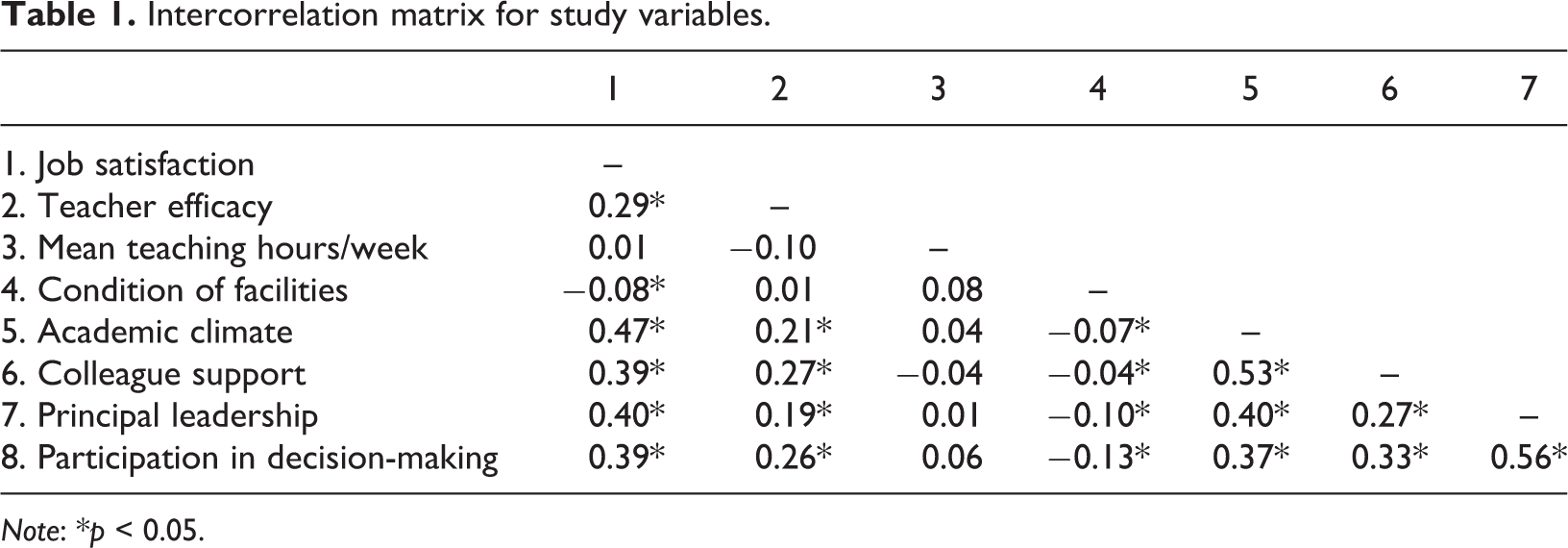
First, the means and standard deviations were calculated for each component. To assess the relations between teacher job satisfaction, teacher efficacy and the components of school culture as perceived by teachers, correlation analysis was carried out. As shown in Table 1, significant correlations existed among teacher job satisfaction and teacher efficacy and the various school-level traits. There was a significant correlation between principal leadership and participation in decision-making (r = 0.56; p < 0.05).
Intercorrelation matrix for study variables.
Note: *p < 0.05.
Exploratory factor analysis
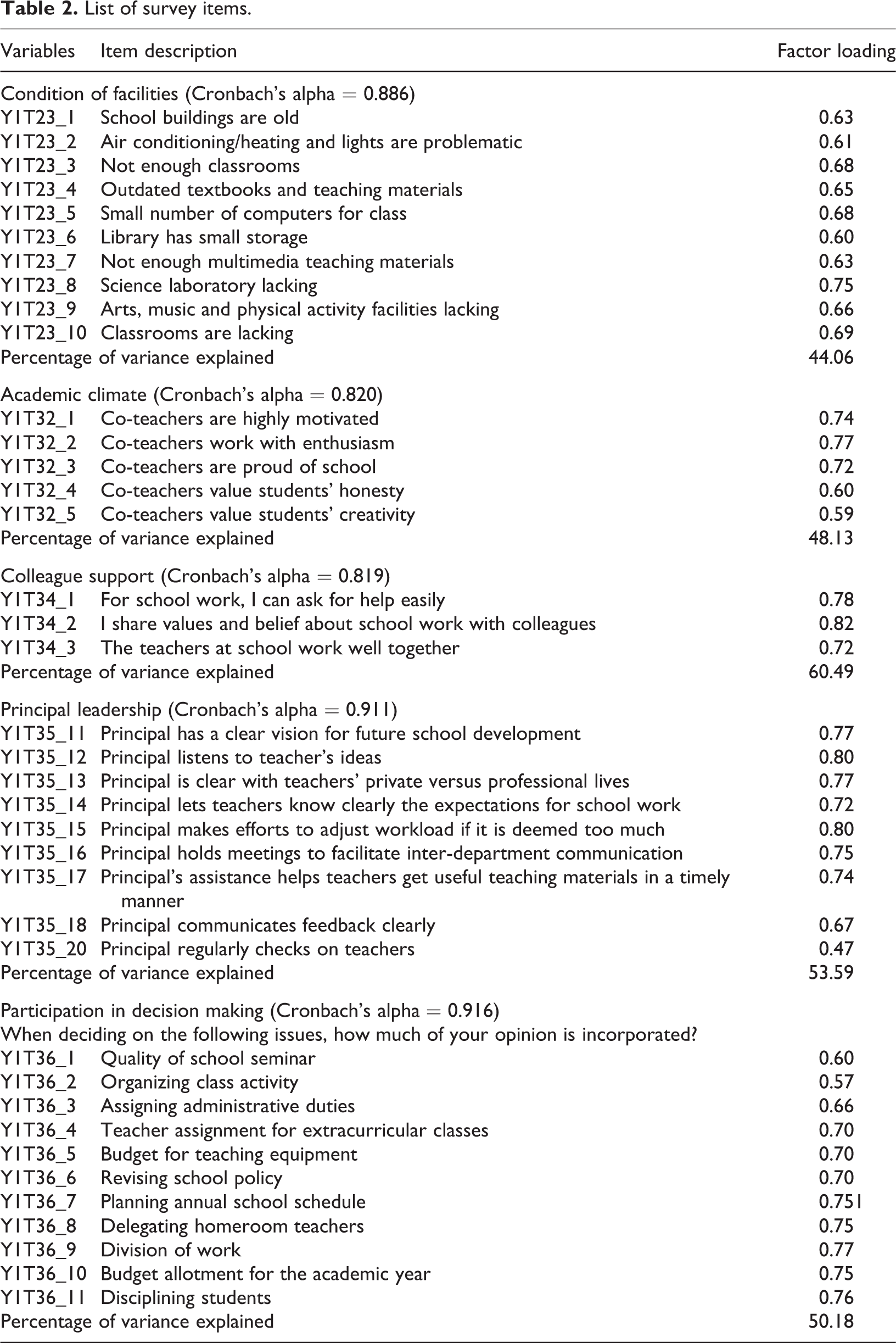
A robust WLS estimation was used with a promax rotation. Oblique rotation was used given correlation between school culture dimensions. Empirical approaches, such as a scree test and pattern of factor loading, were considered within a theoretical framework considering extant literature to confirm that the final factor selection was interpretable and substantively plausible. Through this process, a five-factor model emerged as the most meaningful and parsimonious model. The fit of the five-factor solution in RMSEA and SRMR was acceptable. The value of RMSEA was 0.06 and the value of SRMR was 0.04. Table 2 displays which items related to each of five obtained factors and reports pattern coefficients. Cronbach’s alphas and intercorrelations for these factors are presented in Table 2.
List of survey items.
Multilevel analysis
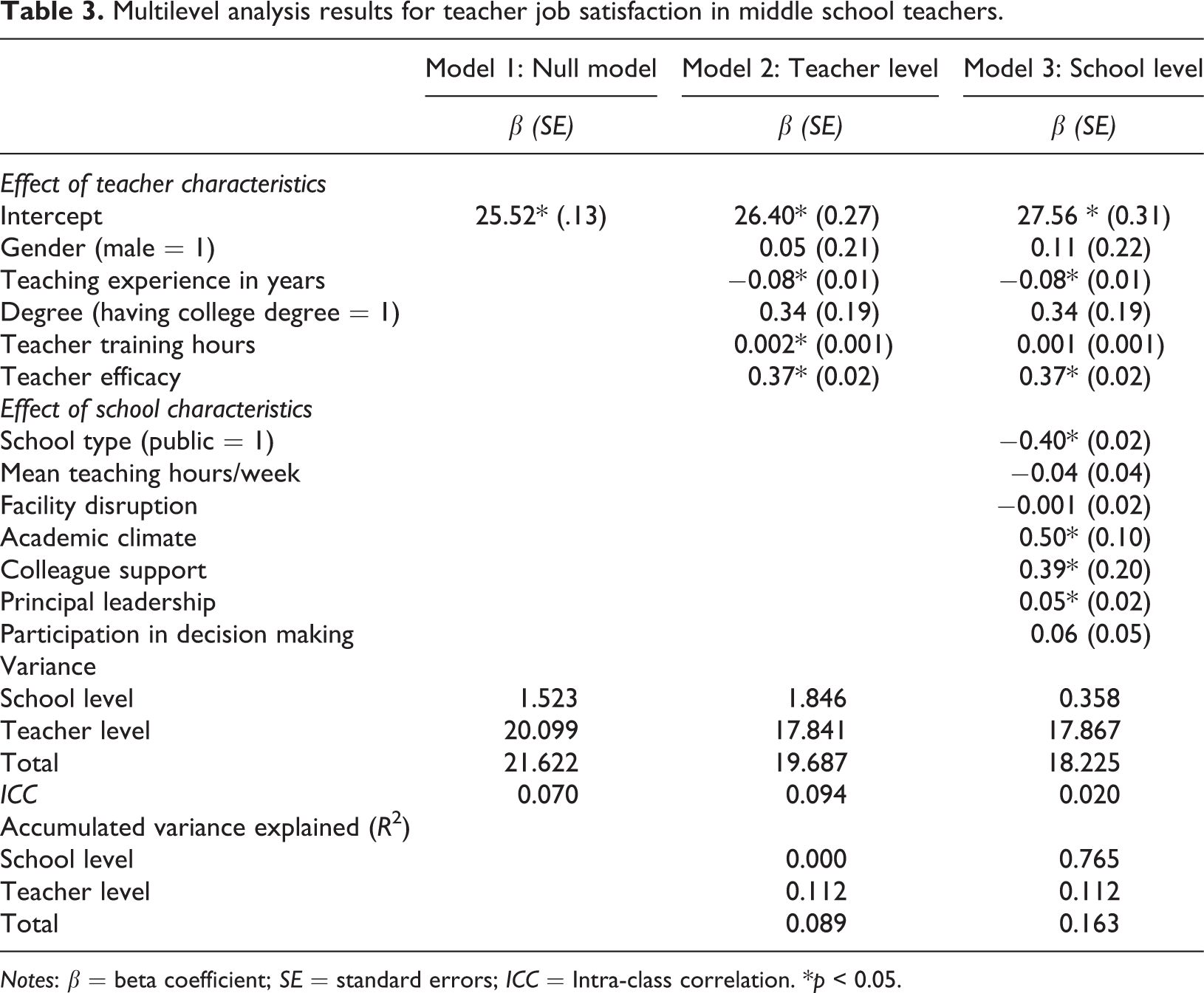
We conducted HLM to assess individual and school predictors of teacher job satisfaction by teachers’ personal characteristics and the perceived school culture in their respective schools. First, a null model was applied to the data. This null model provided information regarding the partitioned total variance in overall teacher job satisfaction into within-school and between-school variances. The intra-class correlation was 0.07, indicating that 7% of the variance in overall teacher job satisfaction is between school-level characteristics.
The results from the Model 2 show that among teachers’ individual background variables, years of teaching experience (β = −0.09, p < 0.05) had a negative effect on job satisfaction. Teacher training hours had a significant but no practical effect on teacher job satisfaction. Teacher efficacy had a statistically significant effect (β = 0.37, p < 0.05) on job satisfaction. Gender and degree did not significantly affect teacher job satisfaction.
The results from the Model 3 show that among school level variables, public school teachers (β = −0.40, p < 0.05) had a negative effect on job satisfaction, compared to private school teachers. Among school culture factors, except participation in decision making, all other factors were statistically significant predictors on teacher job satisfaction. Academic climate was the most strongest predictor (β = 0.50, p < 0.05) on outcomes, followed by colleague support (β = 0.39, p < 0.05), and principal leadership (β = 0.05, p < 0.05).
The effect of the conditional model is shown in the accumulated explained variance (
Multilevel analysis results for teacher job satisfaction in middle school teachers.
Notes: β = beta coefficient; SE = standard errors; ICC = Intra-class correlation. *p < 0.05.
Discussion
The current study examined factors affecting teacher job satisfaction by analyzing how teachers’ individual level variables and their school culture affected the degree of their job satisfaction, in a nationwide educational data set of middle schools teachers in Korea. The inter-correlations among the variables showed that there were positive correlations among teacher job satisfaction and with all of the school-level traits that make up the school culture. This indicated that teachers’ perceptions of their school’s culture were positively related to their teacher job satisfaction. The significant correlation between principal leadership and participation in decision making suggested teachers considered principals as having the power to invite them to contribute in the decision-making process of the school. This finding is in line with previous studies on school culture and teacher job satisfaction, from Korea and other countries (Kim, 2001; Perie and Baker 1997).
The multilevel analysis results showed that 7% of the total variance in overall teacher job satisfaction lay between schools. This indicated that significant variability existed between schools in teachers’ average satisfaction scores and no less than 7% of overall teacher satisfaction can be explained by school-level variables. This level of variance attributed to between-school differences was similar to the study previously discussed that had also conducted HLM analysis on teacher job satisfaction among Korean middle school teachers (Lee and Hurh, 2008). This finding confirmed the importance of considering the school-level factors when explaining teacher job satisfaction, rather than focusing exclusively on teachers’ individual characteristics.
Results showed that teacher’s individual characteristics explained 11.2% of the variance among teachers. With regards to individual characteristics, teachers’ efficacy significantly affected their job satisfaction. The more teachers feel they had understanding of the academic proficiency levels their students the more teachers were satisfied with their work (Caprara et al., 2006; Kim et al., 2009). How these findings relate to another education phenomenon in Korea, private spending on tutoring services outside the school, needs further examination. Some estimates report 15% of the country’s GNP and up to 22% of a household’s income (NCEE, 2014). Knowing that students receive academic support outside of the school may influence teachers’ sense of efficacy. The number of years teaching negatively affected teacher job satisfaction, findings similar to those found in other countries. Relationships among students receiving tutoring, teacher efficacy and years of teaching need further investigation.
School-level characteristics explained 76.5% of the variance among schools, emphasizing that teachers’ perceptions of job satisfaction is influenced by the other adults in the school they work (for example, colleagues and leaders). School culture had a significant positive impact on teacher job satisfaction after adjusting for individual characteristics at the teacher level. Private school teachers reported greater levels of job satisfaction than their public school counterparts. How teachers perceived their schools’ academic climate, support from colleagues and principal leadership also impacted teacher job satisfaction. These findings suggest that although it is easy to think of the teaching occupation as being autonomous and mainly consisting of relationships with students, the relationships teachers have with other teachers and the administrative/leadership staff is important to their job satisfaction as well.
It is interesting to note that the teachers in this study did not place a great weight on participating in the decision-making process. As teachers become more involved in critical decisions concerning the direction of the school, their communication becomes more complex. This change in communication may be a source of demotivation and job stress that in turn creates a negative influence on the lives of teachers (Davis and Wilson, 2000).
Although the accumulated variance explained by final model was 16%, which suggests that the multilevel model used in the current study was effective for explaining middle-school teacher’s job satisfaction, the study is not without limitations. One of the limitations of the study is that the sample only consisted of middle school teachers. One may hypothesize that the way school climate influences elementary school and high school teachers is different from middle school teachers. Therefore the findings from this study should not be generalized to those groups of teachers till future research is conducted to compare these groups.
A second limitation of the study is that the variables included were only related to the teachers as they are situated within the schools. External factors that have potential to influence teacher job satisfaction were not examined, such as the previously mentioned students’ utilization of private tutoring services or aspects of their personal lives (being the primary financial supporter versus family’s secondary income). Further research is needed to examine these additional aspects of teachers’ lives.
Conclusion and implications
The findings of the study have important implications for how efforts should be made to bring about changes to the culture of schools. By confirming that characteristics pertaining to schools can explain the individual differences in teacher job satisfaction, it is anticipated that the findings of this study will inform administrative leadership on how to better enhance teacher job satisfaction. Specifically, principals, heads of subject departments and other leadership faculty in schools need to encourage an atmosphere where teachers support one another. Teachers themselves need to extend themselves to be supportive of one another as well, since if everyone were to wait for the other to provide support no one would be supported. In addition to departments, supportive communities could be built among the homeroom teachers of each grade level. Finally, considering that our measure focused on principals as facilitators of communication who maintain frequent contact with teachers, we suggest districts and departments of education to offer professional development that teaches principals what supportive leadership is and how they can enact this type of leadership in their respective schools.
This study extends and deepens understanding of teacher job satisfaction, and lays a good foundation for the provision of better education policy on the basis of its empirical data. It is hoped that this study will provide research material for effective educational management based on the results from nationwide large-scale data analysis related to the question of how school culture affects teacher job satisfaction.
Footnotes
Declaration of conflicting interests
The author(s) declared no potential conflicts of interest with respect to the research, authorship, and/or publication of this article.
Funding
The author(s) disclosed receipt of the following financial support for the research, authorship, and/or publication of this article: This work was supported by Sookmyung Women’s University, Seoul, Korea. (1-1403-0173)