



Abstract
The aim of the study was to determine the frequency of followership styles, and their connection with job satisfaction and satisfaction with extrinsic/intrinsic aspects of work in teachers. The sample included 206 secondary school teachers of three grammar and three vocational schools in three towns in Serbia. The results indicate that the most prominent followership styles were star followers (58.7%) and pragmatists (39.8%). Star followers attached greater significance to intrinsic aspects of work and reported a higher job satisfaction rate, while pragmatists placed more importance on extrinsic ones. Independent thinking correlated with intrinsic aspects of work and job satisfaction, and active participation with job satisfaction and both work aspects. The results also show that a higher degree of engagement (particularly when combined with economic satisfaction) predicted a higher level of job satisfaction. If dominant followership and motivational structures of teachers were learnt, the management of educational institutions would be improved because teachers who participate in making work decisions have a greater sense of empowerment and commitment to organizational goals. Although affected by types of personality, dominant followership structures of the teacher may be influenced during the course of professional training, thereby directing them towards the development of functional followership types.
Introduction
An evaluation of teacher’s role points towards great changes it has gone through during the last 50 years. Contemporaneous educational processes are quite complex and encompass various integrated activities for an individual, teaching staff and institution in such a way that the conception of social and pedagogical roles of the contemporary teacher broadens, as well as the content, range and forms of teachers’ activities. Current tendencies in education development suggest growth of active involvement of teachers at all levels of education; hence, teachers’ roles are expanding from assisting with the management of schools to evaluating educational initiatives and facilitating professional learning communities (York-Barr and Duke, 2004).
A teacher is a person in a context, and teaching is a function of school environment, internal and external settings of the school, as well as of personal qualities (Jennings and Greenberg, 2009). Employees in school environment work in a formally organized business structure, which as such assumes the prerequisite for obeying superiors, their orders and expectations, but may also be a fertile ground for adverse consequences of conformism and similar forms of group behaviour. For these reasons, we believe that it is essential to investigate teachers’ inclinations to certain followership behaviours, together with the factors reinforcing such behaviours.
Therefore, the first aim of the study is to determine the frequency with which particular followership styles (according to Kelley’s model) occur in the teaching staff of two types of secondary schools in Serbia (grammar school and vocational schools) and their potential differences in relation to the control variables.
Followership
The term ‘followership’ is used in a number of ways: as the opposite of leadership on a leadership/followership continuum, a direct or indirect influential activity or as a role for those influenced by a leader (Crossman and Crossman, 2011). Both follower and leader are roles, and not personality structures, whereby roles are regarded as behaviours, a system of activities which are expected from an individual holding a certain position in a particular group, such as an organization, culture, society (Havelka, 2000).
In line with role theory (Biddle, 1986), roles are acquired through interpersonal interactions. Roles do not have an impact only on specific activities of employees, but also on their opinions of and attitudes to their leaders, tasks and the organization as a whole. Although organizational behaviour is context specific and conditional on environmental, organizational and social factors (for example cultural values, norms, beliefs, preferences), it may also be influenced by non-normative expectations, and the roles themselves may evolve over time (Biddle, 1986). Accordingly, we shall adopt the standpoint that roles are interactive, and view them as a partially changeable construct, whose manifestations are relatively stable.
In a similar vein, the theory of Howell and Mendez (2008) stipulates that followership may take an interactive form in which the followership role is complementary to that of the leadership role in achieving organizational goals. It may also take an independent form in which followers act independently of their leaders with minimal supervision and management. Finally, it may take a changeable form where employees assume the followership or leadership role, depending on an actual situation or assignment.
There is a considerably smaller body of research focusing on followership in contrast to investigations into leadership, and the concept of a follower has been unjustifiably separated from that of a leader, although these two concepts are at opposite ends of the same continuum (Baker, 2007). What is emphasized in many of the studies is that the leader is the only proactive person in a work situation, whereas followers are reactive parts of the system, empty boxes to be filled with the data from the leader (Can and Aktaş, 2012). Followership is normally followed by assumptions that individuals instinctively know how to follow (Agho, 2009), which is one more reason why it has attracted less attention than leadership in research. However, results show that 80% of work that contributes to the success of organizations fall within followers, and the remaining 20% represent the leader’s engagement (Kelley, 1992).
Although leaders hold formal positions of power, in reality they need followers’ consent to their leadership so that they could manage business of an entire organization (Russell, 2003). It is essential to point out that the concept of the follower in this article is unrelated to any potential negative connotations of the lexical unit itself or the viewpoint of followers as people with lesser abilities, according to singular leader models (Russell, 2003). It rather denotes that a person formally takes a subordinate position in a hierarchical structure. Thus, they simultaneously have an immediate superior ‘above’ themselves, whose assignments they must formally complete with obedience. 1
Followership styles
The theoretical basis of our study is Kelley’s followership theory, primarily because it focuses on corporate environment and the application of acquired knowledge about followership within organizational relations. Therefore, it is applicable to social relations in school environment as well. According to this theory, followership entails courses of action or conditions in which an individual supports or facilitates the leader to meet organizational goals (Kelley, 2008). A great number of people spend a lot of time pursuing the follower role, which is something that determines not only their job satisfaction, but also self-satisfaction and life satisfaction (Kelley, 1988). Kelley discerns two mutually interrelated dimensions of followership: independent critical thinking and active engagement. Independent thinking without active engagement may drive people with excellent ideas away from the organization if they lack tools to put their ideas into practice, while active engagement without independent thinking may create people who are committed, but lack their own attitude and never refuse orders, regardless whether they are good or bad (Kelley, 1988).
Drawing on Kelley’s theory, the following followership styles were examined in this article (cited in Marković, 2011: 113–121): The exemplary followers (high level of independent thinking and active engagement) –Exemplary or star followers think independently and critically, they take an active part in their job, they are able to engage in critical situations and accept the goals of the organization as their own. The greatest number of people starts their career in this followership style. However, depending on the concurrence of events, this can be commonly changed. The alienated (independent thinking at a very high level, active engagement low) – The alienated think for themselves, but they fail to be active in fulfilling tasks. They have a positive image of themselves, they perceive things more realistically than others do, but they are also sceptical. Such followers are often deemed quite cynical, stubborn, troublemakers who undermine authority. These people have difficulty fitting into teams; they are dissatisfied because the leader fails to exploit their abilities and ideas. The yes-people (independent thinking at a very low level, active engagement high) – Yes-people readily accept tasks, they are good team players, they are completely devoted to the organization and trust their leader, they make an effort to avoid or ease a conflict, lack personal ideas and opinions and are no threat to the leader. These people are engaged at work, but do not question attitudes and opinions of the leader. We shall call this type of followership conformists in this article because they fulfil all the criteria of conformist behaviour (Marković, 2011). The pragmatists (medium-level independent thinking and active engagement) – Pragmatists incline towards certain attitudes and change their attitudes in line with the organization policy. They carry out appropriate tasks, but rarely work more than required, aspire to keep conflicts to a minimum and to do their job well, but they are not willing to sacrifice themselves for somebody or something. Emotions of anger and alienation are present in alienated followers, whereas the dominant feeling in pragmatists is the one of self-sufficiency, mixed with anxiety to a certain extent. The passive followers (low-level independent thinking and active engagement) – Passive followers always rely on their leaders and their opinions, they work only when instructed, they have lack of initiative, motivation and feeling of security and thus they need someone to constantly guide them. Kelley singles out extremely passive followers who cannot make it without a leader, and people who like to be followers so that they shut themselves off and do not use their potentials.
Job satisfaction
A high rate of teacher departure from teaching jobs is reported in numerous countries throughout the world regardless of differences in their education system (Crossman and Harris, 2006; Skaalvik and Skaalvik, 2011), which places importance on investigating teachers’ job satisfaction and on working towards the elimination of sources of negative influence on job satisfaction and work motivation.
Job satisfaction is a construct which encompasses feelings that someone has about their job and a cognitive evaluation of it. As such, it represents one of the most frequently studied constructs in organizational research, because it has been interrelated both theoretically and empirically with various organizational constructs, such as productivity, absenteeism and organizational involvement among others (Wright, 2006).
Two basic viewpoints stand out relative to the definition of this concept (Matanović, 2009). The first one is holistic, whereby job satisfaction is regarded as a one-dimensional construct, a general feeling and attitude to one’s job. The second is additive, since this construct is seen as multidimensional, as a sum of different aspects of job satisfaction. Job satisfaction would then be defined as everything that a person feels about their job and different aspects of the job (Spector, 1997: 2). Therefore, a person dissatisfied with one or more aspects of their work may after all be motivated to do the job. These aspects are most commonly labelled under two groups (Spector, 1997): extrinsic (work facets such as material rewards, working conditions, interpersonal relationships of employees) and intrinsic (work content, work autonomy, level of responsibility and creativity, and the like).
Findings have shown schoolteachers’ morale, job satisfaction and motivation to be much less influenced by externally initiated factors, such as salary, educational policy and reforms, than by factors from the more immediate context within which teachers work (Evans, 2001). The nature of this influence is different to different teachers, because of their diverse job-related needs, values and goals; nevertheless, building relationships with colleagues and headteachers emerges as one of the key factors in the effectiveness of teachers in school environment (Evans, 2001; Silva et al., 2000). Various studies conducted in educational settings have revealed that leadership behaviours of headteachers, as well as recognition, support and respect from superiors had an effect on job satisfaction of teachers (Cerit, 2009; Crossman and Harris 2006). However, the question how followership behaviours of teachers affect job satisfaction is yet another unanswered question. This is the reason why in the second part of the article the extracted followership dimensions and styles have been correlated with job satisfaction, level of extrinsic and intrinsic satisfaction.
Methods
Sample and procedure
The research was carried out with the sample of 206 secondary school teachers of three grammar schools and three vocational schools in three towns (Sjenica, Novi Sad and Kragujevac) within a month. These towns were chosen because they differ in size, region and the level of economic development (SORS, 2013). 2 Novi Sad, the largest city of all and most developed, is the capital of the northern region. Kragujevac, the next largest and developed city from the list, is located in Central Serbia. Finally, Sjenica, the smallest and least developed of the three towns, is situated in the southern part of Serbia. Research indicates that the type of school as defined by ownership, funding and religious affiliation may have an impact on teachers’ job satisfaction (Crossman and Harris 2006). The difference between secondary schools according to the type of educational profile (grammar versus vocational schools) has not been investigated so far. Accordingly, we included grammar school as a more comprehensive type of school, which covers a wider range of general subjects to be studied, and vocational technical schools as examples of occupational-oriented courses that are more directed at practical work in their classes (Table 1).
Distribution of the sample according to school types and regions.
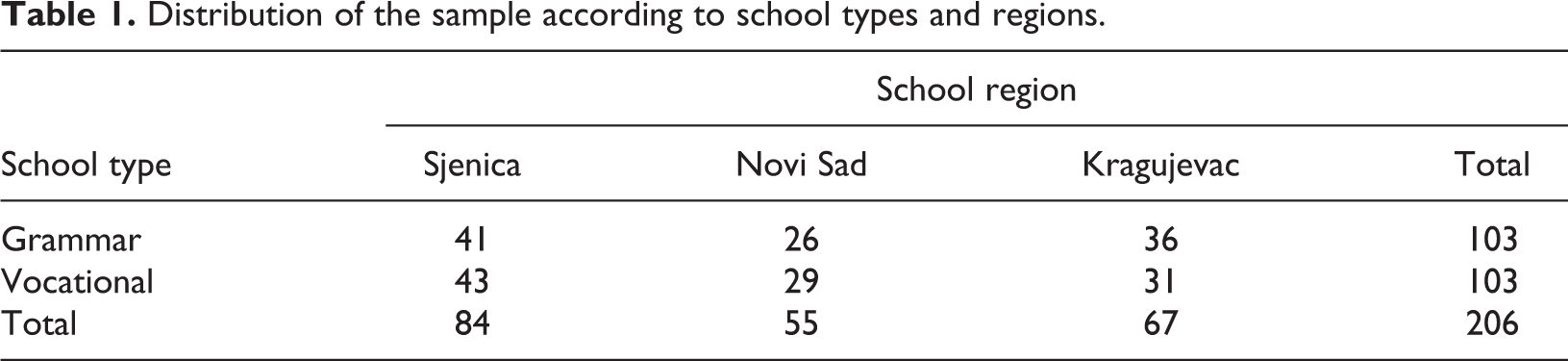
Female teachers from the sample outnumbered male teachers with 62.6% in comparison with 37.4% (χ2(1) = 13.123, p < 0.000). This distribution was similar regardless of the type of school (67%-33% in grammar schools and 59%-41% in vocational schools), which follows the distribution of general population of teachers in Serbia. The youngest employee was 23 years of age, the oldest 64 (M = 43,17; SD = 10,475), and their work experience ranged from one to forty years (M = 16.08; SD = 10.062). No differences were found according to age (t(204) = −0.8114, p = 0.418), nor work experience (t(204) = −0.249, p = 0.804) relative to school type. As regards teachers’ degrees, 1.5% completed vocational college, 84.5% held a bachelor’s degree and 14.1% a master’s degree. 3
Instruments
The following instruments were used in the study.
Followership Questionnaire (Kelley, 1992), which measures two dimensions of followership: independent critical thinking (10 items, for example, ‘Do you act on your own ethical standards rather than the leader’s or the group’s standards?’) and active participation (also 10 items, for example, ‘Do you take the initiative to seek out and successfully complete assignments that go above and beyond your job?’). The existent data speak in favour of psychometric properties of the scale, with the aggregate coefficient of internal consistency α = 0.84, and individual scores on the subscales ranging from 0.63 to 0.74 for independent thinking and 0.69 to 0.87 for active engagement (Seeley, 2007).
There are different versions of the scale in languages other than English, in which the two-factor structure of the instrument in question has been also obtained, as well as a satisfactory reliability of the followership measure (Gatti et al., 2014). In the current study, the Serbian version was employed (Jovanović et al., 2003), which was translated to the Serbian language and style with no content changes. It consisted of 20 items that the participants evaluated on a six-point Likert scale in terms of how much the statements were applicable (or not) to them. The ranges of the points were 0 – ‘something rarely happens or you rarely do it’, 3 – ‘something happens occasionally or you occasionally do it’, 6 – ‘something almost always happens or you almost always do it’. The results on the scale were formed by adding up scores to the sum, whereby the minimal number of scores on each dimension was 0 and maximum 60 (Jovanović et al., 2003). The instrument also measures five styles of organizational behaviour described in the introductory part of the article: an exemplary follower (score > 45 on IT, and > 45 on AE 4 ), an alienated follower (> 45 on IT, < 15 on AE), a conformist (< 15 on IT, > 45 on AE), a passive follower (< 15 on IT, < 15 on AE), and a pragmatist (15–45 on IT, 15–45 on AE).
Minnesota satisfaction questionnaire or MSQ (Weiss et al., 1967), which measure individual job satisfaction and encompasses twenty different aspects of work environment, was used in this article in its Serbian version (Kosanović and Stevanov, 2003). Similarly to the previous scale, this scale is also a direct translation of the original scale, adapted to the Serbian language and style with no content changes. Research to date shows good properties of the scale, such as internal consistency coefficients ranging from 0.85 to 0.96, and test-retest reliabilities of 0.70 to 0.80 (Kosanović and Stevanov, 2003; Buitendach and Rothmann 2009). Twenty items were factor analysed and the following factors were extracted: factor of intrinsic (11 items describing satisfaction with the degree of autonomy at workplace, level of creativity, responsibility, social status) and extrinsic satisfaction respectively (nine items relating to working conditions, wages, interpersonal relationships among the employed, safety). Besides the scores on the individual factors, an aggregate score of general job satisfaction may be provided, whereby lower values indicate lower levels of job satisfaction.
Finally, with an aim to collect demographic information relevant to the study, we have also included questions about sex, age, level of education (degree), economic status and work experience of the sample, which were treated as control variables in this study.
Statistics
The normal distribution of the variables was verified by using the Kolmogorov–Smirnov test. The internal consistency of the scales was measured by Cronbach’s alpha. Differences in scores were computed with Mann–Whitney and Kruskal–Wallis tests, independent t-test and one-way analysis of variance. The Pearson’s and Spearman’s coefficients were used for correlation. All tests were two-tailed, with p ≤ 0.05 considered statistically significant. For the purposes of data analysis, PASW Statistics 18 was employed.
Results
The Followership Scale showed a satisfactory reliability (α = 0.83). The most prominent followership style was that of exemplary followers (58.7%), followed by pragmatists (39.8%), whereas the alienated (1%) and conformists (0.5%) were insignificant in number. The distribution of responses on the subscale of independent thinking significantly differs from normal distribution (KS (206) = 0.078, p = 0.004) and is skewed towards higher values (M = 41.66, SD = 7.551). The situation is similar with responses on the subscale of active participation (KS (206) = 0.066, p = 0.028, M = 43.51, SD = 8.172).
The Job Satisfaction Scale indicated a high reliability as a whole (α = 0.90), as well as with the individual subscales (extrinsic: α = 0.83; intrinsic: α = 0.85). The mean value was 73.07 (SD = 12.145) out of maximum 100, which on average suggests mildly expressed job satisfaction of the participants, although the distribution of responses was within normal, both in the grammar school teachers (KS (103) = 0.074, p = 0.191) and vocational school teachers (KS (103) = 0.081, p = 0.093). With regard to intrinsic aspects, the minimum was 28, maximum 60 out of 60 in total (M = 46.30, SD = 7.229), while the minimum relative to extrinsic aspects was 7, and maximum 30 out of 30 in total (M = 19.88, SD = 5.021).
In terms of individual work aspects, most positively evaluated aspect was ‘prospect to do something for others’ (M = 4.24) and ‘prospect for independent work’ (M = 4.07). Most negatively evaluated aspect was the one relating to the ‘relation between wages and commitment’ (M = 2.86). The teachers were mainly dissatisfied (24.8%) or somewhat dissatisfied (30.1%) with their overall economic situation. Only 4.4% of the teachers were satisfied with their economic circumstances, whereas 23.8% were somewhat satisfied and 17% were neutral.
Demographic characteristics and followership styles
If we include the two most frequent types of followership in the analysis (that is, exemplary followers and pragmatists), what can be noticed is that there are no differences according to the control variables: school type (χ2(1) = 0.049, p = 0.824), region (χ2(2) = 0.890, p = 0.345), sex (χ2(1) = 0.056, p = 0.813), age (t(201) = −0.744, p = 0.458) and work experience (t(201) = −0.714, p = 0.476). The only difference was found in satisfaction with economic circumstances, wherein the exemplary followers were significantly more satisfied than the pragmatists were (t(201) = 2.541, p = 0.012).
The scores on the dimensions of independent thinking and active participation showed no differences according to sex (U(206) = 4672, p = 0.476; U(206) = 4799, p = 0.685), and school type (U(206) = 4780, p = 0.519; U(206) = 5108, p = 0.646).
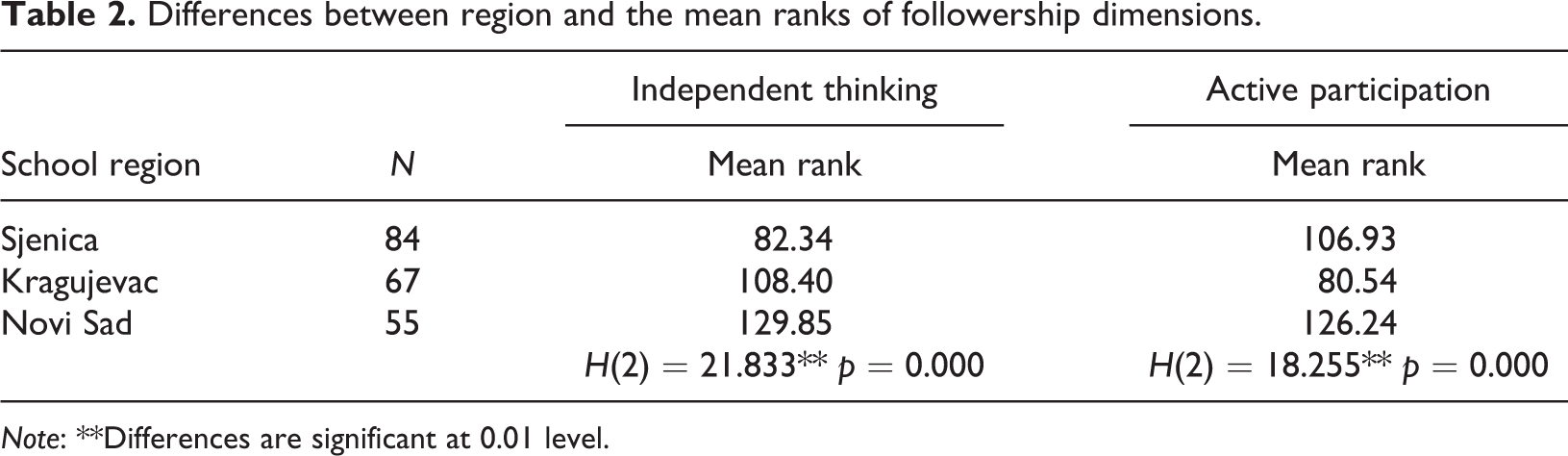
Having employed Kruskal-Wallis test, we detected significant differences in scores on these dimensions of followership according to the region variable (Table 2).
Differences between region and the mean ranks of followership dimensions.
Note: **Differences are significant at 0.01 level.
Independent thinking had no correlation with the rest of the control variables, whereas active participation showed a weak correlation with satisfaction with economic situation (the greater satisfaction, the higher level of participation). A strong positive correlation was found between active participation and independent thinking (Table 3).
Correlations between age, work experience, satisfaction with economic circumstances, and the followership dimensions.

Note: **Correlations are significant at 0.01 level.
Demographic characteristics and job satisfaction
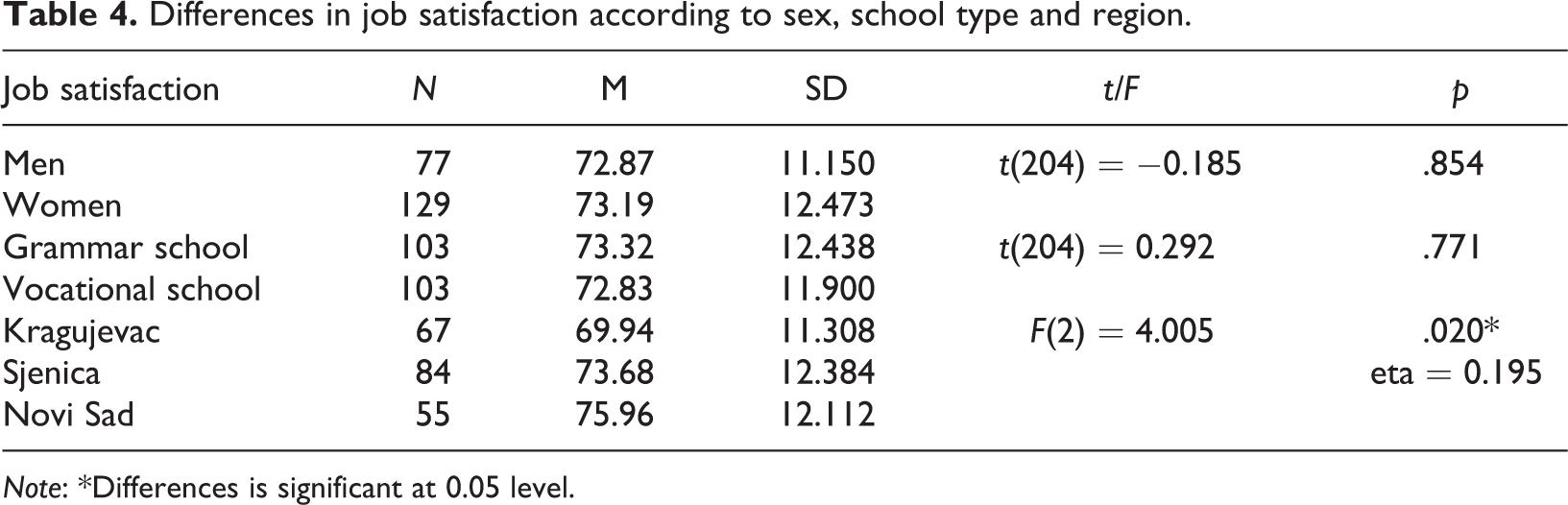
The arithmetic means of the subsamples with regard to job satisfaction did not differ according to sex, school type and region (Table 4).
Differences in job satisfaction according to sex, school type and region.
Note: *Differences is significant at 0.05 level.
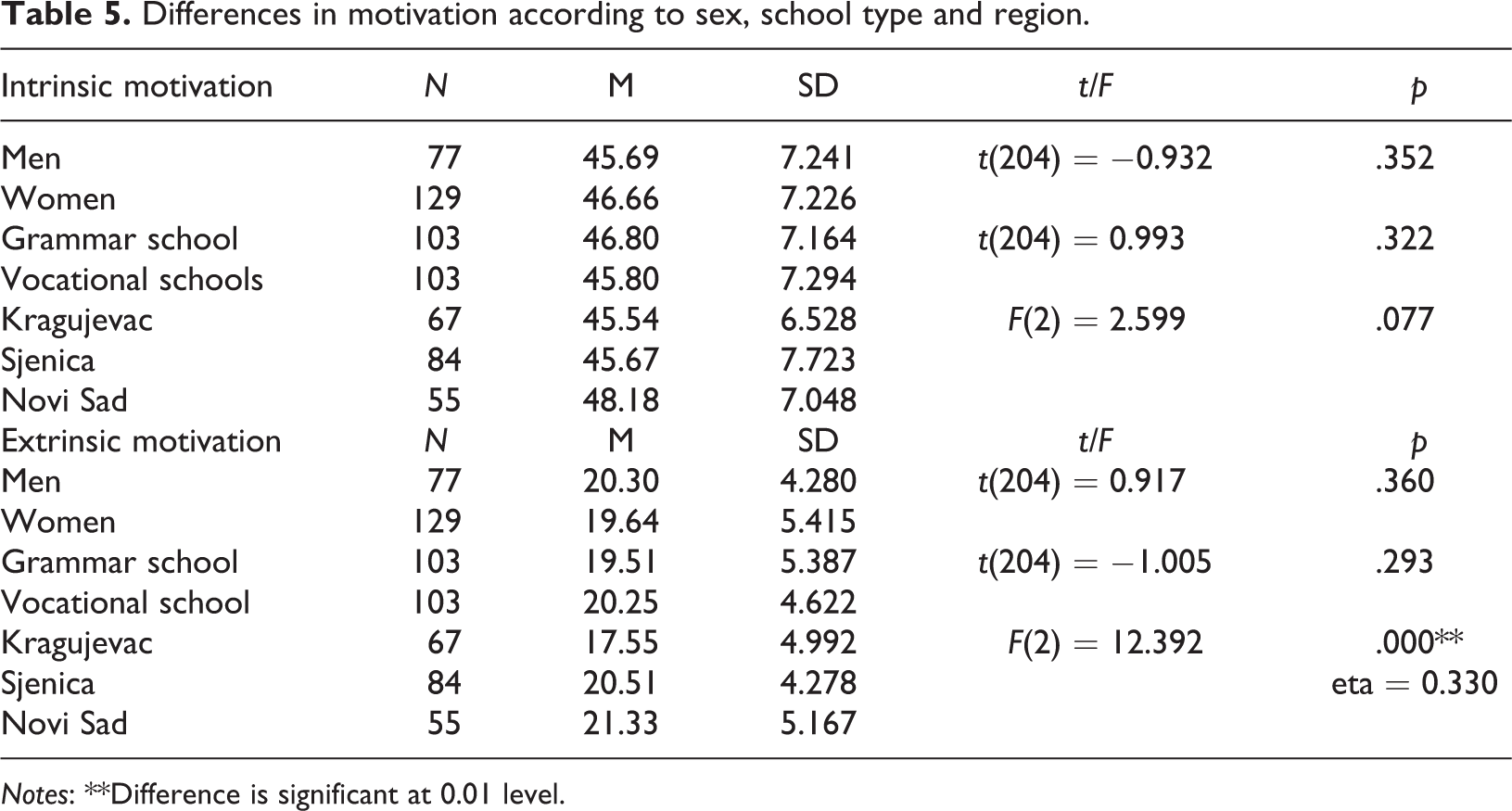
Similar findings were recorded for intrinsic and extrinsic scores. However, there was no difference found according to regions for intrinsic, but it was detected for extrinsic scores (Table 5).
Differences in motivation according to sex, school type and region.
Notes: **Difference is significant at 0.01 level.
Job satisfaction was moderately (positively) correlated with satisfaction with economic situation and strongly (positively) correlated with both types of work aspects. The same applied to both intrinsic and extrinsic aspects, which were mutually strongly (positively) correlated as well (Table 6).
Correlation between demographic variables and job satisfaction, and motivation types.
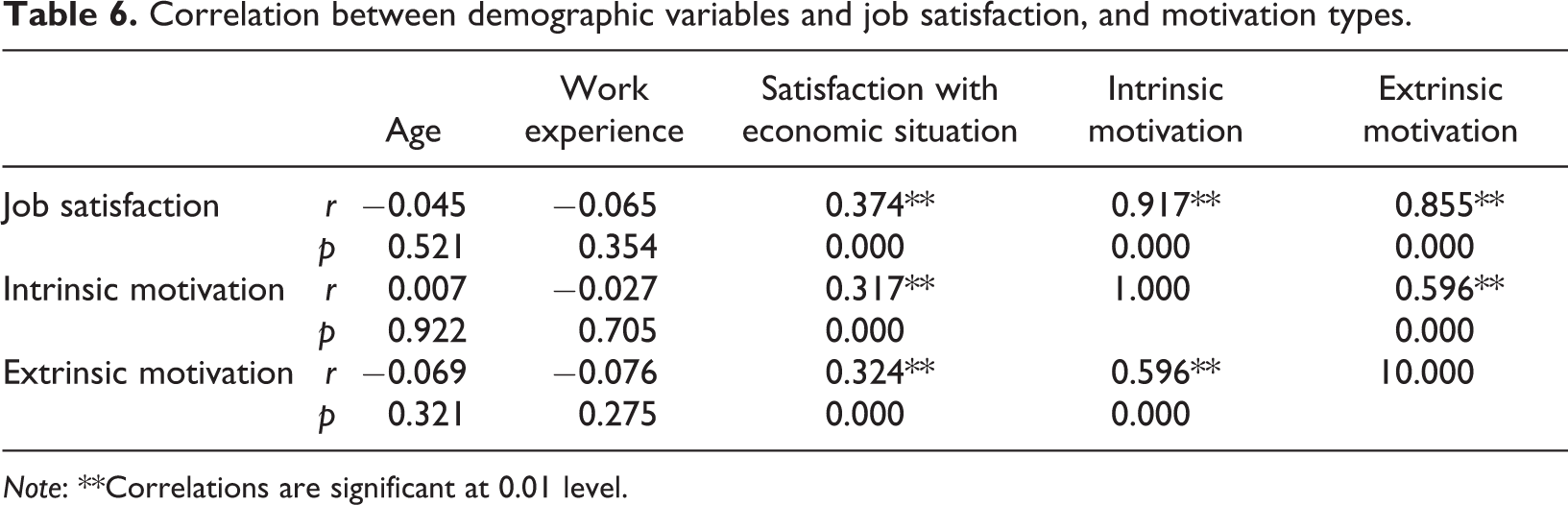
Note: **Correlations are significant at 0.01 level.
Followership dimensions/styles and job satisfaction
Finally, in this section we shall present the analysis showing the correlation between followership dimensions and styles, on the one hand, and the level of job satisfaction and motivation, on the other. As in the previous section, we have included only the two most common followership styles, which showed significant differences in job satisfaction intensity and motivation. While the exemplary followers stood out in terms of the level of intrinsic and job satisfaction, extrinsic satisfaction was somewhat more present in the pragmatists (Table 7).
Differences in motivation and job satisfaction according to followership styles.
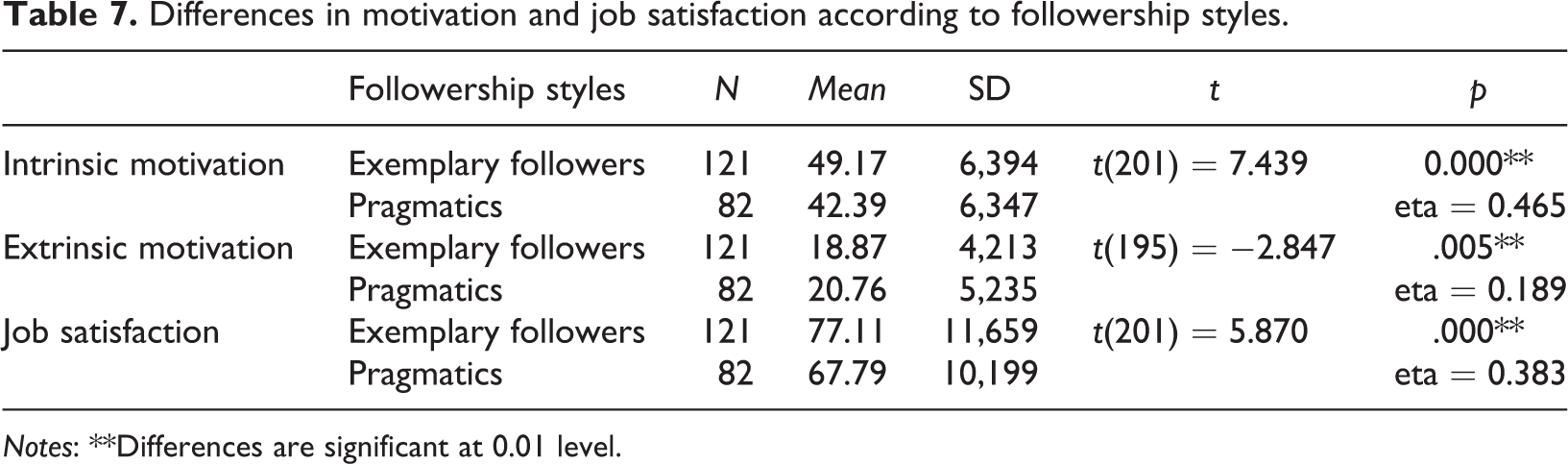
Notes: **Differences are significant at 0.01 level.
Independent thinking as a followership dimension, showed a moderate positive correlation with intrinsic aspects of work (r = 0.341, p = 0.000), and a weak correlation with job satisfaction (r = 0.194, p = 0.005), whereas active participation showed a strong to moderate correlation with job satisfaction (r = 0.545, p = 0.000) and both work aspects (intrinsic r = 0.523, p = 0.000; extrinsic r = 0.473, p = 0.000).
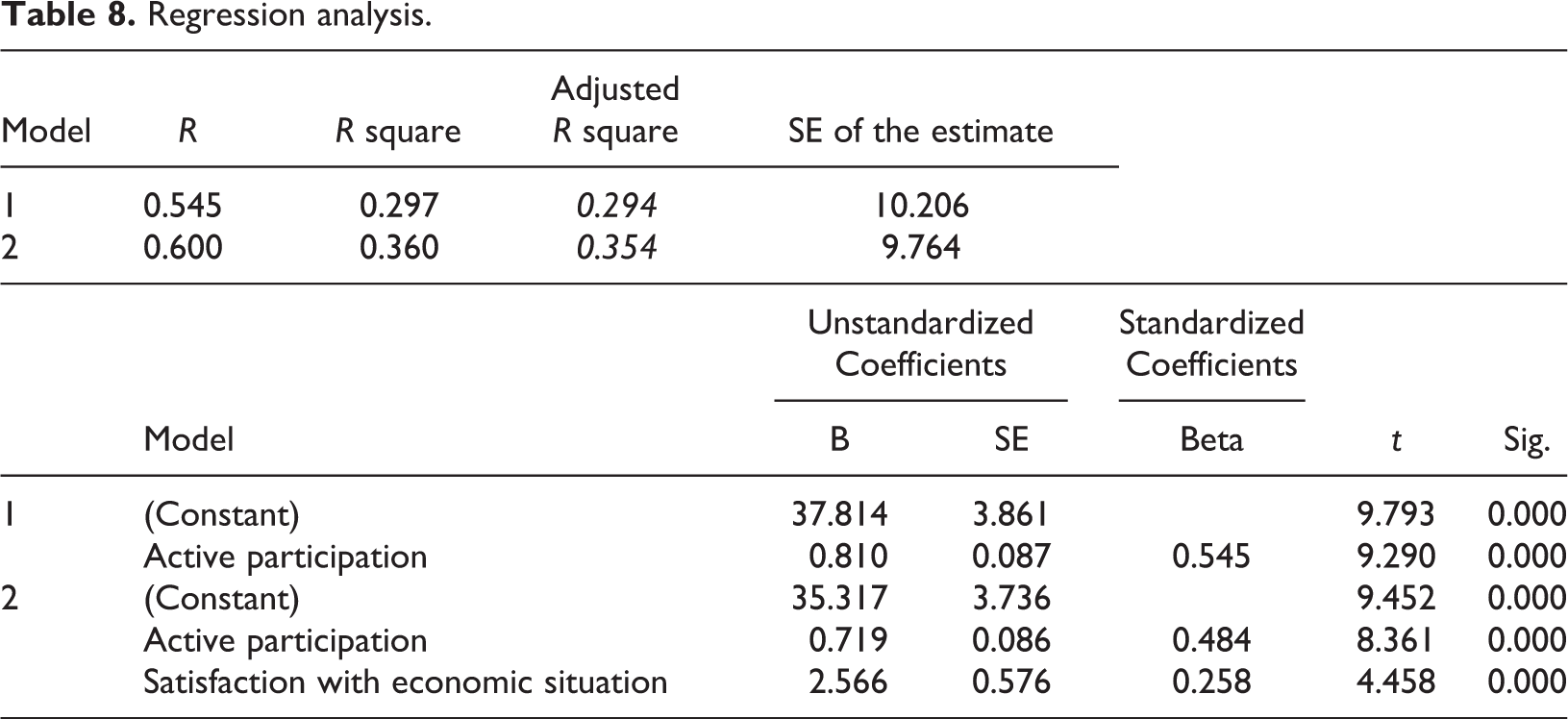
By means of employing hierarchical regression analysis and following the requirements for conducting the analysis (Urdan, 2005), in further process we only included the control variables and followership dimensions which were moderately or strongly correlated with the job satisfaction variable, together with the predictor variables that were not mutually strongly correlated. Active participation and satisfaction with economic circumstances were also included in the analysis. The model significantly predicted job satisfaction (F(2) = 57.081, p < 0.001), explaining 36% of the total variance, with the dominant part of active participation of nearly 30% (Table 8).
Regression analysis.
Discussion
Followership styles and dimensions
In the introductory part of the article, we have underlined that numerous factors influence teachers’ behaviour, from personal qualities, intragroup relations, to school/organizational environment and a wider social/cultural context. First, we shall turn our attention to a potential link between individual and group factors, and extracted followership styles.
With almost 60% in our sample, the exemplary followers (a high level of independent thinking and active participation) exceed maximum 35%, which is normally expected in organizations (Kelley, 1992). However, these data are quite common in educational institutions. In a study investigating followership among the employees of an American university, on average the participants also showed high scores (over 5 out of maximum 7), both on the dimension of active participation and independent thinking (Blanchard et al., 2009). In groups composed of well-educated individuals, who are assured of their competence, the degree of conformity is lower (Morris and Miller, 1975), and dependent on feeling secure in one’s position in a group. If a person feels confident about their position in a group, they will more frequently express their disagreement with other people’s opinions (Rot, 2006), that is, independent critical thinking will be more conspicuous, as it is the case with our results.
There are findings suggesting that the majority of people start their professional career as exemplary followers (Kelley, 2008), or else that they have a strong desire to prove themselves at the beginning of their employment (Mathieu and Zajac, 1990). This is only partly true for our sample that reported the highest number of exemplary followers around the first two years of work experience, but also between 15 and 20 years of work. What may be at work with regard to this finding is the impact of a teacher’s period of life. Teachers’ readiness to assume the role of a leader is conditioned by their being at a personal life stage, which allows one time and energy to assume the position of leadership (Katzenmeyer and Moller, 2001). Having developed their own family community and family life, teachers may fully re-commit to their work, both critically and actively in a later period of life. These data correspond to some studies showing that life events in persons aged between 31 and 40 have a negative effect on job satisfaction, whereas there is an increase in job satisfaction after the stated period (Crossman and Harris 2006).
The next dominant group is that of pragmatists that Kelley describes as followers who incline towards certain attitudes, and change their attitudes along with the changes of organizational policies. This type shows a medium level of independent thinking and active participation. With nearly 40% of the participants, this style slightly differs from 35%, which the existing data on general population predict most (Kelley, 1992). In addition, there is a possibility that the anticipated percentage of conformists (of 20–30%) in our sample was replaced with this style of behaviour in the organization, because pragmatists also have a somewhat explicit need to feel secure and they achieve it by not standing out in behavioural patterns, which is similar to conformity (Bordens and Horowitz, 2008).
Finally, the results of the present study may also be interpreted in the light of conformity, or more precisely by giving socially desirable responses, because the participants were most likely able to anticipate which statements entailed exemplary professional behaviour, and which involved negative behavioural patterns. Consequently, we may not claim with complete confidence that these results portray the genuine followership styles and not the one that our participants wanted others to see in them. Convergence is also likely to have occurred, since it is similar to conformity, whereby judgements and norms of people belonging to the same group and judging the same objects spontaneously converge towards each other, thus becoming similar (Rot, 2006). This is especially true when individuals in a group are perceived as similar (Berg and Bass, 1986 cited in Lacković-Grgin, 1994).
With regard to a potential connection between followership dimensions and the control variables, we detected a weak link between active participation and satisfaction with economic circumstances (the greater satisfaction, the higher degree of participation), 5 as well as a significant difference in scores according to regions. The distribution of scores in terms of satisfaction with economic situation tallies with the distribution of scores relative to active participation according to regions. Therefore, in line with the previous finding, it is quite unsurprising that Kragujevac had the lowest level of economic satisfaction, followed by the lowest level of engagement.
Organizational, cultural characteristics and followership
We have not evaluated thoroughly in this article the characteristics of schools as institutions. In our study the headteachers were chosen by the teaching staff, which may also be the reason why these teachers could easily express disagreement and free will because their headteachers are most likely regarded as ‘one of their kind’. What should be explored in some future studies, though, is the connection between followership styles of teachers and certain characteristics of school leaders and their organizational behaviour.
Moreover, in further research it would be sensible to examine differences between state and private educational institutions because there are data stating that the majority (63.6%) of the participants at private universities acted as pragmatist followers, and only 12.5% were exemplary followers (Oyetunji, 2013). In addition, teachers in privately managed schools exhibited higher satisfaction levels than those in foundation schools, which may be explained with a number of environmental factors, such as larger financial/non-financial resources and less state-driven bureaucracy (Crossman and Harris, 2006).
As regards the broader social context within which the surveyed schools operate, several things are worthy of mention that have possibly led to the polarization of the teachers’ followership behaviour into exemplary followers and pragmatists. According to cultural values theory (Hofstede and Hofstede, 2005), and theory of corporate, organizational cultures (Trompenaars, 1994), it is acceptable for people to spontaneously express their emotions in cultures high in affectivity. Since the nature of cultural values and relationship in Serbia falls within this framework (Dzamonja-Ignjatovic et al., 2010), this spontaneity may bring people to express both their emotions, opinions and disagreement freely, which can be one of possible contextual interpretations for the high level of independent thinking in some of the participants.
Since social conditions favourable to the development of the pragmatic style are also common in Serbia, such as highly insecure and uncertain working conditions, with changeable agenda and working instructions, together with the atmosphere where employees need to make internal agreements to ‘get the job done’ (Kelley, 1992), it is no surprise that it stood out as dominant in our sample. In collectivist (Hofstede and Hofstede, 2005) or communitarian (Trompenaars, 1994) cultures such as Serbia, there is an emphasis of strong connectedness and cohesive integration among people. This results in feeling secure, but also in a strong sense of loyalty and uniformity of attitudes. In the light of the events of the last 20 years or so, a strong tendency towards harm avoidance has also developed in this environment (Dzamonja-Ignjatovic et al., 2010), 6 which brings about unification and conformity (Hofstede and Hofstede, 2005; Rot, 2006). Nonetheless, these changes have also brought about some minor changes in cultural values. Analogous with other former communist countries (Trompenaars, 1994), individualism has become prominent in one part of the population, which may be a possible explanation for this division of the sample into pragmatists and exemplary followers.
Followership dimensions and job satisfaction
In terms of the connection between followership styles and job satisfaction, the exemplary followers attached greater significance to intrinsic aspects of work and reported higher job satisfaction, while the pragmatists placed more importance on extrinsic ones. These data correspond with the existing findings in educational institutions, which have shown that participants with a higher level of active participation and independent thinking (exemplary or star followers) reported the highest scores on intrinsic satisfaction (Blanchard et al., 2009).
Although independent thinking failed to show any significant predictive value as regards job satisfaction, the results of the current study suggest that there is a certain interconnection between these variables. This is in accordance with the findings of Deci (1991), who concludes that intrinsically motivated people find it very important to have the feeling of autonomy (independent thinking) supported, because they afterwards have a feeling that they shape their own behaviour and take it as a consequence of personal choices, and not as the result of external control. What the participants of the present study singled out as one of the most positive aspects of their work was the opportunity to work autonomously.
Intrinsically motivated employees are more productive, satisfied and committed to work (Deci, 1991), but at the same time less prone to conformist behaviour (Lacković-Grgin, 1994). Motivational research to date, however, also suggests a positive connection between intrinsic motivation and satisfaction with economic situation (Bong, 2001). A number of previous studies reported that teachers are for the most part satisfied with their profession, primarily motivated by intrinsic aspects of work, such as the inherent nature of the job, its achievements, affection for children and teaching (Beara, 2009). In contrast, it is also evident that Serbian teachers, being financed through the country’s budget, also tend to be dissatisfied with working conditions. They are discontented with wages, school equipment, management and similar factors, which is something they expressed in the current research by giving the lowest mark to the aspect of remuneration.
Not only do employees satisfied with their economic situation show a higher degree of extrinsic work satisfaction, but also a greater degree of engagement and a higher level of independency in decision-making, which suggests that we should not exclusively rely on intrinsic work aspects when successful results are expected at work. This is in line with the theory of self-determination, whereby intrinsic and extrinsic motivation aspects are not taken as dichotomous, but are rather at opposite ends of the same continuum (seminal work of Deci and Ryan). While intrinsic factors may primarily motivate people to become teachers, extrinsic work conditions can influence their satisfaction and their desire to remain in teaching (Lee et al., 1991). The results of our study also indicated that a higher degree of engagement predicted a higher level of job satisfaction, and in combination with economic satisfaction, it even showed a higher degree of its predictive value.
The teacher’s role and position are conditioned by the character of an education system and also by a host of sociocultural factors, whereby social reputation of the teacher is reflected in the importance given to the teaching profession in a society, esteem for professional and moral values of the teaching job and the amount of remuneration which the teacher receives for their work (Havelka, 2000). If we take a look at earlier definitions of followership and its dimensions, we shall notice that there is a human’s need for personal development and improvement, on the one hand, and for security and personal protection, on the other (Steger et al., 1982). These two dimensions are the ones present in the two extracted followership styles (the former in the exemplary followers, the latter in the pragmatists). They typically describe two dominant, but opposite tendencies of an employed person in our society. They typify teachers who possess knowledge and skills, who are self-confident, motivated (especially by intrinsic factors, although they need to have a higher degree of extrinsic satisfaction as well) and have a team support of their colleagues. Therefore, they more readily accept changes in contemporaneous education, reforms, active learning, class teamwork activities and the like.
On the negative side, they also typify some teachers who are pragmatists, less motivated, with dominant extrinsic needs, more inclined to bureaucracy and obedience to rules, with no need to experiment in different situations. They have the knowledge, but lack confidence and urge to step out of the comfort zone; thus, they feel more confident to work routinely, following uniform rules and holding on to the traditional class format since it excludes additional engagement, creativity and potential situations in which they lack ready-made answers.
Limitations and suggestions for future studies
It is necessary to point to the limitations of the study. First, it is a correlational study, and it has not been longitudinally conducted to determine the relationships between the variables more clearly. Second, with the employment of self-reported questionnaires, especially when psychological processes are concerned, there is always a risk relative to the issue of subjectivity, such as providing socially desirable answers in the first place.
Finally, Kelley himself (1992) maintains that it is necessary to assess followership styles of people within different cultures because of the impact of different social and cultural factors. Research to date has failed to address the question how people display their dependency or free will in hierarchical relationships with respect to cultural values (Can and Aktaş, 2012). Consequently, it would be reasonable to compare followership styles in schools from different cultural milieus in the future, to compare state and private schools, schools that are part of a pilot programme and traditional schools, and the like. Until then, part of the results of our study pertaining to certain followership styles, may be generalized only to the environments with similar socio-political characteristics, that is, developing countries or countries in transition, with dominant presence of state schools and a low budget for the education sector.
One of the aspects that should definitely be more thoroughly investigated in future studies is the role of independent thinking. In similar research, the followership dimensions together explained 10% of the variance in terms of job satisfaction, whereby active participation was positively connected with job satisfaction, and independent thinking with extrinsic motivation (Blanchard et al., 2009). In the professional model of education restructuring (Elmore, 1990), besides traditional, other characteristics of daily teacher’s activities are recognized, such as variety, uncertainty, and ambiguity; thus, it is vital that teachers have dominant critical thinking and self-evaluation. Critical thinking and re-examination of a work situation may lead to increased awareness of negative aspects of employment (most commonly remuneration or overtime). Nonetheless, in combination with active participation, it may also give rise to the comprehension of meaningful and positive aspects of the job (helping others, autonomy, creativity), which further complicates the picture of the impact of independent thinking on job satisfaction and performance.
Conclusion
The presence of particular followership styles has far-reaching consequences for functioning of people in a work environment such as school. School is an institution towards which practical interventions should be directed in order to prevent potential negative impacts of conformist or similar negative forms of employees’ behaviour, since school is a significant agent in the development of an individual and society in general.
If teaching staff members could grasp the dynamic relationship between leaders and followers, which actually exists in their immediate environment, it could help to promote a transparent, inclusive and more comprehensive interaction among all members of such organizations (Crippen, 2012). It may also lead to the development of trust, loyalty and engagement of employees through clearer and better-defined mutual relationships.
Schools are too complex to be led by headteachers only. Teachers are the ones who possess comprehensive knowledge with regard to daily operations and interactions with students and parents. Therefore, their perspectives and insights should be acknowledged by the management as they may result in reaching more effective decisions (Barth, 2001). The more teachers participate in making decisions about working conditions, the stronger sense of empowerment they have, which leads to greater ownership and commitment to organizational goals (Barth, 2001). Schools in which the headteacher and teachers worked closely together and communicated regularly were reported to show more positive outcomes and to uphold norms of teamwork and openness (Hart, 1994).
Investing in leadership preparation of school headteachers is important because it may result in more positive working conditions, and consequently enhanced student learning. Although a programme design for leadership preparation can play an important role in school improvement (Orphanos and Orr, 2014), it is not sufficient on its own. It is essential to invest in teachers’ in-service training and courses with regard to functional forms of followership behaviour. This takes on an added importance because followership constitutes a manner of fulfilling the followership role, which as such is dominantly dependent on personality types (certain personality characteristics will be more liable to certain followership styles), but is also quite dependent on environmental factors, wider social settings, current position in an organization, and the like.
Despite the fact that prevailing followership structures of the teacher are in essence conditional on personality characteristics, we can influence them in the process of professional and in-service training, thereby directing them towards the development of functional followership types. Finally, it would result in a higher quality of work, better educational outcomes, as well as greater satisfaction of students and parents (Beara, 2009). Hopefully, some of the conclusions and questions raised in this study will encourage some further steps in the mentioned directions of the present-day education.
Footnotes
Declaration of conflicting interests
The author(s) declared no potential conflicts of interest with respect to the research, authorship, and/or publication of this article.
Funding
The author(s) received no financial support for the research, authorship, and/or publication of this article.