



Abstract
Internationally, there is increasing emphasis on teacher leadership of professional development. This provides opportunities for teachers to initiate and facilitate professional learning activities beyond their own schools. There is a need for theoretical tools to analyse their leadership activity and how to support it. Constructs from complexity leadership theory and the concept of teacher system leadership are used to develop a framework to analyse the purposes and practices of teacher professional development leaders supported by a national programme for mathematics teacher professional development in England. I argue that the teachers’ activities constitute a form of adaptive leadership involving innovating and organising professional development within arenas of leadership, through the processes of mobilising, brokering and the creation of networks. This required engaging in ‘system work’ to fulfil purposes connected to both local and system-wide concerns. The teachers were supported by the enabling leadership of headteachers and by national warrants for exercising leadership. The study demonstrates the value of the analytical framework and indicates that a cadre of teacher system leaders can be developed by attending to the interplay of professional development leadership and a wider system-orientated professional identity and by specific support to develop adaptive leadership capacities and skills.
Keywords
Introduction
Teachers are increasingly leading professional development, encouraged by policy initiatives and tendencies found in many jurisdictions (Boylan, 2016; Coolahan, 2002). These include the creation of new designations and teacher leadership roles (Fairman and Mackenzie, 2012; Margolis, 2012; Sachs, 2003; Taylor and Jennings, 2004; Tripp, 2004; York-Barr and Duke, 2004), more interschool collaboration (Hadfield and Jopling, 2012; Hargreaves, 2011; Higham et al., 2009), the increasing prevalence of collaborative professional development (Cordingley et al., 2003; Jackson and Temperley, 2007), as well as initiatives that emphasise the importance of teacher expertise (Lieberman and Pointer Mace, 2009; Muijs and Harris, 2006).
The role of any professional development leader is complex and multifaceted, involving many different sub-roles and activities. Here, I use professional development to refer both to activities that are intended to lead to professional learning and to the outcome of those activities. There are two different aspects of professional development leadership to consider. One is the pedagogical leadership of professional learning itself – the role of a professional developer. However, this paper is mainly concerned with a second aspect of leadership of professional development – the leader as initiator and organiser of professional development activity. As a consequence the professional learning that arose for participants in the activities they led is not discussed in detail other than to note that the form of professional development activity had transformative (Kennedy, 2014; Sachs, 2011) potential (see below).
The meaning of leadership that informs this paper is that it is an activity constituted in the interaction of actors involved in particular contexts (Harris, 2007; Spillane et al., 2004; Uhl-Bien, 2006). From this perspective, the unit of analysis is wider than individuals in formal leadership roles. It also includes the process and activity of leading as an intentional activity that either sustains the continuation of practices or instigates or guides change in them. Thus, it encompasses informal leadership. Central to leadership activity are influence, enactment of values and vision (Bush and Glover, 2014).
The first purpose of this paper is to address the need to theorise the new landscape of professional development. The theoretical contribution is twofold. Firstly, within the professional development literature there is relatively little discussion of the professional development leader and how their activity is meaningful within broader systemic contexts. This is also specifically the case in recent contributions that theorise professional learning informed by complexity theory (Opfer and Peddar, 2011), the perspective on professional learning that informs this paper. Secondly, whilst leadership of professional learning is recognised as a site for teacher leadership (see Fairman and Mackenzie, 2012), the form and nature of such leadership is as yet under-theorised within the teacher leadership literature.
In the first part of the paper, to address these issues, I develop a conceptual framework by considering the landscape of professional development, the research base on teacher leadership of professional development and its relationship to teacher system leadership occurring in and through arenas of leadership (Boylan, 2016). Further, taking a systemic perspective, I draw on complexity leadership theory to introduce the concepts of adaptive and enabling leadership (Uhl-Bien and Marion, 2009) to the discussion of professional development leadership and teacher leadership more generally.
The second purpose of the paper is to add an empirical account to an under-reported area in the research literature. The theoretical framework developed is supported and illustrated by an analysis of teacher professional development leaders in a particular context – activity initiated by a national programme for professional development of mathematics teachers in England, through the National Centre for Excellence in Teaching Mathematics (NCETM), as it existed for the period 2006–2011. The NCETM programme had two types of outcomes. Firstly, the grant programme and other activity led to professional learning for mathematics teachers. Secondly, it created opportunities for teachers to lead professional development often beyond their own school. It is the latter – professional development leadership – that is considered here.
I identify the complex ecology of roles and arenas of action of the teacher leaders as they innovate and discuss ways that they instigate and broker activity, and mobilise others to engage in professional development, as well as co-ordinating it. Such adaptive leadership arises from a system-orientated professional identity that echoes notions of teacher activism (Sachs, 2003) and so affirms that their activity is a form of teacher system leadership in which teachers’ moral concerns and conceptual frameworks can extend beyond a concern for their own school and students (Boylan, 2016)
The NCETM programme provided opportunities and warrants for exercising or extending teacher system leadership; this indicates the importance of enabling leadership (Uhl-Bien and Marion, 2009) to support teachers’ adaptive leadership. The study demonstrates the theoretical purchase of the proposed analytical framework in this context. It also supports the argument that national initiatives have the potential to develop a cadre of teacher system leaders by, firstly, paying attention to the interplay of professional development leadership and a wider system-orientated professional identity that is enacted through adaptive leadership and, secondly, by supporting teachers to develop the skills and capabilities to effectively exercise adaptive leadership.
Changing professional development landscapes
The landscape of professional development has changed in many countries, reconfiguring professional development activity and relationships (Boylan, 2016; Coolahan, 2002). The boundaries of traditional models of professional development were relatively strong. Professional development took place at specific places – often outside the school – and at specific times, separate from the usual rhythms of school life and not usually led or organised by teachers. Increasingly in professional development, the boundaries are more porous between the practices of teaching and of professional learning (see for example, Margolis, 2012; Poekert, 2012; Sachs, 2003). This reflects greater emphasis on teacher and distributed leadership (York-Barr and Duke, 2004) and can be understood as part of an on-going international tendency that emphasises the importance of teachers’ involvement in setting the agenda for development, interacting with peers, and evolving and testing their own responses to pedagogic challenges (Coolahan, 2002; Fraser et al., 2007; Margolis and Deuel, 2009; Sachs, 2003). Both parallel to, and reciprocally influencing, this are new interschool relationships; boundaries between schools have become more porous as interschool collaborations of various types have emerged (Boylan, 2016; Hargreaves, 2011; Higham et al., 2009; Pont et al., 2008). New roles and identities have emerged including the teacher as a professional development leader of colleagues in their own organisation and beyond (Fairman and Mackenzie, 2012; Hadfield, 2007; MacBeath, 2005; Margolis, 2012; Tripp, 2004).
The NCETM, during the period in question, exemplified three aspects of the current professional development landscape found elsewhere. It has similarities to other teacher-led professional development projects and networks that have a curriculum subject focus, such as the National Writing Project in the US (see Lieberman and Pointer Mace, 2009). It also actively encouraged and sponsored collaboration between schools. Such networks are increasingly important in teacher professional development internationally, for example the English Network Learning Communities (Earl and Katz, 2007; Hadfield, 2007; Jackson and Temperley, 2007), Singaporean teacher networks (Tripp, 2004) and the Australian National Schools Network (Sachs, 2003). Thirdly, the NCETM sponsored Advanced Skills Teachers (Taylor and Jennings, 2004), an example of the development of new roles and designations in teacher leadership also found in Australia (Smyth and Shacklock, 1998), New Zealand (Taylor et al., 2011) and in the US (Margolis, 2012).
This changing landscape draws attention to the contested nature of what is variously described as teacher learning, development, growth or change. Arguably, discussion of professional learning lacks a developed theory of what is meant by learning. As O’Brien and Jones (2014) point out, the use of different terms is not simply an issue of semantics. Terms used both describe different phenomena and also, I contend, are normative; they convey what the user believes ought to be the focus of effort. Further, even when the same term is used there are considerable differences between outcomes that might involve retooling (Sachs, 2011) or transmission of skills or those that have the potential for the transformation of practice, purposes and change in teacher identity (see Kennedy, 2014; Sachs, 2011). The focus in this paper is on the leadership of activity that has the possibility of the latter.
Professional development and learning have often been modelled as linear pathways of activity and effects, although interconnections between different domains or aspects have also been recognised (see for example, Desimone, 2009; Guskey, 2002). Such models may have merits in giving insight into professional learning that arises from more traditional forms of professional development, such as attendance at external continuing professional development (CPD) courses. However, they do not appear as well suited to theorise the diversity of forms of professional development that are locally produced and adapted. An alternative is to conceptualise professional learning as systemic and complex, and to consider professional learning environments as nested systems constituted in part through, and entangled with, the activity of individual teachers, collectives and organisations as well as the wider socio-political educational system (Opfer and Peddar, 2011). This also accords with situated views of learning and situated leadership (Spillane et al., 2004).
This perspective draws attention to teachers’ orientation to what Opfer and Peddar (2011) describe as learning activity systems, taken to include not only the professional learning stimuli but also organisational characteristics and context, including school leadership, that supports (or inhibits) professional learning. However, one absence in complexity models of professional learning is, as yet, explicit reference to the role of the professional development leader. Further, although the importance of the wider macro system is acknowledged, somewhat absent is a consideration of the relationship between professional learning and wider systemic contexts. A theory of professional learning and of professional development based on a systemic perspective needs to extend such conceptualisation to consider leadership of professional development activity, and to examine the consequences of widening the unit of analysis to consider the macro context.
A conceptual framework for leadership of professional development
Leadership of professional development has been recognised as an important aspect of teacher leadership (Boylan, 2016; Fairman and Mackenzie, 2012; Poekert, 2012; York-Barr and Duke, 2004). However, there are few accounts specifically focused on teachers as professional development leaders, particularly in the context of interschool activity (although for recent studies see Lange and Meaney (2013) and Margolis (2012)). There is a need to develop existing conceptualisations to analyse and research professional development leaders in contexts where the professional development is situated and is enmeshed with other activities and relationships. Further, new contexts involve leading beyond a bounded organisation and through the creation or emergence of networks of various sorts. To develop a conceptual framework I draw on two theoretical sources: theories of teacher leadership as extended in the construct of teacher system leader and complexity leadership theory.
The concept of system leadership emerged in the context of the development of interschool collaborations and support; concern with enacting system-wide change, as well as the application of systems theory and complexity theory to school leadership and organisation (Boylan, 2016). Although the term is most prominent in the English context, similar developments are found internationally (Boylan, 2016; Pont et al., 2008). Until recently, system leadership has almost invariably been used in reference to headteachers (see Higham et al., 2009). More recently, the meaning has been extended to include teachers both in policy documents in England (Hargreaves, 2011; NCSL, 2012), as well as theoretically through the notion of a teacher system leader (Boylan, 2016). The latter is informed by Sachs’ (2003) concept of activist professionalism focused on collaborative professional learning, as well as organisational and collegial relationships based on moral and social purposes that involve activity beyond the school.
The notion of a teacher system leader is a more generic alternative to other terms such as practitioner champions (Hargreaves, 2003) or hybrid teacher leaders (Margolis, 2012), since it emphasises teacher leaders’ relationships to system-wide change and their moral purpose focused on such change. In summary, teacher system leaders: lead and share innovations and/or generate practical knowledge beyond their own school; influence improvements for student learning, achievement and welfare in other schools through collaboration with other teacher leaders; gain or inspire the commitment of others in their own and others’ schools; lead the development of personal and professional learning communities that cross organisational boundaries or are networked with other learning communities; infuse their practice with moral purpose shared with others; and act with an awareness of the potential strategic impact of their own and others’ practice on the wider system (Boylan, 2016:65).
Another way of viewing teacher system leadership is as an extension of theories of teacher and distributed leadership in the context of interschool collaboration. In this regard, the discourses of teacher and distributed leadership have been critiqued as implicated in the regulatory and performative accountability regimes that dominate within neo-liberal educational policy (Ball, 2010; Fitzgerald and Gunter, 2008; Hartley, 2010). Hatcher (2008) has made similar arguments in relation to system leadership in the current English context. System leadership is, then, a term that has the potential to be imbued with different meanings and aligned to various agendas. There is a parallel here with professional development, which also can be enacted as an extension of managerialism or alternatively in more teacher-centred ways as found in the programme discussed below.
System leadership is used to variously refer to a systemic orientation towards leadership activity, to interschool leadership, and a standpoint that advocates school-level leadership of the education system (see Boylan, 2016). These represent the micro (the immediate relational aspects), the meso (beyond the home locale), and the macro (system-wide) aspects of system leadership. These can be thought of as arenas for professional development leadership. These are illustrated in relation to NCETM activity in Table 1.
Arenas of leadership for the National Centre for Excellence in Teaching Mathematics (NCETM) system.
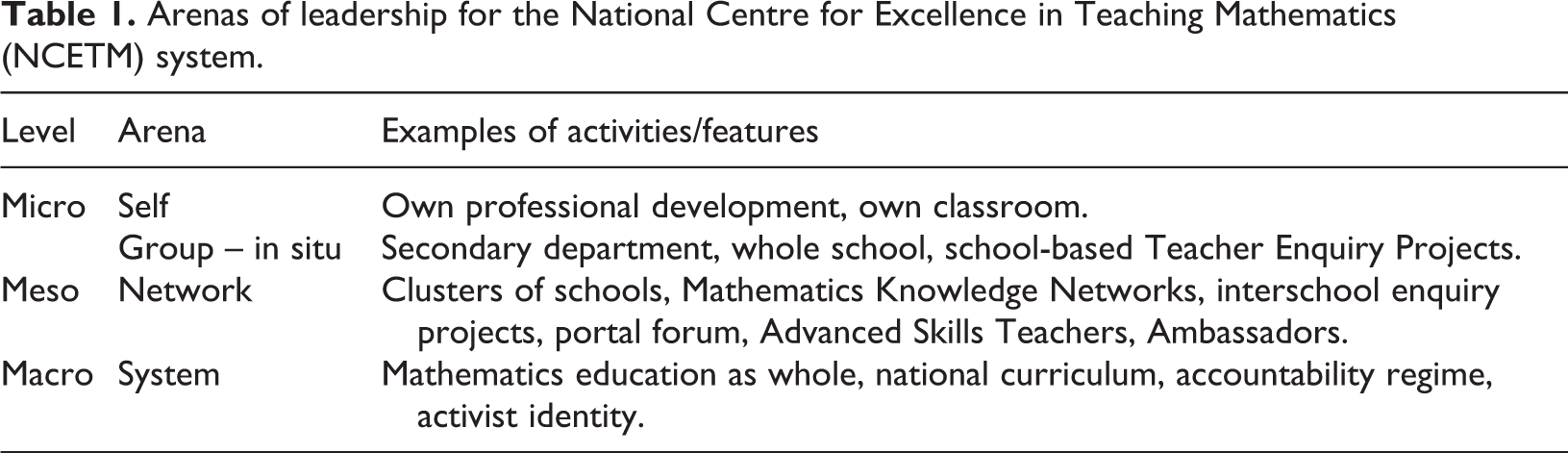
The concept of arenas of leadership allows for categorisation of the site and scope of leadership activity in relation to professional development. To conceptualise the form of leadership practice, I draw on a framework from complexity leadership theory developed to understand leadership in bureaucratic organisations.
Uhl-Bien and Marion (2009) identify three entangled forms of leadership – administrative, adaptive and enabling. This conceptualisation of complex leadership is proposed as a model to understand the formal and informal dynamics within particular organisations. However, I contend that it is more widely applicable and here I extend the model to explore how these forms of leadership relate to professional development in informal networks across organisations.
All three forms of leadership are needed for bureaucratic organisations to thrive. Administrative leadership addresses the bureaucratic functions of the organisation and is expressed through formal systems. Enabling leadership has two functions. Firstly, it fosters adaptive leadership and, secondly, supports the integration of innovation into the administrative functions of the organisation.
Adaptive leadership: is an informal leadership process that occurs in intentional interactions of interdependent human agents (individuals or collectives) as they work to generate and advance novel solutions in the face of adaptive needs of the organization (Uhl-Bien and Marion, 2009: 633).
Adaptive leadership occurs in the informal system that is an essential aspect of an organisation as a complex adaptive system. Uhl-Bien and Marion identify a number of characteristics of adaptive leader activity. Extending these and the notion of teacher system leadership, I propose four aspects of adaptive leadership relevant to teacher leadership in interschool contexts.
Leader as innovator: adaptive leadership is not primarily about directing or motivating subordinates but rather about innovation through the propagation of new ideas often occurring through informal roles.
Leader as responsive and purposeful: adaptive leaders are embedded in contexts and leadership activity arises in response to challenges or needs such contexts present; thus the motivation to innovate arises from personal goals and needs and interdependence as much as from a single shared goal or vision.
Leader as networker: leadership is often informal and outside established structures often exercised through the development of networks through which ideas spread, thus adaptive leaders foster information flows.
Leader as system worker: adaptive leaders are adept at understanding and interacting with the complex systems they are situated in.
In the context of education, the latter can be thought of as engagement in ‘system work’, understood as mobilising system resources to meet leaders’ purposes and also influencing and shaping the systems that they are part of. Below, I discuss the extent to which these features are found in the professional development leaders in the study; this includes considering the tensions between the conceptualisation of motivation in Uhl-Bien and Marion’s model and included in the notion of teacher system leadership.
To summarise the argument so far, in the previous section the landscape of professional development was considered and I identified the need to theorise professional development leadership, particularly in meso and macro systemic contexts. The concept of teacher system leadership provides a way of addressing the need to pay attention to micro, meso and macro aspects and also brings the issue of purpose to the centre of the analytical framework. The concepts of adaptive and enabling leadership provide fine-grained conceptual tools to examine the process of leadership practice, particularly in relation to innovation, response and purpose, networking and system working. Figure 1 summarises the theoretical framework I propose.
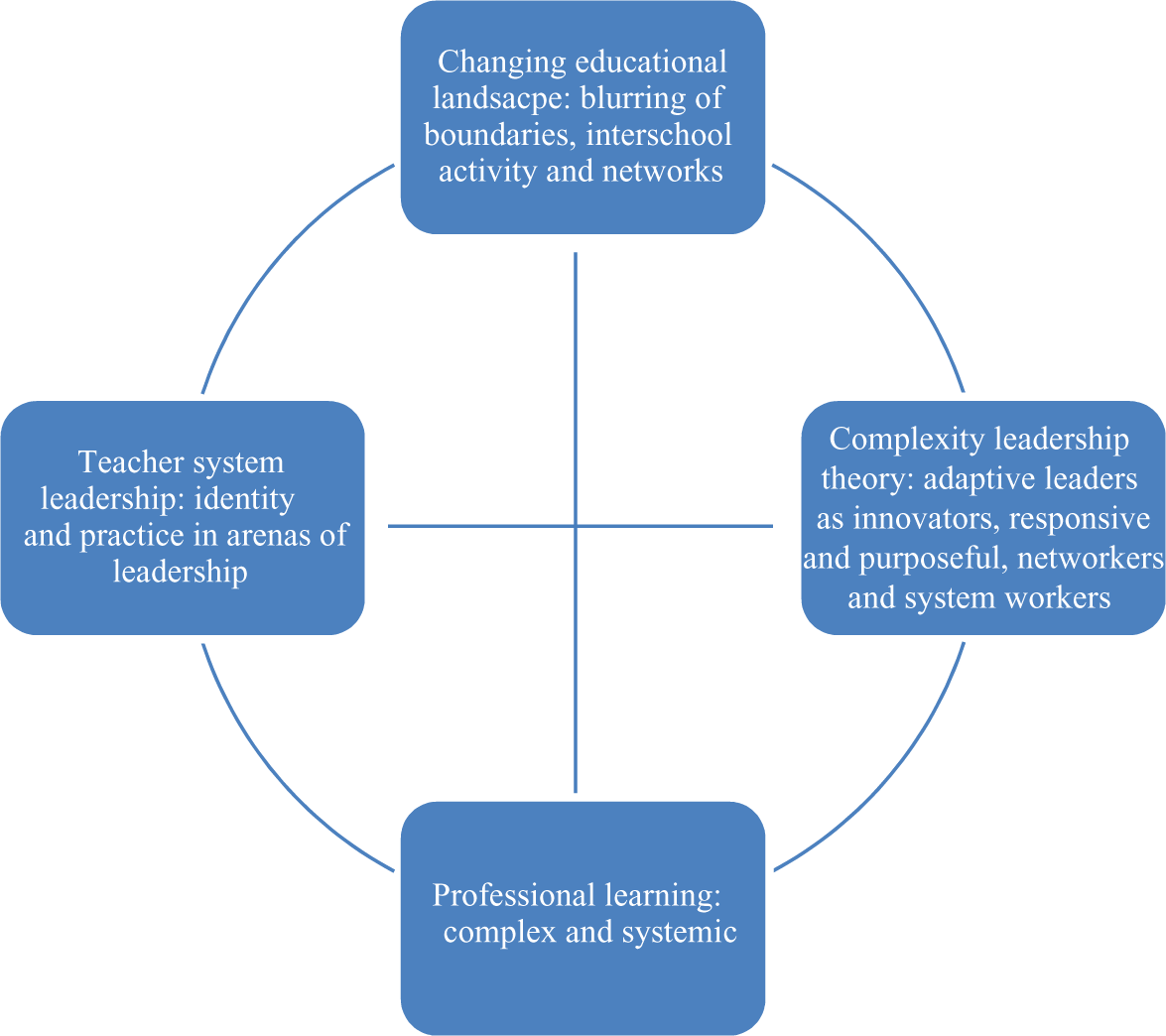
Theorising professional development leadership.
I now use these concepts to analyse the practice of professional development system leaders engaged in NCETM-supported activity.
The NCETM study
The NCETM professional development programme
Hoyles (2010) provides a detailed description of the NCETM’s activities, summarised below. The NCETM was established as an on-line ‘virtual centre’; its website and related on-line resources being its key visible on-going presence. A significant further aspect of the NCETM’s activity was a grants programme that supported teachers to engage in school-based or cross-school professional development and enquiry. Teacher Enquiry Projects (Joubert and Sutherland, 2010) offered financial support to engage in collaborative action research projects. Collaborative enquiry groups could be bounded in a single school or involve a wider network. The NCETM introduced specific grants to encourage such networks through Mathematics Knowledge Networks grants (Gousetti et al., 2011). At the time of the study, the NCETM had a small cadre of permanent Regional Coordinators and a large pool of ‘Associates’ available to support particular projects. It also developed a national network of ‘Ambassadors’ – serving teachers who acted as promoters of NCETM activity and of the NCETM.
The NCETM programme was a relatively decentralised change initiative, having a contested set of goals and means and loose institutional coupling in relatively unstable environments combining both lateral and vertical organisational forms (Fullan, 2006). Although the establishment of the NCETM as a national policy initiative had characteristics of a ‘top down’ approach, the NCETM described its practice as ‘bottom-across’, involving collaboration across school sites (Back et al., 2009). In the context of English mathematics education, the NCETM, at this time, represented an alternative to the centralised initiatives of the National Numeracy Strategy and later National Strategy (see Leithwood et al., 2004) that were commonly perceived as prescribing teaching approaches and forms of professional development.
Study methods
The NCETM commissioned a study into its impact (Coldwell, et al., 2010). Leadership emerged as a theme from consideration of the data rather than because the data were initially collected in relation to leadership. The lack of an initial focus on leadership is possibly a limitation of the study. However, an alternative perspective is that this adds credibility to the argument that the NCETM was a gateway to extending some participants’ arenas of leadership given that discussion of this was not directly prompted.
The study used two main methods – telephone interviews and case studies – supported by documentary analysis. The evaluation was subject to institutional ethical approval and consent was obtained from all participants, including the 89 telephone interviewees; note that names used in the paper are pseudonyms. Interviews were digitally recorded and then summarised with significant quotations transcribed and analysed qualitatively and quantitatively, through a coding frame. In addition to telephone interviews, 10 case studies were conducted consisting of multiple interviews on site with teachers, senior leaders and, in many cases, school students. Initial analysis of evaluation data identified a group of teachers who led professional development. Further analysis combined both inductive analysis of emergent themes and deductive analysis informed by literature on teacher, distributed and system leadership as well as on activist professional identity (Sachs, 2003). This led to a focus specifically on teacher leaders who were leading beyond their own schools and whose purposes were systemic – identified as teacher system leaders – consisting of 10 participants in telephone interviewees and seven who were subjects of case studies. This subset of data was reanalysed thematically (Ryan and Bernard, 2003) using deductive themes derived from the theoretical framework described above, including the constructs drawn from complexity leadership theory. Thus, the analysis and discussion presented below represents the outcome of the qualitative dance (Janesick, 1994) between data, theory, literature and analysis, an approach aligned with a methodology of adaptive theory (Layder, 1998).
Adaptive leaders as innovators: Arenas of leadership and leadership roles
The teachers exercised a form of adaptive leadership innovating to meet local needs. The professional development leaders instigated their projects, shaping the pedagogical focus, the type of professional development and the form of the networks. It is notable that meso activity across schools was often intended to address the micro context – that is, the needs in the leaders’ own schools. For example, through running a ‘maths week’ in her school, Sally identified the need to develop teachers’ capacity to teach through problem solving. Recognising a similar need in other schools, she instigated a Mathematics Knowledge Network focused on problem solving. The focus and nature of the projects were then shaped further through the networks that they developed, so that the process of adaptation led to common needs being addressed.
Thus one feature of adapted leadership, as exercised in relation to professional development, was adaptation to the situation. Another aspect was to adapt or utilise the resources available. Laura was responsible for the Further Mathematics course in her school (a post-16 extension course). In order to gain financial resource she began a Mathematics Knowledge Network involving other schools. Laura decided to engage in meso level leadership, in part, prompted by the financial resource available for network activity that would in turn support her in addressing the professional development needs of colleagues in her own workplace. One common aspect of the adaptive leadership role was to broker resources to enable professional development activity to occur.
A number of participants across the cases and interviews had formal roles or designations that had system leadership aspects involving interschool collaborative or school-to-school support. Four were Advanced Skills Teachers (AST), two of these were sponsored by the NCETM and four were designated as NCETM Ambassadors. This meant that the NCETM provided funding to release these teachers to promote NCETM activity and to support projects in other schools. However, even where participants had a formal interschool leadership role their professional development leadership combined both formal and informal aspects. Here, ‘informal’ refers to the temporary nature of the role and that it was not part of the formal organisational structures. For some, their informal roles were recognised and sanctioned by school leaders.
Table 2 gives a summary of the different arenas in connection to these levels and a selection of illustrative examples in relation to NCETM activity.
Arenas of leadership and formal and informal roles.

As can be seen, three of the teachers, Ian, Heather and Tony, did not have a formal teacher leadership role in their own schools. These three particularly exemplify the way that the NCETM supported opportunistic (MacBeath, 2005) engagement in system leadership activity, a theme returned to below.
Adaptive leadership as responsive and purposeful: System leadership
As noted above, engagement in meso activity was related to concerns in the micro arena. In this section, I also consider macro purposes and how leading professional development activity connected to teachers’ visions about the wider education system. Participants were motivated to lead professional development by purposes related to both mathematics teaching and to forms of professional development.
All interviewees shared a concern with changing the instrumental and transmissive mathematics pedagogy that is often found in schools to one that emphasised problem solving and more open and collaborative pedagogies: ‘to make maths more creative and more accessible for all’ (Lucy). It is notable that the NCETM’s own view of mathematics pedagogy was ambiguous. The NCETM set out a vision for mathematics pedagogy primarily expressed in terms of values and principles rather than prescriptive or detailed descriptions of practice (NCETM, 2008). These principles combined concern for mathematical fluency and rigour with the development of problem solving, understanding, learner engagement and collaboration and mathematical relevancy.
For some of the participants, the NCETM offered a means to enact beliefs and values that were already held in relationship to mathematics teaching. This was particularly evident for those, such as Brian, Simon, Sally, Michael, Pat and Ian, who had previous involvement in curriculum development projects, subject associations or activity for change in mathematics education. For Sally, for example, the NCETM offered the possibility of leading change within her school in line with her aim of mathematics being more practical, embodied and relevant to children and less driven by a concern for meeting targets. She then extended this leadership beyond her school through the Mathematics Knowledge Network, providing opportunities for wider influence for her vision of what mathematics teaching could be. For others, for example Lucy, Simon and Nicola, engagement with the NCETM led to changes in their view of mathematics: It’s really changed the way I think about my teaching and I’ve got much more of a forward thinking attitude now (Nicola).
Other purposes were more clearly linked to the type of moral purposes identified in executive system leaders (Higham et al., 2009) with concern for wider social outcomes being expressed. For example, Pat’s motivation went beyond her particular school and was rooted in her own educational history: Two people from my year went to uni in a school of 1500, so I was one of the very lucky ones to escape. My motivation is to give children choices later in their lives, that’s why reducing girls’ drop out from maths after GCSE is important to me (Pat, case study 5).
Uhl-Bien and Marion (2009) suggest that adaptive leaders develop their purposes locally rather than from a shared vision. It might appear that the example of the NCETM professional development leaders varies from this. However, Uhl-Bien and Marion’s framework was developed in relation to bureaucratic organisations in which adaptive leaders develop and act from their own purposes rather than a corporate vision. The professional development leaders’ purposes are also locally developed and arise in relation to their own and colleagues’ professional experiences and values.
The NCETM’s values and principles in mathematics education and the forms of CPD they supported, discussed above, offered a set of ideas around which those involved in the different forms of networks and collaborations and those leading them could gather in a way akin to those found in social movements (Crossley, 2002; Hadfield, 2007; Schneider and Somers, 2006). A feature of social movements is some heterogeneity even where central purposes are shared (Hadfield, 2007) and here too the exact focus, beliefs and practices were not uniform. Nevertheless, there was a set of overlapping shared purposes with a moral or axiological aspect. As a group the teachers demonstrated a shared passion for both an alternative to ‘tell and practice’ forms of teaching mathematics and to ‘listen and do’ approaches to professional learning.
This shared passion was often described with a sense of opposition to prevailing practices such as the teaching approaches experienced as prescribed by the National Strategy or the associated professional development experience. A feature of social movements and social activism is that a shared moral purpose is frequently developed in opposition to orthodox, legitimated practices and those that are prevalent (Hadfield, 2007; Schneider and Somers, 2006). Further, the purposes are, arguably, systemic, given that the teacher leaders’ purposes made sense in relation to the practices in mathematics and professional development that were found in the macro system. Thus, I argue that these teachers can be viewed as system leaders.
In summary, the approach to teacher learning and re-imagining of mathematical teaching promoted by the NCETM resonates with Sachs’ (2011) description of professional development that fosters teacher activism (Sachs, 2003) and so, arguably, encourages the development of teacher system leader identity that includes a concern for the development of more agentic forms of professional learning. Thus the teachers show characteristics of professional development activists.
Adaptive leaders as networkers and system workers
Central to this professional development activism in the participants’ narratives are enrolling and mobilising others to create and/or strengthen of networks for professional learning. The network then provided the means for learning to be generated and shared. Here, again ideas drawn from analysis of new social movements are potentially useful. Tasks for social movement leaders and systemic professional development leaders have parallels; both groups need to instigate new structures and mobilise others into activity through the development of shared meanings (Schneider and Somers, 2006).
Sally drew on pre-existing informal relationships to form a Mathematics Knowledge Network. She invited mathematics co-ordinators from other schools, people she had previously taught with and assistant heads she had met through a course for aspirant heads. Others drew on more established networks, for example an existing Further Mathematics Network (Laura), emergent self-organised networks (Andy and John) and existing local authority networks (Brian and Pat).
Whilst in some cases the form of networks was relatively simple – for example, teachers leading projects that involved teachers from a number of other schools – in other cases complex patterns of relationships with wider networks were reported as new organisational forms emerged. For example, an Advanced Skills Teacher in one school, Pat, described setting up a Mathematics Knowledge Network, funded by the NCETM, within an existing network that was initially set up because teachers perceived a lack of support from the Local Authority (LA). Later, the Mathematics Knowledge Network reconnected with the Local Authority network: I heard about an LA maths talk course across the county, and I thought ‘we are doing this stuff!’, so I said ‘can we help you do this since we are doing the MKN on this?’ The person moved from being defensive to saying, ‘oh can we meet up and have a talk’, so I thought, ‘this is really nice’, because – there was a dialogue going in with the authority, whereas before it was all a bit us and them, [our network] doing their own thing (Pat, AST, case study 8).
Enabling leadership: Local support and national warrants
For adaptive leadership to flourish needs the support of enabling leadership (Uhl-Bien and Marion, 2009). Two types of enabling leadership were evidenced in this study – that of school leaders locally and the NCETM’s national support.
It is well established in the literature that school leadership support is important for successful innovation in school (see for example, Fullan, 1995; Hadfield, 2007; Hargreaves, 2011; Harris and Chapman, 2002) and for enabling teacher leadership (see for example, MacBeath, 2005; Muijs and Harris, 2006; Poekert, 2012), notwithstanding that support may not always be completely benign and can potentially be constraining. Many of the leaders of NCETM-funded activity were supported by senior leadership or were themselves in such leadership positions. The culture [that the headteacher] has generated has allowed that to happen…the culture he sets is important – I wouldn’t say you could do this in every school (Pat).
The professional development leaders used the support of the NCETM to convince and mobilise others; it provided a warrant (McNamara and Corbin, 2001) to legitimise their activity, opening spaces and possibilities for action. Important here was the term ‘National’ in the title of the NCETM, which helped some of the teachers to resist pressures from school leaders or to enrol their support.
One Head of Department, John, spoke of the NCETM providing ‘legitimacy to the way we wish to teach’. He linked involvement in NCETM activity to being able to resist pressures to teach in the way advocated by senior leadership who wanted, for example, the early entry of pupils for exams. John used the NCETM involvement and support to maintain and develop alternative approaches such as group work and activities with more practical elements. He was able to contest departmental practice with senior school leaders by showing, through involvement with the NCETM, that his preferred approaches were successfully used elsewhere. Similarly, Brian noted that the NCETM’s funding ‘gave it a certain cachet that convinced the school that something major is going on here, [and so] we’ll give them the time to get into this’.
Above I pointed to adaptive leadership involving external system work to develop networks. John and Brian engaged in sophisticated system working within their schools as they negotiated and developed their positions to foster or protect their preferred forms of mathematics teaching and professional learning. For John, Brian and Tony, the contestation was with internal forces, for others the focus was on the external context. Some used the support of the NCETM to validate their approaches when subject to Office for Standards in Education, Children’s Services and Skills (Ofsted) inspections.
Tony provides the most dramatic example of how the NCETM created opportunities for leadership that might not otherwise have been possible and to an extent compensated for the lack of support by his school leaders. Prior to becoming an NCETM ambassador he had bid for funds for, and successfully led, a number of projects. He described supportive relationships in his department but saw senior leaders in his school as obstructive. This led to tensions about the use of the funds derived from NCETM activity. He felt that involvement with the NCETM was not seen positively by senior leadership. However, NCETM activity provided a route towards exercising leadership when his formal role within school did not allow this. I feel personally that my NCETM work has been out of my school than inside my school, I have much more of an impact out of school with other schools than I do in my own.
In summary, the warrant the NCETM provided supported the participants to enact changes in mathematics or to defend their approaches, and to instigate collaborative networks and ‘bottom-across’ professional development. This was done in relation to, and sometimes against, powerful voices in their own organisations and external forces and actors.
Conclusions
This study adds to the limited knowledge on the leadership of professional development by teachers. I began by arguing that to address gaps in both the professional development and teacher leadership literatures we need to develop theoretical tools to understand more about teacher leadership of professional development and to conceptualise the nature of leadership of professional development activity. I have offered an approach to thinking about teacher leadership of professional development, and support for it, using the constructs of adaptive and enabling leadership drawing on complexity leadership theory. Arguably, these are, as yet, under-utilised in accounts of teacher leadership and educational leadership more generally. These constructs are analytical tools that give insight into how teacher leadership of professional development occurs in practice. When combined with notions of teacher system leadership, an integrative picture of teacher leadership activity may be developed. As illustrated by the case of NCETM professional development leaders, the constructs serve to conceptualise situations where there is interplay of external support and teacher initiative at the school or network level. The concepts of macro, meso and micro systems provide broad distinctions between different systemic arenas for the purposes and activities of the professional development leader as organiser.
Adaptive leadership is an informal leadership process through which leaders innovate to generate or advance responses to perceived local and systemic needs. This responsiveness is purposeful and involves mobilising and enrolling others to form networks, and involves system work that includes brokering, and indeed campaigning, for professional development linked to counter-orthodox mathematics pedagogies and agentic forms of professional development. The concept of adaptive leadership also describes leadership roles enacted by teacher system leaders (Boylan, 2016), which hitherto had been proposed as a theoretical construct: leader as innovator, as responsive and purposeful, as networker and as system worker.
Enabling leadership was provided nationally by the NCETM and locally, in some but not all cases, by school leaders. The NCETM provided powerful warrants for the teacher leaders to lead professional development and, in turn, the involvement in professional development provided a warrant to lead; albeit that this was translated (Boylan, 2010) to support their particular purposes. Thus, the NCETM’s warrant provided the macro systemic context for action in local contexts through the development of heterogeneous networks.
The importance of moral purpose in teacher leadership has been pointed to often (for example, Fullan, 1995; Hargreaves, 2011; Sachs, 2003; York-Barr and Duke, 2004). However, the literature on the nature of teacher leaders’ purposes and motivations is under-developed. We do know that moral imperatives and collective purposes are motivations to instigate and lead professional development (Hadfield and Jopling, 2012; Margolis and Deuel, 2009; Wood and Lieberman, 2000). The study of NCETM teacher leaders supports this. One way of conceptualising the successful enabling leadership of the NCETM and local school leaders is that it enabled the expression and enactment of teacher leaders’ moral purposes. When moral purposes are extended to the macro system an activist professional identity may develop (Sachs, 2011). I have proposed that the teacher leaders can be viewed as professional development activists.
In the introduction, I identified two meanings of professional development leader – professional developer and professional development organiser. For clarity, I have treated these separately, focusing on the accounts of the participants in relation to how they initiated, organised and so led professional development activities through processes of brokering and mobilisation. However, the developer and organiser roles are related. Potentially, the notions of adaptive and enabling leadership may also be useful for conceptualising the professional developer as a facilitator role and support for it. If extended in this way then it would be important to consider, more fully than there has been space to do here, the nature of professional learning and how this relates to different forms of leadership.
There are four areas that are beyond the scope of this paper to fully develop but which I point to here as indications of directions for further work in this area. Firstly, in the study reported here, I have focused on the professional development leaders as the beneficiaries of the enabling leadership of the NCETM and often school leaders. However, from the perspective of the teachers with whom the professional leaders worked, their leadership was, in turn, enabling. This suggests the need to re-examine the constructs of enabling and adaptive leadership in the context of education and to recognise that adaptive and enabling leadership are relational and so are relative terms rather than fixed.
The second area for consideration is whether these constructs are applicable to leadership in education beyond the focus on leadership of professional development. The construct of adaptive leadership, supported by enabling leadership, moves the focus to a more agentic formulation in contrast to instances of distributive and teacher leadership where that leadership is exercised from authority that is transferred or bestowed on teacher leaders – delegated leadership (Harris and Chapman, 2002). It is also one, I contend, that fits with the lived experience of teachers who create opportunities for themselves to address their own and others’ professional development and other needs.
The third area to examine is the extent to which the patterns of activity that occurred in the NCETM-sponsored professional development leadership – enrolling, brokering, campaigning, warranting and so on – are found in other instances of professional development leadership. In this regard, recently this typology of roles and the concepts of enabling and adaptive leadership has usefully been applied to study of leaders and instigators of computing teacher professional development (Boylan, and Willis, 2015), providing a framework for the national leadership of a programme in this area to consider and refine their approach. Linked to this is the extent to which the concept of professional development activism, proposed in this paper, may help to illuminate the purposes and practices of professional development leaders in other contexts.
The fourth area is to address the issue of power in leadership of professional development. I noted above that power is under-theorised in the discussion of educational networks, and arguably the same applies to research on teacher leadership. The teachers’ activity as system workers and use of local and national warrants indicate the importance of both the micro-politics of power in specific contexts, but also how power in the macro system shapes action, for example the accountability regime (as administrative macro leadership) and the NCETM (as enabling macro leadership). Arguably, both in Uhl-Bien and Marion’s (2009) original account and my extension of the model of complexity leadership, power is not fully considered or theorised.
The argument made in this paper also has a further methodological implication. Enquiring into the processes of adaptive leadership requires a focus on mechanisms and patterns rather than variables. In relation to professional development leadership, this suggests examining, firstly, the conditions that create opportunities for teachers to instigate professional development and, secondly, the forms such leadership take, as well as conditions that limit it, rather than seeking to relate linearly the relationship between initial and outcome variables. Again this requires further theorisation of both professional learning and phenomena such as power in leadership.
Arguably, the outcomes of this study have the potential to inform the design and development of professional development courses or programmes for professional development leaders themselves. In relation to the NCETM, it is interesting to note that its programme changed after 2011. An important focus became CPD for professional development leaders themselves. The NCETM developed a two-day course – the Professional Development Leaders’ Support Programme. This focuses on the leader as professional developer and so on the pedagogical aspects of leading professional development. The study reported here indicates that the organisational leadership aspects should also be attended to, and suggests that other sets of skills, knowledge and dispositions are needed to support the organisational and activist role of the professional development leader, particularly in cross-school contexts. This would include supporting professional developers to articulate their own vision for teaching and learning, as well as their understanding of system contexts, including criticality about the contested and political nature of education and the development of micro-political awareness and skills to enable the leaders to develop networks and enrol and mobilise others; that is, to be a system worker. Potentially, this approach might be supported by applying research and theory on consultancy roles to system leadership practice (Close, 2016).
More speculatively, it suggests that an important aspect of fostering adaptive leadership arose from the ambiguous position that the NCETM took in relation to mathematics pedagogy, which allowed teacher leaders to inscribe their activity with their own purposes. Recently the NCETM has developed a new course focused on developing a cadre of teachers committed to Asian Mastery style curricula and pedagogy. This is a more directive approach and one that seeks to mobilise professional development leaders around a specific vision informed by current policy concerns and so, given the characteristics of adaptive leadership, the extent to which this will succeed in developing adaptive leaders is open to question.
To conclude, the study suggests that a cadre of teacher system leaders can be supported by attending to the interplay of professional development leadership and a wider system-orientated professional identity and by specific support to further enable teacher leaders to enact adaptive leadership.
Footnotes
Declaration of conflicting interests
The author(s) declared no potential conflicts of interest with respect to the research, authorship, and/or publication of this article.
Funding
The author(s) disclosed receipt of the following financial support for the research, authorship, and/or publication of this article: Data was collected as part of the ‘Assessing the impact of the National Centre for Excellence in the Teaching of Mathematics (NCETM) on teachers and learners’ study 2009-2010, funded by the NCETM. Subsequent research received no specific grant from any funding agency in the public, commercial or not-for-profit sectors.