



Abstract
This paper examines emotional expression experienced by female principals in the Arab school system in Israel over their managerial careers – role-related emotions that they choose to express or repress before others. I employed narrative methodology, interviewing nine female principals from the Arab school system to investigate expression of emotions in professional life stories that they narrated. Findings indicate that the principals’ emotional expressions differ according to career stage; on induction into principalship, they are stressed, feel threatened, distressed and challenged. As they establish themselves in their role they are calmer, use more humour and more ‘correct’ facial expressions. At a more advanced career stage, they express empathy and compassion, and concern for the maintenance of educational achievements. Understanding principals’ emotional expression at different career stages contributes to the quality of principal-teacher relations in the school.
Introduction
The words I heard from a female principal aroused my curiosity concerning the ways in which female Arab principals choose to express their emotions at different career stages and how these emotional expressions become a managerial tool in the Arab schools in Israel. My initial stage in the role was accompanied simultaneously by happiness and fear; happiness to have finally succeeded [in attaining the role] and fear of a new experience, not previously encountered. During the establishment stage I became more creative. I needed to overcome the fear and to begin to work; I felt strong self-confidence at that stage. After that came composure and mental calm … and now the most important stage has begun and this involves maintaining success (Eman).
In recent years, the study of emotions in educational management relates increasingly to emotional relations between the principal and teachers (Blackmore, 2004; Cliffe, 2011; Day, 2011; Hargreaves, 2005; Oplatka, 2011). These emotional relations vary according to different stages of the principal’s and the teacher’s career (Demetriou et al., 2009; Hargreaves, 2005; Oplatka, 2011). It is claimed that gender influences the manner in which principals express emotions in schools (Crawford, 2009) and this is especially noticeable in traditional societies in which women are assumed to express emotions more than men (Arar and Oplatka, 2014). Generally speaking, Arab women face gender segregation in the workplace, and they are expected to hide their emotions in coeducational institutions due to cultural expectations of women’s behaviour and appearance in the public sphere. The issue of Arab women in leadership positions has recently received attention in research on the subject, although women principals’ emotional expression in the workplace has not yet been given in-depth research consideration.
The present research aims to trace the emotional expression experienced and expressed by female Arab principals in their managerial careers, focusing on the different emotional experiences at each stage. More specifically, the research aims to answer the following question: How do the female principals express their emotions at each stage of their careers (transition from teaching to management, induction into the management role and establishment stage)?
Understanding the expression of emotions at different career stages and the dynamic manner in which they develop may teach us about the effect of emotional expression and its contribution to the quality of interaction between principals and teachers and to school climate (Day, 2011; Hargreaves, 2005).
The article begins with a literature review discussing emotions and educational leadership, and emotional expression practices at different career stages, emphasising the influence of culture and society on female Arab principals’ expression of emotions. Then the qualitative approach employed in order to collect and analyse the principals’ life stories is described. The findings section describes the main emergent themes for each of the career stages and the characteristics of emotional expression at those stages. In conclusion, I discuss the contribution of these findings for school principals and suggest directions for further research.
Emotions in the workplace and in education
Most scholars define ‘emotion’ as an ephemeral and fluid phenomenon (Hargreaves, 2005). Emotions mix ‘psychological, physiological and cognitive processes that allow people to process experience and to express it through positive or negative feelings’ (Bridges et al., 2004: 340). Emotions can be explained in different theoretical models. For example, Lopes et al. (2012) describe a hierarchy of emotional control including the stage of learning to express, articulate and understand emotions. Distinctions are also drawn between feelings, emotions, emotional labour and emotions at work, and these can be influenced by different situations at work (Oplatka, 2011).
Teachers’ emotions and their welfare in school constitute important indicators of the quality of school management (Day, 2011; Hargreaves, 2005). It has also been argued that schools and classrooms are flooded with emotions (Day, 2011) which influence the quality of teachers’ work and students’ learning (Hargreaves, 2005). These understandings have assisted research concerning emotional intelligence in teaching and management (Cliffe, 2011; Demetriou et al., 2009), emotional language and the connection between emotions and decision-making (Day, 2011). Cliffe (2011) suggested a five-level typology to identify the use of emotional intelligence among high school principals in England: (1) awareness of personal feelings; (2) conscious emotion management in a manner appropriate for the situation; (3) channelling emotions in a manner that improves motivation for performance; (4) recognition of the feelings of others; and (5) management of interpersonal relations while emphasising effective interpersonal links.
Teachers’ emotions are influenced by the school climate and the school principal’s style and reciprocally influence them (Hargreaves, 2005: 968). Crawford (2009) examined how the school’s emotional reality helps to form the principal’s personal self that is then expressed in the formation of interactions with those around them. In this study, Crawford clarified the reciprocal influence between the principal’s leadership and the school’s organisation and emotions.
Many scholars agree that principals have to cope with a challenging and complicated reality, and the expectations of them are vast (Leithwood and Beaty, 2008). Recently principals have also been under pressure due to frequent government reforms and the need to comply with the expectations of many stakeholders (Gronn, 2003). Often the principal acts as the sole leader responsible for motivating teaching staff towards goals through their use of a leadership style and consistent daily functioning, including expression of different emotions (Oplatka, 2011).
The principal’s behaviour may be accompanied by affective expressions of different types, including feelings experienced as a result of internal affective processes, emotions expressed as a result of these feelings and mood. Both intrapersonal and interpersonal affective expressions are interspersed in the principal’s interactions with the school staff, with parents and teachers and they constitute the core of educational work. Thus the school principal constitutes the focal point at which these professional emotions are concentrated, and it becomes important for the principal to be aware of this dimension when performing his or her role, and to consider these emotional expressions when he or she wishes to influence those around them (Crawford, 2009).
Some scholars have noted that female principals tend to manage their schools with the expression of mixed emotions, combining home and work environments, a situation that may testify to a lack of professionalism (Blackmore, 2004). When female principals express their emotions in school, they are often perceived as less professional, less rational, and as being fixed in a positive dimension of feelings of warmth, love, compassion and concern, in parallel with the expression of anxiety, unstable management and lack of self-confidence (Coleman, 2011). These prejudicial views challenge female principals. Nevertheless, Blackmore (2004) argued that management of an effective school requires the appearance and expression of emotions in organisational interactions. It is noted that although emotions are a universal phenomenon, they are also influenced by cultural norms and the way in which they are expressed is also cultural (Day, 2002).
Recent research on effective school management has emphasised the importance of interpersonal relations and noted the necessity to consider staff members’ changing needs in order to lead the school to success (Blackmore, 2004; Day, 2002; Gronn, 2003; Oplatka, 2011), while the study of emotions and the consideration of emotions in principal–teacher relations capture a central position in this field (Day, 2002; Gallant and Riley, 2013).
Women principals’ emotional expression in different career stages
It is commonly accepted that a principal’s career can be seen as composed of several stages, principally: preparatory stage, induction stage, stage of establishment and stage of renewal or, alternatively, decline (Cliffe, 2011; Crawford, 2009). A study by Oplatka (2011) on the nature of emotions in educational management, and particularly in later career stages, showed a correlation between different career stages and principals’ emotional expression.
Analysis of women principals’ life stories shows that during early principalship, these women deal largely with managerial prowess and repress personal emotional expression (Crawford, 2009). In these preliminary stages, especially in developing countries, women principals report that they are extremely stressed, frustrated and have a sense of helplessness (Arar et al., 2013). Later in mid-career, these women became more involved in promoting pedagogy and assisting the growth of their staff and feel a stronger sense of self-confidence, accumulating deep professional experience (Grogan and Shakeshaft, 2010). Many women principals report a sense of relief in their work during this period, in which they tend to delegate authority, focusing more on educational planning (Oplatka, 2006) and establishing an educational climate of care and concern (Arar and Abu-Rabia-Queder, 2011). Indeed, female principals’ managerial style tends to alter over the years. It was found that female principals moved from an authoritarian style based on their legitimate power – meaning power stemming from their role – while they repressed their emotional expression, to power based on their expertise as pedagogic leaders, relying on the teachers’ identification with their educational approach (Crawford, 2009).
Women principals are the exception in traditional societies, where the role of principal is usually associated with men (Oplatka, 2006). Thus, women who attain managerial posts in these societies are expected to demonstrate masculine characteristics such as authoritarian management and control (Arar and Oplatka, 2014). Research on women in the Arab school system in Israel indicates that women encounter strong resistance when they seek appointment as principals (Arar et al., 2013).
Observation of Arab society in Israel shows that there is a dichotomous set of expectations from men and women school principals. Local culture dictates two types of management that they are expected to deliver: authoritative and goal-oriented, and the women principals themselves expect to demonstrate this masculine style and to repress emotional expression and other feminine interpersonal qualities (Arar and Oplatka, 2014). Studies have shown that female Arab principals do indeed adopt a masculine administration style in the initial stages of their principalship (Arar and Abu-Rabia-Queder, 2011). Nevertheless, it seems that in later career stages female Arab principals demonstrate an alternative style that contradicts the traditionally accepted approach to leadership. As they gain confidence and as their authority is recognised their leadership relies more on successful interpersonal relations with stakeholders (Arar et al., 2013).
Methodology
In order to explore the dynamic nature of female Arab principals’ emotional expressions, I adopted qualitative life stories methodology (Chase, 2005), which enables the researcher to identify ‘what people intend to do’ and provides a framework to understand people’s work as active protagonists in their professional careers (Crawford, 2009: 39). I used in-depth interviews to reveal the life stories of nine female Arab principals and supervisors. As explained by Erickson (1986), qualitative research is shaped during the data analysis, so there were no preliminary hypotheses before the research was undertaken. Relying on literature dealing with the issue of emotions in educational administration and women managers’ expression of emotions at different stages of their careers through their biographies (Cliffe, 2011; Crawford, 2009), I assumed that certain emotions result from personal characteristics and are expressed in the principals’ ‘personal narrative,’ which helped me to understand what underpinned the expression or repression of emotions. Moreover, I tried to describe emotions as ‘social constructions’ and this helped me to understand what was happening in each situation (Crawford, 2009), assuming that these were expressed in the principals’ behaviours (Cliffe, 2011). The narratives of the principals that emerged from my interviews are presented here as they appeared within a particular social context and the context of their managerial posts.
Research procedure
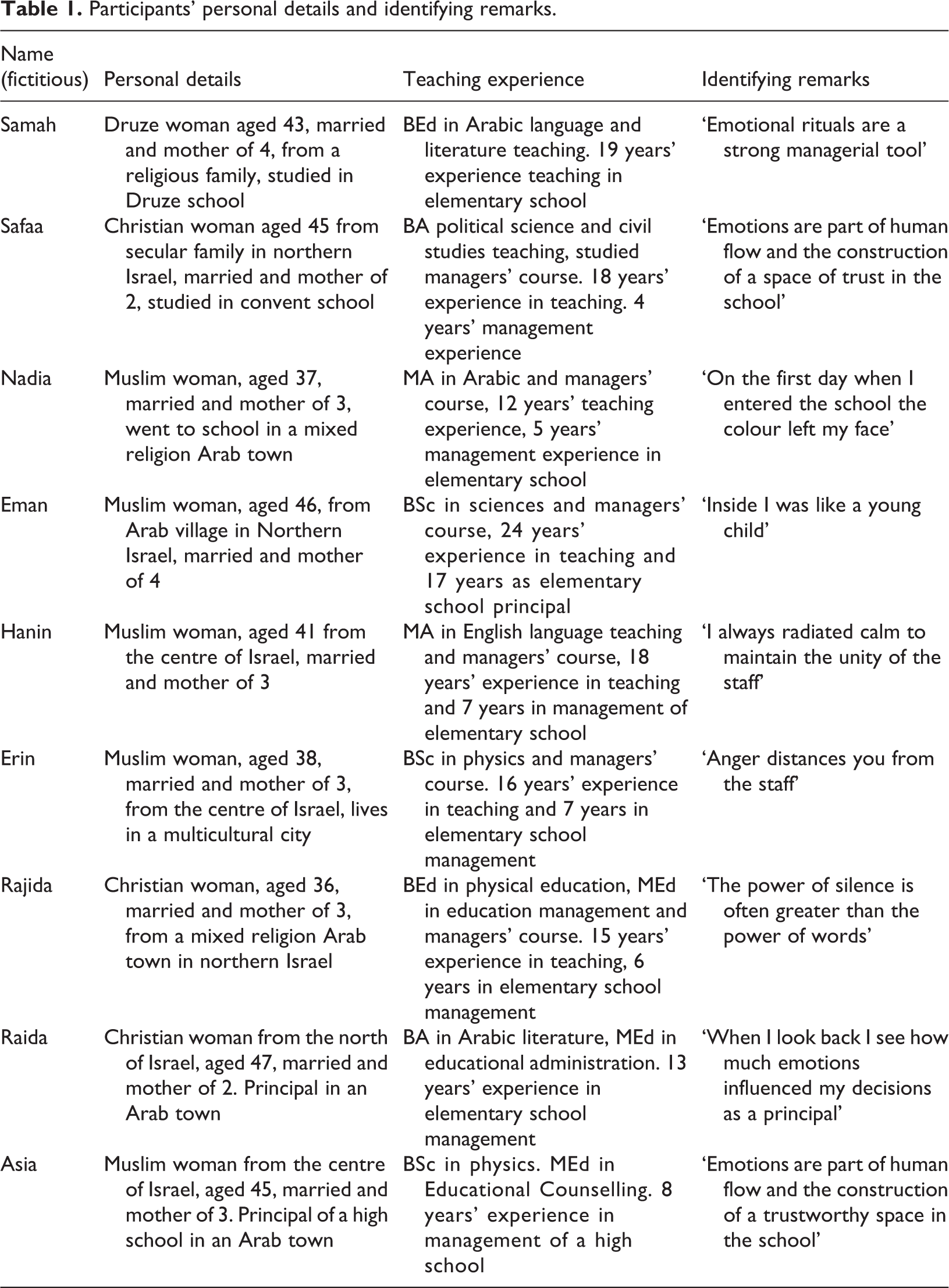
The women selected to participate in the research were in different career stages, in different geographical regions and in different types of environment (Arab urban, Arab rural villages or mixed towns). They were all employed in the Arab school system in Israel. I selected the women according to the snowball method, according to criteria of easy access and availability and with the help of recommendations from colleagues (see Table 1). The data collection took place over two years from 2013 to 2014, depending on the principals’ availability. The interviews were conducted in the principals’ offices, in Arabic, and lasted for approximately two hours. The interviews were recorded with the interviewees’ consent, then transcribed and translated from Arabic into English.
Participants’ personal details and identifying remarks.
The interview focused on the principals’ life experiences and the meaning that they attributed to their experiences as a principal, relating specifically to particular emotional events at each of the different career stages. Questions asked about their past included: ‘Can you identify moments in your career as a principal when particularly strong or weak emotions surfaced? Why did they occur?’ Questions concerning the present included: ‘What do you want people to know about you as a human being? How is that related to your leadership style?’ Finally, there were questions concerning the context: ‘describe the emotional context of your school at the moment,’, etc.
Despite the variety in the biographical profiles of the sample described in Table 1, the insights from these findings are largely restricted to the particular participants and I leave the reader to decide whether they are relevant and insightful for similar populations (Freebody, 2003).
Data analysis
Qualitative data analysis of the life stories collected from the interviews followed the four stages suggested by Marshall and Rossman (2012): ‘organisation of the findings, construction of categories and themes and the connections between the themes, examining any hypotheses that arose and searching for different meanings for the themes’. Comparative analysis guided the coding and organisation of the findings (Bird et al., 1999) and included comparison of each category with the themes that they contained. All the findings were then compared, leading eventually to interconnected categories. This systematic data collection and analysis hopefully reinforces the reliability of the research and the authenticity of the data that were obtained.
Findings
The findings represent the women principals’ stories about their careers, describing the emotions they express at each career stage, indicating how their expression of emotions influences their administrative style in the school in different career stages.
Before entering the role
Interviewees reported a range of feelings that flooded them before and immediately after they began their work as principals. For example, Nadia described the fears she experienced: It really scared me – how could I undergo such a transition without some sort of trial experience. I was confused and feared that I might fail. The night before the tender I did not sleep, I was so nervous that I even forgot what I needed to say in the interview. In contrast to my usually strong personality and despite the fact that I have been through many interviews, I had fears because the former principal had been a very strong respected figure and it is difficult as a young woman to replace such a principal and to radiate strictness and assertiveness. Once I announced my candidature for the tender, suddenly all my closest girlfriends began to distance themselves from me … I felt alone in this struggle. I could not sleep; there were many voices that I heard: what do you need this for? I also heard other threatening voices in the background; I felt angry and had to keep it to myself and not express it and to continue to cope determinedly. The moment that I expressed my desire to train for management, my colleagues in school started to tell me: What do you need that for? It frightened me and I began to have serious doubts. I tired myself out thinking whether I needed it or not.
First years as a principal
Having won the tender, the new female principals found themselves rather isolated. They understood that this period would be critical for their positioning in the school. Nadia explained how she coped with her fears from the beginning: On my first day in the school I prayed to God that it would be OK … I was really rather hysterical, I felt that everyone was looking at me suspiciously, examining and threatening. At the end of the day I had almost no colour in my face, I felt choked. At home I didn’t even speak to my child and just said that I wanted to sleep. I slept almost four hours and woke up to a new reality – I was a principal. When I began the job I needed to show a firm face because the school population was not at all easy. In my first weeks I had to expel a student. His mother came and cried. She said that he had nowhere to go; he had joined street gangs. I chose to maintain my decision. I am on trial here … although to a certain extent, I identified with her, I prevented myself from following that feeling and I radiated strictness, strength and power. Nevertheless, inside, I felt like a small child, just beginning to walk, afraid to fall at any moment. I have a teacher with whom I always used to go walking; suddenly she began to distance herself from me. I heard from someone that her husband had told her that he didn’t want her to be friends with someone so hard. It really made me feel angry, frustrated, that I had been pushed aside because I have chosen to become a principal. Usually I am calm. So even if I was angry I would not show it immediately; sometimes, when I was angry I would go to my room, breathe in and count till ten. [I also acted with restraint] if I was happy because a teacher had done something that I admired, and even when I encountered a problem I wanted them to see that I was annoyed, but not by shouting or being loud, but rather in a manner that would maintain their dignity and the connection. Teachers who worked for me at the beginning suffered; they must have been stressed by the demands and received less support from me because I requested more. I expressed my desire for perfection throughout the school. They were just waiting for me to fail, so I had to demonstrate control and authority, to prove that a woman knows how to manage a school even in a better way than a man; there was no room for smiles, stroking, just action.
The mid-career stage
After several years in school management the women principals reported that they went through a second, mid-career stage. They all noted that their emotional experiences and the expression of these emotions in interpersonal interactions altered during this period. For example, Hanin described her awareness of her emotions and how her emotional expression influenced some of the staff: The evaluation of the class’s functioning involves many emotions, since evaluation is subjective. In a mid-term meeting when a teacher presented the achievements of her class and especially the poor achievements of the less successful students, she remarked disdainfully, ‘they’re a waste of time,’ and I felt uneasy. It’s my responsibility to pass it on to her calmly and pleasantly in a conversation in order to maintain the cohesion of the staff. But on the other hand I’m really upset for those students.
A woman principal in mid-career is aware of the power of her emotions in any interaction with the teaching staff (Cliffe, 2011); however, female Arab principals’ expression of emotions is also influenced by their particular cultural and social context. Nadia voiced this succinctly: I come from Arab society, a society that gets very emotional about everything, it can’t be changed. I express my emotions in specific cases but in other cases I have to repress the expression of my emotions so that they won’t be seen as a sign of my weakness … A mother came to see me and told me that she did not have sufficient income to buy shampoo and so definitely could not buy the necessary equipment for school … I felt myself trembling, I was so moved, I got up from my principal’s chair and went and hugged her. I closed the door and told her that from now on … she would not have to worry anymore; I would be her mother here. It’s difficult to imagine Arabs without any emotional expression. Emotions are an important matter but in school management they can be a source of weakness. A school principal sometimes has to detach herself from her feelings; otherwise her organisation will become one big party. But we are all human and if we do not express our emotions we may become robots that perform instructions. I use a lot of humour in my work as a principal, I think it’s important because I am the type of person who loves everyone and wants to have a good relationship with my staff and be in a state of happiness … even when criticising teachers I use good humour. One of my teachers swore at a student … when I called her to me, I sat beside her, not opposite her, I held her hand and asked her: ‘what happened to you?’ And she began to cry and to apologise, I hugged her and told her that I would be here for her, but asked her to think how she would feel if a teacher humiliated one of our daughters in the same manner. How would any of us react? She cried, I hugged her and contained her feelings … but I finished the conversation with a plan to amend the situation … [I achieved] results that I would not have achieved by shouting and threatening, and I would have lost one of the wounded parties. My emotions have not changed during my professional life, apart from the first year, when I felt anxious and continually deliberated how I should look at things, speak and express my emotions so that they wouldn’t exploit me and say that I was irresponsible. But today I feel happy, satisfied and proud.
Teachers expect their principal to believe in them and to trust them with professional pedagogic issues. Interestingly, the interviewees reported that their level of trust in the staff changed over the different stages of their careers, starting with a low level of trust in their staff and the desire to demonstrate an authoritarian style of management at the beginning of their managerial career: ‘I was suspicious and afraid that someone would try to harm me or my mission’ (Eman). Over time they developed a higher level of trust in the staff, believing in their capabilities and their ability to demonstrate autonomous leadership: ‘today I let them feel that I rely on them, containing them, listening, hugging them and especially supporting them’ (Riham).
We can learn about the way in which the female principals used emotional expression when they look back over the different stages of their careers in the following section.
Retrospective insights concerning emotional expression
To understand how the principals perceived the expression of their feelings at each career stage, I asked them to retrospectively consider the expression of their emotions in school at all stages of their career. Asia described how she saw the expression of emotions in her work as a veteran principal: Emotions are part of human flow and help to construct a space for trust in school … you have to listen to a teacher, to be empathetic towards his needs and to form a space of trust in which he can express himself, since there is a difference between what a person actually feels and what he expresses to you. Working in fear cannot protect the teachers in the long run and may even erode any staff cohesion. So it’s very important that the principal develops trust in the teachers and gives them the feeling that they are part of a concerned and supportive family.
Eman and Raida explained how they created a safe, concerned and constructive space for their staff. They see their shaping of emotions as a part of the school’s substance. Eman felt it was important to control her emotional expression in school: If your feelings as a principal are not well controlled, they may overflow into a lot of areas in the school and colour your leadership and relations with others. This also influences the impression that you leave. There are moments that I sat and wondered. Why, despite all my real concern and giving to them, do I encounter circumstances that threaten to undermine my decisions? These thoughts can sometimes be depressing, the very thought exhausts me. Sometimes I even wanted to hit back at them in anger, then at other times I gathered them all and demonstrated that I am in control. I repressed my negative emotions for that moment and channelled them in a conscious and constructive manner.
As the women principals progress through their careers and distance themselves from their initial years in the profession, when they had not yet established their managerial expertise, they become more effective in meeting pedagogical challenges. ‘Today it is important for me to realise their [the teachers’] initiatives’ (Eman); Raida talked about the development of a facilitating environment for the expression of emotions in school: Emotional expression has for the students become the semantics of the school and I have succeeded in transmitting this concept to the students, to the teachers and at a later stage to the parents. I think that it is only feminine management that can do this. At the end of each trimester, the students perform emotional reflection and express this in writing, and we also sit and do a session in which we express our feelings, give presents and ask each other for forgiveness. [At first] When I went to talk in an assertive manner with a male teacher, it’s true that I adopted a strong tone of speech, but I was trembling inside. I made sure that I maintained a low tone and expressed agreement in my communication with the male supervisor, who is particularly stern … today I speak with the men around me, whether it is a supervisor or the mayor of the local government, in a more appropriate tone and actually choose to contain them and to express powerful calm, if it’s possible to call it that.
Discussion
My research focused on the emotional dynamics experienced by female Arab principals in Israel over their managerial careers. The research findings permit characterisation of emotional expression at each of the principals’ career stages: the stage of ‘transition’ from teaching to management is characterised by anger and repression of the principals’ self-expression, yet there is also happiness. Emotions are suppressed to demonstrate control, and ‘not appear weak’, and also ‘so that I won’t appear to lack answers to issues that arise’ (Aiman). On the other hand, calm and acceptance are expressed in communication with supervisors. This is a behaviour pattern mentioned in the literature as ‘externalization’ and ‘flattening of emotion’ (Hargreaves, 2005). But this behaviour increases the female principals’ sense of isolation and even engenders conflict with the staff, especially when they attempt to undermine stability and introduce change (Gallant and Riley, 2013).
The second, ‘establishment’ stage is characterised by calm, assertiveness and connectivity, active leadership aiming to ‘bring people together and create correct work relations between principal and teachers’ (Erin). At this stage, the female principals distance themselves from the emotional cycle of vulnerability and embrace a cycle of emotional containment (Blackmore, 2004), constructing a staff team and employing collective decision-making (Schutz et al., 2006).
At a later career stage, expressions of compassion and containment help to construct trust and maintain achievements. At this stage, the principals change their managerial style to group leadership and ‘break down partitions between them and the staff,’ passing from isolation into management supported by others, as Riham explained: ‘I maintain good friendship with my colleagues. I listen more in order to contain, to understand and to contribute.’ These behaviour patterns focus on a special effort to consider their own emotions as the principal and also those of the other stakeholders, in order to better read the organisational map and improve the management of the organisation’s emotional dimension to effectively achieve the organisation’s goals (Gallant and Riley, 2013; Oplatka, 2011).
I noticed that the female principals’ accumulated experience and the establishment of their authority led them to use restraint and strategies of emotional containment, forming a culture of trust and good relations among staff members. Crawford (2009) also noted that female principals’ emotional expression was more likely to influence the organisation, and can even determine the pace and quality of work and interaction in the work environment. The principals encounter their students’ emotions on a daily basis and so they also necessarily manage the emotions of others (Demetriou et al., 2009).
The findings also sharpen understanding of the correlation between the principals’ emotional expression and the culture in which they act, and indicate how emotions are perceived in the local cultural milieu (Crawford, 2009; Hargreaves, 2005). On attaining their role, female Arab principals avoided emotional expressions in communication with various stakeholders to prevent themselves from being seen as weak or too feminine and being excluded from managerial discourse, which is mostly perceived as male business (Arar and Oplatka, 2014). However, with time, as they gain the trust of their staff and the threat decreases, these female principals increased the use of emotions in their management, expressed in compassion, containment and listening to the teachers, to the extent that they ‘no longer distinguish between their home atmosphere and that of the school’ (Eman) (Fineman, 2008; Gallant and Riley, 2013).
Thus the research shows that emotions lie at the core of female principals’ work. Understanding the position and value of emotions in the school leads us to recommend that the study of emotions and their expression should be part of principal training programmes, exposing them to strategies of emotional intelligence for school management. Comprehension of the power of emotions can help them to enhance the control and management of emotions as a useful tool, especially in times of difficulty, challenge, distress, or when pressured by the demands of the role. It should be recognised that principals move to action, inter alia, because of the emotions they experience. This means that they should be aware of and manage their emotions in a conscious manner to more effectively influence others. And they should be able to channel their emotions in a way that will help to prevent burnout (Gallant and Riley, 2013).
My findings can therefore help us to identify the emotional contexts of the school principals and the reasons for their patterns of action, including the ways in which they manage emotional dynamics with others within the organisation, and help to empower others.
The women’s narratives also showed how their educational leadership is challenged by these emotional dynamics, especially in an era of rapid change and pressure for accountability (Crawford, 2009; Hargreaves, 2005). This paper can therefore inform principals and help them to cope more effectively with their own emotions and those of their environment, influencing the manner of communication in school to assist the attainment of school goals and vision.
The narratives of these women principals give voice to their personal stories and their contribution to the establishment of healthy, humane and containing organisations through sensitive emotional management. Since the world’s education systems report difficulties in finding suitable school principals, this may constitute a criterion for choice of principals.
The research has limitations. It relied on personal narratives to understand the emotional expression of female Arab principals at different career stages. It therefore produced a rich picture, but cannot purport to represent a broad population or be generalised to similar populations. The work of principals in Arab society, and especially female Arab principals, is riddled with difficulties and challenges. The role of emotions at each career stage, and the acquisition and development of principals’ emotional intelligence as an effective work tool for the formation of sensitive coherent school management in future principal cadres, should be further investigated to inform principal training.
Footnotes
Declaration of conflicting interests
The author(s) declared no potential conflicts of interest with respect to the research, authorship, and/or publication of this article.
Funding
The author(s) received no financial support for the research, authorship, and/or publication of this article.