




Abstract
The rationale for this article is to give complexity the central place it warrants in school leadership, management and organisational practice and research. We analyse the relevant literature, particularly that relating to complex human systems and their loose coupling nature. The analysis reveals the dimensions of complex human systems and consequences that emanate from those dimensions, which include system evolution. We use the dimensions, together with notions of interactional capability, opportunities for interaction, the legitimacy of interactions and the extent to which the institutional primary task conditions interactions, to create an organisational/institutional perspective on schools as complex, evolving, loosely linking systems (CELLS). Five main systems of a school as a whole-school system are identified: the teaching staff system; the ancillary staff system; the student system; the parent system; and significant other systems in the wider system. In the article, we illustrate the nature of the teaching staff system from a CELLS perspective. We discuss issues arising from our analyses: interaction, influence and leadership; ontological issues; the nature of ‘the school’; the significance of the parent system; the special nature of interactions between the members of the teaching staff system and the student system; and institutional performance.
Introduction
Despite the growing use of complexity perspectives in education research generally (Byrne and Callaghan, 2014) and in school leadership and management research particularly (Goldspink, 2007; Morrison 2002, 2010), we consider that complexity as a foundational aspect of schools is still not adequately acknowledged, which unduly limits research, policy and practice in school leadership, management and organisation. This lack of acknowledgement is somewhat ironic, given that 40 years ago Weick (1976) defined the organisational characteristics of schools as loosely coupling and, in so doing, drew attention to their complexity. He argued that these characteristics both configure, and are configured by, the daily work of leading and managing in schools, an argument that remains valid and which underpins our motivation for writing this article. School leadership and management practices will be shaped by the complexity of schools as institutions. We therefore consider that the complex nature of schools as institutions needs to be addressed anew, and in a way that is robustly underpinned by theoretical understandings of complexity.
Our intention in this article is to give complexity the central place it warrants in analyses of school organisation by: analysing complexity theories, including loose coupling theory (Weick, 1976); developing a perspective on schools as complex, evolving, loosely linking systems (CELLS); illustrating the CELLS perspective by applying it to the teaching staff system in a school; and discussing issues that arise from the perspective and our analyses. The structure of the article mirrors the above four points.
Complexity theories: An overview
An initial understanding of ‘complexity’ can be achieved by distinguishing between the terms ‘complicated’ and ‘complex’ (Cilliers, 1998). An object is merely complicated if it can be completely described in terms of its individual components. An entity is complex when the interactions among its constituent parts are such that it cannot be fully understood simply by describing its components. Further, in complicated systems, the components merely interconnect, whilst in complex systems, the components interact and are changed by those interactions.
Complexity is a wide-ranging concept and has been applied in various fields: automata; cybernetics; game theory; problem solving; artificial intelligence; evolutionary biology; and relatively recently, organisation theory (Alhadeff-Jones, 2008). The literature reflects this breadth of usage. There are, thus, many complexity theories (Boulton et al., 2015; Gell-Mann, 1994; Morrison, 2002) and their application needs to be refined/adapted according to context (Cilliers, 1998; Holland, 2014). A number of problems arise from applying complexity theory as it is used in the physical sciences to human systems because of the properties of the interacting elements, see, for example, Boulton et al. (2015).
Our interest here is in complex human systems (Mitleton-Kelly and Davy, 2013) that have been imaged in various ways. Weick (1976) did so using the notion of loose coupling and, more recently, others have modelled such systems as: complex adaptive systems (Gell-Mann, 1994); complex responsive systems (Stacey, 2011); and complex evolving systems (Mitleton-Kelly and Davy, 2013).
Complexity theories are open to critique on the grounds that they are a wide-ranging and unwieldy body of ideas and concepts (Boulton et al., 2015) and that they are merely metaphorical. By developing a valid perspective on the complexity of schools, which we consider to be a mid-range theory (Merton, 1968), we intend to identify the essence of complexity theories as they relate to human systems and make working with complexity more manageable. As regards the second criticism that complexity is merely a metaphor, authors offer a countervailing view, with Morin (1992) arguing that complexity offers a paradigmatically different approach and Fuller and Moran (2000) putting forward the view that it provides a methodological standpoint. Our own work here is to establish an analytical framework that identifies and characterises the dimensions and consequences of complexity. We thus provide more than metaphor, which as Alvesson (2002: 19) asserts is an ‘image of the world on which one is focussing’. Further, the analytical framework is neither an organising metaphor nor a root metaphor, which frames a more limited part of the reality captured by the organising metaphor (Connolly et al., 2011; Mangham and Overington, 1987). In addition, it is more than a construction of the mind and a means of representation as nominalists or relativists might argue, for example, in relation to school culture (Connolly et al., 2011).
A systemic perspective
A systemic perspective in its widest sense configures our thinking about complex human systems (James et al., 2007). Thus, an open systems model (James and Connolly, 2000; Scott, 1998; Von Bertalanffy, 1968) with inputs, core processes, a system core-environment boundary, system output/outcomes and feedback, shapes our analyses of complex human systems that we give below. However, this model is only a heuristic device and we are alert to the potential problem of reification (Boulton et al., 2015). Individuals interact, and in any system may change the system and may penetrate and change other systems (Boulton et al., 2015). We also recognise that any one individual will simultaneously be part of a number of systems. No individual will ever be part of only one system. Further, the boundaries between those different systems are variously configured and brought into being by a range of animating forces (James et al., 2013). Systems nest within other systems (Cilliers, 1998); Mitleton-Kelly, 2003); there are sub-systems within any system. Further, all systems are part of a wider system (James et al., 2007).
A systemic perspective has various implications (James et al., 2007). Individuals and the causes of their problems are part of the same wider system. This perspective can give deeper insights into events and phenomena, thus helping to avoid a reductionist standpoint, which unduly simplifies complexities. In systemic interrelationships, power, whether individual, collective, allocative or legitimated, will be important, and the notion of authorisation by the system may be significant.
Complex human systems
To capture the range of conceptions of complexity and the features of complex human systems, we undertook a meta-ethnographic analysis (Hawkins and James, 2016; James and Hawkins, 2016; Noblit and Hare, 1988) of the relevant literature, including Weick’s (1976) foundational work on loose coupling. Meta-ethnography entails the analysis and synthesis of research findings and the development of models that interpret findings across multiple studies. The analysis revealed two themes: (1) the dimensions of complexity; and (2) the consequences of complexity. Dimensions are the defining features of complex human systems and they vary in nature and extent, which affects system complexity. Consequences are the potential outcomes of the dimensions and they also vary in nature and extent. We discuss these dimensions and consequences in the following sub-sections using specific references from the literature set we analysed in order to illustrate sub-themes in the data.
The dimensions of complexity in human systems
Interactions are the central dimension of complex human systems. Schools are places where there is a high level of interaction, which is why we argue that complexity is a foundational aspect of schools as institutions. Interactions occur within a system core and across the boundary between the system core and other systems in the wider system. Interaction between individuals within the system core is understandably a robust theme in the literature, see, for example, Goldspink and Kay (2003), Mitleton-Kelly (2003), Snowden and Boone (2007) and Stacey and Mowles (2015). Interaction between system actors is a key idea in conceptualisations of complex human systems. The idea of interaction/interdependence is also central to Weick’s (1976) loose coupling perspective. These interactions between individuals/events/entities may be weak, happen infrequently and change over time, but are nonetheless the ‘glue’ that holds a complex human system together (Weick, 1976).
All the dimensions of interactions within the system core of a complex human system described below can be reiterated for interactions across the system boundary between the system core and entities in the wider system.
The heterogeneity of interactors
The heterogeneity or variety of interactors in complex human systems is a substantive theme, see, for example, Mitleton-Kelly and Davy (2013). Mena (2003) refers to Ashby (1956), who suggested that heterogeneity is a variable dimension and, therefore, an indicator of systemic complexity, an argument that remains valid. Some authors, for example, Mitleton-Kelly (2003) view variety as a prerequisite of system evolution, an issue we discuss further below.
The number of interactors
As with heterogeneity, the number of interactors in a complex human system features as a theme in the literature and is a potential contributor to human system complexity. Goldspink (2007: 41) explicitly refers to complex systems as ‘comprising large numbers of agents in highly connected webs’ (our emphasis).
Interactions are of a range of kinds
Interactions in complex human systems are processes of human relating and, as such, the content/subject may vary considerably (Stacey and Mowles, 2015) and encompass formal, informal, rational and emotional kinds of interactions (Goldspink 2007). Interactions may be recurrent, though not necessarily, and may be continually maintained in dynamic interlinking networks of linguistic, behavioural and affective interactions (Goldspink and Kay, 2003).
Interactions have a historical dimension
The historical conditioning of interactions is a significant aspect of complex human systems (Room, 2011), although Boulton et al. (2015) argue that this dimension, which will be culturally shaped, is often inadequately considered in analyses of complex human systems.
Interactions are motivated and intentional
Engagement in any behaviour, including interaction in a complex human system, requires motivation (Michie et al., 2011) and the motivational/intentional aspect of interacting agents features in the literature. Mitleton-Kelly (2003) thus argues that actors in complex human systems intentionally make choices. However, the notion of intention is problematic (Eoyang, 2006; Holland, 2014; Juarrero, 1999) and the outcomes of intentional interactions in complex human systems cannot be predicted (Mitleton-Kelly, 2013).
Feedback is an aspect of interactions
Feedback in complex human systems is a process by which information generated by an interaction is used for decision-making or regulation processes, which then affects subsequent interactions (Mena, 2003; Stacey, 1996). It can be negative and inhibitory, or positive and reinforcing and can change rapidly in nature and extent (Stacey and Mowles, 2015). As a result, the system may display unstable/non-equilibrated behaviour. Patterns of feedback within a human system may become more complex and dynamic over time but not necessarily so (Stacey and Mowles, 2015).
Feedback arising from interactions can affect future interactions in different and unpredictable ways. Sometimes, feedback can bring about large effects, perhaps larger than the initial interaction. Thus, in human interactions, its effect is unlikely to be straightforward as in a cybernetic system conceptualisation (Mitleton-Kelly, 2003).
Interactions change those interacting
In complex human systems, those interacting change as a consequence of the interactions (Holland, 2014; Mitleton-Kelly, 2003; Mitleton-Kelly and Davy, 2013) although the nature and extent of the change will vary and unpredictably so. Importantly, interactions influence those interacting and are, thus, at a fundamental level, leadership interactions (Cuban, 1988).
Interactions are non-linear in nature
A number of authors draw attention to the non-linear nature of interactions, for example, Goldspink and Kay (2003) and Snowden and Boone (2007). Goldspink and Kay (2003: 462) suggest that non-linearity in this context and from a systemic standpoint means that the output/outcome of an interaction ‘will vary in a manner which is not directly proportional to its input’, and that this aspect of interactions can contribute substantially to the complexity of human systems.
Consequences of complexity in human systems
The dimensions of complex human systems discussed above have a number of consequences. These consequences are the outcomes of both the within-system core interactions and interactions across the system boundary with other systems in the wider environment. The consequences are of two main kinds: those related to emergence and whole-system evolution; and those related to the non-linearity of interactions, as follows.
Consequences related to emergence and whole-system evolution
There is emergence within a system and in the systems in its environment
Emergence is the idea that system properties develop through interactions and it is a significant theme in the literature, see, for example, Goldspink and Kay (2003). The system evolves because individuals change as a consequence of within-core and across-boundary interactions. New properties develop that are individually and collectively manifested (Mitleton-Kelly, 2003). The new order, which is not predetermined, is often difficult to predict and can be irreversible (Dooley, 1997).
Interrelationships develop through interaction
Entities interacting within the system core and across system boundaries in a complex human system create interrelationships, the nature of which cannot be predicted (Mitleton-Kelly, 2003). These interrelationships may change the rules – the norms, assumptions and customs – of interaction.
Patterns of interaction develop
Patterns of interaction can develop over time as a consequence of interactions (Eoyang, 2006; Snowden and Boone, 2007). Local interaction produces emergent global patterns in the form of widely legitimised laws or designs and without any ‘direction’ from a ‘centre’ (Stacey and Mowles, 2015). The same/similar type of change may recur numerous times, or similar change cycles differing in scope or scale may be generated (Falconer, 2002). Gell-Mann (1994) argues that patterns become compressed into schema that provide some combination of description, prediction and prescriptions for action. Pattern development can be predicted but its nature cannot, because of non-linearity and emergence in the system (Stacey and Mowles, 2015). Patterns may ‘lock in’ individuals and constrain interactions (Boulton et al., 2015).
The whole of a complex human system is more than the sum of the parts
This theme, although perhaps colloquially expressed, features in the literature, see, for example, Holland (2014) and Snowden and Boone (2007). It captures something of the essence of complex human systems; the emergent properties are beyond the characteristics of any of its components (Mena, 2003). As Richards (2012: 1) puts it, referring to a group musical performance setting: ‘There is a certain magnetic glue that pulls us all together…Once we get behind our instruments there’s something bigger. The sum is greater than the parts.’
There is competitive pressure on emergent properties
In complex human systems, emergent properties are subject to competitive pressure as a consequence of feedback resulting from their interactions with other properties. Some properties will thus be enabled/promoted; others will be disabled/suppressed. As a consequence, fitness emerges (Gell-Mann, 1994), a line of thinking Mitleton-Kelly (2003) pursues, drawing on the idea of fitness for survival, which is a feature of evolutionary biology. Conflicting/competing constraints emerge as power and the dynamics of inclusion and exclusion (Stacey and Mowles, 2015). Dooley (1997) contends that schema, which frame interactions, exist in large numbers and compete for survival.
Properties emerge in hierarchical levels and nest with other emergent system properties
Hierarchy in complexity theory refers to the notion of nested sub-systems (Cilliers, 2001
In complex human systems, interactors, who have become structurally coupled, form a higher-order system (Goldspink and Kay, 2003). The recurrent interactions that give rise to this are uniquely determined by the participants and their individual and collective histories of interaction. Each such higher-order system may be treated as operationally closed and may be distinguishable as a new entity. Changes at one hierarchical level may influence emergent forms at levels above and below. In the dynamic emergence of organisational change, changes at individual, group, departmental and organisational levels of scale may occur simultaneously with each level influencing the others (Eoyang, 2006).
There is capacity for self-organisation
A number of authors, including Weick (1976), draw attention to the self-organising capacity of complex human systems (Dooley, 1997; Eoyang, 2006; Goldspink, 2007; Prigogine and Stengers, 1984). Self-organisation can take various forms and exists for diverse reasons (Mena, 2003) but, arguably, an important motivation is to establish stability (Snowden and Boone, 2007). The creation of order in complex systems, which frequently occurs in the absence of external direction (Goldspink and Kay, 2003; Stacey and Mowles, 2015), is usually the result of micro-structuring processes (Goldspink, 2007) and interdependency (Stacey and Mowles, 2015). Weick (1976) argued that loosely coupling systems have the capacity to make rapid, economical and significant adaptations, and to self-correct without any need for central direction or a plan. Mitleton-Kelly (2003) refers to complex systems as being self-repairing and self-maintaining. Despite these optimistic assertions, arguably, the extent and nature of such self-organisation/repair/maintenance cannot be predicted.
There is potential for whole-system evolution
Emergence, in its various forms, is the main consequence of interactions and underpins the way the whole system changes and evolves. For Mitleton-Kelly (2003) and others, for example, McKelvey (2008), system evolution is a significant consequence of the complexity of human systems. Mitleton-Kelly and Davy (2013) argue that because interactions across the system boundary are two-way, motivated and intentional, entities do not simply adapt to systems in their environment, they co-evolve with them. Such evolution may result in the destruction of valued properties. This notion of the evolution of a system, together with the evolution of systems in their environments, are important consequences of the dimensions of complexity described earlier.
Consequences related to the non-linearity of interactions
Establishing cause and effect relationships is difficult
The difficulty of establishing cause and effect relationships in complex human systems is a significant theme in the literature (Holland, 2014; Stacey and Mowles, 2015). It is a consequence of complexity because of: the non-linearity of interactions (Goldspink and Kay, 2003; Snowden and Boone, 2007); the nature of feedback in interactions (Gell-Mann, 1994); the number of systems and sub-systems interacting (Goldspink and Kay, 2003); and the effect of the variety of interactions (Goldspink and Kay, 2003). The degree and extent of interactions may also have a role here. In systems with a high level of connectivity, only a few sub-systems or components need to exhibit non-linear or discontinuous characteristics for the whole system to then behave in a non-linear way (Goldspink and Kay, 2003). Importantly, establishing within-system cause and effect relationships is difficult because of cross-boundary interactions with other systems in the environment.
System predictability is problematic
Predicting the future properties of complex human systems is problematic because of the nature of local interactions (Eoyang, 2006; Falconer, 2002; Stacey and Mowles, 2015). Snowden and Boone (2007) interestingly contrast ordered, chaotic and complex systems in this respect. In ordered systems, the system constrains the agents – they are locked in (Boulton et al., 2015) – whilst in chaotic systems there are very few, if any constraints. However, in complex systems, the individuals and the system constrain each other, particularly over time, which means that future outcomes cannot be predicted.
Small actions may have large effects
The notion that small actions may have large effects in complex human systems is a significant theme in the literature, see, for example, Snowden and Boone (2007). Weick (1982) draws attention to this consequence of complexity, arguing that loosely coupling systems may react excessively to relatively small actions but their tendency is to underreact. However, Mitleton-Kelly (2003) argues that in conditions far distant from the equilibrium, non-linear relationships prevail, which explains the potential for small actions to have large effects. Referring to Prigogine and Stengers (1984: xvi), they conclude that, as a consequence, the system becomes ‘inordinately sensitive to external influences. Small inputs yield huge, startling effects’ and the whole system may reorganise itself. Dooley (1997) adopts a similar line of thinking, as do Stacey and Mowles (2015).
There is potential for both chaos and stability
The notion that complex human systems exist in a state between chaos and stability features in the literature. Thus, Goldspink and Kay (2003) and Mitleton-Kelly (2003) argue that complex human systems can be stable and little change may happen for a while, but then a perhaps unforeseen system constraint may initiate a substantive change.
Developing a perspective on schools as CELLS
In the previous section, we have described the dimensions – the starting points and certainties – of complex human systems and the consequences of those dimensions, the most significant of which is arguably that the whole system evolves. In this section, we use that analysis to develop an organisational/institutional perspective that can be applied to schools. We argue that other behavioural aspects of interactions that do not feature substantively in the literature on complex human systems, and aspects of the institutional nature of schools should be included because they shape interactions in, and therefore the complexity of, schools.
Additional behavioural dimensions
Although Boulton et al. (2015) refer to the behavioural aspects of complex human systems, such references in the literature are rare. Arguably, they are important dimensions of complex human systems. Michie et al. (2011: 4) state that there are three ‘necessary conditions for volitional behaviour to occur’: (1) motivation; (2) capability; and (3) opportunity. Thus, for an activity such as interaction to occur all three elements need to be present. Motivation to interact is included in the motivated and intentional aspect of interaction discussed above. Interactional capability and opportunities for interaction should feature in a complexity perspective on schools.
Interactional capability affects complexity
Interactional capability encompasses ‘the psychological and physical capacity’ and ‘having the necessary knowledge and skills’ (Michie et al., 2011: 4) to interact. Interactional capability will affect interactions within the system core and between the system core and other systems in the environment.
The opportunities for interaction affect complexity
Opportunities for interaction comprise the chances and occasions for interaction (Michie et al., 2011). These opportunities will have temporal and spatial/physical aspects; interactions take time, and need to occur in a space of some kind. They will affect the nature and extent of interactions within the system core and between the system core and those systems in the system’s environment.
Additional institutional dimensions
Scott (2014) argues that that legitimacy (Suchman, 1995) of organisations as institutions is achieved by institutionalisation, which is underpinned by three so-called pillars: (1) the regulatory pillar, which concerns compliance with the rules and regulations; (2) the normative pillar, which comprises values and norms and promotes and sets expectations of particular ways of working; and (3) the cultural cognitive pillar, which is ‘the shared notions of the nature of reality and the jointly held sense-making schema which enable meaning-making and interpretation’ (Bunnell et al., 2017: 6). In addition to the institutionalising pillars, the institutional primary task, which is in essence ‘what the institution is there to do’ is a significant institutionalising force and has a substantial role in establishing institutional legitimacy (Bunnell et al., 2017).
The legitimacy of interactions
In complex institutions, such as schools, the legitimacy of interactions is important and will play a significant part in institutionalisation (Bunnell et al., 2016, 2017). The pillars of institutionalisation, which underpin a school’s legitimacy, will condition interactions. In asserting the importance of legitimacy, we are aware that the rules/regulations, the norms and the cultural aspects of institutions will themselves have been shaped through the interactions over time of individual interactors operating at the micro-level of analysis (Boulton et al., 2015).
The extent to which the institutional primary task conditions interactions
The institutional primary task will condition institutionalising activities that relate to the three pillars of institutionalisation (Bunnell et al., 2016, 2017). It will, therefore, condition interactions within a system and between the system and its environment. Again, interactions at the micro-level of individual actors (Boulton et al., 2015) may shape understandings of its primary task.
The notion of ‘loosely linking’
Weick (1976) argued for the idea of ‘coupling’ as opposed to ‘linking’ in depicting the complexity of schools as organisations. Arguably, in so doing he was seeking to connect his work with other theorists of that era, for example, Glassman (1973), as much as establishing a secure and non-semantic distinction. Our preference for the term ‘loosely linking’ arises from Weick’s (1976: 1) notion that the interacting units in complex systems, which as Weick says are ‘tied together’, interact, yet remain distinct with a separate identity. They do not form a ‘couple’ in this respect.
A CELLS perspective
Taking the dimensions of complexity identified earlier, incorporating the additional dimensions, and adopting the notion of loosely linking, a CELLS perspective can be developed that can be applied to organisations as institutions, including schools. It has the following dimensions grouped as follows.
Interactions
interactions occur within the system core;
interactions occur between the system core and the systems in the core’s environment.
Organisational factors affecting interactions
the heterogeneity of interactors;
the number of interactors;
the opportunities for interaction.
Features of interactions
interactions are of a range of kinds;
interactions have a historical dimension;
interactions are motivated and intentional;
interactions are affected by interactional capability;
feedback is an aspect of interactions;
interactions change those interacting;
interactions are non-linear in nature.
Institutional dimensions that condition interactions
the legitimacy of interactions;
the extent to which the institutional primary task conditions interactions.
To varying extents, consequences or outcomes arise from the dimensions of CELLS as follows.
Consequences related to emergence and whole-system evolution
there is emergence within a system and in the systems in its environment;
interrelationships develop through interaction;
patterns of interaction develop;
the whole of a complex human system is more than the sum of the parts;
there is competitive pressure on emergent properties;
properties emerge in hierarchical levels and nest with other emergent system properties;
there is capacity for self-organisation;
there is potential for whole-system evolution.
Consequences related to the non-linearity of interactions
establishing cause and effect relationships is difficult;
system predictability is problematic;
small actions may have large effects;
there is potential for both chaos and stability.
Consequences of the institutional conditioning of interactions
interactions within a system and between systems may be conditioned by interpretations of what is legitimate;
interactions within a system and between systems may be shaped by the primary task.
Schools as CELLS
In seeking to apply the CELLS perspective to a single school, we acknowledge that any one school comprises many complex human systems, which are systems within a whole-school system. We consider that the significant interacting systems are as follows. The teaching staff system – made up of those who have a formally designated responsibility to provide the curriculum and teach the students. This system will include those who have formally designated school leadership responsibilities. It also includes teaching assistants. The ancillary staff system – comprising those who ensure that teaching can take place but who do not have a formally assigned teaching responsibility. The student system – consisting of those for whom the curriculum is provided. The parent system – a significant school system, the members of which have substantial interaction with those in the student system and interact variously with the other whole-school systems. Significant other systems in the wider system – such as inspection and accreditation agencies, law-making bodies, policy-making entities, other schools and numerous other wider community-based organisations/institutions.
Within those different systems that are part of the whole-school system, there is potential for substantial interactions between individuals of the kind discussed above and, as a consequence, they have complex, evolving, loosely linking systemic dimensions. The systems comprising the whole-school system are illustrated in Figure 1.
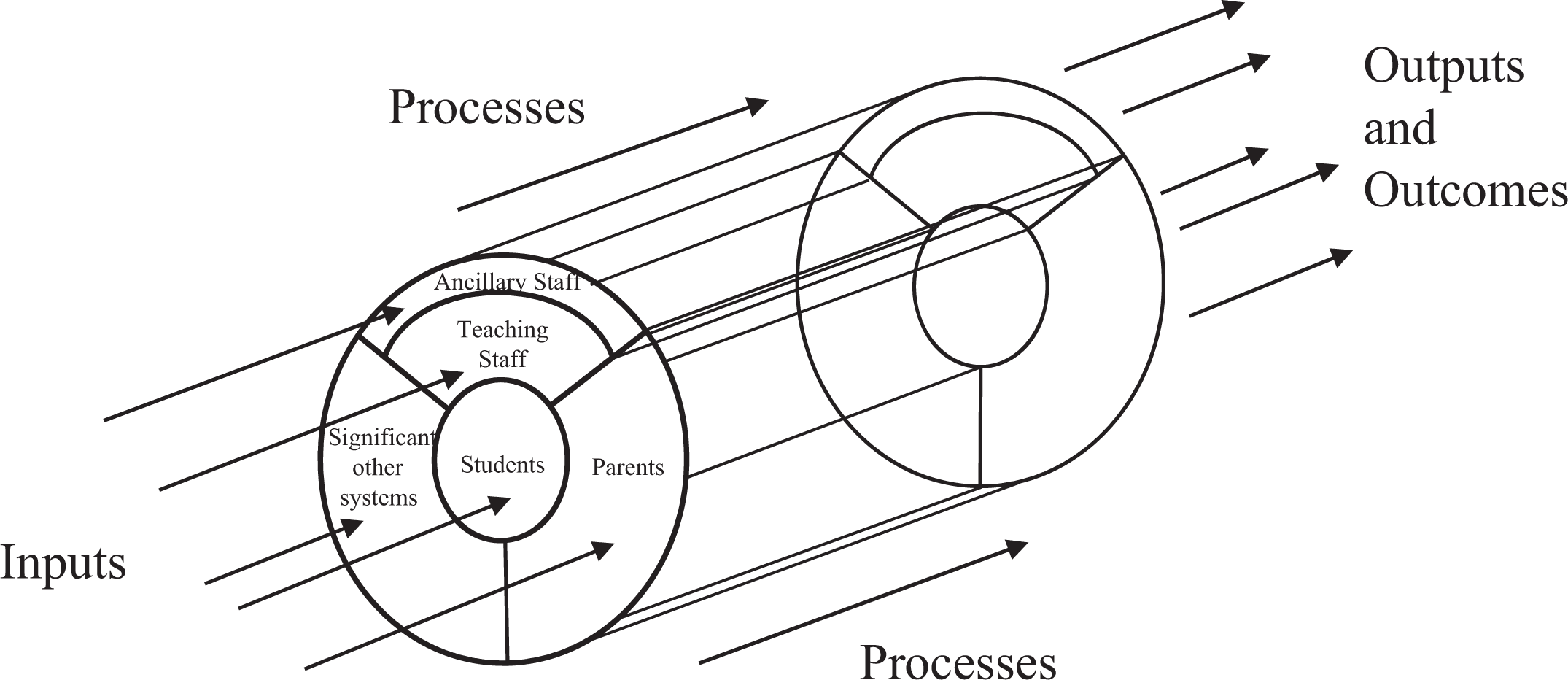
Diagram showing the main systems that make up a whole-school system.
In Figure 1 we have not used the standard depiction of the open systems model, see, for example, Hoy and Miskel (2008). Those people typically considered to be in a school’s external environment – that is, parents and those in the significant other systems are not located ‘outside’ a school. They are part of the whole system of a school. In the way we have imaged a whole-school system in Figure 1, the intersystem boundaries are not simply physical, with the parent and significant other systems beyond the school gate/perimeter fence, but very varied with a range of properties that are animated by a variety of forces (James et al., 2013), that can be construed in a number of ways (Cilliers, 2001).
Within each system that makes up a whole-school system there will also be sub-systems, each manifesting to varying extents the dimensions we have identified. In the teaching staff system, which is our main interest in this article, there may be formal sub-systems comprising members of subject teaching groups, pastoral care teams and leadership/management teams, and also informal sub-systems of various kinds. The ancillary staff system may comprise members of premises management teams, financial administration groups and the human resource management team. These groups may be located within the physical boundary of the school or elsewhere. The parent system will also be made up of different sub-systems – comprising individuals in various friendship groups, neighbourhood groups and parent groups connected to the school. Sub-systems in the significant other systems in the wider system will be numerous, as we have identified above, and individuals in those sub-systems will interact with each other and with other whole-school systems.
The teaching staff of a school from a CELLS perspective
In this section, we explore the teaching staff system of a school from a CELLS perspective. Our examples and illustrations are drawn from our professional experience as teachers and researchers in both primary and secondary schools in England. The teaching staff system is highly interactional in nature. Within the system there will be interaction and, as Figure 1 illustrates, the teaching staff system boundary abuts the student system, the ancillary staff system, the parent system and significant other systems in the wider system.
The teaching staff system: Interactions within the core and with the other systems in a whole-school system
Organisational factors affecting interactions
The heterogeneity of interactors
Individual members of staff will be different in a variety of ways, including: gender; ethnicity; teaching experience generally and in the particular institution; teaching capability; management responsibilities; subject teaching specialism if any; and personality and personal characteristics. This heterogeneity will affect system complexity. Similarly, the nature of the systems, the members of which interact with members of the teaching staff system, will vary as will the individuals in those systems. The students, with whom those in the teaching staff system interact extensively and variously will differ widely. Parents, and the members of the school’s ancillary staff system will also be heterogeneous and perhaps considerably so. The interactors in the significant other systems will also vary substantially, from inspectors from Ofsted, which is the school inspection system in England (Ofsted, 2016), to teachers in other schools, to members of the local authority where a school is located, to those in organisations in the local community.
The number of interactors
This dimension will vary according to the size of the school. However, in many schools there will be a large number of teaching staff members. For example, in many secondary schools in England the number will exceed a hundred. Through their work, teachers will interact extensively with the student system which will have a very large number of students, perhaps exceeding the number of teachers twenty-fold. They will also interact with: the members of the ancillary staff system, who may be numerous; the large number of parents in the parent system by various means – see below; and with those in the numerous other significant systems such as examination boards, Ofsted, professional associations/networks/associations and teachers in other schools.
The opportunities for interaction
Opportunities for interaction within the teaching staff system will vary according to the time set aside for formal/informal interaction and physical limitations on interaction. Teaching remains a largely solitary activity because of the way that classroom teaching is typically organised, which arguably limits opportunities for interaction, although many teachers in England will work closely with teaching assistants. Opportunities for teaching staff system–other system interactions will be very diverse and will include: classroom and other interactions with the student system; parents’ evenings, newsletters and other communications with the parent system; and a range of other opportunities for interactions with significant other systems.
Features of interactions
Interactions are of a range of kinds
Those who have experience of schools will be very aware of the wide range of interactions that take place among members of the teaching staff. Interactions may be: school/teaching related or not; substantial or trivial; serious or humorous; brief or extended. The teaching staff system’s interactions with the other systems will be extremely varied – from diverse classroom interactions with those in the student system, to the varied interactions with members of the ancillary staff system who will have a range of responsibilities, to interactions with parents in the parent system, which could vary enormously, to the interactions with (various) significant other systems. Interactions with the student system will be substantial, purposeful and varied, with each member of the teaching staff system undertaking boundary work (James et al., 2013). The shared responsibility for boundary work of this kind adds substantially to the complexity of the teaching staff system.
Interactions have a historical dimension
All teachers will bring their personal and professional history to interactions with their colleagues, which will add complexity to these. Similarly, they will bring those histories to their interactions with other systems, as will those in other systems with whom they interact.
Interactions are motivated and intentional
The intentionality of interactions among teaching staff system members is significant. Interactions are unlikely to be without purpose of some kind, will be at a particular level and will be to a greater or lesser extent. The intentional underpinnings of interactions within the system and of interactions in other systems will be reciprocal in nature. Interactions initiated by those in systems abutting the teaching staff system will have motives/intentions, although the outcomes of such motivated interactions will not be entirely predictable.
Interactions will be affected by interactional capability
Interactional capability will vary for many reasons and will, thus, add to the overall complexity of the teaching staff system. Arguably, given the nature of teaching, the interactional capability of the members of the teaching staff system is likely to be substantial. Those in other systems interacting with those in the teaching staff system must have the capability to do so, a problematic notion given the diverse nature of those in the other systems constituting the whole-school system. Teachers will also have varied capability to interact with all those in the other systems, which is again a challenging notion.
Feedback is an aspect of interactions
Again, those with experience of the way schools work will expect feedback to be part of teaching staff interactions, and this will be variously given and received. As with interactions within the system, feedback will be a component of all interactions between members of the teaching staff system and other systems.
Interactions change those interacting
Teachers change as a consequence of their interactions with other teachers. The briefest of interactions will change the interactors in some way. Similarly, through interaction with those in other systems, the members of the teaching staff system will be changed as will those in the other systems. Arguably, the task of the members of the teaching staff system is to change those in the student system and, through reflective processes, they themselves will be changed. This mutual change is a powerful source of evolution in the whole-school system.
Interactions are non-linear in nature
The outcome of an interaction between teachers in the teaching staff system may not be in direct proportion to the intention or the process of the interaction. A perhaps brief exchange could have very significant consequences. The same could be applied to interactions between teaching staff system members and those in the other systems that comprise the whole-school system.
Institutional dimensions that condition interactions
Institutional legitimacy conditions the nature of interactions
The legitimacy of interactions of all kinds and whether they are commensurate with the customs, norms and expectations of the teaching staff of a school will affect interactions within the teaching staff system. Interactions between the teaching staff system and the other systems will also be conditioned by interpretations of what is legitimate, which those in other systems could construe very differently. Arguably, this variation of interpretation could significantly affect complexity.
The institutional primary task conditions interactions
Interactions between members of the teaching staff system will be shaped by their conceptions of the institutional primary task and what they consider the institution is there to do. Similarly, interactions between those in the teaching staff system and those in other systems will be conditioned in various ways by the institutional primary task – especially so for interactions with those in the student system. However, those in the other systems may have differing views of the institutional primary task of schools as institutions.
Consequences of the dimensions of the complexity of the teaching staff system
Many of the consequences of the dimensions of the complexity of the teaching staff system discussed earlier will be evident in schools. The main overall consequence is that the teaching staff system and other closely linking systems evolve together. The specific consequences can be grouped as follows.
Consequences related to emergence and whole-system evolution
Interrelationships and patterns of interaction develop through interaction, and the whole becomes more than the sum of the parts. Emergent aspects of the teaching staff system and other linked systems experience competition. Properties emerge in hierarchical levels and nest with other emergent system properties and, importantly, through emergence, there is potential for whole-system evolution. Teachers have the capacity to self-organise when they are faced with a situation for which there is no pre-prepared plan of action which, given the complex nature of schools, may well happen. Many would argue that professional teachers will also have the motivation to self-organise in this way.
Consequences related to the non-linearity of interactions
Again, these consequences relating to the non-linearity of interactions will be familiar. Establishing cause and effect relationships can be difficult; system predictability is problematic, and relatively small actions within systems and between systems may have large effects. Importantly, both chaos and stability are possible. A whole-school system is potentially unstable, even though we may wish to think otherwise (James, 2010).
Consequences of the institutional conditioning of interactions
Interactions within a system and between systems may be conditioned by interpretations of legitimacy and the institutional primary task, but these interpretations may be varied.
Discussion
To recap, the complexity of schools, in a colloquial sense, is self-evident to those who have direct experience of them. However, in a theoretical sense, that complexity has not been fully analysed, nor does complexity have the central/foundational place it merits in the analysis of schools as institutions or school leadership and management. This is, therefore, our motivation for developing the CELLS perspective we have set out in this article. Various issues arise from our analyses as follows.
Interaction, influence and leadership
We accept as axiomatic that interactions change those interacting. Interactions between those in the teaching staff system and those in the student system are typically considered to be of a pedagogic nature. Interactions among those in the other whole-school systems are typically construed differently. In these systems, those interacting are influenced by the interaction and the interactions are therefore seen as leadership interactions (Cuban, 1988). This argument establishes leadership as a widespread phenomenon in all the non-student systems in a whole-school system viewed from a CELLS perspective. Leadership will be widely distributed in schools because interaction is widely distributed. The potentially destabilising nature of this all-pervading influence through interaction in an institution such as a school is prevented by the way the institutional dimensions of schools as CELLS condition interactions.
The complexity of schools as institutions
The analysis graphically illustrates the very complex nature of schools, which arises from the potentially diverse nature of interactions both within and between the five main systems of a whole-school system. Importantly, all these systems are continually evolving together. Complexity is a foundational feature of schools as institutions and the perspective we have developed is significant and can advance understandings of schools as institutions. In a general sense, a complexity perspective offers an alternative to the reductionist paradigm/discourse of control (Osberg and Biesta, 2010; Stacey and Mowles, 2015; Weick, 1976). Further, it is an alternative to mainstream theory of change/transformation. As Morrison (2005) has argued, complexity theory is more thorough than either structuration or habitus as a theory of change because it explains how schools can change by social production or emergence.
Ontological issues
Boulton et al. (2015), Byrne and Callaghan (2014) and Morin (1992) argue that a complex systems conception of the social world is a valid ontological perspective because it captures the very essence of the social world. This assertion underpins their claim for the relevance of complexity theories for understanding social systems. Arguably, the highly interactional nature of schools means that ‘knowing a school’ is a challenging enterprise. A school is always in the process of becoming something else through interactions, which argues for a process ontology (Mead, 1932; Sztompka, 1994). In process ontology there is a focus on becoming and change, which enables the nature and processes of emergence to be addressed through the complexity of interactions. We suggest that these issues need to be more fully addressed in the study of school organisation, leadership and management.
The nature of ‘the school’
Our analyses highlight the difficulty and perhaps inappropriateness of talking about a school as a physical entity. The perspective we have developed potentially extends conceptions of what a school as a building or place is. Further, it also draws attention to the difficulty of characterising aspects of ‘a school’, such as a ‘school culture’ (Deal and Peterson, 1999) or ‘school climate’ (Cohen et al., 2009). A ‘school’ comprises very diverse systems, each with very different characteristics. These systems, potentially, each have their own cultures/climates, which are subject to influence by interactions with individuals in the other systems and are continually evolving.
The significance of the parent system
From a systems perspective, the interactions between those in the parent system and those in the student system are likely to be considerable and frequent, hence our rationale for identifying the students’ parents as a major system. The way those in the teaching staff system enable their interactions with those in the parent system and engage with them is important (Goodall, 2007; Harris et al., 2008), especially given the benefits that can result (Gorard and Beng, 2013). There is considerable scope for further analysis here.
The special nature of interactions between the teaching staff system and student system
The cross-boundary interactions between those in the teaching staff system and members of the student system are, of course, at the very heart of the school as an institution. For those in the teaching staff system, these cross-boundary interactions are very purposeful in an interactional sense; they are initiated and undertaken to change the nature of the student system. All members of the teaching staff system are, thus, boundary workers (James et al., 2013) in this respect; they all engage in cross-boundary work as indeed do the students. These interactions add very substantially to the complexity of the whole-school system. Arguably, the proportion of system members who are authorised as boundary workers should be included as a dimension of complex human systems and organisations generally.
Institutional performance
Ensuring high levels of performance of schools is challenging because of their nature as CELLS. Morrison (2010) rightly cautions against using complexity as an excuse for complacency in this respect. Even so, the performance of schools is contingent on a range of complex and loosely linking factors which may be difficult to predict and control. Similarly, the complex nature of a teacher’s working environment can make teacher performance management (Department for Education, 2012), which is arguably conceived as an instrumental linear and cause and effect exercise, very problematic. Achieving performance objectives may not be under the direct control of the teacher and the appropriateness of annually set objectives may change as a whole-school system evolves. The nature of schools as CELLS calls for new and innovative ways of ensuring their high level of performance and of assessing their performance and the performance of those who work in them.
Concluding comments
In this article, we have developed a perspective on schools as CELLS in order to give complexity the central place it warrants in analyses of school organisation. In bringing complexity to the fore, we have developed a perspective on schools as institutions to underpin understandings of their taken-for-granted features and how they are organised. Such a perspective may explain the challenging nature of school organisation, the problematic nature of cause and effect models of planning and control and why some schools prosper and some do not. The CELLS perspective may provide new and productive starting points for policy- and practice-related initiatives to improve educational quality. It may open up new and productive avenues of enquiry for researchers.
We are aware that this analysis of schools as CELLS may not be complete and we invite other scholars with an interest in the perspective we have developed to elaborate on it further. Finally, the complex nature of schools calls for a way of analysing the many and varied interactions that take place within them.
Footnotes
Declaration of Conflicting Interests
The authors declared no potential conflicts of interest with respect to the research, authorship and/or publication of this article.
Funding
This research received no specific grant from any funding agency in the public, commercial or not-for-profit sectors.