




Abstract
This study examines a teaching-oriented higher education community which undertook a major programme of change when planning a new campus and redesigning its pedagogics. This is a single case qualitative study based on in-depth interviews of community members and field observations and using activity theory as an analytical framework. It is suggested that instead of merely being a rhetorical tool of senior management, distributed leadership can be practised in higher education communities for the benefit of the learners, the teaching and administrative staff and the local community. The study emphasises the importance of the joint sense making of the pedagogical approach in the creation of distributed leadership practices in a teaching-oriented higher education community. It also highlights how higher education students may take an active role in a work system characterised by distributed leadership, and how the infrastructure of a campus building may support distributed leadership.
Introduction
Distributed leadership accentuates the collective dynamics of leadership rather than focusing on the actions and beliefs of appointed leaders. It offers a non-individualistic, post-heroic alternative for discussing leadership, because it shifts the lens of examination from the hierarchical leader–follower relationship to the conjoint agency of those in formal management and those labelled in organisational charts as ‘followers’ or even ‘subordinates’. In place of examining how followers could be motivated to accomplish more than expected by feeling trust, loyalty and inspiration toward transformational, charismatic leaders (Bass, 1985; 1997), distributed leadership approaches focus on the collective, context-specific processes and practices of organisational actors whose roles may be fuzzy, fluid and constantly changing. (Bolden, 2011; Gronn, 2000; Jones, 2014; Thorpe et al., 2011). Bennett et al. defined distributed leadership as an ‘emergent property of a group or network of interacting individuals working with an openness of boundaries and the varieties of expertise are distributed across the many, not the few’(Bennett et al., 2003: 7).
For over a decade, the ideas of distributed leadership have been extensively discussed by school management researchers (e.g. Harris, 2008; Mifsud, 2016; Tian et al., 2016). Although the emphasis on the collective management dynamics could offer a counterbalancing perspective against the managerialist and leader-based discourses in academia (Crevani et al., 2015; Kezar and Lester, 2011), higher education researchers have, with a few exceptions (Creanor, 2014; Harkin and Healy, 2013; Jones et al., 2012; 2014a; 2014b; Keppell et al., 2010; Zepke, 2007) been less eager to accentuate the value of distributed leadership
In order to contribute to the discussion of distributed leadership in higher education, this paper presents an in-depth case study of a higher education community which has gone through a major change and, in the process, created a context-specific working culture characterised by distributed leadership. By employing qualitative research, this paper aims to provide a detailed description of the processes of distributed leadership which were enacted in constructing a new campus community and identity. Arguing that distributed leadership is not merely rhetoric but also a tool for bringing about change in a higher education institution, the paper gives voice to the community members as they share their accounts of how they participated in the planning process of the construction of a new campus building, their present views on the campus identity and visions for the future.
This paper also contributes to the general literature on distributed leadership because it discusses a major change initiative. Kempster et al. (2014) noted that the idea of a ‘heroic leader’ dominates the literature of change management, and called for new explorations of distributed leadership in connection with change initiatives in different contexts.
The paper is structured as follows. First a short review of studies of distributed leadership in higher education is provided; this is followed by an introduction to activity theory, which serves as an analytic framework for this study. The ‘Alpha Pittoresqeville campus’, the context of the case study, is then introduced. The data collection and analysis methods are then explained and the paper concludes with presentation and discussion of the research findings.
Distributed leadership: a contested concept in higher education literature
The conceptual development of distributed leadership has resulted in multiple analytic models and the overlapping use of terminology. No universally accepted definition of distributed leadership can be found (Thorpe et al., 2011). Any researcher searching for non-individualistic frameworks for the study of leadership needs to clarify the differences between ‘distributed’ leadership with ‘distributive leadership’ (Creanor, 2014; Keppell et al., 2010), ‘shared leadership’ (Fletcher and Käufer, 2003; Pearce, 2004), ‘constructivist leadership’ (Lambert, 2003) and ‘hybrid configurations of leadership’ (Bolden and Petrov, 2014; Gronn, 2009).
In addition to these general difficulties of the concept, the reason for higher education researchers’ hesitance to examine distributed leadership may lie in the close similarity of its ideas with the tradition of shared governance and collegial leadership (Burke, 2010; Kezar and Lester, 2011). One might argue that distributed leadership is an idea that has been proved to work in higher education (Birnbaum, 2004) and therefore has travelled from higher education to other leadership contexts, contrary to the normal phenomenon of management fads transferring from other contexts to higher education (Vuori 2015a; Birnbaum, 2001).
Gosling et al. (2009) and Bolden et al. (2009) argued that distributed leadership does not necessarily work as an analytic framework in higher education but, rather, serves as a rhetorical tool by highlighting the leaders’ goals. The rhetoric of the discourse, however, might blur the actual power dynamics of a higher education institution. Kezar and Lester (2011) suggested that shared (distributed) leadership serves the interests of management and posits that the remainder of the actors in a higher education institution are mere implementers of the agenda set by the management.
In a recent British study, Floyd and Fung (2017) highlighted that there are several inherent challenges of higher education and higher education institutions which make the application of distributed leadership a complex matter. Among these are the complexities and parallel existence of different missions of the higher education community, diverse academic leadership roles, communication challenges, and academic values and identities. Bolden et al. (2008) suggested that higher education institutions tend to seek solutions by paying attention to key individuals or restructuring efforts and are less keen to improve mechanisms that foster collective endeavours.
More favourable accounts of distributed leadership have been published in connection with higher education development projects in Australia and New Zealand. One of the significant findings of these studies is that distributed leadership can diminish the gap between the administrative and teaching staff (Harkin and Healy, 2013; Jones et al., 2012). Research has also shown that distributed leadership can act as a catalyst for curriculum change (Keppell et al., 2010) and enhance innovation in pedagogics (Creanor, 2014).
Activity theory
Cultural–historical activity theory is a framework for analysing work by using ‘an activity system’ as a central unit of analysis. It emphasises the connectedness between the parts of an activity system, the network of activity systems with other activity systems and the multi-voiced nature of activity. An activity system can be illustrated as a combination of interlinked triangles (see Engeström, 1987: 78). The elements in the upper triangle are the ‘subject’, which could be an individual or a group, the ‘object’ and the mediating ‘tools’ which the subject uses in an object-oriented action (Engeström, 1987; 1999; 2001). The activity system elements that create conditions in which the goal-directed activity can take place are the ‘rules’, the ‘community’ and ‘the division of labour’. The activity system results in the ‘outcome’.
Each activity system is a product of its history, and its objects and tools will have been shaped in the layers of its history. The activity system develops and changes through the contradictions (structural tensions) between the elements of the activity system or between the activity systems (Engeström, 1987; 1999; 2001). The ‘third-generation’ activity theory (Engeström, 1987; 1999; 2001) or the background writings it builds on (Leont’ev, 1981; Vygotsky, 1980) have been recognised as contributing to the conceptual development of distributed leadership. In his seminal article on leadership conceptualisations, Gronn (2000) suggested that new approaches to leadership must take into account theories of action, and he developed his argument by referring to the ideas presented in activity theory. Spillane et al. also emphasised the value of activity theory as a conceptual underpinning of their approach to distributed leadership. They highlighted that it ‘presses us to move from individual activity to consider how the material, cultural, and social situation enables, informs and constrains human activity’ (Spillane et al., 2004: 10). In her discussion of distributed leadership in school context, Harris (2003), too, acknowledged the contribution of activity theory to her approach to distributed leadership.
Methods
As a single case study using qualitative methods, this paper aims to provide a detailed description of the multi-voiced sense-making processes of the members of the community. The campus in Pittoresqueville (a pseudonym for the city where the campus is located) was chosen as a single case because, contrary to the critical accounts on the possibilities of distributed leadership in higher education, this case offered a unique setting for discussion of a successful implementation of its principles. The case also has the potential therefore to shed insight on a contested phenomenon (Stake, 1995; Merriam, 1998) and justified the appropriateness of the selection of a single case in this study.
In this study, the pseudonyms ‘Alpha’ and ‘Omega’ will be used to refer to the two higher education institutions involved in the case study. Both Alpha and Omega are teaching-oriented higher education institutions. While they both have several campuses, they share a campus in Pittoresqueville which is situated approximately 50 kilometres from the main campuses of both institutions. There are no other higher education institutions in the city of Pittoresqueville or in the province where it is located.
The research material consisted of theme interviews with Alpha staff and students, and field notes taken during observation periods on campus. The informants represented different roles on the campus: senior and principal lecturers (n = 5), their line managers (n = 3), students (n = 2), administrative personnel and library staff members (n = 3) and one academic advisor. The sample was selected such as to have an equal number of people representing administration (management, administrative and library staff) and teaching staff (lecturers and academic advisors). Within these groups the sample strategy was to interview those who were recognized by either the researcher or by an informant as the most knowledgeable about the campus development. The sample is not proportionally representative of these staff categories, therefore all those who acted in line-manager positions at the time of the study were interviewed, but only one-seventh of the members of the teaching staff were selected as informants for this study.
The themes for all interviews were as follows: The perceived value of the Pittoresqueville campus in its geographical environment and for the higher education institution of which it is part; The perceived outcomes of a recent organisational change; The perceived uniqueness of the campus; and Scenarios for the future.
The theme of the uniqueness of the campus was approached with multiple questions asking the respondents what was unique and essential on campus and how they presented the campus to various stakeholder groups (e.g. applicants, new students, new staff, companies and foreign and domestic visitors). In addition, those informants (n = 10) who had been part of the community throughout the planning and construction process were asked to answer the following question: How did the Alpha Pittoresqueville campus become the Alpha Pittoresqueville campus? The interviews did not include any direct questions about leadership, nor was the term ‘distributed leadership’ presented by the interviewer at any time.
The interviews lasted 42 minutes on average and were conducted during the course of one academic year. The data started to saturate after seven interviews, indicating remarkably similar perceptions of the life on campus. The observation periods took place during the same academic year when the researcher visited the campus several times in connection with two large-scale student-led learning projects.
The interviews were transcribed verbatim. The first round of coding of the interview data and the field notes from the observation periods was inductive and was conducted to categorise the informants’ expressions of the attributes of campus uniqueness, the campus construction process and talk of leadership. The largest subcategories under the main category of ‘uniqueness’ were ‘the learning approach’, ‘human touch’, ‘architecture’, and ‘collaboration’. The subcategories for coding the campus construction process were ‘the starting point’, ‘progress’, and ‘friction’. The informants’ discussions on leadership were categorized into subgroups either as ‘leadership of others’ or ‘my leadership’.
The data started to make sense after the first coding round with regard to the ‘friction’ code because this was seen to indicate something potentially important about the community transformation from the ‘starting point’ to the present perceptions of community identity (uniqueness). This finding was regarded as the result of the inductive coding round and led to a search for frameworks that could shed additional light on the analysis of the data. The framework of activity theory was chosen at this stage. The data were recategorised using the elements of the activity system as the main coding categories (‘subject', ‘object’, ‘tools’, ‘outcome’, ‘rules’, ‘community’ and ‘division of labour’) and these elements were distinguished first at the campus construction phase (Figure 1) and again at the time the interviews took place (Figure 2).
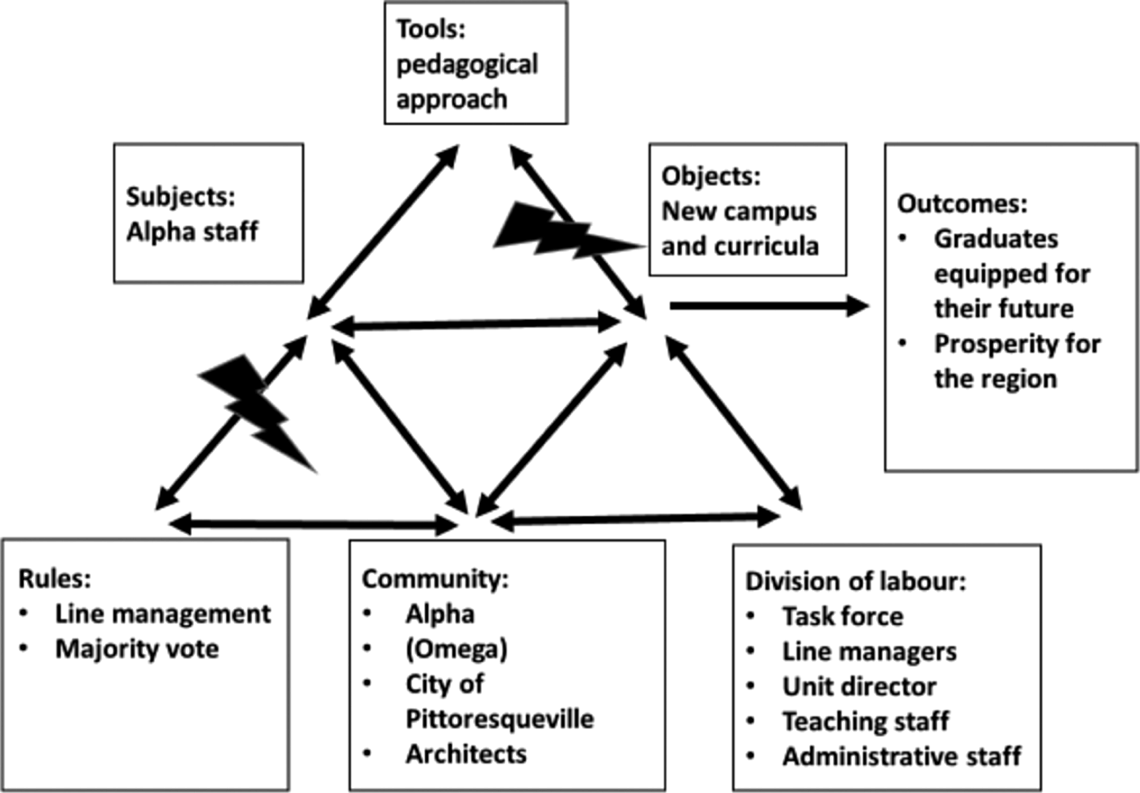
The work system in the planning stage. Adapted from Engeström, 1987.
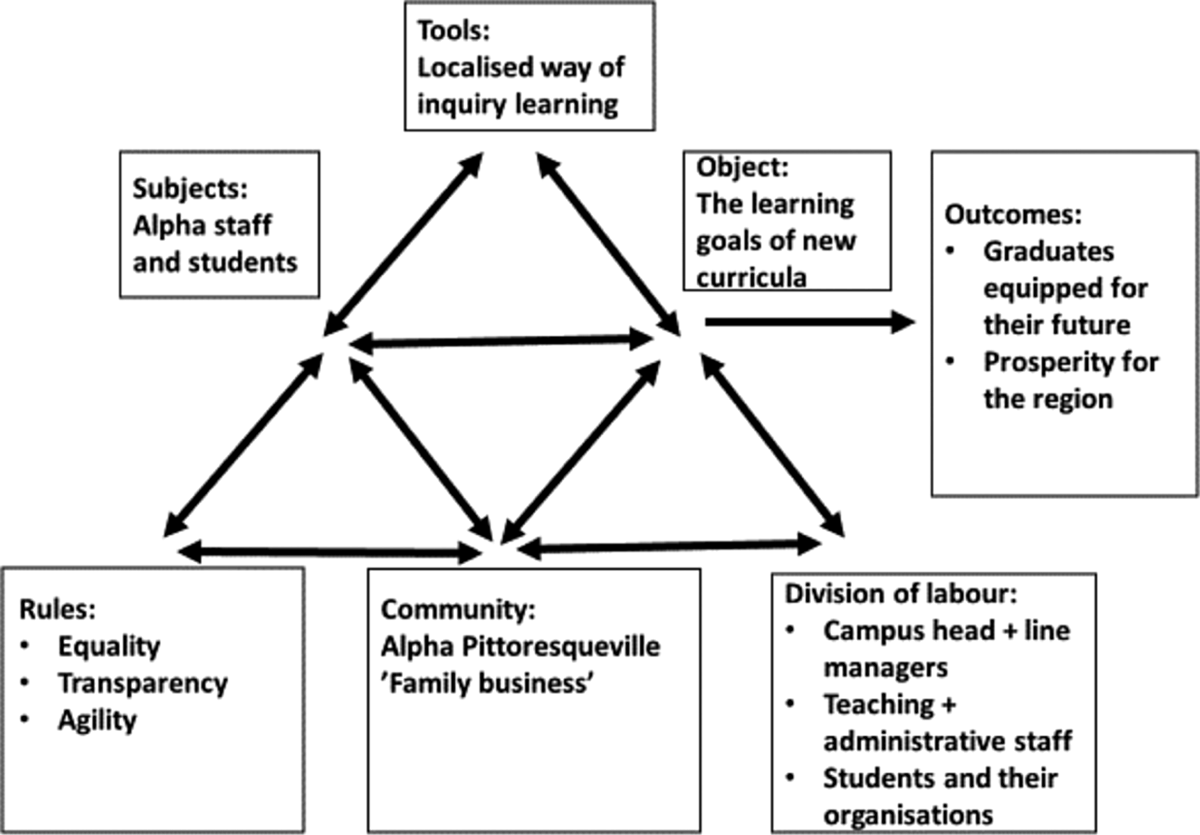
The work system at the time of data collection. Adapted from Engeström, 1987.
What now follows provides a narrative of building the Alpha Pittoresqueville campus from the first planning stage to its present state. All pseudonyms used in this paper are female, although two of the interviewees were male. The informants in management and administrative staff categories were given the code A (administration), the senior and principal lecturers and academic advisors were given the code T (teaching staff) and the students were given the code S (students).
Background
Pittoresqueville’s historic sites and old-town infrastructure make it one of Finland’s main tourist destinations. Its 50,000 inhabitants welcome 1.6 million tourists annually. In addition to employing people in tourism and retail, Pittoresqeville hosts electro-technical and petrochemical industries. Despite the grand history of the city and its ambitious plans for the future, the education level of the region is lower than the Finnish national average.
Until the establishment of Finnish polytechnics took place in the early 1990s, the tertiary-level educational needs of the region were satisfied with the supply of three separate colleges: one for nursing, one for business and one for tourism. In the 1990s, the business and tourism colleges joined polytechnic Alpha and started to educate bachelor-level students in business and tourism management. The nursing college became a part of polytechnic Omega.
In 2006, members of Finnish polytechnic institutes started to translate their name into English as ‘universities of applied sciences’ (UASs). This translation was contested for a decade and only as late as 2016 did the Finnish Ministry of Education acknowledge the translation. With their 138,000 degree students, Finnish UASs now comprise approximately half of the country’s higher education sector. UASs offer bachelor’s and master’s degrees; in addition, they conduct research, development and innovation activities aimed at supporting the needs of business, industry and the regional economy.
The Alpha University of Applied Sciences is steered and co-funded by the Finnish Ministry of Education and Culture but its legal status is that of a limited company, headed by a board which appoints the Managing Director who acts as the rector of the institution. The directors of educational units report to the rector and manage their units, which offer several professionally-oriented degree programmes. Currently (2017) Alpha UAS has 11,000 students and is located in five campuses. Omega UAS has 8,000 students in seven campuses. Together they have a joint campus in Pittoresqueville with 1,000 students and 60 staff. The following describes the planning and construction of the Pittoresqueville campus.
The first steps
It took more than five years from the moment the representatives of the senior management of Alpha approached the city of Pittoresqueville with the idea of building a new campus to the inauguration of the new campus building. The staff of Alpha worked at two different locations at that time. Laura (A) described her thoughts in those days: I wondered how can this [situation] be so miserable. There is a river in between us, with business [education] on one side and this [tourism education] on the other side, and the river is long and deep and we cannot find anything in common. It was like a competition: ‘We do it this way, we have, we have always, yes, we have already tried that before’.
The planning process of the campus building lasted several years; all Alpha staff members were involved. The planning process was led by a task group headed by a member of the teaching staff, and this group reported to a supervisory group which consisted of degree programme managers and the unit director. The task group acted as an intermediary and was responsible for organising and planning actions; its members were chosen from those individuals who were ‘interested in pedagogics and future foresight’ (Birgit, A). ‘Although many say that you cannot change the curriculum and the premises at the same time, we did’, Doris (T) noted, ‘and now thinking back, we are very satisfied’. Ella (T) described the working methods: We had many full-day workshops during which we started to think, hey, what is the learning of the future. What do we want it to be and how shall we accomplish that? And if so, what would it mean for our pedagogic approach and what would it mean for the premises? We started entirely from the basic assumptions of learning roles: How does one learn in the first place?
The process involved meeting the architects and, later, the interior designers on different occasions. Birgit (A) recalled the meetings and working practices: …everyone was allowed to actually participate and everyone was expected to participate. Of course, some were more active than others, but everyone had a role. When meeting with the architects, I believe that everyone noticed that they actually listened to us. I believe it was quite a strong motivator to encourage people to open their mouths.
The pragmatists and the radicals
The planning process of the new campus revealed that there were two fundamentally different staff orientations: those who were described by Vivian (T) as ‘healthy-minded pragmatists’ and those who were seen to be willing to take a more revolutionary path to the future. Laura (A) shared a memory from the first days of the planning when she noticed the split: We had our first session where the people were firmly above the clouds and thinking how at the new campus everything just goes and flows, based on the idea that people interact with each other and that results in understanding. And I thought I have two options: either to go along with it or say exactly what I want and think. And so I shared my point of view that the degrees are not achieved just by hanging around like that; we also need benches, tables, books and files.
A lot was at stake, because the planning process was concerned with both the fundamental learning principles to be adopted in the new curricula and the joint working practices in the new building. The actions of the opposing camps were thus described as ‘hitting the brakes’ and ‘sabotaging’, which in turn were described as causing ‘open wounds’.
The discussion also involved asking who would be making decisions. Would it be a majority vote, or should some, for example the line managers, be given more than one vote? Harriet (T) noted that, For the lecturers, the joint decision making, the majority rule of democracy is very difficult. If we decide something together, one thinks that it will not concern me because I was of the opposite opinion.
The activity system at the planning stage
Figure 1 depicts the activity system of Alpha Pittoresqueville staff at the planning phase. The object of the work was a new campus and curricula; and the outcome of the activity was to be the preparation of employable graduates and, as the legislation for Finnish UASs requires, prosperity for the region. The work was divided between the task group, the programme managers and the unit director, the teaching staff and the administrative personnel. In addition to Alpha staff, the planning involved the city, the inhabitants of Pittoresqueville, representatives of Omega UAS – because they were also moving into the new campus building, the architects, and the interior designers.
There were, however, two contradictions in the activity system. Contradictions are a source for disturbances and conflicts, but also create opportunities for innovative disruptions (Engeström, 2001). The first contradiction in the Alpha Pittoresqueville work system, in the planning stage, was between the tools and the object regarding the principles of pedagogy – how does one teach and learn. The second contradiction was between the subjects and the rules and concerned who had the power to decide. Vuori (2011, 2015a) argued that Finnish UASs do not have a history of shared governance and are more inclined to adopt a managerialist culture with top- down management. Contradictions occur when the old collides with the new (Engeström, 2001). In this respect, the ideas of distributed leadership and joint-decision making can be considered as a new rule colliding with the old managerialist practices.
The way we do things around here
Figure 2 illustrates how the activity emerged after the contradictions of the planning stage were solved. The upper part of the figure shows that the guiding tool of the new activity system was the new pedagogical approach adopted by the Alpha Pittoresqueville staff, ‘our way of inquiry learning’ (Harriet, T). This pedagogical framework is common to all degree programmes offered by Alpha Pittoresqueville. Students have a project that will connect different courses of the semester. With projects commissioned by companies or other organisations, the students are ‘linked to the challenges of the companies’ (Birgit, A). In this approach, the students are considered as active constructors of knowledge and have responsibility for their learning. The boundaries between different subject areas have been diminished because courses are offered as a combined effort of lecturers from different disciplines.
The outcome of the work system is the same as in the planning stage: graduates equipped with the skills to succeed in the future and prosperity for the surrounding region. The pedagogical approach has changed the role of the students and they are thus genuine subjects of the activity system. Heidi (S) accentuated this point from the student perspective: The lecturer is not solely responsible for the project; rather, one student from the class is a project manager. The lecturer only oversees, and of course takes care that it moves forward…A lecturer does not always have to be a powerful authority figure…who tells and others listen. Instead, we learn by doing, through trial and error.
Figure 2 shows how the ‘rules’, ‘community’ and ‘division of work’ have changed in the work system compared to the previous stage (Figure 1). The community at Alpha Pittoresqueville campus has evolved into a ‘family’ or ‘family business’ consisting of teaching and administrative staff and students. It really is like a family spirit. You can see among the staff that we have a really good time together and we have good relationships. Many of us want to come to work because…something happens all the time and it is nice to work. (Ella, T) Students are seen as whole persons, and personnel are also seen as whole persons. It is understood that there is always a human being behind the work, and she has a private life and it influences the work. (Nelly, A) …for us, human touch is a real, existing matter (Sara, A).
The architecture of the campus building supports this sense of community through transparency. Isa (T) explained this as follows: ‘It [the building] has been designed to create transparency and close communications, so that students and the whole staff are interacting all the time’.
The campus infrastructure has been built on the idea of an open atrium type of space in the centre, with the use of glass walls, thereby providing transparency for all meeting and classrooms. Two of the participants reflected on this as follows: The [Campus] building functions by collecting people together. And the downstairs lobby, something happens often there. Somehow the feeling spreads above and quite often people stand on the upper floors and look down at what’s happening…It is very difficult for me to describe it, but there is something magic in the activities and the resulting vibrations which spread around in the different rooms and corridors. (Yvonne, T) …these glass walls, you don’t want to hide the classes inside some small classroom. This creates a sense of freedom. It does not feel that one is sitting in a stuffy classroom, but instead you can see through the school when you see into classrooms, you see what happens there. (Marianne, S) The community spins around there quite strongly. You are always in the middle of everything and you celebrate those name days and bring cakes and give neck massages to each other. (Birgit, A)
Alpha Pittoresqueville campus also wants to extend its community spirit by giving a special welcome to people visiting the campus. This includes not only receiving applicants in the entrance examinations and orienting new students, but also welcoming citizens of Pittoresqueville and other visitors to campus. We try to welcome people and visitors to our community. Everyone can help and you can talk to everyone here. We are kind of the same family, and you are welcome to join us. (Birgit, A) No one has ever said to me that it is not worth starting to do something or that I should not take the initiative and start experimenting with something. (Laura, A) We perhaps think that let’s try and see how it goes. We can always make it positive, because we are so close to students that we can always tell students what we are piloting and why. If it doesn’t go well, we can always tell the students that this was an experiment and ask them what they think. (Birgit, A) One could think that we are kind of a laboratory; we are small enough, but we are international and kind of active. (Hanna, T)
Formal leadership
The narrative of constructing a higher education community alongside the construction of the actual building for the community in Pittoresqueville accentuates the collective empowerment of all members of the staff (see Figure 2, division of labour). The community did not abolish the formal line-management roles, but the interviews with both line managers and the rest of the staff emphasised that the success of the effort belonged to everyone. The line managers themselves characterised their roles as enablers and communicators. When asked what she was personally proud of during the change, one of the line managers replied, ‘I can’t answer that. The project succeeded, so I must have succeeded as well’. The formal leadership was able to create a culture where the whole community, including the students, could be part of the change. Ella (T) remarked that, A very big underlying force has been that our bosses and senior management…are very positive about all development and give you freedom, responsibility and opportunities.
Both sectors of the Finnish higher education system – that is, the research universities and UASs – have experienced major cuts since 2010. The Ministry of Education and Culture’s Structural Development plan and its mission to create stronger higher education units (Vuori 2015b) have forced many UASs to shut down operations in smaller campuses. This is not the only threat to which the Alpha Pittoresqueville community is exposed; they must also face the idea of losing the community’s autonomy if the decision-making machinery of Alpha were to take over. Isa (T) expressed the worst-case scenario as follows: How would I put it…kind of like a form of organisational castration in which someone somewhere outside would make the plans and [Pittoresqueville] would just produce education and the local decision making and local management would come to an end. Bureaucracy would increase and the model of a bigger organisation would be implemented by force.
Relationship with Omega UAS
The original plan was to create one Pittoresqueville campus with three main parties: Alpha, Omega and Pittoresqueville’s regional development company. Ultimately the latter did not move to the Pittoresqueville campus; instead, a branch of the local city administration located its offices there but currently has a very limited involvement in the activities with Alpha and Omega. Omega students and staff share and use the same premises, such as the library, classrooms and staff flexi-office, but, contrary to the original plans, apart from sharing the library the activities of Alpha and Omega can be characterised as activity systems that are connected but with ‘separate organisations under the same roof’ (Nelly, A). Alpha and Omega, quite nicely, don’t compete with each other. We might work in parallel, but we do not actually work much together. (Yvonne, T) We have a very good relationship in terms of when we have a break or have coffee. Nobody distinguishes if you are from Omega or Alpha…And we make jokes in the same way in that office. But from the point of view of work, we do not have anything common with Omega at the moment. (Ella, T)
Conclusions and discussion
Floyd and Fung (2017) noted that surprisingly little research had been conducted on distributed leadership in higher education. This study was a single-case study and, as such, offers one perspective on this phenomenon. However, single-case case studies may contribute to an emerging field of research if they provide new insights (Merriam, 1998; Stake, 1995). This case study helps substantiate the argument that distributed leadership in higher education can be more than mere rhetoric (see Gosling et al., 2009) or a disguised way to implement senior management’s agenda (Kezar and Lester, 2011). Furthermore, the study suggests that distributed leadership may have profound implications that benefit both employees’ and students’ engagement.
Several measures were taken to ensure the validity of the analysis. First, the informants were chosen to represent all community members, including the management, administration, teaching staff and students. Second, in addition to interviews, the researcher observed how the community worked in practice by seeing how it took ownership of its learning processes in two different student-driven projects. Third, the data were carefully coded in two iterative cycles: first inductively and then deductively. Fourth, after the case narrative was written, it was checked by two informants from the original interviews (Lincoln and Cuba, 1985) who confirmed the correctness of the factual contents and concluded that the interpretation of the events was genuine and acceptable.
The case narrative of Alpha Pittoresqueville campus accentuates how the elements of trust, respect, recognition and collaboration in distributed leadership (Jones et al., 2012; 2014b) were gradually incorporated in the creation of a new working system. The analysis of the work systems through the framework of activity theory (Engeström, 1987; 1999; 2001) revealed that the change took place through addressing and solving the problem of two contradictions in the planning stage: the first concerned the learning approach as the major operating tool of a learning-oriented higher education community, while the second concerned the power system on campus in terms of who made decisions. These contradictions resulted in heated discussions and a change process – a back-and-forth journey in which the opposing camps, ‘those in the clouds’ and ‘those on the ground’, expressed conflicting views revealing both commitment and resistance to change.
Although the Alpha Pittoresqueville campus is engaged in conducting research and development activities, the major share of its budget focuses on teaching activities. Thus joint sense making of the pedagogical approach was crucial for the change to take place and a community to develop. Earlier studies have demonstrated the potential of distributed leadership to foster curriculum change and innovation in pedagogics (Creanor, 2014; Keppell et al., 2010). The learning approach of the Alpha Pittoresqueville campus emphasises students’ active learning, engagement, collaboration with the local employers, and teachers’ role as facilitators. In practice, the new learning approach encapsulates what Kuh considered to be student engagement: Student engagement represents the time and effort students devote to activities that are empirically linked to desired outcomes of college and what institutions do to induce students to participate in these activities. (Kuh, 2009: 683)
Similar to the studies conducted by Harkin and Healy (2013) and Jones et al. (2012; 2014a; 2014b), the case of the Alpha Pittoresqueville campus highlights the potential of distributed leadership to diminish the gap between the teaching and administrative staff. This was emphasised by the interviewees in both staff categories and exemplified in the accounts of the administrative staff who either planned to or had already moved from their designated offices to the flexi-office to be part of the community.
Gronn (2000: 331) suggested that ‘the potential for leadership is present in the flow of activities in which a set of organization members find themselves enmeshed’. Furthermore, he argued that a trigger for chance may come from a person or a group of people not having formal management roles. On the Alpha Pittoresqueville campus the change process was originally triggered by formal management when it set up a task force for curriculum development, but it was the task force’s question on pedagogics that revealed the contradictions in the system and triggered the change which ultimately transformed not only pedagogics but how the Alpha Pittoresqeville community works.
Gronn (2000) argued that a trigger for change may, or may not, result in a chain of actions that will destroy the equilibrium and lead to long-term change. Activity theory highlights that disequilibrium is caused by contradictions in the work system. Contradictions have their roots in the history of the system and the possible paths along which to proceed, the ‘zone of proximal development’, is dependent on the history of the system (Engeström, 2001). Therefore what happened in Pittoresqueville cannot be repeated as such in any other place, because the zone of proximal development is dependent on each work system’s own history. Furthermore, when the contradictions of the activity system are revealed, the people in the activity system may start to question them and sometimes this ‘escalates into collaborative envisioning and a deliberate collective change effort’ (Engeström, 2001: 137). On the Alpha Pittoresqueville Campus it was the task force’s questions on the fundamental principles of learning that triggered the change because the question revealed contradictions in the activity system. The system changed, however, only after the contradictions were dealt with.
The finding of this study, therefore, is that distributed leadership was not mandated from above (see Kezar and Lester, 2011; Mifsud, 2016) but, rather, was a practice that was adopted by the community with the support and participation of the formal management. This was possible first because of the strong local autonomy granted to Alpha Pittoresqueville campus by Alpha UAS, and second because of the non-heroic leadership orientations of local management. The patience of the management to endure the lengthy process of joint sense making resulted in a work system that has changed the leadership and work practices of the community. The numerous remarks of the informants that refer to ‘family’, ‘home’ or ‘family business’ exemplify the community culture that was developed.
The metaphors referring to ‘family’, together with the comments on the ‘human touch’ on campus, signal that distributed leadership has contributed positively to employees’ well-being. The success of reforming the work conditions has led to an agile ‘lab’ culture which readily welcomes pilot studies and other experiments and thus demonstrates how to tolerate and make use of new internally or externally driven changes.
The original goal of creating a joint work system of Alpha, Omega and the city of Pittoresqueville on new premises was not achieved. It is evident that while they are connected to each other, they are separate activity systems that work not jointly but in parallel. This separateness was taken for granted to such an extent that the majority of the interviewees, although sharing the same premises with Omega, did not mention Omega in the interviews except when specifically asked by the interviewer.
Contributing to a field of studies of distributed leadership in higher education, the Alpha Pittoresqueville case study offers insights regarding a successful change initiative characterised by distributed leadership in a teaching-oriented higher education community. Previous studies have shown that distributed leadership is a contested concept, particularly in higher education. In the case study of Alpha Pittoresqueville, distributed leadership cannot be regarded as mere rhetoric or as an order given by the senior management. Rather, distributed leadership emerged as a new, collaborative way to organise work on campus. As Floyd and Fung (2017) pointed out, there are multiple inherent complexities in the organisation of higher education that may make distributed leadership difficult. The tension between fundamentally different approaches to how one learns might be one of the crucial factors of adding such complexity; and, as this case study indicated, the transformation of the community from the starting point (Figure 1) to the system characterized by distributed leadership (Figure 2) would not have been possible if the problem of the tension had not been solved. As the differences between Figures 1 and 2 indicate, the solution to the pedagogical content transformed the ‘rules’, ‘community’ and ‘division of work’ elements of the activity system.
The Alpha Pittoresqueville case study also considered how the mental adjustment to distributed leadership practices took place at the same time that the community physically moved to the new premises – premises that were constructed to support the learning vision and distributed leadership practices that had been adopted. Further examination of the relationship between mental and physical (and virtual) space arrangements in connection with higher education leadership could offer interesting new avenues for research.
Footnotes
Declaration of conflicting interests
The author(s) declares no potential conflicts of interest with respect to the research, authorship and/or publication of this article.
Funding
The author(s) thanks the Foundation for Economic Education for financial support.