




Abstract
New career principals are tasked with many sensemaking opportunities and often rely on their peers to assist with these sensemaking processes, engaging in a form of newcomer socialization. This study investigates how two first year elementary school principals in the US state of Michigan become socialized to their new roles as school leaders by examining how these individuals make sense of new teacher evaluation policies and systems. Findings show these principals relied on their social networks to make sense of the teacher evaluation process. These principals did so in an effort to establish positive and trusting relationships with their colleagues and in an effort to make up for a lack of initial training with these systems. Implications for policy and practice are discussed.
Introduction
New career principals are tasked with a multitude of responsibilities immediately upon accepting their role as school leader. For example, principals must manage personnel, be an instructional leader, and logistically run a complex organization. Navigating this myriad of responsibilities is a cognitively demanding process, as principals must make sense of their new tasks and responsibilities while considering how their actions will: (a) impact their identity as a school leader; (b) impact their relationships within the school; and (c) be received by their superiors at the district office. These competing demands often result in principals making sense of their new roles and responsibilities with their social networks in their school.
Although new principals must make sense of many different roles and responsibilities, perhaps their most important sensemaking opportunity is evaluating teacher performance. Given the consensus on the importance of teacher quality for positive student outcomes, such as achievement, attendance, and graduation (Chetty et al., 2014) and because teacher evaluations are career-defining for teachers (e.g., used for hiring, firing, and tenure decisions) (Harris et al., 2014), it is important to examine how principals make sense of these increasingly complex policies and systems. In this article I ask the following. 1. How do first year principals make sense of and construct meaning around their school’s current teacher evaluation system? 2. What resources do principals use to assist in helping them make sense of these evolving policies?
Literature review
The research that informs this work includes: (a) literature on the socialization of newcomers in organizations and (b) literature on principal sensemaking, with a focus on principal sensemaking of teacher evaluation policies and systems.
Socialization of newcomers in organizations
Socialization is common amongst all newcomers in organizational settings and is commonly defined as the process by which a newcomer comes to understand the abilities, values, norms, and behaviors that are essential for becoming a productive and accepted member of the organization (Louis, 1980; Van Maanen and Schein, 1979). Despite this seemingly clear and well-established understanding of what newcomers must achieve to become socialized in their new environment, a long line of research documents the struggles of organizations to support the transition of individuals into new roles (Louis, 1980; Van Maanen and Schein, 1979). Research examining individuals in organizations suggests newcomers experience a lack of clarity of how to best begin their new role within an organization, regardless of their ability or previous experience (Louis, 1980). Because there is no gradual introduction to an individual’s new role, newcomers are generally left to make sense of their role on the fly and at times with little support or guidance (Louis, 1980; Van Maanen and Schein, 1979). Although newcomers are expected to be experts in their new position, in reality it takes time for individuals to become proficient in their new role (Louis, 1980). Empirical research on the socialization of newcomers to organizations suggests newcomers find it difficult to understand the culture of the organization (Louis, 1980; Saks and Ashforth, 1997). Regardless of an individual’s ability or expertise, often times newcomers must simply spend time in their new position in order to better understand the norms, values, and personalities of their colleagues.
Finally, newcomers often enter their new role with a set of expectations about their new position. However, they often experience events and situations that do not align with their expectations and they are forced to attempt to realign their expectations and make sense of these scenarios as they unfold (Louis, 1980; Weick, 1995). Research suggests newcomers are motivated to reduce or eliminate the uncertainty of their new role so they can better understand and explain their work to themselves and their coworkers. Often times individuals attempt to reduce or eliminate this uncertainly by socializing with peers in an effort to co-construct meaning around their new role (Crow, 2007; Saks and Ashforth, 1997).
Socialization and sensemaking of new principals
Much of the research on individual socialization in organizations holds true for the socialization of school principals. Although the majority of school principals are not newcomers to educational organizations, as most have previous teaching or school administrative experience (Spillane and Anderson, 2014), new principals often experience occupational socialization, as their new roles as school leaders are drastically different than their previous jobs (Spillane and Anderson, 2014). For example, newcomers to the principals’ office experience a change in relationships with colleagues and experience an increased complexity in their new role. In addition, new principals are expected to be experts in areas from evaluating instructional effectiveness to understanding and managing accountability policies, such as high-stakes testing (Spillane and Anderson, 2014).
Empirical and theoretical research suggests that in an effort to better understand their role as school leaders new principals often engage in sensemaking (Bengston et al., 2013; Cottrell and James, 2016; Crow, 2006, 2007; Crow and Glascock, 1995). Briefly, sensemaking theory acknowledges that past experiences and prior knowledge shape learning and that learning occurs through our social and situational context (Weick, 1995). Although new principals can (and do) make sense of unfamiliar scenarios often by relying on their own experiences, beliefs, and values in an effort to bring clarity to an uncertain situation (Ganon-Shilon and Schechter, 2016), more often these individuals rely on colleagues and social networks in an effort to create a shared social understanding of the situation or task at hand (Crow, 2007; Ganon-Shilon and Schechter, 2016; Louis, 1980; Saks and Ashforth, 1997).
Socialization of newcomers and principal sensemaking of teacher evaluations
In an effort to further explore the socialization of newcomers and new principal sensemaking I chose to study how new principals navigate the process of evaluating teachers. The socialization of new principals around teacher evaluation is a nuanced and illustrative example of the process of newcomer socialization. For example, principals must decide how critically they want to evaluate teacher performance while taking into consideration relationships with their teachers and doing what is best for the organization. This delicate balancing act is often socially negotiated, as principals try to fairly critique teachers and hold them accountable for their performance, while also attempting to build trusting relationships with their staff.
In addition, the evaluation process is not only new to the principals who are conducting their first performance evaluations, but it is new for teachers, who are experiencing new teacher evaluation policies and systems, including changes to how often and how long they are evaluated, how they are evaluated (including how observation rubrics and the use of student assessment data), and the stakes attached to these policies, in terms of hiring, tenure, and firing decisions. As a result, principals must make sense of teacher evaluations in their new social context and must try to work with other members of the organization to interpret, explain, and deliver on how this process will look in practice (Maitlis and Christianson, 2014; Weick, 1995). Several studies have looked at how principal cognition impacts teacher evaluation policy implementation as they transition to their new office, concluding principals navigate trade-offs and negotiate the demands of evaluating teachers based on their personal context and experience (Halverson and Clifford, 2006; Halverson et al., 2004; Rigby, 2015; Spillane and Anderson, 2014). Other research shows individual cognition, including an individual’s beliefs, skill, will, resources, time, context, and capacity, impact how principals think about and ultimately act on their new roles, responsibilities, and expectations of being a school leader (Halverson and Clifford, 2006; Kimball and Milanowski, 2009; Weatherley and Lipsky, 1977). However, there is a current gap in the empirical literature on the socialization of new principals around teacher evaluations. Given the uncertain nature of newcomer socialization and principal sensemaking, this research aims to examine how new school leaders are socialized in and make sense of their responsibility to evaluate teacher performance.
Case context
Michigan, like many states across the USA, has undergone unprecedented changes to their state’s teacher evaluation system (see Table 1).
Timeline of educator evaluation changes in Michigan since 2009.
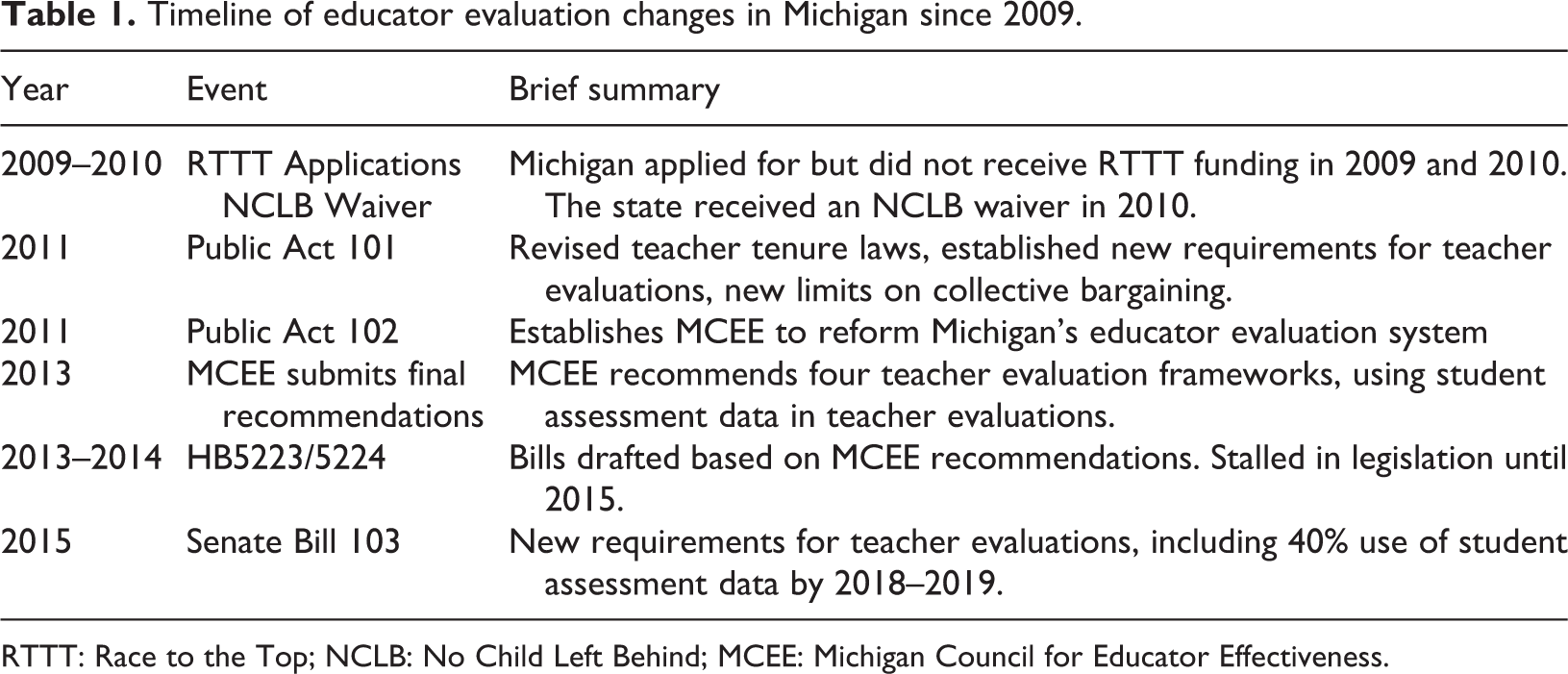
RTTT: Race to the Top; NCLB: No Child Left Behind; MCEE: Michigan Council for Educator Effectiveness.
At the time these data were collected, these principals not only had to make sense of the evaluation process as a first time evaluator, but also had to communicate and explain this new process to the teachers they were evaluating. This combination makes the principals in this case an important case to examine, as the participants’ sensemaking will help shed light onto how principals are socialized in and make sense of the teacher evaluation process. It is plausible (and likely) that principals in other states are experiencing similar teacher evaluation reforms and, therefore, the results of this work may have broader implications for new career principals and their socialization and sensemaking processes.
Methodology
This comparative case study is part of a larger, 12-principal, study that explores how principal cognition impacts teacher evaluation policy implementation. These two principals were chosen from this larger sample because they were in their first year as a school principal. In an effort to best answer this study’s research questions and better understand how new principals become socialized around teacher evaluation policy, I followed these principals as they navigated the entire process of evaluating one teacher each in their respective schools. I observed each of these principals conducting a teacher evaluation pre-conference, I observed the official teacher observation used for evaluative purposes, and I observed the subsequent post-conference, where teacher evaluation ratings were assigned. In addition, I interviewed these principals three times throughout this process and I interviewed the teachers at the end of the evaluation process. Finally, I collected principal observation notes and final teacher evaluation ratings of the observed teachers.
Participants and sampling strategy
The participants of this study were selected using criteria-based sampling (Creswell, 2013). Participants had to meet each of three criteria for selection: (a) all participants had to be located in the same state, as teacher evaluation policies vary from state to state; (b) all participants had to work in public schools that were under the same state teacher evaluation policy requirements; and (c) participants were required to be in their first year as a principal. Although this type of sampling design was not able to capture all important variables in each context, it is useful to provide insights of the different perspectives offered by these principals (Creswell, 2013). The goal of this type of sampling is not to make generalizable statements of all principals with similar characteristics as the participants in this study, but instead to begin hypothesis and theory building about principals with these characteristics and how these characteristics may impact how new career principals are socialized to their role as school leader as well as how these individuals make sense of unfamiliar and new situations or tasks.
Data collection
According to Yin (2013), case studies typically draw information from sources including interviews, direct observations, participant observations, documentation, archival records, and artifacts. In this study I rely on three sources of information: (a) interviews; (b) observations; and (c) artifacts. My research questions are best addressed by these types of data and collecting this type of data allowed me to validate my data and findings through data triangulation by showing that diverse data collection methods confirm the findings (Miles et al., 2014).
Principal interviews
The principals in this study were interviewed three separate times in 2016. The three interview protocols were originally piloted with two principals in an effort to get feedback on the format, length, and the types of questions asked. The participant interviews were conducted in one-on-one settings and focused on the principals’ experiences using and perceptions of teacher evaluation policies. The interviews were audio-recorded and notes were taken during the conversations. The interviews took place three times during the data collection—once at the beginning of the collection, again during the middle of data collection, and then near the end of data collection.
Observations
Each principal was observed conducting a teacher observation that was used for a teacher’s final evaluation score. In addition, when available, principals were observed at the pre- and post-conferences with their teachers. During these observations field notes were taken and immediately recorded following each observation to ensure accuracy. The field notes were checked with both the principal and teacher to ensure their thinking and conversations were accurately represented. The purpose of the observations was to better understand how principals observe teachers in practice and how principals and teachers communicate about the evaluation and evaluation process. In addition, in qualitative work it is important to observe people in their natural environments (Yin, 2013). Finally, the observations were also collected in an effort to triangulate the data and add credibility to my findings.
Artifacts
Principal observation notes of teacher instructional practices were also collected from both participants in this study. The purpose of collecting these documents was to better understand what principals were observing and making note of during official observations of teachers. In addition, these notes provided insight to what type of feedback principals were providing teachers. Final teacher evaluation ratings of the observed teacher were collected from both principals. The purpose of collecting these evaluation scores was to see ultimately how principals rated teachers, the feedback they gave to teachers, and how both principals and teachers communicated and used evaluation data.
Data analysis
All data were organized using Atlas.ti software and analyzed to interpret patterns, trends, commonalities, and links among the participants (Miles et al., 2014). Codes were developed inductively and as themes emerged from the coding process they were grouped together by theme (Creswell, 2013; Miles et al., 2014). All code groupings were then reviewed, looking for common excerpts that highlighted similar themes and ideas. After completing all coding of data, the validity of the coding process was checked by recoding the data for a second time. Any discrepancies were noted and addressed in order to refine and justify assertions and to look for possible other alternative interpretations of the data (Miles et al., 2014). Once the codes were grouped common themes ideas were grouped together as similar data. After the coding process was complete, quotations were compared to original interview text, making sure they were taken in context.
Establishing credibility
Qualitative researchers can take several steps towards establishing credibility, including member checking, data triangulation, peer reviews, and external audits (Creswell, 2013). In this study I relied on member checks, data triangulation, and peer review to establish credibility. Firstly, I ensured all participants were allowed to read transcripts of recorded information and notes and they were afforded an opportunity to address any discrepancies that they felt did not accurately portray what they were trying to say or do. In addition, I contacted all participants to clarify any questions that arose during the transcribing and coding of the data. Secondly, I used data triangulation (observations, interviews, and artifacts) to add to the credibility of my analysis and findings. Finally, I used peer review by training another coder to review and code 10 percent of the data I collected (we achieved over 80 percent agreement on all coding). I also solicited critical feedback from colleagues throughout the writing process.
The cases of Ms Holland and Mr Drake: First year principals
Ms Holland worked in traditional public schools for more than 10 years as a teacher before taking a job as a principal (see Table 2 for complete principal experience information). As a teacher, Ms Holland taught primarily grades K-3 in a district different than the district where she is currently the principal. Ms Holland earned her master’s degree in educational administration and is currently the principal of an elementary school in a rural district in Michigan. Her school serves approximately 385 students in grades K-4. Mr Drake primarily taught elementary school in the same large, urban district in Michigan where he is currently the principal. Mr Drake also earned his master’s degree in educational administration and his school currently enrolls approximately 308 students in grades K-5.
Principal and school characteristics.

FRL: Free and Reduced Price Lunch.
Ms Holland’s school is currently labeled yellow on the Michigan Schools Accountability Scorecard, which is in the middle of the state’s rating system, while Mr Drake’s school is currently rated red, the lowest possible rating. Briefly, the Michigan Schools Accountability Scorecard combines student assessment data with graduation and attendance rates and compliance with federal and state laws. The purpose of the scorecard is to give the state, districts, schools, parents, and the public a way to see how schools are performing in relation to these areas. These scorecards replaced No Child Left Behind’s (NCLB’s) annual yearly progress (AYP) reports. Finally, and of particular importance to this study, Ms Holland’s school uses the Thoughtful Classroom as their teacher evaluation system. This systems requires 75 percent of a teacher’s final evaluation score be based on observations of classroom instruction (of which Ms Holland is the sole observer for all teachers in her building) and 25 percent based on student assessment data. To determine this 25 percent for third and fourth grade teachers, Ms Holland’s system uses Michigan’s mandated annual assessment and for teachers in grades K-2 the system uses a district created assessment. Mr Drake’s school uses a district designed teacher evaluation system, of which 75 percent of a teacher’s final evaluation is based on evaluation of teacher instruction (Mr Drake is the sole evaluator) and 25 percent is based on student assessment data. To determine this percent for teachers in grades 3–5 the system uses state mandated assessments. Grades K-2 use district created assessments.
It is important to note that both principals’ teacher evaluation systems were new to their respective districts at the time of data collection. Both principals had no familiarly with these systems (as an administrator or teacher) before beginning their roles as school principals.
Findings
An analysis of the data reveals that principals rely on their networks of peers to make sense of the teacher evaluation process. In part due to the abstract nature of new teacher evaluation policies and systems, the principals in this study socially negotiated how the teacher evaluation process would unfold. The principals in this study indicate adopting this approach for two primary reasons: (a) to develop positive relationships with their colleagues, including teachers in their building and district level administrators; and (b) to make up for a lack of initial training with these systems.
Developing positive relationships with teachers
Each principal in this study emphasized the importance of developing positive and strong relationships the teachers in their building. Both principals expressed that working with teachers in an effort to promote a “dual understanding” of new evaluation systems was imperative to building trusting relationships with their teacher. The principals felt that before their new evaluation system could successfully enter their organization, they first needed to take steps to build a shared understanding and trust amongst their staff. For example, Ms Holland said, “Evaluating a teacher does put a strain on your relationship. There is a fine balance there. I really want them to be able to just have their own voice and speak their own truth.” Ms Holland went on to say that she and her teachers co-developed how teacher evaluations would occur during the school year. Although Ms Holland was quick to point out there were many logistical aspects of the policy that she could not change (such as the documents she needed to provide teachers and the time she spent observing teachers), she thought working with teachers to construct an understanding of how to best use their district’s teacher evaluation would be an effective approach when trying to secure positive relationships. Ms Holland took steps to socially negotiate the more abstract aspects of her school’s new teacher evaluation policy in an effort to both make sense of these complex policies and build positive and trusting relationships with her teachers.
Mr Drake also emphasized that he involved the teachers in making sense of his school’s teacher evaluation system in an effort to secure relationships with his staff. For example, Mr Drake recalled that he and his teaching staff prioritized evaluating classroom management, as this was a “shared value” of almost all of the teachers in his building. His teachers took pride in their ability to successfully manage a classroom and, as a result, the teachers believed this was a key component to how teachers should be evaluated. This resulted in Mr Drake prioritizing talking about classroom management with teachers during conferences and in their official teacher evaluation feedback. For example, in feedback to one teacher Mr Drake noted, “Classroom management is strong and she has worked to build relationships with students.” Mr Drake also noted things revolving around classroom management, such as transitions and collaboration amongst students in the classroom. Because his teachers had an understanding that classroom management would be a focus for him during official teacher evaluations, Mr Drake believed this help alleviate some of the stress and concerns his teachers had, which ultimately would strengthen the relationships he had with his new staff. He said: I was a teacher and I know the feelings. I know how they feel when they come in for an evaluation and that panic in wanting to know right away how they did, but then as a teacher, I was okay with it. I wanted feedback because I wanted to get better.
Co-constructing a shared meaning of their school’s teacher evaluation system in an effort to strengthen and secure positive relationships with their teachers was not without its problems. For example, Ms Holland mentioned at times she was too quick to give teachers the “benefit of the doubt” when observing their practice and at times avoid difficult conversations around their performance because she wanted to secure these relationships. Ms Holland said: My admin team will tell me frequently that I still think very much like a teacher. I don’t know that I think that’s bad. I’m still very sensitive (to how evaluations impact teachers). I will admit it’s very hard for me to give a minimally effective or ineffective or missed opportunity. I think that I still think more like a teacher than an administrator. That will come later. I think that it has been a transition for me in general to switch my mindset from teacher to administrator. I have tried to consciously be more relational with them in the non-evaluation sense because I don’t want them to feel like I’m picking on them or targeting them (when performing their official evaluation). That just might be my own insecurity. I might get over that later. It is still just really hard for me to feel like I am giving someone a bad score and then not having a relationship with them. Relationships allow you to have those tough conversations, and if you don’t have that relationship, that tough conversation can’t occur.
Lack of initial training with new systems
Despite being new to their position as principal and encountering an evaluation system with which they were both unfamiliar, Ms Holland and Mr Drake said they did not receive official administrative training on how to use these systems. Ms Holland recalled her initial introduction to her district’s evaluation system: I believe that my administrative team last year received training. I think they were picking between that (The Thoughtful Classroom) and maybe the Marzano model is what they were looking at. They had quite a few days of training last year. This year I really—I had one day of training as PD that was actually where they were training teachers, not administrators. I went to the teacher training, so at least I got a little bit of feel for that. The rest of my training really has been on the go, reading by myself, researching online, and then working with my administrative team for consistency. It’s been a limited training. At this point, there are a few things that are hard for me to identify within it, but I think that that’s more me having to seek out more professional development and knowledge in that area. Even the areas that I’m lacking, I’m lacking when I see everyone in that area, so I don’t feel like it’s been inconsistent in that way. I do think there are some areas that aren’t being covered, but I think those’ll be added as we move along.
Mr Drake did not receive any initial training to assist him in using his district’s teacher evaluation system. Instead, he recalled relying on learning the system as he went through the process of evaluating the teachers in his building and by thinking about what the process was like when he was a teacher. He said, “There really wasn’t much training. It was more of just self taught and just knowing the evaluation process (from being a teacher). I drew on my experiences as a teacher.” When asked if he would have preferred a formal initial training with his school’s teacher evaluation system, Mr Drake said yes, but overall he thought he had a good handle on how the system was supposed to work. Mr Drake did not think a lack of an initial training impact his ability to navigate the process of evaluating his staff because although his district’s evaluation system was new, he felt like he understood how the district evaluation process worked because he had been a teacher in the same district for eight years.
The limited initial training experienced by each principal in this study resulted in these principals drawing on other areas of support to better understand their teacher evaluation system. The first way principals attempted to make sense of and better understand evaluating their teachers was by drawing on their experiences as a teacher. For example, when asked how she made sense of these new policies and systems given her lack of training, Ms Holland recalled her evaluations as a teacher being very stressful and “career-defining.” As an administrator, she understood the pressure teachers were under. Ms Holland explained that she knew most of her staff was hard-working and as a result she did not feel any of her teachers deserved a poor rating. When asked if she would have potentially felt comfortable rating teachers more critically if she had been trained in the system, she said “that would have helped.”
Ms Holland also drew on her experiences as a teacher when conducting observations of teacher instruction. For example, as a teacher Ms Holland was very focused on routines and procedures in her classroom and as a result she focused on this during her observations of her current teachers. During one observation of a teacher she provided feedback that said, “What can students do that is productive when they are waiting for a peer to complete a task? Have a routine established for what students are to do if they finish early.” This is just one example of the type of feedback and conversations Ms Holland typically had with the teachers she evaluated. She made sure to prioritize routines and procedures because this was something she valued as a teacher.
Ms Holland and Mr Drake used different approaches when attempting to make up for a lack of training with their new teacher evaluation systems. For example, Ms Holland relied on the connections she made with other principals at various summer trainings and professional developments. During these trainings (which were not centered on teacher evaluations), Ms Holland met her new principal colleagues in the district and through developing relationships became comfortable asking these principals for assistance as she began the process of evaluating the teachers in her building. However, because the system was new, often times Ms Holland and the other principals in her district had the same questions. She said: We had administrative meetings with all the administrators in the district twice a month. My administrative team, it’s (the teacher evaluation system) new for them, too. It’s not like I feel like I’m the one with the questions and they’re all with the ones with the answers. Usually my questions are the same questions they have.
Ms Holland went on to say that the other principals have talked about working together in the future to make sure they were all using the evaluation system in the same or similar fashion. She said: We did talk about maybe observing together next year because we feel like there might be some importance to have consistency between the district. Next year we’re hoping to maybe all three observe (the same teachers) together. Not necessarily count as their evaluation, but really for ourselves to come together with how we are thinking. I have no idea if the way that I’m doing it is similar to the way (the other administrators) doing it.
Like Ms Holland, Mr Drake also relied on his more veteran principals when he had questions or concerns about his district’s teacher evaluation system. However, unlike Ms Holland, Mr Drake received a district mentor. Even though the evaluation system was new to all principals in the district, Mr Drake thought having an experienced mentor helped him greatly when attempting to understand his district’s teacher evaluation policy. Mr Drake asked his mentor questions about things such as how to best schedule observations, how to best explain the student assessment component to his staff, and how to deal with challenging evaluations. Mr Drake explained, “Being a new principal, I have a mentor in the district. She is in my building every Tuesday, and those are the times that I ask questions for more clarification when needed. That has been helpful.”
Mr Drake went on to say that having structured, weekly meetings was extremely help for him as he did not have to take time out of his already busy day to seek out assistance of other principals. He knew every Tuesday he would have a meeting with his mentor teacher and therefore when questions came up while he was evaluating his staff, he knew he could run these by his mentor teacher within a week. Mr Drake also commented he could contact his mentor at other times outside of their regularly scheduled meetings, but having a set, consistent meeting was reassuring and one less thing he needed to worry about. Finally, Mr Drake noted it was nice to have someone who had been through the process of evaluating teachers before, even if it was with another teacher evaluation system. The experiences of his mentor teacher alone helped Mr Drake navigate this challenging process.
As both participants’ comments suggest, relying on their more veteran principal peers was a strategy they utilized in an effort to fully understand and implement their teacher evaluation system. Although the structure of these conversations and support was different, both Ms Holland and Mr Drake said that relying on their more veteran peers alleviated some of the concerns of how to best navigate the teacher evaluation process.
Discussion
These findings support prior work suggesting principals rely on their peer networks when making sense of new policies (Rigby, 2015; Saks and Ashforth, 1997). In addition, this research extends this line of inquiry by suggesting principals engage with their peers in teacher evaluation policy socialization for two primary reasons. Firstly, these new career principals prioritize establishing positive relationships with the teachers in their building and, as a result, they attempt co-constructing meaning around these systems. These principals socially negotiate the sensemaking process, which impacts how these policies enter systems of practice. For example, in the case of Ms Holland, she knew she rated teachers more favorably than might be expected because she did not want the evaluation process to strain her relationships with her staff. Other research suggests policies, including teacher evaluation policies, are negotiated between principals and teachers in an effort to aid in the implementation of these policies and systems (Coburn, 2005; Rigby, 2015; Spillane et al., 2002). Secondly, the principals in this study received limited initial training on how to use their district’s teacher evaluation system and, as a result, they often rely on their own experience as a teacher and their more veteran principal peers to help navigate this complex process. Other research suggests principals receive little to no initial training when handed new teacher evaluation systems (Kraft and Gilmour, 2015) and, as a result, principals are left to lean on other methods to lead their school through this process.
The results of this study have two important practical implications. Firstly, because the principals in this study rely on their networks of teachers to navigate the teacher evaluation process, teachers may be able to negotiate how teacher evaluations are conducted, often to their benefit. This is potentially problematic as not only could this negotiation misalign with the expectations of policy designers, but may cause problems with cross-teacher comparisons within districts. For example, will newer principals allow for greater teacher say in how teacher evaluations look in practice compared to their more veteran principal peers? If so, this could undermine what policymakers and districts are trying to create—a fair and consistent evaluation system for all teachers and a system of evaluations that provides accurate information on teacher performance. In addition, in part because they received abstract ideas regarding how these evaluations should look in practice and in part to become socialized in their new role, the principals in this study prioritized establishing positive and trusting relationships with their staff by co-constructing how teacher evaluations would look in practice. This approach is not inherently bad, as it may lead to greater teacher buy-in and establish a productive relationship that allows for the principal and teacher to work together and support teacher growth. However, this approach also has the potential for principals to sacrifice objective evaluation of teacher performance in an effort to feel accepted and trusted by their colleagues.
The second practical implication is, as currently constructed, in most contexts school principals are the primary school-based actors charged with complying with and enacting teacher evaluations systems (Steinberg and Donaldson, 2016), and districts and policymakers rely on principals for successful implementation of these systems. However, both principals in this study note a lack of training with how to use these systems. Due to this lack of initial and ongoing training, principals were forced to make sense of these new policies and systems based primarily on their personal background and experiences and their network of administrators. Although these approaches may have some value, it is unlikely these systems will play out in practice in the ways they were envisioned by policymakers and teacher evaluation system designers without intentional initial training for principals. In addition, after this initial training on how to use these systems principals should receive more targeted ongoing training and professional development of specific areas within these systems. For example, growing evidence suggests conferences between principals and teachers are crucial to the overall evaluation process because these conferences provide opportunities for teachers to improve their practice and ultimately student achievement (Steinberg and Donaldson, 2016; Steinberg and Sartain, 2015; Taylor and Tyler, 2012). Therefore, principals should receive support on how to best utilize these conferences. In short, providing initial, ongoing, and targeted training with new teacher evaluation systems is of crucial importance for the successful implementation of these systems. Although principals will likely continue to seek the support of their principal colleagues, especially early in their careers, providing this type of intensive training has the potential to alleviate some of the need for principals to rely exclusively on this network of peers to make sense of the important process of evaluating their teaching staff. Importantly, this training may assist in the socialization of new principals into their roles as school leaders as they will have expertise and confidence in how to best use and implement these systems.
Finally, it is important to note the limitations of this work. Firstly, the principals in this study shape the findings by their experiences, thoughts, actions, and beliefs. If data was collected from two other principals the findings may look different. Secondly, although principals were observed in their natural environment implementing their teacher evaluation system, the researcher did not observe each principal multiple times, with a variety of teachers, or during all interactions the principal had while attempting to implement and make sense of their teacher evaluation system. In this way, the data collected may not be a complete representation of all that principals did while making sense of their teacher evaluation system. Finally, as with all qualitative research, it is important to acknowledge that the presence of the researcher may have impacted what was observed during data collection. Despite these limitations, the results of this work do shed light on how two first year principals made sense of evaluating the teachers in their building and understanding their teacher evaluation system. The results of this research have potential to lead to hypothesis building and could potentially be tested with larger samples of principals in future research.
Future research should continue to explore how new career principals socialize in their new roles by using specific policies or systems as a lens for better understanding how this socialization occurs, as well as the implications of this socialization for principal–teacher relationships, policy implementation, and student achievement. For example, future research could examine how new career principals make sense of other important and abstract policies, such as curriculum policies, professional development policies, or accountability policies, and compare the results of how principals make sense of and socially negotiate these policies and systems to how principals make sense of and socially negotiate teacher evaluation policies and systems.
Footnotes
Declaration of conflicting interests
The author declared no potential conflicts of interest with respect to the research, authorship, and/or publication of this article.
Funding
This research received no specific grant from any funding agency in the public, commercial, or not-for-profit sectors.