




Abstract
Teacher leadership is one of the essential factors in curriculum implementation. Curriculum development is never an easy task for teachers. Several studies have indicated that teacher leadership has led to school improvement and fostered student achievement and engagement in learning. However, most studies have focused on examining teacher leadership in Western contexts; rarely have studies been conducted to explore how teacher leadership takes place in an ‘East meets West’ context. The aims of the mixed-method study are the following: (a) to investigate teachers’ perceptions and experiences of teacher leadership, and (b) to explore how teachers act out teacher leadership in a peer network. This study used the case of a local primary school. Data collection methods included teacher surveys, individual interviews with teachers, and field notes from a one-day teacher shadowing. The data indicated that teachers were more oriented towards student learning, but insufficient space was available for enacting teacher leadership in terms of teacher collaboration, shared leadership and reflective practice. Thus, implications for teacher leadership development are discussed.
Background of study
Teacher leadership is one of the essential factors that support curriculum development and implementation in schools (York-Barr et al., 2005). Various studies have found that teacher leadership facilitates and fosters school improvement and enables student achievement and engagement in learning (Leithwood and Jantzi, 2000). Likewise, teacher leadership has positive effects on organisational and teacher efficacy (Angelle and Teague, 2014). Over the past decades, teacher leadership studies have been conducted to investigate how teachers perceive and practice teacher leadership in different school contexts, including early childhood education (Heikka et al., 2016), primary education (Sigurðardóttir and Sigþórsson, 2016), secondary education (Crowther et al., 2009) and teacher education (O’Hair and Odell, 1995). However, previous studies on teacher leadership have mostly been conducted in Western countries, such as Canada, Finland, the UK and the USA, whereas very few studies have examined teacher leadership in Asian countries such as Hong Kong, Singapore and China (Law et al., 2007; Hairon and Dimmock, 2012; Wong, 2010).
Theoretical framework
Teacher leadership: Definitions and development
There are no universal definitions of teacher leadership, which has been associated with instructional leadership (Hallinger, 2005), pedagogical leadership (Webb, 2005), or distributed leadership (Spillane et al., 2001). Katzenmeyer and Moller (2001) referred to teacher leadership as the behaviour of those who ‘lead within and beyond the classroom, identify with and contribute to a community of teacher learners and leaders, and influence others towards improved educational practice’ (p.5). Wenner and Campbell (2017) recently provided an operational definition about teacher leadership as ‘teachers who maintain K–12 classroom-based teaching responsibilities [and take] on leadership responsibilities outside of the classroom’ (p.140). Similarly, Margolis (2012) raised a more context-specific definition of teacher leadership and advocated the concept of the ‘hybrid teacher leader’, which is described as ‘a teacher whose official schedule includes both teaching K–12 students and leading teachers in some capacity’ (p.292). Hunzicker (2017) classified teacher leadership in different ways, including formal, informal and hybrid, where hybrid teacher leadership attempts to maintain an effective balance between formal or hierarchical power and informal or relational power. Margolis and Huggins (2012) warned that hybrid teacher leadership may cause the inefficient use of the teacher leaders’ time and expertise due to their roles and responsibilities not being clearly defined. The concept of teacher leadership is changing and varies from formal senior, administrative and positional leaders to informal, regular and non-positional teachers who do not have any official duties or responsibilities other than teaching duties. In the past two decades, teacher leadership has almost become congruent with the concepts of principalship or administrative leadership, which are mainly concerned with the administration and management in school organisations. With the rise of democracy and decentralisation of power, scholars have shifted from studying managerial roles and leader traits to studying concepts such as teacher leadership. This condition marks a paradigm shift in studying teacher leadership from sole, heroic, charismatic leadership roles and traits (Blasé and Blasé, 1998) to collaborative, collective practice of leadership in schools that are described as professional learning communities (Bolam et al., 2005). Recent studies (e.g. Struyve et al., 2014) on teacher leadership no longer attempt to investigate the managerial roles or characteristics of school leaders; rather, some studies have investigated the teachers’ social networks, or their social ties to the complex inter-relationships and mutual influence amongst teachers (including principal and teachers), where social capital theory has been used by recent studies to explain how and to what extent teachers work together (Nappi, 2014).
Key conditions for developing teacher leadership
The existing literature has attempted to determine the key conditions that facilitate or obstruct the development of teacher leadership in school organisations. Key factors mediating the processes of teacher leadership are summarised, including organisational cultures (Kilinc, 2014), collaboration with colleagues (Ronfeldt et al., 2015), trust (Demir, 2015), collective efficacy (Angelle and Teague, 2014), principal’s support (Mangin, 2007), shared practices (Nappi, 2014) and school-university partnership (Snoek et al., 2017). Collaboration has been found to be one of the crucial elements in supporting teacher leadership in schools (Ronfeldt et al., 2015). But former studies on teacher collaboration in developing teacher leadership were mostly about teacher education programmes, mentoring, field experience and school–university partnership (e.g. Rhodes and Beneicke, 2002) instead of a naturalistic school setting. This concept of collaboration is linked to ‘contrived collegiality’ (Hargreaves and Dawe, 1990), where peer support takes place in artificial, formal ways.
Teacher leadership in Hong Kong
With the promotion of school-based management in the territory, power has been decentralised from the principal to teachers, who are encouraged to participate in decision-making processes (Curriculum Development Council, 2009, 2014). Before the mid-2000s, most of the previous studies (e.g. Walker and Dimmock, 2000; Wong, 2003) on teacher leadership in Hong Kong were related to principalship, where principals were regarded as significant stakeholders and much of the focus was on discovering their leadership behaviours, traits and styles, as well as challenges. Recent studies have found that collective decision-making processes are evidenced in the local school context (Hallinger and Bryant, 2013; Lai and Cheung, 2013). This approach may not be easily practiced due to the cultures of hierarchy and seniority under the bureaucracy-centred school system in Hong Kong (Lo et al., 2012; Loh and Tam, 2017), in which Confucian values such as patriotism and relationships still prevail, in which junior teachers behave and respond to such social norms by ‘saving faces’ and showing respect to seniors by consulting seniors, and thus the power dynamics may distort the ‘equal’ participation of teachers in decision-making (Yuen et al., 2015). However, Yuen et al. (2018) discovered that the empowerment of teacher leadership in school-based curricula can be enacted through a ‘bottom-up’ approach – one that allows teachers to exercise discretion in making judgements in school-based curricula using a reflective approach that encourages teachers to take actions in everyday social interactions. Local teacher leadership studies were conducted in different educational contexts, including early childhood education (Ho and Tikly, 2012), primary education (Law et al., 2014), and secondary education (Lai and Cheung, 2013). However, they were context-specific and lacked generalisability. This study aims to fill this gap by exploring how teachers perceive and experience teacher leadership, and how teachers provide peer support in curriculum development at a local primary school. Two research questions guided the study.
What are teachers’ perceptions and experiences of teacher leadership and peer support?
How do teachers act out teacher leadership in a peer network in curriculum development?
Research methods
Participants and settings
The study was conducted in a government-funded primary school established in 1995. The school occupied more than 8000 square metres and had a school hall, a library, 30 classrooms, two computer rooms and eight special functional rooms. This school is co-educational, accommodating approximately 300 students in a total of 15 classes, where the majority was non-Chinese-speaking students or students whose mother tongue was not Chinese. The school has a total of 32 teachers, all of whom possess teaching certificates, with 97% having a bachelor’s degree and 30% having a master’s degree. Only 10% of the teachers had obtained special education training. The school conducts four summative assessments. It has eight administrative teams and eight subject departments (Figure 1) led by senior teachers with administrative duties. The areas of concern in school development include catering for learner diversity, developing respect for cultural diversity, and enhancing routine training and self-management skills.
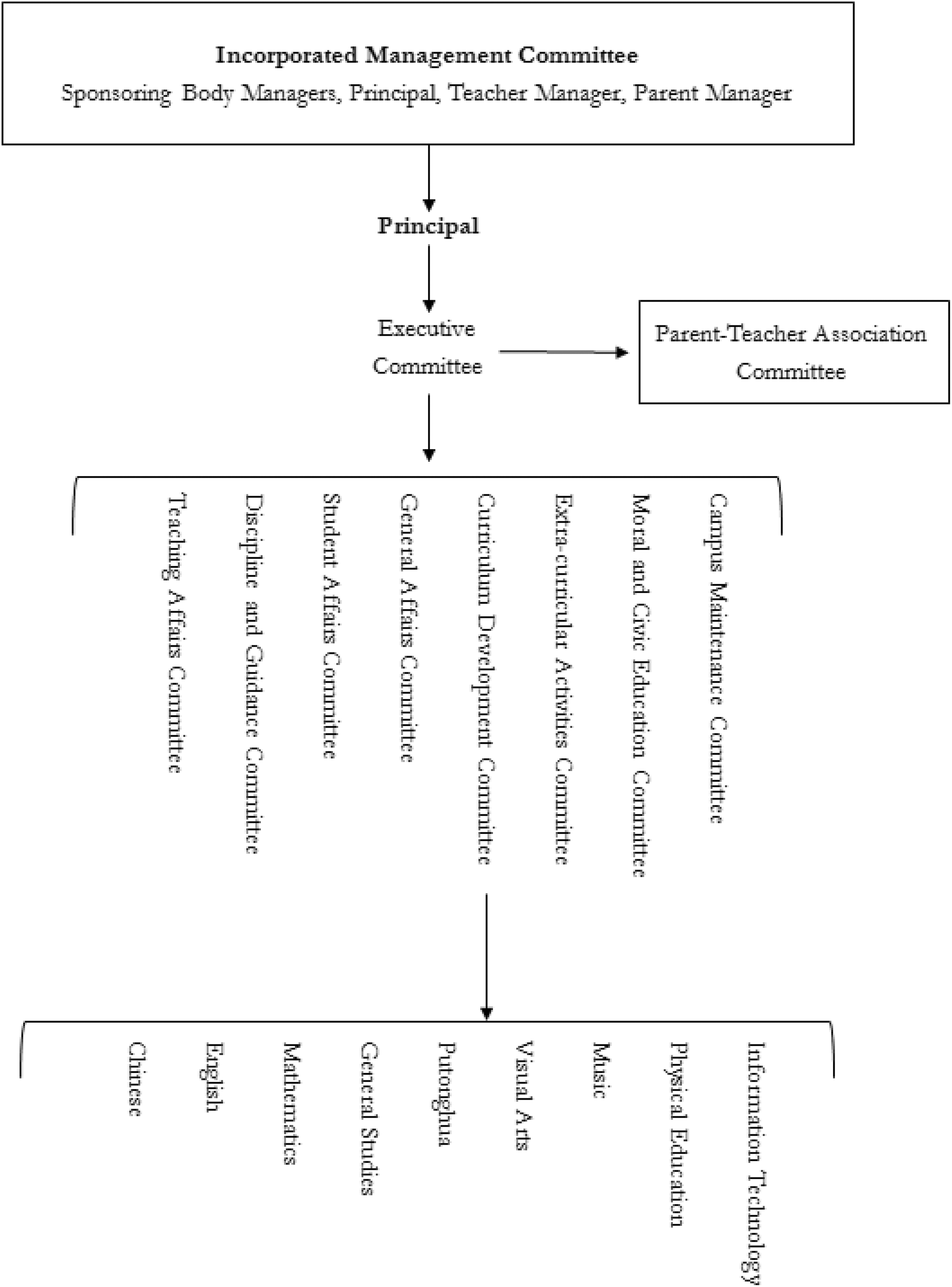
School organisation chart.
Research design
This is a sequential mixed-method study with quantitative and qualitative approaches that complement each other and allow for a more robust, in-depth analysis (Creswell, 2013) (Figure 2).
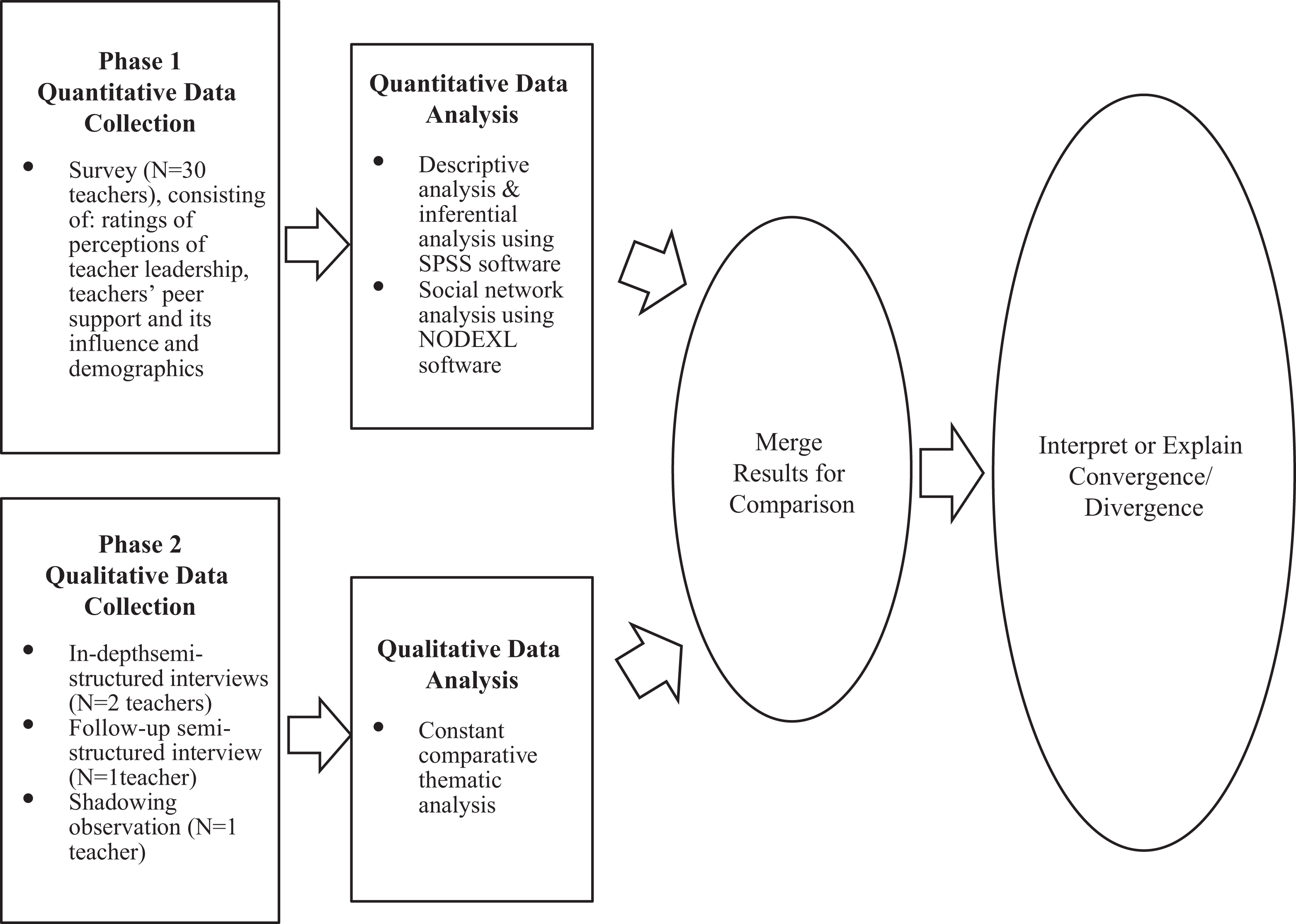
Sequential mixed-method design.
Phase 1: Quantitative data collection and analysis
Data collection. In the first phase of data collection, all the teachers in the school were invited to complete a survey. The principal assigned one teacher to administer the survey; all teachers were given two weeks to complete the survey. The survey was given in bilingual form, to enable all participants to understand the survey items; the translation was based on the original English version and reviewed and revised in accordance with the advice of two Chinese tutors. A pilot study was conducted on three teachers who assisted by providing comments on each item and the study was conducted in the case school in early May 2016 using the final version of the questionnaire as illustrated below.
Based on the purpose of the study, relevant constructs were selected based on the instruments developed by Bolam et al. (2005), Olivier et al. (2003), Hargreaves and Fullan (2012) and Angelle and Teague (2014), focusing on the key dimensions of professional learning communities that offer an important venue for embracing and building teacher leadership capacity. The survey was developed with a total of five dimensions to measure the perceptions of teacher leadership. The first part (Part 1) focused on the perceptions of teacher leadership according to the teachers’ individual level, covering two dimensions, namely, Student Learning and Teacher Collaboration, which emphasised ‘I’ as a ‘first-person’ identity that helps survey respondents cognitively and emotionally engage in reading aloud and self-talk based on his/her own experience (Goldenberg, 1996) (Appendix 1A). The second part (Part 2) examined how teacher leadership is experienced at subject department level, consisting of three dimensions: Reflective Dialogue, Shared Leadership, and Continuous Improvement (Appendix 1B). Parts 1 and 2 used a 6-point Likert scale, ranging from strongly disagree (1) to strongly agree (6).
Individual teacher level
Student learning
This refers to the instructional practices that teachers adopt to engage students in learning and make adjustments to help students learn. Seven items were included in this dimension (e.g. I set learning targets for individual students).
Teacher collaboration
This involves the collective inquiry processes, where teachers work together to plan and think about student achievement through different ways (e.g. peer observation) for opening such conversations. Teachers provide support and guidance to other teachers, and not only can teachers collaborate with each other within their schools to improve learning and teaching, they can also collaborate with teachers from other schools. Twelve items are included in this dimension (e.g. I work with other teachers to look into the reasons for differences in student achievement across classes).
Subject department level
Shared leadership
This refers to the inclusion of the contributions of all teachers, including the principal and ordinary teachers, such that every teacher in school has the opportunity to discuss and share their ideas and make decisions with the support of the principal. Six items belong to this dimension (e.g. Teachers are actively collaborating in finding ways to improve the school as a whole).
Reflective dialogue
This is a kind of collective learning where teachers inquire on issues related to student improvement through peer feedback, peer observation and discussion to develop and improve instructional strategies for further improvement in student learning. Five items were included in this dimension (e.g. Teachers share with one another their reflections about their learning).
Continuous improvement
Teachers work together to strive for sustained and on-going student and school improvement. Two items were included in this dimension (e.g. Subject departments are proactive in addressing areas that need attention).
Part 3 explored the teachers’ peer support network in the case school. This required the participants to provide information on teachers who had assisted them in curriculum development and assess the extent and frequency to which such assistance could influence them. The design was based on the survey instrument developed by Spillane et al. (2001), who adopted social network analysis (SNA) to explore the teachers’ networks.
Part 4 required participants to provide their demographic information such as gender, years of teaching experience, academic qualifications, and key roles in the school.
Data analysis
Quantitative data from the survey (i.e. Parts 1 and 2) were computed with the application of the Statistical Program for Social Sciences, version 21.0. Descriptive analysis, including mean scores, SD, frequency counts, reliability tests for items and scales and correlation matrix, was carried out.
Reliability analysis
The reliability of the scale and each individual survey item were measured with Cronbach’s alpha. The survey scale of teachers’ perceptions of teacher leadership at the individual level and subject department level was of a generally high internal consistency (i.e. 0.88 and 0.92, respectively; Field, 2009). The internal consistency of each identified component was acceptable, with a Cronbach’s alpha ranging from 0.87 to 0.92.
Principal component analysis (PCA)
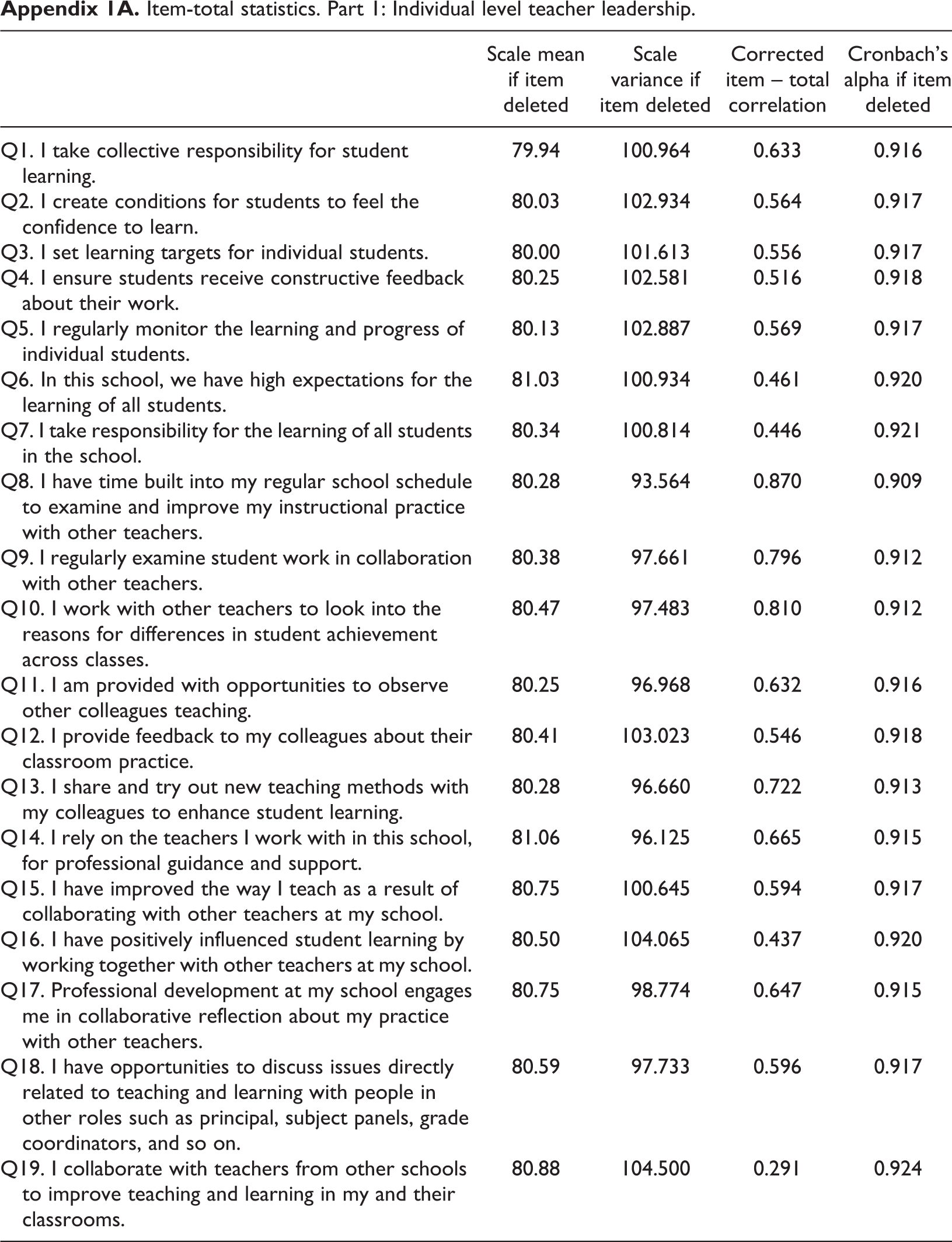
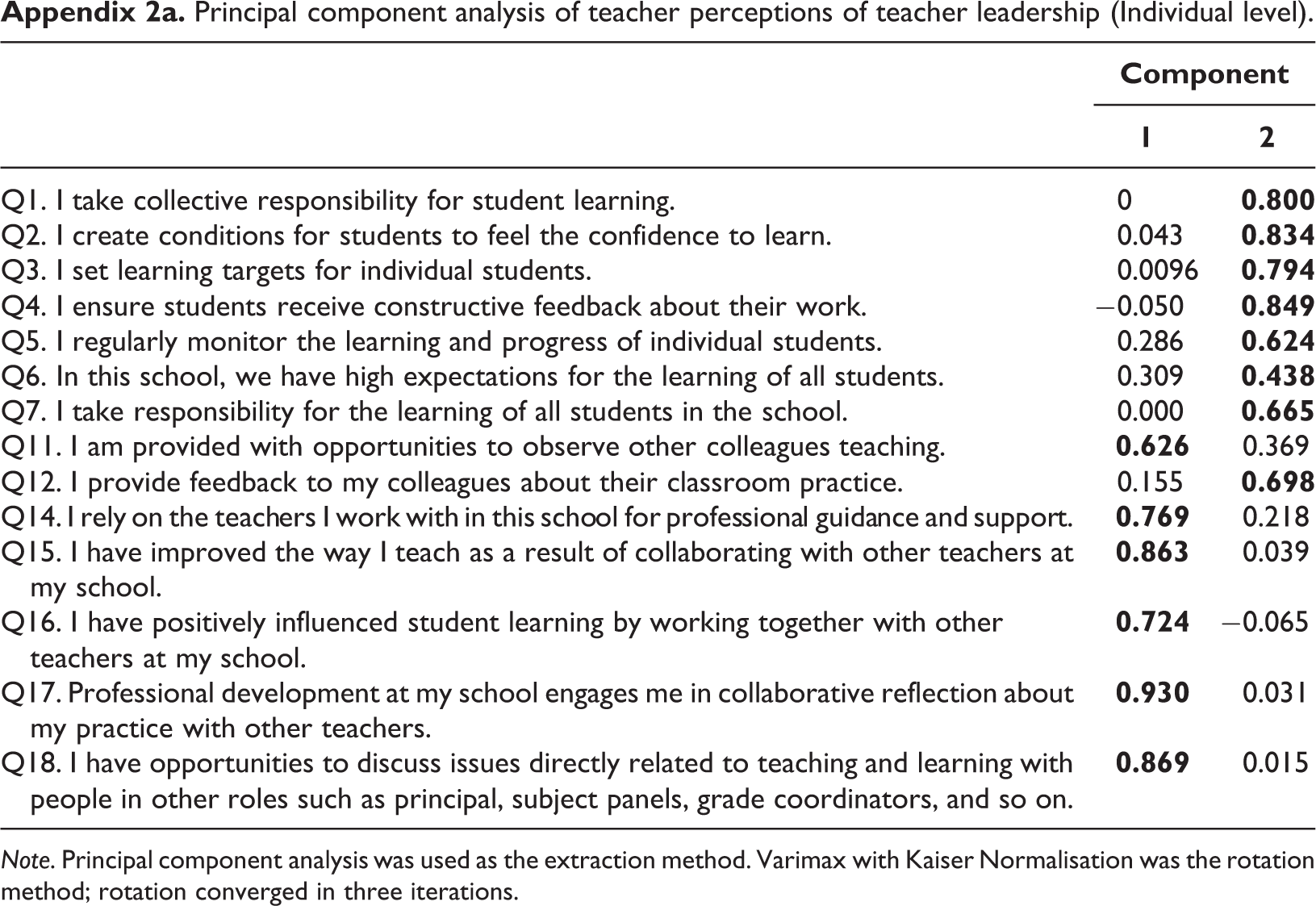
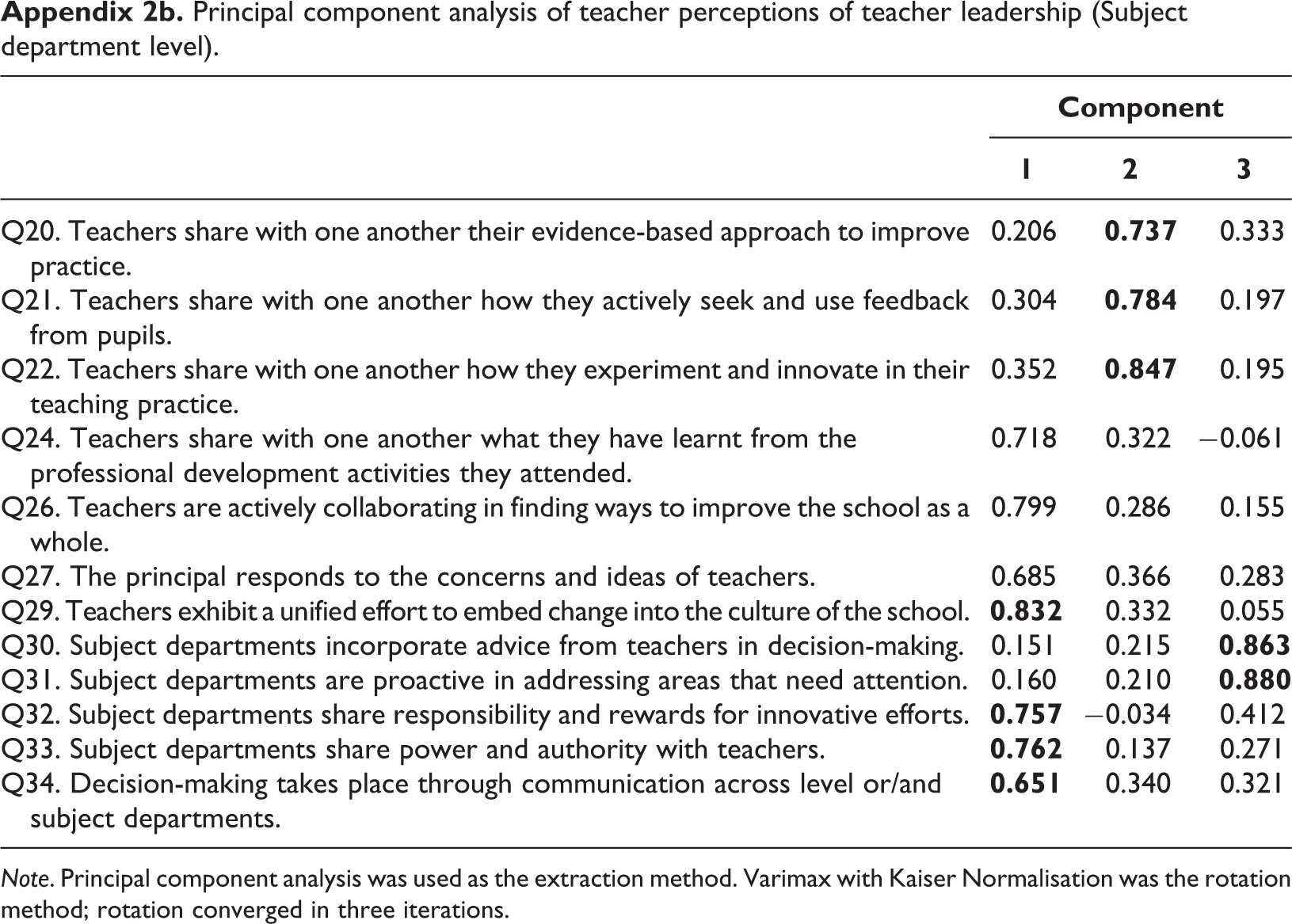
Construct validity was verified using PCA that summarises the inter-relationships amongst the variables accurately (Bryman and Cramer, 1990). Using factor analysis is to ‘determine a meaningful interpretation of the factors that provides insight into the data for use with further analysis’ (Goldberg, 1997, p.1). Only two items with a corrected item-total correlation of <0.30 (i.e. Q7, Q19) were removed from the scale before PCA (Appendices 1A and 1B), whilst the item loadings were examined based on cut-off factor eigenvalues <1.0 (Field, 2009). The items (i.e. Q13, Q23, Q25 and Q28) were removed from the scale due to two conditions: (a) those with factor loadings less than 4.0, or (b) those with item loadings greater than 4.0, which fall into two or more components (Field, 2009) (Appendices 2A and 2B).
In Part 1, two dimensions of how teachers perceive teacher leadership on an individual level were identified: Component 1: Student learning and Component 2: Teacher collaboration. One item (Q12. I provide feedback to my colleagues about their classroom practice) that originally belonged to the Teacher Collaboration dimension fell into Component 1: Student Learning. The amount of variance explained was 63.50%. In Part 2, three components were identified: Component 3: Shared leadership, Component 4: Reflective practice, and Component 5: Continuous improvement, where the amount of variance explained was 74.93%.
Social network analysis (SNA)
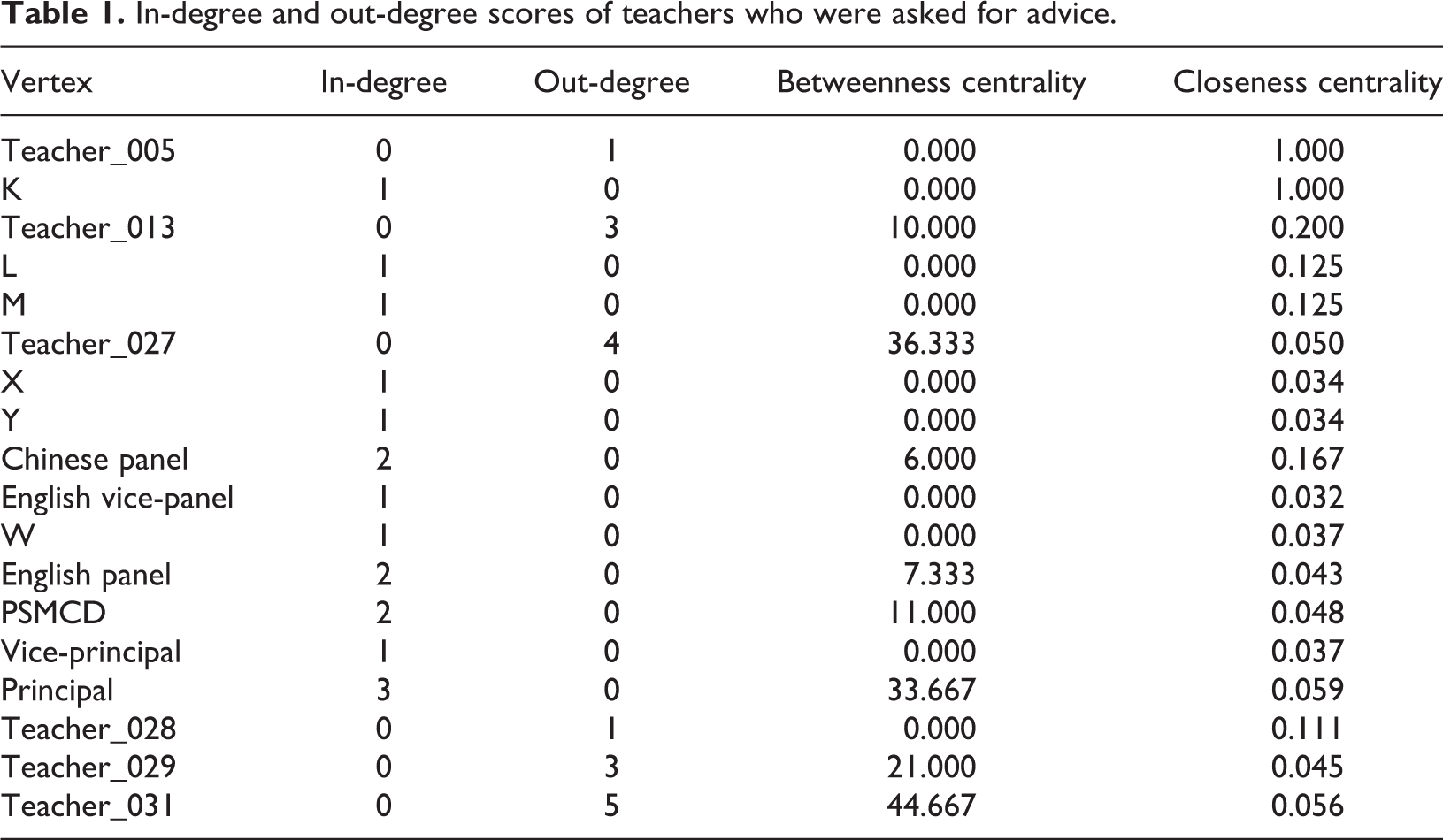
This was applied to the data collected in Part 3 of the teacher survey to explore the teacher networks used in providing peer support concerning curriculum development. SNA acts as a relevant and useful tool in the exploration of the complexities of teachers’ mutual influence, peer support and participatory efforts in social relations (Spillane et al., 2001). SNA can help identify possible strategic ways to collaborate and determine the centrality and closeness of the networks, which could potentially relate to job performance and task behaviours (Sparrowe et al., 2001). Using the NodeXL Pro software, in-degree and out-degree teacher interactions were shown (Table 1), where the term ‘degree’ is defined as the measure of the total number of edges connected to a particular vertex inwards and outwards (Hansen and Smith, 2014). Arrows were used to show the direction from the teachers who needed help (source vertex) and pointed to the ones they tended to ask for help (recipient vertex). The role level of teachers was also used to investigate the patterns of peer support, including: Level I (principal, vice-principal, department head of curriculum development and subject panelheads), Level II (grade coordinators and other committee coordinators), and Level III (class teachers, subject committee members as well as other committee members), which may influence teacher participation in curriculum decision-making (Wan et al., 2018).
In-degree and out-degree scores of teachers who were asked for advice.
Phase 2: Qualitative data collection and analysis
Data collection
Teacher interviews and teacher shadowing were conducted in the second phase of data collection.
Teacher interviews
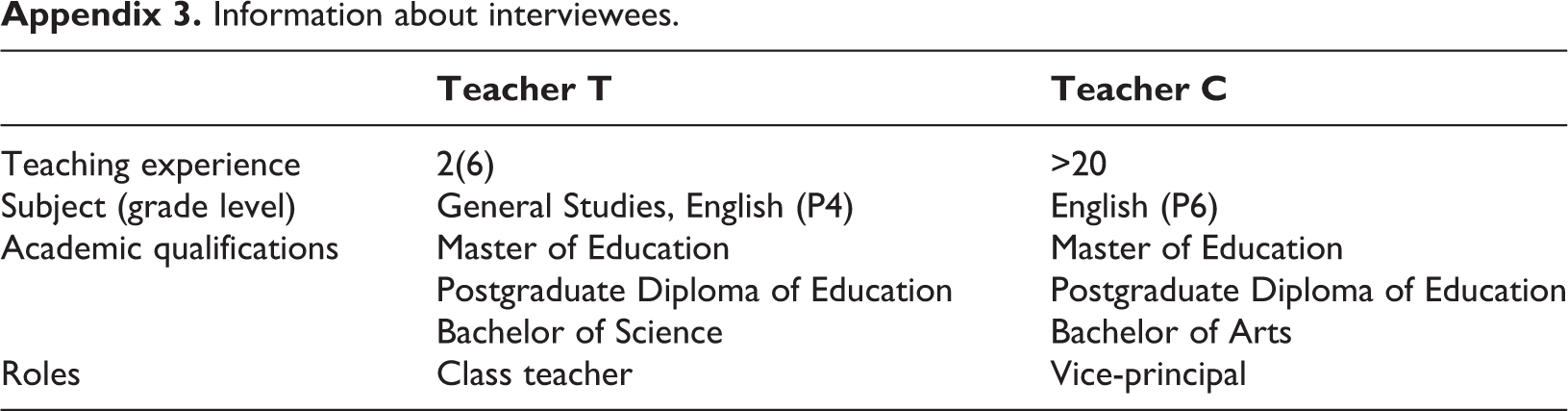
A total of five individual teachers consented to participate in the individual interview in the teacher survey. The researchers attempted to approach these individuals for individual semi-structured interviews so as to elicit their views and understanding of teacher leadership and how teachers support each other in curriculum development processes. However, only two of them were able to participate (Appendix 3). The interviews were conducted in early June 2016. Examples of questions in this round of interviews include the following.
What does teacher leadership mean to you?
If you are going to seek help from others, who will you approach? And why?
To obtain stronger data on teachers’ perceptions and experiences of teacher leadership, the researchers tried to invite these five teachers again in July 2017, but only one of them (who was interviewed in 2016) agreed to be re-interviewed. As this teacher had been interviewed before, additional questions about how teachers in subject departments interacted and what experiences were encountered in seeking help in supporting curriculum development were included, for example: (a) In what ways were teachers involved in the decision-making process in your subject department? and (b) Which teachers are most connected with your work as principal? Each interview lasted around 45–60 min. During the interviews, teachers were informed of the purpose of the study and the confidentiality of the data, including the anonymity of their identities. The interviews were audio-recorded with permission from the teachers.
Teacher shadowing
A one-day teacher shadowing was conducted in early June 2016. This method was applied to obtain ‘site-centred’, onsite information (Padgett, 2016, p.100). Approval for teacher shadowing was obtained from the shadowee, one of the interviewees who participated in the teacher interviews. Before the shadowing, the researchers and the shadowee negotiated on the details of the shadowing method (Bryman and Bell, 2003), where the researchers followed the shadowee everywhere except for those sessions where they were requested to leave for reasons of confidentiality or when the shadowee wanted to have personal time alone (e.g. lunch) (Edwards et al., 1990, p.42). Chatting with the shadowee was done when explanations were needed to understand the shadowee’s actions and motivations behind. During the process, two of the researchers acted as shadowers who took detailed field notes regarding the teachers’ communication and interactions, including how teachers collaborated with each other. Drawings were used to represent the worlds which ‘have strong associations with the social contexts from which they arise’, where layers of rich ‘facts’ are ‘a vital part of a research triangle linking’ the field notes (Hendrickson, 2008, p.125). Such visual data helps release ‘voices’ to tell stories that ‘sensorially integrate’ the observation, to assist written field notes and interview data in capturing the holistic understandings of relationships between what the subjects are doing and what is hidden behind and around the scene (Edwards and Bhaumik, 2009, p.3). The field note data collected from teacher shadowing were cross-checked by the two shadowers.
Data analysis
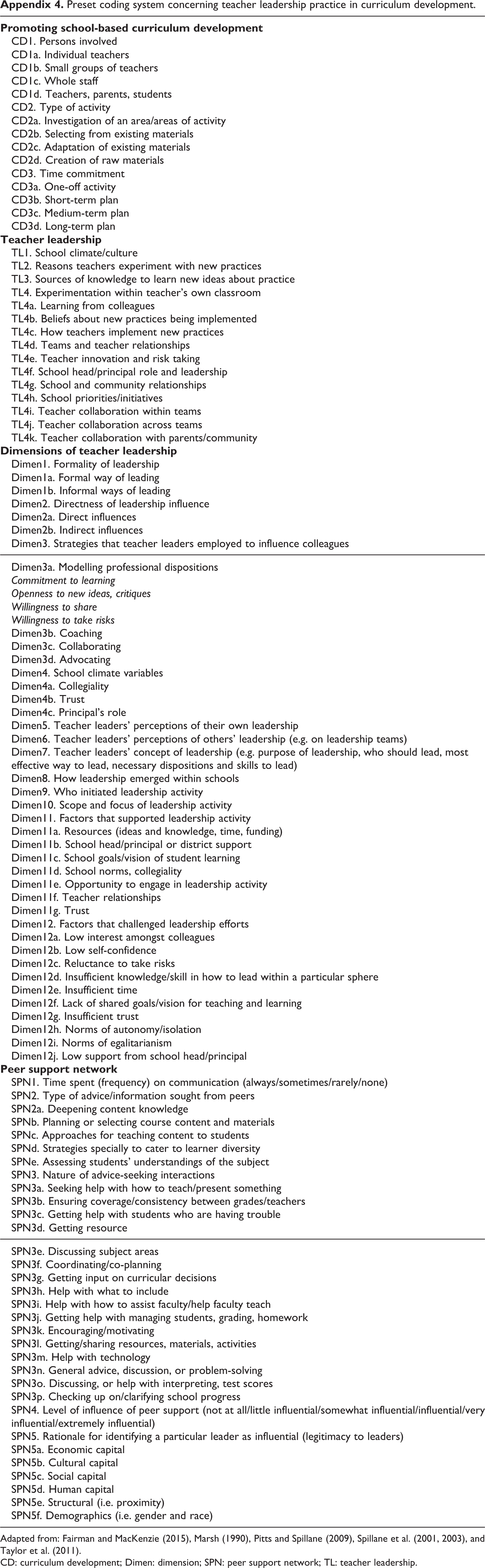
Qualitative analysis was done on the individual interview data and field note data (Miles et al., 2013). Both interview data and field note data were managed through checking the transcribed interviews and repeated listening to the audiotapes. Using a preset coding system (a colour-coding method) according to the key findings of quantitative data in the teacher survey (Appendix 4), key themes were generated and categorised using a thematic approach containing the processes of coding the data ‘in relation to patterns and iteration’, identifying themes, constructing themes, reviewing themes and defining themes (Pahl, 2004, p.343). As the qualitative data analysis was managed by the first author, to ensure the reliability and validity of the data, peer review of the data analysis was conducted by one of the co-authors as an independent second coder (Burnard et al., 2008). The independent second coder is an experienced teacher and is currently studying for a doctorate degree in education at a university; she was responsible for 20% of the qualitative data. More than 90% in the inter-rater reliability of all codes was attained whilst the first and second coders discussed and agreed upon uncertain cases (Morse et al., 2002). All the datasets were finally compared and contrasted to generate and categorise emerging themes (Guest et al., 2012).
Findings
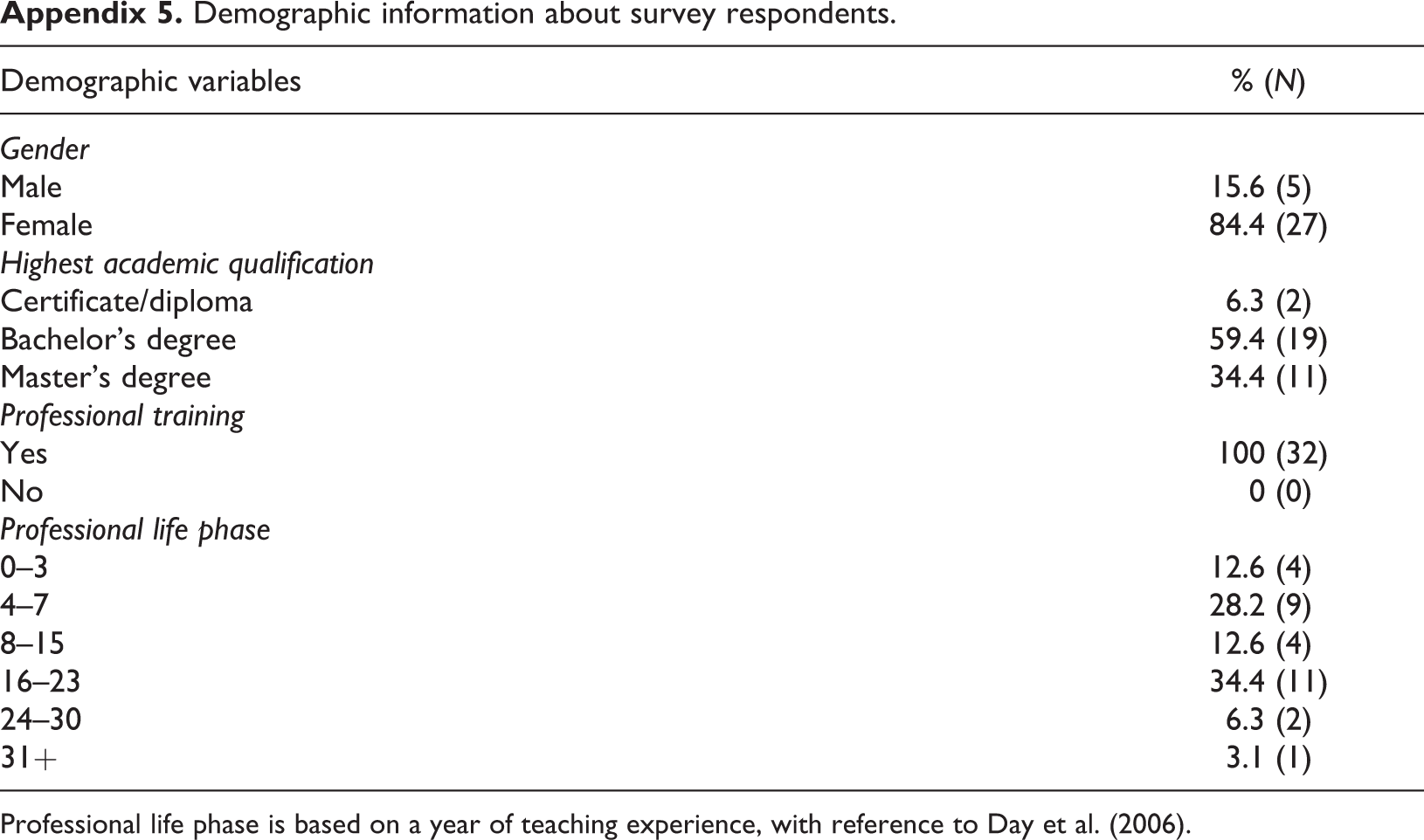
The study aimed to understand how teachers perceived teacher leadership and peer networks in supporting school-based curriculum development. In the first stage of data collection, 32 teachers in the case school responded to the survey (Appendix 5), with a return rate of 100%. More female teachers (N = 27) than male teachers (N = 5) responded. Most survey respondents were 16–23 years old. The average number of years of teaching experience of this group of teachers was 13. Three in-depth interviews, together with a one-day teacher shadowing, were conducted in the second stage of data collection, where one teacher was interviewed twice for further inquiry about how teachers support each other in curriculum development.
Teacher leadership: Focus on student learning but…?
Teachers generally accepted the idea of teacher leadership and tended to be positive towards teacher leadership in school, with an overall composite mean score of 4.41 (SD = 0.51) from Parts 1 and 2 (Table 2). However, a gap between teachers’ perceptions of teacher leadership was found at the individual level and the subject department level, where the overall mean score of individual-level teacher leadership perceptions was 4.48 (SD = 0.53), whereas that of the subject department level was 4.28 (SD = 0.57). Teacher leadership is quite marginalised at the subject department level. Teachers tended to focus on student learning (Component 1), with this aspect achieving the highest mean score (M = 4.64, SD = 0.57). Interview data evidenced that teachers showed concern about how to facilitate student learning with focus on planning and designing teaching materials. Despite great ‘care’ about student learning, teachers seemingly did not work together to foster student learning. Teachers did not have high expectations of student learning, as evidenced by the second lowest mean score in the survey, which was: Q6. In this school, we have high expectations for the learning of all students (M = 3.88, SD = 0.98). This ‘low’ expectation upon students is most likely related to the diverse cultural background of students, which made it difficult for teachers to suit the students’ learning needs. Both teachers interviewed were uncertain if their students could learn and used the words ‘very weak’ to describe their students. These responses imply that although teachers care about student learning, their teaching efficacy was seemingly low, and teachers did not feel confident that they were getting through to their students (Tschannen-Moran and Hoy, 2001).
Teacher perceptions of teacher leadership (N = 32).
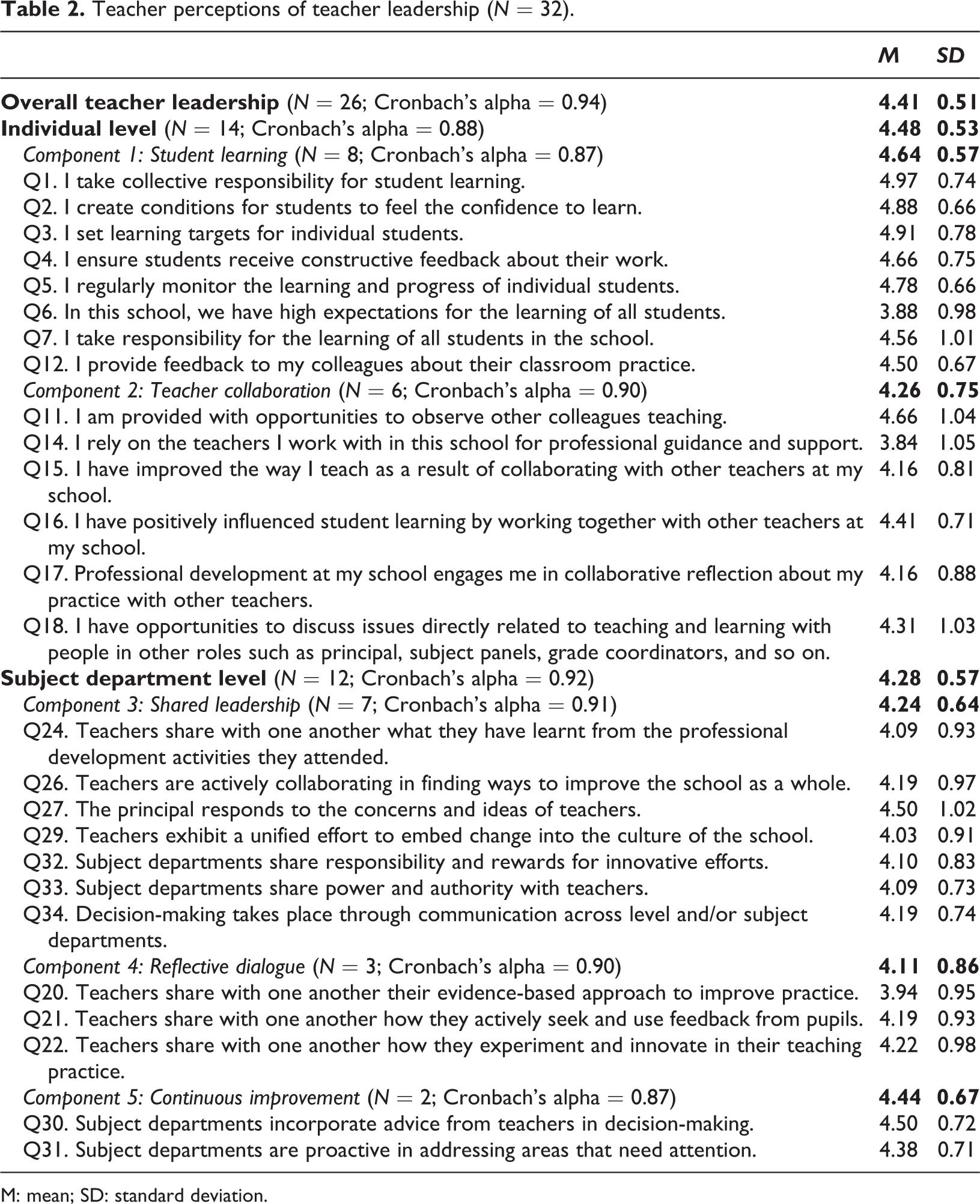
M: mean; SD: standard deviation.
In line with this finding, correlational analysis showed strong or moderate relationships amongst teacher collaboration, shared leadership, reflective dialogue and continuous improvement. However, student learning was not associated with teacher collaboration and shared leadership (Table 3). This condition may indicate that teachers perceive student learning through their ‘individual’ perspectives rather than the ‘collective’ perspective, where the teachers’ goals of helping students learn are narrowly shared amongst them. This also indicates a lack of collegiality bringing teachers together to seek solutions for helping students to learn (Spillane et al., 2001).
Correlation amongst teacher leadership components.
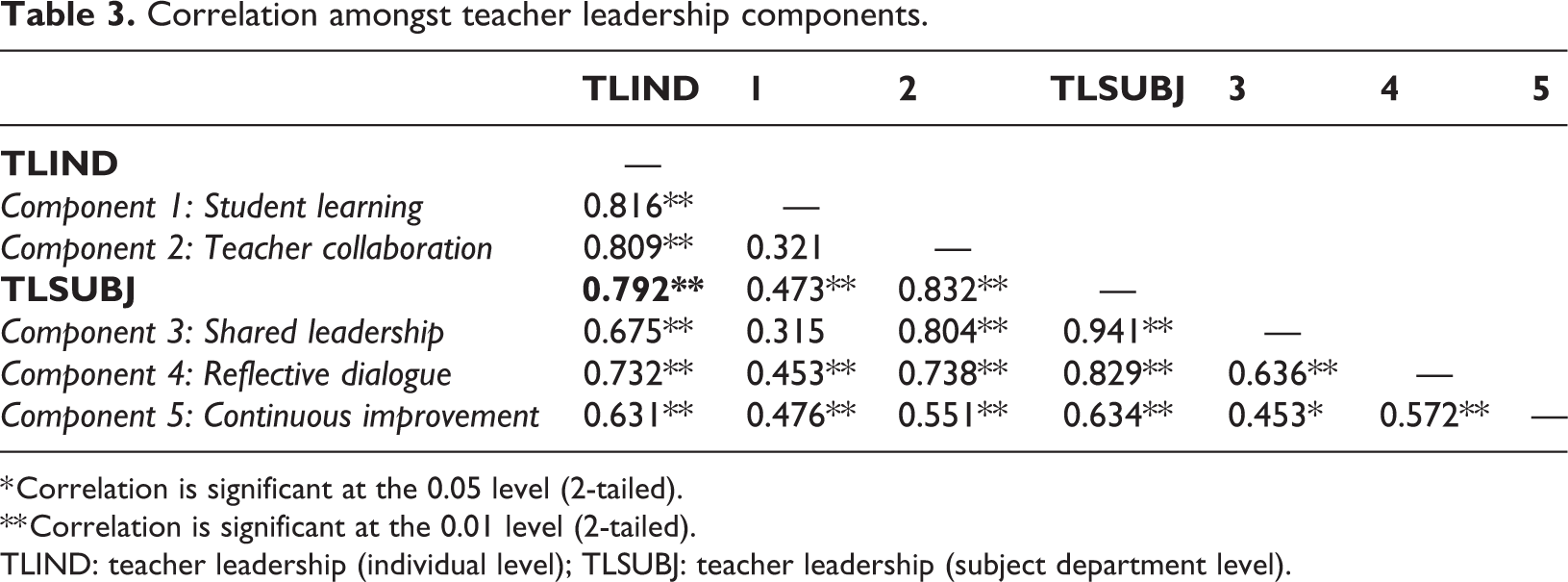
* Correlation is significant at the 0.05 level (2-tailed).
** Correlation is significant at the 0.01 level (2-tailed).
TLIND: teacher leadership (individual level); TLSUBJ: teacher leadership (subject department level).
Teacher leadership: Does teacher collaboration exist?
Although teachers were concerned about student learning, they experienced fewer collaborative opportunities in supporting student learning. The survey data obviously found that teachers’ perception on teacher collaboration was not very positive at the individual level (M = 4.26, SD = 0.75). The findings of Part 3 in the survey consistently revealed that teachers’ peer support network was likely not strong. Most teachers did not show their willingness to answer what aspect of help that they might ask from others, and more than 80% (N = 26) did not respond to this question. Similarly, teachers might be reluctant to answer questions about how the help might influence them and how often they would seek help from others, and more than 80% of such responses were missing. Such a finding corresponds with the survey finding concerning Component 2: Teacher collaboration, where Q14. I rely on the teachers I work with in this school for professional guidance and support (M = 3.84, SD = 1.05) was the lowest mean score in the survey. Teachers did not realise that professional support was useful to them. Teacher_031 expressed that, I would seek help from the PSMCD [curriculum development officer] as he has this responsibility to give us help! Though he could not help much in fact, I think his support was sort of logistic arrangement and this is much better than the General Studies panel head. Because that panel head gave us nothing. There is no direction. He never gave us any resources or information to support us! (Teacher_031, 31 May 2016)
Based on SNA, the relationship amongst teachers concerning the help-seeking behaviours is shown in Figure 3. All vertices were only either in-degree or out-degree. The relations between teachers were featured by scarcely distributed social interaction patterns and the helping behaviour was uni-directional. A total of three groups of teachers were found in this peer support network dealing with curriculum development. The first group was formed by Teacher_031, Teacher_027 and Teacher_029. The others were formed by Teacher_005, Teacher_013 and Teacher_028, respectively. Teacher_031, with six years of teaching experience, played a multi-role in the school, including class teacher, an English teacher, a grade coordinator and a committee member, and sought for advice from teachers, including her two subject panel heads, the principal, the vice-principal, PSMCD (i.e. curriculum development officer) and a regular teacher (i.e. W). Teacher_029, a librarian teacher, asked for advice from the principal, English panel and English vice-panel. This probably was related to the implementation of school-based reading programmes as initiated by the English subject team where reading materials and readers had to be prepared by the librarian. Teacher_027, a panelhead, sought help from the principal, the PSMCD, and several teachers whose names were not disclosed.
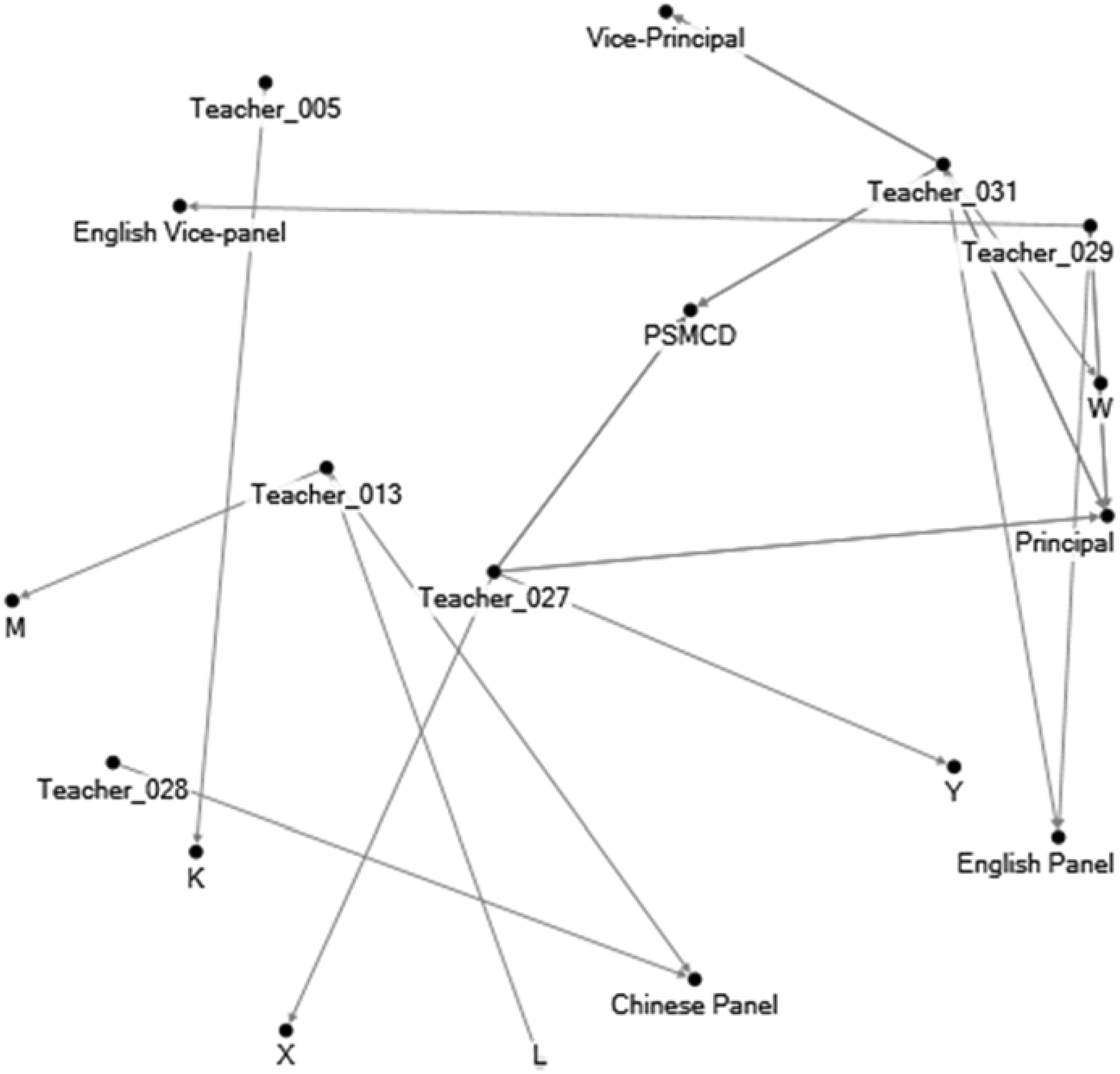
Teachers’ social network regarding help-seeking behaviours concerning curriculum development.
Teachers’ seek-help behaviours more likely occurred within the same subject group. For example, Teacher_013 (a Chinese teacher) sought advice from Chinese panelhead, L (a Chinese teacher) and M (a Chinese teacher and director of general affairs), whilst Teacher_029 (an English teacher) sought advice from English panelhead and English vice-panelhead. The networking groups display that stronger ties mainly were formed and connected due to the existing working relationships in the school. Moreover, referring to the first name as listed in the network, teachers obviously would seek help from those who had the most direct and relevant relations in the working environment (Marin, 2004; Small, 2013) (Table 4). This represents the higher degree of closeness based on the ‘core’ routine working interactions (Grippa and Gloor, 2009; Habinek et al., 2015; Marin, 2004).
Summary of teachers who sought for advice and their named advisors.
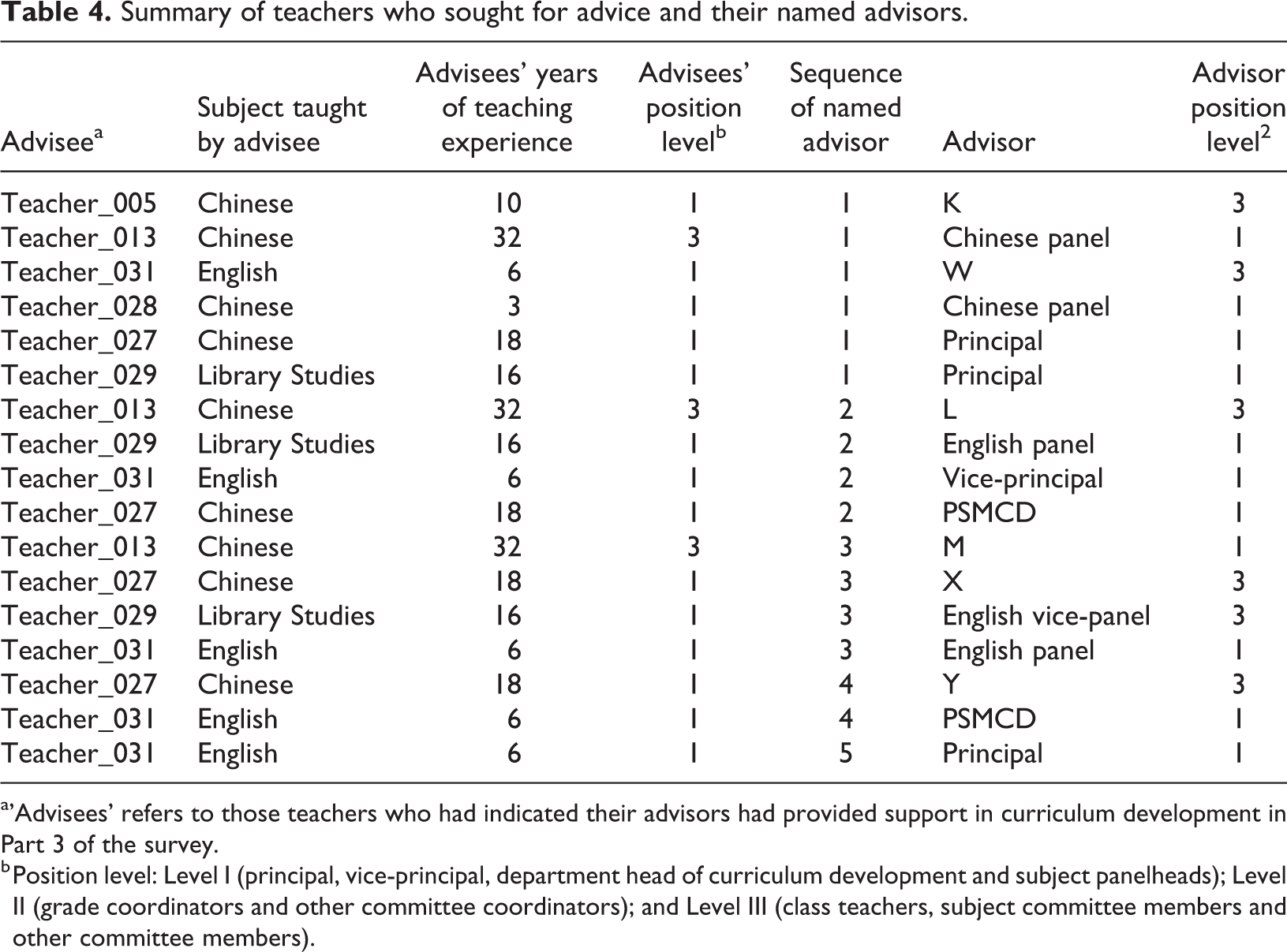
a’Advisees’ refers to those teachers who had indicated their advisors had provided support in curriculum development in Part 3 of the survey.
b Position level: Level I (principal, vice-principal, department head of curriculum development and subject panelheads); Level II (grade coordinators and other committee coordinators); and Level III (class teachers, subject committee members and other committee members).
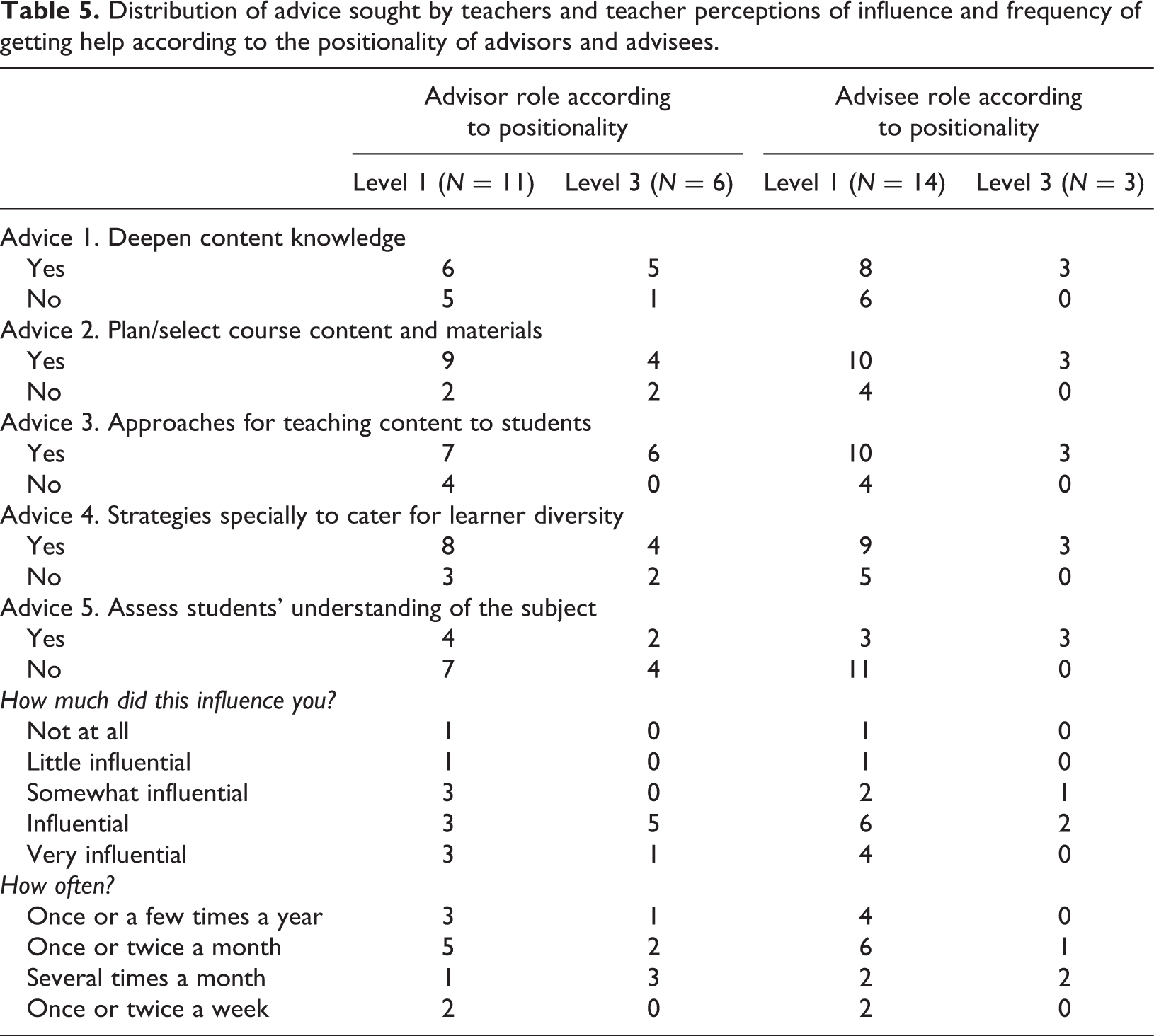
Table 5 shows the distribution of teachers according to the positional levels of teachers and advisors who responded to the survey question about peer support in curriculum development. Clearly, most advice was mainly sought from senior teachers with managerial roles and responsibilities (i.e. Level I teachers), for example, the principal, the PSMCD (i.e. curriculum development officer), the vice-principal, the English panelhead, and so on. Out of 12 named advisors, there were three teachers who asked the principal for advice, as followed by the English panelhead, the Chinese panelhead, the PSMCD (i.e. curriculum development officer), the vice-principal, and other teachers. Teachers did not often help each other but usually attempted to seek help from seniors (positional leaders). However, only a very few senior teachers (positional leaders) sought help from other non-positional teachers. ‘Leaders’ (positional) tended to help and assist other positional leaders and non-positional teachers, although those teachers who received the most help kept seeking help, yet did not offer it themselves.
Distribution of advice sought by teachers and teacher perceptions of influence and frequency of getting help according to the positionality of advisors and advisees.
During the interview, Teacher_031 asserted that she would ask different teachers for help but preferred seeking the senior teachers (e.g. vice-principal) for advice and help. However, the vice-principal mentioned that she tended not to seek help and expected to do her tasks on her own. I cannot think of anyone [who can help].…I do not think that I will ask for help. It is natural to do only [the stuff] that you are able to do…If you cannot finish those jobs, just don’t bear those responsibilities. It is hard to ask for help as everyone has their own businesses to take care of. (Vice-principal, 1 June 2016) Our official co-planning is very random.…In my first year of working here, a colleague who taught the same grade level as mine said to me that, “no teacher in this school likes co-planning and teachers would talk about what to do, but usually that won’t be done in [reality]”. (Teacher_031, 31 August 2017) The principal usually sticks memos on the board. If he has any notices to inform us, like meeting agendas, he will stick them on the board. Department heads, not every head, do the same. Some will message us in “WhatsApp” to remind [us] to do [this] and that. (Teacher_031, 31 August 2017)
Informal communication was infrequent amongst teachers. Consistent with the social network (Figure 3) indicating that teachers seldom sought help from the principal, observation data showed that informal communication between the principal and teachers was rare. The principal was never seen on the shadowing day. Teacher_031 commented: ‘Usually the principal stays inside the office room. He won’t come out unless there’s something very important that he must handle’. This may be related to the location of the principal’s office, which was on the ground floor, whereas the teachers’ staff rooms were on the third floor. One of the teachers’ staff rooms was for the positional leaders (i.e. with middle management roles) and Grades 1–2 class teachers, whilst another was for Grades 3–6 class teachers. Each staff room had three computers and one printer to prepare teaching materials. Figure 4 shows the setting of one of the staff rooms, where teachers sit in rows and are surrounded by partitions. This setting may obstruct teachers’ collegial relationships. I want to seek help from my partner who teaches the same grade level. She sits in another room. Once I saw my partner at the corridor and I immediately asked her for advice. When she entered her own staff room, our dialogue stopped as she continued to work there.…Even [if] I try to actively ask questions to [sic] others, including those sitting around me, they just keep on doing marking and do not respond to me. (Teacher _031, 31 August 2017)
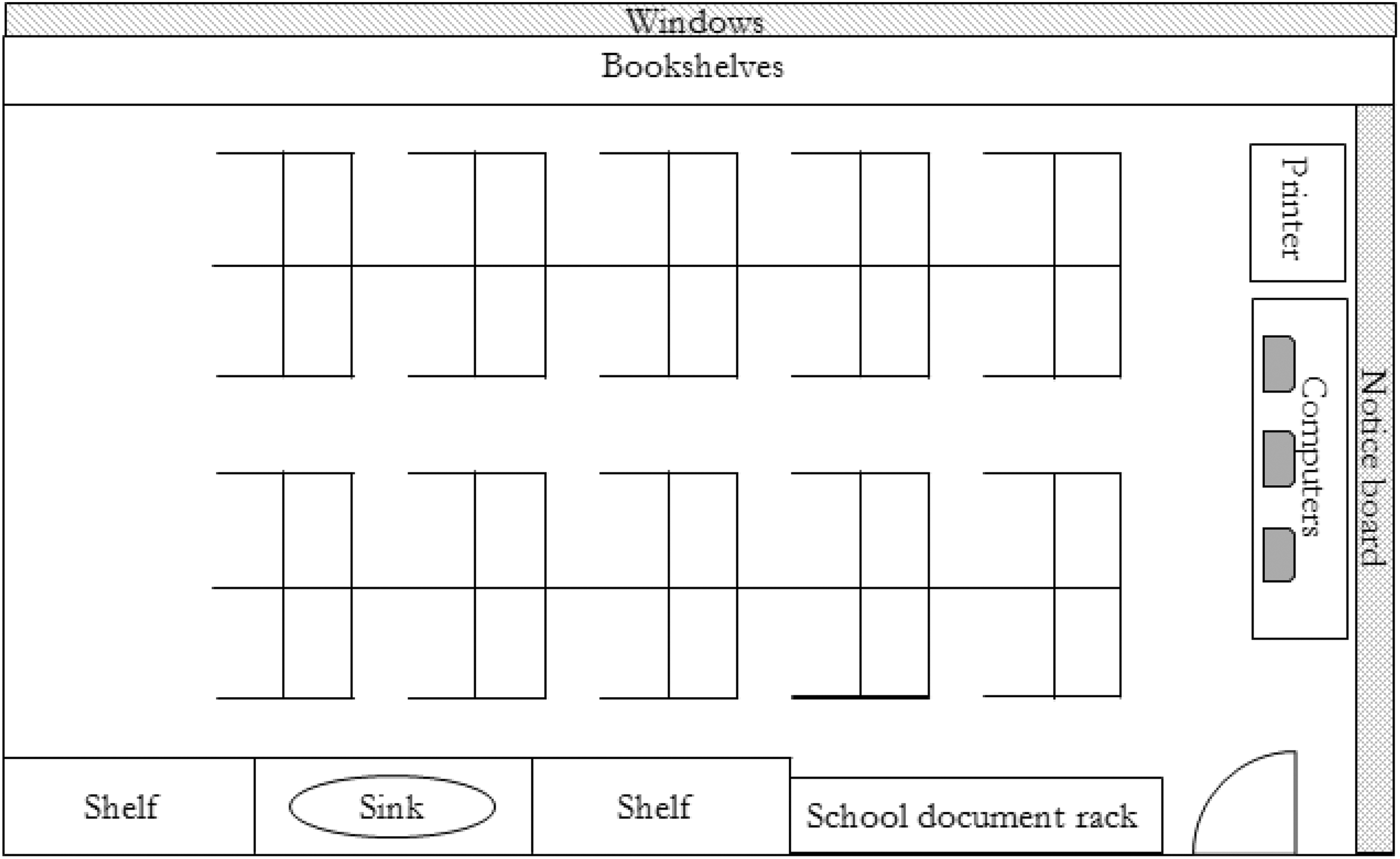
Staff room setting for Grades 3–6 class teachers.
Thus, formal and informal teacher collaboration seldom occurred, which may be related to different factors such as the location of the staff room, floor plan design of the staff room and school organisational structure.
Teacher leadership: Does shared leadership exist?
In line with insufficient teacher collaboration, shared leadership was not yet sufficiently developed in the school. Shared leadership (Component 3) was the second lowest component amongst other components in Parts 1 and 2 in the survey (M = 4.24, SD = 0.64), and this perception was similar to that of teacher collaboration at the individual level (M = 4.26, SD = 0.75). Collective practice, such as power sharing (i.e. item Q33; M = 4.09, SD = 0.73) and sharing of professional learning (i.e. item Q24; M = 4.09, SD = 0.64), which are key elements of shared leadership, was not commonly recognised by teachers. Teachers seldom worked together, even when they did not have clear directions about how their curriculum worked. In the survey data, the item Q29. Teachers exhibit a unified effort to embed change into the culture of the school obtained the lowest mean score (M = 4.03, SD = 0.91). Teacher_031 expressed that There’s no direction for the whole grade level. There is no recommendation from other teachers. You just prepare your own stuff for your own class…That’s class-based.…I really want to make a change to help students to learn. However, this is just my matter, not everyone’s wills…I found that it was important to teach students some manners before the excursion activity…however, my panel head told me that the activity was not managed by us English teachers.…she told me that this is related to [Discipline Team], not us. (Teacher_031, 31 August 2017)
Teachers had limited influence over and participation in collective curriculum decisions. Opportunities for shared decision-making amongst teachers were scarce. Interview data indicated that the principal seemingly acted like an administrator, who mainly assigned managerial duties to other seniors, and that decision-making processes were more reliant on senior teachers. Teacher_031 mentioned that Those senior teachers have more “say”.…They always can explain why that works and why that can’t work. These teachers are of similar teaching experience as our principal. So our principal always respects them. (Teacher_031, 31 August 2017)
Continuous improvement versus reflective dialogue
In the survey, Component 5: Continuous improvement obtained the highest mean score (M = 4.44, SD = 0.67) within the three components at subject department level, where Q30. Subject departments incorporate advice from teachers in decision-making got the highest mean score amongst other survey items. However, Component 4: Reflective dialogue got the lowest mean score (M = 4.11, SD = 0.86) amongst the three components at the subject department level, where Q20. Teachers share with one another their evidence-based approach to improve practice got the lowest mean score (M = 3.94, SD = 0.95) amongst 12 survey items. Teachers were not oriented toward solving problems or looking for improvement together for evidence-based practices with the use of data. Teacher_031 pointed out: ‘As we don’t have much co-planning, there is not much data for reference in supporting me to do follow-up for student learning’. The development of evidence-based practice is still immature at the subject-department level. This is probably due to three key factors, namely: teachers’ heavy workload, unfamiliarity with collaborative activities, and the school culture of seniority. First, teachers did not have the time to work together to solve problems and improve instructional practice. Teacher_031 expressed: ‘We all have heavy workloads and tight teaching schedule. [It] is impossible to collect data and discuss [them] slowly’. Observation data revealed the fully packed teachers’ daily routines. Teacher_031 described a teacher’s routine as ‘7-ups’, which is a commonly used term in Hong Kong to describe a teacher who stands up and conducts lessons continuously without stopping. Second, teachers were likely not used to doing collaborative lesson planning. On the shadowing day, the English department team, including one English panel (formal leader), one native English-speaking teacher, and five teachers without any official position, had an ‘official’ 5-min collaborative lesson planning session. Teachers expressed their own ideas of projected learning products for their own classes; however, their ideas were not ‘discussed’ with each other to reflect on previous experiences or to use data for informed decision-making. Third, the school culture was more seniority-oriented. Although senior teachers play dominant roles and ‘have more say’ in school development, they were more reluctantly engaged in discussion with others for making changes whilst ‘silence’ appeared to be one of the apparent characteristics of subject department meetings. The possibility of engaging teachers in reflective, in-depth discussion for sustained student development is thus marginalised.
Discussion and implications
The aim of the study was to explore how teachers perceive and experience teacher leadership, and how teachers provide peer support in curriculum development in a local primary school. Based upon the findings, the following discussion is organised into three key emergent issues.
Encapsulating teacher collaboration: From formality to informality
In this study, teachers were concerned about student learning, which is consistent with other studies demonstrating teachers’ sense of responsibility for student learning (Diamond et al., 2004). However, formal and informal teacher collaboration in school work is at a low level. The formal way for teacher collaboration to occur is only a form without substance, as there is only a loose-coupling official timeslot for co-planning, in which teachers of different subjects can ‘obey’ or ‘not obey’ the scheduled timeslot to share teaching ideas. Informal collaboration rarely occurs amongst teachers working in subject teams due to different possible ‘structural’ obstacles such as time, workload and location of the staff room.
This ‘disconnection’ between student learning and teacher collaboration can be seen as a result of the failure in managing schools as professional learning communities, where the current organisational infrastructure does not work effectively to ensure the quality of teacher collaboration for the collective goal of student learning, and teachers cannot carry ‘collective’ senses of responsibility for improving student learning. Insufficient spaces and conditions hinder the expansion of teacher leadership through the presence of official mechanisms for promoting ‘contrived collegiality’ amongst colleagues (Hargreaves and Dawe, 1990). A professional learning culture must thus be developed through ‘strategic pathways’ for creating collaboration spaces for teachers to inquire and reflect on pedagogical problems in order to realise the collective power of contributing to student achievement (Muijs and Harris, 2003). This can be done by building collaborative capacity through physical or emotional support from the top-level management (i.e. the principal) in formal and informal ways. The significance of teacher collaboration can be given focus through the current school system by including teacher collaboration as one of the performance criteria, so as to engage teachers in professional discourses that involve the processes of reflection on their own teacher collaboration in an ‘inter-professional’ way (D’Amour and Oandasan, 2005). Organic and inclusive infrastructures can be restructured for teacher interaction (Glazer et al., 2004). For example, the relocation of the principal’s office and the combination of staff rooms can be considered to let teachers have common spaces for informal communication. Importantly, upon considering the ‘busyness’ of teachers (Schad, 2018) and the competing need to ensure time for teacher collaboration, the current hours and workloads of teachers should be reviewed to distribute teachers’ workload according to personal and professional qualities, rather than seniority and positionality.
Espousing shared leadership: From positionality to professionality
The study reflects that the school tended to be under a ‘hierarchical’ system that relies on the positionality of teachers (i.e. Level I teachers), where those with positional power had ‘duties’ to ‘help’ with other positional teachers, as well as those non-positional teachers who tended not to realise that they could influence others. This ‘recognised’ positionality of senior teachers is likely influenced by the prevailing Confucian values, where teachers tend to show trust and respect, and more likely to conform to the seniors (Chan, 2018; Drechsler, 2018). The ‘in-group’ of senior teachers tends to play a dominant role in driving the uni-directional flow of social capital of teachers working in the school (Gerlacha and Gockelb, 2017). This possibly may lead to some disconnected constellation amongst teachers striving for a unified school vision (i.e. student learning), owing to this one-way social capital flow that blocks continuous improvement through generating reflective dialogue from positional (seniors) to non-positional teachers. The dominance of seniority and lack of non-positional teacher participation in giving support could be a ‘deficit’ in the social capital, as positional teachers who offer help (i.e. benefits) to such non-positional teachers might feel that they would not get any benefits in return (Lin, 1999). This may lead to the ‘asymmetric’ payoff (e.g. satisfaction, incentives to help) to positional teachers who give contributions without returns (Cohen et al., 2001). Therefore, such ‘asymmetry’ may undermine the potentials of every single teacher as a ‘professional’ (Darling-Hammond and Sykes, 1999), who highly values knowledge sharing, reflective instructional practice and makes curriculum decisions deliberately (Curry, 2008). Further explorations may be done to find out how such inclined social capital can be built into the teacher network; for example, how teachers are engaged in dialogues that help them practice teacher leadership (Hallinger, 2005).
The significance of professional learning networks is commonly realised in sustained school improvement (Brown and Poortman, 2018). The current teacher networks more likely are restricted to the senior groups of teachers and to what extent other teachers can contribute to such kinds of professional learning seemingly is uncertain. The social network in the study showed that not many teachers sought help from the principal, who displays ‘invisible and unobtrusive forms of control’ (Heck, 1998, p.62) over the school rather than explicitly influencing teachers by helping them directly. This may be linked with the literature that has criticised principals who behave like ‘remote’ leaders and fail to realise instructional issues in classrooms without thinking beyond the office door (Heck, 1998). Nevertheless, there were three teachers out of six teachers who responded to the peer network question in the survey, who sought the principal for advice. This may imply that the roles of the principal still tended to be more important than others in acting as ‘instructional leader’ in supporting the teacher networks in curriculum development in this context.
Realising the existence of the traditional hierarchy of power (in which certain social norms of Chinese society, such as respect for seniors) remains (Cheng, 1998), teachers also generally recognised the concept of teacher leadership that originated in the West, a concept that puts more emphasis on equal participation of teachers. In Western literature, the hierarchy of power usually pertains to the potential for disruption of democracy where (non-positional) teachers likely do not realise themselves to be leaders in this confronting system (Magee and Galinsky, 2008; Weber, 2009). The current study tends to affirm the possibilities of co-existence of traditional Chinese values and teacher leadership, which can be regarded as a unique, culture-specific leadership under the idea of ‘the west wind meets the east wind’ (Qian et al., 2017). How such teacher networks can work (deeply) has to be further investigated through careful considerations about the (re-)distribution of power to all teachers who have opportunities in making grade-level and schoolwide decision-making with delegated responsibilities and sufficient time in engaging in leadership development (Wan et al., 2018).
Enacting reflective practice: From accountability to development
Teachers in the study had higher mean scores in continuous improvement (Component 5) than reflective dialogue (Component 4). This was most likely related to the school self-evaluation mechanism as recommended by the government (Education Bureau, 2016), which expects every school to set up a ‘systematic and evidence-based school self-evaluation’ for ‘the enhancement of students’ learning effectiveness’ (Education Bureau, 2016, p.ii). However, ‘routines’ for using an evidence-based approach that involve using research in collecting and using data to inform decisions for improving learning and teaching are absent in the school in supporting sustainable school development (Quong, 2013). This finding is likely aligned with the other studies that teachers rarely realise the use of research in informing daily practice due to context factors such as insufficient time, tight teaching schedule and heavy workload (e.g. Wan, 2011). Creating ‘third spaces’ for initiating constructive dialogues for making professional judgements in school practices is important (Foreman-Peck and Travers, 2015, p.345). An evidence-based approach for reflective dialogue should be built-in to the school culture to create sufficient space and time for meaningful reflection and shared decision-making in a safe, input-conducive environment, where teachers have opportunities to collectively engage in in-depth cognitive and emotional discourses about student learning in a positive social culture for sustainable school improvement (Hollingworth et al., 2017).
Conclusion
This study contributed to our understanding of how teacher leadership was perceived and practiced in the Asian context. The study revealed teachers’ perceptions of teacher leadership and their social network in curriculum development. Findings from this study seized the incongruence between teachers’ perceptions of student learning and realisation of teacher leadership in terms of teacher collaboration, shared leadership, reflective dialogue and continuous improvement. The study also explored teachers’ relatively weak peer support network in school, which was more reliant on the seniority of teachers. Therefore, exploring the supportive conditions for the complexity of teachers’ networks can be done to ensure teacher leadership development in school in this unique sociocultural context.
The study has several limitations. Although the case study may not be generalisable to other specific contexts, the findings can help expand and enlarge our understandings of teacher leadership as perceived and practiced in Hong Kong. Further considerations can enhance the current study. First, more participants in the case school, including the principal, subject department heads and other teachers, can be invited for interviews and shadowing. Second, a longitudinal study on the process of teacher leadership development in the case school can be conducted in which the complexities of teacher leadership development can be continuously explored in a systematic way. Various schools can be invited to conduct case studies for comparison and contrast of the similarities and differences of teacher leadership in practice.
Footnotes
Item-total statistics. Part 1: Individual level teacher leadership.
| Scale mean if item deleted | Scale variance if item deleted | Corrected item – total correlation | Cronbach’s alpha if item deleted | |
|---|---|---|---|---|
| Q1. I take collective responsibility for student learning. | 79.94 | 100.964 | 0.633 | 0.916 |
| Q2. I create conditions for students to feel the confidence to learn. | 80.03 | 102.934 | 0.564 | 0.917 |
| Q3. I set learning targets for individual students. | 80.00 | 101.613 | 0.556 | 0.917 |
| Q4. I ensure students receive constructive feedback about their work. | 80.25 | 102.581 | 0.516 | 0.918 |
| Q5. I regularly monitor the learning and progress of individual students. | 80.13 | 102.887 | 0.569 | 0.917 |
| Q6. In this school, we have high expectations for the learning of all students. | 81.03 | 100.934 | 0.461 | 0.920 |
| Q7. I take responsibility for the learning of all students in the school. | 80.34 | 100.814 | 0.446 | 0.921 |
| Q8. I have time built into my regular school schedule to examine and improve my instructional practice with other teachers. | 80.28 | 93.564 | 0.870 | 0.909 |
| Q9. I regularly examine student work in collaboration with other teachers. | 80.38 | 97.661 | 0.796 | 0.912 |
| Q10. I work with other teachers to look into the reasons for differences in student achievement across classes. | 80.47 | 97.483 | 0.810 | 0.912 |
| Q11. I am provided with opportunities to observe other colleagues teaching. | 80.25 | 96.968 | 0.632 | 0.916 |
| Q12. I provide feedback to my colleagues about their classroom practice. | 80.41 | 103.023 | 0.546 | 0.918 |
| Q13. I share and try out new teaching methods with my colleagues to enhance student learning. | 80.28 | 96.660 | 0.722 | 0.913 |
| Q14. I rely on the teachers I work with in this school, for professional guidance and support. | 81.06 | 96.125 | 0.665 | 0.915 |
| Q15. I have improved the way I teach as a result of collaborating with other teachers at my school. | 80.75 | 100.645 | 0.594 | 0.917 |
| Q16. I have positively influenced student learning by working together with other teachers at my school. | 80.50 | 104.065 | 0.437 | 0.920 |
| Q17. Professional development at my school engages me in collaborative reflection about my practice with other teachers. | 80.75 | 98.774 | 0.647 | 0.915 |
| Q18. I have opportunities to discuss issues directly related to teaching and learning with people in other roles such as principal, subject panels, grade coordinators, and so on. | 80.59 | 97.733 | 0.596 | 0.917 |
| Q19. I collaborate with teachers from other schools to improve teaching and learning in my and their classrooms. | 80.88 | 104.500 | 0.291 | 0.924 |
Item-total statistics. Part 2: Subject department level teacher leadership.

| Scale mean if item deleted | Scale variance if item deleted | Corrected item-total correlation | Cronbach’s alpha if item deleted | |
|---|---|---|---|---|
| Q20. Teachers share with one another their evidence-based approach to improve practice. | 59.67 | 67.678 | 0.622 | 0.939 |
| Q21. Teachers share with one another how they actively seek and use feedback from pupils. | 59.40 | 67.352 | 0.681 | 0.937 |
| Q22. Teachers share with one another how they experiment and innovate in their teaching practice. | 59.30 | 67.597 | 0.766 | 0.935 |
| Q23. Teachers share with one another their reflections about their learning. | 59.43 | 68.116 | 0.670 | 0.937 |
| Q24. Teachers share with one another what they have learnt from the professional development activities they attended. | 59.40 | 70.317 | 0.661 | 0.937 |
| Q25. Teachers can carry out decisions and plans designed for school-wide improvement. | 59.57 | 66.668 | 0.801 | 0.934 |
| Q26. Teachers are actively collaborating in finding ways to improve the school as a whole. | 59.37 | 66.999 | 0.783 | 0.934 |
| Q27. The principal responds to the concerns and ideas of teachers. | 59.10 | 65.128 | 0.783 | 0.934 |
| Q28. Teachers have opportunities to influence important decisions even if they do not hold an official leadership position. | 59.63 | 65.757 | 0.781 | 0.934 |
| Q29. Teachers exhibit a unified effort to embed change into the culture of the school. | 59.67 | 65.264 | 0.798 | 0.934 |
| Q30. Subject departments incorporate advice from teachers in decision-making. | 59.13 | 71.913 | 0.471 | 0.941 |
| Q31. Subject departments are proactive in addressing areas that need attention. | 59.23 | 71.840 | 0.479 | 0.941 |
| Q32. Subject departments share responsibility and rewards for innovative efforts. | 59.50 | 69.155 | 0.653 | 0.937 |
| Q33. Subject departments share power and authority with teachers. | 59.50 | 69.086 | 0.709 | 0.936 |
| Q34. Decision-making takes place through communication across level or/and subject departments. | 59.43 | 68.254 | 0.751 | 0.935 |
Principal component analysis of teacher perceptions of teacher leadership (Individual level).
|
|
||
|---|---|---|
|
|
|
|
| Q1. I take collective responsibility for student learning. | 0 |
|
| Q2. I create conditions for students to feel the confidence to learn. | 0.043 |
|
| Q3. I set learning targets for individual students. | 0.0096 |
|
| Q4. I ensure students receive constructive feedback about their work. | −0.050 |
|
| Q5. I regularly monitor the learning and progress of individual students. | 0.286 |
|
| Q6. In this school, we have high expectations for the learning of all students. | 0.309 |
|
| Q7. I take responsibility for the learning of all students in the school. | 0.000 |
|
| Q11. I am provided with opportunities to observe other colleagues teaching. |
|
0.369 |
| Q12. I provide feedback to my colleagues about their classroom practice. | 0.155 |
|
| Q14. I rely on the teachers I work with in this school for professional guidance and support. |
|
0.218 |
| Q15. I have improved the way I teach as a result of collaborating with other teachers at my school. |
|
0.039 |
| Q16. I have positively influenced student learning by working together with other teachers at my school. |
|
−0.065 |
| Q17. Professional development at my school engages me in collaborative reflection about my practice with other teachers. |
|
0.031 |
| Q18. I have opportunities to discuss issues directly related to teaching and learning with people in other roles such as principal, subject panels, grade coordinators, and so on. |
|
0.015 |
Note. Principal component analysis was used as the extraction method. Varimax with Kaiser Normalisation was the rotation method; rotation converged in three iterations.
Principal component analysis of teacher perceptions of teacher leadership (Subject department level).
|
|
|||
|---|---|---|---|
|
|
|
|
|
| Q20. Teachers share with one another their evidence-based approach to improve practice. | 0.206 |
|
0.333 |
| Q21. Teachers share with one another how they actively seek and use feedback from pupils. | 0.304 |
|
0.197 |
| Q22. Teachers share with one another how they experiment and innovate in their teaching practice. | 0.352 |
|
0.195 |
| Q24. Teachers share with one another what they have learnt from the professional development activities they attended. | 0.718 | 0.322 | −0.061 |
| Q26. Teachers are actively collaborating in finding ways to improve the school as a whole. | 0.799 | 0.286 | 0.155 |
| Q27. The principal responds to the concerns and ideas of teachers. | 0.685 | 0.366 | 0.283 |
| Q29. Teachers exhibit a unified effort to embed change into the culture of the school. |
|
0.332 | 0.055 |
| Q30. Subject departments incorporate advice from teachers in decision-making. | 0.151 | 0.215 |
|
| Q31. Subject departments are proactive in addressing areas that need attention. | 0.160 | 0.210 |
|
| Q32. Subject departments share responsibility and rewards for innovative efforts. |
|
−0.034 | 0.412 |
| Q33. Subject departments share power and authority with teachers. |
|
0.137 | 0.271 |
| Q34. Decision-making takes place through communication across level or/and subject departments. |
|
0.340 | 0.321 |
Note. Principal component analysis was used as the extraction method. Varimax with Kaiser Normalisation was the rotation method; rotation converged in three iterations.
Information about interviewees.
|
|
|
|
|---|---|---|
| Teaching experience | 2(6) | >20 |
| Subject (grade level) | General Studies, English (P4) | English (P6) |
| Academic qualifications | Master of Education | Master of Education |
| Postgraduate Diploma of Education | Postgraduate Diploma of Education | |
| Bachelor of Science | Bachelor of Arts | |
| Roles | Class teacher | Vice-principal |
Preset coding system concerning teacher leadership practice in curriculum development.
|
|
| CD1. Persons involved |
| CD1a. Individual teachers |
| CD1b. Small groups of teachers |
| CD1c. Whole staff |
| CD1d. Teachers, parents, students |
| CD2. Type of activity |
| CD2a. Investigation of an area/areas of activity |
| CD2b. Selecting from existing materials |
| CD2c. Adaptation of existing materials |
| CD2d. Creation of raw materials |
| CD3. Time commitment |
| CD3a. One-off activity |
| CD3b. Short-term plan |
| CD3c. Medium-term plan |
| CD3d. Long-term plan |
|
|
| TL1. School climate/culture |
| TL2. Reasons teachers experiment with new practices |
| TL3. Sources of knowledge to learn new ideas about practice |
| TL4. Experimentation within teacher’s own classroom |
| TL4a. Learning from colleagues |
| TL4b. Beliefs about new practices being implemented |
| TL4c. How teachers implement new practices |
| TL4d. Teams and teacher relationships |
| TL4e. Teacher innovation and risk taking |
| TL4f. School head/principal role and leadership |
| TL4g. School and community relationships |
| TL4h. School priorities/initiatives |
| TL4i. Teacher collaboration within teams |
| TL4j. Teacher collaboration across teams |
| TL4k. Teacher collaboration with parents/community |
|
|
| Dimen1. Formality of leadership |
| Dimen1a. Formal way of leading |
| Dimen1b. Informal ways of leading |
| Dimen2. Directness of leadership influence |
| Dimen2a. Direct influences |
| Dimen2b. Indirect influences |
| Dimen3. Strategies that teacher leaders employed to influence colleagues |
| Dimen3a. Modelling professional dispositions |
| Commitment to learning |
| Openness to new ideas, critiques |
| Willingness to share |
| Willingness to take risks |
| Dimen3b. Coaching |
| Dimen3c. Collaborating |
| Dimen3d. Advocating |
| Dimen4. School climate variables |
| Dimen4a. Collegiality |
| Dimen4b. Trust |
| Dimen4c. Principal’s role |
| Dimen5. Teacher leaders’ perceptions of their own leadership |
| Dimen6. Teacher leaders’ perceptions of others’ leadership (e.g. on leadership teams) |
| Dimen7. Teacher leaders’ concept of leadership (e.g. purpose of leadership, who should lead, most effective way to lead, necessary dispositions and skills to lead) |
| Dimen8. How leadership emerged within schools |
| Dimen9. Who initiated leadership activity |
| Dimen10. Scope and focus of leadership activity |
| Dimen11. Factors that supported leadership activity |
| Dimen11a. Resources (ideas and knowledge, time, funding) |
| Dimen11b. School head/principal or district support |
| Dimen11c. School goals/vision of student learning |
| Dimen11d. School norms, collegiality |
| Dimen11e. Opportunity to engage in leadership activity |
| Dimen11f. Teacher relationships |
| Dimen11g. Trust |
| Dimen12. Factors that challenged leadership efforts |
| Dimen12a. Low interest amongst colleagues |
| Dimen12b. Low self-confidence |
| Dimen12c. Reluctance to take risks |
| Dimen12d. Insufficient knowledge/skill in how to lead within a particular sphere |
| Dimen12e. Insufficient time |
| Dimen12f. Lack of shared goals/vision for teaching and learning |
| Dimen12g. Insufficient trust |
| Dimen12h. Norms of autonomy/isolation |
| Dimen12i. Norms of egalitarianism |
| Dimen12j. Low support from school head/principal |
|
|
| SPN1. Time spent (frequency) on communication (always/sometimes/rarely/none) |
| SPN2. Type of advice/information sought from peers |
| SPN2a. Deepening content knowledge |
| SPNb. Planning or selecting course content and materials |
| SPNc. Approaches for teaching content to students |
| SPNd. Strategies specially to cater to learner diversity |
| SPNe. Assessing students’ understandings of the subject |
| SPN3. Nature of advice-seeking interactions |
| SPN3a. Seeking help with how to teach/present something |
| SPN3b. Ensuring coverage/consistency between grades/teachers |
| SPN3c. Getting help with students who are having trouble |
| SPN3d. Getting resource |
| SPN3e. Discussing subject areas |
| SPN3f. Coordinating/co-planning |
| SPN3g. Getting input on curricular decisions |
| SPN3h. Help with what to include |
| SPN3i. Help with how to assist faculty/help faculty teach |
| SPN3j. Getting help with managing students, grading, homework |
| SPN3k. Encouraging/motivating |
| SPN3l. Getting/sharing resources, materials, activities |
| SPN3m. Help with technology |
| SPN3n. General advice, discussion, or problem-solving |
| SPN3o. Discussing, or help with interpreting, test scores |
| SPN3p. Checking up on/clarifying school progress |
| SPN4. Level of influence of peer support (not at all/little influential/somewhat influential/influential/very influential/extremely influential) |
| SPN5. Rationale for identifying a particular leader as influential (legitimacy to leaders) |
| SPN5a. Economic capital |
| SPN5b. Cultural capital |
| SPN5c. Social capital |
| SPN5d. Human capital |
| SPN5e. Structural (i.e. proximity) |
| SPN5f. Demographics (i.e. gender and race) |
Adapted from: Fairman and MacKenzie (2015), Marsh (1990), Pitts and Spillane (2009), Spillane et al. (2001, 2003), and Taylor et al. (2011).
CD: curriculum development; Dimen: dimension; SPN: peer support network; TL: teacher leadership.
Demographic information about survey respondents.
| Demographic variables | % (N) |
|---|---|
| Gender | |
| Male | 15.6 (5) |
| Female | 84.4 (27) |
| Highest academic qualification | |
| Certificate/diploma | 6.3 (2) |
| Bachelor’s degree | 59.4 (19) |
| Master’s degree | 34.4 (11) |
| Professional training | |
| Yes | 100 (32) |
| No | 0 (0) |
| Professional life phase | |
| 0–3 | 12.6 (4) |
| 4–7 | 28.2 (9) |
| 8–15 | 12.6 (4) |
| 16–23 | 34.4 (11) |
| 24–30 | 6.3 (2) |
| 31+ | 3.1 (1) |
Professional life phase is based on a year of teaching experience, with reference to Day et al. (2006).
Declaration of conflicting interests
The authors declared no potential conflicts of interest with respect to the research, authorship, and/or publication of this article.
Funding
The authors disclosed receipt of the following financial support for the research, authorship, and/or publication of this article: We gratefully acknowledge the support from the principal and teachers in the study. This paper was partially based on the paper presentation at the ISATT 2017 Conference.
