



Abstract
International research has shown that the quality of school leadership and management (SLM) is important for teaching and learning, particularly in schools where there is acute resource deprivation. This article explores the relationship between leadership and academic achievement in South African secondary schools with varying socio-economic conditions. The study is based on data from 12,154 South African Grade 9 learners, 334 mathematics teachers and 292 principals who participated in the 2015 Trends in International Mathematics and Science Study (TIMSS). Using indicators that represent different aspects of school leadership, this article examines whether the type of leadership and management practices depend on the school setting and whether better school leadership and management supports academic achievement. The analysis revealed distinct relationships between school leadership and management and academic achievement based on the socio-economic status of learner bodies. Potential policy responses are discussed.
Introduction
The role of the school principal in South Africa has expanded in recent years. Principals were traditionally viewed as managers and administrators, but this is no longer the case (Botha, 2004; Bush and Glover, 2016; Christie et al., 2007; Wills, 2015). Findings from a number of local studies confirm that the nature of principalship has moved beyond daily management and administrative tasks to focus more on improving teaching and learning in schools (Bush and Glover, 2014; Christie, 2010; Maringe et al., 2015; Moletsane et al., 2015). In the context of dismantling the apartheid system of education, principals have, over the past two decades, been tasked with implementing policies and programmes to support the massive expansion and integration of schools while striving to raise academic standards.
Currently, the South African Department of Basic Education (DBE) views principals as ‘key delivery agents’ and ‘the most important partners in education’ (DBE, n.d.). The Personnel Administrative Measures contained in the Employment of Educators Act 76 of 1998, revised in 2016, sets out the core duties of school principals, which include policy implementation, management of staff, learners, information and infrastructure, as well as school discipline (Republic of South Africa (RSA), 2016a). The roles are further clarified in the Policy on the South African Standard for Principalship (RSA, 2016b), which sets out eight interdependent areas that constitute the core purpose of principalship. These policies do, however, acknowledge that these duties may vary depending on the approaches required by the nature of the school.
The policy landscape reflects a growing consensus that without a well-led schooling environment, resources at schools cannot be used efficiently; neither can they be managed sustainably (RSA, 1996). The policy framework which aimed to ensure equal provision of education has, however, not been successful for all, as the majority of schools still operate in contexts of multiple deprivation (Moletsane et al., 2015). Principals in these varying socio-economic contexts are faced with challenges and tasks that may require differing school leadership and management (SLM) approaches. Most of the research on SLM and educational outcomes in South Africa is based on small-scale studies. While these studies have provided useful insights into the conditions in a specific set of schools, few studies have been able to provide a national perspective of SLM in South African schools.
This article has two overarching goals. The first is to understand the nature of leadership and management that operates across South Africa’s diverse schooling contexts. The second is to test the strength of the relationship between SLM and learner academic achievement across learning environments. We use data from the 2015 Trends in International and Science Study (TIMSS) for our study. The article is structured as follows. After this brief introduction, we turn to a review of the literature on leadership and management within different schooling contexts and how these measures have been found to relate to academic outcomes. The literature is used to develop a framework around which the empirical work in this article is based. In particular, we focus on instructional leadership, ensuring an orderly and supportive environment and principal experience and training. This is followed by a description of the TIMSS 2015 data and our approach to the analysis of the data. The penultimate section presents the results for each school group characterised by socio-economic status (no-fee, fee-paying and independent schools). We discuss the findings and conclude in the final section.
A framework for school leadership and management
The relationship between SLM and learner achievement has been the focus of international attention, although researchers generally agree that the effects can be difficult to measure (Hallinger and Heck, 1998; Leithwood and Jantzi, 2000). Recent theoretical contributions have shown that the quality of leadership matters for learner outcomes, especially in failing schools (Bloom et al., 2015; Branch et al., 2013). How leadership is viewed and measured and its relationship to learner outcomes may vary from one country to another as well as within specific countries (OECD, 2013). Moreover, access to effective school leadership can be constrained by a school’s ability to recruit experienced staff. Schools that are situated in poor communities are less likely to attract and retain good teachers and principals. Staff at these schools work in difficult conditions where disorder and lack of discipline may interfere with their ability to provide effective instruction (Duncan and Magnuson, 2011). Children attending high-poverty schools are more likely to learn in environments where learners arrive at school unprepared and where learning and behavioural problems are common (Duncan and Murnane, 2014). Such daily challenges can overwhelm even the most experienced and committed staff.
Many different labels have been assigned to school leaders over the years to identify what their focus should be. At various times, school leaders have been encouraged to be transformational, distributive, managerial, participative, post-modern and even moral to name but a few (Bush, 2007; Leithwood et al., 1996; Spillane and Healey, 2010). Some descriptions even borrow from the leadership literature within the business environment (Clarke, 2007). We base our framework for this study on local and international findings about effective leadership in challenging environments (Bryk et al., 2010; Bush and Glover, 2016; Hoadley and Galant, 2015; Taylor, 2011). The common thread in the literature is that an effective principal can make a difference to teaching and learning when compared to an ineffective one who is working in a similar socio-economic context. South African schools differ considerably in what effective school leadership looks like (Christie et al., 2007). We test whether the professional organisation of a school by its principal depends on the group of schools under investigation. Our conceptual framework consists of three characteristics of SLM: instructional leadership, ensuring an orderly and supportive environment through management, and the experience and training of the school principal. Although not an exhaustive list, these are three key areas where the relationship between SLM and educational outcomes has been shown to be strong and consistent in the South African and international literature. Each is discussed below.
Instructional leadership
Leadership through the lens of instruction is thought to provide a mechanism to link effective principals to the quality of education in a school. The thinking is that for teachers to instruct learners well, they need to be guided by competent instructional leaders who can provide feedback and guidance (Harris et al., 2003; Leithwood et al., 1996). The term has assumed renewed importance in educational leadership discussions in the 21st century. As performance standards and accountability structures have taken centre stage in global education debates, there has been a growing interest in how school principals influence educational outcomes (Hallinger, 2005; Heck, 1992; Huber, 2006). Instructional leadership has also been shown to be positively correlated with other measures of effective leadership, such as framing communication goals, school management and curriculum development (OECD, 2013).
Principals and Heads of Department (HoDs) in high performing South African schools work actively to improve instruction (Hoadley and Galant, 2015). In a study on effective leadership in poor schools, Kamper (2008) found that the leadership efforts of effective principals were focused on excellence in the classroom. Learner progress was monitored regularly allowing for timeous action to correct problems. This echoes the findings of earlier studies which found that effective South African principals are involved in the quality assurance of assessments and monitoring the progress of learners (Kanjee and Prinsloo, 2005; Taylor and Prinsloo, 2005). This process includes ensuring that teachers were equipped for their roles and responsibilities in relation to curriculum coverage. It also meant that established systems of monitoring classroom practices were in place. Thus school leadership required a supportive role player, the principal, as a facilitator of learning (Kamper, 2008; Kanjee and Prinsloo, 2005).
In Hoadley et al.’s (2009) study on instructional leadership, principals reported spending most of their time on administrative functions and disciplining learners. ‘Instructional leadership’, as read through ‘overseeing teaching and learning’ and ‘supervising teachers’, was not a function that took up the majority of many principals’ time. Bush and Glover would add that middle managers play the most important role in instructional leadership and that greater emphasis should be placed on equipping HoDs with the resources to supervise teaching and learning (Bush and Glover, 2016).
A broader view of instructional leadership
Critics argue that the conceptual foundations of instructional leadership place an unrealistic burden on a single individual to fulfil an almost heroic role on a daily basis. It is impractical, they argue, to assume that principals have the time and skills to engage with teachers across grades and subject areas (Leithwood et al., 1996). This is especially so in high-poverty schools where principals spend a lot of time on daily management and administrative tasks and in ensuring the safety and security of learners. Some researchers have expanded the definition to what has been described as ‘shared instructional leadership’ (Marks and Printy, 2003), which is a combination of transformational and instructional leadership. This version of instructional leadership depends heavily on respectful relationships and open communication between teachers and school principals (Marks and Printy, 2003).
Also related to instructional leadership is how well a school principal can articulate a common vision to everyone involved in the life of the school and inspire teachers, parents and learners to work towards shared goals. Kamper (2008) argued that the supportive role of effective South African principals was evident from the emphasis on teamwork. These relationships, between teachers and principals, were found to have a significant association with learner achievement gains over time. In addition, collaborative relationships between teachers were positively associated with higher academic achievement of learners, suggesting the importance of creating a collaborative teacher culture (Hoadley et al., 2009).
Principals play a crucial role in developing a conducive environment for teacher collaboration. A well-developed structure for teacher collaboration stems from strong leadership in sharing the vision for teacher collaboration (Steyn, 2015). Van der Vyver et al. (2013) described the difficulties that South African principals experienced in identifying their own, and the teachers’, emotional states accurately. With regard to management factors, teachers reported inadequate support, empowerment, altruism and participative decision-making from the principals.
Ensuring an orderly and supportive environment through management
The managerial dimension deals with how well the school is functioning at an operational level. Bush and Glover (2016) explain that part of the expanding role of South African school principals includes ensuring the safety and functionality of the school environment. Studies in South Africa have revealed greater disciplinary and safety challenges in historically disadvantaged schools (Zuze et al., 2016). Ngcobo and Tikly’s (2010) study of township and rural schools highlighted the importance of a conducive environment for teaching and learning. Teacher and pupil attendance and punctuality, discipline, and sufficient teaching and learning resources were among the factors mentioned by the authors. School principals who rely on poor organisational systems have poor administrative structures, may experience supply shortages, lack of punctuality and poor communication between parents and school staff members.
School principals need to engage with parents and communities to enforce safety and discipline, but this may lead to unintended consequences. In a South African study on teacher leave management practices focusing on principals in rural schools, Moletsane et al. (2015) found that principals attempted to balance the rights of teachers to good conditions of employment with the rights of learners to receive an education in a safe and orderly environment. Here the principals made decisions that compromised ideals of learner safety and school order, where either parents or other teachers were asked to ‘look after’ the absent teacher’s learners. In this context, while the teacher’s right to leave-taking was ensured, teaching and learning were often interrupted or lost, and the learners’ right to quality education was compromised.
Experience and training
A principal’s education level is known to correlate with other leadership practices (Valentine and Prater, 2011). Critics argue that the current form of academic preparation of South African principals through university training followed by intervals of in-service training is not leading to improvements in schools (Bush and Heystek, 2006). There have been efforts to professionalise the role of the principal. Two notable examples are the introduction of the mandatory School Leadership Advanced Certificate in Education (ACE) in 2007 (Bush et al., 2011) and the more recent Advanced Diploma in Education: School Leadership and Management that is based on the Policy on the South African Standard for Principalship (RSA, 2016b).
Developing a healthy school culture is a slow and deliberate process. Christie et al.’s report on the organisational culture of well-functioning South African schools referenced school leaders who developed academic expectations, a common sense of purpose and a general work ethic (Christie et al., 2007). Principals need to remain in school for long enough to influence the climate of the school, and therefore a reasonable tenure in the same school is necessary. Internationally, the proportion of principals who have remained in the same school for at least six years correlates with high achievement (Branch et al., 2012). The same study found that where staff shortages exist, ineffective principals can be recycled. In South Africa, turnover in the labour market for principals is particularly low (Wills, 2015). Union membership may play a role in the appointment of school principals. Where union affiliation is the determining factor for appointing principals, years of experience and academic qualifications are rendered meaningless. In fact, the extent of political union affiliation has been linked to high levels of school dysfunction (Msila, 2014). Of course the culture of the school also depends on the input of parents and the community. The legislation for school governing bodies (SGBs) has been in place since 1997, but in practice, the effectiveness of SGBs to hold school leadership to account varies because of the skills required to carry out these roles (Xaba, 2011). It is noteworthy that this relationship between SGBs and schools may change as a result of the proposed limitation of SGB powers contained in the Draft Basic Education Laws Amendment Bill (RSA, 2017).
Research questions
Informed by this conceptual framework, the specific set of research questions is as follows: Does access to quality SLM depend on the type of school environment that is available to learners? What is the relationship between better/higher quality SLM characteristics and achievement in different South African schooling environments? Are some SLM factors more important than others?
Data and modelling approach
TIMSS South Africa data used in this study
We use data from the 2015 wave of TIMSS to investigate whether the nature of leadership depends on learners’ and schools’ socio-economic contexts, and if indicators of better SLM characteristics (as described in the conceptual framework) are associated with narrower achievement gaps in South African schools. The sampling procedure followed a two-stage stratified cluster sample design to ensure that the sample was representative of the population of Grade 9 learners in South Africa (Zuze et al., 2017). The 2015 sample consisted of 12,514 learners, 334 mathematics teachers and 292 principals in 292 schools. Each learner completed a mathematics assessment test and a contextual questionnaire. Teachers and principals completed contextual questionnaires only.
South African government schools are classified by the poverty levels of learners and of the community where the schools are situated. Schools range from the least resourced no-fee schools where parents do not pay any tuition, to better resourced fee-paying and independent schools, where a wide range of school fees are charged. The DBE uses a quintile ranking to determine its allocation of funding to schools. No-fee government schools are in quintiles 1, 2 and 3. These schools are the least resourced. Fee-paying government schools are more affluent and can charge school fees. These schools are in quintiles 4 and 5. Independent schools are not government owned and the quintile ranking does not apply. These school types are distinctive not only by their access to resources but also by their levels of academic achievement (Zuze et al., 2017). Our TIMSS results are presented separately for each school category.
Measures
Information about how schools are organised in TIMSS is largely based on principal self-reports, although there are some instances where teachers also contribute. We measured leadership quality based on TIMSS-derived and author-calculated indicators of: a) instructional leadership, b) promoting an orderly and supportive environment, and c) the principal’s experience and training. These indicators were based on self-reported information from the learner contextual questionnaire, and the mathematics teacher and principal questionnaires. In addition to leadership quality, learner and school variables that have been found to be related to achievement differences in South African schools were also included in the analysis (Setati and Adler, 2000; Taylor and Yu, 2009; Van Der Berg et al., 2011). These variables were: gender, fluency in the language of the test (either Afrikaans or English), socio-economic status (index based on the availability of 16 assets in a learner’s home), age and school location. Results were presented separately based on type of school (no-fee, fee-paying or independent). School type is used as an indicator of school SES because fee-paying and independent schools are typically better resourced than no-fee schools, which rely exclusively on state funding. The variables will be described briefly in the relevant results section.
Analysis plan
Descriptive statistics of learner and SLM characteristics in each school type were generated to address the first research question, where we compared school environments with different forms of leadership and management. The second and third research questions considered the relationship between leadership quality and achievement gaps in South Africa in different school types. We conducted multilevel regression analysis to account for variations in Grade 9 school mathematics achievement in 2015 and the extent to which leadership qualities explained the variance. Multilevel analysis was used owing to the nested structure of the TIMSS data (Grade 9 learners within each of the schools in the sample). It was also motivated by the research questions that we were addressing. We set out to investigate the relationship between SLM characteristics in different school settings and the academic achievement of learners within those schools (De Leeuw and Meijer, 2008).
The dependent variable was the TIMSS Grade 9 learner mathematics scores. We estimated a series of mixed models where the level-1 covariates were learner characteristics (age, gender, language fluency and socio-economic status) and where the level-2 covariates were school and leadership characteristics. The learner level (level-1) variables were included as controls. We expected that higher average mathematics achievement would be related to having a higher socio-economic status, being the appropriate age for the grade, being male and being fluent in the language of the test. At the school level, we predicted that better managed environments would have higher average test scores although the strength of the relationship between SLM and achievement would depend on the type of school. Here, a well-managed environment was one where instructional leadership was practised, where the climate was orderly and supportive, and where principals were experienced and qualified. The results shown below are presented separately for each type of school (no-fee, fee-paying and independent) and for each SLM dimension. We were also interested in comparing which SLM characteristics were most effective in explaining variation in achievement. For each model, we compared the variance explained by the different sets of leadership qualities across the three types of school.
Scope and limitations of this study
We note four limitations of this study. The first is that SLM is primarily assessed as a characteristic of school principals. We acknowledge that school management teams may influence the culture of SLM in any given school. The second is that the study is based on self-reported data. Responses could reflect subjective perceptions or socially acceptable answers rather than actual reflections of reality. Third, the data is cross sectional. Such data cannot be used to make causal conclusions. It can, however, be used to test the relationships between variables as we have done. Lastly, this study uses secondary international data and thus the variables that can be examined are limited to what was assessed in the main international study.
Although these limitations restrict the claims that can be made in this study, and we are not in a position to make any strong causal links, the research does provide a comprehensive picture of SLM in South Africa to extend the current body of literature.
Results of data analysis
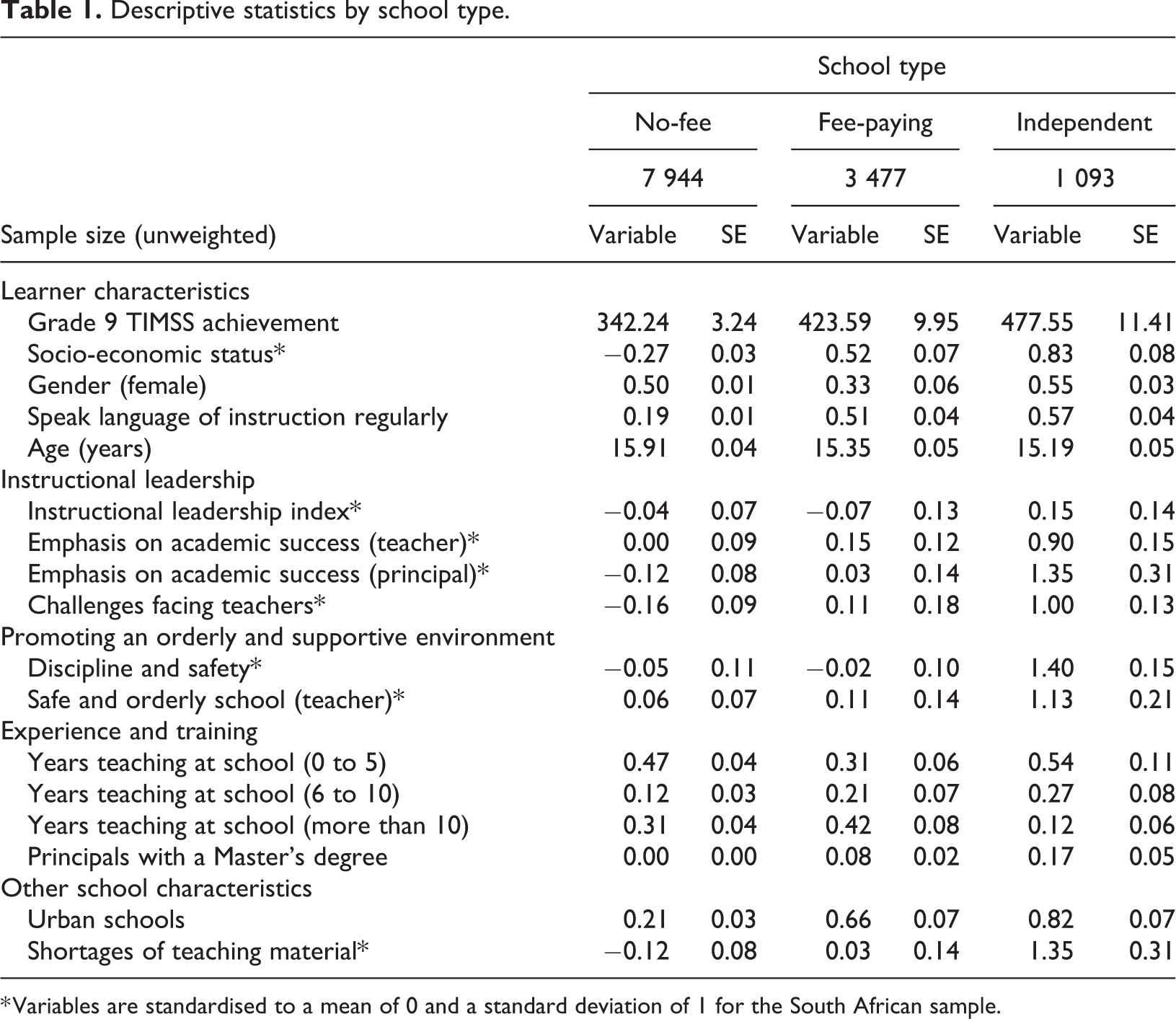
Table 1 presents summary statistics on all variables used in the analysis for each South African school classification. Learners from no-fee schools tended to be older, achieved lower average test scores on the TIMSS assessment, and spoke the language of instruction less often than learners in fee-paying and independent schools. In addition to lower average test scores, there was less variation in average achievement between no-fee and fee-paying schools. The intraclass correlations for no-fee, fee-paying and independent schools were 25%, 59% and 66% respectively. Without exception, leadership indicators were more favourable in fee-paying and independent schools when compared with no-fee schools. However, some of the differences stood out. Some 31% of principals at no-fee schools and 42% of principals at fee-paying schools had worked at the school for more than 10 years, implying that they were older and had no other recent experience apart from their current environment. This is in stark contrast to only 12% of principals in independent schools. None of the principals in no-fee schools had a Master’s degree, while 8% of principals at fee-paying schools and 17% of principals at independent schools had a Master’s qualification. Only 21% of no-fee schools in TIMSS were located in urban areas compared with 66% of fee-paying schools and 82% of independent schools.
Descriptive statistics by school type.
* Variables are standardised to a mean of 0 and a standard deviation of 1 for the South African sample.
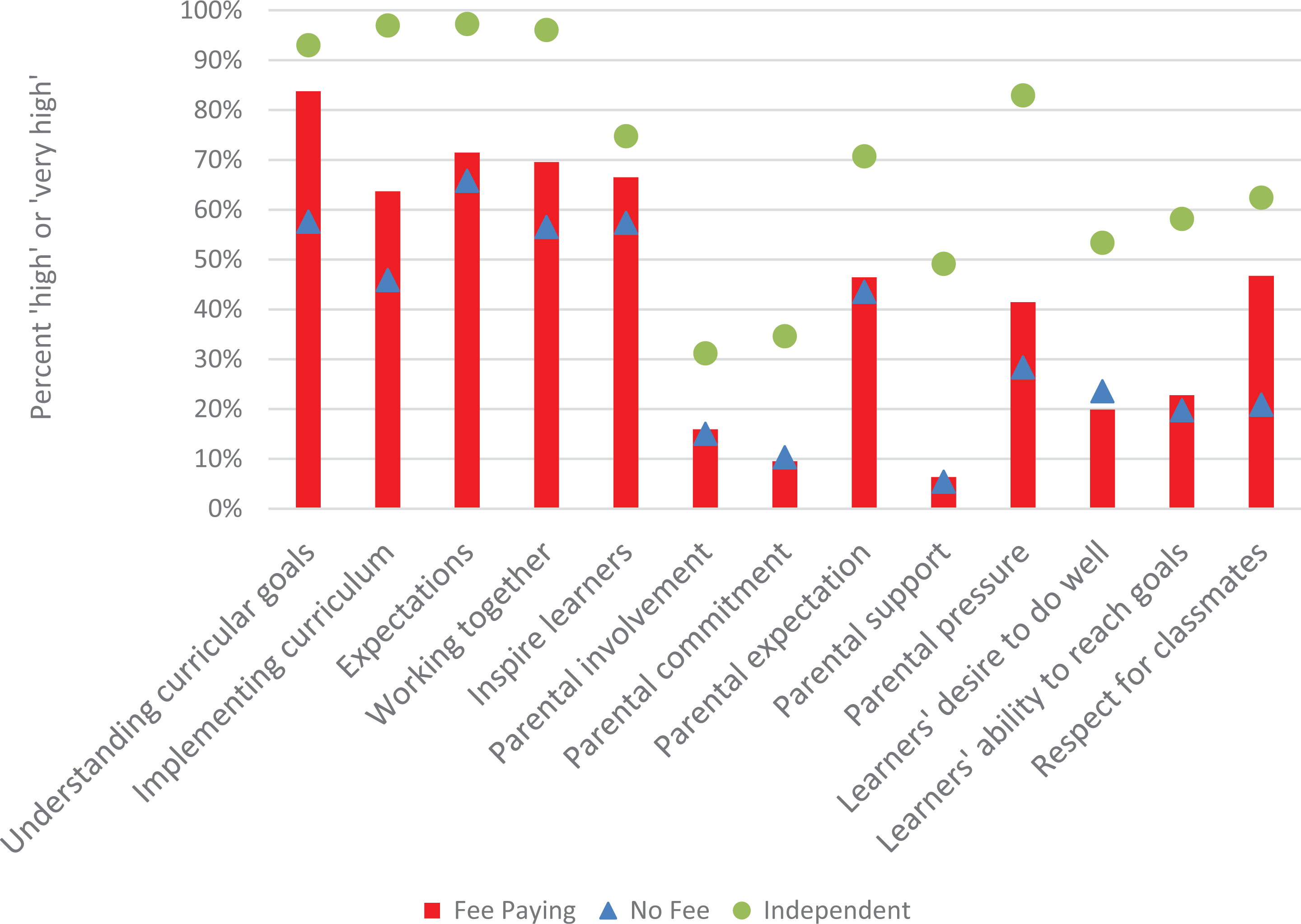
The summary in Table 1 also reveals that independent schools were advantaged in their views about instructional leadership. Figure 1 takes a closer look at what was driving these differences by showing how principals responded to each of the questions that were used to derive the TIMSS ‘emphasis on academic success’ index. The height of each bar is the percentage of principals from fee-paying schools who viewed the listed activities as either ‘very high’ or ‘high’ at their schools. Also shown are the corresponding responses for principals in independent schools (circles) and for no-fee schools (triangles).
Indicators for academic success (principal).
One of the most consistent patterns is that reports from independent school principals were more positive in comparison with principals from fee-paying and no-fee public schools. Independent school principals were especially confident in the competence of their teachers. More than 95% of independent school principals reported that their teachers’ understanding of the school’s curricular goals, success in implementing the curriculum, expectation of learner achievement and tendency to work together to improve learner achievement were ‘very high’ or ‘high’. In no-fee and fee-paying schools, responses ranged from 46% to 66% and 64% to 84% respectively.
Interestingly, the widest gaps between independent and public schools on these questions were on topics about parents and learners. According to principals, parents from independent schools showed greater support for learner achievement, ensured that learners were ready to learn and were more actively involved in supporting the school. They also placed greater pressure on schools to ensure academic standards were met. Whereas 49% of independent school principals reported that parental support for learner achievement was ‘very high’ or ‘high’, less than 10% of principals in public schools viewed parental support in the same way. Similarly, more than 80% of principals at independent schools reported high levels of parental pressure in contrast to 28% of principals from no-fee schools and 41% of principals from fee-paying schools.
Principals also viewed their learners’ commitment to academic success differently. At least half of principals from independent schools rated their learners’ desire to do well in school and their ability to reach the school’s academic goals highly. Less than 25 % of principals in no-fee and fee-paying schools placed their learners in the same category.
Principals’ reports on safety and discipline also appeared to vary considerably depending on type of school. In Figure 2 the relationship between the school safety and school discipline indicators for different groups of schools is compared. Each circle represents the estimate for a school in the TIMSS sample, and higher values represent higher levels of discipline and safety. The TIMSS measure of school safety (safe and orderly school) was based on teacher reports about the safety of the school and the neighbourhood, learner behaviour, rules about security and learner conduct, and how consistently these rules were enforced. The school discipline index focused on punctuality, absenteeism, classroom disturbances, cheating, profanity, vandalism, theft, physical injury to learners and staff, and intimidation and verbal abuse among learners and staff members.
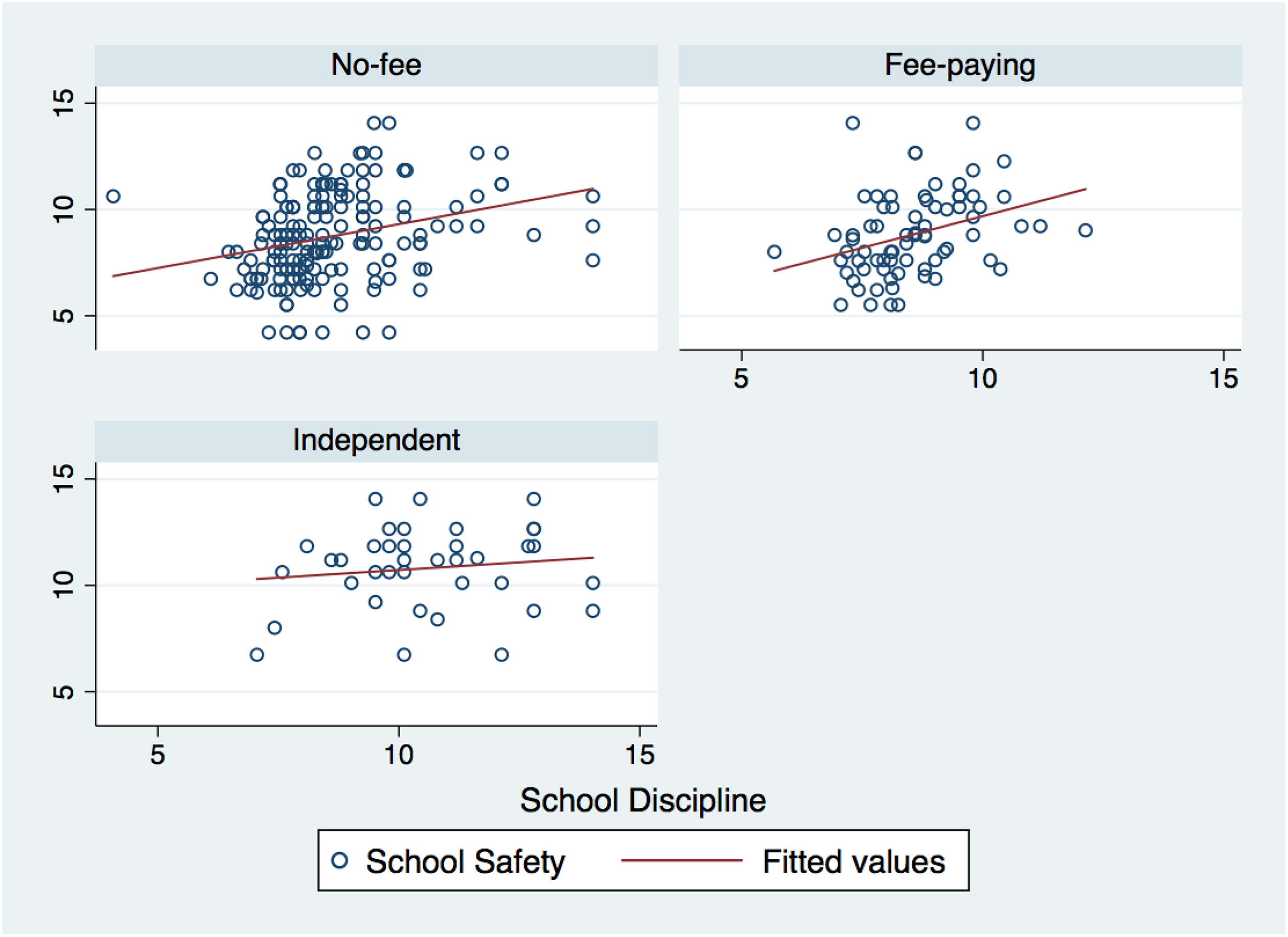
School discipline and school safety.
The relationship between discipline and safety was more consistent in public schools. Patterns of discipline and safety moved in the same direction. Reports on safety were generally higher in independent schools than in public schools, but the safest independent schools were not necessarily the most effective at ensuring a climate of discipline was in place.
In Figure 3, a closer look at the years of experience of school principals at the surveyed schools is shown. There are two distinct patterns visible. In no-fee public schools and independent schools, there is a large cohort of principals with relatively short tenures at the school. About half of principals in these schools reported that they had worked at the school for five years or less. The length of stay for half of principals in fee-paying schools was up to 10 years. At the other extreme are patterns for principals with very long tenures at the school. In this instance, the gap between public schools and independent schools is wide. Some 80% of principals had been at the school for up to 10 years, and 80% of principals in public schools (no-fee and independent) had been at the school for up to 17 years. The motives for length of stay and turnover are likely to be different, which is a point to which we will return later.
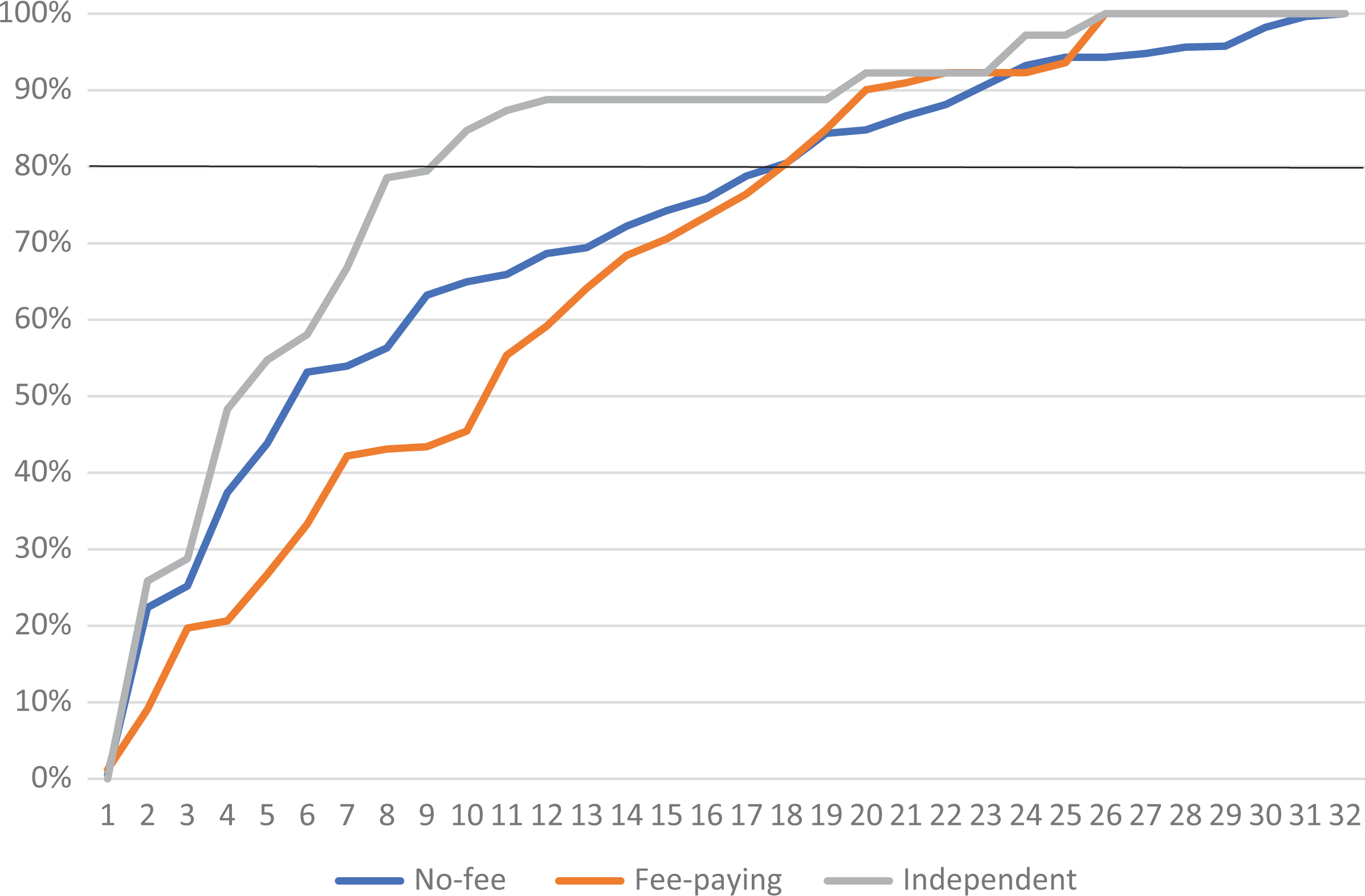
Principal’s years of experience at the current school.
Leadership quality and academic achievement
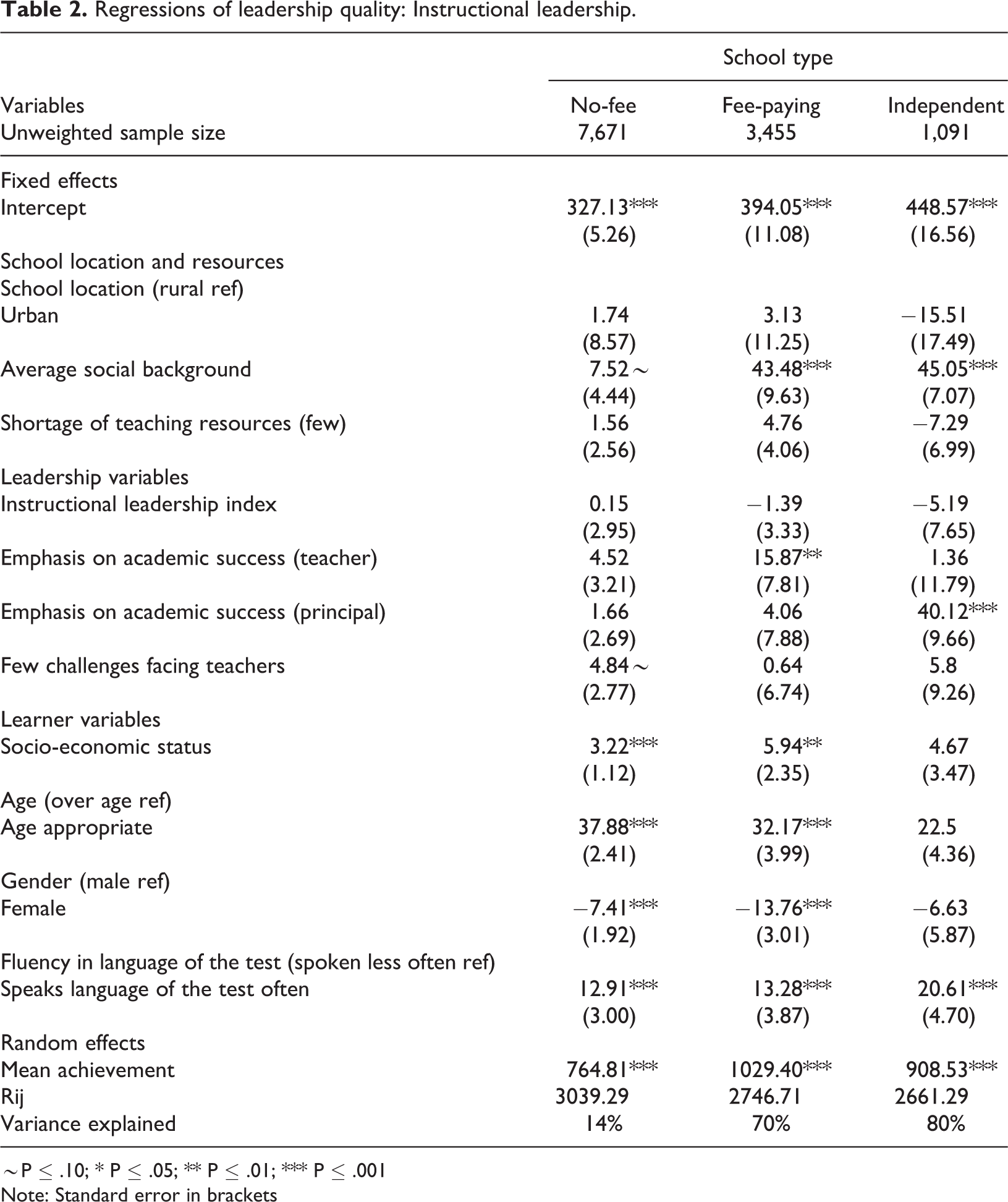
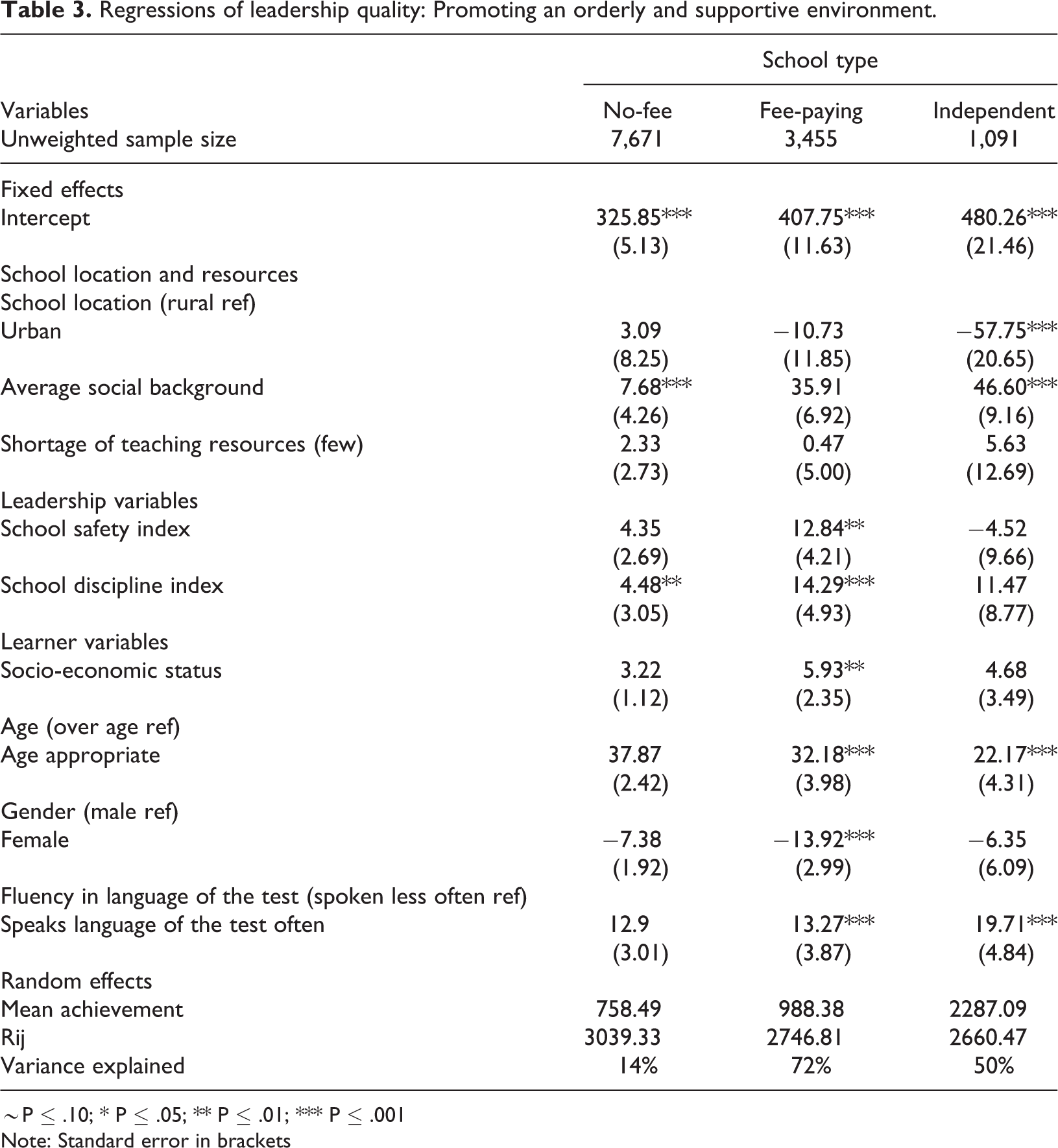
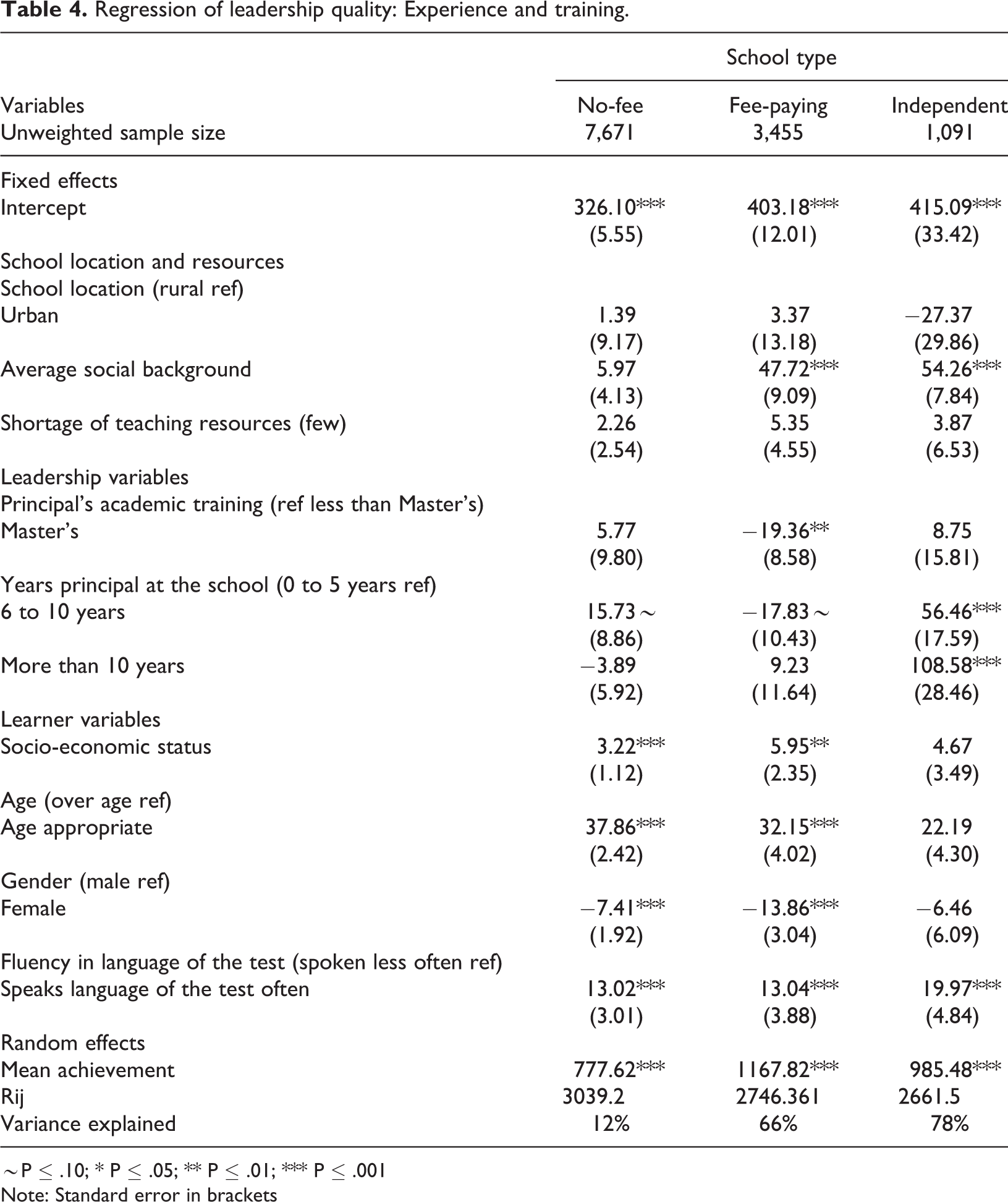
In Tables 2 to 4 the regression results are shown by school type. Each model was run separately by school type and took into account one of the leadership dimensions that were described earlier (instructional, promoting a supportive and orderly environment, and experience and training). Statistical adjustments for the location of the school, the average social background of the school (average SES), the resource levels of the school and learner background (age, gender, socio-economic status and language fluency) were used throughout the analysis. Generally, the variables in these models followed predictable patterns with a higher socio-economic status and greater language fluency being related to higher average achievement. Age (being above the appropriate grade age) and gender (being female) were associated with significantly lower average test scores. The relationship between average social background and average mathematics achievement was positive and significant in better resourced fee-paying and independent schools. We also found that children attending public urban schools achieved at higher levels than children attending rural schools.
Regressions of leadership quality: Instructional leadership.
∼P ≤ .10; * P ≤ .05; ** P ≤ .01; *** P ≤ .001
Note: Standard error in brackets
Regressions of leadership quality: Promoting an orderly and supportive environment.
∼P ≤ .10; * P ≤ .05; ** P ≤ .01; *** P ≤ .001
Note: Standard error in brackets
Regression of leadership quality: Experience and training.
∼P ≤ .10; * P ≤ .05; ** P ≤ .01; *** P ≤ .001
Note: Standard error in brackets
We used four indicators of instructional leadership. The first is an author-derived index that was based on teacher reports of their involvement in professional development activities. The remaining three are TIMSS indicators for the emphasis placed on academic success and the challenges facing mathematics teachers. The ‘challenges facing teachers’ index was based on the teachers’ response to the eight challenging conditions including class size, material coverage, teaching hours, preparation time, pressure from parents, administrative task, and lack of time to assist learners or cover the curriculum. Average social background is a measure of learner SES that is aggregated to the school level. These are continuous variables where higher values represented fewer challenges faced by teachers and higher emphasis on academic success.
The index of instructional leadership was not significantly related to achievement. However, emphasis on academic success from principals in independent schools and teachers in fee-paying schools was significantly related to improved achievement even with other factors such as the average social background of the school being taken into account. The instructional leadership model was more effective in explaining variance in average mathematics achievement between fee-paying schools and independent schools than among the no-fee sample.
The extent to which order and safety were promoted in the school was captured by two TIMSS indicators on school discipline problems, and safety and order at the school that were described earlier. Higher scores on the index of school discipline were assigned to schools where the principal reported hardly any problems and where teachers reported few issues related to safety and order. The models for promoting an orderly and supportive environment are set out in Table 3. A positive correlation with achievement was found between promoting school safety and achievement in fee-paying schools. The same relationship was found in no-fee and fee-paying schools with regard to the promotion of school discipline. This leadership model was most effective at explaining variation in achievement between fee-paying schools.
The final models tested the relationship between academic qualifications and a principal’s work experience, on the one hand, and average school achievement on the other. We used information on the number of years that a principal had worked at the current school and the share of principals with at least a Master’s degree to capture leadership experience and training. The relationship between years of experience (6 to 10 years, and more than 10 years) and achievement was positive and significant in independent schools only. There was a significant, negative relationship between learner achievement and principals who had obtained a Master’s degree in fee-paying schools. This suggests a mismatch between the theoretical knowledge gained in the qualification and the practical application thereof.
Discussion and conclusion
The broad aim of this study was to compare the professional identities of school leaders in no-fee, fee-paying and independent South African secondary schools and to determine whether gaps in achievement in different schooling contexts could be explained by the SLM qualities of a school. It was premised on previous South African studies that have shown the importance of leadership for educational success and the variation in effective leadership even among schools that share a socio-economic environment.
In line with previous South African studies, our results revealed that instructional leadership and promoting a safe and orderly environment were among the most important leadership factors for academic achievement in many schools (Hoadley et al., 2009; Ngcobo and Tikly, 2010; Taylor, 2011; Zuze et al., 2016). A learner’s access to particular SLM environments largely depended on the type of school that the learner attended. Access to better SLM mirrored access to physical and human resources but not entirely. There were some instances where the quality of school leadership in better-resourced fee-paying schools more closely resembled poorly resourced no-fee public schools than it did independent schools (for example in the role of discipline and safety for achievement). However, when it came to instructional leadership, patterns for fee-paying and independent schools were more closely aligned. Where schools seemed to differ the most in instructional leadership was in teacher preparation and parental commitment. Both were much higher in independent schools. What this analysis seems to suggest is that although a strong leader is important, effective leadership relies on support from multiple role players both within the school and beyond.
School safety and discipline mattered more for academic achievement in public schools. No-fee and fee-paying schools with a more functional environment had higher average achievement scores than similar schools with less safety and order. This echoes previous studies about the importance of ensuring basic functionality in challenging educational environments (Christie et al., 2007; Ngcobo and Tikly, 2010). It also supports related research about the benefits of scripted lessons as well as regular monitoring and assessment of teachers in poor schools, all of which rely heavily on a structured and orderly environment (Hoadley and Galant, 2015).
The work experience of a school principal paid greater achievement dividends in independently managed schools. We found evidence that learners in independent schools benefited from principals who had a tenure of more than six years at the school, relative to shorter periods of time. These factors remained important, even when the quality of the school and a learner’s background were accounted for. This suggests that principals in independent schools become more effective as they gain more experience. It may take a number of years for a principal to find stability and fully implement policies and practices that positively influence the school’s functioning and performance. It might seem surprising that the link between professional experience and learner achievement was not found in public schools. However, evidence of other factors, such as union affiliation, are known to influence professional appointments in schools (Msila, 2014). In addition, there may be binding constraints that prevent leaders from translating their skills into raising learning outcomes. This would blur the relationship between experience and learner outcomes considerably because a principal’s position would be based on bargaining power rather than a sustained commitment to transform the academic culture of a school. Union pressures would be less of a factor in independent schools, which could explain the significance of a principal’s work experience in these settings. One solution would be to introduce competency-based assessments for appointing principals (Wills, 2015), but how this could be implemented is still unclear.
We recognise that cross-sectional data limit our ability to draw firm causal inferences. There is a potential bidirectional relationship between SLM and educational outcomes. It is unclear whether principals drive the culture of the school or whether their leadership style is a response to external pressures from parents and other parties. If it is motivated by accountability structures, then schools with strong governing bodies will invariably be the most functional (Xaba, 2011). Further research into these connections is needed.
Our analysis of school leadership was dependent on the TIMSS study design where many of the reports about leadership characteristics were from the principals themselves. However, unlike many earlier small-scale studies, our results were nationally representative. To support future policy efforts into school leadership requires pooling the strengths of small- and large-scale studies. One way of achieving this would be to include a standard set of indicators across studies so that trends can be monitored more regularly. Because of the role that HoDs play in managing instruction, they should be included when teacher samples are drawn for assessment. Finally, although the relationship between school leadership and achievement outcomes is an important one, there are many other ways that SLM improves the academic outlook of learners. Future research should look beyond achievement to link SLM to other educational outcomes.
Footnotes
Acknowledgements
We acknowledge Gabrielle Wills, Research on Socio-Economic Policy, Department of Economics, Stellenbosch University, for her critical review of the article.
Declaration of conflicting interests
The authors declared no potential conflicts of interest with respect to the research, authorship, and/or publication of this article.
Funding
The authors disclosed receipt of the following financial support for the research, authorship and/or publication of this article: This work was supported by the Economic and Social Research Council, grant ES/N01023X/1.