




Abstract
This bibliometric review of research sought to document and compare trends in educational leadership and management (EDLM) knowledge production from the emerging regions of Asia, Africa and Latin America. Using a science mapping methodology, the review identified 1171 articles published in nine “core” EDLM journals between 1965 and August 2018. This represented 22% of the full corpus of articles published in these EDLM journals during this period of time. Despite representing a relatively small portion of the overall corpus, these studies from emerging regions grew to comprise 42.5% of the corpus published between 2015 and 2018. Despite this broad pattern of growth, there was also significant geographical variation in the volume of articles published in these journals both between and within the regions. The review also identified “canonical scholars and documents” that have demonstrated lasting influence on this knowledge base. Co-citation analyses also revealed several schools of thought within this literature. The review concludes that the global literature in EDLM is undergoing a significant change in composition. The findings will inform scholarly efforts to develop a more diverse, representative, and globally relevant knowledge base. Recommendations are offered for strengthening the quality and scope of research from emerging regions of the world.
Keywords
Introduction
During the mid-1990s, scholars working outside mainstream centers of scholarship in educational leadership and management (EDLM) began to question the tacit assumption of the universality of the EDLM knowledge base (Bajunid, 1996; Cheng and Wong, 1996; Hallinger and Leithwood, 1996). These critiques surfaced a need for research from more diverse settings to build a global knowledge base in EDLM (Oplatka, 2004; Ribbins and Gunter, 2002; Walker and Dimmock, 2002). Over the ensuing 20 years, scholarship from “Emerging Regions” of Asia, Africa and Latin America began to address this gap (e.g., Castillo and Hallinger, 2018; Hallinger, 2018c; Hallinger and Bryant, 2013; Oplatka and Arar, 2017; Walker and Hallinger, 2015). However, these reviews mostly relied on descriptive topographical analyses of the emerging-regions knowledge base in EDLM. Thus, the field continues to lack a comprehensive, empirically supported picture of how research publication from ER is reshaping the composition of the EDLM literature.
This comparative review of EDLM knowledge production across Asia, Africa, and Latin America was guided by several research questions.
This review used quantitative tools of science mapping (Small, 1999) to review 1171 journal articles from Asia, Africa, and Latin America published in nine Scopus-indexed, EDLM journals between 1965 and August 2018. Meta-data associated with these articles were analyzed using bibliometric methods (Zupic and Čater, 2015). The review seeks to offer insights into the evolving global knowledge base in EDLM.
Conceptual background
In this paper, “knowledge base” refers to literature that underlies EDLM as an applied field of study (Donmoyer, 1999; Murphy et al., 2007; Ogawa et al., 2000; Oplatka, 2010). Scholars have evidenced an interest in understanding the nature and scope of the EDLM knowledge base as far back as the 1960s (Eidell and Kitchel, 1968). Subsequent empirical analyses of the EDLM knowledge base have focused on the types of papers published (e.g., conceptual, empirical, review), as well as the prevalence of different topical foci, conceptual models, and research methods (e.g., Bridges, 1982; Gumus et al., 2018; Hallinger and Chen, 2015; Murphy et al., 2007; Oplatka, 2010; Ribbins and Gunter, 2002).
This review approaches the knowledge base as a dynamic entity (Eidell and Kitchell, 1968; Ogawa et al., 2000) that can be analyzed on at least four dimensions (see Figure 1). The first dimension features “size” or the number of documents in the EDLM knowledge base. “Time” refers to the growth trajectory of journal publication. “Space” refers to the geographic distribution of documents (e.g., Hallinger, 2018c). The geographical distribution of documents offers insight into how much we know about EDLM across different parts of the world (Flessa et al., 2017; Hallinger, 2018a, 2018c; Mertkan et al., 2017; Oplatka and Arar, 2017). “Composition” refers to the intellectual structure of the knowledge base (Small, 1999). Zupic and Čater (2015) defined intellectual structure as “the examined scientific domain’s research traditions, their disciplinary composition, influential research topics, and the pattern of their interrelationships” (p. 435). Composition can be analyzed in terms of patterns of authorship, journal publications, research methods, and topics (see Bridges, 1982; Flessa et al., 2017; Gumus et al., 2018; Hallinger and Bryant, 2013; Oplatka and Arar, 2017).
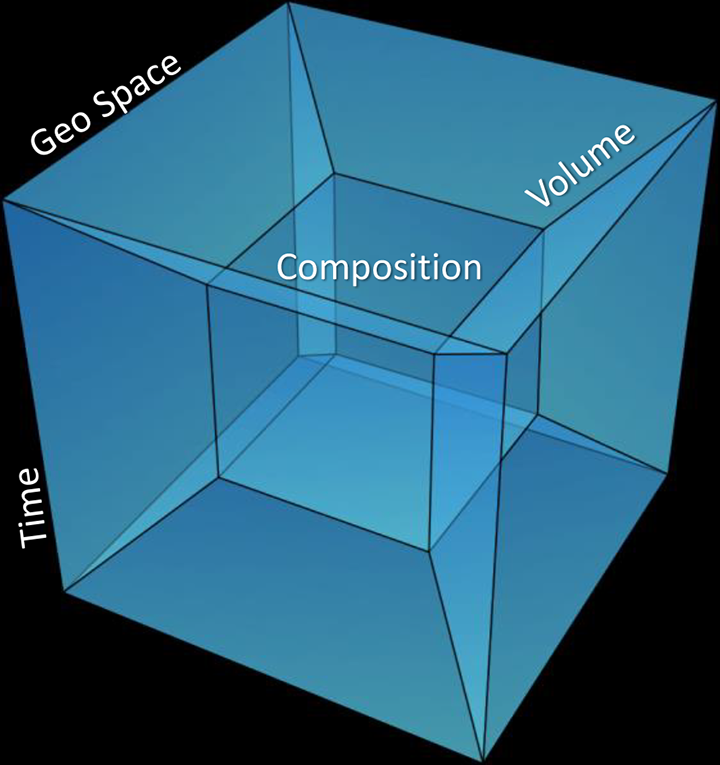
Four-dimensional conceptual model of a knowledge base.
Method of review
The current review employed “science mapping,” a variant of bibliometric analysis, to analyze the EDLM knowledge base on the four dimensions identified in Figure 1. Science mapping draws on advances in text mining to provide more comprehensive analyses of the composition and structure of the knowledge base than were possible in the past (see Nerur et al., 2008; Small, 1999; Van Eck and Waltman, 2017; Zupic and Čater, 2015).
Search criteria
This review focused on articles published in nine core international EDLM journals is shown in Table 1. 1 Each has an espoused mission of publishing international EDLM research, employs blind review procedures, publishes in English, and is indexed in the Scopus database (Elsevier). A corollary review had established that these nine journals were among the top-10 most frequently cited journals in EDLM research (Hallinger, 2018b). The 10th journal, National Association of Secondary School Principals (NASSP) Bulletin, was deemed unsuitable because it seldom publishes articles focusing on EDLM outside of the USA.
Statistics on emerging-regions articles published in the nine EDLM journals.

EAQ: Educational Administration Quarterly; EDLM: educational leadership and management; EMAL: Educational Management, Administration and Leadership; IJEM: International Journal of Educational Management; IJLE: International Journal of Leadership in Education; JEA: Journal of Educational Administration; LPS: Leadership and Policy in Schools; SESI: School Effectiveness and School Improvement; SLM: School Leadership and Management; SO: School Organization.
Books, book chapters, and conference papers were excluded from the review. The rationale was that their review processes are seldom comparable to double-blind peer review used by the nine journals. Indeed, it is for this reason that the Scopus database provides less extensive coverage of these kinds of sources.
Inclusion criteria used in identifying eligible articles within these journals were: (a) time period, (b) topical focus, and (c) geographical location of the author(s). The review extends back to 1965, the earliest date for which the Scopus index yielded articles for these journals. This timeframe enabled full coverage of all articles published in the selected journals with the exception of the earliest publications in the Journal of Educational Administration (JEA; i.e., 1962–1964), the first international research journal in the field. Thus, this review was able to illuminate patterns of emerging-regions scholarship within the full evolution of the modern generation of EDLM research.
The topical scope for the review included all studies of EDLM in K–12 and higher education settings (Figure 2). The operational criterion for topical inclusion was inclusion in one of the EDLM specialization journals. This decision to limit the review to journals specializing in EDLM avoided the difficulty of determining the eligibility of studies based solely on keywords. For example, a keyword search designed to identify “all EDLM research published in Scopus journals” would have introduced a much higher level of ambiguity in decision-making around the eligibility of individual studies. Because bibliometric reviews typically work with large datasets, both efficiency and effectiveness of search processes must be considered to optimize the results.
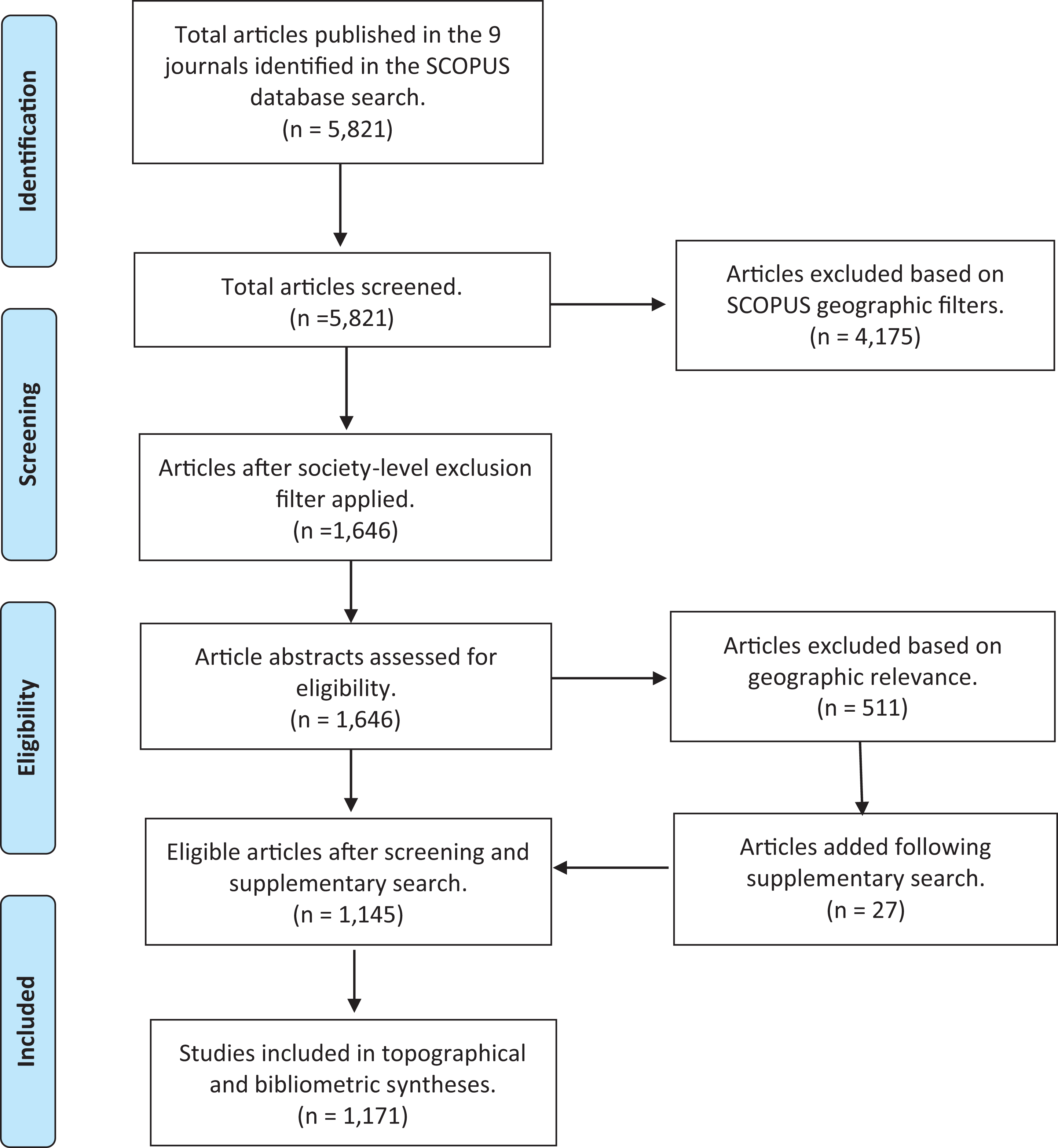
PRISMA flow diagram detailing steps in the identification and screening of sources for the review of EDLM research from emerging regions, 1965–2018.
Geographic scope was defined in terms of three regions of the world: Latin America, Africa, and Asia. Asia included societies extending from Turkey and Russia on the West to Japan and Papua Guinea in the East. Africa included the main continent as well as the islands of Madagascar, Mauritius, and Seychelles. Latin America extended from the Caribbean islands and Mexico in the North to Chile in the South. Although each of these three regions is admittedly heterogeneous in terms of religion, culture, and language, they represent widely accepted geographic regions of the world. Moreover, for the purpose of this review, scholarship from these regions can be characterized as located outside of mainstream Anglo–American–European EDLM scholarship. Thus, they all qualify as emerging regions.
The author acknowledges that numerous European societies could be also characterized as “emerging” with respect to international publication of EDLM research. However, it would have been difficult to come up with a defensible decision rule designed to determine inclusion or exclusion. Therefore, the author decided to include publications from Europe within the Anglo–American region and accept this as a limitation of the review.
Identification of sources
The author followed Preferred Reporting Items for Systematic Reviews and Meta-Analyses guidelines for conducting systematic reviews of research (Moher et al., 2009). Preferred Reporting Items for Systematic Reviews and Meta-Analyses specifies the steps to be followed and reported in the identification and extraction of information for use in bibliometric reviews (see Figure 1). The initial search aimed to identify the full set of articles included in these Scopus journals. This was necessary to develop benchmarks against which to compare emerging-regions literature.
Thus, the initial search was conducted using the Scopus search engine with parameters set as follows: Inclusion: Dates, 1965 to 31 August 2018; Inclusion: Source Title: each of the nine journals noted above; Inclusion: Document Type: articles and research reviews; Exclusion: Author’s geographical affiliation outside of the emerging regions (see below); Exclusion: Document Type: book reviews, commentaries, books, chapters, conference papers.
This search yielded a total of 5821 articles (see Figure 1). 2 This comprised the full EDLM knowledge base published in the nine journals between 1965 and August 2018. With respect to inclusion/exclusion criteria, the review included articles authored by scholars located in the emerging regions as well as articles about EDLM in the emerging regions authored by scholars located outside of the emerging regions. This search strategy enabled the review to document accurately the scope of knowledge about EDLM in the emerging regions as well as authorship patterns in the emerging-regions literature.
This strategy did, however, necessitate adjustment to the normal process of filtering sources in the database. For example, in the case of several authors (e.g., C. Dimmock, P. Hallinger, A. Walker, or A. Harris), the author had to distinguish where they were located at the time of authorship of a document. If the author was located in an emerging-regions society (e.g., Hong Kong, Singapore, Thailand, Malaysia) at the time of authorship, then the article was included regardless of its topic. If, however, the scholar was located outside of an emerging-regions society (e.g., Australia, USA, UK) at the time of authorship, then the article was only included if it explicitly addressed EDLM in an emerging-regions society.
Managing these dual criteria during the search required a three-step process. First, Scopus’s geographic filters were applied to separate out emerging-regions studies from the initial database. This entailed exclusion of articles where the author’s affiliation was listed as the USA, UK, Australia, New Zealand, Canada, or a European society. This reduced the database to 1646 articles. However, this total still included 614 “undefined sources,” or articles for which location information was lacking in the Scopus database.
Next the titles and abstracts of the 1646 documents were scanned to confirm their relevance using the dual geographical criteria delineated above. This resulted in the exclusion of 501 documents, comprising duplicates and articles incorrectly included by Scopus (e.g., from the undefined sources). This left a database of 1145 articles.
At this point, the author compared the 1145 articles with the results of a database developed from a previous inspection of the journals’ websites. This revealed 26 articles that had been incorrectly removed by Scopus geographic filters, leaving a review database consisting of 1171 journal articles.
Data extraction
Bibliographic data related to the 1171 journal articles were downloaded in a comma-separated values (.csv) file. The stored data included author name, author affiliation, article title, keywords, abstracts, and citation data. This intact data file was later edited using the Scopus thesaurus function and then uploaded into visualization of similarities (VOS) VOSviewer software. A second copy of the same .csv file was saved for supplementary analysis in Excel.
Data analysis
Bibliometric analysis incorporates three broad types of statistical analysis.
The first is descriptive statistics used to describe patterns of knowledge production (e.g., size, change over time, number of documents by decade, geographic source, scholars, etc.).
The second is citation analysis used to calculate how many times each of the 1171 documents (or authors or journals) contained in the review database has been cited by other documents (or authors or journals) located in the Scopus index (i.e., Scopus citations). Citation analysis enables researchers to identify prominent authors, publications, and sources within a domain of knowledge (e.g., see Tables 1, 2, and 3).
Rank order of 20 most highly cited EDLM journal authors from emerging regions based on nine Scopus-indexed journals.
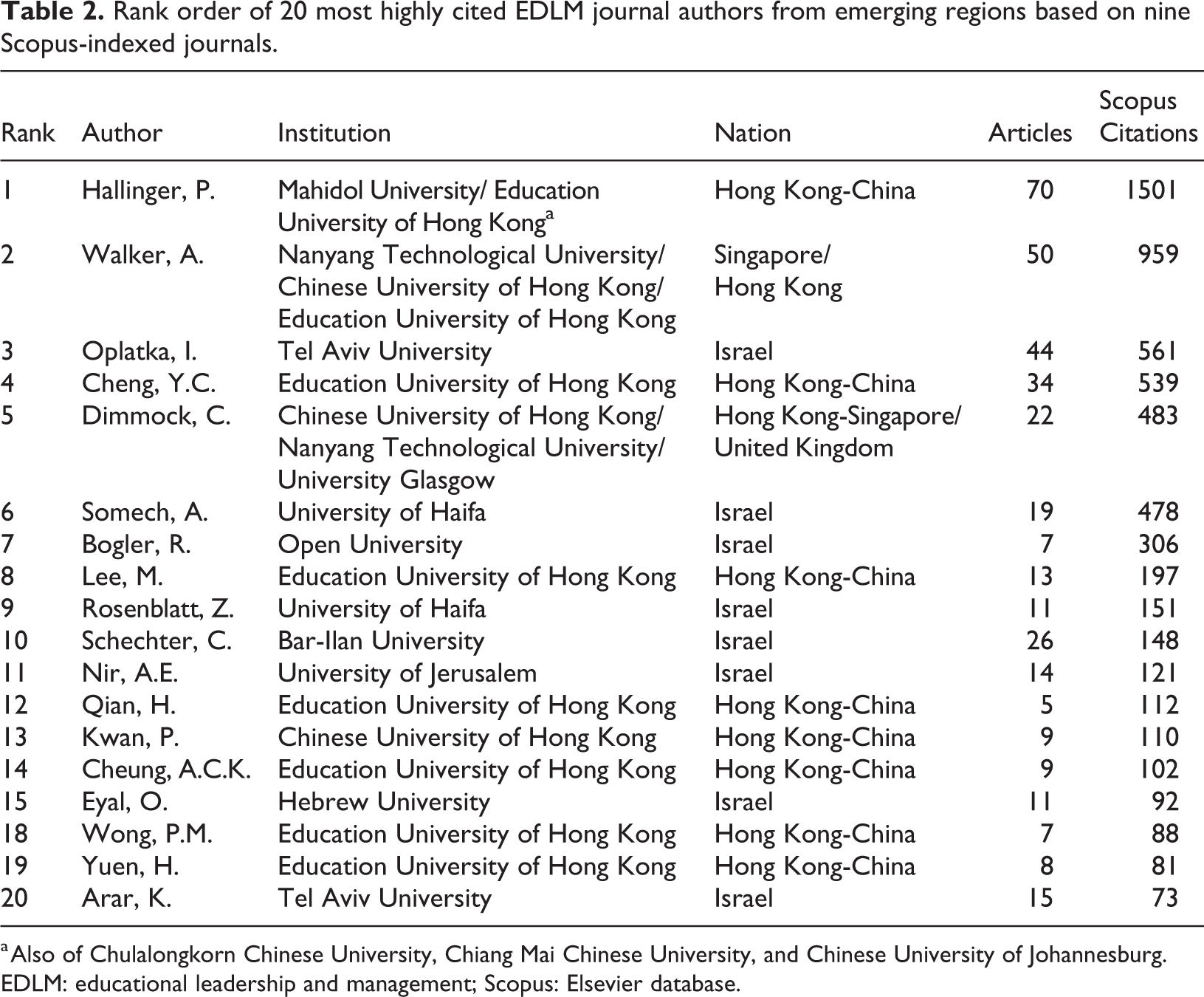
a Also of Chulalongkorn Chinese University, Chiang Mai Chinese University, and Chinese University of Johannesburg.
EDLM: educational leadership and management; Scopus: Elsevier database.
The 20 educational leadership and management journal articles from emerging regions with highest Scopus citations.

This list was based on citation analysis of 1171 emerging-regions articles.
a Scopus citations are based on citations by other sources contained in the Scopus index of documents as of 20 August 2018.
b Google Scholar citations are based on citations by other sources contained in the Google Scholar index of documents as of 20 August 2018.
EAQ: Educational Administration Quarterly; EDLM: educational leadership and management; EMAL: Educational Management, Administration and Leadership; IJEM: International Journal of Educational Management; JEA: Journal of Educational Administration; Scopus: Elsevier database; SESI: School Effectiveness and School Improvement; SLM: School Leadership and Management.
The third approach is co-citation analysis, a variant of traditional citation analysis. Co-citation is the frequency with which two units (e.g., documents, authors, journals) are cited together. Zupic and Čater (2015) explain that Co-citation analysis uses co-citation counts to construct measures of similarity between documents, authors, or journals…A fundamental assumption of co-citation analysis is that the more two items are cited together, the more likely it is that their content is related. (McCain, 1990: 431)
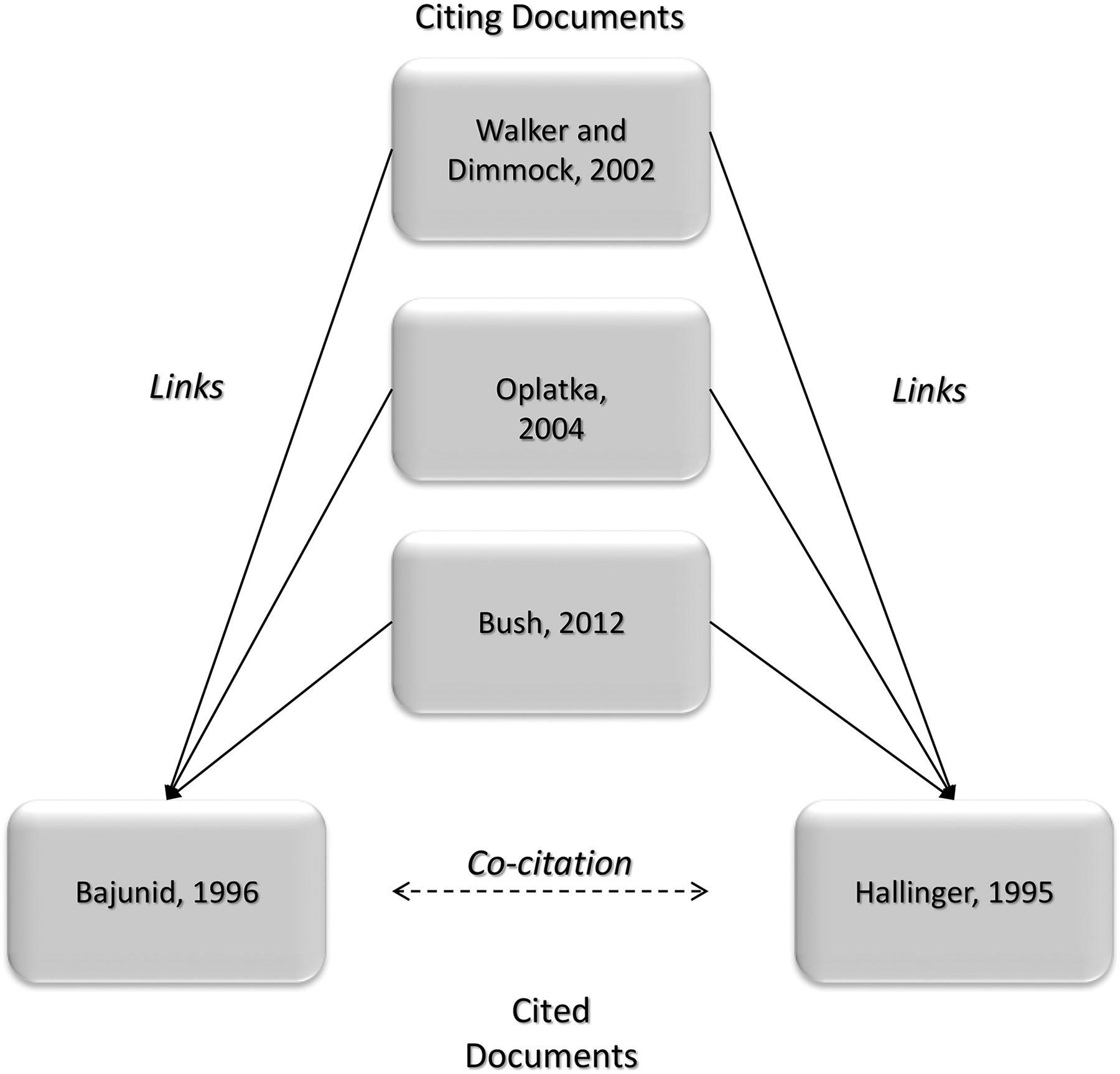
Example of co-citation of documents in science-mapping EDLM.
Note that in Figure 3 each of the “citing documents” (e.g., Oplatka, 2004) is also “linked” to the documents that it cites. “Links” represent an additional kind of relationship between documents (or authors or journals) that coexist within the conceptual space of a literature. Although the “citing documents” must be in the author’s database, that is not necessarily the case for a co-cited document. For example, the Hallinger (1995) article in Figure 3 was published in the University Council for Educational Administration (UCEA) Review, which is neither located in the review database nor even in the Scopus index. Nonetheless, it has been included along with the Bajunid (1996) article in the reference lists of several documents that are in the review database (i.e., Bush, 2012; Oplatka, 2004; Walker and Dimmock, 2002). Thus, it has been captured by the co-citation analysis.
Co-citation analysis uses these co-citation counts to construct measures of similarity between documents, authors, or journals (McCain, 1990). More specifically, co-citation counts are formulated into co-citation matrices that serve as the basis for analytical techniques used in science mapping such as multidimensional scaling and VOS (McCain, 1990; Small, 1973; Van Eck and Waltman, 2017). In this review, VOSviewer software was used to conduct co-citation analyses and to create visual representations of the relationships among authors and among topics in the emerging-regions knowledge base. Thus, co-citation analysis provides a complementary but arguably broader measure of influence than traditional citation analysis.
Results
This section presents results with respect to patterns of EDLM knowledge production in the emerging regions of Asia, Africa, and Latin America. Presentation of the results are aligned to the three research questions.
Volume, growth trajectory, and geographic distribution
The 1171 emerging-regions articles represent 21.2% of the full EDLM corpus published in the nine journals. In light of past critiques (Bajunid, 1996; Hallinger, 1995; Mertkan et al., 2017; Walker and Dimmock, 2002), this volume of emerging-regions research was larger than expected. The first publications from emerging regions did not appear until the 1970s, during which nine articles were published (see Figure 4). Indeed, up until 1990, only 18 emerging-regions articles appeared in these journals: 14 from Asia, four from Africa, and none from Latin America. These 18 articles represented only 1.4% of the EDLM corpus published in these journals during the initial 25-year period of the review. This affirms critiques published in the 1990s that asserted a strong geographical imbalance in the EDLM literature (e.g., Bajunid, 1996; Hallinger, 1995).
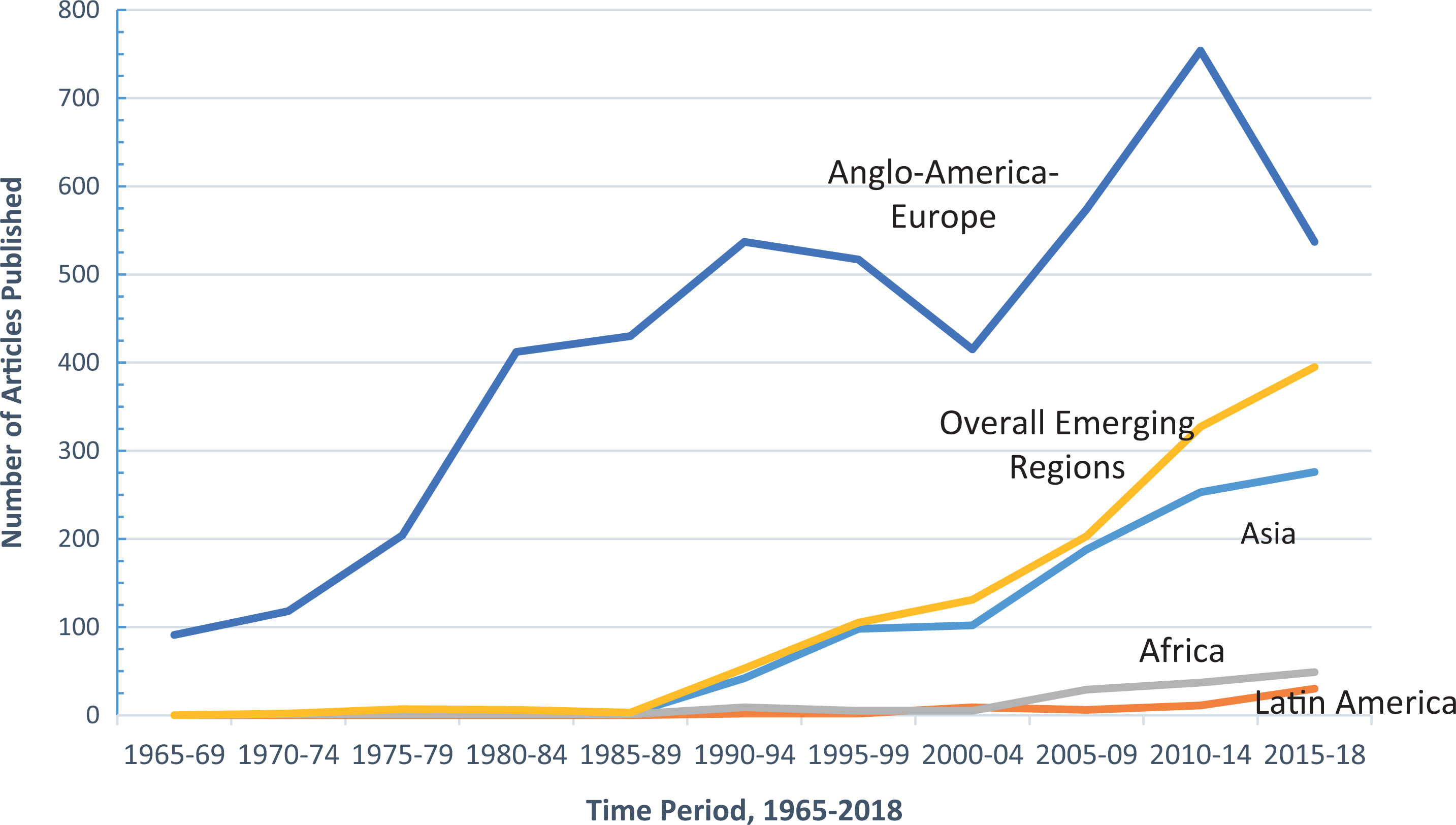
Change in EDLM publication volume over time within and across emerging regions, 1965–2018
Publication volume only began to increase perceptibly in the 1990s, during which 158 articles were published. Mirroring the broader growth trajectory of the EDLM literature (Hallinger, 2018b), emerging-regions publication volume continued to increase in subsequent decades (see Figure 4). Thus, emerging-regions scholarship has increased dramatically over the past 20 years both in raw volume and as a proportion of the global EDLM literature. Quite unexpectedly, during the three-year period 2015–2018, emerging-regions articles rose to comprise 42.4% of the full EDLM corpus published in these nine journals. This is a remarkable change in the composition of the global EDLM knowledge base, and one that has likely gone unnoticed by many scholars and journal editors in our field.
At the same time, however, contributions to EDLM research have not been evenly distributed, either across or within the emerging regions (see Figures 4 and 5). Geographical disaggregation of the emerging-regions literature found that scholarship from Asia (973 articles) accounted for 83% of the articles, followed by Africa with 12% (138 articles), and Latin America with 5% (60 articles). This finding suggests that the results of this review are quite skewed by the imbalanced distribution of publication volume toward Asian scholarship.
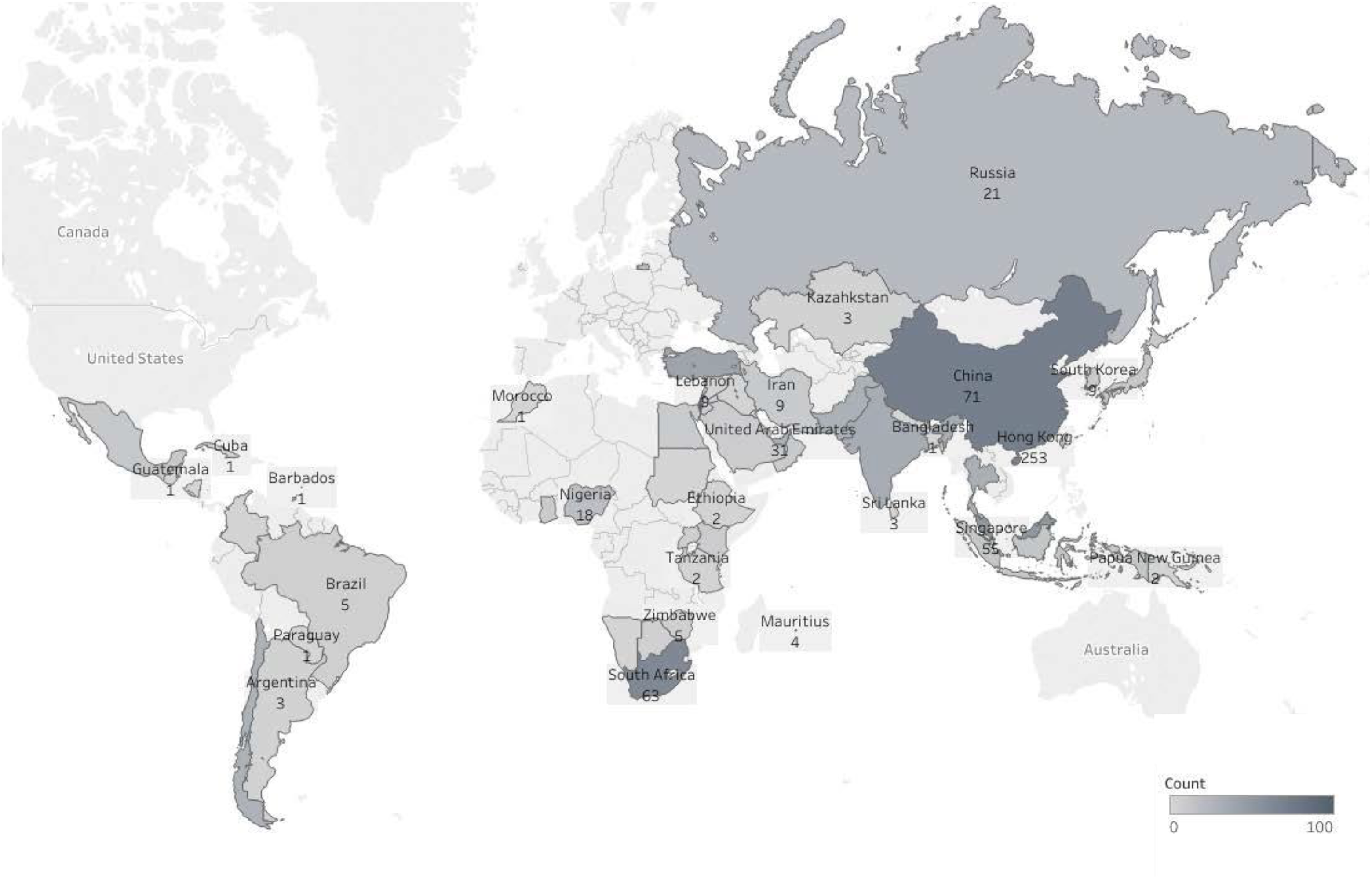
Global distribution of the EDLM literature from emerging regions, 1965–2018.
As indicated in Figure 5, patterns of knowledge production were similarly imbalanced within each of the three regions. Indeed, the map illustrates clearly that each region has societies with high levels of EDLM research output and “blank spots” where empirical information on the EDLM is lacking. Regional leaders in EDLM scholarship include Hong Kong, Israel, China, Singapore, Malaysia, and Turkey in Asia, South Africa in Africa, and Chile in Latin America. Taken together, these findings offer encouragement that the field is growing rapidly beyond the traditional centers of EDLM knowledge production, but also frame the significant challenges that lie ahead in developing a global field of study.
Identification of influential journals, authors and articles
The second research question focuses on composition of the emerging-regions knowledge base from the perspective of “composition.” Analysis of journal contributions to the emerging-regions literature found considerable variation in both document volume and impact. As shown in Table 1, International Journal of Educational Management (IJEM), Journal of Educational Admistration (JEA), and Educational Management, Administration and Leadership (EMAL) have been the most active disseminators by volume of publications. 3 It should be emphasized, however, that large differences exist in the frequency and duration of publication among the journals, and therefore in the total number of articles published by each. By proportion of articles, IJEM, JEA, and International Journal of Leadership in Education (IJLE) have devoted the most publication space to emerging-regions literature. By contrast, Leadership and Policy in Schools (LPS) and Educational Administration Quarterly (EAQ) have published surprisingly few emerging-regions articles, either by raw total or proportion of publications. Longitudinal analysis reaffirmed that these patterns have remained consistent over the course of the past decade (not tabled).
In terms of Scopus citations, JEA ranked first, slightly ahead of IJEM (see Table 1). However, despite publishing significantly less emerging-regions scholarship, EAQ and SESI led the nine journals in terms of “Scopus citations per document”. Journal co-citation analysis offered further insight into scholarly impact by analyzing journals included in the reference lists of documents included in the review database. Journal co-citation analysis found that the 10 most influential journals in order of co-citations were: JEA, EAQ, EMAL, School Leadership and Management (SLM), School Effectiveness and School Improvement (SESI), IJEM, Journal of Applied Psychology, Educational Leadership, Teaching and Teacher Education, and Academy of Management Journal (not tabled). Taken together, these journal analyses suggest that among the nine EDLM journals included in this review, IJEM and JEA have been the most hospitable to emerging-regions papers and that JEA and EAQ have demonstrated the strongest scholarly impact.
Citation analysis, shown in Table 2, was also used to identify scholars who have published the most articles and gained the most Scopus citations (i.e., Hallinger, Walker, Oplatka, Y.C. Cheng, Dimmock). Notably, the 20 most highly cited scholars all came from East Asia (e.g., Hallinger, Walker, Cheng, Dimmock, Kwan, Lee, Cheung, Wong) and Israel (e.g., Oplatka, Somech, Bogler, Rosenblatt, Schechter, Nir, Eyal, Arar). The absence of scholars from Africa and Latin America in Table 2 reflects the earlier-cited imbalance in regional contributions to this literature. Nonetheless, the author noted that the most productive scholars in the Latin American corpus were Slater, Weinstein, Galdames, and Shin, and Mestry, Oduro, Moorosi, Bush, Heystek, Nguni, and Grant in the African EDLM literature (not tabled).
Next, the author used citation analysis to identify the most highly cited emerging-regions journal articles (see Table 3). First, it is noted that these highlycited documents span the 15-year period 1996–2011 during which emerging-regions scholarship first began to achieve a “critical mass.” The fact that none of the articles in Table 3 was published after 2011 reflects the fact that citation analysis disadvantages the most recent publications (Zupic and Čater, 2015). With this in mind, the fact that six of the top 20 papers in the list were published from 2009 to 2011 further highlights the impact of these papers.
It is also notable that Table 3 includes a mix of empirical (eight), conceptual (seven), review (three), and commentary (two) articles. This pattern is interesting in that reviews of research often dominate lists of highly cited articles (Hallinger, 2014, 2018b). Indeed, the presence of so many conceptual papers among the 20 most highly cited papers (35%) in this literature is at odds with their much lower representation in the full database (i.e., 10%). Additional analysis revealed that several of these conceptual papers were among the earliest published papers to assert the importance of adopting a cultural lens in EDLM scholarship (Bajunid, 1996; Cheng and Wong, 1996; Dimmock and Walker, 1998, 2000; Hallinger and Leithwood, 1996). Thus, these can be considered seminal papers that launched the development of this emerging-regions literature.
The empirical studies in Table 3 are similarly noteworthy for their use of increasingly sophisticated conceptual models and constructs related to instructional leadership (Hallinger, 2011a), transformational leadership (Nguni et al., 2006; Yu et al., 2002), collaborative leadership (Hallinger and Heck, 2010a, 2010b, 2011), teacher capacity (Hallinger and Heck, 2010a, 2010b, 2011; Nguni et al., 2006), and job satisfaction and commitment (Bogler, 2001; Nguni et al., 2006; Somech and Bogler, 2002; Yu et al., 2002). These empirical studies also featured methodological advancements such as multilevel modeling, longitudinal data analysis, and multifactor statistical methods. In tandem, and somewhat surprisingly, these conceptual and methodological features place the top-cited empirical studies in the emerging-regions literature at the forefront of advancements in EDLM scholarship globally.
Intellectual structure of the emerging-regions knowledge base
The final research question focused on the intellectual structure of the emerging-regions knowledge base in EDLM. The analytical strategy used to address this question employed “co-citation analysis” of authors and keyword co-occurrence analysis, or co-word analysis.
Co-citation analysis identified an “author co-citation network composed of 37,925 authors” in the reference lists of articles in the review database. Thus, co-citation analysis of influential scholars went far beyond the authors and articles located in the actual review database. Co-citation analysis revealed that the most influential scholars in the emerging-regions literature were Hallinger, Leithwood, Walker, Y. C. Cheng, Harris, Heck, Dimmock, Fullan, Murphy, Bush, Hoy, Oplatka, and Day (not tabled).
VOSviewer was next used to generatean author co-citation map (see Figure 6). The author co-citation map shows nodes, each representing a different scholar. Size of the node reflects the volume of author co-citations. Proximity of scholars to one another reflects their “intellectual affinity” based on the number of their co-citations. Density of links between scholars reflects scholars who are frequently cited with one another. The map also groups authors into colored “clusters” that serve as proxies for the “schools of thought” that comprise the knowledge base (McCain, 1990; Small, 1999; Van Eck and Waltman, 2017). Schools of thought reflect common theoretical perspectives and/or lines of inquiry shared among scholars (White and McCain, 1998; Zupic and Čater, 2015).
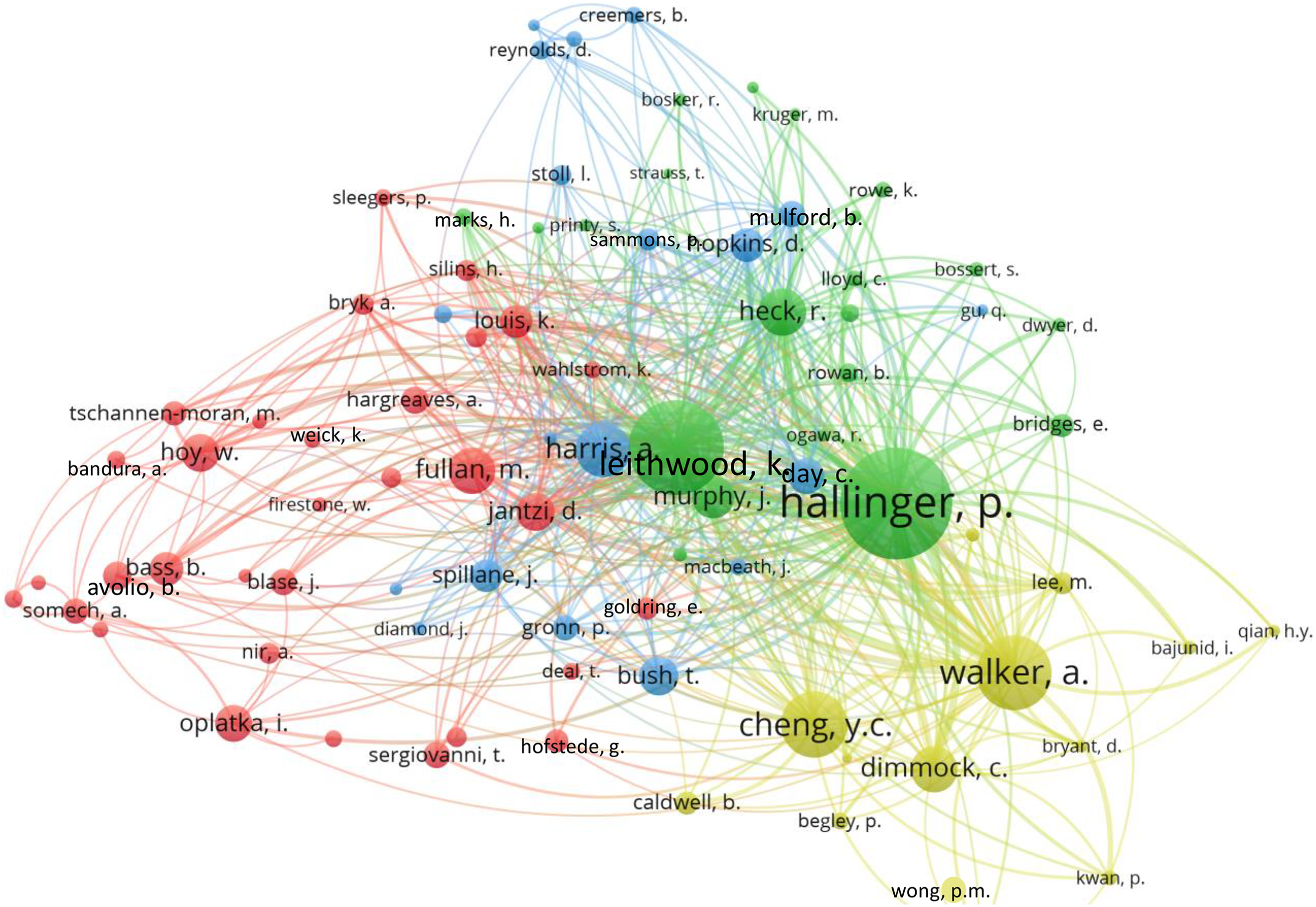
Network map of author co-citations for emerging-regions scholarship, 1965–2018.
The threshold for co-citation analysis was set at 15 author co-citations and a display of 85 authors on the map. The colored clusters shown in Figure 6 illuminate four distinct schools of thought. The gold cluster is largely composed of scholars who have focused on “Cultural Perspectives on School Leadership and Change.” Scholars in this school of thought have tended to study how school leadership, change, and educational reform are shaped by the cultural and institutional contexts of societies located in these emerging regions (Bajunid, 1996; Cheng, 2009; Cheng and Walker, 2008; Dimmock and Walker, 1998; Walker and Hallinger, 2015). This school of thought has been led by the contributions from East Asia by Allan Walker, Y. C. Cheng, and Clive Dimmock. This is perhaps the clearest example of a distinctive emerging-regions school of thought.
The red cluster evidences a more eclectic focus reflected in a dispersed distribution of author nodes. Within this school of thought, one group of Anglo-American-European scholars focuses on Leading Teacher Change (e.g., Fullan, Louis, A. Hargeaves). A second group of scholars occupying the left region of this cluster (e.g., Hoy, Somech, Oplatka, Nir, Blasé, Sleegers) have focused specifically on how leadership impacts teacher psychological attitudes (e.g., teacher job satisfaction, commitment trust, learning). Notably, this latter group includes strong representation by Israeli scholars. This has potential to develop into a second culturally distinctive literature within emerging-regions scholarship. The distance and paucity of links between the red and gold clusters suggest that these two emerging-regions schools of thought are developing largely independent of one another.
The green cluster consists of scholars whose research has focused on “Principal Leadership for Learning.” This school of thought has been led by contributions from Western scholars such as Ken Leithwood, Philip Hallinger, Joe Murphy, and Ron Heck. The centrality of this cluster in the network map highlights the global prominence of this school of thought as well as its influence on emerging-regions scholarship. Hallinger’s location directly adjacent to the gold cluster reflects his cross-over relationship with the East Asian school of thought as well as well as the prominence of his earlier scholarship while located in the USA.
Finally, a more dispersed blue cluster is discerned with dual foci on Shared Leadership (Harris, Spillane, Bush, Gronn) and School Improvement (Harris, Hopkins, Day, Sammons Mulford, and MacBeath). The more dispersed character of this cluster reflects its intertwined relationship with other clusters.
Also notable in this co-citation analysis map is the central location of several scholars whose nodes touch upon, and have dense links with, multiple clusters. In the science-mapping literature, these characteristics are used to define “boundary-spanning authors” whose scholarship integrates or connects ideas from different schools of thought. By this standard, K. Leithwood, J. Murphy, A. Harris, P. Hallinger, and C. Day stand out as boundary-spanning scholars in this literature. The fact that among these scholars only Hallinger, and to a lesser extent Harris, have beenlocated in an emerging region suggests the extent to which scholarship in these regions has been influenced by global scholarship. That is, scholars within the emerging regions still tend to cite global intellectual leaders more than scholars in their own region or in other emerging regions.
The final step in the analytical strategy employed keyword co-occurrence analysis or co-word analysis. Zupic and Čater (2015) explained that …when words frequently co-occur in documents, it means that the concepts behind those words are closely related…The output of co-word analysis is a network of themes and their relations that represent the conceptual space of a field. (Zupic and Čater, 2015: 435)
The co-word search was set to “All Keywords” located in titles, keywords and indexes of documents, with a threshold of at least five cases of keyword co-occurrence (i.e., a keyword co-occurring in two documents). A “thesaurus file” (Van Eck and Waltman, 2017) was created and applied to reduce unwanted redundancy between duplicative keywords such as “principal” and “principals.” This analysis yielded a co-word map set to display the 60 most frequently co-occurring keywords and was color-coded to indicate the relative popularity of topics in recent years (see Figure 7).
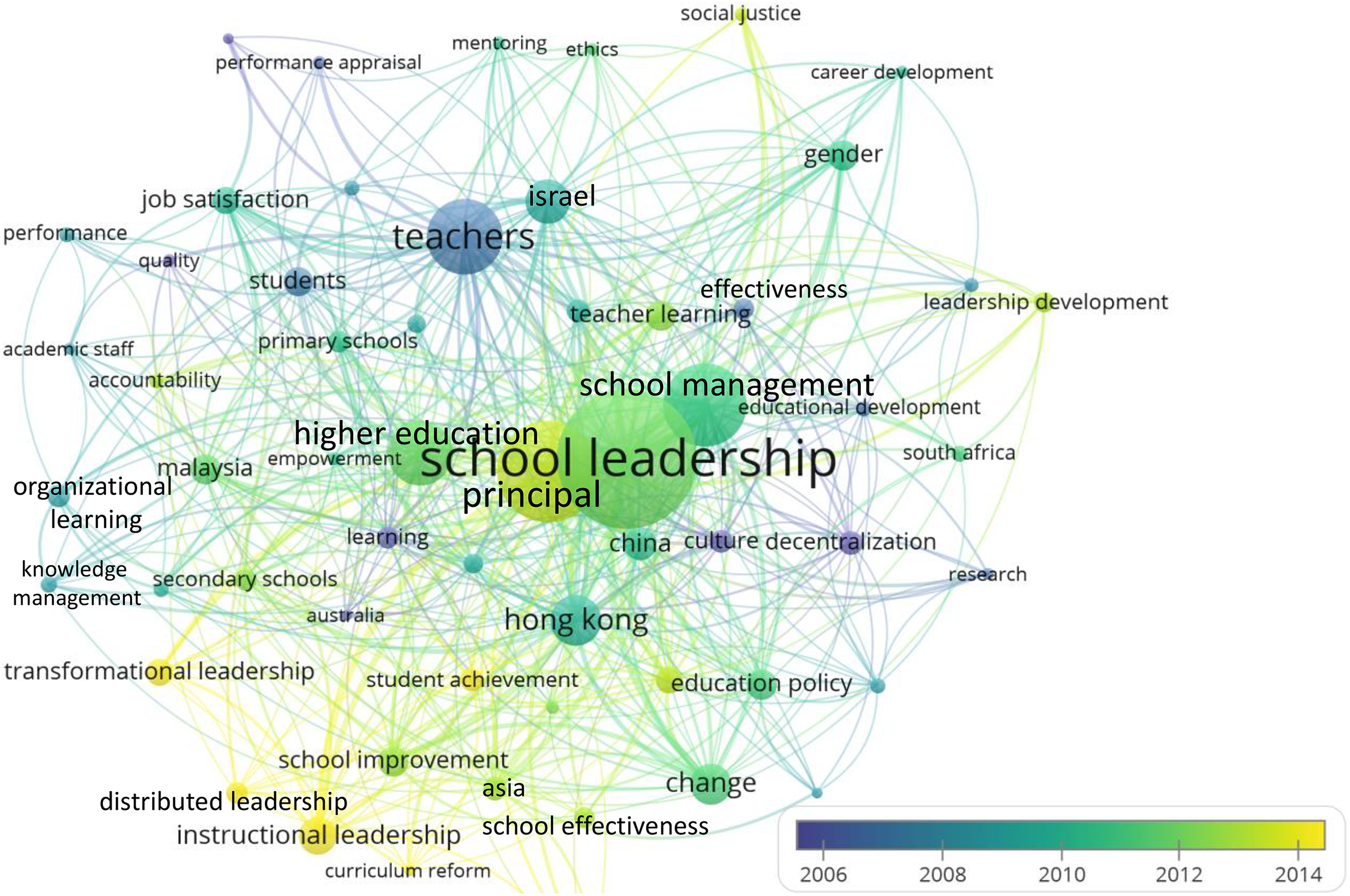
Temporal keyword co-occurrence analysis of emerging-regions research in EDLM, 2006–2015.
The centrality of “school leadership,” “school management,” “principal”, and “higher education” on the co-word map, the size of their nodes, and their proximity to each other, suggest that these represent the key topical foci within the overall emerging-regions literature. The reader should recall that the author did not employ these as keywords to identify articles for this review. Instead, these keywords surfaced via an independent analysis of co-word occurrence in articles produced over the publication history of these journals. This affirms the centrality of these topics within this literature.
The author wishes to suggest that this finding would not necessarily have been predicted (Hallinger, 2018b; Oplatka, 2010). Indeed, the map suggests that issues of education finance, policy, governance, culture, change, school improvement, and education reform literally revolve around and take their meaning from these three key topics within this literature. An additional, and somewhat unexpected topic that evidenced high co-word frequency, was “higher education”. This is significant in that no journals that specialize explicitly in higher education were included in the review database.
Science mapping has also been used in the identification of the research front or “growing tip” of the literature (de Solla Price, 1965). Identification of the research front alerts scholars to the most recent topical trends emerging within a literature. The patterns revealed in Figure 7 suggest that the research front in the emerging-regions literature in EDLM lies in papers that examine principal and shared leadership (e.g., instructional, distributed, transformational leadership) in relation to student achievement and curriculum reform. Other topics of recent interest include social justice, school improvement, teacher learning, accountability, and leadership development.
Discussion
This research review was undertaken with the goal of mapping research on EDLM from the emerging regions of Asia, Africa, and Latin America. Using science-mapping methods, the author analyzed features of 1171 articles published in nine Scopus-indexed EDLM journals between 1965 and 2018. This concluding section highlights limitations of the review method, and offers interpretation and implications of the findings.
Limitations
The most salient limitation of this review follows from the decision to focus on articles published in a bounded set of nine international refereed EDLM journals that are published in English. If the author had broadened the primary database to include articles from journals such as Management in Education, NASSP Bulletin, and/or Educational Leadership, the UK- and USA-centric focus of these journals would only have further accentuated the publication gaps reported in this review. This delimitation of the review was, therefore, justified on the grounds that these nine international EDLM journals would provide a representative picture of the evolution of emerging-regions scholarship.
The author also wishes to reiterate that the author co-citation analysis included in this review included all authors cited in the reference lists of the 1171 emerging-regions articles in the review database. This means that the review “reached out” to encompass a much wider literature. In sum, the author asserts that the decision to focus on this particular set of EDLM journals was suitable for the purposes of this review.
At the same time, however, the exclusion of journals published in other languages (e.g., Arabic, French, Spanish, Chinese, Portuguese) remains an important limitation of this review. As the global knowledge base in EDLM has begun to advance, scholars have recently started to include research published in other languages as well as in English in reviews of research (e.g., Flessa et al., 2017; Hallinger et al., 2015; Walker et al., 2012). Although including such research was not practical for the current review, this is a wholly positive development that should be encouraged.
Another limitation concerns this review’s use of the term “emerging regions.” As noted earlier, each of these regions is heterogeneous in terms of cultures and levels of economic development. Thus, the author’s use of this term was meant to highlight regions of the world that have traditionally produced relatively few international publications in EDLM. Over the course of the review, the author sought to highlight differences both within and across the three regions.
Interpretation and implications of the findings
For a quantitative review of research, this paper tells a richly detailed story about the development of emerging-regions scholarship within the broader field of educational leadership and management. During the mid-1990s, a handful of EDLM scholars decried the scarcity of research published in international journals from outside of Anglo–American–European societies (e.g., Bajunid, 1996; Hallinger, 1995; Hallinger and Leithwood, 1996). Subsequently, these and other scholars began to develop conceptual models and methods aimed at enabling the culturally situated study of school leadership (Dimmock and Walker, 1998, 2000; Walker and Dimmock, 2002). Yet, to date there have been only limited efforts to document empirically the extent of these perceived imbalances in the EDLM literature, and if they have diminished during the ensuing two decades (Hallinger, 2018a; Hallinger and Bryant, 2013; Mertkan et al., 2017; Oplatka and Arar, 2017).
The corpus of 1171 articles from the emerging-regions articles identified in this review represents a modest but rapidly growing knowledge base. The volume of this corpus of publications is particularly impressive when one considers the evolution of this literature. Although emerging-regions scholarship only represents about 20% of the full corpus published in these EDLM journals, 45% of these articles have been published in the past five years. This represents an empirically verified “sea-change” in the field. Projecting ahead, the trends documented in this review (e.g., Figure 4) portend a far more balanced global EDLM knowledge base in the years to come.
Despite this broad trend of increased knowledge production, there was substantial interregional variation. While 83% of the emerging-regions publications came from Asia, only 12% were from Africa and 5% from Latin America. This implies that the findings reported in this review are heavily skewed toward Asian publications. Thus, overall trends reported in the review do not in all cases accurately reflect patterns derived from each of the regions.
In addition, the landscape of “within-region variation” was similarly uneven. Although each region featured one or two peaks (e.g., Hong Kong, Israel, South Africa, Chile), the topography of knowledge production consisted of many more low-lying valleys. These inter- and intraregional trends suggest that despite recent impressive overall growth in emerging-regions knowledge production, the global map of EDLM scholarship is still filled with numerous blank spots (see Figure 5). This reprises Hallinger's (1995) and Bajunid’s (1996) contention that despite the ubiquitous practice of school leadership and management throughout the world, our knowledge base remains highly uneven in terms of geographic scope.
A key challenge in the coming decades will be to build research capacity among scholars across the emerging regions. The good news is that data reported in this review affirm a positive trajectory for emerging-regions scholarship broadly defined. In addition, the review identified centers of research excellence within each of the regions that could potentially be leveraged through cooperative ventures. By way of example, the Asia Leadership Roundtable, launched by the Education University of Hong Kong in 2010, has fostered a focused research agenda, enhanced research capacity, and contributed significantly to the East Asia region’s output over the past half-dozen years. Indeed, a significant portion of the East Asian scholarship produced since 2010 can be traced to these cooperative efforts.
In 2016, an Africa Leadership Roundtable was initiated by scholars at the University of Johannesburg with similar aims and strategies for capacity-building and publication. These initiatives have employed a two-pronged strategy that links regional scholars with each other, as well as with influential international scholars. These and other types of intra- and inter-regional cooperation can be employed to build capacity and knowledge production in the coming decade.
This leads to the next key finding, which concerned the role of journals in disseminating formal knowledge about EDLM practices. IJEM, JEA, EMAL, SLM, and IJLE evidenced the highest frequency of publishing emerging-regions scholarship among the nine journals. JEA, IJEM, EMAL, and SLM led the journals respectively in total citation impact. However, EAQ evidenced by far the highest rate of citations per document (see Table 1). Journal co-citation analysis revealed JEA and EAQ as the most influential journals publishing emerging-regions scholarship. This was rather surprising because EAQ ranked near the bottom of the nine journals on emerging-regions publication volume.
This apparent anomaly supports the perception shared informally among emerging-regions scholars that publication in EAQ will achieve the highest impact for their scholarship. Yet, the findings also suggest that the likelihood of successful publication by emerging-regions scholars in EAQ is exceedingly small. Only 43 of EAQ’s total corpus of 1007 articles consisted of emerging-regions scholarship (4.2%), and 16 of 43 those articles were authored by just two scholars (A. Somech and P. Hallinger). 4 Absent their contributions, the proportion of emerging-regions scholarship drops to only 2.6% of the EAQ corpus. It was further noted that this trend has not changed significantly over the past decade, thereby affirming the sense that publication of emerging-regions scholarship in EAQ is akin to an “impossible dream”.
However, the implication of this analysis goes beyond EAQ’s role in publishing emerging-regions scholarship. Quite a few EDLM journals have historically adopted a “national focus”—either implicitly or explicitly. All journals will need to reconsider their publication priorities during an era when EDLM is transitioning into a global field of applied research, policy, and practice.
Another contribution of science mapping lies in the empirical verification of several distinct schools of thought that comprise the intellectual structure of the emerging-regions knowledge base. Author co-citation analysis revealed that since the mid-1990s a distinctive literature has grown up within EDLM based on emerging-regions scholarship. This was most apparent with respect to scholarship on principal leadership and change from East Asia and scholarship on principal leadership and teacher attitudes from Israel. Although the analyses conducted in this review did not study topical foci by region, prior reviews of research can amplify this picture. For example, Hallinger (2018c) reported that the African literature in EDLM contained four key topical foci: principal leadership, school governance, social justice, and leadership development. Flessa and colleagues (2017) and Castillo and Hallinger (2018) identified school effectiveness, principalship, and leadership training and development as key topical foci in Latin America. Taken together with findings from this review, the author speculates that regions (and societies) may develop distinctive sets of topical priorities based on needs and policies in different local contexts (see Clarke and O’Donoghue, 2017; Hallinger, 2018a).
Before conducting this review, the size, the density, and the coherence of emerging-regions scholarship in EDLM could not have been predicted. Yet, the review has empirically documented each of these dimensions of the emerging-regions knowledge base. This leads to the recommendation that regional scholars should conduct substantive reviews of regional scholarship guided, at least in part, by the four schools of thought identified in this review. The author anticipates that research synthesis will be more suitable than meta-analysis at this stage of review. The goal of these reviews would be to illuminate the substantive contributions of regional scholarship to the broader findings that describe each of the four broad domains or schools of thought.
Thus, for example, a substantial emerging-regions literature has grown up on Principal Leadership and Learning. A research synthesis would first highlight the results of emerging-regions studies in this domain from a particular region and then compare these with findings from Anglo-American-European societies. A similar approach could be employed with the other schools as well. Together these reviews would provide a useful lens to sharpen our understanding of how cultural and institutional contexts influence the enactment of leadership for learning (Bajunid, 1996; Clarke and O’Donoghue, 2017; Hallinger, 2018a).
Finally, the author would like to reflect on the value of science mapping as a method of research review. Zupic and Čater (2015) proposed that science mapping represents a third approach to research review that complements research synthesis and meta-analysis. The current effort at mapping contributions to the EDLM knowledge base from emerging regions illustrates the potential of this approach. While this review took a broad perspective on EDLM scholarship, science mapping can also be applied to specific lines of inquiry (e.g., leading change, distributed leadership, social justice, gender and school leadership) or to scholarship published by a single journal (see Zupic and Čater, 2015). In closing, this reviewer wishes to strongly endorse science mapping as a valid approach to research review and encourage other EDLM scholars to embrace this method to enhance the long-term development of our field.
Footnotes
Declaration of conflicting interests
The author declared no potential conflicts of interest with respect to the research, authorship, and/or publication of this article.
Funding
This research received no specific grant from any funding agency in the public, commercial or not-for-profit sectors.
