



Abstract
The emergence of Chief Executive Officers as leaders of educational service providers is positioned in multi academy trusts, the preferred structure of schooling in England. Within this structure, the Chief Executive Officer position is distinct and different from previous constructs of headteachers, since the Chief Executive operates at both street level, that is within the MAT, and beyond ‘the street’. In this article, I argue that a new conceptualisation of the headteacher is needed to explain the emerging position and practices of the Chief Executive Officer. These include the interface with the market, adopting entrepreneurial dispositions and constructing professional and business networks. I typologise these practices and positioning through the analysis of empirical data gathered from the Leadership of the Lawrence Trust Project and its Chief Executive Officer, KT Edwards.
Keywords
Introduction
This article reports on research from the Leadership of the Lawrence Trust Project (LLTP) examining the practices and position of the Chief Executive Officer (CEO) operating in a complex school structure in England known as a multi academy trust (MAT). 1 CEOs (sometimes referred to as executive principals) were first appointed in 2004 to run more than one school and are emerging as a new ‘type’ of headteacher overseeing federations, chains of schools or MATs. I investigate the CEO as leader through a socially critical lens ‘where theories may be deployed in ways which challenge interpretations whose legitimacy, indeed their discursive dominance derives from their claim to be value free’ (Courtney et al., 2018: 2). In adopting such an approach, one is ‘troubling the epistemological foundation’ (Courtney et al., 2018: 5) which allows for the researcher as well as the practitioner to make sense of the ‘interplay between policy, agency and structure’ (Courtney et al., 2018: 2). In order to do this, I introduce ‘the practitioner’ KT Edwards, CEO of the Lawrence Trust (anonymized names). I investigate the foundations of the CEO position through tracing the emergence of Edwards’ agency.
Adopting a policy scholarship approach (Grace, 1995), I argue that the conceptualisation of the headteacher is changing from that articulated over the last 40 years, building on the work of Grace (1995, 2000), Hughes (1985), Hall et al. (1996) and Thomson (2009). I posit that the CEO as an emerging construct operates both on and beyond ‘the street’ where position and practice are distinct and different. In defining this space, I deploy thinking from urban design in locating the CEO at both the ‘street level’ and beyond ‘the street’ – that is the interface between the education service provider (the MAT) and civic society: parents, pupils and the community. I theorise the ‘street level’ as a complex space and ‘streetness’ as a metaphor for CEO practice. Notably, I present a different way of describing the CEO in their environment through the introduction of a typology I call Street Practice. I develop the typology by engaging with Lipsky (2010) on street-level bureaucrats, and Kingdon (1984) on policy entrepreneurship.
I then draw on data gathered from the LLTP, using the Street Practice Typology to analyse Edwards’ practice and position. In so doing I attempt to make sense of the interplay between policy, Edwards’ agency and structure. I conclude that the position of the CEO as an instantiation of the privatisation of education adopts corporate practices and operates in interrelated complex policy spaces.
The research reported in this article sets out to make a clear contribution in two ways: the first is empirical where I have undertaken an ethnographic embedded study investigating the new phenomenon of the CEO. In so doing I present an emerging construct of the headteacher as CEO of a MAT. The second is conceptual, through the presentation of a novel typology that has four aspects. The first type examines the bureaucratic system at the street level, where the CEO is part of a hierarchical government system and where power is related to structure and policy implementation. The second is the street-level professional where the interface is viewed between the CEO, whose power and status are gained through accreditation as a recognised education expert, and civic society. The third describes the work of the CEO as an entrepreneur, where the interface involves trading with the market, and where power is about profit. The fourth identifies networks of the CEO as a way s/he brings contractual relations and power flows to the street. The data from the LLTP suggest that these types cannot be inhabited simultaneously but may emerge and recede according to time and context: the CEO may switch seamlessly between them, reflecting the complexities of the position.
KT Edwards as CEO
Utilising studies from business, I argue that whilst Edwards’ position has similarities with earlier versions of the emerging executive headteacher community, his practices and positioning are distinct and different. Jonas et al. (1989: 205) describe an executive who ‘has no immediate superiors…with substantial control over the conditions of the workforce’, whose position is distinct (Buyl et al., 2011). The position is complex: CEOs contend with globalisation, rapid technological and social change (Yukl, 2013). Chester Barnard’s (1968) classic work The Functions of the Executive (originally published in 1938) describes three important executive functions within a formal organisation. First, the maintenance of organisation communication through establishing ‘the scheme of the organisation’ (Barnard, 1968). Second, securing essential services from individuals, and third, formulating ‘purposes and objectives’ (Barnard, 1968: 217). These communication networks enable CEOs to influence organizational culture through the use of ideologies such as ‘the repeated articulation of an inspiring vision’ (Yukl, 2013: 281). The CEO’s executive work demonstrates entrepreneurial dispositions: single-mindedness and perceived charisma. Executives undertake non-executive work serving a ‘legitimising function or as a conduit of communication to an external audience’ (Barnard, 1968: 216). These highly visible actions embody service ‘beyond the call of duty’ and become ‘stories which are propagated widely’ (Yukl, 2013: 283). Symbols of executive power include generous remuneration packages, the provision of an executive office, personal assistant and other inducements (McCall, 2010). Edwards is illuminative of this type of CEO position, and what is happening in England is indicative of similar roles in other national systems such as a US school superintendent (for an example of a school superintendent implementing change in an urban school district, see Howard et al., 2010). The MAT, formed in 2012, consists of five secondary schools, a teaching school and three primary schools. Edwards, CEO since 2014, enjoys all the trappings of an executive: he has considerable discretion within the MAT; organisation communication comes from Edwards and is devolved to the headteachers of each school.
Edwards’ position is located in the historical development of headteachers, yet he remains different from the traditional headteacher articulated by Hall et al. (1996) and Hughes (1985). Such studies highlight the realities of headteachers as leading professionals involved primarily with the curriculum, assessment and pedagogy, before site-based management introduced from 1988 (known as the Local Management of Schools), shifted the focus onto markets, staff and pupil recruitment, and performance data. Subsequently ‘super heads’ emerged under the New Labour (NL) academies programme (see Astle and Ryan, 2008; Daniels, 2011, Kulz, 2015). Whilst Edwards shares similarities with heads in post at the time, the structure in which Edwards operates is different. Since 2010 there has been a proliferation of new school types in England (Courtney, 2015b), where corporatisation and corporate actors flourish (Gunter et al., 2015). Edwards is the embodiment of the neoliberal imaginary that conflates education with business, insinuating the market with public services ‘privileging private sector knowledge over professional knowledge’ (Courtney et al., 2018: 3). The reimagining of the education as a market space has intensified (Ball, 2018), where the corporatisation of state education is an expression of neoliberalism both in England (Courtney, 2015a) and internationally (Saltman, 2010). Edwards as a corporate actor has replaced the elite business sponsors of academies prevalent under NL, such as Lord Harris of Peckham. Edwards is self-made: seizing the opportunity that the academies programme offered, becoming CEO, thereby increasing his agency through brokering deals and seeking financial and in-kind sponsorship as he saw fit.
For Wilshaw and Edwards, the structuring context in which their practices function and where they gain recognition has shifted. Wilshaw was speaking to a value system that connected back to headship of the 1960s which incorporated notions of ‘how do we help pupils give of their best’, whereas Edwards’ values are epitomised in ‘how do we run this organisation in such a way that the data and the brand are protected?’
The next section traces the emergence of the CEO position from early conceptualisations of headteachers to the evolving new community of executive heads and CEOs.
The emergence of the CEO
Research suggests that the conceptualisation of headteachers is connected to the micro contexts of headship and the macro political, ideological and structural dimensions of education (Gunter et al., 1999: xi). This relationship between agency and structure is reflected in both biographies of and by headteachers (for example, Marie Stubbs’ [2003] Ahead of the Class) and primary research on headship: (Ball, 1987; Grace, 1995; Gunter, 2001, 2012b; Gunter et al., 1999; Kulz, 2015; Thomson, 2009). What is evident from such accounts is a focus on the individual at the head of the organisation, where notions of control, direction and mandate are located. For example, Taylor’s (1968) work on the professionalization of headship, and Coulson’s (1978, 1980, 1988), studies which saw primary headship blending personal control with moral authority where the head was pivotal, proprietorial and paternalistic, established an emerging new construct of the headteacher. Hughes’ (1985) study of high school heads conceptualised interdependent elements of headship: that of the lead professional and chief executive where the practice of the headteacher consisted of an interface not only with the LA, parents and teachers, but with the wider community. This core focus on headteacher dominance (and even autocracy) was encapsulated in Grace’s (1995) analysis that traces the identity of the headteacher from the mid-nineteenth century where heads were constituted as male authoritarian figureheads. Whilst the role has been recontextualised in the late twentieth century around notions of ‘first among equals’ and collegiality (Grace, 1995), the prevalence of the independent and disciplinarian headmaster tradition has endured (Grace, 1995; Kulz, 2015). Whilst heads were involved in the core elements of schooling – acting as the lead professional, implementing personal educational philosophies and teaching – research began to give accounts of the tensions in identity and practice (e.g. Ribbins and Marland, 1994), and where Hall et al. (1996: 71) concluded that traditional models of headship were no longer appropriate ‘because of the increasing demands of government policy’.
When New Labour took office in 1997, the emphasis on the charismatic and heroic headteacher role continued. Headship was further re-cultured, becoming ‘a risky business’ illustrated in Thomson’s (2009) study. The restructuring of headteachers’ professional and pedagogic identity with the marginalisation of ‘the professional’ took place (Ball, 2013; Gunter and Thomson, 2004; Gunter, 2001, 2004, 2012a). Through the neoliberal project, public services, including schools, adopted marketing and managerial values with the emergence of the senior manager and school business manager (Gunter, 2004), and where intensive performativity was evident (Ball, 2003; Ball and Junemann, 2012; Gunter and Fitzgerald, 2013).
The head had to be a transformational leader: the answer to school improvement. Some successful ‘inspirational’ headteachers, embodying preferred models of leadership legitimised through bespoke training programmes provided by the National College for School Leadership, were invited to advise the Government on school improvement (Gunter, 2012a). A policy elite was created, comprising government ministers, heads, representatives from HEIs and business. This redefining of the headteacher continued under the Conservative governments from 2010 (in formal coalition 2010–2015) with the introduction of new qualifications for Executive Headteachers (NPQEL), referencing ‘non-school contexts’ including business (DfE, 2017). With MATs playing ‘a central role in the school system’ (DfE, 2016), a reculturing of leadership was evident with the focus on school to school support through ‘system leadership’ (Hopkins and Higham, 2007; Greany, 2018). Edwards is distinct from previous heads such as Wilshaw, Daniels and the heads in Astle and Ryan’s (2008) book, because he oversees a domain which is complexly organised and constructed through acquisitions based around pragmatic business rationales, rather than Wilshaw’s social mobility narrative that framed his tenure as head of Mossbourne Academy (Kulz, 2015). Edwards’ executive function is far more aligned with corporate business; whilst he holds the appropriate accreditation rendering him ‘an expert’, he operates in other non-educational networks that provide legitimacy and business opportunities. Given this new type of role and associated practice means that much of the normative literatures about effective and improving organisational leadership are outdated, as illustrated by Gunter et al.’s (2018) characterisation of corporatisation as a form of ‘luxury leadership’. Thus, a new conceptualisation of headteacher is needed because their position and practices often lie beyond one school.
The CEO’s spaces: interpreting ‘the street’
I conceive the street level as complex ‘representational spaces’ (Lefebvre, 2014: 291), where occupiers perceive the street in distinct ways. From an urban design perspective, the street has a clear identity, yet is aligned to the system, seen as a ‘total network when repeating relationships are sufficiently regular and predicable’ (Lynch, 1960: 60). In this context I maintain the street is formed of multitudinous spaces consisting of buildings, corridors, classrooms, community areas and offices that constitute one stratum of a complex organisational structure that forms a MAT. It is a homogenous space where there are explicitly and implicitly shared rules. Whilst scholars writing on urbanism maintain that the street is the public space (Jacobs, 1961; Lynch, 1960), in the case of the CEO’s ‘street’, access is limited: it is not open to all. Whilst it is an ‘arena for social expression’ (Moughtin and Mertens, 2003: 131), it is controlled through the deployment of surveillance techniques or ‘eyes on the street’ (Jacobs, 1961). These involve agents monitoring the street, senior personnel observing and the utilisation of electronic devices. The street is the site of dynamic interactions that are situated and normalising.
The ‘street people’ comprise pupils, parents and visitors interconnecting through shared street language and culture. Street ties link them to others on the street, who comprise front-line workers. When these ties become formalised the citizen becomes the client. Those ‘front-line workers’ who have direct contact with citizens and clients are typically teachers, other professionals, support staff (Lipsky, 2010). They display high levels of discretion to accommodate their clients’ varied requirements, for example parents needing official information regarding their child, comprising progress data, attendance and behaviour records, whereas pupils enjoy a more systematic and enduring encounter with the front-line workers who support learning, and record and measure progress. Clients operating at the street level are non-voluntary; they do not purchase the service and have little choice in an alternative if they become dissatisfied (Lipsky, 2010: 54).
The street is the space where the state and its citizens come together: a place of social encounters where the action takes place through the interface with the front-line worker and the citizens. The CEO embodies ‘streetness’ – a metaphor for the assimilation of the work of the street. Streetness, conceptually, is the symbolic interface of the CEO and other actors who are situated on and beyond ‘the street’.
A new name: ‘street practice typology’
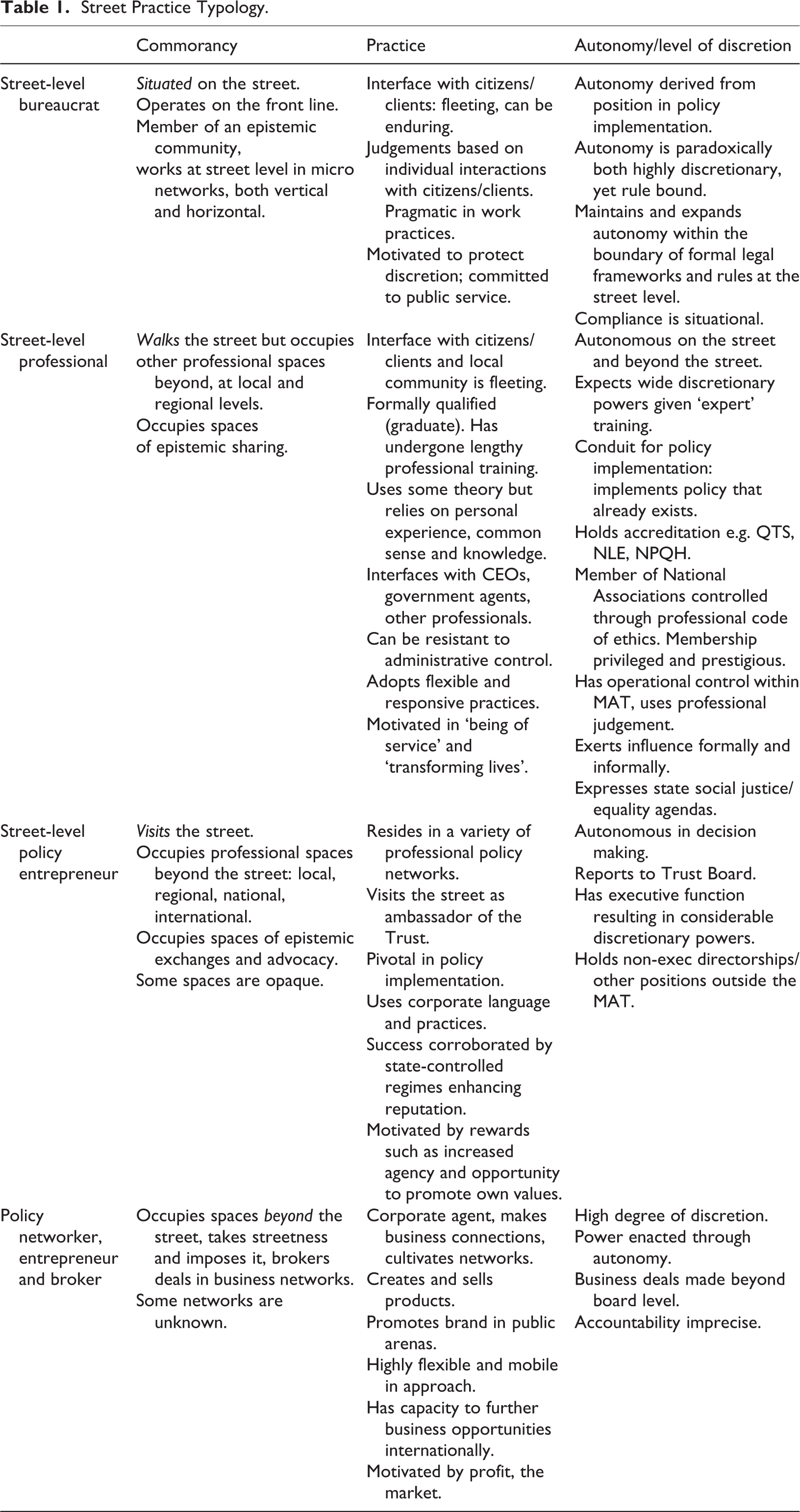
I propose four ways of understanding the position-taking and positioning of the CEO within this complex space. As a ‘new agent’, the CEO needs a new conceptualisation. In this section I argue that the CEO exhibits some elements of the front-line worker referred to as a street-level bureaucrat, as devised by Lipsky (2010). However, I argue that the CEO does not operate at the street level solely as a bureaucrat, but embodies elements of a street-level professional, a street-level policy entrepreneur (Arnold, 2015; Kingdon, 1984), and that of a policy networker, entrepreneur and broker. There are common features of all four types: the CEO is a public official interfacing with citizens, undertaking their work on the street in a micro network with both vertical and horizontal relations, yet the boundaries of the street are permeable and changing (Lipsky, 2010).
In Table 1, I conceptualise the CEO position through the street practice typology. I maintain that the CEO adopts certain practices of all four perspectives in the course of his/her work.
Street Practice Typology.
The street-level bureaucrat
As a street-level bureaucrat, the CEO interfaces with clients, colleagues and other street-level bureaucrats in epistemic communities. I draw on Lipsky’s (2010) ground-breaking research on street-level bureaucrats, namely ‘public service workers, who interact with the citizens in the course of their jobs’, with their work ‘often hidden from public view’ (Lipsky, 2010: xvii). Street-level bureaucrats have longevity, usually holding their positions longer than politicians (Lipsky, 2010: xviii). Within the educational context they work on ‘the street’ as administrators, interrogating data, preparing reports and teaching. Authority is delegated from the centre because of the professional frameworks that govern them (Lipsky, 2010). Thus, their work is constrained by rules on the street; however, with few direct supervisors, the CEO as a street-level bureaucrat is able to exercise power. Consequently, compliance is situational using discretion ‘not only as policy making actors…but as policy formers’ (Hupe and Hill, 2007: 283).
For the CEO as street-level bureaucrat, the operational place can be located at the bottom of the policy hierarchy on the street, yet the position of the CEO extends to the street-level professional.
The street-level professional
As a professional the CEO walks the street but occupies other professional spaces of epistemic sharing. Professionalism has been ‘renovated’ as a concept (Evans 2008). It is externally imposed, where the professional is the efficient deliverer of a ‘predetermined product’ and where professions have clients (Ozga, 1995; Troman, 1996). Professionalism is typified by its changing nature; it is not in some static absolute (Helsby, 1999; Holroyd, 2000). Hoyle (1995) conceptualises a professional as acquiring a set of skills through competency-based training. Professional judgements made by the street-level professional are based on expertise gained through accreditation programmes. As a professional, the CEO adopts professional language, with membership of professional groups maintaining and enhancing status.
Hughes’ (1985) research recognised that heads had to be ‘outward looking and cosmopolitan’ (Hughes, 1985: 275) as CEO and leading professional. The leading professional exerts influence eliciting the cooperation of colleagues through ‘informal interactions’ that take place in staff rooms and corridors, which are ‘highly political occasions providing collegial influence in both directions’ (Hughes, 1985: 282). The CEO ‘legitimises hierarchy’ whilst ‘not restricting professional autonomy’ (Hughes, 1985: 276). Although these roles interpenetrate, the CEO’s position is external, located beyond the street. The street-level professional as the efficient deliverer of a ‘predetermined product’ has influence interacting with clients beyond the street. The extension of these external activities is practised by the street-level policy entrepreneur.
The street-level policy entrepreneur
The policy entrepreneur visits the street as ambassador, observing and monitoring activities, remaining emotionally detached and therefore pivotal in policy implementation. In conceptualising the policy entrepreneur, I draw upon research from policy studies, specifically Kingdon (1984) who conceived policy entrepreneurs (PEs) acting as advocates, located: ‘in or out of government, either elected or appointed’ (Kingdon, 1984: 129). They are members of networks, acting as broker and influencer, motivated by job security, career advancement, expanding agency, promoting their own values (Kingdon, 1984). PEs are willing to invest ‘hopeful of a future return’ (Kingdon, 1984: 129), thus enhancing reputation. They attempt to ‘soften up’ policy communities through giving speeches, occupying policy/specialist communities, or affording repeated attention to an issue (Kingdon, 1984).
Within the typology I posit that the CEO operating at the street level as a policy entrepreneur (rather than at the federal government level as in Kingdon’s study) interfaces with a variety of policy networks. These are often opaque, located beyond the street at local, regional and national levels, consisting of epistemic exchanges and advocacy. The policy entrepreneur is politically astute, often remaining in position during the course of several policy reform windows, which are used to leverage resources and exploit opportunities to influence policy (Kingdon, 1984).
In practice, the CEO is more entrepreneurial in seeking opportunities for commissions and takeovers. S/he oversees the operations and the provision of education services including the selling of these services to the external market. As PE the CEO reports directly to the Trust board but has prime executive function resulting in considerable discretionary powers, including when, where and who to visit at street level.
Within the typology the CEO often holds non-executive positions outside the organisational structure, forming collegial ties within corporate networks and allowing access to policy elites to leverage influence. The interface with the market is crucial as the PE will engage as an ‘expert of truth’ (Rose, 1999 in Ball, 2012: 40), in advocating, framing and packaging policy ideas often for profit. The articulation and re-articulation of success narratives increase spheres of influence and agency within these networks. As the agent of government policy, the PE is bound by government legislation, but as the interpreter of policy may use discretion to oppose it. However, the PE operates within other spaces as a policy networker, entrepreneur and broker: the fourth conceptualisation in the typology.
Beyond the street: the policy networker, entrepreneur and broker
Ball and Junemann (2012) identify PEs as ‘boundary spanners’ – transnational operators moving in extensive interconnected networks operating at the macro level. The typology does not focus on these elite policy entrepreneurs per se, rather, I identify the CEO here as a policy networker entrepreneur and broker situated in more than one location within the policy community. These spaces lie beyond ‘the street’ and may span national boundaries.
For the CEO the ‘business mission’ is a strong imperative. The policy networker, entrepreneur and broker occupies spaces beyond the street, taking his/her ‘streetness’ and imposing it, using it to broker deals. These spaces consist of powerful networks where the brand is promoted and where business opportunities are sought. The policy networker has capacity to extend networks internationally if opportunities arise. Many of these networks are opaque and not always traceable (Gunter, 2012a). Accountability is nebulous. These networks are ‘shaped by constant interaction between groups of linked professionals, managers and experts’ (Lawn and Lingard, 2002: 292). Here the policy networker thrives, projecting power and getting the deal done.
Researching a CEO: methodology and methods
Ethnography allows data to be gathered in their naturalistic setting (Lofland, 1971). This approach was appropriate given data gathered are more descriptive than prescriptive, epistemologically inductive and ‘often unstructured’ (Hammersley and Atkinson, 1995). A purely observational role enables the researcher to remain detached from the social setting, not seeking to disturb what is being observed. However, ‘there are epistemological assumptions underlying its use’ (Scott and Usher, 2011: 108), including assumptions that the researcher should detach any preconceptions in the construction of reality. However, reflexivity recognises that researchers are inescapably part of the social world they are researching (Hammersley and Atkinson, 1995). Although a former headteacher, I was a stranger to a MAT. My role was non-participative, that of the ‘professional stranger’ (Agar, 1980), observing the participant.
My choice in focusing on one CEO in one context as ‘micro ethnography’ (LeCompte and Preissle, 1993: 8) represented a subset of the larger educational system, similar Wolcott’s (2003) study. I sought to discover the ‘complex specificness’ (Geertz, 1973: 26) where the ‘effective story should be specific and circumstantial’ (Wolcott, 1995: 174). Such a process allowed for cultural sharing between researcher and participant to attempt to make sense of the interplay between policy, agency and structure. Whilst not claiming that Edwards is representative of CEOs, the data presents an ‘instantiation of the possible’ (Bourdieu, 1998, cited in Courtney, 2015c: 76).
Access was negotiated directly through Edwards’ PA. Fieldwork was undertaken over a 12-month period. I observed Edwards in Executive Team and network meetings, those with colleagues, parents, governors and actors from other networks. I attended a staff recruitment morning, open days and official functions. During observations, I remained an unobtrusive, passive observer sitting out of Edwards’ sight line. Field Work Notes were constructed in a systematic way using Spradley’s (1980) heuristic, recording data at five-minute intervals. Many ‘informal’ conversations with Edwards provided rich data where I was able to ask questions on what I had previously observed. I wrote these up as FWN after the event.
Shadowing school principals as a distinctive methodological approach (Czarniawska, 2007; Gronn, 2009; Wolcott, 2003) afforded insights into the less obvious aspects of Edwards’ work and provided opportunities for him to explain his actions. On these occasions I followed Edwards ‘in his stride’ remaining behind him but close enough to hear what was being said, occasionally asking questions. I walked the corridors, visited lessons and travelled to other schools with him.
Four semi-structured interviews were conducted, each with a specific focus and transcribed. Firstly, a career history interview (CHI); second, Edwards’ professional networks (NWI); thirdly, practices, values and beliefs (with Best Practice Network, BPI) and finally the structure of the MAT (STRI). Transcripts were member checked (Lincoln and Guba, 1985). To aid in triangulation, primary sources were analysed using 10 stages of documentary analysis (Fitzgerald, 2012). All names were anonymised.
The four categories described in the Street Practice Typology provided broad themes (nodes) to code the interview data using NVivo software, for example I used nodes of: ‘MATs and Academies’; ‘structure’; ‘career’; ‘networks’. I extrapolated these data using more detailed cases to reflect different aspects of each node. I identified the same key themes from primary sources and fieldwork notes. This process was iterative, enabling analysis and explanation of the position and practices of Edwards.
Analysis: the CEO and ‘streetness’
Part of Edwards’ streetness is his ability to locate himself on the street (his executive office is in one of the schools), assuming the characteristics of the front-line worker, adopting practices of ‘the street’. These include his appearance. He is impeccably dressed, yet he adopts ‘the look’ of the street to assimilate: on morning duty he wears a high visibility jacket, and he picks up litter in corridors. He interacts with pupils, colleagues, parents, consciously adapting his identity. I have many badges, I only wear the badge which states what school I’m in, sometimes it says ‘staff’, sometimes it says headteacher. (CHI, 26 September 2017)
Edwards as a street-level bureaucrat
As a bureaucrat Edwards is situated on the street operating on the front line. He replicates and models the expected behaviours of other front-line workers, whilst at the same time using his power to monitor that Trust policy is enacted: all teachers must greet their pupils outside their classrooms; senior staff, including Edwards, check pupils’ uniform on entry to the school. As a bureaucrat, Edwards is bound by the formal legal frameworks within the MAT structure: ‘Everything is scripted. Absolutely scripted. Sometimes it might seem I’m winging it but I’m not – I keep to the script’ (CHI, 26 September 2017). He enacts policy when describing the rigorous due diligence processes: [w]e are all involved…for a school that we have been asked to take over…this include[s] everything from the types of funding stream…the staffing, the desktop analysis, legals (sic), the finance. (BPI, 5 December 2017)
Whilst Edwards’ origin is ‘in the policy process’ Lipsky (2010: xii), located in the policy space of the street, outlasting elite policy entrepreneurs, his position as CEO is more nuanced: he also occupies different spaces of the street-level professional.
Edwards as a street-level professional
Edwards does not remain ‘on the street’. His position allows him access to other networks, retaining his ‘streetness’ through his repeated articulation of the trust vision (Yukl, 2013). As a street-level professional he walks the street. His profile lists his professional credentials: ‘a National leader of Education…a key driver in the Beacon School movement’ (LT Website, accessed 29 September 2017). He has undergone professional ‘competency-based training’ Hoyle (1974), gaining accreditation to access other networks.
As the ‘lead professional’, Edwards ensures ‘bureaucratic formalisation whilst not restricting professional autonomy’ (Hughes, 1985: 276), which is shown when working elsewhere: ‘We went and left Sarah here, I said I’m not going to interfere. I didn’t’, yet still needing affirmation he tells me, ‘But she rang me’ (CHI, 26 September 2017).
As an SLP, Edwards uses opportunities to articulate the Trust’s success and enhance his agency. During a school visit which coincided with a new parents’ meeting, he entered the room unannounced, introduced himself, gave an impromptu speech about the success of the Trust and the excellence of the school (FWN, 10 October 2017). The interaction was fleeting and unscripted. Similarly, his contribution to a DfE networking event allowed him to interact with others in a space of epistemic sharing. As the main presenter Edwards ‘softened-up’ (Kingdom, 1984: 134) colleagues through persuasive arguments around successful MATs. However, Edwards moves beyond these spaces and embodies characteristics of the entrepreneur.
The CEO as street-level policy entrepreneur
As a policy entrepreneur, Edwards embodies government policy advising on pupil behaviour, leadership and school improvement. In implementing policy, he describes Trust practices ensuring each school is performing to expectations: we have the same standards across the trust, that’s my job and the exec team to keep the standards, school improvement starts…from the top. (BPI, 5 December 2017) [t]he Schools’ Minister Nick Gibb, he’s been here twice, we got Michael Gove here before he was Education Minister. (NI, 17 April 2018) So, I said ‘come on what’s the score?’ He [Ofsted Inspector] said: ‘It’s special measures’, and I said: ‘don’t, if you give it special measures it will close, but if you give it satisfactory…and then make it a bad satisfactory we are coming in’, and he did. (CHI, 26 September 2017) We are fairly ruthless…if it doesn’t benefit the trust…why would we do it? We need to gather assets, assets mean people. (BPI, 5 December 2017)
The CEO as policy networker, entrepreneur and broker
Edwards is not highly mobile in that he does not operate within trans-global policy networks. Instead he has developed extensive local and national policy networks beyond the street, which have been cultivated over time: I spend a lot of time working with local councillors, key community leaders, people who make a difference. (NI, 17 April 2018) [I also gained access] through [council leader] who said it would be really good if you could meet the [Secretary of State for Education] so I did. I’m very well connected with the Chief Education officers. (NI, 17 April 2018)
Edwards as a policy networker, entrepreneur and broker focuses on the Trust brand, actively networking and brokering deals.
Discussion
The Street Practice Typology provides a useful articulation of the emerging practices of the MAT CEO role. Whilst not claiming any generalities, Edwards’ case remains particular and the implications of study are broad (Wolcott, 1995). Empirical data gathered in situ provide unique insights into the practices and positioning of a CEO. It reveals that headship is being recultured and reconceptualised to incorporate distinct and new practices within a complex organisational structure which has the legal status of a business. It builds on work by Kulz (2015, 2017) on the headship of one academy, to examine CEO practice in a MAT. Previous heads of academies operated as street-level bureaucrats and street-level professionals, enjoying institutional autonomy. As CEO, Edwards’ practice and position enables him to operate as a street-level bureaucrat, a street-level professional, a street-level policy entrepreneur and as a policy networker, entrepreneur and broker. The study has enabled a ‘lifting of the veil’ to reveal clear distinctions between Edwards as CEO and previous executive headteachers in charge of single academies such as the Principal in Kulz’s (2017) book. These are apparent in three ways: through Edwards’ position and the structure of the MAT; through his praxis, control, discretion and agency; and through his entrepreneurial disposition.
Structure
Edwards’ position was incubated in New Labour policies enabling headteachers to propagate professional accreditation, locate themselves within elite communities, and for some to lead on school improvement commissions. However, most were Executive Headteachers of one academy – Wilshaw, for example, was the ‘captain of his ship’ (Kulz, 2015: 85), whereas Edwards is the leader, occupying a far more complex role as CEO of an extensive business empire consisting of over 1,000 employees, located across four local authorities. Edwards embodies the neoliberal agenda of privatising education in England. Whilst not the business owner, Edwards, in utilising policy windows, became the CEO of an early convertor academy, without an external sponsor, enabling him to extend autonomy, retaining tight control, form policy, recruit corporate assets and decide on expansion. His extensive networks have provided access to the market. The structure of the MAT, incorporating a teaching school as a wholly owned subsidiary and commercial arm enables Edwards to undertake lucrative commissions and sell educational products.
Praxis, control, discretion and agency
Articulating a vision different from that of the transformational, social mobility narrative, Edwards’ praxis as CEO is pragmatic, perpetuating the brand, simultaneously winning bids and interfacing with the market. Edwards does not necessarily champion government policy; he is able to choose the schools in which he works, refusing to undertake certain commissions, thus increasing his agency. His level of discretion is considerable: whilst on the street he demonstrates control in supervising, directing and surveilling his clients. Edwards enjoys freedom from direct external accountability. Unlike other headteachers, Edwards is not exposed to public pressures of performativity: his name does not appear on Ofsted reports, for example.
Entrepreneurial disposition
Edwards embodies the successful executive. His roots lie within the market: his executive function involves transactions, whether it be taking over schools, building new ones or selling educational products, yet he still remains on ‘the street’. Consequently, there is a growing synergy between the CEO of education service providers and business, which, for Edwards, has begun to penetrate transnational boundaries.
Conclusion
Such a conceptualisation of the CEO in the Street Practice Typology is important because it explains that this new form of leading is positioned both on and beyond ‘the street’. The data have presented the CEO as a corporate actor embodying nascent entrepreneurialism through interface with the market. As the position of CEO is emerging within the MAT structure, further historical research is needed to investigate practices of CEOs by way of comparison to Directors of Education in England, for example. Furthermore, contemporary projects in comparing the CEO with school superintendents or leaders of charter schools in the USA would locate MATs within a global context. This would require deploying a range of methodologies and methods in order to move forward from the single case.
Footnotes
Acknowledgments
I am most grateful to Professor Helen Gunter and Dr Steven Courtney and the anonyous reviewers for their insightful comments on earlier drafts of this article.
Declaration of conflicting interests
The author declared no potential conflicts of interest with respect to the research, authorship, and/or publication of this article.
Funding
The author received no financial support for the research, authorship, and/or publication of this article.
