




Abstract
This study examined the relationships between leadership practices, professional learning communities, teachers’ efficacy beliefs and perceptions of whole-child development in the context of kindergarten education. A sample of 2120 teachers from 153 Hong Kong kindergartens participated in a questionnaire survey. The results showed that principals’ leadership practices had significant effects on all five professional learning community components. Leadership practices were also positively related to teachers’ perceptions of whole-child development directly and indirectly through the mediation of three professional learning community components, namely a shared sense of purpose, collaborative activities and a collective focus on children’s learning. Moreover, three professional learning community components (i.e. a collective focus on children’s learning, deprivatized practice and reflective dialogue) were positively associated with teachers’ perceptions of whole-child development via their efficacy beliefs. The findings support the mediating role of professional learning communities in developing kindergarten teachers’ collaboration for improving their efficacy beliefs and perceptions of the whole-child development of children. Kindergarten principals play a key role in cultivating a supportive culture and facilitating teacher learning.
Keywords
Introduction
Educational reforms have recently focused on improving collaborative cultures and teachers’ instructional quality through building professional learning communities (PLCs) in kindergartens (Brown and Englehardt, 2016; Damjanovic and Blank, 2018; Schneider and Kipp, 2015; Thornton and Cherrington, 2018). In a broad sense, a PLC can be viewed as “an inclusive and mutually supportive group of people with a collaborative, reflective and growth-oriented approach towards investigating and learning more about their practice in order to improve pupils’ learning” (Stoll, 2011: 104). The concept of PLC shifts the traditional approach of professional development from the acquisition model dominated by external experts to the participatory knowledge construction model (Vescio et al., 2008; Wood and Bennett, 2000). Teachers in a PLC conduct ongoing reflection, collaboration and collective learning to form a shared vision of children’s learning.
The success of PLCs in bringing about positive changes in professional practice and collaborative culture is dependent on its situated institutional context. Some contextual factors, such as leadership practices, workplace conditions, resources and policies for professional development, may account for the possible benefits of PLCs (Louws et al., 2017). The importance of the principal’s leadership practices in developing a PLC has been extensively supported in studies of school leadership (Zheng et al., 2016, 2018a; Mullen and Hutinger, 2008; Wahlstrom and Louis, 2008). Hord (1997) asserted that supportive principal leadership is an integral part of effective PLCs in terms of facilitating collaborative professional development. Furthermore, a PLC creates opportunities and conditions for implementing new professional practices. Some researchers have posited that PLCs are positively associated with teaching effectiveness and student achievement through collective teacher learning (Bruce et al., 2010; Louis and Mark, 1998; Vescio et al., 2008). Developing schools and kindergartens as PLCs hinges on teachers’ active engagement in improving their instructional practices, and consequently increasing their commitments to children’s learning. The improvement of teachers’ instructional practices is particularly important for kindergarten education, where teachers play a key role in helping children achieve a balance of intellectual, physical and socio-emotional development as a foundation for life. How confident kindergarten teachers are about their professional competence will influence children’s learning (Guo et al., 2011; Sheridan et al., 2009). Thus, facilitating teacher learning not only influences children’s engagement in learning at an early age, but also helps them to become lifelong learners and prepares them for meeting future challenges (Sanders et al., 2015).
Previous studies have affirmed the positive effects of PLCs on student learning outcomes as shown by successful examples in primary and secondary schools (Bruce et al., 2010; Lomos et al., 2011). Few studies have analyzed PLCs in kindergartens or examined how a PLC affects children’s whole-person development (Cherrington and Thornton, 2015; Damjanovic and Blank, 2018). In Hong Kong, the study of collective professional learning among kindergarten teachers has received less attention, and the concept of a PLC has rarely been used in kindergartens (Ho et al., 2016). Nevertheless, there has been a significant step towards building PLCs in kindergartens since the implementation of free kindergarten education and quality reviews of kindergarten education in recent years. In 2017, the Kindergarten Education Curriculum Guide (hereafter the Guide) published by the Curriculum Development Council (CDC) attached great importance to developing PLCs in kindergartens. In the Guide, a learning community is defined as “a group of people who have shared values and goals, and work closely together to generate knowledge and create new ways of learning through active participation, collaboration and reflection” (CDC, 2017: 121). Taking this view, a learning community is conceived as an important way to improve teacher development, and ultimately to enhance the quality of kindergarten education. With a few exceptions (e.g. Thornton and Cherrington, 2018; Sheridan et al., 2009; Wood and Bennett, 2000), the role of PLCs in kindergarten education has rarely been examined. This study attempts to address the gaps in the literature by investigating the relationships between leadership practices, PLCs, teacher efficacy and whole-child development in the context of kindergarten education.
Literature review
Conceptualizing professional learning communities
Many studies have attempted to identify the key characteristics of PLCs (Stoll, 2011). Hord (1997) was one of the first scholars to conceptualize a PLC as comprising five components, namely, supportive and shared leadership, shared values and vision, collective learning and application, shared personal practice and supportive conditions. Soon after, Louis and Marks (1998) proposed five interconnected components: a shared sense of purpose (SSP), collaborative activities (CA), a collective focus on student learning (CFSL), deprivatized practice (DP) and reflective dialogue (RD). Vescio et al.’s (2008) comprehensive review summarized a PLC as being characterized by five factors: shared values and norms, a clear and consistent focus on student learning, RD, DP to make teaching public, and a focus on collaboration. Research on PLCs in school settings has increased their recognition in Hong Kong and mainland China in recent years (Lee, Zhang and Yin, 2011, 2016, 2018a; Pang et al., 2016). Using a sample of schoolteachers in Hong Kong, Lee, Zhang and Yin (2011) found that two PLC factors, collective learning and application, and supportive structural conditions, were positively related to teachers’ commitment to students. Studies of PLCs in primary schools (Zheng et al., 2016; Yin and Zheng, 2018) affirmed a five-factor model akin to the categorization of Louis and Marks (1998).
Building PLCs is a key strategy for all school stakeholders (i.e. principals, teachers and students) for improving school effectiveness and student learning. Lomos et al.’s (2011) meta-analysis of PLCs affirmed that the school environment could enhance teacher collaboration and student achievement. They observed that a PLC is effective when teachers “share a common view on the school’s mission, mutually reflect on instructional practices, cooperate, engage in reflective dialogue, and provide one another with feedback on teaching activities, all with a focus on student learning” (p. 122).
Following the conception proposed by Leithwood et al. (2010), school leadership indirectly influences student learning through four paths (i.e. rational, emotional, organizational and family). A well-functioning PLC is an important mechanism in the organizational path which bridges the association between leadership, PLCs and student achievement. Leadership practices exert the strongest impact on teachers and students in the organizational path by providing guidance on the development of the PLC. Within this conceptual model, highly efficacious teachers are more likely to engage in the innovations of various instructional strategies to meet the learning needs of students.
Professional learning communities and leadership practices
Effective principal leadership is conducive to the development of PLCs (Wahlstrom and Louis, 2008). Louis et al. (1996) regarded structural conditions and supportive leadership as indispensable factors supporting PLC development. Mullen and Hutinger (2008) pointed out the active role of principals in facilitating and maintaining teachers’ learning in a group. Research has also confirmed that principal leadership can directly and indirectly affect student learning (Leithwood et al., 2010). Hallinger and Heck (1998) identified the direct, mediated and reciprocal effects of principals’ effects on student achievement. Sebastian and Allensworth’s (2012) multilevel analysis found that the differences in student achievement between high schools were associated with principal leadership through the creation of a learning climate.
In line with the Western literature, the important role of school leaders in nurturing PLCs has also been identified in Hong Kong and mainland China (Yin and Zheng, 2018; Hallinger et al., 2014; Li, Hallinger and Ko, 2016; Walker et al., 2014; Wang, 2016; Zhang and Pang, 2016). Hallinger et al. (2014) affirmed the key role of Hong Kong primary school principals. They found that teachers’ interpretations of the principals’ leadership practices (e.g. giving advice, mentoring, coaching and training) enhanced their professional teaching. In mainland China, Yin and Zheng (2018) found that leadership practices have positive effects on all five components of PLCs. Adopting Hord’s (1997) five dimensions of a PLC, Zhang and Pang (2016) found that leadership was a significant resource for PLCs in China. In a qualitative study, Wang (2016) found that school leaders played a critical role in developing a shared vision, shaping a culture of trust, and supporting and monitoring collegial learning. Although considerable literature concerns the effects of principal leadership in schools, few studies have attempted to investigate the role of leadership practices in the context of early childhood education (Cheung et al., 2018b; Chan, 2018; Siraj-Blatchford and Manni, 2007).
Professional leadership communities and teacher efficacy
Teacher efficacy has been recognized as an important factor influencing teachers’ instructional practices. Self-efficacy refers to individuals’ beliefs about their own abilities to achieve a particular course of action (Bandura, 1997). Teachers with a high level of self-efficacy experience higher levels of confidence (Duran et al., 2009) and better quality classroom instruction (Guo et al., 2010). Guo et al. (2011) also demonstrated that teacher self-efficacy is contextually situated and is influenced by teachers’ sense of collaboration and level of influence in the decision-making process. Their findings support teacher collaboration as a means of developing effective teaching strategies.
Extensive studies have suggested that teacher collaboration in a PLC may help to improve teaching practices, leading to a positive change in student learning (e.g. Bruce et al., 2010; Leithwood et al., 2010; Vescio et al., 2008). In PLCs, teachers learn together, build shared knowledge, bring what they learn to their classrooms, and reflect on their experience to refine their teaching. Berry et al. (2005) observed that teachers working in professional learning teams improved their instructional strategies based on student data, which enhanced student learning. Ning et al. (2016) also found similar results in their investigation of PLCs in Chinese societies. They reported that a “PLC which strives to develop collaborative work cultures for teachers has become a promising approach for enhancing instructional effectiveness and student learning” (pp. 239-240).
The importance of professional development initiatives in the early childhood sector has been highlighted in recent years. With the emphasis on accountability for children’s outcomes, teachers’ professional practices, skills and beliefs have been seen as important factors in determining children’s learning (Martinez-Beck and Zaslow, 2006; Schachter, 2015; Sheridan et al., 2009). There is an increasing need for kindergarten teachers to increase their understanding of child development and thus support children’s learning. Cherrington and Thornton (2015) reported some qualitative findings on the characteristics of effective school-based PLCs in early childhood settings. Their study stressed that the supportive structural and relational condition is important in building PLCs, such as the provision of time and space for PLC members to meet, discuss and reflect. Thornton and Cherrington (2018) investigated various factors which enable the sustainability of PLCs. From their interview data, teachers expressed that they would share professional conversations and give criticisms within the learning group when they trusted each other. Recently, Yin et al. (2019) quantitative study found that both faculty trust and PLCs facilitated kindergarten teachers’ professional learning in Hong Kong.
However, despite the recent upsurge of interest in investigating PLCs, there is a scarcity of studies providing compelling evidence of the effects of PLCs in kindergartens and their importance for teachers’ and children’s learning. Thus, more studies are needed to extend the scope of research by providing empirical validation of the effects of PLCs within kindergarten contexts.
The call for whole-child development in Hong Kong
Studies on early childhood education have placed the emphasis on nurturing balanced child development, viewing children as “whole persons” (Diamond, 2010; Nodding, 2005; Sanderse et al., 2015). Unlike the didactic teaching approach, the whole-child approach advocates that teachers should “let children feel safe, secure and accepted” (Diamond, 2010: 784).
In Hong Kong, there has been a call for whole-child development with an objective of nurturing children to attain all-round development across multiple domains. Children aged between 3 and 6 years are eligible to receive free kindergarten education. The core of kindergarten education as explicitly stated in the Guide is to foster in children “a balanced development in the domains of ethics, intellect, physique, social skills and aesthetics, thus achieving the goal of whole-person education” (CDC, 2017: 7). The emphasis is on developing a child-centered curriculum through an integration of children’s learning (CDC, 2017: 9). The Guide recommends that kindergartens connect the six Key Learning Areas through real-life themes and hands-on experience (CDC, 2017: 20). It is also recommended that kindergarten curriculum design should aim at developing children’s problem solving and critical thinking, providing opportunities for inquiry-based and hands-on applications (CDC, 2017: 22). With the guiding principle of integrating the curriculum, teaching and learning, teachers are increasingly expected to be responsible for curriculum development. Rather than academic performance pursuits (i.e. standardized tests or assessments), promoting the long-term development and success of the whole child has become the primary concern of kindergarten education in Hong Kong.
Despite the increased attention given to whole-child development, there remains an unsolved issue of how to strike a balance between the need for academic training and other developmental aspects (Sanderse et al., 2015). Teachers in Hong Kong have reported increased pressure from parental expectations about the academic curriculum (Chan, 2016). Meanwhile, they have been asked to ensure that children gain all-round experience rather than only receiving content knowledge. Overall, these competing demands require a high level of collaboration among teachers and a strong collective approach to producing a developmentally appropriate curriculum. For these reasons, the initiative of promoting integrated learning in kindergartens emphasizes that PLCs enhance teachers’ professional knowledge and improve their pedagogical practices (Cherrington and Thornton, 2015; Damjanovic and Blank, 2018; Thornton and Cherrington, 2018). However, practicing a quality whole-child program is a complex undertaking. Teachers have noted difficulties in implementing whole-child education, such as a lack of resources and related training. Participation in curriculum development, on top of overwhelming teaching duties, also creates an unmanageable workload for teachers (Ho, 2010a; Tam, 2015). The time constraints and heavy teaching work of kindergarten teachers in Hong Kong prevent teachers from learning about and discussing children’s learning in an effective way.
The present study
The literature reviewed in previous sections has indicated that there may be some relationships between leadership practices, PLCs, teacher efficacy, and their perceptions of whole-child development. In this respect, the organizational path defined by Leithwood et al. (2010) provides a theoretical framework for the present study. Specifically, Leithwood et al. (2010) summarized four paths through which school leadership influences student learning, namely, rational, emotional, organizational and family paths. In the organizational path, the professional development of teachers is a concern of school leaders, and PLCs constitute the mechanism through which principals’ leadership exerts its influence on teachers and students. This implies that PLCs may mediate the effects of leadership practices on teachers’ efficacy beliefs, and further on their perceptions of children’s whole-child development.
With teachers facing multidimensional challenges of professional development, teacher collaboration and reflection in PLCs have the potential to improve teaching practices, and thus have a positive influence on children’s learning. The kindergarten principal is the pivotal person to envision, lead and foster the PLC so that it can enhance teacher efficacy for whole-child development. However, the effects of PLC and leadership practices have seldom been examined in the context of kindergarten education. This study fills the gaps in the literature by providing an investigation into the relationships between leadership practices, PLCs, teachers’ efficacy and perceptions of whole-child development, with a particular focus on the mediating role of PLCs. Specifically, this study addresses three questions as follows. What are the effects of leadership practices on PLC components in kindergartens? How are leadership practices significantly associated with kindergarten teachers’ efficacy beliefs and their perceptions of whole-child development? Do PLC components significantly mediate the relationships between leadership practices and kindergarten teachers’ efficacy beliefs and their perceptions of whole-child development?
Methods
Participants
This study was based on a five-year teacher development project (2011–2017) in Hong Kong kindergartens. The project aimed at enhancing kindergarten teachers’ capacity in curriculum design and implementation of whole-child development through the building of teacher networks and PLCs. A total of 160 Hong Kong kindergartens were invited to participate in a questionnaire survey between February and April 2017. We invited teachers other than principals and student teachers to complete a questionnaire if they had participated in the five-year project. The participants responded to the questionnaire voluntarily with no incentive. Ethical approval for the research was granted by the university’s ethics research committee.
Of the 160 kindergartens, 153 agreed to take part in the survey, and 2120 valid questionnaires were returned. This sample represented around 14.8% of the total number of kindergartens and 15.0% of the total number of kindergarten teachers in Hong Kong. Almost all of the respondents were female (98.5%); 84.4% were teachers, 8.6% were head teachers or vice-principals and 6.4% were assistant teachers; 48.3% had taught in early childhood education for 10 years or less, 27.3% had taught for between 11 and 20 years, and 23.8% had taught for 21 years or more; 54.4% had obtained certificates or diplomas, 40.9% had obtained Bachelor’s degrees, and 2.4% had earned Master’s degrees. All qualified kindergarten teachers had completed their qualification training courses.
Instruments
The questionnaire consisted of the following four scales:
(1) The 21-item Leadership Practice Scale (LPS) adapted from Day et al. (2009). This scale covers 21 strategies (setting directions, developing people, redesigning the organization, and managing the school instruction program) that principals may have used to affect school improvement and effectiveness. We used this scale because the 21 strategies cover both transformational and instructional leadership functions which are the two most prominent leadership models in educational research (Gumus et al., 2018). Sample items include “My principal gives staff a sense of overall purpose,” “My principal gives staff support to improve teaching practice” and “My principal encourages collaborative work among staff.” This scale has been validated in previous studies conducted in the Chinese contexts such as Hong Kong and mainland China.
(2) The 20-item Professional Learning Community Scale (PLCS) adapted from Louis and Marks (1998). The PLCS consists of five subscales, including SSP, CA, CFSL, DP and RD. In the subscale of RD, we kept two original items from Louis and Marks’s (1998) scale and added two new items to reflect the kindergarten education context in Hong Kong. These two new items are “In a collective lesson planning period, we discuss the effectiveness of some specific thematic activities in order to improve the quality of the activity design” and “In a collective lesson planning period, we discuss children’s performance in specific domains (e.g. social skills or aesthetics) in order to improve the assessment strategies.” We used this scale because Wang (2015) pointed out that in Chinese contexts, PLCs only include teachers, rather than all professional staff in the school, and all of the five factors in the PLCs are about teachers’ perceptions and practices. Sample items include, “Most of my colleagues share my beliefs and values about what the central mission of the school should be,” “In our kindergarten, there is a great deal of cooperative effort among staff members on teaching and learning” and “During the collegial lesson planning meeting, we discuss teaching practices and methods of team members.” This scale has also been validated in our previous study in Hong Kong (Yin et al., 2019).
(3) The 12-item Teacher Efficacy Scale (TES) developed by Tschannen-Moran and Hoy (2001). It comprises three factors: efficacy for instructional strategies, efficacy for classroom management, and efficacy for children’s engagement. Each factor consists of four items. Sample items are, “I can use a variety of assessment strategies,” “I can establish a classroom management system with each group of students” and “I can get students to believe they can do well in kindergarten.”
(4) The 15-item Whole-Child Development Scale (WCDS) validated by Cheung et al., (2018b). It was used to examine teachers’ perceptions of children’s whole-person development in kindergartens. This scale referred to the Hong Kong Education Bureau’s (2003) Performance Indicators (Preprimary Institutions) for assessing children’s development in five domains: physical development, cognitive and language development, affective and social development, aesthetic development, and other learning attitudes and abilities. Sample items are, “Children can clearly express their ideas,” “Children can show respect to others and be in harmony with others” and “Children can try different ways to solve problems.”
Apart from the WCDS, which asked teachers to rate their responses on a 6-point Likert scale, all items were rated on a 5-point Likert scale ranging from “strongly disagree” to “strongly agree.” The LPS, PLCS and TES were originally developed in English. They were first translated into Chinese by two authors of this study who are fluent in both Chinese and English. Then, the translated versions were reviewed by practitioners and experts in early childhood education to guarantee that the translation was clear for kindergarten teachers. Before the main survey, a pilot test with a sample of 128 teachers from eight kindergartens was conducted to examine the psychometric qualities of the questionnaire. Some slight changes in wording were made to make them more aligned to the context of early childhood education in Hong Kong.
Data analyses
SPSS 21.0 and Mplus 7.1 were used to analyze the data. Confirmatory factor analysis (CFA) was first conducted to examine the construct validity of the scales used in the study. The descriptive statistics and correlations were then computed using SPSS. Structural equation modeling (SEM) and mediation analysis were conducted using Mplus. For the CFA and SEM analyses, a number of indices were used to assess the model fit, including the chi-square statistic (χ 2), Root Mean Square Error of Approximation (RMSEA), Tuacker–Lewis index (TLI), and Comparative Fit Index (CFI). Following Schreiber et al.’s (2006) recommendations, CFI > .90, TLI > .90 and RMSEA < .08 were used as cut-offs to indicate an acceptable data fit. For the mediation analysis, bootstrapping was used to detect indirect effects and issues of non-normality (Hayes, 2009).
Results
Reliability and construct validity
CFA analyses were conducted to test the construct validity of each scale. The first-order factor structure of PLCS showed a marginally acceptable model fit (χ 2 = 1872.78, df = 160, p < .001, RMSEA = .07, CFI = .90, TLI = .89). For LPS, four factors were found to be highly correlated, suggesting the existence of a second-order factor structure. A second-order factor structure of LPS showed an acceptable model fit (χ 2 = 1428.26, df = 185, p < .001, RMSEA = .06, CFI = .95, TLI = .95). Similarly, three factors of TES were highly correlated. A second-order factor structure was tested and the results showed an acceptable model fit (χ 2 = 330.98, df = 51, p < .001, RMSEA = .05, CFI = .97, TLI = .97). For WCDS, a second-order factor structure was adopted (χ 2 = 609.838, df =85, p < .001, RMSEA = .05, CFI = .97, TLI = .97).
Descriptive statistics and correlations
Table 1 presents the descriptive statistics of all factors. Among the five PLCS factors, CFSL (M = 4.02, SD = .51) had the highest mean scores, followed by CA (M = 3.94, SD = .52), RD (M = 3.88, SD = .61), and SSP (M = 3.81, SD = .58). DP had the lowest mean score (M = 3.50, SD = .65). The LPS and TES scored 3.82 (SD = .64) and 3.94 (SD = .44), respectively. On a 6-point Likert scale, the mean score of the WCDS was 4.58 (SD = .66). All factors reached acceptable reliability which showed Cronbach’s alpha values ranging from .77 to .96. Table 1 also showed that all factors were found to positively correlate with each other.
Descriptive statistics, reliability and correlation matrix.
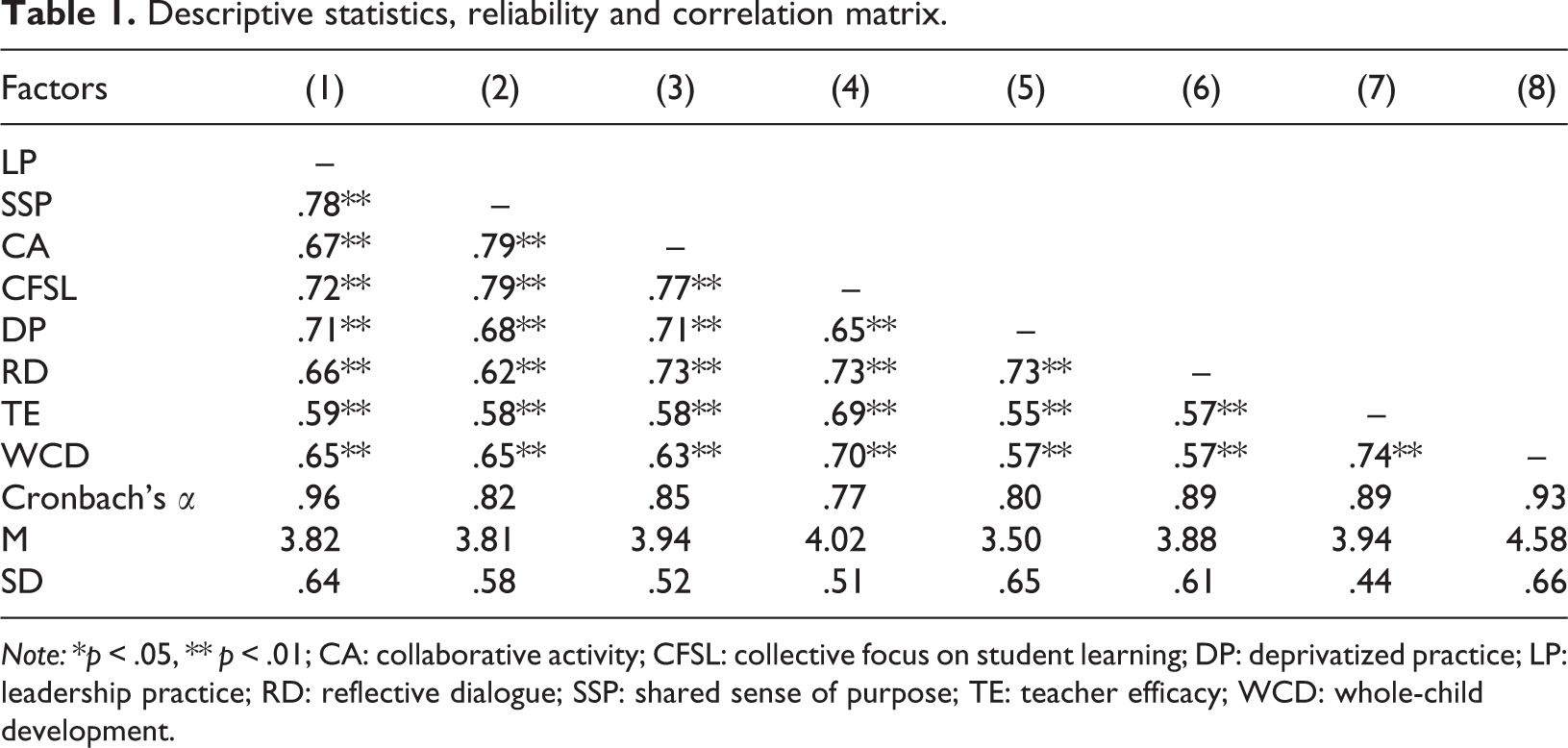
Note: *p < .05, ** p < .01; CA: collaborative activity; CFSL: collective focus on student learning; DP: deprivatized practice; LP: leadership practice; RD: reflective dialogue; SSP: shared sense of purpose; TE: teacher efficacy; WCD: whole-child development.
SEM analysis
An SEM model was constructed to examine the relationship between principal’s leadership practices, PLC components, teacher efficacy and children’s whole-person development. The results showed that this measurement model had a good data fit (χ 2 = 8086.292, df = 2170, p < .001, RMSEA = .04, CFI = .94, TLI = .93).
As Figure 1 shows, leadership practices based on the second-order factor structure had significant direct relationships with all five PLC components with standardized beta coefficients ranging from .69 to .81. Leadership practices exerted the strongest impact on shared sense of purpose (β = .81, p < .001) followed by a collective focus on child learning (β = .76, p < .001). Meanwhile, leadership practices had a positive direct effect (β = .11, p < .01) on teachers’ perceptions of whole-child development, but had a non-significant direct relationship on teacher efficacy. The results also showed that three PLC components had positive direct effects on teachers’ perceptions of whole-child development. These were SSP (β = .10, p < .01), CA (β = .10, p < .001) and CFSL (β = .16, p < .001). Three PLC components significantly predicted teacher efficacy. A CFSL (β = .44, p < .001) had a substantial impact on teacher efficacy, compared with two other PLC components, that is, DP (β = .08, p < .05) and RD (β = .13, p < .001). Meanwhile, teacher efficacy had a significantly positive direct effect (β = .44, p < .001) on teachers’ perceptions of whole-child development.

Effects of leadership practices on teachers’ perceptions of whole-child development through PLC components and teacher efficacy (shown significant paths only) Note: *p < .05, **p < .01, ***p < .001; CA, collaborative activity; CFSL, collective focus on student learning; DP, deprivatized practice; LP, leadership practice; RD, reflective dialogue; SSP, shared sense of purpose; TE, teacher efficacy; WCD, whole-child development.
Mediation analysis
To examine the indirect effects, mediation analysis based on 10,000 bootstrapping samples was conducted. Table 2 summarizes the results of the mediation analyses. Standardized estimates of indirect effect, with a 95% confidence interval (CI), and ratio of indirect to total effect are reported. An indirect effect is significant if zero is not located between the lower and upper boundaries of the CI (Hayes, 2009).
Mediation of PLC components and TE on the relationship between LP on WCD.
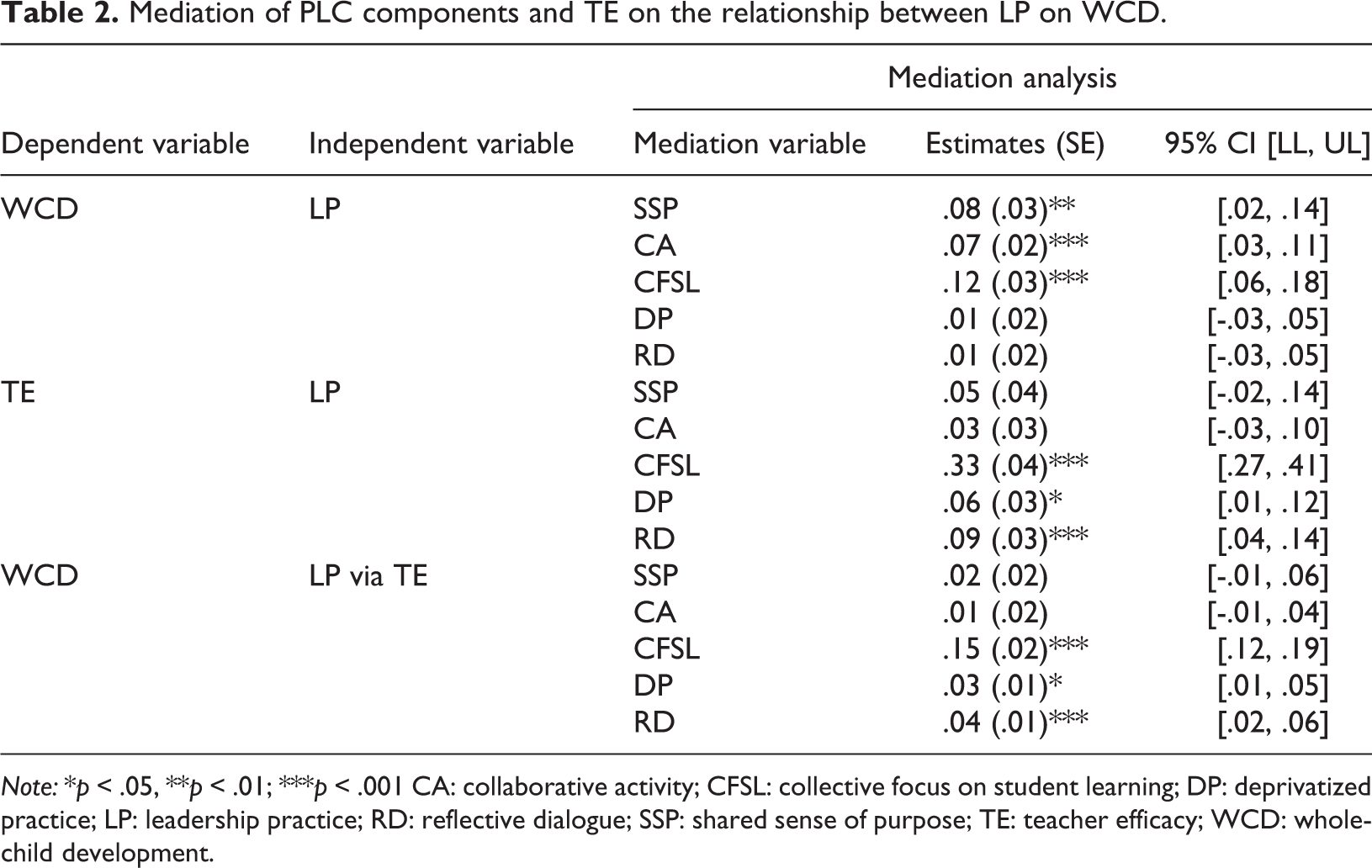
Note: *p < .05, **p < .01; ***p < .001 CA: collaborative activity; CFSL: collective focus on student learning; DP: deprivatized practice; LP: leadership practice; RD: reflective dialogue; SSP: shared sense of purpose; TE: teacher efficacy; WCD: whole-child development.
As shown in Table 2, three PLC components, that is, SSP (β = .08, p < .01), CA (β = .07, p < .001), and CFSL (β = .12, p < .001), positively mediated the paths from leadership practices to teachers’ perceptions of whole-child development. Three PLC components, namely, CFSL (β = .33, p < .001), DP (β = .06, p < .05), and RD (β = .09, p < .001), positively mediated the paths from leadership practices to teacher efficacy. These three PLC components also positively mediated the paths from leadership practice to teachers’ perceptions of whole-child development through teacher efficacy.
Discussion
The Relationships between leadership practices, professional learning communities, and teachers’ perceptions of whole-child development
Although PLCs are increasingly viewed as an important context for continuous improvement in teaching effectiveness and school improvement, only a very few studies have investigated the role of PLCs in improving kindergarten teachers’ practices and children’s learning (Cherrington and Thornton, 2015; Damjanovic and Blank, 2018; Ho et al., 2016). The results of our study indicate that the PLCs in Hong Kong kindergartens had components similar to those in primary and secondary schools. Five PLC components were conceptually identified: SSP, CA, CFSL, DP and RD. Consistent with the previous literature, Hong Kong kindergarten teachers in PLCs take collective responsibility for children’s learning. They develop instructional strategies, such as theme-based and play-based learning, for improving children’s learning based on student data (Lee, Zhang and Yin, 2011; Pang et al., 2016; Stoll, 2011; Vescio et al., 2008).
This study highlights the importance of leadership practices for the development of a PLC. It was found that principals’ leadership practices had positive relationships with all five PLC components. Kindergarten principals adopting effective leadership strategies exerted a great impact on developing a culture of shared purpose and a sense of collective responsibility for children's learning. These results support the findings of some previous studies conducted in Hong Kong and mainland China which found that principals were the key agent facilitating the development of PLCs (Yin and Zheng, 2018; Hallinger et al., 2014; Li et al., 2016; Zhang and Pang, 2016). When principals exercised effective leadership practices, teachers engaged in more discussion with colleagues and reflection on their practices. However, the direct effect of principal leadership on teacher efficacy was non-significant. This finding is consistent with previous results about principals’ “indirect leadership” influencing teacher capacities in other school sectors (Yin and Zheng, 2018; Hallinger et al., 2014; Leithwood et al., 2010). It may be because kindergarten principals are expected to develop shared values among colleagues, redesign school structures and create a supportive learning environment, rather than providing direct instructions for kindergarten teachers about specific content knowledge, teaching strategies and classroom management.
The results of the mediation analyses show some significant indirect relationships of leadership practices to teachers’ perceptions of whole-child development through PLC components. When teachers perceived more leadership from their principals, they were more willing to learn and try new ideas and to participate in collective professional activities, which would in turn benefit children’s whole-person development. Meanwhile, it is interesting to note that our results showed a significant direct effect of principal leadership on teachers’ perceptions of whole-child development. This finding may be explained in two ways. First, kindergarten principals in Hong Kong usually have higher qualifications (e.g. a Bachelor’s or Master’s degree) than kindergarten teachers who are only required to possess a Qualified Kindergarten Teacher qualification (Ho, 2010b). All new qualified kindergarten principals must have a Bachelor’s degree in early childhood education and complete a recognized principalship certificate course (Education Bureau of HKSAR, 2019). With their higher level professional qualifications, principals are more familiar with and receptive to the ideas of whole-child development. Second, principals play a leading role in managing the curriculum for improving children’s learning (Ho, 2010b). Kindergartens in Hong Kong are usually smaller than primary or secondary schools (Chan, 2014), and their structure is flatter and less hierarchical. Therefore, it is easier for kindergarten principals to convey messages about the importance of whole-child development to their staff.
The importance of professional learning communities in promoting teacher efficacy and teachers’ perceptions of whole-child development
A PLC is not only teachers sharing in a group. The collaboration, discussion and reflection among members in a PLC have the potential to transform teaching practices in ways that have positive impacts on children’s learning. Our mediation analyses further reveal that significant indirect relationships were found for three PLC components on teachers’ perceptions of whole-child development through their efficacy beliefs. These findings are consistent with those of Lee, Zhang and Yin (2011) and stress the crucial role of PLCs in developing teachers’ instructional effectiveness. In a PLC, teachers learn from each other to transform their classroom practices through discussion and reflection. In this process, teachers clarify what their students should learn and systematically gather evidence of that learning through common formative assessments. They study the evidence together to inform and improve their individual and collective practices. Through an active process of discussing, constructing and collaborating with others on their practices, teachers can feel more confident and develop a strong sense of self-efficacy (Duran et al., 2009).
Our SEM analyses also showed that PLCs positively mediated the relationships of principal leadership to teacher efficacy and teachers’ perceptions of whole-child development. These results are in accordance with previous literature suggesting that kindergarten principals’ leadership practices can facilitate teacher collaboration to reinvent practice and enhance professional dialogue to improve teaching effectiveness (Hallinger and Heck, 1998). When teachers perceive higher levels of collective focus on child learning, RD and DP in the PLC, teachers’ sense of efficacy can increase, which in turn has a positive relationship on their perceptions of whole-child development. Importantly, this study confirmed that PLCs play a pivotal role in enhancing the connections between kindergarten principals’ leadership practices, teacher efficacy and children’s learning. Recently, Hairon et al. (2017) proposed a conceptual framework showing that the enactment of PLCs can shape the learning culture of a school and improve teacher practice. According to their suggestions, school leadership and professional support can facilitate teacher learning in PLCs, and thus increase their capacity for teaching and learning.
However, our findings indicate that, except for a collective focus on child learning, PLC components in general had relatively weak relationships on teachers’ efficacy and perceptions of whole-child development. One possible reason may be that a heavy teaching load occupies too much time for teachers to meet and share with colleagues about the teaching strategies and activities they have used in the classroom (Cherrington and Thornton, 2015; Ho, 2010a; Louws et al., 2017; Tam, 2015). Thus, teachers have no extra time to conduct in-depth discussion and reflection on their practices together. Hairon and Dimmock (2012) also highlighted high teacher workloads and increasing demands from various stakeholders as one of the constraints delimiting teachers’ commitment to PLCs. Another plausible explanation is that the establishment of PLCs in Hong Kong kindergartens is still at an early stage. Kindergarten teachers can rarely visit fellow teachers’ classrooms, and seldom discuss teaching practices openly with colleagues (Li, 2015). This is consistent with Tam’s (2015) finding that it is still uncommon for Hong Kong teachers to observe each other and give feedback on teaching performance.
Limitations and directions for future research
Some limitations of this study are noteworthy. First, despite a relatively large sample size, the participating kindergartens were drawn from a convenience sample. Future research could adopt a stratified sampling design to analyze the impact of PLCs on children’s learning, and consider different kindergarten backgrounds such as type (i.e. full-day and half-day) and size (measured by the number of students). Second, considering the high correlations among the four factors, we adopted a second-order factor structure of leadership practices in the present study, which results in the inability to differentiate the effect of each leadership practice dimension. Future work may consider differentiating the effects of various leadership practice dimensions. Third, for the assessment of whole-child development, this study used teachers’ perceptions rather than children’s learning outcomes as the criteria. A future study could seek to combine some objective measures of children’s learning or developmental outcomes to assess whole-child development. Fourth, this study only included quantitative survey data. The qualitative differences in teacher perceptions are yet to be uncovered. It would be worth using a mixed-methods approach or follow-up qualitative analyses to triangulate the results.
Implications for practice and research
This study has some implications for understanding and developing PLCs in kindergartens. To the best of our knowledge, there is an absence of research on the characteristics of PLCs in Hong Kong kindergartens (Ho et al., 2016). This study advances the research by offering some quantitative evidence about the role of PLCs in developing teacher collaboration and efficacy beliefs and promoting children’s whole-person development. Considering that PLCs in Hong Kong kindergartens are far from mature, kindergarten principals should make more efforts to develop more effective PLCs. For example, kindergartens are recommended to allocate scheduled time to ensure that teachers have collective learning opportunities to enhance collegial relationships and develop more collaborations for professional development.
Our findings revealed that leadership practices are conducive to developing PLCs in kindergartens. Principals play a key role in cultivating a supportive culture and facilitating teacher learning for continuous improvement (Wahlstrom and Louis, 2008). Our study also revealed that principal leadership was associated with the development of PLCs and children’s learning. This does not only mean that teachers need to work together to improve their teaching, but also suggests that kindergarten principals should be involved in the building of teacher collaboration. The advent of a PLC is not a superficial change to teacher learning, but allows teachers to have an ongoing commitment to improve their practice through collective efforts (Berry et al., 2005; Ning et al., 2016).
Recent studies have emphasized the significance of networked PLCs across schools (e.g. Hofman and Dijkstra, 2010; Schneider and Kipp, 2015). Such professional learning networks provide platforms to build connections for teachers to exchange their views and teaching practices, making concerted efforts to enhance the effectiveness of teaching and learning. Future research may include such networked PLCs in the analysis. In short, developing effective PLCs in kindergartens is a promising direction for enhancing teacher collaboration, reflection and professional learning, with the ultimate goal of providing quality kindergarten education to our children and cultivating their whole-child development.
Footnotes
Acknowledgement
The authors would like to thank the School Development Team of the Centre for University & School Partnership at the Chinese University of Hong Kong for helping with the data collection.
Declaration of conflicting interests
The author(s) declared no potential conflicts of interest with respect to the research, authorship, and/or publication of this article.
Funding
The work was supported by the Quality Education Fund of Hong Kong SAR Government under Grant No. EDB/QEF22/17/10.
