



Abstract
The career progression of teachers of black, Asian and minority ethnic heritage is a matter of much debate and research. Over the past decade, a body of research has confirmed that race discrimination/race inequality is a factor in the progression of teachers of black, Asian and minority ethnic heritage in England. Although it has been argued that ‘Britain is not a racist nation’, it nonetheless has, as described by Phillips in 2016, a ‘…deep sensitivity to…ethnic and cultural difference’. According to Miller, this sensitivity remains at the heart of a ‘deep-rooted and continuing struggle among black, Asian and minority ethnic teachers and academics for equality and mutual recognition’. Drawing on Miller’s 2016 typology of educational institutions: engaged, experimenting, initiated and uninitiated, this paper presents evidence from three English headteachers of Multi-Academy Trusts who devise, implement and embed positive actions in the recruitment, development, retention and progression of staff of black, Asian and minority ethnic heritage. The objective of this study was to examine the work of school leaders/institutions in taking steps to improve black, Asian and minority ethnic teacher progression in England, by identifying and highlighting ‘what works’, and how. Furthermore, by treating each school/leader as a unique ‘case’, this paper shows their motivation (personal and professional), experiences of ‘race’, school contexts and the type/s of leadership required and used in these institutional contexts to change attitudes, cultures and behaviours.
Introduction
Racism and school leadership
Although Phillips (2016) provides that ‘Britain is not a racist nation’, there is significant evidence that many educational institutions in England are racist (Miller, 2016; Bhopal and Jackson, 2013; ECU, 2011). Nevertheless, this paper seeks not to resolve, but rather to surface, this apparent contradiction, since it is important in the context of what is being discussed herein. Racism is a reality (Bell, 2004), and racism in England’s education system is a reality – a reality played out in different ways, affecting students and staff in multiple ways and influencing their experience of, and interaction with/in, the education system. For example, although Phillips (2016: 1) argues that Britain is not a racist nation, he also provides that Britain has a ‘…deep sensitivity to…ethnic and cultural difference’ – sensitivities which are at the heart of a ‘deep rooted and continuing struggle among BAME teachers and academics for equality and mutual recognition’ (Miller, 2016: 206), and a struggle ‘that is a significant feature of contemporary educational institutions…’ (Miller, 2018: 3).
Although many may disagree about the extent or degree of racism in Britain, there is no denying the growing disparities at societal levels in indicators of health, education, incarceration, or inequity of opportunity and outcomes. Put differently, despite its espoused belief in equality (levelling the playing field for all) and equity (more for those who need it), the UK has created and reinforced a system of ‘in group’ and ‘out group’ along racial lines, producing, in effect, many nations within one nation, or enclaves, with their own experiences and their own internal and external racialised problems or privileges. Although much emphasis has been placed on the role of educational leaders in tackling racism in their institutions, it is also important to remember that educational institutions and educational leaders are by-products and microcosms of this overarching context – a context where inequity and inequality are endemic.
Institutional racism occurs at the micro and macro levels of educational institutions, and, as pointed out by Scheurich and Young (1997: 5),
Institutional racism exists when institutions or organizations, including educational ones, have standard operating procedures (intended or unintended) that hurt members of one or more races in relation to members of the dominant race…institutional racism also exists when institutional or organizational cultures, rules, habits, or symbols have the same biasing effect.
Institutional racism can reinforce racist attitudes and behaviours that blight the experience of students and staff from minority ethnic backgrounds within an institution and thus within the system as a whole. Nevertheless, and despite the fact they and their institutions are by-products or microcosms of racialised national, social and community contexts, educational leaders are powerful individuals who are uniquely placed to influence staff, students and other stakeholders in ways that help raise their awareness of and attention to issues of racism/race discrimination, and to helping and enabling them to tackle race and other forms of discrimination, and to promoting, building and sustaining educational institutions in ways that positively influence all who study and work therein. In other words, leaders/leadership can be a powerful antidote to race inequality and discrimination in organisations. This paper presents examples of positive actions taken by three English schools/school leaders who have used the power associated with their positions, coupled with moral purpose, to challenge race inequality in staffing in their schools – leading them to devise, implement and embed strategies and approaches to improve the recruitment, development, retention and progression of staff from BAME heritage in their schools. Whereas existing studies on the progression of BAME teachers have examined the plethora of barriers to progression, and, more recently, enablers to progression at the level of individuals (Miller, 2014, 2015, 2016), the objective of this study was to examine institutional/leadership practices in supporting and enabling progression.
Literature review
Teachers of BAME heritage in England
BAME teachers make up an important part of the overall population of staff in schools in England. They are an important group of individuals from non-White descent, and, although not a homogenous group, their experience of the education system in England in terms race/ethnicity-based discrimination is broadly consistent. On the one hand, this makes understanding the race/ethnic-based discrimination in education somewhat easier; and on the other hand, it raises significant questions about the practice of educational institutions and educational leaders in promoting or ensuring race equality. There are approximately 451,000 teachers in the state sector in England, including 24,281 headteachers. Of the total number of headteachers, approximately 277 are of BAME heritage. Of the total number of teachers, 86.5% (or 395,564) are White–British, 3.8% (or 17,377) are from ‘Other White’ backgrounds, 1.7% (or 7774) are White–Irish, 1.8% (or 8231) are Indian, 1.0% (or 4513) are Pakistani, and 1.0% (or 4513) are Black Caribbean, and less than 1% are Black African (DfE, 2017a). Of the approximately 20,000 qualified teachers from Black and Minority Ethnic heritage, just over 1200 are in a formal leadership position: including the 277 headteachers noted above, and about 950 deputy and assistant headteachers. Correspondingly, as at January 2017, 8.67 million pupils were enrolled in state-funded and independent schools in England. This is an increase of just under 110,000 pupils of which about 66.3% (between 2016 and 2017) are of BAME heritage. Of the 4,689,660 students enrolled at primary schools, 32.1% are of BAME heritage, and of the 3,223,090 enrolled at secondary schools, 29.1% are of BAME heritage (DfE, 2017b).
Teachers of BAME heritage matter
There is extensive evidence that there are academic-related and other benefits to students and their institutions when students and teachers share the same race/ethnicity because teachers are able to serve as role models, mentors, advocates, or cultural translators for students (Gershenson et al, 2017; Wei, 2007). As noted by SecEd (2015), ‘[h]aving a leadership team from a range of ethnic backgrounds also helps to forge good relationships between students and staff’. Students of BAME heritage benefit from seeing staff of BAME heritage in their classrooms and in leadership roles since they provide role models for them. Wei (2007: 10) describes this as ‘co-identification’, and it is widely believed that co-identification can play a role in encouraging students of BAME heritage to enter the teaching profession (McNamara et al., 2009). It has also been reported that leaders of BAME heritage can draw on their own experiences to engage with students of BAME heritage by challenging racial stereotypes and by lobbying for and/or making changes throughout their institutions in order to address issues of discrimination and create a more inclusive environment (Miller and Callender, 2018; McNamara et al., 2009).
The progression of teachers of BAME heritage
Barriers to progression
From an inductive review of extant literature conducted in 2018, Miller (2018) reported five broad sets of factors related to the progression of teachers of BAME heritage in England. These are: (a) unfair policy treatment, (b) racism/race discrimination, (c) institutional practices, (d) group membership or affiliation, and (e) Religion (in particular, Islam). What follows is a brief summary of these factors.
Enablers to progression
There is a paucity of research evidence on enablers to progression among teachers of BAME heritage. Nevertheless, led by Miller (2014, 2015, 2016) there is an emerging body of literature which seeks to fill this gap in the literature and in our understanding. These are discussed below:
Affiliation/Group membership
Miller (2014) found that several ‘marks of affiliation’ or membership of professional and/or informal networks can contribute to the progression of teachers of BAME heritage. For example, successful completion of programmes such as TeachFirst, Future Leaders, or participation in school-led government funded training through the Leadership, Equality and Diversity Fund (LEDF) is believed to have the same effect as regularly spending time with an ‘in-group’ at the pub on Friday evenings after school – that is, an increase in the chances of progression.
Appeasement or Adaptation
Miller (2015) also found that when teachers of BAME heritage ‘proved themselves’, (and had thus become a part of an ‘in-group’ or ‘network’ or ‘club’), although not guaranteed, their chances of promotion/progression were improved. That is, teachers of BAME heritage appear to stand a better chance of promotion/progression where they: first, look like; second, share cultural habits and patterns of behaviours similar to White teachers; and/or third, where they are prepared to ‘adopt’, ‘adapt’ and ‘adjust’.
White sanction
Miller (2016) found that progression/promotion of teachers of BAME heritage is, in many cases, linked to or is reliant upon the support and endorsement of a white colleague – or ‘White sanction’. Miller (2016: 11) defines ‘White sanction’ as a deliberate act ‘where the skills and capabilities of a BAME individual are, first, acknowledged and, second, endorsed/promoted by a white individual, who is positioned as a broker and/or mediator acting on behalf of or in the interests of the BAME individual’. Although acknowledging that ‘White sanction’ positions white colleagues as gatekeepers, and is therefore problematic, Miller (2016: 11) nevertheless reasons that ‘White sanction’ can lead to positive outcomes for the teacher of BAME heritage who has been endorsed by a white colleague, since ‘White sanction’ provides ‘legitimacy’ and ‘enabling’.
Educational institutions and race equality
Practices in educational institutions have often lagged behind equality regulations, and, in some cases, there has also been a clear mismatch between them. The Equalities Challenge Unit (2011) found some initiatives fail due to: the absence of resources and authority for the initiative, and sometimes fatigue and apathy towards new initiatives where previous staff experiences tend to be of unsuccessful initiatives that achieved neither substance nor sustainability (ECU 2011: 46–47).
Ahmed (2007: 236) however notes that some institutions have shown a ‘lack of commitment to change’, and Miller, (2016: 218) notes some institutions are only involved in ‘light touch’ interventions. Accordingly, based on their interaction with the progression of staff/teachers of BAME heritage, MIller provides there are four types of institutions, namely: engaged, experimenting, initiated and uninitiated.
In an
In an
In an
In an
This institutional typology will be essential in our understanding and interpretation of the evidence provided by headteachers in the current study. Nevertheless, as noted by Kalra et al. (2009), for diversity initiatives to be productive, there have to be changes to institutional cultures. Furthermore, for diversity initiatives to be successful, there is need for leadership that is committed in speech and in action (Ahmed, 2007); which cuts through the paralysis of action associated with diversity issues (Mirza, 2008); and which is courageous (Miller, 2019).
Positive actions
Positive action is a range of measures allowed under the Equality Act 2010 (part 5) which can be taken lawfully to encourage and train people from under-represented groups to help them overcome disadvantages in competing with other applicants. For example, if an education institution has a low rate of applications from individuals from BAME heritage for academic and academic-related roles, and if it wanted to improve this, targeted action could be taken to improve this situation through changes to existing and/or the implementation of new strategies and procedures.
Positive action is not positive discrimination and the two concepts must not be confused. Positive discrimination (e.g. setting quotas or any form of preferential treatment) is unlawful, although setting [improvement] targets is not. Where positive action has been taken to encourage applicants from disadvantaged groups to apply, every applicant must be considered on merit and interview, appointment and/or promotion/progression must be based strictly on the agreed selection criteria. The Equality Act 2010 does, however, permit reasonable adjustments, which may give preferential treatment to an individual with a disability. I should point out, however, that the Equality Act has been described as ‘both a lock and a key or as both the motor and handbrake of progress as far as equality practice is concerned’ (Miller, 2018: 11) since it promotes equality of access but doesn’t guarantee equality of outcomes.
Leadership theories
Several theories of leadership could support the focus of this paper and/or our understanding of the actions of headteachers in the study. However, courageous and social justice leadership theories were used based on their relatedness to the topic and to highlighting and articulating the actions and modus operandi of headteachers in pursuing changes to institutional cultures.
Courageous leadership
Many organisations continue along a routine path, day in day out, due to the failure of leaders to take charge and lead change. But leading change in organisations requires courage. According to Freeman (2008: 1), courageous leadership involves …courageous listening, courageous decision-making, courageous action, the courage to set and enforce standards of behavior, and the courage to do what it takes to change destructive existing habits. Courageous leadership requires people to see what others don’t want to see, and do what others don’t want to do. Courageous leadership therefore requires and includes clarifying group perceptions, rebalancing power, leading by example, setting the tone, enforcing standards, taking risks and doing things differently…
Social justice leadership
Social justice, according to Vogel (2011: 71) is the ‘full and equal participation of all groups in a society that is mutually shaped to meet their needs, including an equitable distribution of resources where all members are physically and psychologically safe and secure, self-determining, interdependent’. In education, social justice is a complex concept that has come to mean different things in different contexts due to a variety of social, political, cultural and economic factors (Berkovich, 2013). Nevertheless, it is widely accepted that social justice is a principle (and a practice) based on values or beliefs centred around morality, justice, respect, equity and equal opportunities for all, irrespective of race, ethnicity, creed, (dis)ability, gender, class, economic status and/or other marginalising characteristics (Berkovich, 2013).
Although there is no single definition of social justice leadership, a common theme among definitions is that social justice has to do with leaders using their power to create equity. Bogotch (2000: 2) argues, ‘Social justice, just like education, is a deliberate intervention that requires the moral use of power.’ Furthermore, Theoharis (2007: 223) proposes social justice leaders: …advocate, lead, and keep at the center of their practice and vision issues of race, class, gender, disability, sexual orientation, and other historically and currently marginalizing conditions…Addressing and eliminating marginalization in schools…
Methodology
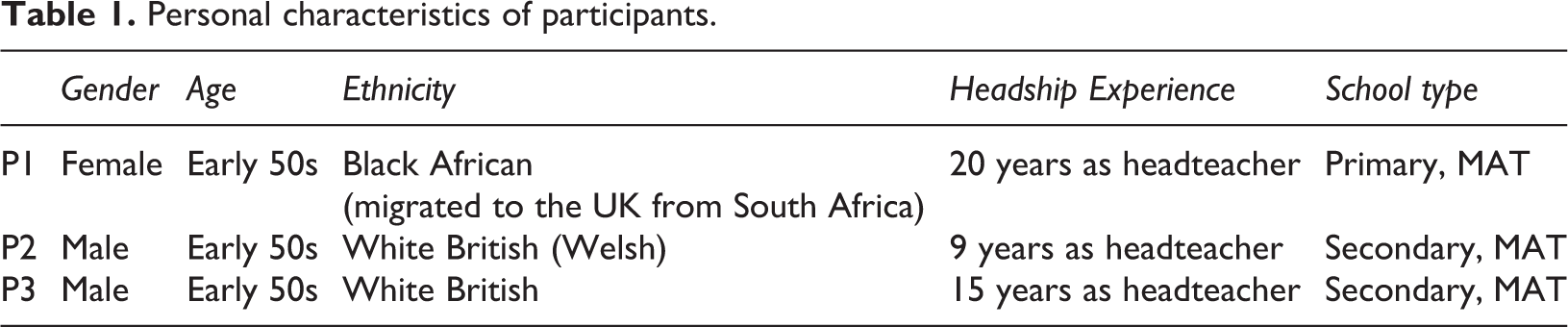
Data collection for this qualitative exploratory study was conducted between October 2018 and May 2019. There were three participants (headteachers): one female and two males. Participants are all from schools defined as Multi-Academy Trusts (MATs). A MAT is a group of schools in partnership with each other, often, but not always, because they are geographically close to one another. Although the person in charge of a MAT is usually referred to as a chief executive officer, in this study, they will be referred to as headteachers or P1, P2, P3. All three headteachers are in charge of two schools. The female headteacher is in charge of a primary MAT and both male headteachers are in charge of secondary MATs. Sampling was opportunistic. A blast was sent out via social media to schools/headteachers with a request to participate in a study on ‘positive actions in BAME staffing’. This was followed up by several other blasts on social media to recruit. Of the 24,281 school leaders in England, only three responded, and those that responded did so via social media. In-depth interviews were held with each headteacher lasting over 45 minutes at a time, and each headteacher was interviewed twice – via Skype and/or telephone. A series of follow-up emails were exchanged between the researcher and participants, and interview transcripts went through a process of ‘respondent validation’. This was not only important as an ethical issue in research, but was crucial to the field since currently there is no available research evidence on what/how school leaders challenge and change school structures to promote race equality in staffing.
Participants
The headteachers shared many similar characteristics, although they had many things between them which were very different.
Each headteacher in this study is in charge of two schools. However, this study focused on positive actions in only one school per headteacher – the school determined by the headteacher to be in greater need of positive actions intervention around race.
Analytical approach
This study combined thematic analysis and elements of auto-ethnography. Additionally, Brooks and Watson’s (2018) model of ‘Ecologies of racism’ – which combines different lived states: Pretext–context–posttext with different levels of racism: individual, dyadic, sub-cultural, institutional and societal – is used as a key analytical frame. In choosing this analytical framework, my aim was to provide a detailed picture of a particular situation or context (in this case the individual schools) by drawing on accounts of actions taken and examples of impacts provided by headteachers within their individual schools. Combining these approaches was believed to be more useful to the overall analysis since the emphasis was on identifying and cross-matching actions taken by different actors (headteachers) in different work contexts, and since a main objective of the study was ‘…interpretive explanation and not prediction’ (Doyle, 2003: 326).
Findings
Several important findings have emerged from this study, which provides qualitative insights into the motivation, attitudes, behaviours and actions of headteachers in their individual schools in the recruitment, development, retention and progression of staff from BAME heritage. The findings are discussed below.
School characteristics
Two headteachers were located in different parts of London, and one was located in the north of England. All three schools are part of a MAT. One of the secondary schools is a comprehensive school and the other is a grammar school. Socio-economic profile of families varies among schools, as does the ethnic and racial profile of students and staff. The primary school, however, currently has the highest level of race diversity in staffing.
The meaning of race equality in staffing to you (the person)
Headteachers came to this question from very different personal stances, reflecting direct/indirect experiences of race inequality/discrimination, underpinned by their personal commitment to transforming schools for individuals and school communities.
P1 connected her stance to the need to provide students with ‘hope’ through ethnic role models that look like them: For children to feel successful they need to have hope. They need to have role models around them that look like them; that inspire them to believe they can achieve. It’s about role models. It’s more than that though. A diverse staff helps us to see pupils as who they are and not just targets. It helps us to be better able to talk to parents from all backgrounds (P1, female). Social mobility is crucial, and should be open to all, including racial mobility. It’s important people from all backgrounds have an equal chance of succeeding. My Welsh background is important to my stance. I experienced prejudice as a child, and I remember expressions such as no blacks, no Irish, no dogs…(P2, male). Equality is a key point for me. I have an equation that I used to use quite often: talent + hard work = success. However, seeing the treatment of BAME staff in our schools, I have since added ‘opportunity’. That is talent + hard work + opportunity = success. Opportunity is missing for several persons, and I have spent a lot of my time as a leader helping people to spot those opportunities, and using my influence to level the playing field. Not positive discrimination, but to challenge and remedy issues through structures and systems (P3, male).
The meaning of race equality in staffing to your school (the professional)
Although it was not entirely possible for headteachers to separate their personal motivations from their professional motivations, their reasons provided significant insights into why race equality was an important issue for their schools and for their leadership. These insights were practical, perspectival and philosophical.
For P1, it was about providing students with ethnic role models, which provided an advantage to more effectively communicating with parents through shared cultural understandings:
Parents don’t want their children to be average. Co-identification with parents allows teachers to challenge parental lack of engagement more effectively and, as a result, rally support through their co-identification. This kind of buy-in therefore becomes more powerful for the school. Staffing that reflects the community will result in a better school for the community ultimately. This is a model that is needed in every school, and not just a black school. Children in every school need to realise that teachers and leaders are capable of coming from every/any ethnic background, and it is ok. They need to know there can be successful black teachers/leaders (P1, female).
For P2, it was this was seen as both a moral duty and a recognition of the power of institutions to challenge the status quo:
It’s important because it’s important in education. It’s important for student population so it is important in staffing. It is a moral dimension that should be reflected in staffing. In principle, school leaders should act to promote diversity, including race. Race equality as an issue is important to our students. They have been fighting for and campaigning for race equality. They have been a driving force. We are nurturing adults to challenge the status quo, which means challenging ourselves, and recognising the power institutions have to maintain or challenge the status quo and to blight or provide opportunities for others.
For P3, it was after being exposed to race diversity as a teacher in schools in Bradford and London, having grown up in ‘an exclusively white village in Yorkshire’: I grew up in a typical working class family in an exclusively white village in Yorkshire. I left school with one ‘O’ level. Through injury and illness, I missed a lot of schooling, but I am not sure I was all that focused either. At weekends I often attended the working men’s clubs with my parents. There, a lot of ugly things were said about people who were not white. This was pretty common. However, I have worked in racially diverse communities in Bradford and Brixton, South London, and I have worked with the police and interfaith leaders…As a young teacher, I also assisted schools in tackling racism through different sporting initiatives, which, as you can imagine, have been a total immersion for me…these have opened my eyes to several equality issues around race discrimination and exclusion (P3, male).
Positive action in the recruitment, development, retention and progression of BAME staff
The main focus of the study was about the positive actions taken by headteachers to improve recruitment, development, retention and progression among staff of BAME heritage. Table 3 summarises the different approaches used by headteachers/schools, as well as different strategies used to support these approaches. Recruiting from ethnic communities (local and international) where large numbers of students came from was a common strategy used by headteachers, in particular P1. All three headteachers enlisted specialist support from external entities to support them, with both P2 and P3 enlisting the support of recruitment agencies, and P1 enlisting the support of a human resources expert. A common support and direct recruitment strategy was also used: advertising in outlets specifically targeting and/or oriented towards persons of BAME heritage.
Personal characteristics of participants.
School characteristics.
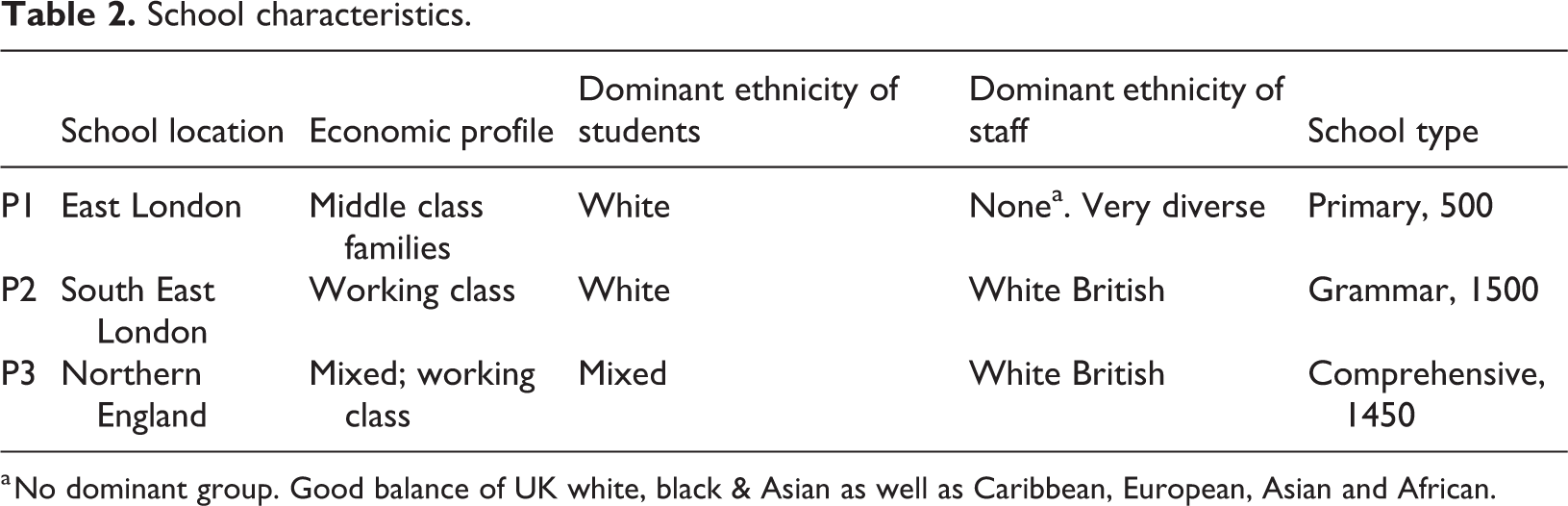
a No dominant group. Good balance of UK white, black & Asian as well as Caribbean, European, Asian and African.
Strategies for recruitment, development, retention and progression of BAME staff.
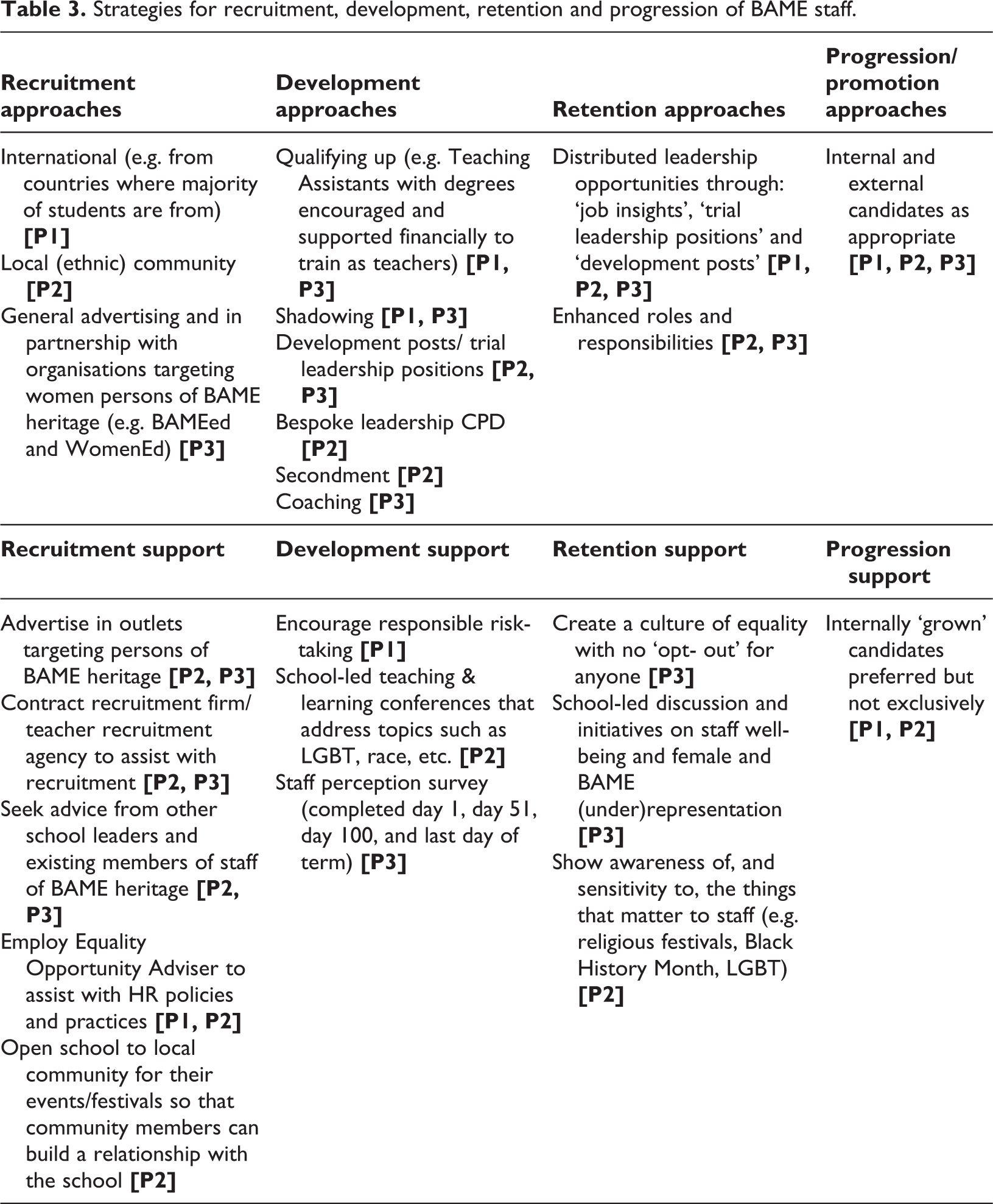
‘Qualifying up’ was a key approach used by P2 and P3. This is where teaching assistants with degree qualifications were supported by the school to train as teachers. Furthermore, shadowing, appropriate continuing professional development (CPD) on leadership and secondment opportunities were also provided, through what P3 described as a clear ‘talent management process’. The use of development posts/trial leadership positions was used by all three headteachers to provide what they described as ‘job insights’. These approaches were supported by an ‘opt-in’ school culture where all staff have to get involved in equalities discussion and initiatives involving teaching and learning, changing structures, and staffroom interactions and conversations. Furthermore, P3 highlighted that his school receives feedback from staff through questionnaires completed at four points during a school term; the findings from which are translated into follow-up actions for all staff as appropriate.
Retention approaches were somewhat linked to development approaches and included distributing leadership (thus giving more persons more opportunities) and through providing enhanced roles and responsibilities (thus providing opportunities to deepen and widen leadership). These approaches were supported by whole-school discussions on under-representation which allowed all staff to own the issue of race inequality/discrimination, and for staff of BAME heritage to see that any imbalance was not ignored or hidden. P2 also highlighted that, in opening his school to the local community for hosting their festivals, the community had begun to see the school as ‘our school’, and by ensuring events at school reflected the diversity of issues that matter to staff (especially minoritised staff), this was important to their sense of belonging. Progression was linked to recruitment, development and retention approaches and, in the main, headteachers preferred to promote internal candidates they had ‘grown’, although there was room for suitably qualified and experienced candidates from outside.
Impact/effectiveness of the approaches/ strategies
The ultimate aim of the range of positive actions taken by headteachers was towards change for staff of BAME heritage in particular, and for their schools in general. Headteachers recognised they and their schools were on a journey to change that would take time and effort. Nevertheless, each reported some element of success.
P1 noted: BAME teachers are speaking out; they are becoming more confident. We have a diverse leadership team with a black female principal, and two other members of the leadership team who are from BAME backgrounds. A diverse teams provides confidence and opens the eyes and ears of BAME people to speak out and be counted (P1, female). The strategies have been very effective but more BAME people need to apply/put themselves forward. It’s frustrating there isn’t broader [national] strategy that the school’s effort could dovetail into. We need a strategy to help us grow leaders from all areas (P2, male). It’s important to grow the middle leaders’ base of BAME staff in schools, so there will be enough qualified and experienced BAME staff to enable succession planning (P2, male). Although early days, a new culture is being created. I am looking for solutions. Upfront are the actions; underneath are the values and beliefs. We have to move away from being the hero to being the hero-maker. Majority of the white leaders in my school are becoming white allies in actions and words, and this is starting to impact staff (P3, male). We [have to] move beyond the statutory things like equal opportunity statements. I am modelling the way it’s meant to be. I want to make myself a white ally. Not a poster boy, but someone who wants to be more comfortable feeling uncomfortable in the current climate of discrimination. I have given my school two to three years to change completely, not five years, that’s too long…(P3, male).
Motivation to introduce these specific strategies
Headteachers had different motivations for introducing the specific actions/strategies, ranging from push-back in the face of community racism, to a moral obligation that schools (students, teachers, teachers, other staff) are reflective of their local and wider communities.
P1 noted: School leaders need to invest in [race] diversity. There is simply no excuse (P1, female). First, the belief that grammar schools can be a lot more than they have been. Second, there is an element of racism in the community. I received at least one letter each year from an unknown person, complaining about how dark the school is, and that ‘it wasn’t like that when I was there’. Third, it’s about social conscience. A school’s leadership should reflect its community. Diversity matters in schools for students and staff. We want students from all backgrounds to feel they can…Getting our students to have a positive role model is important. It’s our moral obligation and education leadership comes with responsibility (P2, male). Age and experience have strengthened my moral purpose. I am louder and prouder about the things that I feel are important. I want to be a ‘White ally’. As I become older, I am becoming more comfortable in being uncomfortable. It’s harder to talk about race exclusion than women exclusion in this country. I use my position, my reach and my influence, within and outside my networks, to try and tackle this issue. This has given me a degree of confidence, and some people are uncomfortable…(P3, male).
Institutional analysis and BAME staffing pre-implementation of actions/strategies
Asked to rank their school’s interaction with BAME staffing on Miller’s (2016) institutional typology prior to their actions/interventions, headteachers described their schools as:
P1, female.
P2, male.
P3, male.
To support her assessment, P1 provided: No framework existed for the school to support BAME staff progression. It never even crossed people’s minds that the way the school was operating was having an effect on people’s mindset and emotional well-being (P1, female).
Institutional analysis and BAME staffing post – implementation of actions/strategies
Asked to rank their school’s engagement with BAME staffing on Miller’s (2016) institutional typology following their actions/interventions, headteachers described their schools as:
P1, female.
P2, male.
P3, male.
Headteachers spoke of the cumulative impacts resulting from their actions/interventions in terms of increased recruitment, development opportunities provided and progression of staff of BAME heritage.
P1 reflected
I have made sure the recruitment and progression of BAME staff was embedded in our structures. Our decision to recruit the Jamaican teachers, and to recruit a diverse staff team, is part of this. We do it well. We took legal advice to make sure our actions were ok. And we are making a statement in our stance, and we are doing it well. We now have a strong leadership team which includes at least three black staff (P1, female).
P2 also acknowledged: The headteacher of one of the schools in the MAT I lead is from a BAME background (Asian). Before the initiatives I started there was no BAME person on the leadership team. But we have to ensure that nurturing of BAME talent is happening at other levels, and not only for a few individuals (P2, male).
Discussion
As mentioned earlier, this discussion is framed using Brooks and Watson’s (2018) ‘ecologies of racism’ model, specifically the three lived states: Pretext–context–posttext. The choice of this model was important to understanding each headteacher’s history ‘with’ race, their current engagement/interaction with race, and their desired future – predicated on the actions they’ve taken in their schools.
These different early experiences confirm very different histories in relation to racism, and although only P1 directly experienced racism, none were oblivious to it and/or to its effects. P1 and P2 however were more alert to the effects of racism early on, compared with P3 who recalled shouting racist abuse at fellow students of Pakistani heritage. Nevertheless, his commitment to tackling race inequality is directly linked to what he describes as seeing the impacts of race inequality when he became a teacher, and, arguably, as an attempt to ‘right’ earlier wrongs. These critical incidents, and encounters represent vital ‘points’ along a journey to change in relation to issues of race (Theoharis and Brooks, 2012).
The headteachers in this study provided examples of how environmental factors have helped to shape their awareness of race inequality, and how, in turn, they have used this awareness to shape the physical, social, cultural, political and economic environment of their schools in trying to tackle race inequality in their institutions (Larson and Ovando, 2001). Although heavily influenced by and deeply connected to emic and etic racial dynamics in community and society (Brooks, 2012), ‘institutional context’ is changeable, but this requires leadership. Thus, educational leaders and students shape the context of their institutions in relation to race inequality: first, by educating themselves; second, by having difficult conversations about race; third, by critically reflecting on and changing their attitudes and behaviours; and fourth, by crafting and implementing policies and procedures that promote and support race equality (Scheurich, 2002). In the words of P3, ‘there is no “opt-out” regarding race equality at my school’, and in the words of P2, headteachers should ‘recognise the power of institutions to challenge or maintain the status quo’.
The positive actions taken by headteachers are bold and inventive, representing a combination of short and long term, inward and outward facing approaches and strategies, aimed not only at disrupting cultures of exclusion, but also at creating and sustaining cultures of inclusion, thereby putting their schools on a path to [greater] fairness for all staff. These actions, and this type of leadership, are therefore an unequivocal response to Miller’s (2018: 11) challenge that, ‘…where educational leaders fail to commit themselves enthusiastically, visibly and fully, outside and within their institutions, to supporting, investing in, and in some cases directly leading race equality initiatives; or where educational leaders fail to appoint individuals with a passion and a clear mandate for tackling race inequality, the content, focus, intended meaning and outcomes of any such initiative may not be realised’. The actions of headteachers in the study therefore move existing debates about BAME teacher progression forward from them being mere sympathisers and/or passive observers, to them actively investing time, energy and resources into tackling race discrimination, and doing so from the front. These observations mirror findings from Demie (2019) who provided that improving the educational experience and outcomes of black Caribbean pupils in England requires firm commitment and decisive leadership from school leaders.
Posttext
All three headteachers in the study displayed courageous leadership and social justice leadership. Courageous leadership involves ‘…courageous decision-making, courageous action, and the courage to set and enforce standards of behavior…’ (Freeman, 2008: 1). Furthermore, courageous leaders ‘see what others don’t want to see, and do what others don’t want to do’ (Freeman, 2008: 1), and possess the strength, conviction and stamina to move from wanting to change, to findings ways to implement and lead change. Headteachers in this study provided very clear examples of courageous leadership, having moved beyond sympathising to tackling, from talking to doing, being conscious their actions were part of a journey and not a destination.
It should also be noted these headteachers demonstrated social justice leadership. Social justice leadership is not only about promoting excellence, equity and inclusion but also about delivering or taking steps to deliver these. Accordingly, headteachers committed themselves personally and their schools to mid-to-medium term equity agendas and objectives that were not merely talked about but which were owned by all staff and which had become embedded in key institutional priorities. The actions of headteachers in this study very much underline Bogotch’s (2000: 2) observation that, ‘Social justice, just like education, is a deliberate intervention that requires the moral use of power’, and Miller et al.’s (2019: 3) observation that ‘Social justice leaders actively try to right wrongs inflicted on marginalised groups, as well as use their position to create safe spaces and opportunities that promote equity between individuals and groups…”
The attitudes, behaviours and actions of headteachers in this study point to a current and a future-oriented way of thinking about racial dynamics in their schools (Brooks, 2012). That is, inasmuch as their work is very much focused on the future (e.g. missions, goals, strategic plans, etc.), race equality is important enough an issue to also be embedded in the current and future work of these schools (Miller, 2016). Put differently, if race equality is not part of an educational institution’s plan for the future, it will be harder for it to design long-term and sustainable anti-racism interventions, choosing instead to treat racism/race discrimination as sporadic incidents, and attempts to address these as ‘light touch’ and ‘self-serving’ (Miller, 2016: 218), or random acts of improvement (Brooks, 2012; Scheurich and Skrla, 2003), more likely to fail when construed in these terms (ECU, 2011).
Conclusions
Race matters in schools and school leaders both influence and are influenced by racism (Brooks and Jean-Marie, 2007). Accordingly, doing race equality is serious business, and doing race equality in schools or educational institutions is serious business that requires courage and the moral use of power that extends beyond sympathising to taking action. Sometimes accused of putting profit over people, and treating staff unfairly, MATs have not always enjoyed an entirely positive reputation with the public and with those who work in them. Although three ‘cases’ out of 24,281 school leaders is by no means generalisable, it is of note that the headteachers who responded to the invitation and participated in the study are leaders of MATs. Headteachers, like other educational leaders, are caught in a vicious and continuing cycle of performativity, accountability and improvement, where more is being demanded from less, and where turnaround times are increasingly shortened. Additionally, headteachers are operating in a context where equality legislation promotes equal opportunities of access but does not provide guarantee of equal outcomes. This zero sum approach produces only losers and masks any lack of enthusiasm shown by headteachers and other educational leaders, across the country, who use the Equality Act, not as a lever for positive change, but as a tool to justify inaction and reify race inequality on the basis that candidates of BAME heritage are not good enough. In other words, headteachers, and other educational leaders, must come out the shadows of performativity and associated agendas, and a flawed Equality Act, and exercise moral purpose combined with courageous and social justice leadership to take actions to change institutional cultures. The accounts and examples of positive actions provided by headteachers in this study are as important as they are symbolic. They are symbolic because three of 24,281 represent a mere ‘drop in the bucket’ of those needing to lead and take a stand against race inequality in staffing in their schools. But these steps are also important for the field of educational/school leadership, providing excellent insights into courage and justice in action, which individual headteachers and their professional association can adopt. It is very much recognised that the race inequality in England is a deep rooted issue, but, as P1 reasons, ‘there is no excuse to not tackling it’.
Recommendations
This paper offers some recommendations for policy makers, school leaders and researchers that emerged from and during the actual interviews with headteachers and from the analysis of the interview evidence.
School leaders/practice
It is recommended that:
School leaders/school organisations be supported by policy makers and researchers to develop skills and confidence to engage in ‘institutional race talk’ with all members of a school community.
School leaders combine moral purpose with positional power to challenge racist practices and attitudes among members of a school community, and to create more racially inclusive school organisations through targeted actions/interventions.
Researchers
It is recommended that:
Researchers seek out and publish evidence of positive actions being undertaken by school leaders in challenging and/or tackling racism among staff and/or students – not only as a counterbalance to existing debates, but also to offer insights and examples to school leaders/school organisations in search of solutions.
Researchers continue to examine leadership/organisational practices in order that a body of knowledge is developed that adds to public understanding of the ‘how’ and ‘what’ leaders and organisations do to change and/or to create new cultures.
Policy makers
It is recommended that:
‘Race’ related equity issues among students and staff be introduced as a Key Performance Indicator (KPI) for all school organisations and other educational institutions.
Institutional monitoring with respect to the implementation of their race equality duty be made compulsory, and appropriate resources provided by the state and/or local authority to oversee this.
Footnotes
Declaration of conflicting interests
The author(s) declared no potential conflicts of interest with respect to the research, authorship, and/or publication of this article.
Funding
This research received no specific grant from any funding agency in the public, commercial or not-for-profit sectors.
