



Abstract
This study aims to validate Western-based distributed leadership and teacher academic optimism scales in the Malaysian primary school context. This study further examined the relationships between distributed leadership and teacher academic optimism as well as each dimension of teacher academic optimism. Data were collected from 442 primary school teachers in Penang, Malaysia. This study used exploratory factor analysis and partial least squares structural equation modeling for data analyses. Findings revealed that both distributed leadership and teacher academic optimism scales were applicable in the Malaysian primary school context. Distributed leadership has a significant positive relationship with teacher academic optimism by controlling teacher gender and teaching experience. Likewise, distributed leadership has a significant positive relationship with academic emphasis, teachers’ trust in students and parents, and teacher sense of efficacy. Implications and future studies are presented.
Keywords
Introduction
School principals are multitaskers. They are responsible for building school vision, guiding direction for school effectiveness and school improvement initiatives, administrative tasks, and student academic and non-academic performance, fostering a conducive school teaching and learning environment, as well as other related academic tasks (Liebowitz and Porter, 2019). As such, it seems difficult for school leaders to manage schools individually, particularly in a large school (Hulpia et al., 2009a; Thien, 2019). A heroic one-person leadership is no longer sufficient in current times (Harris, 2004; Ng, 2017; Thien and Adams, 2019); thus, the emergence of distributed leadership models (Bush and Glover, 2014; Gronn, 2002). School leaders have to empower various members as authorities and delegate their duties. Leithwood et al. (2006) found that multiple leadership is more effective than singular leadership, with 27% of variation in student achievement across schools attributed to multiple leadership compared to single leader effects.
Distributed leadership is conceptualized as the distribution of leadership functions and involvement in decision-making among both formal and informal leaders, such as the principal, assistant principals, and teacher leaders (Hulpia et al., 2009a). The leadership functions are distributed formally through leadership supervision, leadership support, and team leadership, while informally involves participative decision-making. Meanwhile, McGuigan and Hoy (2006) defined academic optimism as a shared belief among teachers that students’ academic achievement is important, and that teachers have the capacity to help students achieve academically. Academic optimism has been studied in relation to school leadership (e.g. Chang, 2011) and student learning (Bevel and Mitchell, 2012; Wagner and DiPaola, 2011).
However, distributed leadership and teacher academic optimism are relatively new concepts in the Malaysian education literature. Therefore, the applicability of distributed leadership and teacher academic optimism remains relatively unexplored in the Malaysian context. There is a growing interest that emphasized the impact of distributed leadership on teachers’ academic optimism in different national contexts, such as in Canada (Mascall et al., 2008), Taiwan (Chang, 2011), and Saudi Arabia (Alenezi, 2019). In addition, to extend the knowledge base of both distributed leadership and teacher academic optimism, these empirical studies have asserted the importance of linking the dynamics of effective school leadership and teacher academic optimism to different national contexts (Clarke and O’Donoghue, 2016; Walker and Hallinger, 2015).
In Malaysia, the Malaysian Education Blueprint (MEB) 2013-2025 (Shift five) has stressed that the role of principals should not be limited to administrative leadership (Ministry of Education [MEB] 2013, E-27). Future leaders should lead schools in a different way (Bush and Ng, 2019). In relation to this concern, the MED 2013-2025 has highlighted distributed leadership as one of the leadership practices that could help to achieve the Malaysian Ministry of Education’s aims by putting in effort to produce more effective and high-quality school leaders (MEB, 2013). However, the concept of the Western-based distributed leadership model remains unclear due to the limited studies on distributed leadership in the local school context (Bush and Ng, 2019; Tahir et al., 2015). Most of the previous studies in Malaysia are mainly focused on the level of distributed leadership that has been practiced in different school contexts (Abdul Wahab et al., 2013; Daud et al., 2015), and the relationships between distributed leadership and teacher self-efficacy (Abd Halim, 2015), as well as work stress and commitment (Rabindarang et al., 2014). It is notable that most of the distributed leadership scales that have been used in Malaysian studies is somewhat lacking sound psychometric property investigation (see Abd Wahab et al., 2013; Daud et al., 2015). Therefore, it remains questionable whether the original distributed leadership could operationalize similarly in different national contexts (Bush and Ng, 2019). Moreover, as pointed out by Walker and Hallinger (2015), most contemporary leadership theories, including distributed leadership, were developed in Western contexts and, thus, their suitability in the Asian context, such as Malaysia where the education systems are highly centralized, remains arguable. Viewed from the methodological perspective, the ignorance of investigating psychometric properties of distributed leadership scale with its application in different national contexts could engender spurious empirical results.
To address the research gaps, this study attempts to operationalize distributed leadership and teacher academic optimism from the Malaysian primary teachers’ perspective. Apart from that, this study aims to examine the direct effect of distributed leadership on teacher academic optimism by controlling teacher gender and teaching experience. Specifically, this study has extended the investigation of the direct effect of distributed leadership on each dimension of teacher academic optimism.
This study has a twofold benefit. Firstly, this study has extended the literature by contributing to the knowledge base of distributed leadership and teacher academic optimism in the literature. Secondly, this study has added to local and international readers’ understanding of the association between distributed leadership and teacher academic optimism, as well as with each dimension outside Western societies.
Theoretical underpinning and hypothesis development
Distributed leadership
According to Harris (2004, p.13), ‘distributed leadership concentrates on engaging expertise wherever it exists within the organization rather than seeking this only through formal position or role.’ Harris and Chapman (2002) have further claimed that distributed leadership is not merely a process of headship delegation, but also a redistribution of power. Gronn (2010, p. 70) ascertained that distributed leadership as a normative switch ‘from heroics to distribution,’ supporting distributed leadership, is not a singular leadership (Bush and Glover, 2014). Concerning these assertions, most leadership theories uphold the assumption that the social influence process occurs when ‘intentional influence is exerted by one person [or group] over other people [or groups] to structure activities and relationships in a group or organization’ (Yukl, 2002, p.3). In this regard, distributed leadership theory has reinforced that there are multiple sources of influence within organizations, including shared, collaborative, and participative leadership (Spillane et al., 2004). Distributed leadership is widely regarded as an influence process in the educational leadership literature (Bush and Glover, 2014). In particular, the literature has asserted the influence of distributed leadership on teachers’ belief in terms of teacher academic optimism (Chang, 2011; Mascall et al., 2008). Grounded with the theoretical support, this study seeks to investigate the relationships between distributed leadership and a latent variable of teacher academic optimism as well as its three dimensions. The following sections presented the concepts of distributed leadership and teacher academic optimism coupled with discussion of the previous studies related to these two variables.
Conceptualization of distributed leadership
Distributed leadership is primarily defined as a social distribution where a leader has decision-making power that is dispersed to all the school members who are then determined as a collaboration of leaders (Spillane et al., 2004). Distributed leadership is considered a work extension of certain people and the interaction of the primary leaders that complete the work (Spillane et al., 2004; Spillane, 2006). Spillane et al. (2004) described the distribution of leadership as a network of individuals working interdependently to enact practices of leadership toward hitting a common goal that is implied in distributed leadership. Harris (2003) synthesized distributed leadership as the interdependency of leaders sharing responsibility with subordinates rather than a single-leader dependency on themselves (Harris, 2003). In the school context, distributed leadership stretches across individuals. The emphasis is on leadership as practice and interaction among those with formal or informal positions (Spillane, 2006). Specifically, Hulpia et al. (2009b) has conceptualized distributed leadership as a multidimensional construct that consists of four dimensions: (a) cooperation of the leadership team; (b) leadership support; (c) leadership supervision; and (d) participative decision-making.
Cooperation of the leadership team
Cooperation of the leadership team is referred to as a focus on the concerted action in leadership of distribution (Gronn, 2002). Leadership is seen as a matter that requires the cooperation of the entire team. This indicates that leadership is no longer seen as a one-man business, which leads toward an emergent property. This collaborative structure indicates that school leaders work toward mutual reinforcement with mutual support from each other. Such collaborative structure leads to a more predominant leadership team working in the school (Hackman, 1990). On the other hand, group cohesion should be characterized by the cooperative team, with clear agreements about an orientation toward the same goals and role divisions (Hulpia et al., 2009b). Effective teams are characterized by mutual trust and dependency, shared aims and objectives, consensus, open expression of disagreement and feelings, and are involved in decision-making (Senior and Swailes, 2007). Cooperation of the leadership team also matters and it is important through mutual influence whether the leaders synchronize their actions and activities (Mehra et al., 2006). Furthermore, effective teams are characterized by synergetic and collective effects (Luthans, 1995) that imply cohesion, cooperation, and coordination in the team (Buchanan and Huczynski, 2004).
Leadership support
Leadership support is related to the leader’s role in setting and fostering collective school mission and clear visions, stimulating and helping teachers, and motivating the professional learning of teachers (Bamburg and Andrews, 1990). Leadership support concentrates on the role of the leader in promoting and setting the school’s vision, as well as stimulating and motivating teachers (Bass, 1985). The leader’s role is related to constituting supportive leadership. This leadership function seems easily distributed by the school’s principal to other teachers in the school team (Barnett and McCormick, 2003; Bush and Glover, 2003).
Leadership supervision
Leadership supervision can be interpreted as the principal’s role in formally monitoring and controlling teachers in schools (Bamburg and Andrews, 1990). The supervisory leadership of teachers is a leadership function focusing on instructional leadership and predominantly concerns the school principal’s role in directing, monitoring, and controlling (Hallinger and Murphy, 1985). This leadership supervision function is more challenging to distribute and it is mainly a function of formally designated leaders (Goldstein, 2003; Spillane, 2006).
Participative decision-making
Leadership could be distributed through participative decision-making (Hulpia et al., 2012). Participative decision-making allows an informal style of leadership interactions of the school team members (Gronn, 2002; Spillane, 2006). Participative decision-making gives teachers opportunities to be involved in and exert influence on the decision-making process at the school level. Their participation is believed to provoke a sense of ownership and, thus, increase the level of acceptance and recognition of their contribution, which eventually inspires their sense of belonging to the school (Somech, 2005).
Teacher academic optimism
Academic optimism is a significant organizational factor that is linked to student achievement even when the socioeconomic status is controlled (Hoy et al., 2006; McGuigan and Hoy, 2006; Wagner and DiPaola, 2011). Hoy et al.’s (2006) study was one of the earlier studies to find a collective set of optimistic beliefs in the school’s academic emphasis, efficacy, and trust. Teacher academic optimism is one of the school characteristics that had a significant impact on the students’ academic achievement by controlling prior achievement and social economic status. The literature has asserted that academic optimism also appeared at the teachers’ level and it comprises teacher sense of academic emphasis, teacher trust in students and parents, and teacher sense of efficacy (Beard et al., 2010). Teacher academic optimism is conceptualized as teachers’ positive belief that they can make a difference in student academic performance by emphasizing academics and learning, by trusting parents and students to cooperate in the process, and by believing in their capacities to overcome difficulties and react to failure with resilience and perseverance (Woolfolk Hoy et al., 2008). In particular, teacher academic optimism at individual level is made up of three dimensions: (a) academic emphasis; (b) teachers’ trust in students and parents; and (c) teachers’ sense of efficacy.
Academic emphasis
Academic emphasis was conceptualized as ‘the extent to which school is driven by a quest for academic excellence. High but achievable academic goals are set for students; the learning environment is orderly and serious, and teachers believe in their students’ ability to achieve’ (Hoy and Feldman, 1987: 32). Beard et al. (2010) conceptualized teacher academic emphasis as ‘the degree to which teachers find methods and ways engaging students in appropriate and academic task’ (p. 1137). Teachers with high levels of academic emphasis are expected to contribute a great amount of effort in increasing the engagement of students, where academics are the top priority to create a focused and healthy learning environment (Kurz, 2006). McGuigan and Hoy (2006) also affirmed that teacher academic emphasis can have a high impact on teachers’ trust in students and parents and teacher self-efficacy. Therefore, the way teachers perceive their role on what they do to improve student achievement and create an appropriate learning environment in schools is closely connected to teacher academic emphasis.
Teachers’ trust in students and parents
Teachers’ trust in students and parents is referred to as an affective response and the ability to form relationships that are trusting between effective teachers with students and parents (Strakova et al., 2018). Hoy et al. (2006) defined trust as ‘one’s vulnerability to another in terms of the belief that the other will act in one’s best interest’ (p. 429). Teachers’ trust in students and parents is likely to increase teacher self-efficacy, which results in greater teacher efforts in designing and planning a more effective classroom instruction (Woolfolk Hoy et al., 2008). Teachers who trust students and parents are likely to perform more effectively to increase the quality of the instructional practices in the classroom (Beard et al., 2010). It is also expected that when teachers trust their students, students will become more motivated and open-minded for learning (Woolfolk Hoy et al., 2008).
Teachers’ sense of efficacy
Teachers’ sense of efficacy is regarded as a cognitive characteristic and is defined as the teachers’ judgment of capability to bring about expected results of student learning and engagement, even among the students who are unmotivated or in difficult circumstances (Tschannen-Moran and Woolfolk Hoy, 2001). Gibson and Dembo (1984, as cited in Bandura, 1993) discovered that teachers with high efficacy will dedicate more time to identify, instruct, and help students who struggle, and compliment students for their achievements. In contrast, teachers with low efficacy will behave the opposite way. If teachers have faith that they have the capabilities to affect the learning of students, they stipulate higher outcomes, exert greater effort, and face difficulties with persistence. A meta-analysis conducted by Klassen and Tze (2014) has shown that student achievement is significantly associated with teachers’ beliefs in their own competence.
Relationship between distributed leadership and teacher academic optimism
The literature revealed limited studies in investigating the relationship between distributed leadership and teacher academic optimism. Mascall et al. (2008) explored the correlation between four different patterns of distributed leadership and teacher academic optimism, which prior evidence has suggested as an influential impact on student learning. The four patterns of distributed leadership were found to be significantly correlated with teacher academic optimism. A Taiwanese study conducted by Chang (2011) supported that distributed leadership is positively associated with teacher academic optimism at the significance level of .05. Similarly, Malloy’s (2012) study revealed a positive correlation between distributed leadership and teacher academic optimism in secondary schools in Canada. On the other hand, Hasanvand et al. (2013) further supported that the cognitive, emotional, and behavioral domains of distributed leadership are associated with the dimensions of academic optimism in the Iranian high school context. Based on the significant relationship between distributed leadership and teacher academic optimism in the literature, it can be hypothesized that distributed leadership has a significant relationship with teacher academic optimism, as well as with each dimension of teacher academic optimism. As such, the following hypotheses were postulated in this study. H1: There is a positive relationship between distributed leadership and teacher academic optimism. H2: There is a positive relationship between distributed leadership and academic emphasis. H3: There is a positive relationship between distributed leadership and teachers’ trust in students and parents. H4: There is a positive relationship between distributed leadership and teachers’ sense of efficacy.
Deriving from the theoretical grounding and literature review discussed above, Figure 1 shows the conceptual framework concerning the relationships between distributed leadership and teacher academic optimism, as well as the three dimensions of teacher academic optimism (academic emphasis, teachers’ trust in students and parents, and teachers’ sense of efficacy). The dotted circles indicate that the three dimensions of teacher academic optimism were treated as latent variables for the hypothesis testing of H2–4.

Conceptual framework.
Method
Sample
This study employed a cross-sectional quantitative survey research design and a convenience sampling procedure. The population refers to the Malaysian primary school teachers. The targeted population of the study is the primary school teachers who are currently working in Penang on a convenience basis. The southwest and northeast districts in Penang were selected to ensure the representativeness of the data. The total number of primary schools in these two districts is 112. We selected 34 out of 112 primary schools (about 30%) as the school sample. However, four schools, two from each of the districts, declined to participate in the study. Thus, this made 30 selected schools, and we selected 15 schools randomly from each district. This study used the design effect (deff) to compute the average number of teacher samples of each school (Dattalo, 2008). The computation indicated that 15 teachers is considered sufficient for each school. Details of the computation can be found in Kish (2004).
The number of returned questionnaires was 442, indicating a return rate of 98.2%. Table 1 shows the demographic background of the sample. The dominant group was female teachers (86%), whereas male teachers were only 14% out of the total sample. About half of the sample were between 31 and 40 years old (48.4%). About 42% of the sample had teaching experience of 10 years and below, whereas the remaining 58% had teaching experience of 11 years and above.
Sample demographic background.

Instrumentation
This study adapted Hulpia et al.’s (2009a) scale to measure teachers’ individual perception of the two dimensions of distributed leadership: leadership support (10 items) and cooperation in the leadership team (10 items). The leadership support subscale was rated based on a five-point Likert scale ranging from 0 (strongly disagree) to 4 (strongly agree). On the other hand, we used Hulpia et al.’s (2009b) scale to measure the subscales of leadership supervision and participative decision-making (six items). Leadership supervision was rated on a five-point Likert point ranging from 0 (never) and 4 (always); participative decision-making was rated based on a five-point Likert scale ranging from 0 (strongly disagree) to 4 (strongly agree). The Cronbach’s alpha values of cooperation in the leadership team, leadership support, leadership supervision, and participative decision-making were 0.93, 0.91, 0.79, and 0.81, respectively (Hulpia, 2009a, 2009b), implying that the distributed leadership scale shows good internal consistency. This serves as the reason why the current study used Hulpia et al.’s (2009a, 2009b) scale to measure the dimensions of distributed leadership.
This study adapted Chang’s (2011) teacher academic optimism scale to measure the three dimensions of teacher academic optimism, namely academic emphasis, teachers’ trust in students and parents, and teachers’ sense of efficacy. The teacher academic optimism scale contains 19 items: academic emphasis (eight items), teachers’ trust in students and parents (seven items), and teachers’ sense of efficacy (four items). Each item is rated on a six-point Likert scale ranging from (1) strongly disagree to (6) strongly agree. The Cronbach’s alpha values of the dimensions of academic emphasis, teachers’ sense of efficacy, and teachers’ trust in parents and students were 0.87, 0.92, and 0.76 respectively, indicating good internal consistency of the teacher academic optimism scale. Such good internal consistency of the dimensions of academic emphasis, teachers’ trust in students and parents, and teachers’ sense of efficacy has convinced the current study to use Chang’s (2011) scale.
The items of both distributed leadership and teacher academic scale were translated into the Malay language based on the original English version using back translation (Brislin, 1970). The translation procedure aims to maintain the same meanings rather than the literal words for word accuracy. Two English language experts from a local university, who were not unfamiliar with the original scale, translated the Malay version back into English. Next, the researchers scrutinized the translation again and resolved the differences.
Data collection procedure
The survey was administered after obtaining consent from the Malaysian educational regulatory authorities and school headmasters. The researchers notified the respondents on the purpose of the study and read the instructions to answer the questionnaire. The questionnaire was distributed and retrieved in collaboration with the teachers of the selected schools within two weeks. The participation of the respondents in the study was strictly confidential and voluntary. Personal contact was made with the respondents in order to secure a higher response rate. The completed questionnaires were either collected by the researchers in person or by mail. Appreciation cards were given to the respondents who completed the questionnaires.
Data analysis procedure
The 442 cases in the data set were first analyzed using principal component analysis (PCA) to identify the factor structure of the constructs of distributed leadership and teacher academic optimism. The varimax rotation method was used to demonstrate independent relationships among the extracted factors. This study used the three decision rules suggested by Tabachnick and Fidell (2007) to identify factors of both constructs: (a) items with loading values of less than 0.50; (b) items cross-loaded on two or more factors at 0.50 or higher values were excluded; and (c) the eigen value of 1.0 was used as the cutoff value. Items with eigen values of less than 1.0 were extracted.
Next, this study used partial least squares structural equation modeling (PLS-SEM) for the hypotheses testing. PLS-SEM with the two-stage approach was used because of its superiority for prediction, handling reflective constructs (Hair et al., 2017), and producing determinate latent variable scores for higher-order constructs (Rigdon et al., 2019). The two-stage approach involves the assessment of the reflective measurement model followed by the assessment of the structural model (Hair et al., 2019).
At stage 1, the assessment of the reflective measurement model involves the estimation of convergent and discriminant validity. Convergent validity refers to the extent to which an item correlates with other items of the same construct. Meanwhile, discriminant validity refers to the extent to which a construct is truly distinct from other constructs. Convergent validity is examined in terms of (a) indicator reliability (loading value), with the cutoff value of 0.70 and above, (b) composite reliability (CR), with the cutoff value of 0.70, and (c) average variance extracted (AVE), with the cutoff value of 0.50 (Hair et al., 2017). To assess the discriminant validity, we used the estimation of heterotrait-monotrait ratio of correlation (HTMT). The HTMT refers to the ratio of correlations within variables to the correlation between the variables (Henseler et al., 2015). Discriminant validity is established if the HTMT values are smaller than 0.85 (HTMT.85) (Kline, 2011) or 0.90 (HTMT.90) (Henseler et al., 2015). At stage 2, the assessment of the structural model includes the estimation of the strength of the relationship between two latent variables in terms of path coefficient (β), variance explained (R 2), and effect size (f 2).
This study took the use of statistical controls that offer an alternative for addressing potential confounds into consideration. Thus, we have included age and teaching experience as the control variables in this study. The literature revealed different mean scores of teacher academic optimism across gender and teaching experience. For instance, the level of academic optimism in teachers with more than 21 years of teaching experience was higher than those for teachers with teaching experience of 10 years and below (Chang, 2011). Although Alenezi’s (2019) study showed no difference between male and female teachers in perceiving academic optimism, the perception on teacher academic optimism across gender remains arguable in different national contexts.
Results
Exploratory factor analysis
Distributed leadership
For the distributed leadership construct, the first run of exploratory factor analysis (EFA) informed that four items (CO5, CO9, CO10, and PA1) should be excluded from the following analysis because the loading values were found to be below 0.50. The Kaiser–Meyer–Olkin measure of sampling adequacy value was 0.959. Bartlett’s test of sphericity was χ2 (300) = 9310.91, p < .001. Hence, the findings supported the factorability of the correlation matrix (Pallant, 2016). Table 2 shows four extracted factors with eigen values larger than 1.0. All the original 10 items of leadership support were loaded on factor 1. Thus, factor 1 represented leadership support. Factor 2 consisted of seven original respective items of cooperation of the leadership team. Factor 3 indicated participative decision-making, which comprised the five original items. Meanwhile, factor 4 represented leadership supervision, which consisted of all the three original items. Overall, the EFA resulted in 25 items belonging to the four distinct factors, which accounted for 70.62% of the variance explained on distributed leadership. Cronbach’s alpha ranged from 0.898 to 0.940 for the three extracted factors. The internal consistency estimation appeared adequate and above the threshold of .70, as suggested by Nunnally and Bernstein (1994).
Exploratory factor analysis of distributed leadership.

Teacher academic optimism
For the first run of EFA, five items (TE1, AE2, AE4, AE6, and AE8) were excluded because their loading values were lower than the threshold of 0.50. The Kaiser–Meyer–Olkin measure of sampling adequacy value was 0.894, exceeding the threshold of 0.60 (Pallant, 2016). Bartlett’s test of sphericity was χ2 (78) = 3613.158, p < .001, supporting the factorability of the correlation matrix (Pallant, 2016).
Table 3 shows three extracted factors with eigen values larger than 1.0. The original seven items (TT1, TTT2, TT3, TT4, TT5, TT6, and TT7) were loaded on factor 1. Factor 1 represented teachers’ trust in students and parents. Factor 2 represented teachers’ sense of efficacy with three respective original items loaded on it (TE2, TE3, and TE4). Factor 3 indicated that academic emphasis consisted of the three original items of academic emphasis (AE1, AE3, and AE6). Overall, the EFA resulted in 13 items belonging to the three distinct factors, which accounted for 69.16% of the variance explained on teacher academic optimism. Cronbach’s alpha ranged from 0.700 to 0.923 for the three extracted factors. This revealed that the internal consistency estimation appeared adequate and above the threshold of .70.
Exploratory factor analysis of teacher academic optimism.

Assessment of the measurement model (first-order constructs)
Table 4 shows that all the items of each respective first-order construct were found to be above the cutoff value of 0.70. The AVEs of all seven first-order constructs were found to be above 0.50. The CRs were above the cutoff of 0.70. Thus, convergent validity of the first-order constructs was established. Table 5 shows that the HTMT values are smaller than 0.90 (HTMT.90). Therefore, discriminant validity of the first-order constructs was established.
Assessment of the measurement model for the first-order construct.

Discriminant validity (HTMT0.90) for first-order constructs.

Assessment of the measurement model for second-order constructs
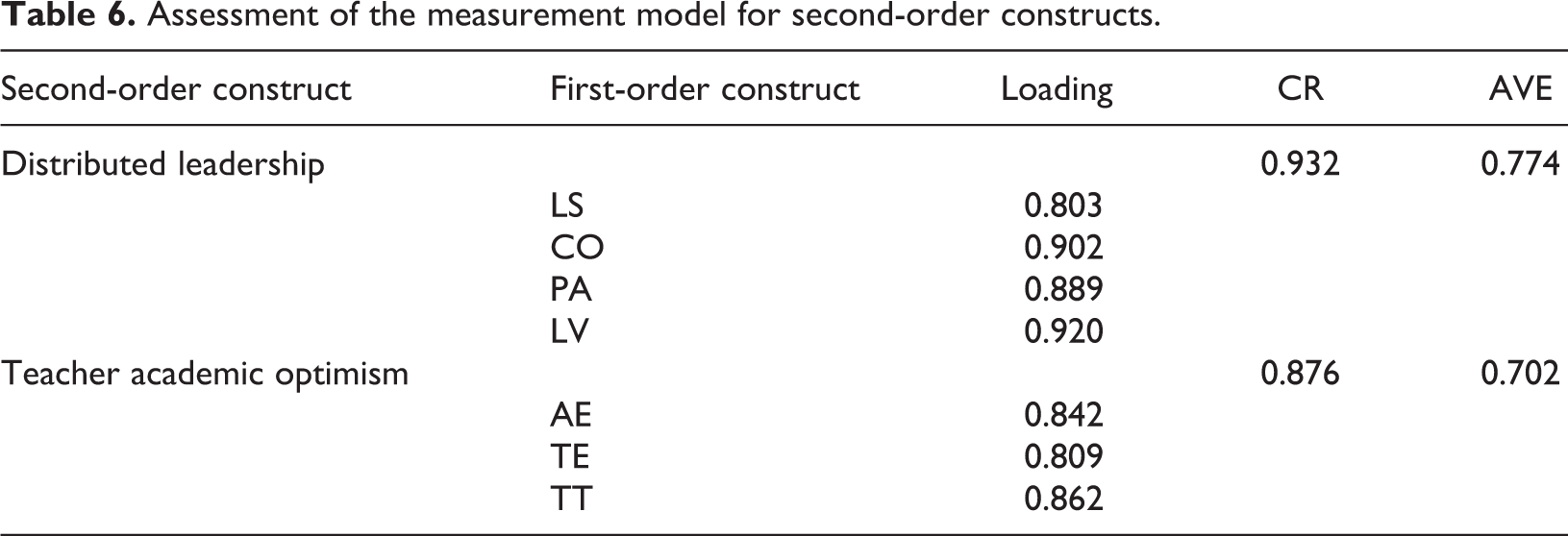
Table 6 shows that the respective first-order constructs of both distributed leadership and teacher academic optimism have loading values above 0.70. The AVE values of distributed leadership and teacher academic optimism were found to exceed 0.50. The CR values of distributed leadership and teacher academic optimism were above 0.70. Hence, convergent validity was established. On the other hand, the ratio of correlations within variables to correlation between variables is 0.515, far less than 0.85 (HTMT.85). Findings that informed discriminant validity was established.
Assessment of the measurement model for second-order constructs.
Assessment of structural model
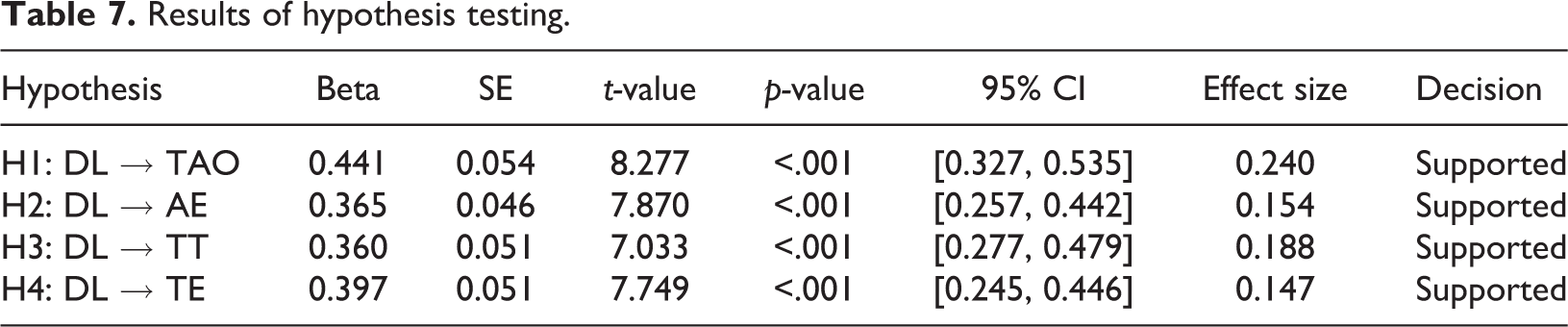
Table 7 shows that distributed leadership has a significant positive relationship with teacher academic optimism (β = 0.441, t > 1.645) at the significance level of .001. Thus, H1 was supported. Likewise, distributed leadership has a significant positive relationship with each dimension of teacher academic optimism: academic emphasis (β = 0.365, t > 1.645), teachers’ sense of efficacy (β = 0.397, t > 1.645), and teachers’ trust in students and parents (β = 0.360, t > 1.645). Hence, H2–4 were supported. The 95% confidence interval corrected bias for each hypothesis that contained no zero has further shown the significant relationships between distributed leadership, as well as distributed leadership with each dimension of teacher academic optimism.
Cohen (1988) proposed that effect size with the cutoff values of 0.02, 0.15, and 0.35 indicates the level of weak, moderate, and strong impact of the independent variable on the dependent variable. Table 7 shows that distributed leadership has a moderate impact on the latent variable of teacher academic optimism (f 2 = 0.240), academic emphasis (f 2 = 0.154), teachers’ sense of efficacy (f 2 = 0.147), and teachers’ trust in students and parents (f 2 = 0.188). Figure 2 shows that distributed leadership contributed about 20% to teacher academic optimism. Specifically, Figure 3 illustrates that distributed leadership contributed about 15%, 17%, and 13% to the dimensions of academic emphasis, teachers’ sense of efficacy, and teachers’ trust in students and parents, respectively.
Results of hypothesis testing.
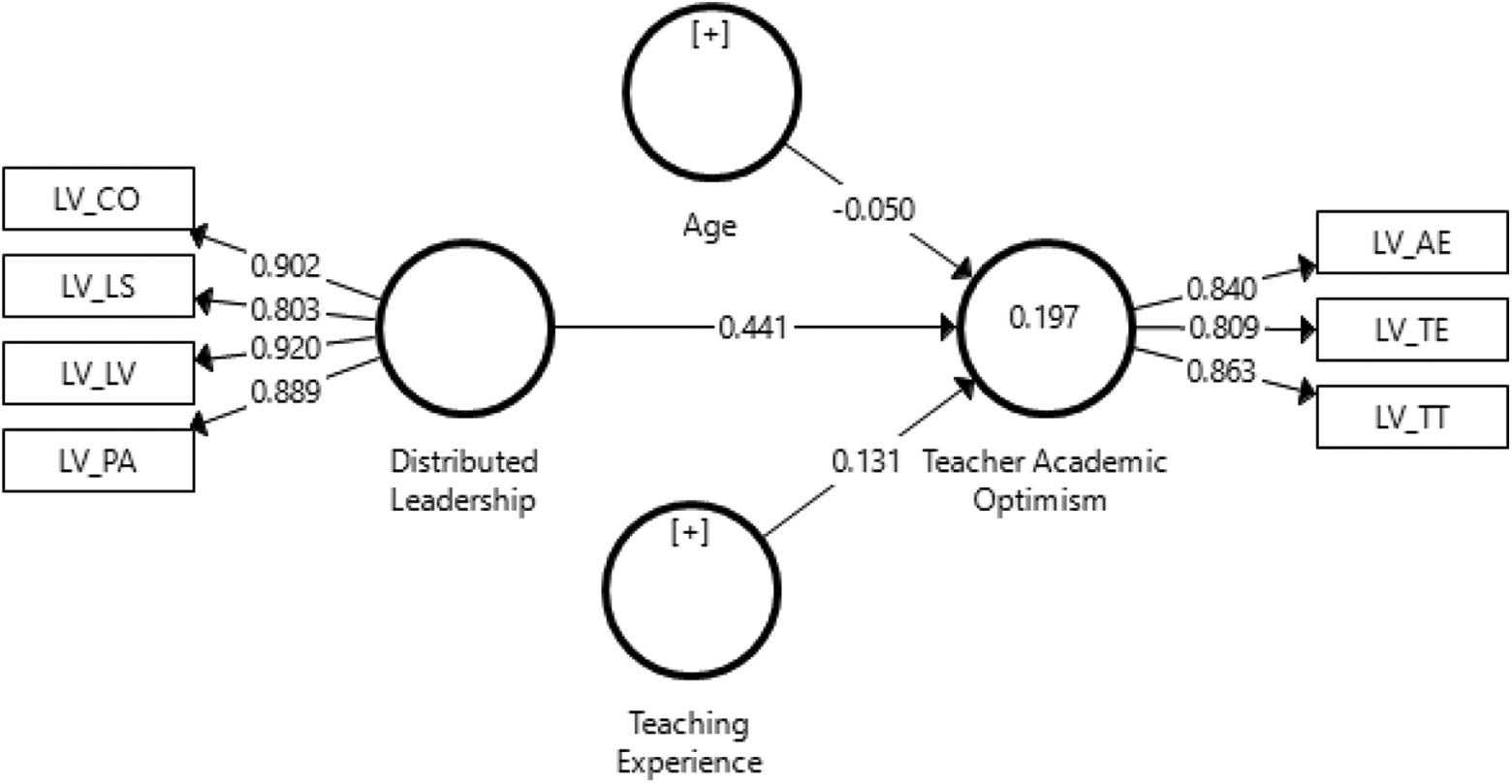
Structural model 1.
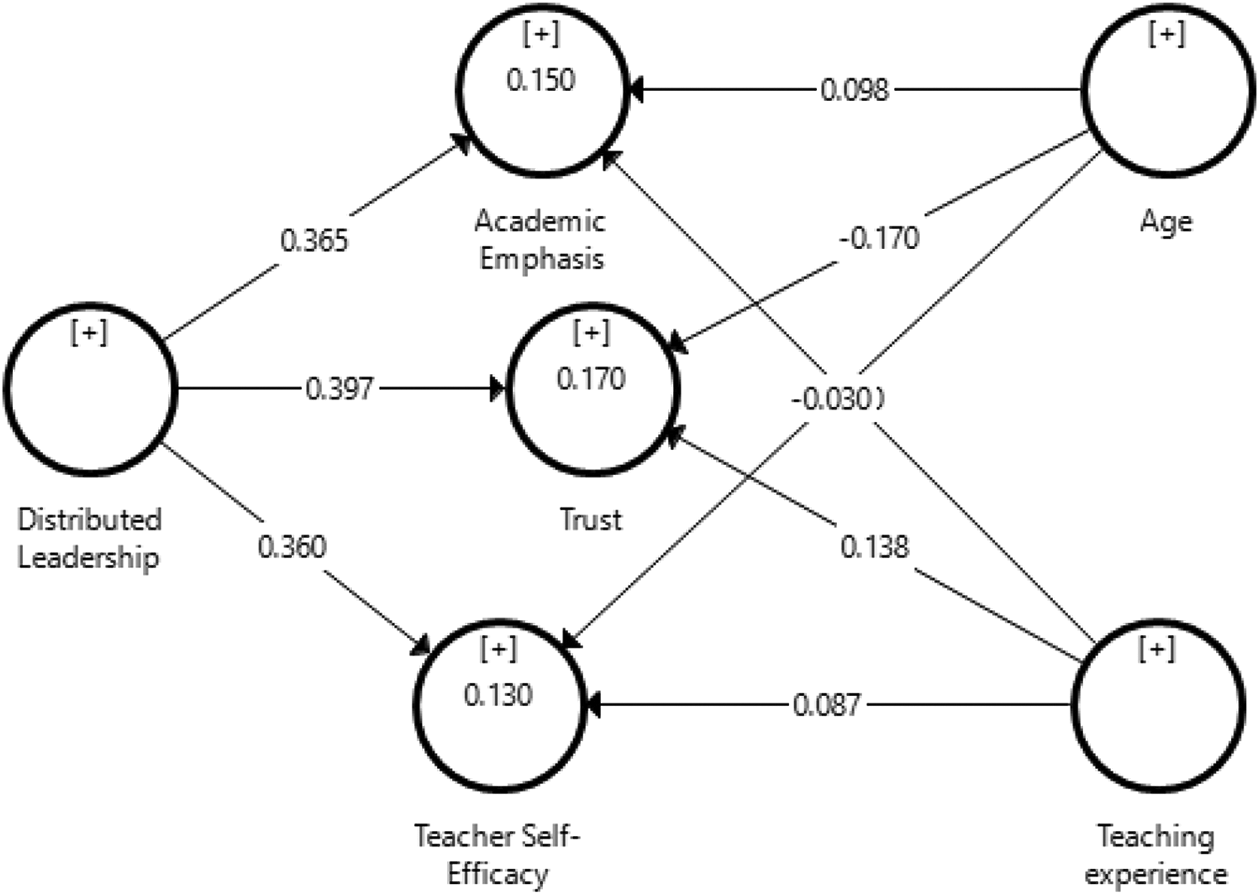
Structural model 2.
To sum up, the EFA results showed that the numbers of extracted factors of distributed leadership and teacher academic optimism are equivalent to the original Western version. The items were loaded on their respective factors for both distributed leadership (see Table 2) and teacher academic optimism (see Table 3). The extracted factors contributed about 70% of variance on distributed leadership and teacher academic optimism, respectively. On the other hand, the results of the assessment of structural model for hypothesis testing (H1–H4) showed that all the direct effects between distributed leadership and teacher academic optimism as well as distributed leadership and each dimension of teacher academic optimism were significant at the level of .05. Based on the effect size values, distributed leadership has the strongest impact on the latent variable of teacher academic optimism, followed by the dimension of teachers’ trust in parents and students, academic emphasis, and teachers’ sense of efficacy.
Discussion
The applicability of both distributed leadership and teacher academic optimism scales as well as the scarcity of these two constructs in the educational literature in the local context has prompted the current study to address these research gaps in the Malaysian primary school context. This study revealed several important findings.
Findings supported that the operationalization of the distributed leadership scale was similar to the perception of Western societies. This can be observed, as similar factors of distributed leadership were extracted based on EFA. The four extracted dimensions of distributed leadership – leadership support, cooperation leadership team, participative decision-making, and leadership supervision – are similar to the original dimensions of the distributed leadership scale developed by Hulpia et al. (2009b). However, the exclusion of the three cooperation leadership team measures (CO5, CO9, and CO10) indicated the variation of the operationalization of cooperation leadership team dimension from the Malaysian teachers’ perspective. There are two possible reasons to explain the findings. Firstly, the original cooperation leadership team subscale has failed to fully capture the Malaysian teachers’ perception of this dimension. To support this assertion, a Malaysian-based qualitative study conducted by Bush and Ng (2019) has revealed additional dimensions of a local-based distributed leadership compared to the Western literature. These additional dimensions include (a) delegation, (b) sharing the workload, (c) trust, (d) consultation, and (e) autonomy. Secondly, Malaysian teachers perceived distributed leadership as delegation instead of the cooperation of the leadership team (Bush and Ng, 2019). School leaders remain in power due to the rigid management structure in a highly centralized education system in Malaysia (Bush and Ng, 2019; Tahir et al., 2015; Thien, 2019). This can be seen as the school leaders delegating tasks to their senior assistants in the form of allocative distributive (Bush and Ng, 2019). Likewise, senior assistants perceived distributed leadership as a top-down process, as they carried out tasks based on the school leaders’ instructions (Tahir et al., 2015).
The EFA findings showed that the three extracted factors concurred with the original Chang’s (2011) teacher academic optimism scale, namely academic emphasis, teachers’ trust in students and parents, and teachers’ sense of efficacy. However, the exclusion of three academic emphasis measures reflected the variation of Malaysian teachers’ operationalization on teacher academic optimism. These three excluded items mainly focused on students’ progress in completing their assignment, their capability of achieving predetermined learning objectives, and cooperation in class learning. In Malaysia, teachers’ perception of academic emphasis is strongly influenced by the ‘examination-oriented’ education system (Chin et al., 2019; Ong, 2010). Malaysian students need to sit for three national assessments throughout the 11 years of their basic education. These national assessments are the Primary School Achievement Test (UPSR), Form Three Assessment (PT3), and Malaysian Certificates of Education (SPM). The first two assessments are predominantly used to gauge students’ learning development after six years of schooling in primary schools and after three years of schooling in secondary schools, respectively. However, the main functions of both assessments have been gradually overlooked by the stakeholders (Chin et al., 2019). The SPM results are used as a gateway to various public and private tertiary education institutions after completing their secondary schooling. These three national assessments are perceived as high-stakes examinations (Ong, 2010), which focus mainly on the cognitive domain of learning. This indicates that the Malaysian education system is skewed toward achieving academic excellence in examinations instead of unleashing students’ progress in a holistic learning manner. Consequently, the overemphasis on the national assessment results have brought ‘teach for test syndrome’ and ‘finishing syllabi syndrome’ impacts (Lim, 2009). As a result, teachers are mainly focused on students’ enhancement in academic performance, contradicting the original academic emphasis subscale by Hoy, Tarter and Woolfolk Hoy (2006).
The current study has enriched the literature with the significant positive relationship between distributed leadership and teacher academic optimism in the Malaysian primary school context. The findings concurred with previous leadership studies in different national contexts, such as in Ontario (Mascall et al., 2008), Taiwan (Chang, 2011), Canada (Malloy, 2012), and Saudi Arabia (Hesanvand et al., 2013). Furthermore, this study has added value by providing empirical findings of the significant direct effects of distributed leadership on each dimension of teacher academic optimism. The findings showed that distributed leadership in terms of a cooperative and well-functioning leadership team in school is likely to influence teacher efficacy. If the cooperation team experienced more collaboration and cooperation in school, this would lead to achieving team-based objectives, solving problems, and enhancing teacher efficacy. Moreover, the findings inferred that distributed leadership was likely to increase teachers’ trust in students and parents. This could be explained, as teachers’ participation can promote commitment to the decisions that are made when there is a sense of ownership, and therefore greater teachers’ trust in students and parents is gained (Somech, 2005). With the support and supervision from the school leaders, teachers are likely to believe that students are capable of academic success regardless of their learning styles, ability, or needs.
Conclusion
This study has moved the education research initiatives a step forward by investigating the applicability of distributed leadership and teacher academic optimism, as well as its relationships outside Western societies. For the implication of policymaking, the findings of this study could inform policymakers to use appropriate empowerment strategies from the lens of distributed leadership to boost teacher academic optimism. Knowledge of such a strategy is crucial, as teacher academic optimism has a significant impact on student academic achievement. Specifically, the findings from the current study could provide evidence for policymakers to plan and propose actions and intervention to improve and enhance principals’ leadership skills and eventually enhance teacher academic optimism in their profession. For the theoretical implication, this study has supported the international literature that distributed leadership could make a difference in teacher academic optimism. Apart from that, this study has extended the theoretical basis in the literature by providing empirical evidence to support the effect of distributed leadership on each dimension of teacher academic optimism, namely academic emphasis, teachers’ trust in students and parents, and teachers’ sense of efficacy, after controlling for teacher gender and teaching experience in a non-Western context. The findings of this study could be used to inform practical implications. School leaders should underscore the importance of the distributed leadership practices in schools and apply the practices in their daily routine in enhancing teachers’ trust in students and parents, as well as teacher self-efficacy. In addition, the validated distributed leadership and teacher academic optimism scales can be used as a self-report evaluation to inform principal and teacher capacity development initiatives.
This study has several limitations that provide the direction of future studies. This study is limited to quantitative survey research design. A deeper understanding of the findings can be gained if observation, documentary analysis, or interviews among teachers can be conducted in future studies. In addition, the omission of four and five measures of distributed leadership and teacher academic optimism, respectively, has shown the need for developing a local-based distributed leadership and teacher academic optimism scale in future studies. As the influence of principal leadership could be indirect (Hallinger and Heck, 2010; Karacabey et al., 2020), the unexplained variance of about 80% of the impact of distributed leadership on teacher academic optimism has called for future studies to include theoretical-based mediators in the current structural model.
Footnotes
Acknowledgment
The authors would like to thank Dr Peng Liu for providing constructive feedback on the early draft.
Declaration of conflicting interests
The authors have no conflicts of interest to declare.
Funding
The authors received no financial support for the research, authorship, and/or publication of this article.
