



Abstract
Empirical research considers teacher collaboration to be an important predictor of outcome variables at the student, teacher, and school level. Principals are responsible for shaping teachers’ work environments, and in doing so, they can strengthen and support teacher collaboration. Drawing on social interdependence theory, we hypothesized that teachers’ collective efficacy has a mediating effect on the relationship between principal leadership and teacher collaboration. We collected data from 630 teachers in 29 primary and secondary schools in Germany and found, based on structural equation modeling, that principal leadership had a significant indirect effect on teacher collaboration, mediated by teachers’ collective efficacy. We discuss the implications of these results for supporting school improvement.
Keywords
Introduction
Teacher collaboration is an important characteristic of successful schools and a significant predictor of a number of outcomes at the student, teacher, and school level (Vangrieken et al., 2015). It can help promote student achievement (Goddard et al., 2007), support teachers in dealing with stressors and psychological strains (Johnson, 2003), and strengthen a school’s capacity for improvement (Li et al., 2016). The responsibilities of the principal, as one of several school administrators, include managing school staff and fostering a positive school climate. This places principals in a position to promote and support teacher collaboration in their schools. In addition to creating supportive conditions (e.g., by providing regular and sufficient time for collaboration) and building trust and a supportive atmosphere among teaching faculty, principals can foster teachers’ motivation to collaborate (Vangrieken et al., 2015). Successful collaboration presupposes that individuals believe in the group’s ability to succeed in joint efforts (Truijen et al., 2013). Principals can support teacher collaboration by strengthening teachers’ perceptions of their collective efficacy (i.e., teachers’ individual perceptions of how well the group of teachers can deal with challenging situations).
Studies have addressed the relationships between principal leadership and both teacher collaboration and collective efficacy. Findings have shown that principal leadership predicts the quantity and quality of teacher collaboration (e.g., Honingh and Hooge, 2014; Voelkel, 2019). Yet with regard to the relationship between principal leadership and teachers’ collective efficacy, the findings to date have been inconsistent. Whereas some studies have found a statistically significant relationship between principal leadership and teachers’ collective efficacy (Çalik et al., 2012; Zheng et al., 2017), others have not (Fancera and Bliss, 2011).
Recent studies have not filled the gap in research on two key aspects of the relationship between principal leadership and teacher collaboration. First, studies have addressed the relationship between principal leadership and teachers’ individual self-efficacy, but few have investigated predictors of teachers’ collective efficacy, although this is considered an important predictor of teacher collaboration. Second, most studies to date have focused solely on the effect of teacher collaboration on teachers’ (self-)efficacy, leaving out reciprocal effects (Goddard and Kim, 2018; Sehgal et al., 2017). Based on approaches from organizational psychology regarding social interdependence as a prerequisite for collaboration (Campion et al., 1993; Truijen et al., 2013), the present study examines teachers’ collective efficacy not as a criterion but as a predictor of collaboration.
This paper addresses the relationships between principal leadership, teachers’ collective efficacy, and teachers’ collaborative behavior. We hypothesize that collective efficacy mediates the relationship between principal leadership and teacher collaboration. In this study, we first present our theoretical assumptions regarding principal leadership and the relationships between principal leadership, the collective efficacy of teachers, and teacher collaboration, followed by our empirical findings. Subsequently, we discuss our study design and results.
Theoretical framework of principal leadership
Principal leadership has long been a topic of investigation in research. Many studies have assessed principal leadership in terms of specific leadership models, such as instructional leadership (Blase and Blase, 2000, Goddard et al., 2015, Robinson et al., 2008) or transformational leadership (Liu et al., 2019; Ninković and Knežević-Florić, 2018; Shatzer et al., 2014). We first briefly describe the two main models of principal leadership discussed in the literature to date to provide theoretical assumptions on the relationships between leadership practices, teachers’ collective efficacy, and teacher collaboration. This comparison provides a comprehensive theoretical framework of principal leadership of this study.
Transformational leadership emerged in the 1970s from organizational research as a first model of leadership. It consists of a set of leadership practices that aim to increase the commitment, capacity, and engagement of staff in meeting their organization’s goals (Burns, 1978; Ninković and Knežević-Florić, 2018). Transformational leaders give “personal attention to individual staff so they feel uniquely valued” (individualized consideration) and encourage staff to think creatively and innovatively about the future of their organization (intellectual stimulation). They “communicate optimism and high expectations (inspirational motivation)” and provide “a vision and purpose” for their organization (idealized influence) (Robinson and Gray, 2019, p. 173).
Instructional leadership focuses on leadership in educational organizations (e.g., schools) and includes all leadership activities aimed at improving teaching quality and the academic progress of students (Leithwood et al., 2004; Marks and Printy, 2003). Instructional leaders define and communicate clear, measurable, and time-based school goals (Hallinger, 2005). They supervise and evaluate instruction, coordinate the curriculum, and monitor students’ academic progress. Moreover, instructional leaders protect instructional time, promote the professional development (PD) of staff, and provide incentives for teaching and learning (Hallinger, 2005).
In the present study, we do not approach principal leadership through a specific leadership model as both transformational and instructional leadership can be criticized for two reasons. First, instructional and transformational leadership are not distinct, but related constructs that have several features in common: both involve articulating a clear vision, setting high expectations, and providing intellectual stimulation in terms of staff development (Felfe, 2006, Hallinger, 2003, Kwan, 2019). For this reason, Hallinger (2003), Marks and Printy (2003), Shatzer et al. (2014) and Day et al. (2016) proposed integrated models of leadership that embrace coexistent attributes of both instructional and transformational leadership. Moreover, Kwan (2019) argues that “the traditional distinct differentiation between the two leadership practices are becoming blurred—with instructional elements embedded in the conception of transformational leadership and teacher development components in the conception of instructional leadership” (Kwan, 2019, p. 346). Therefore, empirical researchers should increasingly focus on a combination of different leadership practices (Berkovich, 2017). Second, as both concepts lack theoretical foundation and consistent empirical evidence, Robinson and Gray (2019) and Robinson et al. (2008) argue that empirical researchers should investigate principal leadership not based on specific leadership styles but through analyses of principals' actual work and its effects.
In the present study, we take on these two points of criticism and address principal leadership as leadership practices in terms of instructional development and staff development. By doing so, we approach principal leadership as a form of coexistent and integrated leadership as it includes facets of both transformational leadership (e.g., providing intellectual stimulation in terms of staff development) and instructional leadership (e.g., supervising and evaluating instruction). Furthermore, instructional development and staff development are leadership practices that principals in Germany are legally obliged to do (Meyer et al., 2019). Thus, we investigate principals’ actual leadership practices and their relationship with teachers’ collective efficacy and teacher collaboration, for which we will present theoretical assumptions and empirical evidence in the following sections.
Principal leadership and teacher collaboration
Principals shape the organizational and cultural contexts of their schools and, hence, define teachers’ working conditions (Pietsch and Tulowitzki, 2017). With regard to teacher collaboration, principals determine the overall conditions, for instance, by providing opportunities for teachers to work together with colleagues (Goddard et al., 2015; Gray et al., 2016). In addition, principals can promote teacher collaboration by creating a climate of mutual trust and involving teachers in decision-making processes (Warwas et al., 2019). Because studies have shown that teacher collaboration predicts good teaching practice and student achievement, principals should support their teachers in working together (e.g., Goddard et al., 2007; Moolenaar et al., 2012; Vescio et al., 2008).
From the perspective of organizational psychology, collaboration in schools is characterized as an activity by a group of teachers (a) who orient their pedagogical work toward mutual goals, (b) who each retain their own autonomy within the group, and (c) who trust one another (Gräsel et al., 2006; Vangrieken et al., 2015). Group-related trust refers to interpersonal characteristics (e.g., personal sense of security) but also to the group’s ability to solve conflicts together (De Dreu and Weingart, 2003; Gräsel et al., 2006; i.e., conflicts that arise from challenging (non-routine) tasks; Janssen et al., 1999).
Empirical findings from the Netherlands (e.g., Honingh and Hooge, 2014), the USA (Goddard et al., 2015; Supovitz et al., 2010), and Germany (e.g., Pietsch et al., 2016; Pietsch and Tulowitzki, 2017) indicate a relationship between principal leadership and teacher collaboration. In particular, studies from Germany found a relationship between teacher collaboration and principal leadership in cases where principals provided structures required for teacher collaboration, for instance, by allocating time slots for collaboration (Harazd and Drossel, 2011; Richter and Pant, 2016; Warwas et al., 2019) or promoting teacher interaction (e.g., by appreciating teachers who work together; Harazd and Drossel, 2011). Findings from a longitudinal qualitative study on nine teachers in the United States suggest it is not sufficient for principals to merely provide structures for teacher collaboration (Szczesiul and Huizenga, 2014), but that principals should “create a culture of shared vision, purpose, and goals, in order to create interdependence and collective responsibility within teams” (Szczesiul and Huizenga, 2014, p. 187). As interdependence and collective responsibility can be understood as features of collective efficacy, we assume a relationship between principal leadership and the collective efficacy of teachers, which we will explain further in the following section.
Collective efficacy and teacher collaboration
Collective efficacy is a group-level characteristic stemming from the interactions of individuals (Bandura, 1997). This concept is not only the sum of individuals’ self-efficacy, but an aggregate set of shared views on a group’s potential (Bandura, 1997; Goddard et al., 2000). In schools, collective efficacy can be understood as a motivational characteristic resulting from teachers’ subjective perceptions of their overall level of teaching effectiveness. In this sense, collective efficacy describes teachers’ perceptions of their collective ability to use their resources to deal with difficult or challenging situations, as well as to produce and enrich successful learning environments. According to Goddard et al. (2000) and in line with Bandura’s concept of self-efficacy, several factors determine teachers’ collective efficacy (Bandura, 1997). These include the individual’s experiences of the whole group’s past successes and failures (mastery experience) as well as the individual’s experiences of the other individual group members’ past successes and failures (vicarious experience). Moreover, positive affective states of the group as well as feedback about past group achievement influence individuals’ beliefs about their collective capability to achieve future goals (social persuasion). However, according to Adams and Forsyth (2006), teachers develop their perceived collective efficacy not only based on past experiences (remote sources, i.e., past successes), but also based on more proximate sources, such as contextual and environmental factors in schools (e.g., perceived group competence). Hence, “teachers are inevitably influenced by the collective to which they belong; but, at the same time, they influence the vision of the collective capacity of the school” (Ninković and Knežević-Florić, 2018, p. 53).
Empirical research has found a positive relationship between collective efficacy and teacher collaboration. Findings from network analyses in Dutch schools have indicated that the density of a social network in schools (i.e., the number of social relationships relative to the maximum possible number of relationships among teachers) predicts teachers’ collective efficacy (Moolenaar et al., 2012). Teacher collaboration in these networks leads to increases in exchanges and support among teachers, which in turn strengthens both personal and professional relationships (Moolenaar et al., 2012). Another study from the United States by Goddard et al. (2015) found an indirect effect of principal leadership on teachers’ collective efficacy, which was mediated by teacher collaboration. Based on socio-cognitive learning theories, the authors argued that social interactions in groups provide opportunities for teachers to work together towards mutually aligned goals, thus creating situations in which individuals compare themselves with peers and thereby acquire ideas about the potential of the entire group (Goddard et al., 2015; Goddard and Kim, 2018). Goddard et al. (2015) found that experiences of joint successes reinforce the perception of collective efficacy, whereas failures weaken it.
Whereas the aforementioned studies were based on socio-cognitive theories and considered teacher collaboration a factor that predicts teachers’ collective efficacy, the present study draws on theories from organizational psychology dealing with social interdependence (Campion et al., 1993). We assume that individuals consider collaboration to be beneficial in achieving their personal goals if they believe in other group members’ abilities to achieve their own goals (Johnson and Johnson, 1989, 2009; Logsdon, 1991; positive social interdependence). For this reason, the individual belief in a group’s potential is a prerequisite for social interdependence and, hence, for collaboration (Little and Madigan, 1997; Logsdon, 1991). Empirical studies from the Netherlands (Truijen et al., 2013) and from South and Central America (Gray and Summers, 2015) have identified social interdependence as a prerequisite for effective collaboration. Findings indicate that teachers are more likely to engage in collaborative relationships and collaborate more intensively if they believe in the potential of their joint work (Gray and Summers, 2015; Truijen et al., 2013). Teachers’ collective efficacy can be viewed as an indicator of this belief, as it reflects the perceived abilities of the entire school staff.
Collective efficacy as a mediating variable between principal leadership and teacher collaboration
As principals shape and determine their school’s working conditions, they are in a position to create the best possible environment for teachers to work together. Findings from empirical studies have indicated that principal leadership has an impact on teachers’ individual and collective (self-)efficacy on the one hand and their collaborative behavior on the other (e.g., Çalik et al., 2012; Hoy and Woolfolk, 1993; Ross and Gray, 2006; Supovitz et al., 2010; Waters et al., 2003). As we investigate specific leadership practices in this study, in the following section we present theoretical assumptions and empirical findings on the relationships between principal leadership in the areas of instructional development and staff development with teachers’ collective efficacy and teacher collaboration.
Instructional development can be considered one aspect of instructional leadership, which comprises all activities aimed at improving the quality of instruction (e.g., conducting classroom visits, defining standards for instructional quality). If principals engage in activities in this field, they provide teachers with guidance on their instructional work. When teachers modify their instruction accordingly and, in turn, experience personal successes (or observe successes of their colleagues), this will in return foster their collective efficacy. Furthermore, when principals conduct classroom visits or promote peer observation and personal feedback, they help teachers analyze their own strengths and weaknesses. Moreover, we assume that teachers who believe in their principal’s instructional abilities will more often approach the principal with questions and ask for advice. All of this helps teachers to cope with difficult professional situations and strengthens their beliefs in their own abilities and in the abilities of the entire teaching staff (Adams and Forsyth, 2006; Marks and Printy, 2003).
In contrast to instructional development, staff development includes all activities of the principal supporting teachers’ competencies. This represents a facet of transformational leadership as it involves leadership practices that provide teachers with intellectual stimulation (e.g., advising teaching staff to participate in PD) and individualized consideration (e.g., addressing professional needs of school staff). When principals support teachers in their professional skills, they directly strengthen the development of competencies and beliefs on an individual level (Tuytens and Devos, 2017, 2011; Van Waeyenberg et al., 2020). We assume, however, that when principals systematically implement activities of staff development in their schools, they increase the percentage of staff with appropriate skills and, hence, the chances of teachers perceiving group-level mastery experiences and vicarious experiences as well as group competence (Adams and Forsyth, 2006; Goddard et al., 2000; Ma et al., 2017).
By providing teachers with opportunities to attend high-quality PD programs, principals can encourage their teachers to reflect on their classroom practices and improve their skills. Moreover, when principals create work environments that help teachers to apply newly acquired skills in the classroom, they foster teachers’ mastery experience (Bandura, 1993). Principals can also build and enhance teachers’ collective efficacy by conducting systematic staff appraisals (Locke and Latham, 1990). We assume that staff appraisals create opportunities for individual discussion, in which principals (as well as other managerial or school staff, e.g., mentor teachers) can provide specific feedback on teachers’ previously specified goals (Hattie and Gan, 2011; Locke and Latham, 1990). On the one hand, this makes teachers feel appreciated and motivated to continue their professional growth (Tuytens and Devos, 2017). On the other, it helps teachers critically reflect on their own performance and identify individual strengths and weaknesses. In this regard, staff appraisals need to be implemented systematically as an ongoing process of goal-oriented (process and product oriented) and data-driven interviews (e.g., based on classroom observations) that combine individual and school improvement planning (Day, 1999; Locke and Latham, 1990). All of these approaches may lead to increases in the entire school staff’s performance and, thus, contribute to teachers’ perceptions of their individual as well as collective efficacy as collective efficacy is not only based on personal experiences, but also on the perception of the group’s ability to perform future tasks (proximate sources, Adams and Forsyth, 2006).
Studies on the relationship between leadership and teachers’ collective efficacy have produced inconsistent findings. Although studies from Turkey, Iran, and Israel report a positive relationship between instructional development activities and teachers’ collective efficacy (Çalik et al., 2012; Hallinger et al., 2018; Qadach et al., 2019), other studies from the United States and Serbia have found no relationship between these characteristics (Fancerra and Bliss, 2011; Ninković and Knežević-Florić, 2018). In terms of staff development, findings are similarly inconsistent. A qualitative study from the United States found that principals can enhance teachers’ self-efficacy by motivating teachers to reflect on their own performance, praising teachers, listening to teachers’ problems, and sharing experiences with them (Blase and Blase, 2000). Although a recent study of Serbian secondary school teachers found a moderate statistically significant relationship between principal leadership in terms of staff development (i.e., the principal encourages teachers to evaluate their practices and refine them as needed) and teachers’ collective efficacy (Ninković and Knežević-Florić, 2018), a study of Chinese teachers did not find this relationship (Liu et al., 2019). However, there is no evidence to date on the relationship between principal leadership and teachers’ collective efficacy in Germany. Only one study conducted by Gerick (2014) investigated the relationship between principals’ transformational leadership and teachers’ individual self-efficacy. Her results showed a small but statistically significant effect for individualized consideration, but no relationship between intellectual stimulation and teachers’ self-efficacy (Gerick, 2014). Pietsch et al. (2018) summarize that studies from Germany dealing with teachers’ motivational outcomes as a result of principal leadership have focused on teachers’ job satisfaction, job commitment, or wellbeing (e.g., Harazd and van Ophuysen, 2011; Klein and Bremm, 2019). In sum, none of the existing empirical research has found clear evidence of a relationship between principal leadership and teachers’ collective efficacy.
Research question
We assume that teachers’ willingness to work with peers increases when they are convinced of the abilities of the other group members. Principals may be able to support this belief by striving to improve both instructional quality and teachers’ competencies. In addition, we assume that teachers feel more competent if, for example, principals define precise goals that teachers can pursue and/or provide teachers with systematic feedback (Lambersky, 2016). For this reason, we address the following questions: Do leadership practices of school principals in the areas of instructional and staff development predict teacher collaboration? Does teachers’ collective efficacy mediate this relationship? Figure 1 illustrates the hypothesized model.

Mediation model for principal leadership in the areas of instructional and staff development, teachers’ collective efficacy, and teacher collaboration.
The following hypotheses are based on the conditions required for a mediation analysis according to Baron and Kenny (1986):
H1: Principal leadership in terms of instructional and staff development positively predicts teacher collaboration.
H2: Principal leadership in terms of instructional or staff development positively predicts teachers’ collective efficacy.
H3: Teachers’ collective efficacy positively predicts their collaboration.
H4: The relationship between principal leadership and teacher collaboration is mediated by teachers’ collective efficacy.
Materials and methods
Sample
We examined the research question using a cross-sectional sample of 630 teachers working at seven primary schools, 15 secondary schools, and seven upper secondary schools in a federal state in Germany. The data were collected as part of the evaluation of an 18-month PD program for principals in which two members of the school leadership team and the teachers at the schools participated. The principals volunteered to attend the PD program. The data were collected in the early part of the PD program after participants had completed the first 2 months. The average response rate per school was 60.0% of the teaching staff. Women made up 62.4% of the participants, and teachers who reported working in the profession for more than 12 years made up 48.7% of the participants.
Instruments
Leadership practices in the field of instructional and staff development were each measured in a teacher survey. With regard to instructional development, teachers were asked to assess how involved their principals were in activities aimed at improving the quality of instruction (e.g., The principal ensures that a common understanding of instructional quality exists at our school). The scale consisted of five items that were adapted from other instruments (Hallinger et al. 2015; OECD, 2014b). Leadership practices in the field of staff development were based on items that describe principal’s engagement in supporting and enhancing teachers’ professional skills (e.g., The principal gives our teachers frequent feedback on how they are developing.). This scale was measured with five items taken from existing instruments by Hallinger et al. (2015), Bass and Avolio (1995), and Felfe (2006). All items were rated on a four-point Likert scale (1 = strongly disagree to 4 = strongly agree).
As studies of legal documents from Germany show that principals are legally obliged to conduct tasks in the field of instructional and staff development as well as support collaboration among teachers (Huber and Schwander, 2015; Meyer et al., 2019), we selected the items based on principals’ formal tasks in this federal state (e.g., supporting teaching staff in dealing with pedagogical issues, conducting classroom observation). Because the original instruments were developed in English and focused on principals’ self-assessments, all items were translated into German and reformulated to assess teachers’ perceptions of their principal’s leadership practices.
Due to the nested data structure, intra-class correlations ICC(1) and ICC(2) were calculated to determine the reliabilities of the scales at the individual and group level (Bliese, 2000; Lüdtke et al., 2006). The ICC(1) indicates the percentage of the total variance that can be attributed to differences between schools, and the ICC(2) represents the reliability of the group mean at the school level (Lüdtke et al., 2006). A reliable measurement requires an ICC(1) > 0.10 and ICC(2) > 0.80. Table 1 presents information on the reliabilities of each scale. Both instructional and staff development showed satisfactory values.
Information on the model fit of all variables.
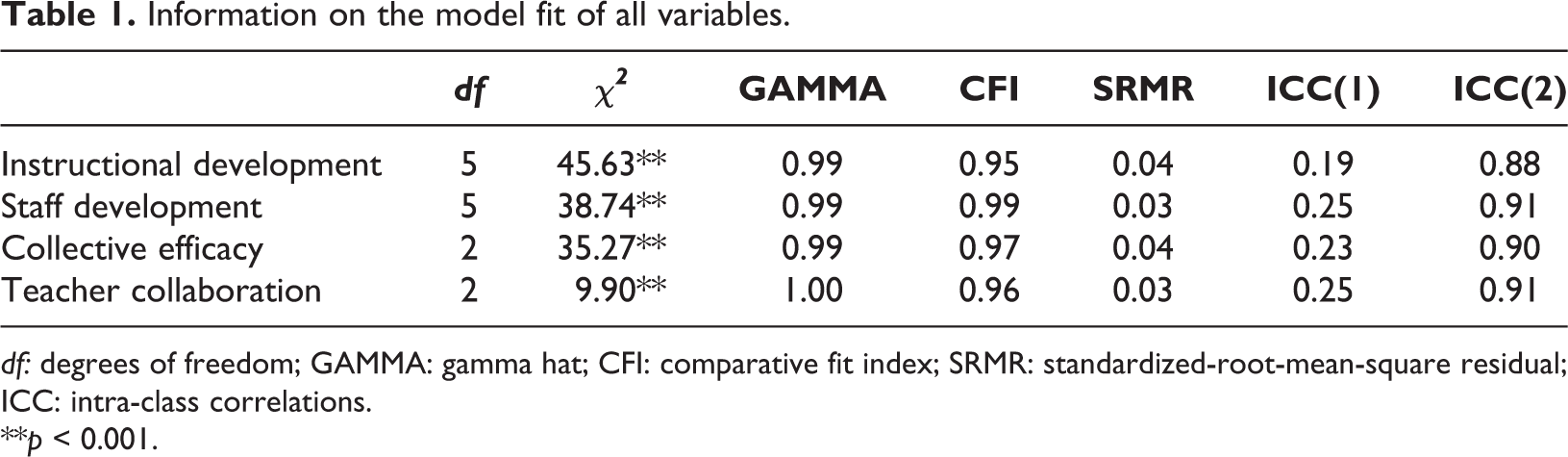
df: degrees of freedom; GAMMA: gamma hat; CFI: comparative fit index; SRMR: standardized-root-mean-square residual; ICC: intra-class correlations.
**p < 0.001.
The collective efficacy scale was assessed with an instrument by Schwarzer and Jerusalem (1999). This scale included four items referring to the teachers’ perceptions of their collective ability to deal with challenging situations and to achieve their goals (e.g., I believe in the ability of our staff to implement innovations even in difficult situations.). Again, teachers were asked to rate the items on a four-point Likert scale (1 = strongly disagree to 4 = strongly agree). With regard to teacher collaboration, teachers were asked to assess how often they engaged in certain forms of collaboration on two different levels. The items referred either to how teachers collaborated in terms of exchange of information and teaching materials among colleagues or to more complex forms of collaboration (e.g., teaching a class together as a team; OECD, 2014a). The scale for assessing teacher collaboration consisted of four items rated on a four-point scale (1 = never, 2 = rarely, 3 = regularly, 4 = always). The items for measuring collaboration were translated into German from TALIS 2013 (OECD, 2014b). Again, both scales showed satisfactory reliability (see Table 1).
Analyses
We used structural equation modelling to investigate the relationships in the hypothesized model (see Figure 1). The IBM SPSS Statistics 25 software was used to prepare the data and calculate descriptive statistics and correlations. The model was estimated in Mplus 8.2 using the full information maximum likelihood algorithm to take all available information into account without replacing or imputing missing values. Although the data demonstrated a multi-level structure, all variables were examined at the teacher level (as the teachers were supposed to assess their principals’ leadership). We accounted for the nested structure of the data (as the sample consisted of several groups of teachers from different schools) by using the school code as a cluster variable in the model. Moreover, the algorithm TYPE=COMPLEX was used.
Initially, we assessed the model fit for each construct (instructional and staff development, teachers’ collective efficacy, and teacher collaboration), to check if all variables can be modeled latently. For this purpose, we estimated four independent measurement models and reported the fit statistics in Table 1. To evaluate model fit, we used Gamma Hat (GAMMA), the Comparative Fit Index (CFI), and the Standardized-Root-Mean-Square Residual (SRMR). We used GAMMA instead of the Root-Mean-Square-Error of Approximation (RMSEA) because the RMSEA is particularly sensitive when models have a small number of degrees of freedom (df) (Hu and Bentler, 1998). The following criteria were applied to identify acceptable model fit: GAMMA ≥ 0.95, CFI ≥ 0.90, SRMR ≤ 0.08 (Bentler 1990; Hu and Bentler, 1999). For all factors, a satisfactory fit was achieved. As instructional and staff development were strongly correlated (r = 0.67), they were included as a second-order factor in the analyses and, hence, combined into one factor for principal leadership.
To investigate our research questions, we estimated a series of structural equation models and reported the standardized path coefficients. According to Baron and Kenny’s (1986) criteria, the following conditions must be fulfilled to identify a mediation effect (see Field, 2013). The direct effect (Hypothesis 1) of a mediation relationship is defined by a statistically significant correlation between the dependent (teacher collaboration) and independent variables (principal leadership). An indirect effect requires a statistically significant correlation between the mediating (teachers’ collective efficacy) and independent variables (principal leadership; Hypothesis 2) and between the dependent (teacher collaboration) and mediating variables (teachers’ collective efficacy; Hypothesis 3). A mediation effect is given if the direct effect is smaller than the relationship between the independent and dependent variables without the mediating variable (Hypothesis 4; total effect). Although a non-significant direct effect and a significant indirect effect indicate full mediation, partial mediation is defined by significant direct and indirect effects with a direct effect being smaller than the total effect (effect without mediation), yet different from zero (see Rucker et al., 2011).
Results
Descriptive data
Initially, we analyzed the data descriptively as shown in Table 2. For this purpose we calculated the means of each scale and compared them with the theoretical mean. Scores above the theoretical mean indicate an endorsement of the items in this scale, whereas scores below the mean represent a disagreement with the items. Teachers’ ratings of their principals’ leadership practices in the areas of instructional development (M = 2.29, SD = 0.68) and staff development (M = 2.21, SD = 0.73) were significantly below the theoretical mean (p < 0.001). This also applied to teachers’ ratings of their collaboration with other teachers (M = 2.31, SD = 0.56, p < 0.001). Teachers’ collective efficacy was rated significantly above the theoretical mean of the scale (M = 2.95, SD = 0.68, p < 0.001), which indicates teachers tend to perceive a high sense of collective efficacy.
Descriptive data for instructional development, staff development, collective efficacy, and teacher collaboration.
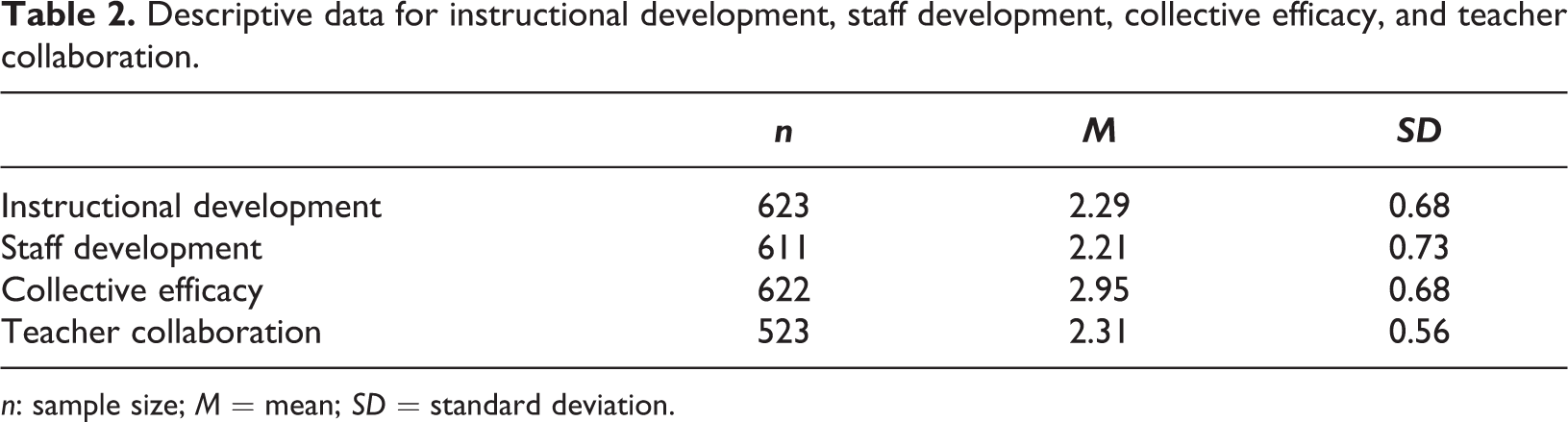
n: sample size; M = mean; SD = standard deviation.
Correlation analysis
To investigate the relationships between instructional and staff development, collective efficacy, and teacher collaboration, we first computed bivariate correlations with all manifest variables (see Table 3). We found strong correlations between instructional and staff development (r = 0.67, p < 0.01). Both scales were also correlated at a medium level with collective efficacy (instructional development: r = 0.46, p < 0.01; staff development: r = 0.49, p < 0.01).
Bivariate correlations for instructional development, staff development, collective efficacy, and teacher collaboration.

** p < 0.01, two-tailed.
Mediation analysis
With regard to our research questions, we estimated structural equation models to investigate the relationships between principal leadership, collective efficacy, and teacher collaboration. With regard to Hypotheses 1 and 2, we first examined the direct relationships between the latent variables in separate models. For Hypothesis 1, we identified a significant large direct effect (β = 0.56, p < 0.001) between principal leadership and teacher collaboration. The more principals were involved in instructional and staff development, the more intensely their teachers collaborated with one another. Furthermore, we found a significant direct relationship between principal leadership and collective efficacy in a separate model (H2: β = 0.64, p < 0.001) as well as between collective efficacy and teacher collaboration in the mediation model (H3: β = 0.20, p < 0.05). After having tested the prerequisites for a mediation analysis, we examined the full mediation model, which showed a satisfying model fit (see Figure 2, χ2 (p < 0.001, df = 115) = 415.47, GAMMA = 0.98, CFI = 0.94, SRMR = 0.05). This model tests Hypothesis 4 and includes direct and indirect effects of principal leadership on teacher collaboration mediated by teachers’ collective efficacy. The direct effect of principal leadership on teacher collaboration (β = 0.42, p < 0.001) is smaller than the coefficient relating principal leadership to teacher collaboration according to H1, which indicates a partial mediation. Moreover, we found a significant indirect effect of β = 0.13 (p < 0.05), which is mediated by teachers’ collective efficacy. A total of 32% of the variance in teacher collaboration was explained by this relationship.
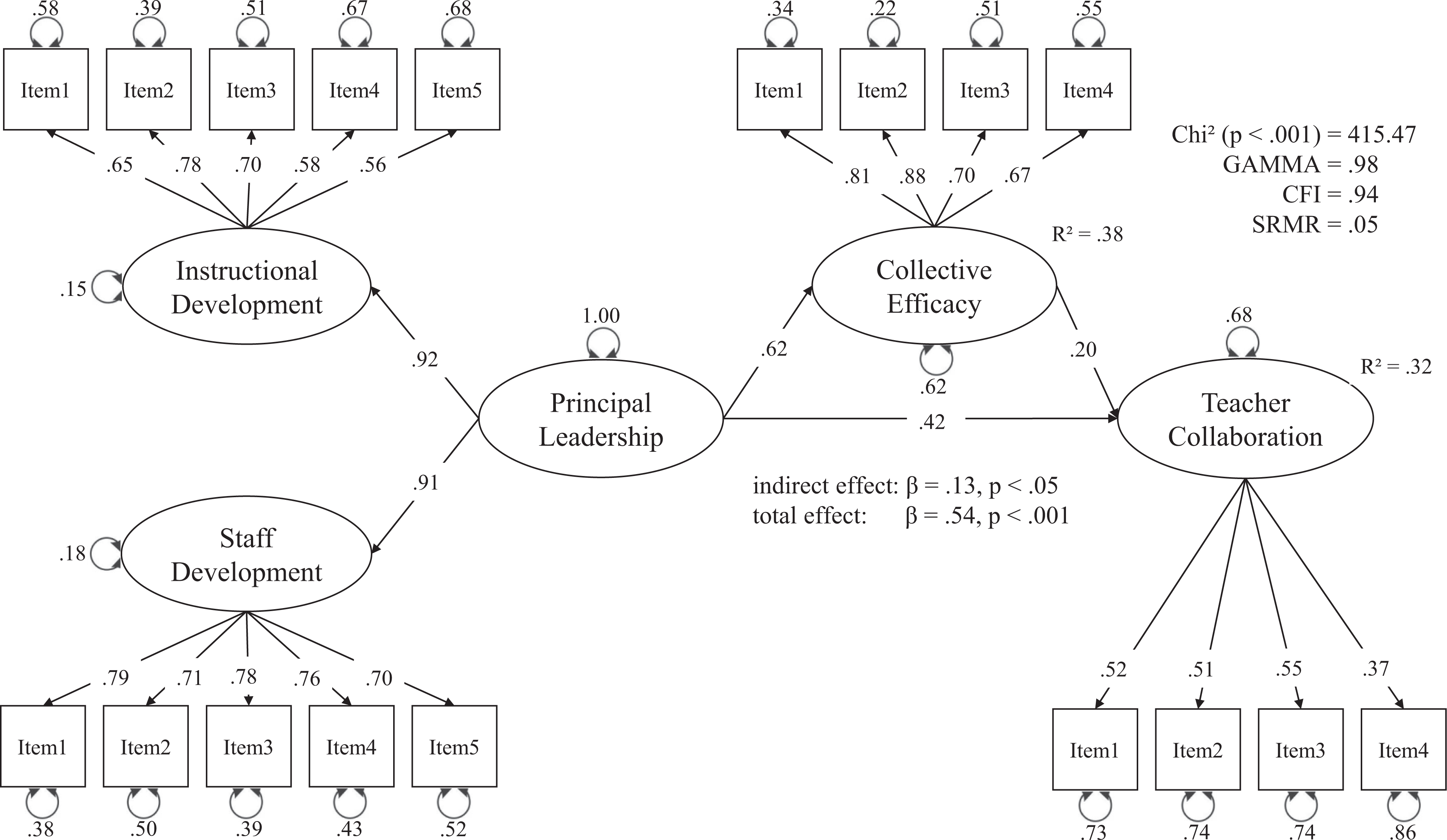
Model of the mediation analysis. Collective efficacy as the mediator between principal leadership and teacher collaboration.
Discussion
The present study investigated the relationships between principal leadership practices, teachers’ collective efficacy, and teacher collaboration. First, teachers rated their principals’ activities in the field of instructional and staff development significantly below average. Our results suggest that principals are not strongly involved in improving the quality of instruction or developing the skills of their school staff. This finding corresponds with other results from Germany (Klein, 2017; Pietsch et al., 2016; Pietsch et al., 2018; Warwas, 2012). Principals in Germany tend to consider themselves more as school administrators than as school leaders who foster school improvement (Harazd and Gerick, 2011; Warwas, 2012). Moreover, our results correspond with the finding that principals in Germany use only a small amount of their time for school improvement (e.g., staff development) because they are a part of the school’s faculty and spend parts of their time teaching (Brauckmann and Schwarz, 2015). Although they do not invest much time in school improvement, as demonstrated by Brauckmann and Schwarz (2015), they seem to be interested in this field as they report a high need for PD (Klein and Schwanenberg, 2020).
Furthermore, our findings indicate that teachers rarely work together, which is congruent with results reported by Richter and Pant (2016), who found that although teachers in Germany exchange information and teaching materials, they scarcely collaborate on a more complex level (e.g., teaching as a team). This might be due to teachers in Germany usually not having sufficient time at school set aside for teacher collaboration only. For this reason, they are more likely to voluntarily work together if collaboration is part of the school culture and if teachers have fixed time slots that allow them to coordinate their work (Richter and Pant, 2016).
Drawing on social interdependence theory, we investigated the mediating effect of teachers’ collective efficacy on the relationship between leadership practices and teacher collaboration. As assumed in Hypothesis 1, our findings show that principals who were involved in instructional and staff development were more likely to work in schools in which teachers worked together more closely. This is in line with findings from other studies showing a positive relationship between principal leadership and teacher collaboration (e.g., Goddard et al., 2015; Sehgal et al., 2017). To promote teacher collaboration, principals can create supportive structures in their schools, for instance, by providing regular opportunities for teachers to collaborate (Gray et al., 2016; Warwas et al., 2019). Apart from these structural prerequisites, however, teacher collaboration also depends on the quality of the social relations within a group. For this reason, we used teachers’ collective efficacy as a construct that mediates the relationship between leadership practices and teacher collaboration.
Findings from our mediation analysis suggest that at schools where principals are involved in instructional and staff development, teachers report higher collective efficacy on the one hand and work together more often on the other (Hypotheses 2 and 4). The results are largely in line with previous findings. Whereas studies by Çalik et al. (2012), Liu et al. (2019), Ninković and Knežević-Florić (2018), and Qadach et al. (2019) found relationships with small to medium effect sizes between principal leadership and collective efficacy, the present study, as well as Hallinger et al., (2018), found a strong effect. Moreover, this corresponds with research on the prerequisites for collaboration among professional learning communities that has identified collective efficacy and trust within a group as essential factors (Cranston, 2011; Gray and Summers, 2015).
Our results offer several contributions to the research on school leadership and school improvement. First, the results of this study help reduce the inconsistencies in the evidence on the relationship between principal leadership and teachers’ collective efficacy by demonstrating a strong relationship between these two aspects. Moreover, the present study investigated principal leadership not through the lens of instructional or transformational leadership models, but by examining leadership practices in the areas of instructional and staff development. By investigating the relationship between principal leadership, collective efficacy, and teacher collaboration in Germany, the study builds on existing research into how cultural differences affect collective efficacy in school contexts (Klassen et al., 2010). Our finding of strong relationships between principal leadership and the collective efficacy of teachers confirms results from other countries such as Israel (Qadach et al., 2019), Iran (Hallinger et al., 2018), Serbia (Ninković and Knežević-Florić, 2018), China (e.g., Liu et al., 2019), and the United States (e.g., Voelkel, 2019).
The findings also have implications for schools and school administrations. Our results suggest that principals’ work in school improvement—in particular, instructional and staff development—is related to teachers’ collective efficacy. Principals can support their teachers’ mastery experiences by providing teachers opportunities to improve their instructional quality and build and develop their skills (Bandura, 1997). In this context, principals can set school-wide instructional goals or ensure that teachers regularly conduct mutual classroom visits and receive feedback on their own performance. They can also discuss learning needs and highlight potential for development in staff appraisals and implement these measures systematically in their schools (Brinson and Steiner, 2007). Novice teachers would benefit in particular from the support of principals and peers, as they often face challenging situations and are at risk of experiencing failure (see Klassen and Chiu, 2010; Tschannen-Moran et al., 1998). However, all these aspects presuppose that principals have sufficient time to carry out these kinds of activities.
As principals in Germany are administrators and school teachers, they rarely have time to devote to their teachers’ PD (Brauckmann and Schwarz, 2015). Furthermore, to engage more strongly in instructional and staff development, principals need specific skills in these areas. In light of principals’ reported need for support in this area, efforts should be made to develop training and PD programs for principals that address these topics in their curricula (Klein and Schwanenberg, 2020). Alternatively, principals could implement shared leadership approaches in their schools and assign these responsibilities to other members of their teaching staff, who might be better equipped with the required skills.
The findings of this study should be interpreted in the light of a few—primarily methodological—limitations. First, we used a cross-sectional study design, which does not provide the basis for conclusions about causal relationships between the variables. Findings obtained with regression analyses only serve to identify bivariate relationships. Because cross-sectional quantitative data are limited to identifying relationships and trends, qualitative research on individual cases as well as longitudinal research designs are needed to explore in more detail how leadership practices shape teachers’ collective efficacy and teacher collaboration. Moreover, we found a strong correlation between instructional and staff development. Although this can be explained in a plausible way, we were not able to identify specific effects of these two aspects in our analysis. The present finding of a partial mediation effect is plausible because we must assume the relationship between principal leadership and teacher collaboration is not exclusively mediated by their collective efficacy (MacKinnon et al., 2007). Other variables, such as teachers’ innovativeness, a school’s social climate, collegial trust, and support by peers can also have mediating effects. Therefore, future empirical studies should take other variables into account when exploring this relationship.
Footnotes
Declaration of conflicting interests
The author(s) declared no potential conflicts of interest with respect to the research, authorship, and/or publication of this article.
Funding
The author(s) disclosed receipt of the following financial support for the research, authorship, and/or publication of this article: The data were collected as part of the evaluation of the professional development program Werkstatt Schule leiten, which was funded by Die Deutsche Schulakademie.
