



Abstract
Research exploring the challenges department chairs face has long suggested the role is difficult and lacks tangible reward (Buller, 2012, 2015; Gmelch et al., 2017). Yet, as higher education demographics, settings, and organizational expectations change and chairs function in more uncertain and increasingly complex institutional environments, it is important to understand how chairs describe the challenges they encounter, the ways in which they respond to those challenges, and the knowledge and skills they draw on to do so. Drawing on 45 interviews with chairs across a variety of institution types, this study focuses on chairs’ perceptions of their role, contextualization of their learning, and understanding how orientations toward faculty, staff, and students contribute to their work. Findings suggest chairs struggle to balance their approaches to the work, striving to employ common sense while decision making, humanity when working with others, and savvy when approaching an unavoidable and often overwhelming political landscape, all while possessing limited institutional authority. These are expressed as tensions of task, organization, and role, and the people and relationships that chairs must reconcile, rather than resolve, if they are to be successful.
Introduction
Chairing a department in higher education has been called “probably the most important, least appreciated, and toughest administrative position in higher education” (Buller, 2012: 3). Yet, because the landscape of higher education is ever changing, department chairs 1 are faced with increasing demands for competency across all aspects of their job duties and the problems they face become more difficult. Certainly, there has been considerable research about the role of department chairs (Aziz et al., 2005; Berdrow, 2010; Bowman, 2002; Bozeman et al., 2013; Branson et al., 2016; Gmelch et al., 2017; Hartwig, 2004; Rowley and Sherman, 2003). Yet ongoing research is needed because as higher education demographics, settings, and organizational expectations change, chairs function in more uncertain and increasingly complex institutional environments (Dopson et al., 2018). Therefore, and in an attempt to address the complexity chairs face, the purpose of this study is to explore how chairs describe the challenges they encounter and the tensions those challenges present.
Success as a department chair is principally based on the chair’s ability to lead and manage faculty and staff (Bowman, 2002; Buller, 2015), promote the development of departmental members (Bryman, 2007; Cipriano, 2011), and provide for departmental longevity and relevance within the larger college and university setting (Hartwig, 2004; Hubbell and Homer, 1997). In this way, the position is internally and externally facing. Chairing requires that one pay attention to the detail of day-to-day departmental life while also focusing on matters of college and university governance, budget, policy, and practice. This work is demanding and complex. Additionally, it rarely aligns with the academic training faculty bring with them to the position (Gmelch et al., 2017). Thus, research suggests (Morris and Laipple, 2015) chairs are more likely to flounder than to flourish. Yet if the department, as a critical location of academic work, is to succeed, understanding how the chair responds to and copes with the challenges they face, matters for the long-term sustainability of academe.
Literature
Research (Buller, 2015, Gmelch et al., 2017, Hubbell and Homer, 1997) suggests the department chair plays a central role in the organizational efficiency and effectiveness of colleges and universities. Often considered a stepping stone for academic administrator development, the role of the chair long been an interest of scholars of higher education (Gmelch and Miskin, 1993; Tucker, 1984). To provide context for this study, the history of the role, the selection of chairs, duties of the chair, inadequacy of preparation, and the challenges of the position are discussed.
History of the role
Much like the role of the dean, the department chair has been a fixture of the academy since the development of departments, schools, and colleges within the larger university (Buller, 2012). Yet, within the research literature in higher education the position lacks a clear lineage as the role and responsibilities of the chair have evolved and in relation to college and university need (Kerr, 1991). However, as Vacik and Miller (1998) suggest, the role became institutionalized in the United States (US) after the Morrill Act of 1892 created the system of land-grant institutions that comprise much of the current landscape of US higher education today. However, we find chairs in education institutions the world over. This suggests that rather than a unifying historical reason for the development of the role, rather, the role is likely attributable to organizational conditions present within universities. That is, as the work of colleges became more complex, need grew for additional leadership roles to support the dean. Much like the rise of middle managers in business (Ranson et al., 1980), the position has evolved to include a number of day-to-day tasks and responsibilities required for the smooth operation of college and university academic business.
Selection of chairs
Department chairs come to the position in a variety of ways (Gunsalus, 2006; Schloss and Cragg, 2013). Most often, chairs are promoted from within existing departments, chosen or appointed from the ranks of current faculty. In many colleges, the role rotates with members, once they have achieved tenure, filling short-term (i.e., 4 year) service appointments with the intent of returning to faculty after their term expires. In other situations, faculty become interested in administration, eyeing a deanship or beyond, and the role of the chair is considered a necessary stage in their development. Chairs may be appointed by and serve at the discretion of the dean, may be elected by departmental faculty, or hold the position in some combination of the two (i.e., elected by faculty yet appointed by the dean).
Duties of department chairs
However, no matter the journey taken to academic leadership, once in the position chairs hold the responsibility for a wide range of often dissociated tasks (Cipriano, 2011). Yet their role in and responsibility for doing the work often lacks clarity and real, tangible authority to complete these charges (Berdrow, 2010). In theory, department chairs have two main arenas of responsibility, including handling the business of the department as well as ensuring the academic mission is achieved. As the business leaders of the department, chairs are expected to run their department in accordance with the policy and rules of the university. As the academic leader of the department, chairs are expected to assure the smooth operation of academic programs and student success (Bryman, 2007; Buller, 2015; Gunsalus, 2006).
However, from a bureaucratic perspective, their placement in the organization (i.e., subordinate to the provost and dean) would suggest that chairs are less responsible for formulating strategy and more responsible for communicating and implementing it (Manning, 2018; Mintzberg, 2009; Weick, 2009). In reality, their work often bridges these roles. Chairs often participate in strategic planning and are considered key players in execution. Chairs make decisions that influence the career trajectories of faculty, and manage curriculums and departmental budgets (Taggert, 2015). Research also suggests they are major decision makers and influence university, college, and unit policies and practices (Rowley and Sherman, 2003; Schloss and Cragg, 2013). Furthermore, the role is multi-faceted, requiring expertise in personnel and budget management, course scheduling and instructional leadership and assessment, internal and external communication as well as hiring, evaluating, mentoring, and coaching faculty. Increasingly, chairs play a significant role in fostering institutional change (McRoy and Gibbs, 2009) and promoting equity and inclusion agenda (Chun and Evans, 2015; Su et al., 2015).
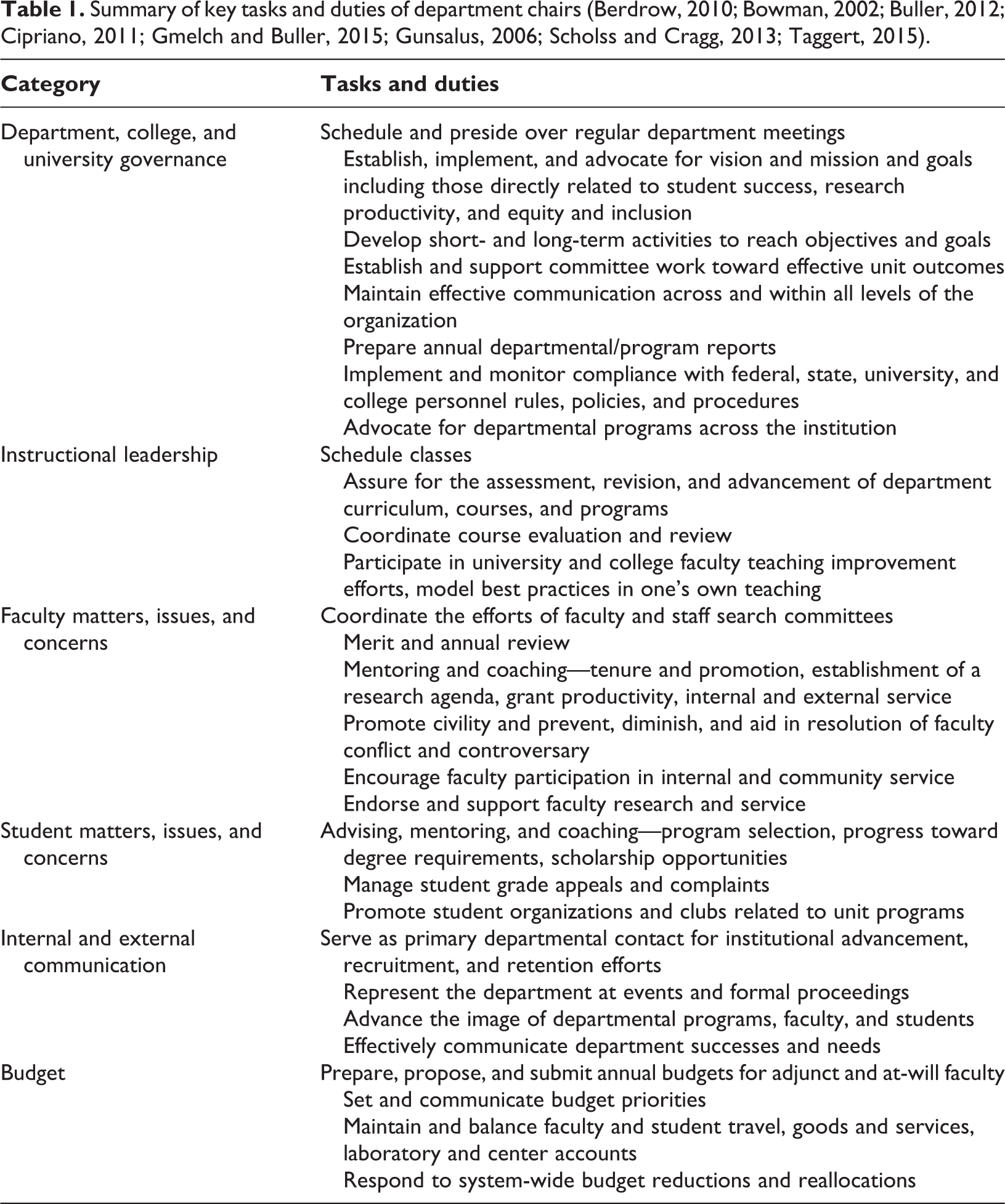
Yet the duties of chairs vary depending on their department, dean, and the institution they serve. In this way, there is no one job description for the position and chairs, even within the same institution, often find themselves charged with very different tasks. For example, the chair of a chemistry department will often find themselves shouldering considerable responsibility for the safety and health of faculty and students in laboratory (lab) settings whereas chairs in education departments maybe charged with state and national accreditation roles unnecessary in other colleges. In short, chairs’ tasks and duties include responsibility for department, college, and university governance; instructional leadership; faculty matters, issues, and concerns; student matters, issues, and concerns; internal and external communication; and budgets. Within each, chairs may complete any number of duties dependent on the kind of department and college in which they lead. Table 1 offers a summary of these tasks and provides detail concerning the variety of duties chairs may encounter as identified in the research literature.
Summary of key tasks and duties of department chairs (Berdrow, 2010; Bowman, 2002; Buller, 2012; Cipriano, 2011; Gmelch and Buller, 2015; Gunsalus, 2006; Scholss and Cragg, 2013; Taggert, 2015).
Inadequacy of preparation
Despite the comprehensive role chairs play in the academy, the literature (Aziz et al., 2005; Dopson et al., 2018; Morris and Laipple, 2015) suggests many chairs receive inadequate and/or ineffective training for the position. It has been posited (Bolman and Gallos, 2011) that faculty who come from fields with a background in leadership studies (e.g., business administration, social psychology, educational leadership) are somewhat better prepared for the leadership work associated with chairing a department. However, more generally, the literature suggests chairs are unprepared for their assigned leadership and management roles (Carroll and Wolverton, 2004). As Gmelch et al. (2017) reported, department chair leadership is often assumed with limited preparation, prior experience or formal training, or understanding of the ambiguity and complexity of their roles. Additionally, chairs often lack an understanding of how to lead within a system of shared governance, the ways in which full-time administrative work requires a significant change from professorial work, the cost of the work to their careers as scholars, artists, and researchers, and preparation to balance their personal and professional lives (Creaton and Heard-Laureote, 2019).
Challenges and tensions of the role
For many who step into the role of chair, these issues are compounded by a sense of disconnection from their prior identity as a scholar and teacher. Clearly, faculty construct and reconstruct their academic identities as new projects, interests, teaching, and other scholarly activities arise. Yet chairing requires that faculty give up, to some extent, control over how their identity is shaped and how they are received. As Gmelch and Buller (2015) have suggested, chairs are required to simultaneously face in two directions—one toward administration and the other toward faculty. Doing so can be disorientating and uncomfortable, and chairs find themselves struggling to position their leadership role in relation to former colleagues and friends (Creaton and Heard-Laureote, 2019). Absent adequate training and professional/peer support, the position can become isolating and lonely (Taggert, 2015).
Additionally, chairs struggle with managing the work of the department, for example, while being expected to balance budgets, manage complex schedules of classes, or provide for research support, they often lack the background to do so (Buller, 2012). Furthermore, much of the role requires they work closely with other members of the department, including faculty and staff. These human-resource roles take a different kind of skillset from that of traditional teaching, research, and service and chairs struggle with tensions related to conflict and motivation (Taggert, 2015).
In summary, the literature concerning the department chair indicates the role holds many challenges and few rewards. However, the position remains essential to the functioning of the academy. Therefore, understanding the ways in which chairs experience their role and work is of increasing importance. In turn, both chairs and the institutions they serve may benefit from understanding how a sustainable pathway for chairs’ leadership might be developed.
Study design, data sources, and methods
Employing qualitative interview methods, this study sought to understand the following research question: What administrative, situational, and/or relational tensions are evidenced across the sample of chairs?
A qualitative study design was chosen for this work as such methods are designed to elicit multiple perspectives and worldviews regarding how events are experienced (Creswell, 2014; Yilmaz, 2013). As a result of this orientation, it is understood that there is a relationship between the researcher and what is being researched, there is subjectivity in creating a study and interpreting data, and results are specific to the context studied (Merriam and Grenier, 2019; Rubin and Rubin, 2012). Because this study sought to develop understanding from the experience of the participants qualitative research methods were appropriate.
Participant recruitment
In total, 45 sitting department chairs were recruited for the study with the intent to collect data about the experiences of chairs from the breadth of colleges and universities in the US and Europe. Universities were clustered by primary focus (e.g., research or teaching) and efforts were made to gain a representative sample from each. For example, the study purposefully sought to include chairs from institutions that focused on high faculty research productivity and with large and strong doctoral programs (i.e., doctoral very high), chairs from institutions with a primary focus on teaching and a limited focus on research (i.e., masters granting institutions), and schools that offered associate and technical degrees and had little to no focus on research.
Recruitment efforts included invitations over social media (e.g., Twitter) and emails sent to chairs identified by internet searches of institutions (i.e., choosing every fifth school within the appropriate category of institution, searching the institution website, and sending a recruitment email). Additionally, efforts were made to include chairs from international universities and departments across a wide range of academic content areas (e.g., education, business, psychology, medicine, the arts) through referrals from existing participants. While the resulting sample cannot be considered random, it is as representative a sample as could be generated (Merriam and Grenier, 2019). Table 2 provides an accounting of participants, their institution type, and the departments represented by college.
Participants.

Note. A&S = Arts and Sciences.
It is important to note that data were collected from July 2019 to March 2020. Therefore, these data were all collected pre-COVID-19. Yet, because the study focused on enduring challenges to chairs’ practice, the findings remain trustworthy (Rubin and Rubin, 2012) and persuasive (Kvale and Brinkman, 2009). Certainly, COVID-19 era leadership has intensified chairs’ work; however, COVID-19 will not likely mitigate any of these persistent tensions and challenges. If anything, it has intensified chairs’ work. In other words, now more than ever, understanding the tensions department chairs face and the ways in which they solve the problems that confront them is important, necessary research.
Description of participants
The sample included chairs that had served as little as 1 year and as many as 20, with an average length of service of 4.3 years. The sample included 24 men (53%; seven education, five social sciences, nine Science, Technology, Engineering, Mathematics (STEM) fields, three business) and 21 women (47%; seven education, 11 social sciences, one math, and two from the arts). Unsurprisingly, and in keeping with demographics within the academy, the sample skews white with only seven (15%) respondents identifying as a person of color. Four (8%) self-disclosed as gay, lesbian, or queer.
Across the sample, chairs generally held a 4-year term with the opportunity to be reelected or reappointed; however, eight (16%) indicated that their terms were indefinite and they served at the pleasure of the dean. Most chairs held 9-month appointments with some form of summer support, usually (86%) received one or more course releases as part of the appointment, and often (76%) received some additional stipend or compensation (e.g., travel funds). Approximately half of the sample (58%) worked in a department that appointed or elected additional faculty members in positions such as assistant chair, program director, and/or coordinator of undergraduate/graduate studies. In these cases, the department tended to include over 25 faculty. Interestingly, only six (13.3%) were hired into the role, 17 (37.7%) were selected or elected from within after indicating an interest in the position, and 22 (48.8%) suggested they had been either “conscripted,” were the only faculty available to serve, and/or felt it was “their turn to step up.” Of the total sample, 21 (46.6%) were full professors, 19 (42.2%) were associate professors, two (4.4%) were assistant professors, and three (6.6%) were adjuncts or instructors.
Interviews
The study used a range of predetermined questions that were applied flexibly within each audio-taped phone call or Zoom interview setting. To increase comfort, participants were given the choice between interview formats and the modality of interview did not alter the structure or appear to impact information shared. Interviews lasted between 60 and 90 minutes and were paced by the interviewee, with interview prompts serving as a guide for a conversation, thus allowing department chairs to tell significant personal stories regarding their experiences as chair. Through close listening (Kvale and Brinkman, 2009; Rubin and Rubin, 2012), it was hoped that an understanding of how chairs experienced their role might be developed. The interviews focused on learning the chairs’ perceptions of the role (i.e., characterizations of challenges and successes), contextualizing the chairs’ learning in their own educational and professional experiences (i.e., sensemaking in their personal and chair work), and understanding how chairs’ orientations toward faculty, staff, and students contributed to their work (i.e., mentoring and coaching, caring, explicit promotion of equity and inclusion).
Coding and analysis
Transcripts from the interviews were analyzed inductively (Merriam and Grenier, 2019; Saldaña, 2009) including two rounds of open coding, followed by one round of in vivo coding. Coding included attention to differences in how participants described their leadership practice (e.g., participative, democratic, relationship focused), the department, college, and university (e.g., stable/chaotic, communal/isolated), and the ways in which they approached challenges and demands (e.g., responsive/reactive, deliberate/ad hoc, planful/improvisational). Additionally, coding sought to clarify the ways in which chairs’ found support for their work and how they characterized their orientations to care for others and themselves. Later in the coding process, codes were combined to create categories and categories were collapsed into themes. Table 3 provides summary examples of interview items and primary and secondary coding themes.
Sample interview questions/items, and coding themes aligned.

Data were subjected to several strategies to ensure trustworthiness, including credibility, transferability, and dependability (Creswell, 2014). Credibility was established through the development of a large and diverse dataset. Furthermore, because the author is a chair herself, trust (an essential factor in credibility) was established as participants felt “you’ve been there” and the nature of the questions asked resonated with participants. Triangulation was developed by the collection of multiple interviews across a variety of institutional types. Member checks were completed as was initial confirmation by a subset of participants (n=12) regarding the themes and tensions as they were identified. Transferability was ensured as the context of these data is described within each finding section (e.g., quote attributed to a particular kind of chair). Finally, dependability is enhanced as the processes of study are articulated and a reflexive journal was maintained with the intent of surfacing the author’s assumptions, biases, and preconceptions.
This paper employs direct quotes from the interviews as a primary data source. Quotes provided are representative of the larger whole and were chosen because they illustrated a general theme, offered a clear example of a common finding, or highlighted, in a focused way, areas in which all chairs struggled. Where data were contradictory in some way (e.g., chairs in high productivity doctoral granting institutions noted research pressures that chairs in baccalaureate degree granting institutions did not report), these instances are identified and noted.
It was not a goal of this research to compare and contrast the work of chairs by institutional size, focus, or departmental affiliation as Biglan (1973) and Stoecker (1993) have already done. Nor was the intent to replicate or confirm the work of Gmelch and Buller (2015) or Gmelch et al. (2017), which suggests chairs’ lives are stressful and their work often unrecognized. Rather, the goal was to develop an understanding of the widespread, enduring demands that chairs face, no matter their context, and to highlight the tensions inherent in the role.
Findings
Research about department chairs (Bozeman et al., 2013; Gmelch et al., 2017; Rowley and Sherman, 2003; Taggert, 2015) has long suggested that chairs find the work stressful. Although no prior study has expressed findings as tensions that must be balanced by chairs, this study confirms prior findings and suggests that chairs’ struggle to balance their approach to the work, and strive to employ common sense in decision making, humanity when working with others, and savvy when approaching an often-overwhelming political landscape, all while possessing limited institutional authority. Participant chairs acknowledged that it was important to understand that department leadership efforts are not static. Rather, as one scholar of higher education put it, chairing: …is dynamic, a mixture of applying your experiences in the department, some analysis of what is facing you in this moment, and some other part learning. This work is a craft, one that requires experience, quick thinking, and real luck, to do it well.
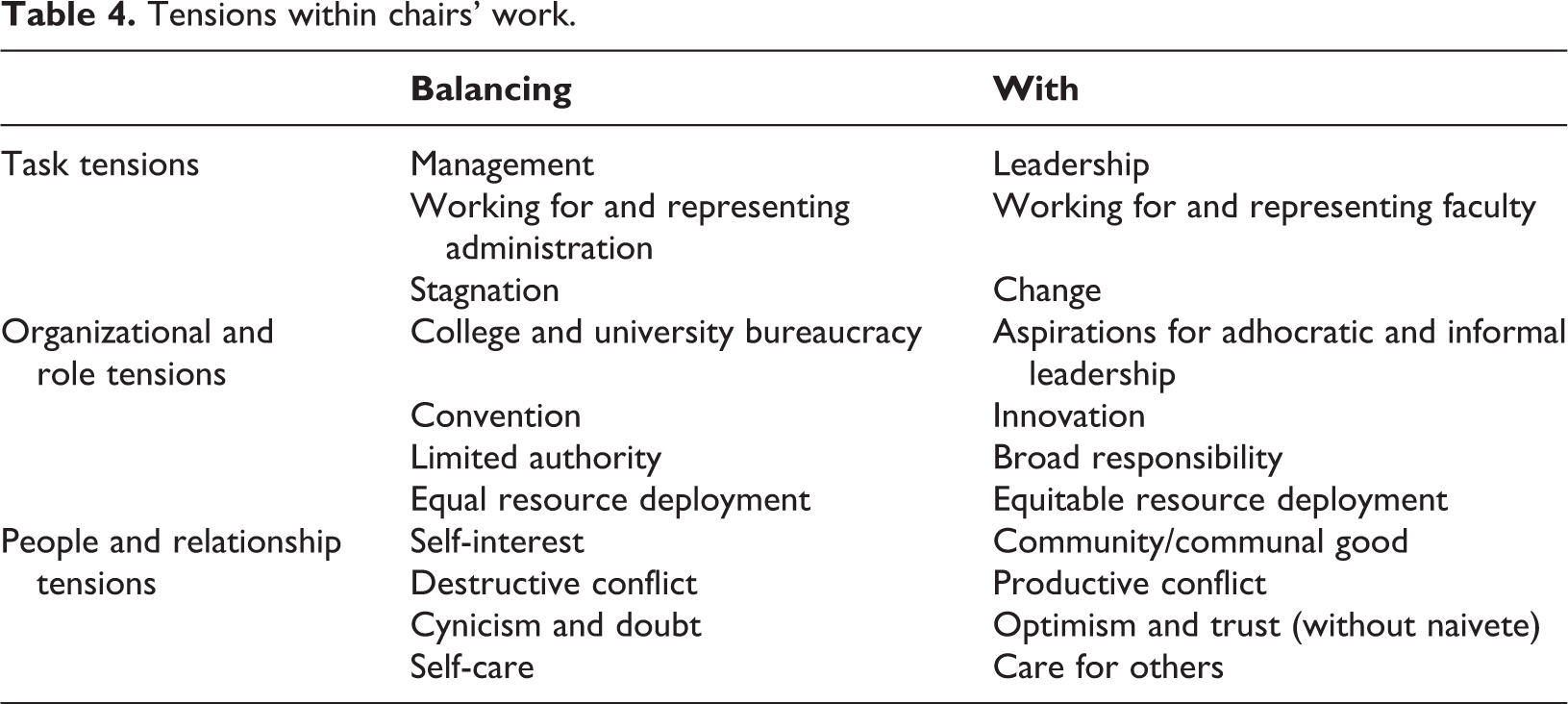
Moreover, chairs asserted that absent integrity and empathy, curiosity and commitment, and patience and resilience they would unlikely be effective. Being visible matters, as does active listening. Knowing when and how to be flexible and when to “hold the line” is needed. A sense of humor does not hurt either. Although each chair’s experience was distinctive, when taken as a whole, the data suggest chairs work to balance tensions related to the tasks they are expected to complete, their placement in and relation to the organization, and their work with and in relationship to departmental faculty, staff, and students. Table 4 provides a summary of key themes (e.g., task, organization, relationship) and tensions balanced within those themes (e.g., balancing management skills with leadership activity).
Tensions within chairs’ work.
Task tensions
Chairs hold their positions because they are needed to assure that the work of the department is addressed. As noted in Table 1, the tasks chairs are expected to complete are extensive and require often disparate skill sets (e.g., faculty mentoring differs from program evaluation) occurring within “tight” and “unyielding” timeframes. As such, chairs are compelled to engage in a “weekly, if not daily, dance,” which asks they balance their choices and decisions against the expectations of provosts, deans, and faculty. Additionally, although the work itself may require new skills (e.g., learning to manage a departmental budget), chairs stated that after learning basic practice and procedures, the pressures of the job arose more from trying to address how to “engag[e] in shuttle diplomacy” between “immediate and long-term work.”
Balancing management with leadership
Inasmuch as chairing is an administrative position, chairs reported spending considerable time working to balance how closely they monitored faculty effort and work with a genuine desire for shared and collaborative departmental leadership. As a chair of a counseling psychology department explained, So, we have to admit about a dozen new students each year. And there’s all the paperwork that goes with it, it has to be in on time, faculty have to read essays, they have to score them, we have to meet. I need to make sure that all happens according to the grad school calendar. So, I have to watch it all, micromanage it, because if we miss deadlines, it gets sticky…but I also need to square that with other really important program goals like what it means to be inclusive, what does it mean to be a Hispanic-serving institution…what are the real community impacts of who we admit? What does that mean for the long-term impact of mental health in the region? That takes a different kind of work. There’s a balance you have to find, you can’t only be administering, you never move forward, and if you’re only doing the leadership side of things, the trains don’t run on time. You have to do both or else it falls apart around you.
Balancing working for and representing administration with working for and representing faculty
As a rule, in higher education, chairs are selected after they have served as faculty. Therefore, and importantly, prior to chairing, their primary identity was as faculty. No matter the institutional affiliation, chairs noted that moving into the role required them to “rethink” who they were in relation to departmental members and others within the college and university and the work that they do. For some, “going to the dark side” was a sought after and welcome change. For others, and especially for those chairs who found themselves “pressed into service” or “last man [sic] standing,” shifting their identity from faculty to administration was a harder undertaking. Further complicating role shift is the reality that chairs are required, unlike deans, to remain as productive as teachers and researchers, albeit in reduced roles. Because of these dual foci, all noted that the role required them to be, “part one thing and part another.” As this same biology chair added, I am faculty and I see myself that way, but my dean, she sees me as management, I guess sometimes I am. I never saw myself in this role. [But] I also sought it out, I figured that from this chair I could better advocate for faculty…doing that, it’s harder than I thought.
I only did this because of my past principal experience. I’ve been in the “us against them” place before, but in schools I wasn’t expected to be both and here that’s hard, I will have to go back…I don’t want to make enemies.
Overall, knowing “whose side I’m on” proved disorienting and dispiriting for many chairs.
Balancing stagnation with change
“Face it, it’s easier to keep doing what we’re doing than to change,” asserted a public affairs chair. A sociology chair echoed a similar concern suggesting, I felt like we needed to change the curriculum, we just needed to look at what we were doing and whether we thought it was working. It became pretty clear we were doing some things well, other things we weren’t doing well at all, and there were good structural reasons for it…most of us, I think, are in higher education because we love our topics, because we believe that it’s valuable and important. But how we define what that means isn’t necessarily going to be the same thing…so we’ve been talking. For 2 years.
Organizational and role tensions
Second, chairs are appointed or elected to their positions because they are needed to connect the work of the department with that of the college and university. As such, chairs find themselves “spanning boundaries and building bridges” across what is often “contested ground.” These tensions were demonstrated as pressures in which chairs’ leadership attentions were equally divided between often “two equally solid and real positions” as well as instances where “there’s a clear need, but [department members] either can’t see it or won’t agree to see it…I mean, there are times when faculty are flat out wrong, and it is my job to represent them anyway.” The following tensions address these “tight spots” in chairs’ organizational and institutional work.
Balancing the college and university bureaucracy with aspirations for adhocratic and informal leadership
Colleges and universities are bureaucratic. They do not operate separate from national and programmatic accreditation requirements. Nor do they function absent state and municipal law or internal policies and practices designed to keep students and faculty safe and engaged in productive learning, teaching, and research. Yet, as chairs reported, the systems and structures of the academy can be confining. Most would, they report, prefer to “handle things on my own, in house, without having to answer to some decision that was made light years away from my programs and students. I hate having to defend that but I do, because I must.” As one English chair stated: I appreciate the support that is provided by the administration and I know, I know, I wouldn’t want to have to create all that on my own, I get what it offers me, but sometimes, often, I wish I could simply pull my peeps together and we could design a new program, or change a class, or confer a certificate without needing someone else’s approval.
Balancing convention with innovation
Significantly, chairs understood that they had been hired (or appointed) to “get organizational work done.” However, many found themselves frustrated by the uniformity required of them as well as how their attentions were to be focused. As a chair of business administration noted, “We have a way we do things, it seems archaic to me, lots of paper is involved, but that’s the way. It can’t be done differently, they like their forms the way they like their forms.” Still others suggested the conventions of “how we do things around here” stood in the way of perhaps, more innovative approaches. As the chair of a rather large and diverse department noted, So [we’re] working on enrollment trends. I’d love to explore what makes one program attractive and the other one wobbly. How do you see what’s structuring the wobbly and how do you change that? Could we do it better if we did it differently?
Balancing limited authority with broad responsibility
“I’m responsible for the department, all these people, but in the end, I have very little power to make anyone do anything. It’s stunning really, what’s expected,” shared by an education department chair. These thoughts were echoed by a chair in anthropology who said, [We’re] being asked to solve problems we’re not necessarily qualified to solve but no one else is either, [we’re] thrown into something and have to figure it out, [and] get it to work…but I have almost no leverage or influence.
Balancing equal resource deployment with equitable resource deployment
No matter if the resource was travel money, graduate or teaching assistants (TA), lab and office space, or access to teaching and learning resources, chairs expressed deep disappointment concerning the limitations on the resources available to them to run their departments. Furthermore, chairs grappled with decisions related to how they were best able to deploy what little money, time, or support they were able to provide. One communications department chair explained, Every year, it’s the same struggle…we pool it all from the get go, everyone gets a base amount, like, 1000, and then everyone gets to apply for what’s left, then I work out the worth of maybe another thing they got. Like, you got TA support and [they] got more travel. Before, there were tons of side deals and everyone thought someone else had it better. [It was] really damaging. I took the position and said to everyone—faculty, staff, the dean—with me, the side deals end. So, at the start of fall semester I put the budget out, and everyone sees what everyone gets. No side deals. It’s fair and they see it. As I see it, folks who make less should get more all around, it shouldn’t be that I get [resources] simply because I’ve put in the time. They should go to who needs them most and who we want to invest in now and for the future. Not everyone likes it that way, but it’s a hit worth taking.
People and relationship tensions
Third, chairs serve because they are needed to manage and lead departmental members. Yet doing is perhaps the most trying responsibility of the job. As the chair of an educational policy department noted, “In the last 10 years, there’s been more and more adverse examples of uncivil behavior [than] I have ever run into before…I know it’s not just where I am. I know it’s universal.” Beyond incivility, chairs noted they are often confronted with conflicts that arise from competing goals and values and/or differing understandings of the data and information available.
Balancing self-interest with community/communal good
As a history department chair shared, “Faculty are a selfish lot, it’s not their fault, that’s what they were raised to be. The system does it to them.” Whether it concerns the tensions of staffing large undergraduate lectures and small graduate seminars, conflicts regarding committee assignments, or clashes involving real or imagined workload differences, chairs noted that faculty tend to focus on their own needs and desires often with little concern for the greater good or a “real, genuine understanding that that’s what they’re doing.” Chairs, especially those in research-intensive institutions, acknowledged that faculty are “rewarded for looking out for themselves” and are “consciously and unconsciously, always, balancing what’s best for them.” Certainly, raises and recognition in academe (most often) arise as a result of one’s individual effort, so self-interest is unexpected. Furthermore, several chairs noted all self-interest is not bad, as a computer science chair stressed, “Faculty should be totally absorbed in what they love, in the lab, working with students, publishing…I want them to succeed, I just can’t have them do it at the expense of everyone else.”
Yet for a department to function well it must be able to come together and do communal work. Curriculum and program planning and evaluation, mentoring of untenured faculty and graduate students, and other full-departmental efforts all require “every possible assistance” if departmental work is to be accomplished. Therefore, finding ways to approach faculty to do communal work and honor the efforts of others in this work was an ongoing source of strain.
Balancing destructive conflict with productive conflict
“I love a good debate,” stated a political science department chair. Others also noted the importance of productive conflict. As a chemistry chair suggested, when conflict is “done well, it’s an opportunity to take another perspective, maybe be more creative, at least find out what we all think is important [and] worth arguing over.” Less appreciated were instances where conflict is fueled by longstanding disputes and ongoing competition. As a medical school chair remarked, the “impact of bad behavior is real, it has a chilling effect, so I try not to allow space for it, at least not in public. I do my best to resolve what I can.” Still, other chairs admitted that they handled persistent conflict by “giving the bully what they want.” They admitted to “know[ing this] didn’t resolve anything” but also acknowledged they lacked the skill set and resources to solve faculty and staff dispute. As an arts chair lamented, I’d love to run a department where we all got along, I see it elsewhere [on campus], I think it would be fun and more intellectually engaging, we’re just not that place [and] I don’t know how to get us there.
Balancing cynicism and doubt with optimism and trust (without naivete)
Chairs reported that it was “easy to get cynical” in the role. As one said, “Every new policy comes from some knee-jerk reaction, I just assume people are going to be brainless.” Another stated, I feel my cynicism is well founded. Half the time the provost’s office does one thing, doesn’t let HR know, and then when I’ve done what they asked, some [other office] tells me “No, it was supposed to be this way around instead.”
A newer chair suggested, “I don’t want to become jaded; I see it happen, but I also don’t want to be naïve, I see what goes on.” To a person, chairs, in this study, persisted because they believed they could have a positive impact on their unit. Yet each suggested they began believing they were better able to “fight city hall” than reality proved. In this way, maintaining optimism and trust in the system was challenging, particularly in times of college and university difficulties such as budget reductions or downturns in enrollment. Preserving positivity and faith in the institution as chairs “learned how the sausage gets made” was seen by many as a source of concern and distress.
Balancing self-care with care for others
Nearly every chair in the study confessed that balancing their own wellbeing with the demands of the position and the demands of others was an ongoing challenge. Chairs noted that “being available” often became “in faculty’s minds, being on call” and that in an effort to be “responsive and transparent” they found themselves working longer and later hours than they wanted. Additionally, many chairs were surprised by how, after time, they found themselves increasingly isolated. A chair of an education department said, “It’s just so lonely. I’ve learned not to trust people, some of whom I thought were friends…it’s like [faculty] don’t see me as a person anymore, I’m just this administrator they can unload on.” Additionally, many suggested being caught by surprise and being unprepared for “how intimate it all is…I know everyone’s business, their divorces, their cancer, their fears and worries. I wasn’t prepared for dealing with this level of personal pain.” As a result, many chairs suggested they had to intentionally find time to exercise, eat properly, and decompress from their work. Others confessed to a “string of broken promises to myself” as they tried to find a balance between chairing, self-care, and care for others.
Implications and conclusions
This study supports prior research that has found chairs’ work to be personally stressful (Gmelch and Buller, 2015) and managing the variety of organizational and relational pressures overwhelming (Berdrow, 2010). This study extends prior work by suggesting that beyond being stressed, undertrained, and/or overwhelmed by the workload, chairs seek to creatively manage and lead their units effectively. No matter how frustrating participants found the position, they persisted because they believed they could make a difference for their departments, programs, colleagues, and students by doing this work, and doing it well. Although they all recognized that higher education was fraught with significant challenges, they believed that (in most circumstances) their work could and did make a difference. Ultimately, they placed a premium on resilience and commitment to service. Doing so allowed them to manage the tensions inherent to the position and to choose where to direct their effort.
It is no surprise that chairing requires significant personal energy, reflection, analytic skill, sound judgement, and communication proficiency. Yet this study does not suggest chairs need to aspire to be superheroes. As a psychology chair suggested, “One needs to be clearheaded about the work…realistic about their [college and university] context…perceptive enough to know when to let others solve their own problems, and more or less emotionally healthy.” Getting along with your provost, dean, and faculty helps, as does an ample budget, but for most, reconciling the tensions inherent in the position boiled down to their ability to step back from the work far enough and often enough to see it for what it was. Realizing the best anyone could do, often without adequate resources on an extremely tight timeline, was to do their “authentic” best.
“Know yourself” was the most common response to my question about advice for someone seeking the position. Knowing yourself included being honest about what came naturally (e.g., responding to immediate concerns) and what required effort (e.g., thinking strategically), but also knowing who they were and who they were not. Simply put, chairs who reported the most comfort with the work suggested that by understanding who they were, they were better able to understand how to best do their work. Chairs who understood their own place in the work reported being better able to cope when problems arose and to accept the enduring tensions intrinsic to the position, because they experienced the work as an extension of their personal connection to their department, college, or university and the people who worked and learned there.
To be clear, colleges and universities can and should do more to support faculty when they are elected, promoted, or hired for the role. Given the key role chairs play in keeping departments running smoothly, it is smart for the institution to take chair on-boarding, mentorship, and coaching more seriously and develop formal and regular opportunities for chairs’ learning. At a minimum, chairs should receive basic orientation toward campus policies and practices to which they are expected to respond and uphold. More robustly, it should become common practice that chairs are provided opportunities for their own professional learning, be they related to institutional practices or more general leadership knowledge and skill sets.
In this way, both chairs and the institutions they serve bear responsibility for balancing the tensions of the role. It will also require we acknowledge that although we may reconcile ourselves to the ever-present demands and tensions of the role, because they are enduring and inherent within to the academy, resolution will not be possible. Ultimately, chairs have a choice about how they approach their leadership, and colleges and universities a choice about how they support and honor those efforts.
Future research on this topic should delve more deeply into understanding the relationship between chairs and deans as well as between chairs and the faculty they lead. Future work should include comparative quantitative and qualitative study of expectations held by deans and faculty of chairs, close case analysis of chairs’ work as it relates to faculty relations and conflict, and should focus on the ways in which chairs’ organizational knowledge is employed in shared decision making and change efforts. Furthermore, researchers should more fully expose differences in chair leadership work as they relate to race, class, and gender. Researchers might consider questions such as: how can chairs, who have attempted to find balance, learn from past successes and challenges? In what ways are their understandings evidenced in daily leadership practice? What would effective promotion and training look like for chair development and how might it be developed?
Footnotes
Declaration of conflicting interests
The author declared no potential conflicts of interest with respect to the research, authorship, and/or publication of this article.
Funding
The author received no financial support for the research, authorship, and/or publication of this article.
