




Abstract
Research has revealed that appropriate school leadership practices can positively support and promote teacher learning. This study examines the influences of Learning-Centered Leadership upon Teacher Agency, Trust and professional learning in a Kuwaiti context. Following results from recent empirical research, this study tested a model of principal leadership effects upon teacher learning via the mediators of Teacher Trust and Agency. The researchers collected data from 1060 teachers working at 64 Kuwaiti public schools and analyzed this data using confirmatory factor analysis and structural equation modeling. Results validated this model, showing that Learning-Centered Leadership affects teacher professional development via Teacher Trust and Agency. This improves our understanding of the relationship between school leadership and teacher professional learning both in Kuwait and internationally; relevant recommendations are listed.
Introduction
Instead of building a culture of professional learning, teachers are faced with a “culture of compliance.” … Instead of creating the conditions for teachers to teach each other, support their peers, and deepen their knowledge about their students, teachers are being given a “one size fits all” set of professional development workshops that deny the variability of how teachers teach, and how they and their students learn. (Lieberman and Pointer Mace, 2008: 227)
Lieberman and Pointer Mace wrote these words in a letter addressed to the then-incoming President of the United States, proposing the restructuring of teacher in-service learning as a key vehicle for successful educational reform. Indeed, the complex nature of the challenges associated with educational reform has made it necessary for education systems around the world to find ways to help educators adapt to the changing educational landscape, especially regarding the need to change “modal approaches to teaching and student learning” (Hallinger et al., 2019: 342). One approach for achieving this involves supporting the professional learning of teachers (Hallinger et al., 2017; Lieberman and Pointer Mace, 2008). Indeed, research has shown that teacher learning has a positive impact on education reform and school improvement (e.g. Parise and Spillane, 2010; Printy, 2008).
Researchers have devoted particular attention to identifying possible ways for supporting teacher professional learning (TPL) in the workplace. One significant line of inquiry has specifically focused upon the role of school leadership, producing results that suggest a positive relationship between principal leadership practices and how teachers learn and develop (Bektaş et al., 2020; Li et al., 2016a, 2016b; Liu and Hallinger, 2018; Karacabey et al., 2020), which will eventually reflect upon student learning as well (Robinson et al., 2008; Sebastian and Allensworth, 2012; Supovitz et al., 2010). In their meta-analytic review of research on the impact of school leadership upon student outcomes, Robinson et al. (2008) found that, through involvement in their teachers’ development, school principals can influence student learning. Thus, they suggested the need for researchers to focus more upon how principal leadership practices shape TPL. Specifically, they assert that: “It seems clear that if we are to learn more about how leadership supports teachers in improving student outcomes, we need to measure how leaders attempt to influence the teaching practices that matter” (Robinson et al., 2008: 669).
Research on the relationship between principal leadership and TPL indicates that this relationship tends to be mediated by teachers’ beliefs and work attitudes such as trust, and teacher agency (TA) (Karacabey et al., 2020; Kwakman, 2003; Liu and Hallinger, 2017; Liu et al., 2016a; Piyaman et al., 2017). Trust has been emphasized as a key organizational factor influencing the professional growth of teachers as it increases their willingness to be actively involved in professional learning activities and share experiences with their colleagues (Liu et al., 2016b; Tschannen-Moran, 2009). TA refers to teachers’ ability to make decisions about their learning needs and take responsibility for their professional development throughout their career (Tao and Gao, 2017). Research has therefore confirmed its significant role in shaping teachers’ engagement in professional learning practices (Bordie, 2019; Molla and Nolan, 2020), as well as its mediating effects in the relationship between principal leadership and teacher learning (Hallinger et al., 2017; Liu et al., 2016b).
Hallinger et al. (2017) argue that due to limited resources and inadequate pre-service and in-service learning opportunities, job-embedded professional learning has become even more crucial for teachers in developing societies. This is even more pressing in Gulf Cooperation Council states, where educational systems are witnessing dramatic changes to their structure, administration, and approaches (see Ally and Alshahrani, 2018; Alazmi and Al-Mahdy, 2020; Alsharija and Watters, 2020; Stringer and Hourani, 2016). In times of radical change, teachers need support as they implement these introduced changes (Fullan, 2001). The same holds true in Kuwait, where school leaders and teachers are facing challenges associated with new policies and reform projects mandated by the Ministry of Education (MOE) (Alsharija and Watters, 2020).
Despite a proliferation of empirical studies which explore the relationships between principal leadership and TPL in a variety of educational contexts (e.g. Bektaş et al., 2020; Hallinger and Lu, 2014; Li et al., 2016a, 2016b; Li and Hallinger, 2016; Liu and Hallinger, 2018; Karacabey et al., 2020), little is known about the topic in Arab societies, as evidenced by recent reviews of educational administration and leadership research in the region (see Hammad and Hallinger, 2017; Hammad and Alazmi, 2020). Alsaleh’s (2020) study in Kuwait did not specifically examine the relationship between school principal leadership and teacher learning, but rather investigated how head of department leadership, collegial cooperation, and administrative support influenced teacher professional development. However, it is expected that this study's findings will contribute to furthering our understanding of principalship within centralized education systems, and outside of Western society, such as in Kuwait. On the other hand, scholars in Kuwait have endeavored to document and analyze the nature and effects of principal leadership practices/behaviors in studies of authentic leadership (Alazmi and Al-Mahdy, 2020), instructional leadership (Alsaleh, 2019), transformational leadership (Alsaeedi and Male, 2013), servant leadership (Alanezi, 2016), and distributed leadership (Al-daihani, 2019).
In view of the current education reforms in Kuwait and the scarcity of research on the relationship between Principal Leadership and TPL, the researchers conducted the current study with the aim of understanding how school principals in Kuwait influence TPL through the mediation of Trust and TA. Our decision to focus upon Teacher Trust (TT) and TA was informed by recent empirical research demonstrating these two factors as “paths” through which school principals can influence TPL (see Bektaş et al., 2020; Li and Hallinger, 2016; Li et al., 2016b; Liu and Hallinger, 2018; Karacabey et al., 2020; Liu et al., 2016a, 2016b). Therefore, this study sets out to answer the following question:
What is the relationship among Learning-Centred Leadership (LCL), TT, TA, and TPL in Kuwaiti public schools?
Conceptual framework
The conceptual model at the heart of this study moots the idea that LCL wields both direct and indirect influence upon teacher professional development (see Figure 1). In short, we suggest that both TT and TA describe “internal pathways” via which a school principal affects the professional development of teachers under their charge. Although this model's relationships derive, in part, from previous research studies in Asia (e.g. Hallinger, et al., 2017; Hallinger and Lu, 2014; Li et al., 2016b; Liu et al., 2016b), it seemed distinctly possible that similar findings could result in Kuwait, i.e. that school leadership influences are fully-mediated by TA and Trust Evaluating these relationships was of primary importance in this study.
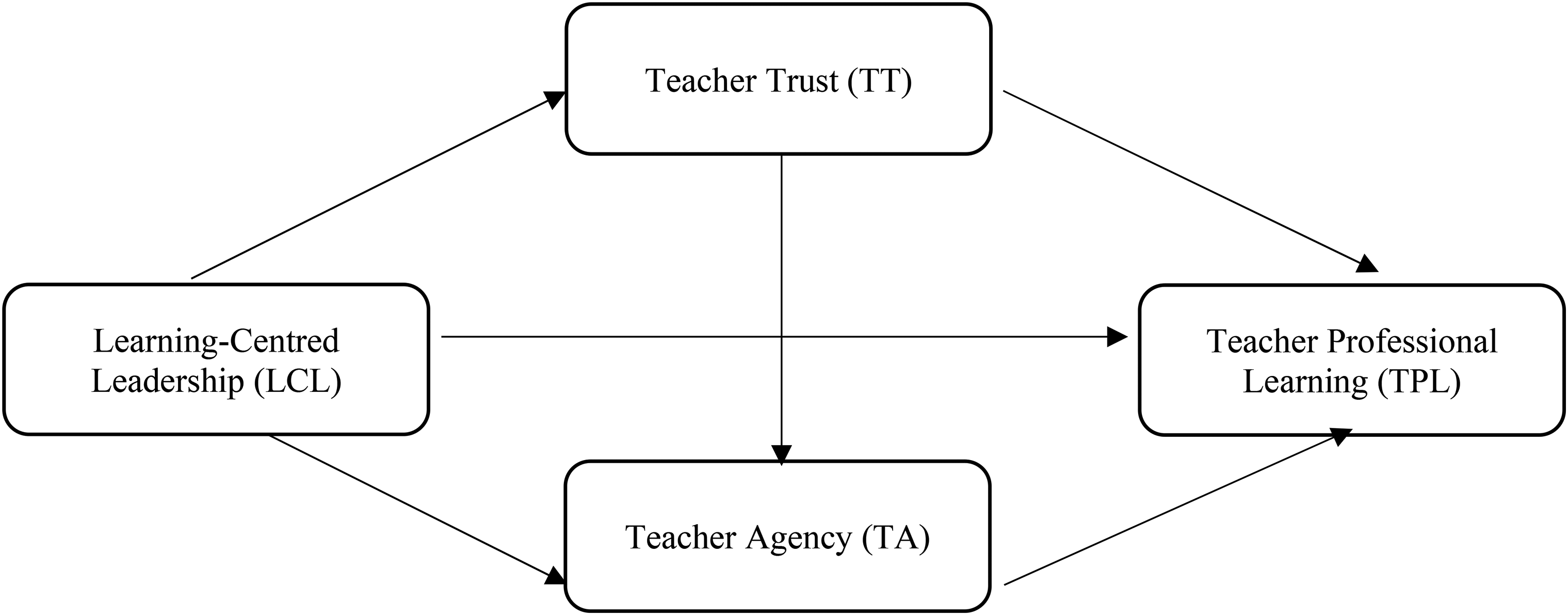
Conceptualized model of the relationships between learning-centered leadership, teacher trust, teacher agency, and teacher professional learning.
Theoretical background
The research reported in this article is underpinned by a growing body of empirical studies regarding the relationship between principal leadership practices and TPL (Hallinger and Lu, 2014; Karacabey et al., 2020; Liu and Hallinger, 2017; Liu and Hallinger, 2018; Liu et al., 2016a, 2016b; Hallinger et al., 2017; Shengnan and Hallinger, 2020; Tran et al., 2018). As indicated by a recent bibliometric analysis of studies in the field, research following this line has witnessed a dramatic growth over the past 20 years (Hallinger and Kulophas, 2020), providing convincing evidence regarding the key role that principal leadership plays in shaping the ways in which teachers engage in professional learning. In this section, we elaborate upon the four constructs investigated in this study, namely TPL, LCL, TT, and TA.
Teacher professional learning
Many researchers have emphasized TPL as a crucial factor for achieving school improvement, especially in times of educational reform and innovation (Geijsel et al., 2001; Lieberman and Pointer Mace, 2008; Opfer and Pedder, 2011; Parise and Spillane, 2010; Qian and Walker, 2013). Teacher engagement in continuous professional learning activities is vital for raising their self-efficacy and improving their instructional practices, thus increasing their ability to support student learning (see Akiba and Liang, 2016; Bruce et al., 2010; Opfer and Pedder, 2011; Ozdemir, 2020). In recognition of its importance, researchers from around the globe have devoted greater attention to the topic. Although early research attempts originated in the West, especially in Anglo-American contexts (e.g. Kwakman, 2003; Opfer and Pedder, 2011; Parise and Spillane, 2010; Thoonen et al., 2012), recent years have witnessed increasing contributions from non-Western societies (e.g. Bektaş et al., 2020; Hargreaves and Elhawary, 2019; Liu et al., 2016a; Karacabey et al., 2020; Ozdemir, 2020; Hallinger et al., 2017; Shengnan and Hallinger, 2020; Tran et al., 2018). This is important for understanding how teacher learning, along with the practices and challenges associated with it, manifest themselves in different educational contexts. Teacher learning differs from one school context to another so, in order to understand it fully, researchers need to consider “the interacting links and influences of the history and traditions of groups of teachers, the educational needs of their student populations, the expectations of their education systems, teachers’ working conditions and the opportunities to learn that are open to them” (Avalos, 2011: 10).
Rather than adopting a traditional, narrow understanding of TPL in terms of externally designed formal workshops where teachers are expected to follow a particular “script” (Lieberman and Pointer Mace, 2008), the present study uses the term to refer to formal and informal learning on the job, defined as “executing activities in the course of daily work, which may lead to improvement of practice” (Kwakman, 1998: 58). This conceptualization has marked a shift in the way studies in the field are addressing TPL, with growing evidence from these studies suggesting the value of job-embedded provision which is more collaborative, self-directed, continuous, and relevant to teachers’ work realities (Avalos, 2011; Harris et al., 2006; Kwakman, 2003). Research has also revealed that practices such as active learning, modeling, reflection, feedback, and coaching are particularly effective in fostering teacher learning (Darling-Hammond, Hyler and Gardner, 2017).
Learning-Centered Leadership
In their quest to find ways to enhance TPL, researchers have considered the potential impact of factors at their schools, especially principal leadership. Encouraged by evidence from empirical research regarding the link between leadership and school improvement (Qian and Walker, 2013; Robinson et al., 2008; Saphier et al., 2006), a considerable body of research has centered upon identifying leadership behaviors and practices that can support teacher learning, with results pointing towards LCL as being especially effective (Karacabey et al., 2020; Kilinc et al., 2020; Liu and Hallinger, 2017; Liu and Hallinger, 2018; Liu et al., 2016a; Liu et al., 2016b; Hallinger et al., 2017). LCL is defined as “intentional efforts to inspire, guide, direct, support and participates in teacher learning with the goal of increasing professional knowledge and promoting school effectiveness.” Although it has similarities with earlier leadership styles, such as instructional leadership and transformational leadership, it is distinguished by its focus upon “capacity building to promote the learning of all members of the school community” (Liu et al., 2016a: 664).
In this study, we adopt Liu et al. (2016a) model of LCL, which consists of four dimensions: (a) Builds a Learning Vision (referring to a school principal’s role in building and communicating a vision which motivates teachers to learn); (b) Modelling (referring to a school's principal acting as a role model to inspire its teachers regarding professional learning); (c) Provides Learning Support (focusing on the role school principals play in creating a school climate that is conducive to collaborative learning, providing adequate resources, and supporting the implementation of teacher learning); and (d) Manages the Learning Program (referring to a school principal's role in the organization and management of professional learning activities).
Teachers’ work attitudes: Trust and Agency
In recognition of the role school culture plays “in shaping teachers’ attitudes towards their learning” (Liu et al., 2016b: 81), researchers have endeavored to illuminate factors that play a mediating role in the relationships between school leadership and teacher learning in order to better understand how school principals can support workplace learning (e.g. Liu et al., 2016a; Liu et al., 2016b; Hallinger et al., 2017; Saphier et al., 2006). Prominent amongst these factors are TT and TA. Tschannen-Moran and Hoy (2000) define Trust as: “one party's willingness to be vulnerable to another party based on the confidence that the latter party is (a) benevolent, (b) reliable, (c) competent, (d) honest, and (e) open” (p. 556). In this sense, Trust is recognized as a key component of a healthy organizational culture, especially when it comes to educational institutions (Goddard, Tschannen-Moran and Hoy, 2001). Indeed, Tschannen-Moran and Hoy (2000: 550) suggest that “trust is pivotal in efforts to improve education.” Strengthening this concept, a number of empirical studies have documented some positive effects of trust upon schools, including teacher collaboration (Tschannen-Moran, 2001), school improvement (Bryk and Schneider, 2002; Louis, 2007), and teacher professionalism (Tschannen-Moran, 2009). Moreover, since it is viewed as “a relational condition that could shape teachers’ willingness to share information with colleagues as well as to participate actively in learning with others in their schools” (Hallinger et al., 2017: 466), Trust seems to be a necessary condition for TPL. In fact, several empirical studies identified Trust as an important factor that mediates the effects of principal leadership on teacher workplace learning (e.g. Bektaş et al., 2020; Karacabey et al., 2020; Li et al., 2016b; Liu et al., 2016a, 2016b; Hallinger et al., 2017).
Researchers in the field have considered TA as another factor that potentially affects TPL. The theory of human agency stipulates that humans have the capacity “to transcend the social pressure of their immediate environment and … shape their environment and life courses” (Bandura, 2018: 130). In a school setting, agency refers to “the teacher's initiative, motivation, and drive to engage in proactive efforts to contribute to school development” (Liu et al., 2016b: 81). The concept of TA connects with the view of teachers as being “agents of change” who are expected to play a central role in enacting change and developing their schools (Priestley et al., 2015). This becomes even more important during educational reform (Datnow, 2012; Tao and Gao, 2017). However, in order for TA to exert a positive impact upon school improvement, there needs to be a favorable school context that encourages collaboration and provides leadership support (Brodies, 2019).
Research indicates that agency plays an important role in shaping teacher engagement in professional learning practices (Bordie, 2019; Lai, et al., 2016; Molla and Nolan, 2020), with evidence suggesting that teachers with a greater “sense of agency” are more active in seeking professional learning opportunities (Molla and Nolan, 2020). Empirical evidence also indicates that TA acts as a mediator to the effects of principal leadership upon TPL (Hallinger et al., 2017; Liu et al., 2016b; Liu and Hallinger, 2017), thus proposing the fostering of TA as a useful strategy which school leaders can adopt to enhance teacher learning.
In the present study, we adopt Liu et al. (2016b) conceptualization of TA, which comprises four dimensions: (1) Learning Effectiveness (i.e. teacher beliefs about themselves as adult learners); (2) Teaching Effectiveness (teacher beliefs about their teaching effectiveness); (3) Optimism (teacher attitudes towards colleagues); and (4) Constructive Engagement (teacher attitudes towards their own workplace learning and willingness to influence their colleagues).
The Kuwaiti educational context
The Kuwaiti education system has undergone fundamental changes as a consequence of the nation's decision to help ensure its long-term future growth by diversifying its economy beyond the finite availability of petroleum production. The development of a knowledge-based component to Kuwait’s economic engine has, therefore, become the catalyst for education reform, rather than its opposite (Alsharija and Watters, 2020). The government-commissioned Vision Kuwait 2030 report states that a “… reinvigorated education system will serve to integrate locals into a competitive market” (Supreme Council of Development and Planning, 2020). Accordingly, a continuous series of educational reforms have effectively restructured the MOE and school leadership over the past few years. Kuwait's MOE established educational development strategies (2005–2025) as part of this journey towards modernization (Alhouti and Male, 2017). However, the focus upon standardized testing which these policies enforced in an effort to ensure accountability for improved student performance misfired in Kuwait. The nation’s students remain insufficiently trained in the knowledge, skills, and values necessary to become productive members of society. They compare poorly relative to international standards, ranking nearly last in the Progress in International Reading Literacy Study (PIRLS) and Trends in Mathematics and Science Study (TIMSS) (World Economic Forum, 2019). These reports indicate that Kuwaiti educational reform has been ineffective so far and requires substantial improvement to achieve its aims. This problem is due, in part, to a lack of coherent coordination. Indeed, during the reform process, educators complained that many top-level decisions were haphazard, arbitrary, and in a regular state of flux. Furthermore, they criticized that this near-constant fluidity in standards has been overly stressful for teachers, students, and parents (Alsaleh, 2019) which, presumably, also contributed deleterious effects to school performance.
In 2014, the MOE established the “Integrated Education Reform Program” to focus on improving education system quality through curriculum development, teaching, and school leadership, strengthening the education center and its assessment capacity, and developing national standards. Another major initiative was the implementation of new school leadership policies and practices. These included new job descriptions to redefine the roles and responsibilities of school principals. A Kuwaiti school principal's formal role has traditionally involved administering central rules and regulations. In this updated description, however, MOE guidance provided principals with new roles as instructional leaders with more responsibility for delivering school objectives, managing the instructional program, developing the school climate, and supervising student outcomes (Alazmi and Alenezi, 2020; Alsaleh, 2019). Furthermore, a better environment for leadership is emphasized to support both teaching and learning by setting a clear direction for the school, developing teachers and staff to be their most effective, and making the organization function well as a whole. This is a remarkable step for schools in the predominantly centralized Kuwaiti educational system. The training provided to school leadership teams and teachers was designed to promote team-based approaches, reliance upon data for decision making, community participation, and effective planning. At the same time, school principals took the initiative to form communities of practice to represent principals at primary, intermediate, and secondary-stage levels of education. The MOE also empowered school principals to serve as agents for change, forming communities of learning to lead knowledge transfer (Alsharija and Watters, 2020).
However, evidence suggests several reasons why Kuwaiti educational reform may fail to achieve its goals. For example, Alsaleh (2019), found that the MOE’s political mandate, with its rigid organizational structure, limits a school principal's authority. Similarly, Alanezi (2016) demonstrated that the Kuwaiti education system is characterized by high power distance. This high-power distance can negatively affect the relationships between principals and their teachers, with school leaders tending not to provide flexible decentralization for decision making nor implementation, having poor relationships with administrative staff, not to mention the arbitrariness of some principals regarding teacher participation in leadership (Al-Daihani, 2019). Therefore, it should be expected that the practices of LCL may be bracketed by these factors.
Reviews of educational reforms carried out in several countries have shown that successful schools are usually led by instructional leaders who concentrate on improving teaching and learning (Hallinger, 2005; Leithwood and Sun, 2018). It is important to note, though, that Kuwaiti educational reform requires skillful “leadership” from school principals in order to improve teaching and learning (Hallinger and Lu, 2014; Common, 2008; Hallinger, 2005). Thus, it is within this context of Kuwaiti education that the authors chose to examine the nature of a school principal's LCL role, and how their practices influence TPL.
Methodology
This study used a non-experimental, predictive survey design, with structural equation modeling to investigate the relationships depicted in Figure 1. In this section, we describe our variables and measures, procedures for collecting data, and analytical strategy.
Data collection
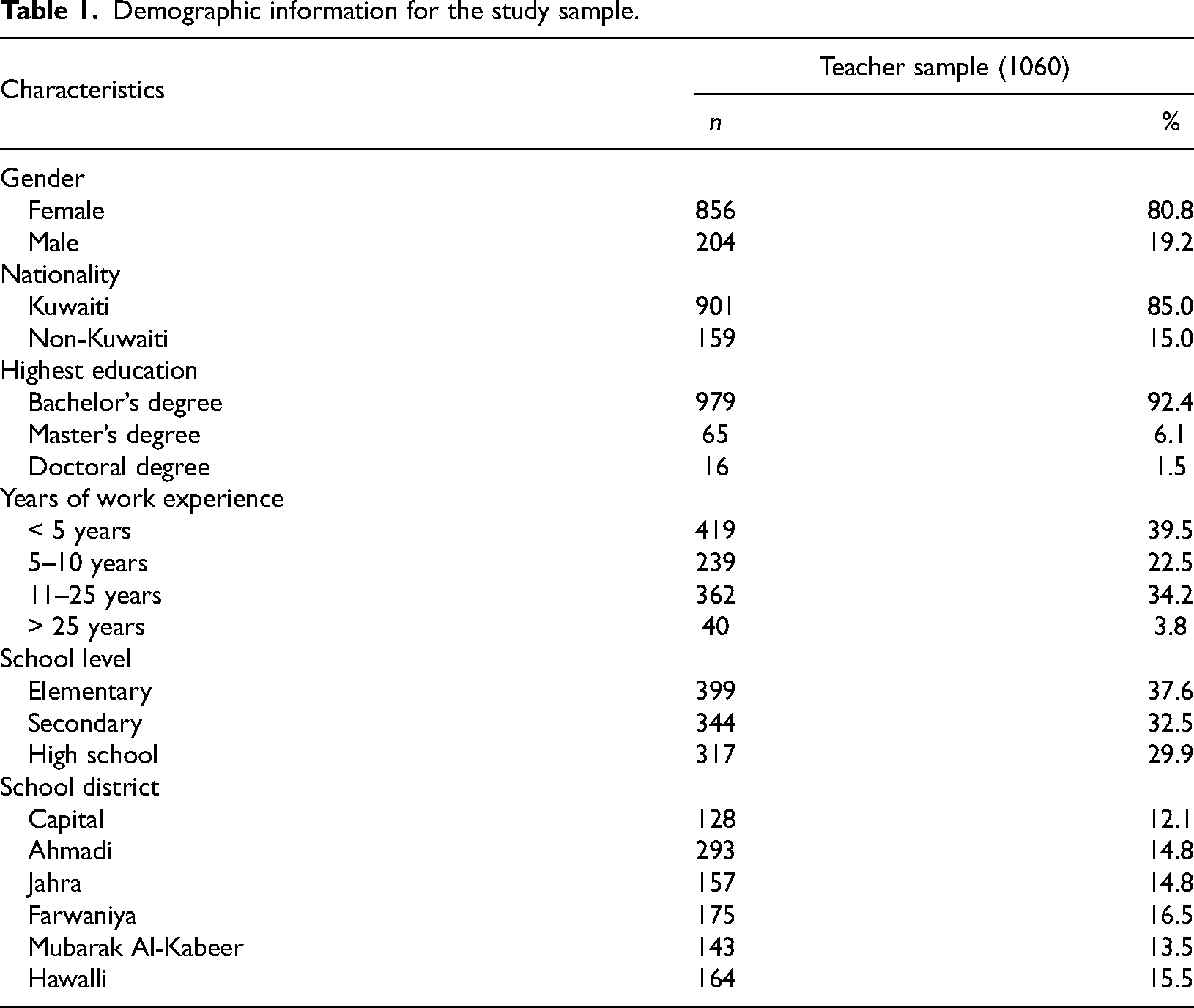
Data collection for this study occurred between May and September 2020. After obtaining permission to conduct the research, we collected data from a stratified random sample of teachers working in 64 public schools spread across Kuwait's six main districts. This number represented 10% of the total number of public schools in the country (n = 636). Stratification was meant to ensure the presentation of the different school levels and districts; the targeted sample included 22 elementary schools, 22 middle schools, and 20 high schools. We e-mailed the link to the online survey to 20 randomly selected teachers at each of the selected schools; participants were allowed 2 weeks to respond. These procedures yielded 1060 valid teacher questionnaires (an 87% response rate), representing roughly 1.5% of the overall public school teacher population in Kuwait (n = 70,317), with a mean of 15 teachers from each school. The sample size was considered more than sufficient to meet the minimum recommended (n = 200) for structural equation modeling (Hu and Bentler, 1999; Kline, 2005). The sample included significantly more female (n = 856) than male (n = 204) teachers, which reflects the national gender distribution of teachers in Kuwaiti public schools (Educational Statistical Group, 2018/2019). All participating teachers had earned professional teaching qualifications from higher education institutions and possessed between 1 and 25 years of teaching experience. Table 1 reveals detailed teacher demographic information.
Demographic information for the study sample.
Measures
Data were collected using an online survey consisting of two sections: the first section sought the participants’ demographic information (i.e. age, gender, nationality, education level, years of work experience, school level, and school district), while the second included the four main variables investigated in the study. We used the same scales which Liu et al. (2016b) applied in a similar study they conducted in mainland China and that Hallinger et al. (2017) also used in their comparable investigation in Thailand. The measures comprised 91 items.
The scale measuring LCL consisted of 25 items in four dimensions: (a) Builds a Learning Vision, (b) Provides Learning Support, (c) Manages the Learning Program, and (d) Modelling. The items used to measure these dimensions were adapted from instruments designed to measure instructional leadership and transformational leadership (Hallinger and Murphy, 1985).
The scale for TT consisted of 17 items adapted from previous scales (McAllister, 1995; Tschannen-Moran, 2009). The items were distributed across three dimensions of Trust: (a) Calculative, (b) Relational, and (c) Faith Trust.
The scale measuring TA drew on 24 items from scales that Shen (2015) and Peng et al. (2006) developed. These items involved four dimensions: (a) Learning Effectiveness, (b) Teaching Effectiveness, (c) Optimism, and (d) Constructive Engagement.
TPL was measured using 25 items drawn from prior scales (i.e. Evers et al., 2016; Kwakman, 2003; Schechter and Qadach, 2012). These items involved four dimensions: (a) Collaboration, (b) Reflection, (c) Experimentation, and (d) Reaches out to the knowledge base.
All items were rated using 5-point Likert scales, with 1 representing a low rating, and 5 being high. Although each of these instruments has undergone extensive testing for psychometric properties in previous research, the current study tested the measurement properties using an Arabic translation of the four instruments to validate their use in the Kuwaiti context. The researchers followed Brislin’s (1970) backward translation method to translate the surveys from English to Arabic. Two bilingual colleagues from the first author's department helped in translating the scales, paying particular attention to possible misunderstandings caused by the translation. Following translation and back-translation procedures, the scales were reviewed by a number of school principals and teachers, which resulted in some items being rephrased to ensure their cultural suitability and clarity of understanding, but without altering their original meaning.
Data analysis
This study used a two-step structural equation model (SEM) for data analysis (Byrne, 2010; Hair et al., 2012). It employed Analysis of Moment Structures v.26.0 software (IBM AMOS) to assess measurement model validity, and then examined the structural model. The former was achieved using confirmatory factor analysis (CFA) to test the scale's construct, discriminant, and convergent validity. As part of this process, the researchers took the maximum likelihood estimation of the covariance matrix and deleted items with either cross-loading or those which failed to achieve the required cut-off criterion with a 0.60-factor loading (Hair et al., 2012). Multiple levels of variable analysis were involved in this measurement model analysis. Since the study's primary interest focused upon LCL, results are presented for the main variable along with its four dimensions. TT, TA, and TPL were all analyzed as uni-dimensional constructs for this research.
The study used the bootstrapping analysis method to investigate indirect effects in the structural model (MacKinnon et al., 2007). Our interpretation for the magnitude of standardized effect sizes (β) derived from Cohen’s (1992) approach (i.e. 0.10–0.30 small effect, 0.30–0.60 moderate effect, >0.60 large effect). It should be noted here that while the χ2-test is often employed to evaluate measurement model fit, it has sample-size sensitivity. Therefore, given the significant size of this study's dataset, we were obliged to forgo this test from our analysis strategy (Hu and Bentler, 1999). However, parameter estimates did engage other fit indices, including comparative fit index (CFI), standardized root mean square residual (SRMR), and root mean square error of approximation (RMSEA). Towards this end, a good model fit demanded a CFI > 0.09, while SRMR and RMSEA must be < 0.08 (Cheung and Rensvold, 2002; Hair et al., 2012).
Results
The results presentation begins with an evaluation of the measurement model, followed by data analysis to investigate the structural model.
Measurement model
Descriptive statistics underwent analysis to determine what, if any, relationships existed between LCL, TT, TA, and TPL, in Kuwaiti public schools. Table 2 shows the latent means (M) and standard deviations (SD) which precipitated from this analysis. These data suggest that teachers in Kuwait regard their school principals as being only moderately engaged in LCL (M = 3.406; SD = 0.86) with a similar pattern emerging for TT (M = 3.84; SD = 0.81) and TPL (M = 3.97; SD = 0.73), while TA (M = 4.00; SD = 0.69) ranked more strongly. Such results reflect positively on nascent MOE efforts to aid the learning and teaching needs of teachers serving at Kuwaiti schools. As mentioned previously in this paper, Kuwait's MOE has made developing teacher professional needs a priority for their school leaders. Principals are responsible for setting a clear direction for their schools, while helping teachers, staff, and the organization as a whole reach peak effectiveness (Alsharija and Watters, 2020).
Descriptive statistics, reliability, and validity of the measurement model.
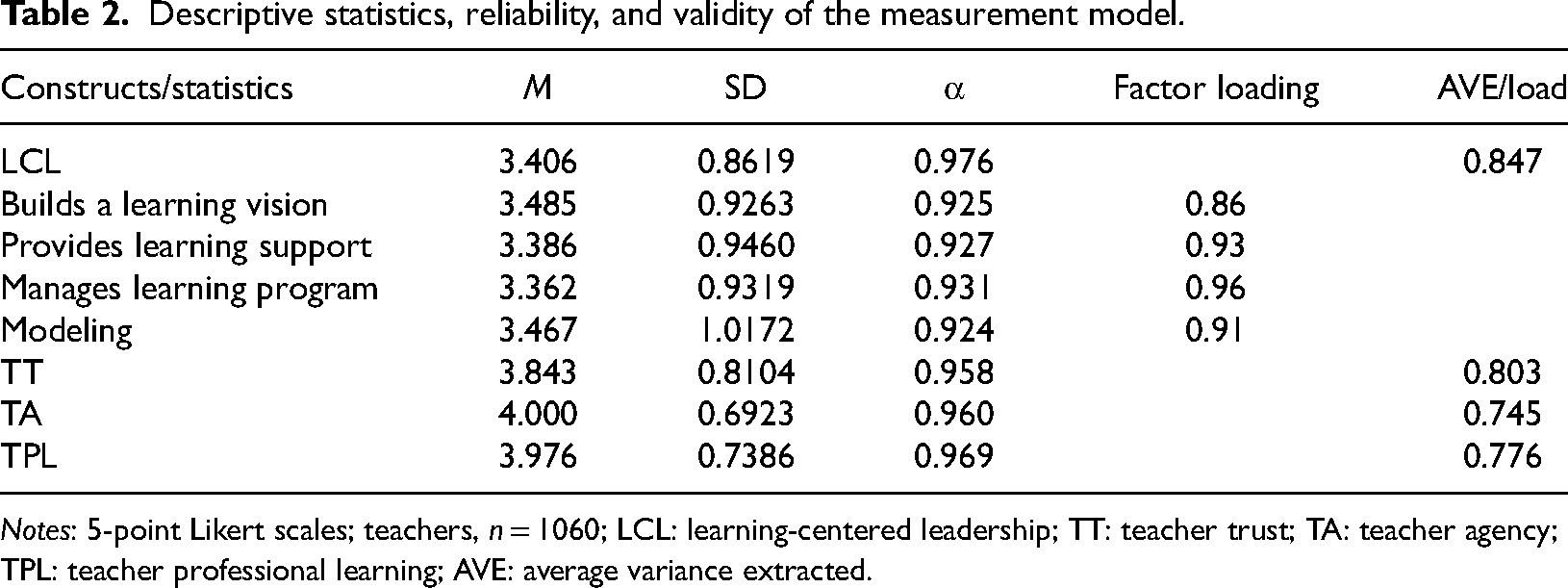
Notes: 5-point Likert scales; teachers, n = 1060; LCL: learning-centered leadership; TT: teacher trust; TA: teacher agency; TPL: teacher professional learning; AVE: average variance extracted.
The researchers then sought to determine the measurement model's reliability and construct validity. Table 2 shows the Cronbach's alpha coefficients (α) of internal consistency for the scales, all of which exceeded 0.70, the standard which Nunnally and Bernstein (1994) recommended. The researchers then assessed instrument convergent validity by examining the average variance extracted (AVE) statistics. Table 2 shows that the AVE values for all four instruments exceed the required criterion of 0.50, thus demonstrating their sufficient convergent validity (Hair et al., 2012). Checking instrument discriminant validity involved comparing the square root of AVE values with correlations among latent variables (Fornell and Larcker, 1981). For each construct, AVE square root values exceeded correlations between latent constructs, thus affirming discriminant validity. Following procedures that Preacher and Hayes (2008) recommended, the researchers conducted a multiple-factor-method test to assess common method bias, with results affirming the proposed conceptual model's overall validity (Hair et al., 2012). And finally, the researchers tested data fit with the proposed conceptual model; results demonstrated a satisfactory fit across each model-fit index (RMSEA = 0.055 (<0.1), CFI = 0.910 (>0.90), and SRMR = 0.046 (<0.08)). Overall, these analyses show strong evidence regarding the reliability and validity of each translated instrument employed in this research, which is entirely consistent with what Liu et al. (2016b) and Hallinger et al. (2017) found during their investigations using the same scales in mainland China and Thailand, respectively.
Leadership effects on TPL
The researchers now undertook data analysis to evaluate the structural model and define the connection(s) between Principal Leadership and TPL. Indeed, the study's conceptual model, depicted in Figure 1, mooted the idea that LCL could imbue direct and indirect effects upon the latter. Such relationships could directly assist school leaders in providing more effective methods for teacher workplace learning. The SEM results shown in Figure 2 show that LCL does indeed have a strong positive influence over TPL, implying that principals can affect the degree of teacher engagement with such activities. Figure 2, however, shows that LCL plays no direct role in promoting TPL (β = 0.01, p < 0.001), but rather that these influences are ‘fully mediated’ via TT and Agency. The pattern of these mediated effects is quite revealing, because although LCL plays a minor direct role in boosting TA (β = 0.25, p < 0.001), its influence is stronger (β = 0.44, p < 0.001) regarding TT. Furthermore, TT exerts a moderately significant effect upon TPL (β = 0.32, p < 0.001), while TA showed a much larger and more significant effect (β = 0.63, p < 0.001). Moreover, TT had a moderately significant effect upon TA (β = 0.55, p < 0.001) along the internal mediation path. In summary, the SEM model confirms that TT and TA mediate the effects of LCL upon TPL in the Kuwaiti schools involved in this research project. However, the nature of this mediation process is not fully consistent with the model we presented in Figure 1. Our results suggest that, for these Kuwaiti schools, LCL affected TPL primarily via the process of building TT which, in turn, bolstered TA which then promoted higher motivation and engagement with TPL.
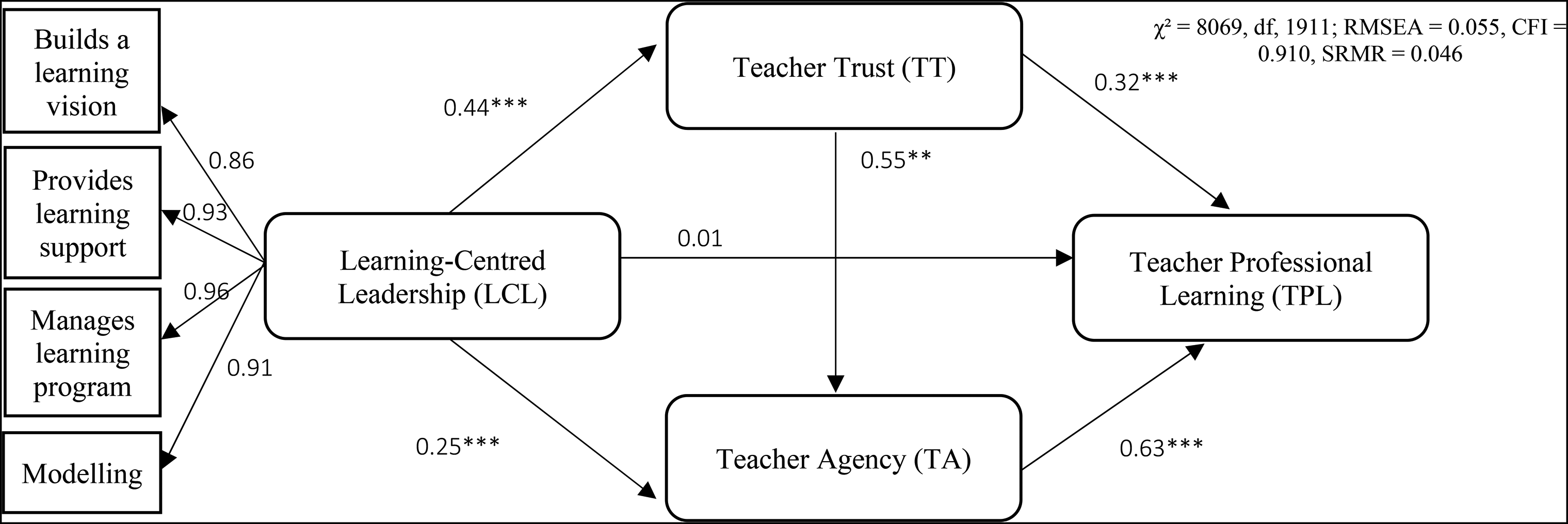
Structural equation model (SEM) model of learning-centered leadership and teacher professional learning. Note: N = 1060, ***p < 0.001.
To further verify the mediating roles our SEM analysis revealed for TT and TA, we also conducted bootstrap analysis, which provided a 95th percentile confidence interval for each path by calculating bootstrap estimates for the mediated paths at the 2.5 and 97.5 percentiles over the 2000 sample distribution (Preacher and Hayes, 2008). Using MacKinnon’s (2008) procedure to obtain a bias-corrected confidence interval for each variable path revealed that LCL has a statistically significant and strong mediating effect upon TPL. As Table 3 indicates, even though the direct path between LCL and TPL was insignificant, the standardized total indirect effect (0.452) did show statistical significance, with mediating effects accounting for 96.9% of the total.
Bootstrapping results for the standardized direct, indirect, and total effects of LCL upon TPL through TT and TA.
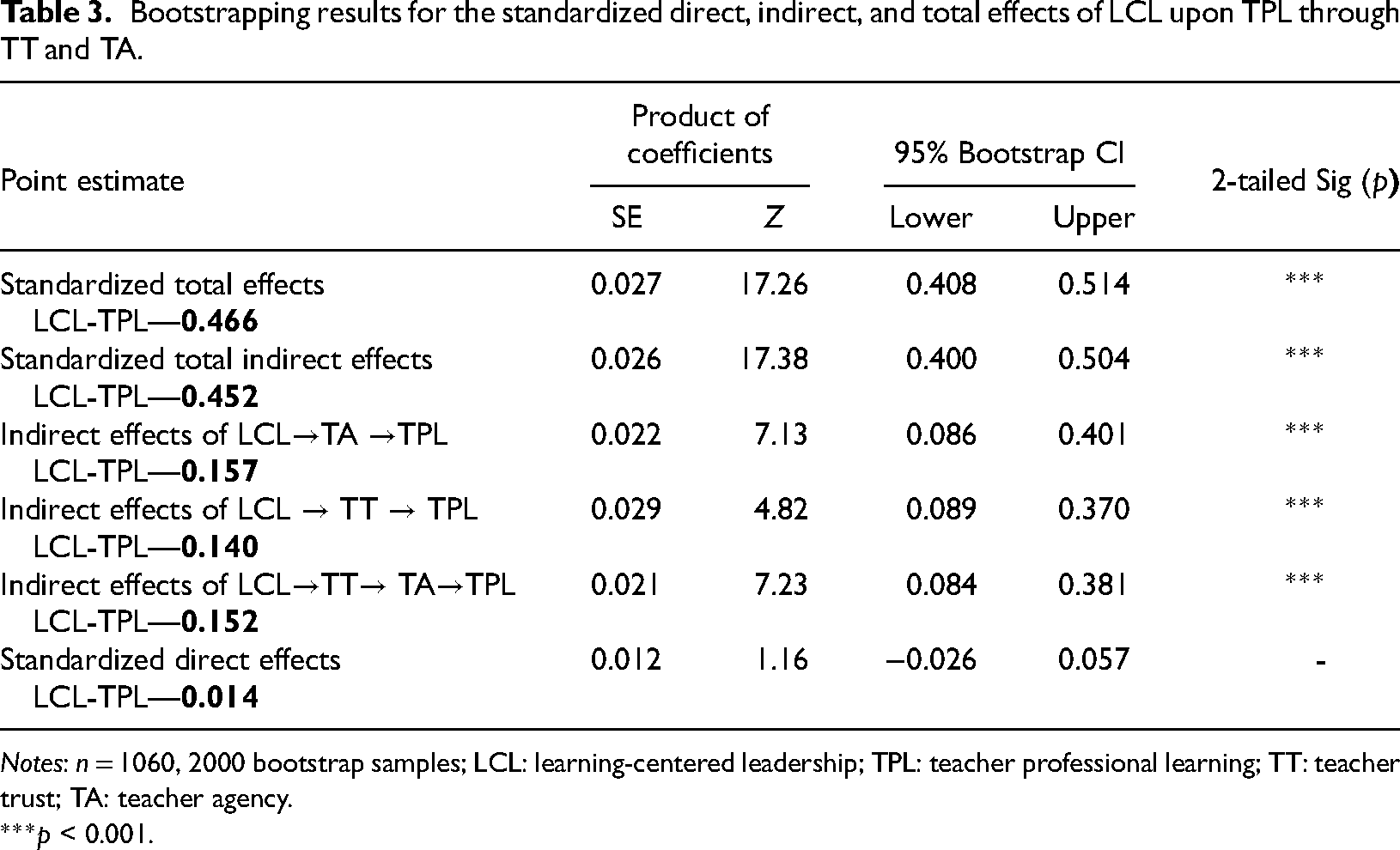
Notes: n = 1060, 2000 bootstrap samples; LCL: learning-centered leadership; TPL: teacher professional learning; TT: teacher trust; TA: teacher agency.
***p < 0.001.
Discussion
Prior research shows that school leadership practices can offer effective instructional influence for fostering an appropriate atmosphere of learning for students (Leithwood and Sun, 2018) while both supporting and motivating teachers and incentivizing school reform, transformation, and improvement (Davis and Darling-Hammond, 2012). While research into LCL is beginning to extend into developing societies (e.g. Liu et al., 2016a, 2016b; Hallinger et al.’s, 2017), the concept remains new for school principals within most Arab nations (see Hammad and Hallinger, 2017; Hammad and Alazmi, 2020). To expand this research to include the Kuwaiti context, this study aimed to investigate relationships in that nation between LCL, TT, TA, and TPL. This section summarizes and interprets primary findings, then discusses implications, and concludes by describing some of this study's limitations
Interpretation and implications of the findings
A number of scholars have investigated the subject of TPL, with their research suggesting that engaging teachers in the practice are an essential step towards school improvement (Fullan, 2001; Robinson et al., 2008; Thoonen et al., 2012). This study's findings add to that body of knowledge, supporting the critical role which a school principal plays in engaging teachers with the continuation of their professional development by acting to promote positive teacher work attitudes (Karacabey et al., 2020; Liu and Hallinger, 2018; Saphier et al., 2006). Indeed, study results suggest that a school principal's leadership practices are associated with TPL via TT and TA. They agree, widely, with the concept that a school principal's leadership can affect TPL by fostering an atmosphere of trust and ownership for the endeavor amongst those in their charge (Hallinger et al., 2014; Lai et al., 2016; Li et al., 2016a; Liu et al., 2016a, 2016b; Qian and Walker, 2013; Wang, 2016). Moreover, this study emphasizes certain conditions that principals may design to both bolster and encourage teacher learning. Essentially this suggests that if a school principal can create a trusting work environment and raise teacher self-confidence in both their abilities to learn and positively affect students, then this could encourage teachers to engage more actively in professional learning endeavors, which ultimately contributes to better school performance. In Liu et al. (2016a: 673) words, school principals need to “employ practices that build a safe and meaningful environment in which teachers can assume greater control over the direction and means of their workplace learning.” This effectively assigns the new role of “leadership for learning” to school principals in developing nations like Kuwait, where such practices fall beyond the traditional purview (Hallinger and Walker, 2017; Lee and Hallinger, 2012; Tran et al., 2018).
These conclusions compare favorably with the findings which Liu et al. (2016b) achieved in their study in mainland China (using the same models of school principal leadership and teacher learning). That being said, there are two notable differences between these results. Firstly, in contrast with our finding of a fully mediated relationship between Principal Leadership and TPL in Kuwait, Liu et al. (2016a) found only a partially mediated model for the same relationship in mainland China. More specifically, she and her colleagues identified a significant, moderate direct effect of leadership upon teacher learning, along with strong mediating effects of TT and Agency (Liu et al., 2016b). Secondly, whereas only a weak relationship between Principal Leadership and TA emerged in our study within Kuwait, the Chinese study into LCL revealed more robust direct effects of Principal Leadership upon TA (Liu et al., 2016b).
Our study also supports Hallinger et al.’s (2017) findings from their research in Thailand, albeit with an exception. Whereas they found that TT held no significant direct relationship with TPL, our study revealed that TT maintained a moderately significant effect upon TPL. These patterns of similarity and difference between the Thai, Chinese and Kuwaiti studies strengthen the validity of our results, but also provide a basis for further refinement in the interpretation of our findings. It could be argued that, while the similarities between our results and prior research point to the existence of “a broadly similar set of leadership practices” that can be effective across culturally different educational contexts (Al-Mahdy et al., 2018: 198), the differences support the proposition that culture plays a key role in shaping the way these leadership practices are enacted (Clarke and O’Donoghue, 2017) as well as the way they interact with other school-level factors to support school improvement (Robinson et al., 2008; Thoonen et al., 2012).
A number of potential implications emerged from our findings for policy makers, school leaders, and leadership preparation providers. For policy makers, it is important to realize that a primary challenge for educational leadership in Kuwait is to move away from more traditional practices into a cooperative pathway that builds capacity for facilitating learning communities. This is not an easy task in the Kuwaiti context, as the formal and standardized nature of policy-making and educational management in the nation, with its characteristic high-power distance, has limited teacher leadership and autonomy in school-based decisions (see Alanezi, 2016; Alhouti and Male, 2017; Alsaleh, 2019). Therefore, there is a need for policy makers in Kuwait to gradually introduce structural changes at the school level in order to provide individual schools with more authority to promote a working atmosphere where teachers engage more closely with both day-to-day and long term decisions governing their institution, especially those directly related to professional development and school improvement.
Concerning school leaders, our results have confirmed the role that school leadership can play in supporting the workplace learning of teachers. This implies that Kuwaiti school principals can play a key role in the current education reform program (see Alsaleh, 2019; Alsharija and Watters, 2020) by embracing leadership behaviors that can empower teachers with a stronger agency for their own practices and generate collegial support which fosters their professional development. Specifically, the results highlight the need for school principals to promote teacher learning through improving teaching instruction, encouraging teachers to reflect upon their practices, to share their knowledge and experiences with their colleagues, and to participate in cooperative staff development opportunities. Principals are responsible for reforming their school’s infrastructure, routines, and policies for sustainable change. Therefore, a school’s principal must encourage all varieties of school learning communities and, by so doing, help teachers provide high standards of student learning (Alsaleh, 2020). Indeed, our findings are consistent with prior research concerning the need for school principals to create an atmosphere of trust and agency if they want to establish a more productive learning environment for both teachers and students in their schools. Building trust among the members of the school community is particularly crucial in school contexts characterized by high power distance like the one in Kuwait.
Finally, our findings also have implications for leadership preparation. We expect that enacting the above-mentioned changes will be a challenging endeavor for Kuwaiti school principals since the practices associated with “instructionally-focused” and “change-oriented” (Murphy et al., 2006) leadership styles have not been part of their normal behavior. As suggested by Lee and Hallinger (2012: 447), principals operating in centralized educational systems tend to adopt “a more ‘traditional head of school’ role.” It is a positive development to see that the updated job specification of school principals in Kuwait places more emphasis on their role as instructional leaders (Alsaleh, 2019) and as change agents (Alsharija and Watters, 2020). It is, therefore, our expectation that those responsible for principal professional development in Kuwait will benefit from the results of this study to design leadership preparation programs aimed at equipping school principals with the knowledge and skills associated with LCL and transformational leadership in order to facilitate such transition.
Limitations
A key limitation to this study involves the research design, as cross-sectional surveys cannot assign causality to the relationships under evaluation. As such, the use of the word “influence” to describe how LCL affects TT, TA, or TPL more properly implies their association. Furthermore, this study investigated the mediating effects of just two aspects that contribute to TPL, these being TT and TA, but there are other facets that play a role in this process (see Heck and Hallinger, 2009; Mulford and Silins, 2003). While the authors are confident in their selection of these two variables, the data analysis is, of course, partially affected by the omission of other variables. Future research should therefore investigate the mediating effects of TT balanced against other potentially relevant factors. Another limitation concerns our inability to conduct multilevel analysis, the reason being that we used an online survey form, thus making the breakdown of teachers’ responses at the school level unknown. Similar studies used single-level analysis when it was not possible to perform multilevel analysis (see Bektas et al., 2020; Piyaman et al., 2017; Polatcan, 2021). The next limitation is related to the present study's reliance on teacher self-reporting techniques, which means that the responses may not reflect actual practices. While we acknowledge that this might raise questions about social desirability bias, researchers (e.g. Kilinc et al., 2020; Luyten and Bazo, 2019) argue that it does not significantly affect the examination of relationships among variables. And finally, since this study involved only quantitative data collected via tools developed for use in non-Arab contexts, the future collection of qualitative data could prove helpful for elaborating how institutional/socio-cultural aspects help mold school principals’ practices in the Kuwaiti context.
Footnotes
Declaration of conflicting interests
The author(s) declared no potential conflicts of interest with respect to the research, authorship, and/or publication of this article.
Funding
The author(s) received no financial support for the research, authorship and/or publication of this article.
