



Abstract
While principal leadership has been exercised in day-to-day practices to address the needs of teachers as professional learners, empirical studies regarding its effects on teacher professional learning have not increased proportionally. Using a sample of 255 secondary school principals and 2756 teachers from four provinces of Beijing, Shanghai, Jiangsu, and Guangdong in China (B-S-J-G-China) who participated in the 2015 Program for International Student Assessment (PISA 2015), this study employed a two-level hierarchical linear modeling to examine principal leadership effects on teacher professional learning. Results showed that principal leadership practices explained a large proportion of between-school variance in teacher learning. Principals’ developing people had positive effects on both personal and collaborative learning. Principals’ instructional improvement had a positive effect on collaborative learning, while principals’ facilitating teacher participation had a negative effect on collaborative learning. The implications for improving principals’ role in promoting teacher learning are also discussed.
Introduction
Education reforms aimed at improving the quality of teaching and learning have called for intensive and effective professional learning of teachers (Darling-Hammond, et al., 2009). Teacher professional learning has been identified as one of the most salient predictors of student learning improvement (Doğan and Yurtseven, 2018). In tandem with this trend, the roles of school leaders have been increasingly emphasized in leading teachers to learn continuously and successfully (Hallinger and Liu, 2016; Liu et al., 2016; Vanblaere and Devos, 2016). It has been highlighted that, through stimulating, backing and sustaining teacher professional learning, school leaders can exert knock-on effects on student learning in both sustained and profound ways (Liu and Hallinger, 2018; Sleegers and Leithwood, 2010). While principal leadership has been exercised in day-to-day practices to address the needs of teachers as professional learners, empirical studies regarding its effects on teacher professional learning have not increased proportionally (Liu and Hallinger, 2018; Pan and Chen, 2020).
Although an emerging line of research has made efforts to connect principal leadership and teacher learning within both western (e.g. Geijsel et al., 2009; Printy, 2007; Vanblaere and Devos, 2016) and eastern contexts (e.g. Hallinger and Liu, 2016; Li et al., 2016; Yin and Zheng, 2018), gaps still exist in the following three aspects. First, available research tended to focus on some specific leadership models (e.g. Geijsel et al., 2009; Liu and Hallinger, 2018; Thien et al., 2021; Yin and Zheng; 2018) rather than leadership practices that can be broadly categorized into good and necessary functions for principals. While emerging research has begun to elucidate effective leadership practices in relation to teacher learning (Buttram and Farley-Ripple, 2016; Pan and Chen, 2020; Qian et al., 2017; Robinson et al., 2008; Yin and Zheng, 2018), there is still a lack of research on the independent effects of different leadership aspects on teacher learning. This is especially true given that different principal leadership practices coexist at schools and work together to influence how and what teachers learn (Kwan, 2020). Second, although professional learning arises from teachers’ participation in both personal as well as collaborative activities (e.g. Doğan and Yurtseven, 2018; Gibbons and Cobb, 2017; Kwakman, 2003), there has been a lack of research into separate forms of teacher learning when studying potential principal leadership effects. Third, while studies have shown that obvious differences exist between schools in teacher professional learning (De Jong, Meirink and Admiraal, 2019; Vanblaere and Devos, 2016), as well as that principal leadership plays an irreplaceable role in stimulating and supporting teacher learning beyond other cultural (e.g. learning atmosphere, value of change, and collaborative culture) and structural supports (e.g. time and resources allocation, appraisal mechanisms, and external networks) that operate at the school level (Admiraal et al., 2016; Huang et al., 2020; Louws et al., 2017), scant research has examined the variation in teachers’ professional learning attributable to the varied principal leadership practices between schools. To fill the research gaps above, the current study examined the effects of different categories of principal leadership practices on teachers’ participation in personal as well as collaborative learning in China through a multilevel modeling analysis.
China has built the largest education system worldwide (Organization for Economic Co-operation and Development (OECD), 2016a). Currently, there are more than 216 million students within over 254 thousand primary and secondary schools (Ministry of Education (MoE), China, 2020). In contrast with those in Anglo-Saxon countries, the education system in China has long been centralized (OECD, 2016a). Under the nation's unitary administrative structure, the MoE undertakes critically macro-level policymaking, planning, and steering role and the local educational authorities take primary responsibility for exercising national policies and managing school education under the MoE's regulations (OECD, 2016a). Although the past two decades have seen a devolution of decision-making authority in areas like curriculum, instruction, and textbooks selection (Qi, 2017), the MoE still keeps a tight rein on “the context within which different educational professions (e.g. teachers, principals) operate” (Liu et al., 2017: 241) through guiding principles and unified standards. For instance, to strengthen the comprehensive implementation of quality education (Su Zhi Jiao Yu) in the whole country, the MoE in 2013 issued the national Professional Standards for Compulsory School Principals that required a role change from grass-roots officials to professionals of school management and leadership (MoE, China, 2013; Liu et al., 2017). Within the standards, stimulating, supporting, and sustaining teacher learning and teaching innovation were specified as core requirements of principal professionalism (MoE, China, 2013). Despite the role shift of principalship, the principal responsibility system that is deeply affected by the high power-distance culture and hierarchical management structures in China still embraces a “principal control” feature (Bush and Qiang, 2000; Zheng et al., 2019). Thus, principals who have been entitled to the right to lead in any domain of school affairs usually adopt a top-down rather than distributed leadership approach to teacher learning (Bush and Qiang, 2000; Huang et al., 2019; Zhang and Sun, 2018). While this has been found facilitative to principals’ leading and developing professional learning activities with full respect of teachers (Walker and Hallinger, 2007), it may also hinder teachers’ authentic involvement in learning and teaching innovation (King and Bouchard, 2011).
In this study, we focus on principals’ leadership approach to teacher learning, to understand the extent to which principal leadership practices contribute to teachers’ participation in personal and collaborative learning in China. The findings of this research can provide more insights into the increasingly important worldwide debate regarding principal leadership effects on teacher professional learning in different contexts.
Literature review
Teacher professional learning
Despite its salient importance, teacher learning has traditionally been known as passive, linear, and context-independent (Kelly, 2006). This simplistic conceptualization has resulted in failures in the development of authentic teaching and learning in the rapidly changing landscape of school education (Clarke and Hollingsworth, 2002; Opfer and Pedder, 2011; Webster-Wright, 2009). In recent years, a complex conceptualization of teacher professional learning taking a nested system perspective has gained mounting momentum (Bruce et al., 2010; Opfer and Pedder, 2011; Stosich, 2016). Within this perspective, teacher learning was considered to be constituted simultaneously in teachers’ personal and professional actions as well as reciprocal and social interactions (Geijsel et al., 2009; Gibbons and Cobb, 2017; Opfer and Pedder, 2011), both of which are embedded within the interaction of teacher- and school-level influences (Bruce et al., 2010; Huang et al., 2020; Kwakman, 2003). Based on the discussions above, we conceptualize teacher professional learning as a combination of personal and collaborative activities that teachers undertake within specific learning systems to construct professional knowledge and develop the expertise of teaching with an aim to improve student learning (Bakkenes et al., 2010; Gibbons and Cobb, 2017; Huang et al., 2019).
A synthesis of the existing literature indicates that teachers’ personal learning activities can be research-based (e.g. research projects, teacher networks) and teaching-based (e.g. teaching experimentation, coaching and receiving coaching) (Bakkenes et al., 2010; Doğan and Yurtseven, 2018; Kwakman, 2003), and that collaborative learning activities occur on the basis of exchange and coordination and observation and dialog (Kwakman, 2003; OECD, 2014c; Pan and Chen, 2020). In practice, teachers may conduct learning activities in both formal and informal settings. In Chinese schools, for instance, teachers have ample opportunities to learn in various school-based training programs and research projects tailored to target groups at different career stages (Zhang et al., 2016). Those in the same subjects also meet regularly in the teaching research groups to conduct collective learning activities, including exchanging materials and ideas, reflecting on classroom teaching, and carrying out lesson preparation and curriculum improvement (Huang et al., 2019). In addition to participation in formal learning activities, teachers usually involve themselves in a series of informal learning activities (e.g. reading, self-reflection, teaching innovation, and informal dialog and feedback), which have been found indispensable to the success of teaching and learning improvement (De Jong et al., 2019; Kwakman, 2003). In the present study, however, we would not separate the informal or formal settings for teacher learning, given that teachers learn from their participation in activities in the context of practice “regardless of the vehicle for teacher learning” (Liu et al., 2016: 80).
The nested nature of teacher learning highlights the importance of teacher characteristics and school conditions in shaping teacher learning (Admiraal et al., 2016; Bruce et al., 2010). Research into the professional learning of teachers with various demographic characteristics has identified gender and teaching experience as two key teacher variables that could explain teacher learning (Opfer and Pedder, 2011). Specifically, studies have revealed that female teachers participate in professional collaboration more frequently than their male counterparts (de Vries et al., 2013). Teachers’ years of teaching experience have been found positively related to their confidence and capabilities in learning and change, suggesting increased learning participation of teachers as they advance along with career ladders to the next expertise level (Grosemans et al., 2015). In addition, schools’ capacity for teacher learning has been found differentiated in terms of different school types and locations (OECD, 2016b; Stoll, 2009). Beyond these teacher and school characteristics, principal leadership is thought to be particularly influential on teacher learning due to the “positional authority and control over school resources” (Schipper et al., 2020: 2) of principals as well as their irreplaceable role in developing teacher learning capacity (Leithwood et al., 2007). However, the existing literature has not generated a deep understanding of the effects of different principal leadership practices on various aspects of teacher learning. More research should be conducted to address this noticeable research gap.
Principal leadership practices and teacher learning
Educational reforms in recent years have been calling for continuous professional learning to build teacher capacity and improve student learning (Darling-Hammond et al., 2009). The prominent role of school principals has been emphasized in promoting quality teaching and learning, fostering teacher capacities and motivation, and designing facilitative structures for learning, through which they can promote sustained and fundamental school change and achieve the ultimate goal of improving student learning (Schipper et al., 2020; Sleegers and Leithwood, 2010). In response to the increasing importance of principal leadership in “fostering school improvement in general, and teacher learning in particular” (Hallinger and Liu, 2016: 164), an emerging line of research has begun to examine principal leadership effects on teacher professional learning.
In the light shed by available studies on school leadership and teacher learning, principals’ leadership practices are crucial for the professional learning of teachers in both Western (e.g. Buttram and Farley-Ripple, 2016; Printy, 2007; Vanblaere and Devos, 2016) and Eastern societies (e.g. Hallinger and Liu, 2016; Pan and Chen, 2020; Yin and Zheng, 2018). Specifically, several leadership models have been examined and identified by researchers as very influential on the development of teacher learning. For instance, Luyten and Bazo (2019) revealed that principals’ transformational leadership (i.e. an empowering leadership approach to teachers’ capacities and motivation for instructional improvement) facilitated school-based teacher (individual) learning, coordinated planning and exchange, and joint reflection, which further contributed to the implementation of learner-centered teaching practice. Liu and Hallinger (2018) found that principals’ instructional leadership (i.e. principals focus on teaching improvement with a more directive approach to coordinating and supervising instructional issues) facilitated Chinese teachers’ participation in school-based professional learning activities. In a study conducted in Neverland, Vanblaere and Devos (2016) indicated the significance of a combination of instructional and transformational leadership styles in the development of the collaborative and reflective practice of teachers. However, they further raised concerns over the difficulty “for one school leader to combine both as they have a different conceptual focus” (p. 35). In this regard, a distributed approach to school leadership (which entails the engagement of teachers with multiple sources of expertise as leaders within the leadership activity) holds promise to overcome the problem and maximize the collective teacher capacity for learning and change (Harris et al., 2007; Hulpia et al., 2011). While distributed leadership de-centers administrators to focus on leadership at the school level as “a unit of analysis” (Gronn, 2002: 424), they are school principals and other administrators who “possess the authority to create structures and opportunities for other organizational members” (Torres, 2019: 113) to participate in leadership activities, including leading teacher learning.
Despite the great variation in conceptual focus between different models in the field of principal leadership, common themes of leadership practices or functions can be extracted enabling principals to enact their role in initiating, supporting, and sustaining teacher professional learning across different contexts and situations (Leithwood and Day, 2007; Robinson et al., 2008). Leithwood et al. (2007), based on several syntheses of international literature in leadership studies, summarized four broad core categories of “good leadership” practices or activities that “have predictable and desirable influences on followers” (p. 43) in both school and non-school situations. In the education field, the first category of leadership practices refers to principals’ setting goals, including framing school goals and missions, fostering a sense of collective purpose, and demonstrating high-performance expectations for teachers (Hallinger and Heck, 2002; Hallinger and Lu, 2014). The second category is principals’ instructional management, which includes task-orientated leadership practices of improving curriculum and instruction and carrying out mentoring and problem-solving (Liu and Hallinger, 2018; Murphy, 1983). The third category denotes principals’ facilitating teacher participation, including engaging teachers with a shared endeavor, creating opportunities for teacher participation, and boosting a collaborative culture (Harris et al., 2007; Leithwood et al., 2007). The fourth category refers to principals’ developing people, which encompasses modeling highly ethical behaviors, offering intellectual stimulation, and ensuring authentic support (Kwan, 2020; Leithwood and Jantzi, 2005). With empirical evidence in support of the four sets of leadership practices (i.e. setting goals, instructional management, facilitating teacher participation, and developing people) continuing to accumulate in recent years (Leithwood and Day, 2007; Leithwood et al., 2020; Sanzo et al., 2011), these core categories of principalship are thought to be potentially influential on teachers’ professional learning (Geijsel et al., 2009; Hallinger and Lu, 2014; Vanblaere and Devos, 2016).
In recent years, research into separate categories of leadership practices and their effects on teacher learning has provided some insights into the roles of the four aspects of principalship in addressing the development of teacher learning. As for principals’ setting goals, this set of practices have potentials to promote teachers’ personal and collaborative learning through principals’ engaging teachers in developing shared purpose and motivating them to progress toward it (Hallinger and Lu, 2014; Meyer et al., 2019). And yet, studies also reveal that an over-use of this leadership task as an accountability tool would have an opposite effect on teacher learning (Hallinger and Heck, 2002; Li et al., 2016). As for principals’ instructional management practices, available empirical research has confirmed the significant role of principals as instructional leaders in stimulating teachers’ participation in professional learning activities, such as reflection, experimentation, research networks, and collaboration (Liu et al., 2016; Printy, 2007). Of note is that research also calls for a shift of principals’ responsibilities to focus on the whole schools’ instructional improvement rather than hands-on problem-solving (which encompasses discussing teachers’ teaching methods, paying attention to disciplinary climate, and helping teachers solve classroom problems), so as to maximize their influences on teacher learning (Andrews and Lewis, 2002; Hallinger, 2003). With respect to principals’ facilitating teacher participation, this set of practices has been identified in several studies as contributive to teacher efficacy, organizational commitment, and psychological empowerment (Hulpia et al., 2011; Liu and Werblow, 2019; Zheng et al., 2019), all of which can fuel the development of teacher learning (Stosich, 2016). Studies further reveal that the successful enactment of this leadership role entails mutual trust and collegial relationships among school leaders and teachers (Carpenter, 2015). Regarding principals’ developing people, this category of practices has been found accountable for a large proportion of leadership effects on teachers’ engagement in personal learning and collaboration as a result of enhanced capacity and dedication of teachers (Geijsel et al., 2009; Kwan, 2020; Vanblaere and Devos, 2016).
In sum, the existing literature has identified four core categories of principal leadership practices that are potentially influential on teacher learning across cultural and organizational contexts (Leithwood and Day, 2007; Robinson et al., 2008). However, available studies usually focus on some specific leadership models and examine their influences on certain measures of teacher learning, rendering the literature far from mature regarding the common features of influential principal leadership in relation to teacher learning (Liu and Hallinger, 2018; Yin and Zheng; 2018). Since different aspects of principalship coexist in daily practice and coalesce to influence the learning activities of teachers at both personal and collaborative levels (Kwan, 2020), it is appropriate to examine different leadership practices and teacher learning in one analytic model, to explore whether each principal leadership category has an independent influence on teachers’ personal and collaborative learning.
Conceptual framework of principal leadership effects on teacher learning
The review of the research has led us to explore the effects of different categories of principal practices on teacher professional learning. Particularly, this study attempts to examine the extent to which principals’ leadership practices of setting goals, instructional management, facilitating teacher participation, and developing people exert influences on teachers’ personal as well as collaborative learning. The results of this study will add to school leadership literature regarding principals’ role in initiating, supporting, and enhancing teacher professional learning. Based on the review of the existing literature above, we proposed a conceptual framework to guide our research (see Figure 1).
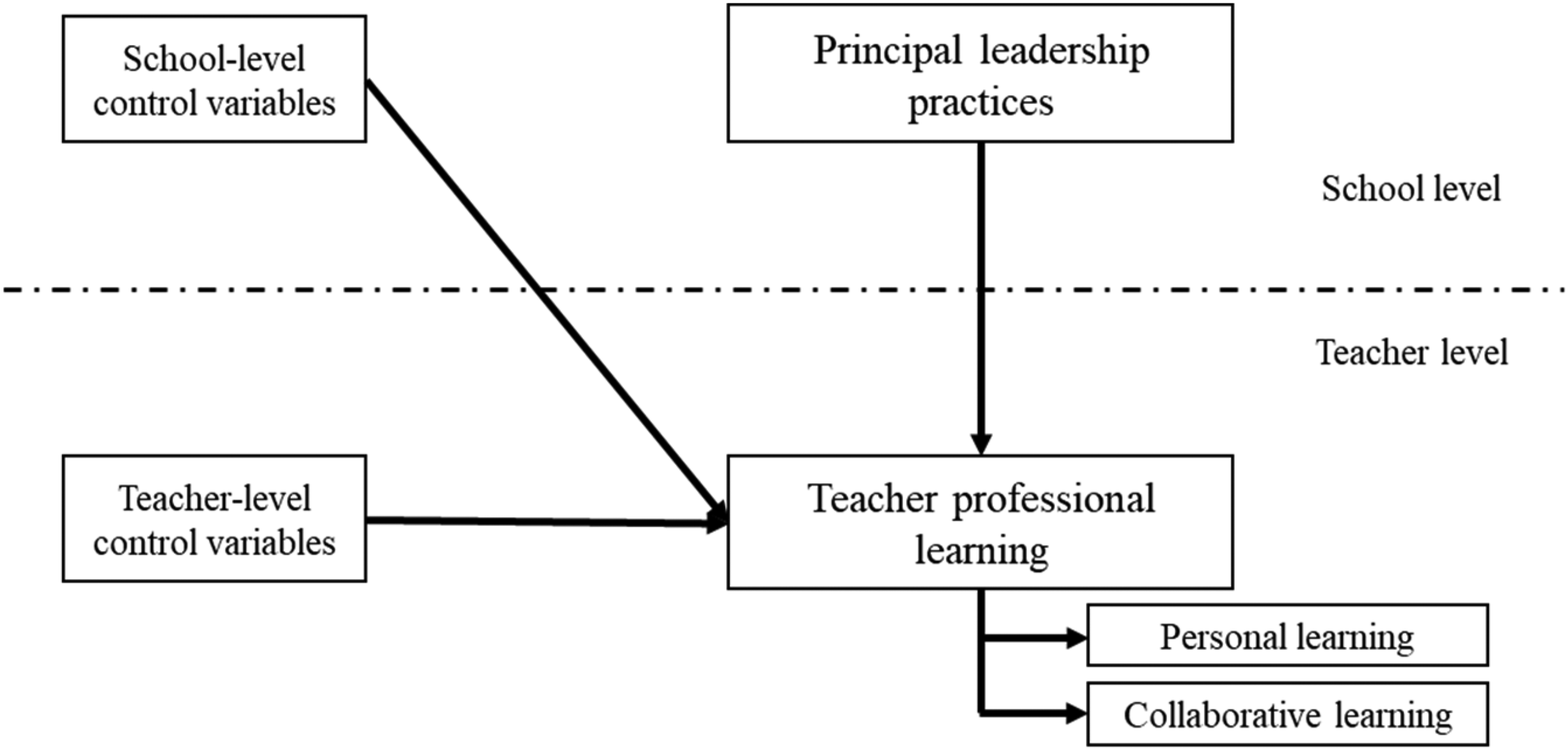
The conceptual framework of this study.
The conceptual framework differs from predominant models of leadership effects on teachers that examine principal leadership and teacher outcomes through the “individual level of analysis” (Liu and Hallinger, 2018: 518). Rather, it responds to the nested nature of teacher professional learning in ways of combining the simultaneous influences of teacher characteristics and school conditions into one multilevel model (Admiraal et al., 2016; Opfer and Pedder, 2011), to explain the variability in teachers’ personal as well as collaborative learning. In this framework, teachers’ gender and years of teaching experience are included in the teacher-level model to account for the variance of teacher learning due to different characteristics between teachers (de Vries et al., 2013; Grosemans et al., 2015). School type and location are controlled at the school-level model to explain the variance of teacher learning attributable to varied school types and locations (Huang et al., 2019; Stoll, 2009; Wang et al., 2017). Beyond these teacher and school backgrounds, the four categories of principal leadership practices that operate at the school level (i.e. setting goals, instructional management, facilitating teacher participation, and developing people) are proposed to significantly influence teachers’ personal and collaborative learning. That is, the extent to which principals exercise their leadership practices varies between schools, and the school-level variance may contribute to different levels of professional learning for teachers in different schools (Huang et al., 2020; Louws et al., 2017; Printy, 2007).
Data and methods
Data source
The study used data of China's Beijing, Shanghai, Jiangsu, and Guangdong provinces (B-J-S-G-China) that participated in the 2015 Program for International Student Assessment (PISA 2015) as a group. The PISA 2015 survey was implemented by participating countries or economies under the coordination of OECD (2017a). In the school investigation, principals were asked to report on a series of questions regarding school background information, assessment and evaluation, and management and leadership, etc. In the general teacher investigation, teachers were asked to answer a set of questions regarding personal information, teaching and learning practices, and working conditions, etc. In the PISA 2015, probability proportional to size sampling method was employed to select sample schools (OECD, 2017a, 2017b). That is, “schools were sampled systematically from a comprehensive national list of all PISA-eligible schools, known as the school sampling frame, with probabilities that were proportional to a measure of size” (OECD, 2017a, 2017b, p. 66). Hence, the sampled schools of B-S-J-G-China in the PISA 2015 were selected across the four provinces. Within each sampled school, 15 non-science teachers were randomly selected to participate in the general teacher investigation. In schools where there were less than 15 non-science teachers, all the non-science teachers would be selected as samples (Mostafa and Pál, 2018). Both principals and non-science teachers were selected as the research sample. With missing data being handled, this study finally identified 255 secondary school principals and 2756 non-science teachers in B-S-J-G-China as the research sample.
Variables
Dependent variables
In this study, dependent variables include two aspects of teacher professional learning, namely, personal learning and collaborative learning. The scales measuring these variables were respectively constructed based on items derived from the general teacher questionnaire (OECD, 2014a).
Teacher personal learning was measured through items asking teachers whether they themselves have participated in any format of personal learning activities during the last 12 months (OECD, 2017a). Following Bakkenes et al., (2010) and Doğan and Yurtseven (2018), we further categorized these items into research-based personal learning (3 items, e.g. participate in research on a topic of interest) and teaching-based personal learning (3 items, e.g. engage in informal dialog to improve teaching), respectively. All the items were rated “yes” or “no,” generating dichotomous categories. Confirmative factor analysis (CFA) using weighted least-squares means and variance adjusted estimation was conducted to construct continuous latent variables. Along the continuum of the latent variables, particular thresholds were estimated in correspondence to the categorical responses (OECD, 2014d). The CFA model calculated latent variables of research- and teaching-based personal learning simultaneously to generate accurate subscales. To avoid the estimation bias caused by the nested structure of data (i.e. teachers being nested within their respective schools), a complex analysis method was specified with school ID as the cluster variable. According to Hu and Bentler (1999), the CFA generated a good model fit with the root mean square error of approximation (RMSEA) (0.052) < 0.08, comparative fit index (CFI) (0.951) > 0.90, and Tucker-Lewis index (TLI) (0.909) > 0.90, supporting the two-dimensional scale of teacher personal learning.
Teacher collaborative learning was measured using items asking teachers to report the frequency with which they collaborate with colleagues in a series of collaborative activities (OECD, 2017a). As indicated by Kwakman (2003) and OECD (2014c), these items were further categorized into exchange and coordination (4 items, e.g. exchange teaching materials with colleagues) and observation and dialog (3 items, e.g. observe other teachers’ classes and provide feedback). All the items were rated on a 6-point response (1 = never, 2 = once a year or less, 3 = 2–4 times a year, 4 = 5–10 times a year, 5 = 1–3 times a month, and 6 = once a week or more). The CFA model was employed to generate latent variables of exchange and coordination and observation and dialog simultaneously by considering the nested and ordinal features of data (OECD, 2014d). Based on Hu and Bentler (1999), the CFA results indicated a good model fit with RMSEA (0.060) < 0.08, CFI (0.993) > 0.90, and TLI (0.988) > 0.90, supporting the two-dimensional scale of teacher collaborative learning.
Independent variables
Independent variables include four categories of principal leadership practices. In the school questionnaire (OECD, 2014b), principals were asked to report the frequency with which they have exercised 13 leadership behaviors and actions in the past academic year through rating on a 6-point response ranging from 1 (did not occur) to 6 (more than once a week) (OECD, 2016b). Item response theory (IRT) was employed in the PISA 2015 to create four leadership variables: one for principals’ setting goals (Pgoal_setting, 4 items, e.g. “I use student performance results to develop the school's educational goals”); two for principals’ instructional management, namely, instructional improvement (Pinstruct_improvement, 3 items, e.g. “I promote teaching practices based on recent educational research”) and problem-solving (Pproblem_solving, 3 items, e.g. “when a teacher has problems in his/her classroom, I take the initiative to discuss matters”); and one for principals’ facilitating teacher participation (Pteacher_participation, 3 items, e.g. “I engage teachers to help build a school culture of continuous improvement”). In this study, Pinstruct_improvement together with Pproblem_solving represents principals’ instructional management leadership as they both indicate task-orientated leadership behaviors in relation to teaching and curriculum development (Hallinger, 2003; Kwan, 2020; OECD, 2016b). In the general teacher questionnaire (OECD, 2014a), teachers were asked to rate principals’ leadership practices of developing people on a 5-item scale ranging from 1 (strongly disagree) to 4 (strongly agree) (e.g. “the principal inspires new ideas for my professional learning”). The IRT was used in the PISA 2015 to construct a teacher-level leadership scale. Within the IRT framework, “item responses are modelled as a function of the latent construct” (OECD, 2017a, 2017b, p. 270), and the calculated value of the latent principal leadership variable reflect the probability of a teacher to score a certain item category based on his/her latent trait and the item characteristics (e.g. the location or difficulty of the item). This scale was then aggregated in this study using mean value for each school, generating the school-level leadership variable for principals’ developing people (Pteacher_development). To ensure the comparability of the Pteacher_development variable with the other four principal leadership variables above, all the school-level principal leadership variables were standardized in this study to have a mean of 0 and a standard deviation of 1.
Control variables
Teacher-level control variables included gender (dummy coded so that male = 1) and teaching years (in tens of years), both of which were derived from the general teacher questionnaire. School-level control variables included school location (dummy coded so that urban school = 1) and school type (dummy coded so that public school = 1), both of which were derived from the school questionnaire.
Data analysis
SPSS 24.0 and hierarchical linear modeling (HLM) 6.02 were used to conduct data analysis. SPSS 24.0 was first used to conduct correlation analysis to calculate the correlations among the variables in this study. Then, given the nested nature of data used in this study (i.e. teachers being nested in schools), HLM 6.02 software was employed to construct a two-level HLM to conduct data analysis through performing restricted maximum likelihood estimation under the guidance of the conceptual framework. The advantages of HLM have been recognized as it is capable of handling data with nested structure, examining predictors at each level, and computing the variance explained by different levels of analysis (Dedrick et al., 2009; Raudenbush and Bryk, 2002). Continuous variables at both teacher and school levels were centered to reduce multicollinearity among predictors.
First, an unconditional model (model 1) was constructed to examine the variance of dependent variables explained by both teacher- and school-level differences. The unconditional model at the teacher level was formulated as


Based on the unconditional model above, intra-class coefficient (ICC) was calculated to indicate the proportion of variance of dependent variables explained at the school level:



Third, based on model 2, variables of the four categories of principal leadership practices were added to form the full model (model 3). The teacher-level model for model 3 was set as


From model 2 to model 3, the proportion of variance of dependent variables explained by the four categories of principal leadership practices at the school level can be computed as

Results
Correlation analysis
Table 1 shows the results of the correlation analysis of the variables at the teacher and school levels in this study. Teachers’ research- and teaching-based personal learning had significant and positive correlations with principal leadership practices of developing people (Pteacher_development). Teacher collaborative learning variables (i.e. exchange and coordination and observation and dialog) were significantly and positively correlated with principals’ setting goals (Pgoal_setting), instructional improvement (Pinstruct_improvement and Pproblem-solving) and developing people (Pteacher_development). Besides, teachers’ personal learning activities were significantly related to teaching years, and teachers’ collaborative learning activities were significantly correlated with gender and teaching years. Moreover, personal learning variables had significant correlations with school characteristics of location and type.
Results of the correlation analysis.
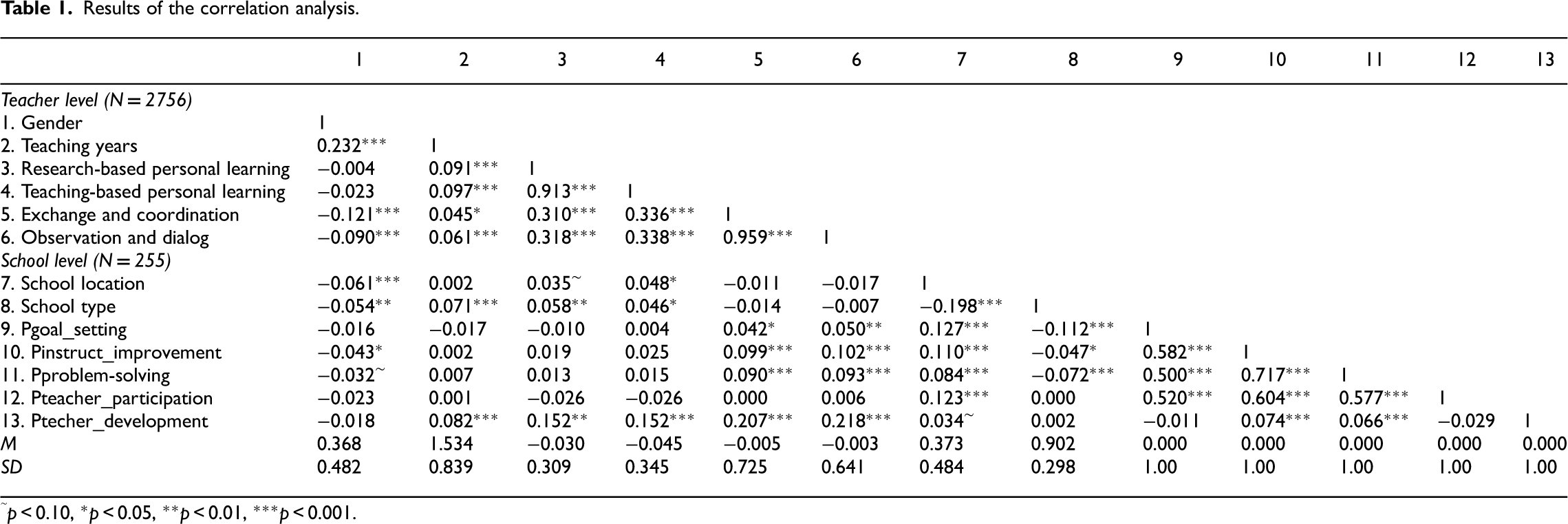
p < 0.10, *p < 0.05, **p < 0.01, ***p < 0.001.
Given the low-to-moderate levels of correlations among independent variables (<0.72) as well as the relatively high levels of the corresponding tolerance statistics (0.374–0.979), multicollinearity is not a concern in our study (Hutcheson and Sofroniou, 1999).
Hierarchical linear modeling
Variance of teacher professional learning variables
Table 2 shows the results of the unconditional model (model 1). It can be indicated by the ICCs that 9.8%, 8.0%, 15.8%, and 16.6% of the variation in research-based personal learning, teaching-based personal learning, exchange and coordination, and observation and dialog was attributed to the differences between schools. As indicated by the significant school-level variance (i.e. τ00) (p < 0.001), teachers’ professional learning activities differed significantly between schools, necessitating the employment of HLM in this study (Bliese, 2000).
Results of the unconditional model (model 1).
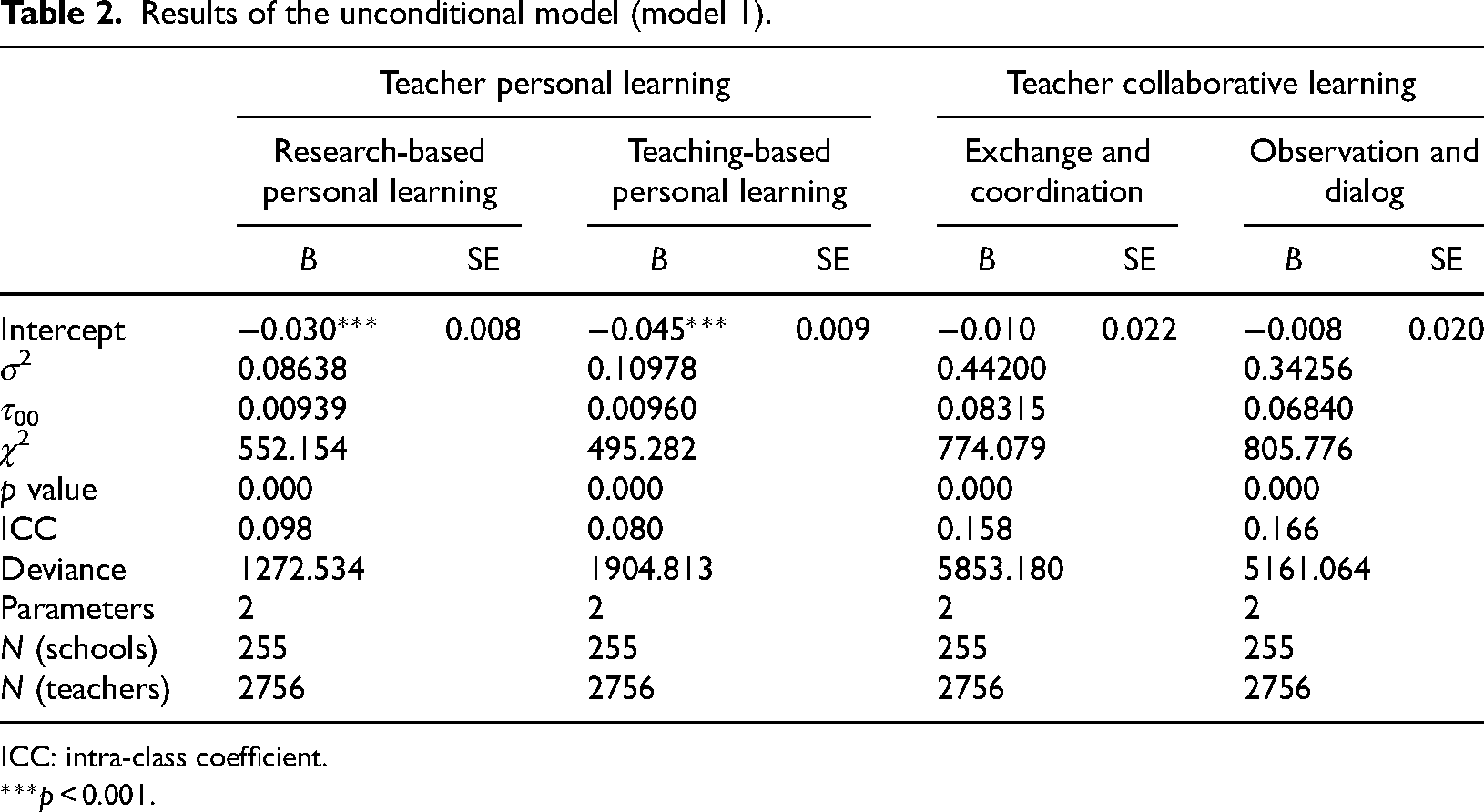
ICC: intra-class coefficient.
***p < 0.001.
The results of the control model (model 2) in Table 3 show that teaching years had significant and positive influences on teachers’ personal as well as collaborative learning. Male teachers were less frequently involved in collaborative learning activities than females. Teachers in urban schools conducted more personal learning activities than rural teachers. Public school teachers participated in more personal learning activities than private school teachers.
Results of the control model (model 2).
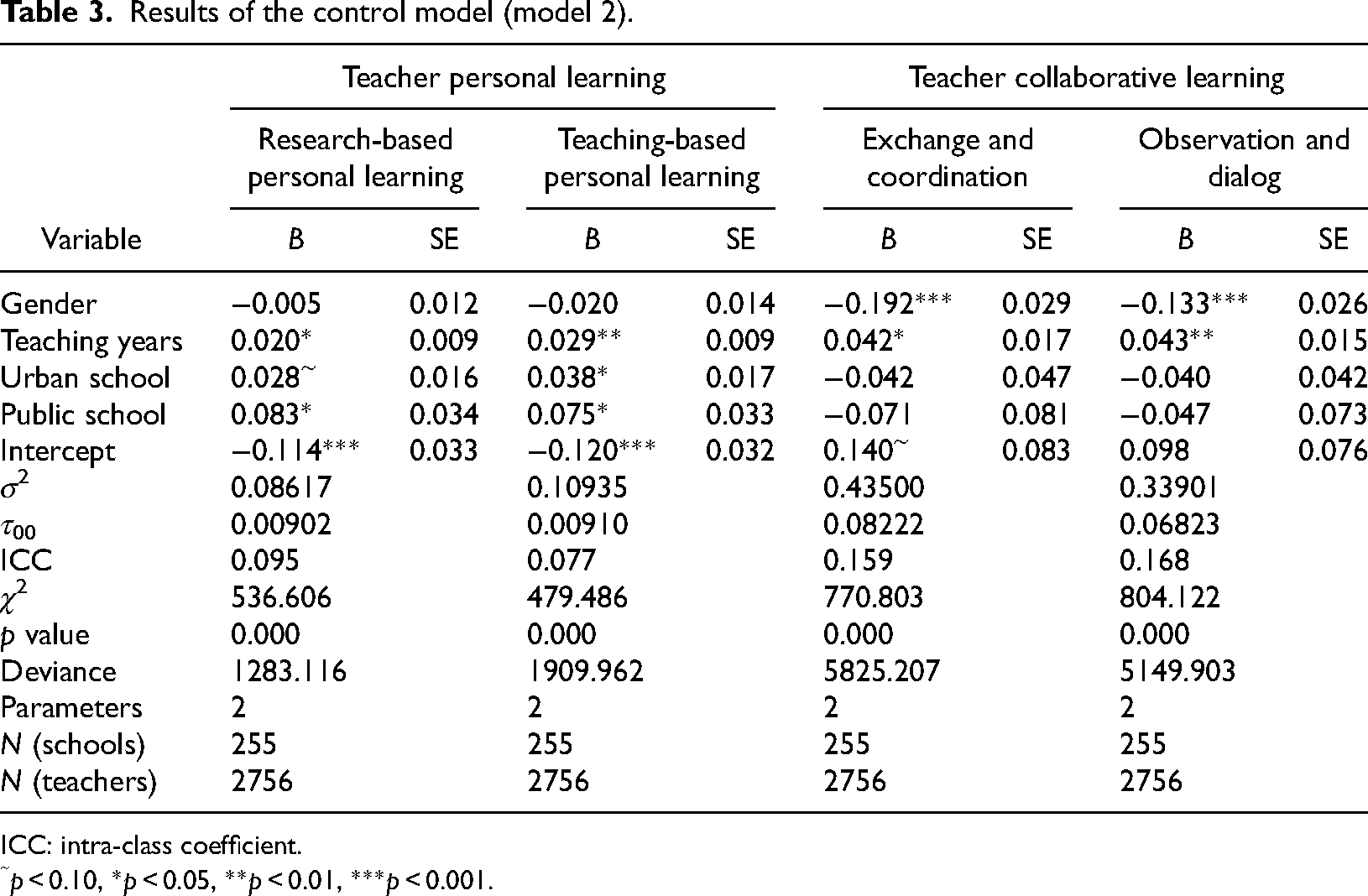
ICC: intra-class coefficient.
p < 0.10, *p < 0.05, **p < 0.01, ***p < 0.001.
The conditional ICCs for research- and teaching-based personal learning are 0.00902/(0.08617 + 0.00902) = 0.0948 and 0.00910/(0.10935 + 0.00910) = 0.0768, respectively, and for exchange and coordination and observation and dialog are 0.08222/(0.43500 + 0.08222) = 0.159 and 0.06823/(0.33901 + 0.06823) = 0.168, respectively. That is, with control variables being considered in model 2, the between-school differences still accounted for 9.5%, 7.7%, 15.9%, and 16.8% of variance in the four dependent variables above, respectively. Given that the school-level variance (τ00) in all the four dependent variables remained significant (p < 0.001), additional school-level predictors may account for the unexplained variance.
Principal leadership effects on teacher professional learning
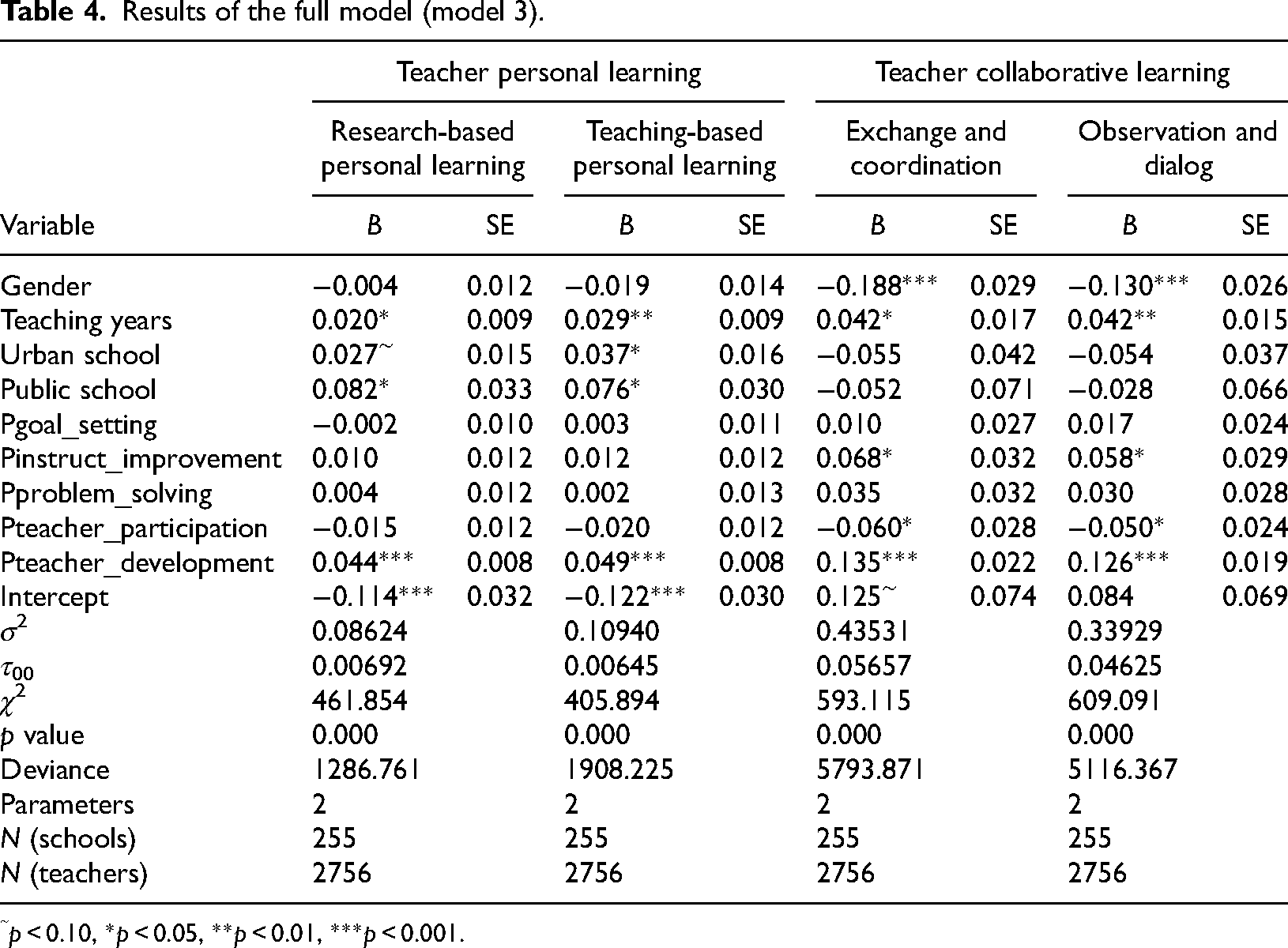
The results of model 3 in Table 4 demonstrated the effects of principal leadership practices on teacher professional learning variables. From model 2 to model 3, the proportion of explained variance at the school level was (0.00902–0.00692)/0.00939 = 0.22 for research-based personal learning, (0.00910–0.00645)/0.00960 = 0.28 for teaching-based personal learning, (0.08222–0.05657)/0.08315 = 0.31 for exchange and coordination, and (0.06823–0.04625)/0.06840 = 0.32 for observation and dialog. In other words, the four categories of principal leadership practices explained 22%, 28%, 31%, and 32% of the school-level variance of research-based personal learning, teaching-based personal learning, exchange and coordination, and observation and dialog, respectively.
Results of the full model (model 3).
p < 0.10, *p < 0.05, **p < 0.01, ***p < 0.001.
As shown in Table 4, principals’ setting goals had no effect on any teacher professional learning variable. The two variables representing instructional management leadership, Pinstruct_improvement and Pproblem_solving, had different effects on teacher learning. Principals’ instructional improvement had significant and positive effects on the two collaborative learning variables of exchange and coordination for teaching (B = 0.068, p < 0.05) and observation and dialog (B = 0.058, p < 0.05), while principals’ problem-solving had no significant effect on teacher personal or collaborative learning variables.
Principals’ facilitating teacher participation had no significant effect on research- or teaching-based personal learning but had significant and negative effects on teacher collaborative learning variables of exchange and coordination (B = −0.060, p < 0.05) and observation and dialog (B = −0.050, p < 0.05). Principals’ developing people had significant and positive effects on research- (B = 0.044, p < 0.001) and teaching-based personal learning (B = 0.049, p < 0.001) as well as teacher collaborative learning variables of exchange and coordination (B = 0.135, p < 0.001) and observation and dialog (B = 0.126, p < 0.001).
Discussion
The prominent role of school principal leadership in promoting teacher professional learning has been emphasized in both Western (Printy, 2007; Vanblaere and Devos, 2016) and Eastern contexts (Hallinger and Liu, 2016; Yin and Zheng, 2018). While research into effective principal leadership practices has emerged (Buttram and Farley-Ripple, 2016; Pan and Chen, 2020; Qian et al., 2017; Robinson et al., 2008), there is still a lack of deep understanding as to different principal leadership categories and their effects on various aspects of teacher learning. To address this noticeable research gap, we focused on four core categories of principal leadership practices (i.e. setting goals, instructional management, facilitating teacher participation, and developing people) and explored their independent effects on teacher professional learning, a multifaceted construct connotating teachers’ personal and collaborative engagement in context-embedded and student-oriented learning activities (Huang et al., 2019; Kwakman, 2003). In particular, we adopted a nested system perspective for teacher learning conceptualization and subsequently constructed a two-level HLM to examine the variance of teacher learning variables due to the varied principal leadership practices at the school level beyond teacher and school backgrounds.
The necessity to examine between-school differences in principal leadership practices
The results of the unconditional model (model 1) reveal significant between-school differences in teacher professional learning, which has long been overlooked in previous studies (Liu and Hallinger, 2018; Opfer and Pedder, 2011). Specifically, school differences explained 9.8%, 8.0%, 15.8%, and 16.6% of the variance within research-based personal learning, teaching-based personal learning, exchange and coordination, and observation and dialog, respectively. The results of the control model (model 2) corroborate the findings of previous studies regarding the importance of teacher characteristics and school backgrounds in shaping teacher learning (Admiraal et al., 2016; Grosemans et al., 2015; Huang et al., 2020). Specifically, female teachers were found more frequently involved in collaborative learning activities than males, echoing the gender difference in teacher collaboration (de Vries et al., 2013). Teaching years had positive effects on both personal and collaborative learning of teachers, which can be due to that more experienced teachers were more accustomed to and better prepared for professional learning (Bakkenes et al., 2010). Meanwhile, teachers in urban or public schools carried out more personal learning activities than their counterparts in rural or private schools, respectively, substantiating the importance of school backgrounds in shaping teacher personal learning (Stoll, 2009; Wang et al., 2017). With the teacher- and school-level backgrounds being considered in the full model (model 3), the variation in principal leadership practices between schools had salient influences on teachers’ personal and collaborative learning, supporting our argument for the irreplaceable role of school-level principal leadership in the development of teacher learning. To step further, we focused on specific categories of principal leadership practices and examined their independent effects on teacher learning.
The effects of different principal leadership categories on teacher learning
The results reveal that principal leadership practices are crucial for the development of teacher learning at both personal and collaborative levels (Kwakman, 2003; Louws et al., 2017; Printy, 2007). Since teachers are the most important agents of educational change, principals’ leading teacher learning can be effective to build up school-wide capacity for sustained change and improvement (Huang et al., 2019; Sleegers and Leithwood, 2010). More than that, the results provide insights into the effects of different principal leadership categories on teacher professional learning. In line with previous research supporting the salient role of principals in developing professional learning capacities (Geijsel et al., 2009; Sleegers and Leithwood, 2010), principals’ developing people had significant and positive effects on both personal and collaborative learning of teachers, above and beyond the effects of other leadership categories. However, principals’ setting goals had no significant effect on teachers’ personal or collaborative learning, despite that this aspect of leadership practices has been identified as particularly important in motivating teachers to learn in both personal and collaborative ways (Hallinger and Lu, 2014). Of the two components of instructional management leadership (i.e. instructional improvement and problem-solving), neither had significant effects on teacher personal learning, and only one (i.e. instructional improvement) had significant effects on teacher collaborative learning. Surprisingly, principals’ facilitating teacher participation had no significant effect on teacher personal learning but had significant and negative effects on teacher collaborative learning.
The non-significant effect of principals’ setting goals may be due to two major reasons. First, the goal-setting leadership needs to go through the “filter” of psychological mechanisms before it can spur changes in teacher learning behaviors (Bandura, 1986; Liu and Hallinger, 2018). The individual differences in teachers’ internalization of the educational goals may limit the predictive effects of principals’ setting goals. Second, teachers’ professional learning may be undermined by the excessive use of goals as accountability tools for school principals (Kwakman, 2003; Li et al., 2016). Especially in the Chinese contexts where principals adopt a top-down leadership approach to teacher development, the over-use of accountability systems may narrow teachers’ focus of professional learning to specific areas and reduce their teaching autonomy and innovation (Meyer et al., 2019). Several studies conducted in Chinese schools have revealed that the top-down requirements and impractical expectations from school principals conflicted with the learning purpose of teachers and reduced their motivation in pursuit of continuous learning (Huang et al., 2019; Zhang and Pang, 2016).
Comparing principals’ instructional improvement and problem-solving behaviors, varied instructional responsibilities of principals exerted different impacts on teacher collaborative learning. Specifically, principals’ instructional improvement (i.e. principals focus on improving instructional programs of the whole school) had positive effects on both exchange and coordination and observation and dialog of teachers, resonating with previous studies necessitating the strategic role of principals in monitoring and promoting instructional improvement (Andrews and Lewis, 2002; Liu and Hallinger, 2018). However, principals’ problem-solving behaviors had no significant effect on teacher collaborative learning. The results, on the one hand, can be due to the limited time and energy of principals, which makes it difficult for principals to interact with every single teacher and provide support and advice for teaching improvement (Tan, 2018). On the other hand, influenced by the high power-distance culture and hierarchical school structure, teachers in Chinese schools tend to follow rather than challenge tasks and ideas delivered by school leaders (Wong, 2010). Although these cultural and institutional forces facilitate principals’ role in stimulating teachers’ pedagogical progress, they may also block teachers’ participation in collaboration for innovative problem-solving (Zhang and Pang, 2016).
Departing from the predominant arguments (Hulpia et al., 2011), principals’ facilitating teacher participation exerted negative effects on teachers’ collaborative learning (i.e. exchange and coordination and observation and dialog). The results reflect the dysfunctional and inconsistent role of principals in sharing and distributing their leadership work across school members and situations (Weiss et al., 1992). For instance, Smylie et al. (2007) found that school administers tended to involve teachers in sharing workload rather than leadership functions among faculty members when the trust was lacking within the school organization. Thus, it is possible that principals in the four provinces of China assigned many trivial administrative tasks to teachers who already had a high teaching load (Liu and Onwuegbuzie, 2012), which inevitably cut down on the time available for school-based collaboration. Studies also found that under the influence of directive and authoritarian practices in Chinese schools, teachers are used to demonstrating obedience to the authority of school principals (Wong, 2010). Thus, when teachers have opportunities to participate in collaborative decision-making, they may suppress true opinions and constrain their behaviors to conform to the directions of school leaders (Wong, 2010). The factors listed above can undermine teachers’ beliefs in and commitment to collaborative learning.
Conclusion and implications
Over the past ten years, professional learning has become increasingly important for teachers to achieve continuous development and ensure high-quality teaching (Darling-Hammond et al., 2009; Opfer and Pedder, 2011). Principals’ performing leadership functions have been identified as crucial for the development of teacher professional learning at both individual and collaborative levels (Geijsel et al., 2009; Huang et al., 2019; Kwakman, 2003; Liu and Hallinger, 2018). This is especially true in the Chinese contexts where principals as top school leaders unequivocally assume an irreplaceable role in supporting and promoting teacher learning (Liu et al., 2017; Qian et al., 2017; Walker and Hallinger, 2007).
The research findings contribute to the existing literature by examining the effects of different categories of principal leadership practices on teacher professional learning at both personal and collaborative levels. In particular, our research substantiates the need to examine principal leadership effects on teacher learning through a multilevel framework of analysis, within which the influences of teacher-level characteristics and school-level conditions are simultaneously considered (Liu and Hallinger, 2018; Opfer and Pedder, 2011). The research also gives prominence to the role of Chinese culture (i.e. the high power-distance culture) and institutional specificity (i.e. hierarchical management structures) in shaping principal leadership effects on teacher learning (Bush and Qiang, 2000; Huang et al., 2020; Walker and Hallinger, 2007; Zhang and Sun, 2018). Although the research was conducted in China, it can shed light on research conducted in international societies with similar contextual features.
This study provides some practical implications for principals’ leading and managing teacher professional learning in practice in Chinese schools. First, some leadership practices can be specifically and intensively exercised to boost teachers’ personal and collaborative learning. For instance, school principals can involve teachers to reflect on their own professional growth in reference to school improvement plans, through which principals can stimulate the professional development needs of teachers and enhance their participation in professional learning (Huang et al., 2019). Besides, principals should focus on monitoring and ensuring the improvement of school curriculum and instruction rather than just serving the problem-solving of certain teachers (Andrews and Lewis, 2002). Moreover, to ensure the pedagogical progress of ordinary teachers, principals may provide broad autonomy to teacher leaders or expert teachers and involve them to lead and enact instructional innovations and take on the responsibility to model good teaching practices and support colleagues through mentoring and coaching (Pan and Chen, 2020).
In addition, principals should create favorable preconditions for the successful enactment of other categories of leadership practices (i.e. setting goals and facilitating teacher participation). For instance, when school principals set educational goals and communicate them to teachers, they may also attend to teachers’ psychological conditions and ensure that teachers have internalized the educational goals into personal goals, to elicit a positive change in teaching and learning (Geijsel et al., 2009; Hallinger and Lu, 2014). Besides, when school principals involve teachers in decision-making processes, they should encourage teachers’ voices and opinions and authentically share leadership functions with teachers, to promote their participation in dealing with decision-making issues regarding teacher professional learning. Principals may also spend time and energy building organizational trust within schools to facilitate teacher participation and promote teacher learning (Smylie et al., 2007; Yin and Zheng, 2018).
Finally, multiple categories of leadership practices coexist in practice and it is the combined effect that makes a difference in the development of teacher professional learning (Kwan, 2020). In order to effectively promote teacher professional learning, school principals may arrange a repertoire of leadership strategies that are contributive to the professional growth of teachers and contingent on the interaction of teacher and school conditions (Huang et al., 2020; Tan, 2018). Having said this, it must be noted that school principals assume a myriad of responsibilities in Chinese schools (Yin and Zheng, 2018). They are not only designated as the top leader and administrator of school organization but are held responsible for implementing external policies and maintaining community relations (MoE, China, 2013; Liu et al., 2017). To generate sustained and significant leadership effects on teacher learning, school principals must treat teacher learning development as a top priority and invest sufficient energy and time to enhance teachers’ professional learning (Tan, 2018).
This study has several limitations. First, as schools were sampled in the four developed eastern provinces of China (i.e. B-J-S-G-China) as a whole (OECD, 2017a, 2017b), we cannot identify the interprovincial differences within the exercises of principal leadership and its impacts on teacher learning. Hence, the data of B-S-J-G-China can only be used to provide insights into principal leadership effects on teacher learning across all four provinces. Nonetheless, given the top-down administration of primary and secondary education in China (OECD, 2016a), there may be limited differences regarding the exercises of principal leadership and the subsequential influences on teacher learning across the four provinces. Second, although both science and non-science teachers were investigated in the PISA 2015, only non-science teachers were asked to rate principals’ leadership practices of developing people in the general teacher questionnaire (OECD, 2014a). For the sake of data availability, only non-science teachers were included in this study. However, this may lead to concerns over the gender composition of the research sample, as gender can be influential on teacher professional learning (de Vries et al., 2013). Future studies may take into account the issue and randomly selected a sample of teachers with various subject backgrounds. Third, it should be noted that the leadership variables of setting goals, instructional management, and facilitating teacher participation were derived from principals’ self-rating, while the leadership variable of developing people was measured through calculating teachers’ rating data. Although the use of multisource data reduced the likelihood of common method variance bias (Liu and Hallinger, 2018), different measurement approaches to principal leadership practices may lead to variation in the magnitude of predictive coefficients). Nonetheless, this study still confirmed the predictive effects of principals’ developing people on teacher learning when controlling for other principal leadership categories. Future studies may examine principals’ developing people and their independent effects on teacher learning using principals’ self-rating data. Finally, the data used in this study is cross-sectional in nature and cannot warrant causal inferences. However, principal leadership practices as contributing factors to the school organizational conditions may work as stable system influences, impacting teachers’ professional learning. Thus, changes in teacher learning can be attributed to the varied principal leadership practices between schools.
Footnotes
Declaration of conflicting interests
The authors declared no potential conflicts of interest with respect to the research, authorship, and/or publication of this article.
Funding
The authors disclosed receipt of the following financial support for the research, authorship, and/or publication of this article: This work was supported by the 13th Five-Year Plan Project of Educational Science in Jiangsu Province (grant number C-a/2020/01/02), and by the Fundamental Research Funds for the Central Universities.
