




Abstract
Prior research has established principal leadership as a key factor in enhancing professional learning communities. However, researchers are only beginning to make progress in identifying the means and ‘paths’ through which school leaders contribute to professional learning communities. This study tested a multilevel, moderated mediation model of the processes linking instructional leadership and professional learning communities in China where professional learning communities have long been embedded in the culture of schools. In this study, ‘teacher responsibility’ was proposed as a mediator and procedural justice climate as a moderator of the relationship between principal leadership and teacher professional learning communities. The results based on the analysis of responses from 3374 teachers revealed significant direct and indirect effects of instructional leadership on the professional learning communities via teacher responsibility. Procedural justice climate significantly moderated the effects of instructional leadership on both teacher responsibility and professional learning communities. The positive effects of instructional leadership were strengthened when the procedural justice climate was higher.
Keywords
Introduction
Since the 1990s, schools have increasingly invested in teachers’ professional learning with the aim of enabling more adaptive, effective responses to the demands of educational reform (DuFour and Eaker, 1998; Louis et al., 1996a, 1996b). Guided by research on professional learning communities (PLCs), education systems accept the value of engaging teachers to work collaboratively for teacher knowledge, skill, beliefs, practice, and student learning outcomes (Doğan and Adams, 2018; Hairon et al., 2017; Lomos et al., 2011; Zheng et al., 2021). Notably, these research findings have emerged not only in Western societies (Admiraal et al., 2021; Park et al., 2019), but also in East Asia (Liu and Yin, 2022; To et al., 2021; Yin et al., 2019; Zheng et al., 2021).
Given the importance of PLCs for enhancing teachers’ practices as well as student achievement (Lomos et al., 2011; Ronfeldt et al., 2015), how supportive conditions promote the enactment of PLCs has attracted increasing interest from researchers (Bryk et al., 1999; Gray et al., 2016; Qian and Walker, 2021). School leadership is one important factor that supports the enactment of PLCs (Hairon and Tan, 2017; Ho et al., 2020; Qian and Walker, 2021; To et al., 2021). Studies have found that leadership practices are associated with instructional leadership (Vanblaere and Devos, 2016; Wang, 2016; Zheng et al., 2019) and transformational leadership (i.e. Valckx et al., 2020; Vanblaere and Devos, 2016) can influence teacher engagement in PLCs.
We focus on the effect of instructional leadership on PLCs for two reasons. First, instructional leadership is the core aspect for Chinese principals (Wang, 2016). Professional standards for Chinese principals have delineated specific expectations for a principal to enact instructional leadership to facilitate school-based teaching research and effective learning community (Ministry of Education, 2013). Second, scholars have identified a series of leadership practices (i.e. routinizing teacher collaborative learning, allocating resources for teacher learning, building a culture focused on teacher learning, and managing the instructional programme) for productive PLCs in China, which are closely related to instructional leadership (Qian and Walker, 2021; Wang, 2016; Yin and Zheng, 2018; Zheng et al., 2019)
This study further applied social information processing theory to unpack how and when instructional leadership may motivate teachers to engage in PLCs. Social information processing theory suggests that salient, relevant, and credible information from the social context of schools (including significant individuals and environmental characteristics) influences individuals’ opinions, attitudes, and motives (Salancik and Pfeffer, 1978). Principals who demonstrate instructional leadership create a clear direction, reward systems, and a learning-centred environment for teachers (Hallinger, 1982/1990/2015). As one of the most important sources of influence in schools, principals provide direct constructions of socially acceptable requirements, norms, and expectations for teachers.
Chinese society is well known for the hierarchical structures with high power distance (Hofstede, 2010). Teachers in high power distance cultures tend to be more accepting of administrators’ directives due to their hierarchically superior positions than are teachers in low power distance cultures (Walker and Dimmock, 2000). Beliefs about seniority, hierarchy, and harmony motivate Chinese teachers to actively seek cues from their principals concerning their expectations for socially acceptable attitudes and behaviours (Liu and Hallinger, 2021). Chinese principals, therefore, influence teachers’ sense of responsibility and engagement in PLCs by communicating explicitly and implicitly their expectations.
Contingency theory emphasizes that leadership effectiveness depends on the interaction of leader behaviour with the environmental situation. A growing number of scholars have cautioned that a ‘one-size-fits-all approach’ cannot explain fully the effectiveness of leadership in schools that operate in widely differing institutional and cultural contexts (Hallinger, 2018; Walker and Dimmock, 2012). However, how culture influences educational leadership effectiveness is still relatively unexplored (Dimmock, 2020; Hallinger, 2018; Hallinger and Heck, 1998; Walker and Dimmock, 2012). The neglect of school context factors may lead to spurious relationships of leadership and work-related outcomes (Dimmock, 2020; Liu and Hallinger, 2021). Thus, it is important to explore the boundary conditions that shape the effectiveness of principal instructional leadership.
Procedural justice climate refers to perceptions of fair treatment in the enactment or explanation of formal policies and procedures in the organization (Murphy et al., 2003; Niehoff and Moorman, 1993). Teachers’ sensitivity regarding procedural justice predicts the degree to which they perceive that their schools value their contributions and care about their well-being. A school climate of procedural justice boosts teachers’ self-esteem and conveys a sense of appreciation in return for their work engagement. According to social exchange theory (Blau, 1964; Murphy et al., 2003), teachers who work in a climate of procedural justice develop a desire to reciprocate and behave in ways that will benefit their schools. Thus, we propose that a procedural justice climate promotes teachers’ sense of work responsibility and engagement in PLCs. That is, procedural justice plays the role of moderator in the relationship between instructional leadership, teacher responsibility, and PLCs.
These sets of proposed relationships are captured in the three research questions that guided this study.
Does teacher responsibility mediate the effects of principal instructional leadership on the enactment of PLCs? Does the procedural justice climate of schools moderate the effects of principal instructional leadership on teacher responsibility? Does the procedural justice climate of schools moderate the mediated effects of principal instructional leadership on PLCs through teacher responsibility?
Theoretical perspective
In this research, we argue that the positive effects of instructional leadership towards PLCs are achieved, in part through teacher responsibility. Procedural justice climate as a contextual variable moderates the instructional leadership–teacher responsibility relationship and subsequent PLCs. We discuss the main constructs in the study and present the conceptual model that guided data collection and analysis in this section.
PLCs in China
Although there is no universally accepted definition of PLCs (Hairon et al., 2017; Stoll et al., 2006), research suggests that PLCs are characterized by ongoing, collaborative, reflective, learning-oriented, and growth-promoting learning activities (Hairon and Tan, 2017; Qian and Walker, 2021; Stoll et al., 2006). Two prominent characteristics of PLCs include teachers’ collaborative efforts and supportive conditions (Hord, 1997; Roy and Hord, 2006; Zhang and Pang, 2016).
PLCs in this study were defined as teacher communities that are oriented towards organizational learning, shared responsibility, reflective dialogue, and de-privatized practice (Hargreaves, 2007; Ho et al., 2016; Liu and Yin, 2020). Organizational learning encourages teachers to seek new information from outside, share information with colleagues, and interpret and integrate information to promote school improvement (DuFour and Eaker, 1998; Schechter, 2008). Shared responsibility creates a collective commitment and accountability for teachers to student learning beyond their own classrooms (Stoll et al., 2006). Reflective dialogue emphasizes on knowledge exchange among colleagues to promote a deepened understanding of the teaching and learning process (Louis et al.,1996a, 1996b; Stoll et al., 2006). The de-privatized practice encourages teachers not only to share their expertise via discourse, but also to engage in ‘open’ or ‘public’ lessons that are observed and critiqued by colleagues (Louis et al.,1996a, 1996b). These four characteristics have been applied and validated in Chinese contexts (Ho et al., 2016; Liu and Yin, 2022).
Although the term PLCs originated in Western countries three decades ago, structured teacher collaboration has been embedded in Chinese teachers’ daily work for more than half a century (Chen, 2020; Qiao et al., 2018; Qian and Walker, 2021; Zheng et al., 2021). In 1952, the Ministry of Education of the People’s Republic of China issued two policy documents titled Interim Provisions for Primary (Secondary) Schools (Draft). According to these policies, all Chinese primary and secondary schools were required to establish subject-based Teaching and Research Groups (TRGs, Jiaoyanzu) which would meet regularly for the purpose of instructional improvement. Fifty years later, subject-based TRGs were identified as a key system-level factor explaining the excellent performance of Shanghai students in the Programme for International Student Assessment (OECD, 2014).
PLCs in Anglo-American school systems tend to emphasize teachers’ bottom-up initiative and willingness to engage in collaborative learning. Consistent with broader cultural norms the Chinese version of PLCs is administratively mandated, institutionalized, and top-down (Wong, 2010; Zhang et al., 2017; Zheng et al., 2019), which often can be labelled as ‘arranged collegiality’ (Wong, 2010; Zhang et al., 2017). On the one hand, researchers suggest that PLCs which are purposefully organized and designed provide, at a minimum, structural support to catalyse, support, and – potentially – sustain the collective learning of teachers (Hargreaves, 2015; Wong, 2010). On the other hand, scholars also express concern that ‘arranged collegiality’ in the absence of enough trust, mutual respect and understanding can lead to resistance from teachers and the more superficial learning attributed to cultures of ‘contrived collegiality’ (Wong, 2010; Zhang et al., 2017).
Instructional leadership and PLCs
Instructional leadership has gained global acceptance over the past several decades as a key role through which school principals contribute to school effectiveness and improvement (Hallinger and Heck, 1998; Zheng et al., 2019). The most commonly applied model of instructional leadership conceptualizes this role as consisting of three main dimensions: defining the school mission, managing the instructional programme, and developing a positive school learning climate (Hallinger, 1982/1990/2015).
Through practices associated with these dimensions, principals as well as other leaders within the school, focus the school on a common direction and develop norms that support teaching and learning development. While the concept of instructional leadership was developed in the USA, national policies now set the formal role expectation for principals in China to act as instructional leaders (Ministry of Education, 2013). Within this role, Chinese principals are expected to assume responsibility for developing curriculum and instruction, and supporting teacher learning and development. A subset of this research has focused on how instructional leaders foster the development of PLCs (Qian and Walker, 2021; Vanblaere and Devos, 2018; Zheng et al., 2019).
Social information processing theory suggests that individuals adjust their perceptions, attitudes, and behaviours according to salient, relevant, and credible information from social context (Salancik and Pfeffer, 1978; Zalesny and Ford, 1990). For example, teachers tend to look for cues from principals to form opinions about desired and acceptable behaviours in their schools. By developing and communicating a school-wide vision of learning, organizing time for collaborative work among teachers, and providing necessary support for instructional improvements (Hallinger, 1982/1990/2015), instructional leaders can shape teacher engagement in PLCs. Thus, we suggest instructional leadership is positively related to engagement.
Teacher responsibility as a mediator of leadership and PLCs
There is abundant qualitative and quantitative evidence that principals and teacher leaders play an important role in the formation of PLCs (e.g. Qian and Walker, 2021; To et al., 2021; Vanblaere and Devos, 2016, 2018; Wang, 2016; Yin and Zheng, 2018). Yet, limited studies have provided evidence on the means through which leadership practices contribute to PLCs ( Hairon et al., 2017; Liu and Yin, 2020). In this study, we propose a new variable, termed ‘teacher responsibility’, as a mediator of leadership effects on PLCs in the Chinese context.
Alternatively translated as ‘teacher obligation’, teacher responsibility has been defined as the ‘internal obligation and commitment to produce or prevent designated outcomes’ (Lauermann and Karabenick, 2011, p. 127). Drawing upon social information processing theory, information processing patterns influence an individual’s attitude and behaviour, which involves an individual’s perception of, interpretation of, and responses to social cues (Salancik and Pfeffer, 1978). As important social influencers in the school, principals are the salient sources of social information for teachers. Principals with instructional leadership demonstrate they value PLCs by intentionally expressing behavioural expectations, seeking resources, and proposing requirements to the well-function of PLCs (Qian and Walker, 2021; Wang, 2016; Zheng et al., 2019). Their behaviours and actions provide important social cues to teachers about what should be the schools’ priority, work requirements, and norms, which affect teachers’ work attitudes and philosophies (Park et al., 2019). That is, teachers are convinced that they should care about their professional development to ensure and improve teaching quality. Thus, instructional leadership would lead to teacher responsibility to achieve teaching goals.
Previous research suggests that teachers with a high level of responsibility tend to be internally motivated and proactive, which affect teachers’ long-term commitment to, persistence in their teaching engagement, then further promote instructional effectiveness (Daniels et al., 2017; Eisenberger et al., 2001; Guskey, 1984; Liu and Yin, 2020; Matteucci et al., 2017). PLCs in China are mainly reflected in the TRGs, which are formal organizational units within the schools. The productive PLCs have to be purposefully organized and arranged (Hargreaves, 2015; Wong, 2010). Teacher responsibility also has positive implications, as teachers with a high level of responsibility deem themselves more able to influence student success (Matteucci et al., 2017). They may actively engage in mutual interactions, collaborative inquiry, and extra-role activities without external monitoring and control to improve their practices (Eisenberger et al., 2001; Liu and Yin, 2020; Matteucci et al., 2017; Zhang et al., 2017). That is, responsible teachers have a strong willingness to invest efforts in their work. Thus, we expected that teachers’ personal responsibility for work-related outcomes may predict their PLCs engagement.
Procedural justice climate as a boundary condition
Researchers have suggested that the effects of educational leadership result from the interaction between leaders and their contexts rather than as a function of the principals’ behaviours alone (i.e. Liu and Hallinger, 2021; Liu and Yin, 2020; Walker and Dimmock, 2012). Thus, we have further proposed that teachers’ perceptions of procedural justice climate will influence teachers’ response to instructional leadership practices. As noted earlier, procedural justice climate refers to the shared perceptions of individuals concerning the fairness and transparency of policies, procedures, and resource allocation in schools (Niehoff and Moorman, 1993).
Teachers who work in the high procedural justice climate have stronger control over the processes of promotion opportunities, incentives, fair pay, and performance evaluation. That is, a procedural justice climate increases the chance of securing a more impartial treatment (Shabeer et al., 2020). Thus, a procedural justice climate may act to reinforce reciprocity norms between teachers and their schools (e.g. Blau, 1964). When teachers perceive these procedures as fair, they believe that their principals can be trusted to protect their interests. This in turn engenders feelings of commitment, loyalty and obligation towards the school (Somech and Ron, 2007). For this reason, previous research suggests that procedural justice climate significantly strengthens teachers’ organizational commitment (Shapira-Lishchinsky and Rosenblatt, 2009), trust for principals (Aydin and Karaman-Kepenekci, 2008), work obligation to achieve school goals (Naumann and Bennett, 2000; Somech and Ron, 2007), and organizational citizenship behaviour (Somech and Ron, 2007).
According to the social exchange theory (Blau, 1964), a procedural justice climate conveys fairness, openness, transparency, and respect in the interaction process, which is viewed as an indication of the extent to which principals value teachers. The process influences trust-building and work commitment between principals and teachers. Specifically, teachers who work in a climate of high procedural justice will tend to believe that their personal interests are cared for and protected by the principal. The positive social influence is also helpful to make the principal’s expectations and requirements more salient. Teachers are motivated to evoke positive feelings and extend their effort to reciprocate the principal’s fair treatment even without immediate ‘payback’. Thus, we suggest that the effects of instructional leadership on teacher responsibility and PLCs may be more pronounced when the procedural justice climate is high.
In summary, this study seeks to examine the mediating relationship between instructional leadership and PLCs via teacher responsibility, how the contextual variable of procedural justice climate might moderate this mediated relationship (see Figures 1 and 2).

Research model linking instructional leadership to professional learning communities (PLCs) through teacher responsibility as moderated by procedural justice climate.

Results of the model testing **p < .01; 1means interaction of instructional leadership and procedural justice climate in predicting teacher responsibility.
Method
Participants and procedures
Surveys were collected from teachers in 65 senior high schools in Qingdao, a city located in eastern China. With the support of the Qingdao Municipal Education Bureau and Local Assessment Center for Education Quality in 2018, our sample schools constitute 90.3% of the senior high schools in Qingdao (N = 72) (Qingdao Municipal Education Bureau, 2018). Participation in the research was voluntary and not rewarded. Data collection and analysis were anonymous. Background information of the project, such as project aims, guarantees of anonymity, voluntary participation, and instructions to fill out the questionnaire were given before questionnaire distribution.
With the permission of principals, 4000 copies of the questionnaire along with a cover letter were distributed to teachers in an online survey. We obtained a final sample of 3374 teachers with an average sample of 51.91 teachers per school across 65 schools, yielding a response rate of 84.35%.
Among the 65 schools, three were rural schools (n = 101), 22 rural–urban-continuum schools (n = 902), and 40 were urban schools (n = 2291). Among 3374 respondents, 1313 (38.90%) were males. The majority of respondents (n = 2948, 87.30%) held a bachelor’s degree, 12.60% (n = 424) held a graduate degree, and 0.1% (n = 2) held a high school diploma. In addition, 17.40% (n = 579) had a senior professional rank, 39.80% (n = 1323) a 1st grade professional rank, 42.80% (n = 1422) a second/third grade professional rank or no rank within the Chinese education system. The overall teacher sample was broadly similar to the national teacher population on these characteristics (Xie, 2013). Table 1 shows the demographic distribution of the sample.
Demographic characteristics of the sample (N = 3374).

Measures
Following our theoretical model, the variables of teacher responsibility and PLCs were conceptualized as individual-level constructs, instructional leadership and procedural justice climate were conceptualized as group-level constructs. All of the variables were assessed using a five-point Likert-type scale (1 = strongly disagree; to 5 = strongly agree).
Following the standard procedures recommended by Brislin (1980), scale items were translated from English into Chinese and then back-translated into English by two bilingual experts to obtain equivalent versions. Then, we invited 10 experienced educators (teachers, principals, and educational policymakers) to discuss the Chinese version of the items one by one and to suggest changes to the wording, ensuring that the items were suitable for Chinese teacher samples and could be well understood by the participants.
Instructional leadership
We measured instructional leadership with a translated version of a validated instrument designed to measure instructional leadership (Hallinger, 1982/1990/2015). This scale consisted of 22 items with three dimensions: defines the school vision (e.g. ‘Develop a focused set of annual school-wide goals’), manages the instructional programme (e.g. ‘Participate actively in the review of curricular materials’), and develops the school learning climate (e.g. ‘Create professional growth opportunities for teachers as a reward for special contributions to the school’). The teacher form of this instrument has been validated and widely used in China as well as other international settings (Hallinger et al., 2015).
Our hypotheses focused on the whole construct of instructional leadership rather than on sub-dimensions. Thus, we performed a second-order confirmatory factor analysis (CFA) to examine the construct validity of the instructional leadership scale in this study (e.g. Liu and Hallinger, 2021). The second-order factor model achieved a satisfactory data fit (χ2 (df = 206) = 9.27, comparative fit index (CFI) = 0.95, root-mean-square of approximation (RMSEA) = 0.05 with 95% confidence interval (CI) (0.04, 0.05), standardized root mean squared (SRMR) = 0.03; Tucker–Lewis index (TLI) = 0.94) (Hu and Bentler, 1999). The Cronbach alpha for this scale is 0.98.
Convergent validity was estimated by examining statistically significant factor loadings that should be 0.5 or higher, average variance extracted (AVE) values that should be preferably 0.5 or higher, and construct reliability (CR) values that should be 0.7 or higher (Hair et al., 2006). For instructional leadership, all the factor loadings for the latent variables were significant (p < .00, 0.77–0.94). AVE value was 0.92 and CR value was 0.97.
Professional learning communities (PLCs)
The research used a 16-item PLC scale developed by Ho et al. (2016). This scale is comprised of four facets that comprise a PLC: de-privatized practice (four items), reflective dialogue (four items), shared responsibility towards school mission (four items), and organizational learning (four items). Although these four dimensions of PLCs have been validated, the analyses presented in this article focus on PLCs as a unified variable. Based on the combination of parsimony in data analysis and presentation in a multilevel moderated mediation model, we decided to forego the analysis of the four dimensions of PLCs. We conducted second-order CFA to check whether the four dimensions loaded on a single latent factor. The second-order factor model achieved satisfactory fit (χ2 (df = 206) = 8.81, CFI = 0.96; RMSEA = 0.05; SRMR = 0.03; TLI = 0.95) (Hu and Bentler, 1999). Cronbach’s alpha of the main PLCs construct was 0.97. All the factor loadings for the latent variables were significant (p < .00; 0.64–0.95). AVE value was 0.86 and CR value was 0.96.
Teacher responsibility
We employed six items from Eisenberger et al.’s (2001) scale to assess teacher responsibility. The factor model achieved satisfactory fit (χ2 (df = 206) = 26.72, CFI = 0.97; RMSEA = 0.087; SRMR = 0.03; TLI = 0.93) (Hu and Bentler, 1999). Cronbach’s alpha for this scale was 0.89 in the present study. Even though the value of RMSEA is slightly higher than the cut-off value of 0.08, other fit indices of teacher responsibility are satisfied, we still believe the adequacy of the teacher responsibility model in matching the data (Chen et al., 2008). All the factor loadings for the latent variables were significant (p < .00; 0.57–0.94). AVE value was 0.60 and CR value was 0.88.
Procedural justice climate
We used six items from the scale developed by Moorman (1991) to measure procedural justice climate. The factor model achieved satisfactory fit (χ2 (df = 206) = 13.38, CFI = 0.98; RMSEA = 0.06; SRMR = 0.01; TLI = 0.98) (Hu and Bentler, 1999). Cronbach’s alpha for the procedural justice climate scale was .97 in this study. Factor loadings were significant (p < .00; 0.87–0.95). AVE value was 0.85 and CR value was 0.97.
Control variables
Previous research found striking disparities in the actual functioning of PLCs between rural and urban schools in China (Qiao et al., 2018). Thus, we decided to control for school location at the group level.
Analytical strategy
Our data contained a hierarchical structure in which teachers were nested with their schools. In the main analysis, our research questions involved testing the relationship between school-level variables (i.e. instructional leadership and procedural justice climate) and individual-level variable (i.e. teacher responsibility). The dependent variable of PLCs was set as an outcome variable in level 1, because multilevel path analysis using Mplus 7.4 cannot analyse data from a micro-macro research design (Croon and Veldhoven, 2007; Muthén and Muthén, 2017).
With multilevel path modelling, we can assess the within- and between-unit effects in an effective and simultaneous way. To justify aggregating the individual-level scores at the school level, it is necessary to demonstrate sufficient within-group and between-group heterogeneity (Bryk and Raudenbush, 1992). To assess within-group heterogeneity, we calculated within-group agreement [rWG(j)] indices for each of the study variables with a cut-off criterion of 0.70 (George, 1990). Using the uniform null and normal distributions (George and James, 1993), the average rWG(j) scores were satisfactory for procedural justice (level-2 predictor, rWG(j) = 0.90, SD = 0.37) and instructional leadership (level-2 predictor, rWG(j) = 0.97, SD = 0.02).
Further support for the aggregation of teachers to the school level was provided by the intra-class correlations (ICC(1) and ICC(2)) that aimed to assess the reliability of teacher means for each study variable at the school level (Bliese, 2000). The ICC(1) and ICC(2) values for instructional leadership were 0.03 and 0.89, respectively. The ICC(1) and ICC(2) values for procedural justice were 0.02 and 0.85, respectively. Taken together, these results provided sufficient statistical justification for aggregating the teacher perception data of instructional leadership and procedural justice climate to the school level (Bliese, 2000).
This research adopted the 2-1-1 mediation model introduced by Preacher et al. (2007). This approach aims to estimate the conditional indirect effects of instructional leadership on PLC enactment (i.e. the indirect effects at 1 SD above or below the mean of the moderator). We controlled for the group-level variable of school location in our multilevel modelling. Analysis of the mediation model entailed an examination of two kinds of cross-level effects: a 2-1 portion (level-2 predictor to level 1 mediator) and a 1-1 portion (level 1 mediator to level 1 outcome) using the R-mediation procedure.
We used a Monte Carlo bootstrapping with 20,000 repetitions to obtain the CIs around the product of coefficients for the respective paths (Mackinnon et al., 2004). A major strength of path modelling, as compared with step-wise regression analysis in moderated mediation, is that we are able to quantify the moderated mediation effects in a single step as a holistic model, rather than using a piecemeal approach (Preacher et al., 2007). In order to minimize potential problems of multicollinearity, we used grand-mean centring for instructional leadership and procedural justice climate before calculating the interaction term (Aiken and West, 1991).
Results
Confirmatory factor analysis
A CFA was performed to assess the validity and distinctiveness of the study measures. The goodness-of-fit indices showed a satisfactory data structure: χ2 = 6164.19 (df = 1116, p < .01), CFI = 0.95, TLI = 0.94, RMSEA = 0.04, and SRMR = 0.05. All items were significantly related to their respective constructs. We also tested alternative models to examine the discriminant validity of the constructs according to the possible convergence of different constructs. The goodness-of-fit indices provided evidence for our hypothesized four-factor solution as the best fit for the data (see Table 2).
Comparison of alternative models (N = 3374).

IL: instructional leadership; TR: teacher responsibility; PLCs: professional learning communities; PJ: procedural justice climate; CFI: comparative fit index; TLI: Tucker Lewis index; RMR: root-mean-square residual; RMSEA: root-mean-square of approximation; SRMR: standardized root mean squared.
Results of preliminary analyses
Descriptive and inferential statistics were calculated with SPSS. Table 3 presents means, standard deviations, and correlations. The mean scores for instructional leadership, teacher responsibility, and PLCs were all relatively high on the 5-point Likert-type scales. They ranged from 4.18 for procedural justice climate to 4.53 for PLCs. The standard deviations for the constructs of instructional leadership, teacher responsibility, PLCs and procedural justice climate were in the low to moderate range (0.56–0.91). The strongest relationships were between procedural justice climate and instructional leadership (r = 0.80, p < .01), teacher responsibility and PLCs (r = 0.75, p < .01), and instructional leadership and PLCs (r = 0.62, p < .01) (see Table 3).
Descriptive statistics for individual-level (level 1) variables (N = 3374).
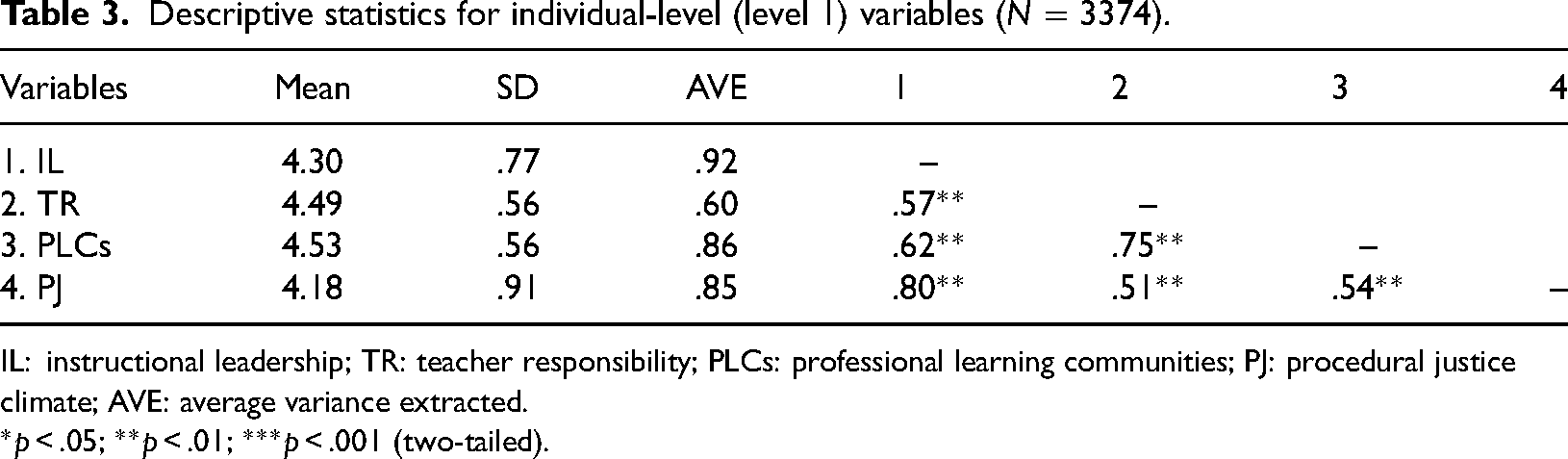
IL: instructional leadership; TR: teacher responsibility; PLCs: professional learning communities; PJ: procedural justice climate; AVE: average variance extracted.
*p < .05; **p < .01; ***p < .001 (two-tailed).
Examining cross-level mediating effects of teacher responsibility
The first research question sought to determine the nature of instructional leadership effects on PLC enactment. Our tests examined the possibilities that instructional leadership could influence PLC enactment directly and/or indirectly through teacher responsibility. For this test, we used Monte Carlo bootstrapping which simulated 20,000 repetitions in order to obtain CIs around the product of coefficients for the respective paths (MacKinnon et al., 2004).
As proposed, instructional leadership was strongly and significantly related to teacher responsibility at the individual level (β = 0.71, p < .00). Teacher responsibility had a similarly strong, positive, significant relationship with PLCs at the individual level (β = 0.69, p < .00). Instructional leadership had a moderate, significant relationship with PLCs at the individual level (β = 0.27, p < .00) (see Table 4). The indirect effect of instructional leadership on PLCs via teacher responsibility at the individual level was also in the moderate range (estimate = 0.20, p < .00, 95% lower limit CI (LLCI) = 0.37, 95% upper limit CI (ULCI) = 0.61). Because these values do not include zero, we concluded that both the direct and the indirect effects of principal instructional leadership on PLCs were significant.
Results of the mediated relationship between instructional leadership and PLCs via teacher responsibility (N = 3374).
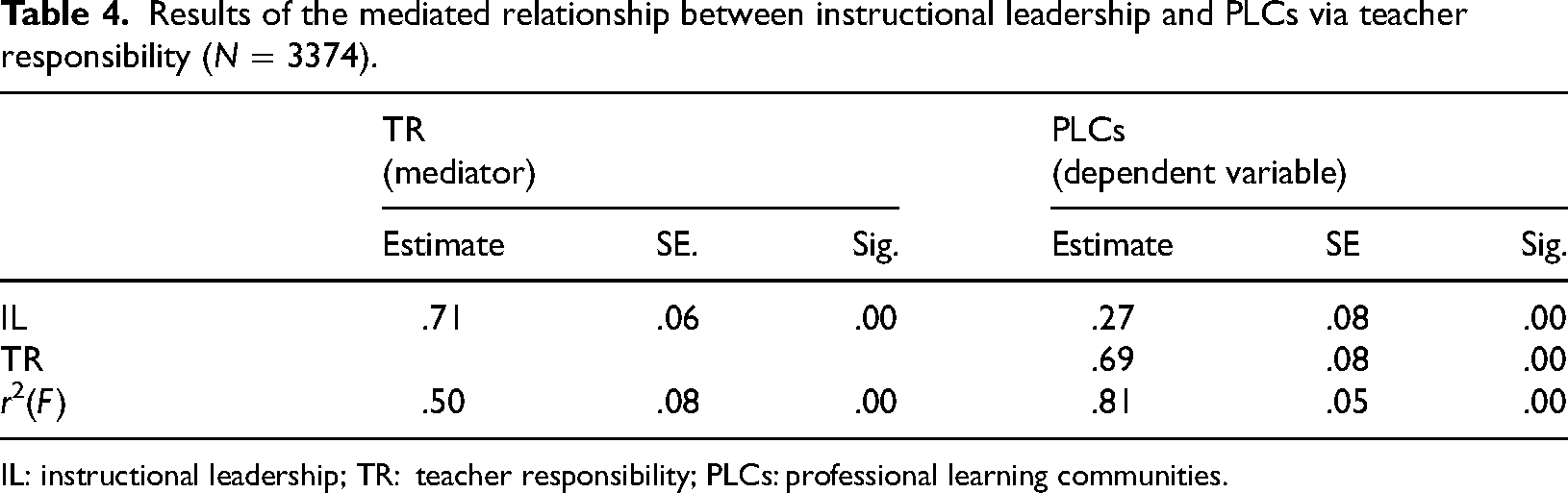
IL: instructional leadership; TR: teacher responsibility; PLCs: professional learning communities.
The moderating effects of procedural justice climate
The next research question inquired into whether the procedural justice climate of a school would moderate the effects of principal instructional leadership on teacher responsibility. After including the control variables, the interaction term (see Table 5) was significantly associated with teacher responsibility at the individual level (β = 0.29, p < .00). This means that the relationship between instructional leadership and teacher responsibility was stronger in schools where teachers held more favourable perceptions of their school’s procedural justice climate than in schools where teacher perceptions of procedural justice climate were weaker.
Moderated mediation results for PLCs across level of procedural justice climate (N = 3374).

IL: instructional leadership; TR: teacher responsibility; PLCs: professional learning communities; PJ: procedural justice climate.
In order to more clearly visualize the moderation effects of procedural justice climate on instructional leadership and teacher responsibility, we plotted these relationships in a graph (see Figure 3). It shows that the relationship of instructional leadership with teacher responsibility strengthens as the procedural justice climate perceived by teachers in their schools’ increases. Or, in schools where teachers do not perceive a climate of transparency and fairness, the effects of instructional leadership on teachers’ sense of responsibility tend to be weaker.

Illustration of the moderation effects of procedural justice climate on instructional leadership and teacher responsibility.
The moderated mediation effects of procedural justice climate
The third research question asked if procedural justice climate would also moderate leadership effects on PLCs. In order to minimize potential problems of multicollinearity in this multilevel analysis, we used grand-mean centring for instructional leadership and procedural justice before calculating the interaction term (Aiken and West, 1991). We used the R-mediation procedure with version 3.4.4 to calculate Monte Carlo and asymptotic normal theory CIs (Tofighi and MacKinnon, 2016) to estimate the conditional indirect effects of instructional leadership on PLCs. To confirm the moderated mediating effect of procedural justice climate, we examined indirect effects at high versus low levels of the moderator.
The moderated mediation effect of teacher responsibility between the interaction of instructional leadership and procedural justice climate on PLCs was significant. This was demonstrated by the index of moderated mediation: Estimate = 0.12, 95% LLCI = 0.03, 95% ULCI = 0.09. This means that a procedural justice climate reinforces the effect of instructional leadership on teacher responsibility, which further translates into stronger teacher perceptions of their schools as PLCs. The indirect effect was stronger (estimate = 0.28) and significant at high perceptions of procedural justice climate (95% LLCI = 0.06, 95% ULCI = 0.18). However, it was weaker (estimate = 0.07) and insignificant when the perception of procedural justice climate was low (95% LLCI = 0.00, 95% ULCI = 0.05) (see Table 6 for detailed results).
Conditional indirect effects of instructional leadership on PLCs at various levels of procedural justice climate (N = 3374).

LLCI: lower limit confidence interval; ULCI: upper limit confidence interval.
Discussion
Teachers’ ongoing, collaborative, growth-oriented PLCs have been shown to be important for school improvement (Doğan and Adams, 2018; Hairon et al., 2017; Zheng et al., 2021). Therefore, understanding how principals can motivate and enhance PLCs has become an important question for school policymakers, leaders, and researchers (Liu and Yin, 2020; Qian and Walker, 2021; Vanblaere and Devos, 2016; Zheng et al., 2019). Building upon social information processing theory (Salancik and Pfeffer, 1978) and social exchange theory (Blau, 1964), the current study advanced the understanding of the relationship between instructional leadership and PLCs. We found that instructional leadership has a positive indirect relationship with PLCs via teacher responsibility. Moreover, procedural justice amplifies the direct relationship that instructional leadership has with teacher responsibility and its indirect relationship with PLCs (via teacher responsibility). These findings offer implications for theory and research.
Interpretation of the findings
The adoption of PLCs has become an increasingly popular approach to school improvement worldwide, we still have limited knowledge about how PLCs are established, motivated, and sustained (Gray et al., 2016; Hairon et al., 2017). Although the literature highlights the potentially important role played by principals in supporting PLCs, empirical testing of the means by which principals contribute to PLCs is still emerging (Buttram and Farley-Ripple, 2016; Qian and Walker, 2021; Vanblaere and Devos, 2016; Zheng et al., 2019). Previous research often employed a need-satisfaction paradigm which proposes that principals motivate teachers’ engagement in PLCs by satisfying their different needs (Gray et al., 2016; Qian and Walker, 2021).
Building upon and extending social information processing theory (Salancik and Pfeffer, 1978), our research suggests that teachers adjust their attitudes, behaviours, and beliefs in response to cues provided by principals through their instructional leadership. Specifically, in China’s hierarchical system, Chinese principals set a learning-oriented school vision for the school (attention-shifting mechanism), provide learning support (role-sending mechanism), and engage personally in the professional learning programme (role-modelling mechanism). Thus, social information processing theory expands our understanding of PLCs by proposing multiple social influences from principals to teachers’ attitudes and behaviours.
Second, we theorize and empirically show that instructional leadership promotes PLCs via teacher responsibility. PLCs in China operate in a context of a mandated, top-down, administrative system (Zhang et al., 2017; Zheng et al., 2019). Researchers have suggested that under such conditions, PLCs may tend towards contrived forms of collegiality that do not necessarily lead to genuine teacher engagement and learning. In China’s cultural context principals, as instructional leaders, set, communicate, and reinforce learning-centred standards for teachers to promote teaching quality. In this vein, our work contributes to extant work on PLCs by demonstrating that school principals, through their enactment of instructional leadership, are able to influence teachers’ sense of work responsibility and subsequent engagement in PLCs. Thus, we believe that this moves the literature forward by illuminating how instructional leadership operates as an influence mechanism with positive effects on teacher attitudes (i.e. teacher responsibility) and PLCs.
Third, we show that instructional leadership and procedural justice climate jointly strengthen teacher responsibility, and consequently their engagement in PLCs. The conceptualization of procedural justice climate as a moderator in our theoretical framework is relatively novel in research on instructional leadership and PLCs. A fair procedure climate signals to teachers that they are respected, valued, and fairly treated by their principals. It induces the perceptions of organizational care and support, which may result in a desire to reciprocate with a higher sense of work responsibility.
Thus, a procedural justice climate promotes teachers’ positive reactions to instructional leadership in their work environment. However, we also suggest that schools with instructional leadership that do not provide a procedural justice climate will engender a sense of exclusion and dent teachers’ social connectedness with principals, which undermine the affective effect of instructional leadership. The fact that we detected the cross-level interactions for procedural justice climate with instructional leadership is an important extension to the educational leadership and PLCs literature. These findings suggest that procedural justice climate is a potentially important contextual variable with meaningful influence on teacher responsibility and PLCs. In other words, our findings suggest that higher levels of teacher responsibility and PLCs are likely to be enhanced when instructional leadership is accompanied by reinforcement of procedural justice climate. This is an important area for further research.
Finally, although an abundance of empirical research on PLCs has accumulated over the past three decades, to date, we have limited knowledge about how PLCs are implemented in the collectivist, high power distance societies of Asia (Hairon and Dimmock, 2012; Hairon and Tan, 2017; Ho et al., 2020; Qiao et al., 2018; Yin et al., 2019; Zhang et al., 2017). Our research provides initial evidence that PLCs can also function and thrive in hierarchical work contexts (Hairon and Tan, 2017). We highlight the importance of school leaders and procedural justice climate in developing PLCs in China context which also provides insights into the international societies with similar societal culture and institutional contexts such as Malaysia, Singapore, Vietnam, and Thailand.
This study offers several implications for policy and practice. First, our study shows that instructional leadership matters in catalysing positive effects on teacher responsibility and PLCs. Given the positive effect of instructional leadership, further training should enable principals to reflect on their own leader behaviour, fully understand the value of instructional leadership, and experiment with instructional leadership in role plays.
Second, the mediating role of teacher responsibility suggests that teacher positive attitudes are partly affected by the salient information in their social context. Thus, we suggest principals should pay close attention to creating a motivating school environment by setting clear guidelines on expectations and implementing tangible projects to encourage, support, and reward meaningful learning. This will be helpful to foster a sense of responsibility among teachers and promote their positive engagement in PLCs.
Our research also indicates that the effects of instructional leadership on teacher responsibility and PLCs are somewhat contingent upon the level of procedural justice climate. Even in modern China, principal practices are still deeply influenced by Confucian culture. They tend to distribute resources partly based on the principle of equality, seniority, and close personal bonds. The moderating role of procedural justice climate in our results suggests that Chinese principals should pay attention to their ethical and moral obligation to promote teachers’ procedural justice perceptions. For example, when school leaders implement teachers’ performance-based assessment programmes, they should set clear and transparent ground rules, meet with teachers to discuss performance appraisal processes, allow teachers to voice their concerns, and provide timely feedback. The processes are helpful to promote school leaders to act more ethically and increase teachers’ perceptions that leaders are supportive and care about them over time.
Limitations
The cross-sectional, single-source research design used in the study increases the possibility that the results are influenced by common method variance (Podsakoff et al., 2003). Second, the findings may have limited generalizability because of the types of schools studied – senior high schools – and the cultural context in which the schools are based. Third, serious convergence issues may be encountered with multilevel structural equation modelling (MSEM) estimates based on fewer than 80 groups (Li and Beretvas, 2013). Because of limited school-level sample data (N = 65), we used multilevel path analysis, which treated the dependent variable of PLCs as an individual-level variable. Given the importance of the multilevel nature of PLCs (Hairon et al., 2017; To et al., 2021; Zheng et al., 2021), MSEM is recommended in further studies to improve methodological rigour and produce accurate estimated effects and CIs (Hairon et al., 2017; To et al., 2021).
Footnotes
Declaration of conflicting interests
The author(s) declared no potential conflicts of interest with respect to the research, authorship and/or publication of this article.
Funding
The author(s) disclosed receipt of the following financial support for the research, authorship and/or publication of this article: This work was supported by the National Social Science Foundation for Education of China under grant CFA 210248.
