




Abstract
Effective leadership by school principals is reported to involve shaping school cultures, fostering collaboration, allocating resources, and motivating teachers’ attitudes which results in (in-)directly impacting student learning. While the literature recommends a move toward collective and distributed processes of sense-making, the role of the school principal and their respective leadership practices in the context of curriculum reform is still largely underrepresented. Using an integrated framework of policy enactment, sense-making and instructional leadership, this article explores how school principals interpreted curriculum reform at lower secondary level in the Republic of Ireland and how these interpretations translated into leadership practices. This qualitative study, part of a larger national 4-year longitudinal study, interviewed 65 secondary school principals approximately a decade after implementation regarding their experiences of leading Junior Cycle reforms. Our findings reveal that in contested reform contexts, instructional leadership dimensions of programme management and climate-building functionally collapse into reciprocal practices shaped by principals’ diagnostic assessment of organisational readiness. Additionally, time operates as both a manageable resource and a healing mechanism through which resistance dissipates over time. We conclude that the principal's role as policy enabler requires antecedent relational work in creating cultural conditions through which collective sense-making and significant change can proceed.
Introduction
The complex nature of curriculum change has long been an area of focus within the educational research field, and a substantial body of research is concerned with the differences between the intentions of designed curriculum, how it is enacted in schools and how that curriculum is ultimately experienced by students (Braun et al., 2011; Cooney et al., 2023; Fullan, 2016; Maguire et al., 2020; Priestley et al., 2014). Consequently, there has been a significant focus on teachers’ responses to curriculum and how their beliefs, values and existing practices influence the enactment of curriculum changes (Priestley et al., 2015). The role of the school principal in curriculum change has received less specific attention (Priestley, 2011; Loh and Hu, 2021; Acton, 2021; Pak et al., 2020; Starr, 2011; Mäkiharju and Hilli, 2024). Yet school principals play pivotal roles in leading curriculum change at a school level (Ganon-Shilon and Schecter, 2017, 2019; Ganon-Shilon et al., 2021; Levin and Datnow, 2012; Rafferty and Turunen, 2015), often setting a vision for the school and advocating for reform (Cooney et al., 2023; Fullan, 2016; Hargreaves, 2019; Sahlberg, 2006). They play an important role in helping to facilitate a collaborative culture where collective ownership of change can develop (Govindasamy and Mestry, 2022; van Wyk, 2020). They also play a critical role in change-management, allocating resources and supporting professional development of staff to help realise reforms, as well as monitoring and evaluating the effectiveness of the changes (Ganon-Shilon et al., 2021). These activities reflect core dimensions of instructional leadership adapted to reform contexts.
However, leading curriculum change in schools is complex and challenging. Curriculum reforms often serve as policy instruments through which governments advance particular social, economic or ideological agendas (Apple, 2004; Sahlberg, 2006), potentially creating tensions when the values embedded in reforms conflict with those held by educators. While some curriculum changes may be readily accepted by school staff, many curriculum changes can be seen as top-down in nature and may face a level of opposition, particularly if it is believed that they are being imposed on teachers or that the proposed changes do not align with established practices (Ganon-Shilon and Schechter, 2017). School principals can often find themselves positioned at the intersection of these tensions where they must simultaneously advocate for the changes while also maintaining staff cohesion and limit conflict that the reforms may cause. At the centre, then, are principals themselves whose own views and beliefs regarding the reforms are generally viewed as superfluous in the broader scheme. Indeed, principals often play important mediating roles as they attempt to facilitate the enactment of changes within schools where reception to the reforms may be negative or at best lukewarm in nature (Francois and Weiner, 2022; Ganon-Shilon and Schechter, 2023; González et al., 2020).
This article aims to contribute to this field of research by focusing on the central role of school principals in national curriculum change at lower secondary education within the Republic of Ireland, referred to as Junior Cycle reform. This particular curricular reform commenced in 2012 amid severe austerity and received a mixed response from teachers with some believing in the changes proposed, while others strongly objected to them. These different responses not only existed between schools, but within school staffrooms or subject disciplines. In addition to the micro-politics of the in-school dynamics, Junior Cycle reform was subject to heated public debate with wide-scale national media coverage. Set against this context of contestation and ambiguity, the contribution of this article is in exploring how school principals’ sense-making of Junior Cycle reform shaped their instructional leadership practices within a challenging context. The study draws on an integrated framework of policy enactment, sense-making and instructional leadership, to explore how principals interpreted contested curriculum reform demands within their school contexts and translated these interpretations into concrete leadership actions aimed at enabling reform implementation. This case of large-scale curriculum reform in Ireland provides a distinctive context in which to explore this process. Our data collection takes place at least 10 years after the initial implementation, offering principals an opportunity to reflect on their leadership of a phased implementation process. The study was therefore guided by two questions:
How did school principals interpret and make sense of Junior Cycle reform within their school contexts? How did this sense-making translate into leadership practices aimed at enabling reform enactment?
The structure of the article is as follows. First, we position our integrated framework of policy enactment, sense-making and instructional leadership, this provides the framing through which we ourselves make sense of the principals’ experiences. Second, we provide a detailed overview of the politicised and contested professional context in which the Junior Cycle Framework was introduced; this is of crucial importance to understand and appreciate how public focus may have shaped principals’ sense-making and leadership practices. Following a presentation of the research methodology, the findings are presented and discussed in the subsequent sections. The final section sets out the key conclusions and main insights from the study.
Making sense of curriculum change
Enacting reforms
High-quality leadership and its associated practices have proven to be essential in terms of school improvement, reform and student growth (Bush, 2019; Leithwood et al., 2008, 2020; Liu and Feng, 2023). Hallinger (2016) concludes that it is through their practices of shaping school cultures, fostering collaboration, arrangement and allocation of resources and, motivating and influencing teachers’ attitudes that school principals/leaders have an (in-)direct impact on student learning and growth. Educational reforms present challenges for such practices, and require interpretation, negotiation and enactment. Our particular framing for this study pays attention to both the structural contexts in which reforms unfold, and the interpretive and translational practices through which principals mediate them.
The implementation of educational reforms is a complex social enactment that involves two interconnected aspects of interpretation and translation (Ball et al., 2011). As a result, policies are not simply ‘implemented’ but are actively shaped by actors throughout a school through these processes. A central interpreter early in the enactment process is the principal, and the literature clearly positions the school principal as having a decisive role in the successful enactment of reforms (Ganon-Shilon and Schechter, 2017; Ganon-Shilon et al., 2021; Levin and Datnow, 2012; Rafferty and Turunen, 2015; Shaked and Schechter, 2017). However, we are not making the error of assuming that other staff are not also engaged in a form of their own interpretation, especially if the proposed changes are subject to public scrutiny and commentary. Principals are positioned as tight-rope walkers – as they work to protect and lead their school and staff while also being held externally accountable to standardised expectations of policymakers (Ganon-Shilon and Schechter, 2019; Levin and Datnow, 2012; Murray et al., 2025) – their initial interpretation is understandably diagnostic in nature, in terms of teachers’ needs and professional development, significance and severity of the proposed changes, allocation of time and resources, or the impact on relationships and culture. This interpretive work leads to a translation into educational practices that can either uproot historical practices or can inadvertently circumvent the reform and maintain the status quo. As a result, the enactment of policies rarely reflects their initial intended purposes (Ganon-Shilon and Schechter, 2019; Rigby et al., 2016). Of significance too is the assumption of an endpoint in the enactment, as curriculum/educational reforms are not static and therefore, cannot ever be considered as being ‘done’ (Lambert and Penney, 2023; Li, 2017); rather the enactment and its actors are in a constant interconnected process of ‘(re)interpretation-(re)translation’ (Cooney et al., 2023: 2). As a result, we are guided by Fullan's (2016) understanding of policy enactment as a process in which principals creatively interpret, negotiate, mediate, re-contextualise and translate reform demands into specific actions and practices that honour their school context.
Sense-making: The interpretative work of school principals
Ganon-Shilon and Schecter (2017) (see also, Ganon-Shilon and Schecter, 2018, 2019; Ganon-Shilon et al., 2021; Ganon-Shilon and Becher, 2026) provide a useful framework that attempts to understand the interpretive work of principals: sense-making. Sense-making is an active and dynamic process by which individuals create and assign meaning to circumstances and events that they interpret as being uncertain or ambiguous. This interpretive work is realised in its translation into practices that seek to mediate or resolve the uncertainty and challenges (im-)posed by events. This creative mediation is framed by the event itself but also from prior knowledge and experiences, and the relational connections to and within the social context that the event takes place in (Ganon-Shilon and Schecter, 2023). In educational settings, principals’ sense-making of reform involves diagnosing organisational and cultural conditions, interpreting policy texts and expectations, and assessing teachers’ responses and professional needs (Ganon-Shilon and Schechter, 2017, 2019, 2023). This work is necessarily relational and iterative, unfolding over time as leaders continually adjust their understandings in response to shifting expectations, emerging challenges and feedback from staff. Sense-making, like enactment, is not a once-off activity but an ongoing process of interpretation and reinterpretation that shapes how principals understand their role and responsibilities.
Instructional leadership
Sense-making provides the cognitive and interpretive dimensions of our framing of principals’ work within reforms. Importantly, though, integrating instructional leadership allows our framework to grasp how interpretations translate into concrete practices. Hallinger and Murphy's (1985) foundational model identified three enduring dimensions of instructional leadership: defining the school's mission, managing the instructional programme and promoting a positive school learning climate. While initially presented as concurrent leadership practices, Hallinger and Murphy (1986) cautioned that challenging or contested educational contexts may require a differential of emphases. Recent longitudinal research provides empirical evidence that principals often enact these dimensions sequentially rather than simultaneously, progressing from organisational climate-building to teacher support to collaborative instructional improvement (Liljenberg, 2025), with climate prioritisation creating foundational conditions for subsequent instructional changes (Ralebese et al., 2025). This staged progression appears particularly necessary when reforms are ambiguous or contested, as shared understanding must develop before collective implementation can proceed effectively (Ganon-Shilon et al., 2022). In this study, sense-making and instructional leadership are treated as analytically distinct but mutually informing constructs. Sense-making captures the interpretive work through which principals diagnose and understand reform conditions, while instructional leadership reflects the enacted practices through which these interpretations are realised. Rather than positioning one as preceding or determining the other, we conceptualise their relationship as dynamic and reciprocal, with interpretation and enactment continuously shaping one another over time (Cooney et al. 2023). In this sense, the study does not depart from the concept of instructional leadership, but seeks to extend it by demonstrating how its dimensions are interpreted and enacted in context through principals’ ongoing sense-making.
Principals’ decisions to prioritise particular dimensions of instructional leadership can be understood as informed by the sense-making they engage in during these critical junctions of change. Principals act as sense-makers who interpret reform demands within their school contexts (Ganon-Shilon and Schechter, 2019), translating these interpretations into leadership practices. For example, if through the sense-making process, a school principal views the curriculum reform as primarily managing instructional practices, their instructional leadership will reflect this prioritisation. On the other hand, if the reforms are interpreted as posing a potential threat to the school's positive learning climate, leadership practices will take on a different prioritisation aimed at building cultures of collaboration and professional learning to support reform implementation. Therefore, principals’ sense-making offers an analytic lens through which to understand how different dimensions of instructional leadership may come to be prioritised in practice. These practices can be understood as the visible, enacted expression of ongoing sense-making, while also feeding back into and reshaping principals’ interpretations as reform unfolds.
Together, these perspectives on policy enactment, sense-making and instructional leadership, provide an integrated framework for exploring and understanding principals’ leadership of contested curricular reforms. Enactment theory establishes that reforms are actively mediated rather than passively received and implemented; this highlights the agentic role of school actors and as a result, contextual significance. Sense-making captures the cognitive and interpretive work of how principals construct meaning in ambiguous or contested spaces. Finally, instructional leadership situates concrete practices of mediation, representing the enacted dimension of this interpretive work. Consequently, this framework enables us to understand how principals’ diagnostic interpretive work regarding their school contexts in light of the reform demands shaped their translated instructional leadership practices, and therefore, how they attempted to negotiate the tensions and expectations surrounding the Junior Cycle reform.
Spaces of ambiguity – the research in context
Accepting that ‘educational reform is a complex cultural endeavour’ (Gordon and Patterson, 2008, p. 33), we explore three contextual factors that may have influenced principals’ sense-making. This section is structured by three complementary trends that contributed to the contested context: the teacher unions’ reception of the reforms, new policies shaping teacher workload, and the austerity impact on the professional context.
Teacher union resistance to assessment reforms
Firstly, there existed regular calls to address the dominance of formal, summative examinations in Irish post-primary education, which negatively affected the curriculum and student experience (Looney, 2001, 2006). Studies showed the Junior Certificate (ages 12–15) placed excessive emphasis on terminal exams, reducing student engagement and increasing stress and anxiety (Smyth, 2006; Smyth et al., 2007). Curriculum reviews led to the Framework for Junior Cycle (DES, 2012), an ambitious reform aiming to reduce focus on final exams, balance knowledge and skills, and offer students more choice and flexibility. A significant shift was the move to school-based assessment, where teachers assessed students for state certification – a ‘radical departure… for a post-primary system so focused on exams’ (NCCA, 2011, p. 6). Teacher unions strongly opposed this (Murchan, 2021), leading to public disputes, industrial action, and significant media attention (Devitt, 2021). Negotiations with the Department of Education resulted in a revised Framework for Junior Cycle (2015), implemented over 5 years to accommodate system-wide changes. Despite considerably negative and adversarial media coverage, the reforms were not wholly rejected by teachers. Evidence from this broader study that informs this article suggests many aspects were welcomed, though debate about teachers’ roles in assessment persisted during early implementation (McGarr et al., 2022, 2023, 2024a, 2024b, 2026).
New policies shaping teacher workload
Another factor shaping perceptions of Junior Cycle reform was the increasing demands on teachers from new policies and workload. In 2012, the (then named) Department of Education & Skills released the School Self-Evaluation Guidelines for Post-Primary School (2012), an evaluative framework formalising the link between quality education and school leadership (O’Brien et al., 2015) while also mandating practices of self-evaluation which had previously ‘failed to take hold’ (McNamara and O’Hara, 2006, p. 577).
Austerity measures
Tensions around Junior Cycle reform were also heightened by ongoing austerity measures and budgetary restrictions following the global financial crisis in 2008. A European Union (2013) report identified Irish teachers as among the most affected across 16 member states. Middle management in schools was ‘decimated’ (Barry et al., 2024; McNamara and O’Hara, 2012, p. 95), not only undermining schools’ capacity for self-evaluation, but of particular significance here, placing Junior Cycle implementation workload on school principals. Ironically educational leadership literature at the time advocated moving away from archaic and monocratic forms of leadership that relied on the heroics of a singular individual (Gunter, 2012; Harris, 2009), viewed as unsustainable in the face of growing societal and political expectations of schools (Muijs et al., 2004). School principals in this study operated amid significant, divisive curriculum reform and the lingering effects of austerity, which had weakened or eroded middle leadership.
Taken collectively, these contextual factors would have shaped principals’ sense-making as they navigated and mediated the risks and tensions of leading change.
Methodology
This research, exploring school principals’ leadership practices in second level schools in Ireland, formed part of a larger 4-year multi-dimensional mixed methods longitudinal study exploring the roll-out of the Framework for Junior Cycle curriculum. The multi-dimensional aspect of this larger study explored the experiences of stakeholder groups, parents, students, teachers and school principals using a range of different research tools including interviews, focus group discussions, surveys and classroom observations. This article reports on one dimension of this study, the qualitative school principal interviews (n = 65), analysed using thematic analysis to gain an insight into the school principals’ leadership and enactment practices (Braun and Clarke, 2012). In designing this particular phase, and as a guiding principle for the broader study, we endeavoured to prioritise the voice of the schools and participants to allow them to tell their stories. As a result, the interviews were structured to facilitate principal voice in terms of their lived experiences of enactment.
Sample of school principals
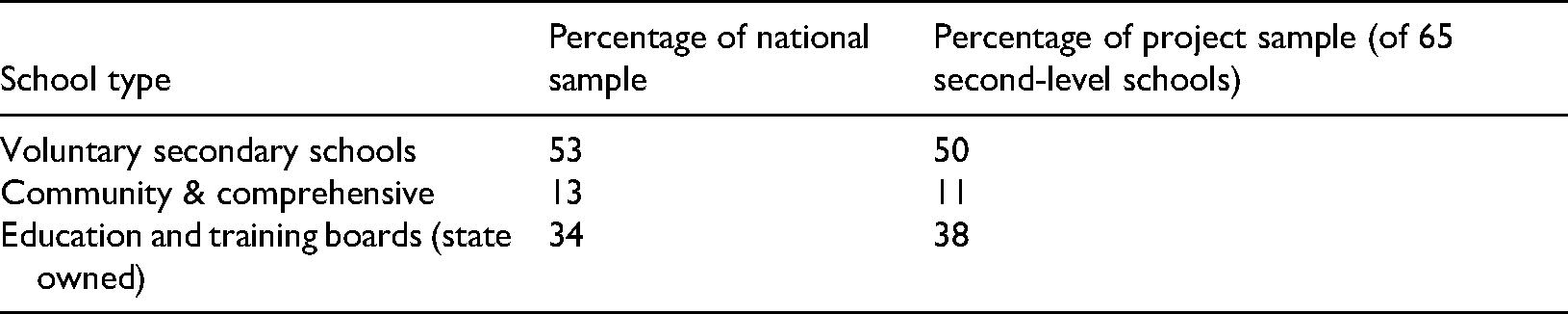
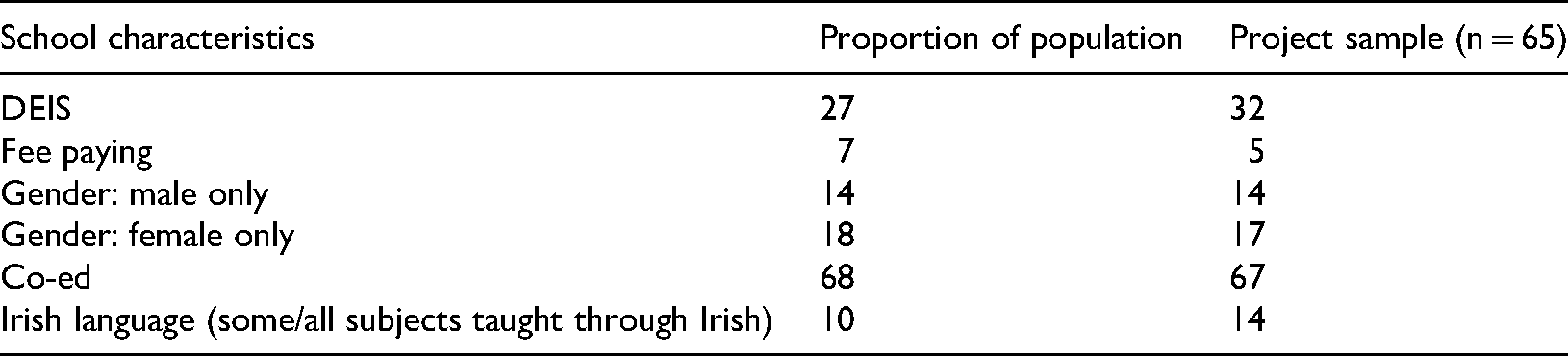
To capture the principals’ perspectives on the implementation, a representative sample of 100 schools was identified through the national database of the 723 second-level schools in Ireland. This representative sample consisted of schools of varying patronage types including voluntary secondary schools (schools run by religious organisations) and state schools. It also consisted of a representative mix of other school variables including single-sex and mixed, schools with predominantly socio-economically disadvantaged students (referred to as Delivering Equality of Opportunity in Schools, DEIS), rural and urban and schools where the Irish language was the medium of instruction and schools of different student enrolment numbers. The sample also ensured a broad geographic spread across the country. This representative sample of schools was selected to ensure that a broad range of school perspectives were obtained and to further strengthen the diversity of perspectives: two schools catering for student with additional learning needs, and two Youthreach centres (an education, training and work programme for early school leavers aged 15–20 years of age) were included. The study did not subsequently compare the different school types as the range of variables resulted in small numbers of schools in any category. For example, a mixed, voluntary secondary, rural school of between 200 and 400 students within a particular geographical location would result is a very small number of schools. Furthermore, analysis of teacher survey data from a separate dimension of the study showed no significant difference in views of the changes by school patronage type (see McGarr et al., 2024a). The study did record the sex of the participants (31 male and 34 female), however, because of the relatively small and identifiable population, other demographic details of the school principals were not recorded as to do so could have potentially threatened the anonymity of the research participants. The tables below set out further details on the school sample highlighting its representative nature with recorded school characteristics.
Research approach
The study was approved by the University Ethics committee and following this in late 2020 and early 2021, all schools were initially emailed providing them with a research information sheet and an invitation to participate. Follow-up phone-calls to schools were also undertaken to increase participation rates. Participation in the study was voluntary and those that volunteered were required to sign a consent form indicating their willingness to participate in the study. When consent was received, a plan was drawn up to interview the principals over the following 2 years of the study. If a school principal declined to participate, a similar school matching the school's profile was selected from the database of 723 schools.
Semi-structured Interviews took place from mid-2021 and continued over the following 2 years. While all original 100 schools had consented to participate, as the study progressed some schools declined to participate in the interviews having all already originally agreed to do so. As participation was completely voluntary, schools were not required to provide a reason for their withdrawal. However, the main reasons provided for the withdrawal communicated to the research team was that school leadership had changed in the intervening period or that workload and time commitments prevented participation. As a result, the final total number of interviews conducted was 65. While this was smaller than the original target of 100 schools the sample remained representative of the different schools.
Interviews were conducted online via Microsoft Teams. A semi-structured interview approach was adopted. This approach was chosen to ensure a comparable interview format while enabling participants to elaborate on their experiences and for the interviewer to pursue questions the capture leadership practices. The key guiding questions were sent in advance to school principals to enable them to reflect and consider their responses. All interviews were recorded and transcribed for analysis purposes. There were four parts to the interview: part 1 explored the school principals’ understanding of the curriculum reforms; part 2 sought their views on its implementation; part 3 examined their views on the outcomes and impact of the changes; and the final part enabled them to provide any other feedback and perspectives on the changes. This section of the interview was particularly helpful in facilitating the principals to express any other views and opinions they had around the changes or their implementation in schools. The flexibility afforded by the semi-structured format enabled leadership issues to emerge organically through the participants’ narratives rather than being driven by specific questions that can result in scripted responses.
Analysis of the interviews
All interview transcripts were initially read by members of the research team for familiarisation and subsequently thematically analysed using Braun and Clarke's (2012) steps for thematic analysis. This included an initial familiarisation with the transcribed text, initial open coding, a grouping of codes into themes and a refinement of the themes through discussion with the other research team members. The inductive approach to analysing the data also helped to identify cross-cutting themes that transcended any one area of the interview. While our approach was primarily inductive, our theoretical framework, in particular Hallinger and Murphy's (1985) dimensions of instructional leadership, provided concepts that helped us recognise and attach language to patterns in principals’ descriptions of their practices. This iterative process enabled us to identify how principals’ diagnostic work (sense-making) connected to their enacted leadership responses across mission-setting, programme management and climate-building dimensions. This was particularly relevant in capturing the leadership practices of the school principals that tended to be expressed through their talk throughout the interview rather than specific questions. These identified codes were synthesised into macro-level themes to capture the over-arching issues in the principals’ talk related to their leadership practices. Key themes developed from this process included the initial response to the reforms, the challenges of maintaining harmony amongst the school staff and the challenges of navigating this contested terrain. While four members of the research team engaged in the analysis of the interview transcripts, member checking was not employed due to the size of the sample, the logistical constraints of the study and because some interviews (15%) were conducted through the native Irish language (Gaeilge) preventing the other researchers from engaging with those transcripts. However, ongoing peer debriefing and discussion provided a level of consistency in the interpretation of the data.
Findings
These findings trace the interpretation-to-translation process central to our integrated framework of policy enactment, sense-making and instructional leadership. The first theme captures principals’ diagnostic sense-making work; how they interpreted teachers’ receptiveness, assessed organisational readiness, and made sense of the emotional and cultural climate surrounding Junior Cycle reform. The second theme demonstrates how this diagnostic work translated into instructional leadership practices, revealing adaptive enactment of leadership dimensions shaped by principals’ contextual assessments. We view these themes as occurring in parallel as they illustrate how principals’ interpretive work formed the foundation for their enacted leadership responses during contested curriculum reform.
Principals’ diagnostic sense-making of reform reception and school readiness
Throughout the interviews, the principals reflected on teachers’ receptiveness to the Junior Cycle reforms, and how this affected particular school contexts. This interpretive work – reflecting the diagnostic work of sense-making – formed the foundation of their own subsequent leadership responses, as they attempted to make sense of the cultural and emotional climate within which they would be required to lead the changes. In this theme, the principals’ retrospective revealed three broad patterns of response, arising from their diagnostic understanding of the contextual readiness for these changes.
Positive reception
Ten of the principals described contexts where the reforms were received with a genuine sense of enthusiasm. One principal, for example, recalled that the staff were ‘gung ho for it here’ (P2) from the beginning. Looking back on the initial reaction to the changes, another principal reflected: I think at the time it was very enthusiastic. I think everybody was fairly tired of the junior Cert [the previous programme]. Nobody saw a purpose in it anymore. It didn't signify anything of great importance and I think everybody was looking for something new. Everybody wanted something up to date and I think they got it and everybody was enthusiastic about in the beginning … (P4)
In a similar tone, another principal claimed that there was a ‘genuine buzz at the start of the reform’ (P20). A notable feature of the principals reporting a positive reception to the changes in their schools was the belief that a positive response was not necessarily common and that they were ‘lucky’ that the responses to the changes were positive in their own schools, suggesting – and as we will go on to show – that in most cases there were more negative responses: we've been lucky we had good buy in from the start. (P14) some staff who have been here a reasonable period of time got very enthusiastic about it. So I think we're very lucky here. (P20)
Negative reception
Seventeen principals described predominantly negative responses to the reforms in their schools. The initial challenges associated with the changes appeared to contribute to this, with one principal lamenting the problems associated with its original introduction and the ongoing feelings this maintained, stating ‘the beginning is the most important part of any journey’ (P14). In a similar tone, another argued that these initial experiences shaped teachers’ views of the reforms from then on and remained; ‘unfortunately teachers have a long memory’ (P2).
When commenting on how the reform was received in the school, the principals reported feelings of ‘apprehension’ (P45, P12), ‘concern’ (P47), ‘trepidation’ (P52), ‘scepticism’ (P5), ‘fear’ (P3) and ‘frustration’ (P16) caused by the perceived uncertainty of the terminal examinations as a result of the changes: people were frustrated because they couldn't do their job properly … this comes back again, which I mentioned earlier, about no [examination] papers, no curriculum plans. The you know almost doing it blindfolded you know, and trying to find their way … (P16) There was great fear, trepidation in regard to, oh God, what are they imposing on us now? How are we going to do this continuing assessment? Our kids aren't going to be able for this? This is going to be a huge increase on my workload? (P52)
Contextual factors were also reported in responses. One principal noted that wider austerity measures including teacher pay-cuts and cuts to school resources which occurred around the time of the reform also contributed to the negative climate: I could see that some staff were very frustrated with us [school management] and plus you have to remember Junior Cycle was introduced at the time of great economic turmoil in the country and a lot of people were worried about, you know, will I have enough money, you know, and there was all this business on the pass machines [bank machines], you know, we're going bankrupt and we owe so much money and all that kind of stuff and people were very frustrated and they saw the governments as being a kind of a, maybe I'm reading too much into it, but I felt it was a lot of negativity towards the change and everything that was coming about. (P4)
Teacher union mandates that called for non-cooperation with the original reforms were also a contributing factor, as one principal noted that the teachers in their school were, ‘just listening to the party line [from the teacher union] and they were they were resistant to it’ (P17). Another claimed that union opposition created, ‘fierce problems there and I was impeded for those years’ (P13).
Despite such negativity, many of the principals that reported initial negative responses from their staff also noted that the negativity surrounding the reforms had dissipated over the 4 to 5 years of its attempted implementation in schools. Yeah, so very negative at the start. And I would say overall now quite positive (P1) Teachers had grave reservations about some of the courses that were introduced … that is all quietened down … things have quietened after the first exam. (P46)
Mixed reception
The most commonly reported response was that of a mixed reception to the changes. Many of these responses still indicated a high level of negativity to the changes, but these were somewhat tempered by the presence of other teachers in the school that appeared to be in support of the changes. Teacher Union opposition was also raised several times, indicating the impact of the industrial action taken during the initial phase of the changes, as the following examples highlight: When it was first introduced, I would say varied, varied … [the] senior end of the staff … [had] to get to grips with [it], whereas the NQT's [newly qualified teachers] this was all they knew anyway, and the middle of the road people, not too much entrenched in the way we always did things. So yes, let's go with it and see how it transfers. So I'd say … three, you know, at the beginning career, the middle and the out the door … once things settled a bit and they went through one full cycle and you had the other subjects coming on then it was generally well received. (P8) I would say that we mixed, it seems very mixed, fifty-fifty I would say, I should be very careful the way I say this now, the less unionised teachers were the more receptive. Is that a diplomatic way of saying it? (P13)
It is important to note that while initially the two teacher unions serving teachers in second level schools opposed the changes, one union later instructed its members to engage, while the other continued in its opposition. Some school principals often found themselves leading schools – known as dual-union schools – in which the teaching staff could be members of different unions. As a result, in these schools, some teachers complied with union mandates and did not cooperate with the professional development offered, whereas teachers from the other union engaged in centrally designed in-school continuous professional development (CPD) supports and with the changes. Naturally, this affected the principals’ diagnostic work in the attempt to make sense of the cultural and emotional climate. This appeared to place principals in challenging positions: I mean there were absolute roadblocks at the very beginning. In terms of the word dual union [a school that had teachers from different teacher unions - TUI and ASTI], and that would have been obviously the case for over 100 schools in the country. We just handle it very open, very honest and say, “well look at your TUI colleagues, they're engaging. ASTI, we absolutely fully respect your right not to engage, but we're going to just trundle on quietly. We're just going to trundle on and get on with their work” … and I think people respected that we named it and that, you know, we named that. We're good, we're all just going to do our jobs, but we fully respect the place of both unions. (P21)
Principals’ diagnostic sense-making revealed highly varied organisational contexts ranging from enthusiastic acceptance in a minority of schools to significant resistance or fractured mixed responses in the majority. This variability meant there was no uniform implementation context, but rather multiple school-specific realities shaped by emotional climate, union positioning, examination uncertainty and austerity effects, reflecting how reforms are actively mediated within local conditions rather than passively received (Ball et al., 2011). Principals recognised their diagnostic work was further complicated by the fact that sense-making had occurred beyond school boundaries: teachers had already encountered and interpreted reforms through media, unions and public debate before school-level engagement, challenging assumptions about principals as first interpreters of policy (Ganon-Shilon and Schechter, 2017). The emotional intensity captured in retrospective accounts, alongside recognition that attitudes evolved over extended timeframes, indicated these were dynamic rather than static situations requiring ongoing interpretation and reinterpretation (Weick, 1995). This diagnostic work – assessing staff receptiveness, organisational readiness and cultural climate – formed the relational foundation (Ganon-Shilon and Schechter, 2023) upon which principals’ instructional leadership responses would be built, as the following finding demonstrates.
Instructional leadership practices shaped by diagnostic sense-making
The second theme relates to how the principals described ways in which their diagnostic reading of school contexts shaped the instructional leadership practices they enacted during reform implementation. When reflecting on how they positioned themselves and what actions they took, principals’ accounts revealed practices organised around two interconnected dimensions of instructional leadership, with different emphases depending on their assessment of organisational readiness and cultural climate. The first dimension of defining and communicating the mission remained distinct across contexts. However, the second and third dimensions of Hallinger and Murphy's (1985) framework – managing the instructional programme and building positive climate – were functionally collapsed into one another in these contested reform contexts, with principals enacting programme management through climate-building work.
Defining and communicating the school mission
A significant proportion of principals specifically emphasised this dimension of their work, describing how they positioned themselves visibly as advocates and drivers of reform. These roles were described as ‘being out on front and selling the changes’ (P17), ‘inspiring, encouraging and mentoring’ (P16), and ‘in general being positive about the changes’ (P15).
Principals appeared to maintain this positivity, despite the challenges associated with the reforms. One principal noted that ‘I would be positive enough and even when things are bad, I'll always put [my] best foot forward’ (P10). Another school principal recalled that anytime the curriculum changes were mentioned it resulted in a ‘yawn of negativity’ from staff and that maintaining positivity in such an environment was like trying to ‘hold back the tide’ (P51). The following quotes provide examples of their practices in advocating for the changes: I suppose as a mentor or as a driver of the whole thing. Yeah, I mean, nobody would ever say a single negative word to me about it. (P48) If you have reservations, you certainly keep them under your hat and you move on because you know the changes are coming in and if you present a negative attitude to your staff then you will end up with negative outcomes which is not helpful for the student body. (P49) But as a school leader, you had to drive the process on and you just had to keep engaging with everybody and try to be positive about it. No matter what misgivings you might have had about it, the biggest misgiving, and it still is a misgiving and they're [teachers] like, ‘How can we know on the final day, when our students sit down in June to do a 2-hour long English exam or Geography exam or a History exam, how can we help them to know a little bit about what's coming in [on the examination]? It's all very well saying the skills and everything like that, but, you know, maybe if you look at some of the stuff that has come up in English papers in the last few years, it has been a little bit erratic. (P4)
A notable feature of these comments is the presence of personal misgivings about the changes that are withheld from the teaching staff. It is also evident that ambiguity around the terminal examinations was influential in determining teachers’ responses to the changes. Comments from the principals would indicate that this group of school principals primarily saw their roles as advocates for the changes and worked to maintain an outward level of positivity throughout the changes.
Managing the instructional programme through building positive culture
The majority of principals described their work in ways that suggested a collapsing of Hallinger and Murphy's (1985) dimensions of programme management and climate-building practices. In these contested reform contexts, principals’ efforts to manage the instructional programme by providing professional development, allocating time and resources, and encouraging qualifications, were inseparable from their work around building and maintaining positive and supportive school cultures. These were not enacted as separate, sequential dimensions but rather as integrated practices where programme support simultaneously functioned as relational and cultural work.
Professional development provision, for instance, was described not merely as technical upskilling but as responding to teachers’ emotional needs and demonstrating institutional care: So we put an awful lot of emphasis on making sure that they are being upskilled. On top of that then, if there's anybody [who] wants to [undertake] postgrads [postgraduate study], we've introduced bursaries over the last couple of years. (P5)
Another principal revealed how ensuring adequate professional development was understood as relational work of supporting teachers through uncertainty: I just knew that this was something that was being rolled out and my central role was to make sure that it was rolled out properly in a timely fashion, that the staff felt that they had sufficient professional development to get them over the line. (P10)
The language of getting teachers ‘over the line’ suggested programme management as enabling and supporting rather than simply directing or monitoring instructional change.
The allocation of time emerged as particularly illustrative of how programme management and climate-building collapsed into one another. Time was not simply an administrative resource to be scheduled but was equally a mechanism for building collaborative culture and addressing teachers’ emotional responses to reform. One principal articulated this integration explicitly: [Y]ou provide time. We facilitate teachers having time to learn this to plan it to work on it. And you also listen to their fears around this and try and help them to come up with ways of managing those fears. You know, because they are genuine fears like people are feeling inept when it comes to the digital world and things like that. (P16)
This quote captures how providing time for curriculum work was indistinguishable from creating space for teachers to voice anxieties, have those fears validated as ‘genuine’, and collaboratively develop strategies for managing uncertainty. Another principal similarly described time provision as enabling both practical curriculum work and the collaborative relationships necessary for that work: So realistically you're managing it and you're making sure that you're following the right curriculum. You would have been doing that anyways, but it's a case of giving time, and I suppose that's all that's always it's the constraints of time, is always the argument. So giving time for teachers to meet and to collaborate and discuss. (P50)
Material resource provision functioned similarly as both programme support and demonstration of care. Principals described resource allocation in language that revealed its dual function of enabling instructional programme management while simultaneously building trust and demonstrating responsiveness to teachers’ needs: So as a leader, I need to know what support they need and how I can put those resources in place for them. (P56) … basically providing them with as much information and as many resources as required to try and move them into that new space, you know and to try and support and protect them in it. (P1)
The language of ‘support’ and ‘protect’ demonstrates how resource provision was understood as transcending beyond merely supplying materials and seen instead as fostering a sense of safety and care. Another principal's reflection captured this integrated understanding: Teachers need time and resources, for example, any computer labs they need, you know, we bought all they need. They need whatever, whatever practical resources they need I should give them as a leader. (P3)
In dual-union contexts particularly, this integration of programme management and climate-building became essential. The earlier example from P21 about ‘naming’ dual-union tensions ‘very open, very honest’ while simultaneously respecting both unions’ positions and ensuring work continued demonstrated how principals could not separate managing curriculum implementation from managing fractured relationships and building a climate that would enable engagement. What these accounts reveal is that the integration of these dimensions was evident not through principals’ explicit reflection on collapsing categories, but through the consistently relational and deliberate language they used to describe programme management activities, the language of support, protection, responding to needs and enabling engagement, revealing that managing the instructional programme in contested contexts was inherently cultural, and therefore relational work.
What emerged across these practices was that principals did not describe enacting instructional leadership dimensions uniformly. Rather, their retrospective accounts revealed adaptability based on their diagnostic reading of school context (Hallinger and Murphy, 1986; Liljenberg, 2025). Principals who had assessed their schools as relatively receptive described being able to engage more directly in mission-setting and advocacy, while those who diagnosed significant resistance or fractured responses described emphasising the integrated managing-the-programme-through-climate-building work as foundational. This was not a binary distinction between two types of principal, but rather, reflected how instructional leadership dimensions were enacted depending on diagnosed readiness (Ralebese et al., 2025). Regardless of dominant practices described, all principals acknowledged their schools were on ‘journeys’ in terms of the changes and that it was a slow process. One principal noted that working in an environment where curriculum changes were contested: ‘winning over hearts and minds is a slow process’ (P7), while another believed that this work doesn’t ‘just doesn't happen overnight. It's not something that happens [or] that can happen just in an instant’ (P11). In contested reform contexts, programme management became the mechanism through which positive culture was built, and positive culture became the condition through which programme management could proceed.
Discussion
The principals in this study engaged with these interviews approximately a decade after the start of the phased implementation of the changes that commenced in 2012 and the mediation via industrial relations processes and agreed iteration of the Junior Cycle Framework in 2015. This temporal distance afforded principals an opportunity to reflect across a wide arc of the implementation of the reforms – and accepting that reforms are never truly ‘done’ (Lambert and Penney, 2023) – enabling the space to recognise practices that may have been overlooked in the immediate contested experience. Striking though, is that despite the temporal distance, the emotional intensity is still evident in their use of language and cliches conveying fear, frustration and the tensions associated with dual-union staffrooms along with the sense of relief of a generally smooth change process. These embodied memories underscore the significance of the changes and of the contested nature of schools at the time. It is this appreciation of the contextual factors at play during the initial implementation of the Junior Cycle Framework that enables us to address the study's guiding research questions. In line with our integrative framework, context shapes and sets the parameters of principals’ sense-making (interpretive) and instructional leadership (its translated and enacted expression). We have structured the discussion in two sections. First, we address both of our research questions by examining how principals’ context-driven sense-making resulted in an adaptive and functional integration of instructional leadership dimensions. Second, we reflect on the role of time, both as a resource mobilised within leadership practice and as an analytical condition revealed through the study's longitudinal design.
Adaptive instructional leadership as enacted sense-making
Hallinger and Murphy's (1985) foundational framework identified three dimensions of instructional leadership (defining mission, managing the instructional programme and promoting positive climate) as concurrent leadership practices. Their subsequent work acknowledged that challenging contexts may shift the emphases of these dimensions (Hallinger and Murphy, 1986). In the contested context of Junior Cycle reform, our findings suggest that these dimensions did not remain distinct but instead became functionally intertwined. Rather than operating as separate domains of practice, programme management and climate-building were enacted together through relational and organisational work, reflecting principals’ efforts to respond to the specific cultural and professional conditions within their schools.
This was evident in how the principals described collapsing or integrating programme management and climate-building through supporting professional development, allocating time or ring-fencing resources. They described these practices as inherently relational, supporting and protecting teachers, responding to ‘genuine fears’, getting teachers ‘over the line’ and moving ‘into new space’. This relational work shows the diagnostic nature of sense-making as the principals offered an insight into their interpretation of the professional context, and what might be required to advance the reforms. As a result, programme management was not merely technical curriculum implementation; rather, managing the programme required simultaneously managing the emotional climate and building trust within the teaching staff. Therefore, the two dimensions of programme management and promoting positive culture reciprocally occurred as programme management became the mechanism through which positive cultures were built, and positive cultures became the conditions through which programme management could proceed.
Given the possibly fractious nature of cultures within schools at the time of the reforms, the principals’ diagnostic sense-making proved essential in navigating this dual functioning as adaptive (Liljenberg, 2025; Ralebese et al., 2025). Principals who had diagnosed their schools as relatively receptive, described being able to engage more directly in advocacy and championing, while those who diagnosed significant resistance or fractured responses described facilitatory work in emphasising the integrated programme-management-through-climate-building work as foundational.
Thus, instructional leadership in this context is best understood as adaptive practices that both shape and are shaped by ongoing sense-making of reform conditions. This finding also extends to Ball et al.'s (2011) policy actor typologies by suggesting the role of a policy ‘enabler’ within their enactment framework. While policy narrators, entrepreneurs and translators feature as policy roles, our finding regarding principals’ adaptive instructional leadership – creating the relational and material conditions for reform work – differs from the practices of translating or championing policies. Instead, this policy enabler role served a relational function in building trust, validating concerns and supporting teachers through uncertainty. The two aspects of enabler we noted in the data were either the principal as a mission-setting champion or programme-enabling facilitator. These were not fixed practices but emerged as adaptive responses based on the diagnostic sense-making of school cultures. In reform spaces that face significant professional and public opposition, principals’ diagnostic work proves essential in enabling policy reform by strategically allowing cultural work to proceed in tandem with instructional change.
Instructional leadership, therefore, is not positioned here as a separate domain of practice, but as the enacted and adaptive expression of ongoing sense-making within contested reform environments. In relation to our first research question, the findings indicate that principals’ sense-making of the Junior Cycle reform was less concerned with interpreting the policy itself and more focused on diagnosing the professional and organisational conditions within their own schools – including staffroom cultures, union positioning and the degree of receptiveness or resistance. In responding to these contextual interpretations, principals enacted leadership practices that combined programme management with relational climate building, thereby addressing our second research question regarding how this sense-making translated into leadership practices aimed at enabling reform enactment. However, this relationship was neither linear nor hierarchical. Principals’ diagnostic interpretations of their contexts shaped how they led, yet those enacted leadership practices simultaneously fed back into and recalibrated their evolving understanding of the reform within their schools. In this way, sense-making and instructional leadership were reciprocally constituted processes, unfolding iteratively across reform trajectories. It is within this dynamic cycle that the principal emerges as a policy enabler: not merely translating reform mandates but actively shaping the relational and material conditions through which reforms can be realised within their professional contexts.
Time as a resource, healer and methodological lens
Beyond the adaptive leadership practices described above, a further insight emerging from the study concerns the role of time in how principals experienced and interpreted the reform process. The literature outlines the scarcity of time and that it is a precious resource in professional practice and curriculum reform (Cooney et al., 2023; Ganon-Shilon and Schechter, 2019; Ganon-Shilon et al., 2021), and principals’ responses naturally drew attention to time. However, our findings indicate a more complex dual function of time, as the principals described two distinct but interconnected ways that time functions throughout the reform process.
The first function aligns with traditional resource management or allocation understandings of time – as something that can be given or budgeted. Principals described actively allocating time as a resource; this was evidenced in ring-fencing time for professional development or creating spaces for collaborative planning. This function of time allocation reflects conventional instructional leadership practices, with principals managing organisational resources to enable programme enactment. Although commonly lamented as a ‘lack-of’ in the literature, there appeared to be an abundance of time available. An explanation for this could be the centrally planned investment in professional development to complement the Junior Cycle introduction and the principals’ own recognition that collective sense-making requires dedicated temporal space.
However, the second function of time emerged through the temporal distancing embedded in the study design, as principals reflected on how their experiences of the reform evolved over time. In this sense, time also functioned as a healing mechanism. Given the contested nature of the reforms, the principals observed that the in-school negativity, tension, resistance and general anxiety surrounding the changes characterising some schools’ initial reception dissipated over time. Through lived experience and increasing familiarity with examination cycles, uncertainty and negativity began to ease. As one principal noted, ‘things have quietened after the first exam’, suggesting that tangible engagement with examination papers and student performance provided reassurances. These reflections illustrate how time shaped not only the practical management of reform, but also the emotional and relational climate within which it unfolded.
Importantly, this temporal dimension was visible precisely because the interviews were conducted a decade after the initial implementation. The reflective distance afforded principals an opportunity to step outside the immediacy and ongoing nature of the reform and to interpret their experiences across a broad arc of implementation. In this sense, time operated not only as a leadership resource and organisational healer, but also as a methodological lens through which the longer-term trajectory of reform could be understood. What emerges from these retrospective accounts is that the cultural tensions surrounding the reform gradually softened as experience accumulated: that ‘long memories’ eventually fade, and that the ‘slow process’ of ‘winning hearts and minds’ operates on extended timeframes that leadership alone cannot accelerate but that by also treating time as a resource, a principal can ease tension until experience reassures.
While the spectre of examination and the ‘teaching to the test’ phenomenon (Gleeson, 2010) associated with the previous incarnation of the Junior Cycle was evident in these reflections – in the form of uncertainty regarding the terminal examination papers – the dual function of time communicated by the participants is significant for understanding curriculum reform more broadly. Rather than unfolding as a discrete project with a clear endpoint, reform appears as an ongoing and iterative process. This interpretation aligns with literature on the (re-)interpretation and (re-)translation, and as a result, the (re-)enactment of change (Cooney et al., 2023; Lambert and Penney, 2023; Li, 2017). Finally, this was captured by the principals depicting reform as a journey rather than a destination, suggesting an appreciation for the temporal progression through which reform enactment unfolds.
Conclusion
This study explored how school principals interpreted curriculum reform demands and translated this made-sense into leadership practices within a highly contested setting. Two key insights emerged. First, in contested reform contexts, instructional leadership dimensions do not operate as discrete practices that merely shift in emphasis. Instead, in this study, principals’ diagnostic interpretations of their professional contexts resulted in an adaptive integration of programme management and climate-building practices. In this sense, leadership was enacted through relational work, in supporting teachers, allocating time and creating conditions for engagement, positioning principals as policy enablers who worked to make reform possible within the realities of their schools. Second, the retrospective nature of the interviews reveals the temporal dimension of reform. In this study, time functioned not only as a resource to be mobilised by principals in managing implementation, but also as a gradual healing mechanism through which tensions softened, uncertainty eased and reform became more familiar through lived experience.
Together, these findings highlight that reform enactment unfolds as an iterative and temporally extended process rather than a discrete moment of implementation. By foregrounding principals’ diagnostic sense-making and the adaptive leadership practices as reciprocally constituted processes, this study contributes to understandings of instructional leadership and policy enactment as relational and contextually responsive processes. The study also illustrates the analytical value of retrospective and longitudinal perspectives in leadership research, allowing practitioners to reflect across the broader arc of reform rather than its immediate pressures. In terms of limitations, as the interviews were conducted approximately a decade after the initial implementation, the study captures principals’ retrospective sense-making, that is, how the reform has been interpreted, remembered, and stabilised over time, rather than contemporaneous reactions at the point of curriculum introduction. Future research may benefit from further longitudinal and reflective approaches that explore how school leaders interpret, adapt to and recalibrate reform efforts across extended timeframes.
Footnotes

Funding
The authors disclosed receipt of the following financial support for the research, authorship, and/or publication of this article: The data reported on in this paper was collected as part of a broader study funded by the National Council for Curriculum and Assessment.
Declaration of conflicting interests
The authors declared no potential conflicts of interest with respect to the research, authorship, and/or publication of this article.