




Abstract
This paper examines a case of trial by media revolving around a routine property crime in Hawaii. Trial by media is an emerging concept in crime media research; it illuminates how 21st-century mediascapes facilitate dynamic and interactive representations of crime, which may create spaces for alternative justice processes. Here we examine the impact of one victim’s efforts to identify a house burglar by sharing surveillance photos of the crime itself on the Internet, and the ensuing consequences. We chart how images of this relatively minor property crime circulated on the Internet through social media and eventually became a significant story for local corporate news. We also explore the consequences of this process, both in terms of restorative justice and surveillance research. Specifically, we document the way that social media presents opportunities outside of the criminal justice process for redress of grievances. We also, though, document how social media can create a forum for both racist and hate speech around criminals and those perceived to be criminal, and finally, we consider the ambiguous implications of using personal surveillance technologies as primary crime prevention strategies.
Introduction
On Friday March 14, 2014, a married couple in Kaaawa, Hawaii, came home to find that a burglar had climbed through a dining room window and stolen several thousand dollars’ worth of jewelry, electronics, and other items. Seeing the door to the deck open, the man said to his wife, “Someone’s been in the house.” Then, the depressing walk around the house followed to see what was missing.
The next morning, the couple called the police, and accomplished the somewhat routine (and unsatisfying) process of filing a report. Right after the officer left, though, they checked the motion-activated, security camera that had been installed months before. Somewhat surprised, they found that the camera had taken several clear shots of the burglar moving through the house. In addition to sharing the photos with police, the husband decided to post the photos on his blog, which generally covers political and media issues in Hawaii, hoping someone could identify the perpetrator. Over a five-day period, the photos from the blog went viral on social media, were picked up by corporate news (both locally and nationally), and generated wide-ranging, online discussion. Additionally, the couple received roughly half a dozen tips from four states (including a number of false identifications). Within two days, though, the perpetrator was identified, and his family returned the stolen property.
The couple had simply hoped sharing the photos would lead to the identification of the burglar, but they were astonished by the response and, especially, the return of the stolen property. Without fully intending it, they had initiated a process that has implications beyond a single burglary—a trial by media (Greer and McLaughlin, 2012). Trial by media, is defined as, “a market-driven form of multi-dimensional, interactive, populist justice in which individuals are exposed, tried, judged and sentenced in the ‘court of public opinion’” (Greer and McLaughlin, 2012). Trial by media is important because it may function as a discursive flashpoint, upon which moral boundaries may be formed and reformed. However, it is also significant because it can impact official justice processes and larger social phenomena, for example by influencing actual police investigations and even providing a venue for informal, restorative justice practices. Here we examine a novel example of trial by media and the ensuing consequences.
We find this case significant in that it departs from existing scholarship on trial by media, and, perhaps more importantly, illuminates several intriguing consequences of it. Previous research on trial by media has focused on high-profile crimes and scandals, resulting in episodes initiated by traditional media playing out on a national or international scale (Greer and McLaughlin, 2011, 2012). However, as we show here, trial by media can be initiated through new media, revolve around a far more routine crime, and occur on a much smaller scale, playing out largely in local media, over a short period of time. Though small in scale, this case generated both encouraging and troubling consequences. First, this case opened a space for an alternative, somewhat restorative, justice process. Outside of official channels, the perpetrator was identified. Further, attempting to right the wrong, his family returned the stolen property and apologized of their own volition. On the other hand, this trial by media also elicited a highly punitive public response, which drew from pre-existing discourses regarding a racialized “crime-wave” of drug-induced property crime on Oahu, and perhaps most troubling, it points to the dangers associated with publishing alleged perpetrator’s faces: the possibility of vigilante justice. Finally, this case also piqued public interest in the personal surveillance technology that allowed for the intermediatization of the crime.
Literature review
Internet and other new media technologies have had powerful and diverse social impacts over the past several decades, and these impacts have been the subject of much scholarly debate. Perhaps the central debate regarding these technologies has been a discussion of their liberating and constraining potentials, particularly in terms of fostering democracy and a strong civil sphere. Some argue such technologies can foster a more pluralistic public sphere (Shirky, 2011). However, others argue that, being largely elite controlled, these technologies are stultifying, constraining, or divisive, especially in wealthy nations (Bagdikian, 2004; Habermas, 2006; McChesney, 2013). Ultimately, these new technologies are both liberating and constraining, contingent upon on how they are implemented, controlled, and used (Lyon, 2008). Much research continues to examine the impact of new media for democracy in a general political sense. However, criminologists are now specifically examining how new media affect processes of crime and justice, as well as their social constructions.
One of the most discussed impacts of new media is the proliferation of surveillance and recording technologies in public and private spaces (Jewkes, 2010). Though neither surveillance, nor many surveillance technologies, are necessarily new, new media and electronic technologies have facilitated the massive proliferation of and interconnectivity among various forms of surveillance (Lyon, 2008). Shadowing the broader liberating/constraining debate, some scholars have pointed out how such technologies can increase citizens’ perceptions of safety, while others have expressed concerns about the possible panoptical impacts of such technologies (Foucault, 1995; Jewkes, 2010). Many argue that the proliferation of new surveillance technologies and their increasing interconnectivity during the information age can have oppressive social control impacts, as citizens who perceive themselves to be under constant surveillance may adhere to increasingly rigid self-governance (Jewkes, 2010). Such concerns may be even more important given recent revelations about the Internet surveillance efforts made by state agencies such as the United States National Security Agency (NSA).
On the other hand, the use of these technologies has not been solely top-down. Mobile communication devices have facilitated citizen journalism allowing citizens to make and disseminate recordings of events that otherwise would not be widely seen. Moreover, in some cases, devices such as hand-held video cameras and recording-enabled mobile phones have allowed citizens to record official misconduct, such as police brutality (Allan, 2006; Skehill, 2008). Thus, while surveillance technologies may enable panoptical arrangements in which the few watch the many, they may also do the opposite, allowing the many to watch the few (Lyon, 2008).
New media’s impact on crime and justice is not limited to the influence of surveillance. Research has shown how new media also allow for alternative (though imperfect) justice processes. For example, Salter (2013) found that sexual assault victims who are dissatisfied with authorities’ responses might seek alternative outcomes by exposing their attackers via social media, though with mixed results. Salter argues that the Internet is a space open to “counter publics” in which sexual assault allegations can be discussed and responded to outside of official channels. However, he found victims’ successes in seeking justice via these counter publics was contingent on structuring factors such as age, class, and conformity to gender norms.
While research examining novel phenomena arising from new media is important, research which examines how new and traditional media interact is perhaps more important. One concept that gives insight into such interactions is trial by media. Greer and McLaughlin (2012) define this concept as “a market-driven form of multi-dimensional, interactive, populist justice in which individuals are exposed, tried, judged and sentenced in the ‘court of public opinion.’” Trial by media can illuminate the intersection of traditional and new media, and how such intersections enable new types of interaction among media, audiences, and claim-makers. It may involve not only traditional journalistic coverage of a crime, but the participation of diverse parties, such as corporate media, bloggers, and audience members. The involvement of these diverse parties in such episodes is important in that it adds an interactive dynamic, in which crime discourses are shaped by various forces rather than being dominated by mainstream corporate media. Further, trial by media entails “intermediatization,” in which a case can be subject to representation via diverse media, such as documentaries, Youtube videos, and/or traditional print news. Trials by media may be symbolically important, as cases can be sites for the negotiation and/or reaffirmation of moral boundaries. Moreover, they can have productive material consequences in that they affect actual criminal prosecutions, policy changes, etc. (Greer and McLaughlin, 2011, 2012). Extant scholarship on this phenomenon deals with prominent cases, covered nationally or internationally, which are exposed primarily by corporate media. However, as we will discuss, trials by media may also occur on a smaller, local scale and be initiated by non-corporate, social media.
Data and methods
Our analyses of this case utilized four major types of data. First, we analyzed documents such as media reports and legislative documents relating to property crime in Hawaii, as well as data on the dimensions of crime in Hawaii. Second, we examined content from a community Facebook page dedicated to crime on Oahu. Third, we used viewing and sharing data from websites to track interest in and circulation of the story. Finally, we analyzed reader comments from blog posts, news stories, and Facebook posts, to investigate reader reactions to the case.
More specifically, we performed a thematic qualitative analysis of Internet and TV coverage of the case, as well as other issue-based media coverage on property crime on Oahu. In regard to this particular case, we examined news stories from two corporate news outlets, hawaiinewsnow.com (the news department for the NBC, CBS, and ABC affiliates in Honolulu) and khon2.com (a Fox affiliate); from civilbeat.com (an independent Hawaii news site); and the blog site of the male victim. We also examined Facebook posts by these news outlets. In regard to issue-based coverage, we examined local news stories on property crime on Oahu in the 18 months leading up to the crime. We analyzed only articles that addressed the general problem of property crime, rather than those reporting on individual incidents. Though hundreds of incident-based stories were produced during that time, we excluded them from our analysis because they rarely featured commentary (by reporters or community claim-makers) about property crime in general and systematically examining them was impossible due to limitations in the archiving systems of local media. To supplement this media analysis, we also examined legislative committee reports and testimony regarding the enactment of a mandatory minimum law for habitual property offenders, as well as content from the Facebook page Hono Kailua.
In addition to analyzing news coverage of the crime, we wanted to quantify somehow interest in the story, and how it circulated on the Internet. To do this, we examined viewing data from the blog site where the case was originally mediatized. Additionally, we counted Facebook shares and Twitter tweets of the story from various media outlets and social media pages (e.g. Hawaii News Now’s Facebook page). Clearly, these data are not a comprehensive measure of interest in the case, or these stories’ circulation on the web. However, these data do give us a rough measure of the trajectory of interest, that is, the timing of the increases and decreases of public interest in the story. Furthermore, sharing data give us some indication of how the story was spread among various websites.
Finally, we also examined 319 reader comments from blog posts, news sites, and Facebook pages. Clearly, reader comments are fraught with methodological issues, since not everyone responds in the public sphere. The data are not representative of all readers, as readers must self-select in choosing to make a comment. Further, readers that take the initiative to comment may do so for varying reasons. Some readers may be especially moved by the story. Others may feel the need to refute claims made in the story. Still others, known as “trolls,” may simply be looking to agitate others (Shin, 2008). At first, we took an inductive approach to our analysis of reader comments. After a first wave of analysis, we concluded that a frame analysis, coding for up to two frames employed in each comment, was most illuminating (Goffman, 1974). This allowed us to create a frame typology, track what discourses readers employed in reaction to the stories, and examine how they were employed.
Context: crime in paradise?
While our introduction provides some details of this case, it is likely useful also for us to provide a more comprehensive account of the crime and contextualize it within a broader discussion of crime in Hawaii. Hawaii has a relatively low violent crime rate compared to the US mainland. In 2012, Hawaii’s violent crime rate was 243 per 100,000 residents compared to 387 for the entire US (Fuatagavi and Perrone, 2013; US Department of Justice, 2013). However, it has a comparatively high property crime rate. In 2012, Hawaii’s property crime rate was 3,118 per 100,000 residents, compared to 2,859 for the entire US (Fuatagavi and Perrone, 2013; US Department of Justice, 2013). Explaining Hawaii’s elevated property crime rate is beyond the scope of this paper, but one might note that the high cost of living in Hawaii exacerbates the already high level of inequality common to the US, while the confines of a small island likely increase many residents’ sense of relative deprivation. Moreover, Hawaii is a major mass tourist destination, and there is evidence that tourism and crime are related with tourists more likely to be property victims than local residents (Chesney–Lind and Lind, 1986). Thus, in some ways, Hawaii seems to be a safe, low-crime state, but its economy may well promote a relatively high property crime rate.
This case did not occur in a political vacuum. Indeed, it occurred during a period of significant public concern over property crime in Hawaii with some groups contending that crime, particularly drug-related, property crime, was a serious problem in the state, despite its non-violent character. Our analysis of general crime media coverage and the Facebook page Hono Kailua (a crime-related blog started by a Kailua resident) illuminated discourses that comprise the dominant social construction of property crime at the time. Specifically, these accounts argued that a wave of drug-induced, property crime was affecting Hawaii, especially one community named Kailua.
Kailua is a moderately affluent community on the east side of Oahu, home to both middle-class professionals and vacationing millionaires. In fact, US president Barack Obama generally spends Christmas there. Official statistics indicate not rising but declining crime, for violent and property crime in both the state, and specifically Honolulu County (Fuatagavi and Perrone, 2013). Despite this, media and claim-makers argue that over the past year, property crime has risen sharply, becoming pervasive in Kailua. For example, one news story read (Uyeno, 2014), “It’s been nearly a year since we first reported a rash of crime in Kailua. Since then residents have waged a war to take back their community.” The causes of this crime wave, according to some citizens and politicians, were lenient treatment by the justice system and methamphetamine addiction. Citizens complained of what they called “catch and release policing” and argued most property crimes were committed to support offenders’ drug habits. One story summed this up concisely, reporting (Uyeno, 2014), “Residents say they know who the thieves are, but, as soon as they’re arrested, they’re back on the street,” continuing, “[the prosecutor’s office] says that almost every property crime is tied to drugs.”
To wage “war” on this crime wave, many residents and officials argued for punitive legislation, specifically the enactment of House Bill 2205, which created a mandatory one-year prison sentence for habitual property offenders. Many residents argued vociferously for this measure. In fact, some claim-makers attempted to direct public outrage not only at offenders, but also at those opposing this legislation, for example by referring to them as “criminal rights groups.”
To summarize, pre-existing discourses regarding property crime constructed a crime wave of drug-induced, property offenses, perpetrated by habitual offenders who had been continually released by overwhelmed police. Further, many claim-makers pushed for get-tough legislation as a solution to the problem. The fact that anecdotal evidence presented for this crime wave by claim-makers is contradicted by statistics on offenses known to police, 1 the volatility of public concern, and the hostility expressed by many residents, to us, suggest the possible existence of a moral panic over property crime in Hawaii (Fuatagavi and Perrone, 2013; Goode and Ben–Yehuda, 1994). It was in this period of intense public concern and punitive sentiment that someone broke into this couple’s house.
“Someone’s been in the house”
On March 14, 2014, two Kaaawa residents returned home to find several of their indoor cats outside on the deck, a sign that someone other than themselves had entered their home. They discovered that someone had entered through a window, and ransacked the home, taking several thousand dollars’ worth of personal items. The police response was routine and unimpressive. They filed a report, and took a very brief inventory of a few of stolen items, and gave the victims a three by five card with a report number (presumably to file with their insurance claim). Clearly, neither the police officer who responded nor the victims believed this would be effective in identifying the thief or returning the stolen property.
The couple had previously installed a motion-activated, web camera, which took several shots a second upon detecting motion, saving the images on an online cloud drive. They believed the camera had been malfunctioning, but upon checking the drive, discovered the camera had worked nearly perfectly. It captured several images of the burglary, some clearly showing the thief’s face, as he moved through the house, rifling through things, picking up items, and putting them in a pillowcase he had taken from the bedroom (Figure 1).

Photo of burglar from victim’s security camera (face blurred to ensure anonymity).
After sharing the photos with police and preparing a pseudo-wanted poster, the husband then decided to post several of the photos on his investigative journalism blog, which has a substantial following, ranked fourth in Hawaii (Lind, 2014), eventually posting three blog entries that day. Somewhat to his surprise, the photos went viral, circulating among social media sites, mainstream media broadcasts and websites, other blogs, and several other websites. The next day (March 16) two local television stations picked up the story, each producing a story on the case for their nightly broadcasts and posting stories on their websites. The husband also posted another blog entry about the crime on March 16. All the while, social media users were sharing the various iterations of the story widely on Facebook. As a result of this intermediatization (Greer and McLaughlin, 2012) of the case, the victims received numerous tips, not only from local residents, but also from the mainland. Ultimately, two names surfaced repeatedly, and those names were given by the victims to the police.
On the evening of March 16, the victims received a phone call from someone claiming to recognize the burglar. He informed them that he knew the man in the photo, but wanted to talk to the victims first before identifying him. He said he would call them back. Several hours later, the man fulfilled this promise, asking the victims to meet him so that he could return the stolen items. Upon meeting with them, he returned most of the stolen property and told them that he was the perpetrator’s brother and that a niece on the mainland who had seen the photos identified her uncle. Further, he stated, the burglar had been struggling with drug addiction and legal problems for some time. His family was trying to help him, and though they realized there might be further consequences, they wanted to at least return what property they could. 2
With the property returned and the burglar identified, the husband took the photos off his blog in an effort to limit any additional stigma suffered by the burglar or his family. However, the victims were left to grapple with several questions. To what degree had this story “gone viral” and what were the consequences of this process? Had Facebook solved this crime as it seemed (it certainly appeared to be a very effective investigative tool)? That said, should they proceed with the prosecution even though the family had returned virtually everything that was taken? What was the proper thing to do in terms of the official response to this crime; did they have a responsibility to his neighbors to try to ensure this man was incarcerated and, thus, not able to victimize his neighbors? What were the consequences of all these false identifications? In the following sections, we struggle with similar questions as we roughly chart the story’s “viral” trajectory and examine some of the consequences of this process.
A viral trajectory
Coverage by local television stations may evidence public interest in the case somewhat, but measures of audience consumption are a more persuasive and useful indicator of such interest. Thus, we sought to document how interest in the case rose and fell, and through which venues it circulated. We examined sharing and viewing data from several sites to accomplish this. These data allow us to chronologically track interest in the case, and quantify how it was shared to some degree.
Data from the victim’s blog site provide a fairly clear picture of sharply rising interest in the case, followed quickly by nearly sharply tapering interest. Figure 2 documents this situation. It shows that the first blog post on the burglary, posted on the morning of March 15, was only modestly viewed, by 678 people, and “liked” on Facebook by only one person. However, later that day, the two subsequent posts were viewed approximately 30,000 times each (to contextualize, the previous 30 blog posts averaged 107.4 views), and were liked thousands of times each. The following day’s post had far fewer views (1499), but still far more than normal, and had 32 likes. The post on March 17, reporting the suspect had been identified and the property returned, had increased traffic and likes once again, presumably because of the novelty of social media “solving” a crime. However, the post on March 18, which shared information on the camera used to identify the burglar, shows a drastic decrease in traffic, with only 358 views and 2 likes.
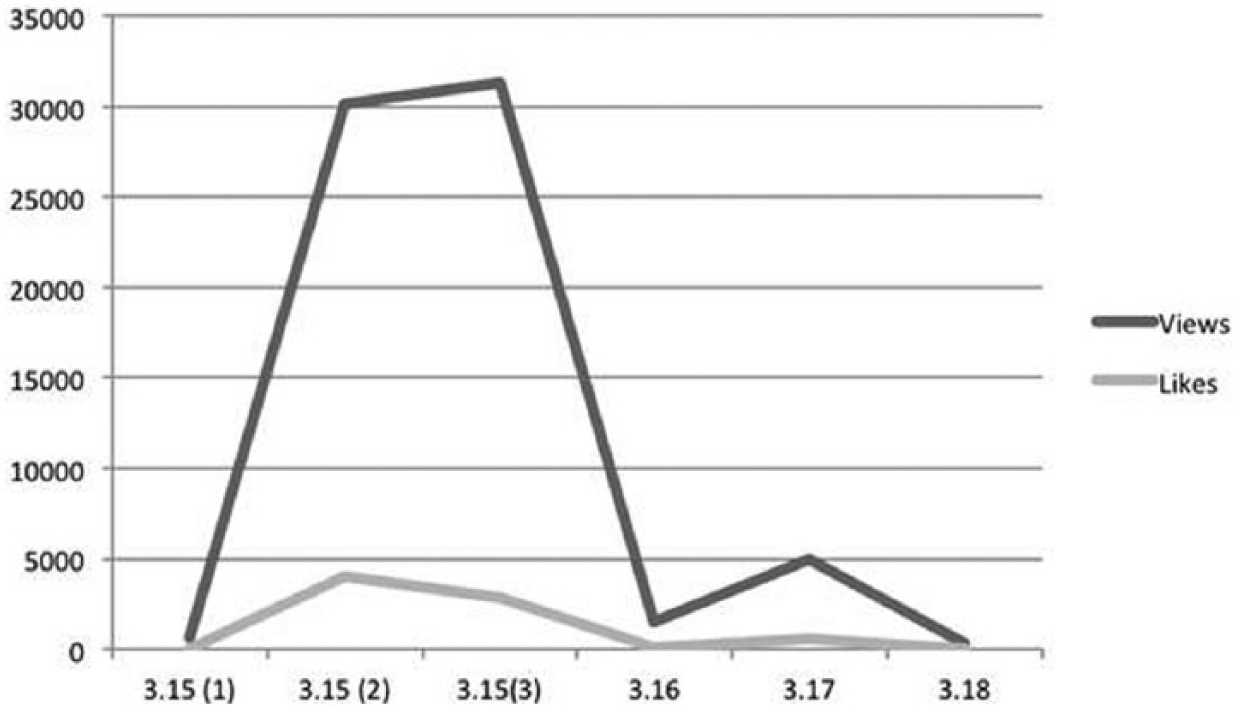
Viewing and sharing data for Ilind.net.
Data from news sites and their social media sites fail to illustrate clearly a pattern of sharply rising and falling interest. This is because each news outlet only aired one story on the case, though two of them also posted on Facebook pages about the case and another posted a story update on its website. Since these data represent content from different outlets of varying popularity, disseminated through different media, they are not usefully comparable. However, these data do suggest significant interest in mainstream media coverage of the story.
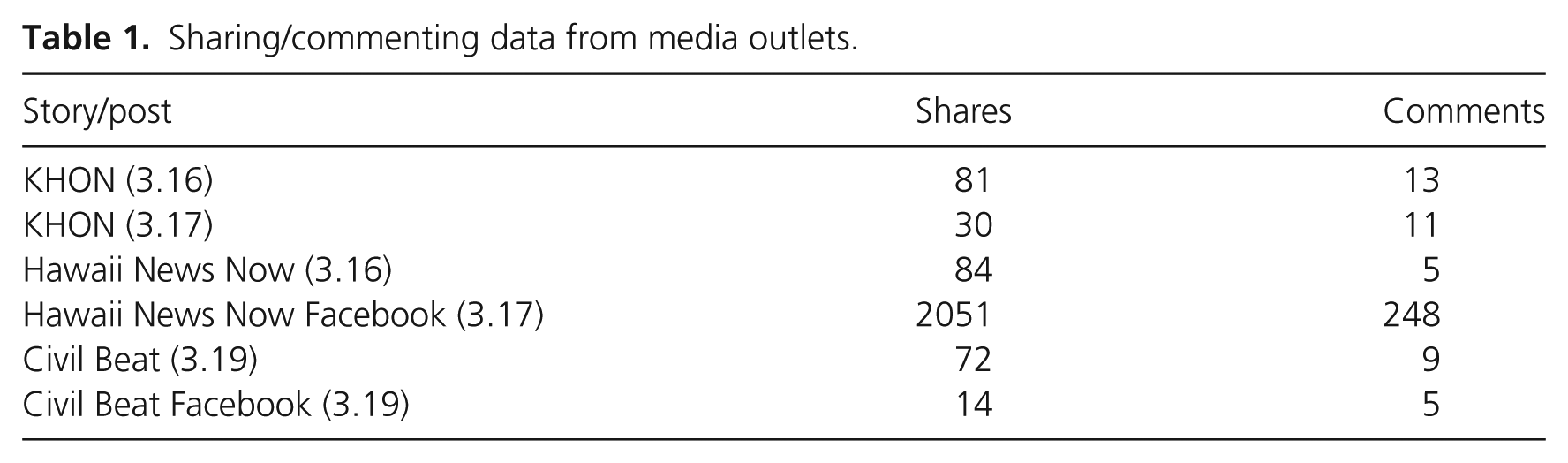
Local television stations picked up the story on March 16, with two stations producing a story each for their broadcasts, and putting them on their websites. The next day, one of the television stations posted a story update on its website, while the other posted a link to its original story on Facebook. Then on March 19, civilbeat.com posted a story written by the male victim about the crime, and posted on Facebook about it. Table 1 illustrates the sharing and commenting data for these stories. As the table shows, journalistic coverage of the case was shared at least 2332 times and commented on at least 286 times, though one might note that most of these were done through the Hawaii News Now Facebook page. As stated before, these are not comprehensive data, but they do demonstrate two points. One, it seems interest in the story rose sharply as the story spread on the Internet. Two, the case garnered interest via various fora, including mainstream journalism.
Sharing/commenting data from media outlets.
A trial by media
The previous data demonstrate the intermediatization of this case. However, these data only illustrate the presence of the story in the media. The discourses surrounding the case are the true substance of this process. To identify and analyze these discourses, we examined news stories about the crime and corresponding reader comments. Story content provides the outlines of the case’s mediated discursive construction, while reader comments show how some consumers responded to and discussed the case in a pseudo-civil society forum.
Mainstream media coverage of the case was relatively simple, comprising short stories of approximately 300–400 words each. There were two types of stories on the case—accounts of the crime with requests for tips and retrospectives describing how the case had been resolved. Accounts of the crime nearly all included three components. These components were a basic description of the crime (including a photo of the burglar), discussion of the role of technology (security cameras and/or social media), and a narrative implying the victims employed personal agency to solve the crime and reassert their home security. Retrospectives contained the same components, but also discussed how the burglar’s family returned the stolen property.
News accounts of the crime were mundane, providing basic, minute details, engaging in what Websdale and Alvarez (1998) have called “forensic reporting”—essentially telling more and more about less and less. However, the inclusion of a suspect photo was a significant component in that it presented a racialized actual and symbolic offender for the audience. The offender was a dynamic and somewhat dramatic actor in the series of pictures taken, and the clarity of the image (particularly his face and clothing) was also a factor in the coverage and popularity of this case. Indeed, a number of law enforcement officials noted that these victims’ camera produced far clearer pictures than they normally receive from victims (including corporate victims like convenience stores and banks). Not only was a crime committed, viewers virtually watched it. However, more importantly, the set of images produced a racialized, classed symbolic offender that neatly fit with prejudicial notions about the “typical” offender in Hawaii. The person in the photographs was a male, and he was ostensibly “local” (i.e. a person of Asian and/or Polynesian heritage). Moreover, this person appeared to be working class, as he was wearing paint-stained jeans, sunglasses, and a t-shirt, essentially what a construction worker might wear. As we will discuss later, this image fits with some readers’ notions of typical offenders in Hawaii.
In addition to detailing the burglar’s actions, news reports discussed the role of technology in the case. In fact, technology was apparently the “hook” that made this story newsworthy. For example, most stories made mention of the surveillance camera or social media in their headlines, reading (Yoro, 2014), “Camera captures Kaaawa burglar in the act” and “Stolen items returned after burglar photo goes viral” (Yoro, 2014; KHON2, 2014). As an instance of relatively minor property crime, this story was not especially newsworthy. Thousands of such crimes occur in Hawaii every year; in 2012, Hawaii recorded 7635 burglaries (Fuatagavi and Perrone, 2013). Yet, the facts that a homeowner’s security equipment captured such clear images of the crime and that the case was solved through social media made it a novel event. Thus, the use of technology to solve this crime was the most prominent element of news coverage.
Finally, multiple stories discussed or quoted the husband telling why and how he installed the security camera, stating that he had bought the camera after a previous burglary. These discussions contained an implicit, and sometimes explicit, logic that citizens must exercise personal agency to secure their property today. For example, one story quoted the victim saying (Yoro, 2014), “All you can do is make it a little harder for people to get in so that they might want to go someplace that’s not quite as much trouble. Doesn’t take as much time. Won’t require making noise to get in.” Essentially, these stories implied that personally engaging in target hardening of property is an effective and desirable way for citizens to prevent crime.
News coverage of the crime was routine, it comprised what one might expect from television news coverage. Coverage generally stuck to the facts of the case, and maintained an ostensibly neutral tone. However, reader comments were far more colorful. As stated before, such comments are far from representative measures of audience reaction. However, these data illuminate the reactions of some audience members. Furthermore, once posted, comments can be read by anyone reading the story, thus becoming part of the discursive construction of the crime. Reader comments were diverse, employing 11 distinct frames. Table 2 lists the frames and their frequencies, and provides a brief explanation of each one. 3
Reader comment framing (N = 319).
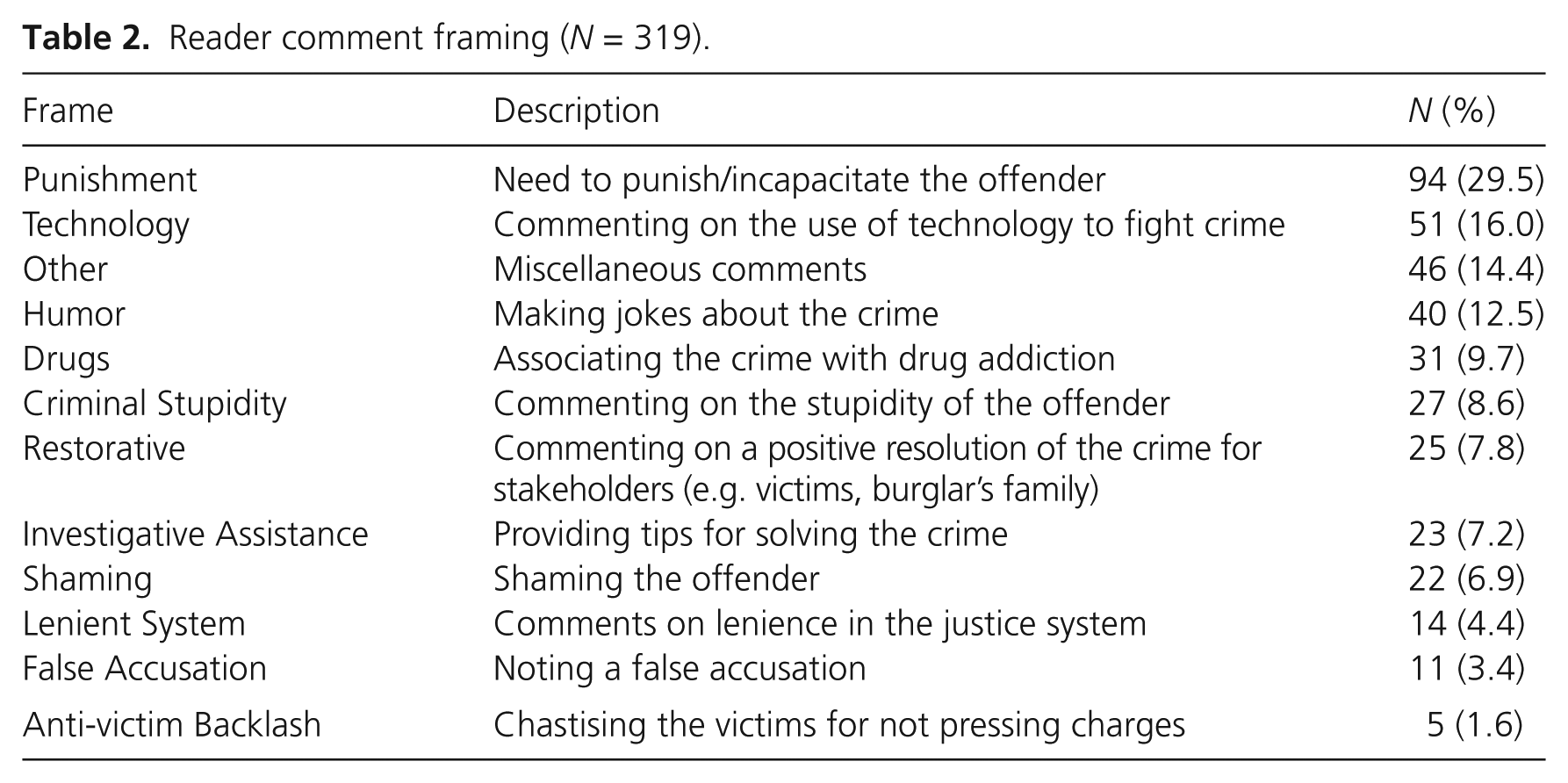
As Table 2 shows, the punishment frame was by far the most popular frame, employed in 29.5% of comments. Employing this frame, many readers argued for the importance of punishing the offender, often citing the moral importance of punishment or its crime prevention potential. For example, one comment stated [emphasis in original] (Hawaii News Now, 2014), “Busted… throw the book at him! I HATE thieves. Quit taking other people’s possessions. They work HARD to earn the money to buy those things!” Punitive comments ranged in harshness from simply stating that thieves should be incarcerated to suggesting that the US adopt mutilating punishments such as amputating thieves’ hands.
Five other recurrent frames—drugs, criminal stupidity, shaming, lenient system, and anti-victim backlash frames—were somewhat similar to the punishment frame in that they expressed a degree of hostility towards the offender and/or a more or less retributive orientation towards crime. The second most common frame—the drug frame (9.7% of comments)—basically commented on the supposed criminogenic effects of drug addiction, especially methamphetamine. One comment on the victim’s blog stated (Lind, 2014), “Very sorry to hear this. Per the usual, it may be someone nearby, probably to fund a meth habit.” Readers employing this frame generally expressed the view, pushed by some officials in Hawaii, that nearly all property crime was related to methamphetamine (Uyeno, 2014).
The criminal stupidity frame was most often used to chastise the offender for not realizing he was on camera. One person wrote (Hawaii News Now, 2014), “Yup, say cheese dumb a$$ [sic] & nope, you’re not on candid camera.” Such comments may have been made in an effort to inject humor into the discussion. However, they constitute hostility in that the humor was had at the expense of the “stupid” offender. Furthermore, many of these comments were racializing, using Hawaiian pidgin English, a creole language at least informally spoken by many locals. For example, one comment read (Hawaii News Now, 2014), “Poor uncle, no can hide now braddah! Lose money cuz!” Clearly, the use of such language may racialize the person using it. However, such comments were symbolically directed at the offender, presuming he was local and understood pidgin. The humor frame may seem similar to the criminal stupidity frame. However, the humor frame differs fundamentally in that comments employing the humor frame did not use humor at the expense of the offender. Instead, these comments generally made light of the situation, to perhaps keep the whole situation in perspective, for example joking about the trauma suffered by the family’s cats because of witnessing the crime.
The shaming frame, present in 6.9% of comments, generally expressed how the offender should suffer public, stigmatizing shame. It is important to note, however, that all of the shaming comments employed stigmatizing, rather than reintegrating shame (Braithwaite, 1989). For example, one comment read (Hawaii News Now, 2014), “By posting these photos of the crook caught in the act you are allowing the public, his family, his employer, his coworkers, and his friends to identify the jerk and to publicly shame him. They should know the scum in their midst.”
The lenient system frame, employed in 4.4% of comments, basically commented on how punishment was unlikely for this offender, portrayed criminal justice officials as incompetent, and/or blamed the crime on a system that released habitual property criminals. For example, one comment on the victim’s blog read as follows (Lind, 2014): “Unfortunately, here in Hawaii it makes no difference if he is caught. Even if he was arrested and convicted of burglarizing your home, there is a 70% chance that he would be given probation rather than sent to prison. That 70% probation rate applies even if he has multiple prior convictions. So you are wasting your time even trying to ID him…”
Interestingly, many readers remarked specifically on the lenience of Hawaii’s criminal justice system, contrasting it with mainland states’ systems perceived to be harsher. It should be noted, though, that a recent review of the Hawaii criminal justice system by the Justice Center of the Council of State Governments concluded that, in many respects, Hawaii’s system is more punitive than other comparable states, particularly around issues of bail, relatively harsh sentencing for “low severity drug offenders,” and parole (Derrick and Chung, 2013).
Finally, a few people expressed hostility towards the victims for not aggressively pressing charges against the burglar through the criminal justice system. For example, one comment on the victim’s blog stated (Lind, 2014), “Don’t mean to be blunt but letting this guy off the hook only lets him do this to someone else… To me if you ask people to help you find this person and let him go without punishment it’s a slap in our face for trying to help.” Though this frame was employed in only 1.5% of comments, its usage is significant in that it suggests that some readers’ punitive zest was great enough that their hostility pointed towards the victims when their reactions were perceived to be insufficiently punitive.
Many comments expressed punitive sentiments or hostility towards the offender. However, a substantial number of them expressed optimism over the fact that the property was returned by the family or expressed sympathy for the offender, empathizing with those addicted to drugs and/or living in poverty. For example, one individual responded to another reader, writing (Hawaii News Now, 2014), “Bobby, you’re absolutely right. Yes, I would feel loss. Yes, I too felt anger when my things of sentimental value were stolen. But when I found out who it was and heard what that person was going through, I felt compassion and pity on the guilty party. I’ve been on that end myself and you’re right, it felt horrible. But what felt even worse was what that person had been going through at that time.”
Such comments employed what we call the restorative justice frame. These comments took a non-punitive stance towards crime and acknowledged a diversity of parties affected by crime (Braithwaite, 1989). The restorative justice frame was not dominant, but it was present in a substantial proportion (7.8%) of comments.
Many other comments focused on the victims, trying to help them identify the suspect by either providing tips or indicating that they had shared the photos of the burglar on social media. For example, one comment on the victim’s blog stated (Lind, 2014), “I shared this on FB, and now I see that some of my Oahu friends saw it and shared it as well. Good for you for getting a picture. Somebody knows this guy and I hope you find him.” Such comments fall under what we call the investigative assistance frame, present in 7.2% of comments.
Investigative assistance comments occurred before the resolution of the case. However, afterward, a number of people remarked on how the majority of tips generated through social media had misidentified the suspect. For example, one comment read, “Clearly all but one of any leads received are wrong. Yet they were reported to HPD! Have the names of the wrongly identified people been posted by anyone on the web? And where do they go to get their reputation back if they have either been reported to HPD or posted on the web or both?” (Hawaii News Now, 2014)
As this quote shows, these comments generally expressed concern about the consequences of the misidentification made by many tipsters. Such comments were somewhat uncommon though, present in only 3.4% of comments.
Finally, many readers remarked on the role of technology in resolving this crime. 4 Comments employing the technology frame either asserted that personal security devices were necessary for nearly all homeowners, asked for information about the camera system, or remarked on the power of social media. For instance, one individual asked the male victim about his camera, writing, “Please let us know what brand of cam system you have. I am shopping for one and the quality is excellent! Glad you got your stuff back!” (Lind, 2014).
Some of these frames share affinities with others. In fact, one might aggregate the majority of these frames into two categories—hegemonic and alternative justice frames. The punishment, shaming, lenient system, drugs, criminal stupidity, and anti-victim backlash frames fall under the category of hegemonic frames. Hegemonic justice frames basically reproduce the dominant discourses on crime, which construct crime through matters of stigmatizing and retributive punishment and individual failings. Focusing on the need to punish, imagining offenders as stupid or morally bankrupt, and seeing drug addiction as a direct cause of criminality are all ideas that complement the current punitive regime in American justice. The technology frame might not ostensibly seem to have direct affinities to other hegemonic justice frames. It does not relate to matters of punishment or criminal stigma. However, discourses regarding technology as a crime fighter have long been a part of hegemonic crime discourses (Leishman and Mason, 2003; Surette, 2007). Furthermore, discourses surrounding technology relate to neoliberal notions about personal safety as an individual concern; the significance of which we will discuss in the next section.
On the other hand, alternative frames constitute divergence from hegemonic thinking on crime, focusing on helping the victims (but not necessarily enabling a need for retribution) and acknowledging the diverse parties and harms that comprise this crime. The restorative and investigative assistance frames fall under the category of alternative justice frames.
The humor frame is the only frame left out of this typology. In some ways, it illustrates the presence of crime as a public spectacle in American media, and a degree of audience desensitization to it (Jewkes, 2010). Thus, one might consider it a hegemonic justice frame. However, we hesitate to place it in the hegemonic justice category, as it does not pertain to matters of retribution, punishment, or criminal stigma.
The presence of a significant number of reader comments employing the alternative justice frames is encouraging to us. It shows these consumers are not monolithically focused on punishment and retribution. Instead, many audience members were resistant to punitive discourses and took a somewhat holistic perspective on crime. However, when examining the balance between the use of the hegemonic and alternative justice frames, these findings are less encouraging. Hegemonic justice frames were present in the vast majority (76.6%) of comments. This suggests to us that there is a degree of punitive consensus regarding property crime in Hawaii. In fact, many of the comments remarked that this crime, featuring a drug-addicted, repeat offender, of lower-class standing, and local background was “typical” of crime in Hawaii. Furthermore, when considered in relation to broader media coverage of property crime, it seems these comments are both produced by and perpetuate an atmosphere of heightened concern and punitive sentiment.
Discussion
As stated earlier, we believe this case study fits well with Greer and McLaughlin’s (2012) definition of trial by media. In our case, after a crime was perpetrated, the event was intermediatized, an offender was identified, publicly “prosecuted” through social and corporate media, and, ultimately, chastised. However, this case is also distinct. Here we show that trial by media may revolve a far more mundane crime, and occur over a short time period. Were it not for two new technologies—powerful but affordable personal surveillance equipment and social media (particularly Facebook)—the case would never have entered a public mediascape. Further, this alternative justice process created space for a somewhat restorative outcome, yet this process also led to a false identification and possible virtual miscarriage of (media) justice. Additionally, in light of the preponderantly punitive and arguably racist audience reaction, this case must be considered in relation to the wider climate of concern over property crime in Hawaii, which has clear moral, panic-like qualities. Finally, the role of surveillance technology in the case generates both encouraging and troubling implications.
As stated before, previous research on trial by media has focused on more serious crimes and wider-reaching scandals (Greer and McLaughlin, 2011, 2012). Our case is nearly the opposite. Home burglaries are not novel television news material. Yet, this crime became a substantial, state-wide story, though only for a few days. This case would not have become a story at all if it were not for a computerized security camera and social media. While the camera allowed for the recording of the crime, the blogosphere and social media (especially Facebook) circulated the story very quickly. In fact, during this case, local corporate media scrambled to keep up with private citizens’ social media. Previous studies of trial by media have shown how traditional news media broke a story that circulated across new media (Greer and McLaughlin, 2011, 2012). Our case shows how social media broke a story that circulated across other new media, then traditional news media.
Greer and McLaughlin (2012) define trial by media as an alternative justice process. Our case indeed entailed an alternative justice process, in at least two ways. First, this process created a space for a somewhat restorative outcome. Regardless of official responses, the perpetrator’s family tried to undo the harm of this theft by returning most of the stolen property and offering a sincere apology. Such an outcome happening through official channels is implausible.
Second, though this alternative justice process produced one encouraging outcome, it was far from perfect. In fact, the false identification of another suspect and the possibility of his being chastised publicly on the Internet are hard to miss. To us this false identification raises the possibility that this populist, informal process can easily morph into social media witch hunts. Indeed, this may have been the case after the Boston marathon bombing, when false identifications were widely circulated not only on sites such as Reddit, but also in mainstream news (Golgowski, 2013). Moreover, the possible impacts of this media justice process on official justice should be considered. Two possible impacts are clear to us. One, there is some possibility that the virtual miscarriage of justice that occurred might have led to an actual miscarriage of justice. The misidentification of an innocent suspect online might have led to a wrongful conviction or prosecution, though it is not clear to us if there would have been enough evidence to charge or convict the falsely identified man. Another possible impact concerns the actual offender. The notoriety of this case, coupled with more general frustration and anger over property crime, might have spurred police and prosecutors to treat this man more harshly than other similar offenders. In an effort to win public trust, authorities could have used this man as an example to enhance their punitive credentials. While this may not constitute a miscarriage of justice equal to a wrongful conviction, it would have violated principles of equality before the law. Moving forward, it is important to consider how alternative justice processes in the media can affect official justice processes, and theorize those effects.
Our trial by media may or may not have affected official justice processes. However, it clearly made an impact on some community members. While some public reactions to the case were non-punitive/restorative, most reader responses to the case were vociferously punitive. Many readers sermonized about the case, arguing that this “typical” crime was committed by a “typical” offender, basically meaning that it was a product of a morally bankrupt, drug-addicted, local (read Polynesian/mixed heritage), lower-class offender. Such a construction is a near perfect fit with the mediated discourses employed to discuss the recent “crime wave” in Kailua. Surely, mediated discourses influenced public reaction to our crime, but coverage of this crime likely also perpetuated the circulation of these discourses. In aggregate, the pre-existing crime discourses and public reactions to the crime show evidence of many moral panic criteria, such as hostility, volatility, disproportionality, and of course, a racialized folk devil (Goode and Ben–Yehuda, 1994; Hall et al., 1978). One might understand this case as embedded in a moral, panic-like climate of concern, which could potentially have destructive material consequences. In fact, three months after the burglary, despite a grim overcrowding problem in its prison system, Hawaii governor Neil Abercrombie signed House Bill 2205 into law, ensuring at least one year of incarceration for those convicted of multiple property crimes (Sakahara, 2014).
The role of surveillance technology in this case is also ambiguous to us. Ostensibly, this technology seems to have played a helpful role in identifying a burglar, aiding homeowners’ retrieval of stolen property, and spreading public awareness of a theft. Still we might raise concerns for two reasons. First, this technology enables some degree of self-surveillance, contributing to a panoptical society in which everyone is being watched. Especially considering recent domestic spying by the NSA, we wonder if surveillance images might be used against those using them to protect their homes and property. Second, readers and viewers expressed significant interest in and optimism about the use of this technology. In our minds, this hints at a public endorsement of a neoliberal, risk-management society in which individuals are the primary party responsible for their safety and security (Garland, 2002; Miller and McMullan, 2011). In such a society, homes do become securitized castles, with computerized walls.
Overall, the effects of this case on justice and public perceptions of crime seem somewhat paradoxical. On one hand, the case opened an alternative justice space and room for diverse public debate, which worked against punitive crime politics in some ways. On the other, the racialized, punitive reaction and uncritical support for technologized securitization generated by the case play right into neoliberal, punitive politics. To discuss comprehensively the nature of such a paradox and its causes is beyond the scope of a single paper. However, some features of this case and following events allow us to theorize partially the factors upon which these impacts are contingent.
It seems to us that the elements of a trial by media that fit pre-existing stereotypes and expectations encourage punitive reactions. Specifically, the offender in this case fit with stereotypes concerning crime in Hawaii. As such, his presence in the case confirmed and perpetuated audience members’ preconceived notions. Moreover, the type of crime (burglary) supported the impression that Oahu was experiencing an intense wave of property crime. Finally, the ineffectiveness of the traditional police response in this case reaffirmed audience members’ perceptions of police impotence on Oahu. It is important to note also, that the influence of pre-existing stereotypes is present in both a short-term and long-term sense. The racialized typical offender present in this case is likely representative of a long-standing cultural trope in Hawaii. Additionally though, the poignancy and salience of this trope was enhanced during this case because of a shorter-term, moral, panic-like climate which existed. Thus, the long-term stereotype of a racialized offender and the more intermediate presence of a moral panic atmosphere were factors that likely pushed audience reactions to this case in a punitive, hegemonic direction.
Conversely, there were some aspects of the case that did not fit with stereotypical notions of crime in Hawaii. Most importantly, the fact that, attempting to make amends, the offender’s family returned the stolen property contradicts hegemonic notions, such as the ideas that crimes are committed by typical classes of people and that punitive reactions are the only way for crime victims to get satisfaction. Instead, for some citizens, it seemed this case encouraged them to think more restoratively about crime. Basically, it seems when a trial by media has elements that contradict dominant assumptions about crime, it generates counter-hegemonic effects. In fact, the fallout from another, somewhat similar, case approximately six months after this one supports such a hypothesis. In late July 2014, Honolulu police sergeant Darren Cachola was caught on a security camera repeatedly punching his girlfriend in a local restaurant (Kerr, 2014). In addition to the footage, Cachola’s record included a restraining order and a history of abuse against his ex-wife. Coverage of the crime spurred another trial by media; the case was subject to intense debate online and offline. The footage, and the facts of the case, clearly refuted hegemonic notions of police as law-abiding public protectors. It indeed led the public and officials to start asking questions about widespread police misconduct in Hawaii. After the surveillance tape was widely covered in local media, public outrage spurred legislative hearings on Honolulu Police Department’s handling of domestic violence and forced public apologies from the department for its mishandling of the case and others like it (Civil Beat, 2014). Further, the case started a wider conversation regarding police transparency and accountability.
The possibly counter-hegemonic influence of technological novelty should also be considered. Though in some ways we are troubled by the role of technology in this case, one must acknowledge that the prospect of social media “solving” the case seemed to intrigue both journalists and the public. Social media technology here allowed an otherwise mundane case to be introduced to a multifarious mediascape, where it was open to many interpretations and diverse commentary. It is possible that technologically novel “hooks” for stories allow ordinary citizens to influence corporate news agendas and create justifications for news coverage of mundane crimes, sometimes in ways that challenge dominant discourses of crime.
The roles of various claim-makers (e.g. social movement actors, officials, advocates, etc.) should be considered in this respect as well (Anonymous Reviewer, 2014). For example, claim-makers associated with Hono Kailua linked this crime with their broader assertions of a pervasive crime wave on the east side of Oahu. Also, though we uncovered no direct evidence of it, officials with a punitive agenda, for example the county prosecutor, might have used this “typical” case to back up their claims and rally support for punitive measures such as House Bill 2205. Moreover, it is important to note that pre-existing, racialized, crime stereotypes and the recently supplied, moral, panic-like discourses on property crime constituted a supply of discursive capital from which such claim-makers could draw to push public reactions in a punitive direction, reinforce their own claims and perpetuate the existing climate of concern. On the other hand, claim-makers with a more restorative orientation might have used the offender’s family’s actions as evidence that non-punitive solutions to crime bring direct benefits to victims. Essentially, claim-maker framing efforts likely exert an important influence over the possible impacts of such a trial by media. Moreover, the dialectics between pre-existing discourses and claim-makers’ assertions allow the mutual strengthening of each. Ultimately, it seems trials by media are ambiguous and potentially paradoxical; their impacts can be hegemonic, counter-hegemonic, or both, contingent on many factors, including how the case fits with established, hegemonic frameworks.
One final aspect that must be considered is the question of the generalizability of this case study. Hawaii possesses a somewhat unique social and economic environment, and it is geographically remote from other states. Those particularities must be accounted for, yet they do not preclude the possibility of generalizable findings. The size of media markets is a particularly important factor to consider when conducting a case study of media phenomena. Honolulu is a smaller media market than many other large, mainland, urban centers (Chicago, New York, Los Angeles, etc.). For this reason, the newsworthiness threshold for media in Honolulu is probably lower than large, mainland cities. Indeed, Hawaii journalists are sometimes accused of “cat in tree” journalism. Thus, it seems unlikely that such a case would be widely covered in a large, mainland city or have such a tangible impact. That said, Honolulu is the 53rd largest city in the United States, so it is really not quite the sylvan “paradise” conjured by travel posters (US Census Bureau, 2012: 27). Moreover, huge cities like New York and Dallas are not the only media markets, and it is possible that such a case would gain comparable notoriety in medium-sized cities (think Fresno, Kansas City, or Tucson), suburbs, or rural areas on the mainland. So, while trial by media cases similar to ours may be unlikely in large, urban areas, they may well crop up in other smaller communities in mainland North America or Europe.
Another aspect of this case that is distinct, yet possibly generalizable, is the role played by racial prejudice. Compared to many North American communities, Hawaii has an unusually diverse population, which in some ways makes it a unique racial environment. However, this diversity does not eradicate racial tensions, as some claim-makers may imply (Rohrer, 2008). In fact, the centrality of race in perceptions of crime demonstrated by this case is an important commonality shared by Hawaii and other communities. Ultimately, the powerful interactions between trials by media and pre-existing, racial stereotypes is a highly generalizable finding, one that should be explored further.
Conclusion
Changes in the techno- and mediascapes of the 21st-century have far-reaching and profound impacts, which scholars must continually work to understand. The intersections of new technology and traditional media enable new ways of understanding social phenomena, and new ways of responding to them. Trial by media is both a way of understanding crime, and responding to it. This case shows that even a small-scale case may have far-reaching implications. We are encouraged by the space for restorative justice created by this case, yet it also provided a setting for the expression of punitive sentiments about crime and victimization. We are also ultimately unsure about the role of new personal surveillance technologies play as a response to crime. Are they aids to solving the crime or voyeuristic fodder for media coverage of crime? Future research might investigate some of the questions generated by this study. What is the potential for creating restorative spaces in informal justice processes facilitated by social media? How do alternative, mediated justice processes intersect with official ones? Do such media, though, also create the possibility of racially-driven and informed, moral panics, and worse the possibility of actual vigilante justice? Do novel technological phenomena create avenues for ordinary citizens and/or mundane events to challenge dominant constructions of crime? And, finally, what is the political and social meaning attached to self-surveillance as a response to the crime problem and what are the potential risks and unintended consequences?
Footnotes
Funding
This research received no specific grant from any funding agency in the public, commercial, or not-for-profit sectors.