




Abstract
After a homicide, survivors are thrust into relationships with a myriad of professionals. For cold case homicide survivors, these relationships are likely to develop into long-term, persistent interactions. Interviews from 24 cold case homicide survivors in the United States reveal that media professionals are often the source of additional trauma, and yet, most survivors expressed a need for continued communication and continued coverage of their case. Utilizing social constructivist grounded theory for data collection and analysis, common themes emerging from the survivors’ stories include inadequate coverage of the case, inaccurate portrayal of victim or information, negative reactions to the media, and positive experiences and desire for long-term coverage. Implications and recommendations for survivors and media professionals are detailed within.
Introduction
In 2013, 14,196 reported homicides occurred in the United States (USDOJ, 2014). That year, 35.9 percent of cases were left unsolved (USDOJ, 2014), increasing the risk the case will be classified as a cold case homicide. Each homicide leaves behind at least four survivors (Murphy, 1997). With a clearance rate of approximately 36 percent, in 2014 more than 20,000 family members grieved the unsolved murder of a loved one.
Scholars and practitioners do not agree on the definition of a cold case homicide. The current study is guided by Walton’s (2006) definition which classifies a case as ‘cold’ when 1) the original detective is no longer working the case, 2) there is no new information or promising leads, and 3) the case is at least a year old with no activity. With each unsolved homicide the surviving family members are left to cope with the aftermath, becoming a unique class of victims known as cold case homicide survivors. Few scholars have explored this subset of homicide survivors (exceptions: Stretesky et al., 2010; Wellman, 2014a, 2014b), but these individuals struggle with a unique grief and complicated reality that exists long after the murder.
Interactions with related practitioners such as law enforcement agents, bereavement specialists, and the media will become commonplace for cold case homicide survivors. The current paper seeks to answer how these survivors perceive the coverage, treatment, and relationship they have established with the media. Literature focusing on the survivors of solved homicides, the newsworthiness of homicide cases, and the impact of coverage on trauma survivors is provided as a framework.
In-depth interviews were conducted with survivors whose stories were systematically coded to uncover commonalities. Within the interviews survivors described various media interactions from initial breaking news coverage and crime reports to feature stories and documentaries on their loved ones’ deaths. The survivors frequently perceived their cases to be portrayed by the media inadequately or with inaccuracy, easily expressed negative interactions with media personnel, had some accounts of positive experiences, and yet overwhelmingly had a strong desire to continue a relationship with the media professionals in an effort to generate leads in their cases.
Surviving a homicide: Those left behind
Following a homicide the surviving family members are left behind to rebuild their lives in the midst of a complex, unexplainable set of circumstances. Homicide survivors often experience traumatic grief, commonly present following violent, sudden deaths (Armour, 2002; Feldman Hertz et al., 2005; Malone, 2007; Masters et al., 1988; Murphy et al., 2003; Vessier-Batchen and Douglas, 2006). Traumatic grief results in a shattered world view, emotional manifestations, and physical responses to grief (Spungen, 1998) and is intensified when the murder is considered to be preventable, sudden, and/or involves a child (Rando, 1993). Additionally, if there is an absence of social and family support and/or the survivor had a strained relationship with the murder victim prior to death, there is an increased risk of traumatic grief. Wellman (2014a, 2014b) examines cold case homicide survivors, and has found that the unsolved, uncertain journey that they face further contributes to enhanced traumatic grief. Further complicating their experience, years of interactions with practitioners, including media, constantly remind survivors of the violent death.
Exploring newsworthiness and the appeal of covering homicides
Media personnel are able to select the type and manner in which information will be disseminated to their readers and viewers. Specific factors enhance the likelihood a story will be defined as ‘newsworthy’ and deserving of coverage (e.g. Chibnall, 1977; Galtung and Ruge, 1965; Greer and Reiner, 2012; Jewkes, 2004). While the most influential ‘news values’ are unique to each scholar, the consensus is that events that present as unexpected and violent, include powerful or elite people, provide spatial and cultural relevance to the readers, and have an individual focus are likely to be deemed more newsworthy. Galtung and Ruge (1965) propose the greater the number of factors present in an event, the more likely it is to be selected as news. Once selected, the newsworthy elements will be extrapolated and enhanced, and this process of selection and distortion of the event will be replicated throughout all stages of media coverage and distribution.
Stories of violence and victimization temporarily allow readers to vicariously experience the pain and suffering of the victims within a story (Peelo, 2006; Walklate and Petrie, 2013). Specifically, homicides generate an enormous amount of media attention and are the most likely crime to be selected by journalists to be featured in the news (Gilliam and Iyengar, 2000; Graber, 1980; Meyers, 1997; Peelo, 2006). Many scholars have sought to understand how and why particular cases receive attention in the media while others do not. Researchers conclude the more unusual the factors and details of the case, the more newsworthy the case will become (Blau, 1991; Chermak, 1995; Oliver and Myers, 1999). Demographic case variables heavily impact case selection and determine the frequency, type, location, and tone of the stories (for example: Gilchrist, 2010; Pritchard and Hughes, 1997).
Race of the victim may be one of the most significant factors in coverage. Homicides involving a white victim are more likely to receive media attention than a case involving a Hispanic or African American victim (Dowler, 2004; Entman, 1992; Johnstone et al., 1994; Lundman, 2003; Pritchard and Hughes, 1997). The majority of homicide victims are minorities (USDOJ, 2014), yet African American victims are not often viewed as newsworthy (Blau, 1991; Simon, 1991). Gilchrist (2010) found that race of the victim was significant in the amount and type of coverage provided to missing and murdered women in Canada. Aboriginal women received 3.5 times less coverage than white women. Stories of Aboriginal women had 1.4 times fewer words, were often hidden in the soft news and advertisement sections, were impersonal, and lacked any empathy. Photographs of minority women were often passport sized. Pictures in the white women’s cases were larger, portrayed nurturing qualities, depicted active police investigations, and included supporting images such as sketches and maps.
Coverage can potentially be attributed to the position in which society values white womanhood. Whereas minority women may be viewed as ‘lesser’ victims (Entman and Rojecki, 2000; Jiwani, 2008; Jiwani and Young, 2006), white women are idolized as pure and innocent (Collins, 2013; Collins, 2000; Dyer, 1997; Jewkes, 2004; Wilcox, 2005) and thus deemed more deserving of media attention. Regardless of gender, the portrayal of white, upper-class victims may be of interest because of high status and lack of status deviance (Pritchard and Hughes, 1997; Shoemaker and Reese, 1996).
Race of the offender is also important. A Black offender and a Black victim are unlikely to receive media attention, as is a White offender and Black victim. Many studies have confirmed that a Black offender and a White victim have an increased opportunity for coverage (Lundman, 2003; Madison, 2001). One explanation for this selective attention may be societal biases and scripts of White racism and fear of crime by African American offenders (Capeci, 2015; Feagin, 1991; Lundman, 2003; Madison, 2001). Another explanation is interracial African American homicides are too ‘common’ (USDOJ, 2014) and the media seek statistically deviant cases (Pritchard and Hughes, 1997).
Coverage may be influenced by gender. Lundman (2003) found female on female homicides are likely to receive more coverage than male on male homicides, but male offenders with female victims were most likely to receive attention and front page placement. Again, women are less likely than men to be killed, and thus when the victim is female the statistical deviance factor arises, thus making the case more attractive to media personnel (Pritchard and Hughes, 1997; USDOJ, 2014).
Age of the victim, location, and geographic/cultural proximity may be critical in understanding media selection of homicide cases. Child and elderly victims are more likely to receive a greater number of stories, increased story length, front page placement, and presence of a picture, compared to middle-age victims (Pritchard and Hughes, 1997). Suburban homicides that include wealth and safety as two of the defining factors of the neighborhoods where the crime occurred are often more newsworthy (Blau, 1991; Simon, 1991). Cases that occur in close geographical proximity are likely to be of greater interest to readers, as people want to know what is happening around them (Greer, 2003). When a case contains deviance and shock value, such as drugs, gangs, or a vulnerable class of victims, society views the homicide as culturally deviant, again increasing the interest in the case (Greer, 2003; Pritchard and Hughes, 1997). These types of homicides help readers define and reinforce their own morals and behaviors (Katz, 1987; Peelo, 2006; Pritchard and Hughes, 1997).
Impact of news coverage on survivors of violent crime
Content decisions are often based on the available information and perceived audience needs, with the audience’s interests often being the greatest factor (Fahmy, 2005; Kratzer and Kratzer, 2003; Tai and Chang, 2002). The rush to fulfill the audience’s needs creates a challenge for journalists to instantly make decisions as to whom to interview, gauge the potential shock and trauma that could be present among survivors, and attempt to gather as much information as quickly as possible without appearing insensitive (Walsh-Childers et al., 2011). There exists a current gap between perceptions of the general audience’s needs and the impact coverage will have on those closest to the story (Fahmy and Roedl, 2010). Journalists must be aware of the impact homicide stories can have on the related survivors. While the larger society is able to read the news, digest the information, and quickly move forward (Brookes et al., 2015), survivors of violent crime do not perceive and process the media coverage of crime in the same manner (Peelo, 2006).
Activists have called for recognition of the insensitive and often unethical way media personnel and media coverage approach violent crime victims and families (Levin, 1995; Rentschler, 2007; Roper 1996). Potential survivor victimization and traumatization has led to redefined ethical guidelines for journalists covering violent crimes and catastrophic events (example: Code of Ethics and Professional Conduct, 2000; Simpson and Cote, 2006). Another major change to improve victim/survivor experiences includes a shift towards victim-oriented journalism. Rentschler (2007) details how universities are including victim-oriented journalism in their curriculum. Students trained in ‘emotional literacy’ are encouraged to write from the victim’s perspective, empower survivors, allow survivors to have a voice in the story, and focus energy on offender prosecution. Operating from a care perspective, journalists can ensure that traumatized individuals are both informed and treated in a beneficial manner (Vanacker and Breslin, 2006).
Previous studies have explored the perception of media coverage and related media interactions among survivors of large-scale violent crimes such as school shootings, terrorist acts, and other mass killings. While some survivors experience compassionate and genuine interactions with the media (Walsh-Childers et al., 2011), the majority of literature details survivors’ negative relationships, lack of satisfaction, and increased trauma (Armour, 2003; Doka, 2002; Fahmy and Roedl, 2010; Haravuori et al., 2011; Rando, 1993; Rynearson, 1988, 1994; Spungen, 1998).
On September 11, 2001, terrorists hijacked several planes and carried out attacks on the Pentagon and the World Trade Center, killing 2997 people. Exposure to frequent coverage of the attacks increased posttraumatic stress disorder (PTSD) among viewers who were directly affected by the event (Ahern et al., 2002). Viewing traumatic images of people falling or jumping from the Twin Towers at the World Trade Center was consistently associated with high levels of PTSD. In April 2007, a student at Virginia Tech went on a shooting spree, killing 32 people and injuring 17 more. Survivors perceived journalistic behavior to follow three major themes: insensitive, invasive, or therapeutic (Walsh-Childers et al., 2008). Surviving family members of the Virginia Tech victims found the related media coverage to be problematic for several reasons. The initial images were described as too graphic, many learned of the event via the media prior to official notification, and they felt stories glorified the shooter (Fahmy and Roedl, 2010).
Haravuori et al. (2011) studied media coverage following a 2007 high school shooting in Finland. Students who were exposed to trauma and interacted with reporters rated higher on PTSD measures than did other trauma exposed students who did not have contact with the media. Additionally, measures of intrusion, avoidance, and hyperarousal after trauma were highest for those who had given an interview and had followed the media most. These results indicate involvement with and viewership of the media increased stress among survivors.
Immediately following a homicide, many reporters will seek information from the surviving family, claiming a right to know the specifics of the case, and thus bringing unwanted attention to the family (Armour, 2002). Media intrusion can distort the meaning of the tragedy for the surviving family (Miller, 2009; Peelo, 2006). When the murder victim has a criminal or deviant past, the media often reports this information, thus causing disenfranchised grief (Doka, 2002; Spungen, 1998). Such coverage is likely to cause survivors to feel revictimized by the negative media coverage, judgement, and isolation (Rando, 1993; Rynearson, 1988, 1994), potentially prolonging the healing process (Armour, 2003).
For cold case homicide survivors, this prolonged grief and complex relationship with the media is likely to be ongoing for years after the homicide. Due to the declining homicide clearance rate, many crime reporters and journalists will interact with families of cold case homicides. It is important to understand the nature of this relationship, the impact the media interactions and coverage can have on the survivors, and the motivations behind the survivors’ desires to engage in partnerships with reporters.
Sample recruitment and study design
The current study explores the lived experiences of cold case homicide survivors, who comprise a vulnerable group of victims. Despite the risk of re-traumatization, participation of vulnerable subjects in qualitative research is often beneficial and therapeutic (Lakeman and Fitzgerald, 2009). Even for participants who report distress during a study, most report the overall experience was positive and helpful (Jorm et al., 2007). To address topic sensitivity and participant vulnerability, several precautions were taken.
The researcher dedicated a significant amount of time prior to data collection to understanding cold case homicides by developing a strong foundation of trust with bereavement groups, law enforcement personnel, and media reporters (consistent with: Lakeman and Fitzgerald, 2009; Sollund, 2008). The researcher attended several bereavement groups to establish an understanding of the homicide survivors’ realities. Additional time was spent consulting with a cold case homicide unit, which resulted in the review of case files, introductions to various survivors, and the opportunity to assist media professionals seeking information. This foundational work later translated into trust and reduction in power differentials between the survivors and the researcher (Sollund, 2008).
In addition to the informed consent information, the researcher spoke with survivors about engaging in research and the potential risk of distress (Henderson and Jorm, 1990). Participants’ wellbeing was monitored throughout the interviews (Lakeman and Fitzgerald, 2009). Naturally, some participants did present with emotional distress. When this occurred, the researcher paused the interview and inquired into the participants’ needs and desire to continue. No survivors wished to remove themselves from the study, demonstrating the importance they placed in sharing their story. Instead, the participant would ask to skip the question, reminisce about a positive moment, pause the interview, or in one event asked to reschedule the remainder of the interview. Throughout the study, the researcher was open, transparent, and reflexive with the survivors to create a safe environment (Sollund, 2008). Protections and contact with the survivors did not end after the interviews were complete. Debriefing, follow-up care, and long-term communication was established with the participants (Cooper, 1999; Lakeman and Fitzgerald, 2009). A resource sheet with local and national organizations, counselors, websites, and recommended reading was provided.
Recruitment was a direct result of the professional and personal relationships that provided the first participants for the study via referrals. The researcher committed to providing the survivors with a transparent and nonjudgmental opportunity to share their stories in an effort to better educate others on their lived experiences. With each interview, the survivors shared the names and contact information for other cold case homicide survivors. No survivors refused the invitation to participate in the study.
The snowball sample included 24 cold case homicide survivors from 15 different families. Six males and 18 females were involved. The racial breakdown included eight African Americans and 16 Caucasians. The average age of the participants was 50 years old, ranging from 18 to 74 years old. Average time since the homicide was 12 years, with a range of 2–44 years. Relationships between the survivors and victims included 10 parents (three fathers and seven mothers), nine siblings (three brothers and six sisters), two granddaughters, one grandmother, one daughter, and one wife. In an effort to protect the identity of the survivors, information about housing, income, education, and occupation have been kept confidential. Case details, demographic information, and pseudonyms can be found in Table 1.
Demographic characteristics of participants.
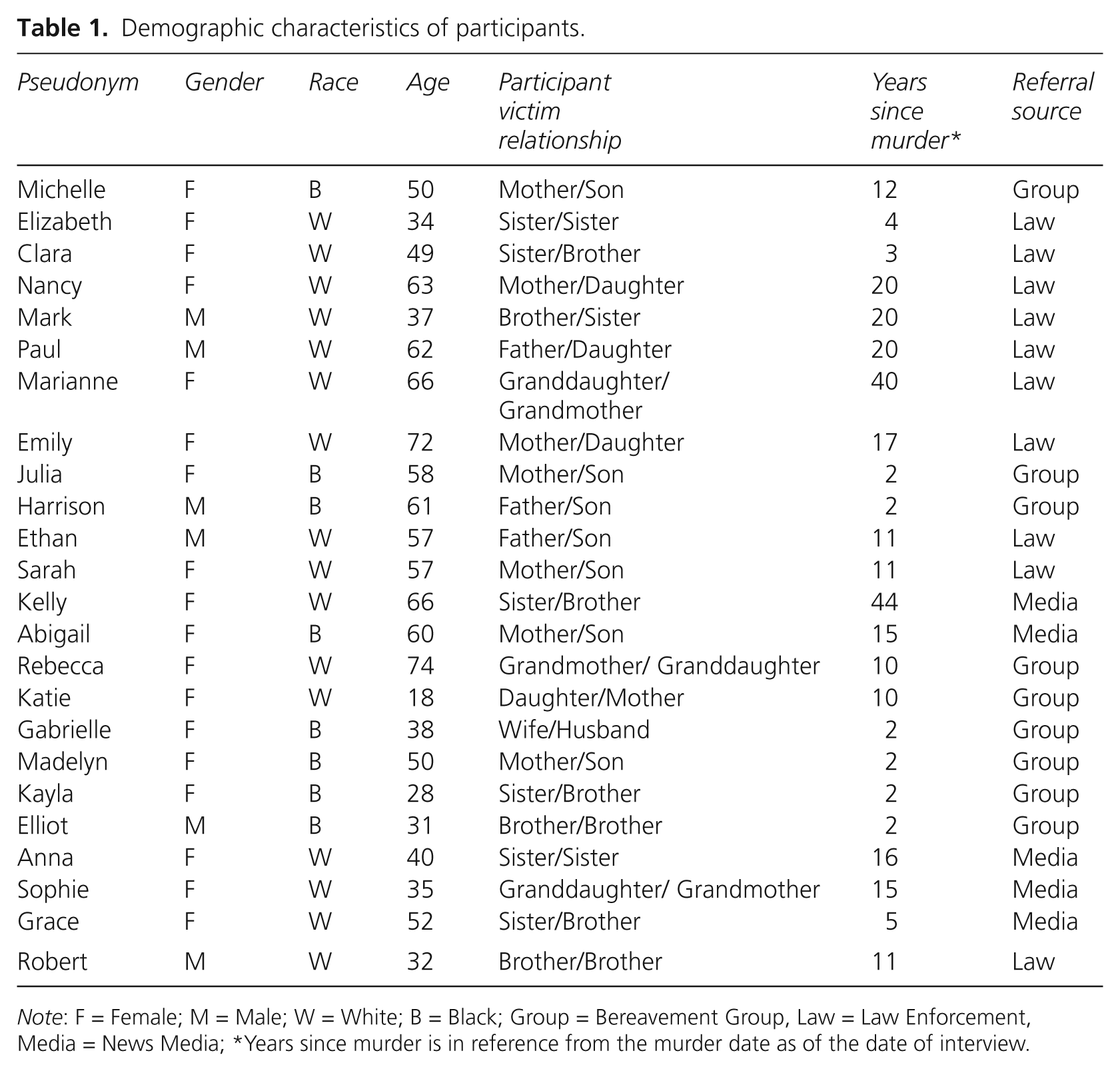
Note: F = Female; M = Male; W = White; B = Black; Group = Bereavement Group, Law = Law Enforcement, Media = News Media; *Years since murder is in reference from the murder date as of the date of interview.
Participants completed in-depth interviews, lasting 1.5–4.5 hours. Survivors were asked to identify a comfortable interview location which was usually their home but also included work, public venues, and personal vehicles. Following Institutional Review Board guidelines, survivors were asked to review and sign an informed consent form and provide permission to audiotape the interview for accuracy purposes. After consenting, survivors were asked to tell their story from the moment they were notified of the homicide to the present day. Interviews were audio recorded and transcribed verbatim. There were no corrections made to the survivors’ quotes regardless of grammar or dialect. Transcripts were sent to survivors who desired a copy and communication with survivors has been continuous as publications are prepared using their stories.
While many areas of interest were explored, the current paper only details the survivors’ lived experiences with media personnel and case related coverage. Social constructivist grounded theory served as the framework for exploring and interpreting participants’ encounters. The researcher was guided by Charmaz’s methodological and analytical grounded theory approach (Charmaz, 2000, 2008), which embraces the idea there are multiple realities shaped by the social construction and interpretation of events. Additionally, Charmaz highlights the need for reflexivity, subjectivity, and the co-construction of meaning from both researcher and participant (Charmaz, 2008). As a result, the researcher uses the participants’ voices and opinions as the most significant part of analysis and presentation.
Grounded theory provides rich meaning to individuals’ lives and is a powerful lens through which to view problematic events, such as homicide (Denzin and Lincoln, 2008). In accordance to grounded theory, no specific theory guided the present research, and the data generated was used to develop patterns of meaning (Creswell, 2007). To allow for the survivors to share their story with little input from the researcher, a semi-structured interview format guided by open-ended questions was used (Creswell, 2007).
To address survivors’ interactions with the media, the researcher asked participants to ‘detail your experience with the media and coverage of your ____’s case from the time of the homicide to today’. In the event that the survivor had little to say or did not include various aspects of their experiences, the researcher had follow-up probes. These included ‘How would you describe your overall interactions with the media?’, ‘Can you describe the coverage in the case?’, and ‘Would you detail what type of relationship you currently have with the media?’. The interviews were coded using line-by-line coding, which formed basic codes. Original codes were mined for common themes. While grounded theory is designed to develop an overall ‘theory’ of the social phenomenon being studied, the nature of this article is to highlight a portion of the survivors’ experiences through the constructivist lens. Collecting and analyzing data under the constructivist framework allows the researcher to understand and report the participants’ perceptions of their reality (Charmaz, 2008; Creswell, 2007). The results within will depict the common experiences and overall perceptions these survivors expressed in regards to the media. Major themes are presented and are supported with examples of survivors’ quotes that embody the trends.
Understanding emerging themes
For the cold case survivors in this sample, the media had a multifaceted and significant impact on their immediate and long-term grief. Through their stories, five media related themes emerged including 1) inadequate coverage of the case, 2) inaccurate portrayal of information or victim, 3) negative experiences with media, 4) positive experiences, and 5) desire for long-term coverage. Each theme is illustrated by the survivors’ own accounts. Each quote is prefaced with the survivor’s pseudonym and followed by their relationship to the victim.
Inadequate coverage of the case
While the police were primarily blamed for the lack of progress in a survivor’s case, most of the cold case homicide survivors also had an expectation that media could and should serve as a critical key in solving their case. The majority of survivors in this sample perceived the media coverage in their case to be inadequate. Survivors cited a lack of effort and attention as a major hindrance to the case.
[The media never ran a follow-up story] I don’t think they were trying to solve it. I really don’t. (Grandmother)
I just felt like I needed more, more coverage done. And more talked about, something else done. Yea a lot of people don’t know that he is dead. So yea there should have been a lot of media coverage there should have been a lot more done. There should have been, you know. They didn’t investigate a whole lot. If you ask me. (Mother)
I don’t think they emphasized enough on the suspect. They just said tall black man wearing a blue jersey. That is half the people over there. They had no description of his bicycle. There was a witness that had seen him, so why didn’t they ask this witness to come forward and give more information. (Sister)
They didn’t dive into anything. They didn’t even interview us. (Brother)
Homicides provide the media with sellable stories and are deemed as profitable (Gilliam and Iyengar, 2000; Graber, 1980; Meyers, 1997; Peelo, 2006). Following a homicide, media personnel must rush to provide exclusive/breaking coverage, and may fail to contact the family, to articulate the family’s voice in the story, or to explore additional sources of information (Walsh-Childers et al., 2011). For cold case survivors, the media’s lack of attention reduced the community’s knowledge of the death, decreased the likelihood of witness cooperation, and demonstrated a lack of concern or care.
Michelle rummaged through a clear plastic tub where she had placed her son’s belongings. She retrieved an envelope, displaying a newspaper clipping.
My son’s life was reduced to a one inch by three inch block on page 4 of the newspaper. It is like he didn’t even matter. (Mother)
Michelle was confident her son was not important to the media or community because he was ‘another dead black man’. Other African American families echoed her frustrations. Race was perceived to play a role in the coverage, mirroring results found in previous studies (Campbell, 1995; Chiricos and Escholtz, 2002; Entman and Rojecki, 2000; Gruenewald et al., 2013; Rando, 1993; Rynearson, 1988, 1994). While African Americans are largely victimized by homicide (USDOJ, 2014), the media focuses on ‘unusual’ case characteristics to select the most attractive stories (Chibnall, 1977; Galtung and Ruge, 1965; Greer and Reiner, 2012; Jewkes, 2004).
Similarly, victims with ‘deviant’ status may receive less media attention. Marianne noted that her grandmother’s career was most likely to blame for the media’s lack of concern.
Nobody from the press interviewed anybody. Never. And just kind of gave it short shrift, I guess would be the phrase, that she was just some old reprobate that ran a tavern out in the woods and that was it. (Granddaughter)
Except for a select few families, most of the survivors expressed how their loved one’s murder only appeared in a single short story, several pages into the newspaper. The two families who received the most case coverage involved victims who were white, upper-class, collegiate women. Consistent with previous literature, Caucasian women are viewed and portrayed as innocent and more attractive to the media (Collins, 2000, 2013; Dyer, 1997; Jewkes, 2004; Wilcox, 2005). Similarly, white, upper-class victims appear to be of heightened interest because of their lack of status deviance (Pritchard and Hughes, 1997; Shoemaker and Reese, 1996). While inadequate coverage seemed to be interpreted as a disadvantage, the survivors articulated that the media had also shared incorrect information about their cases and the victim, again contributing to a lack of community concern.
Inaccurate portrayal of victim or information
Media coverage of horrific crimes is consumed and processed by the public and, soon after, the details and victims are forgotten (Brookes et al., 2015). Most of the survivors described the way the media focused on past criminal records, less than flattering character descriptions, and, in some cases, completely incorrect information. Surviving family members felt the way the media framed the murder and the victim was harmful to both the investigation and their personal grief (Armour, 2003).
The timeliness and immediacy of homicide coverage can create the opportunity for errors to emerge in press coverage. Despite intentions, survivors felt media personnel who covered their cases were careless in their coverage.
The headline said, ‘Tavern owner murdered and robbed’. (…) I already told you what a meek, mild little lady she was. And it was a gas station. It’s just not factual. (Granddaughter)
[Son reported as roommate of cocaine dealer] No he wasn’t; he didn’t have a roommate. I was ballistic. (…) don’t tell everybody they were roommates. I was furious. They weren’t even anywhere near each other. (Mother)
Other families described how their loved one’s names had been misspelled or wrong. One family noted their son’s first and middle name were reversed, while another mother stated her daughter’s last name was not correct. Mistakes in important information, like the victim’s name, were viewed as inconsiderate and disrespectful.
Families recalled case related news stories tended to focus on their loved one’s lifestyle choices and criminal background. Survivors articulated the problematic impact this may have on societal views of the case and the public’s willingness to help with the investigation. Anna thought her sister’s history with drugs and prostitution had reduced the attention and care surrounding her sister’s murder.
I think because she had a criminal record and that she was a prostitute and a drug user that they put her on the back burner. You know? That’s one less crime happening today. That’s how they made me feel and that was pretty much the very first article I read in the newspaper. (Sister)
Anna further describes that once people conceptualize her sister as a ‘criminal’, any hope of someone calling with related information is depleted.
People see local prostitutes murdered they are really not going to turn in their brother or cousin for doing it. Who is going to turn in criminal for turning in another one? (Sister)
Rebecca felt the media’s focus on her sister’s profession as an exotic dancer allowed viewers to picture her granddaughter as a societal burden and not a victim.
She was a dancer … so what? … sometimes they say, ‘No humans here’ after a girl’s killed, because she was a prostitute or … ‘Somebody did the world a favor.’ (Grandmother)
Michelle provided an explanation for why the media may focus on negative aspects of a victim’s life, noting the manner in which a story is framed is not accidental.
I think sometimes that um they put too much emphasis on a victim’s past history, criminal history, lifestyle and all that stuff. And I kind of have a feeling I know what behind that. That is a way how some people feel safe, and they think that person brought all that onto themselves and hey, I can still feel safe and not have to think about that having to happening to me or anybody that I care for because we’re just not into that lifestyle that that victim might have had. (Mother)
Her interpretation is substantiated by literature which confirms coverage of deviant lifestyles and subsequent victimization helps viewers confirm their own safety and morals (Katz, 1987; Peelo, 2006; Pritchard and Hughes, 1997). In the way in which the media presents offenders as mythical evil creatures (Greer and Jewkes, 2005), victims are presented in a context which allows readers to find comfort in the traditional ‘us’ versus ‘them’ mentality (Wright, 2016).
The media rarely portrays victims as true victims, and instead presents a sensationalized character likely to reap the most profit and viewers (Fahmy and Roedl, 2010; National Center for Victims of Crime, 2000; Rentschler, 2007). Often seeking to illicit shock, event-oriented crime pieces have the potential to construct an unrealistic and stigmatizing reconstruction of reality for readers (Greer, 2012). Survivors believed the media had the ability to sway society to view their loved one through a sympathetic lens or through one of indifference. A single word or picture could change the experience and relationship survivors shared with the media.
That’s his jail picture. Why? I mean you could have got a picture. They are just lazy. There are many pictures of him. (Brother)
They didn’t even bother to ask for a picture of my son. They just used his booking photo. What does that say about him? To people? (Mother)
We have so many beautiful pictures of my brother. All they had to do was ask, and we could have provided them with a picture [that was not a booking photo]. (Sister)
Regardless of why the media included these facts, survivors perceived the coverage as problematic, causing them to feel isolated, judged, and distressed (consistent with Rando, 1993; Rynearson, 1994). Their frustrations highlighted feelings of disenfranchised grief (Doka, 2002; Spungen, 1998) and stunted grief progression (Armour, 2003). As the interviews progressed, survivors’ stories shifted from the early mistakes and factual errors to deeper struggles and positive experiences with the media.
Negative reactions to media
The majority of survivors’ experiences with the media were negative in nature, and continued years after the original homicide. The media’s goals of viewership and common sensationalism of violent crime are in direct contrast with the survivors’ ability to grieve.
Elizabeth was hopeful when a news outlet reached out to produce a special cold case segment. Elizabeth declined the offer to view the piece prior to its airdate, knowing it would be of little comfort to her. However, she had not been told of the outlet’s decision to rerun her brother’s story a week later.
And the following Sunday, I was in bed, asleep, and I was dozing off and I heard that music and I knew that music. And I knew right then. And they tell when they’re going to do it that it’s going to be a disturbing call when you listen to it. Well, they played it again and they didn’t tell me they were going to do that. So I was totally freaked out. (…) I hadn’t heard his voice since then and he tells you, he describes the man and he tells you that uh, ‘I’m dying’. (Sister)
While Emily viewed the coverage of her daughter’s death as a positive step in the reinvestigation of the case, gruesome details in the media’s accounts were viewed as distasteful.
… that she was dead and that she had been beaten and they did describe that on the TV. That she had been beaten to death. I know what the media’s like, you know, it’s all sensationalism. (Mother)
Survivors who had similar experiences shared that the media coverage forced them to recall the brutality and trauma surrounding the murder. In reviews of homicide and suicide stories, media attempt to create a sense of loss and tragedy, but it is often in direct contrast to how the surviving family members wish to remember their loved one. Crime scene pictures, autopsy details, and re-enactments of the homicide add entertainment value and capture audiences, but these portrayals often further traumatize survivors (Websdale and Alvarez, 1997).
Robert’s anger with the media came from his parents’ displays of emotional distress after each call, interview, or story from the media focusing on his brother’s murder.
Locally, the media pissed me off a few times. [It was hurtful] to know that my parents were hurt and to see my mom grieving and to see my dad cry or upset. That sent me into a rage every single time. (Brother)
Kayla’s experience with the media had greater impact than emotional damage. Media personnel in her case placed her family in danger.
They put it [our address] in the paper so we had to move. They got our address. It is so dangerous. I went to them and asked them, why did they put our address in the paper? They said they get whatever comes over the police bulletin. (…) I had to move. (Wife)
The exact address of their home created great anxiety for Kayla. She feared that a reader may seek to re-victimize her family. Kayla discussed how readers did not need to know the exact location of the murder. Describing a nearby intersection or section of town would have been more than enough information and would have protected her from potential harm.
Homicide coverage is frequently interpreted as insensitive to the victim and surviving family, intrusive into their lives, and sensationalizing of the individuals in the story (Haravuori et al., 2011; Ministry of Justice Finland, 2009). The media is also blamed for adding pain to an already tragic situation (Hawkins et al., 2004). Haravuori and colleagues (2011) found that the psychological well-being of survivors of a traumatic shooting was significantly impacted by the subsequent media coverage of the event. Direct interactions with journalists increased the survivors’ presentation of PTSD indicators and the greater the exposure to event coverage, the greater the survivors’ measures of distress. Inaccurate presentations of information and the inclusion of insensitive material can increase the distress survivors feel and thus correspond to reports of negative perceptions of the media (Englund et al., 2014). The overwhelming majority of cold case homicide survivors summarized their interactions with the media as negative. Findings are consistent with studies examining survivor reactions to media coverage (Armour, 2003; Doka, 2002; Fahmy and Roedl, 2010; Haravuori et al., 2011; Rando, 1993; Rynearson, 1988, 1994; Spungen, 1998).
Positive experiences
Despite the negative experiences with the media, a small minority of survivors recalled positive moments. In direct contrast to the disappointment, anger, and marginalization experienced in the survivors’ accounts thus far, the positive interactions in this sample were the result of feeling as though the media personnel were compassionate and respectful of their family.
Like many survivors, Grace noted her brother did use drugs. She was fearful he was going to be portrayed as a ‘thug’ and a ‘drug dealer’. She was relieved when reporters focused on the case facts and not his irrelevant addiction.
Jackson used to smoke dope, but they didn’t emphasize on that. (Sister)
Abigail was also fearful of how a television special would present her son’s life and homicide.
[They] did a great job about the cold case and presenting what we were saying and how we felt. (Mother)
The cold case feature included clips of an interview with Abigail, who embraced the opportunity to aid in the production. She was able to incorporate positive memories and personal pleas for community support, and to articulate the impact of the unsolved homicide on her family.
Clara had a similar opportunity to have her sister’s cold case featured on an evening television news broadcast.
It was good. I was relieved she did a good job. I was nervous in the beginning and it’s kind of surreal to watch and know that it’s your sister that they’re talking about. Everyone I’ve worked with has been kind and compassionate. We’ve been fortunate. I was nervous. (Sister)
Clara also encountered a respectful journalist who allowed her to share her sister’s homicide, her reflections on the case, and Clara’s life since the death. Clara felt safe and able to trust that the journalist would present her sister’s story with dignity.
These positive recollections resulted from media personnel carefully considering the information shared with the public, while expressing genuine concern for the family’s feelings and respect for the deceased. Findings mirror the experiences expressed by the survivors of traumatic events, such as the Columbine High School shooting (Hawkins et al., 2004) and the Virginia Tech shooting (Walsh-Childers et al., 2008). While positive experiences with the media are rare throughout the literature, survivors who did note a healthy relationship specified that the reporters’ sincere compassion was a defining characteristic. When possible, survivors should be included in fact gathering, story construction, and media presentations. By having their voice as part of the media story, survivors are likely to benefit from vocalizing their personal story (Breslin, 2003; Chermak, 1995).
Desire for long-term coverage
Regardless of the pain many families expressed, almost all felt the media was one of the strongest tools and sources of hope in solving their case. Despite the risk of emotional harm, the survivors noted a high level of desire to partner with the media.
My youngest son thinks that I shouldn’t be going to the newspaper and the media that I should just let this go. And I said, if I don’t fight for him, nobody else is going to. I have to. Somebody has to do it. I think that this is my job to do it and I’m going to do it. And he says that I should just get over it and get on with it. (Sister)
There were times when I just wanted to be alone. And they follow you everywhere. But I gave them permission to do that because I had nothing to hide. And that’s the most important thing I learned in this case. That if you deny them access, they’ll never come back. And you need that coverage. (Mother)
I never turned down an interview. I haven’t to this day and I never will. I don’t care who it is. I don’t care what they want. I didn’t care if they were bad mouthing Christina. I would give that interview because at this stage, call me. Any news is good news. (Father)
I didn’t want to do it, but the only reason I did was because I wanted them to know … I wanted the people to know how much I loved him. I wanted everything to be out. (Father)
Anytime they put anything in publication to the media or TV or anything maybe somebody will see it … (Father)
I want his picture here, there, everywhere. (Mother)
The desire to cooperate with the media demonstrates the importance the survivors place in case coverage. Many viewed the media as an outlet for keeping the case relevant, potentially inspiring a community member to come forward with information and ultimately aiding law enforcement in solving the case. When carefully placed, personal details of the deceased and their surviving family can garner increased empathy from viewers (Anastasio and Costa, 2004), and thus increase the commitment the community will have to aiding in the investigation. Homicide survivors who have a resolution in their cases have recognized that sympathetic, compassionate reporters who continue to share information about their loved one’s murder played an instrumental role in the apprehension and prosecution of the perpetrator (National Center for Victims of Crime, 2000).
Immediately following the murder, families may be overwhelmed with grief. With the passage of time, many survivors are not only willing but eager to aid the media. It is important to be sensitive to survivors’ desires, respectful of their wishes, and open to a family’s change in access policy. Survivors in this study also noted families would benefit from appointing a family spokesperson for all media inquiries. Appointing a point of contact can limit the intrusion of the media, allow for private grief, and allow a line of communication between media and the family to remain open. As family members are ready to engage with media personnel, they can expand the points of contact.
Bridging the gap between media personnel and cold case survivors
Media personnel serve as instrumental figures in homicide survivors’ journeys. The current study highlights the conflict that exists between the goals of media personnel and the needs of victims of violence. Media practitioners are tasked with the responsibility of creating news in an effort to maximize circulation and viewers. Case selection is mainly decided by audience interests and needs (Fahmy, 2005; Kratzer and Kratzer, 2003; Tai and Chang, 2002). Homicides create sellable news, and are often the subject of media headlines (Gilliam and Iyengar, 2000; Graber, 1980; Meyers, 1997; Peelo, 2006). Case facts are also influential in deciding the amount of coverage a case will receive (Blau, 1991; Chermak, 1995; Oliver and Myers, 1999). Even though most homicide victims are African American (Blau, 1991; Simon, 1991; USDOJ, 2014), victims who are Caucasian and wealthy are more likely to receive media attention (Pritchard and Hughes, 1997; Shoemaker and Reese, 1996). The current sample highlights this reality, as the few families who reported positive experiences and satisfaction with case coverage included upper-class, white female victims.
Survivors overwhelmingly felt disappointment and frustration with the media. More than two-thirds of the survivors articulated their cases had not received adequate or accurate media coverage. They felt the lack of attention and inaccurate portrayal of their slain loved one likely prohibited the ‘truth’ from emerging and lessened the community’s concern for the victim. These families stated media personnel had a responsibility to aid in the investigation of their loved ones’ murders, noting the news stories were more than headlines, and instead were perceived as an extension of the police investigation. It is likely cold case survivors have lost faith in the police, shifting the burden to the media and community members to come forward and serve as instrumental figures in the resolution of the murder (Stretesky et al., 2010; Walton, 2006; Wellman, 2014b). Thus, it can be concluded the desire for long-term coverage is a result of this shift.
Regardless of medium, ethical guidelines specify that journalists and media professionals should strive to provide accurate and fair information, while acting with the utmost integrity (Society of Professional Journalists, 2014). The Society of Professional Journalists charges that its members should seek and report the truth, recognize and minimize the risk of harm to those affected, serve the public by acting independently, and be accountable and transparent in the work that they do. Exploring multiple types of crime coverage, Bucqueroux and Seymour (2009) focus on the importance of the media professional being a part of the larger context of the crime scene, carefully partnering with the victims, family members, advocates, and other service providers to protect the victim and the larger community.
It is clear that additional training and education on the sensitive nature of violence and homicide coverage is needed. University curriculum would benefit by specifically addressing best-practices of victim-oriented journalism (Rentschler, 2007). A valuable addition to collegiate courses would be the inclusion of interactive victim impact panels to learn directly from survivors about the critical role the media play in their grief. Integrating scholarly research on the topic of survivor relations may also better enhance the educational experience. A focus on early education can provide a much needed background for young journalists to understand the power of the relationship between the media and survivors of violent crimes.
The current study reveals actions by media personnel which resulted in emotional distress. It is noted that not all emotional trauma caused from the media can be avoided. However, in an effort to maximize the effectiveness of media coverage, reduce trauma to surviving family members, and to demonstrate respect for the murder victim, several recommendations for media practitioners have emerged. Many of these recommendations are consistent with current ethical guidelines for reporters, including minimizing harm, providing accurate stories, and operating with transparency and fairness (example: Bucqueroux and Seymour, 2009).
Reporters should strive to be thorough, precise, and accurate in their depictions of cold case homicides (Society of Professional Journalists, 2014). According to the survivors, one of the most important details is to ensure that the victim’s full name is spelled correctly and in the correct order. If a picture is used, families have expressed a desire to have media personnel contact them for a preferred photo instead of using a booking photo. Unless a victim’s criminal history is vital to the case, survivors believe these details should be avoided as they dissuade the community from coming forward with imperative information. Most families in this sample wanted to have a role in the media coverage of their loved one’s case. Early contact between victims’ families and journalists can serve as a catalyst for open communication, thus improving the ability for journalists to provide accurate and fair information while creating a positive experience for survivors.
Media outlets are beginning to create standing cold case homicide segments/slots that feature various cases. To replicate these efforts, television news outlets may choose to feature a cold case spotlight, allowing for inclusion of police and family interviews. Print outlets may seek to have a uniformed template for displaying the cases to ensure some type of uniformity in coverage. For example, once a month there may be a dedicated page to current cold cases, each with a picture of the victim and similar coverage. These features have the potential of providing continued case exposure, gathering viewers and readers, and possibly generating important leads in the highlighted cases.
The purpose of the study is to provide an outlet for the experiences of the cold case homicide survivors in this sample and to articulate their perceptions of reality. By utilizing social constructivist grounded theory, the researcher’s personal knowledge and experiences with the survivors’ stories knowingly shaped the interpretation of the data. These survivors’ stories stem from their personal experiences predominately with print journalism and television news in the United States. The survivors’ voices help to fill the gap that currently exists about the experiences of families coping with an unsolved, cold homicide and serve as an important component of constructing a theoretical approach to surviving an unsolved homicide. The media-specific results provide valuable information for both cold case homicide survivors and journalists working with these victims.
The stories within demonstrate the complexity of the media/survivors relationships. For cold case homicide survivors, they will enter a professional relationship with the media shortly after the murder of their loved one. Most survivors detailed that despite the significant pain and strained relationships they had with media in their case, they were desperate to continue communication. Cold case homicide survivors therefore maintain this forced relationship, prolonging and complicating the grief journey. Some survivors believe that if journalists would seek to understand the importance of case coverage and the emotional distress such coverage can cause, more efforts would be made by the media to minimize additional harm. Further training for media professionals on the impact of media coverage, the importance of compassionate reporting, and the delicate balance between selling news and covering a family’s tragedy would likely help resolve some unintended conflict between these parties. Survivors would likely benefit from resources that provided guidance on navigating the intrusion of the media, should they chose to cooperate with the media on their case. Future research should continue to explore cold case homicide coverage and its effects; expand the current study to a larger sample of survivors, mediums, and geographical locations; and explore the journalists’ perceptions on coverage of cold case homicides.
Footnotes
Funding
The author(s) received no financial support for the research, authorship, and/or publication of this article.