



Abstract
Methamphetamine (“meth”) has received a massive amount of media attention in the United States over the last decade. In reporting, journalists, politicians, and police commonly link meth to widespread risk, violence, criminality, and rural decay. Although the rise in meth use, addiction, and crime has been largely overstated, such imagery legitimizes an expansion of surveillance and policing to rural landscapes. In this research, I examine the way meth and meth makers are represented in case coverage of a meth lab fire sited in upstate New York. I find that reporters narrate a more general meth lab “social problem formula story” with caricature villains (meth makers), victims (community members), and heroes (law enforcement and legislators). Significantly, this model of storytelling conveys a distorted and exaggerated understanding of meth as a social problem, turning the atypical meth lab case into the “typical,” while legitimizing law and order solutions. In contributing to the contemporary “methamphetamine imaginary,” this formula story forgoes a structural analysis that considers the prevailing global drug war, rural poverty, or broader capital inequality.
Introduction
While crack plagued the minds of the US public in the latter part of the 20th century, a new drug menace dominated newspaper headlines in the early 21st century: “meth.” Perhaps most emblematic of the explosive threats—metaphoric and literal—posed by meth is the clandestine lab. While a place of drug manufacture, the meth lab symbolizes much more. It is a space of criminality, where meth cooks bring stolen anhydrous ammonia found in fertilizer retrieved from nearby farms or mix precursor ingredients obtained from naive pharmacists. It symbolizes rural decay: lab refuse strewn about country roads distorts the image of idyllic rural life. It envisions a place of largescale operation and risk: potential explosions and noxious airborne chemicals threaten public safety, while meth makers appear armed and ready to take on raiding law enforcement. Ultimately, the clandestine meth lab symbolizes the rural in a state of disorder and crisis (Linnemann, 2016).
To develop stories warning of meth-driven rural decline, members of the news media often draw from Drug Enforcement Administration (DEA) statistics and police reports on “meth lab incidents.” With these numbers, they show that “meth lab incidents” have doubled, tripled, or even quadrupled in a few years. 1 Such “incidents,” however, rarely reflect the aforementioned imagery. This is largely due to how “incidents” are categorized. “Meth lab incidents” are recorded under three categories: chemicals only/equipment only, dumpsites, and lab seizures. From this inclusive categorization (Best, 2001), trash alongside the road which includes meth precursor ingredients, or even a retrieved two-liter soda bottle containing a mixture of chemicals and pseudoephedrine pills (indicating the small-scale “one pot” method), may be counted as meth lab incidents (Linnemann, 2016: 170). Thus, there is a striking difference between documented “meth lab incidents” and popular imagery of the meth lab as an operation run by a dangerous meth maker/maniac.
Given this contrast, in what ways does the aforementioned imagery of widespread meth production, violence, risk, and potential victimization come to dominate the public imagination? How do individual—and largely atypical—cases of meth-related violence structure this overarching imagery? In this research, I analyze regional newspaper coverage of a meth lab fire sited in a small town in upstate New York. Three men and one woman were in the cabin at the time of the fire. While all had been using meth, two of the men were engaged in production. The fire, which ignited because a plastic container of lantern fuel was placed on a wood burning stove, tragically took the life of the woman. The two manufacturers were charged with and convicted of manslaughter.
Adopting a cultural criminology perspective, I view the case as a cultural site and news reporting as cultural text revealing the complex ways meth is imagined and defined as a social problem in the region and more broadly (Brown, 2009; Ferrell, 2013). I find that, as a narrative unit (Wright, 2016), case reporting reveals a more general meth lab “social problem formula story” (Loseke, 2003) in which meth production is envisioned through a melodrama of one-dimensional villains (meth makers), victims (ostensibly law-abiding public), and heroes (police and legislators) (Wright, 2015). Through a process of routinization, the atypical or exceptional case becomes the norm, framing what is widely understood about meth manufacture and meth lab violence (Reinarman, 1994).
More broadly, such images help to shape how the contemporary rural United States is understood and envisioned. The case reporting contributes to what Travis Linnemann (2016: 5) refers to as the “methamphetamine imaginary,” which “encompasses the many ways in which methamphetamine mediates the social word—how individuals imagine themselves and their relations to one another through this particular drug.” By imagining meth, meth makers, and meth labs through a lens of fear, risk, and individual criminality, the coverage omits a structural analysis of rural poverty or injustices resulting from the global drug war (Paley, 2014). Furthermore, such reporting legitimizes historically oppressive and punitive drug control practices (Reinarman, 1994). Thus, in supporting the contemporary methamphetamine imaginary, the case reporting, however small-scale, supports a larger project of state expansion in an ongoing drug war against people, populations, and territories.
Meth, fear, and social control
The links between concern over meth and social control have been established in scholarship on meth and moral panic (Armstrong, 2007; Weidner, 2009), governance (Linnemann, 2013), and narcopolitics (Garriott, 2011). Setting the foundation for critical engagement, scholars have shown that meth use and production did not significantly increase during times of massive coverage (Armstrong, 2007). Meth use also remains fairly low—at about 0.3% of the overall population in 2015. 2 Furthermore, as an amphetamine, meth contains the same basic chemical properties as commonly used and less stigmatized Ritalin and Adderall (McKenna, 2013). Amphetamines have been historically used by students and workers, not to mention public figures like former president John F Kennedy and baseball player Pete Rose (Armstrong, 2007: 431). The addictiveness of meth and the drug’s links to criminality have also been overstated (Armstrong, 2007; Linnemann, 2013; McKenna, 2013; Omori, 2013; Weidner, 2009).
The immense concern over the drug, nevertheless, enables a range of neoliberal governing and authoritarian police practices, which Linnemann (2013) has described as “governing through meth.” Through discourses of fear and risk—linking meth to child abuse, robbery, environmental degradation—meth justifies an expansion of surveillance, intelligence-led policing, and an increase in inter-agency collaboration between, for example, lab clean-up teams, fire officials, and childcare specialists. Surveillance responsibilities also extend to private actors: storeowners become legally mandated to record meth precursor purchases, property owners are at times expected to monitor tenants, and community members are encouraged to spot meth lab remnants in their neighborhood (Garriott, 2011; Linnemann, 2013, 2016; Revier et al., 2016; Stanley, 2006). This, to be sure, is a caricature of the rural as a place of immense insecurity in need of state-led intervention (Bell, 2007; Linnemann, 2013; Neocleous, 2011).
Meth users and producers are often targeted as the cause of such insecurity. They obtain folk devil status, becoming an “identifiable object onto which social fears and anxieties may be projected” (Cohen, 1972: 41). Accordingly, the meth user is raced, classed, and gendered in a variety of ways. Reporters refer to meth as “poor man’s cocaine” or a “trailer trash drug” (Armstrong, 2007: 432), while education initiatives such as Faces of Meth display pejorative “before and after” mugshot photos of predominantly poor white users, contributing to a larger representation of poor “white trash” (Linnemann and Wall, 2013; Wray, 2006). 3 Furthermore, campaigns like The Meth Project appeal to traditional views of masculinity and femininity in attempts to scare youth away from the drug (Linnemann, 2010, 2016). Meth has also been associated with suburban women (Boeri, 2013), gay men, and concerns surrounding AIDS (Watney, 1997). 4
Routinized reporting of extreme, violent, and atypical cases involving meth makers further reaffirms these characterizations (Reinarman, 1994). Several cases have received national notoriety. In Kansas, a man named Scott Cheever shot and killed Greenwood County Sheriff Matt Samuels, who was serving a non-meth-related arrest warrant. Meth ingredients were found on his property and, due to widespread coverage, the aptly named Matt Samuels Chemical Control Act passed (Linnemann, 2013: 48–51). In Texas, the murder of state trooper Nikky Green by a meth cook sparked a national and state-wide movement for pseudoephedrine regulation (Stanley, 2006). In Pennsylvania, Dustin Briggs shot and killed two sheriff deputies serving a meth-related warrant to Briggs’ partner. Case coverage cited meth users as “violent and out of control,” while supporting the passage of anti-meth state legislation in Pennsylvania and New York (Revier et al., 2016).
Akin to these cases, the upstate meth lab explosion studied here impacted a real community of neighbors, families, and friends. Yet, in the trial and reporting of the event those involved took on larger cultural and abstract dimensions (Loseke, 1993). Thus, through the power of fear-inducing rhetoric, individual biographies are reduced to the singularity of meth maker, victim, or fearful community. It is, therefore, how reporters draw from and contribute to the prevailing methamphetamine imaginary that reveals how this case may speak to contemporary forms of governance, representation, and social control.
Methods and approach
To collect case reporting I accessed the ProQuest Gannet Newsstand and Newsbank Access World News databases. I searched for the first and last names of the four individuals at the cabin. I retrieved 42 articles spanning eight newspapers. Newspapers include: Ithaca Journal (Ithaca), Press & Sun-Bulletin (Binghamton), Elmira Star-Gazette (Elmira), Watertown Daily Times (Watertown), The Leader (Corning), Associated Press State Wire, Associated Press Elmira Metro Area (Elmira), Buffalo News (Buffalo), and The Morning Call (Allentown, PA). Coverage mostly spanned the years 2011–2013. Several articles were published across newspapers. When this occurred, I cite in-text the newspaper nearest to the case and with the overall most case coverage, the Elmira Star-Gazette. While a modest sample size, it is proportionate to the overall small circulation of the newspapers and to the population size of the region covered.
There are several benefits in drawing from such local reporting. First, local reporting affords a micro-level analysis of fear and crime as a locally situated process (Banks, 2005). In this sense, the imagining of meth may be informed by—and even conflict with—the overarching methamphetamine imaginary, one perhaps highly informed on a state and national platform. Small-town newspapers are especially important for local narratives of crime, as these cases may not appear on alternative social media platforms. Second, local reporting reveals how crime is understood and framed in an everyday context (Ferrell et al., 2008). Although manslaughter is a “big” crime, many trial participants considered it an everyday occurrence of meth-related local violence. It perhaps wove into the everyday cultural architecture of small-town living and the local methamphetamine imaginary, displayed next to reporting on local school events or information on travel and weather. Thus, the meth case encompasses what Presdee (2000: 15) calls, “the debris of everyday life,” in which community living and local political engagement are organized (Garriott, 2011).
Although newspaper databases offer immediate access to such local newspaper content, Chris Greer and his colleagues (2007: 6) warn: Reduced to words on a computer monitor, printed “news” becomes decontexualized, shorn of structure and style, disconnected from defining images and surrounding stories – and so, ultimately, left with little similarity to the increasingly spectacular, brilliantly colourful products that media audiences consume on a daily basis.
As noted here, images are often omitted from retrieved newspaper coverage. As the visual “constitutes perhaps the central medium through which the meanings and emotions of crime are captured and conveyed to audiences,” this omission is theoretically and methodologically limiting (Greer et al., 2007: 5). 5 Furthermore, online databases do not depict how the text and visual are formatted together, nor do they capture how various stories are formatted on a single newspaper page (Ayres and Jewkes, 2012; Jewkes, 2015). To capture these details, I accessed newspaper microfilm, with a keen eye for how images, texts, and what Roland Barthes (2000: 191) called “photographic messages” contributed to the case narrative.
To supplement this information, I considered case documents from the County Courtroom Clerk where the criminal cases were argued. I was permitted to write personal notes on available files. Documents include memos for evidence, the indictment, photographic evidence (“bad copy” versions), and sentencing transcripts. Although my analysis here focuses on newspaper reporting, these documents offered descriptive information on the case as well as a consideration of the myriad ways reporters draw from official documents, whether indictment or trial transcript. This revealed the interaction and intersection between media and juridical processes, documentation, text, and public knowledge (Ewick and Silbey, 1998; Garriott, 2011).
Drawing insight from cultural criminology (Ferrell, 2013), I consider the case as made meaningful through ongoing interaction and cultural production processes. The case, as represented in the news, depicts a politics of meaning where situations (meth explosions) and groups (meth makers) are defined and categorized by claims-makers occupying various positions of power and rhetorical influence (Ferrell, 2013; Surette, 2014). Those working within the criminal justice system (police, judges, attorneys), for example, maintain a high degree of credibility in defining the nature of the “crisis” (Hall et al., 1978). Reporters often rely on these actors for information and insight, in turn providing a platform for such claims (Chermak, 1997) and producing conditions in which “deviant” groups and activists/advocates may counter their assertions (Pearce and Charman, 2011).
When compiled, the case reporting forms a larger narrative of meth criminality. Narratives, as a form of discourse, have gained increasing prominence in criminology (Presser and Sandberg, 2015). Significantly, they reflect and construct cultural discourses on crime and justice (Presser, 2012; Wright, 2015). For analytical focus, I adopt Donileen Loseke’s (2003: 89) “social problem formula story.” A formula story includes various claims-making statements and strategies that, when combined, “create a narrative, a story with a plot and characters, and point of being told” (Loseke, 2003: 89). Such stories include assertions on the cause of the problem (diagnostic framing), why people should care about it (motivational framing), and plausible solutions (prognostic framing) (Loseke, 2003: 59). Furthermore, they shape images of conditions (meth making), “people categories” (meth maker/victim), morality (meth maker/victim as immoral/moral), and emotion (suffering, mourning, remorse) (Loseke, 1993). Thus, the formula story concept allows for an examination of how the case, as a narrative unit, speaks to conditions of meth making, morality, and emotion bounded within larger drug imaginaries.
The Baldwin cabin meth lab explosion
In May 2011, a meth lab exploded in the Town of Baldwin, an upstate New York town hosting a population of less than 1,000 residents. According to court documents, this occurred when Gary Varlan and Brion Peters, both white men in their fifties, placed three plastic containers filled with lantern fuel on a wood-burning stove in order to heat it for meth production. The fuel unexpectedly ignited and set the cabin aflame. Brian Yontz, also a fifty-something white man, and Kanisha Wood, a 20-year-old white woman and family friend of Varlan, were in the cabin at the time. Wood was trapped in a backroom and, though Peters and Yontz managed to get her to a nearby hospital, she ultimately died from the third- and fourth-degree burns that covered nearly her entire body.
Varlan and Peters were charged with second-degree manslaughter and third-degree unlawful manufacture of methamphetamine. The third man, Yontz, was not charged with a crime, which may have been because he testified against Peters and provided police with information on other meth lab operations in the region. Varlan pleaded guilty to the manslaughter charge and agreed to testify against Peters. He received a sentence of two to six years. Peters rejected a plea deal of a five-and-a-half- to 11-year sentence. Peters admitted to producing meth, but denied direct responsibility for Wood’s death. Peters testified that, by following Varlan’s advice, he was not immediately aware of the dangers posed in placing the plastic container on the stove. The jury found Peters guilty on all counts. He received a maximum prison sentence of seven-and-a-half to 15 years, and was ordered to pay restitution in the order of US$43,650.30.
Risk, violence, and the meth maker
Subsequent case reporting serves as a cultural text. It is a story told within a historical, political, and cultural context of drug scares and, more specifically, of meth panic; it is a time when meth makers are considered an object of widespread fear and vilification. It is such cultural discourses on meth that informed how the cases were discussed by reporters, state actors, and the public.
This is revealing when considering the themes of danger and risk inherent in establishing Peters’ culpability in trial. To convict Peters of manslaughter, the jury was tasked with identifying him as directly responsible for Wood’s death. This meant determining if he knew the risks posed by placing the plastic container on the wood burning stove. If he did not, the jury could find him guilty of criminally negligent homicide. Although reportedly a tough decision, jurors determined him guilty of manslaughter: he was responsible for Wood’s death, and he knew he was committing a dangerous act. A reporter reinforces the coupling of meth and risk when summarizing the jury decision: “Brion Peters knew he was doing something dangerous when he caused a meth lab fire that killed an Elmira woman …” (Elmira Star-Gazette, 2012a: A1; emphasis added).
Although the decision was on the dangers of placing a plastic container on a wood burning stove, it became largely circumscribed within a calculus of risk, danger, and meth production more generally. This appears in sentencing statements made by the judge and published in the newspaper. When determining a sentence, a judge may consider a defendant’s perceived remorse, quality of character, and criminal history. This, too, is grounded in class and status factors associated with the defendant—white collar criminal defendants, for example, often receive lenient sentences as they are not considered “real” criminals (Wheeler et al., 1988). This is not so for meth producers. The judge drew from the prevailing imagery of the dangerous meth maker when dismissing letters sent by Peters’ family and friends requesting he receive a “second chance:” I have every reason to believe the people who wrote them were sincere in their remarks about you, which causes the court to wonder whether they know about this dark side of your life or whether you simply have hidden it from them. Every few weeks, there is a headline about a meth lab blowing up and people getting injured or killed. This whole case is about whether you knew and disregarded (that) a substantial danger existed. Anyone walking down the street of this town or any town in the United States knows the dangers meth labs present. Once again, the public will know a meth lab exploded and somebody died. And once again, they will find out that somebody is going to prison for it. (Elmira Star-Gazette, 2012b: A1; parentheses in original)
A point that stands out here is the judge’s claim about the widespread presence of meth labs: “Every few weeks, there is a headline about a meth lab blowing up and people getting injured or killed.” Although an unsubstantiated claim, and a quick analysis of local headlines confirms this—while such headlines would not be an accurate indicator of meth lab activity—it is a powerful statement on the condition of meth lab volatility. The judge is an impactful storyteller, in status and rhetoric. He conjures an image of the rural as once tranquil but now littered with volatile meth labs waiting to explode and injure or kill people—whether the producers or perhaps members of the public (Best, 1999; Brownstein, 1999).
By making a claim on the ubiquity of exploding meth labs, the judge asserts a kind of a common sense risk calculus of meth and danger. As Sean Hier (2003) states, the contemporary “risk society” (the condition of late modernity in which behavior is mediated through risk and anxiety) is ripe for a variety of fear-inducing panics. Similarly, meth is linked to a diverse set of risks that conjure public fear and anxiety. It has been linked to natural disaster, random violence, and terrorism, to list a few (Linnemann, 2013). This juxtaposition of risk and danger, as situated within a larger culture of fear (Furedi, 2006), is informative in how the public comes to understand meth, risk management, and the perceived immorality of the meth maker. To borrow from Linnemann (2013: 42): “… the tactics employed to govern through meth are less concerned with apprehending, prosecuting or even punishing and more concerned with warning the public of meth’s risks and reducing the conditions said to contribute to them.”
It is through the apprehension and prosecution of Peters, as mediated public spectacle (Brown, 2009), that risks associated with meth production are advertised. Peters’ “dark side” is not necessarily one of malicious intent, the kind associated with the image of sexual predator or serial killer (after all, he did drive Wood to the hospital), but rather comes from his disavowal of the putative risks involved in meth production as a whole. As the judge stated, “This whole case is about whether you knew and disregarded (that) a substantial danger [risk] existed” and “anyone walking down the street” knows these risks. His disregard of the risks associated with meth production, in turn, renders Peters a folk devil. As Hier (2011: 538–539) suggests, “The normative commitment to individual liberty is not only oriented towards recognizing the capacity of individual autonomous action [of risk management] but also towards addressing those individuals who are judged unable or unwilling to exercise that capacity – folk devils.” 6
The violent nature of the meth maker in the reporting was further driven by a conflation with Peters’ past drug offenses and his violent criminality more generally. In responding to the letters sent to the court, the prosecutor reasoned that Peters was out of “second chances” due to his past drug convictions. Peters’ attorney countered by noting that “while Peters’ criminal history is extensive, his crimes did not involve him victimizing others,” and his “actions were without malice, as he drove Wood to the hospital.” These are behaviors, his attorney suggested, of an addict and not a violent offender (Elmira Star-Gazette, 2012b). This exchange thus reflects a larger discursive coupling of drug offense and violent behavior, a coupling that was prominent in claims made by the judge and prosecutor (Brownstein, 1999; Garriott, 2011). 7
Peters’ mark as violent meth maker is a transformative process. Ethnomethodologist Harold Garfinkel (1956: 420) applies the term “status degradation ceremony” when defining moments in which an individual’s identity turns “into an identity lower in the group’s scheme of social types …” In the trial, Peters is transformed from an integrated community member—an autonomous liberal subject capable of managing risk (Hier, 2011)—to a folk devil: the violent meth maker. He becomes, through apprehension and reporting thereof, an outsider, and his behavior presumes a formulaic, deterministic endpoint. Like with major drug kingpin Walter White on popular television series Breaking Bad, meth necessarily leads to violence, death, and destruction (Linnemann, 2016; Wakeman, 2017). As the judge affirms in the reporting, “Once again, the public will know a meth lab exploded and somebody died.”
Meth victims and meth victimizers
To be sure, somebody did die: Kanisha Wood tragically passed away from burns accrued from the fire. A reporter recounts Varlan’s testimony against Peters: Varlan wept on the stand as he testified about Wood being trapped inside, of how he escaped by going through a window, then looked to another window in hopes that Wood would emerge from there, and of seeing Wood as she was burned. (Elmira Star-Gazette, 2012a: A1)
Victimhood is also made sense of through mediated interaction within a cultural context. There is a “hierarchy of victimization” (Greer, 2007: 22) in which those considered “ideal victims,” often elderly people, white women, or children, are most readily conferred victim status (Altheide, 2002; Christie, 1986; Loseke, 2003). Subsequently, reporters play an essential role in defining how much attention a victim receives and in determining whether they are deserving or undeserving of this status (Chermak, 1995; Simon, 2007).
Perhaps no voice is more powerful in defining victimhood in crime news than the bereaved mother who has suffered the loss of a child (Wright, 2016). A mother’s love is considered to know no bounds: the bond between mother and child offers her an emotional authority no judge can replicate. Here, the bereaved mother has ultimate authority in detailing the extent and form suffering takes as a result of criminal activity. This is revealed in news reporting of pre-sentencing remarks by Wood’s mother: “… she’ll never celebrate her birthday and I’ll never see her get married . . . My world stopped on May 8, 2011, and hasn’t moved a day forward since” (Elmira Star-Gazette, 2012b: A1).
If Varlan appears sympathetic in his testimony, this is quickly discounted in statements made by Wood’s mother. According to a reporter: After reading the [previous] statement, Wood then turned to speak directly to Varlan, who was a friend of the family for the past 20 years and was the preacher who officiated [her] wedding. “I never thought in a million years we would be here,” she said. “…. And no matter what happens here today, I know it can never bring her back.” (Elmira Star-Gazette, 2012b: A1)
Pre-sentencing remarks by Wood’s grandfather and read by Wood’s mother confirm this point: You (Varlan) are making a drug that is tearing people apart. You are destroying the lives of people in the community, and you do it with no remorse whatsoever. Everyday in this country there is a story of a meth lab that has gone wrong; someone dies. On May 8, 2011, it was your meth lab went [sic] wrong and sadly, as fate would have it, my granddaughter died. (Elmira Star-Gazette, 2012c: A1; brackets in original)
Thus, Wood’s victimhood is bound with the image of Varlan as villainous meth maker (Greer, 2007: Loseke, 1993). As for Peters, this ensues from a process of identity and status transformation. As her mother noted, Varlan was a family friend for over 20 years. He officiated her wedding, uniting a bond of family, friendship, and community. Meth making ruptures this bond. It serves a process of “defamiliarization” where our sense of family, friendship, and community is troubled (Peelo, 2006: 165). He is, as the previous passage asserts, “tearing people apart . . . destroying the lives of people in the community.” In the process, he is rendered an outsider with “no remorse whatsoever” (Elmira Star-Gazette, 2012c: A1).
The visual depiction of meth victims and meth victimizers is displayed in a front-page article titled “Meth maker guilty” (see Figure 1). The left-hand photo in Figure 1 is of Peters being escorted by a state official. The right-hand photo is of Wood’s mother and grandmother holding a picture of Wood, clearly in mourning. It is a powerful photographic representation of very real suffering (Wilkinson, 2005). Visually, both parties are separated into individual frames with definitive borders, yet they are juxtaposed through meth-related circumstances (Jones and Wardle, 2010). As photographic spectacle, this juxtaposition marks bodies, brands stigma, and confers innocence, guilt, and loss (Carney, 2010). It removes ambiguity between innocent and guilty; after all, all had been using meth, were in a cabin where meth was being produced, and were acquaintances. It does this by defining boundaries, both visually and textually, between the monstrous meth offender and meth victim—and, by extension, between meth maker and community, friend, and family.
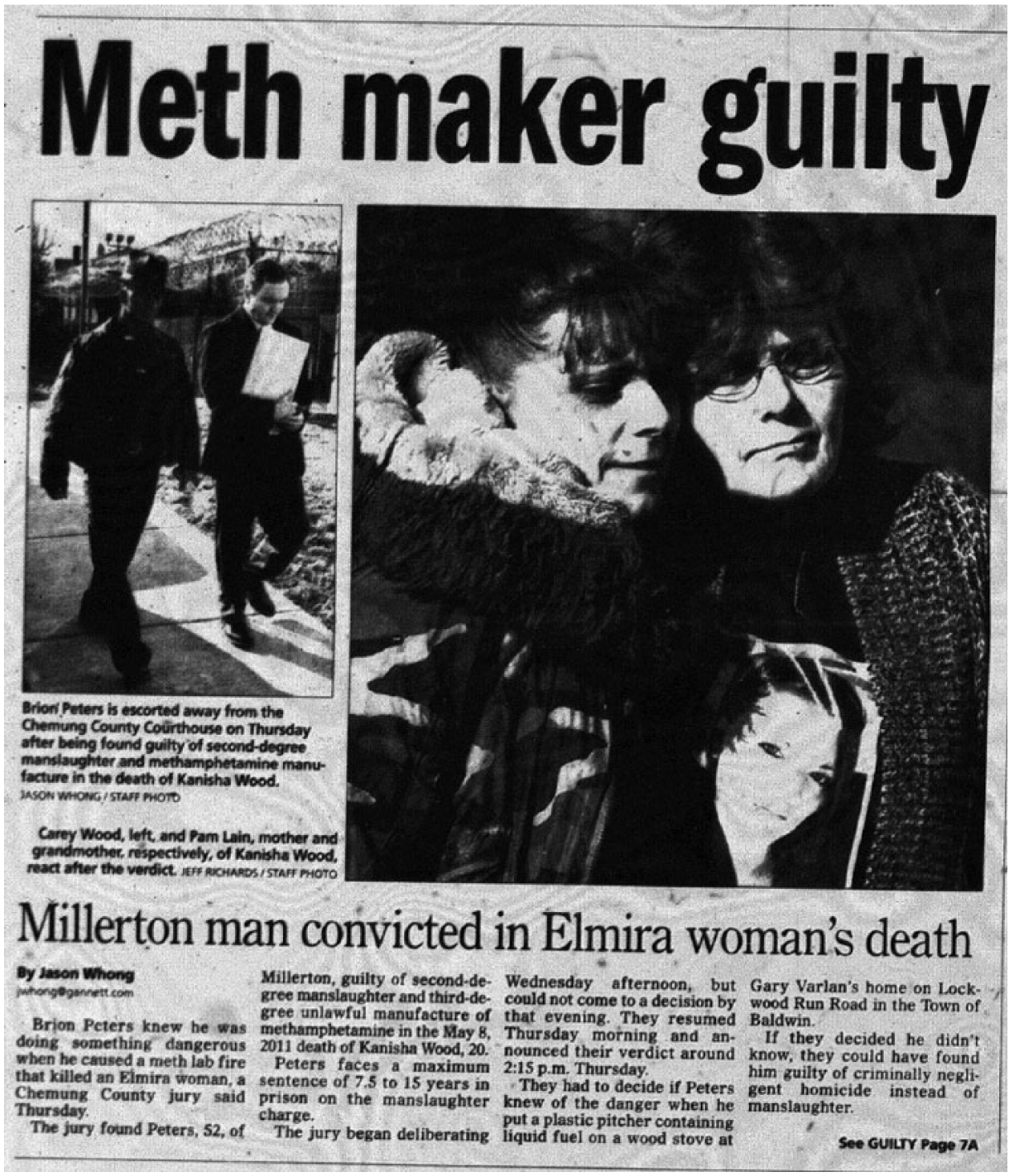
Elmira Star-Gazette (2012a) front page reporting on Brion Peters’ conviction.
The two photos also depict a process of motion. While Peters is moving toward a state of incarceration, Wood’s family is transitioning into a state of mourning. This sequence is often forecasted in statements made by family and friends of victims. For example, although victim impact statements offer a sense of compassion in the legal system, they tend to reproduce negative images of offenders (Bandes, 1996), while further situating prosecution as the primary vehicle for victim advocacy (Simon, 2007). In newspaper coverage, Peters’ apprehension is an important narrative point for the heroic display of police and prosecutorial power. It is through prosecution and imprisonment—rather than community engagement, resource investment, or restorative justice—that wounds are considered to heal. On this point, upon Peters’ sentencing Wood’s mother affectionately reported: “I know she’s up there looking down and I know she knows what’s been taking place, and I hope now she can rest in peace. We’re going to heal as a family” (Elmira Star-Gazette, 2012c: A1).
Resolution as law and order solution
Despite its seeming conclusion, the story of the Baldwin cabin explosion does not quite end there. Indeed, legal cases are often used to support legislative change after the trial has ended. Bereaved mothers, too, often become victim-heroes, championing for such legal change (Wright, 2016). As David Garland (2001) points out, victim discourse contains “a media preference to report personalised accounts of being let down by the system” (paraphrased by Wright, 2016: 6; Greer, 2007). Notably, the killing of law enforcement by alleged meth producers influenced much state and national legislation, as reviewed previously.
Two examples stand out in case reporting. The first is a rebuke of the plea bargaining system. Wood’s grandfather informed a reporter that he feels “stronger measures need to be in place to prevent similar tragedies:” “One man gets sent to jail for 15 years of his life and the other gets two to six because he turned state’s evidence,” Lain said. “The crime isn’t any different and everything is the same. Something needs to be done with the judicial system. If you’re making drugs, you’re making drugs. If people die, people die and something has to be done to stop this stuff from happening.” (Elmira Star-Gazette, 2012c: A1)
His indication seems to provide a further law and order solution, viewing the current system as lenient on crime. This reflects a “faulty system” frame where, as Theodore Sasson (1995: 14) states, “The only way to enhance public safety is to increase the swiftness, certainty and severity of punishment.” Notably, however, plea bargaining is instrumental in contributing to the harshness of criminal justice practices. They largely extend prosecutorial power and challenge rights of “due process” (Alexander, 2012; Kilgore, 2015). In this sense, it may not be surprising that plea bargaining in meth cases was not given more consideration by reporters or the public at large.
A second example appears in the article “Undisclosed hazards” (Elmira Star-Gazette, 2013). Published over a year after the conviction, the reporter used the case to cite problems of current homeowner laws where a homeowner is not required to inform a tenant that a property was a former meth lab. The article mentions the US Environmental Protection Agency as listing “53 chemicals associated with meth production,” warns of “resulting toxic byproducts,” and asserts that, after police leave a lab, “it is not clear what is left behind.” The reporter connects meth chemical dangers to the Baldwin case, citing “fuel solution in plastic pitchers” and “lithium out of batteries” as examples of the chemical dangers in production. The article supports proposed legislation by New York State Senator Timothy Kennedy that would mandate homeowners and renters to ensure sellers and landlords disclose the status of a property as a former meth lab. Currently the bill (S1823) is waiting committee approval. 8
The coverage also visually links the existence of widespread dangerous meth labs with “meth lab incidents.” The two pictures in Figures 2 and 3 are drawn from the first page of the article. The description of the Baldwin meth lab explosion is visualized in a picture of a meth lab clean-up team outfitted in hazard suits (Figure 2). This imagery, furthermore, is rendered a common occurrence with the adjacent “meth lab incident” table in Figure 3. Thus, through the juxtaposition of text, photo, and numerical table (Ayres and Jewkes, 2012; Jones and Wardle, 2010), the atypical case becomes the “typical.”
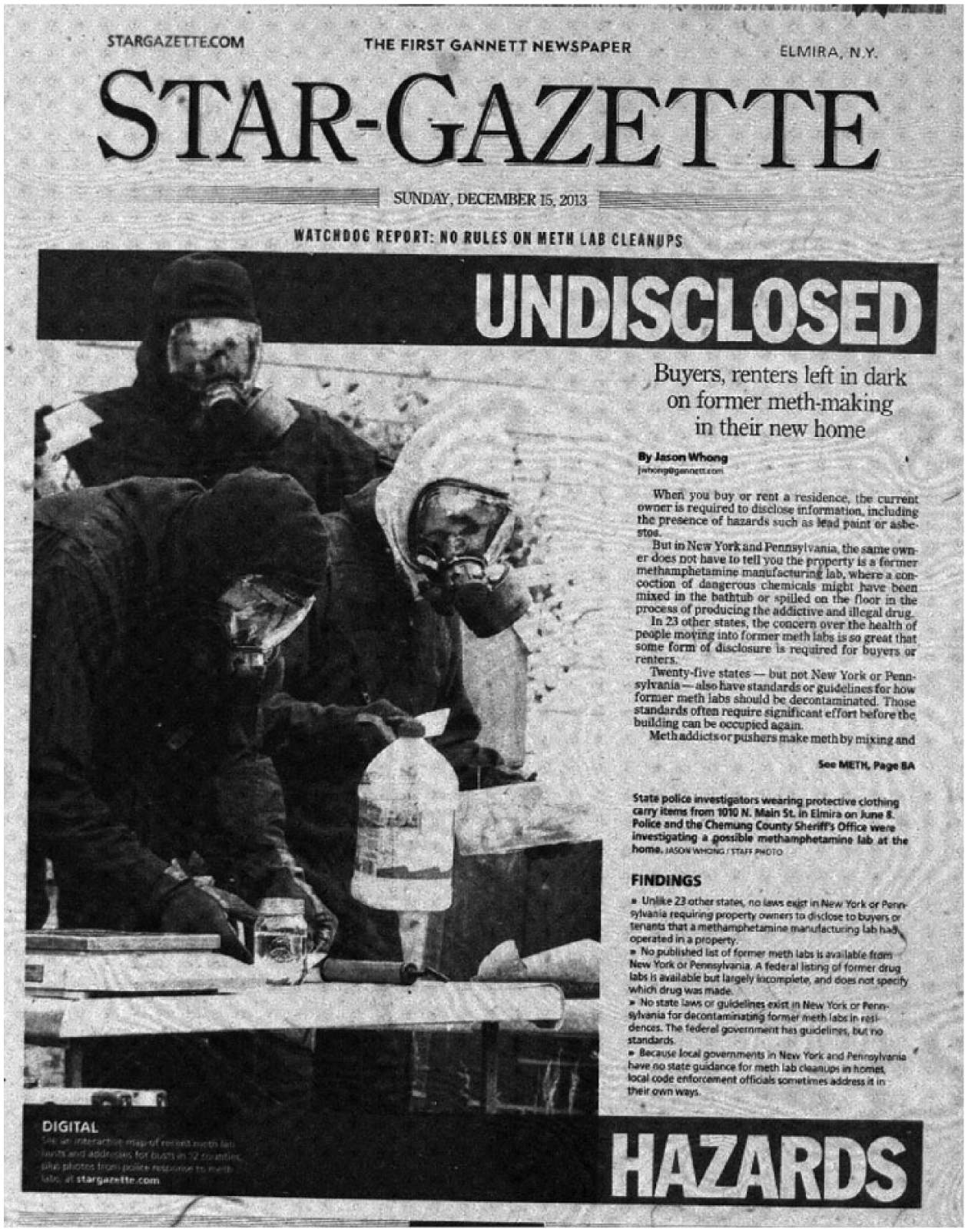
“Undisclosed hazards” article with a photograph capturing a meth lab clean-up crew outfitted in hazard suits.
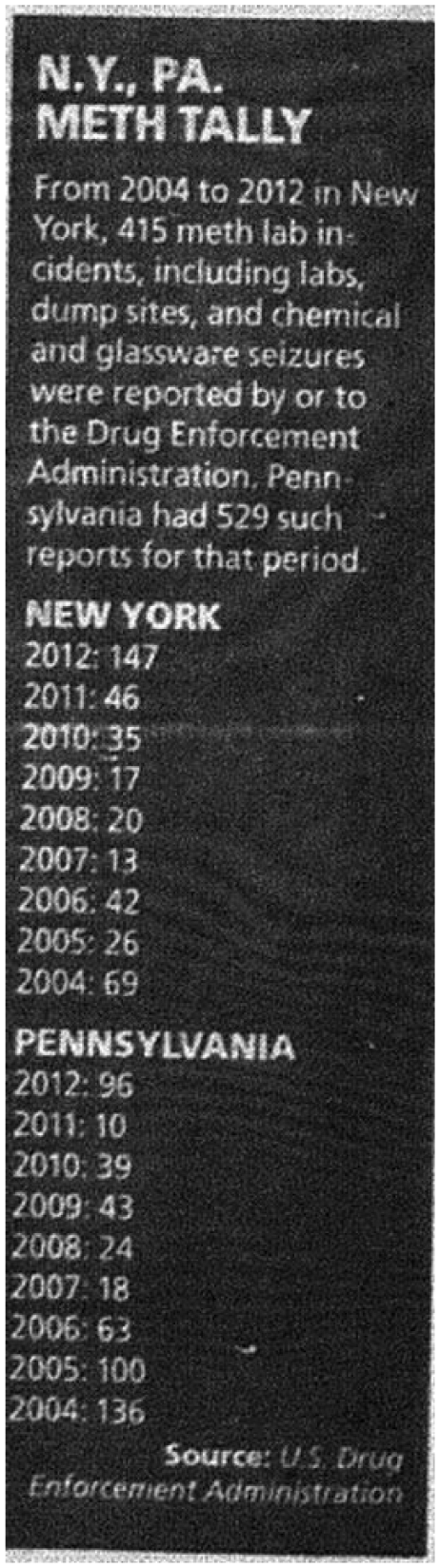
Numbers on reported “meth lab incidents” in New York and Pennsylvania in “Undisclosed hazards” article.
Significantly, these two examples are not linked to vast legislative change: the case did not bring about changes in plea bargaining, while the hazard bill is still in committee. This may be attributed to the staggering amount of meth legislation already passed, including 2005 anti-meth New York legislation signed by then-Governor George Pataki, and the Patriot Reauthorization Act signed by then-president George Bush (Revier et al., 2016; Stanley, 2006). In showing how engrained such legislation and the methamphetamine imaginary had been at the time of the case, the judge’s remark that “… once again, they will find out that somebody is going to prison for [making meth]” is revealing (Elmira Star-Gazette, 2012b: A1). It depicts an entrenched, causal link. It is a clear and natural response to the social problem: someone made meth, someone died, and now a meth maker is going to prison for it—once again.
Conclusion and implications
Is this the most productive way of framing meth as a social problem? It certainly is not the most imaginative. What are the consequences of such framing? What does the meth lab formula story, as a melodrama of perpetrators, victims, and heroes (Wright, 2015), leave out? In what ways does it omit new narrative endings or future possibilities?
I want to reflect a bit more on Peters’ “dark side.” It is Peters’ alleged “dark side,” his folk devil embodiment, that makes sense of his meth production, manslaughter, and subsequent incarceration. It is informative, moreover, to consider, through the methamphetamine imaginary, how his “dark side” may be projected onto the rural as a whole. Through the lens of the methamphetamine imaginary, as Linnemann (2016) contends, the rural is envisioned as a place of fear, risk, and degradation. It marks a shift from tranquil, idyllic rural life to one of insecurity. Through meth, the “dark side” of the rural is also rendered visible.
Although a symbolic rural, the basis of this imagery cannot be dismissed as merely irrational. As Jock Young (2011) points out, there is a “rational irrationality” to public concern over putative social threats, however “disproportionate” they may appear. We must look, then, at what the meth lab formula story leaves out: specifically, questions of rural structural change over the last few decades. Scholarship on this abounds, including studies on rural homelessness (Fitchen, 1992), unemployment (Sherman, 2014), a decline in family farming (Tunnell, 2006), corporate agro-dominance (Armstrong, 2007), and welfare reform (Pruitt, 2007). Certainly, upstate New York has experienced massive deindustrialization, manufacture outsourcing, job loss, jail expansion (Pragacz, 2016), and prison closure in dependent prison towns (Martin et al., 2016; see Martin and Price, 2016). Is it perhaps no surprise that an illicit production process may be a viable—and simultaneously fear-inducing—option, or that social control would tighten in a time of such economic and social insecurity?
People also get left out of the formula story. True, the formula story tells of “types of people” (Loseke, 2003): of villains (meth maker), victims (meth lab victim, community), and heroes (police, prosecutors). These are, however, caricatures—they sap the complexity out of human experience and social agency. Scholars have captured such complexity, for example, in interviews with women meth users on stigma management, negotiation, and resistance (Copes et al., 2014; McKenna, 2013) or on status hierarchies and conflict resolution in meth production processes (Jenkot, 2007). Furthermore, as meth is often associated with poor whites, this narrow framing does not consider the experiences of rural people of color. Speaking to the omission of this population, John Eason (2012: 274) extends the concept of the rural “hyperghetto” to capture “the confluences of race, punishment, and rural disadvantage in the U.S. prison building boom.” 9
Without such consideration of structure and social agency, the meth lab formula story remains entrenched and deterministic: another meth lab blew up, somebody died, and somebody went to prison. The only solution is more policing, more surveillance, more control. When thinking of this case, I am reminded of crime television programming: individual perpetrators are casted as evil and uncaring villains, creating an “us versus them” dichotomy; innocent victims serve as tools for forging public empathy (Peelo, 2006); and resolution is permitted through punitive approaches meant to protect an ever-at-risk public (Fishman and Cavender, 1998). Like crime drama, the consuming public is meant to side with law enforcement, while a law and order model is legitimized—it is an effective melodrama (Wright, 2015) that powerfully serves meth social problem work (Loseke, 2003).
This, however, comes at a cost. As Joel Best (2001: 39) aptly states, “Using the worst case to characterize a social problem encourages us to view that case as typical and to think about the problem in extreme terms,” thus distorting “our understanding of the problem.” Ultimately, the meth lab formula story casts meth-related problems in extreme terms by portraying images of meth, risk, violence, and rural insecurity. Such drug panic ideology “mobilizes demands for immediate repression,” while ignoring root issues linked to rural poverty and global capital inequality, crisis, and insecurity (Chiricos, 1996: 44). Moving from an individual-oriented to a structural-oriented (and social agent-oriented) style of framing (Beckett and Sasson, 2003) would provide a foundation for potentially effective solutions, research approaches, and community empowerment. Such framing may be key in preventing tragedies such as the one studied here from occurring, in turn marking a transition from the prevailing drug imaginary to an imagining of future solutions and possibilities.
Footnotes
Acknowledgements
I would like to thank Andrew J. Pragacz and Rachelle Jereza for their insight and ongoing input on this project. Joshua Price and William G. Martin deserve thanks for their scholarly and activist work in upstate New York, which culminated in collaborative, critical scholarship that proved foundational for this research. Travis Linnemann deserves special thanks for providing essential feedback on an earlier draft. Finally, I would like to thank anonymous reviewers for their constructive comments.
Declaration of conflicting interests
The author(s) declared no potential conflicts of interest with respect to the research, authorship, and/or publication of this article.
Funding
The author(s) received no financial support for the research, authorship, and/or publication of this article.