




Abstract
On February 26, 1988, rookie New York City police officer Edward Byrne was shot dead while guarding a material witness in a drug trafficking case in South Jamaica, Queens. This article considers how state narratives and visual rhetoric emerging from Byrne’s murder emboldened the police power and a revanchist campaign aimed at “taking back the streets” secreted under the war on drugs. As such, this case powerfully illustrates a disparate politics of death and the ways that the state enlists thanatopolitical power in order to reaffirm and reproduce its sovereign authority. Such a reproduction or reanimation of power registers as the state’s ability to unleash violence unequivocally and unequally upon poor and marginalized communities, as later demonstrated by the legal and proper police murder of Sean Bell, a resident of South Jamaica, Queens killed by NYPD agents in 2006.
I kill therefore I am. (Phil Ochs, 1969)
“It all started with Eddie,” reminisced New York City detective Richie Sica, “the Police Department’s victory in winning back New York from drug dealers is his legacy” (McAlary, 1998). Like so many of his contemporaries, Sica, who was one of the first NYPD officers to arrive on the murder scene, would indeed live and breathe Byrne’s death for the rest of his career. Edward Byrne was a 22-year-old rookie cop assigned to the 103rd precinct in South Jamaica, Queens, which at the time was a predominantly African American community in New York City. Growing up, the blue-eyed, mustachioed Irish kid—who at the time of his death was still living with his parents in Long Island—had wanted to follow in his father’s footsteps and become a cop. And on the day of his death, as described by local newspapers, he was in fact “just starting life” (Gannon, 2015).
On the morning of February 26, 1988, Byrne was sitting in his patrol car guarding a witness and informer to a drug case at the corner of Inwood Street and 107th Avenue, an area the New York Post later described as “battle-scarred” and nicknamed “Crack Alley” (Connor, 1999). As Phillip Copeland and Scott Cobb acted as lookouts, two other members of a local drug dealing outfit, Todd Scott and David McClary, approached his cruiser and fired five rounds, killing Byrne instantly. The subsequent trial would show that the four acted on the behest of the recently jailed drug kingpin Howard (Pappy) Mason, who, from a jailhouse telephone, ordered “a hit on any cop for $8,000 in retaliation for his arrest”—Byrne was their choice (Editorials, 2016).
A full minute passed before sirens announced to the streets of New York City that a “brazen assassination,” as Time magazine described it, had just gone down (Magnuson, 1988). Within hours, lurid images of Byrne’s patrol car—with windows blown out and a blood-covered interior (see Figure 1)—would reach beyond the boroughs of New York, the particular way in which the murder occurred grabbing the attention of the nation. In countless television and news reports, the gory scene shown alongside a picture of the rookie officer dramatically punctuated the attack. Yet this was always more than the reporting of one cop’s murder—these were images of a “cold-blooded” assassination, a declaration of war, and, according to then-New York City police commissioner Benjamin Ward, “an attempt to intimidate not just the witness, but all who cooperate with the police in battling drugs” (Lyall, 1988a). The narratives following Byrne’s death took aim at the increasing scourge of drugs and the webs of criminality it spun. In many ways, Byrne is iconic to the current state of US policing, as his death has been directly linked to the intensification of the drug war (Benavie, 2016), and the so-called “militarization” of police (Balko, 2013). Vincent Henry (2004: 247) goes as far as to describe Byrne’s death as one that “ultimately became emblematic of a new and especially pernicious form of evil.” Yet, the cultural and political import of Byrne’s death is not confined to regional police practice, or the silos of academic journals and books. Both local and national newspapers, and popular culture more broadly, continue to mark Byrne’s death and its importance to the unfolding war on drugs and violence. As the memoirs of several former NYPD officers further document, Byrne’s death was indeed a key moment for policing in the city (see Conlon, 2012; Pegues, 2016). Journalist Ethan Brown has found Byrne’s death to be an important narrative for hip hop in South Jamaica during the 1990s (Brown, 2005), and for the rise of the drug war “snitch” (informant) (Brown, 2007). Likewise, Mike McAlary’s (1992) account of Byrne’s death, Cop Shot, is a highly regarded contribution to the true crime genre, detailing the murder, the hunt for Byrne’s killers, and the impact of drugs on America’s urban streets. Perhaps most notably, the Edward Byrne Memorial Justice Assistance Block Grant (JAG) has, for decades, served as the conduit for billions of dollars in funding to state and local police and criminal justice agencies.
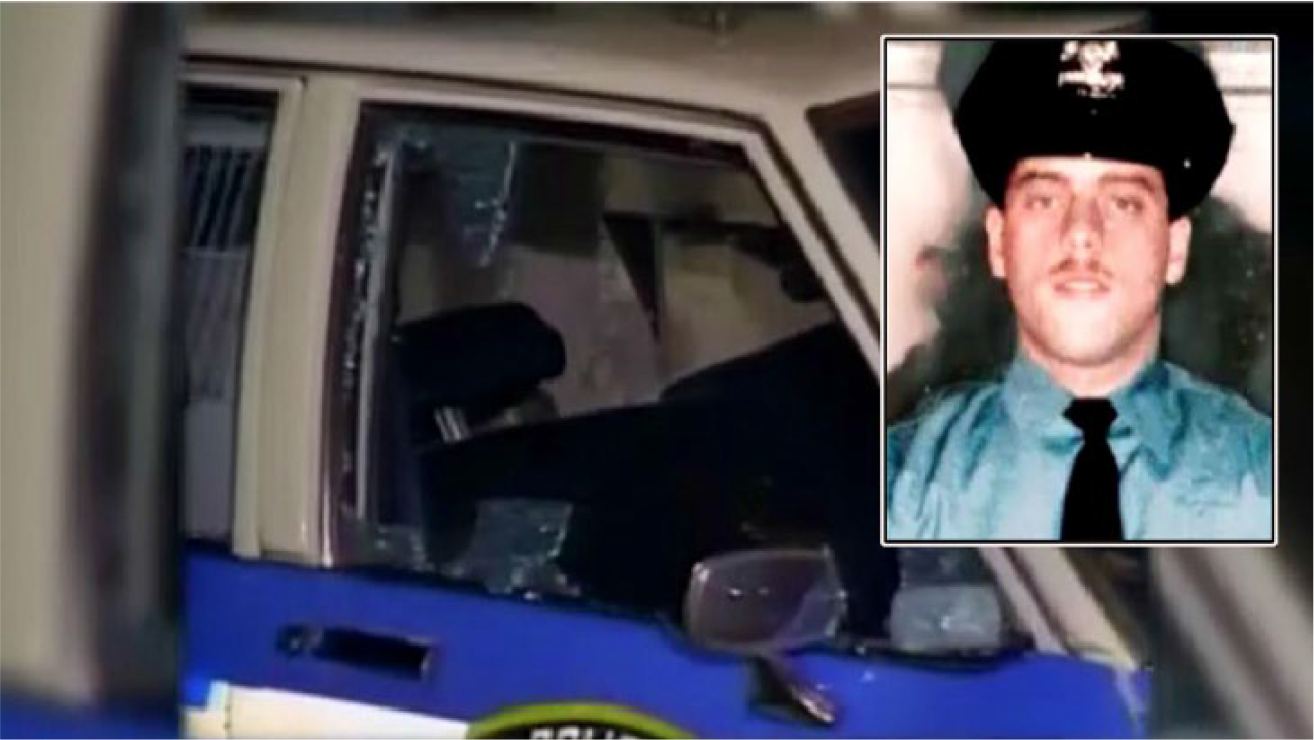
A widely used image of Byrne and patrol car.
While Byrne was not the only NYPD officer killed that year, the details of his death, aided by its timing and expedient politicization, ensured that the promises made over his dead body would be kept: Edward Byrne would not be forgotten. Indeed, 10 years later Tracy Connor (1999: 5) of the New York Post had not forgotten “the five bullets that drug-gang henchmen pumped into Officer Edward Byrne’s skull … shatter[ing] a city already in the midst of a vicious drug war.” A full 20 years on, the New York Daily News again recognized that while “people had been dying for years,” Byrne’s death made “the country aware of what was going on with crack and narcotics” (Marzulli and Gendar, 2008). As such we might understand the murder of Edward Byrne as an event in the philosophical sense. As described by Slavoj Žižek, an event is “something that occurs within the world, but is a change of the very frame through which we perceive the world and engage in it” (Žižek, 2014: 12). Of course, I do not suggest that Byrne’s murder was the first police death to be politicized in a significant manner, but rather that it was a turning point within the specific context of New York City’s history, specifically as it relates to the shocks of crisis instigated by the imposition of a new neoliberal economic regime and a decidedly revanchist war on drugs. Likewise, we might envision Byrne’s murder as a significant casualty of the so-called “War on Cops,” which conservative commentators like Heather Mac Donald (2016) have insisted has been waged by a lawless public for some 30 years. Important in such narratives is how the killing of a police officer reflects a larger ontological ghost not typically reflected in the loss of life. The death of police, this “War on Cops,” reflects the interconnected visualization of police with order, of police with civilization, of police and the state. An officer’s corpse offers evidence of the vulnerability of our social body, an inducement of terror over the precariousness of our civilized existence (Žižek, 1993). This “War”, then, becomes one against us all.
Before we press forward, it is important to acknowledge that Edward Byrne’s death is tragic, as any life lost is. That said, this project is critical of and attempts to theorize the state narratives and visual rhetoric surrounding Byrne’s death in order to demonstrate how they contributed to subsequent strategies and policies that have revitalized the state’s policing project. The narrative function constructs both violence in general and violence directed at the police within a very limited range of positions, generating standardized scripts for persons and officials, and ultimately making it difficult to advance counternarratives of state and police violence. Rhetorically, the meaningful, consequential, and legible images circulated around this lone officer’s death offer a far more powerful and visceral profundity to this event, functioning to evoke and intensify emotions and responses to the state’s narrative (see Dickinson et al., 2010).
This case also usefully highlights the unequal representations of death and powerfully details how a police death is a political act which offers the state a mechanism to (re)emphasize and (re)imagine its own power. In other words, Byrne’s murder offers a glimpse of the ways in which the state uses this killing in order to reanimate itself. Therefore, we begin with the rather obvious point that death is far from simply the endpoint in a biological process. Rather, it is an instrument of power, a mechanism for defining the boundaries of citizenship and liberal capitalist subjectivities, which gives death the ability to take life. As such, the murder of Edward Byrne usefully reveals the state’s thanatopolitics and the various ways in which the politics of death intersect with and are enlisted by the police power (Murray, 2006). Thanatopolitics is not simply a restatement of the Foucauldian formula of biopolitics, but rather finds the project of “making life live” to be a “lethal business” (Dillon, 2015: 150). Thanatopolitics offers a look at death beyond the end of biological life, forewarning a project where death only marks the start of an engagement with its varying forms. It is a framework of seeing the ability to make death possible through the promotion of life, or by making some lives relevant and necessary, thereby making others irrelevant and unnecessary—a death that serves as origin point for other lives. Here, death takes on a life of its own. In the context of early 1990s New York City and the burgeoning war on drugs, Byrne’s death is the revanchist catalyst par excellence (Smith, 1998), remembered by some as the event that “led officers to reclaim the city” (Stelloh, 2013). Emboldened claims to “tack back the city” were then put to work through what sociologist Harry Levine describes as “the long-term growth and institutionalization of the drug war” (as quoted in Blow, 2014). Therefore, I understand the drug war and the police power more broadly as thanatopolitical projects which, at their core, mark certain—mostly black and brown—bodies and lives for incarceration and death.
While this case provides insight into how the state enlists death in its symbolic form, it is also important to note that the symbolic is in turn reified in the concrete practices and techniques of power. It is through these ritualized practices of an officer’s death that the state is reproduced, reanimated, and reborn. This symbolic rebirth is the reification of sovereign power and its symbolic dislocation from the police power, while ideologically connecting the life (and death) of the police officer to the state’s well-being. It is here, in a fabricated state of what Tyler Wall has described as an “ordinary emergency,” that the state says to its subjects “we all need the police” (see Wall, 2016a). Lastly, through a critical understanding of the thanatopolitical, subsequent events like the murder of Sean Bell in 2006 by the NYPD just blocks from Byrne’s memorial become part of a broader project which is no less than an ongoing war for civilization (Wall, 2016a). Therefore, the question that must initiate this process, then, is this: How does the murder of one of the state’s own engage the state’s thanatopolitics, ratify its power over the affairs of the dead and the living, and thereby mark the boundaries between the living and those marked as always already dead?
Edward Byrne and the politics of grief and enmity
As retired NYPD Lieutenant Phillip Panzarella reflected, “Byrne’s death couldn’t be compared with other cop homicides”—this was “an out-an-out assassination” (Goff, 2014). Addressing the media immediately following Byrne’s funeral, Mayor Ed Koch elevated the rookie officer to martyrdom with comparisons to the likes of Martin Luther King Jr and John F Kennedy, insisting that:
If drug traffickers have become so emboldened that they can engage in the assassination of a young police officer, then our whole society is at risk and we will have anarchy … That is why his death rivals the others. Not because he is Edward Byrne, but because of what it means to have this police officer assassinated. (Young and Hartocollis, 1988)
What is clear is that Byrne’s murder operated in a “solitary, chilling niche” for a city in the midst of economic and political calamity (Dwyer, 1999). During a time where crime, particularly illegal drugs, was seemingly overwhelming cities and leaking into suburbs across the US, one New York City prosecutor remembered Byrne’s death as the event that tore away the “fabric of our society” (Connor, 1999). Echoing Mayor Koch, Justice Thomas Demakos, who presided over the trial of Byrne’s killers, declared the act an attack “against the very foundations of our society” (Fried, 1989). An attack on police, the very power tasked with bringing civilization into existence, its “civilizing project par excellence” (Wall, 2016a: 868), clearly marks a strike at society’s foundations: bourgeoisie order (Neocleous, 2000).
From being a central piece of campaign strategy for city and national politics, to offering news media outlets a chance to capitalize on the theatre of fear, and focusing the NYPD’s sights on expanding both their symbolic and literal power, while disavowing the very real threats of drugs to residents of communities like South Jamaica, Queens, Byrne’s death coalesced into a state narrative that functioned to detach the police power from the state. Mayor Koch, presidential candidate George Bush Sr, and President Ronald Reagan headlined the collection of politicians engaged in moralizing contests of grief for the dead officer and the state of the country. Koch, for instance, authorized the use of US$12,900 from his re-election committee to take out an ad in the New York Times, intent on reminding the nation that the violence that killed Byrne was not “simply New York’s problem” (Marriot, 1988). President Reagan called the Byrnes directly to offer his condolences and to promise the grieving parents that something would be done. At his first campaign appearance (see Figure 2), surrounded by NYPD personnel, George HW Bush accepted Edward Byrne’s badge from the dead officer’s parents as a talisman of police endorsement and an addition to his burgeoning “tough on crime” credentials (Rosenthal, 1988). Calling out his campaign opponent Michael Dukakis, Bush carried the shield as a “symbol” of his law and order bona fides, his “promise” to make America’s streets safe again (Ritchie, 1989), and “a reminder of all the brave police officers who put their lives on the line for us every single day” (Bush, 1989). At a ceremony honoring line-of-duty deaths at NYPD headquarters, former prosecutor and first time mayoral candidate Rudolph Giuliani promised Byrne’s father that he too would not forget Eddie (Glaberson, 1989).
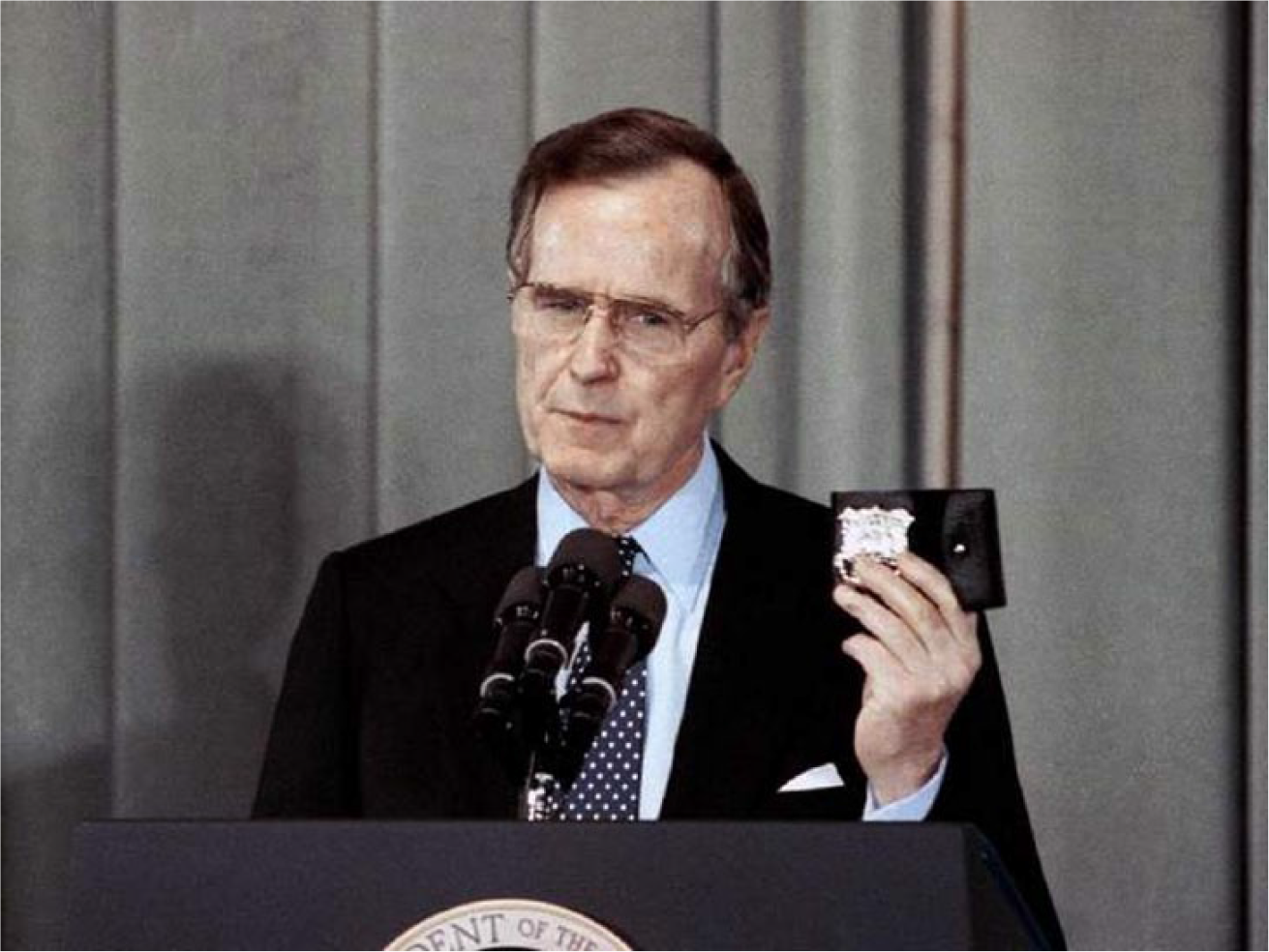
Presidential candidate George HW Bush holding up officer Edward Byrne’s badge on the campaign trail, 1988.
Edward Byrne was laid to rest in Farmingdale, Long Island on February 29, 1988 (Lyall, 1988b). Captured by local news channels, a sea of officers six deep and stretching for over eight city-blocks gathered to say their final goodbyes to their fallen brother (Magnuson, 2001). Sarah Lyall of the New York Times pointed to the parade of approximately 10,000 officers from around the country as a sign of their resolve, “an action which will convey how seriously [the police] take this” (Lyall, 1988b). Far from solemn defeat, the mood of those in attendance was one of righteous indignation—“we can’t let it happen again,” said Officer Pete McGinnis, while another captured the growing revanchist vitriol gripping the city and nation: “we’ve always been angry, and this has helped bring it out in the open … This provides us with the moment to do something dramatic to reverse the disease” (Lyall, 1988b). This death, as Lyall (1988b) remarked, “made the police determined to fight back against those responsible—not just the person who pulled the trigger, but everyone who traffics in drugs.” The funeral and its massive turnout was not just about Byrne, then; rather, it was a rallying cry, a show of force, and, as one officer recalled 20 years later, “a wakeup call” (Marzulli and Gendar, 2008).
As John Crank (2014) notes, the ritualism of the police funeral links the somber theology of death to the political force of the police, marshaling a politics above and beyond the funerals of “ordinary” citizens. In such rituals, the politics of enmity (Mbembe, 2016) come into full view, adversaries are named and profaned, and the ceremonial display of flags and uniforms—and, in the case of Byrne, the slain officer’s clothing—become powerful statements of the righteousness of police work helping reanimate fraternal solidarity. As Catherine Bell (1980: 195) suggests, a display such as this does not “disguise the exercise of power, nor does it refer, express, or symbolize anything outside itself.” The police funeral, then, is frankly a bare demonstration of thanatopolitical power, with symbolic gestures, news coverage, and stark iconography powerfully demonstrating the ways in which the slain might live on in vengeful spirit.
The political theatre ushered in by Byrne’s death was not limited to those holding or hoping to hold office. An onslaught of reportage and footage of the grieving family helped to reach into the homes of dislocated spectators to make the death of a New York City cop a national affair. These theatrics are underlined by a comment made by former NYPD officer turned author Mike McAlary (1992: 3), who noted that before his murder Edward Byrne was just “an anonymous cop in a city of 27,000 blue uniforms,” but dead “he would belong to the nation.” Rhetoric such as this implored liberal subjects to share in the family’s grief and reminded them that the officer who died “keeping us safe” did indeed “belong to the nation.” The affective politics ginned up by the news media and expedient politicians quickly coalesced as a means of legitimate interaction. To be part of this community—patriotic, law abiding, righteous—one need only show outrage, or somber respect to the fallen officer and his family and to all police officers, in fact. Of course, we see the symbolic politics of police deaths continue today in the blue striped black flag, various “Back the Blue” campaigns, and the rhetoric of public figures such as David Clarke who asserted to attendees of the 2016 Republican National Convention that “Blue Lives Matter in America!” This is not to suggest that police officer deaths simply produce a mass of viewers turned mourners. Rather, spectators immersed in politically marshaled terror and grief were asked to empathize with Byrne’s family and to imagine if they had lost a son. In doing so, the Byrne family becomes a public site of mourning, as it is not only the gendered object of the police that is threatened, but also what Dubber (2005) understands as still being attached to the police: patriarchal order.” This codes the offense as a vulgar act against “our” moral sensibilities. In other words, the parent here is not simply Matthew or Ann Byrne but the state itself. Thus, it makes sense that “these streets” need to be reclaimed, as it is the police power that makes possible the state’s ability to get its house back in order. Byrne’s murder, then, emphasized a form of social solidarity taken up by each individual’s own seeming connection to the family.
Here we can see how the thanatopolitical interpellates liberal subjects through the public practice of mourning—whether expressed as part of a ceremony, or individual politics that speak to “what must be done” to stem the rising tide of violence and insecurity. As Uli Linke (2006) suggests, what results from visceral contact zones such as this is a process of enclosure—a means of de-politicizing any following acts of violence by politicizing the corpse. In other words, the collective grief invoked by the murder of a state agent de-politicizes the state’s subsequent acts. Likewise, lost in the grief and terror invoked by this brazen assault on the state and social order was any consideration of the predicament of the Jamaica, Queens community, the rising war on drugs, and the economic conditions in which drug markets prosper. Also lost in the rush of political condemnation and collective mourning was any consideration of the always already racialized strategies that put Byrne on that street corner to begin with and of the police power more broadly. Drawing on Althusser’s (2014) understanding of hailing, Žižek (2009) notes how an event such as this addresses the subject, who was always already a subject of liberal ideology. Through this distinct event and collective affect, liberal subjectivity is reaffirmed through an allegiance to the state and its police and opposition to crime and disorder.
If a police officer’s life could be taken so easily and ruthlessly, then, as Byrne’s father Matthew made clear, “none of us are safe” (Barron, 1988). As such, the state narratives and visual rhetoric effectively conflate “physical space” with the “psychic safety” of the community, making a discrete threat a collective condition (Smith, 1998: 3). Beyond the “ordinary emergency” which authorizes routine police practice (Wall, 2016b), this cop’s death confirmed to a fearful public that there exists an “especially pernicious form of evil” (Henry, 2004: 245), one civilized society knew existed, just not here—until now. In describing the streets of New York City as “lawless as the streets of Beirut or Bogota”, Byrne’s father suggested that the only way to grasp the dismal reality of the US was by invoking the spectre of violence and disorder in the Middle East and the Global South. Of course, representations of Byrne’s killers were drawn from the vast historical basin of racialized animus, fear, and terror (Singh, 2014). The racialized dimension was made clearer, as the police is always coded as whiteness, protectors of a liberal social order always already coded in similar terms. Dubbed “monsters” by New York Deputy Commissioner John Miller and described as “mutts” by Mr Byrne himself, such descriptions made clear that the men accused of “tearing the fabric of society” were not quite human, their behavior not quite explainable, and thus that they were not quite “fit to live in our society” (Connor, 1999). Rumors of the killers’ laughter (Howard, 2012) and lack of remorse at the trial bolstered this narrative. Indeed, the killers’ mug shots (see Figure 3), positioned in stark contrast to that of Byrne, helped reiterate to a reeling public a racialized enemy suitable for incarceration and death—an enemy capable of true evil.

Images of the four accused, and Kingpin “Pappy” Mason who put the hit out on a police officer, highlighted by the life they took.
A city and nation “sick of murderous, vicious” drug dealers controlling their streets (Marzulli and Gendar, 2008) looked to the police to take them back. Reiterating the belief that the “pendulum had swung too far,” Koch, speaking at a ceremony honoring Byrne and four other officers who had died in 1988, promised to push forward increased economic and political support for the NYPD’s expanding presence throughout the city (Dunlap, 1989). To come was no less than what one retired NYPD described as a “frontal assault” (Samaha, 2014). Harnessing these vengeful politics and cheered on by a fearful city, the NYPD would transfer the fears of a city into a set of policies to take back the streets. Punctuating his concern, Koch underlined that in “a war for national survival,” Byrne was “our martyr” (Magnuson, 2001). Made by such unruly subjects, this “declaration of war” reaffirmed the place of the police as the thin blue line between order and chaos (Connor, 1999). As Mark Neocleous (2014) has argued, such a “war” is not figurative but literal, animated by the inseparable powers of police and war, making visible the “criminal” or “universal adversary” aligned against the police and liberal capitalist social order (Neocleous, 2016). In other words, an event such as this offers a means of organizing and making legible threats to social order. Here, with the death of a rookie cop, bracketed by political gamesmanship and political theatre, the drug war becomes a real war. For the radical geographer Neil Smith (1996: 277), the city’s revanchist cry “might well be: ‘who lost the city? And on whom is revenge to be exacted?’” Heartened by a parade of 10,000 vengeful police officers, the aftermath of Byrne’s death must be read along these lines. If the death of this officer materialized metaphorical harm to the social body, the funeral made real the visual transfer of trust and power from politicians to the police in reclaiming the city; and the “revengefulness and reactionary viciousness” classifying New York City during this tumultuous time was justified through the depoliticization of taking back the streets (Smith, 1996: xviii). It is no surprise, then, that the New York Times, when looking back, sees Byrne’s death as “the catalyst” to the city becoming safe (Hauser, 2008). It is also no shock that when Police Commissioner Bill Bratton addressed the crowd at Byrne’s 2016 memorial, he reiterated that “his life, his sacrifice, began a change in this city … it awakened this city” (Ortiz, 2016). Coinciding precisely with a broader move toward gentrification citywide, Byrne’s death served as the catalyst for police “determined to fight back against those responsible—not just the person who pulled the trigger, but everyone who traffics in drugs” (Lyall, 1988b), while neoliberal capital developments were neatly secreted under a new revanchist push in the war on drugs. Structurally, then, this was not just about four black “monsters” who killed a cop, or even about a city “reversing the disease” of drugs and crime (Lyall, 1988b). If there indeed was a moral obligation to “take back [the] city, corner by corner, door by door, street by street” (Stelloh, 2013), it was more aptly a move to “take” the city and its most profitable real estate from the poor and disenfranchised that called it home (Smith, 1996); the racialized construction of enemies making it possible, even necessary, to do so.
More materially, by the end of 1988, a democratically controlled Congress passed the Anti-Drug Abuse Act of 1988, a centerpiece to their legislation being the notorious mandatory minimum sentencing structure imposed for crack cocaine. The death penalty was also extended to drug traffickers and, with a special provision “to anyone who intentionally kills any law enforcement officer while committing a Federal drug felony,” was undoubtedly influenced by Byrne’s case (Brown, 2007). At the signing of this landmark legislation, President Reagan, standing side-by-side with Byrne’s parents, remarked:
With us today are Matthew and Ann Byrne, who join us as we give their son’s comrades the valuable tools they need to carry forth the fight for which young Eddie so valiantly gave his life … We salute Eddie Byrne. We salute his family for their determination that his death will not have been in vain. (Reagan, 1988)
Not long after the 1988 Act, legislators began work on what would become an equally monumental piece of legislation—the Crime Control Act of 1990—which authorized roughly US$900 million dollars for the newly renamed Edward Byrne Memorial Justice Assistance Grant (Byrne JAG). From its inception, the Byrne JAG program prioritized funding to programs focused on violent and drug-related crime and those programs that helped to establish multijurisdictional and multi-state “task forces” that would support national drug-control initiatives.
Locally, Koch kept some of the promises he had made in the midst of the Byrne affair, helping then-NYPD commissioner Benjamin Ward, New York City’s first black Police Commissioner, establish aggressive Tactical Narcotics Teams (TNT) (James, 1988a). TNT programs represented a clear paradigm shift in the city’s anti-drug efforts and toward order maintenance policing more generally. The TNT program, which at the time was the largest of its kind ever established, was also a move which epitomized a growing call to “let cops be cops” (Hamil, 2014). Committing more than US$116 million to the program in 1989 alone, this provided, as Commissioner Ward bragged, “more resources to the war on drugs than any other municipality in the country” (Marriot, 1989), and as researcher Michael Letwin observed, “a drug war army second only to the … Drug Enforcement Agency” (Letwin, 1990: 802).
Advancing the innocuous mission “to eliminate quality of life conditions in the target area that foster drug trafficking and use” (Letwin, 1990: 7), TNT made an undeniable symbolic gesture, launching its inaugural operation in the same South Jamaica, Queens where Edward Byrne had died. Armed with battering rams and military tactics and equipment, TNT units set off to eradicate the spread of crack, focusing primarily on low-level street dealers, not unlike those charged with murdering Byrne. True to their promise to “take back the city,” teams of investigators and undercover officers moved from neighborhood to neighborhood conducting buy-and-bust operations, overwhelming poor and working class, predominantly African American and Latino neighborhoods (Letwin, 1990). Further emboldening the revanchist campaign, the city paired building inspectors with TNT who were authorized to confiscate property from landlords who “allowed” drug trafficking on their properties. These teams returned to certain neighborhoods for what they called “maintenance” days, bolstering the narrative that it was the police power that would eradicate drugs and violence and bring order to the city (Frankel and Freeland, 1990). Of course, what received less media coverage and public scrutiny than their publicized drug war victories was that “drugs and crime” were used as tactics to evict residents from their homes, thereby freeing up some properties for development.
Ultimately, for the mayor, police officials, and some members of the media, the success of the TNT program was proven by a marked increase in arrests and the development of specialized drugs courts designed to process the byproducts of the new brand of street-level drug policing. Just a cursory glance at arrest statistics from this period demonstrates the magnitude, if not the vengefulness, of the campaign. In the first 11 months of 1988, citywide felony drug arrests made up 90,000 of 279,000 arrests in the city, a rate “more than twice that of five years before” (Letwin, 1990: 9). Accordingly, drug prosecutions soared, with drug felony filings increasing 288% between 1985 and 1989 (Wachtler, 1989). Further upstream, state prison sentences for felony drug convictions climbed 16.9% in 1988, and by 1990 more than 30% of state prison inmates (9719) were doing time for drug crimes, an increase of over 300% (Letwin, 1990). By April 1, 1990, roughly 5400 people had entered state prison as a direct result of TNT operations (Letwin, 1990). As the campaign continued, and TNT rounded up more and more drug users and dealers, seized countless “crack houses,” and shuttered public housing units, city administrators hailed TNT as central to improved “quality of life” and restored social order (Ward and Harding, 1988). By and large, the aggressive zero-tolerance, “order maintenance” tactics like TNT, which were unleashed on the most marginalized residents and neighborhoods of New York City for the better part of two decades, continue today—justified by an illusory politics of security (via the police power) which purport to make the city “safe.” While homicide afflicting marginalized communities today is less than one quarter of what it was in 1988, the illusory politics of security here is intended to suggest the illusory politics of security as police power. 1988 was not the first year of violence due to illegal drug markets in South Jamaica, nor was this the first time communities like South Jamaica, Queens looked toward the state for help in solving this problem. Yet, the seeming safety of the community was only ever threatened after Byrne was killed. Although the connection between police tactics and these changes is contentious and complex, the narrative remains centered on police power, a liberal figment designed to reaffirm the state’s power over life and death.
While proponents of such strategies would characterize New York City’s rise from crime-ridden to the “city that became safe” (Zimring, 2011) through policing’s “greatest comeback” (Mastrosimone, 2013), those on the business end of the police power no doubt recall this history differently. Policing’s “great comeback” would of course coincide with one of the most violent periods in South Jamaica and the city’s history, one which would see champions and detractors alike openly decry the NYPD as “the biggest gang in New York” (Brown, 2005). What you “got after the killing of Edward Byrne,” writes Ethan Brown (2005), was “trouble” which appeared not only as increased police presence, but even more subtly, as a shift away from drug treatment for children, home-care services for those with AIDS, child care, job training, libraries, schools, parks and recreation, and care for the homeless (Preston, 1989). 1 A number of closed homeless shelters would, instead, serve to house the expanding incarcerated population (Preston, 1989). With the shift of such care—from safety to security—this project of reanimation, that is, the shift from state welfarism to neoliberalism, becomes realized through Byrne’s afterlife.
Revenge, thanatopolitics, and the killing of Sean Bell
While I have framed Byrne’s killing as a catalyst for important developments in New York’s history, it is also important to attempt to understand how such events may resonate in a historical future. That is, in politicizing Byrne’s death, the state in effect refuses to allow its subjects to forget the event, even when imagining an unfolding future. Here, death is not “the end,” but a renewable source of resources and opportunities to put Byrne’s death to work—his afterlife. Not unlike commands to “never forget” the tragedies of September 11, 2001, the unshakable specter of street-level violence characterized by Byrne’s death restates the mantra of sovereign power—no one is ever safe, anywhere. Held in the psyche as such, Byrne’s death can never be forgotten as long as violence, drugs, and crimes against police are a problem for this nation. Such a politics of grief echoes into the future with the federal grant program that bears his name. Indeed, even if many are unaware of who Edward Byrne was, myriad police projects—from juvenile delinquency and emergency service aid, to high-tech weaponry and funding for more officers and multijurisdictional SWAT training—and hence the police power, carry his name forward into the future. Today the spectral power of Edward Byrne can be directly observed on the block of 91st Avenue between 168th and 169th Street in South Jamaica, Queens, the home of the 103rd precinct. Although some in the local community initially objected to renaming the street, Byrne’s former colleagues took it upon themselves to impose his memory by hanging homemade street signs with his name on 91st Avenue, ignoring both the law and the wishes of some residents—making clear, “whose streets, their streets.” Mayor Koch supported the memorialization efforts, vowing to rename the street with or without community approval, arguing that “not honoring him in this small way” was in itself a smear on Byrne’s memory (Bohlen, 1989). Perplexed, the 103rd’s community relations officer stated that his fellow officers could not see any reason why the block could not “be named after a 22-year-old kid who died protecting this community” (Bohlen, 1989). A few months later, the community relented, allowing the city and the NYPD to officially take another step toward fulfilling the promise to “never forget.” Like the street that bears his name, the 103rd Precinct too is haunted by Byrne’s memory, powerfully symbolized by the portrait of the young cop that decorates its front lobby. Likewise, in 2004 the city dedicated a US$14 million Police Athletic League complex in South Jamaica to Byrne, further punctuating this particular combination of the police power and the thanatopolitical (Burke, 2004). While seemingly innocuous and reverent, such gestures operate as security techniques that govern death by, as Tom Lundborg (2012) describes, “folding” the police power into architectural form. As such, streets, buildings, and monuments that memorialize Byrne and other fallen drug war soldiers operate as “banal nationalism” subtly reaffirming the righteousness of police and state power (Billig, 1995). Statements like those made by the relations officer and the bricks and mortar of memorialization not only enforce a collective amnesia of police violence, but by operating under the guise of victimization (i.e. police sacrifice), these mechanisms enable the ongoing construction of livability by creating vicious registrations of resistance that ultimately confirm a police presence (Arbona, 2015).
As the image in Figure 4 of the 25th year Byrne memorial demonstrates, each of these sites, great and small, valorize the police power while also making and reaffirming the boundaries between that which is honored and remembered and that which is disregarded and lost. Indeed, Byrne’s memorials stand in stark relief against other lives lost in the very same neighborhood where he took his last breath. At a Community Board 12 2 meeting in 1989, Queens resident Connie Felton made this point, raising concern over the precinct’s refusal to acknowledge other lives lost on the streets of South Jamaica: “if we are going to honor officers, why could we not honor others who also gave their lives?” (Bohlen, 1989). 61-year-old Mildred Greene, who was murdered in South Jamaica in 1987, before she could testify in a drug case, is one such instance. Greene, too, was a casualty of the city’s drug war. Yet, Greene’s death did not merit the state’s memorialization but rather silent absence. Murdered less than a year before Byrne and under similar circumstances, the death of an elderly black woman barely warranted public mention, let alone a hero’s funeral. As one of the NYPD investigators assigned to her case told the New York Times, “her significance was that she was insignificant, an ordinary citizen who did her duty” (James, 1988b). Unlike Byrne, Greene’s death is not an icon for national self-recognition. Hers is one that can never be mourned, as her body has always already been marked as lost, perhaps never really considered a life to begin with, and definitely never a life worth valuing and preserving. Like many living in South Jamaica, her death simply stands as an everyday occurrence, barely worthy of the state’s attention. The mark left on the imagination of the political community here, as well as on the bodies and spaces of South Jamaica, Queens, is clear: to die one must not only play a role in keeping the state’s order, but in bearing the state’s mark one must enliven the logics of security. Here, this ability to order makes life visible to the state (Scott, 1998); in turn, remembering “our” dead “like a state” closes off discourse by remaking both bodies and space (Auchter, 2014). Consequently, questions of collective responsibility presented following Byrne’s death never materialize, while a death like Mildred Greene’s remains indistinguishable and unremarkable.
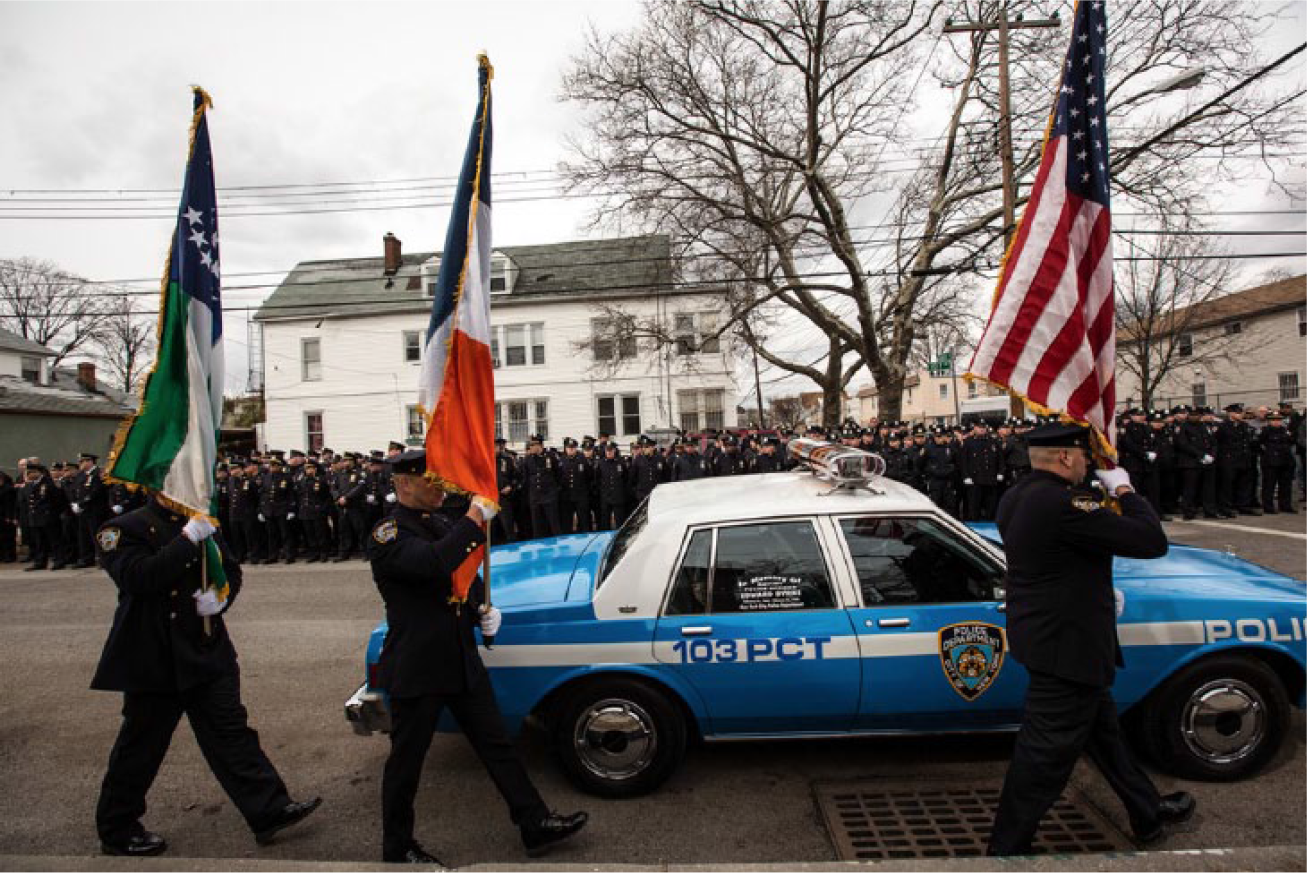
At Inwood Street and 107th Avenue in Jamaica, Queens, a car was parked where officer Edward Byrne was killed 25 years ago.
The spectral resonance of Byrne’s death continues in memorialization projects, commemorative ceremonies, and international media outlets such as the New York Times and Time, and even Buzzfeed (see Kemp and Parascandola, 2012). Byrne’s memorial site was the first place Bill Bratton came after being sworn in as police commissioner in 1994—a gesture of his revanchist politics. Even more telling, the memorial was where Bratton, on his second term as commissioner, assured those gathered that he would never forget Byrne, and in fact “none of us ever should” (Hamil, 2014). Today, Byrne’s story is one the NYPD has yet to forget, his death remaining a vital part of NYPD lore passed from veteran to rookie, strengthened by the yearly vigil held on the spot he was shot. Twenty-eight years later, the death of one rookie cop still haunts the living through a potent concoction of thanatopolitical and police power.
Byrne’s ghost is perennially resuscitated by the negation of the lives of those responsible for his death. Up for parole in 2012 and every two years thereafter, Byrne’s killers have been routinely rejected. Writing to the parole board in 2012, then-New York City Mayor Bloomberg penned, “it would be a gross abuse of justice” if these killers were able to walk free after serving their 25-year sentence—cop-killers deserve no justice (Kemp and Parascandola, 2012). Even more vengefully, four years later the Patrolmen’s Benevolent Association president Patrick Lynch urged the parole board to make sure that Byrne’s killers would “leave prison only in coffins” (Queens Chronicle, 2016). Socio-communal grief, memorialization, and the concrete policing practices which they underpin can therefore be read as thanatopolitical techniques which govern life and fabricate social order by rendering some lives superfluous.
“I kill therefore I am”: Thanatopolitics as Sean Bell
While the TNT program no longer exists in name, its practices, which helped to normalize the victories in “winning back the city” for which it is credited, remain (Seigel, 2015). Indeed, as I have argued here and as others also suggest, a line can be drawn from the death of Edward Byrne to some of the most regressive practices of the NYPD such as stop-and-frisk (see Cox and Cunningham, 2017; White, 2014). As such, the state sanctioned violence that continues to echo across New York City’s boroughs must be seen as a part of this legacy. The murder of Sean Bell, who was killed by NYPD officers just blocks from Byrne’s memorial in South Jamaica, Queens must also then be part of this continuity.
Killed November 25, 2006 as he left a local bar on the morning he was to be married, Sean Bell’s memory sits in stark contrast to Byrne’s, both geographically and politically. Confronting Bell and his friends after their bachelor party, seven NYPD cops, five of them in plain clothes and two undercover, opened fire on Bell and his friend’s vehicle (see Figure 5). The 50 rounds that the NYPD agents fired into the car, killing Bell and wounding two of his friends, were later justified by claims of a furtive movement toward a gun, though no gun was ever found. After much deliberation, only three of the seven NYPD agents involved were charged with crimes, which ranged from manslaughter to reckless endangerment and degree assault. However, in an all too predictable confirmation of the state’s thanatopolitics, the killing of Sean Bell was, in fact, ruled proper and the officers were acquitted on all counts. 3 The two murder scenes, separated by just a few blocks, powerfully demonstrate the decades-long effects of the NYPD’s aim of “taking back the streets.” Despite the murky and contested events surrounding Bell’s killing—the fact that the officers admittedly never announced their presence, the fact that part of their surveillance was to follow and surround Bell’s vehicle, and the fact that no gun was found—the reality that police had long ago established certain neighborhoods and indeed bodies as their territory prequalified their tactics for immunity. Whether “GUN!” was heard or not became immaterial to the actual confrontation and subsequent trial. As Giorgio Agamben (1998) might therefore suggest, the thanatopolitics of police power set in motion by the killing of Edward Byrne render some lives, like Sean Bell’s, unworthy of revenge or justice.

The Nissan Altima Sean Bell and his friends were in when they were shot at 50 times by NYPD.
This link is further established in the differing paths each’s afterlife experienced. Like Byrne, Bell’s life would be idealized in hip hop, a trust fund for Bell’s children would be set up by rapper and mogul Jay Z, and a community center in South Jamaica, Queens was established in his name, and four years after his death the New York City Council would succumb to public pressure and name a street after Bell. Yet, in the same breath, we look back and realize that the community center established in his name has since closed its doors, failing to raise the financial support needed to keep its community driven programs operational (Bockmann, 2013). Naming a street after Bell was met with a broad range of disapproval, highlighted by Councilman Eric Ulrich’s seemingly innocuous quote: “we use a street renaming as a way of recognizing someone’s heroic actions … However tragic Sean Bell’s death was, I don’t believe his life or his death was heroic” (Zraick, 2009). And, while a 2010 civil settlement gave Bell’s two kids each US$3.5 million, Bell’s fiancee Nicole Paultre Bell summarized the exchange rate for a black body: “no amount of money can provide closure, no amount of money can make up for the pain … We’ll just try to learn how to live with it and move on” (Marzulli and Hutchinson, 2010). On the other hand, Vincent Henry (2004) argues, “Byrne’s name continues to evoke emotion-laden memories or associations,” his death becoming an “imparting lesson that potentially saves other cops’ lives,” rendering him an enduring symbol and warning sign to all officers in blue (Henry, 2004: 247).
As such, Byrne lives on not only in the official signs, memorials, and rhetoric of the NYPD, “but in the minds and hearts of cops who remember him and the difficult lessons of his death” (Henry, 2004: 249). The lessons of his politicized death and racialized specter of his murderers likely appear in the police mantra “your job is to go home at night,” and the political theology of the thin blue line which holds the always righteous police protect the innocent from the wicked (Linnemann and Medley, 2017). As sponsor of a US congressional Thin Blue Line legislation Rep. Vern Buchanan makes clear, “these brave men and women and their families put it all on the line and deserve our unwavering support” (O’Brien, 2017). This “unwavering support” rears its head in the recent high-profile murders of young black men and boys Tamir Rice, Michael Brown, and Philando Castile (to name a few), whose killings were justified by this fearful and racialized narrative. These are the very same imaginings that enabled Officer Jeronimo Yanex to successfully contradict video evidence of Philando Castile, claiming he heard him mutter “I’m gonna pull out my gun”. For former Officer Darren Wilson, he saw in Mike Brown a hulking, demonic form rather than a 17-year-old boy, while it took roughly one second for officers to identify, shoot down, and abandon 12-year-old Tamir Rice’s body, in a playground, for holding a pellet gun. Then there are the 41 shots fired at Amadou Diallo after officers (mis)took his black wallet for a gun after a case of mistaken identity. Proper justification for these deaths remains the same: each officer feared for their life. Weighted down by a historical case like Byrne’s, the insecurities of the state create these present moments of future violence and exposures to death. This is what the emergence of the movement for Black Lives has attempted to show, and hence the demand for black lives to matter. Then again, this too is what the rise of recent Thin Blue Line legislation and Blue Lives Matter bills have looked to counter, Byrne’s death a picture of the dangers of police—of what “we” all—have to fear.
Returning to a seemingly innocuous, still revanchist, quote voiced at Byrne’s 25th memorial anniversary, that his death helped “take back this city corner by corner, door by door, street by street,” we might understand how Sean Bell was construed as socially dead, or not quite living (Samaha, 2014). In the “taking back” of Queens’ streets, the officers that killed Bell were authorized, and in fact expected, to engage whomever they deemed unruly or suspicious. In the “corner by corner,” officers found themselves at Bell’s prenuptial celebration, and in the “door by door,” the seeming over-kill of 50 rounds fired into a car of unarmed men were normalized. As such, in the justified killing of Sean Bell we can see that the words of Bill Bratton, when speaking of his promise to remember Byrne, emerge from the revanchist and thanatopolitical register: “It’s what makes us the NYPD … We fulfill our promises” (Moore, 2016).
Thanatopolitics highlights the role that death plays in both governing and enabling the embodiment of a certain, proper life within the body politic, of defining both the life of the state and life within the state (Shields et al., 2014). Made visible has been the (re)creation of life through Byrne’s death, the anxieties and ontological insecurities rearing up the moment life is lost, and how insecurities are secured through the righteous vengeance of the police power. Accordingly, state power that exposes, neglects, and targets subaltern and marginalized populations to the point of disposability is also reaffirmed. Byrne and Bell’s cases powerfully illustrate that not only are certain lives ungrievable, as Judith Butler (2004) contends, but that mourning itself is a political process, a tool for the state to make visible proper citizenship. Let us recall that while there is a national police week, which pays homage to all police officers lost in the line duty, regardless of circumstance, there is no such gesture afforded to the estimated thousands killed by police—with circumstances often obscured—in the US each year (see Ohlheiser, 2015). We see time and time again the police power’s ability to control the narrative of death and violence. As the Washington Post reported in 2015, the NYPD has routinely edited Wikipedia entries on its stop-and-frisk policies as well as the portions of Wikipedia’s NYPD entry that deal with allegations of misconduct and violence.
While the (re)animation of the state occurs through its own memorial practices, it also occurs through the legitimate violence exercised against those socially dead and thanatopolitically alive others who unluckily find themselves on the business end of police power (Linnemann et al., 2014). As Nikolas Rose (2007: 57) summarizes, thanatopolitics, then, are forces, strategies, and techniques that enable expressions of power through “the threat of death, the fear of death, the example of death, the calculated exercise of death.” The (re)animation of political power—as a thanatopolitical strategy—requires the construction not only of people who come to a necessary death, but of the subsequent practices of truly killing them (Shields et al., 2014). As such, death continues to circulate as both an absolute punishment and a state of being for bodies deemed improper. Thanatopolitics is the creation of a national condition that defines life solely through the negation of others. Whether it is the slow death of criminalization, the absence of Mildred Greene’s memory, or the killing of Sean Bell, thanatopolitics again and again marks such (in)distinctions. As such, we must understand the state and its thanatopolitical strategies as defined through its power to negate, which twin Phil Ochs’ seminal words: I kill therefore I am. Exercising its power to kill breathes life into the state. Each repeated act—each blow of the officer’s fist, the swing of their baton, the pull on the trigger, each a necessary negation of lives considered long dead—defines the state.
Footnotes
Acknowledgements
I would like to acknowledge Travis Linnemann for his contributions and advice throughout this project. Thanks also to Kaitlyn Selman for the seemingly endless conversations about death and police. Lastly, I would like to thank the anonymous reviewers for their generous feedback.
Funding
The author(s) received no financial support for the research, authorship, and/or publication of this article.