



Abstract
This article examines a representation of convict leasing in an unexpected and seemingly inconsequential place—an amusement park. Located in Branson, Missouri, the popular 1880s-themed Silver Dollar City proudly claims to offer historical education and entertainment through “realistic” constructions of the past. One of the park’s oldest and most popular attractions is the Flooded Mine ride, where park guests travel in “mine carts” through a depiction of a flooding mine, trying to “help the sheriff” by shooting laser light guns at kitschy animatronic convict laborers who are trying to escape. We first examine the Flooded Mine as a unique form of penal spectatorship, arguing that riders are able to enjoy the lighthearted mockery of the convict laborers’ suffering through a process of moral disengagement. Second, we use the lens of collective memory in an endeavor to expose the processes of remembering and forgetting at work in Silver Dollar City. We argue that the simulations of the past constructed in the park are not an apolitical platform for entertainment, but rather work to produce a narrative that perpetuates a kind of white nostalgia that erases black suffering. While ostensibly displaying a story of convict labor, the Flooded Mine depicts all the prisoners as white men, effectively performing an historical erasure of chattel slavery and its transmutation into convict leasing. By obscuring the incalculable pain produced by convict leasing and incarceration, the dissimulation allows riders to avoid any ethical engagement with these systems of racialized control.
Keywords
Introduction
This article explores the Flooded Mine ride at Silver Dollar City amusement park in Branson, Missouri as a case study in penal spectatorship and, more broadly, the park itself as a site of heritage production. Drawing upon the work of scholars who study “dark tourism,” we use the Flooded Mine at Silver Dollar City to build upon wider critical accounts of historical depictions of imprisonment and suffering. Essentially, dark tourism involves travel to places associated with death and dying, suffering, catastrophe, and/or violence (Sharpley and Stone, 2009; Stone, 2006, 2011; Strange and Kempa, 2003). For example, spaces of confinement such as defunct prisons (see Wilson et al., 2017 among others) and plantations (see Adamkiewicz, 2016 among others) have become popular travel destinations. Scholars of dark tourism have long been interested in documenting and critically examining the ways in which curators rely upon various techniques to deliberately dissociate from, or completely reimagine, elements of conflict, darkness, and violence inherent in this type of destination (Biran and Hyde, 2013; Carrabine, 2017). In the case of plantation museums, for example, curators tend to adopt logics of white supremacy, marginalizing or even ignoring the experiences of the enslaved, thereby minimizing their suffering and the brutality of the system of chattel slavery (Buzinde and Santos, 2008; D’Harlingue, 2015; Eichstedt and Small, 2002; Giovannetti, 2009; Small, 2013). Similarly, prison museums often present the prison in a way that it is uncoupled or removed from the suffering and violence experienced therein (Wilson, 2008; Wilson et al., 2017).
The Flooded Mine similarly dissociates from the suffering and violence inherent in convict leasing and presents a spectacle of punishment as entertainment. According to Brown (2009: 4), many Americans “access punishment through cultural practices removed from formal institutions like prisons.” These cultural and popular representations of punishment “provide frameworks for ordinary citizens to step into or out of self-conscience modes of awareness as moral spectators and deliberative citizens” (Brown, 2009: 4) and provide “evidence about how citizens attempt, or fail to attempt, to understand and process the meanings surrounding punishment” (Brown, 2009: 120). The Flooded Mine—a ride in which park guests travel through an animatronic flooding mine where convict laborers are trying to escape—is a unique site of penal spectatorship (see Figure 1). Unlike most mediated representations of prison life and sites of penal tourism, this spectacle is specifically marketed and designed for the entertainment of children (see Figure 2). The ride is advertised on the park’s website as a family fun ride: A signature Silver Dollar City ride, kids of all ages enjoy this indoor float-through family attraction. Get your pistol ready to take aim at targets along the way! Hit the bull’s eye to ring the bell, blow the whistle, and compete for points with arcade-style shoot-out fun. (Herschend Family Entertainment, 2017)
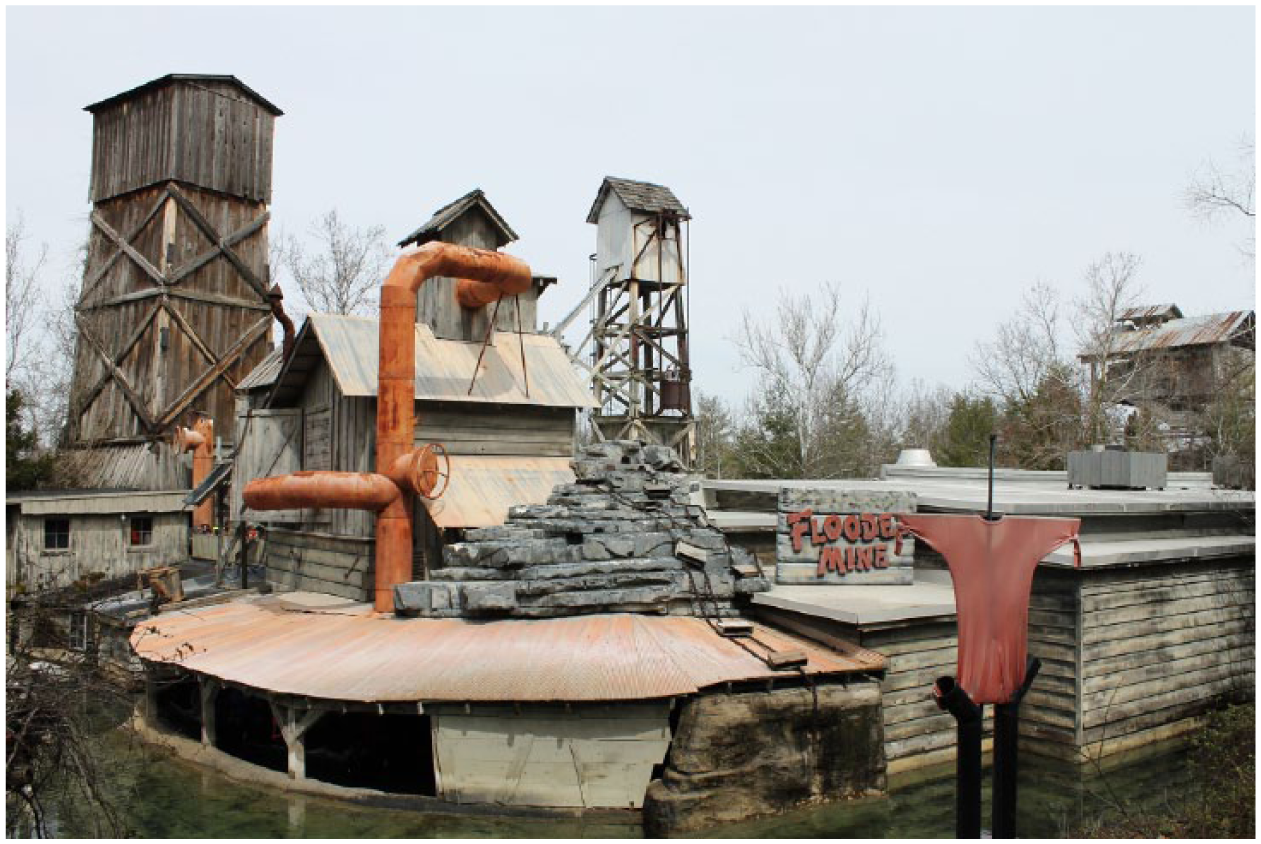
Entrance to Flooded Mine.
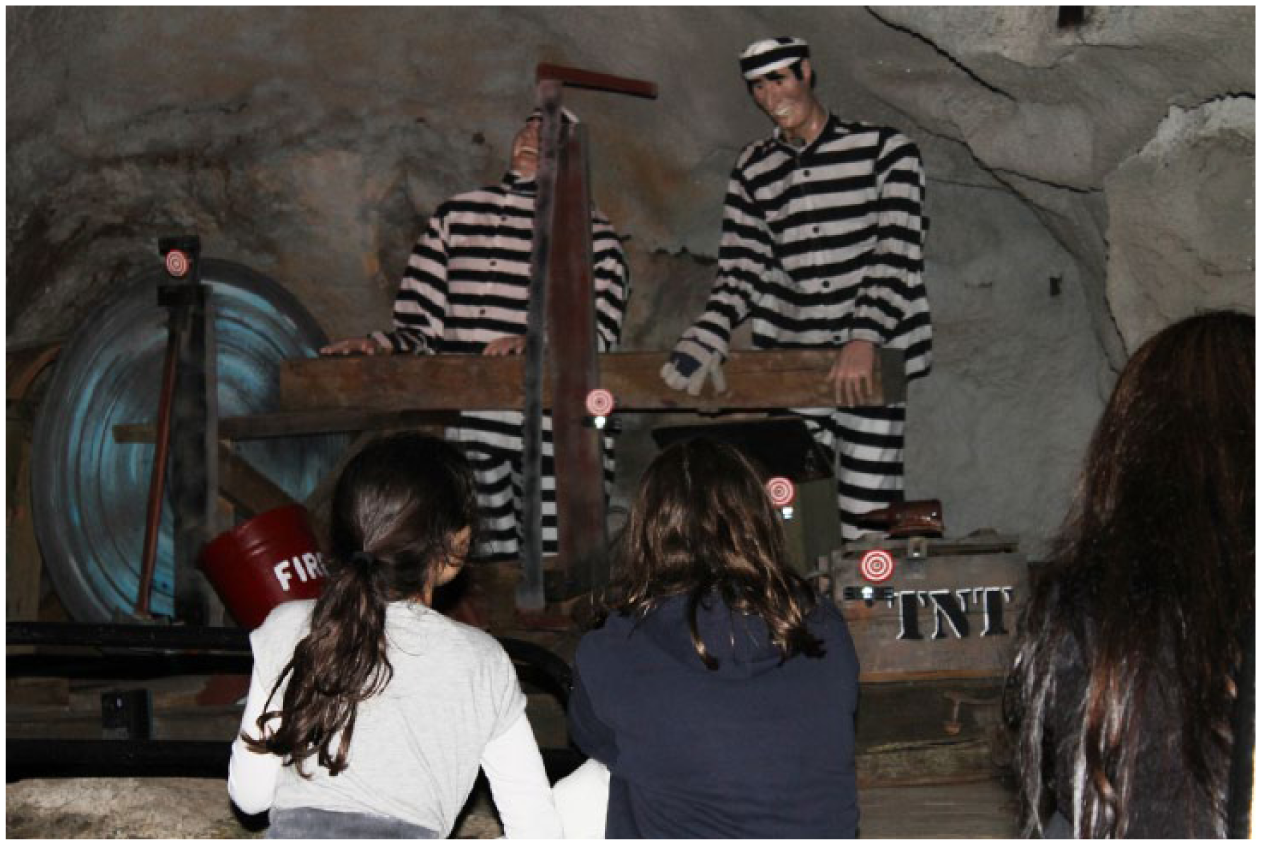
Children “help the sheriff”.
Despite its intended audience, the ride candidly depicts prisoners being subjected to historically accurate forms of torture used by penal authorities and capitalists who exploited and profited from forced prison labor. Young riders are asked to help the warden, facetiously named N.O. Parole, by shooting at escaping prisoners with infrared laser light guns, all the while being invited to laugh at the plight of the convicts through cheap jokes such as a sign that contemptuously reads, “Do not feed the prisoners.” Essentially, the ride provides an experience for children to marvel at a carefully constructed spectacle while actively participating in the infliction of punishment—even death—upon cartoonish convicts, all in the name of fun.
Scholars of heritage production have long been interested in documenting and critically examining the ways in which various spaces—from small farms once inhabited by famous historical figures, to large national parks memorializing battlefields, and even commercial spaces such as the Anheuser-Bush and Guinness beer factories—create cultural heritage destinations through depictions of artifacts, communities, traditions, and events of the past (Hewison, 1987; Kirshenblatt-Gimblett, 1998; Sturken, 2007; Timothy and Boyd, 2006; Urry, 2002 [1990]). Although Silver Dollar City is certainly in the heritage production business, the park differs from formally acknowledged or traditional heritage sites because neither the land on which the park was built, nor the park itself, holds any clearly recognized cultural or historical significance. Rather, the park’s creators sought out and purchased artifacts and historic buildings, transporting them to the site and arranging them to blend in with carefully constructed simulations to create a faux heritage space that mimics a mining town from the late 19th century. The park is a place where family fun and Christian values are woven into an old-timey, small-town atmosphere that allows visitors to feel connected to the Ozark region’s past. While some may be tempted to dismiss the Flooded Mine at Silver Dollar City as playful fantasy befitting an amusement park, we argue that it is an important case study of both heritage production and penal spectatorship, as the park’s sentimentalizing of the past is not innocuous and, like many heritage and penal sites, tells us more about the socio-political order of the present than the past.
Dozens of scenes depict the practice of convict leasing with remarkably accurate detail, from the use of replica uniforms and salvaged mining equipment, to the display of brutal methods of punishment used to control prisoners. In fact, the animatronic scenes at the amusement park are strikingly similar to the historical photographs of convict miners on display in the museum of the Missouri State Penitentiary, except for one key detail—while the majority of convict miners in the photographs are black, all of the convict miners in the tableaus constructed in the Flooded Mine are white. Acknowledging that all approaches to representation of the past are tied to contemporary cultural, ethnic, or national identity, Gable and Handler (1996: 568) describe heritage production as a “form of cultural salvage” whereby museums and heritage sites become “arbiters of a marketable authenticity.” Like heritage production sites such as plantations and prison museums, Silver Dollar City, as a capitalist enterprise, attempts to promote itself through the lens of “edutainment,” wherein the distinction between education and entertainment is obscured (Huey and Broll, 2017: 518–519). It is both a simulated heritage site where guests are told they can learn about the Ozark region’s past and an amusement park filled with thrilling rides and family fun. The park’s website advertises a place to have fun with history—to be entertained and educated about the Ozarks’ past.
While a nuanced discussion of ongoing scholarly debates regarding the epistemological underpinnings of authenticity in museums, heritage sites, and the academy are beyond the scope of this article (see Gable and Handler, 1996; Hamilton, 1994; Hewison, 1987; Schwartz, 1982), we rely on the concept of collective memory to argue that there is inherent value in exposing claims to the authentic as constructions. As a conceptual framework, collective memory demonstrates how the relationships between material artifacts and memory are complex and deserving of critical analysis (Connerton, 1989; Schwartz, 1982). This lens allows us to uncover the ways that people, spaces, and objects are made to perform meaning. Specifically, as a constructionist epistemological position, Connerton’s (1989: 3) concept of collective memory asserts that knowledge is socially constructed and contextually embedded such that “images of the past commonly legitimate a present social order.” Hence, from this perspective, Silver Dollar City is not a neutral, apolitical location operating as a historical conservancy, but rather an inherently political space shaped by dominant narratives that reinforce a particular set of beliefs and values.
Below, we examine the Flooded Mine as a site of penal spectatorship, arguing that park visitors are able to enjoy the ride and laugh at suffering without moral compunction for several reasons. First, we discuss how the dominant narrative about crime and punishment in American culture relies upon an ‘othering’ of prisoners and ‘criminals’ that permits moral disengagement. These groups of people are viewed as deserving of punishment or violence. Additionally, we argue that the kitschy nature of the ride, along with the notion that convict leasing belongs to a bygone era, permits an even greater moral distance. Next, we look at Silver Dollar City as a site of heritage production that promotes a kind of white nostalgia through which a simulated authenticity becomes “believable” as it erases racialized violence and naturalizes whiteness. Using the lens of collective memory, we show how the park both relies upon willed forgetting and perpetuates collective amnesia, such that histories of slavery, convict leasing, and imprisonment are whitewashed, reimagined, and sold to consumers in palatable ways.
In this case study, we aim to employ an “orientation towards the visual that is capable of encompassing meaning, affect, situation, symbolic power and efficiency, and spectacle in the same ‘frame’” (Hayward, 2010: 3). In researching the topic, we employed visual (Ball and Smith, 1992) and textual (Fairclough, 2003) analysis frameworks to decode the meanings and messages of the Flooded Mine within the surrounding sociohistorical context. To this end, we visited the park several times to conduct a non-intrusive form of participant observation. We rode the Flooded Mine multiple times, carefully observing each scene or vignette depicting prison labor, taking dozens of photographs and video footage. We then used the photographs and video, as well as notes taken about the conversations and behavior of guests and staff, for our analysis. Though the park did not approve our request to formally interview employees or guests, we initiated casual conversation with patrons while waiting in line and exiting the ride. We also analyzed both visual and textual data retrieved from marketing material such as the official promotional website for Silver Dollar City and Facebook pages dedicated to the park and the Flooded Mine ride. Data analysis of the written and visual material involved inductive, open coding to identify key themes. Additionally, to contextualize the events depicted in the ride, we toured the now defunct Missouri State Penitentiary and visited local historical societies, researching the practice of convict leasing in the Ozark Mountain Region (made up primarily of Missouri, Arkansas, and Oklahoma).
The Great Shootout in the Flooded Mine: Punishment and moral disengagement
Developed in 1968 (Payton, 1997) and still among the park’s most popular attractions, the ride officially known as the Great Shootout in the Flooded Mine entertains patrons as they float through a terrifying disaster in a mine operated by convict laborers, who wear the recognizable black and white zebra-striped uniforms that prisoners wore in the Missouri State Penitentiary in the 1880s, the time of the fictional flood. Interestingly, over the last 40 years, much of the promotional material, including postcards sold by the park, has described the ride as an exhilarating adventure but has failed to mention that the men working in the mine are convicts. The back of one postcard reads, “The Flooded Mine is an adventure for young and old alike at Silver Dollar City, Mo. Ozark visitors ride through the mysterious, inundated passageways aboard old-fashioned ore barges.” Another postcard boasts, “A ride through the flooded, dimly lit passageways of the Unlucky Silver Mine is a vacation experience to remember for years to come” (see Figure 3).
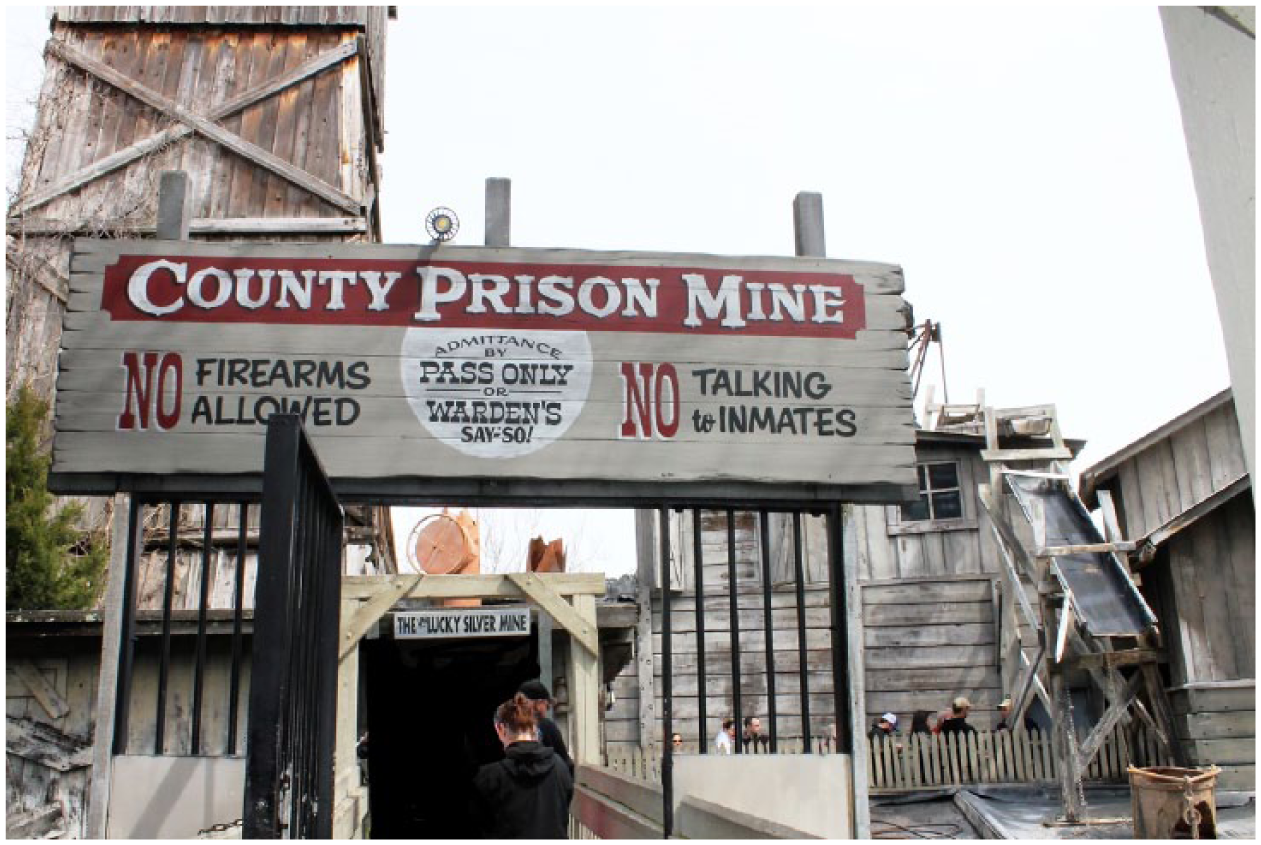
Entrance to the Flooded Mine ride.
Notwithstanding the manner in which the ride has been marketed to visitors over the years, the Flooded Mine is unmistakably a lighthearted, trivializing representation of 19th century occupational hazards, convict leasing, and prison life. Before entering the boarding area, riders are invited to take funny pictures of one another “locked” in replica stockades. The first scene of the ride depicts a guard’s box comically displaying the “rules” of the ride as though they are rules one would see when entering a prison, including the sign mentioned above that mockingly reads, “Do not feed the prisoners.” Next, guests are greeted with the ride’s irritatingly catchy theme song whose lyrics are clearly meant to warn riders of the dangers that await them in the flooded mine, while its lighthearted tune simultaneously creates an upbeat feel: ‘Welcome to the mine. Yeah. Welcome to our toil. Welcome to the trouble ‘neath the earth and soil. You’ll sweat a little water, you’ll sweat a little blood, and you might get out if the mine don’t flood’ (Herschend Family Entertainment, 2017). Here is where a sign tells the guests that the warden, N.O. Parole, needs their help rounding up prisoners who are trying to escape the flooding mine with their lives but also, perhaps more importantly to the theme of the ride, to gain their freedom.
In the 1980s, as the park began to amass an impressive collection of thrill rides, park management feared that a slow-moving, older ride like the Flooded Mine could lose its appeal and thus made the ride more interactive. Rather than having passengers float passively through the mine, they introduced laser light guns that tally the number of times riders hit infrared-sensitive targets to activate animatronic features, allowing the riders to compare sharpshooting skills at the end of the ride (see Figure 4). The addition of the guns in the 1980s renovation marks a shift in the rider’s role from one of passive spectator who watches the convicts to active participant who attempts to control them with violence. Targets are programmed to turn on lights, play sound effects, and reveal hidden surprises or jokes, such as a bucket of water being dumped on the convicts or miniature “explosions” caused by devices labeled “TNT” or “dynamite.” However, the overall goal in arming the riders with weapons is stated candidly on the park’s website: The warden needs your help! The county prison mine is flooding, and some of the prisoners are trying to escape! Climb into ore carts as the water carries you through the flooded mine shafts, past jack hammers, pump stations, mine explosions and even sleeping guards. (Herschend Family Entertainment, 2017)

Laser light guns aimed at targets.
Belying the brutality of forced prison labor, convicts are presented in a cartoonish, hackneyed manner. Audience members are frequently invited to laugh at the plight of the naïve prisoners shown having fun, goofing off, and even playing in the water, thus enjoying the “break” that the flooding crisis allows. While several scenarios throughout the ride suggest the prisoners are trying to take advantage of the chaos of the flood to escape their imprisonment, other scenes depict terrified, frantic, and panicking prisoners, alongside others who seem blissfully unaware of their impending fate, smiling and happily working as the water levels continue to rise (see Figures 5 and 6).

A panicked convict attempts to contain the flood.
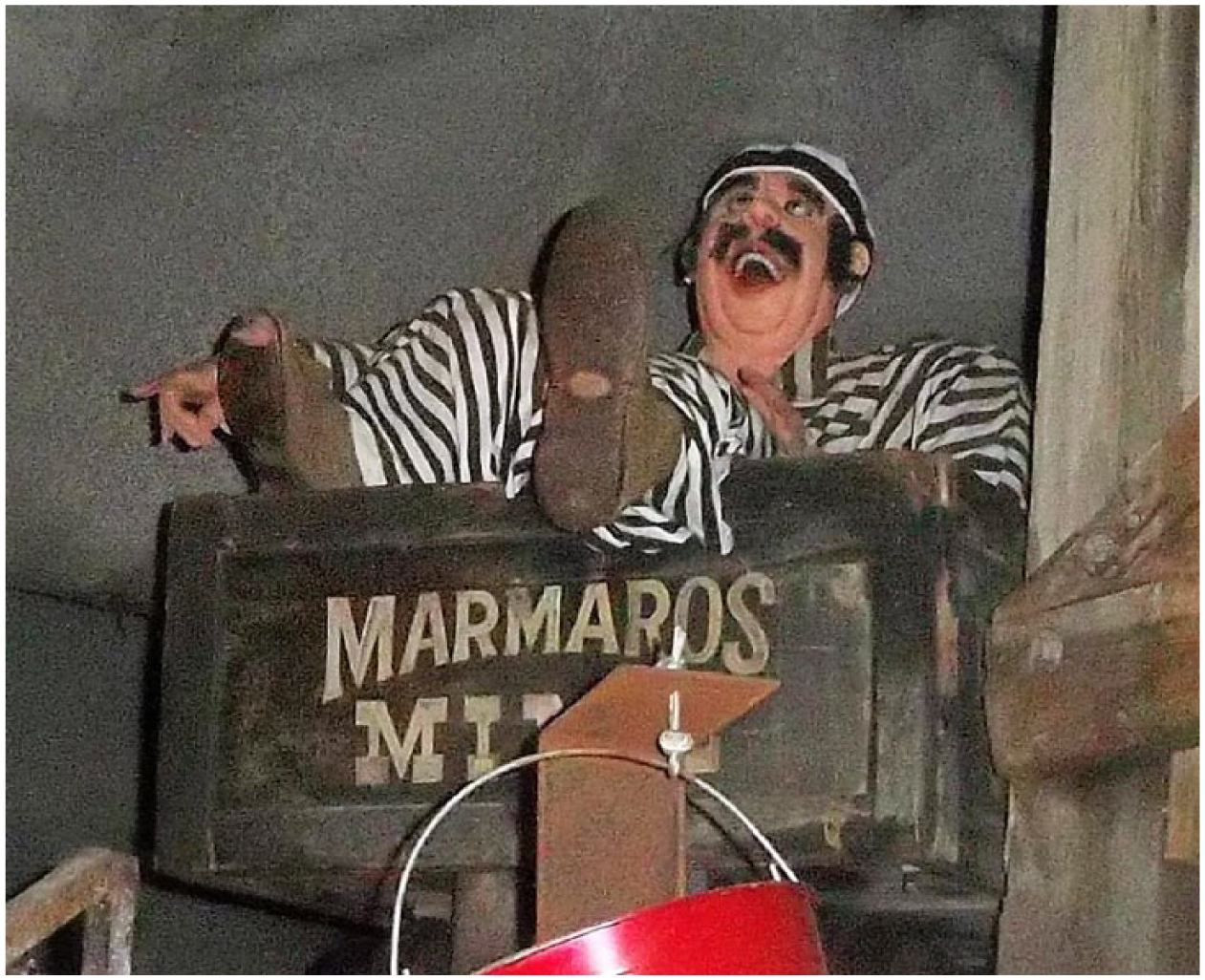
Frolicking in the flood.
Humor is an aspect of nearly every scene in the Flooded Mine, from silly gags to the use of much darker humor such as puns and wordplay laughing at torture and death. Yet, when the authors experienced the ride, we immediately realized that we had a markedly different emotional reaction than seemed common among other riders. Our feelings of uneasiness, revulsion, and shock at what we saw as a flippant depiction of human suffering and tragedy seemed in stark contrast to the laughing and smiling faces of children and adults around us. However, simply dismissing the people who created the ride and the thousands of people who enjoy the experience each year as insensitive or cruel ignores the socially ingrained beliefs about crime and punishment that have made the ride a popular attraction, enjoyed by generations for over 45 years. The point here is not to make an argument that the ride is necessarily harmful or offensive, but to unpack the ways in which the dominant ideology regarding crime and punishment embedded in the ride allows the suffering of human beings to escape criticism. Moreover, the fact that people can derive enjoyment from viewing human misery is not a new phenomenon, as scholars of history often note a fascination with punishment and suffering in the artifacts of centuries of Western “civilization”. For example, in his discussion of artistic images from the 1700s, Carrabine (2012: 54) describes a depiction of a group of fancily clad, upper class women visiting Bedlam asylum, gleefully watching the squalid spectacle of madness before them. He encourages us to ask not why they are there at all, but rather “why they find the abject misery entertaining. An uncomfortable question posed to all of us who watch images of suffering.”
Riders can clearly see terror and pain in the faces of the ill-fated convicts, some of whom are visibly restrained, either chained to mining equipment or locked in barred cells, while others are singled out and punished with physical torture. In one particularly heinous example, two convicts in the flooding mine are kept in a cage, where one is hung in a stress position by his wrists from the bars above, while the other is struggling to hold up his fellow prisoner’s legs to relieve some of the pressure. Visitors clearly see the pained expressions on their faces, displayed next to a sign that mockingly reads, “Sentenced to hang for 187 days” (see Figure 7). This tableau is modeled on a punishment commonly used at the Missouri State Penitentiary in the late 19th century known as “the rings,” which involved chaining a man’s hands above his head to a metal ring attached to a wall, where he would then be forced to hang for eight to 14 hours a day (Schreiber et al., 2004).

“Sentenced to hang for 187 days”.
Another scene asks riders to literally laugh at prisoners who were worked to death. It features the tombstones of people who have presumably died while working the mines: one inscribed with the epitaph “O.I. Labured [sic]; Now I. Rest” is located next to an old wooden casket where skilled shooters can hit a target that lifts the lid, revealing a skeleton wearing a tattered convict uniform (see Figure 8). Research suggests that people sometimes engage in joking to feel superior to or distanced from others, especially those outside their group and those perceived as lower in status (Boskin and Dorinson, 1985; Francis, 1994). Thus, as scholars have observed at dark tourist sites (Brown, 2009; Wilson et al., 2017), audience members may be unwilling or unable to recognize and confront what they are directly looking at—the suffering of human beings.
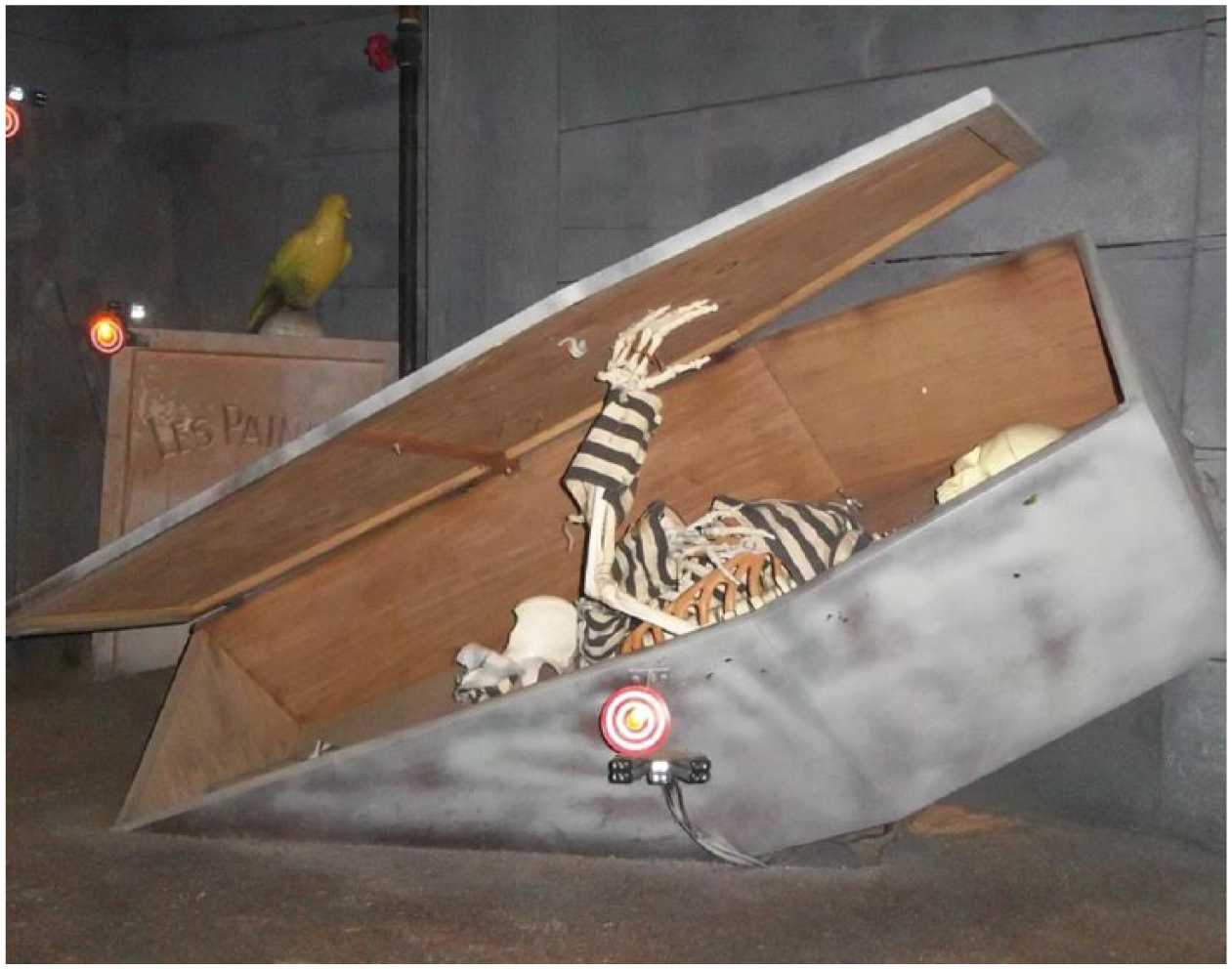
Skeleton in coffin wearing tattered convict uniform.
The depiction of the mine workers as convicts raises an important question: Would the audience experience the ride differently if they were watching free workers trying to escape a flooding mine? We argue that the ride would not be so successful without the moral distance provided by the depiction of workers as prisoners. When prisoners are essentialized as the “Other,” the excluded, they exist in a state of “social death” in which they are shut away, punished, and deprived of rights in ways that do not commonly elicit protest from most members of society (Bauman, 2000; Cacho, 2012). Opotow et al. (2005: 305) argue that we have a scope of justice and draw lines between those who are included in that scope (and so, deserve fair treatment) and those who lie beyond the boundary, who are “morally excluded, beyond our moral concerns, and eligible for deprivation, exploitation, and other harms that might be ignored or considered as normal, inevitable, and deserved.” Moral exclusion is characterized by viewing the excluded as unconnected to and psychologically distant from oneself; lacking a sense of moral obligation to the excluded; distinguishing the excluded as “nonentities, expendable, and undeserving” of fair treatment and/or resources; and supporting practices and living conditions for the excluded that would be unacceptable for the included (Opotow et al., 2005: 305–306).
If the Flooded Mine is to “succeed” as an entertainment experience, the ideal audience is one that not only has had little to no personal contact with convicts or incarcerated people, but also “approaches history at a remove” and adopts the “state-sponsored narratives, prescribed emotional reactions, and overly simplified renditions of complex events” that permeate Silver Dollar City (D’Harlingue, 2011: 23). Scholars tend to agree that most people in Western nations view punishment from a distance, thereby developing ideas about and placing judgments upon prisons and prisoners through exposure to mediated representations, rather than direct experience with the carceral system (Brown, 2009; Ogletree and Sarat, 2015). Brown (2009: 12–13) posits that, due to the ways in which criminalization and incarceration disproportionately target people of color and poor people, many others are “disconnected from the practice of punishment” and employ a “penal gaze” to view representations of punishment “in a manner that does not force or ask observers to speak back or engage in dialogue. This kind of looking is fundamentally voyeuristic, distracting, and yet authoritative, inhibiting a deeper interrogation of punishment.” Cultural criminologists make engagement with representation and meaning imperative. We simply cannot hope to have a critical understanding of crime or punishment without attenuation to the “swirling dynamics of culture” and “flow of collective meaning” that saturate our thoroughly mediated world (Ferrell et al., 2008: 125).
In the case of the Flooded Mine, little detail is provided about the biographies or convictions of individuals working the mines. The few crimes listed on the faux wanted posters hanging at the entrance of the mine include bank robbery, horse thievery, and bootlegging. However, when we would occasionally ask one of the young riders sharing our cart what they thought of the people in the mine, the most common response was simply some version of, “They are the bad guys.” Barton and Brown (2015: 249) suggest that tourists at defunct prisons may be able to gaze upon whipping posts, birching tables, or gallows as “family fun” if the audience is “comfortable in accepting the original recipients of such punishments were deserving of their fate.” Thus, even without a clear understanding of the exact nature of the reasons people are imprisoned in the Flooded Mine, audiences may not be bothered by the tragic events or lighthearted treatment of harsh conditions due to an ethical belief system grounded in “reciprocal morality,” whereby such events and conditions are acceptable as punishment for criminal behavior (Minogue, 2011). Fittingly, this eye-for-an-eye belief system sits comfortably within an amusement park whose major draw is its promotion of Evangelical Christian values (Aubrey, 1996; Ketchell, 2007). Sigler’s (2006: 572) use of “blind-eye deterrence” suggests that, by looking away from and failing to ethically engage with the pains of punishment, people can contentedly support a state that engages in “exceptionally harsh treatment” of prisoners without openly endorsing the use of such tactics. Viewing the Flooded Mine through the lens of blind-eye deterrence helps explain how the audience can hold the belief that torturing prisoners is wrong while simultaneously not objecting to the mocking displays of suffering featured prominently in the spectacle. Thus, to experience the events depicted in the Flooded Mine as entertaining, humorous, or enjoyable, we must hold, at least in part, a certain set of moral beliefs about prisoners and justice.
Additionally, the passage of time may help to provide the emotional distance necessary to enjoy a ride through Silver Dollar City’s Flooded Mine. Just as the authors experienced when touring defunct prisons, including the Missouri State Penitentiary, Alcatraz, Eastern State Penitentiary, and Kilmainham Gaol, scholars of penal tourism document the ways that tour guides incorporate humor at the expense of prisoners into their narratives, while also making a spectacle of the state-sanctioned violence and death used to control and punish prisoners (Chen et al., 2016; Welch, 2013; Wilson, 2008). Punishment, especially the more harsh, gruesome, or brutal practices, is a major theme in advertising for, and often takes center stage in, prison tours (Barton and Brown, 2015; Huey, 2011; Walby and Piche, 2011; Welch, 2013). However, these penal spectacles are presented to guests as mechanisms to gaze at practices of the past, so that they view not only the physical structures of the prisons, but also the punishment that happened inside the walls, as anachronistic. Additionally, by displaying artifacts of brutality independent of their social and political contexts (Barton and Brown, 2015; Walby and Piche, 2011), prison museums free audiences from contemplating the austerity and severity of punishment both past and present. Prison museums are thus able to graphically discuss their grim histories in such a way that “generally evokes the state-sanctioned narrative of penal progressivism which infers that things were harsh then, but they are acceptable now. Or, indeed, the harsher the punishment then, the more lenient and compassionate punishment is now by comparison” (Barton and Brown, 2015: 249). As such, visitors to these non-operational prisons easily chuckle with their tour guides as they joke about the harsh realities of prison life and take funny photos of themselves shackled to iron balls or locked in cells, taking solace in the belief that the brutality of these systems that enabled the suffering of convicts in the past is wholly removed from the ways we punish people in our current carceral systems. So, if most people touring authentic spaces of incarceration adopt the necessary detachment to laugh without compunction at the suffering of real people in the past, guests floating through the faux prison mine at Silver Dollar City can do so with even greater emotional distance.
Patrons of the park may not notice, or not be bothered by, the suffering of prisoners in the Flooded Mine because of how commonplace jokes about prisoners and prison violence are in representations of prison life in popular culture. Although this ride was built in the late 1960s (Payton, 1997), in the decades since, we can easily find examples of movies and TV shows trivializing prison life, as well as “reality” shows about prisoners and more serious programs, both fictional and nonfictional, acclaimed for their supposedly authentic depictions of prison life (Bennett, 2006; Ferrell and Hayward, 2011; Mason, 2003; O’Sullivan, 2001). The blasé treatment of harsh prison conditions and the very real threat of violence, even rape, is standard fare in prison-themed comedies. The humorous representation of convict laborers in the Flooded Mine is imbued with the same kind of spectacular violence that appears repeatedly in mediated images of punishment and crime in contemporary America (Ferrell and Hayward, 2011).
We argue that this type of entertainment combines elements of humor and “kitsch” to transform a complex, potentially disturbing aspect of American history into an easily digestible experience palatable to most of the park’s visitors. The humorous displays in the Flooded Mine can best be described by Sturken’s (2007) use of the concept of “kitsch,” a specific type of popular culture that often evades serious scrutiny by appearing as backward, crass, sardonic, fantastical, ironic, campy, or playful. For example, in his study of haunted plantation tours, D’Harlingue (2015: 77) uses the concept of kitsch to argue that, by playfully focusing on fantastical ghost stories, tour guides encourage visitors to experience an emotional connection with white slaveholders, which “allows for a kind of unguardedly frank expression of nostalgia for, and fantasy about, slavery in all its gratuitous violence.” As such, he argues that the tours’ narratives are “not simply a representation of violence past, but an enactment of present violence and its force relations,” and these “encounters with violence” are successfully disguised by the kitschy nature of haunted tourism (D’Harlingue, 2011: 24). Similarly, the kitschy approach used in the Flooded Mine enables riders to float merrily through images of suffering. In other words, kitschy popular culture activities like ghost tours or amusement park rides featuring suffering and violence can tell stories that both revel in violence and simultaneously transform brutal realities by relying on easy emotional formulas to create an experience accessible for mass consumption. Thus, in part, it is this “‘kitschification’ of memory” (Thurston, 2017: 588) that allows people to derive pleasure from the Flooded Mine, despite its depiction of the callous disregard for loss of life inherent in convict leasing, articulated so well in the title of Mancini’s (1996) renowned book on the subject, One Dies, Get Another.
Convict leasing: A system of racialized control
In 1865, the 13th Amendment to the US Constitution officially abolished slavery and involuntary servitude except for those convicted of a crime, opening the door for the creation of convict labor systems to sustain institutionalized white supremacy and perpetuate the control and exploitation of black bodies. Convict leasing, Blackmon (2008: 68–69) argues, “solved two critical problems for southern whites. It terrorized the larger black population into compliance” and “significantly funded the operations of government by converting black forced labor into funds for the counties and states.” Simply put, to meet the demands of cheap labor and ensure that a steady supply of newly freed blacks could be fed into the criminal justice system, states constructed vagrancy laws known as Black Codes. These laws varied from state to state but effectively restricted the lives of black people so that activities such as walking at night after curfew, “loitering,” unemployment, or changing employers without permission could result in lengthy imprisonment and involuntary labor (Blackmon, 2008; Mancini, 1996; Oshinsky, 1996). Dispelling any myths of a surge of “black crime waves,” judicial records indicate these race-specific violations and other petty charges accounted for the massive incarceration of black people in the late 19th century. States with prisons that predated the Civil War, such as the Missouri State Penitentiary, rapidly expanded to accommodate the large influx of prisoners, while other states literally converted former slave plantations into prisons, including Mississippi State Penitentiary (also known as Parchman Farm) and Louisiana State Penitentiary (named Angola after the home country of many of the enslaved Africans who had worked the plantation). Thus, in the early decades of convict labor systems, legally emancipated, yet newly imprisoned, people could be forced to live and work on the very plantations that held them captive as slaves.
While laws regarding convict labor systems varied over time and from state to state, they typically involved government officials leasing inmates to large corporations, small businesses, or even individual families (Blackmon, 2008; Mancini, 1996; Oshinsky, 1996). Under these systems, convicts were forced, through beatings and physical torture, to labor either inside prison walls or in factories, farms, brickyards, lumber camps, mines, and so on. In her acclaimed novel Beloved, Toni Morrison tells the story of an enslaved man, Paul D., who, upon being transported to a prison labor camp for attempting to escape slavery, sees Mister, the plantation rooster, “smiling as if to say, You ain’t seen nothing yet” (Morrison, 2006 [1987]: 264). The rooster’s omen, Childs (2009: 284) suggests, is not meant for Paul D. alone, but rather forebodes the fate of black people after emancipation, as the transition resulted in “amplification rather than abatement of injury, living death, and murder for many former slaves.” As Paul D. is paraded along the road to the prison camp, he becomes part of a spectacle of Southern white violence intended to instill fear and deter anyone who might consider behaving in unauthorized ways. Oshinsky (1996) argues that, although many convicts toiled in mines and factories that were hidden from view, prison officials deliberately exposed those who worked on chain gangs, as well as those who were being transported, to an often-fearful public both as a means of deterrence and a form of humiliation for the prisoners. In nearly every aspect, Blackmon (2008: 57) suggests, from “the acquisition of workers, the lease arrangement, the responsibilities of the leaseholder to detain and care for them, the incentives for good behavior—convict leasing adopted practices almost identical” to slavery, often with deadly consequences. These systems were fundamentally Slavery by Another Name (as revealed in Blackmon’s 2008 book title on the subject) or even Worse than Slavery (as Oshinsky’s 1996 title posits).
From 1839 to 1917, the Missouri State Penitentiary operated both lease and contract labor systems (Kremer, 1992; Rasmussen, 2012; Reynolds, 1982; Schreiber et al., 2004). The system of prison leasing originated in Kentucky in 1825 and was adopted in most Southern states during the 19th century, allowing business owners to take over and manage prison facilities and use the labor of convicts for private profit. The leasing entity was responsible for feeding, clothing, and housing the convicts, either in state-owned prisons or private establishments, which they typically did reluctantly, supplying the bare minimum (if that) needed for survival. Under the lease system in Missouri, living facilities were often not properly maintained, food tended to be spoiled or full of bugs, “inmates were in desperate need of proper clothing …, beds and bedding were scarce and covered with filth and vermin,” and convict defiance was widespread, requiring employment of additional guards to quell resistance (Schreiber et al., 2004: 15). Leasing systems in Missouri were no different than those in other states in that they were fraught with corruption and exploitation and invited abuse, as profit motives were prioritized over the cost of support for the prisoners. Abandoning the lease system in 1875, due to both public outcry over the exploitation of prisoners and concerns regarding regular escapes, Missouri State Penitentiary officially adopted the contract system, thereby handing control of the facility and prisoners back to a warden employed by the state, who then contracted out the labor of prisoners on an individual basis (Kremer, 1992; Schreiber et al., 2004). By 1879, private Ozark-based companies enjoyed substantial profits under the contract system due to the combination of exploited labor and the fact that the state (not the company) was responsible for providing food, clothing, and shelter for prisoners (Reynolds, 1982).
Regardless of whether they were subject to a lease or contract system, Missouri prisoners who worked in mines throughout the 19th century were forced to live in squalid conditions with poor medical treatment, scant food, and frequent floggings, resulting in hundreds of deaths caused by fires, floods, explosions, falls, neglect, and disease (Rasmussen, 2012; Reynolds, 1982). Accounts of prisoners who worked the factories and mines describe the harshness of prison labor practices, with demands for increasingly high productivity accompanied by brutal consequences for failing to meet unreasonable work quotas (Kremer, 1992; Rasmussen, 2012). A prisoner could be placed on a starvation diet, beaten, lashed or whipped, and, as one Ozark prisoner describes, kept in a “dungeon-like isolation cell, without his coat or shoes” and deprived of all furnishings save a “night bucket” (Schreiber et al., 2004: 84). Typical of the brutality enacted upon convicts at the time, documents from the Missouri State Penitentiary reveal that beatings could be especially bloody and painful, as guards were known to attach small pieces of steel to the end of whips, which were used to lash a man who had been stripped naked and wore only shoes to “catch the blood that flows down his limbs” (Schreiber et al., 2004: 85). The wounds were often so severe and deep that for weeks after the whipping, a prisoner’s clothing or bedding would stick to his bloodied flesh and require careful removal by fellow convicts to prevent fatal infection.
This brutal system of convict leasing in Missouri faced significant challenges from both convicts, who often destroyed property in protest, and free white laborers, who argued that prison labor drove down wages and slackened safety precautions in the workplace (Rasmussen, 2012; Schreiber et al., 2004). Convict mining operations were particularly despised by free white miners, who formed an anti-convict labor society and repeatedly introduced unsuccessful legislation to try to prohibit convict labor in local mines (Reynolds, 1982). After decades of effort, organized labor successfully gathered the legislative support they needed, and in 1917, the Missouri state legislature prohibited the use of convict labor for the profit of private industry. Labor unions would later use the Missouri prison labor system as the “worst example of corrupt and unfair labor practices” to lobby for the Hawes-Cooper Act of 1929, which “banned the sale of prisoner-made goods on the open market” (Schreiber et al., 2004: 70). Thus, the men portrayed in the Flooded Mine as convict laborers in 19th century Missouri would have actually been working under extremely inhumane and punishing conditions.
Creating white nostalgia and erasing the history of black suffering
To better understand how racial oppression—a disquieting, but nevertheless fundamental, aspect of convict leasing—could so easily be dismissed, we must keep in mind that all constructed representations of the past, from those located in historically-themed amusement parks to those in well-respected museums, are shaped by a variety of socio-historic factors. Opened in 1960 (Payton, 1997), Silver Dollar City is located in Branson, Missouri, a family-oriented vacation destination in the heart of the Ozark Mountain Region. Branson, often described as “hillbilly Las Vegas,” has developed into a thriving tourist destination with more than seven million visitors annually (Branson Tourism Center, 2017), two million more than visit the Grand Canyon (National Park Service, 2017). Vacationers flock to the neon-lit streets of Branson to enjoy a mix of Christian, country, and Broadway music and dancing, along with other “wholesome” leisure opportunities for families. Tourists visiting the region in the late 19th century were initially attracted to the isolation and natural environment of the Ozarks but became interested in the people, culture, and history of the region, inspiring locals to develop entertainment-based tourist attractions based on local (white) culture. For example, by the turn of century, locals had developed large theatres and musical entertainment spaces such as Jim Owen’s Hillbilly Theater and The Presleys’ Mountain Music Jubilee, offering a taste of regional folklore with historical reenactments and variety shows that combined folk, country, and gospel musical performances with fast-paced comedy acts (Francaviglia, 1995).
Although less physically isolated today, the rugged terrain and geographic remoteness of the Ozark Mountain Region have had lasting effects on the popular symbols of Ozark culture, such that “the area has come to be perceived by both locals and outsiders as isolated in time, as well as place” (Francaviglia, 1995: 58). To better understand Branson’s ascent to the popular Christian entertainment center it is today, we must first consider the ways it is imagined as part of the region’s collective memory, as: an idyllic forested Arcadia, a place of transparent lakes, rippling streams, and small towns … the last remaining region of pure rural cultural values, a refuge of Jeffersonian democracy, where people cherish their freedom, cling to old ways, resist changes. (Rafferty, 2001: 5)
Despite the economic and environmental devastation caused by industrialization and deindustrialization, which led to a recharacterization of the region as “a poverty-stricken land … with abandoned mines and mills, depleted soils, decaying villages, and run-down farms, inhabited by shiftless hillbillies,” locals remain culturally wedded to the region’s image as a stronghold of rugged American individualism (Rafferty, 2001: 5).
Similar to other heritage production sites such as Arizona’s Old Tucson or Virginia’s Historic Williamsburg, Branson has made local history a central theme of the tourism industry, offering visitors the illusion of historical authenticity through simulations of a bygone era. Thus, in the case of Silver Dollar City, heritage production is linked to the “Branson Brand,” a carefully constructed city-wide image that blends (white) nostalgia for a “simpler time” with conservative Christian values (Aubrey, 1996; Ketchell, 2007). In the interest of promoting the city’s self-proclaimed identity, as well as regional and national pride, many venues in Branson offer a complete re-envisioning of historical facts. One particularly salient example is Dolly Parton’s Dixie Stampede, a coliseum-sized rodeo set in the Civil War era Ozarks, touted on its website as “the world’s most visited dinner attraction” (and run by the same corporation that owns Silver Dollar City). Here, guests sit on opposing sides of the arena, designated “South” and “North,” as they participate in a staged contest to “settle an age-old rivalry” (Harris, 2017). After watching a theater show, guests race to pass miniature flags along their rows in a contest that determines victory for either the South or the North. Regardless of the outcome, neither side is left to walk away feeling disheartened, as the show ends with a rousing patriotic ceremony of healing between the Union and the Confederacy, while “America the Beautiful” plays in the background. Not only is the audience able to potentially experience a re-envisioning of history with a victory for the South, but, throughout the hours-long event, slavery is never so much as mentioned. Similarly, reenactments of Civil War era events at Silver Dollar City both encourage patriotism and avoid any moral questions about slavery.
One of Branson’s hallmark attractions, Silver Dollar City receives over two million guests per year and is designed, according to the park’s website, to allow guests to “discover new fun in America’s past.” The notion of masquerading as a “pioneer” having “fun” in the 19th century is clearly intended for a specific demographic. Situated along tree-lined walkways with employees in period costume, the park features restored 19th century buildings, including an 1843 country house complete with live farm animals, an 1880s era schoolhouse, and an 1849 chapel “dismantled log by log, lovingly rebuilt,” as well as a replica town square, firehouse, county jail, and saloon. In these spaces of edutainment, guests can attend Christian church services on Sunday, test their knowledge of history with faux schoolteachers, or watch skits depicting historical figures such as Carrie Nation of the Women’s Temperance Union fighting to eradicate alcohol from the town (see Figure 9). As with most modern amusement parks, Silver Dollar City also boasts dozens of high speed thrill rides, such as the prize winning wooden coaster, “Outlaw Run,” each named in accordance with the park’s theme. From staged variety acts, to craft displays like glass-blowing, metalsmithing, and candle making, nearly every aspect of the 61-acre park is designed to evoke a sense of the “reality” of small-town 19th century life in the Ozarks.

Silver Dollar City saloon.
Silver Dollar City presents a genteel, sanitized vision of the Ozarks’ past, selectively revealing some aspects of historical accounts, while simultaneously censoring others: Unlike mining towns in rowdy 19th century America, there are no “blind tiger” saloons dispensing moonshine, no knife fights, no mule trains driven by profane miners with poor personal hygiene. Silver Dollar City avoids a rigid, literal interpretation of the past while keeping a frontier-friendly atmosphere. (Payton, 1997: 9)
Despite the fact that “promotional materials adamantly proclaimed the park’s authenticity and boasted that ‘everything about the city remains just as it was nearly a century ago in the Ozarks’,” Ketchell (2007: 65) notes the ways in which “promoters consciously elided problematic historical happenings.” For instance, although the park portrays the region’s most notorious post-Civil War bushwacker, Alf Bolin, “it benignly restricted (and continues to restrict) his murderous ways to a jovial attempted train robbery as patrons circumambulate the grounds” (Ketchell, 2007: 66). Other historical figures such as the Bald Knobbers, a vigilante group that formed in the late 1800s to “purge the area of its criminal element” (Hernando, 2015: 2), take center stage in several Silver Dollar City rides and reenactment plays. Though this group brutally punished, intimidated, and even killed locals who broke the law or Christian moral codes, the park’s depictions expunge their violent exploits (Schreiber et al., 2004) and instead present them as a group of mischievous, masked characters who engage in playful antics. Thus, while the park’s creators claim to educate tourists with accurate portrayals of local history, violent and troublesome historical facts are transformed into benign amusement or erased from the scene altogether.
Timothy and Boyd (2006: 3) refer to strategies of representation intended to disguise or dissociate from unpleasant historical facts as “collective amnesia,” which they define as “selective memory in relation to certain events and people, or a purposeful course of ignoring history.” By telling some stories and silencing others, Silver Dollar City creates a desired, unproblematic history, and in doing so, sells a specific type of nostalgia to its audience: white nostalgia, “a mode of remembrance celebrating a specific time and place in history by erasing narratives of racism and by whitewashing memories” (Adamkiewicz, 2016: 17). Like the plantation museums discussed above, Silver Dollar City and Branson rely on tourists’ compliance with a white nostalgia narrative and invite them to “gaze” at the spectacle presented to them without critical engagement (Urry, 2002 [1990]). In the case of plantation museums, curators often “deny the history of slavery or mention it only as a side effect” (Adamkiewicz, 2016: 13), while the white, slaveholding family takes center stage (Buzinde and Santos, 2008; D’Harlingue, 2015; Eichstedt and Small, 2002; Giovannetti, 2009; Small, 2013). Moldin et al. (2011: 4) describe most planation tours as painting “vivid, detailed accounts of the lives of members of planter families while reducing enslaved people … to stock characters who receive less attention than the furniture and china owned by the master.” For example, at Evergreen plantation in Louisiana, tour guides continuously refer to slaves as “servants” and stress the ways in which the enslaved black women who worked in the house were beloved by the slaveholders and considered “part of the family.” Similarly, Silver Dollar City constructs identity through a fictionalized historical narrative that necessitates both certain types of inclusion (of whiteness, rugged individualism, entrepreneurial capitalism, etc.) and exclusion (of racialized violence, heteropatriarchy, class struggle, etc.).
By largely ignoring the existence of the Ozarks’ indigenous peoples, the Osage Indians, as well as people of African descent brought to the area as slaves, Silver Dollar City seems to be frozen in the timeline of an alternate history in which indigenous genocide, slavery, Jim Crow laws, and other forms of racialized violence do not exist. The park inherently presents a dissimulation of settler colonialism and capitalism that deterges the unsightly wounds which characterize these systems. Both Branson and Silver Dollar City focus almost exclusively on the experiences of white settlers and, more specifically, pride themselves as champions of a “hillbilly history” that “focuses on a white, rural, yeoman farmer who is backward and antimodern,” a trope deeply embedded in the collective memory of the Ozarks, and one that Brandon (2013: 48) argues “obscures much diversity in the region and, more importantly, absolves the region from its history of racial conflicts.” In both remembering and forgetting, the park amounts to a small-scale demonstration of the wider phenomenon inherent in the construction of national identities, what Renan (1992 [1882]) called “willed forgetting,” whereby the violence upon which a nation is built must be forgotten so that history can be reimagined in a way that conjures a sort of patriotic kinship among its members. Willed forgetting is “rooted within dominant colonizing cultures and thus impacts all that live within them” (Saleh-Hanna, 2015: 8). Yamamoto et al. (2013: 3) argue that “Americans have often dealt with the painful impact of political crises by ‘willed forgetting’—that is, by deliberate acts of collective amnesia.” Thus, any attempt to understand how Silver Dollar City, or any for-profit historical destination, whitewashes history cannot ignore the role of our own culpability, our own cultural unwillingness to confront shameful and reprehensible parts of our past (and present).
Silver Dollar City, like any peddler of history as entertainment, presents a narrative fitting its own goals or specific worldview, but it is also a capital venture, constrained, in part, by the limits of what is palatable to paying audiences. By obscuring some of our more shameful history, the park frees the visitor from the burden of facing truths they are either unaware of or would rather forget. Although we do not know the extent to which guests might complain about the representations at the park, we certainly did not find any evidence of backlash from patrons. Either the audience is unaware of the misrepresentation or they accept the alteration, continuously consuming and reaffirming the park’s white nostalgia narrative so that it is viewed and constructed through a “white gaze” (Fanon, 1967). As with the penal museums Saleh-Hanna (2017: 690) has examined, tourists at the park similarly “consume revisionist histories and colonizing narratives.” Thus, we should note the importance of recognizing that visual and linguistic representations, such as the park ride examined here, are always “embedded in the social worlds that produce them” (Carrabine, 2011: 455), and in this case, constructed through a lens of white nostalgia, innately structured by white supremacy and built upon a foundation of Western colonization.
The Flooded Mine’s failure to depict convict labor as a system of racialized control stands in stark contrast to Silver Dollar City’s claims, in their promotional material, that they are “dedicated to preserving 1880s Ozark culture” and providing an “educational experience” for visitors. Not only did the creators of the Flooded Mine salvage materials from an inoperative local mine, for example, but they also unmistakably researched information about what convict laborers would have worn and how they were treated in the Ozark mines. Yet, the racism that shaped convict leasing was selectively ignored. Either the park managers were simply unaware of this reality or the omission was an overt attempt to obfuscate racial violence. In either case, in the decades since the ride’s construction in 1968, the park has failed to address this aspect of the ride, even when it underwent massive renovations in the 1980s. In other words, rather than demolish the ride (or take the time to acknowledge the fallacies in the story it tells about convict leasing), park managers instead added laser guns and overhauled the animatronics with targets.
The whiteness of the convict laborers erases black suffering, thereby allowing us to evade a reckoning with the racial violence upon which America is built. In addition to the park’s refusal to acknowledge the ways racism manifested in the past, we should also consider the ways in which the erasure of blackness in this dissimulation reflects the anti-blackness and continuing legacy of white supremacy that structure American society today. As hooks (2004: xii) argues, popular cultural representations inculcate a fear of black men as “brute—untamed, uncivilized, unthinking, and unfeeling,” based on “stereotypes that were first articulated in the 19th century but hold sway over the minds and imaginations of citizens of this nation in the present day.” We might try to imagine what could happen if the depiction of the workers were changed to reflect the historical reality that convict leasing was an extension of slavery. Any consideration of a more historically accurate portrayal of convict leasing in the Flooded Mine must question whether the presence of black convicts in such a space would allow (white) riders to experience any sense of “danger” in the mine as a carefully constructed, contained thrill befitting an amusement park ride, or if the fear of blackness articulated by hooks renders such a space uncognizable. In other words, we must ask if the erasure of blackness, along with the insertion of whiteness, in the (animatronic) bodies of the convict laborers is what allows the Flooded Mine to remain palatable to the park’s audience.
Conclusion
In the nearly 50 years following the unveiling of the Flooded Mine, the United States has experienced unprecedented growth in prisons, filled disproportionately with people of color, resulting in some of the highest incarceration rates in the world. The racial oppression that defined 19th century convict leasing still shapes every aspect of the criminal justice system today, from police targeting to disparate sentencing and rates of conviction. Private businesses and the state continue to take advantage of disenfranchised prisoners and profit from their labor. The Flooded Mine is unusual in that it openly displays the often ignored and nearly invisible topic of prison labor (at any time in our history) in the United States. Unfortunately, Silver Dollar City brazenly rejects the opportunity to show an authentic historical depiction and further encourages indifference towards the welfare of convicts, a lack of concern that pervades history.
Because representations of punishment like the case study discussed here “simplify and depoliticize the realities of penality and penal history,” Barton and Brown (2015: 252) argue that we must learn to listen to the narratives of those who have been othered, paying attention not only to “testimonies of shame, remorse and redemption” but also to those of “contestation and resistance.” For example, around the same time convicts are supposedly causing trouble for the warden in the imaginary town of Silver Dollar City, resistance occurred with some regularity in real mines that utilized convict labor throughout the Ozark region. Taking just one rather infamous historical example, the park could have accurately depicted an incident in 1877 that involved over 200 black convicts toiling in the Montserrat Coal Company mine in Johnson County, Missouri (Kremer, 1992; Reynolds, 1982). Essentially, when two men, set to be whipped for lying and being “loud and unruly,” refused to exit the barracks, an uprising ensued (Schreiber et al., 2004). Thus, the ride could have celebrated resistance to oppressive forces and capitalist exploitation and been an object lesson about what happens when we lose compassion for a group of people. Instead, prison labor is the backdrop of an entertainment experience which obscures the horrific and dangerous reality of convict leasing in late 1800s. By discounting the authenticity of these traumatic experiences, faced by real people, in the interest of entertainment, terrified victims of state-sanctioned violence become fetishized punch-lines. Convicts in the Flooded Mine are representations, shadows, relics of a time gone by and, as with the ghosts haunting plantations (D’Harlingue, 2015) and defunct prisons (Barton and Brown, 2012; Chen et al., 2016), Silver Dollar City offers us a connection between the living and the dead that is neither a form of memorial nor an acknowledgement of past injustice, but merely a tool for entertainment.
Many of us blindly consume narratives that make light of prison life, past or present, when we watch Hollywood movies, tour prisons, or ride the Flooded Mine. Rather than gaze at a spectacle, we should engage in the difficult task of asking ourselves about our own complicity within a carceral landscape that continues to support systems of punishment which inflict suffering upon millions. Any effort to move beyond spectacle necessitates an engagement with those parts of history that are erased from cultural memory. According to Wilson (2008), reckoning with the aspects of cultural memory that deny historical realities involves an experience of cognitive dissonance that results from an encounter with the very thing one’s society “chooses to forget.” In the Flooded Mine, this forgetting makes the audience unable to see what they are directly looking at—the suffering of human beings. Rather than dismiss these representations of incarceration as trivial entertainment, we should take seriously what these sites say about the penal ideologies embedded within them and, in this case specifically, the morbid intersectionality between punishment, confinement, and race.
Footnotes
Declaration of conflicting interests
The author(s) declared no potential conflicts of interest with respect to the research, authorship, and/or publication of this article.
Funding
This research received no specific grant from any funding agency in the public, commercial, or not-for-profit sectors.