




Abstract
Just as the political divisions in the North of Ireland are subject to ongoing critique, so too is its culture that maintains what scholars recognize as contested heritage. Ethno-political symbols, such as flags and murals, not only point to certain identities but also mark their territory. Whereas those emblems have been the subject of extensive research, political posters remain an overlooked source of rich iconography. This article fills that void by examining a collection of posters on display at the Irish Republican History Museum in West Belfast. The posters, in their original incarnation, emboldened the streetscapes of urban zones during “the Troubles”—a euphemism used to depict sectarian violence from the 1960s to the 1990s. In their afterlife, those posters have been preserved as material artefacts consumed by political tourists interested in gaining insight into the dissonance of heritage. Semiotics—the study of signs—provides a theoretical paradigm for this interpretation of the posters and their meaning. Moreover, Juri Lotman’s notion of the semiosphere (semiotic space) adds a deeper layer of analysis by directing critical attention to the role of the boundary where the performance of signs is most intense.
Introduction
The North of Ireland, much like the scholarly literature describing it, contends with a complex interplay of tension and strain. With that realization in mind, Brian Graham (1996: 10) observes that “cultural artefacts, including heritage landscapes, will be invested with differing and conflicting meanings by various social groups” (see Crooke, 2005; Graham and McDowell, 2007; McDowell, 2008; Neill, 2017). Even the expression North of Ireland, rather than Northern Ireland, is rife with political ambition committed to the Republican struggle for unification with the South of Ireland (see Hearty, 2014). Correspondingly, objects, images, and sites are imbued with degrees of dissonance that mirror competing ethno-political identities. Flags, murals, and memorial gardens not only “belong” to certain groups but also serve to mark their territory. Whereas that cultural impulse endures within rural landscapes, it is more pronounced in dense urban space where postindustrial streetscapes lay bare the legacies of colonial and paramilitary violence.
In developing a study of contested heritage streetscapes, political posters are a rich source of evidence since, by design, they deliver pointed messages about “the Troubles”—a euphemism associated with sectarian conflict in Northern Ireland from the 1960s to the late 1990s (Feldman, 1991; McEvoy, 2001; Shirlow and Murtagh, 2006). From the perspective of the Irish Republican (and Nationalist) movement, posters inject vivid symbolism into their causes, such as the condemnation of the Royal Ulster Constabulary, support for hunger strikers, and the unification of Ireland. Relying on an array of semiotic techniques, those “signs of trouble” are aimed at generating solidarity in the face of conflict, thereby adding to what Graham (1996: 10) recognizes as “the contested interpretation of heritage.”
This undertaking examines the dissonance of heritage in the North of Ireland from the standpoint of the Republican (Nationalist) campaign. In particular, it delves into an archive of political posters in an effort to expose further evidence of cultural conflict. Those material artefacts, in their previous incarnation, contributed to the unique streetscapes of urban communities during a low-level war. In their afterlife, however, those posters are stored in the Irish Republican History Museum where they join other objects and images displayed for memorialization and tourism. Whereas it might be tempting to describe the tourism around “the Troubles” as a form of dark tourism (Lennon and Foley, 2010), the term political tourism is more fitting since it attempts to untangle the difficult issues of contested heritage and identity (Boyd, 2000; McDowell, 2008; Welch, 2016). As we shall see, those posters possess cultural residue from a period of intense conflict; moreover, their preservation stabilizes collective memory while resisting its erasure (see Draper, 2012). Guiding this interpretation are various communication techniques embodied in semiotics. Toward that end, the inner workings of culture within Irish Republicanism are analyzed through a semiotic framework, including the semiosphere and, just as importantly, its boundary. 1
Study of signs
For more than a century, scholarly and scientific knowledge has undergone considerable fragmentation into a series of disciplines, subdisciplines, specialties, and subspecialties. Simultaneously, the flood of new ideas has spawned integrative visions that borrow from one another in ways that create vibrant intellectual paradigms. The field of semiotics serves as a prime example of the fusion of transdisciplinary activity, becoming a paradigm feeding into linguistics, philosophy, cybernetics, psychology, sociology, criminology, and so forth (Bouissac, 1976, 1990). As we shall see, semiotics also plays an important role in heritage studies, particularly in communities with contested identity that tends to be projected onto streetscapes.
Chief among the early pioneers of semiotics is Charles Sanders Peirce (1839–1914) whose background in epistemology prompted him to assemble a formal study of signs. For Peirce, the process of knowing—at first glance—seems natural; however, there is much more to that seemingly simple acquisition of knowledge. Indeed, there exists an energized symbolizing activity that is commonly understood to be thought. Peirce viewed basic semiotics in triadic forms: Thing, Representation, and Form. The Form is the manner by which the Thing is represented. The Thing is the bare “it” of the Representation. The Representation is the unity of the Thing and the Form which form a common identity. There is really nothing to know about a Representation other than it simply represents. “Precission” refers to the capacity to distinguish between the Representation from the represented and from the manner of representation (Peirce, 1982–1984; 1992). Other triadic forms were later developed, building a more established Peircean semiotics. Consider three different modes: symbol, icon, index. A symbol is purely conventional since its representation must be learned, such as a traffic sign. An icon in the form of a painting, for instance, is recognized for its resemblance to a famous person. An index is an indicator insofar as it is directly connected to the signified (e.g. footprints of a dog, photographs of city, the pulse rate of a patient) (Lidov, 1996). Peircean semiotics is useful in deciphering the following scenario. A person (the recipient and interpreter) sees smoke (an index) and immediately thinks of fire (the referent) and assumes that there is a fire burning nearby. And, depending on its proximity that person might actually do something such as call the fire department.
Peirce, to be sure, is just one of many prominent semiotic theorists. Other luminaries include Ferdinand de Saussure (1857–1913), a Swiss linguist noted for his version of semiotics that he termed semiology. At its core, semiology rests on the relationship between the sign, the signifier, the signified, and the referent. Like Peirce, the correspondence between the signifier and the signified is arbitrary and frequently negotiated. Often taking a macro approach to semiotics, de Saussure (1983) delved into language and its historical implications within educational and political institutions. Similarly, Russian semiotician Juri Lotman (1922–1993) directed his cultural analysis at political ideology and art, thus embarking on a structural-semiotic approach. Art, from the view of Lotman (1970), is a system of signs as well as a model of reality that marks an intersection between cognition and communication. More broadly, he interpreted culture as information manifesting as collective memory; in turn, it is acquired, preserved, and transmitted by certain groups. In his Universe of the Mind (2000), Lotman proposes that culture generates meaning which enters into a holistic social system that he called the semiosphere, or totality of all sign systems, including sign users, text, and codes of communication. Elaborating on that phenomenon, Lotman (2005) characterizes the semiosphere as the space where semiosis—the performance of signs—occurs. The semiosphere and language, as well as meaning and communication, are deeply intertwined: “Without the semiosphere, language not only does not function, it does not exist” (Lotman, 2005: 205). Moreover, Lotman (2005: 218) contends, meaning without communication is simply not possible.
While language, meaning, and communication all thrive within the semiosphere, there are other factors and forces. Lotman explains that the semiosphere is predicated on its contradictions: it is unequal yet unified, asymmetrical yet uniform. The semiosphere is holistic and social; however, it is also composed of individuation in ways that give rise to self-description expressed through the first-person pronoun: “One of the primary mechanisms of semiotic individuation is the boundary, and the boundary can be defined as the outer limit of a first-person form” (Lotman, 2000: 131). The boundary demarcates the culture and territorial space between “our” internal space which is “my own,” “safe,” and “harmoniously organized” and “their” external space which is deemed “hostile, dangerous, and chaotic” (Lotman, 2000: 131). Adding to the dynamic nature of the semiosphere, the boundary is marked by “the hottest spots for semioticizing processes.” Moreover, the boundary contains an element of ambivalence since it “both separates and unites” (Lotman, 2000: 136).
As we approach the North of Ireland and its “signs of trouble,” it is important to point out that this orientation will move opportunistically among many semiotic perspectives so as to extract levels of meaning contained in the political posters for the Irish Republican (and Nationalist) movement. Throughout the interpretations, we remain mindful that the word sign operates in two fundamental ways. First, it is an object that is meant to be publicly displayed, thereby contributing to richly recognizable streetscapes. Second, it is something that symbolically stands for something else. To maximize their power to convey messages, those material artefacts rely on a host of semiotic techniques. Moving forward, the power of those images contributes to a deeper political and cultural context that perpetuates the dissonance of heritage.
Political tourism of contested heritage
Given the scholarly popularity of the semiosphere, it is unsurprising that Lotman’s influence reaches into urban research, especially since “the city can be understood as a semiotic whole by considering varying semiotic natures of the urban space” (Remm, 2011: 124). Likewise, Mumford (1938: 480) reminds us that an essential feature of the city is drama—particularly, social drama. In Belfast, visitors are drawn into a unique form of social drama orchestrated by political tourism, an industry that relies on notions of the boundary to accentuate difference amid “the Troubles” (McDowell, 2008). To reiterate, that term refers to ethno-political conflict in Northern Ireland from the late 1960s until the late 1990s; still, that expression is used to depict turmoil in all of Ireland between 1916 and 1924. It was during that period the boundary—in this case, the border—was imposed to separate the North of Ireland from its South. During both eras of conflict, the controversial border gave rise to political imprisonment coupled with political violence (e.g. bombings, executions, and prisoner abuse). That social drama marred Irish society in ways that have been semiotically preserved in myth, legend, and martyrdom. Political tourism in Republican neighborhoods (bordering Loyalist sections) goes to great lengths to connect those historical dots, producing a bold narrative of the Irish struggle for freedom. Correspondingly, various forms of victimhood are not only mourned but also celebrated for their sacrifice for Irish Republicanism (Welch, 2015, 2016; Graham and Whelan, 2007; Smith, 2006).
Political tourists in Belfast are not passive agents. Rather, they “act as mediators in the arena of conflict, helping to externalize the political objectives;” by doing so, they enjoy “a level of access denied to many others from the same place” (McDowell, 2008: 407). A main reason for restricted access among Belfast residents is the fact that the city is still segregated by boundaries, or “Peace Lines,” constructed during “the Troubles” to separate the Republican communities from their Loyalist counterparts (McAtackney, 2011). McDowell goes on to explain that political tourism is a vehicle for extending localized interpretations of past conflict in which disputant groups not only compete for the status of victimhood but also seek legitimization and power. The experiences of political tourists are often shared with others upon their return home; personal photographs of sites and symbols serve to verify and authenticate the dissonance of heritage. With that realization, cultural stakeholders (e.g. tour guides) in Belfast are committed to shaping a particular vision of the conflict, whether Republican or Loyalist (Graham and McDowell, 2007; McDowell, 2008; Neill, 2017). In terms of semiotics, those developments mark important steps toward understanding the semiosphere and its key actors, or stakeholders, who deliver scripted messages and social drama to their audience members who, in turn, transport those interpretations to other cultural spaces.
In Belfast, political tourism resembles patterns of urban discourse found elsewhere in Europe (e.g. Berlin) where “urban stakeholders, citizens, local administrators and politicians . . . discuss which cultural heritage should be preserved” (Hess-Luttich, 2016: 12). Among the influential stakeholders shaping narratives for political tourists are political parties, especially Sinn Fein (SF) in West Belfast where Irish Republican heritage is most pronounced. There, political tourism is a conscious strategy for stakeholders who are committed to shedding Belfast of its reputation as the “Pariah City” due in large part to “the Troubles” (Neill et al., 1995). By comparison, Berlin has been long characterized as “a city condemned forever to becoming and never being” (Scheffler, 2015 [1910], quoted in Hess-Luttich, 2016: 29). Whereas Berlin and Belfast each have their unique historical circumstances, present day tourism invites outsiders to experience an evolving semiosphere that has been shaped by a controversial boundary (i.e. the Berlin Wall, and the “Peace Lines” in Belfast).
Political tourists in Belfast often gravitate to some of the state-sponsored landmarks, most notably a Victorian institution known as the Crumlin Road Prison which has been converted into a museum. While tour guides (as stakeholders) do mention the more recent “Troubles,” the subject is somewhat muted so as to avoid contested heritage, a subtle reminder that political tension still permeates the city. Other—privately run—cultural sites are more vocal and partisan about the conflict (see McAtackney, 2013, 2014). In West Belfast (a Republican stronghold), Roddy McCorley’s Club and the Irish Republican History Museum display collections of semiotically charged artefacts and images (e.g. machine guns, photographs of police beating civilians).
A fleet of popular Black Taxi tours facilitates post-conflict tourism, offering visitors a novel way to learn about “the Troubles.” While crisscrossing the boundaries (or “Peace Lines”) separating the ethno-political communities, political tourists witness key features of the Belfast semiosphere, including massive murals and solemn memorial gardens. By way of introduction, Black Taxi drivers provide a brief overview of the conflict that left more than 3500 people dead (Graham and Whelan, 2007; McKittrick et al., 2001). So as to decipher the rival paramilitaries, the driver outlines the complex symbols of political, ethnic, and religious identity. They explain that as “the Troubles” intensified, two ideologically separate communities became further polarized. While the subject requires a good deal of caution, the groups are commonly referred to as either Protestant, Unionist, Loyalist (who regard themselves as British) or Catholic, Nationalist, Republican (who regard themselves as Irish). Those sectarian groups—with varying degrees of commitment—continue to hold competing national aspirations. The Protestant, Unionist, Loyalist community, the majority in Northern Ireland, aspires to maintain its connection to British sovereignty (Green, 1998). By contrast, the minority Catholic, Nationalist, and Republican people support a united Ireland. Moreover, “Republican refers to those groups or individuals who have traditionally sought to bring about a united Ireland by violent means” (Ellison et al., 2013: 572). As we shall see, that militant side of the struggle clearly fuels the semiotics of “the Troubles,” which in turn amplifies contested heritage as well as political tourism.
While being temporarily immersed in a post-conflict Belfast, political tourists learn more about the emergence of Northern Ireland which, in 1998, became a distinct political entity within the United Kingdom. Currently, it is governed by a power-sharing deal enshrined in the Belfast Agreement (also known as the Good Friday Agreement) (see Hennessy, 2005; Shirlow and Murtagh, 2006). Before the Peace Process, however, paramilitaries representing those rival political/religious/ethnic communities entered into “a low-level war” (Green, 1998; McAtackney, 2014; McEvoy, 2001). As noted previously, ethnosectarian conflict has reinforced a contested heritage that endures today. Curiously, as Graham and Whelan (2007: 476) contend, the Peace Process “was fashioned so as to avoid creating mechanisms for addressing the legacy of the past, not least the commemoration of the fatalities of the Troubles” (see McEvoy and Conway, 2004). Filling that vacuum, actors and stakeholders in the political tourism industry tend to maintain their rigid positions for purposes of performing heritage to an external audience. By sticking to the script of the past, and “exacerbating difference,” critics argue, the narrative becomes counter-productive since it keeps some residents from moving forward in the peace process. The dissonance of heritage, as a result, becomes firmly entrenched in ways that perpetuate a social drama of protagonists and antagonists (Graham, 1996; Lederach, 1995; Smith, 2011). Or, as McDowell (2008: 419) observes: The “imagined” conflict needs sustenance in the construction of symbols, which remind the public that the conflict is not far away. These conflict signifiers represent continuing power struggles which symbolise contested identities and heritages and help keep the conflict ongoing. This form of tourism, particularly resonant in Republican areas, can be read, therefore, as a manifestation of the conflict by other means.
In the promotion of political tourism, Black Taxi tours treat the city of Belfast as a museum of sorts (see Alpers, 1991; Samuel, 1994; Waterton, 2008). By visiting working class neighborhoods on both sides of the “Peace Lines,” there seems to be an attempt to deliver some balance to the controversies. However, the Irish Republican History Museum is a privately run venue that, as one would expect, issues a decidedly partisan narrative on “the Troubles.” The Museum is dedicated to Eileen Hickey who served as the IRA OC (Officer Commanding) for the women held at the Armagh Gaol during “the Troubles.” The Museum serves as a place of remembrance for Hickey as well as for those who were imprisoned or murdered during the conflict. The space has a “community center” atmosphere as (helpful) volunteers clip old newspaper articles to be added to the growing anthology of objects and pictures. Overall, the exhibit surveys the Irish Republican history dating back to previous rebellions against British rule. Still, there are enough contemporary items to make political tourists feel the emotional register of the recent “Troubles,” particularly from the point of view of Irish Republicans, Nationalists, and Catholics.
The collection stands apart from others due to its recognition of women in Irish political history. “A significant feature of the commemorative landscapes that have evolved in Northern Ireland since the late 1960s relates to their highly gendered nature and, in particular, to the invisibility of women in the visual iconography of the Troubles” (Graham and Whelan, 2007: 480; see Dowler, 1998; Scarlata, 2014). Upon entering the Museum, visitors are greeted by the “Republican Women’s Role of Honour.” Nearly 20 names of women are listed in chronological order of their death (e.g. “Maura Meehan – Shot dead by the British Army on the 23rd Oct 1971. Age 31”). The honor roll is joined by a floral display resembling a funeral. “In Remembrance,” the sign reads: We also remember with pride, those women from this and past generations, who died dedicating their lives to the cause of Irish Freedom. Most of these women endured a life of severe hardship, blatant discrimination and personal suffering and in many cases years of imprisonment for their Republican beliefs (Si Eire mo Thir).
Inside the Museum is a vast archive of “the Troubles.” Amongst the hundreds of artefacts and images are more than 20 large photo albums collated according to controversial topics (e.g. H Block photos, Armagh photos, POW art, Hunger Strike). Evidence of “signs of trouble” is found in a series of photo albums containing original posters dating back to the 1960s (and up to the present). As Carrabine (2014: 134) correctly points out, “archival practices have a significant bearing on how meanings are organized” (see Merewether, 2006; Sekula,1986). Adding even more theoretical significance to the archive (and museums and libraries), Foucault (1986: 7) theorizes that interest in the accumulation of time is an “idea that belongs to our modernity” (see Lord, 2006). In their original incarnation, those posters were displayed to promote various causes of the Republican movement, thereby contributing to the streetscapes of contested heritage. In their “afterlife,” however, archived posters are testament to the importance of preserving the past with special attention to collective memory, cultural identity, and the spirit of the Republicanism. While there is no shortage of scholarly interest in deciphering the murals of Northern Ireland (McAtackney, 2011; Rolston, 1992, 1998, 2003, 2013), poster analysis has been largely neglected, especially from the standpoint of contested heritage studies and semiotics (see Center for the Study of Political Graphics, 2017; Linen Hall, 2017). For this investigation, a collection of more than 150 different posters is surveyed to determine their semiotic content and technique. Although the range of subject matter reaches far into the history of “the Troubles,” four thematic topics are examined in detail: occupation and brutality, resistance and sacrifice, women and warriors, great escapes and legends. In concert, these social dramas speak to a unique semiosphere consisting of complex sign systems, sign users, text, and codes of communication (Lotman,1989, 2000).
Semiotic themes and techniques
As the peace process urges communities in Northern Ireland to enter a new era of openness, more disclosures are emerging about what actually occurred during “the Troubles” (McAtackney, 2013, 2014). In a revealing comment, a former British intelligence officer conceded that while the British won the “intelligence war,” the IRA (Irish Republican Army) won the “propaganda war” (BBC, 2016; see Curtis, 1984). By that remark, one can surmise that the Republican movement had achieved formidable success in generating support for its campaign. Moreover, political posters—such as those examined herein—probably played a cultural role in boosting morale and solidarity, especially within Republican strongholds where the struggle was most intense. And, in doing so, those posters (both then and now) contribute to the dissonance of heritage, collective memory, and ethno-political identity—all of which is contained in a semiosphere for political tourism.
Occupation and brutality
Barbed wire is among the recurring motifs used to convey the message that the Irish Catholic community is under occupation by a foreign force. One poster, for instance, shows a prisoner behind barbed wire at the Long Kesh internment camp. At the onset, it should be noted that Long Kesh is not only a contested site in the history of “the Troubles” but also a significant source for political and cultural dispute. In the early 1970s, Long Kesh held hundreds of detainees; the majority of them were Republican/Nationalist, and many were interned without trial. Soon thereafter, Long Kesh was replaced by Her Majesty’s Prison The Maze (or “H Blocks”—due to the shape of the design). Still, political prisoners continued to call the entire prison compound Long Kesh (or “the Kesh”) while the British authorities referred to it as “The Maze.” After the prison was closed in 2000, competing political groups and stakeholders debated plans for the site. Republicans organizations (e.g. Sinn Fein) advocated the development of an International Centre for Conflict Transformation. Loyalists proposed that the compound be bulldozed since, by doing so, that contested site of heritage would be kept from becoming a place of pilgrimage and “shrine” to the IRA and its leader, Bobby Sands, who died there on hunger strike (Kindynis and Garrett, 2015; Neill, 2017). Eventually, “the Kesh”—or “the Maze”—was quietly demolished with the exception of a “representative sample” of the prison (i.e. a cell block, a guard tower, and the medical unit) (Graham and McDowell, 2007; McAtackney, 2014; Wylie, 2004).
Returning to the image with barbed wire, the illustration shows a guard tower looming over the prisoner’s shoulder as he looks left. A caption reads: “IRISH REPUBLICAN P.O.W.’S TORTURED AND DENIED POLITICAL STATUS.” Above is a picture of members of the Royal Ulster Constabulary. One officer of the unit is armed with an assault weapon. Another caption states: “BRITISH ARMY AND RUC MURDERS AND TORTURERS GO SCOT FREE” (Figure 1). With respect to technique, the outline of the prisoner is a sketch which could represent any of the thousands of internees. The image of the RUC unit is a photograph; in semiotic terms, it is an index directly connected to the signified that serves to document and verify the “truth” (Goudge, 1965). The reputation of the RUC among the Republican (and Nationalist) communities is rife with contempt, and their legacy of brutality has remained embedded in a collective memory and contested heritage (Ellison, 2000; Ellison et al., 2013; Mulcahy, 2006).

British Army.
Policing practices were (are) so controversial that the RUC was disbanded, paving the way for the establishment of the Police Service of Northern Ireland (PSNI) in 2001. Political parties swiftly weighed into the debate with contrasting responses. The Social Democrat and Labour Party (SDLP, a moderate Nationalist organization) backed the PSNI from its inception; however, Sinn Fein (a Republican party) withheld its support (Hearty, 2014). Numerous posters in the archive capture the tone of that opposition to police reform, including one with a large photograph of an officer in riot gear aiming an assault rifle at the audience (“the recipients”), thereby ensnaring political tourists into the social drama of “the Troubles.” The text blends methods of “naming names” with official reportage alongside Hollywood (action) movie promotion. At the top of the poster, three politicians are listed—David Trimble, Ronnie Flanagan, and Tony Blair—with the statement “These men are after your hearts and minds.” In report style, it continues: “They want you to join a paramilitary force that: Stands condemned by the UN and Amnesty; Engages in collusion with loyalist death squads; Uses plastic bullets to kill children; Is not supported by the nationalists and republicans.” With detectable degrees of ridicule and sarcasm, the poster’s headline reads “Coming Soon PSNI – the shocking sequel to the RUC . . . Only the name has been changed.” Critics of the PSNI continue to characterize its practices as “political policing” against those “left behind” through covert policing and misuse of anti-terrorism legislation (Committee on the Administration of Justice, 2012). Sinn Fein issued a bolder condemnation by referring to the PSNI as a continuation of colonial policing by a “British police force still referred to as the ‘the RUC’” (Hearty, 2014: 1053; Saoirse, 2013). The residual effects of the brutality of the RUC have been located in the everyday experiences (and semiosphere) of the Republicans who view them as a force of the “state oppressors” (Ellison and O’Reilly, 2008: 331; see Ellison and O’Rawe, 2010).
So as to paint the RUC (and PSNI) in a negative light, graphic designers juxtapose the Crowned Harp (the official emblem of the RUC) with menacing photographs of Loyalist masked and armed paramilitary members labeled UDA (Ulster Defence Association) and UVF (Ulster Volunteer Force), with a statement that playfully declares: “The RUC is at your service 24 hours a day (Issued by the Sein Fein Publicity Department”) (Figure 2). Making claims that the RUC colludes with Loyalists (and vice versa), illustrations of RUC officers show them wearing the sash of the Orange Order, a highly contentious Loyalist group whose marching tradition into Catholic neighborhoods remains a flashpoint for contested heritage (see Shirlow and Murtagh, 2006). Further documenting the brutality of the RUC, four panels of the poster include action photographs of police beating defenseless civilians.

The RUC.
Unsurprisingly in a semiosphere of dissonant heritage, “assault” is a theme that is repeated in many posters. Among the more inventive techniques is the reworking of the topography of Great Britain and Ireland in which the island of Great Britain is morphed into an officer in riot gear with a club striking Ireland. Again, that theme speaks to the “memory politics” of a divided society (Hearty, 2014) in ways that rely on the semiotics of maps to express the Republican (and Nationalist) vision of a united Ireland. Through repetition (a standard technique in symbolism and persuasion), the map of Ireland is drawn without a partition separating the North; thus, without a boundary, the notion of unity is conveyed. Moreover, the map of Ireland is superimposed with the letters “S F,” a reminder that Sinn Fein is an all-Ireland political party as well as a major stakeholder in contested heritage (see Green and Loveluck, 1994). Shoring up support for Sinn Fein, its public relations office commonly prints Irish words and phrases in ways that evoke a strong sense of ancestral belonging and identity, especially since language is a form of shared symbolism (Burke, 1966). The field of semiotics recognizes that “difference” has considerable signifying purchase, allowing ethnic groups to distinguish themselves from colonial occupiers (Said, 1993; see Gregory, 2004; Welch 2009). With respect to political tourism, McDowell (2008) draws attention to the tendency to “exacerbate difference” in the drama over contested heritage in Northern Ireland.
Resistance and sacrifice
For hundreds of years, the Irish response to British colonization has been contoured along lines of strict defiance. In a bluntly titled poster, “RESISTANCE,” an intimidating picture of a masked paramilitary volunteer aiming a rifle is accompanied by the sentiments of Republican prisoner Bobby Sands: There can never be peace in Ireland until the foreign, oppressive British presence is removed, leaving all the Irish people as a unit to control their own affairs and determine their own destinies as a sovereign people, free in mind and body, separate and distinct physically, culturally, and economically.
For the Republican movement in the 1980s, the struggle against the British in Northern Ireland gradually incorporated parallel political tactics known as the “Armalite and Ballot Box” strategy (McAllister, 2004). Shipments of Armalites (or AR-15, AR-18 semi-automatic rifles) were smuggled from the US to equip the IRA, becoming an emotive symbol of the Republican resistance (Bell, 2000). In fact, many of the images of assault weapons in the posters appear to be Armalites—nicknamed “The Widowmaker.” The electoral/militant strategy is best exemplified in the campaign of Bobby Sands who was elected to the British Parliament while on hunger strike, an event that tightly fused resistance with sacrifice. The “Armalite and Ballot Box” slogan is traced to Danny Morrison who spoke at the 1981 Sinn Fein conference: “Who here really believes we can win the war through the ballot box? But will anyone here object if, with a paper ballot in this hand and an Armalite in the other, we can take power in Ireland” (English, 2005: 224–225; see Moloney, 2007).
To illustrate the “fight-peace” duality as it resonates in the Republican movement, a series of posters insert another innovative device created by graphic artists. The figure has a decidedly Gestaltic impression that blends a fist with a dove (Figure 3). Gestalt theory integrates perception, cognition, and phenomenology into a figure that allows the viewer (recipient) to see a holistic picture that is more than the sum of its parts (Humphrey, 1924). At a glance, the fist/dove symbol can be interpreted as a message of conflict, or of harmony, or of both. That optical illusion is known as multistability, which is the tendency of seemingly ambiguous perceptions to alternate between different appearances (e.g. the Necker Cube, Rubin’s vase/face; see Wade, 1982). That parallel political agenda becomes clearer since it is well known that the Sinn Fein POW Committee printed the fist/dove emblem on many posters. Political tourists, especially in the semiosphere of West Belfast, are inundated with Sinn Fein messages endorsing unity (see Graham and McDowell, 2007; McDowell, 2008). Again, since that Republican neighborhood is located on the boundary with a Loyalist section, there is a noticeable semiotic intensity (see Lindström et al., 2011).

Fight-peace.
Adding to a dissonant culture, resistance and sacrifice are symbolically bridged with a succession of organized campaigns: the blanket protest, the dirty (no wash) protest, and the hunger strike (see Welch, 2016). In 1976, Thatcher’s British government moved to “criminalize” paramilitaries in Northern Ireland by holding them in the Maze prison (H-Blocks) that was built to replace “the Cages” (Long Kesh internment camp). By doing so, political prisoners would be denied their Special Category Status. As a stigma of their lower status as “ordinary criminals,” prisoners would be compelled to wear state-issued uniforms. That requirement (and loss of Special Category Status) was met with fierce opposition, sparking a blanket protest that would persist for five years. The first “blanket man” was Kieran Nugent, who became a recognizable figure in the Republican struggle. Refusing to accept the prison uniform, Nugent wore only his blanket, which emerged a symbol of non-compliance. According to local folklore, Nugent famously declared: “If they want me to wear a uniform they’ll have to nail it to my back” (Bishop and Mallie, 1987: 349–350). Hundreds of prisoners from the Republican (and Socialist) movement would join the “blanket men” as a shared expression of sacrifice (Campbell et al., 1994; O’Rawe, 2005). Several posters in the archive pay tribute to the “blanket men,” including one that features a photograph of a large public demonstration with marchers holding a banner with the words “Victory to the Blanket Men.”
In 1978, prisoner resistance at the Maze escalated into a “dirty (no wash) protest” whereby the prisoners refused to empty their chamber pots (as the cells were built without toilets and sinks). Upwards of 300 prisoners then smeared their excrement on the walls. Up until March 1981, that powerful rebuke of confinement reached primordial levels of pollution and disgust (see Adams’ foreword to Sands, 1998; Douglas, 1966). Archbishop Cardinal Tomas O Fiaich visited the prisoners, curiously comparing the stench and filth to “the sewer pipes in the slums of Calcutta . . . I was unable to speak for fear of vomiting” (Taylor, 1997: 221–222). O Fiaich, nevertheless, was struck by their high morale. Prisoners seemed to keep their sanity by studying Irish. Some even wrote those words into the excrement covering the walls of their cells, a ritual that could be understood as a primitive rite of resistance (Bishop and Mallie, 1987; see Katz, 1988). In solidarity, the “dirty protest” spread to other prisons, including Maghaberry. A poster commemorates the struggle: “Support 1981–2011: The Maghaberry Dirty Protest.” A photograph of a prisoner scrawling onto a cell wall coated in excrement is noticeably positioned into the graphic, thereby documenting the dirty defiance.
At the Armagh Women’s Prison, Mairead Farrell and 30 other Republican prisoners joined the “dirty protest” in 1980. Since they retained their right to wear their own clothes there was no “blanket” protest; still, they smeared their menstrual blood across the cell walls (Coogan, 2000). Another poster commemorates the “BLANKETMEN/ARMAGH WOMEN HISTORIC REUNION” (2011). A slogan speaks to the enduring spirit of resistance and solidarity: Some bonds can never be broken . . . And they are still loved, by all who knew them well; In a romantic chamber of the heart and in a nostalgic country of the mind where it will always be – 1981.
The same photograph of a prisoner shown in the “Maghaberry Dirty Protest” is coupled with an illustration of a woman prisoner captioned “STOP strip-searches.” An aerial shot of the H-Blocks (of the Maze prison) adds authority to the poster’s design; indeed, the H symbol endures simultaneously as an emblem of (British) oppression as well as of (Republican) resistance (see Olley, 2007; Purbrick, 2004; Wylie, 2004).
A series of different forms of protest at the Maze culminated in the 1981 hunger strike. That semiotic laden event situates Bobby Sands at the center of the narrative while spanning the sacrifices of nine other prisoners who also starved to death in an act of collective sacrifice. Whereas the iconic image of Sands permeates a vast number of posters, his smiling face is frequently joined by those of the other nine hunger strikers (1981) as well as previous hunger strikers (e.g. Terence MacSwiney who died in a British prison in 1920; see Beresford, 1987; Murphy, 2014). Expressions of martyrdom are ubiquitous in poetic messages, for instance: “Greater love hath no man that this, that he lay down his life for his friends.” The Irish tricolors (green, white, and orange) decorate this and many of the posters intended to promote unity and nationalism. Similarly, the list of five demands of the Irish prisoners is frequently declared:
No prison uniform
No prison work
Free association
Visits, letters, parcels, and recreational facilities
Full remission
That particular poster commands “Don’t Let Them Die!” and features an illustration of a “blanket man” beside a woman prisoner with her fist raised in defiance. Martyrdom is not only communicated in plain language but also visually. The popular image of Sands is sometimes modified to re-create a Christ-like impression. Semiotically, that technique makes use of one icon while borrowing from another icon, thus becoming one of the most hagiographic renderings in the collection. Furthering the theme of religious martyrdom, a drawing shows a prisoner dying on a crucifix (Figure 4).

Sands-Christ.
With those symbols in full view, political tourists are immersed in a semiosphere of socio-religious meaning. Many posters commemorate and capture the fine details of the religious and paramilitary protocol. One poster visually describes a funeral procession in which the casket (covered in the Irish tricolor flag) is being carried through the streets by men in civilian clothes. Escorting them is an IRA volunteer dressed in fatigues, a black turtle neck sweater, black gloves, a beret, and shades. The caption draws historical lines between the recent “Troubles” and an earlier era by quoting 1916 rebel leader PH Pearse: “They shall be spoken of among their people and generations shall call them blessed.” To commemorate the fallen, photographs identified by name and affiliation (e.g. IRA, civilian) are arranged around the border of the artwork. A similar poster shows an Irish flag-draped casket carried by IRA volunteers wearing fatigues, berets, and black masks. The military tradition known as the “firing party” or “three volley salute” appears in several photographs. That ceremony is performed at the open funeral in which three soldiers (in unison) each fire three shots in the air (aimed over the casket). The ritual is traced to the European dynastic wars when battles were suspended to bury the dead. The “three volley salute” marks the continuation of fighting, struggle, and contested heritage (see Moloney, 2007).
Perhaps the most honored “firing party” is the one that accompanied the funeral of Bobby Sands. One poster brings the viewer into close range as three IRA commanders position their rifles over the casket. A photograph of Sands is joined by his words: I refuse to change to suit the people who oppress, torture, and imprison me, who wish to dehumanise me . . . I have the spirit of freedom which cannot be quenched by even the most horrendous treatment. Of course, I can be murdered, but I remain what I am – a political prisoner of war. (See Sands, 1998; Figure 5)
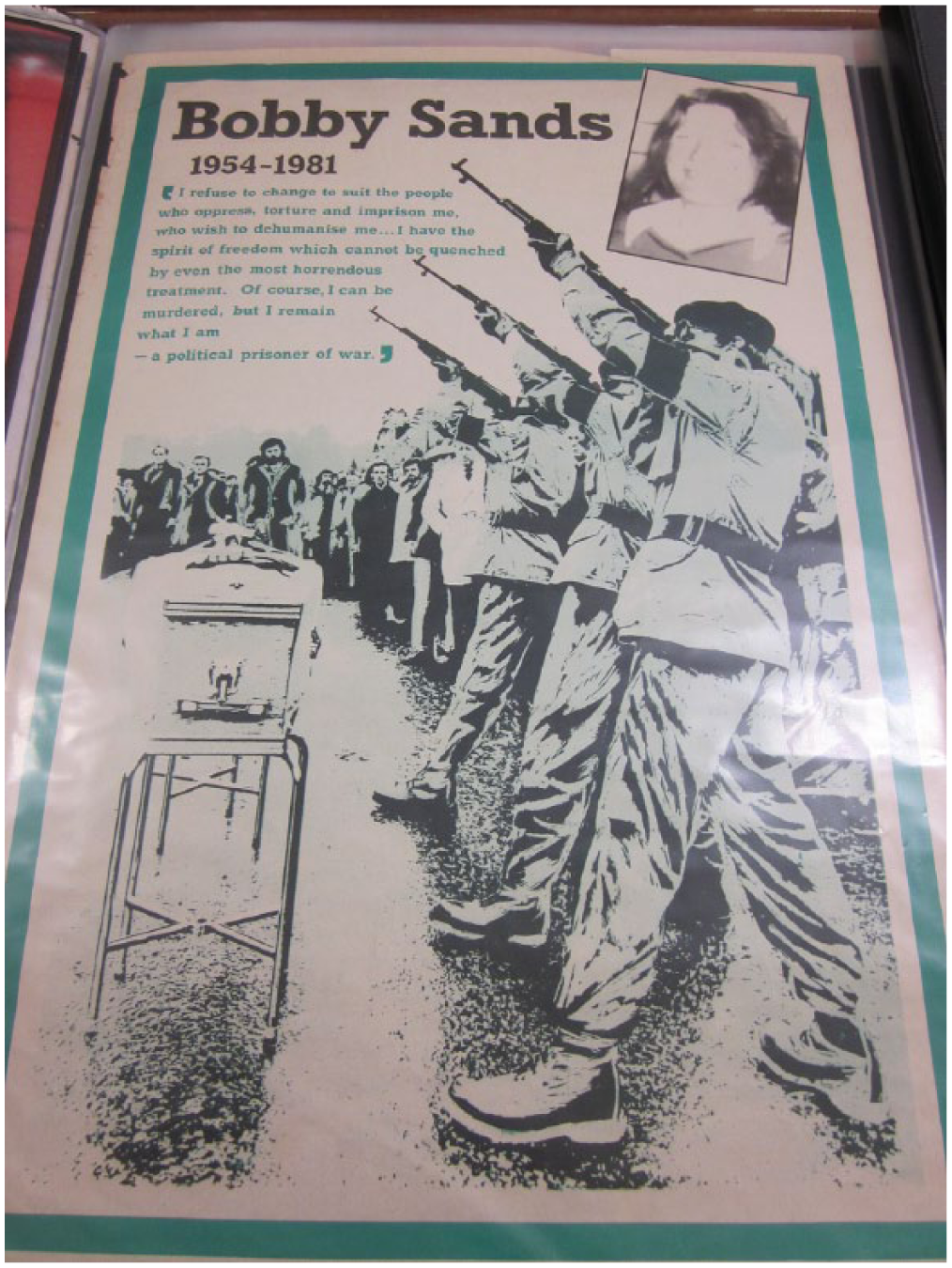
Firing party.
His death was commemorated worldwide and more than 100,000 people lined the funeral route to the cemetery, his final resting place. Many illustrations in the archive display other symbols of Irish Catholicism, including the Celtic Cross and the Easter Lily (a flower the faithful are encouraged to wear on their lapel).
Women and warriors
As noted previously, visual expressions of “the Troubles” tend to be highly gendered and skewed toward masculinity (Dowler, 1998; Graham and Whelan, 2007; Scarlata, 2014). Indeed, most of the archived posters conform to that pattern. Still, various images of Irish women suggest an assortment of social roles. One poster contains an illustration of a woman holding the hand of a small child outside the Long Kesh internment camp. In terms of semiotics and the semiosphere, political tourists (the viewers, or recipients) recognize that the woman is a sign representing motherhood. The scene gives us enough information to assume (interpret) that she is a dedicated spouse intent on visiting her husband (the referent). Moreover, it conveys a message that she has the role of a single parent while her partner is detained. Like so many other posters, the border is trimmed by barbed wire interlaced with the words “internment.” Slightly different terminology is used to highlight a sense of victimhood at the hands of the state: “Free the Political Hostages” (Issued by the Political Hostages Release Committee ’73) (Figure 6). Displaying photographs of cheerful young people is another communicative (indexical) technique geared toward evoking sympathy for the victims of “the Troubles.” The picture of Mairead Farrell has many appearances in the archive. One poster shows her making direct eye contact with the viewers (hence, forming a sympathetic relationship with the audience). The caption identifies her by role, “1st Year Arts Student.” Farrell is also identified as a victim: “EXECUTED by the SAS in Gibraltar.” The poster draws the audience further into the controversy by actively instructing them to “Demonstrate Your Concern, Attend the Funeral.” Adding to a sense of drama, the text also delivers a cautionary tale: “YOU! COULD BE NEXT.”

Free the political hostages.
From there, posters adopt a decidedly militant posture. The “Women’s Roll of Honour: The Ultimate Sacrifice” features a striking image of an armed IRA woman accompanied by a list of those fallen to political violence. Some of the names are placed under the subheading “Oglaigh na hEireann” which is sometimes interpreted as the “Warriors of Ireland,” thereby shedding the victim label. Interestingly, the name of Mairead Farrell (GHQ Staff) appears once again. Farrell’s words proclaim her status as a “warrior”—“I’ve always believed we had a legitimate right to take up arms and defend our country and ourselves against British occupation (IRA Volunteer Mairead Farrell killed on active service 6 March 1988 in Gibraltar)”. The appearance of the IRA women is noticeably stylish. Compared to their male counterparts, often shown in (loose) battle fatigues, these women wear (form-fitting) black skirts, leather jackets, berets, and shades.
The strong role of (paramilitary) women in the struggle is sometimes compromised by the presence of male figures. In one such poster, an illustration of two armed women posing with an armed male comrade is headlined “Oglaigh na hEireann.” Together the subjects form a trinity, or geometry of force. However, the man is standing while the two women take a knee, thereby projecting a male hierarchy even though the women are presented as brave (and skilled) “warriors” (Figure 7). Still, the female contribution to the Republican struggle is frequently commemorated. The Belfast National Graves (organization) announces a lecture on Countess Markievicz, a prominent leader who embodied the social, political, and cultural vanguard of the Irish cause. Her credentials span an impressive range of activism: nationalist, socialist, suffragette, first woman member of the British House of Commons, and the first woman in the world to hold a cabinet position (Minister for Labour, 1919–1922). Markievicz played a prominent role in the 1916 Easter Rising. In addition to designing the uniform of the Irish Citizen Army, she composed its anthem. Markievicz fought in the uprising, and upon arrest she was one of 70 women prisoners placed in solitary confinement. At her court martial, she defended her fight for Ireland’s freedom. Markievicz was sentenced to death but in a clear case of chauvinism she was spared execution (Foy and Barton, 2011). Consequently, she was deprived of martyrdom. Markievicz scolded the tribunal: “I do wish your lot had the decency to shoot me” (Dowler, 2004: 144; see Haverty, 1988; McCoole, 2003; Matthews, 2010). A glamorous photograph of Markievicz projects a dignified defiance. The poster relies on the Celtic cross to convey a degree of divine memorialization; still, the event is dynamic rather than static, featuring drama by Roseleen Walsh (All Welcome!).
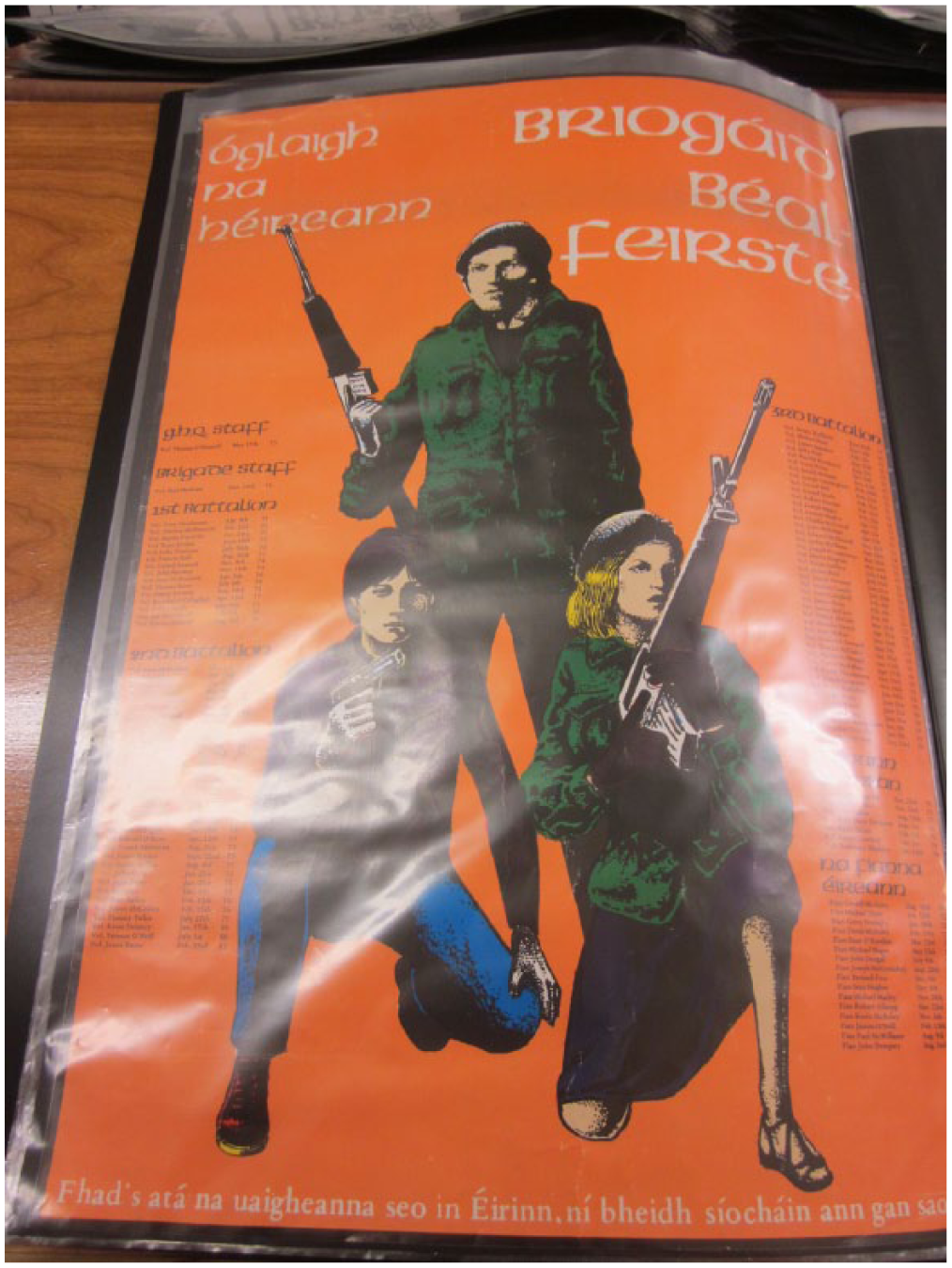
Geometry of force.
Many of the posters in the archive keep attention on the more recent “Troubles” and its residual violence. Here fresh emotional wounds are exposed, including the 1999 assassination of Rosemary Nelson. As a prominent human rights attorney, Nelson had long claimed to have received death threats from the RUC due to her legal work. Posters titled “International Day of Action” bear her photograph. Nelson’s lawyerly image marks a sharp contrast with the “warrior” stance of the IRA women. Another symposium, “Murdered Fighting for Justice: International Women’s Day” (2011), remembers Nelson alongside Rachel Corrie. In 2003, Corrie (a 23-year old American activist) was crushed to death by an Israel Defense Forces armored bulldozer while protesting the demolitions of Palestinian homes. Contested heritage persists as an important theme for political tourists. Then-British Prime Minister Margaret Thatcher appears in several posters. The distorted face of “Maggie the Murderer” is shown with human skulls tumbling out of her mouth (apparently borrowing from the Khmer Rouge Killing Fields) (Figure 8). In another caricature, Thatcher is mocked through the repetition of her comment: “Sinn Fein winning seats would worry me.” The political message is blunt: “Give her a headache. VOTE ADAMS.”
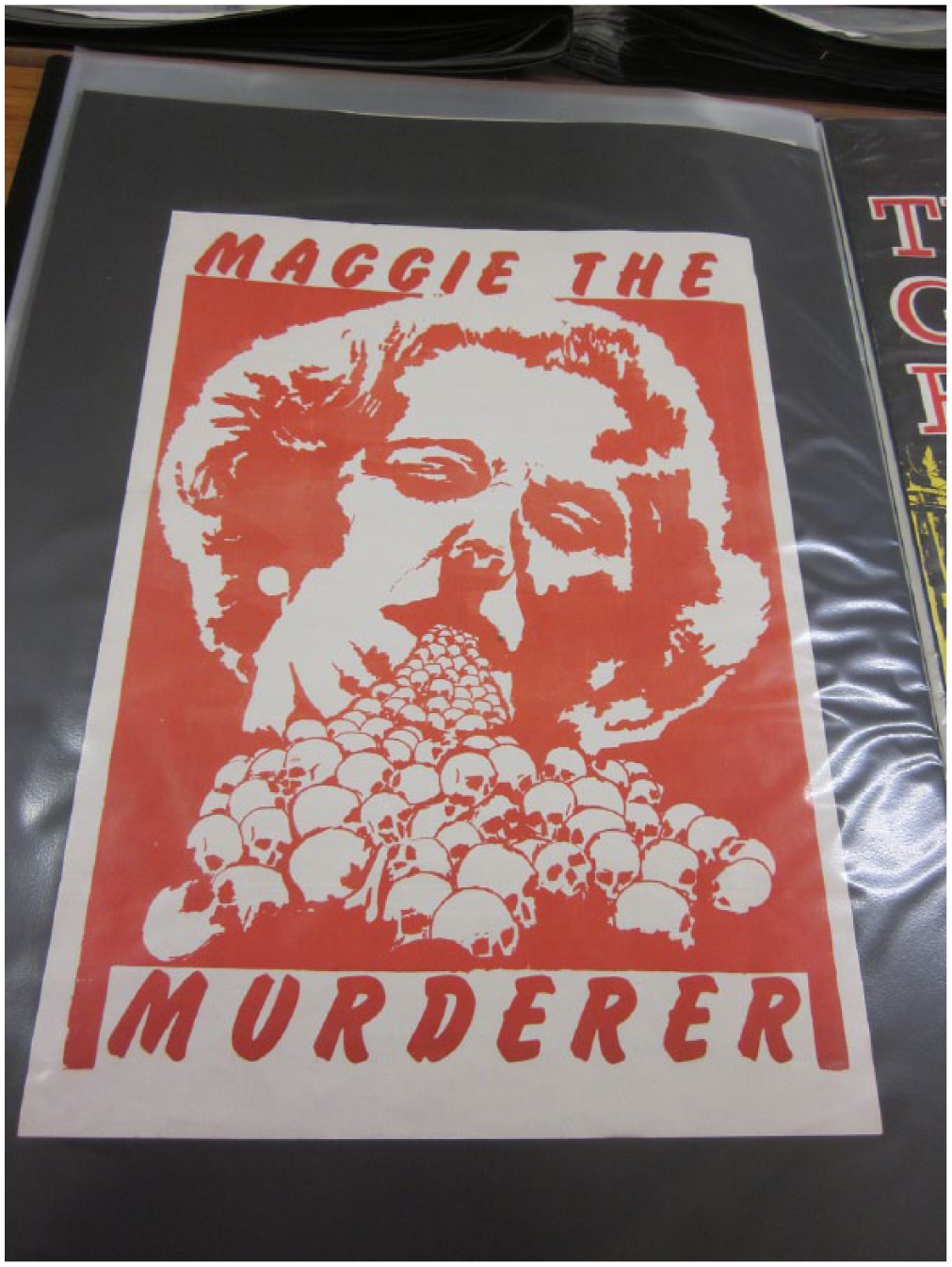
Maggie the murderer.
Perhaps the most iconic expression of the female warrior is discovered in a poster borrowing from the classical French masterpiece by Eugene Delacroix titled “Liberty Leading the People” (1830). Delacroix romanticizes the July Revolution of 1830 in which a bare-breasted woman dramatically raises the French (tricolor) flag in one hand and holds a bayonetted musket in the other. The scene is depicted with controlled chaos as she towers over fallen bodies and defies armed men charging her. At her feet, a young boy adores her majestic courage while another youngster holds up a pistol in choreographed solidarity. The painting’s symbolism is direct. Liberty—also known as Marianne—represents an allegorical goddess guiding France into a new era of Republic Enlightenment (see Boime, 2008). In the Irish version of the warrior, Liberty holds the Republican (tricolor) flag of Ireland. The scene is captioned, “the struggle continues . . . 1989 Ireland.” The work employs a unique semiotic technique in an effort to add a veneer of authenticity to the image. Rather than appearing as a crass rip-off of the revered painting, the poster reveals the original canvas in a manner that reinforces historical continuity between the Irish struggle and that of the oppressed French (Figure 9).
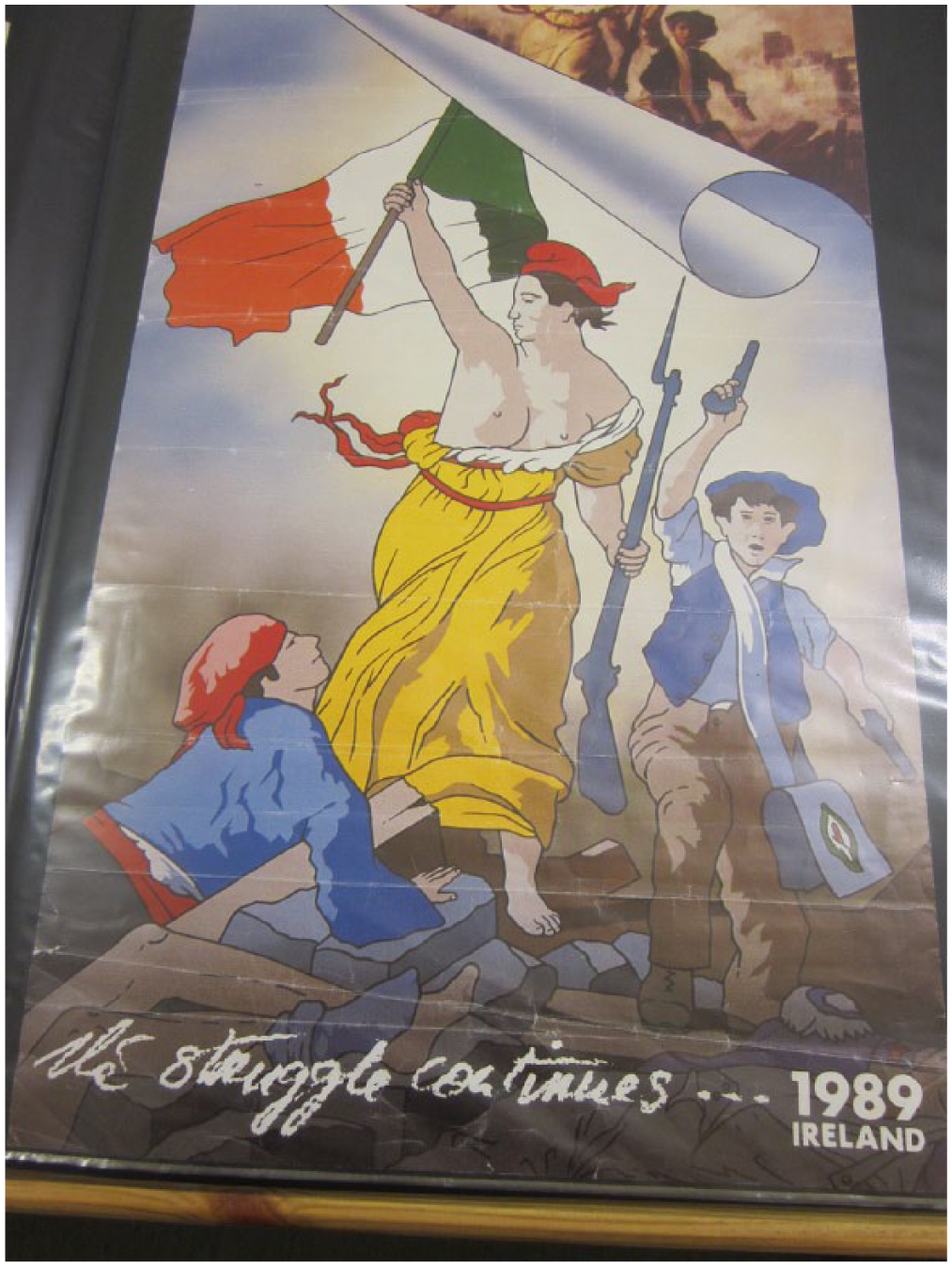
Liberty leading the people.
Great escapes and legends
While many forms of tourism serve as an escape from everyday life, political tourism in Belfast is enhanced by tapping into the social drama of prison escape. Stories of Irish Republican prison escapes are animated with cultural expressions that inspire fellow fighters and widen their international admiration. For Irish culture, prison escapes are an important element of heritage and ritual dating back to the 16th century when Irish clan leaders Hugh Ruadh O’Donnell and Art O’Neil broke away from their English jailers in 1591 (Foster, 1988). In the modern era, McEvoy (2001) explains that for Irish prisoners of war there is a duty to escape (see Prungh, 1955). Defiance is among the chief motives for prison escapes, since in an act of solidarity the escapees join their “fellows in making life as difficult as possible for the authorities” (Cohen and Taylor, 1972: 48). While frustrating their captors, they break boredom, share a collective adventure, and contribute to the war effort. According to an IRA commander: Escapes demonstrate to the British that they cannot imprison our struggle, that it continues behind the prison walls and that despite the might of the war machine, their supposedly escape proof prisons, with determination, skill and patience, our Volunteers can defeat them. (McEvoy, 2001: 49)
In addition to launching a propaganda coup, IRA prison escapes are a valuable source of material and symbolic resistance that serves to ridicule the myth of the omnipotent British state (McEvoy, 2001). Such victories bolster Irish Republican ideology and are celebrated in songs, poetry, and legends that represent Ireland’s long struggle for freedom (O’Donoghue, 1971).
Semiotic displays of prison escapes contained in the archived posters rely on a few different techniques. One poster announces the “1974 Long Kesh Escape & the Killing of Hugh Coney” (2012). The event offers a mix of memorialization and first-hand instruction. The poster explains that Republican prisoners burnt down “the Cages” as a protest against harsh conditions and harassment by the administration, prompting the British army to beat back the internees. In response, IRA officers planned an elaborate escape. The lecture featured Paddy Joe Rice, Fra McCann, and Tony Booster Hughes who described the organizing and digging of the tunnel escape. Rocky Morgan discussed the killing of comrade Hugh Coney as he emerged from the tunnel. Demonstrating the value of visual material in a didactic format, “Former republican internee Joe Doherty will do a pictorial presentation of the 1974 burning of Long Kesh.” The poster includes photographs (or in semiotic terms, indexes) of Hugh Coney and a somber image of the housing units in the cages surrounded by 30-foot fences and barbed wire (see Adams, 1997).
Borrowing the visual dynamics of an action movie, another poster commemorates the 1981 “Great Escape” from the Crumlin Road Prison in which eight IRA volunteers broke out brandishing three pistols and wearing the uniforms of the officers taken hostage. Illustrations show IRA prisoners bursting out of the front gate of the heavily secured prison. With blurry brush strokes, the intensity and velocity of the action dramatizes the escape as prisoners firing handguns knock down officers (Figure 10). A poem honors those who escaped by referring to them as the “M60 Gang,” a four-man active service unit known for their use of heavy M60 machine guns in targeting British military patrols. The gang included Joe Doherty who fled to New York City. There, he became a “cause celebre” as he fought extradition. Doherty’s nine-year legal battle ended with his deportation to Northern Ireland where he was re-incarcerated. His political legacy endures in New York where a public square is named for him, becoming a cultural monument to the Irish Republican struggle (see Dillon, 1992; Greg, 2013).
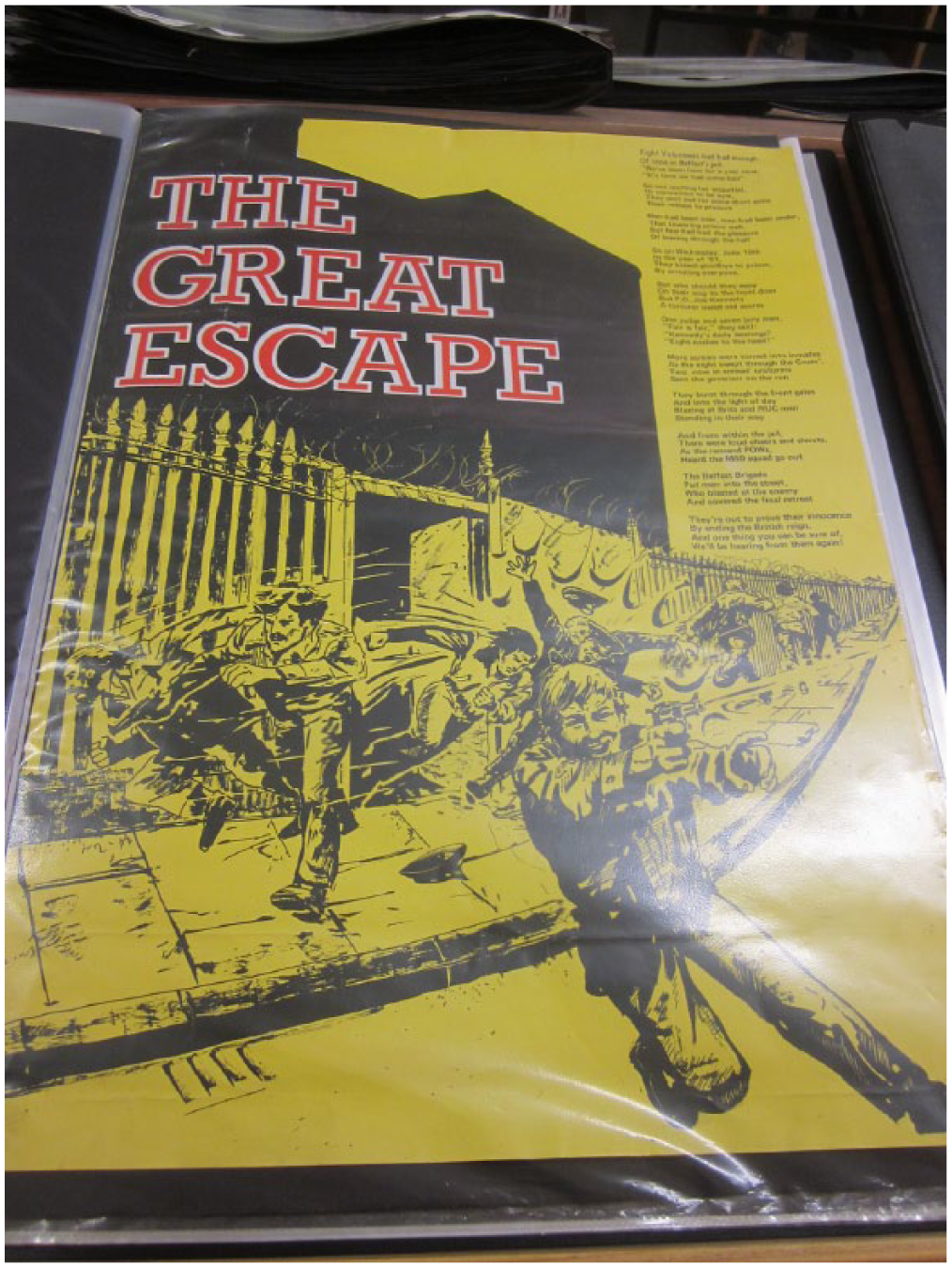
Great escape.
Political tourists gain even greater insight into the Irish struggle as stakeholders boast about the most daring prison escape in IRA history. The event took place in 1983 at the Maze prison, considered the most secure prison in Europe. The fortified institution is located behind 15-foot fences and an 18-foot concrete containment wall wrapped in barbed wire. Solid steel gates were electronically controlled by a state-of-the-art communication system. The escape was carefully organized over lengthy deliberations. As in previous plans, the plot involved the taking of hostages and their uniforms as well as smuggled handguns. In all, 38 prisoners broke out, launching an extensive manhunt into Europe (and the US) that would last years. An upbeat poster reminds us that anniversaries are important cultural markers in Irish Republican history: “THE GREAT ESCAPE: 25th Anniversary, 25 Years to the Exact Day.” A collage of 38 photographs (headshots) document and commemorate each of the escapees. Assembled into a group shot, the image speaks to their collective defiance and shared solidarity. A picture of an H-Block guard tower makes a brooding appearance, thereby symbolizing the role of imprisonment in the British occupation of Ireland.
Conclusion
The “signs of trouble” in the North of Ireland point to several interlocking phenomena, most notably political tourism, the semiosphere, and its boundary. As McDowell (2008: 417) insightfully explains: “Political tourism has an obvious if, as yet, unqualified value, but this lies less in the revenue generated through the actual tours as in the externalisation of Troubles narratives and the consequent sympathy of an external audience.” The form and function of externalization are key to the processes by which political tourists gaze at—and internalize—the performance of signs, or semiosis. Indeed, upon absorbing the sites and symbols of “the Troubles,” especially from the perspective of Republicanism, political tourists return to their own semiosphere where they transmit messages about the history and culture of the Irish struggle. Those versions of contested heritage are accentuated by the presence of the border. As noted throughout, Lotman (2000) recognizes that the boundary is the space at the edge of the semiosphere that both separates and unites. Correspondingly, the boundary is a site of intense semiosis and social drama.
Political tourists are temporarily immersed in a semiosphere containing two sets of boundaries. First, the “Peace Lines” are tangible reminders of ongoing divisions in Belfast between Republican and Loyalists communities. Second, the prevailing narrative on contested heritage is predicated on disputes over the border separating the North of Ireland from the South. Even though the border is currently invisible, due to British de-militarization, it continues to resonate in the popular—and political—imagination. As another potential “sign of trouble,” talks of Brexit have re-activated a sense of anxiety since calls for a border are met with prospects of renewed violence. George Mitchell, the former US Senator who brokered peace in Northern Ireland, has warned there could be “serious trouble ahead” if border checks were reinstated due to Brexit (O’Carroll, 2018). Mitchell goes on to echo messages conveyed to political tourists in which collective memories of the “hard border” are steeped in “stereotyping” and the “demonization” of “others.” Mitchell and other stakeholders contend that peace is often fragile, and that changing attitudes between communities takes years. Asked if a new border could prompt a return to violence, Mitchell did not equivocate: “Yes, there could be serious trouble ahead” (O’Carroll, 2018). According to Lotman (2000, 2005), semiospheres are not static social spaces; rather they thrive on the dynamic (re)production of signs. Especially along the boundary, such semiosis contributes to a cultural atmosphere that gravitates toward the “cosmos” while remaining weary of impending “chaos.”
Footnotes
Acknowledgements
This project benefits from the Rutgers sabbatical program. Many thanks to Tim Newburn and David Lewis (London School of Economics). Likewise, Conor Gearty and Sean Boyle (London School of Economics) as well as Kieran McEvoy and Shadd Maruna (Queens University, Belfast) provided friendly guidance. Special gratitude goes to Laura McAtackney (Aarhus University, Denmark) for outlining the nuances of Irish society. Constructive comments by the anonymous reviewers and Michelle Brown greatly improved this article.
Declaration of conflicting interests
The author(s) declared no potential conflicts of interest with respect to the research, authorship, and/or publication of this article.
Funding
The author received no financial support for the research, authorship, and/or publication of this article.