



Abstract
Following the 2016 general ban on new psychoactive substances, synthetic cannabinoids (‘spice’-type drugs) have moved into unregulated street markets and have become popular among homeless populations in the United Kingdom. Images of so-called ‘spice zombies’, rough sleepers in public spaces experiencing severe substance-induced fits, have been used by local and national media to suggest the growing scale of the problem. This article proposes that such depictions should be read through a cultural analysis rooted in the political economy of austerity policies, where the twofold stigma of substance and welfare dependencies directs guilt at the poor, concealing the systemic cruelty of benefits reforms. Through the circulation of such tropes and the ridiculing of a superfluous abject underclass that embodies them, media and political discourses of the ‘broken society’ highlight an evident need for welfare reduction and more generally for the austerity project.
SPICE it calls you from your deepest depths and if you ignore it then it sends out your worst demons and makes them feel like yesterday. Nightmares you have had as a child, acts of violence you have seen that sickened you, memories of family funerals! You name it, the devil known as spice regurgitates it and amplifies your pain, hurt and fears – they all come back to life in 3D.
Introduction
A woman sits on the ground, one hand propped into the tarmac, the other on the stomach as she convulses, tilting her head back and forward among erratic groans of suffocation. The camera lens approaches and lights up her twitching face, framed by a black hoodie top that draws her silhouette out of the dim background (Figure 1). The 28 second-long mobile phone clip was shot by a man cycling at two in the morning through Midsummer Common, an area of parkland in Cambridge. The local Cambridge News newspaper posted it on its website as ‘shocking “spice zombie” footage’, trusting the cyclist’s assumption that she had taken ‘spice’: ‘I’ve seen documentaries about people taking spice, and that’s exactly what it looked like she’d been doing’ (Elliott, 2017: para. 11); ‘it was like something out of a horror film’ (para. 9).

Still of ‘spice zombie pleading for help’.
A set of photos and clips taken by the Manchester Evening News’s photographers describes ‘a weekday afternoon’ in the city centre’s Piccadilly Gardens square and warns of ‘disturbing images’. Blurred faces and trembling bodies are shown desperately trying to anchor themselves on their feet and to keep from fainting, while others lie on the ground agonising or take refuge inside phone boxes to shake off catatonic fits – all to the tune of everyday business and street life. The title of the lengthy reportage that accompanies the images mentions ‘the pale, wasted figures caught in a Spice nightmare’. The sight of people in ‘zombie-like states’, stumbling around or worse, defecating or vomiting in the street, has become as common to workers in the area ‘as someone selling coffee’ (Williams, 2017: para. 45), the article details.
Such scenes will have become familiar to newspaper readerships in the United Kingdom, more so after the introduction of the 2016 Psychoactive Substances Act (Home Office, 2016). Meant to provide a blanket ban on all new psychoactive substances (NPS) (see Chatwin et al., 2017; Measham and Newcombe, 2017; Potter and Chatwin, 2018), the new drugs legislation was criticised by experts for its ambiguities and potential displacement effects – pushing ‘head shop’ products onto street markets for drugs (Reuter and Pardo, 2017; Stevens et al., 2015), a trend later confirmed by the government’s own assessments (Home Office, 2018). Following a surge in media exposure (Alexandrescu, 2018a), research literature (EMCDDA, 2017, 2018; Ralphs and Gray, 2018; Ralphs et al., 2017; User Voice, 2016) has also observed an intensification of Spice/NPS-related problems among vulnerable populations such as prison inmates and rough sleepers.
Spice-type products, sold globally as herbal blends and smoked like naturally-occurring cannabis (see Griffiths et al., 2010), account for around a quarter (179) of the over 670 NPS monitored at present by the European Monitoring Centre for Drugs and Drug Addiction (EMCDDA, 2018). Drug workers and media reports pointed out that in the UK spice strains, variations of synthetic cannabinoid receptor agonists (synthetic cannabinoids or SCRAs, for short), have been made more dangerous once absorbed into illicit distribution flows, possibly adulterated with other psychoactive substances and varying in potency, further leading to overdoses and aggression among users (Doward, 2017; Lusher, 2017). Spice (used as a general label for SCRAs) acquired the reputation of a ‘zombie drug’ largely from its visible degrading effects on homeless populations in deprived areas of England and Wales.
With it, there has also appeared the media cliché of the ‘spice zombie’, contoured and caricatured through (occasionally reader-generated) images and footage of rough sleepers lying numb on street pavements and doorways or moving chaotically through town centres, overpowered by substance-induced seizures. Such visual depictions of unproductive bodies are situated here in a larger symbolic economy of austerity policies and poverty shaming (Alexandrescu, 2017). They are understood as channelling condemnation of the abject and ‘undeserving’ poor and aiding to legitimise anti-welfare measures as political common sense and cultural consensus (Barton and Davis, 2018; Jensen and Tyler, 2015).
This article traces the stigmatisation of people using spice back to long-entrenched notions of welfare and substance dependence. It aims to show how the troubling symbolism of the ‘spice zombie’ threads through the moral ground of self-abandonment to both addictive substances and state help. This underlies the tensions aroused by the presence and visibility of redundant groups in community or consumption spaces within urban centres, the discomforting social residue of austerity dogma. Synthetic cannabinoids and the misery they cause point to the eroding forces of markets and the systemic disintegration of safety nets and solidarity. Disseminating images of ‘spice zombies’ taken by revolted readers in their living and community environments, parts of the mainstream media invite an affirmation of difference between the deserving subjects of the civilised society and the abject welfare-dependent classes, as well as the indifference of the former towards the suggested self-inflicted condition of the latter.
Addicted to the dole: Dependence and anti-welfarism
Substance and welfare dependencies oftentimes cohabit in the moral imaginaries of austere times. Degrading images of drug-afflicted subjects inhabiting public space are understood here by recourse to the ideological arena of austerity, where Bhattacharyya (2017) notices that culturally mediated structures of feeling tend to direct social contempt at personal failure. Despair is institutionalised under the regime of readjustment and reduction of welfare expenditure – ‘tightening the purse’ or ‘living within our means’ become normative measures of individual worth for those apparently incapable of professing recovery within their own lives.
The modern regulatory ‘drugs’ concept itself ties in with a history of bio-disciplinary techniques aiming to order the lives of unproductive social subjects (Seddon, 2016). Through industrial capitalism and beyond, a dominant discourse of addiction problematised the ‘diseases of the will’ (Valverde, 1998) and the symptoms (waste, immorality, indolence, compulsion) of a spoiled individual rationality touched by alcohol and substance dependence, incompatible with the work ethics of the production line (Levine, 1978; Reinerman, 2005; Room, 2003; Seddon, 2010). This goes on to mark more recent transitions to neoliberal regimes, where drug abuse would add to the ills of deindustrialised economies and to the fragmentation of working-class communities that accompanied the ultimate demise of the post-war British welfare state.
The leitmotif imagery of emaciated, pale bodies on ‘death drugs’ such as heroin, of the physical and moral degradation of youths sharing needles in rundown urban areas, chimed with class fears and stigma in the health and education campaigns of the 1980s (Rhodes, 1990). Poster and television advertisements in the ‘Heroin Screws You Up’ series (see Museum of Drugs, n.d.), for example, typified the opiate user as weak and personally irresponsible (incapable to ‘Just Say No’) but did little to question the need to block out the emotional trauma inflicted by the structural changes and ruthless individualism eroding the webs of solidarity in Thatcherite Britain. A more pragmatic harm-reduction approach eventually came out of the period with the adoption of the ‘Mersey Model’ (Ashton and Seymour, 2010), but the figure of the welfare-assisted, economically redundant addict was to persist.
In the aftermath of the 2007–2008 crisis, austerity measures were pushed by governments as the only way of rebalancing national economies and saving the international financial order. These came at severe social costs. In England alone, with severe cuts to employment and housing benefits in the background, estimates show a doubling of rough sleeper numbers in the first five years (2010–2015) of the Conservative-led coalition government, also coinciding with budget slashes that saw 14 per cent fewer accommodation services and 16 per cent fewer bed spaces available for those in need (McCulloch, 2017). On top of this, numbers compounded by the BBC (Rhodes, 2018) also indicate a £162m (18 per cent) squeeze in drug and alcohol treatment from 2013–2014 to 2017–2018, a period in which recorded drug deaths were significantly increasing year by year.
The popular appeal of austerity, its apparently simple rationale of cutting debt and spending to eventually reboot economic growth, keeps haunting the public and technocratic spheres as a ‘zombie idea’ itself that refuses to be laid to rest, despite numerous historical failures (Blyth, 2013; Quiggin, 2012). Furthermore, the political discourse of austerity as a given empties collective memory of a pre-crisis time while pushing forward the unquestioned necessity of suffering for an unclear future (Bennett and McDougall, 2017; Bramall, 2013). This further serves to blur questions of fairness and culpability – bankers receive bailouts, the poor are stripped of their handouts.
The human toll and wellbeing deficit caused by the violence of the solution (public spending reduction) adds to that of the initial problem (the crisis), typically affecting the most vulnerable in society (Cooper and Whyte, 2017; Stuckler and Basu, 2013). The unemployed, the precariously employed, the rough sleepers and the disabled are now forced to compete with each other in almost market-like conditions to prove they are worthy of the scarce support that remains available. Those least successful are castigated by the popular media as the culprits of their own misery, assuming the futility of welfare allocation and ‘rationalising the very system that causes crisis and austerity politics in the first place’ (Berry, 2017: 20).
News images: Visual metaphors and ideology
The points put forward here are informed by a corpus of 30 images depicting people using synthetic cannabinoids published on the news websites of national and regional/local British media. These were extracted through the Google Images search engine by using the term ‘spice zombie’, covering a period of one year (January–December 2017). The search was only limited to files posted on UK-registered web domains. The corpus was supplemented with selected news texts and videos, to add context to the main theme of interest, i.e. the visible effects of spice use within public spaces.
Of the resulting corpus, 17 images came from national outlets (Daily Mail – 5; Daily Mirror – 3; The Sun – 3; Daily Star – 3; Metro – 1; Daily Express – 1; The Times – 1) and 13 from regional/local outlets (Manchester Evening News – 4; Evening Chronicle – 2; Daily Record – 2; Cambridge News – 1; Evening Times – 1; The Bolton News – 1; The Scottish Sun – 1; Wales Online – 1). The trope of the ‘spice zombie’ lends itself predominantly to tabloid and conservative media formats and it is to this segment that the discussion of such depictions primarily refers. This article concerns itself largely with the potential political impact and wider semantics of such visual items in the British public sphere, in the macro-economic context of recent years.
A critical visual analysis (Kress and Van Leeuwen, 1996, 2001) engages here with news-incorporated images as metaphorical categories. Metaphors act as cognitive maps that bridge past and present events; that can connect lived experience, emotion and meaning to ideology (Lakoff and Johnson, 1980; Wang, 2014). The discursive moulds of prohibition and anti-welfarism code and sediment reading grids of specific visual arrangements – the sight of substance-using bodies connotes contagion and unease, the visible hardships of the extreme poor can become expressions of bare compulsion and surrender to drugs and addiction etc. Metaphorical framings (rough sleepers as compulsive ‘zombies’ ), this article intimates, push and flatten complex life histories into the narrowing schemas of such ideological fields.
Spice and spikes: Rough sleepers in the city
In 2017, newspapers warned their readers of possible encounters with ‘spice zombies’: headlines such as ‘Shocking images show people turning into “zombies” after taking drug Spice’ (Metro, 11 March 2017), ‘UK gripped by zombie drug epidemic as Spice spreads to another city [Cardiff]’ (Daily Star, 23 September 2017), ‘Watch “Spice zombies” stagger around Freeman Street – as one nearly gets hit by car’ (Grimsby Telegraph, 20 September 2017) and ‘Shocking video shows men on “spice” reduced to zombies in Plymouth city centre’ (The Herald, 30 November 2017) became familiar templates locally and nationally. User-shot street photos and footage added to collectively imagined geographies of insecurity around public squares and shopping areas that would turn familiar places into eerie, unpredictable spaces.
Media tropes of public disorder are tied into the fabric of consumer culture. Concentrations of fringe groups around concentrations of capital in urban consumption and transit areas invite public anxieties around violations of good behaviour. They also stir up ontological anxieties about the civilising force of capital itself. As the anthropologist David Harvey (2010) observes, conquering and ordering space is the essential motif of bourgeois utopian desire, the ultimate dream of civilising the unruly essence of external (natural) and internal (human) conditions. The spectacle of the commodity (shopping malls, market streets etc.) can only be reassuring when concealing the class ‘other’, the useless consumer ‘leeching off’ the rationality of capital (begging, loitering) in the public sphere (Harvey, 2005).
This is why the rough sleeper’s visibility is disturbing, more so in its substance-dependence guise; it is the denial of individual autonomy and rationality, essential qualities of the liberal subject. In the British political arena of austerity, where welfare dependence is said to produce social breakdown, the homeless are the visual symptom of the otherwise concealed ‘other’ moving out of traditional sites of territorial stigma e.g. sink estates or ‘welfare ghettos’ (see Slater, 2012; Wacquant, 2008). The ‘broken Britain’ narrative (Hancock and Mooney, 2013) pushed by Conservative politicians, government agencies, affiliated think tanks and pundits signals here both a failure and a need to contain the ill-behaved post-industrial underclass that swells up rough sleeping numbers (see also Haylett, 2001; McKenzie, 2015; Raisborough and Adams, 2008).
The spectacle of homelessness appears as a blemish on the spectacle of middle-class aspiration and abundance – ‘within the sea of consumption, the bodies of the visible homeless can appear as island nightmares’, as Gerrard and Farrugia (2015: 2231) contend. The visual discourse of homelessness, the same authors observe, is crafted in mainstream media and pop culture but played out in everyday contacts, in avoidance or sympathy, in violence or empathetic exchange. ‘Defensive’ urban architecture, for example – spikes and railings, curved or segmented benches meant to deter sleeping and long stays – is increasingly present in cities (McVeigh, 2016), but oftentimes resisted by locals who cover anti-homeless spikes with cushions, for example (Bardsley, 2017).
In the cultural net of austerity, however, displays of solidarity can seem increasingly out of place and out of purpose. Social media trends such as ‘selfies with homeless people’ (Winchester, 2014) caught some momentum, young people taking photos of themselves with rough sleepers passed out in public spaces, though they were generally met with condemnation across the world and across the media spectrum. But resistance to symbolic violence is conditioned by the moral capacity to project the existence of homeless people as different, but still human (see Hodgetts et al., 2006). Press portrayals of ‘spice zombies’ as threatening and disgusting presences deny the destitute person’s identity as victim and human.
Media frames prompt expectations of unpleasant brushes with undesirables. ‘Watch as drug Spice reduces men to zombies on busy city streets’, the local Devon Express & Echo newspaper (11 September 2017) invites its online readership (Waddington, 2017). Two men, ‘shuffling zombies’ (para. 2), are seen in a half-minute amateur clip of police officers approaching and trying to reason with them in Plymouth city centre. Their chaotic inner states contrast with the effervescence of the street, their purposeless stagnation out of time and community life. ‘Oh how we need President Duterte over here as a Narcotics Minister’, a reader comments, unsubtly referencing Philippines president Rodrigo Duterte’s mass extra-judicial killings of people who use drugs (see Human Rights Watch, 2017) as a response to such unwanted presences.
Representations of abject bodies stem from and feed back into the moral metabolism of street life. The sociologist Zygmunt Bauman refers to this as ‘ambivalent territory – the site of danger as well as freedom’ (Bauman, 1995: 127). The imagined space of the street is populated by two-faced strangers. The figure of the unknown stranger is pleasure and seduction, the freedom of random encounters, the denial of all commitments. But it is also menace and danger, the horror of uncertainty and the dread of dissolution. Substance users and rough sleepers are trapped in such an ‘adiaphoric’ space of visceral encounters, as Bauman indicates, where the gaze only engages others in snapshot encounters, refusing to cling on or penetrate beyond the skin into the nature of the other.
Sites of the abject (and mass-mediated images of it) turn ambivalence into immediacy. Disgust both attracts and repels the gaze towards the site of the unpleasant. It grips the viewer, arousing curiosity but also the fear of instant contamination. It references the chaotic and perishable matter of uncivilised, ‘animal bodies’ (Nussbaum, 2004) that hides behind civilised displays of communal life (such as the naked, mucky or purulent bodies of the homeless), but it also flirts with the freedom of absolute negation, with the complete collapse of norms and order (Korsmeyer, 2011). Disgust is urgent. It calls for an immediate reaction to contain the disgusting and irrational object’s visceral disturbance and contamination potential.
The abject carnality and deficient rationality of the substance-dependent rough sleepers that come to inhabit media and urban imaginaries, polluting the recovering body of the nation, serve as tell-tale signs of the decivilising, corrosive effect of individual weakness and over-reliance on welfare, further justifying austerity and its moral schema of forced suffering and personal responsibility as the only path to rehabilitation.
Degrading substances: Stigma and social abjection
The visual and textual grammar through which substance-using bodies are depicted marks them as impure outsiders, when the people who use drugs are perceived to be of lower social strata (Huggins, 2010; Linnemann and Wall, 2013; Scheibe, 2017). Dehumanising rhetoric not only ignores the lived experiences and suffering of those whose lives are scarred by poverty and substance abuse, but also desensitises public opinion towards the systemic, symbolic and oftentimes physical violence directed at them. As the Global Commission on Drug Policy notes in one of its most recent reports, ‘two narratives of drugs and people who use them have been dominant: one links drugs and crime, the other suggests that the devastating consequences of drug use on an individual are inevitable’ (Global Commission on Drug Policy, 2017: 8).
The stigmatising language and conservative tropes that equate ‘drugs’ with crime and personal failure are rooted in structural inequalities, material deprivations and social injustice (Alexandrescu, 2018b). Seeping, diseased individual bodies that repulse the social body are historically those of classed, ethnic or gendered groups (Ahmed, 2004; Skeggs, 2005). Drugs further mark them out and sink them into marginality and abjection. It is because people who use spice are primarily poor and powerless, just like the ‘junkies’ who used heroin, crack cocaine, crystal methamphetamine and other ‘lower class drugs’ (that most degrade the subject’s physical and social image) before, that they are made to seem less than human and less than civilised – ‘the word zombie implies these people are diseased inhuman shells with no reason or emotion’ (Llewelyn, 2017: para. 1).
The prevalence of zombie narratives within pop culture speaks to the fetishisation of the destructive potential and cannibalistic brutality of class relations in contemporary capitalism (Vint, 2017). In a Marxist sense, abject flesh-eating posthumans erring between life and death would embody the squalid and lifeless existence of industrial labour. Along with George Romero’s (1978) Dawn of the Dead, the ‘shopping-mall zombie’ becomes more of an avatar of late modern consumer afflictions. Shopping addictions, ‘black Friday’ frenzies and shop floor fights, credit card abuse, obsessive hunting for sales promotions and other such pathologies now point to the existential dread of compulsive consumption : ‘The violence, wastefulness and instinctive serial consumption of the zombie makes it, like the serial killer, a gothic projection of the commodifying fury of late capitalism’ (Jarvis, 2007: 343).
The ‘narco-zombies’ of the newspapers covering spice are, on the other hand, not hyper but deficient consumers just as they are deficient citizens or clandestine inhabitants of the streets, shopping areas and other supposedly ordered spaces of consumption. Their compulsive desires are only geared towards the one commodity that dilutes to eventually numb down the urgency and relevance of all other appetites, the synthetic drug. They come across as the nihilistic refusal and negation of the rationalising drives of free markets and consumer choice. They taint the order of communal spaces through chaotic movement or unpleasant excretions of their bodies, vomiting or defecating in plain sight.
In one picture among a larger series (Daily Mail, 10 March 2017) capturing ‘zombies’ ‘with sunken cheeks and white skin covered in sores’ (Malone, 2017: para. 1), a young man with blond dishevelled hair seems frozen in time, his face leaning towards the cobbled ground as if pulled by a heavy magnet, limp arms framing his torso and hips as if to signal unconditioned surrender (Figure 2). His grey tracksuit is tattered and stained, a large hole ripping through the fabric folding over his left thigh. Passers-by in the background seem to move towards his inert, barely standing body, their unitary flow in contrast with his uncanny stagnating presence. Some look at him, others appear to purposely avoid him. Readers and viewers gaze at the man from behind the filter of their screens, watcher and watched kept at a moral distance.
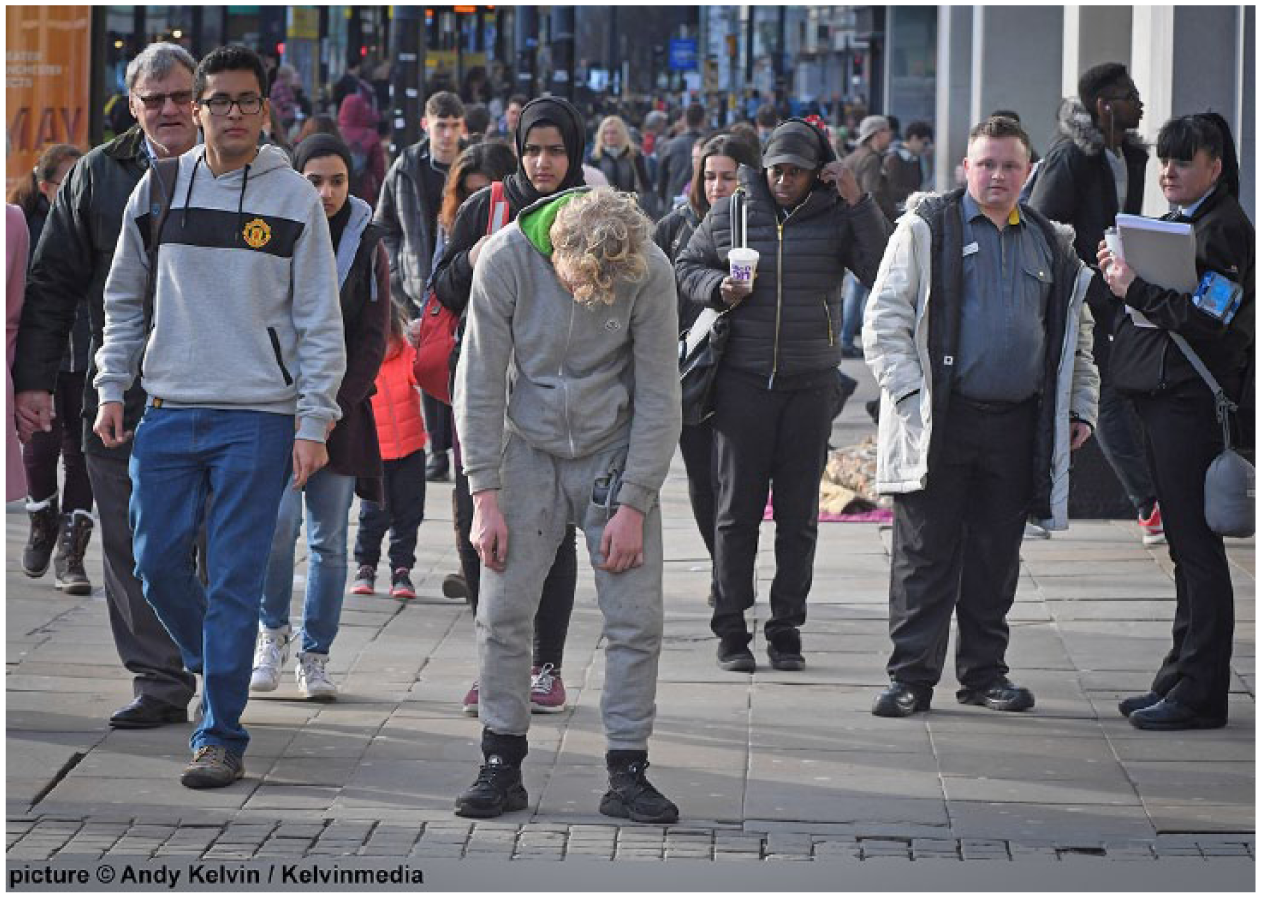
Image in a reportage on the ‘rise of zombies’.
The image conceals the turning points, events and circumstances that brought the inert body of the man into that one particular moment, captured by the still. As Kress and Van Leeuwen (1996: 168) suggest, ‘seeing has, in our culture, become synonymous with understanding’. In the mass-mediated liquid surveillance and remote ‘voyeurism’ of the digital universe, there is rarely any significant exploration of the other (Bauman and Lyon, 2013). Images make themselves self-evident. They block out alternative readings in their purported shock value that with each repetition, in each instantiation of people captured in zombie-like states reminiscent of pop culture mythology such as Romero’s ‘living dead’ or Frank Darabont’s more recent Walking Dead (2010–), invites existential angst.
In his ethnographic work on the homeless of Paris, the psychoanalyst Patrick Declerck discusses the dehumanising effects of destitution on those living on the streets for long periods of time – ‘empty men and women, stripped of themselves and of their history’ (Declerck, 2001: 308). He observes many who somehow fade away into their own corporeality. They ignore broken bones without medical treatment for days or they wear the same socks for months until textile fibres chew into the skin tissue down to the bone and almost merge with the limb they were stretched on. These are not psychotic or schizophrenic people, he adds. They just appear to have faded out of their bodies, to retreat from the possibility of pain by negating the very carnal existence that affords it.
Synthetic cannabinoids, as other mind-altering drugs before, open up another escape hatch, a catalyst to that process of voiding the self. Similarly, it must be observed, stigmatising images do not only capture and convey, but in a sense they also imprint or superimpose themselves onto the abject body of the rough sleeper. Shame latches onto the pores of selfhood, impossible to scrape off without dissolution, the shattering of one’s ego and life history.
Vinnie, one of the characters in Peter Morgan’s novel The Spice Boys, notices of those trapped in the care-prison-homelessness cycle, as himself: ‘We don’t live in the same society and by the same rules as Joe Public’ (Morgan, 2017: 112). This can mean ‘having fuck all to lose’ and violently standing up to ‘normal’ society, as when ‘lads from London’ partying at a nearby club want to come film into rough sleepers’ tents in central Manchester, to put it on YouTube and ‘humiliate someone who is in their lowest ebb’ (Morgan, 2017: 122). But it can also mean resignation and total surrender to ‘the demon known as spice’ (Morgan, 2017: 52–53), as with most real-life headlines and street photos of ‘spice zombies’ coming out of the city, where the four young homeless protagonists of the novel tragically try to survive.
Media rituals tap onto everyday frictions and frustrations, but can be echoed in damaging ways on the ground. As the journalist Max Daly (2018) documents, web and social media pages posting footage and photos of people collapsed in urban areas have amassed tens of thousands of followers in recent years. Visitors contribute their own materials. In some of the clips, those being filmed are shouted at, humiliated by having thrown cold water thrown at them or even attacked by members of the public. Sometimes the content is picked up by tabloid media and the social media feeds attract hateful comments, tolerated by the webpage administrators who in one instance refer to the platform as ‘serving the public interest’: The majority of followers are supportive and hate the Spice users with a vengeance. They are disrupting the public by sitting around in the streets with their head in the gutter, dancing around in front of women and children, puking up and aggressively begging to buy more Spice. People are having to walk past them with their children or on their way to work. (Founder and admin of the Spice Heads webpage, cited in Daly, 2018: para. 16)
To counter trends like these, one local authority, Sheffield City Council, resorted to launching a social media campaign itself, asking residents not to take and share demeaning photos of persons feeling ill after having taken synthetic cannabinoids (Lowe, 2018). In one extreme case of aggression reported by the press (Hayes, 2018), a local Barnsley man was sentenced for the killing of another man who was lying unconscious in a public garden, by stamping on his head. The assailant had reportedly told witnesses he had had enough of spotting ‘spice heads’ in the town and was planning to wait for the CCTV cams to point another way to take action. Chains of causality that link mainstream reporting, social media shaming and grassroots violence cannot be established beyond the specific circumstances of such violent outbursts, but homeless people are doubtlessly the easiest of targets for public anger.
Arguably, within the larger context of ideologically imposed austerity, it is not only ‘Joe Public’ who sees fit to direct (symbolic) violence at the vulnerable. The production and perpetuation of shaming labels also become forms of governmentality. The state itself ‘weaponises’ stigma (aided by political and media voices) to point at the moral deficits of those deemed culpable for their own troubling condition (extreme poverty, lack of shelter, disability, work incapacity, migration status etc.) and deflect collective responsibility towards the individual (Scambler, 2018). Working on Goffman’s (1963) stigma concept, Tyler and Slater (2018) observe that even though stigma arises in micro-interactions, it also tends to emerge within specific social settings and around particular socio-historical conditions.
With ever-deepening inequalities and precariousness (Schrecker and Bambra, 2015; Tombs, 2017) on one side, and the humiliation of poverty in a consumer culture where the incapacity to buy and show is one of the cruellest forms of disenfranchisement (Bauman, 2007; Hall et al., 2008) on the other, government mobilisation of stigma towards the dispossessed takes the neoliberal project further in undermining the foundations of welfare regimes, dissolving collective responsibility and solidarity (Shildrick and MacDonald, 2013; Tyler and Slater, 2018). In the mediation of state-sanctioned stigma, news audiences can increasingly contribute not only as active or tacit purveyors of exclusionary strategies (humiliating rough sleepers or turning a blind eye to abuse) but as producers of meaning and contributors to the engineering of anti-welfare consensus.
‘Zombie spotting’: Crafting (in)difference
Projections of shared spaces in media narratives of urban disorder shape expectations of discomforting encounters for those transiting the streets. But they also shape reflexes to capture and evidence the strange crossings of paths when they do occur. In the case of the young woman filmed in Cambridge in a presumed synthetic cannabinoid-induced fit (Introduction and Figure 1), the cyclist who took the footage recalls: ‘I cycled past her, and my sister did, then I decided to go back and get some pictures of her on my phone. I thought no one would believe me if I told them what I’d seen’ (Elliott, 2017: para. 8). To witness without recording in a networked universe of sharing media and ‘citizen journalism’ is to not have witnessed at all.
Like the cliché of the ‘spice zombie’, the raw but contextless realism of audience-generated visual materials parallels wider blueprints of pop culture aesthetics. ‘Found footage’ horror films, from the now classic Cannibal Holocaust (1980) and The Blair Witch Project (1999) to the later [REC] (2007), Paranormal Activity (2007) and Cloverfield (2008) franchises, operate on the fictional assumption of video recordings found after the disappearance or demise of the characters who had produced them, no longer around to tell the story and give context to the images left behind – hinting at the horrible events that preceded the discovery of the footage.
The genre plays on the dismantling of conventional edited narrative framing but also relies on a ‘knowing suspension of fictionality’ (Heller-Nicholas, 2014: 7). Film audiences dive into ‘hypermediacy’ – the ‘beefing up’ or augmentation of the medium (consumer-available technology such as surveillance, handheld or mobile phone cameras) – to explore imaginary ‘what ifs’ (monsters, cataclysms, visceral brutality) but also to acknowledge the premise that the medium itself cannot be ordered or controlled. The rawness and randomness of sequences are the story. The rawness of the medium also mobilises emotion and aesthetic realism in the news media context of incorporating user-generated footage, but audiences here are asked to operate in reverse and take part in, not retreat from, the construction of fictionality.
It is through fiction framing and pop culture reference that the Cambridge cyclist recognises the woman in front of his eyes as something ‘out of a horror film’ (Elliott, 2017: para. 9), being ‘sure she’d been taking spice’ (Elliott, 2017: para. 11), and the newspaper editors present the footage as what is believed to be ‘a “spice zombie” pleading for help’ (Elliott, 2017: para. 1). It is through script familiarity that three men ‘slumped on pavement in town centre as children play nearby’ (Mirror, 15 June 2018) are given the same label when a photo recently taken in Bridgend, Wales goes viral on social media and catches the attention of nation-wide media. Repetition of shaming rhetoric allows those witnessing (watching, filming or photographing) to deny responsibility for the shamed (Llewelyn, 2017).
Through media fictionalities – amateur footage contextualised by wide-audience media via ‘spice zombie’ symbolism – the felt reality of suffering for poor people who use SCRAs is pointed back at them, abstracted from the social and economic conditions that will have worsened it. In mediated acts of ‘zombie spotting’, their difference from us (‘not like us’) and our indifference to them (‘they did it to themselves’) are affirmed and confirmed. Similar to the staged realism and ‘spontaneity’ of the ‘poverty porn’ genre of ‘observational documentary’ that became popular at the height of the Conservative ‘broken society’ austerity governance, e.g. the BBC’s We Pay Your Benefits (2013), Channel 4’s Benefits Britain (2014) and Channel 5’s On Benefits and Proud (2013) series, they sediment doxa or taken-for-granted knowledge around the moral causes of worklessness and dependence as individual failures.
Bad spending habits of benefits money, substance use and destitution appear as self-evident truths, as the obvious need to cut down on welfare generosity (Jensen, 2014). ‘Poverty porn’, in its imagined link between state provision and selfish desire, excess and criminality, works to fictionalise the suffering of poor people ‘on the dole’ for the bemused gratification and self-assurance of mass audiences who can revel in the certainty that they are not like those shown on screen. Against a visual politics of austerity suffering and free-market ideology as the necessary and only possible configurations of managing a sense of perpetual crisis (Barton and Davis, 2018 – see also Mark Fisher’s (2009) discussion of capitalist realism), ‘observational reality’ snippets such as those capturing the homeless in substance-induced convulsions also imply the reassurance of difference.
‘Spice zombies’ are ridiculed as the latest addition to a long line of ‘anti-welfare national abjects’ (Jensen and Tyler, 2015: 486): ‘skivers’, ‘chavs’, ‘benefits broods’ etc. Technologies of control rely on technologies of consent, further aligning government, expert and media narratives with the lived experience of everyday life for their targeted audiences. As mainstream conservative politics slip further away towards the hard right and continue to invite condemnation towards working-age welfare recipients (and other problematic categories, e.g. economic migrants, refugees), grassroots displays of shaming rough sleepers on synthetic cannabinoids and other vulnerable populations strengthen consent and project acquiescence to the austerity project.
Conclusions
With no end to suffering in sight and difficult times of instability on the horizon as the United Kingdom prepares for what now appears a rather disorderly departure from the European Union, social inequalities and state-sanctioned stigma around forms of hard poverty are likely to persist and deepen divisions on the side of another emerging sense of crisis. Critical-cultural criminologists and media scholars should further interrogate how public discourse intersects with political economy around issues and sites of social marginality such as substance use, work incapacity and homelessness to impose more deprivation onto the weakest.
The economist and former Finances Minister of Greece at the time of the third debt bailout of the country in 2015, Yanis Varoufakis (2017: 40), writes in his political memoir Adults in the Room: My Battle with Europe’s Deep Establishment that austerity would be an awful economic policy if it were an economic policy at all: ‘Austerity is a morality play pressed into the service of legitimising cynical wealth transfers from the have-nots to the haves during times of crisis, in which debtors are sinners who must be made to pay for their misdeeds’. As wealth is further concentrated bottom-up, guilt cascades and echoes top-down into the lives of the poor, who are asked to foot the bill – be it some of Europe’s poorest taxpayers whose governments end up covering bankers’ bad bets on toxic bonds because the banks are ‘too big to fail’, or more domestically through the continuous rollout of welfare reforms.
Fear and isolation often lead rough sleepers into toxic behaviours of alcohol or drug use. Almost half in a sample of 458 interviewed by the homeless charity Crisis (2016) reported being intimidated or threatened with violence, around a third being the victims of physical violence, while in some cases they experienced acts of humiliation such as being urinated on. Universal credit (the merging of unemployment, tax, housing and other benefits into a single payments system) has already made many claimants worse off and risks pushing many more into homelessness and reliance on food banks and charity assistance (Trussell Trust, 2017).
Charities, local councils and progressive media have long been raising concerns about the now close to a decade of austerity programmes and the increasingly visible manifestations of extreme poverty and hopelessness. Media-driven anti-welfare cultural sentiment and vindictive attention to the ‘lost souls’ of the city gather particular force throughout periods of tectonic shifts in economic conditions and tightening fiscal policy, as the pairing of opiate-induced oblivion and (government-forced) deindustrialisation in the politics of condemnation of the 1980s reminds us. Class prejudice separating the worthy working poor and the undeserving dependents stands out as a staple of British public and political discourse. It flows down into everyday life and yet again finds roots in the ethics of self-interest and individualism proposed by our neoliberal times (Valentine and Harris, 2014).
To this extent, critical research itself can inspire more humane ways of relaying the hardships faced by some to the general public, to expose the toxicity of stigma governance and the popular myths that can become unchallenged knowledge. In doing so, it can hopefully begin to imagine empathetic collective responses to their troubles, fostering consent and consensus around the mutual responsibility and moral obligation to do something for others, instead of dismissing, ridiculing or looking away.
Footnotes
Declaration of conflicting interests
The author(s) declared no potential conflicts of interest with respect to the research, authorship, and/or publication of this article.
Funding
This research received no specific grant from any funding agency in the public, commercial, or not-for-profit sectors.
