



Abstract
The Transforming Rehabilitation reforms implemented in England & Wales in 2014 witnessed the transfer of responsibility for a large proportion of the work of the public sector probation service to 21 newly created Community Rehabilitation Companies (CRCs), which were contracted out to a range of providers dominated by private sector interests. This part-privatisation of probation services has raised important questions about the legitimacy of the new organisations in the eyes of both internal and external audiences, and about the ‘legitimation work’ that the CRCs might engage in to address any legitimacy deficits they themselves perceive. This article presents the findings of an analysis of the websites of all 21 CRCs, and considers what these externally facing representations of the CRCs suggest about legitimation work in the private probation sector. Our analysis suggests that CRCs use some of the same strategies of legitimation that have been found in another ‘tainted trade’ – the private security industry – and are similarly ambivalent about what – and to whom – they are marketing their ‘business’. We suggest that our analysis sheds new light on old questions about how the somewhat intangible goods of probation work can be captured and communicated to a mixed constituency of potential stakeholders, as well as raising new questions about the role of websites (and other marketing materials) in that endeavour.
Introduction
Despite being a major part of the criminal justice system, responsible for the supervision of more than 200,000 offenders each year, the probation service in England and Wales has been characterised as a relatively ‘invisible trade’ which has been poorly understood by other actors in and beyond criminal justice (Mawby and Worrall, 2013; Pithouse, 1998). Not only is probation an occupation that is conducted largely beyond public view, it has also traditionally lacked a powerful voice capable of communicating, at a national level, its mission, its successes and its challenges (Mawby and Worrall, 2013). This absence of a strong national identity, and the hidden nature of the work, are some of the reasons that probation has also been relatively neglected by penal sociologists, who have tended to focus their attention on the prison (McNeill, 2019; Robinson, 2016a). It also helps to explain how the Coalition Government was able to push through its Transforming Rehabilitation (TR) reforms (Ministry of Justice, 2013), which radically restructured the service, relatively easily and quietly (Robinson, 2016b).
The TR reforms swept away 35 public sector probation Trusts and replaced them with a new two-tier structure: a much smaller public sector National Probation Service (NPS) (primarily responsible for the supervision of high-risk offenders and the provision of pre-sentence advice to courts) and 21 new Community Rehabilitation Companies (CRCs) responsible for supervising low-medium risk offenders). As part of this process, more than half of the work – and workforce – of the public sector probation service was transferred to the 21 new CRCs which, in 2015, were contracted out to a range of providers dominated by private sector interests (Robinson, 2016b).
This significant transfer of responsibility for the delivery of public probation services to the private sector raises important questions about the legitimacy of the new organisations, in the eyes of both internal and external audiences (Robinson et al., 2016). Although probation work, with its focus on engaging with stigmatised groups of people, has been understood as a type of socially tainted, ‘dirty work’ (Mawby and Worrall, 2013: 8), its relocation in the private sector suggests that it might now attract a new ‘moral taint’, at least among some of its constituencies. While limited research on workers’ experiences has been conducted since TR, there is evidence to suggest that the part-privatisation of probation services – and the idea of ‘probation for profit’ – has been a source of discomfort for at least some of those whose roles (as workers) have transferred to the new CRCs (e.g. Robinson et al., 2016; Deering and Feilzer, 2015; Walker et al., 2019). However, less is known about perceptions of the private probation sector beyond its internal constituency of employees, nor about how the CRCs have sought to construct and communicate their purposes, values and identities as new and legitimate organisational entities, to a potentially wide range of stakeholder groups.
In this article, we focus our attention on those processes of identity construction, and consider how – and to whom – the new CRCs have sought to communicate ‘legitimate identities’ (Ashforth and Gibbs, 1990; Barker, 2001; Robinson et al., 2017). To this end, we draw on recent research in the field of private security, which has addressed similar questions about legitimation work in a ‘tainted trade’ (Thumala et al., 2011; White, 2010, 2014). However, we depart from the methods used in this extant body of research, 1 turning instead to the websites of the 21 CRCs. These websites, we suggest, constitute the main vehicle through which organisational identities are communicated to external audiences and open a window on the ‘activity of legitimation’ (Barker, 2001) embedded in that process of communication. To the best of our knowledge, this is the first study to systematically examine the websites of probation services in England and Wales – and possibly internationally.
The article begins by setting the scene for our analysis, with a brief overview of the TR reforms as the latest and most radical of a series of organisational changes in the Anglo-Welsh probation field. We then outline our methodology, which was inspired by Pauwels’ (2012) multi-modal framework for website analysis. We go on to present our findings in three main sections which address, respectively, representations of organisational identity; representations of the ‘core business’ of the CRCs; and the construction of ‘audiences’ or ‘consumers’ of probation work. In our concluding discussion, we draw together our principal findings in respect of what the analysis appears to tell us about the legitimation of probation work in the private sector. We also consider the limitations of our research and suggest some avenues for future enquiry.
Setting the scene
The English and Welsh probation service is among the longest established in Europe (Vanstone, 2004), but its recent history is one characterised by significant and rapid change. Not only has the service been exposed to the influences of the kinds of broad social and political developments which have affected the punishment field more generally (such as a ‘punitive turn’ in penal policies; the growth of managerialism and the rise of risk as a key concept in criminal justice and other public services) (see inter-alia: Garland, 2001; Simon and Sparks, 2012), but it has also been subject to a number of specific strategies designed to change the way it is organised and delivered. In the last 20 years in particular, there have been major changes affecting the organisation and governance of the service, the profile and training of its practitioners, the size and nature of practitioners’ caseloads, and the official purposes of probation supervision (Robinson, 2016b). A particularly controversial development, in the late 1990s, was the severing of probation officer training from its traditional grounding in social work education. This development was instigated by a Conservative Government keen to ‘toughen up’ probation’s image, and it was followed by similar efforts to increase the punitive nature of community-based penalties. With regard to its organisation, the service has been through several major structural changes since the turn of the century. In 2001, the 42 probation areas were drawn together under the umbrella of a NPS for the first time, and then in 2004 the NPS was subsumed into a new National Offender Management Service (NOMS) alongside the prison service. The end of that decade brought further organisational change, with the creation of 35 Probation Trusts in place of the preceding 42 area services.
However, by far, the greatest rupture experienced by the service came in 2014, when the Coalition Government’s radical TR reforms began to be implemented (Ministry of Justice, 2013). A principal objective of this package of reforms was the creation of a market for the delivery of probation services, centred on enhancing innovation, efficiency and effectiveness (Robinson et al., 2016). On 1 June 2014, the TR reforms replaced the 35 Probation Trusts with a new, two-tier structure: a public sector NPS with responsibility for the supervision of high-risk offenders, and 21 new CRCs with responsibility for managing low- and medium-risk offenders. These 21 new organisations were subject to a competitive bidding process which took place in the latter part of 2014, and in February 2015, the 21 CRCs 2 were let by the Ministry of Justice to 8 successful bidders.
The 8 parent companies varied in size and scale, but the majority (n = 7) were dominated by private sector interests. Some of the private companies were already involved on a global level in delivering outsourced government contracts, while others established consortia in order to secure and deliver the CRC contracts. Two bidders (Sodexo Justice Services) and Purple Futures (an Interserve-led company) secured more than half of the CRC contracts between them. Sodexo is a global outsourcing company which was established in France in the 1960s and originally specialised in catering provision. Its subsidiary, Sodexo Justice Services, was founded in 1993 and, in partnership with a national charity (NACRO) it won six CRC contracts. Interserve, another global outsourcing company, led the Purple Futures consortium and was awarded the contract to run five CRCs. 3 Seven further contracts were won by three bidders (Working Links with three; MTC Novo and the Reducing Reoffending Partnership with two each) 4 and the remaining three CRCs were each let to a separate provider: Seetec Justice; EOS Works and Achieving Real Change in Communities (ARCC). Of the eight parent companies winning contracts, ARCC was the only not-for-profit body, comprising a consortium of nine partners from different sectors including local authorities, charities, other philanthropic bodies and social enterprise organisations.
The TR reforms were the subject of vociferous critique from many quarters. Some critics were opposed in principle to the marketisation of public services, particularly within the criminal justice system (Burke and Collett, 2016). The model of payment for CRCs involved initial funding through government contracts and a Payment by Results (PbR) model, where CRCs would be financially rewarded for demonstrable reductions in offending. This model was considered flawed as some argued there would be no way of demonstrating cause and effect – specifically that any reductions in offending could be directly attributable to CRCs (Albertson and Fox, 2019). Others noted the fact that the reforms were based on a false premise, that is, that probation services were not adequately addressing recidivism among people who were sentenced to short prison sentences; pointing out that this cohort was not in fact subject to probation supervision prior to the TR reforms (Cracknell, 2018). 5 One of the most compelling criticisms questioned the logic of dividing services on the basis of risk, given that risk changes over time (Robinson, 2016b) and creating a split in services would result in cases falling through the cracks. By the time that we began our research, the volume of criticisms had increased, as seen by various negative commentaries from a range of quarters including the Inspectorate of Probation, the National Audit Office and the House of Commons Justice Committee (Carr, 2018).
As has been noted in the organisational studies’ literature, all new organisations face challenges in terms of establishing or building their legitimacy (Ashforth and Gibbs, 1990; Suchman, 1995; Zimmerman and Zeitz, 2002). CRCs, as new entities in the criminal justice field, are clearly no exception. But as the above account illustrates, CRCs were faced not only with the ‘liability of newness’ (Stinchcombe, 1965), but also with the liabilities associated with all of the above critiques: not least their displacement of an existing organisational entity which had a long history and established reputation in the public sector. In this regard, it is useful to look to the adjacent field of private security, in which a struggle for legitimacy has been relatively well documented. According to White (2010), the emergence of a private security industry has challenged deep-seated political norms centred on ‘the average British citizen’s expectation that security provision ought to be monopolised by the state’ and free from the interference of commercial interests (White 2010: 174). White has observed that, in an effort to counter this cultural resistance, private security firms have employed a range of legitimation strategies which have centred on conferring upon themselves qualities associated with ‘stateness’. These strategies have included requests for police endorsement, the fabrication of links with police forces, calculated appointments which tap into the ‘old boy’ police network, and ‘symbolic borrowing’ from the police’s authority and status via the issuing of police-style uniforms for private security officers (White 2010; see also White, 2014). Similar practices of ‘symbolic borrowing’ were also found by Thumala et al. (2011) in their interviews with key players in the private security industry. However, their study is also of interest because it revealed among interviewees a surprising reluctance to seek legitimation for their business with reference to the ‘market world’ of wealth and job creation, profits and market shares. Thumala et al. (2011) sought to explain this finding with reference to two factors: first, the idea that ‘security retains a social value which prompts unease and discomfort about its commercial exchange’, and, second, uncertainty about ‘what exactly is being sold’ (pp. 298–299). The latter, they contend, creates a legitimacy deficit and a sense of moral ambivalence among the purveyors of private security.
Methodology
At the outset of this project, we established that each of the 21 CRCs had its own website. These websites were created when the CRCs were established and the websites of the former 35 Probation Trusts were taken down when they ceased to exist. In contrast, the new NPS did not have a distinct web-presence: rather, it is represented on a generic governmental website (GOV.UK) that encompasses a range of government organisations. 6 We therefore confined our analysis to the 21 CRCs and did not separately analyse or compare these, either with the relatively scant information on the NPS web-page, or the websites of the former Trusts (which were no longer accessible). We began by downloading the entire content of each CRC website during a 1-week time-period in January, 2019 using Adobe DC Acrobat software in order to create a PDF of the content of each website. This allowed us to compile an archive of the websites in a particular time period and a database of content in order to undertake analysis. Table 1 provides an overview of the CRCs and their parent companies in January 2019.
The 21 CRCs and their parent companies.
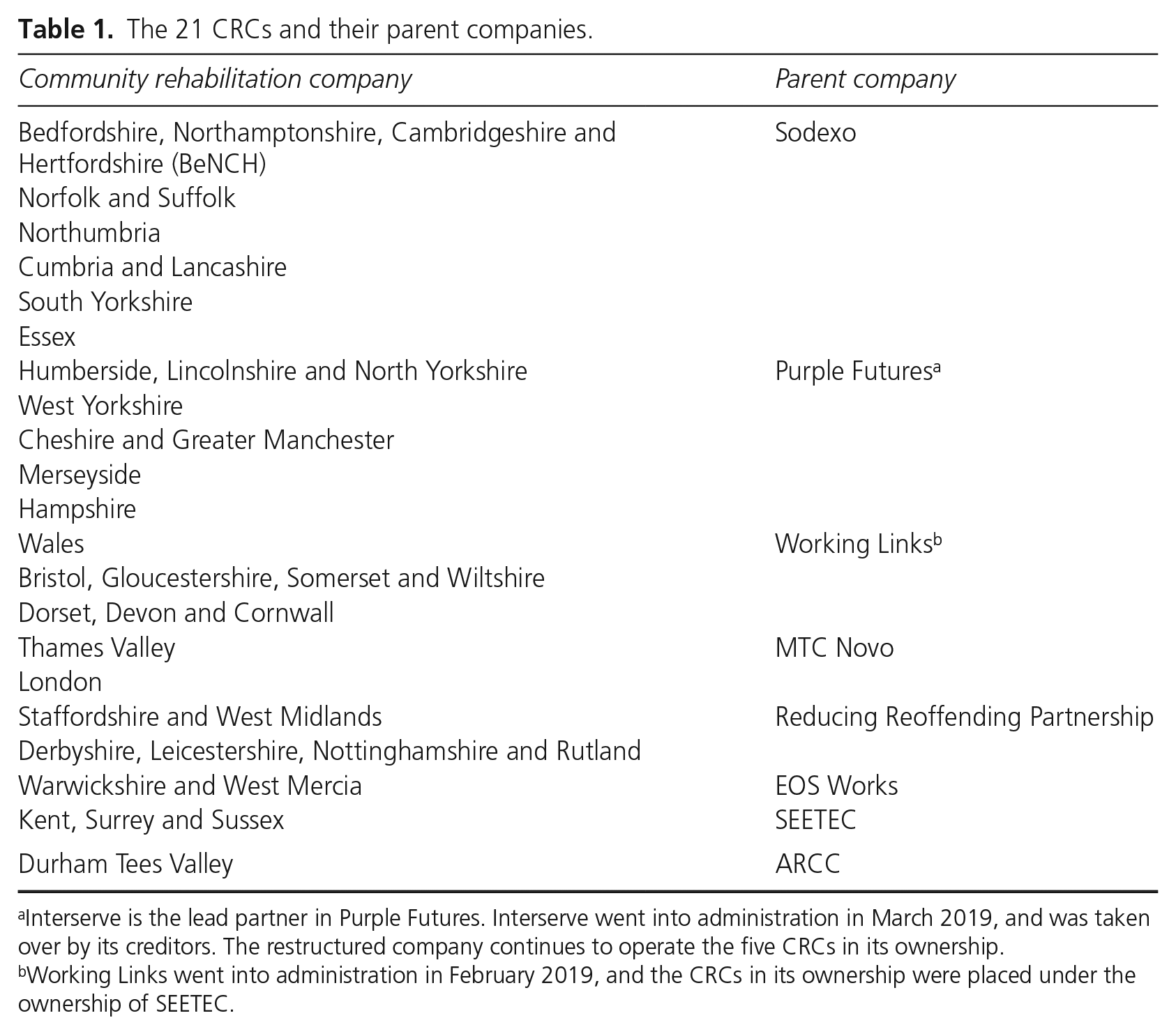
Interserve is the lead partner in Purple Futures. Interserve went into administration in March 2019, and was taken over by its creditors. The restructured company continues to operate the five CRCs in its ownership.
Working Links went into administration in February 2019, and the CRCs in its ownership were placed under the ownership of SEETEC.
We approached the analysis guided by the following research questions: How do CRCs represent their work through their websites? What do these representations suggest about the legitimation strategies of the CRCs? Our analysis was guided by Pauwels’ (2012) multi-modal framework for web-site analysis and particularly informed by the application of this framework by Johnson and Carneiro (2014), who used this approach to analyse museum websites. Following Johnson and Carneiro (2014), we adopted the first four stages of Pauwels’ framework to systematically analyse the websites. This framework encouraged us to adopt a wide lens when looking at the material, and to consider variables we might otherwise have neglected or overlooked. The four stages were as follows: (1) qualitative preservation of first impressions and reactions, (2) qualitative inventory of salient and absent features, (3) in-depth analysis of content and formal choices, and (4) analysis of embedded points of view, implied audience(s) and purposes (see also: Johnson and Carneiro, 2014). Following the preservation of the content as described above, each of the authors separately reviewed the database of archived material, and made notes of our initial impressions and reactions (Stage 1). In particular, we noted our impressions of the visual aesthetics of the sites including imagery, colour palettes, logos and the extent of information provided on the sites. For instance, one of our initial impressions was that some of the websites featured extensive content, while others were much sparser, and in some instances were out of date. Where one company owned several CRCs we also recorded our observations about the similarity or otherwise between the websites of the CRCs operated by that company.
We proceeded, again independently, to the subsequent stages of analysis by collecting information on a coding sheet for each of the CRCs. Here, we recorded in-depth information on the content and structure of each website, noting key salient features and through a process of cross-comparison any absent features (e.g. some websites contained information on the cost of services, while others did not, a point we discuss further below) (Stages 2 and 3). We focused specifically on the ‘audiences’ to whom we perceived the websites to be targeted, and thematically analysed the content of each site (Stage 4). In some instances, it was clear that there were particular target audiences as there were tabs on the websites for different groups, for example, ‘Sentencers’ or someone who had ‘Been Sentenced’, but in other instances the specific audience was unclear, a point that we discuss further below.
In relation to our own positionality, it is important to note that both authors have a familiarity with the probation field having conducted research on different aspects of probation over a number of years. We therefore have an awareness of the subject that inevitably informed our gaze and analysis (Mirzoeff, 2015). We tried to be conscious about how this familiarity might influence both what we saw and our subsequent interpretations. We therefore approached our analyses reflexively by recording our observations as field-notes independently before meeting to compare our initial impressions. This allowed us to be more explicit in our understandings, for instance, which areas of the websites we considered most relevant (home-page/about us) to elaborate on definitions and meanings (e.g. what we meant by models of interventions) and to focus our analysis accordingly.
After we had separately completed our analysis of the 21 websites, we discussed and compared our findings. This led us to the development of a more refined coding approach, which included a more explicit focus on what appeared to us to be potential strategies of legitimation. In the following sections, we present and discuss our findings in relation to three broad themes: visual and textual representations of organisational identity; the use of images, words and numbers to portray their work; and the construction of audiences or ‘consumers’ of probation work.
‘Who we are’: how do CRCs represent themselves?
As noted above, one element of our analysis involved looking for common visual and textual features across the 21 CRC websites, as well as similarities among the ‘families’ of CRCs owned by the same parent company. With five of the eight parent companies owning more than one CRC, we were interested to see whether they had sought to standardise or ‘brand’ their CRCs in ways that would be visible from their websites. We were also interested in the extent to which the parent companies themselves would be visible. Relatedly, we examined the extent to which websites emphasised the CRCs’ ‘newness’, and/or acknowledged the longer history of probation, either locally or as a national service.
Brand recognition
Organisations engage in branding in order to promote a product or service and to communicate their values and identity (Lane Keller and Lehmann, 2006). Although generally little discussed in the context of criminal justice, Annison et al. (2015) have considered the role of ‘the brand’ in relation to Integrated Offender Management (IOM) projects, which involve joint working between probation and police. They suggest that IOM schemes can be understood as a ‘branded product’ in that they both identify a specific service and create expectations for both practitioners and offenders ‘as regards the “experience” that the service will provide’ (Annison et al., 2015: 398). More generally, they note the potentially important role of branding at times of organisational change, when organisational members are likely to experience ‘identity ambiguity’. In these conditions, branding can contribute to the development of a new identity that serves both organisational members and external audiences in making sense of a new environment (Gioia et al., 2000).
In the probation context, the first clear attempt to develop a common visual brand dates back to a time of significant change for the service, when there was a move from localised management to more centralised coordination and control, that is, when in 2001 the first iteration of a National Probation Service came into being. Although not noted at the time as a ‘branding’ exercise, this new organisational framework saw the introduction of a distinctive logo, and a specific colour palette, that was to become a familiar feature of probation nameplates, letterheads, websites and policy documents thereafter. 7 The logo was a pattern of purple and white blocks, and the colour palette was dominated by the colour purple. These visual motifs continued to identify each of the 35 Probation Trusts when they replaced what had been 42 probation areas after 2008.
Our analysis revealed not only that the probation logo had survived the transition from Trusts to CRCs, but furthermore that this was in fact a mandated branding exercise on the part of the (now defunct) NOMS (2014a): an explicit attempt to ‘provide brand continuation and aid public recognition of probation services following structural changes from 1 June 2014’ when the new organisations came into effect (p. 3). The original logo – which was an image with no text – was amended for CRC use by the addition of the word ‘probation’ at the foot of the image. This duly appeared in a prominent position on all of the 21 CRC homepages, accompanied in each case by the name of the CRC area. Figure 1 shows examples of the use of this logo by three CRCs operated by different companies.

Logos of Cheshire and Greater Manchester CRC (Interserve), Thames Valley CRC (MTCnovo) and Cumbria and Lancashire CRC (Sodexo).
Beyond this common branding, the purple palette was prominent on all but one CRC website, and we interpreted this too as a deliberate strategy among CRCs, designed to promote recognition of ‘probation services’ among potential audiences. This, however, was not mandated by NOMS, and we suggest that it could be understood as an example of ‘symbolic borrowing’; a strategy of legitimation which has been noted in studies of the private security industry (Thumala et al., 2011). Symbolic borrowing refers to the deliberate adoption of visual emblems associated with other, related professions, which enjoy public legitimacy. In the case of the private security industry, which has been characterised as a ‘tainted trade’ due to its ‘selling’ of the public good of security: The use of uniforms, badges and vehicles that resemble those of the police (and are designed to do so) are all indicative of an attempt to secure legitimacy by association. (Thumala et al., 2011: 294)
In the probation context, then, symbolic borrowing could be seen in the strategy of continuing to use the colour purple in the text, banners, and so on of CRC webpages. The same can be said of the particular name chosen by Interserve to denote the partnership it led to success in the outsourcing competition: Purple Futures.
As far as ‘branding’ by parent companies was concerned, only two (Purple Futures and Working Links) had obviously standardised the appearance of their CRCs’ websites. In both cases, an identical template was evident on the homepages, but the degree of consistency was greatest among the five Purple Futures sites, which looked identical apart from the CRC’s area name at the top. Although the Working Links homepages were also standardised to a large degree in terms of their layout, they featured some variety in their choice of images (discussed further below). Beyond generic formatting commonalities, evidence of ‘branding’ on the part of parent companies was also apparent in their use of visual images and ‘straplines’, which we also discuss below. Sodexo, with the largest CRC family (n = 6), appeared to have left each area to its own devices with regard to visual representation: there was no evidence among the six that they were under shared ownership.
Part of unfolding history?
Given what we took as examples of symbolic borrowing in a number of cases, we were interested to explore other ways in which the CRCs might have sought to promote the idea of continuity with probation’s past – whether the immediate inheritance of the Probation Trusts (in operation from 2008), or the legacy of probation services which were established in the early part of the 20th century (Mair and Burke, 2013). Indeed, we found that a number of CRCs linked their organisation with a wider narrative about probation that stretched back over a century. For example, in the London CRC, under a drop-down tab – ‘Who We Are’ – there was a link to the ‘History of the London Community Rehabilitation Company’, that provided a timeline dating from 1876 when ‘Probation began in London as a charity’ up until the acquisition of London CRC by MTCNovo in 2015. This timeline featured other key dates, including the passage of the Probation of Offenders Act (1907), the introduction of Multi-Agency Public Protection Arrangements (MAPPA) in 2001 and the establishment of the NOMS in 2004. Similarly, the website of the Staffordshire and West Midlands CRC provided a ‘History Timeline’ that noted the appointment of the first police court missionary in the late nineteenth century up until the establishment of the Midlands Consortium (the precursor to the transfer of the CRC into private ownership) in 2013.
Not all of the CRC websites included such extensive historical information, however. In fact, some presented rather more truncated ‘histories’. For example, the website of the Thames Valley CRC (TV-CRC) simply noted its formation on 1 June 2014, following the implementation of TR reforms, the dissolution of the Probation Trusts and the simultaneous establishment of the new NPS. In something of a nod to continuity, however, this section of the website did note its inheritance of existing employees of the Thames Valley Probation Trust. Similarly, the Warwickshire and West Mercia CRC presented a very brief historical narrative, noting the TR reforms and the merger of two former Trust areas. Another CRC (Essex) situated its history within a broader narrative of the ‘success’ of its parent company (Sodexo) and its consortium partner (NACRO) in ‘delivering justice services across the UK’ for ‘more than two decades’.
Who’s the daddy? The prominence and visibility of parent companies
This latter observation leads us to the question of the prominence/visibility (or otherwise) of the various parent companies. References to a parent company were by no means uniform across the websites, and their visibility was similarly varied. The most prominent example was Kent, Surrey and Sussex CRC, which featured the name of its owner, Seetec Justice, in a large font in a central position at the top of the homepage. The names of three other parent companies (Interserve, Working Links and MTC Novo) appeared fairly prominently (albeit in small text) underneath the generic ‘probation’ logo at the top of their CRCs’ homepages (see Figure 1).
The other four parent companies were, however, less visible on their CRCs’ websites. While a logo for ‘Sodexo Quality of Life Services’ appeared at the foot of its CRCs’ homepages (alongside a separate logo for its partner, NACRO), the two CRCs operated by the Reducing Reoffending Partnership did not mention a parent company on their homepages at all; nor did the websites of the only CRC owned by EOS. Perhaps more surprisingly, the website of the only CRC that was not owned or led by a private company (Durham Tees Valley) did not feature this fact about its parent company on its homepage, but rather included this on a separate ‘About Us’ page, which revealed that the CRC was operated by a consortium of nine members (comprised from the ‘public, private and Third sectors in the North East’).
Information on the ownership and governance structures of the CRCs was thus provided in some form on most of the websites, but it was rarely prominent: in several cases, it was necessary to actively seek this out. Thus, at least some information could be gleaned about the parent company of each CRC, and in a number of instances hyperlinks were available which provided a direct link to the parent company. For instance, the websites of the CRCs owned by Sodexo provided some information on ‘Ownership and Governance’ in the ‘About us’ section of the websites. Here, it was noted that the CRCs were owned by ‘Sodexo Justice’ and a hyperlink then provided access to the ‘Justice’ section of the UK Sodexo site. There information was provided on the fact that Sodexo also operate five prisons in the United Kingdom, and a further link to the company’s ‘Global Justice Services’, provided information on the extent of Sodexo’s global reach, which includes work in prisons in Europe, Australia and Chile. Similarly, the websites of the CRCs operated by Purple Futures provided information on the ‘Purple Futures’ partnership, and the wider Interserve group which again extends globally, with services ranging from ‘Asbestos Management’ to ‘IT hygiene’. Thus, where CRCs were part of a wider portfolio of outsourced government services, this was not immediately evident from any of the homepages of the websites, but a more thorough search eventually revealed this information.
‘What we do’: how do CRCs portray their work?
One oft-cited feature of ‘probation’ is the absence of a recognisable visual iconography (Robinson, 2016a; Happer et al., 2018; Mawby and Worrall, 2013). Probation officers do not wear badges or uniforms, and probation offices are not readily identifiable places (Shah, 2015). Indeed one of the critiques of probation practice has been its perceived failure to convey publicly what it does (Worrall et al., 2017). We were thus interested to record examples of strategies used by the CRCs to communicate the nature of their work to audiences. Below we discuss three such strategies, centred on the use of images, words and numbers respectively.
Picturing probation
Without exception, the CRC homepages included photographic images to help convey something about their work. Our analysis revealed that there were two ubiquitous types of image, relating to the two longest established forms of ‘probation work’: supervision and unpaid work in the community (see, for example, Robinson and McNeill, 2017). Attempts to capture the central practice of ‘supervision’ were very common and typically featured two adults, with one apparently focused on listening to the other. The latter (the supervisee, we surmised) was often pictured with his or her back to the camera (see Figure 2 for an example). Images of unpaid work were a little more varied, but typically featured men in high visibility bibs or jackets, most often doing outdoor work (e.g. digging or gardening) (see NOMS, 2014b) (see Figure 3). Rarer images which we read as attempts to convey something about the nature of probation work included a ‘home visit’, depicted by two women knocking on the door of a house (Thames Valley) and the delivery of an ‘offending behaviour programme’, illustrated by a classroom setting and whiteboard or flipchart (e.g. Derbyshire, Leicestershire, Nottinghamshire & Rutland).

Image from the website of the Norfolk and Suffolk CRC, depicting supervision.

Image of Unpaid Work from Dorset, Devon and Cornwall CRC.
Another image which appeared more than once was the CRC nameplate on an exterior wall (e.g. London; Derbyshire, Leicestershire, Nottinghamshire & Rutland). Although rather uninspiring, these images were perhaps an attempt to communicate the ‘authority’ of the CRC as a criminal justice institution. A small number of homepages included links to short films about specific aspects of the CRC’s work: for example, the Dorset, Devon & Cornwall homepage included a link to a short film about an unpaid work project at a local museum, and Cumbria & Lancashire’s featured links to films about local arts projects in which service users had participated. Finally, we found a small number of generic positive images with no obvious connection to probation work: for example, a smiling woman serving food (Purple Futures homepages); a woman riding a horse and a woman riding a bicycle (both Durham Tees Valley/ARCC).
‘Straplines’ and success stories
As mentioned above, a common feature of the majority of the CRC homepages was a ‘strapline’, defined as ‘a short, easily remembered phrase used by an organization so that people will recognize it or its products’ (Cambridge Dictionary online). Such straplines have been common in the probation context since at least 2001, when the first NPS was created. Its first strapline, designed to emphasise its multiple aims, was ‘Enforcement, rehabilitation and public protection’ (Home Office, 2001). In our analysis, straplines were as likely to be found on the websites of CRCs owned by ‘sole traders’ as those of CRC ‘families’. Of the latter, Purple Futures, Working Links and MTC Novo each had a single strapline that appeared on the websites of all of ‘their’ CRCs, but the same was not true for the Sodexo-owned CRCs (n = 6). Only half of these featured a strapline, and they were all different. This finding chimed with the fact, discussed above, that Sodexo had done little to establish a common brand or visual identity among its CRCs.
Straplines featured between one and three statements. Examples of single statements were ‘Changing lives together’ (BeNCH/Sodexo) and ‘Participating in a positive future’ (Durham Tees Valley/ARCC). Those with more than one statement were all variants of the Purple Futures strapline ‘Reducing reoffending, improving lives, protecting communities’, in that they combined a focus on work with individuals and positive outcomes for both individuals and communities/the public. Less common, but nonetheless evident on a number of sites, were links to positive case studies and other positive news stories. For example, the Kent, Surrey & Sussex homepage included a link to the story of ‘Kevin: A former drug addict has become a successful paid chef a year after his release from prison’. All three of the Working Links homepages included a link to a news story about ‘the impact of mentoring’ on service users in their area. Although these were predominantly about service users, a number referred to their ‘award winning’ staff and/or services (e.g. Thames Valley).
Probation by numbers
As well as attempting to ‘picture probation’, and to capture values or priorities in a strapline, a few CRC homepages featured attempts to convey something about the quantitative aspects of their operations. For example, ‘Durham Tees Valley CRC is responsible for supervising around 5000 participants on either a Community Order or Prison Licence’. The BeNCH homepages included the following ‘key facts’: ‘Our caseload: 6,700 cases a year. Our workforce is approximately 370’. The Thames Valley CRC homepage also included statistics about the number of staff, offenders, unpaid work hours and the population of the area. The homepage of the Staffordshire and West Midlands CRC included a section on ‘Facts and Figures’ which compared the cost of custody with probation. Figure 4 shows an example of the use of such infographics from the website of one CRC.

Infographic providing data on the numbers of people subject to supervision from the website of the Humberside, Lincolnshire and North Yorkshire, CRC.
The use of infographics has become an increasingly popular means of data visualisation, and many organisations use them to convey information on their work and productivity (Lankow et al., 2012). For the purpose of our analysis of CRCs, it is interesting to note the discursive and legitimation work of such graphics. From the example above, we see that these figures help to convey the volume and scale of the enterprise and by implication the importance of its role within the criminal justice system and to wider society. This graph positions this activity beside an icon linking to the Ministry of Justice’s latest re-offending data which provides direct access to data on the Ministry’s website. Thus, the positioning of the CRC activity is directly connected with ‘evidence’ of reductions in recidivism (although as we noted earlier, linking this metric to the activities of CRCs is clearly problematic). More broadly, the depiction of probation by numbers provides further evidence of the extent to which the net of supervision has widened. This phenomenon which has been coined ‘mass supervision’ has been noted both in the United Kingdom and in the international context, where the numbers of people subject to supervision far exceeds the population of people held in prison (see, for instance: Aebi et al., 2015; McNeill, 2019; Phelps, 2013).
Constructing audiences and ‘consumers’ of probation services
The question of who is the consumer or beneficiary of probation services has been contested over many years (Weaver, 2011). In particular, the debate has centred on the status of the ‘service user’ or ‘offender’, who has traditionally been seen as the recipient and beneficiary of probation services. An increased emphasis on public protection, risk management and the needs of victims within probation services in England and Wales from the 1990s onwards formed the backdrop for discussions as to whether the ‘service user’ was the client of probation or merely the target of intervention in service of the real client – the wider public (see, for instance, McCulloch and McNeill, 2007; Nash, 1996).
Writing in 2003, Morgan identified four groups of ‘users’ or ‘beneficiaries’ of probation services: the public; offenders and victims; ministers and civil servants; and sentencers. Of these groups, sentencers were considered by Morgan to be probation’s key constituency, as the principal ‘commissioners’ of community-based sentences. Arguably this remains true today: in the absence of demand for probation services from the courts, probation services would be obsolete. However, the restructuring of probation services under TR has changed this picture somewhat. One of the many concerns voiced about the TR reforms was that private companies might take advantage of the traditional role of probation in providing pre-sentence advice to courts, as a means of ‘drumming up business’ in the interests of maximising their own profits. To address this concern, the provision of pre-sentence information to the courts remained with the public sector part of the service – the NPS – and CRC staff were not allowed an audience at court (Robinson, 2018). Thus, although sentencers or courts continue to ‘commission’ probation services, cases are allocated to CRCs by NPS court teams, on the basis of a risk assessment. While the rationale for the decision to insulate court work from private interests in this way was clear, it put CRCs at one remove from sentencers, bringing into question the idea of sentencers as direct commissioners of services delivered by CRCs. TR also created a new ‘commissioner’ in the shape of the NPS, which not only acts as an intermediary between the courts and the CRCs, but which can also procure services directly from CRCs, as part of a package of interventions offered to its own (high risk) cases. It is against this backdrop that we analysed the CRC websites and sought to understand their own processes of audience construction.
The majority of the homepages included tabs or links to information targeting specific audiences. In most cases, the intended audience was very clear (e.g. tabs labelled ‘Information for sentencers’, ‘Service user information’, ‘Offenders’, ‘Media and Partners’), and in other cases an intended audience could be inferred reasonably easily (e.g. tabs labelled ‘Been sentenced?’ or ‘Careers’). Only two CRCs (Warwickshire & West Mercia and London) directly addressed victims by including a specific tab to this ‘audience’ on their websites. A small number, however, gave no clues as to their intended audience(s). For example, the Norfolk & Suffolk homepage was extremely basic, featuring very little information, a single image, and no links that suggested any specific audience. Northumbria CRC, similarly, had no obvious target audience. A slightly different approach was found for Thames Valley CRC, which offered no direct clues (by way of tabs or links) as to its intended audience(s), but whose homepage was dominated by information about and images of unpaid work, thus giving the impression that its primary audience might be potential community beneficiaries (Bottoms, 2008).
This indirect approach to defining an audience was unusual, but the construction of ‘the community’ as a beneficiary of CRCs’ services was not. Several websites made explicit references to the ‘community’ as an audience or consumer of their services. Sometimes this was done explicitly (by providing an appropriately labelled tab), as in the case of the five Purple Futures CRCs; elsewhere the approach was more implicit, as was the case in Cumbria and Lancashire, Essex, and Northumbria, which all featured invitations to nominate projects for ‘Community Payback’ (i.e. unpaid work by offenders). Whether this attention to the community as a beneficiary of probation work was part of a deliberate attempt to promote the ‘public goods’ on offer from CRCs, or simply the continuation of what went before, we cannot be sure, but it is nonetheless interesting that the ‘community’ was positioned as a potential beneficiary of the labour carried out by people subject to community sentences in this way.
Despite the somewhat remote relationship between sentencers and CRCs discussed above, we found that more than half of CRCs (n = 12) explicitly referenced ‘Sentencers’ as a target audience for their website. For example, the homepage of the Essex CRC had a tab for ‘Sentencers’ with links to a ‘Guide for Interventions: Information for Sentencers’. This Guide offered information on ‘non-custodial sentencing options (interventions)’ provided to the courts in Essex, including Rehabilitation Activity Requirements, Accredited Programmes, Community Payback (i.e. unpaid work in the community) and other potential requirements that can form part of a community sentence. Similarly, the (uniformly branded) homepages of the Purple Futures- owned CRCs each included an information tab entitled ‘Court Information’, which in turn linked to information about available interventions; statistics on the numbers of people under supervision; and ‘Sentencer News’. Information for sentencers did not, however, include details about the costs of CRCs’ services – either because the sentencers are not paying directly, or because this aspect of the work was regarded as something best kept hidden.
Probation for sale: commodification and the ‘rate card’
The CRC websites differed very significantly in the degree to which they explicitly referred to the ‘sale’ of their services. Among the more explicit were the three Working Links CRCs. Each of these had a section called ‘Our Services’ which linked to a ‘Service Directory’, listing the services provided by the CRCs, information about how costings for services could be obtained and specifying that payment must be made in advance. For instance, the Dorset, Devonshire and Cornwall Service Directory provided the following information: We will invoice you or your service user prior to the assessment and will request payment in full, by cheque or via BACS, before the intervention starts. (DDC CRC, Service Directory Version 7, p. 6)
The Working Links websites were also unusual in that they noted the availability of their services to a potentially wide range of purchasers. For example, the Wales CRC website stated, . . . our ambition is to make our services available to everyone who would value them, not just those people who have been sentenced by a court. We see this as a first step towards making our ambition a reality. (Wales CRC, Service Directory)
8
Some of the CRC websites made explicit reference to service ‘rate cards’, which were available to download. The ‘Rate Card’ provides information on services offered and the cost of these services. For example, the Essex CRC Rate Card provided details on the costs of a range of services including ‘IOM’ (£70 per hour, agreed on referral between CRC and NPS). The listed ‘highlights’ of this service include maintenance of shared information exchange systems with the police, group drop-in sessions and individual offence focused work, and home visits by the CRC and the police. A ‘Barriers to Compliance’ group module was also advertised (2 x 1.5 hours sessions for £250), with the stated aim of motivating service users to ‘see positive aspects of successfully completing their order’ (Essex CRC, Rate Card, 2017: 25).
Such explicit information on the costs of services and how they could be purchased was not, however, readily accessible on most of the websites. This reinforced both our perception of the diffuse and sometimes confused construction of the audiences of the CRCs’ marketing efforts, but also the rather muted commercial business aspect of the CRCs. As mentioned earlier, links to the parent companies and their wider business interests could be accessed through a search of the websites, but were usually not immediately apparent. We suggest that the relatively hidden commercial aspect of the CRCs might be an example of what Thumala et al. (2011) describe as ‘narrative foreclosure’, that is, muting the morally tainted aspect of the trade and focusing instead on broader messages about paying back to the community or ‘transforming’ the lives of individuals. We return to these points in our discussion below.
Discussion
Our analysis of the websites of the 21 CRCs created under the TR reforms shows that there are some elements of continuity in the representation of the probation ‘brand’ in the privatised probation sector. This continuity can be seen in the mandated use of a recognisable logo, and in the adoption by many of the CRCs of a particular colour palette, both of which pre-date privatisation. Our analysis also revealed continuity in the use of a ‘strapline’ to convey the primary objectives of the CRCs. This is another established ‘norm’ borrowed from probation’s public sector past. Following Thumala et al. (2011), we have used the concept of ‘symbolic borrowing’ to describe the means by which the private probation sector – in common with the private security industry – seeks to legitimise its work by drawing on the tropes and iconography of more respected or established professions. Our analysis suggests that CRCs have engaged in ‘symbolic borrowing’ to a certain extent, both in respect of the visual elements noted above and (in many cases) by linking their establishment to a narrative about the evolution of probation over time. However, in the probation context the extent of such borrowing was found to be limited by a paucity of well-established symbols. Indeed, a notable feature of probation since its inception is the absence of a recognisable visual iconography. Unlike prisons, probation sanctions have no obvious physical architecture or structural locus and those who administer them are not identifiable in the way that police or prison officers are, by virtue of their uniforms. Thus, both the sanctions and those who enact them fail to generate ready images that can be drawn upon for marketing purposes.
Our analysis of the websites of the CRCs shows some of the difficulties in making the work and therefore the ‘product’ of probation tangible. As we have shown, the visual iconography of probation is limited, and this is partly as a result of the nature of the enterprise. Typically a person who is subject to a community sentence is placed under some form of supervision in the community and they may be required to engage in or abstain from certain activities during this time. The concept of ‘probation’ therefore conveys a certain contingency, a period of testing and conditionality. While recent research has explored the experiences of such conditionality, and indeed has utilised visual methods to do this (see, for example, Healy and Fitzgibbon, 2019; McNeill, 2018), the reality is that conditionality or contingency is by its very nature quite difficult to convey.
The images we found in our analysis depict a very narrow range of activities: most frequently, people meeting (presumably to talk about how a person fulfils the condition of their supervision) and people in high-visibility orange bibs engaging in ‘Unpaid Work’. It is striking that ‘Unpaid Work’ was the most ubiquitous imagery we saw across the websites of the CRCs. On one level, this is unsurprising given that this element of probation work was placed squarely in the domain of the CRCs, but it is also reflective of the fact that this form of sentence – through the requirement that people wear high visibility clothing and carry out work in public areas – has in recent years been the focus of explicit attempts to render it visible to the public, thereby enhancing its external legitimacy with this particular ‘audience’ (King and Maruna, 2008). Indeed, there is a connection here between the ubiquitous imagery of unpaid work and the construction of ‘the community’ as a recipient or beneficiary of the CRCs’ work, which we noted on several websites. Both chime with the dominant utilitarian rationale for probation work which has been particularly evident in policy pronouncements in the last two decades (Robinson, 2008). These rationales emphasise the social and economic benefits and savings that stem from probation work, and tend to construct the public and victims of crime – rather than offenders themselves – as its primary beneficiaries. Narratives about probation and community sanctions that emphasise their social value are arguably both convenient and useful to CRCs to the extent that they deflect attention from narratives that emphasise shareholders and profit-making that are likely to be less palatable to some audiences.
It is perhaps unsurprising therefore that the ‘business’ aspect of the CRCs was not readily evident on most of the websites, and that information about the parent companies (several of which are large corporate enterprises) was far from prominent. Although we cannot know whether this was a deliberate case of ‘narrative foreclosure’ – of hiding the less palatable truths about contemporary probation services – future research might explore this possibility by means of interviews with key actors, as conducted by researchers who have examined strategies of legitimation in the private security industry (Thumala et al., 2011; White, 2010, 2014). It is only via such methods that we can explore the communicative intentions of those with responsibility for marketing probation services. Further research of this kind would also help us to answer nagging questions about the perceived value (to CRCs themselves) of websites as means of communication, about their construction of audiences and consumers of probation work, and, in the case of parent companies with multiple CRCs, their choices in respect of building a recognisable ‘brand’ for their companies.
Since undertaking our analysis, the Ministry of Justice has announced a new phase of probation reform, which will see the return of all offenders under community supervision to the public sector, under the management of the NPS (Ministry of Justice, 2019). At the same time, the CRCs will be dissolved and their contracts terminated. However, the intention remains to contract out significant elements of the probation role to the market place, and both Unpaid Work and ‘rehabilitative interventions’ are included in this. How both an expanded NPS and potentially new for-profit providers of probation services will seek to communicate and market themselves after the next iteration of reform, and how they will construct their audiences, remains to be seen. We will be watching with interest.
Footnotes
Declaration of conflicting interests
The author(s) declared no potential conflicts of interest with respect to the research, authorship, and/or publication of this article.
Funding
The author(s) received no financial support for the research, authorship, and/or publication of this article.
