



Abstract

From an uninformed outsider’s perspective, expressive subcultures appear monolithic in aim, aesthetic, and action. Transgressive subcultures, in particular, are reduced to a caricatured and often demonized version of themselves. Graffiti writers are a prime example of this.
Both from the perspective of having spent most of my life as a member of the graffiti community, as well as having written about graffiti and graffiti writers from a scholarly perspective, I have arrived at the conclusion that my community is impossible to categorize, notwithstanding my rather radically conservative definition of what actually constitutes graffiti (Bloch, 2016; see also Phillips (2019) for a more inclusive perspective on what constitutes graffiti).
The shallow conceptualization of graffiti is in part a result of moral panics that conceive of particular phenomena in terms of its core criminological components. And those criminological attributes that comprise the graffiti writer and his or her ethos is made even more myopic given the racialization that takes place when conceptualizing subversive and marginal others.
I have watched as graffiti writers take to the walls to both denounce and defend issues of local, national, and global import from a variety of perspectives. While most graffiti writers tend to dwell on the left side of the mainstream partisan and political spectrum, their perspectives on social issues run the gambit. Sexist, misogynistic, trans- and homophobic statements and imagery are rife, along with denunciations of police violence, anti-racist imagery, and iconoclastic stances on issues of governmental control.
Reading the writing on the walls concerning the COVID-19 pandemic reveals a graffiti community that can best be described as diverse in terms of its members’ sentiments, with heavy leanings toward conspiratorial perspectives as well as public health preoccupations.
In addition to graffiti that is produced by identifiable and loosely-affiliated members of the global graffiti subculture who collectively adhere to well-defined standards, mores, and norms regarding aesthetic composition of name-based tags and characters, placement, and social hierarchies, much graffiti is produced by unaffiliated individuals for whom writing on a wall is a one-off event or last-ditch effort to be heard regarding a political sentiment, declaration of love, or inane comment. Graffiti depicting and referencing the COVID-19 pandemic is no-less representative of all forms of graffiti writing, as well as of those who take to the walls to express themselves artistically, egotistically, politically, and transgressively.
These following images are just a small sample of what has been uploaded to the Internet in the midst of the outbreak and spread of the virus. Image-based Internet research allows for real-time archaeological exploration of graffiti that, once removed in the material world, will become little more than a cyber ghost (Kindynis, 2019). Ranging from monochromatic messages scrawled on the sidewalk to elaborate multicolored productions painstakingly painted on walls, the diversity of perspectives belonging to those who choose to pick-up a can of spray paint and illegally write their message on an outward facing public or private surface is represented here. Likewise, lending a trained eye, or affective aesthetic analysis (Young, 2012) to the style of lettering, placement, “spot” selection (Ferrell and Weide, 2010), utilization of aerosol paint, and overall balance and composition of the writing and imagery tells us something about its producer in terms of their experience with writing on outside surfaces and their affiliation with the graffiti subculture.
Walls are where people have looked for centuries to gauge public reactions to and personal perspectives on major events that cannot be left to those in power to convey. This is true in times of war, peace, protest, and revolution (Lennon, 2014) and is evidently no-less true in the time of COVID-19.

Depictions of the virus have been produced on walls around the world. The image depicts the virus within a graffiti production accompanied by the message “Corona Panic.”

The virus is depicted with anthropomorphistic characteristics.

A rudimentary message reading “Make the Rich Pay 4 COVID-19,” followed by a cryptic signature.

A “COVID-19” tag contested by the word “Hope.” The COVID writing appears to be by someone with basic knowledge of graffiti conventions as exemplified by the dotted O and exhibited can control. Whereas the “Hope” is inexpertly written, its producer follows the tradition of crossing out, or “lining” to show disapproval, disrespect, or express a direct challenge.
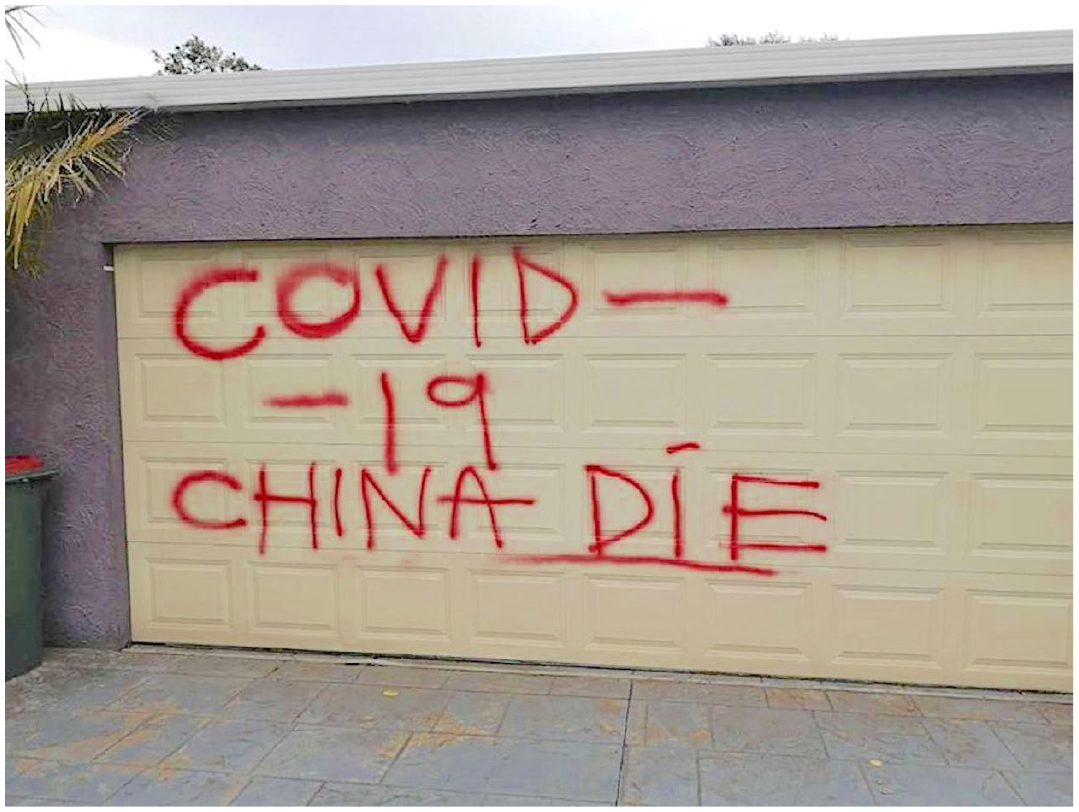
A political statement unproblematically and violently linking COVID-19 to its reported Chinese origins. “COVID-19 China Die” is depicted here in a way that is legible, putting the emphasis on the simplistic scrawl and message. Its placement on a private residence illustrates the producer has no affiliation with the graffiti community for whom writing on single family homes is not practiced.

Similar to the message in Figure 5, here is a simplistic scrawl on a residential property with an allusion to conspiratorial perspectives on COVID-19 given both the message, “COVID-19 is a LIE,” as well as the use of the Freemason symbol as the letter A. Conspiracies have ranged from attributing COVID-19 to the effects of the 5G network, to the belief that governments concocted a COVID scare in order to divert attention away from the building of the 5G network’s infrastructure.

A rudimentary depiction of rolls of toilet paper eluding the grasp of a panicked stick-figured consumer. The playful message speaks to the shortage of toilet paper at the onset of the pandemic, encouraging onlookers to “Buy All Toilet Paper.”

The word “Covide” reveals a standard and well-executed Los Angeles-based and iconic gang-graffiti style judging by the use of the traditional E, inner line of the D, and crossed-out O. Image credit: Susan A. Phillips.

A rudimentary and no-less political scrawl on a slab of concrete in a park setting reading “Wake up, Hoax, COVID, Lies Lies Lies Lies” (punctuation added for conveyance).

Evoking the disproportionate infection and death rates experienced by the Black community in the United States, the message of “Protect Black People COVID-19” makes use of a mail box as platform and “dripper” marker as implement, both of which reveal a basic knowledge of so-called “hip hop graffiti” composition and tactic.

Graffiti writers have taken to the walls with COVID-19 providing the inspiration for both the production of font and imagery. This “COVID” piece contains all of the conventions of advanced graffiti art in terms of color schemes, fill-ins, highlights, and balance.

Street artists have likewise taken to the walls with intricate and expertly-crafted imagery. The image depicts Bill Gates in the midst of the COVID-19 outbreak with what is presumably an inoculation for the disease within a syringe.

The street art stencil composition evokes the ubiquity of the face mask as a prophylactic to be worn to slow the spread of the virus.
Footnotes
Declaration of conflicting interests
The author(s) declared no potential conflicts of interest with respect to the research, authorship, and/or publication of this article.
Funding
The author(s) received no financial support for the research, authorship, and/or publication of this article.