



Abstract
This article examines a sound-based digital project co-created with refugees and asylum seekers held in indefinite detention in Australia and Papua New Guinea to advance understandings of the sensory violence of borders – and resistance to borders – and their reordering of intimate realms. In where are you today (2020), refugees/asylum seekers catalogued their carceral environments in 10-minute sonic vignettes which were distributed to listeners daily via text message, for 30 consecutive days. Drawing on sensory methodologies and feminist orientations towards the intimate, the article considers how this sound project alerts us to an alternative sensory politics attuned to the quiet, quotidian and exhausting labour of resisting Australia’s racialised border regime. Through a close listening to selected recordings, we argue the intimacies shared through where are you today produce knowledge about embodied practices of care, breath, touch and waiting in indefinite detention. Networked, transborder sound projects can unsettle both incarcerated and non-incarcerated subjects’ relationships to their environments, opening affiliative possibilities for coming into relation with the border(s) in new ways. We conclude that the project’s creators forge and sustain carceral intimacies within and despite the border’s affective violence, and that sound is a particularly affective and evocative means of conveying and creating these intimacies, in and beyond indefinite detention.
Keywords
Introduction
Since 2013, the settler colony of Australia has enforced an elaborate and calculated border policy against people seeking asylum who arrive in its waters by boat. This racialised policy has involved incarcerating asylum seekers ‘offshore’ in prison camps – on Christmas Island, Nauru and Papua New Guinea, each former Australian colonial territories – and more recently ‘onshore’, in hotels repurposed as Alternative Places of Detention (APODs) and in Immigration Transit Accommodation (ITAs) in Melbourne, Brisbane and Sydney, along Australia’s eastern edges. Routinely and arbitrarily subject to forced transfers, indefinite detention, and the threat of deportation, those stubbornly refused asylum by the state inhabit and embody the ‘intimate frontiers’ (Stoler, 2016) of an ongoing, yet fragile, colonial project – subject not only to the physical deprivations and entrapments of borders, but their affective and sensory assaults (Meier, 2020; Shalhoub-Kevorkian, 2016). Despite living in conditions of extreme duress, asylum seekers continue to move, breathe and labour against their confinement. They resist, refuse and reimagine the border(s) in ways that remind us that its contours are configured not only through legal instruments, material barriers and physical confinements, but also through the social, political and sensory relations that hold them in place (Russell, 2020). Through bodily, affective and creative labour, refugees and asylum seekers remake these relations, practicing care and forging intimate connections with others across ‘interlocking geographies of excision’ (Perera, 2009: 21) in ways that refuse and confound neat separations between carceral and non-carceral space (Russell and Carlton, 2020; Turner, 2016).
To attend to the intimate and affective dimensions of life in the borderlands, this article develops a sensory analysis of where are you today (2020), a sound-based artwork by the Manus Recording Project Collective (henceforth: the Collective). 1 The project was developed through a collaboration between six asylum seekers held in indefinite detention – Farhad Bandesh, Farhad Rahmati, Samad Abdul, Shamindan Kanapathi, Thanush Selvraj and Yasin Abdallah – and three writers/radio-makers in Melbourne, André Dao, Michael Green and Jon Tjhia. For 30 consecutive days in August 2020, subscribers to where are you today received a text message with a link to a 10-minute sound recording made by one of the project’s co-creators detained in Port Moresby, Brisbane or Melbourne (Figure 1). Geo-location and timestamp tools were used to locate subscribers in precise temporal and spatial proximity to each recording (Figures 2 and 3). The move to ‘onshore’ detention constituted a temporary (and exceptional) redrawing of national borders, which where are you today ‘counter-mapped’ by tracking listeners’ proximities, complicities and entanglements with their shifting configurations. In total, listeners were invited to encounter what became a 5-hour sound archive of emergent and established carceral spaces. Their quotidian and often mundane soundscapes confounded or confirmed listeners’ expectations of what day-to-day life in indefinite detention might sound like (Brooks, 2020; Dao, 2020; de Souza, 2020; Russell, 2020).

Screenshot from ‘where are you today’. Subscription text. Manus Recording Project Collective.

Screenshot from ‘where are you today’ with location data off. Farhad Bandesh, feeding the pigeons. Manus Recording Project Collective.
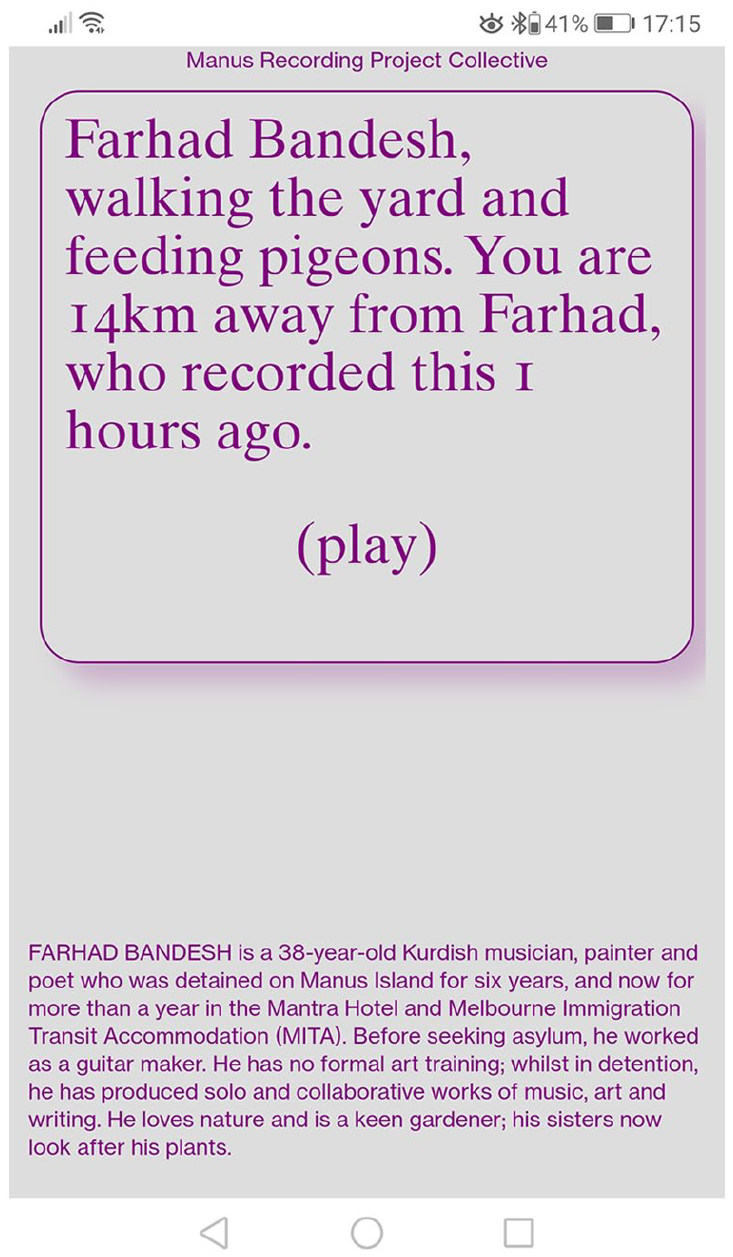
Screenshot from ‘where are you today’ with location data on. Farhad Bandesh, feeding the pigeons. Manus Recording Project Collective.
For the most part, scenes of exceptional suffering or triumph are absent in where are you today. The work refuses to reproduce racialised ‘scenes of subjection’ (Hartman, 1997) or spectacles of suffering through which refugee bodies at the border are commonly framed and represented (Lenette and Miskovic, 2018). Instead, we hear intimate encounters with others, such as impromptu English lessons or haircuts, as well as more private, solitary moments: taking a shower, listening to the birds, waking up in bed in a hotel-room-prison. Sometimes, listeners are invited directly to participate in the activity being recorded, such as a guided meditation, while in other recordings, we overhear or ‘eavesdrop’ on online conversations between friends or in communal spaces. The sounds, rhythms and repetitions of daily routines in detention are made audible, transferable and relatable, as asylum seekers audio record their encounters with others and their environments, scheduled activities and small moments of joy, desire and futurity.
In this article, we draw from feminist approaches to the affective, sensory and intimate (Ahmed, 2000; Berlant, 1998; Campt, 2017; Mountz and Hyndman, 2006) to attend to the ‘carceral intimacies’ (Fleetwood, 2015) that where are you today makes audible, and the unsettling relations it established between the work’s creators and listeners. The article contributes new knowledge about the ‘affective violence’ of borders (Meier, 2020) to the field of critical border studies (e.g. Burridge et al. 2017). It also advances understandings of prison soundscapes (Hemsworth, 2016; Rice, 2016) and the emerging field of ‘sensory criminology’ (Brown and Carrabine, 2019; Herrity et al. 2021; Russell and Carlton, 2020), developing a reflexive, situated and intimate methodological approach to sonic portraits of carceral worlds. Through a form of ‘sensory ethnography’ (Pink, 2015; Russell et al., 2020), we explore how where are you today created a social and digital infrastructure sensitised to the everyday life-sustaining intimacies of lives ‘in limbo’ (Russell and Rae, 2020). Simultaneously, it tasked listeners with reflecting on our (relatively and differently) privileged mobilities in shared times and places. Rather than positioning listeners as simple consumers of others’ suffering, where are you today opened up affiliative possibilities for coming into relation with Australia’s ‘polymorphic borders’ (Burridge et al. 2017) and reckoning with their intimate effects. Against the backdrop of ‘louder’, more vocal global movements against border violence and racial injustice (Vogl et al., 2021), we argue that the carceral intimacies shared through where are you today alert us to an alternative, sensory politics that is attuned to the quiet, embodied and exhausting labour of anti-carceral resistance.
The shifting (and intimate) borders of indefinite detention
The colonial bordering practices of immigration detention regimes reorder both global and intimate relations (Mountz and Hyndman, 2006; Stoler, 2016). In Australia, violence and violation mark the intimate incursions of the border into the everyday lives of Aboriginal and Torres Strait Islander peoples since colonisation – from the expropriation of sovereign Indigenous lands and the severing of kinship relations, to forced displacements, restricted movement and deathly modes of confinement in prison cells (Blagg and Anthony, 2019: 97-132).
In Australia, the re-assertion of territorial sovereignty in response to mobile subaltern bodies who breach the border remains a stubbornly consistent theme (Perera, 2009, 2013). As Moreton-Robinson (2015: 192) reminds us, white possession and ‘patriarchal white sovereignty’ take on new formations, reflecting the ‘shape-shifting nature of colonisation’; punitive policies that regulate the mobility of racialised and othered bodies are enfolded within its consistent logic.
In July 2013, Labour Prime Minister Kevin Rudd declared that ‘asylum seekers who come here by boat without a visa will never be settled in Australia’. Months later, following the 2013 election win by the Liberal-National coalition, the military-led Operation Sovereign Borders policy and border security operation further buttressed a punitive policy which refused asylum seekers entry into its territory. By 2017, the Australian Government had intercepted and forcibly transferred almost 2000 men to the Manus Regional Processing Centre (MPRC), a detention facility located on a former Royal Australian Navy Base on Manus Island, Papua New Guinea. Following the MPRC’s ‘closure’ in October 2017, the shifting borders of indefinite detention have expanded, dispersed and become more insidious (Giannacopoulos and Loughnan, 2020). After a month-long collective protest highlighting refugees’ and asylum seekers’ heightened fears of harm and insecurity if they were moved into community detention on Manus, the remaining detainees were violently evicted and forcibly relocated to smaller facilities dispersed across the island, and later transferred again to Alternative Places of Detention (APODs) such as hotels and other accommodation in Port Moresby.
By February 2019, the Federal Parliament of Australia passed the Migration Amendment (Urgent Medical Treatment) Bill 2018 which allowed for asylum seekers to be temporarily transferred from ‘offshore’ detention on Manus Island, Port Moresby and Nauru, to detention on mainland Australia for ‘urgent’ medical treatment. While the ‘Medevac’ legislation, as it became known, did not disrupt the bipartisan policy of indefinite detention, the Liberal-National coalition government’s longstanding opposition to the amendment made it highly politicised. The legislation was short-lived and repealed 9 months later, by which time almost 200 asylum seekers had been transferred and were now indefinitely stuck ‘onshore’ in various immigration detention centres and APODs. As ‘offshore’ detention has extended to ‘onshore’ locations, seemingly benign hotel rooms in Sydney, Brisbane and Melbourne were transformed from places of hospitality and welcome, into punitive sites of carceral violence (see Loughnan, 2020). 2
Despite asylum seekers’ initial hopes, the Medevac transfers have had unanticipated and devastating consequences for those transferred in 2019, many of whom remain/ed indefinitely imprisoned in APODs and immigration detention centres on the mainland. 3 Most found themselves detained in small hotel rooms, with little or no ventilation Manthorpe (2020: 9), some without access to a balcony or fresh air. By August 2020, when where are you today was made, the harms of Australia’s punitive immigration detention regime were further intensified by Australia’s response to the COVID-19 pandemic. Calls for the urgent release of asylum seekers, refugees and other non-citizens held in detention drew attention to the structural harms and vulnerabilities for people in closed congregate settings and sites of confinement (Dehm et al., 2021; Vogl et al., 2021).
These recent developments in Australian policies on asylum seekers demonstrate that borders are constituted through a shifting, mutable, dense but also porous set of relations (Burridge et al., 2017). While the very dynamism of borders reflects their power to adapt to changing social and legal conditions, their flux also creates new opportunities for resistance. The formation and collaborative work of the Manus Recording Project Collective highlights that the attachments and everyday intimacies that transverse the borders of indefinite detention – challenging its exclusionary, silencing and isolating effects – are also flexible and durable under duress. Relationships between some of the members of the Collective were first forged during the making of the award-winning podcast The Messenger (2017) and developed and expanded during the production of the gallery-based sound installation how are you today (2018). 4 While the podcast medium provided a form of ‘earwitnessing’ that partially overcame some of the intense secrecy that shrouded Australia’s offshore immigration detention system, its highly structured and linear narrative style lessened the ‘veracity’ and intimacy that comes with quick access to unedited sound recording (Rae et al., 2018). This latter approach was explored in the Collective’s how are you today installation that formed part of a larger exhibition on ‘eavesdropping’ (Parker and Stern, 2020), and has been extended through the production of where are you today.
Both how are you today (2018) and where are you today (2020) by the Manus Recording Project Collective make audible the everyday, quotidian and sometimes mundane aspects of racialised border violence. They portray the ‘carceral atmospheres’ of indefinite detention (Russell, 2020) and create new spaces of intensity as listeners are invited to engage and reflect upon them. Each project indexes the shifting social and political relations through which the border is re/made and contested. While how are you today was recorded exclusively from sites of detention in PNG – broadcasting sounds from Manus Island and Port Moresby, at the extreme edges of Australia’s migration border, across the Pacific Ocean in the Bismarck and Coral Seas – where are you today follows a more dispersed border, troubling the political/territorial distinction between ‘onshore’ and ‘offshore’, and reminding Australian-based subscribers the border is also here, ‘just up the road’ (Keenan, 2020).
As existing inequalities and racialised states of vulnerability are amplified by the global COVID-19 pandemic (Vogl et al. 2021), and restrictions on movement and gatherings are imposed by state and federal governments in Australia, these multiplying sites of incarceration are both the frontline and the frontier. For instance, at the time where are you today was made, some internal state borders in Australia had become de facto international borders. The state of Queensland closed its borders to inter-state travellers at the same time as a (largely non-white) international migrant labour force were given exemptions as ‘essential’ workers to take up precarious, low-paid work to keep the economy going. The historical palimpsest of stratified mobility and racist bordering in the state also comes to mind, such as the history of Brisbane’s Boundary Streets – adjacent to the suburb of Kangaroo Point, where hundreds of refugees were detained in the Central Hotel after their transfer from Manus Island and Nauru under Medevac legislation. Under the Aboriginal Protection and Restriction of the Sale of Opium Act, Boundary Streets marked the city’s border for Indigenous people who were kept out of the city limits after dusk. This legislation intimately governed the lives and mobility of Aboriginal and Torres Strait Islander people up until its abolition in the mid-1960s. Under the Act, mounted police would patrol the boundary, cracking stock-whips to enforce a 4 pm curfew (State Library of Queensland, 2012). For Poppy, listening from Brisbane, a key provocation of where are you today related to these stratified mobile relations of the border. In prompting the question, ‘what does it mean to move freely in the colony?’, the work sought to expose and unsettle not only the proliferating sites of detention in which asylum seekers are held, but the very taken-for-granted (and relative) mobilities of its non-incarcerated listeners.
Intimate methodologies: A sensory and relational approach
Our methods for engaging with where are you today were open-ended and generative, drawing inspiration from the multi-sensory research methods of sensory ethnography (Pink, 2015; Russell et al., 2020) and the practice of ‘expanded listening’, which involves attuning to different registers of sound (Gallagher et al. 2017). As Gallagher et al. (2017: 625) suggest, ‘the affective aspect of sound comes precisely from the relations, exchanges and movements between bodies and environments’. We intuited this through our engagement with where are you today; while attending to the sounds of refugee bodies navigating different carceral environments, we were also prompted to reflect upon our own embodied and situated listening positions. As the external sounds of our surroundings (our homes, neighbourhoods and so on) melded and fused with the carceral soundscapes of the recordings that beamed through our headphones or speakers, our encounters with the project were inevitably contingent and continually shifting. This was reinforced by the delivery of geo-location and timestamp data to accompany each recording: each of us was being placed in precise spatial and temporal relation to the various sites of detention (Figures 2 and 3). Our conditions of mobility in the colony thereby choreographed how we heard and experienced the work.
Dao (2018), one of the Melbourne-based members of the Collective, has written about receiving WhatsApp messages from Shamindan and Samad for the creation of how are you today, describing them as ‘regularly punctuat[ing] my week’. For where are you today, this experience of daily ‘interruption’ has been structured into the work. Sound travels across bordered jurisdictions into our ears; but it also travels across different imaginaries and unevenly distributed conditions of living. Potentially, this work multiplies Dao’s experience, but also individualises it to create a distributed listening public (Lacey, 2011). The repetition and variation of an individual’s listening experience reflects the nature of borders as multiplying and dispersed.
As noted above, the MRPC’s previous work, how are you today, was exhibited in galleries and did not make use of any geolocation or timestamp data from listeners. In contrast, where are you today was ‘mobile’ and delivered to individual listeners, who are then placed in specific temporal and spatial relation to each recording. It thereby leveraged ‘the increasing role of personalization by mobile data’ and the affordances of ‘various forms of mobility’ (Hjorth and Lim, 2012: 478) to create a mediated ‘co-presence’ (Madianou, 2016) between the work’s creators and each individual listener. Hjorth and Lim (2012: 478) suggest the overlay of the material-geographic and electronic-social – what they term ‘mobile intimacy’ – allows for ‘multiple cartographies of space’. In these multiple cartographies, ‘the geographic and physical space is overlaid with an electronic position and relational presence, which is emotional and social’ (Hjorth and Lim 2012: 478). With this ‘mobile intimacy’ in mind, both authors kept detailed field notes made during and immediately after listening to each daily 10-minute recording (1–30 August 2020), which were shared with each other over email and shared documents.
During the month that where are you today was created and distributed, we asynchronously exchanged written reflections and responses to what we had heard over the past week; at times noting where, when and how we listened. Our fieldnotes and exchanges recorded our own embodied, situated and affective encounters with the work as it unfolded. It filtered into aspects of our everyday as we incorporated it into our own routines – in the kitchen or courtyard when cooking a meal; taking a walk; lying in bed. This was, in part, an enactment of what sound can do – its capacity to produce affect and atmospheres through relations of intensity between bodies and environments (Gallagher et al. 2017; Russell, 2020). Over time, this process was more than a research methodology; we had created our own small (intimate) listening public. Despite where are you today’s individualised text message delivery mode, the cumulative effects of our relational, social and reflexive listening practices brought us together to examine and respond to questions about borders, carcerality, violence, belonging, affective attunement and so on.
From our engagements with the MPRC’s previous work, how are you today (2018) (de Souza 2020; Russell 2020), we anticipated that where are you today would further shift and extend our understanding of the nature, quality and effects of indefinite detention as conveyed and ‘self-represented’ by asylum seekers’ field recordings (Brooks, 2020). We were therefore sensitised to listen for the ‘minor intimacies’ (Berlant, 1998: 285) that might otherwise go unheard: the ‘small and grand gestures’ expressed by minoritised subjects who often express a wish not to have to push so hard to have ‘a life’. Minor intimacies are present in scenes of ‘quiet resistance, everyday acts of friendship and solidarity, expressions of grief and exhaustion, articulations of desire’ (Brooks, 2020: 16). These moments of cultivated closeness remind us that the borderlands are also zones of contact and re-making, even as they exist to constrict life.
Ahmed (2000: 154) explores two sensory forms of encounter – hearing and touch – that help us think about ‘how we might respond to those others who are already recognised as strangers in a way that is both generous and responsible’. Ahmed (2000: 155) conceives of speaking and hearing in terms of ‘touch’, to challenge assumptions around communication, expression and the transparency of meaning. Instead, ‘touch’ offers an ethics and politics of encountering Others that allows for what cannot be ‘voiced’, spoken or narrated, particularly in contexts of injustice or trauma. Ahmed (2000: 156) elaborates: To think of hearing as touch is to consider that being open to hearing might not be a matter of listening to the other’s voice: what moves (between) subjects, and hence what fails to move, might precisely be that which cannot be presented in the register of speech, or voicing.
This passage raises a crucial aspect about the affective and sensory register through which we approached where are you today as an ethical encounter staged between differently located subjects – creators held in indefinite detention and subscribers who listen from their/our own situated and embodied locations. In this encounter, we are touched and moved by what can be sensed, but which we cannot always fully grasp (Ahmed, 2000: 158). As Campt (2017: 6) suggests, ‘sound can be listened to, and, in equally powerful ways, sound can be felt; it both touches and moves people’. Sound, Campt urges, ‘must therefore be theorized and understood as a profoundly haptic form of sensory contact’. Ahmed and Campt orient us towards modes of analysis that are capacious and expansive, not bound to a single sensory realm or interpretive register; instead reminding us that the senses are intimately entangled.
In the analysis that follows, we consider the intimate relations that persist within, and despite, the affective violence of borders. Drawing on our fieldnotes, we attempt to sense the border’s ‘reordering of the intimate’ (Stoler, 2016) and asylum seekers’ strategies to reclaim bodily integrity, personal spaces and relationships. To develop our sensory analysis, we adapt Fleetwood’s (2015) conceptualisation of ‘carceral intimacy’ to refer to the embodiment and enactment of social relations in carceral spaces that restore dignity and humanity in small, but vital ways. This is no small feat in carceral systems that work to strip away any sense of privacy, identity and dignity from the individual. Attuning to the resonant qualities of the sounds produced by bodies in carceral environments, we focus upon the ‘quieter’, though no less important, practices of survival and endurance. Conducting a close though expanded listening of a small sample of recordings from where are you today, our analysis is organised into two broad themes of carceral intimacy: bodywork, breath and touch; and care and emotional labour.
Carceral intimacies in where are you today
Where are you today invites listeners to attune to both solitary and social practices of making art and life in detention. Collectively, the recordings convey the intimate violence of the border as it follows, impinges on, and encircles, every aspect of the daily lives of these raced/gendered subaltern subjects. Here, intimacy becomes ‘a matter of that which is immediate’ and ‘crushingly close’ (Stoler, 2016: 327). Stoler (2016: 326–327) contends that the ‘violent intimacy of prisons, barracks, and detention centres’ reorder the intimate and reflect how ‘the intrusion of the state into the domain of domestic, private, and bodily space’ persists for populations subject to modern forms of colonial power. In where are you today, there are times when the border’s edge is more easily noticed in specific recordings – where the shape of confined space is sounded out, where proximity to a carceral boundary is made explicit (de Souza 2020; Russell 2020). More commonly though, it is the inaudible but persistent presence of borders in the private domains of these asylum seekers’ lives that is striking. As Mountz and Hyndman (2006: 447) remind us, the intimate also ‘encompasses not only those entanglements rooted in the everyday, but also the subtlety of their interconnectedness to everyday intimacies in other places and times’. Hence intimacy holds a dual connotation; it can suggest intrusion or unwanted closeness (Gill, 2017), but also delicate spatial and temporal attachments that transverse imposed borders.
Writing in the U.S. context where Black masculinities and the criminality of Blackness intersect in specific ways, Fleetwood (2015) mobilises the concept of carceral intimacy to surface practices of care, kinship and attachment that circulate between incarcerated men and their loved ones, and the emotional labour enacted to maintain these connections beyond the prison walls (p. 490). Encountering a visual archive of photographic family portraits taken in prison – including photographs of incarcerated members of her own family – Fleetwood attends to the small, quiet and quotidian practices of intimacy in the traces they bear. In the context of carceral institutions, ‘the regulation of intimacy is magnified’ (Fleetwood in Kushner, 2020: 246). Fleetwood argues photographs taken in prison capture ‘the work necessary to maintain connection and facilitate physical and emotional expression in carceral spaces’. The carceral intimacies she observes of incarcerated men posing with or for their loved ones attest to an embodied refusal to be bound within a representational paradigm that criminalises Black masculinity, even as their relations are shaped by state power and prison borders. These carceral intimacies bear witness to what Campt (2017: 4) describes as the ‘sonic frequencies of the quotidian practices of [B]lack communities’ otherwise overlooked, or rendered invisible (or inaudible). Campt’s method of ‘listening to images’ and Fleetwood’s frame of ‘carceral intimacies’ take up affective and multisensory registers through which to provide alterative accounts of negatively racialised or criminalised subjects.
In the context of settler colonial Australia, Brooks (2020) draws on Butler’s (2009) work on the visual field – and how it frames whose lives are considered grievable – to theorise the ‘white sonic field’. Recognising the ways that white perception determines ‘what can and can’t be heard within the white imaginary’ (Brooks, 2020: 11), the white sonic field ‘renders the racialised other as either silent or as producing a form of noise that threatens whiteness itself’ (Brooks, 2020: 11–12). As a collection of sonic portraits, where are you today is articulated in an alternative register: within the ‘modality of the quiet’ (Campt, 2017: 4). It subverts the constricting logic through which the racialised body comes to be heard, known and contained within the white imaginary. Where are you today is a deceptively ‘quiet’ work; or rather, a work of quiet turbulence, for there is a lot ‘going on’, even when bodies are ostensibly ‘doing nothing’ (Figure 4). Bodies move, breath and labour in and against the border’s violent force. They are made vulnerable by borders, but their vulnerability can also be heard as a mode of resistance (Butler, 2016). Borders are productive of abjection and forced separation and complex sites where intimate relations and solidarities are formed, within and beyond the confines of indefinite detention.
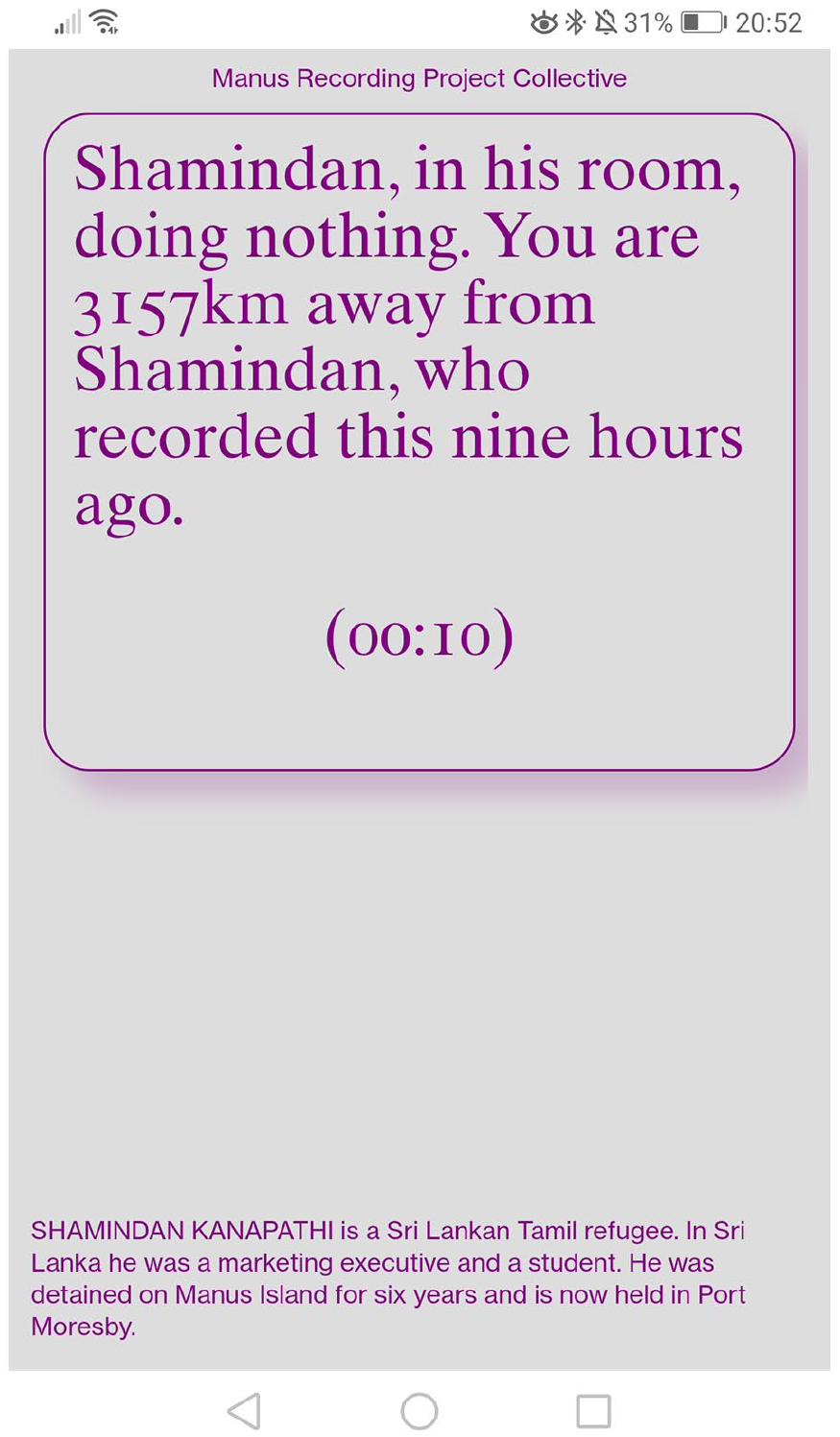
Screenshot from ‘where are you today’. Shamindan, doing nothing. Manus Recording Project Collective.
Bodywork, breath and touch
12.08.20, Yasin, listening to ABC Country and working out at the hotel gym.
14.08.20, Samad, boxing.
16.08.20, Farhad Rahmati, working out with a friend and thinking about the future and freedom.
The sounds of breath and touch in a sequence of three vignettes recorded in the space of six days – by Yasin, Samad and Farhad R – drew our attention to embodiment and bodily conditioning. In this trio of vignettes, Yasin, Samad and Farhad each recorded themselves as they worked out or boxed and sparred with friends inside. They formed a sensory triptych and we often wondered if the work’s creators were listening to each other’s recordings or influenced by each other’s choices of what activities to record. These clips are dynamic and kinetic and drew out different sensory experiences. We heard the shifting rhythm and repetition of sounds across these vignettes: the ‘sharp’ sound of metal on metal from the movement of exercise equipment, or ‘softer’ sounds of boxing gloves on a punching bag. We could hear the laboured breath of exercise and the grunts of physical exertion, of the small release of energy while coupled up indoors for so long in indefinite detention. We hear about Yasin’s shifting mood; that Samad is having a good morning; that Farad is thinking about the future. On listening to this cycle of recordings, Emma wrote in her fieldnotes: Aesthetically, I find these soundscapes soothing: they’re repetitive, though varied enough to be interesting. There are huffs of breath, sometimes escalating to grunts, punctuated by sharper thuds of boxing gloves or clangs of exercise equipment, sometimes with a background of music, or otherwise the silence of the gym. Bodies labour in (carceral) spaces, they disrupt, rework, and remake these spaces (through breath, sound, movement). Bodies are worked (out) for strength, for physical and emotional release in conditions of stasis. Bodies move, despite being stuck. The theme of bodies that labour and breathe also makes me think about racialised hierarchies that simultaneously deny the humanity of those nearer to the bottom and reduce their subjectivities to mere ‘bodies’.
These vignettes evoke Fanon’s (1965: 65) haunting term combat breathing, developed in his analysis of violence and the colonial state in Algeria, which ‘names the mobilisation of the target subject’s life energies merely in order to continue to live, to breath and to survive the exercise of state violence’ (Perera and Pugliese, 2011: 1). The soundscapes of sparring and working out were particularly resonant precisely because of their repetition (and contextual variations) which stretched across multiple sites of carceral confinement, within and beyond the borders of the Australian state (in Melbourne, Port Moresby, Brisbane). We got a sense of the different carceral environments Yasin, Farhad and Samad moved through: the contained sounds of an enclosed space where Yasin works out in the hotel gym
5
; the reverberating sounds of a larger, semi-open space of the Brisbane Immigration Transit Accommodation (BITA). Listeners are prompted to reflect on how long or how regularly detainees are permitted access to these spaces. This provisional mobility is controlled by the state and able to be withdrawn as punishment, arbitrarily. The men’s physical exertion is vital – life sustaining – but their breathing is also conditioned through the life-taking suppression of an all-encompassing settler colonial atmosphere. We can sense these contrapuntal forces. For instance, the repetitive sounds of Samad boxing are as disturbing as they are soothing because they recall a clip he recorded almost exactly 2 years prior for how are you today doing almost exactly the same thing. Is the routine of his boxing training a form of combat breathing? The endless sound of forceful contact set against the pressures that work to constrict life? And yet. For as much as the violence of the border(s) cross the intercies of these men’s bodies, their lived, embodied and durable practices of resistance in the face of the pervasive lethal threat to their corporeal being attests to what cannot be reduced in this way. For Farhad Rahmati (Bandesh et al., 2021: n.p.), the importance of creating a daily routine is crucial to stave off the institutionalising effects of the prison: So my daily life is I wake up at 5:30, go to gym, do one-hour gym, have a shower and have breakfast. I picked up a few online studies. I do my online studies, talk to family, talk to friends. Then, afternoon, almost the same again: I go to gym, do some exercise, do some online studies, watch movies, talk to friends. Actually, now is almost my gym time. . .
The form of breath marked by survival for those held in indefinite detention is a ‘quiet’ mode of resistance, but as these recordings attest, one that strikes out a clear refusal.
18.08.20, Shamindan, in his room, doing nothing
In the above analysis, where are you today creators’ daily activities give us insights into the sensory experiences of indefinite detention. Asylum seekers might be ‘indefinitely stuck’ and progressively worn out by their incarceration, but the above recordings remind us that they are still doing things – working out with and in the company of fellow detainees – that forge and maintain connections and practice mutual and self-care. But what about the in-between moments, those unremarkable stretches of time when ‘nothing’ happens? What can those tell us about the slow violence of indefinite detention and its effects on experiences of space and time? In the recording ‘Shamindan, in his room, doing nothing’ (Figure 4) we earwitness a particular iteration of forced stasis that gives us a better appreciation of Boochani’s take on asylum seekers’ field recordings of detention for how are you today: ‘we are hearing people tortured by time’ (Dao and Boochani, 2020: 53).
After initially listening to this recording, Emma wrote in her fieldnotes: Wow, what a recording! We wait, and wait, while nothing happens. Time warps and spreads. It is manipulated, controlled, and used as punishment, [used as] torture. . . indefinite detention wears on, and on. Capturing this through silence and stillness is difficult in a sound-based project. But this recording perhaps brings us as close as we will get to perceiving this: the fatigue, the quiet of it. Shamindan has created a recording of ‘nothing’, but there is still ‘something’ there: minimalist, mundane and quotidian micro-sounds (yawning, shuffling, clearing throat) become a forceful statement. [This recording] might be read as a rejection of listeners’ expectations for constantly updating ‘content’, such as that provided through mass use of social media platforms and online news websites, that will generate an emotional response, or pique our interest. . . This recording becomes a counterpoint to the consumer culture of new media, to the assumption that detention is only newsworthy if something happens, [such as] an ‘event’ (Another death? A riot? Another exposure of corruption and abuse of power?) that will condense years of suffering and waiting into a nugget of injustice, or pain, that will – it is assumed, it is hoped – grab the attention of the public, generate outrage, condemnation.
Much like its predecessor, where are you today conveys the mundane nature of carceral violence. The waiting, unpredictability and abandonment involved in indefinite detention shows how time itself becomes a form of torture (Dao and Boochani, 2020; Russell and Rae, 2020). The ‘negative geographies’ (MacFarlane, 2020) of sound in this recording – defined more by what cannot be heard that what can – give us a sense of asylum seekers’ powerlessness to determine their surroundings and the rhythm of their day-to-day lives. In this context, any presumption of linear time unfolding progressively towards the future becomes warped. The pervasiveness and oppressiveness of indefinite detention can manifest, sonically, as absence of sound – as ‘nothing’. Regarding how are you today, de Souza (2020) writes that the cumulative recordings eschew dominant liberal modes of political discourse through abstract, atmospheric soundscapes of detention; while Brooks (2020) contends that these projects provoke us to listen beyond the ‘white sonic field’. Shamindan’s recording of ‘doing nothing’ epitomises precisely this: it prompts us to attune to the quiet intimacy of someone confined and waiting, stripped of voice or text, but still hear the slow violence that underpins it.
Care and relational labour
Indefinite detention wears out and wears down bodies. Many of the sonic vignettes in where are you today call attention to the exhausting labour of living under these conditions. Moments of exhaustion are instructive, shedding light on the creative and durative practices of racialised subjects for whom to exist is also to resist (Emejulu and Bassel, 2020). But labouring bodies also create alternative constellations of care and mutual support that refuse bordering logics; they enact an ‘embodied refugee poetics’ (Perera, 2013: 103) which orients us towards the collective labour of possibility. Boochani (2020: n.p.) reminds us that incarcerated bodies produce important forms of knowledge: We should be careful that we don’t reduce—when we are talking about the resistance, and resistance through creation, through art—we should [not] reduce this resistance to only artworks or to only literature or music. . . We should talk about the resistance even based off bodies. I mean, bodies in this context create and produce knowledge, produce philosophy . . . [Refugees’] bodies are subject to politic[s], to power, that’s why even hunger strike[s] or self-harm, all of this are subject to this resistance. . . We should look at the life in that prison, and how people in. . . that prison create a space, create a kind of freedom in th[ose] circumstances. We are talking about a system that has a deep desire to take control of everything. . . When a detainee is making a joke. . . looking after a flower in the corner of the prison. . . looking at the sky. . . that is important, we should look at that too.
Several clips in where are you today document scenes where bodies brought into close proximity – forced and chosen – work to maintain dignity, normalcy and connection across interlocking sites of confinement. These vignettes are full of generosity, hospitality, affection, mutual care: whether between fellow detainees and friendships sustained beyond detention, or towards us as listeners.
12.08.20 Thanush, giving his friend Sinna a haircut
In a vignette recorded in the Melbourne Immigration Transit Accommodation (MITA), Thanush gives his friend Sinna a haircut. Sinna tells Thanush how he’d like his hair and the sustained buzz of electric clippers starts. This steady, vibrational sound is punctuated by the high-energy beats of Euro-techno music playing in the background. In another context a haircut might be unremarkable. Here, the buzz of hair clippers provides a sonic cue that reminds us of what is withheld or restricted by the state. It also highlights everyday practices that refuse to accept even these small indignities. The haircut in MITA is a scene of reciprocity and exchange between friends that exists outside the terms of state-sanctioned ‘care’. The private company Serco manages several immigration detention facilities on behalf of Australian Border Force, including MITA. Under the terms of its Facilities and Detainee Services contract, detainees are provided a ‘free basic haircut service’ by a qualified hairdresser or barber (DIBP, 2017). It is unclear whether the hairdressing services provided by Serco were inadequate or restricted in other ways at the time of this recording. 6 But we do know that, according to his bio on the Collective’s website, before fleeing persecution in Sri Lanka, Thanush was, amongst other things, a hairdresser.
Later in the clip, we hear others gathering round to watch Thanush cut Sinna’s hair – young men in intimate proximity, sharing convivial laughter and conversation in a shared language. At various points, Thanush translates into English. While a feature of both how are you today and where are you today is an expansiveness beyond what can be represented in speech or narrated through words, some of the recordings contain moments of direct address to listeners. In some vignettes, explanatory moments provide insight into the emotional or interior world of the speaker. At other times, they work to orient the listener to the spatial confines of detention. In others still, they are moments of translation. These moments of direct address should not be mistaken for appeals to a white, settler colonial ear (de Souza, 2018). Rather, we suggest they be heard as acts of hospitality that bring us into relation with these men on their own terms. We hear how restrictions on mobility and access to services are reshaped by detainees through interdependent arrangements of care and connection.
08.08.20, Farhad Bandesh, teaching his fellow detainee English
Sound studies researchers suggest that ‘attending to sound helps us rethink how people relate to each other, and the places they inhabit’ (Bull and Back 2015; Doughty and Lagerqvist 2016). In another recording, also in MITA, on 8 August 2020, we listen to Farhad Bandesh teaching a fellow detainee English. Like haircuts, English lessons are also part of Serco’s contractual obligations at the detention centre. But again, it is the informal arrangements to which we are privy in where are you today. These practices reflect and create intimate relations of care, patience and gentleness in the otherwise harsh and frustrated carceral space of indefinite detention. With a door whining open and thudding to a close, birds squawking and the quiet hum of conversation in the background, we hear the following exchange: Farhad asks, ‘Which one? Ahhhh [laughs], you like this one? Say it. You are so gentle’. The learner repeats ‘You are so gentle’. Farhad pronounces again ‘Gen-tle. You are so gentle. Can you say it again?’ The learner repeats ‘You are so gentle’. Encouragement from Farhad follows, ‘You will learn. No worries’. Later, the learner says, ‘I am so happy.’, to which Farhad responds ‘You are so happy. What for?’ [laughter].
Through this exchange, we hear the hesitancy and awkwardness that often accompanies attempts to learn a new language, its unfamiliarity on the tongue. We are reminded of the necessity of repetition to build familiarity with foreign sounds. The content of the English lesson both probes and enacts the care that forms of the basis of this exchange: you are so gentle. When the recitations turn to the feeling of happiness, Farhad is quick to make a joke that bleakly returns us, however momentarily, to the conditions and place in which this casual lesson takes place. While joy might be derived from the relationships and activities shared between detainees, the system nevertheless grinds them down through the torture of indefinite detention. The lack of a prospect for a safe and certain future for asylum seekers and refugees positions the ideal of happiness as cruel joke – if not a light-hearted one in its irony in this moment. Humour, as Boochani (2018) has demonstrated in No Friend but the Mountains, is an important tactic of resistance and survival in conditions of abjection.
The phrases exchanged between Farhad and his interlocutor are elementary, but also tender and unexpected – ’hi, beauty’, ‘I love you so much’, ‘let me kiss you’. These men, with accents marked as nonwhite, share intimate arrangements as their words take form and pass between their lips, back and forth, then mediated to the ears of listeners. These are subjects who are criminalised and racialised through their encounter with the Australian border’s white possessive logic (Moreton-Robinson, 2015), and yet refuse to be confined to its terms of inclusion.
Encounters with soundscapes are shaped by the politics of place, which are culturally embedded and materially contingent (Doughty and Lagerqvist, 2016). Emma listened to this recording over headphones, while walking along a trainline in the wind, with frogs croaking at dusk. The mobility and ‘choice’ granted to listeners of where are you today contrasts with the confinement of its creaters, but it also allows our immediate ‘external’ soundworlds to meld and fuse with the ‘internal’ soundscapes of detention. The myriad variables of space, place and timing shape and alter the sonic experience of each listener, such that no recording will be heard in the same way. For Emma, a foreign language lesson undertaken just hours before listening to the recording of this one in MITA created a new kind of connection and orientation – she could relate to the awkwardness and difficulty of trying to form new sounds, string together unfamiliar words, which affected how she listened and reflected on her own domestic activities, now less clearly demarcated or different to those catalogued in detention. The familiarity is itself unsettling and because of this, maintaining an objective, disconnected or passive role as listener becomes harder. where are you today thus denaturalises the spaces inhabited by detainees and listeners both. As LaBelle (2015: 243) explains: Through listening, an individual is extended beyond the boundaries of singularity and toward a broader space necessarily multiple. . . listening breaks apart [or remakes as porous] the shell of the subject, eases the borders of identity, and initiates an interdependence. . . to listen attentively then is to become a part of things. . . receiving. . . all that is surrounding—the subtle sounds, the far and the near, the voices of persons and insects alike, the shifting wind. Thus, listening predisposes one to be attentive to the greater context, as a lateral becoming, rather than through linear determinations of one’s own will.
Farhad finishes the recording by addressing the imagined listener: ‘I am helping this guy. He has asked me to teach him. I am helping him with pronunciation and some sentence. He is getting much better, day by day’. Farhad’s notation of progress at the end of the 10-minute recording evokes an alternative though simultaneous temporality of detention, one shaped by care, generosity and instruction shared between detainees. Here, time can briefly become ‘unstuck’ through labours of care and a future – of English language proficiency – can be envisioned and worked towards. In an excerpt from Poppy’s fieldnotes, written immediately after listening on headphones, she wrote: As I hear the words and phrases repeat, I am, once again, confounded. I am listening to young men repeat terms of endearment, wondering who they are intended for; why it is these phrases that are their priority . . . The repetition draws me in. I am attuned to the subtle shifts I hear. These require my own minor adjustments. Again, I am broken open by the generosity, the shared intimacy, the humour, playfulness, the practicality, and labour of it. And I hear all these things at once.
Conclusion: Sensing the border
Through collective and creative labour, where are you today documents, intervenes in, and resists racialised border violence. This article has sought to develop a sensory analysis that is alert to the carceral intimacies experienced by those living and making art in relation to the liminal spaces of the borderlands and the differential relations through which the border(s) come into being. By paying attention to sensory and affective dimensions of carceral spaces and intimacies in and beyond indefinite detention, we come to hear ‘how bodies with complex histories and geographies of racialisation negotiate affective pressures and inhabit a world of becoming’ (Lobo, 2014: 102). Where are you today produces knowledge about the embodied practices of care, conviviality, touch and intimacy in detention that work in and against the violent hold of settler colonial border imperialism and its attendant imaginaries. Through the creation of shifting and interdependent relationships between creators and listeners, it alerts us to affiliative possibilities across shared, yet distinct, sites of struggle and suffering; and of the transborder solidarities forged through unevenly distributed and contingent conditions of entrapment, fugitivity, freedom and escape. 7
In this article, we have attended to the different registers and affective aspects of sound conveyed through where are you today, and what it reveals about the sensory politics of borders – and of resistance to them. Through analysis of the aural and haptic practices of care, knowledge-sharing, breathing and bodywork, we identified the capacity for digitally-networked collective projects to convey and produce new intimacies within, beyond and across shifting sites of indefinite detention. Our methodological approach – based in a shared commitment to the process of critical, reflexive and expanded listening to the sensory dimensions of the daily recordings and the environments in which we listened – develops modes of sensorially-attuned inquiry into carceral spaces and settings that refuse to objectify and other them. Instead, our approach followed the lead of where are you today, emphasising and unsettling our preexisting and new relationalities to the polymorphous borders of the colonial state.
Footnotes
Acknowledgements
Our thanks to Claire Loughnan, Andrew Brooks and two anonymous reviewers for generous feedback which advanced our thinking further. We honour the collective labour of the Manus Recording Project Collective whose work continues to challenge and inspire us.
Funding
The author(s) received no financial support for the research, authorship, and/or publication of this article.
