Abstract

Introduction
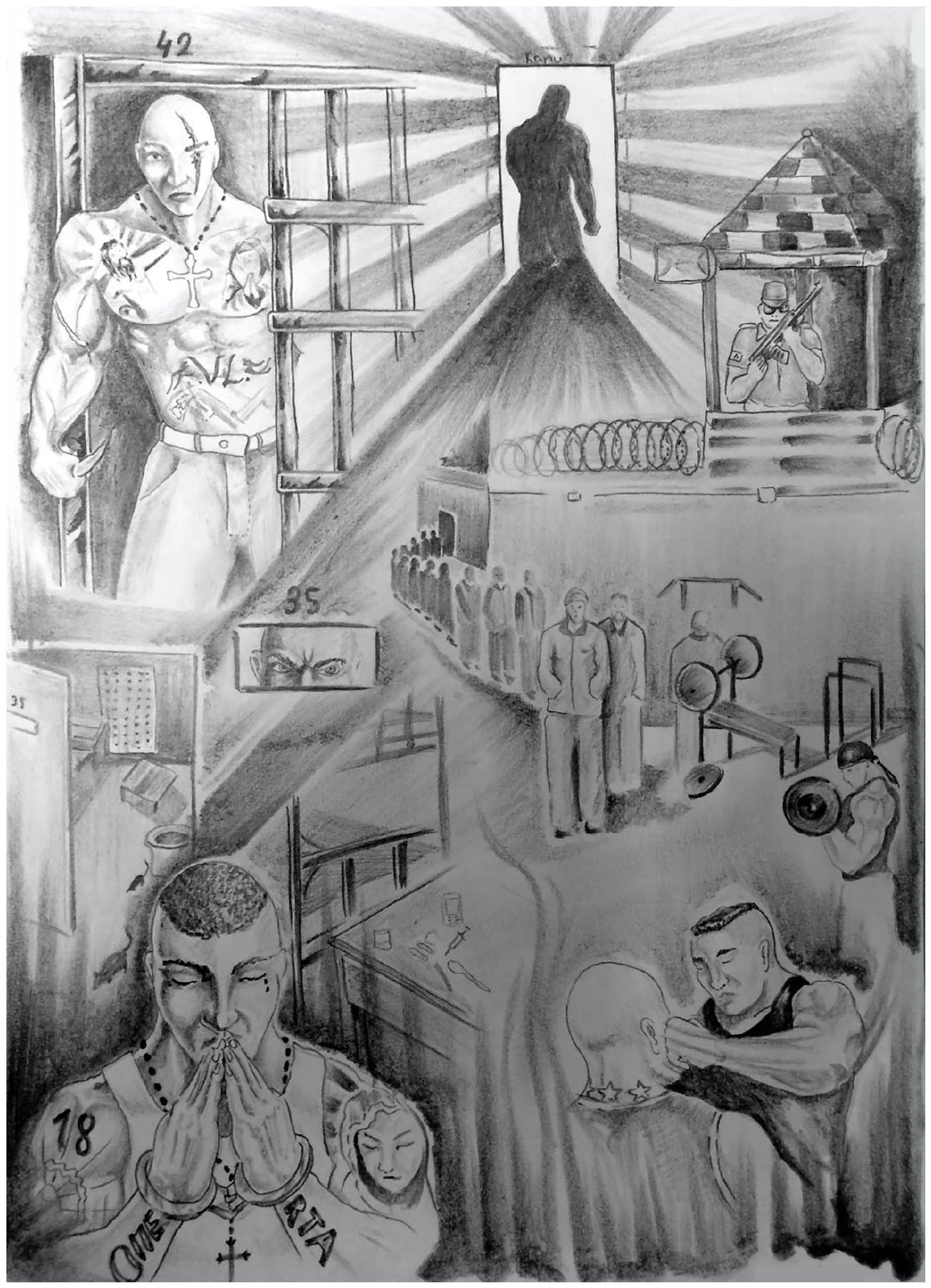
In 1992, I started my work in a prison as a trainee in several positions. I was 19 years old, and a couple of months later, I became a student at the then Police Academy in Budapest. Altogether, I was a prison officer for almost 25 years. Between 2005 and 2014 I worked at the Hungarian National University of Public Service, I was a lecturer of psychology and sociology to prison officer undergraduates. In the Hungarian education system, prison officer undergraduates are part of the prison staff, that is, they do not arrive to university from the street, and already have some practical experience beforehand. Education was a full-time job, students attended lectures during the semesters and spent their practical service in prisons in the summer. During this period, they were given assignments by their professors. Prison psychology was my subject, and during the summer break the students had to collect prison drawings. These drawings were obtained strictly with the permission of the prison governors, mostly from places where it was impossible to identify who had made them. These places were the libraries of the institutions, art workshops or social workers’ offices. Some drawings were signed, in which case I anonymised them using a photo editing software. Over the years I have collected thousands of drawings, I have published some of them and analysed them online. 1 The main objective of the analysis was to observe and identify the symbols in the drawings and to try to place them in a social, cultural and criminological context. Analysing some of the drawings in this way, yielded very interesting results. For example, I was able to identify traits of Roma identity on some drawings. Sometimes I presented the drawings in workshops with expert groups. These meetings were mostly attended by friends with common interest like psychologists, sociologists, lawyers, anthropologists, artists, photographers and ex-inmates, university students, activists, as well as police officers, prison guards and criminologists. In some cases, the drawings were projected in moderated focus group sessions, in other cases through Q&A sessions or open discussions. Out of the large number of drawings, about 20 drawings were selected that could contain unique or general symbols of recent Hungarian prison life in a way that could be described as iconic.
This image is a drawing I selected because it refers to inter-prisoner violence, internal gang culture, the presence of illicit drugs, and change in Hungarian legislation in 2013 (people have to pay for using weight lifting equipment in prisons).